Sebuah paku baja yang dijatuhkan ke dalam air akan langsung mencapai dasar. Sekarang lihat kapal ini. Kapal ini dibuat dari baja yang sama, puluhan ribu ton darinya, dan ia…
English narration · English + 中文 subtitles burned in · Narasi bahasa Inggris · Subtitle bahasa Inggris + 中文 disematkan langsung
8.1
Internal Structure and Density · Struktur Internal dan Kepadatan
Syllabus · Silabus
English
Learning Objective 8.1.A: Describe the properties of a fluid.
8.1.A.1 Distinguishing properties of solids, liquids, and gases stem from the varying interactions between atoms and molecules.
8.1.A.2 A fluid is a substance that has no fixed shape.
8.1.A.3 Fluids can be characterized by their density. Density is defined as a ratio of mass to volume.
Equation:$\rho = \dfrac{m}{V}$
8.1.A.4 An ideal fluid is incompressible and has no viscosity.
Bahasa Indonesia
Tujuan Pembelajaran 8.1.A: Jelaskan sifat-sifat fluida.
8.1.A.1 Sifat pembeda antara padat, cair, dan gas berasal dari interaksi yang berbeda antara atom dan molekul.
8.1.A.2 Fluida adalah zat yang tidak memiliki bentuk tetap.
8.1.A.3 Fluida dapat dikarakterisasi berdasarkan kepadatannya. Kepadatan didefinisikan sebagai rasio massa terhadap volume.
Persamaan:$\rho = \dfrac{m}{V}$
8.1.A.4 Fluida ideal bersifat tak terkompresi dan tidak memiliki viskositas.
Source: College Board AP Course and Exam Description · Sumber: Deskripsi Kursus dan Ujian College Board AP
English
The differences between solids, liquids, and gases come from how strongly their particles interact. A fluid 流体 (liquid or gas) has no fixed shape – it flows because its particles move past one another. Density 密度 is mass per unit volume:
$$\rho=\frac{m}{V}.$$
It depends on the substance and its state. An object sinks or floats depending on how its density compares with the surrounding fluid's – less dense floats, more dense sinks. An ideal fluid 理想流体 is incompressible 不可压缩 (constant density, whatever the pressure) and has no viscosity 黏度 (internal friction) – the model AP uses throughout.
Bahasa Indonesia
Perbedaan antara padat, cair, dan gas berasal dari seberapa kuat partikel-partikel mereka berinteraksi. Fluida (cair atau gas) tidak memiliki bentuk tetap—mengalir karena partikelnya bergerak melewati satu sama lain. Kepadatan adalah massa per satuan volume:
$$\rho=\frac{m}{V}.$$
Ini bergantung pada zat dan keadaannya. Benda tenggelam atau mengapung tergantung pada bagaimana kepadatannya dibandingkan dengan fluida sekitarnya—yang kurang padat mengapung, yang lebih padat tenggelam. Fluida ideal adalah tak termampatkan (kepadatan konstan, apa pun tekanannya) dan tidak memiliki viskositas (gesekan internal)—model AP yang digunakan sepanjang waktu.
Explore · Jelajahi
Float or sink by density · Mengapung atau tenggelam berdasarkan densitas
An object floats if it is less dense than the fluid. Change the density and watch it ride higher or sink, displacing its own weight of fluid. · Suatu benda mengapung jika densitasnya lebih rendah daripada fluida. Ubah densitas dan saksikan benda itu naik lebih tinggi atau tenggelam, menggantikan berat sendiri fluida.
8.2.A
Describe the pressure exerted on a surface by a given force.
8.2.A.1 Pressure is defined as the magnitude of the perpendicular force component exerted per unit area over a given surface area, as described by the equation
Equation:$P = \dfrac{F_\perp}{A}$
8.2.A.2 Pressure is a scalar quantity.
8.2.A.3 The volume and density of a given amount of an incompressible fluid is constant regardless of the pressure exerted on that fluid.
8.2.B
Describe the pressure exerted by a fluid.
8.2.B.1 The pressure exerted by a fluid is the result of the entirety of the interactions between the fluid's constituent particles and the surface with which those particles interact.
8.2.B.2 The absolute pressure of a fluid at a given point is equal to the sum of a reference pressure $P_0$, such as the atmospheric pressure $P_{\text{atm}}$, and the gauge pressure $P_{\text{gauge}}$.
Equation:$P = P_0 + \rho g h$
8.2.B.3 The gauge pressure of a vertical column of fluid is described by the equation
Equation:$P_{\text{gauge}} = \rho g h$
Source: College Board AP Course and Exam Description · Sumber: Deskripsi Kursus dan Ujian College Board AP
English
Pressure 压强 is the perpendicular force per unit area, a scalar 标量 measured in pascals (Pa):
$$P=\frac{F_\perp}{A}.$$
In a fluid at rest, pressure increases with depth 深度 because of the weight of fluid above:
$$P=P_0+\rho g h,$$
where $P_0$ is the pressure at the surface and $h$ is the depth. Pressure acts equally in all directions at a point and pushes perpendicular to any surface.
Distinguish the two pressures AP asks about: the gauge pressure 表压 is the extra pressure the fluid column adds, $P_{\text{gauge}}=\rho g h$, while the absolute pressure 绝对压强 is the total, $P=P_0+P_{\text{gauge}}$ (with $P_0$ usually atmospheric). A tyre gauge reading "$200\ \text{kPa}$" is gauge pressure; the air inside is really at about $300\ \text{kPa}$ absolute.
Worked example. Find the total pressure on a diver $10\ \text{m}$ below the surface of water ($\rho=1000\ \text{kg/m}^3$, surface pressure $P_0=1.0\times10^{5}\ \text{Pa}$):
$$P=P_0+\rho g h=1.0\times10^{5}+1000\times9.8\times10=1.98\times10^{5}\ \text{Pa}.$$
Every $10\ \text{m}$ of water adds roughly one extra atmosphere of pressure. Notice the pressure does not depend on the shape or width of the container, only on the depth.
Bahasa Indonesia
Tekanan adalah gaya tegak lurus per satuan area, sebuah skalar yang diukur dalam pascal (Pa):
$$P=\frac{F_\perp}{A}.$$
Dalam fluida yang diam, tekanan meningkat dengan kedalaman karena berat fluida di atasnya:
$$P=P_0+\rho g h,$$
di mana $P_0$ adalah tekanan di permukaan dan $h$ adalah kedalaman. Tekanan bekerja merata ke segala arah pada suatu titik dan mendorong tegak lurus terhadap permukaan apa pun.
Jack hidraulik: tekanan yang diterapkan pada piston kecil ditransmisikan tanpa berkurang melalui fluida ke piston besar, sehingga gaya kecil dapat mengangkat mobil
Bedakan dua tekanan yang diminta AP: tekanan manometer adalah tekanan tambahan yang ditambahkan oleh kolom fluida, $P_{\text{gauge}}=\rho g h$, sedangkan tekanan absolut adalah total, $P=P_0+P_{\text{gauge}}$ (dengan $P_0$ biasanya atmosferik). Pembacaan alat ukur ban "$200\ \text{kPa}$" adalah tekanan manometer; udara di dalamnya sebenarnya berada pada sekitar $300\ \text{kPa}$ absolut.
Berat kolom cairan menetapkan tekanan tambahan pada kedalaman
Contoh terpecahkan. Tentukan total tekanan pada seorang penyelam $10\ \text{m}$ di bawah permukaan air ($\rho=1000\ \text{kg/m}^3$, tekanan permukaan $P_0=1.0\times10^{5}\ \text{Pa}$):
$$P=P_0+\rho g h=1.0\times10^{5}+1000\times9.8\times10=1.98\times10^{5}\ \text{Pa}.$$
Setiap $10\ \text{m}$ air menambahkan sekitar satu atmosfer tekanan tambahan. Perhatikan bahwa tekanan tidak bergantung pada bentuk atau lebar wadah, hanya pada kedalaman.
Barometer aneroid mengukur tekanan udara dengan kotak logam yang tertutup yang lentur ketika tekanan di luar berubah
Fluids and Newton's Laws · Fluida dan Hukum Newton
Syllabus · Silabus
English
Learning Objective 8.3.A: Describe the conditions under which a fluid's velocity changes.
8.3.A.1 Newton's laws can be used to describe the motion of particles within a fluid.
8.3.A.2 The macroscopic behavior of a fluid is a result of the internal interactions between the fluid's constituent particles and external forces exerted on the fluid.
Learning Objective 8.3.B: Describe the buoyant force exerted on an object interacting with a fluid.
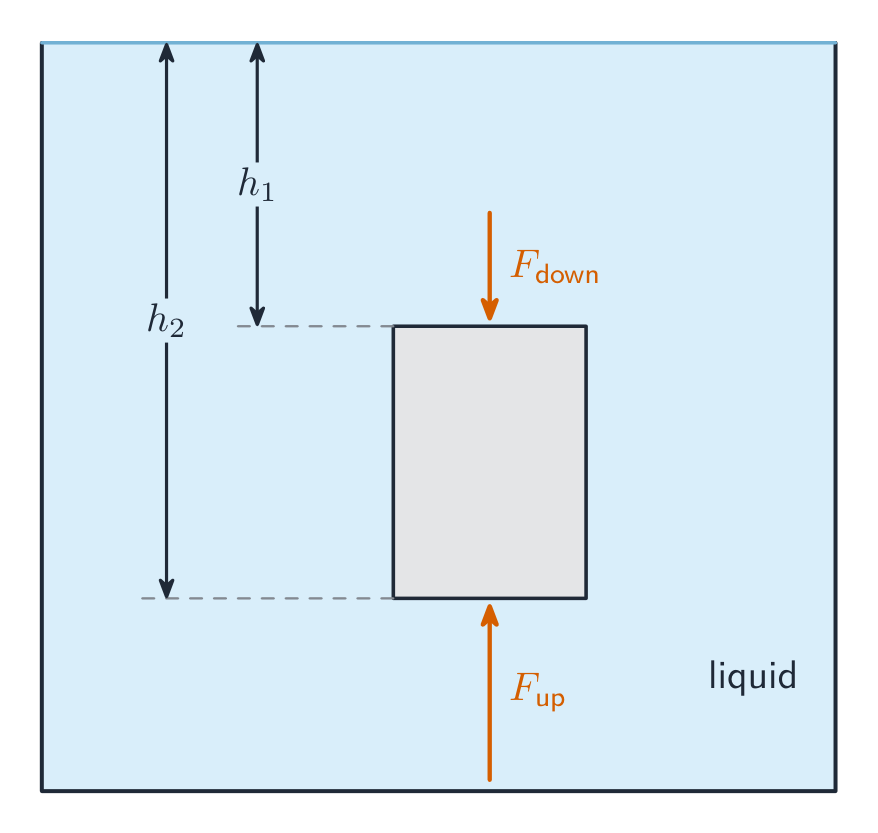
8.3.B.1 The buoyant force is a net upward force exerted on an object by a fluid.
8.3.B.2 The buoyant force exerted on an object by a fluid is a result of the collective forces exerted on the object by the particles making up the fluid.
8.3.B.3 The magnitude of the buoyant force exerted on an object by a fluid is equivalent to the weight of the fluid displaced by the object.
Equation:$F_b = \rho V g$
Bahasa Indonesia
Tujuan Pembelajaran 8.3.A: Jelaskan kondisi di mana kecepatan fluida berubah.
8.3.A.1 Hukum Newton dapat digunakan untuk menjelaskan gerakan partikel di dalam fluida.
8.3.A.2 Perilaku makroskopis fluida merupakan hasil dari interaksi internal antara partikel penyusun fluida dan gaya eksternal yang diberikan pada fluida.
Tujuan Pembelajaran 8.3.B: Jelaskan gaya apung yang diberikan pada objek yang berinteraksi dengan fluida.
8.3.B.1 Gaya apung adalah resultan gaya ke atas yang diberikan pada sebuah objek oleh fluida.
8.3.B.2 Gaya apung yang diberikan pada sebuah objek oleh fluida merupakan hasil dari gabungan gaya-gaya yang diberikan pada objek tersebut oleh partikel-partikel penyusun fluida.
8.3.B.3 Besarnya gaya apung yang diberikan pada sebuah objek oleh fluida setara dengan berat fluida yang dipindahkan oleh objek tersebut.
Persamaan:$F_b = \rho V g$
Source: College Board AP Course and Exam Description · Sumber: Deskripsi Kursus dan Ujian College Board AP
English
Buoyancy: float or sink
An object in a fluid feels an upward buoyant force 浮力 equal to the weight of the fluid it displaces – Archimedes' principle 阿基米德原理:
Combine this with Newton's laws: the object floats when buoyancy balances weight, sinks when weight wins, and rises when buoyancy wins. A floating object displaces exactly its own weight of fluid.
Worked example. A block of density $600\ \text{kg/m}^3$ floats in water ($1000\ \text{kg/m}^3$). What fraction is under the surface? For floating, the buoyant force equals the weight, so $\rho_{\text{fluid}}\,g\,V_{\text{sub}}=\rho_{\text{object}}\,g\,V$:
Gabungkan ini dengan hukum Newton: benda akan terapung jika gaya apung menyeimbangkan beratnya, tenggelam jika beratnya lebih besar, dan naik jika gaya apungnya lebih besar. Benda yang terapung memindahkan tepat beratnya sendiri dalam volume fluida.
Contoh terpecahkan. Sebuah balok dengan densitas $600\ \text{kg/m}^3$ terapung di dalam air ($1000\ \text{kg/m}^3$). Berapakah pecahan yang berada di bawah permukaan? Untuk kondisi terapung, gaya apung sama dengan berat, sehingga $\rho_{\text{fluid}}\,g\,V_{\text{sub}}=\rho_{\text{object}}\,g\,V$:
Jadi $60\%$ berada di bawah air – alasan yang sama mengapa sebagian besar es batu (densitas $\approx 900$) tersembunyi di bawah air.
8.4
Fluids and Conservation Laws · Fluida dan Hukum Kekekalan
Syllabus · Silabus
English
Learning Objective 8.4.A: Describe the flow of an incompressible fluid through a cross-sectional area by using mass conservation.
8.4.A.1 A difference in pressure between two locations causes a fluid to flow.
8.4.A.1.i The rate at which matter enters a fluid-filled tube open at both ends must equal the rate at which matter exits the tube.
8.4.A.1.ii The rate at which matter flows into a location is proportional to the cross-sectional area of the flow and the speed at which the fluid flows.
Derived equation:$\dfrac{V}{t} = A v$
8.4.A.2 The continuity equation for fluid flow describes conservation of mass flow rate in incompressible fluids.
Equation:$A_1 v_1 = A_2 v_2$
Bahasa Indonesia
Tujuan Pembelajaran 8.4.A: Jelaskan aliran fluida tak terkompresi melalui area penampang menggunakan kekekalan massa.
8.4.A.1 Perbedaan tekanan antara dua lokasi menyebabkan fluida mengalir.
8.4.A.1.i Laju masuknya materi ke dalam tabung berisi fluida yang terbuka di kedua ujungnya harus sama dengan laju keluarnya materi dari tabung tersebut.
8.4.A.1.ii Laju materi yang mengalir ke suatu lokasi berbanding lurus dengan luas penampang aliran dan kecepatan fluida.
Persamaan turunan:$\dfrac{V}{t} = A v$
8.4.A.2 Persamaan kontinuitas untuk aliran fluida menggambarkan kekekalan laju aliran massa pada fluida tak terkompresi.
Persamaan:$A_1 v_1 = A_2 v_2$
Source: College Board AP Course and Exam Description · Sumber: Deskripsi Kursus dan Ujian College Board AP
English
For an ideal fluid flowing steadily, two conservation ideas apply:
Continuity 连续性 (conservation of mass): the volume flow rate is constant, so $A_1 v_1 = A_2 v_2$. A narrower pipe forces faster flow.
Bernoulli's equation 伯努利方程 (conservation of energy per volume): along a streamline,
$$P+\tfrac{1}{2}\rho v^2+\rho g y = \text{constant}.$$
Together they explain why fluid speeds up and its pressure drops where a pipe narrows or where flow is fastest.
Worked example. Water flows at $2.0\ \text{m/s}$ through a pipe of cross-section $0.010\ \text{m}^2$, then enters a narrower section of $0.0040\ \text{m}^2$. By continuity the speed there is
By Bernoulli's equation this faster stream is at lower pressure – the effect that lifts an aeroplane wing and pulls two passing ships together.
Exam skill. Choose the right law by what changes. If the pipe changes width, start with continuity ($A_1v_1=A_2v_2$) to get the speeds; if you then need a pressure, feed those speeds into Bernoulli. Watch the height term $\rho g y$ only when the pipe also changes level.
Bahasa Indonesia
Untuk fluida ideal yang mengalir secara stabil, berlaku dua konsep kekekalan:
Gaya apung timbul karena tekanan di bagian bawah benda melebihi tekanan di bagian atas
Kontinuitas (kekekalan massa): laju aliran volume adalah konstan, sehingga $A_1 v_1 = A_2 v_2$. Pipa yang lebih sempit memaksa aliran menjadi lebih cepat.
Persamaan Bernoulli (kekekalan energi per volume): sepanjang garis aliran,
$$P+\tfrac{1}{2}\rho v^2+\rho g y = \text{constant}.$$
Keduanya menjelaskan mengapa kecepatan fluida meningkat dan tekanannya turun di tempat pipa menyempit atau di mana aliran paling cepat.
Di mana pipa menyempit, fluida bergerak lebih cepat (kontinuitas) dan tekanannya turun (Bernoulli)
Contoh terpecahkan. Air mengalir dengan kecepatan $2.0\ \text{m/s}$ melalui pipa dengan luas penampang $0.010\ \text{m}^2$, kemudian masuk ke bagian yang lebih sempit dengan luas $0.0040\ \text{m}^2$. Berdasarkan kontinuitas, kecepatannya di sana adalah
Berdasarkan persamaan Bernoulli, aliran yang lebih cepat ini memiliki tekanan yang lebih rendah – efek yang mengangkat sayap pesawat dan menarik dua kapal yang lewat berdekatan.
Keterampilan ujian. Pilih hukum yang tepat berdasarkan apa yang berubah. Jika pipa berubah lebar, mulailah dengan kontinuitas ($A_1v_1=A_2v_2$) untuk mendapatkan kecepatan; jika Anda kemudian membutuhkan tekanan, masukkan kecepatan tersebut ke dalam Bernoulli. Perhatikan suku ketinggian $\rho g y$ hanya jika pipa juga mengubah level.
8.4
Exam tips · Tips ujian
English
Pressure with depth is $P=P_0+\rho g h$ — it depends on depth only, not the container's shape or width.
Buoyant force = weight of fluid displaced ($\rho_{\text{fluid}}\,gV_{\text{disp}}$); a floating object displaces its own weight, so the fraction submerged is $\rho_{\text{object}}/\rho_{\text{fluid}}$.
Compare densities to predict floating vs sinking; a floating object is in equilibrium (buoyancy = weight), not weightless.
Use continuity$A_1v_1=A_2v_2$: a narrower pipe means faster flow.
Bernoulli: where a fluid flows faster its pressure is lower (wing lift, spray).
Bahasa Indonesia
Tekanan terhadap kedalaman adalah $P=P_0+\rho g h$ — itu bergantung pada kedalaman saja, bukan bentuk atau lebar wadah.
Gaya apung = berat fluida yang dipindahkan ($\rho_{\text{fluid}}\,gV_{\text{disp}}$); benda terapung memindahkan beratnya sendiri, sehingga pecahan yang tercelup adalah $\rho_{\text{object}}/\rho_{\text{fluid}}$.
Bandingkan densitas untuk memprediksi terapung vs tenggelam; benda terapung berada dalam kesetimbangan (gaya apung = berat), bukan tanpa bobot.
Gunakan kontinuitas$A_1v_1=A_2v_2$: pipa yang lebih sempit berarti aliran lebih cepat.
Bernoulli: di mana fluida mengalir lebih cepat, tekanannya lebih rendah (angkat sayap, semprotan).
Interactive lessons on this topic · Pelajaran interaktif untuk topik ini
Work through it step by step, with instant-check exercises. · Kerjakan langkah demi langkah, dengan latihan pengecekan instan.
Pick one and the site follows you — notes, papers, videos and practice all open on it. · Pilih satu dan situs mengikuti Anda — catatan, kertas, video, dan latihan semua terbuka di sana.
Type to search notes, lessons, code, vocabulary and past-paper questions across every subject. · Ketik untuk mencari catatan, pelajaran, kode, kosakata, dan pertanyaan soal lama di setiap mata pelajaran.