Skip to content · ⁨דלג לתוכן⁩

Electric Force, Field, and Potential · ⁨כוח חשמלי, שדה חשמלי ופוטנציאל⁩

AP Physics 2 · ⁨פיזיקה AP 2⁩ · Topic 10 · ⁨נושא 10⁩

Video lesson for this topic · ⁨שיעור וידאו לנושא זה⁩ Open the video page · ⁨פתח את עמוד הוידאו⁩
8:05

כוח חשמלי, שדה חשמלי ופוטנציאל

ענן סוער הוא מפעל מטענים. גבישי קרח מתנגשים בתוכו, ואלקטרונים מצטברים בתחתית הענן. הקרקע מתחתיו הופכת למטענת חיובית. אין…

English narration · English + 中文 subtitles burned in · ⁨קריאת קול באנגלית · תרגום אנגלי + סינית שרוף בתוך הסרטון⁩

10.1

Electric Charge and Electric Force · ⁨מטען חשמלי וכוח חשמלי⁩

Syllabus · ⁨סיילבוס⁩
English

Learning Objective 10.1.A: Describe the electric force that results from the interactions between charged objects or systems.

  • 10.1.A.1 Charge is a fundamental property of all matter.
    • 10.1.A.1.i Charge is described as positive or negative.
    • 10.1.A.1.ii The magnitude of the charge of a single electron or proton, the elementary charge $e$, can be considered to be the smallest indivisible amount of charge.
    • 10.1.A.1.iii The charge of an electron is $-e$, the charge of a proton is $+e$, and a neutron has no electric charge.
    • 10.1.A.1.iv A point charge is a model in which the physical size of a charged object or system is negligible in the context of the situation being analyzed.
  • 10.1.A.2 Coulomb's law describes the electrostatic force between two charged objects as directly proportional to the magnitude of each of the charges and inversely proportional to the square of the distance between the objects.
    • Equation: $\left|\vec{F}_E\right| = \dfrac{1}{4\pi\varepsilon_0}\dfrac{\left|q_1 q_2\right|}{r^2} = k\dfrac{\left|q_1 q_2\right|}{r^2}$
  • 10.1.A.3 The direction of the electrostatic force depends on the signs of the charges of the interacting objects and is parallel to the line of separation between the objects.
    • 10.1.A.3.i Two objects with charges of the same sign exert repulsive forces on each other.
    • 10.1.A.3.ii Two objects with charges of opposite signs exert attractive forces on each other.
  • 10.1.A.4 Electric forces are responsible for some of the macroscopic properties of objects in everyday experiences. However, the large number of particle interactions that occur make it more convenient to treat everyday forces in terms of nonfundamental forces called contact forces, such as normal force, friction, and tension.

Learning Objective 10.1.B: Describe the electric and gravitational forces that result from interactions between charged objects with mass.

  • 10.1.B.1 Electrostatic forces can be attractive or repulsive, while gravitational forces are always attractive.
  • 10.1.B.2 For any two objects that have mass and electric charge, the magnitude of the gravitational force is usually much smaller than the magnitude of the electrostatic force.
  • 10.1.B.3 Gravitational forces dominate at larger scales even though they are weaker than electrostatic forces, because systems at large scales tend to be electrically neutral.

Learning Objective 10.1.C: Describe the electric permittivity of a material or medium.

  • 10.1.C.1 Electric permittivity is a measurement of the degree to which a material or medium is polarized in the presence of an electric field.
  • 10.1.C.2 Electric polarization can be modeled as the induced rearrangement of electrons by an external electric field, resulting in a separation of positive and negative charges within a material or medium.
  • 10.1.C.3 Free space has a constant value of electric permittivity, $\varepsilon_0$, that appears in physical relationships.
  • 10.1.C.4 The permittivity of matter has a value different from that of free space that arises from the matter's composition and arrangement.
    • 10.1.C.4.i In a given material, electric permittivity is determined by the ease with which electrons can change configurations within the material.
    • 10.1.C.4.ii Conductors are made from electrically conducting materials in which charge carriers move easily; insulators are made from electrically nonconducting materials in which charge carriers cannot move easily.

Boundary statement: AP Physics 2 only expects students to make calculations of the electric force between four or fewer interacting charged objects or systems. The analysis of the resulting electric force from more charges is allowed in situations of high symmetry.

עברית

מטרת הלמידה 10.1.A: לתאר את הכוח החשמלי הנובע מאינטראקציות בין אובייקטים טוענים או מערכות.

  • 10.1.A.1 מטען הוא תכונה יסודית של כל החומר.
    • 10.1.A.1.i מטען מתואר כחיובי או שלילי.
    • 10.1.A.1.ii גודל המטען של אלקטרון או פרוטון בודד, המטען היסודי $e$, יכול להיחשב לכמות המטען הקטנה ביותר שאין לחלקה.
    • 10.1.A.1.iii המטען של אלקטרון הוא $-e$, המטען של פרוטון הוא $+e$, ונוטרון אין לו מטען חשמלי.
    • 10.1.A.1.iv מטען נקודתי הוא דגם שבו הגודל הפיזיקלי של חפץ או מערכת מטענת זניח בהקשר הניתוח המתבצע.
  • 10.1.A.2 חוק קולון מתאר את הכוח האלקטרוסטטי בין שני חפצים מטענים כפרופורציונלי ישיר לגודל המטען של כל אחד מהם, והופך ביחס הפוך לריבוע המרחק בין החפצים.
    • משוואה: $\left|\vec{F}_E\right| = \dfrac{1}{4\pi\varepsilon_0}\dfrac{\left|q_1 q_2\right|}{r^2} = k\dfrac{\left|q_1 q_2\right|}{r^2}$
  • 10.1.A.3 הכיוון של הכוח האלקטרוסטטי תלוי במיניות המטענים של החפצים המגיבים, והוא מקביל לקו ההפרדה בין החפצים.
    • 10.1.A.3.i שני חפצים בעלי מטענים מאותה מיניות מפעילים כוחות דחייה זה על זה.
    • 10.1.A.3.ii שני חפצים בעלי מטענים במיניות הפוכות מפעילים כוחות משיכה זה על זה.
  • 10.1.A.4 כוחות חשמליים אחראים לחלק מהמאפיינים המקרוסקופיים של חפצים בחוויות היומיום. עם זאת, מספרם הגדול של אינטראקציות חלקיקים שהתרחשות עושה נוח יותר לטפל בכוחות יומיומיים באמצעות כוחות לא-יסודיים הנקראים כוחות מגע, כמו כוח נורמלי, חיכוך ומתיחה.

מטרת למידה 10.1.B: לתאר את הכוחות החשמליים והכבישתיים הנובעים ממינימום בין חפצים מטענים בעלי מסה.

  • 10.1.B.1 כוחות אלקטרוסטטיים יכולים להיות משיכתיים או דוחים, בעוד שכוחות כבישתיים הם תמיד משיכתיים.
  • 10.1.B.2 עבור כל שני חפצים בעלי מסה ומטען חשמלי, גודל הכוח הכבישתי הוא בדרך כלל הרבה קטן מגודל הכוח האלקטרוסטטי.
  • 10.1.B.3 כוחות כבישתיים שולטים בקנה מידה גדול גם אם הם חלשים מכוחות אלקטרוסטטיים, משום שמערכות בקנה מידה גדול נוטות להיות ניטרליות חשמלית.

מטרת למידה 10.1.C: לתאר את הדיאלקטריקה (הpermittivity החשמלי) של חומר או תווך.

  • 10.1.C.1 דיאלקטריקה היא מדידה של רמת הקיטוב של חומר או תווך בנוכחות שדה חשמלי.
  • 10.1.C.2 קיטוב חשמלי ניתן לדגם כמערעור המיוצר של אלקטרונים על ידי שדה חשמלי חיצוני, resulting in הפרדת מטענים חיוביים ושליליים בתוך חומר או תווך.
  • 10.1.C.3 לריק יש ערך קבוע של דיאלקטריקה, $\varepsilon_0$, המופיע בקשרים פיזיקליים.
  • 10.1.C.4 לדיאלקטריקה של חומר יש ערך השונה מזה של הריק, הנובע מההרכב והסידור של החומר.
    • 10.1.C.4.i בחומר נתון, הדיאלקטריקה נקבעת לפי קלות שינוי המצבים של אלקטרונים בתוך החומר.
    • 10.1.C.4.ii מוליכים עשויים מחומרים מוליכי חשמל בהם נשאי מטען נעים בקלות; בדידים עשויים מחומרים לא-מוליכי חשמל בהם נשאי מטען אינם נעים בקלות.

הצהרת גבול: AP Physics 2 מצפה רק מתלמידים לבצע חישובים של הכוח החשמלי בין ארבעה או פחות אובייקטים טעונים המופעלים זה על זה או מערכות. ניתוח הכוח החשמלי הנגרם מאחוזי מטען נוספים מותר במצבים בעלי סימטריה גבוהה.

Source: College Board AP Course and Exam Description · ⁨מקור: תיאור הקורס והמבחן של College Board AP⁩

English

Electric charge 电荷 is a fundamental property of matter, and it comes in two kinds, positive and negative; like charges repel and opposite charges attract. Charge is conserved and quantized (a multiple of the elementary charge $e$). The force between two point charges is Coulomb's law 库仑定律:

$$F=\frac{k q_1 q_2}{r^2},$$
directed along the line joining them – an inverse-square law like gravity, but it can push or pull.

The constant $k$ hides a property of the medium: the permittivity 介电常数. Free space has a fixed permittivity of free space $\varepsilon_0$ (with $k = 1/4\pi\varepsilon_0$), while the permittivity of matter differs from $\varepsilon_0$, depending on the material's composition and arrangement - which is why a material between two charges changes the force. Note also that although the electric force is vastly stronger than gravity, gravity dominates at large scales, because large objects are usually electrically neutral (equal + and −), leaving only gravity to act.

Worked example. Two point charges, $+3.0\ \mu\text{C}$ and $-2.0\ \mu\text{C}$, sit $0.10\ \text{m}$ apart ($k=9.0\times10^{9}$). The force between them is

$$F=\frac{k q_1 q_2}{r^2}=\frac{9.0\times10^{9}\times(3.0\times10^{-6})(2.0\times10^{-6})}{(0.10)^2}=5.4\ \text{N},$$
attractive, because the charges have opposite signs. (Use the magnitudes for the size and decide the direction from the signs.)

עברית

מטען חשמלי הוא תכונה בסיסית של החומר, וישנם שני סוגים שלו, חיובי ושלילי; מטענים דומים דוחים ומטענים הפוכים נמשכים. מטען שמור ומותגש (כפולה של המטען היסודי $e$). הכוח בין שני מטעני נקודה הוא חוק קולון:

$$F=\frac{k q_1 q_2}{r^2},$$
בכיוון לאורך הקו המחבר ביניהם – חוק ריבועי הפוך כמו כוח הכבידה, אך הוא יכול לדחוף או למשוך.

הקבוע $k$ מסתיר תכונה של המרחב: ה-פרמיטיביות. חלל ריק בעל פרמיטיביות קבועה של חלל ריק $\varepsilon_0$ (עם $k = 1/4\pi\varepsilon_0$), בעוד שהפרמיטיביות של חומר שונה מ-$\varepsilon_0$, בהתאם להרכב והארגון של החומר - מה שמסביר מדוע חומר בין שני מטענים משנה את הכוח. שימו לב גם כי אף שכוח חשמלי הוא הרבה חזק מכבידה, כבידה שולטת בקנה מידה גדול, מכיוון שגופים גדולים הם לרוב ניטרליים חשמלית (+ ו-− שווים), ונותר רק כבידה לפעול.

דוגמה מופרדת. שני מטעני נקודה, $+3.0\ \mu\text{C}$ ו-$-2.0\ \mu\text{C}$, נמצאים במרחק $0.10\ \text{m}$ זה מזה ($k=9.0\times10^{9}$). הכוח ביניהם הוא

$$F=\frac{k q_1 q_2}{r^2}=\frac{9.0\times10^{9}\times(3.0\times10^{-6})(2.0\times10^{-6})}{(0.10)^2}=5.4\ \text{N},$$
משיכה, מכיוון למטענים יש סימנים הפוכים. (השתמש בגדלים כדי לקבוע את הגודל ובחר את הכיוון מהסימנים.)

אדם שנוגע בגנרטור ואן דה גראף עם השיער עומד על קצהו
מטענים דומים דוחים: כל שיער נושא אותו מטען מגנרטור ואן דה גראף, ולכן הם דוחים זה את זה
10.2

The Process of Charging · ⁨תהליך הטעינה⁩

Syllabus · ⁨סיילבוס⁩
English

Learning Objective 10.2.A: Describe the behavior of a system using conservation of charge.

  • 10.2.A.1 The net charge or charge distribution of a system can change in response to the presence of, or changes in, the net charge or charge distribution of other systems.
    • 10.2.A.1.i The net charge of a system can change due to friction or contact between systems.
    • 10.2.A.1.ii Induced charge separation occurs when the electrostatic force between two systems alters the distribution of charges within the systems, resulting in the polarization of one or both systems.
    • 10.2.A.1.iii Induced charge separation can occur in neutral systems.
  • 10.2.A.2 Any change to a system's net charge is due to a transfer of charge between the system and its surroundings.
    • 10.2.A.2.i The charging of a system typically involves the transfer of electrons to and from the system.
    • 10.2.A.2.ii The net charge of a system will be constant unless there is a transfer of charge to or from the system.
  • 10.2.A.3 Grounding involves electrically connecting a charged system to a much larger and approximately neutral system (e.g., Earth).
עברית

מטרות למידה 10.2.A: לתאר את התנהגות מערכת באמצעות שימור מטען.

  • 10.2.A.1 המטען הכולל או חלוקת המטען של מערכת יכולים להשתנות כתוצאה מהנוכחות או משנויים במטען הכולל או בחלוקת המטען של מערכות אחרות.
    • 10.2.A.1.i המטען הכולל של מערכת יכול להשתנות בשל חיכוך או מגע בין מערכות.
    • 10.2.A.1.ii הפרדת מטען מושרית מתרחשת כאשר הכוח האלקטרוסטטי בין שתי מערכות משנה את חלוקת המטענים בתוך המערכות, מה שמוביל לקיטוב של אחת או של שתי המערכות.
    • 10.2.A.1.iii הפרדת מטען מושרית יכולה להתרחש במערכות ניטרליות.
  • 10.2.A.2 כל שינוי במטען הכולל של מערכת נובע ממעבר מטען בין המערכת לסביבתה.
    • 10.2.A.2.i הטענת מערכת כוללת בדרך כלל מעבר אלקטרונים אל ועד המערכת.
    • 10.2.A.2.ii המטען הכולל של מערכת יישאר קבוע אלא אם כן ישנן מעברי מטען אל או מהמערכת.
  • 10.2.A.3 האדמה (Grounding) כוללת חיבור חשמלי של מערכת טעונה למערכת גדולה הרבה וניטרלית בקירוב (למשל, כדור הארץ).

Source: College Board AP Course and Exam Description · ⁨מקור: תיאור הקורס והמבחן של College Board AP⁩

English

Objects charge by moving electrons. A conductor 导体 lets charge move freely; an insulator 绝缘体 holds it in place. Three methods:

  • Friction: rubbing transfers electrons.
  • Conduction 接触起电: touching shares charge.
  • Induction 感应起电: a nearby charge rearranges charge in a neutral object, which can then be grounded to leave it charged.
עברית

גופים נטענים על ידי הזזת אלקטרונים. מוליך מאפשר למטען לנוע בחופשיות; מבודד מחזיק אותו במקומו. שלושה שיטות:

  • חיכוך: שפשוף מעביר אלקטרונים.
  • הולכה: מגע משתף מטען.
  • אינדוקציה: מטען סמוך מעצב מחדש את המטען באובייקט ניטרלי, שאז ניתן להחברו לאדמה כדי לשאור אותו טעון.
Explore · ⁨חקור⁩

Charge an object by rubbing · ⁨טעינת גוף בשחיקה⁩

Rubbing transfers electrons from one surface to another, leaving one positively and one negatively charged. Like charges repel, opposite charges attract. · ⁨שחיקה מעבירה אלקטרונים מפני שטח אחד לאחר, ומשאירה אחד טעון חיובית ואחד טעון negatively. מטענים זהים דוחים, מטענים הפוכים מושכים.⁩

10.3

Electric Fields · ⁨שדות חשמליים⁩

Syllabus · ⁨סיילבוס⁩
English

Learning Objective 10.3.A: Describe the electric field produced by a charged object or configuration of point charges.

  • 10.3.A.1 Electric fields may originate from charged objects.
  • 10.3.A.2 The electric field at a given point is the ratio of the electric force exerted on a test charge at that point to the charge of the test charge.
    • Equation: $\vec{E} = \dfrac{\vec{F}_E}{q}$
    • 10.3.A.2.i A test charge is a point charge of small enough magnitude such that its presence does not significantly affect an electric field in its vicinity.
    • 10.3.A.2.ii An electric field points away from isolated positive charges and toward isolated negative charges.
    • 10.3.A.2.iii The electric force exerted on a positive test charge by an electric field is in the same direction as the electric field.
  • 10.3.A.3 The electric field is a vector quantity and can be represented in space using vector field maps.
    • 10.3.A.3.i The net electric field at a given location is the vector sum of individual electric fields created by nearby charged objects.
    • 10.3.A.3.ii Electric field maps use vectors to depict the magnitude and direction of the electric field at many locations within a given region.
    • 10.3.A.3.iii Electric field line diagrams are simplified models of electric field maps and can be used to determine the relative magnitude and direction of the electric field at any position in the diagram.

Learning Objective 10.3.B: Describe the electric field generated by charged conductors or insulators.

  • 10.3.B.1 While in electrostatic equilibrium, the excess charge of a solid conductor is distributed on the surface of the conductor, and the electric field within the conductor is zero.
    • 10.3.B.1.i At the surface of a charged conductor, the electric field is perpendicular to the surface.
    • 10.3.B.1.ii The electric field outside an isolated sphere with spherically symmetric charge distribution is the same as the electric field due to a point charge with the same net charge as the sphere located at the center of the sphere.
  • 10.3.B.2 While in electrostatic equilibrium, the excess charge of an insulator is distributed throughout the interior of the insulator as well as at the surface, and the electric field within the insulator may have a nonzero value.

Boundary statement: AP Physics 2 only expects students to make calculations of the electric field resulting from four or fewer charged objects or systems. Analysis of the electric field resulting from more charges is allowed in situations of high symmetry. Students will only be expected to perform qualitative analysis of electric fields within insulators.

עברית

מטרות למידה 10.3.A: לתאר את השדה החשמלי הנוצר על ידי אובייקט טעון או תצורת מטעני נקודה.

  • 10.3.A.1 שדות חשמליים עשויים לנגוע באובייקטים טעונים.
  • 10.3.A.2 השדה החשמלי בנקודה נתונה הוא היחס בין הכוח החשמלי הפועל על מטען מבחן בנקודה זו לבין גודל המטען של מטען הבחון.
    • משוואה: $\vec{E} = \dfrac{\vec{F}_E}{q}$
    • 10.3.A.2.i מטען מבחן הוא מטען נקודה בגודל קטן מספיק כך שהנוכחות שלו אינה משפיעה באופן משמעותי על השדה החשמלי בסביבתו.
    • 10.3.A.2.ii שדה חשמלי מצביע הרחק ממטענים חיוביים בודדים וכלפי מטענים שליליים בודדים.
    • 10.3.A.2.iii הכוח החשמלי הפועל על מטען מבחן חיובי על ידי שדה חשמלי הוא באותה כיוון כמו השדה החשמלי.
  • 10.3.A.3 השדה החשמלי הוא גודל וקטורי ואפשר להציגו במרחב באמצעות מפות שדות וקטורים.
    • 10.3.A.3.i השדה החשמלי הכולל במקום נתון הוא הסכום הוקטורי של שדות חשמליים בודדים שנוצרו על ידי אובייקטים טעונים סמוכים.
    • 10.3.A.3.ii מפות שדה חשמלי משתמשות בווקטורים כדי להציג את הגודל והכיוון של השדה החשמלי במיקומים רבים בתוך אזור נתון.
    • 10.3.A.3.iii דיאגרמות קווי שדה חשמלי הן מודלים פשוטים של מפות שדה חשמלי וניתן להשתמש בהן כדי לקבוע את הגודל היחסי והכיוון של השדה החשמלי בכל מיקום בדיאגרמה.

מטרות למידה 10.3.B: לתאר את השדה החשמלי שנוצר על ידי מוליכים טעונים או מבודדים טעונים.

  • 10.3.B.1 בזמן איזון אלקטרוסטטי, המטען העודף של מוליך מוצק מתפלג על פני השטח של המוליך, והשדה החשמלי בתוך המוליך הוא אפס.
    • 10.3.B.1.i בפני השטח של מוליך טעון, השדה החשמלי מאונך לפני השטח.
    • 10.3.B.1.ii השדה החשמלי מחוץ לכדור מבודד עם חלוקת מטען סימטרית-כדורית זהה לשדה החשמלי שנוצר ממטען נקודתי בעל מטען נקי זהה לזה של הכדור הנמצא במרכז הכדור.
  • 10.3.B.2 בזמן איזון אלקטרוסטטי, המטען העודף של מבודד מתפלג בכל האזור הפנימי של המבודד וגם בפני השטח שלו, והשדה החשמלי בתוך המבודד עשוי להיות שונה מאפס.

הצהרת גבול: AP Physics 2 מצפה רק מהתלמידים לבצע חישובים של השדה החשמלי הנובע מארבעה או פחות גופים טעונים או מערכות. ניתוח של השדה החשמלי הנובע ממטענים נוספים מותר במקרים בעלי סימטריה גבוהה. התלמידים יצטרכו רק לבצע ניתוח איכותי של שדות חשמלי בתוך מבודדים.

Source: College Board AP Course and Exam Description · ⁨מקור: תיאור הקורס והמבחן של College Board AP⁩

English
The electric field of a dipole

An electric field 电场 $\vec{E}$ is the force per unit charge that a small positive test charge would feel:

$$\vec{E}=\frac{\vec{F}}{q},\qquad E=\frac{kQ}{r^2}\ \text{for a point charge}.$$
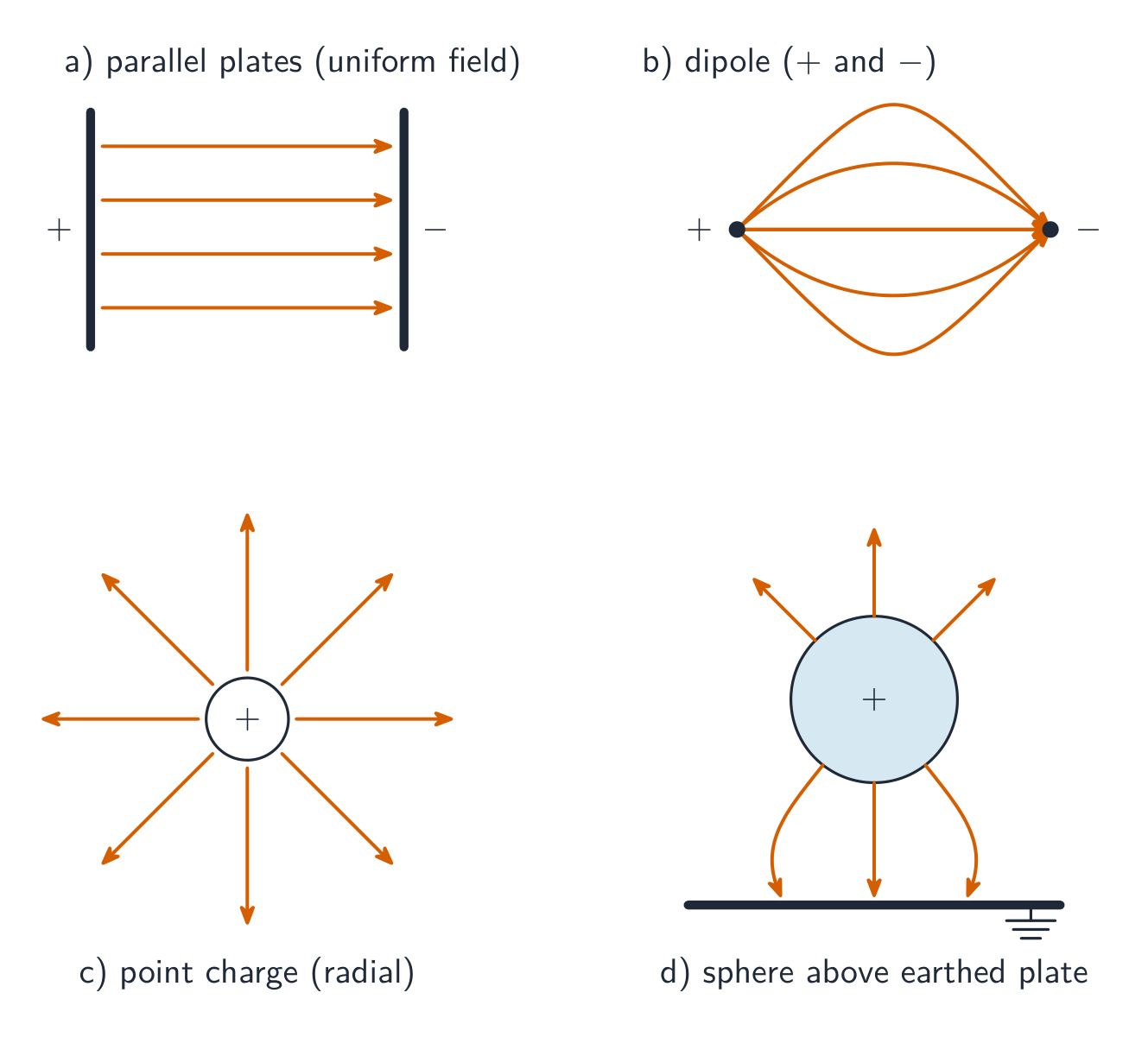
Field lines point away from positive charges and toward negative ones; where they are denser, the field is stronger. A charge in a field feels $\vec{F}=q\vec{E}$.

Worked example. Find the electric field $0.20\ \text{m}$ from a $+5.0\ \mu\text{C}$ point charge: $E=\dfrac{kQ}{r^2}=\dfrac{9.0\times10^{9}\times5.0\times10^{-6}}{(0.20)^2}=1.1\times10^{6}\ \text{N/C}$, pointing away from the charge. A $+2\ \text{nC}$ charge placed there would feel $F=qE=2\times10^{-9}\times1.1\times10^{6}=2.2\times10^{-3}\ \text{N}$.

עברית
השדה החשמלי של דו-קוטב
מספר נתיקי ברק בהירים וענפניים פוגעים מלמעלה בשמי סוערים מעל נמל
ברק: מטען מצטבר עד שהשדה החשמלי בין הענן לקרקע חזק מספיק כדי לנתק אלקטרונים ממולקלות האוויר, וזרם ענק זורם

שדה חשמלי $\vec{E}$ הוא הכוח ליחידת מטען שמטען בדיקה חיובי קטן יחוש:

$$\vec{E}=\frac{\vec{F}}{q},\qquad E=\frac{kQ}{r^2}\ \text{for a point charge}.$$
קווי השדה מופנים הרחק מטענות חיוביות וכלפי שליליות; ככל שהם צפופים יותר, השדה חזק יותר. מטען בשדה מרגיש ב$\vec{F}=q\vec{E}$.

דפוסי קווי שדה חשמלי ללוחות מקבילים, דואידי וטען נקודתי

דוגמה מוצגת. חשב את השדה החשמלי $0.20\ \text{m}$ ממטען נקודתי $+5.0\ \mu\text{C}$: $E=\dfrac{kQ}{r^2}=\dfrac{9.0\times10^{9}\times5.0\times10^{-6}}{(0.20)^2}=1.1\times10^{6}\ \text{N/C}$, המצביע הרחק מהטען. מטען $+2\ \text{nC}$ שנמצא שם יחוש $F=qE=2\times10^{-9}\times1.1\times10^{6}=2.2\times10^{-3}\ \text{N}$.

Explore · ⁨חקור⁩

Map the field around a charge · ⁨שרטט שדה סביב מטען⁩

An electric field points the way a positive test charge would be pushed: away from a positive charge, toward a negative one. Closer lines mean a stronger field. · ⁨שדה חשמלי מצביע לכיוון שהטעון הניסיון החיובית תדחף: הרחק ממטען חיובי, לכיוון מטען שלילי. קווים צפופים יותר מעידים על שדה חזק יותר.⁩

Vocabulary · ⁨מילון מונחים⁩ Train · ⁨אימון⁩
English עברית
Electric charge/ɪˈlektrɪk tʃɑːdʒ/ מטען חשמלי
Coulomb's law/ˈkuːlɒmz lɔː/ חוק קולון
permittivity/ˌpɜːmɪˈtɪvəti/ עקביות
conductor/kənˈdʌktə/ מו Interructor
insulator/ˈɪnsjuːleɪtə/ בודד חשמלי
Conduction/kənˈdʌkʃn/ הולכה
Induction/ɪnˈdʌkʃn/ אינדוקציה
electric field/ɪˈlektrɪk fiːld/ שדה חשמלי
electric potential energy/ɪˈlektrɪk pəˈtenʃl ˈenədʒi/ אנרגיה פוטנציאלית חשמלית
Electric potential/ɪˈlektrɪk pəˈtenʃl/ פוטנציאל חשמלי
10.4

Electric Potential Energy · ⁨אנרגיה פוטנציאלית חשמלית⁩

Syllabus · ⁨סיילבוס⁩
English

Learning Objective 10.4.A: Describe the electric potential energy of a system.

  • 10.4.A.1 The electric potential energy of a system of two point charges equals the amount of work required for an external force to bring the point charges to their current positions from infinitely far away.
  • 10.4.A.2 The general form for the electric potential energy of two charged objects is given by the equation
    • Equation: $U_E = \dfrac{1}{4\pi\varepsilon_0}\dfrac{q_1 q_2}{r} = k\dfrac{q_1 q_2}{r}$
  • 10.4.A.3 The total electric potential energy of a system can be determined by finding the sum of the electric potential energies of the individual interactions between each pair of charged objects in the system.

Boundary statement: As the methods to calculate the electric potential energy due to extended charge distributions exceed the scope of the course, AP Physics 2 only requires that students calculate the electric potential energy of configurations of four or fewer point charges.

עברית

מטרות למידה 10.4.A: לתאר את האנרגיה הפוטנציאלית החשמלית של מערכת.

  • 10.4.A.1 האנרגיה הפוטנציאלית החשמלית של מערכת של שני מטענים נקודתיים שווה לכמות העבודה הנדרשת מכוח חיצוני להביא את המטענים הנקודתיים למיקומם הנוכחי מרחק אינסופי.
  • 10.4.A.2 הצורה הכללית לאנרגיה הפוטנציאלית החשמלית של שני גופים טעונים נתונה על ידי המשוואה
    • משוואה: $U_E = \dfrac{1}{4\pi\varepsilon_0}\dfrac{q_1 q_2}{r} = k\dfrac{q_1 q_2}{r}$
  • 10.4.A.3 האנרגיה הפוטנציאלית החשמלית הכוללת של מערכת יכולה להימצאת על ידי חיבור סכום האנרגיות הפוטנציאליות החשמליות של האינטראקציות הבודדות בין כל זוג של גופים טעונים במערכת.

הצהרת גבול: מכיוון שהשיטות לחישוב האנרגיה הפוטנציאלית החשמלית הנובעת מפירוקי מטען מורחבים עוברות מגבולות הקורס, AP Physics 2 דורשת רק מהתלמידים לחשב את האנרגיה הפוטנציאלית החשמלית של תצורות של ארבעה או פחות מטענים נקודתיים.

Source: College Board AP Course and Exam Description · ⁨מקור: תיאור הקורס והמבחן של College Board AP⁩

English

Two charges have electric potential energy 电势能 stored in their arrangement:

$$U=\frac{k q_1 q_2}{r}.$$
Like charges pushed together store positive energy; opposite charges have negative energy (bound). Moving a charge changes $U$, and the electric force does work equal to $-\Delta U$.

עברית

לשני מטענים יש אנרגיה פוטנציאלית חשמלית מאוחסת בסידורם:

$$U=\frac{k q_1 q_2}{r}.$$
מטענים זהים הנדחפים יחד מאחסנים אנרגיה חיובית; מטענים מנוגדים יש להם אנרגיה שלילית (קשורים). הזזת מטען משנה $U$, והכוח החשמלי מבצע עבודה השווה ל-$-\Delta U$.

בשדה אחיד הפוטנציאל יורד באופן קבוע עם המרחק, ולכן E קשור ל-V
10.5

Electric Potential · ⁨פוטנציאל חשמלי⁩

Syllabus · ⁨סיילבוס⁩
English

Learning Objective 10.5.A: Describe the electric potential due to a configuration of charged objects.

  • 10.5.A.1 Electric potential describes the electric potential energy per unit charge at a point in space.
  • 10.5.A.2 The electric potential due to multiple point charges can be determined by the principle of scalar superposition of the electric potential due to each of the point charges.
    • Equation: $V = \dfrac{1}{4\pi\varepsilon_0}\sum_{i}\dfrac{q_i}{r_i}$
  • 10.5.A.3 The electric potential difference between two points is the change in electric potential energy per unit charge when a test charge is moved between the two points.
    • Equation: $\Delta V = \dfrac{\Delta U_E}{q}$
    • 10.5.A.3.i Electric potential difference may also result from chemical processes that cause positive and negative charges to separate, such as in a battery.
  • 10.5.A.4 When conductors are in electrical contact, electrons will be redistributed such that the surfaces of the conductors are at the same electric potential.

Learning Objective 10.5.B: Describe the relationship between electric potential and electric field.

  • 10.5.B.1 The average electric field between two points in space is equal to the electric potential difference between the two points divided by the distance between the two points.
    • Equation: $\left|\vec{E}\right| = \left|\dfrac{\Delta V}{\Delta r}\right|$
  • 10.5.B.2 Electric field vector maps and equipotential lines are tools to describe the field produced by a charge or configuration of charges and can be used to predict the motion of charged objects in the field.
    • 10.5.B.2.i Equipotential lines represent lines of equal electric potential in space. These lines are also referred to as isolines of electric potential.
    • 10.5.B.2.ii Isolines are perpendicular to electric field vectors. An isoline map of electric potential can be constructed from an electric field vector map, and an electric field map may be constructed from an isoline map.
    • 10.5.B.2.iii An electric field vector points in the direction of decreasing potential.
    • 10.5.B.2.iv There is no component of an electric field along an isoline.

Boundary statement: As the methods to calculate the electric potential due to extended charges exceed the scope of the course, AP Physics 2 only expects that students calculate the electric potential of configurations of four or fewer particles (or more in situations of high symmetry).

עברית

מטרות למידה 10.5.A: לתאר את הפוטנציאל החשמלי הנובע מתצורת של גופים טעונים.

  • 10.5.A.1 פוטנציאל חשמלי מתאר את האנרגיה הפוטנציאלית החשמלית ליחידת מטען בנקודה במרחב.
  • 10.5.A.2 הפוטנציאל החשמלי הנובע ממספר מטענים נקודתיים יכול להימצא באמצעות עקרון הסופרפוזיציה הסקלרית של הפוטנציאל החשמלי הנובע מכל אחד מהמטענים הנקודתיים.
    • משוואה: $V = \dfrac{1}{4\pi\varepsilon_0}\sum_{i}\dfrac{q_i}{r_i}$
  • 10.5.A.3 הפרש הפוטנציאל החשמלי בין שתי נקודות הוא השינוי באנרגיה הפוטנציאלית החשמלית ליחידת מטען כאשר מטען מבחנה מוזז בין שתי הנקודות.
    • משוואה: $\Delta V = \dfrac{\Delta U_E}{q}$
    • 10.5.A.3.i פרש פוטנציאל חשמלי עשוי גם לנבוע מתהליכים כימיים הגורמים להפרדת מטענים חיוביים ומשליליים, כגון בסוללה.
  • 10.5.A.4 כאשר מוליכים נמצאים במגע חשמלי, אלקטרונים יתפצלו מחדש כך שמשטחי המוליכים יהיו באותו פוטנציאל חשמלי.

מטרת למידה 10.5.B: תאר את הקשר בין פוטנציאל חשמלי לשדה חשמלי.

  • 10.5.B.1 השדה החשמלי הממוצע בין שתי נקודות במרחב שווה להפרש הפוטנציאל החשמלי בין שתי הנקודות מחולק במרחק בין שתי הנקודות.
    • משוואה: $\left|\vec{E}\right| = \left|\dfrac{\Delta V}{\Delta r}\right|$
  • 10.5.B.2 מפות וקטוריות של שדה חשמלי וקווי איזופוטנציאל הן כלים לתיאור השדה שמיוצר על ידי מטען או קונפיגורציה של מטענים, וניתן להשתמש בהם לחזות את התנועה של גופים טעונים בשדה זה.
    • 10.5.B.2.i קווי איזופוטנציאל מייצגים קווים בעלי פוטנציאל חשמלי שווה במרחב. קווים אלו מכונים גם קווי שוויון (isolines) של פוטנציאל חשמלי.
    • 10.5.B.2.ii קווי שוויון מאונכים לווקטורי השדה החשמלי. ניתן לבנות מפת איזופוטנציאל מתוך מפת וקטורים של שדה חשמלי, ומפה של שדה חשמלי יכולה להיבנות מתוך מפת קווי שוויון.
    • 10.5.B.2.iii וקטור השדה החשמלי מצביע בכיוון הפחתת הפוטנציאל.
    • 10.5.B.2.iv אין רכיב של שדה חשמלאורך קו שוויון.

ניסוח גבול: מכיוון שיטות לחישוב הפוטנציאל החשמלי עקב מטענים מורחבים עולות מעבר לתחום הלימודים, AP Physics 2 דורש מהתלמידים רק לחשב את הפוטנציאל החשמלי של קונפיגורציות של ארבעה חלקיקים או פחות (או יותר במצבים של סימטריה גבוהה).

Source: College Board AP Course and Exam Description · ⁨מקור: תיאור הקורס והמבחן של College Board AP⁩

English

Electric potential 电势 $V$ is the potential energy per unit charge – a scalar field, measured in volts:

$$V=\frac{U}{q}=\frac{kQ}{r}.$$
The potential difference (voltage) 电压 between two points is the work per unit charge to move between them: $\Delta V=\dfrac{\Delta U}{q}$, and $U=qV$. Positive charges move from high to low potential on their own. Because potential is a scalar, adding the potentials from several charges is much easier than adding field vectors.

עברית

פוטנציאל חשמלי $V$ הוא האנרגיה הפוטנציאלית ליחידת מטען – שדה סקלארי, נמדד בוולטים:

$$V=\frac{U}{q}=\frac{kQ}{r}.$$
הפרש הפוטנציאל (מתח) בין שתי נקודות הוא העבודה ליחידת מטען להזזה ביניהן: $\Delta V=\dfrac{\Delta U}{q}$, ו-$U=qV$. מטענים חיוביים זזים מ autofי פוטנציאל גבוה לנמוך באופן עצמאי. מכיוון שהפוטנציאל הוא סקלארי, חיבור הפוטנציאלים ממספר מטענים קל הרבה יותר מחיבור וקטורי שדה.

הפוטנציאל ליד מטען נקודתי משתנה לפי 1/r
הפוטנציאל סמוך לטען נקודתי משתנה לפי 1/r
10.6

Capacitors · ⁨קבלים⁩

Syllabus · ⁨סיילבוס⁩
English

Learning Objective 10.6.A: Describe the physical properties of a parallel-plate capacitor.

  • 10.6.A.1 A parallel-plate capacitor consists of two separated parallel conducting surfaces that can hold equal amounts of charge with opposite signs.
  • 10.6.A.2 Capacitance relates the magnitude of the charge stored on each plate to the electric potential difference created by the separation of those charges.
    • Equation: $C = \dfrac{Q}{\Delta V}$
    • 10.6.A.2.i The capacitance of a capacitor depends only on the physical properties of the capacitor, such as the capacitor's shape and the material used to separate the plates.
    • 10.6.A.2.ii The capacitance of a parallel-plate capacitor is proportional to the area of one of its plates and inversely proportional to the distance between its plates. The constant of proportionality is the product of the dielectric constant, $\kappa$, of the material between the plates and the electric permittivity of free space, $\varepsilon_0$.
      • Equation: $C = \kappa\varepsilon_0\dfrac{A}{d}$
  • 10.6.A.3 The electric field between two charged parallel plates with uniformly distributed electric charge, such as in a parallel-plate capacitor, is constant in both magnitude and direction, except near the edges of the plates.
    • 10.6.A.3.i The magnitude of the electric field between two charged parallel plates, where the plate separation is much smaller than the dimensions of the plates, can be described with the equation
      • Equation: $E_C = \dfrac{Q}{\kappa\varepsilon_0 A}$
    • 10.6.A.3.ii A charged particle between two oppositely charged parallel plates undergoes constant acceleration and therefore its motion shares characteristics with the projectile motion of an object with mass in the gravitational field near Earth's surface.
  • 10.6.A.4 The electric potential energy stored in a capacitor is equal to the work done by an external force to separate that amount of charge on the capacitor.
  • 10.6.A.5 The electric potential energy stored in a capacitor is described by the equation
    • Equation: $U_C = \dfrac{1}{2}Q\Delta V$
  • 10.6.A.6 Adding a dielectric between two plates of a capacitor changes the capacitance of the capacitor and induces an electric field in the dielectric in the opposite direction to the field between the plates.

Boundary statement: While other shapes are also able to separate charges, only the analysis and descriptions of parallel-plate capacitors are required for AP Physics 2. Edge effects will be ignored unless explicitly stated otherwise.

עברית

מטרת למידה 10.6.A: תאר את התכונות הפיזיקליות של קבל לוחות מקבילים.

  • 10.6.A.1 קבל לוחות מקבילים מורכב משני משטחים מוליכים מקבילים ומרוחקים שאינם יכולים לאחסן כמות שווה של מטען עם סימנים הפוכים.
  • 10.6.A.2 הקיבול קובע את הקשר בין הגודל של המטען האגור בכל לוח לבין הפרש הפוטנציאל החשמלי שנוצר על ידי ההפרדה בין מטענים אלו.
    • משוואה: $C = \dfrac{Q}{\Delta V}$
    • 10.6.A.2.i הקיבול של קבל תלוי רק בתכונות הפיזיקליות שלו, כמו צורת הקבל והחומר המשמש להפריד בין הלוחות.
    • 10.6.A.2.ii הקיבול של קבל לוחות מקבילים פרופורציונלי לשטח אחד מהלוחות והופך ליחס הפוך למרחק בין הלוחות. קבוע הפרופורציונליות הוא מכפלת קבוע הדיאלקטרי $\kappa$ של החומר שבין הלוחות והpermittivity החשמלי של הריק, $\varepsilon_0$.
      • משוואה: $C = \kappa\varepsilon_0\dfrac{A}{d}$
  • 10.6.A.3 השדה החשמלי בין שני לוחות מקבילים טעונים עם חלוקה אחידה של מטען חשמלי, כמו בקבל לוחות מקבילים, הוא קבוע בגודלו ובכיוונו, למעט בסמוך לקצוות הלוחות.
    • 10.6.A.3.i הגודל של השדה החשמלי בין שני לוחות מקבילים טעונים, כאשר מרווח הלוחות קטן משמעותית מממדי הלוחות, ניתן לתאר באמצעות המשוואה
      • משוואה: $E_C = \dfrac{Q}{\kappa\varepsilon_0 A}$
    • 10.6.A.3.ii חלקיק טעון בין שני לוחות מקבילים עם מטענים הפוכים חווה תאוצה קבועה ולכן התנועה שלו משתפת מאפיינים עם תנועת זריקה של גוף בעל מסה בשדה הכבידה סמוך לפני השטח של כדור הארץ.
  • 10.6.A.4 אנרגיית הפוטנציאל החשמלית האגורה בקבל שווה לעבודה שנעשה על ידי כוח חיצוני כדי להפריד את כמות המטען הזו על הקבל.
  • 10.6.A.5 אנרגיית הפוטנציאל החשמלית האגורה בקבל מתוארת על ידי המשוואה
    • משוואה: $U_C = \dfrac{1}{2}Q\Delta V$
  • 10.6.A.6 הוספת דיאלקטר בין שתי פלטות של קבל משנה את הקיבולת של הקבל וגורם להיווצרות שדה חשמלי בתוך הדיאלקטר בכיוון הפוך לשדה שבין הפלטות.

הצהרת גבול: בעוד שצורות אחרות יכולות גם הן להפריד מטענים, רק ניתוח ותיאורים של קבלים עם פלטות מקבילות נדרשים לקורס AP Physics 2. השפעות שפה יוותרו מעבר ללא ציון מפורש אחרת.

Source: College Board AP Course and Exam Description · ⁨מקור: תיאור הקורס והמבחן של College Board AP⁩

English
Discharging a capacitor: τ = RC
Charging a capacitor (RC)

A capacitor 电容器 stores charge and energy on two conductors separated by a gap. Its capacitance 电容 relates charge to voltage:

$$C=\frac{Q}{V},$$
and the stored energy is $U=\tfrac{1}{2}CV^2$. Capacitance depends on the plates' geometry and the material between them, not on the charge placed on it.

Worked example. A $100\ \mu\text{F}$ capacitor is charged to $12\ \text{V}$. It holds $Q=CV=100\times10^{-6}\times12=1.2\times10^{-3}\ \text{C}$ of charge and stores $U=\tfrac12 CV^2=\tfrac12\times100\times10^{-6}\times12^2=7.2\times10^{-3}\ \text{J}$ of energy.

עברית
פריקת קבל: τ = RC
טעינת קבל (RC)

קבל מאחסן מטען ואנרגיה על שני מוליכים המופרדים במרווח. ה-קיבול שלו מקשר את המטען למתח:

$$C=\frac{Q}{V},$$
והאנרגיה המאוחסת היא $U=\tfrac{1}{2}CV^2$. הקיבול תלוי בגיאומטריית הפלטות ובחומר שביןיהם, ולא במטען שמצופה עליו.

קבלים במקביל חולקים אותו מתח, ומטעניהם נוספים

דוגמה מפורטת. קבל בעל ערך של $100\ \mu\text{F}$ טעון למתח של $12\ \text{V}$. הוא מחזיק מטען של $Q=CV=100\times10^{-6}\times12=1.2\times10^{-3}\ \text{C}$ ואוחסן אנרגיה של $U=\tfrac12 CV^2=\tfrac12\times100\times10^{-6}\times12^2=7.2\times10^{-3}\ \text{J}$.

Explore · ⁨חקור⁩

Charge and discharge a capacitor · ⁨טעינה ופריקת קבל⁩

A capacitor stores charge on two plates. It fills and empties exponentially, set by the time constant $\tau = RC$ — bigger $R$ or $C$ means slower charging. · ⁨קבל מאגר מטען על שני פלטות. הוא נטען ומתרוקן באופן אקספוננציאלי, בהתאם לקבוע הזמן $\tau = RC$ — ערך גדול יותר של $R$ או $C$ גורם לטעינה איטית יותר.⁩

Vocabulary · ⁨מילון מונחים⁩ Train · ⁨אימון⁩
English עברית
capacitor/kəˈpæsɪtə/ קבל
capacitance/kəˈpæsɪtəns/ קיבול
10.7

Conservation of Electric Energy · ⁨שימור אנרגיה חשמלית⁩

Syllabus · ⁨סיילבוס⁩
English

Learning Objective 10.7.A: Describe changes in energy in a system due to a difference in electric potential between two locations.

  • 10.7.A.1 When a charged object moves between two locations with different electric potentials, the resulting change in the electric potential energy of the object-field system is given by the following equation.
    • Equation: $\Delta U_E = q\Delta V$
  • 10.7.A.2 The movement of a charged object between two points with different electric potentials results in a change in kinetic energy of the object consistent with the conservation of energy.
עברית

מטרת למידה 10.7.A: לתאר שינויים באנרגיה במערכת עקב הבדל בפוטנציאל חשמלי בין שני מיקומים.

  • 10.7.A.1 כאשר גוף טעון זז בין שני מיקומים עם פוטנציאל חשמלי שונה, השינוי resulting באנרגיה הפוטנציאלית החשמלית של מערכת הגוף-שדה נתון על ידי המשוואה הבאה.
    • משוואה: $\Delta U_E = q\Delta V$
  • 10.7.A.2 תנועת גוף טעון בין שני נקודות עם פוטנציאל חשמלי שונה גורמת לשינוי באנרגיה הקינטית של הגוף בהתאם לשימור האנרגיה.

Source: College Board AP Course and Exam Description · ⁨מקור: תיאור הקורס והמבחן של College Board AP⁩

English

Energy is conserved for charges just as for masses. A charge released in a field converts electric potential energy into kinetic energy:

$$q\,\Delta V=\tfrac{1}{2}mv^2 \quad(\text{gaining speed as it "falls" through a potential difference}).$$

Worked example. An electron ($q=1.6\times10^{-19}\ \text{C}$, $m=9.1\times10^{-31}\ \text{kg}$) is accelerated from rest through a potential difference of $100\ \text{V}$. Its final speed is

$$v=\sqrt{\frac{2q\,\Delta V}{m}}=\sqrt{\frac{2\times1.6\times10^{-19}\times100}{9.1\times10^{-31}}}=5.9\times10^{6}\ \text{m/s}.$$
This is exactly how the electron gun in an old television or an electron microscope works.

עברית

אנרגיה נשמרת עבור מטענים בדיוק כמו עבור מסות. מטען משוחרר בשדה ממיר אנרגיה פוטנציאלית חשמלית לאנרגיה קינטית:

$$q\,\Delta V=\tfrac{1}{2}mv^2 \quad(\text{gaining speed as it "falls" through a potential difference}).$$

דוגמה מפורטת. אלקטרון (מסה $q=1.6\times10^{-19}\ \text{C}$, מטען $m=9.1\times10^{-31}\ \text{kg}$) מואץ ממצב רכינה דרך הפרש פוטנציאל של $100\ \text{V}$. מהירותו הסופית היא

$$v=\sqrt{\frac{2q\,\Delta V}{m}}=\sqrt{\frac{2\times1.6\times10^{-19}\times100}{9.1\times10^{-31}}}=5.9\times10^{6}\ \text{m/s}.$$
זוהי בדיוק הדרכה שבה עובד אקדח האלקטרונים בטלוויזיה ישנה או במיקרוסקופ אלקטרונים.

Vocabulary · ⁨מילון מונחים⁩ Train · ⁨אימון⁩
English עברית
potential difference/pəˈtenʃl ˈdɪfrəns/ הפרש פוטנציאלים
10.7

Exam tips · ⁨טיפים לבחינות⁩

English
  • Coulomb's law and the point-charge field are inverse-square — doubling the separation makes the force (or field) four times smaller.
  • Use magnitudes for the size of a force and decide direction from the signs; the field points the way a positive test charge would move.
  • Potential ($V$) is a scalar so potentials from several charges simply add; the field ($E$) is a vector and must be added by direction.
  • For a charge accelerated through a voltage use energy conservation $qV=\tfrac12 mv^2$.
  • Capacitor relations: $C=Q/V$ (capacitance is fixed by geometry) and energy $U=\tfrac12 CV^2$.
עברית
  • חוק קולון ושדה מטען נקודתי הם ריבועיים הפוכים — הכפלת המרחק גורמת לכך שהכוח (או השדה) יהיה פי ארבע חלש.
  • השתמש בערכים מוחלטים לגודל הכוח והחלט על הכיוון לפי הסימנים; השדה מצביע בכיוון שבו מטען בדיקה חיובי היה זז.
  • פוטנציאל ($V$) הוא סקלר, ולכן פוטנציאלים ממספר מטענים פשוט נוספים; שדה ($E$) הוא וקטור ועל כן יש להוסיף אותו לפי כיוון.
  • עבור מטען שנaccelerated דרך מתח השתמש בשימור אנרגיה $qV=\tfrac12 mv^2$.
  • יחסי קבל: $C=Q/V$ (הקיבול קבוע בהתאם לגיאומטריה) ואנרגיה $U=\tfrac12 CV^2$.

Interactive lessons on this topic · ⁨שיעורים אינטראקטיביים בנושא זה⁩

Work through it step by step, with instant-check exercises. · ⁨לעבור על הדברים צעד אחר צעד, עם תרגילים לבדיקה מיידית.⁩

Past Papers · ⁨מבחני עבר⁩

More topics in AP Physics 2 · ⁨פיזיקה AP 2⁩ · ⁨נושאים נוספים בAP Physics 2 · ⁨פיזיקה AP 2⁩⁩

Log in or create account · ⁨היכנס או צור חשבון⁩

IGCSE, A-Level & AP