מסמר פלדה שנזרק למים צולל ישר לתחתית. עכשיו תסתכלו על הספינה הזו. היא בנויה מאותו פלדה, עשרות אלפי טון ממנה, והיא…
English narration · English + 中文 subtitles burned in · קריאת קול באנגלית · תרגום אנגלי + סינית שרוף בתוך הסרטון
8.1
Internal Structure and Density · מבנה פנימי וצפיפות
Syllabus · סיילבוס
English
Learning Objective 8.1.A: Describe the properties of a fluid.
8.1.A.1 Distinguishing properties of solids, liquids, and gases stem from the varying interactions between atoms and molecules.
8.1.A.2 A fluid is a substance that has no fixed shape.
8.1.A.3 Fluids can be characterized by their density. Density is defined as a ratio of mass to volume.
Equation:$\rho = \dfrac{m}{V}$
8.1.A.4 An ideal fluid is incompressible and has no viscosity.
עברית
מטרת למידה 8.1.A: תאר את תכונותיו של נוזל.
8.1.A.1 תכונות המבדילות בין מוצקים, נוזלים וגזים נובעות מהאינטראקציות השונות בין אטומים ומולקולות.
8.1.A.2 נוזל הוא חומר שאין לו צורה קבועה.
8.1.A.3 ניתן לאפיין נוזלים לפי הצפיפות שלהם. צפיפות מוגדרת כיחס בין מסה לבין נפח.
משוואה:$\rho = \dfrac{m}{V}$
8.1.A.4 נוזל אידיאלי הוא בלתי דחוס ואינו בעל ויסקוזיות.
Source: College Board AP Course and Exam Description · מקור: תיאור הקורס והמבחן של College Board AP
English
The differences between solids, liquids, and gases come from how strongly their particles interact. A fluid 流体 (liquid or gas) has no fixed shape – it flows because its particles move past one another. Density 密度 is mass per unit volume:
$$\rho=\frac{m}{V}.$$
It depends on the substance and its state. An object sinks or floats depending on how its density compares with the surrounding fluid's – less dense floats, more dense sinks. An ideal fluid 理想流体 is incompressible 不可压缩 (constant density, whatever the pressure) and has no viscosity 黏度 (internal friction) – the model AP uses throughout.
עברית
ההבדלים בין מוצקים, נוזלים וגזים נובעים מכוח האינטראקציה בין החלקיקים שלהם. נוזל (נוזל או גז) אין לו צורה קבועה – הוא זורם משום שחלקיקיו עוברים זה לצד זה. צפיפות היא מסה ליחידת נפח:
$$\rho=\frac{m}{V}.$$
היא תלויה בחומר ובמצבו. חפץ טוען או מצוף בהתאם לכך שהצפיפות שלו משווה לצפיפות הנוזל הסביבתי – פחות צפוף מצוף, יותר צפוף טוען. נוזל אידיאלי הוא בלתי דחוס (צפיפות קבועה, בכל לחץ) ואינו בעל ויסקוזיות (חיכוך פנימי) – המודל ש-AP משתמש בו לאורך כל הדרך.
Explore · חקור
Float or sink by density · לצוף או לשקוע על פי צפיפות
An object floats if it is less dense than the fluid. Change the density and watch it ride higher or sink, displacing its own weight of fluid. · גוף צף אם הוא פחות צפוף מהזורם. שינוי הצפיפות גורם לו לעלות גבוה יותר או לשקוע, ולהזיז משקל של נוזל השווה למשקלו.
8.2
Pressure · לחץ
Syllabus · סיילבוס
English
Learning Objective 8.2.A: Describe the pressure exerted on a surface by a given force.
8.2.A.1 Pressure is defined as the magnitude of the perpendicular force component exerted per unit area over a given surface area, as described by the equation
Equation:$P = \dfrac{F_\perp}{A}$
8.2.A.2 Pressure is a scalar quantity.
8.2.A.3 The volume and density of a given amount of an incompressible fluid is constant regardless of the pressure exerted on that fluid.
Learning Objective 8.2.B: Describe the pressure exerted by a fluid.
8.2.B.1 The pressure exerted by a fluid is the result of the entirety of the interactions between the fluid's constituent particles and the surface with which those particles interact.
8.2.B.2 The absolute pressure of a fluid at a given point is equal to the sum of a reference pressure $P_0$, such as the atmospheric pressure $P_{\text{atm}}$, and the gauge pressure $P_{\text{gauge}}$.
Equation:$P = P_0 + \rho g h$
8.2.B.3 The gauge pressure of a vertical column of fluid is described by the equation
Equation:$P_{\text{gauge}} = \rho g h$
עברית
מטרת למידה 8.2.A: תאר את הלחץ המופעל על משטח על ידי כוח נתון.
8.2.A.1 לחץ מוגדר כיוד החלק האנכי של הכוח המופעל ליחידת שטח על משטח נתון, כפי שמתואר במשוואה
משוואה:$P = \dfrac{F_\perp}{A}$
8.2.A.2 לחץ הוא גודל סקלארי.
8.2.A.3 הנפח והצפיפות של כמות נתונה של נוזל בלתי דחוס נשארים קבועים ללא קשר ללחץ המופעל על הנוזל.
מטרת למידה 8.2.B: תאר את הלחץ המופעל על ידי נוזל.
8.2.B.1 הלחץ המופעל על ידי נוזל הוא תוצאה של סך כל האינטראקציות בין חלקיקי הנוזל לבין המשטח עם החלקיקים אינטראקטיביים.
8.2.B.2 הלחץ המוחלט של נוזל בנקודה נתונה שווה לסכום של לחץ ייחוס $P_0$, כגון לחץ אטמוספרי $P_{\text{atm}}$, ולחץ מד $P_{\text{gauge}}$.
משוואה:$P = P_0 + \rho g h$
8.2.B.3 לחץ מד של עמודת נוזל אנכית מתואר על ידי המשוואה
משוואה:$P_{\text{gauge}} = \rho g h$
Source: College Board AP Course and Exam Description · מקור: תיאור הקורס והמבחן של College Board AP
English
Pressure 压强 is the perpendicular force per unit area, a scalar 标量 measured in pascals (Pa):
$$P=\frac{F_\perp}{A}.$$
In a fluid at rest, pressure increases with depth 深度 because of the weight of fluid above:
$$P=P_0+\rho g h,$$
where $P_0$ is the pressure at the surface and $h$ is the depth. Pressure acts equally in all directions at a point and pushes perpendicular to any surface.
Distinguish the two pressures AP asks about: the gauge pressure 表压 is the extra pressure the fluid column adds, $P_{\text{gauge}}=\rho g h$, while the absolute pressure 绝对压强 is the total, $P=P_0+P_{\text{gauge}}$ (with $P_0$ usually atmospheric). A tyre gauge reading "$200\ \text{kPa}$" is gauge pressure; the air inside is really at about $300\ \text{kPa}$ absolute.
Worked example. Find the total pressure on a diver $10\ \text{m}$ below the surface of water ($\rho=1000\ \text{kg/m}^3$, surface pressure $P_0=1.0\times10^{5}\ \text{Pa}$):
$$P=P_0+\rho g h=1.0\times10^{5}+1000\times9.8\times10=1.98\times10^{5}\ \text{Pa}.$$
Every $10\ \text{m}$ of water adds roughly one extra atmosphere of pressure. Notice the pressure does not depend on the shape or width of the container, only on the depth.
עברית
לחץ הוא כוח אנכי ליחידת שטח, סקלר שנמדד בפסקלים (Pa):
$$P=\frac{F_\perp}{A}.$$
בנוזל בשקט, הלחץ עולה עם עומק בגלל משקל הנוזל שמעליו:
$$P=P_0+\rho g h,$$
כאשר $P_0$ הוא הלחץ בפני השטח ו-$h$ הוא העומק. הלחץ פועל באותה עוצמה בכל הכיוונים בנקודה ודוחף אנכית לכל משטח.
רמלי הידראוליים: לחץ המופעל על בוכנה קטנה עובר ללא הפחתה דרך הנוזל לבוכנה גדולה, ולכן כוח קטן יכול להרים מכונית
הבדל בין שני סוגי הלחצים ש-AP שואל עליהם: הלחץ המדוד הוא הלחץ הנוסף שעמוד הנוזל מוסיף, $P_{\text{gauge}}=\rho g h$, בעוד שהלחץ המוחלט הוא הכולל, $P=P_0+P_{\text{gauge}}$ (עם $P_0$ שזה בדרך כלל הלחץ האטמוספרי). מד לחץ בצמיח שמציג "$200\ \text{kPa}$" הוא לחץ מדוד; האוויר בפנים הוא למעשה בלחץ של כ-$300\ \text{kPa}$ מוחלט.
*משקל עמוד נוזל קובע את הלחץ הנוסף בעומק
דוגמה מפורטת. חשב את הלחץ הכולל על צולל $10\ \text{m}$ מתחת לפני המים ($\rho=1000\ \text{kg/m}^3$, לחץ פני השטח $P_0=1.0\times10^{5}\ \text{Pa}$):
$$P=P_0+\rho g h=1.0\times10^{5}+1000\times9.8\times10=1.98\times10^{5}\ \text{Pa}.$$
כל $10\ \text{m}$ של מים מוסיפים כ-1 אטמוספרה נוספת של לחץ. שימו לב שהלחץ אינו תלוי בצורת או ברוחב המיכל, אלא רק בעומק.
ברומטר אנרואידי מדד את לחץ האוויר באמצעות קופסת מתכת סגורה המתכופפת כאשר הלחץ החיצוני משתנה
Learning Objective 8.3.A: Describe the conditions under which a fluid's velocity changes.
8.3.A.1 Newton's laws can be used to describe the motion of particles within a fluid.
8.3.A.2 The macroscopic behavior of a fluid is a result of the internal interactions between the fluid's constituent particles and external forces exerted on the fluid.
Learning Objective 8.3.B: Describe the buoyant force exerted on an object interacting with a fluid.
8.3.B.1 The buoyant force is a net upward force exerted on an object by a fluid.
8.3.B.2 The buoyant force exerted on an object by a fluid is a result of the collective forces exerted on the object by the particles making up the fluid.
8.3.B.3 The magnitude of the buoyant force exerted on an object by a fluid is equivalent to the weight of the fluid displaced by the object.
Equation:$F_b = \rho V g$
עברית
מטרת הלמידה 8.3.A: לתאר את התנאים שבהם מהירותו של נוזל משתנה.
8.3.A.1 ניתן להשתמש בחוקי ניוטון כדי לתאר את תנועת החלקיקים בתוך נוזל.
8.3.A.2 ההתנהגות המקרוסקופית של נוזל היא תוצאה של האינטראקציות הפנימיות בין חלקיקי הנוזל וכוחות חיצוניים המופעלים על הנוזל.
מטרת הלמידה 8.3.B: לתאר את הכוח האולמי המופעל על גוף האינטראקציה עם נוזל.
8.3.B.1 הכוח האולמי הוא כוח נטו כלפי מעלה המופעל על גוף על ידי נוזל.
8.3.B.2 הכוח האולמי המופעל על גוף על ידי נוזל הוא תוצאה של הסכום הכוחות המופעלים על הגוף על ידי החלקיקים המרכיבים את הנוזל.
8.3.B.3 הגודל של הכוח האולמי המופעל על גוף על ידי נוזל שווה למשקל הנוזל שהוחלף על ידי הגוף.
משוואה:$F_b = \rho V g$
Source: College Board AP Course and Exam Description · מקור: תיאור הקורס והמבחן של College Board AP
English
Buoyancy: float or sink
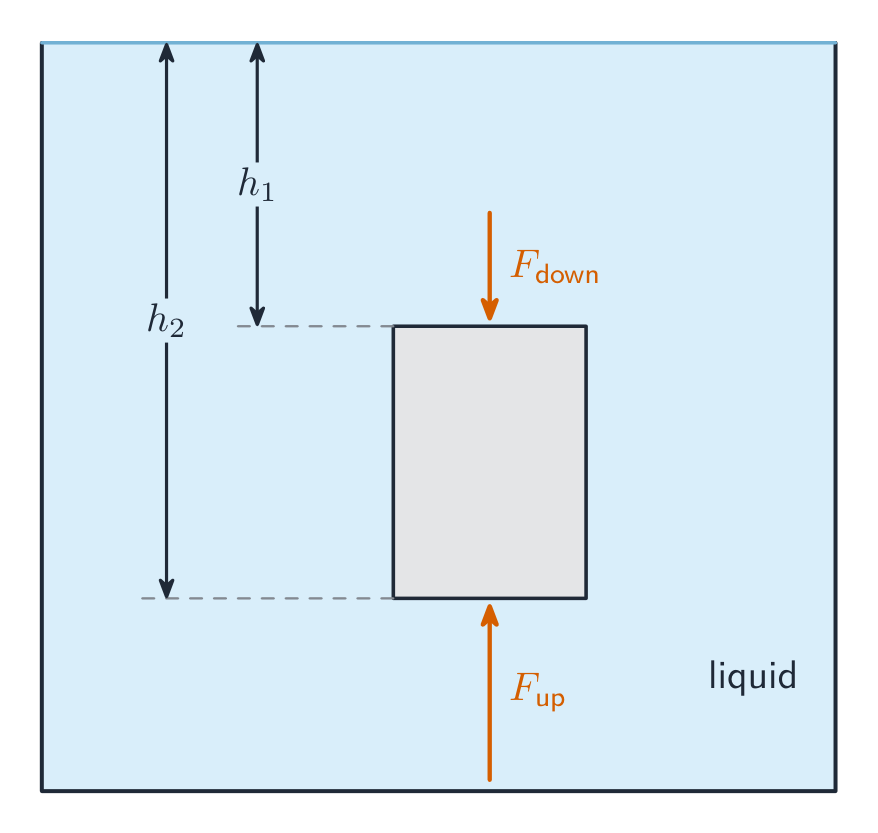
An object in a fluid feels an upward buoyant force 浮力 equal to the weight of the fluid it displaces – Archimedes' principle 阿基米德原理:
Combine this with Newton's laws: the object floats when buoyancy balances weight, sinks when weight wins, and rises when buoyancy wins. A floating object displaces exactly its own weight of fluid.
Worked example. A block of density $600\ \text{kg/m}^3$ floats in water ($1000\ \text{kg/m}^3$). What fraction is under the surface? For floating, the buoyant force equals the weight, so $\rho_{\text{fluid}}\,g\,V_{\text{sub}}=\rho_{\text{object}}\,g\,V$:
שלב זה יחד עם חוקי ניוטון: הגוף צף כאשר הכוח מאוזן במשקלו, שוקע כאשר המשקל גובר, ורם כאשר כוח הצפה גובר. לגוף צף מוסיח בדיוק משקלו של הנוזל.
דוגמה פותרת. בלוק בצפיפות $600\ \text{kg/m}^3$ מצף במים ($1000\ \text{kg/m}^3$). איזה חלק ממנו מתחת לפני המים? לצפיפה, כוח הצפה שווה למשקל, ולכן $\rho_{\text{fluid}}\,g\,V_{\text{sub}}=\rho_{\text{object}}\,g\,V$:
Fluids and Conservation Laws · נוזלים וחוקי שימור
Syllabus · סיילבוס
English
Learning Objective 8.4.A: Describe the flow of an incompressible fluid through a cross-sectional area by using mass conservation.
8.4.A.1 A difference in pressure between two locations causes a fluid to flow.
8.4.A.1.i The rate at which matter enters a fluid-filled tube open at both ends must equal the rate at which matter exits the tube.
8.4.A.1.ii The rate at which matter flows into a location is proportional to the cross-sectional area of the flow and the speed at which the fluid flows.
Derived equation:$\dfrac{V}{t} = A v$
8.4.A.2 The continuity equation for fluid flow describes conservation of mass flow rate in incompressible fluids.
Equation:$A_1 v_1 = A_2 v_2$
עברית
מטרת הלמידה 8.4.A: לתאר את זרימת נוזל בלדחוס דרך שטח חתך באמצעות שימור מסה.
8.4.A.1 הבדל בלחץ בין שני מיקומים גורם לנוזל לזרום.
8.4.A.1.i קצב הכניסה של חומר לצינור המלא בנוזל ופתוח בשתי קצוות חייב להיות שווה לקצב היציאה של החומר מהצינור.
8.4.A.1.ii קצב הזרימה של חומר למיקום נתון פרופורציונלי לשטח החתך של הזרימה ולמהירות שבה הנוזל זורם.
Source: College Board AP Course and Exam Description · מקור: תיאור הקורס והמבחן של College Board AP
English
For an ideal fluid flowing steadily, two conservation ideas apply:
Continuity 连续性 (conservation of mass): the volume flow rate is constant, so $A_1 v_1 = A_2 v_2$. A narrower pipe forces faster flow.
Bernoulli's equation 伯努利方程 (conservation of energy per volume): along a streamline,
$$P+\tfrac{1}{2}\rho v^2+\rho g y = \text{constant}.$$
Together they explain why fluid speeds up and its pressure drops where a pipe narrows or where flow is fastest.
Worked example. Water flows at $2.0\ \text{m/s}$ through a pipe of cross-section $0.010\ \text{m}^2$, then enters a narrower section of $0.0040\ \text{m}^2$. By continuity the speed there is
By Bernoulli's equation this faster stream is at lower pressure – the effect that lifts an aeroplane wing and pulls two passing ships together.
Exam skill. Choose the right law by what changes. If the pipe changes width, start with continuity ($A_1v_1=A_2v_2$) to get the speeds; if you then need a pressure, feed those speeds into Bernoulli. Watch the height term $\rho g y$ only when the pipe also changes level.
עברית
עבור נוזל אידיאלי הנזרם בזרימה יציבה, חלים שני עקרונות שימור:
כוח העלייה נובע מכך שהלחץ בתחתית הגוף גדול מהלחץ בחלקו העליון
רציפות (שימור מסה): קצב זרימת הנפח הוא קבוע, ולכן $A_1 v_1 = A_2 v_2$. צינור צר יותר מחייב זרימה מהירה יותר.
משוואת ברנולי (שימור אנרגיה ליחידת נפח): לאורך קו זרימה,
$$P+\tfrac{1}{2}\rho v^2+\rho g y = \text{constant}.$$
יחד הם מסבירים מדוע הנוזל מאיץ והלחץ שלו יורך במקום שבו הצינור צר או שבה הזרימה היא מהירה ביותר.
כאשר הצינור צר, הנוזל מאיץ (רציפות) והלחץ שלו יורך (ברנולי)
דוגמה פותרת. מים זורמים במהירות $2.0\ \text{m/s}$ דרך צינור בעל שטח חתך $0.010\ \text{m}^2$, ולאחר מכן נכנסים לקטע צר יותר בעל שטח $0.0040\ \text{m}^2$. לפי רציפות, המהירות שם היא
לפי משוואת ברנולי, זרם מהיר יותר זה נמצא בלחץ נמוך יותר – האפקט שמרים כנף של מטוס ומשוך שתי אוניות העוברות זו עם זו.
מיומנות למבחן. בחר את החוק המתאים לפי מה משתנה. אם לצינור משתנה רוחב, התחל ברצף ($A_1v_1=A_2v_2$) כדי לקבל את המהירויות; אם אחר כך תצטרך לחץ, הזן את מהירויות אלו בנוסחת ברנולי. שים לב למונע הגובה $\rho g y$ רק כאשר הצינור גם כן משנה רמה גיאומטרית.
8.4
Exam tips · טיפים לבחינות
English
Pressure with depth is $P=P_0+\rho g h$ — it depends on depth only, not the container's shape or width.
Buoyant force = weight of fluid displaced ($\rho_{\text{fluid}}\,gV_{\text{disp}}$); a floating object displaces its own weight, so the fraction submerged is $\rho_{\text{object}}/\rho_{\text{fluid}}$.
Compare densities to predict floating vs sinking; a floating object is in equilibrium (buoyancy = weight), not weightless.
Use continuity$A_1v_1=A_2v_2$: a narrower pipe means faster flow.
Bernoulli: where a fluid flows faster its pressure is lower (wing lift, spray).
עברית
לחץ עמוק הוא $P=P_0+\rho g h$ — הוא תלוי בעומק בלבד, ולא בצורת או ברוחב המכל.
כוח הצפה = משקל הנוזל שהוסח ($\rho_{\text{fluid}}\,gV_{\text{disp}}$); גוף צף מוסיח את משקלו, ולכן השבר הטבול הוא $\rho_{\text{object}}/\rho_{\text{fluid}}$.
השווה צפיפויות כדי לחזות ציפה לעומת טביעה; גוף צף נמצא באיזון (הצפה = משקל), ולא חסר משקל.
השתמש ברצף$A_1v_1=A_2v_2$: צינור צר יותר פירושו זרימה מהירה יותר.
ברנולי: כאשר נוזל זורם מהר יותר, הלחץ בו נמוך (הרמת כנף, התזה).
Interactive lessons on this topic · שיעורים אינטראקטיביים בנושא זה
Work through it step by step, with instant-check exercises. · לעבור על הדברים צעד אחר צעד, עם תרגילים לבדיקה מיידית.
Pick one and the site follows you — notes, papers, videos and practice all open on it. · בחרו נושא אחד והאתר יעקוב אחריו — הערות, מסמכים, וידאו ותרגולים פתוחים בו.
Type to search notes, lessons, code, vocabulary and past-paper questions across every subject. · הקלד כדי לחפש הערות, שיעורים, קוד, אוצר מילים ושאלות מבחנים בכל הנושאים.


 *משקל עמוד נוזל קובע את הלחץ הנוסף בעומק