Skip to content · ⁨Saltar al contenido⁩

Audiencia, Tesis y Evidencia de Apoyo

AP Lengua Inglesa y Composición · Topic 2 · ⁨Tema 2⁩

Train · ⁨Entrenar⁩
Video lesson for this topic · ⁨Lección de video para este tema⁩ Open the video page · ⁨Abrir la página de video⁩
5:54

Unidad 2: Audiencia, tesis y evidencia de apoyo

Aquí tienes una prueba que puedes hacer a tus propios borradores en unos diez segundos. Lee un párrafo y pregúntate: ¿se leería idéntico ante una audiencia completamente diferente?…

English narration · English + 中文 subtitles burned in · ⁨Narración en inglés · Subtítulos en inglés + 中文 quemados en pantalla⁩

2.1

Understanding an Audience's Beliefs and Needs · ⁨Comprender las creencias y necesidades de la audiencia⁩

Syllabus
English

Enduring Understanding (RHS-1): Individuals write within a particular situation and make strategic writing choices based on that situation.

Learning Objective 1.B: Reading – Explain how an argument demonstrates understanding of an audience’s beliefs, values, or needs.

  • RHS-1.F Writers’ perceptions of an audience’s values, beliefs, needs, and background guide the choices they make.
  • RHS-1.G To achieve a purpose, writers make choices in an attempt to relate to an intended audience’s emotions and values.
  • RHS-1.H Arguments seek to persuade or motivate action through appeals—the modes of persuasion.
Español

Comprensión duradera (RHS-1): Los individuos escriben dentro de una situación particular y toman decisiones estratégicas de escritura basadas en dicha situación.

Objetivo de aprendizaje 1.B: Lectura – Explicar cómo un argumento demuestra comprensión de las creencias, valores o necesidades del público.

  • RHS-1.F Las percepciones de los escritores sobre los valores, creencias, necesidades y fondo del público guían las decisiones que toman.
  • RHS-1.G Para lograr un propósito, los escritores toman decisiones con el fin de establecer una conexión emocional y valorativa con su público objetivo.
  • RHS-1.H Los argumentos buscan persuadir o motivar a la acción mediante apelos: los modos de persuasión.
Source: College Board AP Course and Exam Description · ⁨Fuente: College Board AP Course and Exam Description⁩

English

Unit 1 established that a text has an audience. Unit 2 makes that audience the engine of every choice a writer makes.

  • Writers' perceptions of an audience's values, beliefs, needs, and background guide the choices they make. Note the word perceptions: what steers the writing is the writer's picture of the audience, which may be accurate or not.
  • To achieve a purpose, writers make choices in an attempt to relate to an intended audience's emotions and values.
  • Arguments seek to persuade or motivate action through appeals 诉求 - the modes of persuasion 说服方式.
Español

La Unidad 1 estableció que todo texto tiene una audiencia. La Unidad 2 convierte a esa audiencia en el motor de cada elección que realiza un escritor.

  • Las percepciones de los escritores sobre los valores, creencias, necesidades y contexto de la audiencia guían las decisiones que toman. Observe la palabra percepciones: lo que orienta la escritura es la imagen que el escritor tiene de la audiencia, la cual puede ser precisa o no.
  • Para lograr un propósito, los escritores realizan elecciones con el fin de relacionarse con las emociones y valores de la audiencia pretendida.
  • Los argumentos buscan persuadir o motivar a la acción mediante apelas (appeals) - los modos de persuasión (modes of persuasion).
Cada apelación apoya a algo diferente en la audiencia - y cada una puede fallar a su manera
Nombrar la apelación no sirve de nada por sí solo; nombrar a qué apoya es el análisis
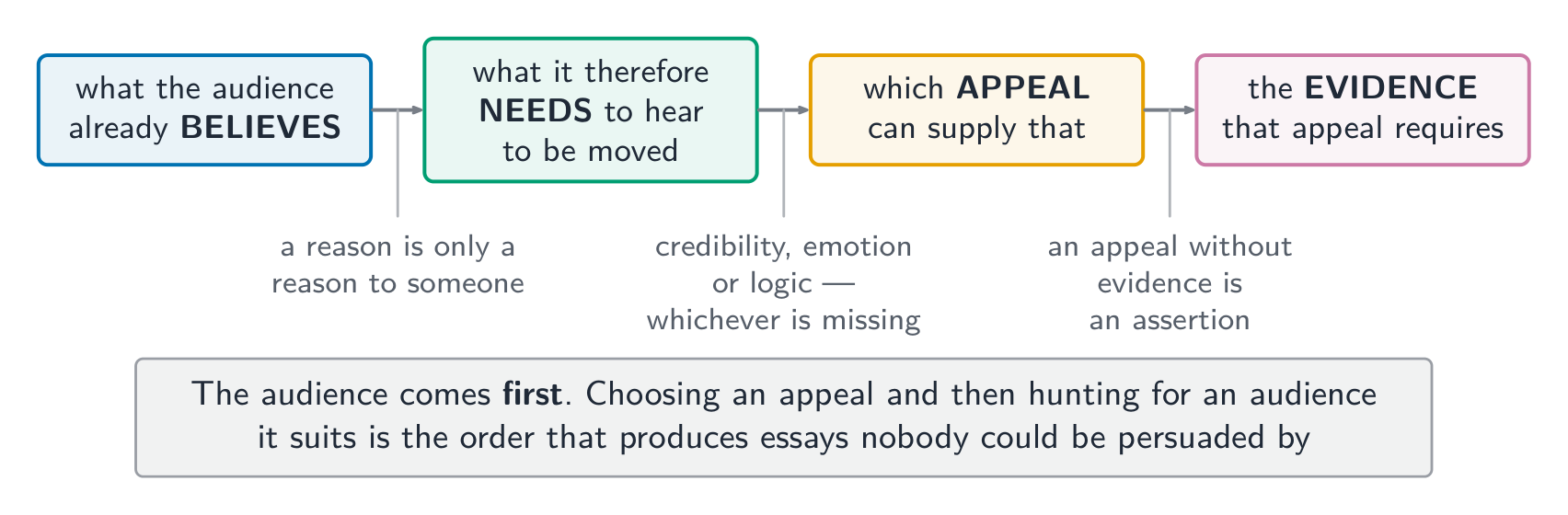
La audiencia va primero: lo que cree determina lo que contará como razón
Explore · ⁨Explorar⁩

Comienza desde la audiencia, no desde el recurso retórico

Lo que la audiencia ya cree determina lo que contará como una razón para ellos.

Vocabulary · ⁨Vocabulario⁩ Train · ⁨Entrenar⁩
English · ⁨Inglés⁩ Chinese · ⁨Chino⁩ Pinyin
appeals/əˈpiːlz/ 诉求 sù qiú
modes of persuasion/məʊdz ɒv pəˈsweɪʒn/ 说服方式 shuō fú fāng shì
credibility/ˌkredɪˈbɪlɪti/ 可信度 kě xìn dù
sufficient evidence/səˈfɪʃənt ˈevɪdəns/ 充分的证据 chōng fèn de zhèng jù
2.2

Writing for an Audience's Beliefs and Needs · ⁨Escribir para las creencias y necesidades de la audiencia⁩

Syllabus
English

Enduring Understanding (RHS-1): Individuals write within a particular situation and make strategic writing choices based on that situation.

Learning Objective 2.B: Writing – Demonstrate an understanding of an audience’s beliefs, values, or needs.

  • RHS-1.F Writers’ perceptions of an audience’s values, beliefs, needs, and background guide the choices they make.
  • RHS-1.G To achieve a purpose, writers make choices in an attempt to relate to an intended audience’s emotions and values.
  • RHS-1.H Arguments seek to persuade or motivate action through appeals—the modes of persuasion.
Español

Comprensión perdurable (RHS-1): Los individuos escriben dentro de una situación particular y toman decisiones estratégicas en su escritura basándose en dicha situación.

Objetivo de aprendizaje 2.B: Redacción – Demostrar comprensión sobre las creencias, valores o necesidades de una audiencia.

  • RHS-1.F Las percepciones de los escritores sobre los valores, creencias, necesidades y contexto de la audiencia guían las decisiones que toman.
  • RHS-1.G Para lograr un propósito, los escritores toman decisiones con el fin de establecer conexión con las emociones y valores de una audiencia pretendida.
  • RHS-1.H Los argumentos buscan persuadir o motivar a la acción mediante apelaciones: los modos de persuasión.

Source: College Board AP Course and Exam Description · ⁨Fuente: College Board AP Course and Exam Description⁩

English

The same three statements now become a writing instruction. Before drafting, decide:

  • What does this audience already believe about the subject?
  • What do they need - information, reassurance, a reason to act?
  • What do they value, and which of those values can honestly be connected to my position?

An argument that ignores these produces writing addressed to nobody. And the CED's framing gives you a useful test for your own drafts: if this paragraph would read identically to a completely different audience, it has not been shaped by one.

Español

Las tres afirmaciones anteriores se convierten ahora en una instrucción de redacción. Antes de comenzar a escribir, decida:

  • ¿Qué ya cree esta audiencia sobre el tema?
  • ¿Qué necesitan - información, tranquilidad, una razón para actuar?
  • ¿Qué valoran, y cuáles de esos valores pueden conectarse honestamente con mi postura?

Un argumento que ignora esto produce una escritura dirigida a nadie. Y el marco del CED le ofrece una prueba útil para sus propios borradores: si este párrafo se leería idéntico ante una audiencia completamente diferente, entonces no ha sido moldeado por ninguna.

2.3

Identifying Claims and Evidence · ⁨Identificar afirmaciones y evidencias⁩

Syllabus
English

Enduring Understanding (CLE-1): Writers make claims about subjects, rely on evidence that supports the reasoning that justifies the claim, and often acknowledge or respond to other, possibly opposing, arguments.

Learning Objective 3.A: Reading – Identify and explain claims and evidence within an argument.

  • CLE-1.F Writers use evidence strategically and purposefully to illustrate, clarify, set a mood, exemplify, associate, or amplify a point.
  • CLE-1.G Strategically selected evidence strengthens the validity and reasoning of the argument, relates to an audience’s emotions and values, and increases a writer’s credibility.
  • CLE-1.H An effective argument contains sufficient evidence; evidence is sufficient when its quantity and quality provide apt support for the argument.
Español

Comprensión duradera (CLE-1): Los autores realizan afirmaciones sobre temas, se basan en evidencias que respaldan el razonamiento que justifica la afirmación y, a menudo, reconocen o responden a otros argumentos, posiblemente contrarios.

Objetivo de aprendizaje 3.A: Lectura – Identificar y explicar afirmaciones y evidencias dentro de un argumento.

  • CLE-1.F Los autores utilizan la evidencia de manera estratégica y con propósito para ilustrar, aclarar, crear un ambiente, ejemplificar, asociar o amplificar un punto.
  • CLE-1.G La evidencia seleccionada estratégicamente refuerza la validez y el razonamiento del argumento, se relaciona con las emociones y valores de la audiencia y aumenta la credibilidad del autor.
  • CLE-1.H Un argumento efectivo contiene suficiente evidencia; esta es suficiente cuando su cantidad y calidad brindan un apoyo adecuado al argumento.

Source: College Board AP Course and Exam Description · ⁨Fuente: College Board AP Course and Exam Description⁩

English

Unit 2 deepens Unit 1's treatment of evidence with three claims about how evidence works:

  • Writers use evidence strategically and purposefully to illustrate, clarify, set a mood, exemplify, associate, or amplify. Evidence does a job, and naming that job is analysis.
  • Strategically selected evidence strengthens the validity and reasoning of the argument, relates to an audience's emotions and values, and helps establish the writer's credibility 可信度.
  • An effective argument contains sufficient evidence 充分的证据 - sufficient when its quantity and quality provide apt support for the line of reasoning.

That third point is often misread as "more is better". Sufficiency is quantity and quality together: three well-chosen pieces of evidence that bear directly on the claim beat six that only touch it.

Español

La Unidad 2 profundiza el tratamiento de la evidencia de la Unidad 1 con tres afirmaciones sobre cómo funciona la evidencia:

  • Los escritores utilizan la evidencia estratégica y propositivamente para ilustrar, aclarar, crear un ambiente, ejemplificar, asociar o amplificar. La evidencia cumple una función, y nombrar esa función es análisis.
  • La evidencia seleccionada estratégicamente refuerza la validez y el razonamiento del argumento, se relaciona con las emociones y valores de la audiencia, y ayuda a establecer la credibilidad del escritor.
  • Un argumento efectivo contiene suficiente evidencia - suficiente cuando su cantidad y calidad brindan un apoyo adecuado para la línea de razonamiento.

Este tercer punto suele malinterpretarse como "más es mejor". La suficiencia es cantidad y calidad juntas: tres piezas bien elegidas de evidencia que abordan directamente la afirmación superan a seis que solo la tocan tangencialmente.

Tipos de evidencia clasificados según lo que cada uno puede y no puede establecer
Explore · ⁨Explorar⁩

Empareja cada tipo de evidencia con lo que no puede probar

Una estadística y una anécdota no son intercambiables; cada una cubre la laguna de la otra.

2.4

Developing a Paragraph with Claim and Evidence · ⁨Desarrollar un párrafo con afirmación y evidencia⁩

Syllabus
English

Enduring Understanding (CLE-1): Writers make claims about subjects, rely on evidence that supports the reasoning that justifies the claim, and often acknowledge or respond to other, possibly opposing, arguments.

Learning Objective 4.A: Writing – Develop a paragraph that includes a claim and evidence supporting the claim.

  • CLE-1.F Writers use evidence strategically and purposefully to illustrate, clarify, set a mood, exemplify, associate, or amplify a point.
  • CLE-1.G Strategically selected evidence strengthens the validity and reasoning of the argument, relates to an audience’s emotions and values, and increases a writer’s credibility.
  • CLE-1.H An effective argument contains sufficient evidence; evidence is sufficient when its quantity and quality provide apt support for the argument.
Español

Comprensión duradera (CLE-1): Los escritores formulan afirmaciones sobre temas, se apoyan en evidencias que respaldan el razonamiento que justifica la afirmación y, a menudo, reconocen o responden a otros argumentos, posiblemente contrarios.

Objetivo de aprendizaje 4.A: Escritura – Desarrollar un párrafo que incluya una afirmación y evidencia que la respalde.

  • CLE-1.F Los escritores utilizan la evidencia de manera estratégica y propositiva para ilustrar, aclarar, crear un ambiente, ejemplificar, asociar o amplificar un punto.
  • CLE-1.G La selección estratégica de evidencia fortalece la validez y el razonamiento del argumento, se relaciona con las emociones y valores de la audiencia y aumenta la credibilidad del escritor.
  • CLE-1.H Un argumento efectivo contiene suficiente evidencia; la evidencia es suficiente cuando su cantidad y calidad proporcionan un apoyo adecuado al argumento.

Source: College Board AP Course and Exam Description · ⁨Fuente: College Board AP Course and Exam Description⁩

English

Applying the above to your own writing, choose each piece of evidence for a stated reason. In practice this means being able to finish the sentence: I am using this piece because it ...

  • ... illustrates a claim that would otherwise stay abstract;
  • ... establishes my credibility on a subject where readers may doubt it;
  • ... connects my position to a value the audience already holds.

Evidence chosen this way produces commentary almost automatically, because you already know what the evidence is doing. Evidence chosen because it was available produces the blank space where commentary should be.

Español

Aplicando lo anterior a su propia escritura, elija cada pieza de evidencia por una razón declarada. En la práctica, esto significa poder completar la oración: Estoy usando esta pieza porque...

  • ...ilustra una afirmación que de otro modo permanecería abstracta;
  • ...establece mi credibilidad en un tema donde los lectores puedan dudarla;
  • ...conecta mi postura con un valor que la audiencia ya posee.

La evidencia elegida así produce comentarios casi automáticamente, porque usted ya sabe qué está haciendo la evidencia. La evidencia elegida simplemente porque estaba disponible deja el espacio en blanco donde debería ir el comentario.

2.5

Identifying the Overarching Thesis · ⁨Identificar la tesis general⁩

Syllabus
English

Enduring Understanding (CLE-1): Writers make claims about subjects, rely on evidence that supports the reasoning that justifies the claim, and often acknowledge or respond to other, possibly opposing, arguments.

Learning Objective 3.B: Reading – Identify and describe the overarching thesis of an argument, and any indication it provides of the argument’s structure.

  • CLE-1.I A thesis is the main, overarching claim a writer is seeking to defend or prove by using reasoning supported by evidence.
  • CLE-1.J A writer’s thesis is not necessarily a single sentence or an explicit statement and may require a thorough reading of the text to identify, but when a thesis is directly expressed, it is called a thesis statement. [Note: While the texts you assign your students to analyze may not always contain obvious thesis statements, they should each have a thesis. It can be good practice for students to write a thesis statement for such texts. On the AP Exam, a clear communication of the thesis is required in students’ essays.]
Español

Comprensión perdurable (CLE-1): Los escritores formulan afirmaciones sobre temas, se basan en evidencia que respalda el razonamiento que justifica la afirmación y, a menudo, reconocen o responden a otros argumentos, posiblemente contrarios.

Objetivo de aprendizaje 3.B: Lectura – Identificar y describir la tesis general de un argumento, así como cualquier indicio que proporcione sobre la estructura del mismo.

  • CLE-1.I Una tesis es la afirmación principal y general que un escritor busca defender o demostrar mediante un razonamiento respaldado por evidencia.
  • CLE-1.J La tesis de un escritor no necesariamente consiste en una sola oración o en una declaración explícita; puede requerir una lectura exhaustiva del texto para ser identificada. Sin embargo, cuando una tesis se expresa directamente, se denomina enunciado de tesis. [Nota: Aunque los textos que asigne a sus estudiantes para su análisis pueden no contener siempre enunciados de tesis evidentes, cada uno debe tener una tesis. Puede ser una buena práctica que los estudiantes redacten un enunciado de tesis para dichos textos. En el examen AP, se requiere una comunicación clara de la tesis en los ensayos de los estudiantes.]

Source: College Board AP Course and Exam Description · ⁨Fuente: College Board AP Course and Exam Description⁩

English
  • A thesis 论点 is the main, overarching claim a writer seeks to defend or prove by using reasoning supported by evidence.
  • A writer's thesis is not necessarily a single sentence or an explicit statement, and may require a thorough reading to identify.

That second point matters for the reading side of the exam. On a rhetorical-analysis passage, the thesis may be distributed across the text or implied by its structure. Do not assume the first sentence of the second paragraph is the thesis because that is where you would put yours.

Español
  • Una tesis es la afirmación principal y general que un escritor busca defender o demostrar utilizando un razonamiento respaldado por evidencia.
  • La tesis de un escritor no necesariamente es una sola oración ni una declaración explícita, y puede requerir una lectura exhaustiva para identificarla.

Este segundo punto es importante para la parte de lectura del examen. En un pasaje de análisis retórico, la tesis puede estar distribuida a lo largo del texto o implícita en su estructura. No asuma que la primera oración del segundo párrafo es la tesis solo porque ahí pondría la suya.

2.6

Writing a Thesis Statement · ⁨Redactar una oración de tesis⁩

Syllabus
English

Enduring Understanding (CLE-1): Writers make claims about subjects, rely on evidence that supports the reasoning that justifies the claim, and often acknowledge or respond to other, possibly opposing, arguments.

Learning Objective 4.B: Writing – Write a thesis statement that requires proof or defense and that may preview the structure of the argument.

  • CLE-1.I A thesis is the main, overarching claim a writer is seeking to defend or prove by using reasoning supported by evidence.
  • CLE-1.J A writer’s thesis is not necessarily a single sentence or an explicit statement and may require a thorough reading of the text to identify, but when a thesis is directly expressed, it is called a thesis statement. [Note: While the texts you assign your students to analyze may not always contain obvious thesis statements, they should each have a thesis. It can be good practice for students to write a thesis statement for such texts. On the AP Exam, a clear communication of the thesis is required in students’ essays.]
Español

Comprensión duradera (CLE-1): Los escritores formulan afirmaciones sobre temas, se basan en evidencias que respaldan el razonamiento que justifica la afirmación y, a menudo, reconocen o responden a otros argumentos, posiblemente contrarios.

Objetivo de aprendizaje 4.B: Escritura – Redactar una tesis que requiera prueba o defensa y que pueda anticipar la estructura del argumento.

  • CLE-1.I Una tesis es la afirmación principal y general que un escritor busca defender o demostrar mediante un razonamiento sustentado con evidencia.
  • CLE-1.J La tesis de un escritor no necesariamente constituye una sola oración ni una declaración explícita y puede requerir una lectura exhaustiva del texto para identificarla; sin embargo, cuando la tesis se expresa directamente, se denomina enunciado de tesis. [Nota: Aunque los textos que asigne a sus estudiantes para analizar pueden no contener siempre enunciados de tesis obvios, cada uno debe tener una. Puede ser una buena práctica para que los estudiantes redacten un enunciado de tesis para dichos textos. En el Examen AP, se requiere una comunicación clara de la tesis en los ensayos de los estudiantes.]

Source: College Board AP Course and Exam Description · ⁨Fuente: College Board AP Course and Exam Description⁩

English

The writing objective is precise: write a thesis statement that requires proof or defence and that may preview the structure of the argument.

Two independent requirements sit in that sentence:

  • It must require defence. Apply the Unit 1 test again: could a reasonable person disagree? A thesis that states a fact cannot be defended, only repeated.
  • It may preview the structure - optional, but useful, because a thesis that names the lines of reasoning it will pursue gives the essay its shape.

On the exam, the thesis point is one of six and it is the cheapest point on the rubric: a defensible thesis in response to the prompt earns it. A restatement of the prompt does not.

Worked example (a real AP exam task). For a Question 3 argument prompt asking you to take a position on the value of a proposed practice, compare two openings. "There are many arguments both for and against this practice." - that earns nothing, because nobody could disagree with it. "Because the practice rewards visible effort rather than actual improvement, it produces the appearance of progress while removing the incentive to seek it." - that earns the point: it is arguable, specific, and it previews the reasoning the essay will develop.

Español

El objetivo de redacción es preciso: redactar una oración de tesis que requiera demostración o defensa y que pueda anticipar la estructura del argumento.

Dos requisitos independientes residen en esa oración:

  • Debe requerir defensa. Aplique nuevamente la prueba de la Unidad 1: ¿podría una persona razonable estar en desacuerdo? Una tesis que afirma un hecho no se puede defender, solo repetirse.
  • Puede anticipar la estructura - opcional, pero útil, porque una tesis que nombra las líneas de razonamiento que perseguirá da forma al ensayo.

En el examen, el punto de tesis es uno de seis y es el punto más accesible en la rúbrica: una tesis defendible en respuesta al enunciado lo obtiene. Una reexposición del enunciado no lo hace.

Ejemplo resuelto (una tarea real del examen AP). Para un enunciado de argumentación Pregunta 3 que le pide tomar una posición sobre el valor de una práctica propuesta, compare dos开场的句子。 "Hay muchos argumentos tanto a favor como en contra de esta práctica." - eso no obtiene puntos, porque nadie podría estar en desacuerdo con ello. "Dado que la práctica recompuesa el esfuerzo visible en lugar de la mejora real, produce la apariencia de progreso mientras elimina el incentivo para buscarlo." - eso gana el punto: es discutible, específica y anticipa el razonamiento que el ensayo desarrollará.

Mismo tema, y solo uno de ellos puede ser objeto de desacuerdo
Vocabulary · ⁨Vocabulario⁩ Train · ⁨Entrenar⁩
English · ⁨Inglés⁩ Chinese · ⁨Chino⁩ Pinyin
thesis/ˈθiːsɪs/ 论点 lùn diǎn
2.6

Exam tips · ⁨Consejos para el examen⁩

English
  • The audience drives everything. If a paragraph would read the same to any audience, it has not been shaped for one.
  • Name what evidence does - illustrate, clarify, associate, amplify. That is analysis; listing evidence is not.
  • Sufficiency is quantity and quality, not volume. Three apt pieces beat six loose ones.
  • A thesis in a passage may be implied or distributed. Read the whole text before deciding.
  • Your own thesis must be arguable. Restating the prompt earns zero of the six points.
  • Previewing your line of reasoning in the thesis is optional but makes the rest of the essay easier to organise.
Español
  • La audiencia lo impulsa todo. Si un párrafo se leería igual ante cualquier audiencia, entonces no ha sido adaptado para ninguna.
  • Nombren qué hace la evidencia - ilustrar, aclarar, asociar, amplificar. Eso es análisis; listar evidencia no lo es.
  • La suficiencia es cantidad y calidad, no volumen. Tres piezas adecuadas superan a seis vagas.
  • Una tesis en un pasaje puede estar implícita o distribuida. Lea todo el texto antes de decidir.
  • Su propia tesis debe ser discutible. Reexpresar el enunciado no otorga ninguno de los seis puntos.
  • Anticipar su línea de razonamiento en la tesis es opcional, pero facilita organizar el resto del ensayo.

Interactive lessons on this topic · ⁨Lecciones interactivas sobre este tema⁩

Work through it step by step, with instant-check exercises. · ⁨Trátalo paso a paso, con ejercicios de verificación instantánea.⁩

Past Papers · ⁨Exámenes Anteriores⁩

More topics in AP Lengua Inglesa y Composición · ⁨Más temas en AP Lengua Inglesa y Composición⁩

Log in or create account · ⁨Iniciar sesión o crear cuenta⁩

IGCSE, A-Level & AP