What Evidence Does
Introduced| English | Meaning |
|---|---|
| strategically and purposefully/strəˈtiːdʒɪkli ænd ˈpɜːpəsfəli/ | With deliberate choices directed towards a clear aim. |
| illustrate/ˈɪləstreɪt/ | To explain or support an idea using an example or other concrete detail. |
| clarify/ˈklærɪfaɪ/ | To make an idea or explanation easier to understand. |
| set a mood/set ə muːd/ | To create a particular emotional atmosphere for an audience. |
| exemplify/eɡˈzemplɪfaɪ/ | To show a general idea through a particular example. |
| associate/əˈsəʊsɪeɪt/ | To connect an idea, person or thing with another in the reader's mind. |
| amplify/ˈæmplɪfaɪ/ | To develop or emphasise an idea by adding detail, examples or further explanation. |
| credibility/ˌkredɪˈbɪlɪti/ | The degree to which a source, claim or speaker deserves to be trusted. |
| sufficient evidence/səˈfɪʃənt ˈevɪdəns/ | Enough support that a careful reader can accept the claim. |
Two writers, the same statistic, different work
- The same figure can open a paragraph or close it, shock a reader or reassure one.
- The number did not change; the job it was given did.
- Unit 2 asks not what evidence is but what it does.
A statistic cannot decide whether it is the opening act or the final punchline; the writer gives it a job.
The jobs evidence can do
- Writers use evidence strategically and purposefully 有策略、有目的.
- The CED's list of jobs: to illustrate 举例, clarify 澄清, set a mood 营造氛围, exemplify 示范, associate 关联, or amplify 放大 .
- Naming the job is analysis; listing the evidence is not.
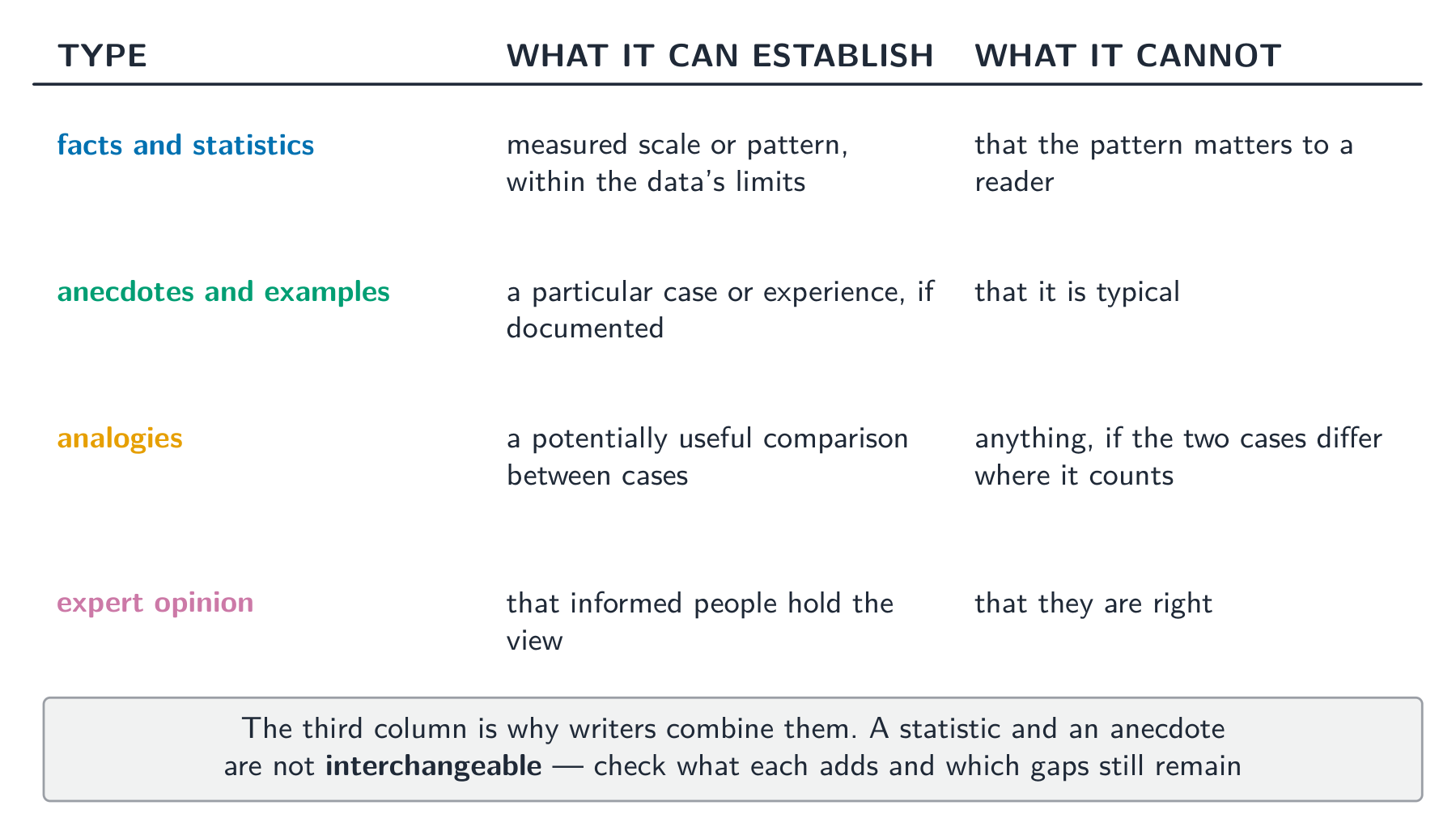
Evidence types sorted by what each can and cannot establish
What job is this evidence doing?
Match each use of evidence to the job the CED would name.
Select all the jobs the CED says evidence can do.
Difficulty 2/5 · 140 coins + a small bonus on first completion today
"Conclude" is not on the CED's list; the six jobs are illustrate, clarify, set a mood, exemplify, associate and amplify.
What strategic evidence buys
- Strategically selected evidence strengthens the validity and reasoning of the argument.
- It relates to an audience's emotions and values.
- And it helps establish the writer's credibility 可信度 — three separate gains from one choice.
Strategic evidence can strengthen reasoning, relate to values and build credibility at once.
Difficulty 1/5 · 100 coins + a small bonus on first completion today
The CED lists all three gains from a single well-chosen piece.
Sufficiency is quantity and quality together, not volume. Six loosely related examples are not more sufficient than three apt ones — the CED's word is apt support, which is a judgement about fit, not about number.
Evidence is sufficient when...
Difficulty 1/5 · 100 coins + a small bonus on first completion today
Apt support is a judgement about fit, not about volume.
Match each gain to what produces it.
Difficulty 2/5 · 140 coins + a small bonus on first completion today
One well-chosen piece can deliver all three at once.
Sufficiency is not volume
- An effective argument contains sufficient evidence 充分的证据.
- Evidence is sufficient when its quantity and quality provide apt support for the line of reasoning.
- Three well-chosen pieces that bear directly on the claim beat six that only touch it.
To analyse evidence, ask why the writer chose ____ piece and not another.
Difficulty 1/5 · 100 coins + a small bonus on first completion today
If removing it costs the argument nothing, it was included for volume.
Analysing evidence in a text
- Ask why this piece and not another — what does it do that a different example would not?
- Ask what it would cost the argument to remove it.
- If nothing is lost, the writer included it for volume, and you may say so.
A writer arguing that a policy is misdirected cites one statistic (illustrate), one participant's account (set a mood), and one comparison with a similar programme (associate). Three pieces, three different jobs — remove any one and something specific is lost.
Evidence is used strategically to illustrate, clarify, set a mood, exemplify, associate or amplify. Strategic evidence strengthens reasoning, relates to emotions and values, and builds credibility. Sufficiency is quantity and quality providing apt support.
Write from the same 30 percent
- Two writers both cite a 30 percent rise in club membership.
- One uses it to illustrate a trend. One uses it to amplify fear of crowding.
- Say what differs.
Two writers cite the same 30 percent rise in club membership. One uses it to illustrate a trend. The other uses it to make crowding feel urgent. What is the difference?
One statistic can illustrate or amplify. The writer chooses.
What differs between the two uses of the 30 percent rise?
Difficulty 1/5 · 100 coins + a small bonus on first completion today
Strategy is the use, not a second statistic.