Skip to content · ⁨Saltar al contenido⁩

Perfeccionamiento de Argumentos Matizados

AP Lengua Inglesa y Composición · Topic 9 · ⁨Tema 9⁩

Train · ⁨Entrenar⁩
Video lesson for this topic · ⁨Lección de video para este tema⁩ Open the video page · ⁨Abrir la página de video⁩
4:51

Unidad 9: Refinamiento de argumentos calificados

La Unidad 9 es corta, y es el movimiento final del curso: cómo manejar los argumentos que se oponen a los tuyos. Todo esto se recompensa directamente en el examen, y el…

English narration · English + 中文 subtitles burned in · ⁨Narración en inglés · Subtítulos en inglés + 中文 quemados en pantalla⁩

9.1

How Claims Are Qualified · ⁨Cómo se califica una afirmación⁩

Syllabus
English

Enduring Understanding (CLE-1): Writers make claims about subjects, rely on evidence that supports the reasoning that justifies the claim, and often acknowledge or respond to other, possibly opposing, arguments.

Learning Objective 3.C: Reading – Explain ways claims are qualified through modifiers, counterarguments, and alternative perspectives.

  • CLE-1.AA Writers enhance their credibility when they refute, rebut, or concede opposing arguments and contradictory evidence.
  • CLE-1.AB When writers concede, they accept all or a portion of a competing position or claim as correct, agree that the competing position or claim is correct under a different set of circumstances, or acknowledge the limitations of their own argument.
  • CLE-1.AC When writers rebut, they offer a contrasting perspective on an argument and its evidence or provide alternative evidence to propose that all or a portion of a competing position or claim is invalid.
  • CLE-1.AD When writers refute, they demonstrate, using evidence, that all or a portion of a competing position or claim is invalid.
  • CLE-1.AE Transitions may be used to introduce counterarguments.
  • CLE-1.AF Not all arguments explicitly address a counterargument.
  • CLE-1.Y Effectively entering into an ongoing conversation about a subject means engaging the positions that have already been considered and argued about.
  • CLE-1.Z Evidence and sources will either support, complement, or contradict a writer’s thesis.
Español

Comprensión duradera (CLE-1): Los escritores hacen afirmaciones sobre temas, se apoyan en evidencia que respalda el razonamiento que justifica la afirmación y, a menudo, reconocen o responden a otros argumentos, posiblemente contrarios.

Objetivo de aprendizaje 3.C: Lectura – Explicar las formas en que se matizan las afirmaciones mediante modificadores, contraargumentos y perspectivas alternativas.

  • CLE-1.AA Los escritores aumentan su credibilidad cuando refutan, contradicen o conceden argumentos opuestos y evidencias contradictorias.
  • CLE-1.AB Cuando los escritores conceden, aceptan toda o parte de una posición o afirmación competidora como correcta, coinciden en que la posición o afirmación competidora es correcta bajo un conjunto diferente de circunstancias, o reconocen las limitaciones de su propio argumento.
  • CLE-1.AC Cuando los escritores contradicen, ofrecen una perspectiva contrastante sobre un argumento y su evidencia, o proporcionan evidencia alternativa para proponer que toda o parte de una posición o afirmación competidora es inválida.
  • CLE-1.AD Cuando los escritores refutan, demuestran, mediante evidencia, que toda o parte de una posición o afirmación competidora es inválida.
  • CLE-1.AE Pueden utilizarse conectores para introducir contraargumentos.
  • CLE-1.AF No todos los argumentos abordan explícitamente un contraargumento.
  • CLE-1.Y Ingresar efectivamente en una conversación en curso sobre un tema significa comprometerse con las posiciones que ya han sido consideradas y debatidas.
  • CLE-1.Z La evidencia y las fuentes pueden apoyar, complementar o contradecir la tesis del escritor.
Source: College Board AP Course and Exam Description · ⁨Fuente: College Board AP Course and Exam Description⁩

English

Unit 9 is short and it is the course's final move: how to handle the arguments that oppose yours. Everything here is directly rewarded on the exam, and the three key verbs are constantly confused.

The framing first:

  • Effectively entering an ongoing conversation about a subject means engaging the positions that have already been taken. An argument that ignores them is not participating in the discussion, only announcing into it.
  • Evidence and sources will either support, complement, or contradict 支持、补充或反驳 a writer's thesis. All three are usable - contradicting evidence is not a problem to be hidden but material to be handled.
  • Writers enhance their credibility when they refute, rebut, or concede opposing arguments and contradictory evidence.

The three moves, in the CED's own definitions:

  • Concede 让步: writers accept all or a portion of a competing position or claim as correct, and agree that the opposing point has merit.
  • Rebut 反驳: writers offer a contrasting perspective on an argument and its evidence, or provide an alternative interpretation.
  • Refute 驳倒: writers demonstrate, using evidence, that all or a portion of a competing position or claim is incorrect.

The distinction is what your evidence lets you do. Refuting requires evidence of error; if you do not have it, refuting is bluffing and a reader will see it. Rebutting requires only an alternative reading of the same facts, which is far more often available. Conceding requires honesty, and it costs nothing - the CED says explicitly that it enhances credibility.

Two further points:

  • Transitions may be used to introduce counterarguments - and, as in Unit 5, the transition should signal the relationship. Critics argue announces one; the strongest objection to this is announces one and ranks it.
  • Not all arguments explicitly address a counterargument. True of texts you read, and worth noting when analysing - an argument that engages no opposition has told you something about its intended audience.
Español

La Unidad 9 es breve y representa el movimiento final del curso: cómo manejar los argumentos que se oponen a los tuyos. Todo esto tiene una recompensa directa en el examen, y los tres verbos clave suelen confundirse constantemente.

Primero, el marco de referencia:

  • Ingresar eficazmente a una conversación en curso sobre un tema significa interactuar con las posturas que ya han sido expresadas. Un argumento que las ignora no está participando en la discusión, solo está haciendo un anuncio hacia ella.
  • La evidencia y las fuentes pueden apoyar, complementar o contradecir la tesis de un autor. Las tres son utilizables; la evidencia contradictoria no es un problema que deba ocultarse, sino material que debe manejarse.
  • Los escritores mejoran su credibilidad cuando refutan, rebaten o conceden argumentos opuestos y evidencias contradictorias.
Tres movimientos diferentes, tres admitencias distintas - y los estudiantes siempre las confunden
Conceder acepta, rebutir contrarresta, refutar desmiente. Elige la que tu evidencia pueda respaldar realmente

Los tres movimientos, según las propias definiciones del CED:

  • Conceder (Concede): Los escritores aceptan toda o parte de una posición u afirmación competing como correcta, y aceptan que el punto opuesto tiene mérito.
  • Rebatir (Rebut): Los escritores ofrecen una perspectiva contrastante sobre un argumento y su evidencia, o proporcionan una interpretación alternativa.
  • Refutar (Refute): Los escritores demuestran, usando evidencia, que toda o parte de una posición u afirmación competing es incorrecta.

La distinción radica en lo que tu evidencia te permite hacer. Refutar requiere evidencia de error; si no la tienes, refutar es fingir y un lector lo notará. Rebatir requiere solo una lectura alternativa de los mismos hechos, lo cual está mucho más disponible. Conceder requiere honestidad, y no tiene costo; el CED afirma explícitamente que mejora la credibilidad.

Dos puntos adicionales:

  • Las transiciones pueden usarse para introducir contraargumentos - y, como en la Unidad 5, la transición debe señalar la relación. Los críticos argumentan anuncia uno; la objeción más fuerte a esto es anuncia una y la jerarquiza.
  • No todos los argumentos abordan explícitamente un contraargumento. Cierto en los textos que lees, y digno de notar al analizarlo; un argumento que no involucra oposición te ha dicho algo sobre su audiencia pretendida.
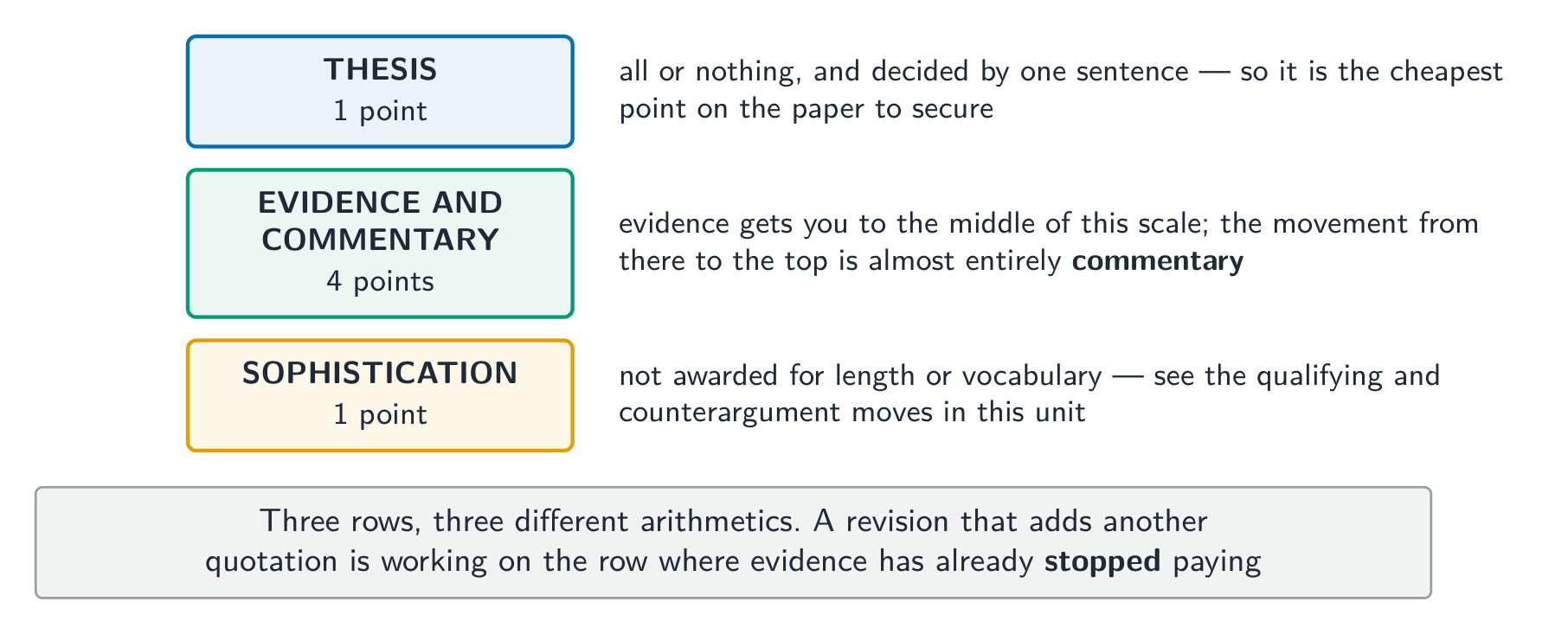
Tres filas, tres aritméticas diferentes - revisa la que aún paga
Explore · ⁨Explorar⁩

Colocar la contraargumentación, y decir qué indica

La posición tiene significado: al principio enmarca el ensayo, al final puede leerse como marcar una casilla.

Vocabulary · ⁨Vocabulario⁩ Train · ⁨Entrenar⁩
English · ⁨Inglés⁩ Chinese · ⁨Chino⁩ Pinyin
support, complement, or contradict/səˈpɔːt ˈkɒmplɪmənt ɔː ˌkɒntrəˈdɪkt/ 支持、补充或反驳 zhī chí 、 bǔ chōng huò fǎn bó
Concede/kənˈsiːd/ 让步 ràng bù
Rebut/rɪˈbʌt/ 反驳 fǎn bó
Refute/rɪˈfjuːt/ 驳倒 bó dǎo
9.2

Qualifying a Claim · ⁨Calificar una Afirmación⁩

Syllabus
English

Enduring Understanding (CLE-1): Writers make claims about subjects, rely on evidence that supports the reasoning that justifies the claim, and often acknowledge or respond to other, possibly opposing, arguments.

Learning Objective 4.C: Writing – Qualify a claim using modifiers, counterarguments, or alternative perspectives.

  • CLE-1.AA Writers enhance their credibility when they refute, rebut, or concede opposing arguments and contradictory evidence.
  • CLE-1.AB When writers concede, they accept all or a portion of a competing position or claim as correct, agree that the competing position or claim is correct under a different set of circumstances, or acknowledge the limitations of their own argument.
  • CLE-1.AC When writers rebut, they offer a contrasting perspective on an argument and its evidence or provide alternative evidence to propose that all or a portion of a competing position or claim is invalid.
  • CLE-1.AD When writers refute, they demonstrate, using evidence, that all or a portion of a competing position or claim is invalid.
  • CLE-1.AE Transitions may be used to introduce counterarguments.
  • CLE-1.AF Not all arguments explicitly address a counterargument.
  • CLE-1.Y Effectively entering into an ongoing conversation about a subject means engaging the positions that have already been considered and argued about.
  • CLE-1.Z Evidence and sources will either support, complement, or contradict a writer’s thesis.
Español

Comprensión perdurable (CLE-1): Los autores realizan afirmaciones sobre temas, se basan en evidencia que respalda el razonamiento que justifica la afirmación y, a menudo, reconocen o responden a otros argumentos, posiblemente opuestos.

Objetivo de aprendizaje 4.C: Escritura – Calificar una afirmación mediante modificadores, contraargumentos o perspectivas alternativas.

  • CLE-1.AA Los autores mejoran su credibilidad cuando refutan, rebaten o ceden ante argumentos opuestos y evidencias contradictorias.
  • CLE-1.AB Cuando los autores ceden, aceptan total o parcialmente una posición o afirmación rival como correcta, coinciden en que la posición o afirmación rival es correcta bajo un conjunto diferente de circunstancias, o reconocen las limitaciones de su propio argumento.
  • CLE-1.AC Cuando los autores rebutan, ofrecen una perspectiva contrastante sobre un argumento y su evidencia, o proporcionan evidencia alternativa para proponer que toda o parte de una posición o afirmación rival es inválida.
  • CLE-1.AD Cuando los autores refutan, demuestran, mediante evidencia, que toda o parte de una posición o afirmación rival es inválida.
  • CLE-1.AE Las transiciones pueden utilizarse para introducir contraargumentos.
  • CLE-1.AF No todos los argumentos abordan explícitamente un contraargumento.
  • CLE-1.Y Participar eficazmente en una conversación continua sobre un tema significa comprometerse con las posiciones que ya han sido consideradas y debatidas.
  • CLE-1.Z La evidencia y las fuentes ya sea apoyarán, complementarán o contradirán la tesis del autor.

Source: College Board AP Course and Exam Description · ⁨Fuente: College Board AP Course and Exam Description⁩

English

For your own writing, the strongest and most reliable shape on Question 3 is:

  1. State your position, qualified to the ground your evidence covers.
  2. Concede the part of the opposing position that is genuinely correct.
  3. Rebut or refute the rest - rebut if you have an alternative reading, refute only if you have evidence of error.
  4. Show why your position survives the concession.

Step 4 is the one most students omit, and it is where the sophistication point lives. Conceding and then not returning to your own argument reads as having changed your mind.

Worked example (a real AP exam question). On a Question 3 argument prompt, compare two treatments of the same objection. Weak: "Some people disagree, but they are wrong." That names an opposing position without engaging it - it is neither concession, rebuttal, nor refutation. Strong: "The objection that the policy is too costly is correct as far as it goes: the direct expenditure is higher than any alternative considered. But cost is only decisive if the alternatives achieve the same result, and the same report shows they do not - so the comparison the objection depends on is not available." That paragraph concedes the cost, refutes the comparison with evidence, and returns to the writer's own position. Three moves, and every one of them is on the rubric.

Español

Para tu propia escritura, la forma más sólida y confiable en la Pregunta 3 es:

  1. Establece tu postura, calificada hasta donde cubre tu evidencia.
  2. Concede la parte de la posición opuesta que sea genuinamente correcta.
  3. Rebate o refute el resto; rebate si tienes una lectura alternativa, refute solo si tienes evidencia de error.
  4. Muestra por qué tu postura sobrevive a la concesión.

El paso 4 es el que la mayoría de los estudiantes omiten, y es donde reside el punto de sofisticación. Conceder y luego no volver a tu propio argumento se lee como haber cambiado de opinión.

Ejemplo resuelto (una pregunta real del examen AP). En una instrucción de argumento de la Pregunta 3, compara dos tratamientos de la misma objeción. Débil: "Algunas personas discrepan, pero tienen razón." Nombra una posición opuesta sin interactuar con ella; no es ni concesión, ni rebatido, ni refutación. Fuerte: "La objeción de que la política es demasiado costosa es válida en la medida en que va: el gasto directo es mayor que cualquier alternativa considerada. Pero el costo solo es decisivo si las alternativas logran el mismo resultado, y el mismo informe muestra que no lo hacen, así que la comparación de la que depende la objeción no está disponible." Ese párrafo concede el costo, refuta la comparación con evidencia, y vuelve a la postura del escritor. Tres movimientos, y cada uno está en la rúbrica.

La postura es una elección retórica, no un espacio de plantilla
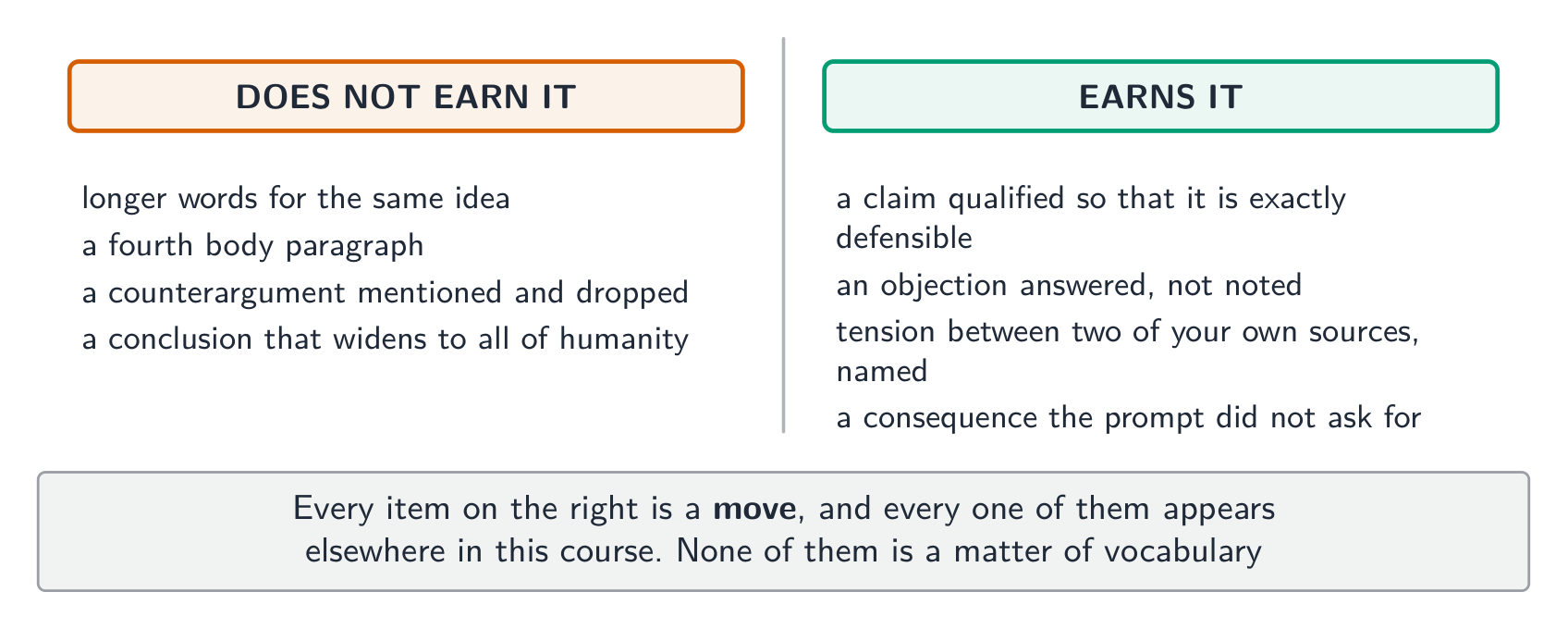
Cada elemento a la derecha es un movimiento enseñado en otra parte de este curso
Explore · ⁨Explorar⁩

Clasificar lo que obtiene el punto de sofisticación

Recompensa un conjunto específico de movimientos, todos enseñados en otra parte de este curso. Ninguno depende del vocabulario.

9.2

Exam tips · ⁨Consejos para el examen⁩

English
  • Concede, rebut, refute are three different claims. Do not use the words interchangeably.
  • Refute only with evidence of error. Without it, rebut instead - an alternative interpretation is almost always available.
  • Conceding raises credibility, by the CED's own statement. It is not a weakness.
  • After conceding, come back. An unreturned concession reads as agreement with the other side.
  • Use a transition that ranks the counterargument: the strongest objection to this is beats some people say.
  • When analysing a text, notice when it addresses no counterargument. That absence tells you who it was written for.
Español
  • Conceder, rebutir y refutar son tres afirmaciones diferentes. No uses las palabras indistintamente.
  • Refuta solo con evidencia de error. Sin ella, rebate; una interpretación alternativa casi siempre está disponible.
  • Conceder eleva la credibilidad, según la propia declaración del CED. No es una debilidad.
  • Después de conceder, vuelve. Una concesión a la que no se regresa se interpreta como acuerdo con la otra parte.
  • Usa una transición que jerarquice el contraargumento: la objeción más fuerte a esto es supera a algunas personas dicen.
  • Al analizar un texto, nota cuándo no aborda ningún contraargumento. Esa ausencia te dice para quién fue escrito.

Interactive lessons on this topic · ⁨Lecciones interactivas sobre este tema⁩

Work through it step by step, with instant-check exercises. · ⁨Trátalo paso a paso, con ejercicios de verificación instantánea.⁩

Past Papers · ⁨Exámenes Anteriores⁩

More topics in AP Lengua Inglesa y Composición · ⁨Más temas en AP Lengua Inglesa y Composición⁩

Log in or create account · ⁨Iniciar sesión o crear cuenta⁩

IGCSE, A-Level & AP