Writing a Thesis Statement
IntroducedThe cheapest point on the rubric
- One of the six points is for a defensible thesis responding to the prompt.
- It costs one sentence and no evidence.
- Students lose it by restating the prompt instead of taking a position.
Turning the prompt into a thesis is like answering “Which train?” with “The one that goes somewhere.”
It must require a defence
- Write a thesis that requires proof or defence.
- Apply the same test as always: could a reasonable person disagree?
- "There are arguments on both sides" fails the test — nobody disputes it.
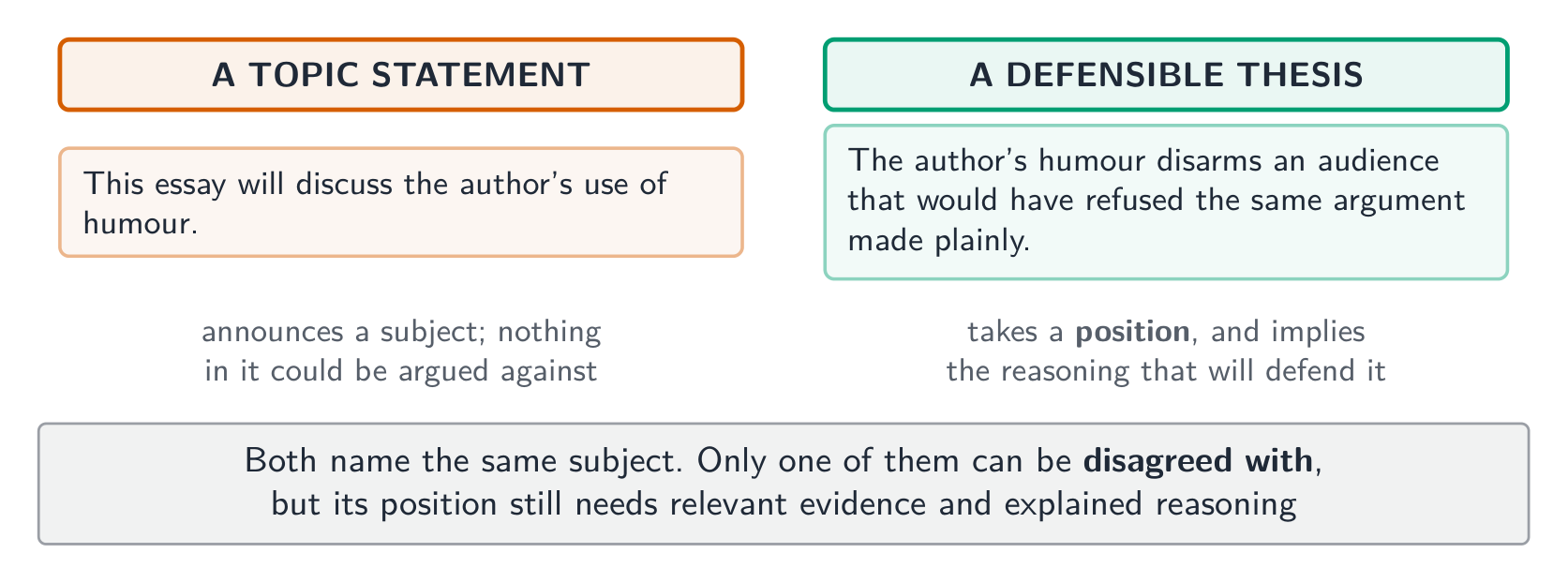
Same subject, and only one of them can be disagreed with
A thesis earns its rubric point when it...
Difficulty 1/5 · 100 coins + a small bonus on first completion today
It must be arguable; restating the prompt takes no position and earns nothing.
It may preview the reasoning
- A thesis may preview the structure of the argument to come.
- That is useful when the shape is genuinely load-bearing.
- It is optional — and a mechanical list of three reasons often produces a rigid essay.
A thesis must list the reasons the essay will give.
Difficulty 1/5 · 100 coins + a small bonus on first completion today
It may preview the reasoning; the CED says explicitly that it need not list reasons.
Restating the prompt is the single most common way to lose the thesis point. "There are arguments on both sides of this issue" takes no position, so there is nothing to defend and nothing to award.
Would this earn the thesis point?
Sort each opening by whether it takes a defensible position.
Select all the tests this lesson gives for a thesis.
Difficulty 2/5 · 140 coins + a small bonus on first completion today
Length is never a test; arguability, specificity and responsiveness are.
Match each thesis fault to its diagnosis.
Difficulty 2/5 · 140 coins + a small bonus on first completion today
Only the third takes a position specific enough to be defended.
Specific enough to constrain
- A thesis so broad that any paragraph could belong under it is not directing the essay.
- Test it: name a paragraph your thesis rules out.
- If you cannot, the thesis is not doing any work.
A thesis written ____ sketching your evidence is nearly always better.
Difficulty 1/5 · 100 coins + a small bonus on first completion today
There are no marks for having predicted your own conclusion.
Writing it under time pressure
- Read the sources or the prompt and sketch your claims before fixing the thesis.
- A thesis written after the evidence is nearly always better than one written before it.
- If the evidence does not fit the thesis, change the thesis — there are no marks for consistency with your first idea.
Weak: "There are many arguments for and against this practice." Strong: "Because the practice rewards visible effort rather than actual improvement, it produces the appearance of progress while removing the incentive to seek it." The second is arguable, specific, and previews the reasoning.
A thesis must require a defence — a reasonable person could disagree. It may preview the reasoning but need not list reasons. Make it specific enough to rule some paragraphs out, and write it after sketching your evidence.
Write from a thesis about 2 hours of homework
- One sentence says homework exists. Another says 2 hours of homework on weeknights costs too much sleep.
- Say which one can be a thesis.
Which sentence can be a thesis, and why? Sentence A says homework exists. Sentence B says 2 hours of homework on weeknights costs students enough sleep to hurt morning lessons.
A thesis has to be worth opposing.
Which sentence is a thesis?
Difficulty 1/5 · 100 coins + a small bonus on first completion today
Only the arguable sentence can organise an essay.