English
Learning Objective 2.1.A: Explain the relationship between the type of bonding and the properties of the elements participating in the bond.
- 2.1.A.1 Electronegativity values for the representative elements increase going from left to right across a period and decrease going down a group. These trends can be understood qualitatively through the electronic structure of the atoms, the shell model, and Coulomb's law.
- 2.1.A.2 Valence electrons shared between atoms of similar electronegativity constitute a nonpolar covalent bond. For example, bonds between carbon and hydrogen are effectively nonpolar even though carbon is slightly more electronegative than hydrogen.
- 2.1.A.3 Valence electrons shared between atoms of unequal electronegativity constitute a polar covalent bond.
- i. The atom with a higher electronegativity will develop a partial negative charge relative to the other atom in the bond.
- ii. In single bonds, greater differences in electronegativity lead to greater bond dipoles.
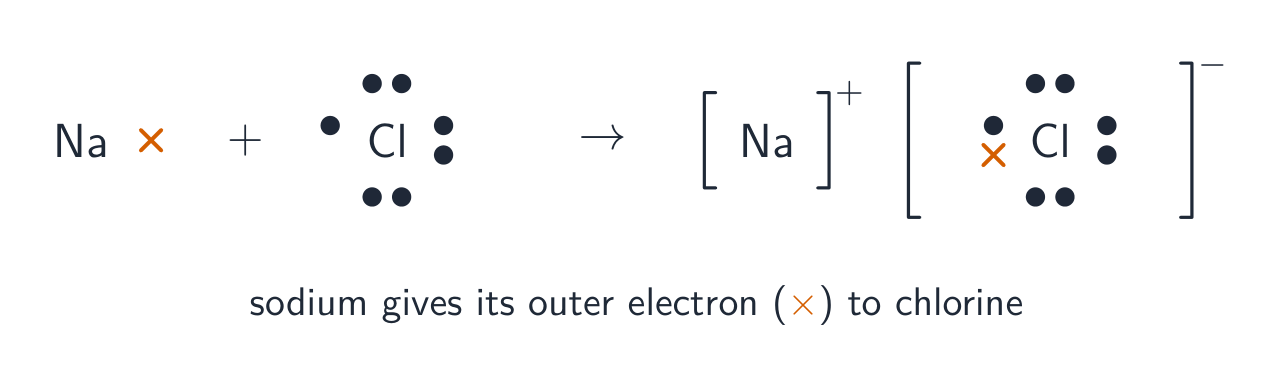
- iii. All polar bonds have some ionic character, and the difference between ionic and covalent bonding is not distinct but rather a continuum.
- 2.1.A.4 The difference in electronegativity is not the only factor in determining if a bond should be designated as ionic or covalent. Generally, bonds between a metal and nonmetal are ionic, and bonds between two nonmetals are covalent. Examination of the properties of a compound is the best way to characterize the type of bonding.
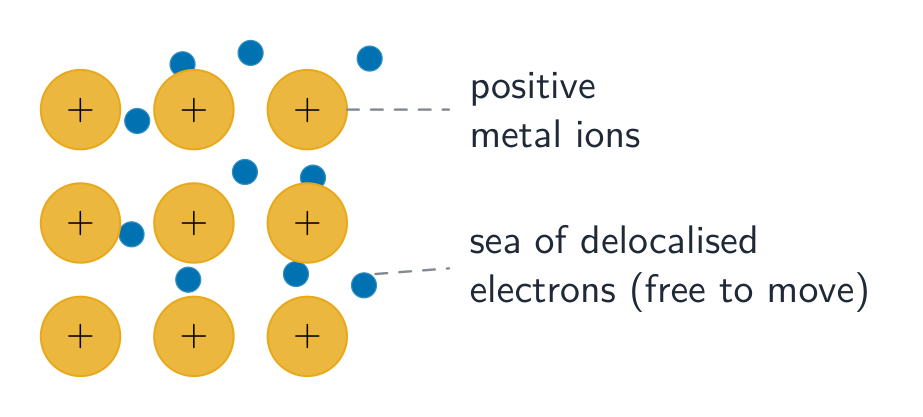
- 2.1.A.5 In a metallic solid, the valence electrons from the metal atoms are considered to be delocalized and not associated with any individual atom.
Español
Objetivo de Aprendizaje 2.1.A: Explicar la relación entre el tipo de enlace y las propiedades de los elementos que participan en el mismo.
- 2.1.A.1 Los valores de electronegatividad de los elementos representativos aumentan al moverse de izquierda a derecha a través de un período y disminuyen al descender por un grupo. Estas tendencias pueden comprenderse cualitativamente a través de la estructura electrónica de los átomos, el modelo de capas y la ley de Coulomb.
- 2.1.A.2 Los electrones de valencia compartidos entre átomos con electronegatividades similares constituyen un enlace covalente no polar. Por ejemplo, los enlaces entre carbono e hidrógeno son efectivamente no polares, aunque el carbono sea ligeramente más electronegativo que el hidrógeno.
- 2.1.A.3 Los electrones de valencia compartidos entre átomos con desigual electronegatividad constituyen un enlace covalente polar.
- i. El átomo con mayor electronegatividad desarrollará una carga parcial negativa en relación con el otro átomo del enlace.
- ii. En los enlaces simples, mayores diferencias en electronegatividad conducen a mayores dipolos de enlace.
- iii. Todos los enlaces polares tienen algo de carácter iónico, y la distinción entre enlace iónico y covalente no es nítida, sino más bien un continuo.
- 2.1.A.4 La diferencia en electronegatividad no es el único factor para determinar si un enlace debe designarse como iónico o covalente. Generalmente, los enlaces entre un metal y un no metal son iónicos, y los enlaces entre dos no metales son covalentes. El examen de las propiedades de un compuesto es la mejor manera de caracterizar el tipo de enlace.
- 2.1.A.5 En un sólido metálico, los electrones de valencia de los átomos metálicos se consideran deslocalizados y no asociados a ningún átomo individual.