Skip to content · ⁨Saltar al contenido⁩

Integración y acumulación de cambios

AP Cálculo BC · Topic 6 · ⁨Tema 6⁩

Train · ⁨Entrenar⁩
Video lesson for this topic · ⁨Lección de video para este tema⁩ Open the video page · ⁨Abrir la página de video⁩
10:02

Explorando Acumulaciones de Cambio

El agua fluye hacia un tanque. El medidor muestra litros por minuto. Esa es una tasa de cambio. Ahora, ¿cuánta agua llegó en los primeros diez minutos? Dibuja la tasa…

English narration · English + 中文 subtitles burned in · ⁨Narración en inglés · Subtítulos en inglés + 中文 quemados en pantalla⁩

6.1

Exploring Accumulations of Change · ⁨Explorando acumulaciones de cambio⁩

Syllabus
English

Enduring Understanding (CHA-4): Definite integrals allow us to solve problems involving the accumulation of change over an interval.

Learning Objective CHA-4.A: Interpret the meaning of areas associated with the graph of a rate of change in context.

  • CHA-4.A.1 The area of the region between the graph of a rate of change function and the $x$ axis gives the accumulation of change.
  • CHA-4.A.2 In some cases, accumulation of change can be evaluated by using geometry.
  • CHA-4.A.3 If a rate of change is positive (negative) over an interval, then the accumulated change is positive (negative).
  • CHA-4.A.4 The unit for the area of a region defined by rate of change is the unit for the rate of change multiplied by the unit for the independent variable.
Español

Comprensión perdurable (CHA-4): Las integrales definidas nos permiten resolver problemas que involucran la acumulación de cambio a lo largo de un intervalo.

Objetivo de aprendizaje CHA-4.A: Interpretar el significado de las áreas asociadas con la gráfica de una tasa de cambio en su contexto.

  • CHA-4.A.1 El área de la región entre la gráfica de una función de tasa de cambio y el eje $x$ representa la acumulación de cambio.
  • CHA-4.A.2 En algunos casos, la acumulación de cambio puede evaluarse utilizando geometría.
  • CHA-4.A.3 Si una tasa de cambio es positiva (negativa) sobre un intervalo, entonces el cambio acumulado es positivo (negativo).
  • CHA-4.A.4 La unidad para el área de una región definida por una tasa de cambio es la unidad de la tasa de cambio multiplicada por la unidad de la variable independiente.

Source: College Board AP Course and Exam Description · ⁨Fuente: College Board AP Course and Exam Description⁩

English

Where a derivative measures a rate, an integral 积分 measures an accumulation 累积 – a total built up from a rate. If a rate of change acts over an interval, the area between its graph and the axis gives the net accumulated change. This "area = total change" idea is the foundation of integral calculus.

Español
Un tanque de agua: la integración acumula el cambio: volumen total a partir de una tasa de flujo

Donde una derivada mide una tasa, una integral 积分 mide una acumulación 累积 – un total construido a partir de una tasa. Si una tasa de cambio actúa durante un intervalo, el área entre su gráfica y el eje da el cambio acumulado neto. Esta idea de "área = cambio total" es la base del cálculo integral.

Vocabulary · ⁨Vocabulario⁩ Train · ⁨Entrenar⁩
English · ⁨Inglés⁩ Chinese · ⁨Chino⁩ Pinyin
integral/ˈɪntɪɡrəl/ 积分 jī fēn
6.2

Approximating Areas with Riemann Sums · ⁨Aproximación de áreas con sumas de Riemann⁩

Syllabus
English

Enduring Understanding (LIM-5): Definite integrals can be approximated using geometric and numerical methods.

Learning Objective LIM-5.A: Approximate a definite integral using geometric and numerical methods.

  • LIM-5.A.1 Definite integrals can be approximated for functions that are represented graphically, numerically, analytically, and verbally.
  • LIM-5.A.2 Definite integrals can be approximated using a left Riemann sum, a right Riemann sum, a midpoint Riemann sum, or a trapezoidal sum; approximations can be computed using either uniform or nonuniform partitions.
  • LIM-5.A.3 Definite integrals can be approximated using numerical methods, with or without technology.
  • LIM-5.A.4 Depending on the behavior of a function, it may be possible to determine whether an approximation for a definite integral is an underestimate or overestimate for the value of the definite integral.
Español

Comprensión duradera (LIM-5): Las integrales definidas pueden aproximarse mediante métodos geométricos y numéricos.

Objetivo de aprendizaje LIM-5.A: Aproximar una integral definida utilizando métodos geométricos y numéricos.

  • LIM-5.A.1 Las integrales definidas pueden aproximarse para funciones que se representan gráficamente, numéricamente, analítica y verbalmente.
  • LIM-5.A.2 Las integrales definidas pueden aproximarse mediante una suma de Riemann izquierda, una suma de Riemann derecha, una suma de Riemann del punto medio o una suma trapezoidal; las aproximaciones pueden calcularse utilizando particiones uniformes o no uniformes.
  • LIM-5.A.3 Las integrales definidas pueden aproximarse mediante métodos numéricos, con o sin tecnología.
  • LIM-5.A.4 Dependiendo del comportamiento de una función, puede ser posible determinar si una aproximación para una integral definida es una subestimación o una sobreestimación del valor de la integral definida.

Source: College Board AP Course and Exam Description · ⁨Fuente: College Board AP Course and Exam Description⁩

English
The integral as area (Riemann sums)
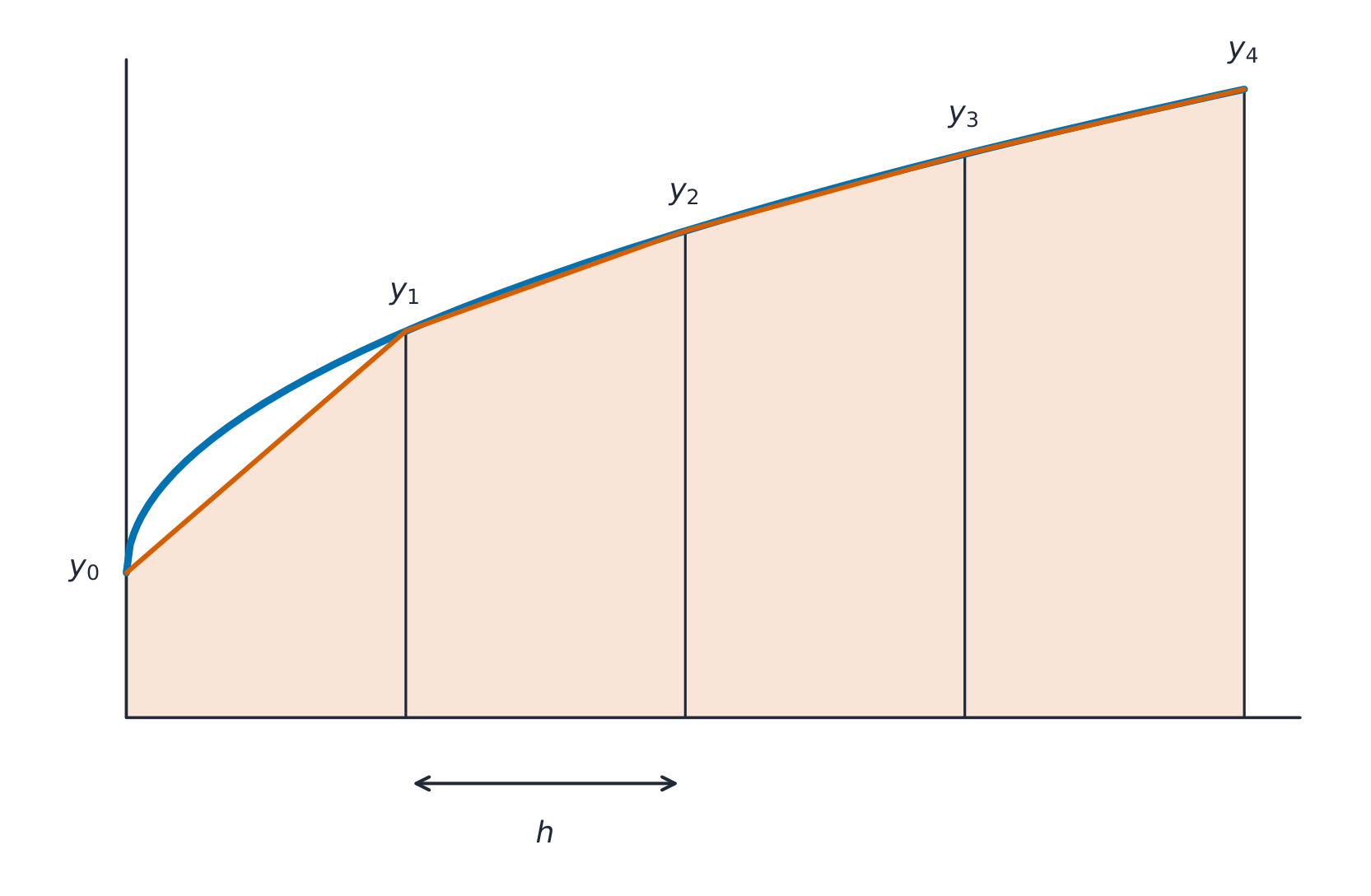
Trapezoidal sums approximate area

A Riemann sum 黎曼和 estimates the area under a curve by adding the areas of thin rectangles. Split $[a,b]$ into subintervals and use the function's height at the left endpoint, right endpoint, or midpoint of each. A trapezoidal sum 梯形法 uses trapezoids instead, averaging the two endpoint heights – usually more accurate. With more, thinner rectangles the estimate improves.

Exam skill: be able to compute left, right, midpoint, and trapezoidal estimates from a table or graph, and state whether each over- or under-estimates based on whether the function is increasing/decreasing or concave up/down.

Español
La integral como área (sumas de Riemann)
Las sumas trapezoidales aproximan el área

Una suma de Riemann 黎曼和 estima el área bajo una curva sumando las áreas de rectángulos finos. Divide $[a,b]$ en subintervalos y usa la altura de la función en el extremo izquierdo, extremo derecho, o punto medio de cada uno. Una suma trapezoidal 梯形法 usa trapecios en su lugar, promediando las dos alturas de los extremos – usualmente más precisa. Con más rectángulos más finos, la estimación mejora.

Una suma de Riemann aproxima el área bajo una curva con rectángulos
Tiras de ancho h aproximan el área bajo una curva

Habilidad de examen: debes ser capaz de calcular estimaciones izquierda, derecha, de punto medio y trapezoidal a partir de una tabla o gráfica, e indicar si cada una sobreestimó o subestimó basándose en si la función es creciente/decreciente o cóncava hacia arriba/abajo.

Explore · ⁨Explorar⁩

Aproximar el área con rectángulos

y = ax³ + bx² + cx + d

Una suma de Riemann aproxima el área bajo una curva con rectángulos. Añade más rectángulos, más delgados, y la estimación converge hacia el integral definido exacto.

Vocabulary · ⁨Vocabulario⁩ Train · ⁨Entrenar⁩
English · ⁨Inglés⁩ Chinese · ⁨Chino⁩ Pinyin
Riemann sum/ˈriːmən sʌm/ 黎曼和 lí màn hé
trapezoidal sum/ˈtræpɪzɔɪdl sʌm/ 梯形法 tī xíng fǎ
definite integral/ˈdefɪnət ˈɪntɪɡrəl/ 定积分 dìng jī fēn
6.3

Riemann Sums, Summation Notation, and Definite Integral Notation · ⁨Sumas de Riemann, Notación de Sumatoria y Notación de Integral Definida⁩

Syllabus
English

Enduring Understanding (LIM-5): Definite integrals can be approximated using geometric and numerical methods.

Learning Objective LIM-5.B: Interpret the limiting case of the Riemann sum as a definite integral.

  • LIM-5.B.1 The limit of an approximating Riemann sum can be interpreted as a definite integral.
  • LIM-5.B.2 A Riemann sum, which requires a partition of an interval $I$, is the sum of products, each of which is the value of the function at a point in a subinterval multiplied by the length of that subinterval of the partition.

Learning Objective LIM-5.C: Represent the limiting case of the Riemann sum as a definite integral.

  • LIM-5.C.1 The definite integral of a continuous function $f$ over the interval $[a, b]$, denoted by $\int_{a}^{b} f(x)\,dx$, is the limit of Riemann sums as the widths of the subintervals approach 0. That is, $\int_{a}^{b} f(x)\,dx = \lim_{\max \Delta x_i \to 0} \sum_{i=1}^{n} f(x_i^*)\Delta x_i$, where $n$ is the number of subintervals, $\Delta x_i$ is the width of the $i$th subinterval, and $x_i^*$ is a value in the $i$th subinterval.
  • LIM-5.C.2 A definite integral can be translated into the limit of a related Riemann sum, and the limit of a Riemann sum can be written as a definite integral.
Español

Comprensión Duradera (LIM-5): Las integrales definidas pueden aproximarse mediante métodos geométricos y numéricos.

Objetivo de Aprendizaje LIM-5.B: Interpretar el caso límite de la suma de Riemann como una integral definida.

  • LIM-5.B.1 El límite de una suma de Riemann aproximante puede interpretarse como una integral definida.
  • LIM-5.B.2 Una suma de Riemann, que requiere una partición de un intervalo $I$, es la suma de productos, cada uno de los cuales es el valor de la función en un punto de un subintervalo multiplicado por la longitud de dicho subintervalo de la partición.

Objetivo de Aprendizaje LIM-5.C: Representar el caso límite de la suma de Riemann como una integral definida.

  • LIM-5.C.1 La integral definida de una función continua $f$ sobre el intervalo $[a, b]$, denotada por $\int_{a}^{b} f(x)\,dx$, es el límite de las sumas de Riemann cuando los anchos de los subintervalos se acercan a 0. Es decir, $\int_{a}^{b} f(x)\,dx = \lim_{\max \Delta x_i \to 0} \sum_{i=1}^{n} f(x_i^*)\Delta x_i$, donde $n$ es el número de subintervalos, $\Delta x_i$ es el ancho del $i$-ésimo subintervalo y $x_i^*$ es un valor en el $i$-ésimo subintervalo.
  • LIM-5.C.2 Una integral definida puede traducirse al límite de una suma de Riemann relacionada, y el límite de una suma de Riemann puede escribirse como una integral definida.

Source: College Board AP Course and Exam Description · ⁨Fuente: College Board AP Course and Exam Description⁩

English

Writing a Riemann sum with summation notation $\sum_{k=1}^{n} f(x_k)\,\Delta x$ and letting the number of rectangles grow without bound gives the exact area – the definite integral 定积分:

$$\int_a^b f(x)\,dx=\lim_{n\to\infty}\sum_{k=1}^{n} f(x_k)\,\Delta x.$$
The integral is the limit of Riemann sums; $a$ and $b$ are the limits of integration.

Español

Escribir una suma de Riemann con notación de sumatoria $\sum_{k=1}^{n} f(x_k)\,\Delta x$ y dejar que el número de rectángulos crezca sin límite da el área exacta – la integral definida 定积分:

$$\int_a^b f(x)\,dx=\lim_{n\to\infty}\sum_{k=1}^{n} f(x_k)\,\Delta x.$$
La integral es el límite de sumas de Riemann; $a$ y $b$ son los límites de integración.

6.4

The Fundamental Theorem of Calculus and Accumulation Functions · ⁨El Teorema Fundamental del Cálculo y Funciones de Acumulación⁩

Syllabus
English

Enduring Understanding (FUN-5): The Fundamental Theorem of Calculus connects differentiation and integration.

Learning Objective FUN-5.A: Represent accumulation functions using definite integrals.

  • FUN-5.A.1 The definite integral can be used to define new functions.
    • Illustrative examples for FUN-5.A.1: $f(x) = \int_{0}^{x} e^{-t^2}\,dt$.
  • FUN-5.A.2 If $f$ is a continuous function on an interval containing $a$, then $\dfrac{d}{dx}\left( \int_{a}^{x} f(t)\,dt \right) = f(x)$, where $x$ is in the interval.
Español

Comprensión Duradera (FUN-5): El Teorema Fundamental del Cálculo conecta la diferenciación con la integración.

Objetivo de Aprendizaje FUN-5.A: Representar funciones de acumulación mediante integrales definidas.

  • FUN-5.A.1 La integral definida puede utilizarse para definir nuevas funciones.
    • Ejemplos ilustrativos para FUN-5.A.1: $f(x) = \int_{0}^{x} e^{-t^2}\,dt$.
  • FUN-5.A.2 Si $f$ es una función continua en un intervalo que contiene a $a$, entonces $\dfrac{d}{dx}\left( \int_{a}^{x} f(t)\,dt \right) = f(x)$, donde $x$ pertenece al intervalo.

Source: College Board AP Course and Exam Description · ⁨Fuente: College Board AP Course and Exam Description⁩

English
The Fundamental Theorem of Calculus

An accumulation function 累积函数 $g(x)=\int_a^x f(t)\,dt$ gives the accumulated area from $a$ up to $x$. The Fundamental Theorem of Calculus (FTC) 微积分基本定理 says its derivative is the integrand:

$$\frac{d}{dx}\int_a^x f(t)\,dt=f(x).$$
Differentiation and integration are inverse operations. With a variable upper limit and the chain rule, $\dfrac{d}{dx}\int_a^{u(x)} f(t)\,dt=f(u(x))\,u'(x)$.

Español
El Teorema Fundamental del Cálculo

Una función de acumulación 累积函数 $g(x)=\int_a^x f(t)\,dt$ da el área acumulada desde $a$ hasta $x$. El Teorema Fundamental del Cálculo (FTC) 微积分基本定理 dice que su derivada es el integrando:

$$\frac{d}{dx}\int_a^x f(t)\,dt=f(x).$$
La diferenciación y la integración son operaciones inversas. Con un límite superior variable y la regla de la cadena, $\dfrac{d}{dx}\int_a^{u(x)} f(t)\,dt=f(u(x))\,u'(x)$.

La función de acumulación añade área firmada; el FTC dice que su derivada es f
Explore · ⁨Explorar⁩

Acumular el área como una integral

y = ax³ + bx² + cx + d

Una función de acumulación $\int_a^x f(t)\,dt$ construye área firmada a medida que $x$ se mueve. El Teorema Fundamental dice que su derivada es simplemente $f(x)$.

Vocabulary · ⁨Vocabulario⁩ Train · ⁨Entrenar⁩
English · ⁨Inglés⁩ Chinese · ⁨Chino⁩ Pinyin
accumulation/əˌkjuːmjʊˈleɪʃn/ 累积 lěi jī
accumulation function/əˌkjuːmjʊˈleɪʃn ˈfʌŋkʃn/ 累积函数 lěi jī hán shù
Fundamental Theorem of Calculus (FTC)/ˌfʌndəˈmentl ˈθɪərəm ɒv ˈkælkjʊləs/ 微积分基本定理 wēi jī fēn jī běn dìng lǐ
antiderivative/ˌæntɪdɪˈrɪvətɪv/ 原函数 yuán hán shù
indefinite integral/ɪnˈdefɪnət ˈɪntɪɡrəl/ 不定积分 bù dìng jī fēn
u-substitution/juː ˌsʌbstɪˈtjuːʃn/ 换元积分 huàn yuán jī fēn
Integration by parts/ˌɪntɪˈɡreɪʃn baɪ pɑːts/ 分部积分 fēn bù jī fēn
Partial fractions/ˈpɑːʃl ˈfrækʃnz/ 部分分式 bù fèn fēn shì
6.5

Interpreting the Behavior of Accumulation Functions · ⁨Interpretación del Comportamiento de las Funciones de Acumulación⁩

Syllabus
English

Enduring Understanding (FUN-5): The Fundamental Theorem of Calculus connects differentiation and integration.

Learning Objective FUN-5.A: Represent accumulation functions using definite integrals.

  • FUN-5.A.3 Graphical, numerical, analytical, and verbal representations of a function $f$ provide information about the function $g$ defined as $g(x) = \int_{a}^{x} f(t)\,dt$.
Español

Comprensión duradera (FUN-5): El Teorema Fundamental del Cálculo conecta la diferenciación y la integración.

Objetivo de aprendizaje FUN-5.A: Representar funciones de acumulación mediante integrales definidas.

  • FUN-5.A.3 Las representaciones gráficas, numéricas, analíticas y verbales de una función $f$ proporcionan información sobre la función $g$ definida como $g(x) = \int_{a}^{x} f(t)\,dt$.

Source: College Board AP Course and Exam Description · ⁨Fuente: College Board AP Course and Exam Description⁩

English

Because $g'(x)=f(x)$, the graph of $f$ tells you everything about $g$: $g$ increases where $f>0$, decreases where $f<0$, has extrema where $f$ crosses zero, and is concave up where $f$ is increasing. Reading these connections off a graph of $f$ is a classic free-response task.

Español

Porque $g'(x)=f(x)$, la gráfica de $f$ te dice todo sobre $g$: $g$ aumenta donde $f>0$, disminuye donde $f<0$, tiene extremos donde $f$ cruza cero, y es cóncava hacia arriba donde $f$ es creciente. Leer estas conexiones fuera de una gráfica de $f$ es una tarea clásica de respuesta libre.

6.6

Applying Properties of Definite Integrals · ⁨Aplicación de Propiedades de Integrales Definidas⁩

Syllabus
English

Enduring Understanding (FUN-6): Recognizing opportunities to apply knowledge of geometry and mathematical rules can simplify integration.

Learning Objective FUN-6.A: Calculate a definite integral using areas and properties of definite integrals.

  • FUN-6.A.1 In some cases, a definite integral can be evaluated by using geometry and the connection between the definite integral and area.
  • FUN-6.A.2 Properties of definite integrals include the integral of a constant times a function, the integral of the sum of two functions, reversal of limits of integration, and the integral of a function over adjacent intervals.
  • FUN-6.A.3 The definition of the definite integral may be extended to functions with removable or jump discontinuities.
Español

Comprensión Duradera (FUN-6): Reconocer oportunidades para aplicar conocimientos de geometría y reglas matemáticas puede simplificar la integración.

Objetivo de Aprendizaje FUN-6.A: Calcular una integral definida utilizando áreas y propiedades de las integrales definidas.

  • FUN-6.A.1 En algunos casos, una integral definida puede evaluarse utilizando geometría y la relación entre la integral definida y el área.
  • FUN-6.A.2 Las propiedades de las integrales definidas incluyen la integral de una constante por una función, la integral de la suma de dos funciones, la inversión de los límites de integración y la integral de una función sobre intervalos adyacentes.
  • FUN-6.A.3 La definición de la integral definida puede extenderse a funciones con discontinuidades evitables o de salto.

Source: College Board AP Course and Exam Description · ⁨Fuente: College Board AP Course and Exam Description⁩

English

Definite integrals obey useful rules: reversing the limits negates the value ($\int_b^a=-\int_a^b$), an integral over a zero-width interval is $0$, they add over adjacent intervals ($\int_a^c=\int_a^b+\int_b^c$), and constants factor out. Use these to combine or split given integral values.

Español

Las integrales definidas obedecen reglas útiles: invertir los límites niega el valor ($\int_b^a=-\int_a^b$), una integral sobre un intervalo de ancho cero es $0$, se suman sobre intervalos adyacentes ($\int_a^c=\int_a^b+\int_b^c$), y las constantes se factorizan. Usa esto para combinar o dividir valores integrales dados.

6.7

The Fundamental Theorem of Calculus and Definite Integrals · ⁨El Teorema Fundamental del Cálculo y las Integrales Definidas⁩

Syllabus
English

Enduring Understanding (FUN-6): Recognizing opportunities to apply knowledge of geometry and mathematical rules can simplify integration.

Learning Objective FUN-6.B: Evaluate definite integrals analytically using the Fundamental Theorem of Calculus.

  • FUN-6.B.1 An antiderivative of a function $f$ is a function $g$ whose derivative is $f$.
  • FUN-6.B.2 If a function $f$ is continuous on an interval containing $a$, the function defined by $F(x) = \int_{a}^{x} f(t)\,dt$ is an antiderivative of $f$ for $x$ in the interval.
  • FUN-6.B.3 If $f$ is continuous on the interval $[a, b]$ and $F$ is an antiderivative of $f$, then $\int_{a}^{b} f(x)\,dx = F(b) - F(a)$.
Español

Comprensión Duradera (FUN-6): Reconocer oportunidades para aplicar conocimientos de geometría y reglas matemáticas puede simplificar la integración.

Objetivo de Aprendizaje FUN-6.B: Evaluar integrales definidas analíticamente usando el Teorema Fundamental del Cálculo.

  • FUN-6.B.1 Una antiderivada de una función $f$ es una función $g$ cuya derivada es $f$.
  • FUN-6.B.2 Si una función $f$ es continua en un intervalo que contiene a $a$, la función definida por $F(x) = \int_{a}^{x} f(t)\,dt$ es una antiderivada de $f$ para $x$ en el intervalo.
  • FUN-6.B.3 Si $f$ es continua en el intervalo $[a, b]$ y $F$ es una antiderivada de $f$, entonces $\int_{a}^{b} f(x)\,dx = F(b) - F(a)$.

Source: College Board AP Course and Exam Description · ⁨Fuente: College Board AP Course and Exam Description⁩

English

The evaluation form of the FTC computes a definite integral from an antiderivative 原函数 $F$ (where $F'=f$):

$$\int_a^b f(x)\,dx=F(b)-F(a).$$
So integrating a rate of change over $[a,b]$ gives the net change in the quantity – the single most-used result in the course.

Worked example. $\displaystyle\int_1^3 (2x+1)\,dx$: an antiderivative is $F(x)=x^2+x$, so the value is $F(3)-F(1)=12-2=10$.

Español

La forma de evaluación del FTC calcula una integral definida a partir de una antiderivada 原函数 $F$ (donde $F'=f$):

$$\int_a^b f(x)\,dx=F(b)-F(a).$$
Así que integrar una tasa de cambio sobre $[a,b]$ da el cambio neto en la cantidad – el resultado más usado en el curso.

Ejemplo resuelto. $\displaystyle\int_1^3 (2x+1)\,dx$: una antiderivada es $F(x)=x^2+x$, así que el valor es $F(3)-F(1)=12-2=10$.

Una integral definida es el área firmada entre la curva y el eje x
6.8

Finding Antiderivatives and Indefinite Integrals · ⁨Encontrar Antiderivadas e Integrales Indefinidas⁩

Syllabus
English

Enduring Understanding (FUN-6): Recognizing opportunities to apply knowledge of geometry and mathematical rules can simplify integration.

Learning Objective FUN-6.C: Determine antiderivatives of functions and indefinite integrals, using knowledge of derivatives.

  • FUN-6.C.1 $\int f(x)\,dx$ is an indefinite integral of the function $f$ and can be expressed as $\int f(x)\,dx = F(x) + C$, where $F'(x) = f(x)$ and $C$ is any constant.
  • FUN-6.C.2 Differentiation rules provide the foundation for finding antiderivatives.
  • FUN-6.C.3 Many functions do not have closed-form antiderivatives.
Español

Comprensión perdurable (FUN-6): Reconocer oportunidades para aplicar conocimientos de geometría y reglas matemáticas puede simplificar la integración.

Objetivo de aprendizaje FUN-6.C: Determinar antiderivadas de funciones e integrales indefinidas, utilizando el conocimiento de las derivadas.

  • FUN-6.C.1 $\int f(x)\,dx$ es una integral indefinida de la función $f$ y se puede expresar como $\int f(x)\,dx = F(x) + C$, donde $F'(x) = f(x)$ y $C$ es cualquier constante.
  • FUN-6.C.2 Las reglas de diferenciación proporcionan la base para encontrar antiderivadas.
  • FUN-6.C.3 Muchas funciones no poseen antiderivadas en forma cerrada.

Source: College Board AP Course and Exam Description · ⁨Fuente: College Board AP Course and Exam Description⁩

English

An indefinite integral 不定积分 $\int f(x)\,dx=F(x)+C$ is the family of all antiderivatives (hence the constant of integration $C$). Reverse each derivative rule: the power rule becomes $\int x^n\,dx=\dfrac{x^{n+1}}{n+1}+C$ (for $n\neq-1$), with $\int \frac1x\,dx=\ln|x|+C$, and the antiderivatives of $e^x$, $\sin x$, $\cos x$, and $\sec^2 x$ come straight from their derivatives.

Español

Una integral indefinida 不定积分 $\int f(x)\,dx=F(x)+C$ es la familia de todas las antiderivadas (de ahí la constante de integración $C$). Invierte cada regla de derivación: la regla de potencia se convierte en $\int x^n\,dx=\dfrac{x^{n+1}}{n+1}+C$ (para $n\neq-1$), con $\int \frac1x\,dx=\ln|x|+C$, y las antiderivadas de $e^x$, $\sin x$, $\cos x$, y $\sec^2 x$ vienen directamente de sus derivadas.

6.9

Integrating Using Substitution · ⁨Integración por Sustitución⁩

Syllabus
English

Enduring Understanding (FUN-6): Recognizing opportunities to apply knowledge of geometry and mathematical rules can simplify integration.

Learning Objective FUN-6.D: For integrands requiring substitution or rearrangements into equivalent forms: (a) Determine indefinite integrals. (b) Evaluate definite integrals.

  • FUN-6.D.1 Substitution of variables is a technique for finding antiderivatives.
  • FUN-6.D.2 For a definite integral, substitution of variables requires corresponding changes to the limits of integration.
Español

Comprensión duradera (FUN-6): Reconocer oportunidades para aplicar conocimientos de geometría y reglas matemáticas puede simplificar la integración.

Objetivo de aprendizaje FUN-6.D: Para los integrandos que requieren sustitución o reordenamientos en formas equivalentes: (a) Determinar integrales indefinidas. (b) Evaluar integrales definidas.

  • FUN-6.D.1 La sustitución de variables es una técnica para encontrar primitivas.
  • FUN-6.D.2 Para una integral definida, la sustitución de variables requiere cambios correspondientes en los límites de integración.

Source: College Board AP Course and Exam Description · ⁨Fuente: College Board AP Course and Exam Description⁩

English

u-substitution 换元积分 reverses the chain rule: choose $u=g(x)$ so that $g'(x)$ also appears, turning $\int f(g(x))g'(x)\,dx$ into $\int f(u)\,du$. Remember to convert $dx$ to $du$ and, for a definite integral, either change the limits to $u$-values or convert back to $x$ at the end.

Español

sustitución u 换元积分 invierte la regla de la cadena: elige $u=g(x)$ de modo que también aparezca $g'(x)$, transformando $\int f(g(x))g'(x)\,dx$ en $\int f(u)\,du$. Recuerda convertir $dx$ a $du$ y, para una integral definida, cambia los límites a valores $u$ o vuelve a $x$ al final.

6.10

Integrating Using Long Division and Completing the Square · ⁨Integración mediante división larga y completado del cuadrado⁩

Syllabus
English

Enduring Understanding (FUN-6): Recognizing opportunities to apply knowledge of geometry and mathematical rules can simplify integration.

Learning Objective FUN-6.D: For integrands requiring substitution or rearrangements into equivalent forms: (a) Determine indefinite integrals. (b) Evaluate definite integrals.

  • FUN-6.D.3 Techniques for finding antiderivatives include rearrangements into equivalent forms, such as long division and completing the square.
Español

Comprensión duradera (FUN-6): Reconocer oportunidades para aplicar conocimientos de geometría y reglas matemáticas puede simplificar la integración.

Objetivo de aprendizaje FUN-6.D: Para integrandos que requieren sustitución o reordenamientos en formas equivalentes: (a) Determinar integrales indefinidas. (b) Evaluar integrales definidas.

  • FUN-6.D.3 Las técnicas para encontrar primitivas incluyen reordenamientos en formas equivalentes, tales como la división larga y completar el cuadrado.

Source: College Board AP Course and Exam Description · ⁨Fuente: College Board AP Course and Exam Description⁩

English

When a rational integrand is "top-heavy" (numerator degree $\ge$ denominator degree), long division rewrites it as a polynomial plus a proper fraction you can integrate. Completing the square in a denominator turns it into a form like $u^2+a^2$, leading to an arctangent antiderivative $\frac1a\arctan\frac{u}{a}+C$.

Español

Cuando un integrando racional es "demasiado pesado" (grado del numerador $\ge$ grado del denominador), la división larga lo reescribe como un polinomio más una fracción propia que puedes integrar. El completado del cuadrado en un denominador lo convierte en una forma como $u^2+a^2$, lo que lleva a una antiderivada arcotangente $\frac1a\arctan\frac{u}{a}+C$.

6.11

Integrating Using Integration by Parts · ⁨Integración por partes⁩

Syllabus
English

Enduring Understanding (FUN-6): Recognizing opportunities to apply knowledge of geometry and mathematical rules can simplify integration.

Learning Objective FUN-6.E: For integrands requiring integration by parts: (a) Determine indefinite integrals. BC ONLY (b) Evaluate definite integrals. BC ONLY

  • FUN-6.E.1 Integration by parts is a technique for finding antiderivatives. BC ONLY
Español

Comprensión perdurable (FUN-6): Reconocer oportunidades para aplicar conocimientos de geometría y reglas matemáticas puede simplificar la integración.

Objetivo de aprendizaje FUN-6.E: Para los integrandos que requieren integración por partes: (a) Determinar integrales indefinidas. SOLO BC (b) Evaluar integrales definidas. SOLO BC

  • FUN-6.E.1 La integración por partes es una técnica para encontrar antiderivadas. SOLO BC

Source: College Board AP Course and Exam Description · ⁨Fuente: College Board AP Course and Exam Description⁩

English

Integration by parts 分部积分 reverses the product rule:

$$\int u\,dv = uv-\int v\,du.$$
Choose $u$ to simplify when differentiated and $dv$ to be easy to integrate (the LIATE guide: logs, inverse-trig, algebraic, trig, exponential). It handles products like $\int x e^x\,dx$ and $\int x\ln x\,dx$, sometimes applied twice.

Worked example. For $\int x e^x\,dx$, choose $u=x$ ($du=dx$) and $dv=e^x\,dx$ ($v=e^x$):

$$\int x e^x\,dx = x e^x-\int e^x\,dx = x e^x - e^x + C = e^x(x-1)+C.$$

Español

La integración por partes 分部积分 invierte la regla del producto:

$$\int u\,dv = uv-\int v\,du.$$
Elige $u$ para simplificar cuando se diferencie y $dv$ para que sea fácil de integrar (la guía LIATE: logaritmos, trigonométricas inversas, algebraicas, trigonométricas, exponenciales). Maneja productos como $\int x e^x\,dx$ y $\int x\ln x\,dx$, a veces aplicándola dos veces.

Ejemplo resuelto. Para $\int x e^x\,dx$, elige $u=x$ ($du=dx$) y $dv=e^x\,dx$ ($v=e^x$):

$$\int x e^x\,dx = x e^x-\int e^x\,dx = x e^x - e^x + C = e^x(x-1)+C.$$

6.12

Integrating Using Linear Partial Fractions · ⁨Integración mediante fracciones parciales lineales⁩

Syllabus
English

Enduring Understanding (FUN-6): Recognizing opportunities to apply knowledge of geometry and mathematical rules can simplify integration.

Learning Objective FUN-6.F: For integrands requiring integration by linear partial fractions: (a) Determine indefinite integrals. BC ONLY (b) Evaluate definite integrals. BC ONLY

  • FUN-6.F.1 Some rational functions can be decomposed into sums of ratios of linear, nonrepeating factors to which basic integration techniques can be applied. BC ONLY
Español

Comprensión perdurable (FUN-6): Reconocer oportunidades para aplicar conocimientos de geometría y reglas matemáticas puede simplificar la integración.

Objetivo de aprendizaje FUN-6.F: Para los integrandos que requieren integración por fracciones parciales lineales: (a) Determinar integrales indefinidas. SOLO BC (b) Evaluar integrales definidas. SOLO BC

  • FUN-6.F.1 Algunas funciones racionales se pueden descomponer en sumas de cocientes de factores lineales no repetidos a los cuales se pueden aplicar técnicas básicas de integración. SOLO BC

Source: College Board AP Course and Exam Description · ⁨Fuente: College Board AP Course and Exam Description⁩

English

Partial fractions 部分分式 split a rational function with a factorable denominator into a sum of simpler fractions:

$$\frac{1}{(x-a)(x-b)}=\frac{A}{x-a}+\frac{B}{x-b},$$
each of which integrates to a logarithm. This technique is essential for the logistic differential equation in the next unit.

Español

Las fracciones parciales 部分分式 dividen una función racional con un denominador factorizable en una suma de fracciones más simples:

$$\frac{1}{(x-a)(x-b)}=\frac{A}{x-a}+\frac{B}{x-b},$$
cada una de las cuales se integra como un logaritmo. Esta técnica es esencial para la ecuación diferencial logística en la siguiente unidad.

6.13

Evaluating Improper Integrals · ⁨Evaluación de integrales impropias⁩

Syllabus
English

Enduring Understanding (LIM-6): The use of limits allows us to show that the areas of unbounded regions may be finite.

Learning Objective LIM-6.A: Evaluate an improper integral or determine that the integral diverges. BC ONLY

  • LIM-6.A.1 An improper integral is an integral that has one or both limits infinite or has an integrand that is unbounded in the interval of integration. BC ONLY
  • LIM-6.A.2 Improper integrals can be determined using limits of definite integrals. BC ONLY
Español

Comprensión duradera (LIM-6): El uso de límites nos permite demostrar que las áreas de regiones no acotadas pueden ser finitas.

Objetivo de aprendizaje LIM-6.A: Evaluar una integral impropia o determinar que la integral diverge. SOLO BC

  • LIM-6.A.1 Una integral impropia es una integral que tiene uno o ambos límites infinitos, o bien un integrando que no está acotado en el intervalo de integración. SOLO BC
  • LIM-6.A.2 Las integrales impropias se pueden determinar mediante límites de integrales definidas. SOLO BC

Source: College Board AP Course and Exam Description · ⁨Fuente: College Board AP Course and Exam Description⁩

English
Improper integrals: converge or diverge

An improper integral 反常积分 has an infinite limit of integration or an infinite discontinuity in the integrand. Evaluate it as a limit: $\int_a^\infty f\,dx=\lim_{b\to\infty}\int_a^b f\,dx$. If the limit is a finite number the integral converges 收敛; otherwise it diverges 发散.

Worked example. $\displaystyle\int_1^\infty \frac{1}{x^2}\,dx=\lim_{b\to\infty}\left[-\frac1x\right]_1^b=\lim_{b\to\infty}\left(1-\frac1b\right)=1$, so it converges to $1$. By contrast $\int_1^\infty \frac1x\,dx$ gives $\lim_{b\to\infty}\ln b=\infty$ and diverges – the same integrand-shape can go either way.

Español
Integrales impropias: convergen o divergen

Una integral impropia 反常积分 tiene un límite infinito de integración o una discontinuidad infinita en el integrando. Evalúala como un límite: $\int_a^\infty f\,dx=\lim_{b\to\infty}\int_a^b f\,dx$. Si el límite es un número finito, la integral converge 收敛; de lo contrario, diverge 发散.

Ejemplo resuelto. $\displaystyle\int_1^\infty \frac{1}{x^2}\,dx=\lim_{b\to\infty}\left[-\frac1x\right]_1^b=\lim_{b\to\infty}\left(1-\frac1b\right)=1$, por lo tanto converge a $1$. Por el contrario, $\int_1^\infty \frac1x\,dx$ da $\lim_{b\to\infty}\ln b=\infty$ y diverge – la misma forma del integrando puede ir en cualquier dirección.

Vocabulary · ⁨Vocabulario⁩ Train · ⁨Entrenar⁩
English · ⁨Inglés⁩ Chinese · ⁨Chino⁩ Pinyin
improper integral/ɪmˈprɒpə ˈɪntɪɡrəl/ 反常积分 fǎn cháng jī fēn
converges/kənˈvɜːdʒɪz/ 收敛 shōu liǎn
diverges/daɪˈvɜːdʒɪz/ 发散 fā sàn
6.14

Selecting Techniques for Antidifferentiation · ⁨Selección de Técnicas para la Antidiferenciación⁩

Syllabus
English

This topic is intended to focus on the skill of selecting an appropriate procedure for antidifferentiation. Students should be given opportunities to practice when and how to apply all learning objectives relating to antidifferentiation.

Español

Este tema está destinado a centrarse en la habilidad de seleccionar un procedimiento adecuado para la antiderivación. Se debe brindar a los estudiantes oportunidades para practicar cuándo y cómo aplicar todos los objetivos de aprendizaje relacionados con la antiderivación.

Source: College Board AP Course and Exam Description · ⁨Fuente: College Board AP Course and Exam Description⁩

English

The BC exam expects you to recognize which method fits: basic rules, substitution (a chain-rule pattern), by parts (a product), partial fractions (a factorable rational), or long division/completing the square. Being able to look at an integral and pick the right tool quickly is itself a tested skill.

Español

El examen BC espera que reconozcas qué método corresponde: reglas básicas, sustitución (un patrón de la regla de la cadena), por partes (un producto), fracciones parciales (una racional factorizable) o división larga/completado del cuadrado. Ser capaz de mirar una integral y elegir la herramienta correcta rápidamente es en sí mismo una habilidad evaluada.

6.14

Exam tips · ⁨Consejos para el examen⁩

English
  • Integration is antidifferentiation; use the power rule $\int x^n\,dx=\tfrac{x^{n+1}}{n+1}+C$ and don't forget the $+C$.
  • The Fundamental Theorem links the two: $\int_a^b f'(x)\,dx=f(b)-f(a)$, and $\tfrac{d}{dx}\int_a^x f(t)\,dt=f(x)$.
  • Approximate a definite integral with Riemann sums or the trapezoidal rule from a table of values.
  • A definite integral is a signed area (below the axis counts negative); split at sign changes for total area.
  • Use u-substitution and remember to change the limits (or back-substitute) accordingly.
Español
  • La integración es antidiferenciación; usa la regla de potencia $\int x^n\,dx=\tfrac{x^{n+1}}{n+1}+C$ y no olvides el $+C$.
  • El Teorema Fundamental conecta los dos: $\int_a^b f'(x)\,dx=f(b)-f(a)$, y $\tfrac{d}{dx}\int_a^x f(t)\,dt=f(x)$.
  • Aproxima una integral definida con sumas de Riemann o la regla trapezoidal a partir de una tabla de valores.
  • Una integral definida es un área firmada (por debajo del eje cuenta como negativa); divide en cambios de signo para el área total.
  • Usa sustitución u y recuerda cambiar los límites (o back-substitute) en consecuencia.

Interactive lessons on this topic · ⁨Lecciones interactivas sobre este tema⁩

Work through it step by step, with instant-check exercises. · ⁨Trátalo paso a paso, con ejercicios de verificación instantánea.⁩

Past Papers · ⁨Exámenes Anteriores⁩

More topics in AP Cálculo BC · ⁨Más temas en AP Cálculo BC⁩

Log in or create account · ⁨Iniciar sesión o crear cuenta⁩

IGCSE, A-Level & AP