Skip to content · ⁨Saltar al contenido⁩

Aplicaciones analíticas de la diferenciación

AP Cálculo BC · Topic 5 · ⁨Tema 5⁩

Train · ⁨Entrenar⁩
Video lesson for this topic · ⁨Lección de video para este tema⁩ Open the video page · ⁨Abrir la página de video⁩
9:33

Uso del Teorema del Valor Medio

Conduces doscientos kilómetros en dos horas. Tu velocidad promedio fue de cien kilómetros por hora. Ahora aquí hay una afirmación. En algún momento durante ese viaje…

English narration · English + 中文 subtitles burned in · ⁨Narración en inglés · Subtítulos en inglés + 中文 quemados en pantalla⁩

5.1

Uso del Teorema del Valor Medio

Syllabus
English

Enduring Understanding (FUN-1): Existence theorems allow us to draw conclusions about a function's behavior on an interval without precisely locating that behavior.

Learning Objective FUN-1.B: Justify conclusions about functions by applying the Mean Value Theorem over an interval.

  • FUN-1.B.1 If a function $f$ is continuous over the interval $[a, b]$ and differentiable over the interval $(a, b)$, then the Mean Value Theorem guarantees a point within that open interval where the instantaneous rate of change equals the average rate of change over the interval.
Español

Comprensión Duradera (FUN-1): Los teoremas de existencia nos permiten extraer conclusiones sobre el comportamiento de una función en un intervalo sin precisar su ubicación exacta.

Objetivo de Aprendizaje FUN-1.B: Justificar conclusiones sobre funciones aplicando el Teorema del Valor Medio en un intervalo.

  • FUN-1.B.1 Si una función $f$ es continua en el intervalo $[a, b]$ y diferenciable en el intervalo $(a, b)$, entonces el Teorema del Valor Medio garantiza la existencia de un punto dentro de ese intervalo abierto donde la tasa de cambio instantánea es igual a la tasa de cambio promedio en el intervalo.

Source: College Board AP Course and Exam Description · ⁨Fuente: College Board AP Course and Exam Description⁩

English
The Mean Value Theorem

The Mean Value Theorem 中值定理 (MVT) links the average rate of change to an instantaneous one:

If $f$ is continuous on $[a,b]$ and differentiable on $(a,b)$, then there is at least one point $c$ in $(a,b)$ where

$$f'(c) = \frac{f(b)-f(a)}{b-a}.$$

In words: somewhere inside the interval, the instantaneous rate equals the average rate. Geometrically, some tangent line is parallel to the line joining the endpoints.

Exam skill. Like the IVT, the MVT is an existence theorem, and questions ask you to justify. Full credit needs: (1) state $f$ is continuous on $[a,b]$ and differentiable on $(a,b)$; (2) compute the average rate $\frac{f(b)-f(a)}{b-a}$; (3) conclude "by the MVT there is a $c$ in $(a,b)$ with $f'(c)$ equal to that value." Both hypotheses must be named.

Worked example. For $f(x)=x^2$ on $[1,3]$ the average rate is $\dfrac{9-1}{2}=4$; setting $f'(c)=2c=4$ gives $c=2$, which lies in $(1,3)$ – the guaranteed point.

Español
The Mean Value Theorem

El Teorema del Valor Medio (TVM) vincula la tasa de cambio promedio con una instantánea:

Si $f$ es continua en $[a,b]$ y diferenciable en $(a,b)$, entonces existe al menos un punto $c$ en $(a,b)$ donde

$$f'(c) = \frac{f(b)-f(a)}{b-a}.$$

En palabras: en algún lugar dentro del intervalo, la tasa instantánea es igual a la tasa promedio. Geométricamente, alguna línea tangente es paralela a la línea que une los extremos.

El Teorema del Valor Medio: alguna tangente es paralela a la secante sobre el intervalo

Habilidad de examen. Al igual que el TVI, el TVM es un teorema de existencia, y las preguntas te piden justificar. Para obtener la puntuación completa necesitas: (1) declarar que $f$ es continua en $[a,b]$ y diferenciable en $(a,b)$; (2) calcular la tasa promedio $\frac{f(b)-f(a)}{b-a}$; (3) concluir "por el TVM existe un $c$ en $(a,b)$ con $f'(c)$ igual a ese valor". Ambas hipótesis deben ser nombradas.

Ejemplo resuelto. Para $f(x)=x^2$ en $[1,3]$ la tasa promedio es $\dfrac{9-1}{2}=4$; establecer $f'(c)=2c=4$ da $c=2$, que yace en $(1,3)$ – el punto garantizado.

Explore · ⁨Explorar⁩

El Teorema del Valor Medio en acción

y = ax³ + bx² + cx + d

El Teorema del Valor Medio garantiza un punto donde la tangente es paralela a la secante a través de un intervalo — la tasa instantánea es igual a la tasa promedio en algún lugar dentro.

Vocabulary · ⁨Vocabulario⁩ Train · ⁨Entrenar⁩
English · ⁨Inglés⁩ Chinese · ⁨Chino⁩ Pinyin
Mean Value Theorem/miːn ˈvæljuː ˈθɪərəm/ 中值定理 zhōng zhí dìng lǐ
Extreme Value Theorem/ekˈstriːm ˈvæljuː ˈθɪərəm/ 极值定理 jí zhí dìng lǐ
critical point/ˈkrɪtɪkl pɔɪnt/ 临界点 lín jiè diǎn
local (relative) extrema/ˈləʊkl ekˈstremə/ 局部极值 jú bù jí zhí
5.2

Extreme Values, Global vs Local Extrema, and Critical Points

Syllabus
English

Enduring Understanding (FUN-1): Existence theorems allow us to draw conclusions about a function's behavior on an interval without precisely locating that behavior.

Learning Objective FUN-1.C: Justify conclusions about functions by applying the Extreme Value Theorem.

  • FUN-1.C.1 If a function $f$ is continuous over the interval $(a, b)$, then the Extreme Value Theorem guarantees that $f$ has at least one minimum value and at least one maximum value on $[a, b]$.
  • FUN-1.C.2 A point on a function where the first derivative equals zero or fails to exist is a critical point of the function.
  • FUN-1.C.3 All local (relative) extrema occur at critical points of a function, though not all critical points are local extrema.
Español

Comprensión Duradera (FUN-1): Los teoremas de existencia nos permiten sacar conclusiones sobre el comportamiento de una función en un intervalo sin localizar con precisión dicho comportamiento.

Objetivo de Aprendizaje FUN-1.C: Justificar conclusiones sobre funciones aplicando el Teorema del Valor Extremo.

  • FUN-1.C.1 Si una función $f$ es continua en el intervalo $(a, b)$, entonces el Teorema del Valor Extremo garantiza que $f$ tiene al menos un valor mínimo y al menos un valor máximo en $[a, b]$.
  • FUN-1.C.2 Un punto de una función donde la primera derivada es igual a cero o no existe es un punto crítico de la función.
  • FUN-1.C.3 Todos los extremos locales (relativos) ocurren en puntos críticos de una función, aunque no todos los puntos críticos son extremos locales.

Source: College Board AP Course and Exam Description · ⁨Fuente: College Board AP Course and Exam Description⁩

English

The Extreme Value Theorem 极值定理 (EVT) guarantees extremes exist: a function continuous on a closed interval $[a,b]$ attains both an absolute maximum and an absolute minimum on it.

A critical point 临界点 is an interior point where $f'(x)=0$ or $f'(x)$ does not exist. All local (relative) extrema 局部极值 occur at critical points – but not every critical point is an extremum. So critical points are the candidates; you must test each.

Español
La cima de una montaña: los extremos y los puntos críticos marcan los valores más altos y más bajos

El Teorema del Valor Extremo (TVE) garantiza que existen extremos: una función continua en un intervalo cerrado $[a,b]$ alcanza tanto un máximo absoluto como un mínimo absoluto en él.

En un máximo o mínimo la derivada es cero

Un punto crítico es un punto interior donde $f'(x)=0$ o $f'(x)$ no existe. Todos los extremos locales (relativos) ocurren en puntos críticos, pero no todos los puntos críticos son extremos. Por lo tanto, los puntos críticos son los candidatos; debe probar cada uno.

5.3

Where a Function Increases or Decreases

Syllabus
English

Enduring Understanding (FUN-4): A function's derivative can be used to understand some behaviors of the function.

Learning Objective FUN-4.A: Justify conclusions about the behavior of a function based on the behavior of its derivatives.

  • FUN-4.A.1 The first derivative of a function can provide information about the function and its graph, including intervals where the function is increasing or decreasing.
Español

Comprensión duradera (FUN-4): La derivada de una función puede utilizarse para comprender algunos comportamientos de la función.

Objetivo de aprendizaje FUN-4.A: Justificar conclusiones sobre el comportamiento de una función basándose en el comportamiento de sus derivadas.

  • FUN-4.A.1 La primera derivada de una función puede proporcionar información sobre la función y su gráfica, incluyendo los intervalos en los que la función es creciente o decreciente.

Source: College Board AP Course and Exam Description · ⁨Fuente: College Board AP Course and Exam Description⁩

English

The first derivative tells you where $f$ rises or falls:

  • $f'(x) > 0$ on an interval $\Rightarrow$ $f$ is increasing 递增 there;
  • $f'(x) < 0$ $\Rightarrow$ $f$ is decreasing 递减.

On the exam, "find the intervals where $f$ is increasing" means: find the critical points, then test the sign of $f'$ between them, and justify with the sign of $f'$ (a stated reason, not just an interval).

Español

La primera derivada indica dónde $f$ sube o baja:

  • $f'(x) > 0$ on an interval $\Rightarrow$ $f$ is increasing there;
  • $f'(x) < 0$ $\Rightarrow$ $f$ is decreasing.

En el examen, "encuentra los intervalos donde $f$ es creciente" significa: encuentra los puntos críticos, luego prueba el signo de $f'$ entre ellos, y justifica con el signo de $f'$ (una razón explícita, no solo un intervalo).

Vocabulary · ⁨Vocabulario⁩ Train · ⁨Entrenar⁩
English · ⁨Inglés⁩ Chinese · ⁨Chino⁩ Pinyin
increasing/ɪnˈkriːsɪŋ/ 递增 dì zēng
decreasing/ˈdiːkriːsɪŋ/ 递减 dì jiǎn
5.4

The First Derivative Test for Local Extrema

Syllabus
English

Enduring Understanding (FUN-4): A function's derivative can be used to understand some behaviors of the function.

Learning Objective FUN-4.A: Justify conclusions about the behavior of a function based on the behavior of its derivatives.

  • FUN-4.A.2 The first derivative of a function can determine the location of relative (local) extrema of the function.
Español

Comprensión Duradera (FUN-4): La derivada de una función puede utilizarse para comprender ciertos comportamientos de dicha función.

Objetivo de Aprendizaje FUN-4.A: Justificar conclusiones sobre el comportamiento de una función en base al comportamiento de sus derivadas.

  • FUN-4.A.2 La primera derivada de una función puede determinar la ubicación de los extremos relativos (locales) de la función.

Source: College Board AP Course and Exam Description · ⁨Fuente: College Board AP Course and Exam Description⁩

English

To classify a critical point $x=c$ as a local max, local min, or neither, check how $f'$ changes sign there:

  • $f'$ changes $+$ to $-$ at $c$ $\Rightarrow$ local maximum 极大值;
  • $f'$ changes $-$ to $+$ at $c$ $\Rightarrow$ local minimum 极小值;
  • $f'$ does not change sign $\Rightarrow$ neither.

Always state the sign change as your justification.

Worked example. For $f(x)=x^3-3x^2$, $f'(x)=3x(x-2)$ is zero at $x=0,2$. Signs give $+,-,+$, so $x=0$ is a local maximum ($f=0$) and $x=2$ a local minimum ($f=-4$).

Español

Para clasificar un punto crítico $x=c$ como máximo local, mínimo local o ninguno, verificar cómo cambia $f'$ de signo allí:

  • $f'$ changes $+$ to $-$ at $c$ $\Rightarrow$ local maximum;
  • $f'$ changes $-$ to $+$ at $c$ $\Rightarrow$ local minimum;
  • $f'$ does not change sign $\Rightarrow$ neither.

Always state the sign change as your justification.

Ejemplo resuelto. Para $f(x)=x^3-3x^2$, $f'(x)=3x(x-2)$ es cero en $x=0,2$. Los signos dan $+,-,+$, por lo que $x=0$ es un máximo local ($f=0$) y $x=2$ un mínimo local ($f=-4$).

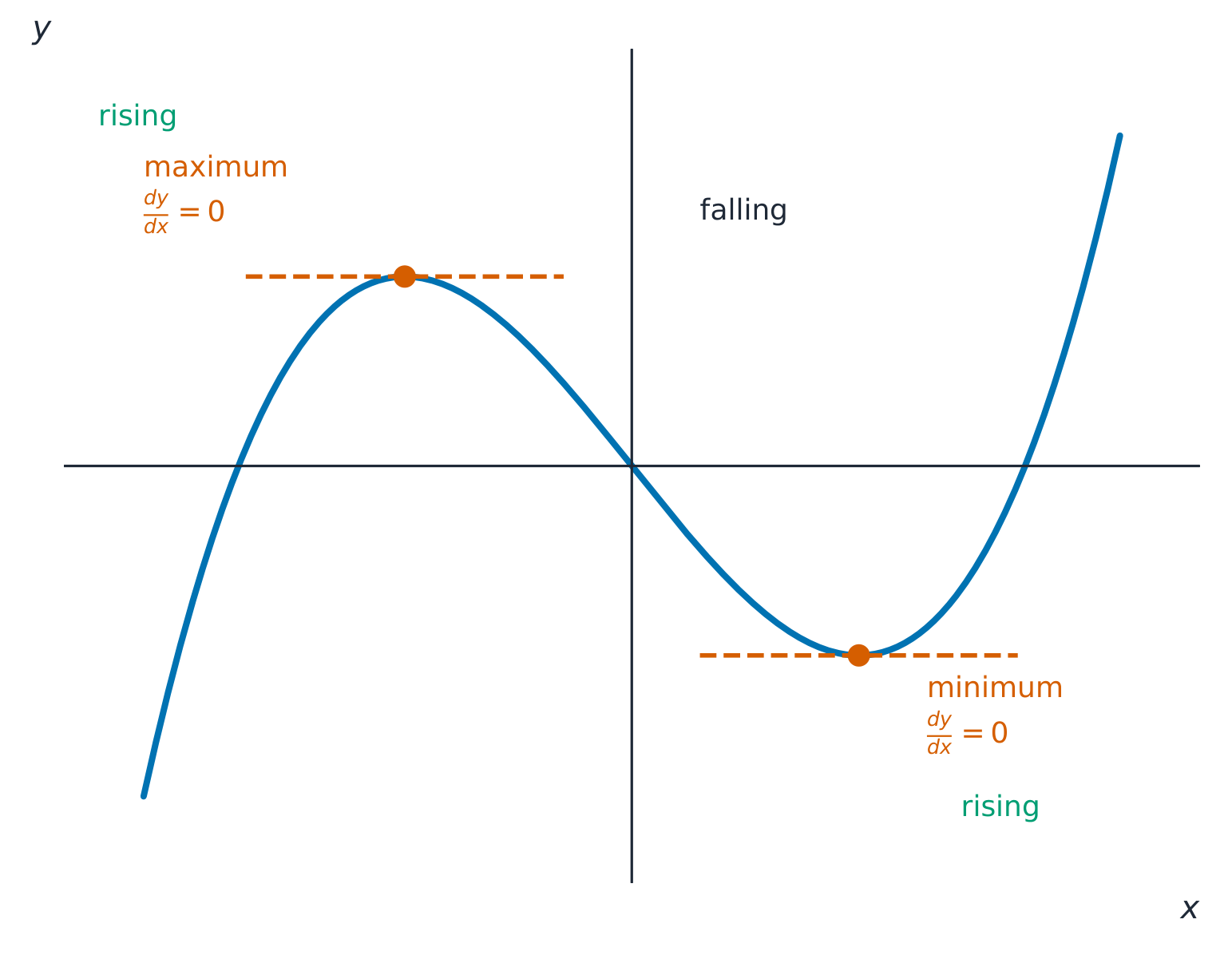
El signo de f-prima establece dónde una función aumenta o disminuye y localiza sus extremos locales
Donde $f' > 0$ la gráfica sube y donde $f' < 0$ baja; un máximo local se sitúa donde $f'$ pasa de $+$ a $-$, un mínimo local donde pasa de $-$ a $+$.
Vocabulary · ⁨Vocabulario⁩ Train · ⁨Entrenar⁩
English · ⁨Inglés⁩ Chinese · ⁨Chino⁩ Pinyin
local maximum/ˈləʊkl ˈmæksɪməm/ 极大值 jí dà zhí
local minimum/ˈləʊkl ˈmɪnɪməm/ 极小值 jí xiǎo zhí
5.5

The Candidates Test for Absolute Extrema

Syllabus
English

Enduring Understanding (FUN-4): A function's derivative can be used to understand some behaviors of the function.

Learning Objective FUN-4.A: Justify conclusions about the behavior of a function based on the behavior of its derivatives.

  • FUN-4.A.3 Absolute (global) extrema of a function on a closed interval can only occur at critical points or at endpoints.
Español

Comprensión Duradera (FUN-4): La derivada de una función puede utilizarse para comprender ciertos comportamientos de la función.

Objetivo de Aprendizaje FUN-4.A: Justificar conclusiones sobre el comportamiento de una función basándose en el comportamiento de sus derivadas.

  • FUN-4.A.3 Los extremos absolutos (globales) de una función en un intervalo cerrado solo pueden ocurrir en puntos críticos o en los extremos del intervalo.

Source: College Board AP Course and Exam Description · ⁨Fuente: College Board AP Course and Exam Description⁩

English

On a closed interval, absolute (global) extrema occur only at critical points or endpoints. The candidates test:

  1. List all critical points in $[a,b]$ and the two endpoints.
  2. Evaluate $f$ at each candidate.
  3. The largest output is the absolute maximum; the smallest is the absolute minimum.

Show the table of values – the comparison is the argument.

Español

En un intervalo cerrado, los extremos absolutos (globales) ocurren solo en puntos críticos o extremos. La prueba de candidatos:

  1. Listar todos los puntos críticos en $[a,b]$ y los dos extremos.
  2. Evaluate $f$ at each candidate.
  3. La salida más grande es el máximo absoluto; la más pequeña es el mínimo absoluto.

Muestra la tabla de valores: la comparación es el argumento.

5.6

Concavity and Points of Inflection

Syllabus
English

Enduring Understanding (FUN-4): A function's derivative can be used to understand some behaviors of the function.

Learning Objective FUN-4.A: Justify conclusions about the behavior of a function based on the behavior of its derivatives.

  • FUN-4.A.4 The graph of a function is concave up (down) on an open interval if the function's derivative is increasing (decreasing) on that interval.
  • FUN-4.A.5 The second derivative of a function provides information about the function and its graph, including intervals of upward or downward concavity.
  • FUN-4.A.6 The second derivative of a function may be used to locate points of inflection for the graph of the original function.
Español

Comprensión Duradera (FUN-4): La derivada de una función puede utilizarse para comprender ciertos comportamientos de la función.

Objetivo de Aprendizaje FUN-4.A: Justificar conclusiones sobre el comportamiento de una función basándose en el comportamiento de sus derivadas.

  • FUN-4.A.4 La gráfica de una función es cóncava hacia arriba (hacia abajo) en un intervalo abierto si la derivada de la función es creciente (decreciente) en dicho intervalo.
  • FUN-4.A.5 La segunda derivada de una función proporciona información sobre la función y su gráfica, incluidos los intervalos de concavidad hacia arriba o hacia abajo.
  • FUN-4.A.6 La segunda derivada de una función puede utilizarse para localizar puntos de inflexión en la gráfica de la función original.

Source: College Board AP Course and Exam Description · ⁨Fuente: College Board AP Course and Exam Description⁩

English

The second derivative describes bending:

  • $f'' > 0$ $\Rightarrow$ $f$ is concave up 上凹 (curving like a cup; $f'$ is increasing);
  • $f'' < 0$ $\Rightarrow$ $f$ is concave down 下凹 ($f'$ is decreasing).

A point of inflection 拐点 is where concavity changes, i.e. where $f''$ changes sign (not merely where $f''=0$). Report its $x$-coordinate and justify with the sign change of $f''$.

Español

The second derivative describes bending:

  • $f'' > 0$ $\Rightarrow$ $f$ es cóncava hacia arriba (curvándose como una taza; $f'$ es creciente);
  • $f'' < 0$ $\Rightarrow$ $f$ is concave down ($f'$ is decreasing).

Un punto de inflexión es donde la concavidad cambia, es decir, donde $f''$ cambia de signo (no simplemente donde $f''=0$). Informe su coordenada $x$ y justifique con el cambio de signo de $f''$.

La concavidad proviene del signo de la segunda derivada; cambia en un punto de inflexión
Explore · ⁨Explorar⁩

Encontrar dónde cambia la concavidad

y = ax³ + bx² + cx + d

Concavidad es el signo de la segunda derivada: cóncava hacia arriba donde la curva retiene agua, cóncava hacia abajo donde se derrama. Un punto de inflexión es donde cambia.

Vocabulary · ⁨Vocabulario⁩ Train · ⁨Entrenar⁩
English · ⁨Inglés⁩ Chinese · ⁨Chino⁩ Pinyin
concave down/kɒnˈkeɪv daʊn/ 下凹 xià āo
point of inflection/pɔɪnt ɒv ɪnˈflekʃn/ 拐点 guǎi diǎn
5.7

The Second Derivative Test for Extrema

Syllabus
English

Enduring Understanding (FUN-4): A function's derivative can be used to understand some behaviors of the function.

Learning Objective FUN-4.A: Justify conclusions about the behavior of a function based on the behavior of its derivatives.

  • FUN-4.A.7 The second derivative of a function may determine whether a critical point is the location of a relative (local) maximum or minimum.
  • FUN-4.A.8 When a continuous function has only one critical point on an interval on its domain and the critical point corresponds to a relative (local) extremum of the function on the interval, then that critical point also corresponds to the absolute (global) extremum of the function on the interval.
Español

Comprensión Duradera (FUN-4): La derivada de una función puede utilizarse para comprender algunos comportamientos de la función.

Objetivo de Aprendizaje FUN-4.A: Justificar conclusiones sobre el comportamiento de una función basándose en el comportamiento de sus derivadas.

  • FUN-4.A.7 La segunda derivada de una función puede determinar si un punto crítico es la ubicación de un máximo o mínimo relativo (local).
  • FUN-4.A.8 Cuando una función continua tiene solo un punto crítico en un intervalo de su dominio y dicho punto crítico corresponde a un extremo relativo (local) de la función en ese intervalo, entonces ese punto crítico también corresponde al extremo absoluto (global) de la función en el intervalo.

Source: College Board AP Course and Exam Description · ⁨Fuente: College Board AP Course and Exam Description⁩

English

An alternative way to classify a critical point $c$ where $f'(c)=0$:

  • $f''(c) > 0$ $\Rightarrow$ concave up $\Rightarrow$ local minimum;
  • $f''(c) < 0$ $\Rightarrow$ concave down $\Rightarrow$ local maximum;
  • $f''(c) = 0$ $\Rightarrow$ the test is inconclusive – fall back on the first derivative test.

Special case: if a continuous function has only one critical point on an interval and it is a local extremum, that point is also the absolute extremum there.

Español

Una alternativa para clasificar un punto crítico $c$ donde $f'(c)=0$:

  • $f''(c) > 0$ $\Rightarrow$ concave up $\Rightarrow$ local minimum;
  • $f''(c) < 0$ $\Rightarrow$ concave down $\Rightarrow$ local maximum;
  • $f''(c) = 0$ $\Rightarrow$ la prueba es inconclusa; volver a la prueba de la primera derivada.

Caso especial: si una función continua tiene solo un punto crítico en un intervalo y es un extremo local, ese punto también es el absoluto extremo allí.

Vocabulary · ⁨Vocabulario⁩ Train · ⁨Entrenar⁩
English · ⁨Inglés⁩ Chinese · ⁨Chino⁩ Pinyin
concave up/kɒnˈkeɪv ʌp/ 上凹 shàng āo
5.8

Sketching a Function and Its Derivative

Syllabus
English

Enduring Understanding (FUN-4): A function's derivative can be used to understand some behaviors of the function.

Learning Objective FUN-4.A: Justify conclusions about the behavior of a function based on the behavior of its derivatives.

  • FUN-4.A.9 Key features of functions and their derivatives can be identified and related to their graphical, numerical, and analytical representations.
  • FUN-4.A.10 Graphical, numerical, and analytical information from $f'$ and $f''$ can be used to predict and explain the behavior of $f$.
Español

Comprensión Duradera (FUN-4): La derivada de una función puede utilizarse para comprender ciertos comportamientos de dicha función.

Objetivo de Aprendizaje FUN-4.A: Justificar conclusiones sobre el comportamiento de una función basándose en el comportamiento de sus derivadas.

  • FUN-4.A.9 Las características clave de las funciones y sus derivadas pueden identificarse y relacionarse con sus representaciones gráfica, numérica y analítica.
  • FUN-4.A.10 La información gráfica, numérica y analítica obtenida de $f'$ y $f''$ puede emplearse para predecir y explicar el comportamiento de $f$.

Source: College Board AP Course and Exam Description · ⁨Fuente: College Board AP Course and Exam Description⁩

English

Key features of $f$, $f'$, and $f''$ mirror each other. To sketch or read graphs:

  • $f$ increasing $\Leftrightarrow$ $f'$ above the axis; $f$ has a local max $\Leftrightarrow$ $f'$ crosses from $+$ to $-$.
  • $f$ concave up $\Leftrightarrow$ $f'$ increasing $\Leftrightarrow$ $f''$ above the axis; $f$ has an inflection point $\Leftrightarrow$ $f'$ has a local extremum $\Leftrightarrow$ $f''$ crosses zero.
Español

Las características clave de $f$, $f'$ y $f''$ se reflejan mutuamente. Para dibujar o leer gráficos:

  • $f$ creciente $\Leftrightarrow$ $f'$ sobre el eje; $f$ tiene un máximo local $\Leftrightarrow$ $f'$ cruza de $+$ a $-$.
  • $f$ cóncava hacia arriba $\Leftrightarrow$ $f'$ creciente $\Leftrightarrow$ $f''$ sobre el eje; $f$ tiene un punto de inflexión $\Leftrightarrow$ $f'$ tiene un extremo local $\Leftrightarrow$ $f''$ cruza cero.
5.9

Connecting $f$, $f'$, and $f''$

Syllabus
English

Enduring Understanding (FUN-4): A function's derivative can be used to understand some behaviors of the function.

Learning Objective FUN-4.A: Justify conclusions about the behavior of a function based on the behavior of its derivatives.

  • FUN-4.A.11 Key features of the graphs of $f$, $f'$, and $f''$ are related to one another.
Español

Comprensión duradera (FUN-4): La derivada de una función puede utilizarse para comprender ciertos comportamientos de la función.

Objetivo de aprendizaje FUN-4.A: Justificar conclusiones sobre el comportamiento de una función basándose en el comportamiento de sus derivadas.

  • FUN-4.A.11 Las características clave de las gráficas de $f$, $f'$ y $f''$ están relacionadas entre sí.

Source: College Board AP Course and Exam Description · ⁨Fuente: College Board AP Course and Exam Description⁩

English

This is the skill of reading one graph to describe another. A very common exam setup gives the graph of $f'$ and asks about $f$: where is $f$ increasing (where $f'>0$), where are $f$'s extrema (where $f'$ crosses zero, with a sign change), where is $f$ concave up (where $f'$ is increasing). Answer questions about $f$ using the height and slope of the $f'$ graph.

Español

Esta es la habilidad de leer una gráfica para describir otra. Una configuración de examen muy común proporciona la gráfica de $f'$ y pregunta sobre $f$: ¿dónde es creciente $f$ (donde $f'>0$), dónde están los extremos de $f$ (donde $f'$ cruza cero, con un cambio de signo), dónde es cóncava hacia arriba $f$ (donde $f'$ es creciente)? Responde las preguntas sobre $f$ usando la altura y la pendiente de la gráfica de $f'$.

Explore · ⁨Explorar⁩

Leer pendiente y curvatura a partir del gráfico

y = ax³ + bx² + cx + d

Donde $f'>0$ la función crece; donde $f''>0$ se curva hacia arriba. Deslice la tangente para conectar la forma de $f$ con los signos de sus primeras y segundas derivadas.

5.10

Introducción a problemas de optimización

Syllabus
English

Enduring Understanding (FUN-4): A function's derivative can be used to understand some behaviors of the function.

Learning Objective FUN-4.B: Calculate minimum and maximum values in applied contexts or analysis of functions.

  • FUN-4.B.1 The derivative can be used to solve optimization problems; that is, finding a minimum or maximum value of a function on a given interval.
Español

Comprensión perdurable (FUN-4): La derivada de una función puede utilizarse para comprender ciertos comportamientos de dicha función.

Objetivo de aprendizaje FUN-4.B: Calcular valores mínimos y máximos en contextos aplicados o en el análisis de funciones.

  • FUN-4.B.1 La derivada puede emplearse para resolver problemas de optimización; es decir, para encontrar un valor mínimo o máximo de una función en un intervalo dado.

Source: College Board AP Course and Exam Description · ⁨Fuente: College Board AP Course and Exam Description⁩

English
Optimisation: the best box

Optimization 最优化 uses the derivative to find the largest or smallest value of a quantity on an interval. It is the candidates/derivative-test machinery applied to a real goal.

Español
Optimisation: the best box

La optimización utiliza la derivada para encontrar el valor más grande o más pequeño de una cantidad en un intervalo. Es la maquinaria de candidatos/prueba de derivada aplicada a un objetivo real.

Cercas cerradas: la optimización encuentra las dimensiones que maximizan el área para una longitud fija de cerca
Fenced enclosures: optimization finds the dimensions that maximize area for a fixed fence length
Vocabulary · ⁨Vocabulario⁩ Train · ⁨Entrenar⁩
English · ⁨Inglés⁩ Chinese · ⁨Chino⁩ Pinyin
Optimization/ˌɒptɪmaɪˈzeɪʃn/ 最优化 zuì yōu huà
5.11

Resolviendo Problemas de Optimización

Syllabus
English

Enduring Understanding (FUN-4): A function's derivative can be used to understand some behaviors of the function.

Learning Objective FUN-4.C: Interpret minimum and maximum values calculated in applied contexts.

  • FUN-4.C.1 Minimum and maximum values of a function take on specific meanings in applied contexts.
Español

Comprensión duradera (FUN-4): La derivada de una función puede utilizarse para comprender ciertos comportamientos de la misma.

Objetivo de aprendizaje FUN-4.C: Interpretar los valores mínimos y máximos calculados en contextos aplicados.

  • FUN-4.C.1 Los valores mínimo y máximo de una función adquieren significados específicos en contextos aplicados.

Source: College Board AP Course and Exam Description · ⁨Fuente: College Board AP Course and Exam Description⁩

English

A dependable procedure:

  1. Write the quantity to optimize as a function of one variable (use a constraint equation to eliminate extras).
  2. State the interval of allowed inputs.
  3. Find critical points ($f'=0$ or undefined) and test them (first- or second-derivative test, or candidates test if the interval is closed).
  4. Answer the question asked, with units and interpretation in context – the maximum area, the minimum cost, etc.

Worked example. With $100\ \text{m}$ of fence for a rectangular pen against a wall (only three sides fenced), let the ends be $x$ and the far side $y=100-2x$. The area $A(x)=x(100-2x)=100x-2x^2$ has $A'(x)=100-4x=0$ at $x=25$; since $A''=-4<0$ this is the maximum, giving $y=50$ and $A=1250\ \text{m}^2$.

Español

A dependable procedure:

  1. Escriba la cantidad a optimizar como función de una variable (utilice una ecuación de restricción para eliminar los términos adicionales).
  2. State the interval of allowed inputs.
  3. Encuentre los puntos críticos ($f'=0$ o no definidos) y pruébelos (prueba de la primera o segunda derivada, o prueba de candidatos si el intervalo es cerrado).
  4. Responde la pregunta formulada, con unidades e interpretación en contexto: el máximo área, el mínimo costo, etc.

Ejemplo resuelto. Con $100\ \text{m}$ de valla para un corral rectangular contra una pared (solo tres lados vallados), deja que los extremos sean $x$ y el lado lejano $y=100-2x$. El área $A(x)=x(100-2x)=100x-2x^2$ tiene $A'(x)=100-4x=0$ en $x=25$; dado que $A''=-4<0$ esto es el máximo, dando $y=50$ y $A=1250\ \text{m}^2$.

5.12

Explorando Comportamientos de Relaciones Implícitas

Syllabus
English

Enduring Understanding (FUN-4): A function's derivative can be used to understand some behaviors of the function.

Learning Objective FUN-4.D: Determine critical points of implicit relations.

  • FUN-4.D.1 A point on an implicit relation where the first derivative equals zero or does not exist is a critical point of the function.

Learning Objective FUN-4.E: Justify conclusions about the behavior of an implicitly defined function based on evidence from its derivatives.

  • FUN-4.E.1 Applications of derivatives can be extended to implicitly defined functions.
  • FUN-4.E.2 Second derivatives involving implicit differentiation may be relations of $x$, $y$, and $\dfrac{dy}{dx}$.
Español

Comprensión Duradera (FUN-4): La derivada de una función puede utilizarse para comprender ciertos comportamientos de la misma.

Objetivo de Aprendizaje FUN-4.D: Determinar puntos críticos de relaciones implícitas.

  • FUN-4.D.1 Un punto en una relación implícita donde la primera derivada es igual a cero o no existe, constituye un punto crítico de la función.

Objetivo de Aprendizaje FUN-4.E: Justificar conclusiones sobre el comportamiento de una función definida implícitamente basándose en evidencia de sus derivadas.

  • FUN-4.E.1 Las aplicaciones de las derivadas pueden extenderse a funciones definidas implícitamente.
  • FUN-4.E.2 Las segundas derivadas que involucran diferenciación implícita pueden ser relaciones de $x$, $y$ y $\dfrac{dy}{dx}$.

Source: College Board AP Course and Exam Description · ⁨Fuente: College Board AP Course and Exam Description⁩

English

All of this extends to implicitly defined relations. A critical point of an implicit relation is where $\dfrac{dy}{dx}=0$ (horizontal tangent) or is undefined (vertical tangent). Because $\dfrac{dy}{dx}$ is usually a relation in $x$ and $y$, and the second derivative involves $x$, $y$, and $\dfrac{dy}{dx}$, substitute your first-derivative expression back in when finding $\dfrac{d^2y}{dx^2}$, then reason about concavity from its sign.

Español

Todo esto se extiende a relaciones definidas implícitamente. Un punto crítico de una relación implícita es donde $\dfrac{dy}{dx}=0$ (tangente horizontal) o es indefinido (tangente vertical). Dado que $\dfrac{dy}{dx}$ suele ser una relación en $x$ y $y$, y la segunda derivada implica $x$, $y$ y $\dfrac{dy}{dx}$, sustituye tu expresión de la primera derivada nuevamente al encontrar $\dfrac{d^2y}{dx^2}$, luego razona sobre la concavidad a partir de su signo.

5.12

Exam tips · ⁨Consejos para el examen⁩

English
  • $f'>0$ means increasing, $f'<0$ decreasing; candidates for extrema are where $f'=0$ or is undefined.
  • Classify a critical point with the first-derivative sign change or the second-derivative test ($f''>0$ minimum, $f''<0$ maximum).
  • $f''>0$ is concave up, $f''<0$ concave down; a point of inflection is where concavity changes ($f''$ changes sign).
  • For an absolute extremum on a closed interval, also check the endpoints.
  • Justify every conclusion by citing the sign of $f'$ or $f''$ — the exam demands the reasoning, not just the answer.
Español
  • $f'>0$ significa creciente, $f'<0$ decreciente; los candidatos para extremos son donde $f'=0$ o es indefinido.
  • Clasifique un punto crítico con el cambio de signo de la primera derivada o la prueba de la segunda derivada ($f''>0$ mínimo, $f''<0$ máximo).
  • $f''>0$ es cóncava hacia arriba, $f''<0$ cóncava hacia abajo; un punto de inflexión es donde cambia la concavidad ($f''$ cambia de signo).
  • Para un extremo absoluto en un intervalo cerrado, también verifique los extremos del intervalo.
  • Justifica cada conclusión citando el signo de $f'$ o $f''$: el examen exige el razonamiento, no solo la respuesta.

Interactive lessons on this topic · ⁨Lecciones interactivas sobre este tema⁩

Work through it step by step, with instant-check exercises. · ⁨Trátalo paso a paso, con ejercicios de verificación instantánea.⁩

Past Papers · ⁨Exámenes Anteriores⁩

More topics in AP Cálculo BC · ⁨Más temas en AP Cálculo BC⁩

Log in or create account · ⁨Iniciar sesión o crear cuenta⁩

IGCSE, A-Level & AP