Un saltador de bungee salta de un puente y cae —cada vez más rápido, directamente hacia el suelo. Entonces, en el último momento, una cuerda elástica se tensa y tira…
English narration · English + 中文 subtitles burned in · Narración en inglés · Subtítulos en inglés + 中文 quemados en pantalla
6.1
Forces that cause deformation · Fuerzas que causan deformación
Syllabus
English
understand that deformation is caused by tensile or compressive forces (forces and deformations will be assumed to be in one dimension only)
understand and use the terms load, extension, compression and limit of proportionality
recall and use Hooke's law
recall and use the formula for the spring constant$k = F/x$
define and use the terms stress, strain and the Young modulus
describe an experiment to determine the Young modulus of a metal in the form of a wire
Español
comprender que la deformación es causada por fuerzas de tracción o compresión (se asumirá que las fuerzas y las deformaciones son unidimensionales)
comprender y utilizar los términos carga, elongación, compresión y límite de proporcionalidad
recordar y aplicar la ley de Hooke
recordar y aplicar la fórmula para la constante del resorte$k = F/x$
definir y utilizar los términos tensión, deformación y el módulo de Young
describir un experimento para determinar el módulo de Young de un metal en forma de alambre
Source: Cambridge International syllabus · Fuente: Plan de estudios Cambridge International
English
Hooke's law & the elastic limit
When a force acts on a solid along its length, the object changes shape (deformation 形变). Two cases (treated as one-dimensional here):
a tensile 拉伸 force stretches the object — it makes an extension 伸长量$x$,
a compressive force squeezes the object — it makes a compression 压缩, treated as a negative extension.
The applied force is the load 负载. The change from the natural length is the extension (or compression).
Both are measured from the natural, unstretched length, never from the loaded length: on a diagram of a spring under a box, the distance the spring has shortened is its compression. A spring's own mass is usually said to be negligible 可忽略的, so the only forces on it are the load and the tension it provides.
Español
La ley de Hooke y el límite elástico
Cuando una fuerza actúa sobre un sólido a lo largo de su longitud, el objeto cambia de forma (deformación 形变). Dos casos (tratados aquí como unidimensionales):
una fuerza tractiva 拉伸 estira el objeto — produce una extensión 伸长量$x$,
una fuerza compresiva aprieta al objeto — produce una compresión 压缩, tratada como una extensión negativa.
La fuerza aplicada es la carga 负载. El cambio respecto a la longitud natural es la extensión (o compresión).
Ambas se miden desde la longitud natural sin estirar, nunca desde la longitud bajo carga: en un diagrama de un resorte con una caja encima, la distancia que ha acortado el resorte es su compresión. La masa propia del resorte suele considerarse despreciable 可忽略 de, por lo que las únicas fuerzas que actúan sobre él son la carga y la tensión que proporciona.
Explore · Explorar
Resorte de la ley de Hooke
Cuelga una carga en el resorte real: hasta el límite elástico, la elongación es proporcional a la fuerza; más allá de él, el resorte queda estirado permanentemente.
Hooke's law and the spring constant · Ley de Hooke y la constante del resorte
English
For many materials at small extensions, the extension is proportional to the load — this is Hooke's law 胡克定律. The constant that links them is the spring constant 劲度系数$k$:
$$F = kx \qquad\Longleftrightarrow\qquad k = \frac{F}{x}.$$
Unit of $k$: $\text{N m}^{-1}$.
Worked example. A spring stretches by $4.0\ \text{cm}$ when a $2.0\ \text{N}$ load is hung from it. Find its spring constant.
Converting the extension to metres ($4.0\ \text{cm} = 0.040\ \text{m}$):
For the one-mark "state Hooke's law", write it in words: the extension is directly proportional to the applied force (load), provided the limit of proportionality is not exceeded. The spring constant is the force per unit extension; the multiple-choice distractors are "extension per unit force" (that is $1/k$) and $\tfrac{1}{2}Fx$ (the energy stored).
Reading a graph:
A force–extension ($F$ against $x$) graph has gradient $k$ in the Hooke's-law region.
An extension–force ($x$ against $F$) graph has gradient $1/k$ in the Hooke's-law region.
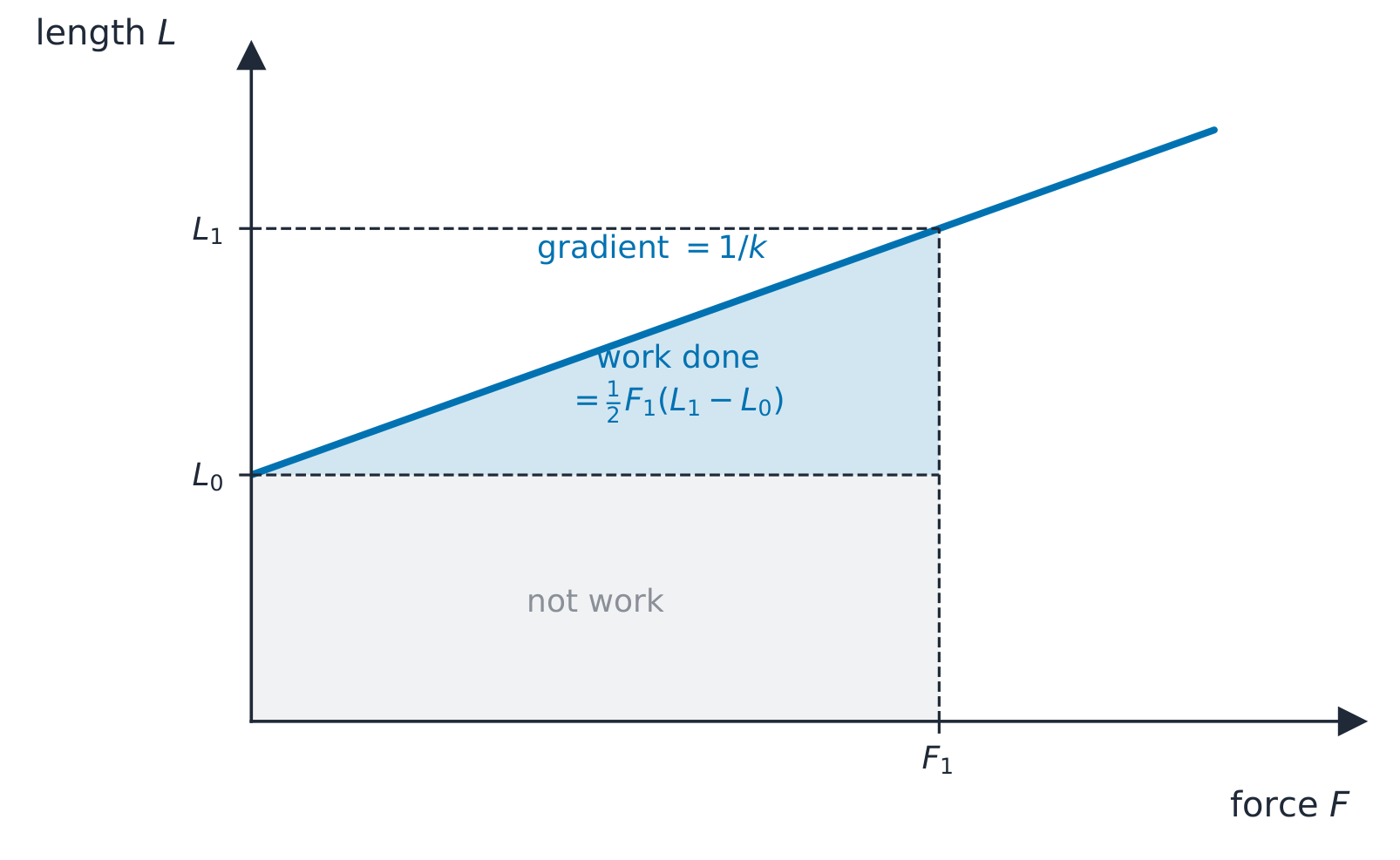
A common trap: if a graph plots length$L$ against force, you can still find the spring constant from the gradient (since $L = L_{0} + F/k$, the gradient is $1/k$ — read it off carefully).
Worked example. A spring has length $90\ \text{mm}$ under a force of $0.80\ \text{N}$ and $115\ \text{mm}$ under $1.30\ \text{N}$. Find the spring constant and the unstretched length.
The extra force $0.50\ \text{N}$ produces the extra extension $25\ \text{mm} = 0.025\ \text{m}$, so $k = 0.50 / 0.025 = 20\ \text{N m}^{-1}$. At $0.80\ \text{N}$ the extension is $x = F/k = 0.80 / 20 = 0.040\ \text{m}$, so the unstretched length is $90 - 40 = 50\ \text{mm}$. On a graph of length against force the intercept on the length axis is $L_{0}$, the gradient is $1/k$, and the work done in stretching the spring is the triangle between the line and the level $L = L_{0}$, not the whole area down to the force axis: the rectangle below $L_{0}$ is the unstretched length multiplied by the force, which means nothing.
Limit of proportionality
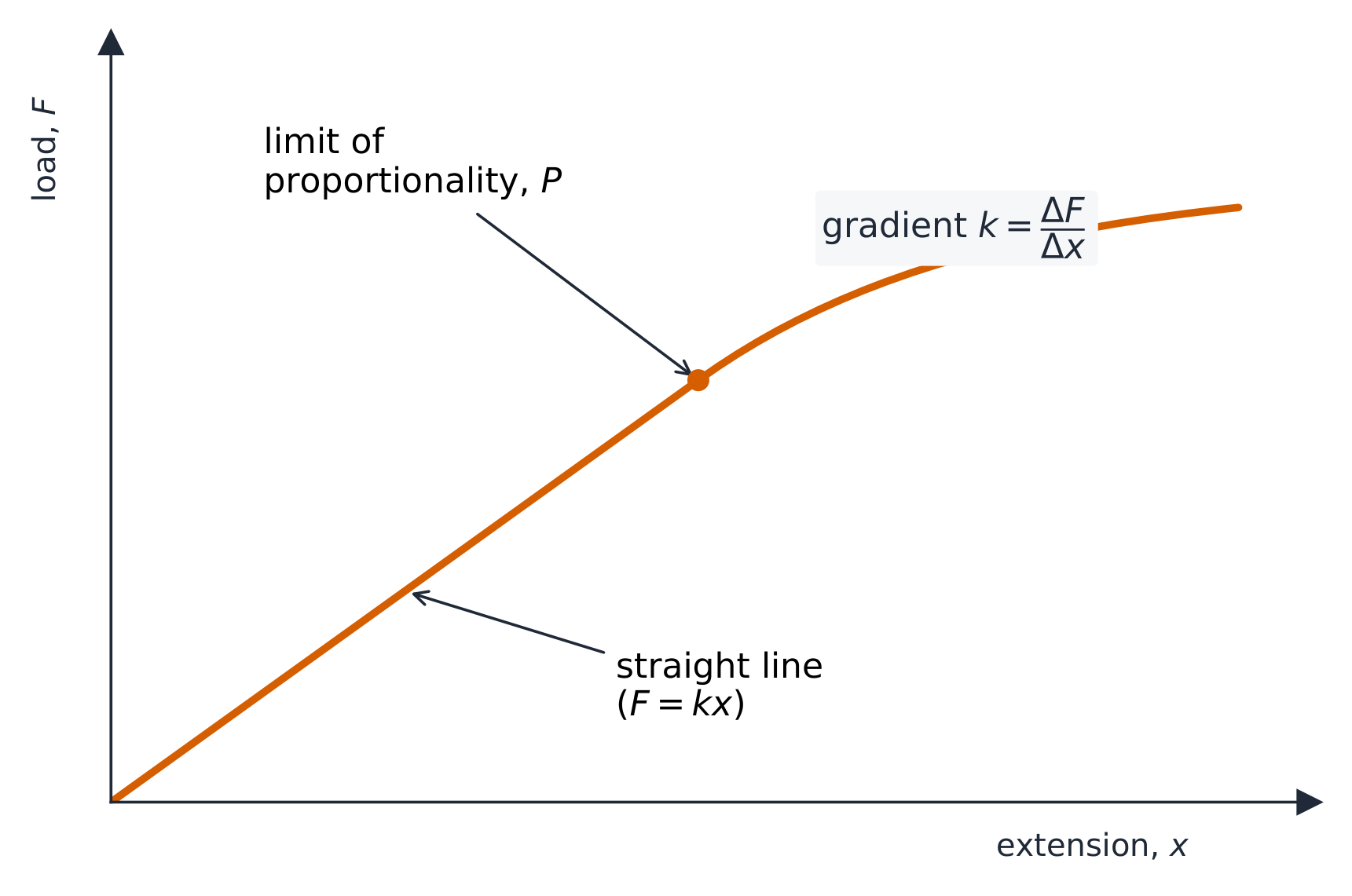
Hooke's law only holds up to the limit of proportionality 比例极限. Past this point the $F$ against $x$ line curves and is no longer straight. The material may still be elastic 弹性 (it returns to its first length when you remove the load) a little further, then it becomes plastic 塑性.
Springs in series and parallel
You may need to combine spring constants:
Series 串联 (one spring hangs from another): the same load passes through both, the total extension is the sum, so $\dfrac{1}{k_{\text{total}}} = \dfrac{1}{k_{1}} + \dfrac{1}{k_{2}}$.
Parallel 并联 (two springs side by side holding the same load): each takes half the load (if they are identical), the extensions are equal, so $k_{\text{total}} = k_{1} + k_{2}$.
Worked example. Springs of spring constant $6.0\ \text{N cm}^{-1}$ and $4.0\ \text{N cm}^{-1}$ are joined end to end and a load of $80\ \text{N}$ hangs from them. Find the total extension.
Each spring carries the full $80\ \text{N}$, so the extensions are $80/6.0 = 13.3\ \text{cm}$ and $80/4.0 = 20\ \text{cm}$: a total of $33\ \text{cm}$ (the same as $k = 2.4\ \text{N cm}^{-1}$ from $1/k = 1/6.0 + 1/4.0$). Three identical springs give the largest combined constant when all three are in parallel ($3k$) and the smallest when all are in series ($k/3$). When a load is shared by two identical springs in parallel, each carries half the force and so stores a quarter of the energy of one spring holding the whole load; the pair together stores half as much as the single spring did. A spring constant in $\text{N cm}^{-1}$ is $100$ times smaller than the same constant in $\text{N m}^{-1}$; give the unit the question asks for.
Español
Un resorte obedece la ley de Hooke: la extensión es proporcional a la fuerza aplicada.
Para muchos materiales, en extensiones pequeñas, la extensión es proporcional a la carga — esto es la ley de Hooke 胡克定律. La constante que los une es la constante del resorte 劲度系数$k$:
$$F = kx \qquad\Longleftrightarrow\qquad k = \frac{F}{x}.$$
Unidad de $k$: $\text{N m}^{-1}$.
Ejemplo resuelto. Un resorte se estira $4.0\ \text{cm}$ cuando se le cuelga una carga de $2.0\ \text{N}$. Calcule su constante del resorte.
Convirtiendo la extensión a metros ($4.0\ \text{cm} = 0.040\ \text{m}$):
Para la pregunta de una marca "enuncie la ley de Hooke", escríbala en palabras: la extensión es directamente proporcional a la fuerza aplicada (carga), siempre que no se exceda el límite de proporcionalidad. La constante del resorte es la fuerza por unidad de extensión; los distractores de opción múltiple son "extensión por unidad de fuerza" (eso es $1/k$) y $\tfrac{1}{2}Fx$ (la energía almacenada).
Una gráfica de carga-extensión: recta hasta el límite de proporcionalidad $P$, luego se curva
Lectura de una gráfica:
Una gráfica de fuerza-extensión ($F$ frente a $x$) tiene pendiente $k$ en la región de la ley de Hooke.
Una gráfica de extensión-fuerza ($x$ frente a $F$) tiene pendiente $1/k$ en la región de la ley de Hooke.
Trampa común: si una gráfica representa la longitud$L$ frente a la fuerza, aún puede obtenerse la constante del resorte a partir de la pendiente (ya que $L = L_{0} + F/k$, la pendiente es $1/k$ — léala con cuidado).
Ejemplo resuelto. Un resorte tiene longitud $90\ \text{mm}$ bajo una fuerza de $0.80\ \text{N}$ y $115\ \text{mm}$ bajo $1.30\ \text{N}$. Calcule la constante del resorte y la longitud sin estirar.
La fuerza adicional $0.50\ \text{N}$ produce la extensión adicional $25\ \text{mm} = 0.025\ \text{m}$, por lo tanto $k = 0.50 / 0.025 = 20\ \text{N m}^{-1}$. A $0.80\ \text{N}$ la extensión es $x = F/k = 0.80 / 20 = 0.040\ \text{m}$, así que la longitud sin estirar es $90 - 40 = 50\ \text{mm}$. En una gráfica de longitud frente a fuerza, la intersección con el eje de longitud es $L_{0}$, la pendiente es $1/k$, y el trabajo realizado para estirar el resorte es el triángulo entre la línea y el nivel $L = L_{0}$, no toda el área hasta el eje de fuerza: el rectángulo debajo de $L_{0}$ corresponde a la longitud sin estirar multiplicada por la fuerza, lo cual carece de significado físico.
Longitud frente a fuerza: la intersección es $L_{0}$, la pendiente es $1/k$, y solo el triángulo por encima de $L_{0}$ representa el trabajo realizado
Límite de proporcionalidad
La ley de Hooke solo se cumple hasta el límite de proporcionalidad 比例极限. Más allá de este punto, la línea de $F$ frente a $x$ se curva y deja de ser recta. El material puede seguir siendo elástico 弹性 (recupera su longitud original al retirar la carga) un poco más, para luego volverse plástico 塑性.
resortes en serie y en paralelo
Puede que necesite combinar constantes de resortes:
En serie 串联 (un resorte cuelga de otro): la misma carga pasa a través de ambos, la extensión total es la suma, por lo tanto $\dfrac{1}{k_{\text{total}}} = \dfrac{1}{k_{1}} + \dfrac{1}{k_{2}}$.
En paralelo 并联 (dos resortes lado a lado sosteniendo la misma carga): cada uno soporta la mitad de la carga (si son idénticos), las extensiones son iguales, por lo tanto $k_{\text{total}} = k_{1} + k_{2}$.
Combinación de constantes de resortes: en serie produce un resorte más blando, en paralelo uno más rígido
Ejemplo resuelto. Dos resortes con constantes de resorte $6.0\ \text{N cm}^{-1}$ y $4.0\ \text{N cm}^{-1}$ están unidos extremo con extremo y una carga de $80\ \text{N}$ cuelga de ellos. Calcule la extensión total.
Cada resorte soporta la carga completa de $80\ \text{N}$, por lo que las extensiones son $80/6.0 = 13.3\ \text{cm}$ y $80/4.0 = 20\ \text{cm}$; en total $33\ \text{cm}$ (lo mismo que obtenería de $k = 2.4\ \text{N cm}^{-1}$ usando $1/k = 1/6.0 + 1/4.0$). Tres resortes idénticos dan la constante combinada mayor cuando los tres están en paralelo ($3k$) y la menor cuando los tres están en serie ($k/3$). Cuando una carga es compartida por dos resortes idénticos en paralelo, cada uno soporta la mitad de la fuerza y almacena así un cuarto de la energía de un solo resorte que sostuviera toda la carga; el par en conjunto almacena la mitad de la energía que almacenaba el resorte individual. Una constante de resorte en $\text{N cm}^{-1}$ es $100$ veces menor que la misma constante en $\text{N m}^{-1}$; utilice la unidad que solicite el problema.
Explore · Explorar
Ley de Hooke
F = k·x
La fuerza es proporcional a la extensión — la pendiente es la constante del resorte k.
Explore · Explorar
Ley de Hooke
F = kx
Hasta el límite, la elongación es proporcional a la fuerza: la pendiente es la constante del resorte k.
Explore · Explorar
Ley de Hooke: F = kx
F = ax
Arrastra la constante del resorte. La fuerza es proporcional a la extensión: una línea recta que pasa por el origen cuya pendiente es la constante del resorte.
limit of proportionality/ˈlɪmɪt ɒv prəˌpɔːʃəˈnælɪti/
比例极限
bǐ lì jí xiàn
6.1
Stress, strain and the Young modulus · Tensión, deformación y módulo de Young
English
For a wire of uniform cross-section under a tensile load:
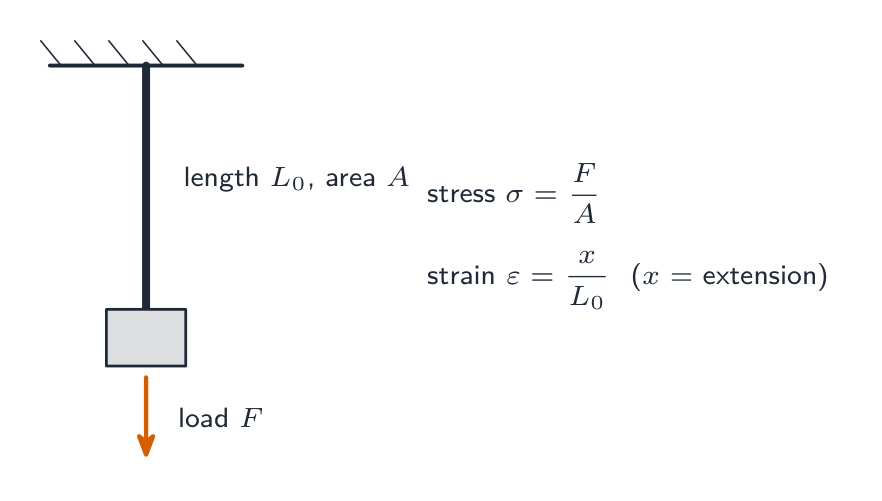
Stress 应力$\sigma = \dfrac{F}{A}$, where $F$ is the load and $A$ is the cross-sectional area 横截面积. Unit: $\text{Pa}$.
Strain 应变$\varepsilon = \dfrac{x}{L_{0}}$, where $x$ is the extension and $L_{0}$ is the original length. Strain has no unit (it is a ratio of lengths).
For the one-mark definitions: stress is the force per unit cross-sectional area (the force acting normally to the area); strain is the extension per unit original length. The unit of stress, $\text{Pa} = \text{N m}^{-2}$, is $\text{kg m}^{-1}\ \text{s}^{-2}$ in base units. The area of a round wire comes from its diameter $d$: $A = \pi d^{2}/4 = \pi r^{2}$, and using $d$ in place of $r$ makes the area four times too big. Convert $\text{mm}^{2}$ to $\text{m}^{2}$ with $10^{-6}$.
Worked example. A tensile force of $18\ \text{N}$ acts on a wire of cross-sectional area $3.2\ \text{mm}^{2}$. Find the stress.
$\sigma = F/A = 18 / (3.2 \times 10^{-6}) = 5.6 \times 10^{6}\ \text{Pa}$. The same force acts along the whole wire, so a bolt whose diameter is $2d$ at one end and $d$ at the other has four times the stress at the narrow end ($\sigma \propto 1/d^{2}$), and a wire of three times the radius carries one ninth of the stress.
The Young modulus 杨氏模量 is the ratio of stress to strain in the Hooke's-law region:
Unit: $\text{Pa}$ (about $10^{11}$ for metals; e.g. steel $\approx 2.0 \times 10^{11}$ Pa).
Worked example. A steel wire of length $2.0\ \text{m}$ and cross-sectional area $1.5 \times 10^{-7}\ \text{m}^{2}$ stretches by $1.0\ \text{mm}$ under a load of $15\ \text{N}$. Find the Young modulus.
The Young modulus is a property of the material — it does not depend on the wire's shape or size. The spring constant $k$ depends on both the material and the size: $k = EA/L_{0}$.
For the one-mark definition: the Young modulus is the ratio of stress to strain (for a material deformed within its limit of proportionality). Because it belongs to the material, a thicker wire of the same metal has the same Young modulus: it stretches less under the same load because its area is larger, not because the metal is stiffer. A "show that $k = EA/L_{0}$" question wants two lines: $k = F/x$ and $E = FL_{0}/(Ax)$, so $E = kL_{0}/A$. Two things follow: a wire's spring constant stays constant while Hooke's law holds, whatever the force, and a wire of the same metal with twice the diameter has four times the spring constant.
Worked example. A copper wire of length $1.7\ \text{m}$ and diameter $0.64\ \text{mm}$ has Young modulus $1.2 \times 10^{11}\ \text{Pa}$. Find its spring constant.
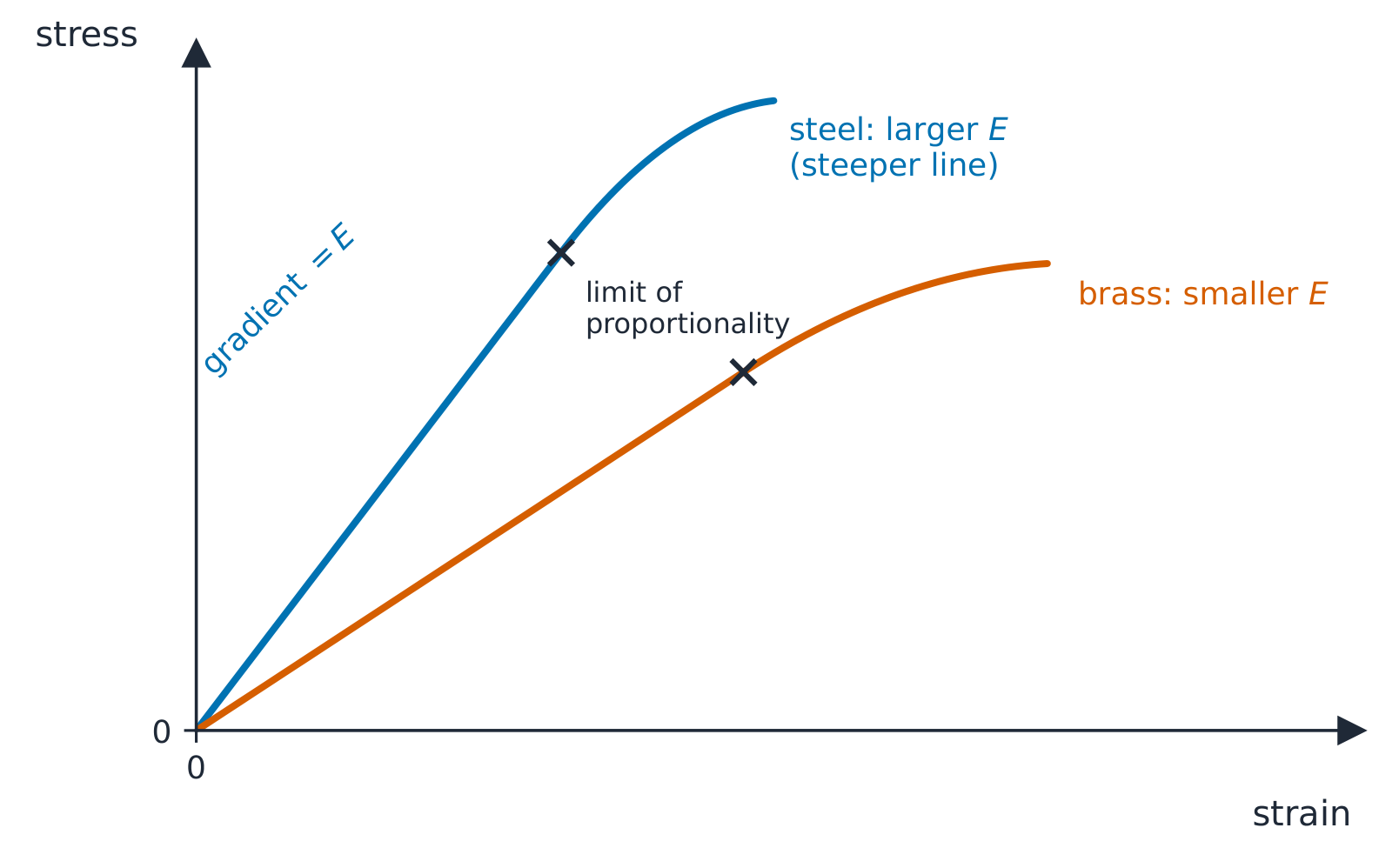
On a stress–strain graph the gradient of the straight part is $E$, so of two materials drawn on the same axes the steeper line is the stiffer material, and a wire with double the Young modulus is drawn as a line through the origin with twice the gradient. On a force–extension graph the gradient is $EA/L_{0}$ and the Young modulus is the gradient multiplied by $L_{0}/A$; only a stress–strain graph has a gradient equal to $E$ itself.
Experiment to find the Young modulus of a metal wire
A standard setup:
Clamp one end of a long, thin wire to a fixed support. Pass the wire over a pulley 滑轮 at the edge of the bench so it hangs straight down.
Measure the original length $L_{0}$ between the clamp and a marker near the pulley, using a metre rule.
Measure the diameter 直径$d$ of the wire at several places with a micrometer 螺旋测微器 and take the average. Work out $A = \pi d^{2}/4$.
Hang weights one at a time. Record the load $F$ and the extension $x$ (how far the marker moves against a fixed scale).
Plot $F$ against $x$. In the straight region the gradient is $EA/L_{0}$, so $E = \text{gradient} \times L_{0}/A$.
Why a long, thin wire? To make the extension big enough to measure well. Why repeat readings and measure $d$ at several places? To reduce random error 随机误差 and check the wire is uniform.
A "describe an experiment" answer earns its marks for the quantities measured and how ($L_{0}$ with a metre rule; $d$ with a micrometer at several points; the load from the masses or a newton meter; the extension from a marker read against a fixed scale, or a vernier scale), the graph ($F$ against $x$, gradient $EA/L_{0}$, or stress against strain, gradient $E$) and the precautions: safety goggles in case the wire snaps, a small load first to straighten kinks, and readings taken on unloading as well as loading to check the wire stayed elastic.
Español
Para un alambre de sección transversal uniforme bajo una carga de tracción:
Tensión 应力$\sigma = \dfrac{F}{A}$, donde $F$ es la carga y $A$ es el área de sección transversal 横截面积. Unidad: $\text{Pa}$.
Deformación 应变$\varepsilon = \dfrac{x}{L_{0}}$, donde $x$ es la extensión y $L_{0}$ es la longitud original. La deformación no tiene unidad (es una razón entre longitudes).
Para las definiciones de un punto: la tensión es la fuerza por unidad de área de sección transversal (la fuerza que actúa perpendicularmente al área); la deformación es la extensión por unidad de longitud original. La unidad de tensión, $\text{Pa} = \text{N m}^{-2}$, equivale a $\text{kg m}^{-1}\ \text{s}^{-2}$ en unidades base. El área de un alambre redondo se obtiene a partir de su diámetro $d$: $A = \pi d^{2}/4 = \pi r^{2}$, y sustituir $d$ en lugar de $r$ hace que el área sea cuatro veces demasiado grande. Convierta $\text{mm}^{2}$ a $\text{m}^{2}$ utilizando $10^{-6}$.
Ejemplo resuelto. Una fuerza de tracción de $18\ \text{N}$ actúa sobre un alambre de área transversal $3.2\ \text{mm}^{2}$. Calcule la tensión.
$\sigma = F/A = 18 / (3.2 \times 10^{-6}) = 5.6 \times 10^{6}\ \text{Pa}$. La misma fuerza actúa a lo largo de todo el alambre, por lo que un perno cuyo diámetro es $2d$ en un extremo y $d$ en el otro tiene cuatro veces la tensión en el extremo más estrecho ($\sigma \propto 1/d^{2}$), y un alambre con tres veces el radio presenta una novena parte de la tensión.
Tensión es la carga por unidad de área transversal; deformación es la elongación por unidad de longitud original
El módulo de Young 杨氏模量 es la razón entre la tensión y la deformación en la región de la ley de Hooke:
Unidad: $\text{Pa}$ (aproximadamente $10^{11}$ para metales; p. ej., acero $\approx 2.0 \times 10^{11}$ Pa).
Ejemplo resuelto. Un alambre de acero de longitud $2.0\ \text{m}$ y área transversal $1.5 \times 10^{-7}\ \text{m}^{2}$ se estira $1.0\ \text{mm}$ bajo una carga de $15\ \text{N}$. Calcule el módulo de Young.
Gráfico de tensión-deformación, lineal hasta el límite de proporcionalidad $P$
El módulo de Young es una propiedad del material; no depende de la forma ni del tamaño del alambre. La constante del resorte $k$ depende tanto del material como del tamaño: $k = EA/L_{0}$.
Para la definición de un solo punto: el módulo de Young es la razón entre la tensión y la deformación (para un material deformado dentro de su límite de proporcionalidad). Perteneciendo al material, un alambre más grueso del mismo metal tiene el mismo módulo de Young: se estira menos bajo la misma carga porque su área es mayor, no porque el metal sea más rígido. Una pregunta de "demuestre que $k = EA/L_{0}$" requiere dos líneas: $k = F/x$ y $E = FL_{0}/(Ax)$, por lo tanto $E = kL_{0}/A$. De esto se derivan dos cosas: la constante del resorte de un alambre permanece constante mientras se cumpla la ley de Hooke, sin importar la fuerza, y un alambre del mismo metal con el doble de diámetro tiene cuatro veces la constante del resorte.
Ejemplo resuelto. Un alambre de cobre de longitud $1.7\ \text{m}$ y diámetro $0.64\ \text{mm}$ tiene un módulo de Young de $1.2 \times 10^{11}\ \text{Pa}$. Calcule su constante del resorte.
En un gráfico de tensión-deformación, la pendiente de la parte recta es $E$, por lo que de dos materiales trazados en los mismos ejes, la línea más empinada corresponde al material más rígido, y un alambre con el doble del módulo de Young se representa como una línea que pasa por el origen con el doble de pendiente. En un gráfico de fuerza-elongación, la pendiente es $EA/L_{0}$ y el módulo de Young es la pendiente multiplicada por $L_{0}/A$; solo un gráfico de tensión-deformación tiene una pendiente igual a $E$ mismo.
Dos metales en un gráfico de tensión-deformación: la línea más empinada tiene el mayor módulo de Young
Experimento para encontrar el módulo de Young de un alambre metálico
Un montaje estándar:
Sujete un extremo de un alambre largo y delgado a un soporte fijo. Pase el alambre sobre una polea 滑轮 por el borde de la mesa para que cuelgue recto hacia abajo.
Mida la longitud original $L_{0}$ entre la abrazadera y un marcador cerca de la polea, usando una regla métrica.
Mida el diámetro 直径$d$ del alambre en varios lugares con un micrómetro 螺旋测微器 y tome el promedio. Calcule $A = \pi d^{2}/4$.
Cuelgue los pesos uno a uno. Registre la carga $F$ y la extensión $x$ (cuánto se mueve el marcador contra una escala fija).
Grafique $F$ contra $x$. En la región lineal, la pendiente es $EA/L_{0}$, por lo tanto $E = \text{gradient} \times L_{0}/A$.
¿Por qué un alambre largo y delgado? Para que la extensión sea lo suficientemente grande como para medirse bien. ¿Por qué repetir lecturas y medir $d$ en varios lugares? Para reducir el error aleatorio 随机误差 y verificar que el alambre sea uniforme.
Una respuesta "describa un experimento" obtiene sus puntos por las cantidades medidas y cómo ($L_{0}$ con una regla métrica; $d$ con un micrómetro en varios puntos; la carga desde las masas o un newtonímetro; la extensión desde un marcador leído contra una escala fija o una escala vernier), la gráfica ($F$ contra $x$, pendiente $EA/L_{0}$, o tensión contra deformación, pendiente $E$) y las precauciones: gafas de seguridad en caso de que el alambre se rompa, una carga pequeña primero para enderezar las torceduras, y tomas de lectura tanto al cargar como al descargar para verificar que el alambre permaneció elástico.
Equipo para medir el módulo de Young de un alambre
Elastic and plastic behaviour · Comportamiento elástico y plástico
Syllabus
English
understand and use the terms elastic deformation, plastic deformation and elastic limit
understand that the area under the force–extension graph represents the work done
determine the elastic potential energy of a material deformed within its limit of proportionality from the area under the force–extension graph
recall and use $E_p = \frac{1}{2}Fx = \frac{1}{2}kx^2$ for a material deformed within its limit of proportionality
Español
comprender y utilizar los términos deformación elástica, deformación plástica y límite elástico
comprender que el área bajo la gráfico de fuerza–extensión representa el trabajo realizado
determinar la energía potencial elástica de un material deformado dentro de su límite de proporcionalidad a partir del área bajo el gráfico de fuerza–extensión
recordar y utilizar $E_p = \frac{1}{2}Fx = \frac{1}{2}kx^2$ para un material deformado dentro de su límite de proporcionalidad
Source: Cambridge International syllabus · Fuente: Plan de estudios Cambridge International
English
As the load grows:
Elastic and straight (Hooke obeyed) — up to the limit of proportionality. Removing the load returns the object to its first length.
Elastic but curved — between the limit of proportionality and the elastic limit 弹性极限. The extension is no longer straight in the load, but on unloading the object still returns to its first length.
Plastic — past the elastic limit. On unloading, the object does not return to its first length; a permanent extension stays.
Hooke's law only holds in the straight, elastic region.
In words: elastic deformation means the object returns to its original length (or shape) when the load is removed; plastic deformation means it does not, and a permanent extension remains; the elastic limit is the maximum load (or extension) for which the deformation is still elastic; the limit of proportionality is the point beyond which the extension is no longer proportional to the load. On a graph the limit of proportionality is where the line stops being straight. The elastic limit lies a little beyond it and cannot be read from a loading line alone. So in a "which statement must be correct" item, the end of the straight part is the limit of proportionality, but whether a later point is the elastic limit or the breaking point cannot be told from the shape of the loading line.
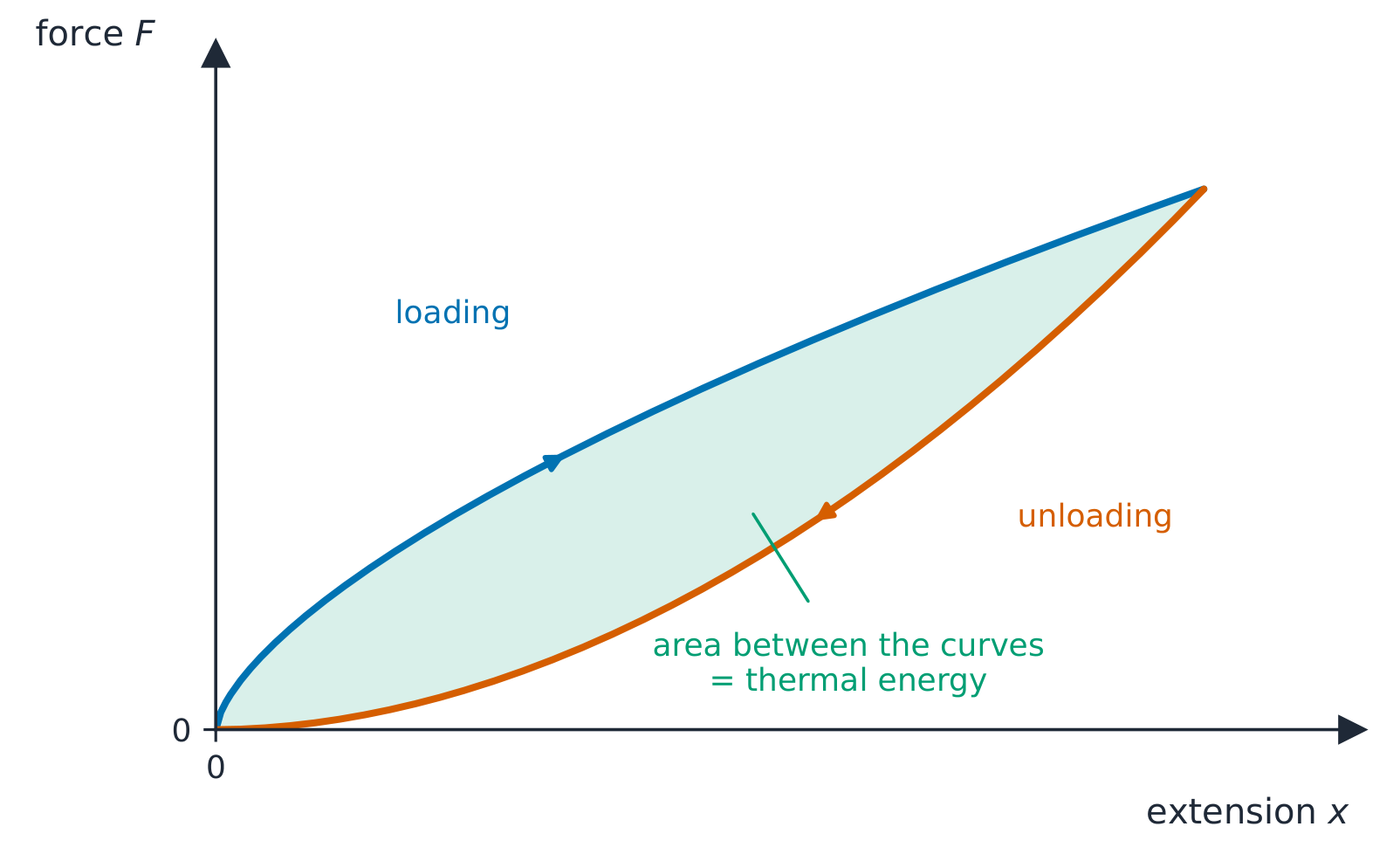
On a force–extension graph for a material taken into the plastic region and then unloaded, the loading line and the unloading line are different. The unloading line is parallel to the first Hooke line but shifted to the right (the permanent extension left when the load reaches zero). The area between the loading and unloading lines is the energy turned into thermal energy 热能 in the material.
A rubber band 橡皮筋 also has different loading and unloading curves, but it returns to its original length: its deformation is elastic. The area between the two curves is again energy dissipated as thermal energy (elastic hysteresis 弹性滞后), and the energy recovered on unloading is the area under the lower curve. The two-mark "explain why the work done in stretching the wire is not equal to the energy recovered when the force is removed" answer says that the wire was taken past its elastic limit, so part of the deformation is plastic and a permanent extension remains, and that part of the work done became thermal energy in the wire.
Español
A medida que aumenta la carga:
Elástico y recto (se obedece la Ley de Hooke) — hasta el límite de proporcionalidad. Al retirar la carga, el objeto vuelve a su primera longitud.
Elástico pero curvo — entre el límite de proporcionalidad y el límite elástico 弹性极限. La extensión ya no es recta respecto a la carga, pero al descargar, el objeto todavía vuelve a su primera longitud.
Plástico — más allá del límite elástico. Al descargar, el objeto no vuelve a su primera longitud; queda una extensión permanente.
La ley de Hooke solo se cumple en la región elástica y recta.
En palabras: deformación elástica significa que el objeto vuelve a su longitud original (o forma) cuando se retira la carga; deformación plástica significa que no lo hace, y permanece una extensión permanente; el límite elástico es la carga máxima (o extensión) para la cual la deformación sigue siendo elástica; el límite de proporcionalidad es el punto más allá del cual la extensión deja de ser proporcional a la carga. En una gráfica, el límite de proporcionalidad es donde la línea deja de ser recta. El límite elástico está un poco más allá y no puede leerse solo a partir de la línea de carga. Por lo tanto, en un elemento de opción múltiple "cuál afirmación debe ser correcta", el final de la parte recta es el límite de proporcionalidad, pero si un punto posterior es el límite elástico o el punto de ruptura no se puede determinar a partir de la forma de la línea de carga.
Fuerza–extensión más allá del límite elástico: $P$ y $E$ marcados, con una extensión permanente $B$ dejada después de descargarUna máquina moderna de ensayo universal (tracción) estira una muestra y registra la fuerza y la extensión
En una gráfica de fuerza–extensión para un material llevado a la región plástica y luego descargado, la línea de carga y la línea de descarga son diferentes. La línea de descarga es paralela a la primera línea de Hooke pero desplazada hacia la derecha (la extensión permanente que queda cuando la carga llega a cero). El área entre las líneas de carga y descarga es la energía convertida en energía térmica 热能 en el material.
Una goma elástica 橡皮筋 también tiene curvas de carga y descarga diferentes, pero vuelve a su longitud original: su deformación es elástica. El área entre las dos curvas es nuevamente energía disipada como energía térmica (histéresis elástica 弹性滞后), y la energía recuperada al descargar es el área bajo la curva inferior. La respuesta de dos puntos "explique por qué el trabajo realizado al estirar el alambre no es igual a la energía recuperada cuando se retira la fuerza" dice que el alambre fue llevado más allá de su límite elástico, por lo que parte de la deformación es plástica y queda una extensión permanente, y que parte del trabajo realizado se convirtió en energía térmica en el alambre.
Una goma elástica vuelve a su longitud original, pero el área entre la carga y la descarga es energía perdida como energía térmica
Energy stored in a stretched material · Energía almacenada en un material estirado
English
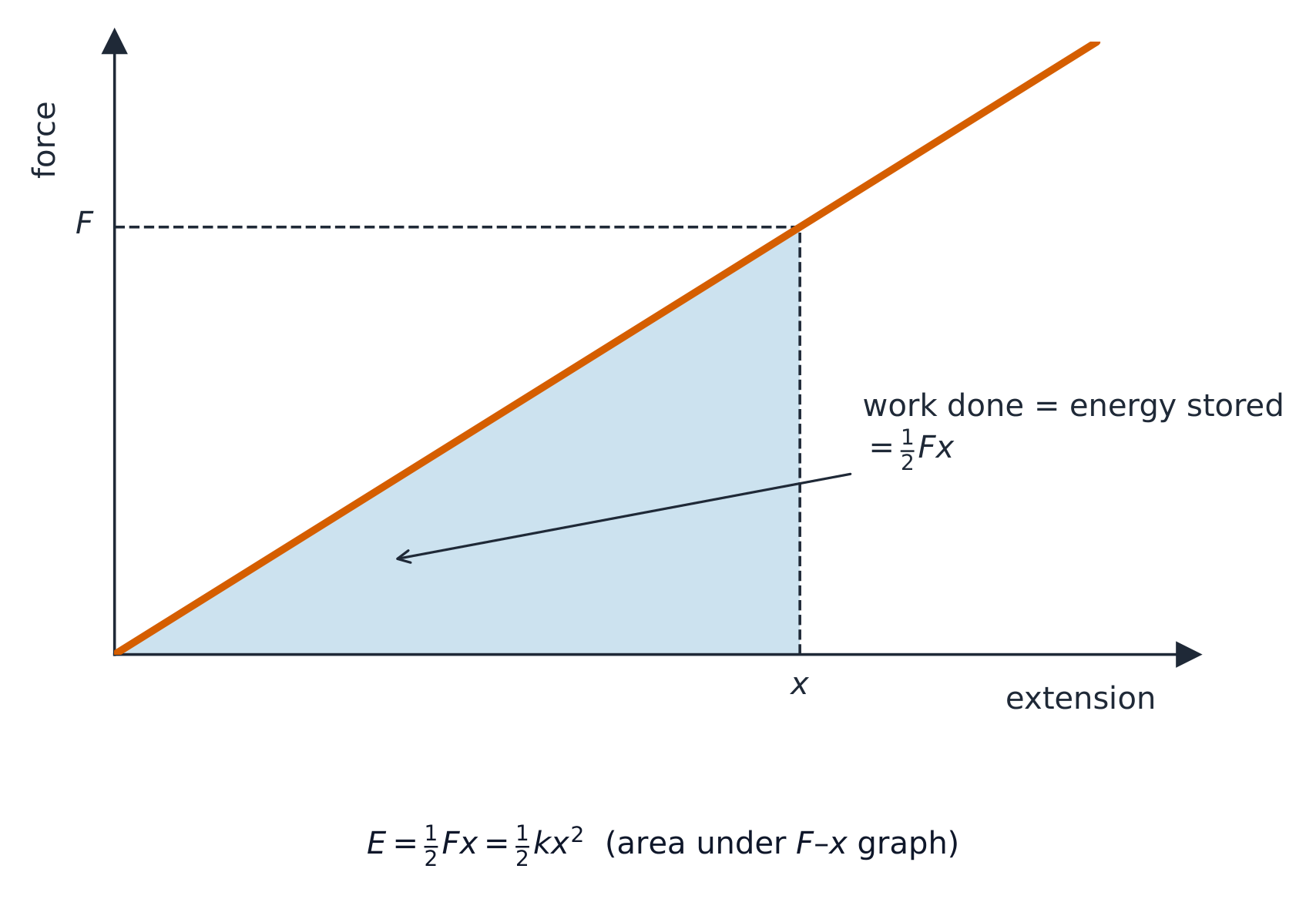
The work done in stretching a material from $0$ to extension $x$, as the load grows from $0$ to $F$, is the area under the force–extension graph.
Why the area: work done is force multiplied by the distance moved, but here the force grows as the material stretches, so the work is the sum of $F\,\Delta x$ over many small extensions, which is the area under the line. Within the limit of proportionality the force rises uniformly from $0$ to $F$, so the average force is $\tfrac{1}{2}F$ and the work is $\tfrac{1}{2}Fx$. On a force–extension graph the gradient is the spring constant.
Hooke's-law material
When Hooke's law holds, the $F$ against $x$ graph is a straight line through the origin. The area under it from $0$ to $x$ is a triangle:
$$E_{\text{P}} = \tfrac{1}{2} F x = \tfrac{1}{2} k x^{2}.$$
This is the elastic potential energy 弹性势能 stored in a spring or wire stretched within its limit of proportionality. An equal form:
$$E_{\text{P}} = \frac{F^{2}}{2k}.$$
Worked example. A spring of spring constant $50\ \text{N m}^{-1}$ is stretched by $0.20\ \text{m}$, within its limit of proportionality. Find the elastic potential energy stored.
Worked example. A wire of spring constant $2.0 \times 10^{4}\ \text{N m}^{-1}$ is already extended by $2.0\ \text{mm}$. Find the work done to increase its extension to $3.0\ \text{mm}$.
The stored energy rises from $\tfrac{1}{2} k x_{1}^{2}$ to $\tfrac{1}{2} k x_{2}^{2}$: $W = \tfrac{1}{2} \times 2.0 \times 10^{4} \times \left[(3.0 \times 10^{-3})^{2} - (2.0 \times 10^{-3})^{2}\right] = 0.050\ \text{J}$. This is the trapezium under the line between the two extensions, not $\tfrac{1}{2} k (x_{2} - x_{1})^{2}$. Because $E_{\text{P}} \propto x^{2}$ at fixed $k$, doubling the extension of a wire stores four times the energy ($0.65\ \text{J}$ becomes $2.6\ \text{J}$), and a stored energy gives the extension as $x = \sqrt{2E_{\text{P}}/k}$: a spring of $k = 400\ \text{N m}^{-1}$ storing $0.32\ \text{J}$ is compressed by $\sqrt{2 \times 0.32 / 400} = 0.040\ \text{m}$. For two wires joined end to end the tension is the same in both, so the total energy stored is $\tfrac{1}{2}F x_{1} + \tfrac{1}{2}F x_{2}$ with each wire's own extension.
Non-Hooke material
For a graph that is not a straight line (a stretched rubber band, or a spring past its limit of proportionality), find the area by counting grid squares or by using trapezia 梯形. The same idea holds: the area under the force–extension graph is the work done on the material. To estimate the work done up to the breaking point, count the squares under the whole curve (part squares as halves) and multiply by the energy one square represents, the force step multiplied by the extension step; saying that the area was found by counting squares is the "explain your reasoning" mark.
Comparing stored energy
A common multiple-choice case: two materials are stretched by the same force, or by the same extension. Using $E_{\text{P}} = \tfrac{1}{2} F x$:
same $F$, smaller $k$ (less stiff) → larger $x$ → more energy stored.
same $x$, larger $k$ (stiffer) → larger $F$ → more energy stored.
A sketch of $E_{\text{P}}$ against extension or compression is a curve through the origin that gets steeper ($E_{\text{P}} \propto x^{2}$), not a straight line. Of two wires of the same length and area under the same load, the one with the smaller Young modulus extends more and so stores more energy.
When a stretched spring is released onto a mass, the elastic potential energy becomes kinetic energy 动能 (and gravitational potential energy if the mass rises). Set $\tfrac{1}{2} k x^{2}$ equal to $\tfrac{1}{2} m v^{2}$ (plus any $mgh$) to find the speed or height.
Español
El trabajo realizado al estirar un material de $0$ a extensión $x$, mientras la carga crece de $0$ a $F$, es el área bajo la gráfica de fuerza–extensión.
El trabajo realizado al estirar un material es el área bajo la gráfica de fuerza–extensión
¿Por qué el área: el trabajo realizado es fuerza multiplicada por la distancia recorrida, pero aquí la fuerza crece a medida que el material se estira, por lo que el trabajo es la suma de $F\,\Delta x$ sobre muchas extensiones pequeñas, lo cual es el área bajo la línea. Dentro del límite de proporcionalidad, la fuerza aumenta uniformemente de $0$ a $F$, por lo que la fuerza promedio es $\tfrac{1}{2}F$ y el trabajo es $\tfrac{1}{2}Fx$. En una gráfica de fuerza–extensión, la pendiente es la constante del resorte.
Material que obedece la Ley de Hooke
Cuando se cumple la Ley de Hooke, la gráfica de $F$ contra $x$ es una línea recta que pasa por el origen. El área bajo ella de $0$ a $x$ es un triángulo:
$$E_{\text{P}} = \tfrac{1}{2} F x = \tfrac{1}{2} k x^{2}.$$
Esta es la energía potencial elástica 弹性势能 almacenada en un resorte o alambre estirado dentro de su límite de proporcionalidad. Una forma equivalente:
$$E_{\text{P}} = \frac{F^{2}}{2k}.$$
Ejemplo resuelto. Un muelle de constante elástica $50\ \text{N m}^{-1}$ se estira una distancia $0.20\ \text{m}$, dentro de su límite de proporcionalidad. Encuentre la energía potencial elástica almacenada.
Ejemplo resuelto. Un alambre de constante elástica $2.0 \times 10^{4}\ \text{N m}^{-1}$ ya está extendido en una cantidad $2.0\ \text{mm}$. Encuentre el trabajo realizado para aumentar su extensión hasta $3.0\ \text{mm}$.
La energía almacenada aumenta de $\tfrac{1}{2} k x_{1}^{2}$ a $\tfrac{1}{2} k x_{2}^{2}$: $W = \tfrac{1}{2} \times 2.0 \times 10^{4} \times \left[(3.0 \times 10^{-3})^{2} - (2.0 \times 10^{-3})^{2}\right] = 0.050\ \text{J}$. Esta es la zona trapezoidal bajo la línea entre las dos extensiones, no $\tfrac{1}{2} k (x_{2} - x_{1})^{2}$. Dado que $E_{\text{P}} \propto x^{2}$ a una extensión fija $k$, duplicar la extensión de un alambre almacena cuatro veces la energía ($0.65\ \text{J}$ se convierte en $2.6\ \text{J}$), y la energía almacenada proporciona la extensión como $x = \sqrt{2E_{\text{P}}/k}$: un resorte de $k = 400\ \text{N m}^{-1}$ que almacena $0.32\ \text{J}$ está comprimido por $\sqrt{2 \times 0.32 / 400} = 0.040\ \text{m}$. Para dos alambres unidos extremo con extremo, la tensión es la misma en ambos, por lo que la energía total almacenada es $\tfrac{1}{2}F x_{1} + \tfrac{1}{2}F x_{2}$ con la propia extensión de cada alambre.
Material no hookeano
Para una gráfica que no es una línea recta (una banda de goma estirada o un resorte más allá de su límite de proporcionalidad), encuentre el área contando cuadrados de la cuadrícula o utilizando trapecios 梯形. La misma idea se mantiene: el área bajo la gráfica fuerza–extensión es el trabajo realizado sobre el material. Para estimar el trabajo realizado hasta el punto de rotura, cuente los cuadrados bajo toda la curva (cuadrados parciales como mitades) y multiplique por la energía que representa un cuadrado, el paso de fuerza multiplicado por el paso de extensión; decir que el área se encontró contando cuadrados otorga la marca de "explique su razonamiento".
Comparación de energía almacenada
Un caso común de opción múltiple: dos materiales se estiran con la misma fuerza o con la misma extensión. Utilizando $E_{\text{P}} = \tfrac{1}{2} F x$:
misma $F$, menor $k$ (menos rígido) → mayor $x$ → más energía almacenada.
misma $x$, mayor $k$ (más rígido) → mayor $F$ → más energía almacenada.
Un boceto de $E_{\text{P}}$ frente a la extensión o compresión es una curva que pasa por el origen y se vuelve más pronunciada ($E_{\text{P}} \propto x^{2}$), no una línea recta. De dos alambres de la misma longitud y área bajo la misma carga, aquel con el módulo de Young menor se extiende más y, por tanto, almacena más energía.
Cuando un resorte estirado se libera sobre una masa, la energía potencial elástica se convierte en energía cinética 动能 (y energía potencial gravitatoria si la masa asciende). Iguale $\tfrac{1}{2} k x^{2}$ con $\tfrac{1}{2} m v^{2}$ (más cualquier $mgh$) para encontrar la velocidad o la altura.
6.2
Definitions the examiner accepts · Definiciones aceptadas por el examinador
English
A definition question is marked against fixed wording. Learn these exactly, and give one answer only.
Term
Definition
Hooke's law
the extension is directly proportional to the applied force, provided the limit of proportionality is not exceeded
spring constant
the force per unit extension
limit of proportionality
the point beyond which the extension is no longer proportional to the applied force
elastic limit
the maximum force (or extension) for which the material returns to its original length when the force is removed
elastic deformation
the material returns to its original length (shape) when the force is removed
plastic deformation
the material does not return to its original length when the force is removed; a permanent extension remains
stress
the force per unit cross-sectional area
strain
the extension per unit original length
Young modulus
the ratio of stress to strain (within the limit of proportionality)
elastic potential energy
the energy stored in an object because it has been stretched or compressed
Español
Una pregunta de definición se califica según un texto fijo. Aprende estas definiciones exactamente, y da solo una respuesta.
Término
Definición
Ley de Hooke
la extensión es directamente proporcional a la fuerza aplicada, siempre que no se exceda el límite de proporcionalidad
constante del resorte
la fuerza por unidad de extensión
límite de proporcionalidad
el punto más allá del cual la extensión ya no es proporcional a la fuerza aplicada
límite elástico
la fuerza máxima (o extensión) para la cual el material recupera su longitud original cuando se retira la fuerza
deformación elástica
el material recupera su longitud original (forma) cuando se retira la fuerza
deformación plástica
el material no recupera su longitud original cuando se retira la fuerza; queda una extensión permanente
tensión
la fuerza por unidad de área transversal
deformación unitaria
la extensión por unidad de longitud original
módulo de Young
la relación entre la tensión y la deformación (dentro del límite de proporcionalidad)
energía potencial elástica
la energía almacenada en un objeto debido a que ha sido estirado o comprimido
6.2
Exam tips · Consejos para el examen
English
Hooke's law ($F = kx$) holds only up to the limit of proportionality.
Stress $= F/A$, strain $= x/L$, Young modulus $=$ stress$/$strain (gradient of the straight part of the stress-strain graph) — watch the units (Pa).
Energy stored $=$area under the force-extension graph$= \frac{1}{2}Fx$ in the elastic region.
Distinguish elastic (returns to shape) from plastic (permanent) deformation.
Common mistakes
Using the diameter as the radius in $A = \pi r^{2}$, or leaving an area in $\text{mm}^{2}$. Halve the diameter first; $1\ \text{mm}^{2} = 10^{-6}\ \text{m}^{2}$.
Reading the work done off a length–force graph as the whole area down to the axis. Only the triangle above $L_{0}$ is work.
Treating stored energy as proportional to extension. It goes as $x^{2}$: double the extension, four times the energy; and the work done between two extensions is the difference of two $\tfrac{1}{2}kx^{2}$ values.
Stating Hooke's law without its condition. "Provided the limit of proportionality is not exceeded" is part of the law.
Swapping the limit of proportionality (the end of the straight line) and the elastic limit (the end of elastic behaviour, a little beyond it).
Saying a thicker wire has a larger Young modulus. The modulus is the material's; the thicker wire has a larger spring constant.
Español
La ley de Hooke ($F = kx$) solo se cumple hasta el límite de proporcionalidad.
Esfuerzo $= F/A$, deformación $= x/L$, módulo de Young $=$ esfuerzo$/$deformación (pendiente de la parte recta de la gráfica esfuerzo-deformación) — comprueba las unidades (Pa).
Energía almacenada $=$área bajo la gráfica fuerza-extensión$= \frac{1}{2}Fx$ en la región elástica.
Distinga entre deformación elástica (recupera su forma) y plástica (permanente).
Errores comunes
Usar el diámetro como radio en $A = \pi r^{2}$, o dejar un área en $\text{mm}^{2}$. Dividir primero el diámetro a la mitad; $1\ \text{mm}^{2} = 10^{-6}\ \text{m}^{2}$.
Leer el trabajo realizado en una gráfica de longitud–fuerza como toda el área hasta el eje. Solo el triángulo por encima de $L_{0}$ es trabajo.
Tratar la energía almacenada como proporcional a la extensión. Varía según $x^{2}$: duplicar la extensión, cuadruplica la energía; y el trabajo realizado entre dos extensiones es la diferencia de dos valores de $\tfrac{1}{2}kx^{2}$.
Enunciar la ley de Hooke sin su condición. "Siempre que no se exceda el límite de proporcionalidad" forma parte de la ley.
Intercambiar el límite de proporcionalidad (el final de la línea recta) y el límite elástico (el final del comportamiento elástico, un poco más allá).
Decir que un alambre más grueso tiene un módulo de Young mayor. El módulo es del material; el alambre más grueso tiene una constante de resortes mayor.
Interactive lessons on this topic · Lecciones interactivas sobre este tema
Work through it step by step, with instant-check exercises. · Trátalo paso a paso, con ejercicios de verificación instantánea.
Pick one and the site follows you — notes, papers, videos and practice all open on it. · Selecciona uno y el sitio te sigue — notas, documentos, videos y práctica se abren en él.
Type to search notes, lessons, code, vocabulary and past-paper questions across every subject. · Escribe para buscar notas, lecciones, código, vocabulario y preguntas de exámenes anteriores en todas las materias.