Cierras un interruptor y la luz se enciende instantáneamente. Así que los electrones deben estar corriendo por el cable a la velocidad de la luz —¿verdad? Falso. Dentro de un cable de cobre…
English narration · English + 中文 subtitles burned in · Narración en inglés · Subtítulos en inglés + 中文 quemados en pantalla
9.1
Corriente eléctrica
Syllabus
English
understand that an electric current is a flow of charge carriers
understand that the charge on charge carriers is quantised
recall and use $Q = It$
use, for a current-carrying conductor, the expression $I = Anvq$, where $n$ is the number density of charge carriers
Español
comprender que una corriente eléctrica es un flujo de portadores de carga
comprender que la carga de los portadores de carga está cuantizada
recordar y utilizar $Q = It$
utilizar, para un conductor por el que circula corriente, la expresión $I = Anvq$, donde $n$ es la densidad numérica de portadores de carga
Source: Cambridge International syllabus · Fuente: Plan de estudios Cambridge International
English
An electric current 电流 is a flow of charge carriers 载流子. In a metal the carriers are negative conduction electrons 电子; in an electrolyte 电解质 they are positive and negative ions 离子; in a semiconductor 半导体 they may be electrons or "holes" 空穴. The conventional current 常规电流 direction is the way positive charge would flow — opposite to the real flow of electrons in a wire.
Charge
Charge is quantised 量子化: the smallest free unit of charge is the elementary charge 基本电荷
$$e = 1.60 \times 10^{-19}\ \text{C}.$$
Every free charge in this syllabus is a whole-number multiple of $e$. The unit of charge is the coulomb 库仑, $\text{C}$.
So a particle can carry $4.8 \times 10^{-19}\ \text{C}$ (three electrons' worth) or $-2.4 \times 10^{-18}\ \text{C}$ (fifteen), but never $1.1 \times 10^{-19}\ \text{C}$ or $6.4 \times 10^{-20}\ \text{C}$; a set of measurements that gives a charge carrier $2.5 \times 10^{-19}\ \text{C}$ cannot be right, because that is not a multiple of $e$. For the one-mark definitions: an electric current is a flow of charge carriers; the coulomb is the charge that passes a point in one second when the current is one ampere (an ampere multiplied by a second); a charge carrier can be an electron, a proton, an ion or an $\alpha$-particle, but never a neutron.
Current as the rate of flow of charge
If charge $Q$ passes a point in time $t$, the current is
$$I = \frac{Q}{t}, \qquad Q = It.$$
Unit of current: ampere, $\text{A}$ ($= \text{C s}^{-1}$). For a changing current, the charge that has flowed in a time is the area under an $I$–$t$ graph.
Worked example. A current of $0.50\ \text{A}$ flows for $2.0$ minutes. Find the charge that passes, and how many electrons this represents. ($e = 1.60 \times 10^{-19}\ \text{C}$.)
The same two lines answer "how many electrons pass in $10$ hours at $4.0\ \text{mA}$" (convert the time to seconds: $N = It/e = 4.0 \times 10^{-3} \times 36\,000 / (1.60 \times 10^{-19}) = 9.0 \times 10^{20}$) and, the other way round, "the average current when $6.0 \times 10^{23}$ electrons pass in $24$ hours" ($I = Ne/t = 1.1\ \text{A}$). A beam of $\alpha$-particles carries a current too: each carries $2e$, so a beam current of $6.9 \times 10^{-9}\ \text{A}$ is $6.9 \times 10^{-9} / (2 \times 1.60 \times 10^{-19}) = 2.2 \times 10^{10}$ particles per second. A lightning strike that transfers $1 \times 10^{20}$ electrons in $30\ \mu\text{s}$ is a current of $Ne/t = 5.3 \times 10^{5}\ \text{A}$.
Drift velocity equation
For a uniform conductor of cross-section area $A$, with $n$ charge carriers per unit volume (the number density 数密度), each carrying charge $q$, moving with average drift velocity 漂移速度$v$:
$$I = A n v q.$$
Worked example. A copper wire of cross-sectional area $1.0 \times 10^{-6}\ \text{m}^{2}$ carries a current of $5.0\ \text{A}$. Copper has $n = 8.5 \times 10^{28}$ free electrons per $\text{m}^{3}$. Find the drift velocity. ($e = 1.60 \times 10^{-19}\ \text{C}$.)
The electrons drift very slowly — less than a millimetre per second.
Two "show that" steps that often precede this calculation. The number density of a metal with one free electron per atom is $n = \dfrac{\text{density} \times N_{\text{A}}}{\text{molar mass}}$: for copper, $8.9 \times 10^{3} \times 6.02 \times 10^{23} / 0.0635 = 8.5 \times 10^{28}\ \text{m}^{-3}$. And the time for an electron to drift the length of a wire is $t = L / v$: at $3.7 \times 10^{-4}\ \text{m s}^{-1}$ a $2.0\ \text{m}$ wire takes $5\,400\ \text{s}$, an hour and a half, even though the current is established almost instantly. Between them, the equation $I = Anvq$ is used as a ratio far more often than as a calculation:
two wires in series carry the same current; if wire Y has twice the diameter of X (four times the area) and the same metal, its electrons drift at a quarter of the speed. Two wires of the same length and diameter but different metals have drift speeds in the inverse ratio of their number densities.
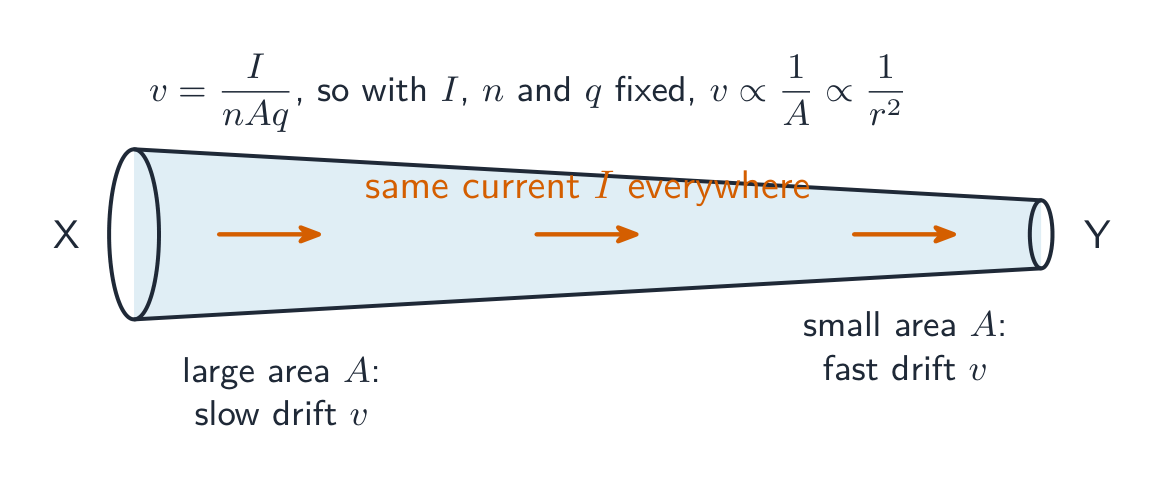
a wire that narrows (a wedge, a tapered rod, a cable of thick and thin strands) carries the same current at every cross-section, so the drift speed rises where the area falls: $v \propto 1/A \propto 1/r^{2}$. A sketch of $v$ against distance along a tapering wire is a curve that rises more and more steeply towards the narrow end, not a straight line.
the p.d. across a uniform wire is proportional to its length at fixed current, because $V = IR = I\rho L / A$ with $I$, $\rho$ and $A$ constant.
Use this to compare currents:
a thinner wire (smaller $A$) at the same $I$ needs a faster drift $v$.
a semiconductor has far fewer free carriers than a metal (smaller $n$), so for the same $I$ the drift velocity is much larger.
in series 串联 components, $I$ is the same everywhere, so if $A$ stays the same but the material changes, $nv$ changes the other way.
Español
Una corriente eléctrica 电流 es un flujo de portadores de carga 载流子. En un metal, los portadores son electrones 电子 de conducción negativos; en un electrolito 电解质, son iones 离子 positivos y negativos; en un semiconductor 半导体, pueden ser electrones o "huecos" 空穴. La dirección de la corriente convencional 常规电流 es la forma en que fluiría la carga positiva —opuesta al flujo real de electrones en un cable—.
Charge
La carga está cuantizada 量子化: la unidad más pequeña libre de carga es la carga elemental 基本电荷
$$e = 1.60 \times 10^{-19}\ \text{C}.$$
Toda carga libre en este programa es un múltiplo de número entero de $e$. La unidad de carga es el culombio 库仑, $\text{C}$.
Por tanto, una partícula puede llevar $4.8 \times 10^{-19}\ \text{C}$ (equivalente a tres electrones) o $-2.4 \times 10^{-18}\ \text{C}$ (quince), pero nunca $1.1 \times 10^{-19}\ \text{C}$ ni $6.4 \times 10^{-20}\ \text{C}$; un conjunto de mediciones que indique un portador de carga $2.5 \times 10^{-19}\ \text{C}$ no puede ser correcto, porque eso no es un múltiplo de $e$. Para las definiciones de un punto: una corriente eléctrica es un flujo de portadores de carga; el culombio es la carga que pasa por un punto en un segundo cuando la corriente es de un amperio (un amperio multiplicado por un segundo); un portador de carga puede ser un electrón, un protón, un ion o una partícula $\alpha$, pero nunca un neutrón.
Current as the rate of flow of charge
Si la carga $Q$ pasa por un punto en el tiempo $t$, la corriente es
$$I = \frac{Q}{t}, \qquad Q = It.$$
Unidad de corriente: amperio, $\text{A}$ ($= \text{C s}^{-1}$). Para una corriente variable, la carga que ha fluido en un tiempo es el área bajo un gráfico $I$–$t$.
Ejemplo resuelto. Una corriente de $0.50\ \text{A}$ fluye durante $2.0$ minutos. Calcule la carga que pasa y cuántos electrones representa. ($e = 1.60 \times 10^{-19}\ \text{C}$.)
Las mismas dos líneas responden a "¿cuántos electrones pasan en $10$ horas a una tasa de $4.0\ \text{mA}$?" (convertir el tiempo a segundos: $N = It/e = 4.0 \times 10^{-3} \times 36\,000 / (1.60 \times 10^{-19}) = 9.0 \times 10^{20}$) y, a la inversa, "la corriente media cuando $6.0 \times 10^{23}$ electrones pasan en $24$ horas" ($I = Ne/t = 1.1\ \text{A}$). Un haz de partículas $\alpha$ también lleva corriente: cada una transporta $2e$, por lo que una corriente de haz de $6.9 \times 10^{-9}\ \text{A}$ corresponde a $6.9 \times 10^{-9} / (2 \times 1.60 \times 10^{-19}) = 2.2 \times 10^{10}$ partículas por segundo. Una descarga de rayo que transfiere $1 \times 10^{20}$ electrones en $30\ \mu\text{s}$ tiene una corriente de $Ne/t = 5.3 \times 10^{5}\ \text{A}$.
Drift velocity equation
Para un conductor uniforme de área de sección transversal $A$, con $n$ portadores de carga por unidad de volumen (la densidad numérica 数密度), cada uno llevando carga $q$, moviéndose con velocidad de deriva promedio 漂移速度$v$:
$$I = A n v q.$$
Portadores de carga derivando dentro de un conductor: los portadores positivos derivan con $I$, los electrones en contra de ella
Ejemplo resuelto. Un cable de cobre de área de sección transversal $1.0 \times 10^{-6}\ \text{m}^{2}$ lleva una corriente de $5.0\ \text{A}$. El cobre tiene $n = 8.5 \times 10^{28}$ electrones libres por $\text{m}^{3}$. Calcule la velocidad de deriva. ($e = 1.60 \times 10^{-19}\ \text{C}$.)
Los electrones derivan muy lentamente — menos de un milímetro por segundo.
Dos pasos de "demostrar" que suelen preceder a este cálculo. La densidad numérica de un metal con un electrón libre por átomo es $n = \dfrac{\text{density} \times N_{\text{A}}}{\text{molar mass}}$: para el cobre, $8.9 \times 10^{3} \times 6.02 \times 10^{23} / 0.0635 = 8.5 \times 10^{28}\ \text{m}^{-3}$. Y el tiempo que tarda un electrón en derivar a lo largo de la longitud de un cable es $t = L / v$: a una velocidad de $3.7 \times 10^{-4}\ \text{m s}^{-1}$, un cable de $2.0\ \text{m}$ tarda $5\,400\ \text{s}$, una hora y media, aunque la corriente se establezca casi instantáneamente. Entre ellos, la ecuación $I = Anvq$ se usa como razón mucho más a menudo que como cálculo:
dos cables en serie transportan la misma corriente; si el cable Y tiene el doble de diámetro que X (cuatro veces el área) y es del mismo metal, sus electrones se desplazan a una cuarta parte de la velocidad. Dos cables de la misma longitud y diámetro pero de metales diferentes tienen velocidades de deriva en razón inversa a sus densidades numéricas.
un cable que se estrecha (una cuña, una barra cónica, un cable de hebras gruesas y finas) transporta la misma corriente en cada sección transversal, por lo que la velocidad de deriva aumenta donde el área disminuye: $v \propto 1/A \propto 1/r^{2}$. Un dibujo de $v$ contra la distancia a lo largo de un cable cónico es una curva que se vuelve más pronunciada hacia el extremo estrecho, no una línea recta.
la d.d.p. a través de un cable uniforme es proporcional a su longitud a corriente fija, porque $V = IR = I\rho L / A$ con $I$, $\rho$ y $A$ constantes.
La misma corriente en todas partes, por lo que los electrones se desplazan más rápido donde el cable es más fino
Use this to compare currents:
un cable más delgado (menor $A$) a la misma $I$ necesita una deriva $v$ más rápida.
un semiconductor tiene mucho menos portadores libres que un metal (menor $n$), por lo que para la misma $I$ la velocidad de deriva es mucho mayor.
en componentes en serie, $I$ es el mismo en todas partes, por lo que si $A$ permanece constante pero cambia el material, $nv$ cambia en dirección opuesta.
Explore · Explorar
Corriente, voltaje y resistencia
La corriente es la tasa de flujo de carga. Aumenta el voltaje y aumenta la corriente; aumenta la resistencia y disminuye — I = V / R.
define the potential difference across a component as the energy transferred per unit charge
recall and use $V = W/Q$
recall and use $P = VI$, $P = I^2R$ and $P = V^2/R$
Español
definir la diferencia de potencial a través de un componente como la energía transferida por unidad de carga
recordar y usar $V = W/Q$
recordar y usar $P = VI$, $P = I^2R$ y $P = V^2/R$
Source: Cambridge International syllabus · Fuente: Plan de estudios Cambridge International
English
The potential difference 电势差 (p.d.) across a component is the energy 能量 transferred per unit charge as that charge passes through it:
$$V = \frac{W}{Q}.$$
Unit: volt 伏特, $\text{V}$ ($= \text{J C}^{-1}$).
If $1\ \text{J}$ of electrical energy changes into other forms (thermal, light, kinetic, …) when $1\ \text{C}$ of charge passes through a component, the p.d. across it is $1\ \text{V}$.
The electromotive force 电动势 (e.m.f.) of a source is the energy given per unit charge by the source. The formula is the same as for p.d.; the difference is direction: e.m.f. is energy given to the charge by the change; p.d. is energy given up by the charge to the component.
The definitions the examiner accepts: the potential difference across a component is the energy transferred (from electrical to other forms) per unit charge passing through it; the e.m.f. of a source is the energy transferred from other forms (chemical, in a cell) to electrical energy per unit charge in driving the charge round a complete circuit; one volt is one joule per coulomb. A battery "marked $9.0\ \text{V}$" therefore gives each coulomb $9.0\ \text{J}$ of electrical energy for the whole circuit, and the product of charge and p.d. is the energy transferred.
Español
La diferencia de potencial 电势差 (d.d.p.) en un componente es la energía 能量 transferida por unidad de carga a medida que esa carga lo atraviesa:
$$V = \frac{W}{Q}.$$
Unit: volt 伏特, $\text{V}$ ($= \text{J C}^{-1}$).
Si $1\ \text{J}$ de energía eléctrica cambia a otras formas (térmica, luz, cinética, …) cuando $1\ \text{C}$ de carga pasa a través de un componente, la d.d.p. a través de él es $1\ \text{V}$.
La fuerza electromotriz 电动势 (f.e.m.) de una fuente es la energía proporcionada por unidad de carga por la fuente. La fórmula es la misma que para la d.d.p.; la diferencia es la dirección: la f.e.m. es la energía dada a la carga por el cambio; la d.d.p. es la energía entregada por la carga al componente.
Las definiciones aceptadas por el examinador: la diferencia de potencial en un componente es la energía transferida (de eléctrica a otras formas) por unidad de carga que lo atraviesa; la f.e.m. de una fuente es la energía transferida de otras formas (química, en una pila) a energía eléctrica por unidad de carga al impulsar la carga por todo un circuito completo; un voltio es un julio por culombio. Por tanto, una batería "marcada con $9.0\ \text{V}$" proporciona a cada culombio $9.0\ \text{J}$ de energía eléctrica para todo el circuito, y el producto de la carga por la d.d.p. es la energía transferida.
Pick the form with the quantities you know. Examples:
two heaters of equal resistance — the one with the larger current gives more power 功率 ($P = I^{2}R$).
two resistors in parallel 并联 across the same voltage 电压 — the one with smaller $R$ gives more power ($P = V^{2}/R$).
a kettle marked "$2.4\ \text{kW}, 240\ \text{V}$" draws $I = P/V = 10\ \text{A}$ and has resistance $R = V^{2}/P = 24\ \Omega$.
Energy transferred in time $t$ is $E = P t$.
Worked example. Two lamps, P rated $250\ \text{V}$, $50\ \text{W}$ and Q rated $250\ \text{V}$, $200\ \text{W}$, are connected in series to a $250\ \text{V}$ supply. Which is brighter?
Their resistances at the rated p.d. are $R = V^{2}/P$: $1250\ \Omega$ for P and $313\ \Omega$ for Q. In series they carry the same current, so $P = I^{2}R$ makes the larger resistance, lamp P, dissipate more power: the "weaker" lamp is the brighter one. In parallel the p.d. is the same across both and $P = V^{2}/R$ favours the smaller resistance: Q. "State and explain which resistor dissipates more power" is answered by naming the quantity the two share (current in series, p.d. in parallel) and the form of the power equation that uses it.
Worked example. A supply delivers $2.4\ \text{kW}$ at $240\ \text{V}$ to a kettle through two cables of resistance $0.10\ \Omega$ each. Find the power lost in the cables.
The current is $I = P/V = 10\ \text{A}$, so the cables dissipate $I^{2}R = 10^{2} \times 0.20 = 20\ \text{W}$, and the kettle receives $2380\ \text{W}$. The efficiency of a circuit that exists to power one component is that component's power divided by the total power from the supply: with $6.0\ \text{V}$ across a $0.86\ \Omega$ series resistor and $4.5\ \text{V}$ across the component at the same current, the efficiency is $4.5 / (6.0 + 4.5) = 43\%$. A thermistor across a fixed p.d. dissipates $P = V^{2}/R$, so as its temperature rises and $R$ falls, the power rises. A kettle draws about $10\ \text{A}$ from a $250\ \text{V}$ supply; a mobile phone charger a fraction of an ampere.
Español
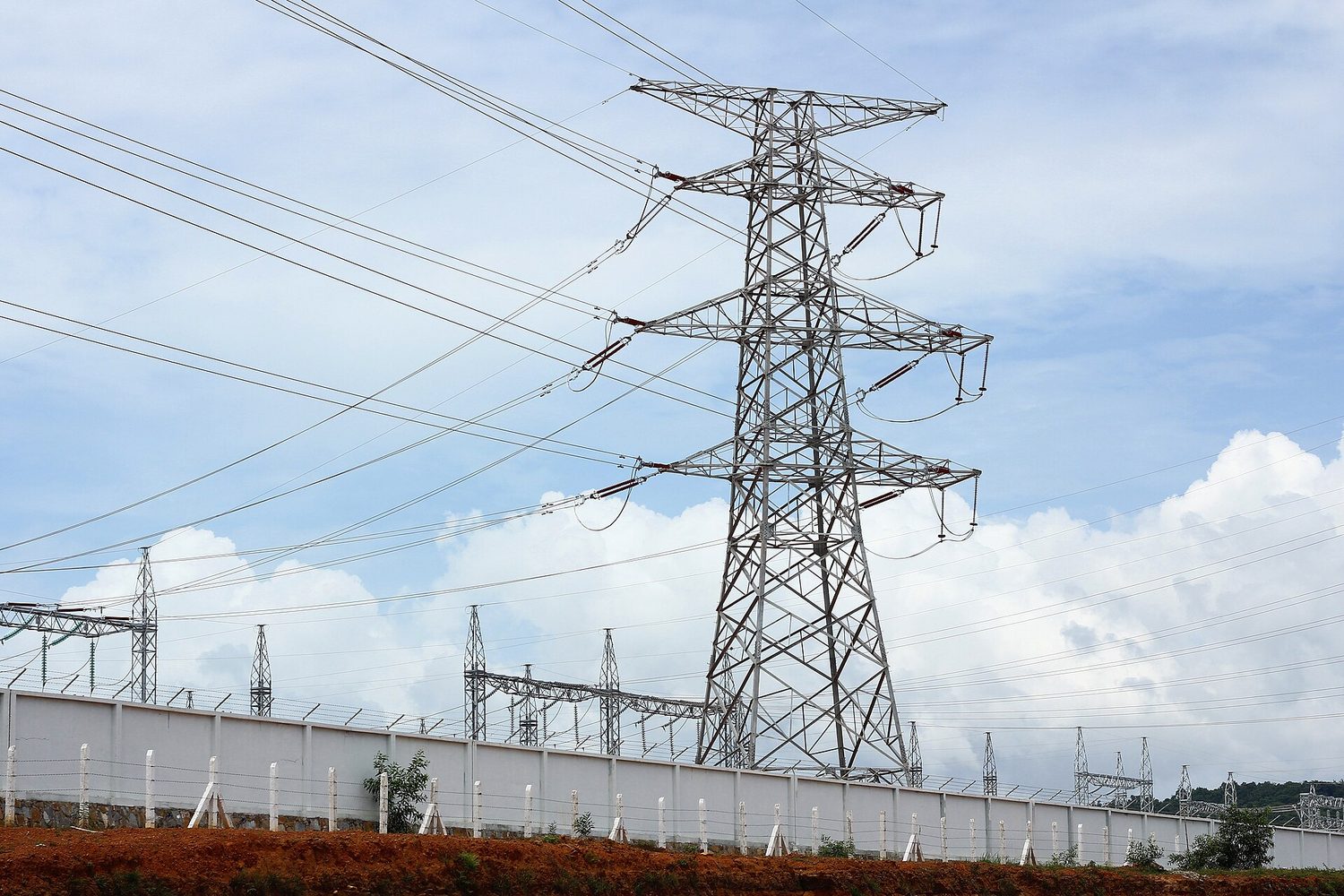
Las líneas de alta tensión transportan energía eléctrica a través del país.
Combinando $V = W/Q$ y $I = Q/t$:
$$P = \frac{W}{t} = V I.$$
Using Ohm's law $V = IR$:
$$P = V I = I^{2} R = \frac{V^{2}}{R}.$$
Pick the form with the quantities you know. Examples:
dos calentadores de igual resistencia — aquel con mayor corriente proporciona más potencia 功率 ($P = I^{2}R$).
dos resistencias en paralelo 并联 a través del mismo voltaje 电压 — aquella con menor $R$ proporciona más potencia ($P = V^{2}/R$).
a kettle marked "$2.4\ \text{kW}, 240\ \text{V}$" draws $I = P/V = 10\ \text{A}$ and has resistance $R = V^{2}/P = 24\ \Omega$.
Energy transferred in time $t$ is $E = P t$.
Ejemplo resuelto. Dos lámparas, P con potencia nominal $250\ \text{V}$, $50\ \text{W}$ y Q con potencia nominal $250\ \text{V}$, $200\ \text{W}$, están conectadas en serie a una fuente de alimentación de $250\ \text{V}$. ¿Cuál es más brillante?
Sus resistencias a la d.d.p. nominal son $R = V^{2}/P$: $1250\ \Omega$ para P y $313\ \Omega$ para Q. En serie llevan la misma corriente, por lo que $P = I^{2}R$ hace que la resistencia mayor, la lámpara P, disipe más potencia: la lámpara "más débil" es la más brillante. En paralelo, la d.d.p. es la misma en ambos y $P = V^{2}/R$ favorece la resistencia menor: Q. "Indique y explique qué resistor disipa más potencia" se responde nombrando la cantidad que comparten los dos (corriente en serie, d.d.p. en paralelo) y la forma de la ecuación de potencia que la utiliza.
Ejemplo resuelto. Un suministro entrega $2.4\ \text{kW}$ a $240\ \text{V}$ a una cafetera a través de dos cables de resistencia $0.10\ \Omega$ cada uno. Calcule la potencia perdida en los cables.
La corriente es $I = P/V = 10\ \text{A}$, por lo que los cables disipan $I^{2}R = 10^{2} \times 0.20 = 20\ \text{W}$, y la cafetera recibe $2380\ \text{W}$. La eficiencia de un circuito diseñado para alimentar un componente es la potencia de ese componente dividida por la potencia total del suministro: con $6.0\ \text{V}$ en un resistor en serie de $0.86\ \Omega$ y $4.5\ \text{V}$ en el componente a la misma corriente, la eficiencia es $4.5 / (6.0 + 4.5) = 43\%$. Una termistor conectada a una d.d.p. fija disipa $P = V^{2}/R$, por lo que, a medida que su temperatura aumenta y $R$ disminuye, la potencia aumenta. Una cafetera consume aproximadamente $10\ \text{A}$ de un suministro de $250\ \text{V}$; un cargador de teléfono móvil, una fracción de amperio.
Explore · Explorar
Potencia eléctrica
P = VI
A voltaje fijo, la potencia es proporcional a la corriente que impulsa.
sketch the $I\text{--}V$ characteristics of a metallic conductor at constant temperature, a semiconductor diode and a filament lamp
explain that the resistance of a filament lamp increases as current increases because its temperature increases
state Ohm's law
recall and use $R = \rho L/A$
understand that the resistance of a light-dependent resistor (LDR) decreases as the light intensity increases
understand that the resistance of a thermistor decreases as the temperature increases (it will be assumed that thermistors have a negative temperature coefficient)
Español
definir resistencia
recordar y aplicar $V = IR$
dibujar las características $I\text{--}V$ de un conductor metálico a temperatura constante, un diodo semiconductor y una lámpara de filamento
explicar que la resistencia de una lámpara de filamento aumenta al aumentar la corriente debido a su aumento de temperatura
enunciar la ley de Ohm
recordar y aplicar $R = \rho L/A$
comprender que la resistencia de una fotorresistencia (LDR) disminuye al aumentar la intensidad de la luz
comprender que la resistencia de un termistor disminuye al aumentar la temperatura (se asumirá que los termistores tienen un coeficiente de temperatura negativo)
Source: Cambridge International syllabus · Fuente: Plan de estudios Cambridge International
English
The resistance 电阻$R$ of a component is
$$R = \frac{V}{I}.$$
Unit: ohm 欧姆, $\Omega$ ($= \text{V A}^{-1}$). Resistance depends on the conditions (such as temperature) when it is measured.
Ohm's law
A conductor obeys Ohm's law 欧姆定律 when the current through it is proportional to the p.d. across it, as long as the conditions (especially temperature) stay constant. For such a conductor $R$ is constant and the $I$–$V$ graph is a straight line through the origin.
Ohm's law is an experimental result, not a definition. The definition $R = V/I$ works for any component; only ohmic ones have constant $R$.
For the marks: resistance is the ratio of the potential difference across a component to the current in it; the ohm is the resistance of a component in which a p.d. of one volt produces a current of one ampere (a volt per ampere); Ohm's law states that the current in a metallic conductor is directly proportional to the potential difference across it, provided that its temperature (and other physical conditions) remains constant. Of several $I$–$V$ graphs, only a straight line through the origin obeys Ohm's law; a straight line that misses the origin, or any curve, does not.
$I$–$V$ characteristics
You should be able to sketch these:
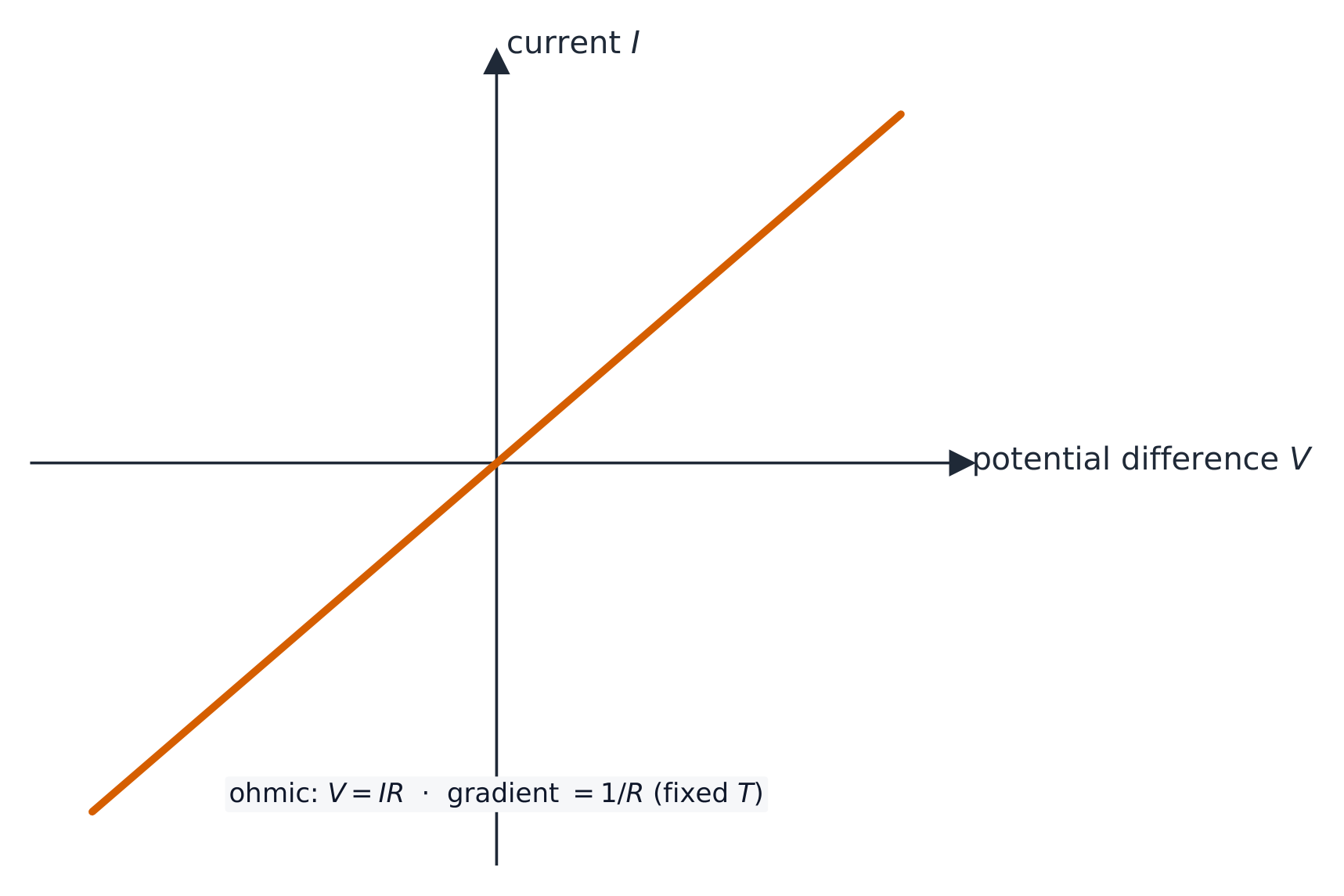
metal wire at constant temperature — a straight line through the origin (constant $R$). Reversing the p.d. drives the current the other way, giving a straight line in both directions.
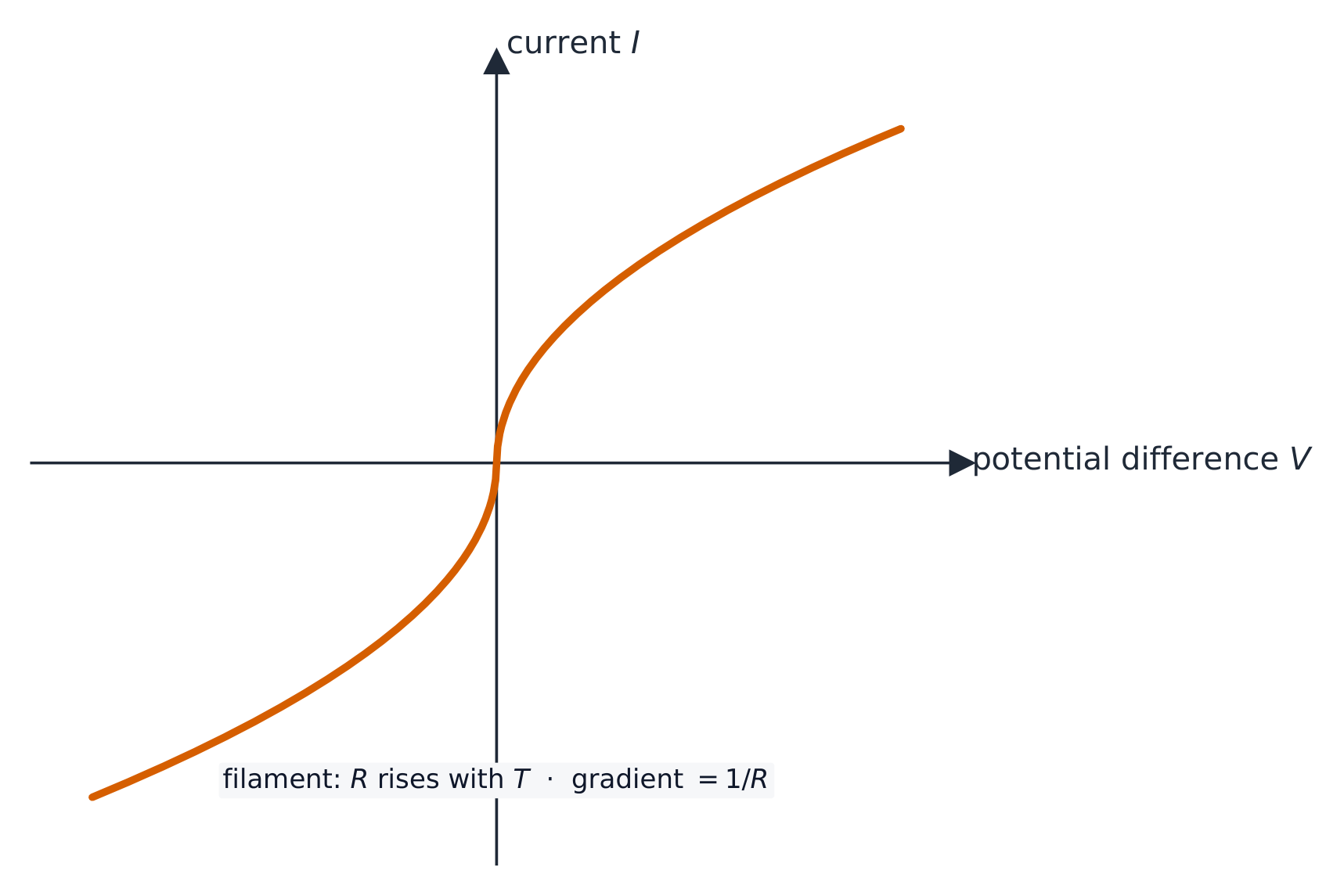
filament lamp 灯丝灯泡 — through the origin, steep at first, then flatter as $V$ (and $I$) grow. Reason: more current heats the filament, so its resistance rises and the gradient $1/R$ falls.
semiconductor diode 二极管 — almost no current for negative $V$ or small positive $V$. Above a "switch-on" voltage (about $0.7\ \text{V}$ for silicon), the current rises sharply.
Explain the shape of the filament lamp's line (three marks): as the current increases the filament's temperature rises; the lattice ions vibrate with larger amplitude, so the free electrons collide with them more often; each collision takes energy from the electrons, so the resistance increases; on the graph the ratio $V/I$ grows and the gradient falls. Run backwards for "the current decreases": the temperature falls, so the resistance falls. Two things to read off any characteristic. The resistance at a point is $V/I$ for that point, never the gradient of a curve, so a diode's resistance is very large (infinite, in practice) up to the switch-on p.d. and then falls steeply as $V$ rises further, and of four components at the same p.d. the one with the smallest current has the greatest resistance. And when a lamp (or a diode) is in series with a resistor, the two carry the same current and their p.d.s add: read the current from the component's curve at its own p.d., then use $V = IR$ for the resistor, and the supply p.d. is the sum.
Resistivity
For a uniform conductor of length $L$ and cross-section area $A$,
$$R = \frac{\rho L}{A}.$$
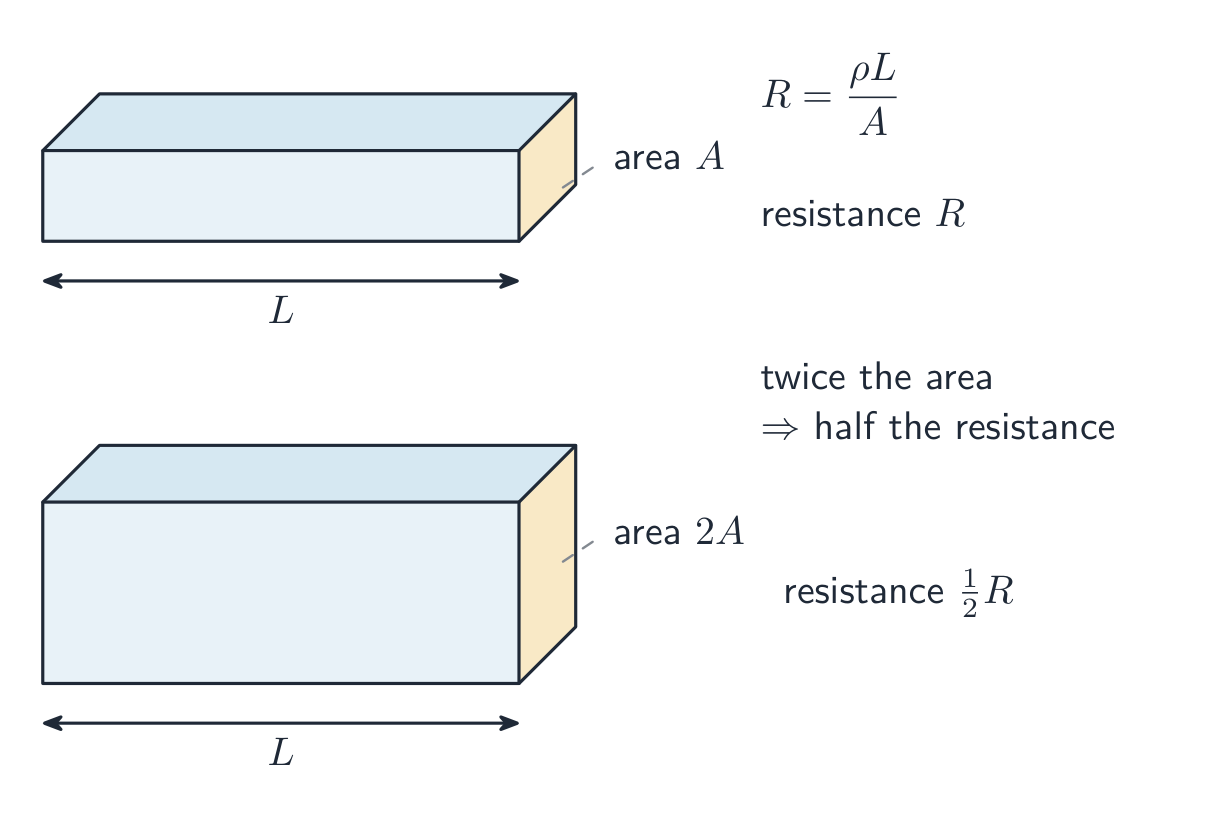
$\rho$ is the resistivity 电阻率, a property of the material, with unit $\Omega\ \text{m}$. Doubling the length doubles $R$; doubling the area halves it; halving the diameter quarters the area and so makes $R$ four times bigger.
Worked example. A copper wire of length $2.0\ \text{m}$ and cross-sectional area $1.7 \times 10^{-7}\ \text{m}^{2}$ has resistivity $1.7 \times 10^{-8}\ \Omega\ \text{m}$. Find its resistance.
Typical values: copper at room temperature $\rho \sim 1.7 \times 10^{-8}\ \Omega\ \text{m}$; an insulator 绝缘体$\rho \sim 10^{15}\ \Omega\ \text{m}$ or more.
The resistivity of a metal rises with temperature (more lattice vibration 晶格振动scatters 散射 the electrons), which is why the filament lamp's $I$–$V$ line curves.
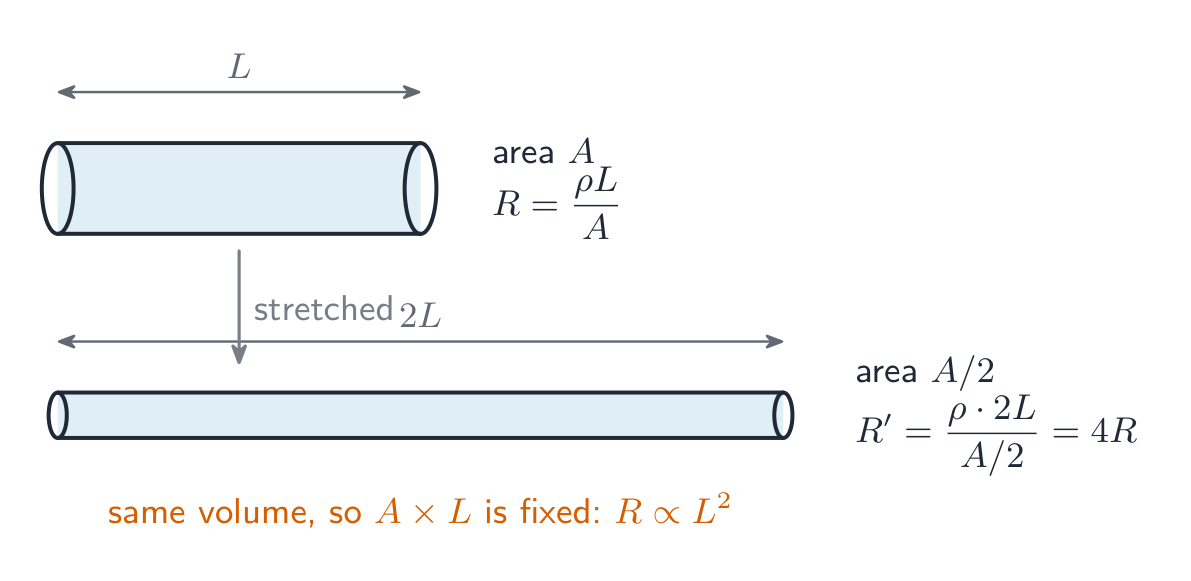
Most resistivity questions are ratios. Stretching a wire keeps its volume ($A \times L$) constant, so if the length becomes $k$ times longer the area becomes $k$ times smaller and $R = \rho L / A$ becomes $k^{2}$ times larger: a wire three times as long (same mass, same metal) has nine times the resistance, and a wire whose diameter falls to $0.940$ of its value has its area multiplied by $0.884$, its length divided by $0.884$, and its resistance multiplied by $1/0.884^{2} = 1.28$.
Worked example. A copper lightning rod of resistance $9.6\ \Omega$ and length $20\ \text{m}$ has resistivity $1.7 \times 10^{-8}\ \Omega\ \text{m}$. Find its radius.
$A = \rho L / R = 1.7 \times 10^{-8} \times 20 / 9.6 = 3.5 \times 10^{-8}\ \text{m}^{2}$, and $r = \sqrt{A / \pi} = 1.1 \times 10^{-4}\ \text{m}$. Doubling the radius (same length) quarters the resistance. The other standard ratios: strands in parallel — seven identical strands share the current, so the cable's resistance is one seventh of one strand's; two wires of the same resistance where one metal has twice the resistivity need the second wire to have twice the area (a diameter $\sqrt{2}$ times larger) for the same length; a wire's resistance per unit length, $0.92\ \Omega\ \text{m}^{-1}$, multiplied by its area, $5.3 \times 10^{-7}\ \text{m}^{2}$, is its resistivity, $4.9 \times 10^{-7}\ \Omega\ \text{m}$; and a cylinder of conducting putty $60\ \text{mm}$ long and $20\ \text{mm}$ across, or a cube of side $a$ ($R = \rho a / a^{2} = \rho / a$), uses the same $R = \rho L / A$ with the shape's own length and end area. When the wire is held under tension, $R_{0} = \rho L / A$ still gives its resistance, and a stretch that lengthens it and thins it raises $R$ for both reasons. Because $\rho = RA/L = R\pi d^{2}/(4L)$, the percentage uncertainty in a measured resistivity is the sum of the percentage uncertainties in $R$ and $L$ plus twice that in $d$.
Español
The resistance 电阻$R$ of a component is
$$R = \frac{V}{I}.$$
Unidad: ohmio 欧姆, $\Omega$ ($= \text{V A}^{-1}$). La resistencia depende de las condiciones (como la temperatura) cuando se mide.
Resistencias fijas reales: las bandas de colores codifican la resistencia en ohmios
Ohm's law
Un conductor obedece la ley de Ohm 欧姆定律 cuando la corriente que lo atraviesa es proporcional a la d.d.p. en él, siempre que las condiciones (especialmente la temperatura) permanezcan constantes. Para tal conductor, $R$ es constante y la gráfica $I$–$V$ es una línea recta que pasa por el origen.
La ley de Ohm es un resultado experimental, no una definición. La definición $R = V/I$ funciona para cualquier componente; solo los óhmicos tienen $R$ constante.
Para las marcas: la resistencia es la relación entre la diferencia de potencial en un componente y la corriente en él; el ohmio es la resistencia de un componente en el que una d.d.p. de un voltio produce una corriente de un amperio (un voltio por amperio); la ley de Ohm establece que la corriente en un conductor metálico es directamente proporcional a la diferencia de potencial en él, siempre que su temperatura (y otras condiciones físicas) se mantenga constante. De varias gráficas $I$–$V$, solo una línea recta que pasa por el origen obedece la ley de Ohm; una línea recta que no pasa por el origen, o cualquier curva, no lo hace.
$I$–$V$ characteristics
You should be able to sketch these:
cable metálico a temperatura constante: una línea recta que pasa por el origen (constante $R$). Invertir la diferencia de potencial hace que la corriente fluya en sentido contrario, dando una línea recta en ambas direcciones.
lámpara de filamento — pasa por el origen, empinada al principio y luego más plana a medida que crecen $V$ (y $I$). Razón: más corriente calienta el filamento, por lo que su resistencia aumenta y la pendiente $1/R$ disminuye.
diodo semiconductor 二极管 — casi no hay corriente para $V$ negativos o pequeños $V$ positivos. Por encima de un voltaje de «encendido» (aproximadamente $0.7\ \text{V}$ para silicio), la corriente aumenta bruscamente.
Explique la forma de la línea de la lámpara de filamento (tres marcas): a medida que aumenta la corriente, la temperatura del filamento sube; los iones de la red vibran con mayor amplitud, por lo que los electrones libres chocan con ellos con más frecuencia; cada colisión extrae energía de los electrones, por lo que la resistencia aumenta; en la gráfica, la relación $V/I$ crece y la pendiente disminuye. Invierta el proceso para "la corriente disminuye": la temperatura baja, por lo que la resistencia baja. Dos cosas que leer de cualquier característica. La resistencia en un punto es $V/I$ para ese punto, nunca la pendiente de una curva, por lo que la resistencia de un diodo es muy grande (infinita, en la práctica) hasta la d.d.p. de encendido y luego cae abruptamente a medida que $V$ aumenta aún más, y de cuatro componentes a la misma d.d.p., el que tiene la menor corriente tiene la mayor resistencia. Y cuando una lámpara (o un diodo) está en serie con un resistor, los dos llevan la misma corriente y sus d.d.p. se suman: lea la corriente de la curva del componente en su propia d.d.p., luego use $V = IR$ para el resistor, y la d.d.p. del suministro es la suma.
Característica $I$–$V$ de un conductor óhmico (alambre de metal a temperatura constante)$I$–$V$ characteristic of a filament lamp$I$–$V$ characteristic of a semiconductor diode
Resistivity
Para un conductor uniforme de longitud $L$ y área de sección transversal $A$,
$$R = \frac{\rho L}{A}.$$
$\rho$ es la resistividad 电阻率, una propiedad del material, con unidad $\Omega\ \text{m}$. Duplicar la longitud duplica $R$; duplicar el área la reduce a la mitad; reducir el diámetro a la mitad cuadruplica el área y por tanto hace que $R$ sea cuatro veces mayor.
Ejemplo resuelto. Un cable de cobre de longitud $2.0\ \text{m}$ y área de sección transversal $1.7 \times 10^{-7}\ \text{m}^{2}$ tiene una resistividad de $1.7 \times 10^{-8}\ \Omega\ \text{m}$. Encuentre su resistencia.
Valores típicos: cobre a temperatura ambiente $\rho \sim 1.7 \times 10^{-8}\ \Omega\ \text{m}$; un aislante 绝缘体$\rho \sim 10^{15}\ \Omega\ \text{m}$ o más.
A longer conductor has more resistance — doubling $L$ doubles $R$A wider conductor has less resistance — doubling $A$ halves $R$
La resistividad de un metal aumenta con la temperatura (más vibración de la red 晶格振动dispersa 散射 los electrones), por lo que la línea $I$–$V$ de la lámpara de filamento se curva.
La mayoría de las preguntas sobre resistividad son razones. Estirar un cable mantiene su volumen ($A \times L$) constante, por lo que si la longitud se vuelve $k$ veces más larga, el área se vuelve $k$ veces más pequeña y $R = \rho L / A$ se vuelve $k^{2}$ veces más grande: un cable tres veces más largo (misma masa, mismo metal) tiene nueve veces la resistencia, y un cable cuyo diámetro cae a $0.940$ de su valor tiene su área multiplicada por $0.884$, su longitud dividida por $0.884$ y su resistencia multiplicada por $1/0.884^{2} = 1.28$.
Estirado a volumen constante: el doble de longitud, la mitad del área, cuatro veces la resistencia
Ejemplo resuelto. Un pararrayos de cobre de resistencia $9.6\ \Omega$ y longitud $20\ \text{m}$ tiene una resistividad de $1.7 \times 10^{-8}\ \Omega\ \text{m}$. Encuentre su radio.
$A = \rho L / R = 1.7 \times 10^{-8} \times 20 / 9.6 = 3.5 \times 10^{-8}\ \text{m}^{2}$, y $r = \sqrt{A / \pi} = 1.1 \times 10^{-4}\ \text{m}$. Duplicar el radio (misma longitud) reduce la resistencia a la cuarta parte. Otras razones estándar: hebras en paralelo —siete hebras idénticas comparten la corriente, por lo que la resistencia del cable es una séptima parte de la de una hebra; dos cables de la misma resistencia donde un metal tiene el doble de resistividad necesitan que el segundo cable tenga el doble de área (un diámetro $\sqrt{2}$ veces mayor) para la misma longitud; la resistencia por unidad de longitud de un cable, $0.92\ \Omega\ \text{m}^{-1}$, multiplicada por su área, $5.3 \times 10^{-7}\ \text{m}^{2}$, es su resistividad, $4.9 \times 10^{-7}\ \Omega\ \text{m}$; y un cilindro de masilla conductora de $60\ \text{mm}$ de largo y $20\ \text{mm}$ de ancho, o un cubo de lado $a$ ($R = \rho a / a^{2} = \rho / a$), utiliza la misma $R = \rho L / A$ con la longitud propia de la forma y el área de los extremos. Cuando el cable se mantiene bajo tensión, $R_{0} = \rho L / A$ sigue dando su resistencia, y un estiramiento que lo alargue y adelgace aumentará $R$ por ambas razones. Debido a $\rho = RA/L = R\pi d^{2}/(4L)$, la incertidumbre porcentual en una resistividad medida es la suma de las incertidumbres porcentuales en $R$ y $L$ más el doble de la de $d$.
Explore · Explorar
De qué depende la resistencia: R = ρL/A
Un cable más largo tiene más resistencia; uno más grueso (mayor área) tiene menos. Cambia la longitud, el área y el metal.
Explore · Explorar
Resistencia (Ley de Ohm)
V = R·I
Ley de Ohm: el voltaje es proporcional a la corriente — la pendiente es la resistencia R.
Explore · Explorar
Ley de Ohm: V = IR
V = aI
Arrastra la resistencia. Para un conductor óhmico, el voltaje es proporcional a la corriente: una línea recta cuya pendiente es la resistencia.
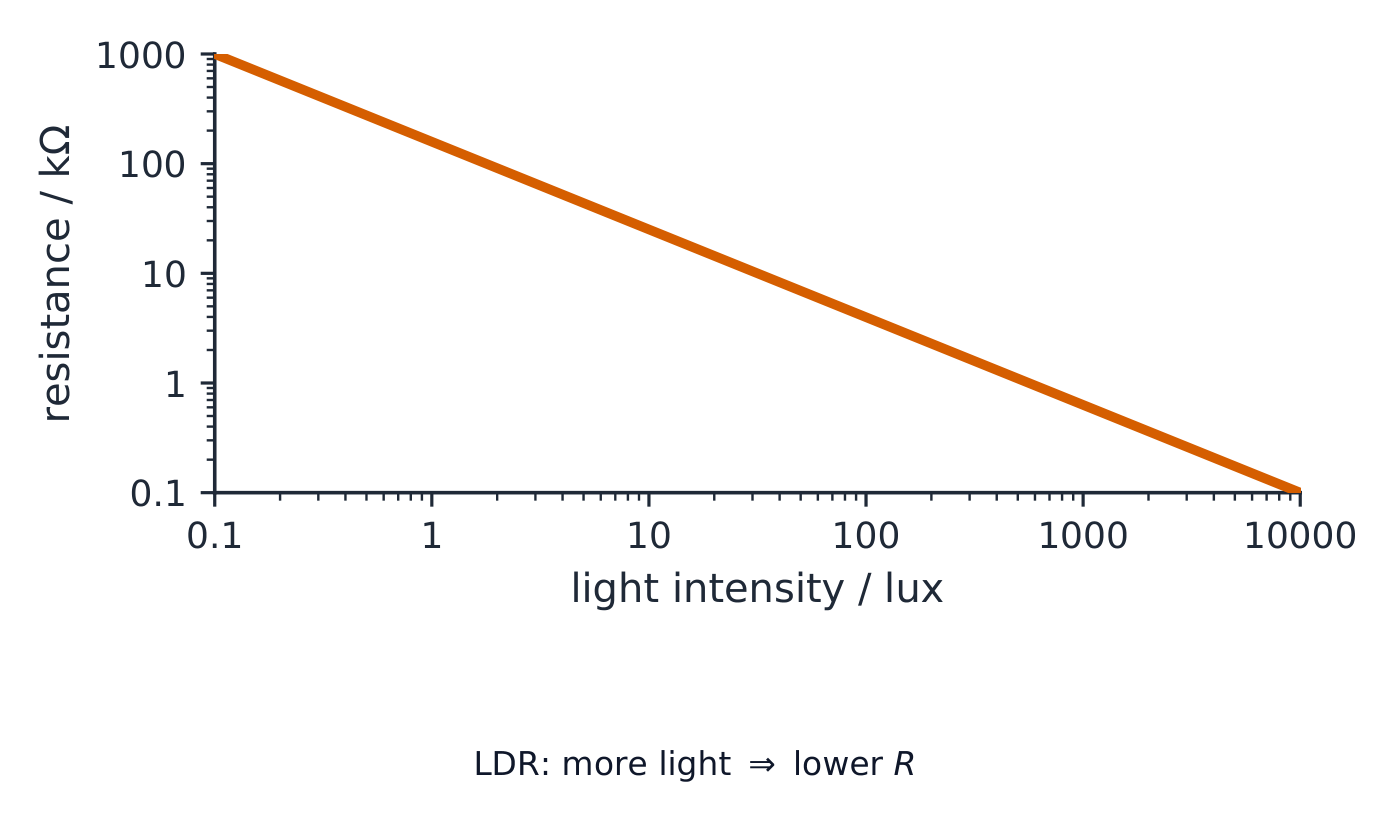
A light-dependent resistor 光敏电阻 (LDR) is a semiconductor whose resistance falls as the light intensity rises. In bright light $R$ may be a few hundred $\Omega$; in the dark it can be in the megaohms. LDRs are used in light-sensing circuits (street lamps, camera light meters). Here the light intensity 光强 controls the resistance.
Español
Una resistencia dependiente de la luz 光敏电阻 (LDR) es un semiconductor cuya resistencia disminuye a medida que aumenta la intensidad de la luz. Con luz brillante, $R$ puede ser de unos pocos cientos de $\Omega$; en la oscuridad puede estar en los megaohmios. Las LDR se utilizan en circuitos sensores de luz (farolas, fotómetros de cámara). Aquí, la intensidad de la luz 光强 controla la resistencia.
Resistance of an LDR decreases as light intensity increases
negative temperature coefficient/ˈneɡətɪv ˈtemprɪtʃə ˌkəʊɪˈfɪʃənt/
负温度系数
fù wēn dù xì shù
potential divider/pəˈtenʃl dɪˈvaɪdə/
分压器
fēn yā qì
9.3
Termistor
English
In this syllabus a thermistor 热敏电阻 has a negative temperature coefficient 负温度系数: its resistance falls as its temperature rises. This is useful for sensing temperature — put it in a potential divider 分压器 and the output voltage changes with temperature.
This is the opposite of a metal: in a semiconductor, more thermal energy frees more charge carriers, and this matters more than the extra scattering.
A sketch of a thermistor's resistance against temperature starts at $R_{0}$ at $0\ °\text{C}$ and falls along a curve that flattens: the fall is not linear, which is the disadvantage of a thermistor as a thermometer (its scale is not uniform, so it needs calibrating). When the light on an LDR is increased, or a thermistor is warmed, its resistance falls, the current in its circuit rises, and the p.d. across it (in series with a fixed resistor) falls while the p.d. across the resistor rises; a fixed resistor and a metal wire at constant temperature keep their resistance, and a filament lamp's rises with current.
Español
En este programa, una termistor 热敏电阻 tiene un coeficiente de temperatura negativo 负温度系数: su resistencia disminuye a medida que aumenta su temperatura. Esto es útil para medir la temperatura: colóquela en un divisor de potencial 分压器 y el voltaje de salida cambia con la temperatura.
Resistance of a thermistor falls as temperature rises
Esto es lo opuesto a un metal: en un semiconductor, más energía térmica libera más portadores de carga, y esto importa más que la dispersión adicional.
Un esquema de la resistencia de una termistor frente a la temperatura comienza en $R_{0}$ en $0\ °\text{C}$ y desciende siguiendo una curva que se aplana: la caída no es lineal, lo cual es una desventaja de la termistor como termómetro (su escala no es uniforme, por lo que necesita calibración). Cuando aumenta la luz sobre un LDR o se calienta una termistor, su resistencia disminuye, la corriente en su circuito aumenta y la diferencia de potencial (d.d.p.) a través de ella (en serie con una resistencia fija) disminuye mientras que la d.d.p. a través de la resistencia fija aumenta; una resistencia fija y un alambre metálico a temperatura constante mantienen su resistencia, mientras que la resistencia de una lámpara de filamento aumenta con la corriente.
Definitions the examiner accepts · Definiciones aceptadas por el examinador
English
A definition question is marked against fixed wording. Learn these exactly, and give one answer only.
Term
Definition
electric current
a flow of charge carriers
coulomb
the charge passing a point in one second when the current is one ampere
potential difference
the energy transferred from electrical to other forms per unit charge passing through a component
electromotive force (e.m.f.)
the energy transferred from other forms to electrical energy per unit charge, by a source driving charge round a complete circuit
volt
one joule per coulomb
resistance
the ratio of the potential difference across a component to the current in it
ohm
the resistance of a component in which a potential difference of one volt produces a current of one ampere
Ohm's law
the current in a metallic conductor is directly proportional to the potential difference across it, provided its temperature remains constant
resistivity
the constant $\rho$ in $R = \rho L / A$, a property of the material with unit $\Omega\ \text{m}$
number density
the number of charge carriers per unit volume of the conductor
Español
Una pregunta de definición se califica según un texto fijo. Aprende estas definiciones exactamente, y da solo una respuesta.
Término
Definición
electric current
a flow of charge carriers
culombio
la carga que pasa por un punto en un segundo cuando la corriente es de un amperio
diferencia de potencial
la energía transferida de eléctrica a otras formas por unidad de carga que pasa a través de un componente
fuerza electromotriz (f.e.m.)
la energía transferida de otras formas a energía eléctrica por unidad de carga, por una fuente que impulsa la carga alrededor de un circuito completo
volt
one joule per coulomb
resistencia
la relación entre la diferencia de potencial a través de un componente y la corriente que lo atraviesa
ohmio
la resistencia de un componente en el que una diferencia de potencial de un voltio produce una corriente de un amperio
Ley de Ohm
la corriente en un conductor metálico es directamente proporcional a la diferencia de potencial a través de él, siempre que su temperatura permanezca constante
resistividad
la constante $\rho$ en $R = \rho L / A$, una propiedad del material con unidad $\Omega\ \text{m}$
densidad numérica
el número de portadores de carga por unidad de volumen del conductor
Use $I = Q/t$, $V = W/Q$ (energy per unit charge) and $P = VI = I^2 R = V^2/R$.
Ohm's law ($V = IR$) applies only to an ohmic conductor at constant temperature — a filament lamp is non-ohmic.
Sketch and interpret the $I$-$V$ characteristics of a resistor, filament lamp and diode.
An LDR's resistance falls with light; a thermistor's falls as temperature rises.
Common mistakes
Taking the resistance from the gradient of a curved $I$–$V$ graph. Resistance is $V/I$ at the point; only for a straight line through the origin is it the reciprocal of the gradient.
Leaving a time in minutes or hours in $Q = It$. Convert to seconds first.
Saying the filament lamp's resistance rises "because of the voltage". The chain is current, temperature, ion vibration, more collisions, more resistance.
Forgetting that a stretched wire changes in two ways. At constant volume the area falls as the length rises, so $R \propto L^{2}$.
Using the diameter as the radius in $A = \pi r^{2}$, or leaving $\text{mm}^{2}$ unconverted.
Comparing powers with the wrong form. Series components share the current, so use $I^{2}R$; parallel components share the p.d., so use $V^{2}/R$.
Español
Use $I = Q/t$, $V = W/Q$ (energy per unit charge) and $P = VI = I^2 R = V^2/R$.
La ley de Ohm ($V = IR$) solo se aplica a un conductor óhmico a temperatura constante; una lámpara de filamento es no óhmica.
Esbozar e interpretar las características $I$-$V$ de una resistencia, una lámpara de filamento y un diodo.
La resistencia de una CFL (resistencia dependiente de la luz) disminuye con la luz; la de un termistor disminuye a medida que aumenta la temperatura.
Errores comunes
Tomar la resistencia a partir de la pendiente de un gráfico curvo $I$–$V$. La resistencia es $V/I$ en el punto; solo para una línea recta que pasa por el origen es igual al recíproco de la pendiente.
Dejar un tiempo en minutos u horas en $Q = It$. Convertir primero a segundos.
Afirmar que la resistencia de la lámpara de filamento aumenta "debido al voltaje". La cadena causal es: corriente, temperatura, vibración iónica, más colisiones, mayor resistencia.
Olvidar que un cable estirado cambia de dos maneras. A volumen constante, el área disminuye a medida que aumenta la longitud, por lo tanto $R \propto L^{2}$.
Usar el diámetro como el radio en $A = \pi r^{2}$, o dejar $\text{mm}^{2}$ sin convertir.
Comparar potencias con la fórmula incorrecta. Los componentes en serie comparten la corriente, por lo que se usa $I^{2}R$; los componentes en paralelo comparten la diferencia de potencial, por lo que se usa $V^{2}/R$.
Interactive lessons on this topic · Lecciones interactivas sobre este tema
Work through it step by step, with instant-check exercises. · Trátalo paso a paso, con ejercicios de verificación instantánea.
Pick one and the site follows you — notes, papers, videos and practice all open on it. · Selecciona uno y el sitio te sigue — notas, documentos, videos y práctica se abren en él.
Type to search notes, lessons, code, vocabulary and past-paper questions across every subject. · Escribe para buscar notas, lecciones, código, vocabulario y preguntas de exámenes anteriores en todas las materias.