Un carrusel no tiene motor en su vía. Una cadena lo arrastra hasta la primera colina — y después, está solo. Entonces, ¿cómo logra atravesar cada bucle…
English narration · English + 中文 subtitles burned in · Narración en inglés · Subtítulos en inglés + 中文 quemados en pantalla
5.1
Work, energy and power · Trabajo, energía y potencia
Syllabus
English
understand the concept of work, and recall and use $\text{work done} = \text{force} \times \text{displacement in the direction of the force}$
recall and apply the principle of conservation of energy
recall and understand that the efficiency of a system is the ratio of useful energy output from the system to the total energy input
use the concept of efficiency to solve problems
define power as work done per unit time
solve problems using $P = W/t$
derive $P = Fv$ and use it to solve problems
Español
comprender el concepto de trabajo, y recordar y utilizar $\text{work done} = \text{force} \times \text{displacement in the direction of the force}$
recordar y aplicar el principio de conservación de la energía
recordar y comprender que la eficiencia de un sistema es la relación entre la energía útil de salida del sistema y la energía total de entrada
utilizar el concepto de eficiencia para resolver problemas
definir la potencia como trabajo realizado por unidad de tiempo
resolver problemas utilizando $P = W/t$
derivar $P = Fv$ y utilizarlo para resolver problemas
Source: Cambridge International syllabus · Fuente: Plan de estudios Cambridge International
English
Work done by a force
Work 功 is done when a force moves its point of contact along the line of the force. For the one-mark definition write: work done is the product of the force and the distance moved in the direction of the force. The work done by a constant force $F$ that causes a displacement 位移$s$ is
$$W = F \cdot s \cdot \cos\theta,$$
where $\theta$ is the angle between the force and the displacement. Only the component 分量 of the force along the displacement does work.
Worked example. A child pulls a sledge $5.0\ \text{m}$ across the snow with a rope, using a force of $20\ \text{N}$ at $60°$ to the ground. Find the work done by the rope.
Unit: $\text{J} = \text{N m}$. Work is a scalar 标量.
Special cases:
force in the same direction as the motion ($\theta = 0$): $W = Fs$, positive work, energy 能量 given to the object.
force at right angles to the motion ($\theta = 90°$): $W = 0$. The normal contact force 支持力 on a car on a flat road does no work.
force opposite to the motion ($\theta = 180°$): $W = -Fs$, negative work, energy taken from the object (for example friction 摩擦力).
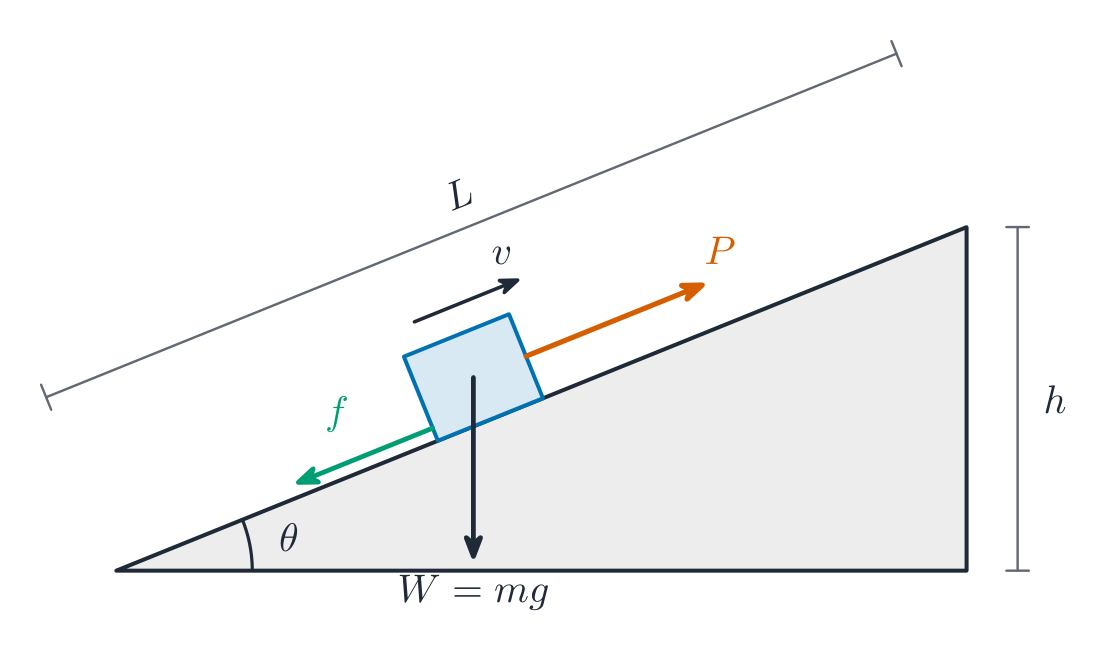
For an object moving up a slope at angle $\alpha$ to the horizontal 水平, the work done against gravity in rising a height $h$ is $mgh$, while the work done by a horizontal push over the slope length $L$ uses $\cos\alpha$.
Two multiple-choice tests of the definition: no work is done on an object that slides at constant velocity along a frictionless surface (no force along the motion), or on one that is simply held still (no distance moved); work is done when a force lifts it. And when a box is pushed at constant velocity across a rough floor, the work done by the push is $F \times d$ for the whole distance, however the path is split into stages.
Worked example. A block of mass $4.9\ \text{kg}$ is pushed at constant velocity up a rough slope of length $8.0\ \text{m}$ that rises $1.5\ \text{m}$, by a force of $12\ \text{N}$ acting along the slope. Find the work done against friction.
Constant velocity means no change in kinetic energy, so the work done by the push is shared between the gain in gravitational potential energy and the work done against friction. Work by the push: $12 \times 8.0 = 96\ \text{J}$. Gain in GPE, using the vertical rise: $4.9 \times 9.81 \times 1.5 = 72\ \text{J}$. So the work done against friction is $96 - 72 = 24\ \text{J}$, and the friction force is $24 / 8.0 = 3.0\ \text{N}$. Using the slope length in $mgh$ is the commonest error on this question.
Conservation of energy
Energy is never made or destroyed — it only changes from one form to another, or moves from one object to another. In a closed system 封闭系统, the total energy stays constant. This is conservation of energy 能量守恒, stated for the marks as: energy cannot be created or destroyed; it can only be transferred from one form to another (so the total energy of a closed system is constant).
When you write an energy equation, list every form the energy starts as and ends as. Common forms in this syllabus: kinetic, gravitational potential, elastic potential energy 弹性势能, electrical 电能, thermal, sound, chemical energy 化学能.
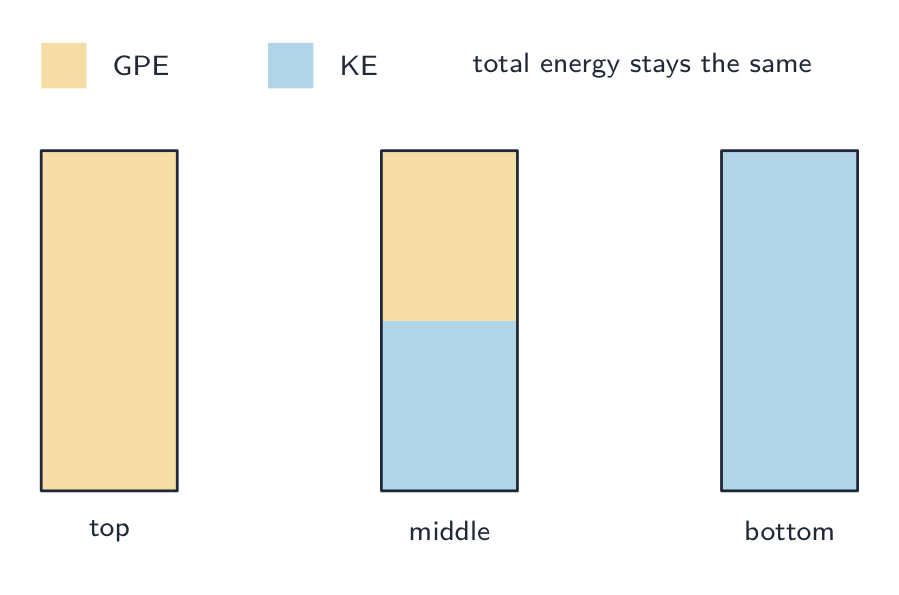
A ball rolling down a frictionless 无摩擦ramp 斜坡 turns gravitational potential energy 重力势能 into kinetic energy 动能: $mgh = \tfrac{1}{2} m v^{2}$, so $v = \sqrt{2gh}$. With friction, some of this energy becomes thermal energy 热能 of the ramp and the air.
Worked example. A ball is released from rest at the top of a smooth ramp $1.2\ \text{m}$ high. Find its speed at the bottom (take $g = 9.81\ \text{m s}^{-2}$).
All the gravitational potential energy becomes kinetic energy, so $v = \sqrt{2gh}$ (the mass cancels):
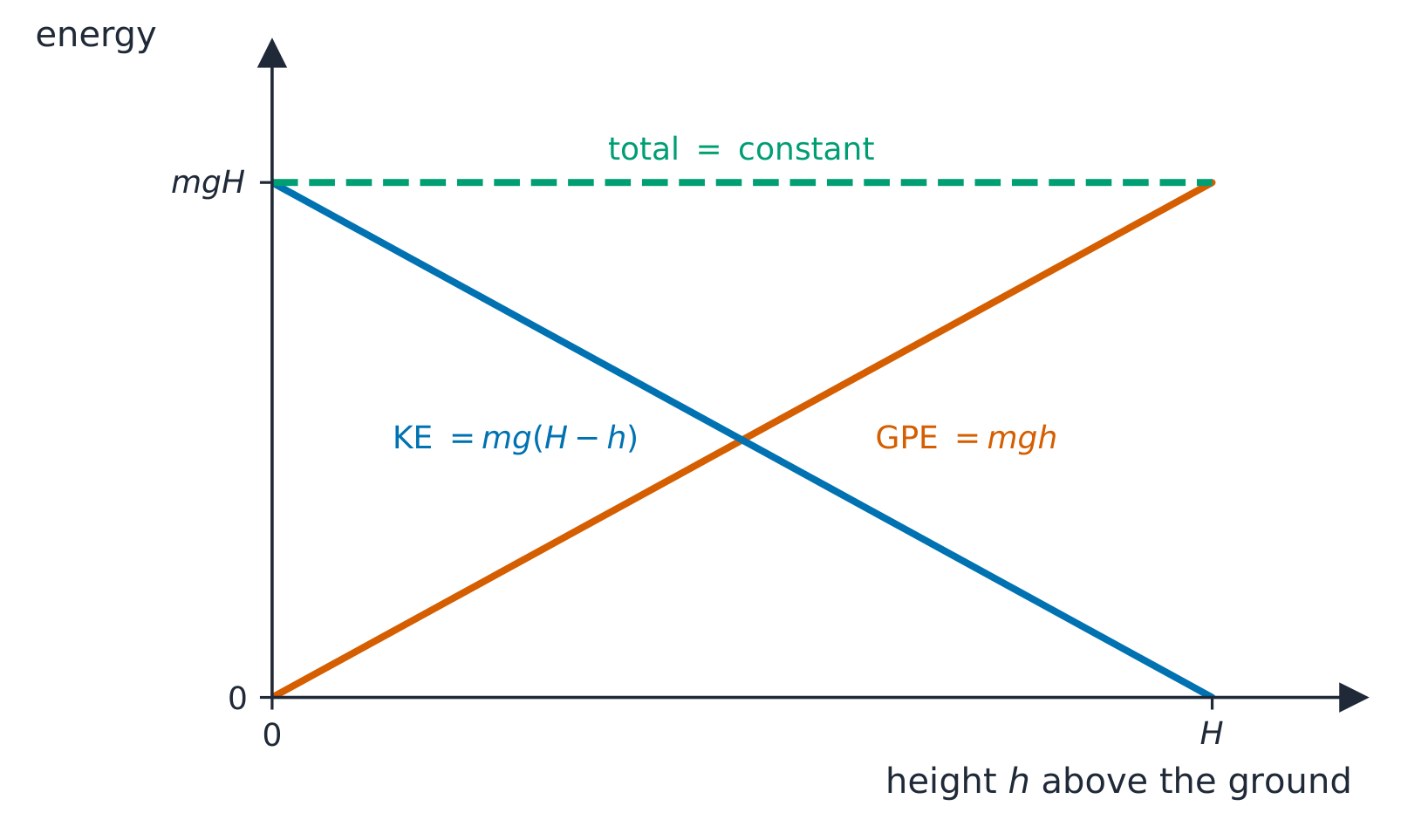
The same idea reads a graph. For a ball falling from height $H$ with air resistance negligible, the GPE falls in a straight line with height ($mgh$), the KE rises in a straight line ($mg(H - h)$), and the two add to the constant $mgH$ at every height.
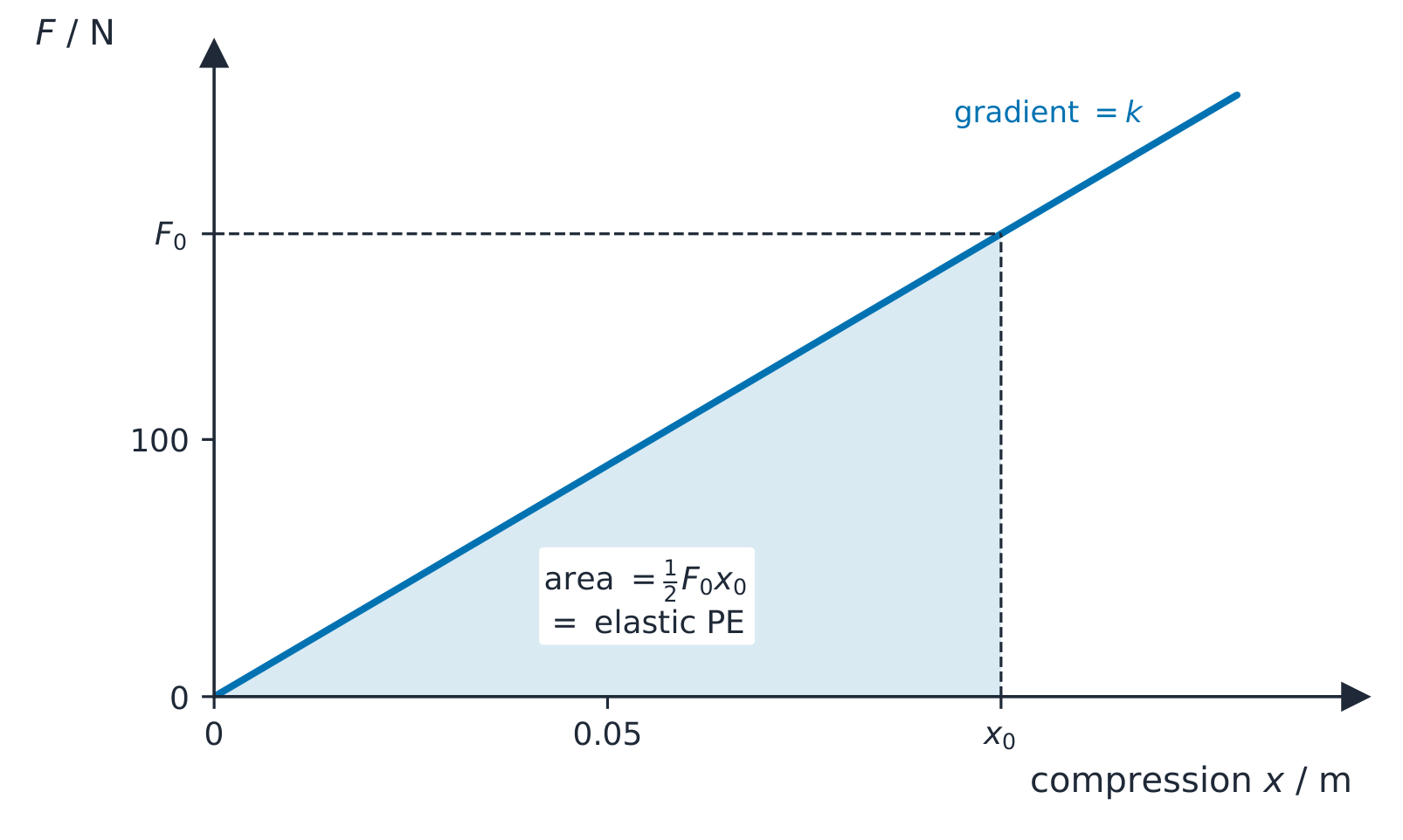
The energy chain can pass through a spring. A block that hits a spring with kinetic energy $110\ \text{J}$ while sliding a little downhill, so that its GPE falls by a further $20\ \text{J}$ before the spring stops it, stores $110 + 20 = 130\ \text{J}$ of elastic potential energy at the greatest compression, if nothing is lost to friction. The spring's force–compression graph then gives the compression: the energy stored is the area under the line, $\tfrac{1}{2} F_{0} x_{0}$ for a spring that obeys Hooke's law (topic 6), so a maximum force of $2600\ \text{N}$ means $x_{0} = 2 \times 130 / 2600 = 0.10\ \text{m}$. At that instant the resultant force on the block is the spring force minus the component of the weight down the slope, and its acceleration follows from $F = ma$ (topic 3).
Efficiency
The efficiency 效率 of a system is
$$\text{efficiency} = \frac{\text{useful energy output}}{\text{total energy input}} \times 100\%.$$
The same idea with power:
$$\text{efficiency} = \frac{\text{useful power output}}{\text{total power input}} \times 100\%.$$
Efficiency is always less than 100% in a real system, because some input energy becomes "useless" forms — usually thermal energy. If a total energy $E$ is supplied and an amount $Q$ is wasted, the useful output is $E - Q$ and the efficiency is $(E - Q) / E$; a motor rated at $1.7\ \text{kW}$ input with efficiency $53\%$ delivers $0.53 \times 1.7 = 0.90\ \text{kW}$ of useful output.
For an electric motor lifting a load with efficiency $\eta$ at voltage 电压$V$ and current 电流$I$, the useful output power is $\eta V I$. From this you can find a force, a lifting speed, or a tension 张力.
Worked example. An electric motor lifts a $50\ \text{kg}$ load at a steady $0.40\ \text{m s}^{-1}$ while drawing $250\ \text{W}$ of electrical power. Find its efficiency (take $g = 9.81\ \text{m s}^{-2}$).
The useful output power is $P = mgv = 50 \times 9.81 \times 0.40 = 196\ \text{W}$, so
Worked example. A motor raises a block with a force of $240\ \text{N}$ through a vertical distance of $12\ \text{m}$ in $60\ \text{s}$. The input power to the motor is $900\ \text{W}$. Find the useful output power and the efficiency.
Work done on the block: $W = Fd = 240 \times 12 = 2880\ \text{J}$. Useful output power: $P = W / t = 2880 / 60 = 48\ \text{W}$. Efficiency: $48 / 900 \times 100\% = 5.3\%$. Most of the input goes into thermal energy in the motor and its cable. Turned round, a lift motor of useful output $20\ \text{kW}$ raising $1500\ \text{kg}$ through $20\ \text{m}$ takes $t = mgh / P = 1500 \times 9.81 \times 20 / 20\,000 = 15\ \text{s}$.
Español
Las turbinas eólicas transfieren la energía cinética del viento en energía eléctrica.
Trabajo realizado por una fuerza
Se realiza trabajo 功 cuando una fuerza desplaza su punto de contacto a lo largo de la línea de acción de dicha fuerza. Para la definición de una marca, escriba: el trabajo realizado es el producto de la fuerza por la distancia recorrida en la dirección de la fuerza. El trabajo realizado por una fuerza constante $F$ que provoca un desplazamiento 位移$s$ es
$$W = F \cdot s \cdot \cos\theta,$$
donde $\theta$ es el ángulo entre la fuerza y el desplazamiento. Solo la componente 分量 de la fuerza a lo largo del desplazamiento realiza trabajo.
Solo la componente de la fuerza a lo largo del desplazamiento ($F\cos\theta$) realiza trabajo
Ejemplo resuelto. Un niño tira de un trineo $5.0\ \text{m}$ sobre la nieve con una cuerda, aplicando una fuerza de $20\ \text{N}$ a $60°$ respecto al suelo. Calcule el trabajo realizado por la cuerda.
Unidad: $\text{J} = \text{N m}$. El trabajo es una magnitud escalar 标量.
Casos especiales:
fuerza en la misma dirección que el movimiento ($\theta = 0$): $W = Fs$, trabajo positivo, energía 能量 entregada al objeto.
fuerza perpendicular al movimiento ($\theta = 90°$): $W = 0$. La fuerza de contacto normal 支持力 sobre un coche en una carretera plana no realiza trabajo.
fuerza opuesta al movimiento ($\theta = 180°$): $W = -Fs$, trabajo negativo, energía extraída del objeto (por ejemplo, fricción 摩擦力).
Trabajo positivo ($W = +Fs$): fuerza en la dirección del movimiento (arriba). Trabajo negativo ($W = -Fs$): fuerza opuesta al movimiento, p. ej., fricción (abajo)
Para un objeto que se mueve cuesta arriba por una pendiente con ángulo $\alpha$ respecto a la horizontal 水平, el trabajo realizado contra la gravedad al ascender una altura $h$ es $mgh$, mientras que el trabajo realizado por un empuje horizontal a lo largo de la longitud de la pendiente $L$ utiliza $\cos\alpha$.
Dos pruebas de opción múltiple sobre la definición: no se realiza trabajo sobre un objeto que desliza a velocidad constante sobre una superficie sin fricción (no hay fuerza a lo largo del movimiento), ni sobre uno que simplemente se mantiene quieto (no hay distancia recorrida); sí se realiza trabajo cuando una fuerza lo levanta. Y cuando se empuja una caja a velocidad constante sobre un suelo rugoso, el trabajo realizado por el empuje es $F \times d$ para toda la distancia, independientemente de cómo se divida la trayectoria en etapas.
Ejemplo resuelto. Se empuja un bloque de masa $4.9\ \text{kg}$ a velocidad constante por una pendiente rugosa de longitud $8.0\ \text{m}$ que asciende $1.5\ \text{m}$, mediante una fuerza de $12\ \text{N}$ actuando a lo largo de la pendiente. Calcule el trabajo realizado contra la fricción.
Una caja empujada cuesta arriba por una pendiente rugosa a velocidad constante: el trabajo realizado por el empuje paga por el aumento de EPg, que solo depende del ascenso vertical $h$, y por el trabajo realizado contra la fricción a lo largo de toda la longitud $L$
La velocidad constante implica que no hay cambio en la energía cinética, por lo que el trabajo realizado por el empuje se reparte entre el aumento de energía potencial gravitatoria y el trabajo realizado contra la fricción. Trabajo del empuje: $12 \times 8.0 = 96\ \text{J}$. Aumento de EPg, utilizando el ascenso vertical: $4.9 \times 9.81 \times 1.5 = 72\ \text{J}$. Por tanto, el trabajo realizado contra la fricción es $96 - 72 = 24\ \text{J}$, y la fuerza de fricción es $24 / 8.0 = 3.0\ \text{N}$. Utilizar la longitud de la pendiente en $mgh$ es el error más común en este tipo de ejercicio.
Conservación de la energía
La energía nunca se crea ni se destruye; solo cambia de una forma a otra o se transfiere de un objeto a otro. En un sistema cerrado 封闭系统, la energía total permanece constante. Esto es la conservación de la energía 能量守恒, formulado para las marcas como: la energía no puede crearse ni destruirse; solo puede transferirse de una forma a otra (por lo que la energía total de un sistema cerrado es constante).
Al escribir una ecuación energética, enumere todas las formas en las que comienza y termina la energía. Formas comunes en este programa: energía cinética, energía potencial gravitatoria, energía potencial elástica 弹性势能, energía eléctrica 电能, térmica, sonora, energía química 化学能.
Una bola que rueda cuesta abajo por una pendiente 斜坡sin fricción 无摩擦 convierte energía potencial gravitatoria 重力势能 en energía cinética 动能: $mgh = \tfrac{1}{2} m v^{2}$, por lo que $v = \sqrt{2gh}$. Con fricción, parte de esta energía se transforma en energía térmica 热能 de la rampa y del aire.
En una rampa sin fricción, la energía potencial gravitatoria se convierte en energía cinética mientras la energía total permanece constante
Ejemplo resuelto. Una bola se suelta desde el reposo en la parte superior de una rampa suave $1.2\ \text{m}$ de altura. Encuentre su velocidad en la base (tomar $g = 9.81\ \text{m s}^{-2}$).
Toda la energía potencial gravitatoria se convierte en energía cinética, por lo que $v = \sqrt{2gh}$ (la masa se cancela):
La misma idea se lee en un gráfico. Para una bola que cae desde una altura $H$ con resistencia del aire despreciable, la energía potencial gravitatoria (GPE) disminuye en línea recta con la altura ($mgh$), la energía cinética (KE) aumenta en línea recta ($mg(H - h)$), y ambas suman la constante $mgH$ a cada altura.
Una bola en caída: tanto la GPE como la KE cambian en línea recta con la altura, y su suma es constante
La cadena de energía puede pasar a través de un resorte. Un bloque que golpea un resorte con energía cinética $110\ \text{J}$ mientras desliza ligeramente cuesta abajo, de modo que su energía potencial gravitatoria disminuye en otros $20\ \text{J}$ antes de que el resorte lo detenga, almacena $110 + 20 = 130\ \text{J}$ de energía potencial elástica en la máxima compresión, si no se pierde nada por fricción. La gráfica de fuerza–compresión del resorte entonces da la compresión: la energía almacenada es el área bajo la línea, $\tfrac{1}{2} F_{0} x_{0}$ para un resorte que cumple la ley de Hooke (tema 6), por lo que una fuerza máxima de $2600\ \text{N}$ significa $x_{0} = 2 \times 130 / 2600 = 0.10\ \text{m}$. En ese instante, la fuerza neta sobre el bloque es la fuerza del resorte menos la componente del peso hacia abajo por la pendiente, y su aceleración se sigue de $F = ma$ (tema 3).
La energía almacenada en un resorte es el área bajo su gráfico de fuerza-compresión: $\tfrac{1}{2} F_{0} x_{0}$, lo cual es igual a $\tfrac{1}{2} k x_{0}^{2}$
Eficiencia
La eficiencia 效率 de un sistema es
$$\text{efficiency} = \frac{\text{useful energy output}}{\text{total energy input}} \times 100\%.$$
La misma idea con la potencia:
$$\text{efficiency} = \frac{\text{useful power output}}{\text{total power input}} \times 100\%.$$
La eficiencia siempre es menor del 100% en un sistema real, porque parte de la energía de entrada se convierte en formas "inútiles" — usualmente energía térmica. Si se suministra una energía total $E$ y se desperdicia una cantidad $Q$, la salida útil es $E - Q$ y la eficiencia es $(E - Q) / E$; un motor con una entrada nominal de $1.7\ \text{kW}$ y una eficiencia de $53\%$ entrega $0.53 \times 1.7 = 0.90\ \text{kW}$ de salida útil.
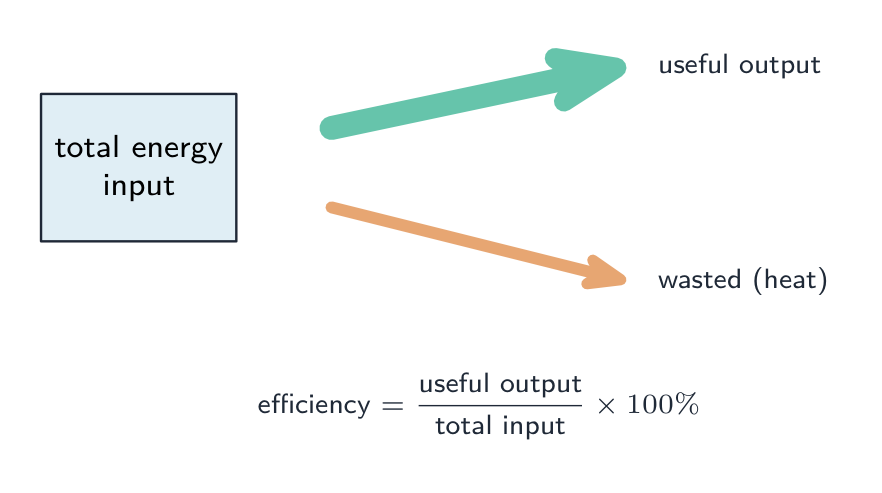
Eficiencia: solo una parte de la energía de entrada se convierte en salida útil; el resto se desperdicia, generalmente como calor.
Para un motor eléctrico que eleva una carga con una eficiencia $\eta$ a un voltaje 电压$V$ y una corriente 电流$I$, la potencia de salida útil es $\eta V I$. A partir de esto, puedes calcular una fuerza, una velocidad de elevación o una tensión 张力.
Ejemplo resuelto. Un motor eléctrico eleva una carga de $50\ \text{kg}$ a velocidad constante de $0.40\ \text{m s}^{-1}$ mientras consume $250\ \text{W}$ de potencia eléctrica. Hallar su eficiencia (tomar $g = 9.81\ \text{m s}^{-2}$).
La potencia de salida útil es $P = mgv = 50 \times 9.81 \times 0.40 = 196\ \text{W}$, por lo tanto
Ejemplo resuelto. Un motor eleva un bloque con una fuerza de $240\ \text{N}$ a través de una distancia vertical de $12\ \text{m}$ en $60\ \text{s}$. La potencia de entrada al motor es $900\ \text{W}$. Encuentre la potencia útil de salida y la eficiencia.
Trabajo realizado sobre el bloque: $W = Fd = 240 \times 12 = 2880\ \text{J}$. Potencia útil de salida: $P = W / t = 2880 / 60 = 48\ \text{W}$. Eficiencia: $48 / 900 \times 100\% = 5.3\%$. La mayor parte de la entrada se convierte en energía térmica en el motor y su cable. A la inversa, un motor de elevación con una potencia útil de salida de $20\ \text{kW}$ que eleva $1500\ \text{kg}$ a través de $20\ \text{m}$ consume $t = mgh / P = 1500 \times 9.81 \times 20 / 20\,000 = 15\ \text{s}$.
Explore · Explorar
Flujo de energía y eficiencia
La energía de entrada se divide en trabajo útil y energía desperdiciada; la eficiencia = útil ÷ entrada, y útil + desperdiciado siempre es igual a la entrada.
Explore · Explorar
Trabajo, energía y potencia
PE + KE = constante
El trabajo transfiere energía; al caer, la PE se convierte en KE con el total fijo.
Power 功率 is the rate of doing work, or the rate of transferring energy:
$$P = \frac{W}{t} = \frac{\Delta E}{\Delta t}.$$
Unit: $\text{W} = \text{J s}^{-1}$. Power is a scalar.
Power, force and velocity
For an object moving at velocity 速度$v$ with a force $F$ along the direction of motion, in a short time $\Delta t$ the displacement is $v\,\Delta t$ and the work done is $F v\,\Delta t$. Dividing by $\Delta t$:
$$P = F v.$$
This is one of the most useful results in mechanics. A "derive $P = Fv$" answer needs exactly those three lines: $P = W / t$, $W = Fs$ for a force along the motion, and $s / t = v$; then use it to solve problems in which a vehicle or a load moves at constant speed.
Worked example. A car travels at a steady $25\ \text{m s}^{-1}$ against a total resistive force of $600\ \text{N}$. Find the output power of its engine.
At constant speed the driving force equals the resistive force, so
For a car at constant velocity $v$ on a flat road, the engine power must balance the total resistive force: $P = F_{\text{resist}} \cdot v$. If the drag 阻力 grows with $v^{2}$, doubling the speed roughly quadruples the power needed.
For lifting a weight 重力$mg$ straight up at constant speed $v$, the useful output power is $P = mg \cdot v$.
For an aircraft hovering at a fixed height, the lift force equals the weight, and a large power is needed because air must be pushed downwards all the time.
A crane raising $600\ \text{kg}$ at a steady $12\ \text{m}$ per minute lifts at $v = 0.20\ \text{m s}^{-1}$, so its useful output power is $mgv = 600 \times 9.81 \times 0.20 = 1.2\ \text{kW}$. Convert the speed to $\text{m s}^{-1}$ first.
A sailboat pushed by a constant wind force at constant velocity must also feel an equal resistive force from the water: constant velocity means zero resultant force, so the wind's power $Fv$ is all going into work against the water.
Español
Potencia 功率 es la tasa de realizar trabajo, o la tasa de transferir energía:
Realizar el mismo trabajo en menos tiempo implica mayor potencia
$$P = \frac{W}{t} = \frac{\Delta E}{\Delta t}.$$
Unidad: $\text{W} = \text{J s}^{-1}$. La potencia es una magnitud escalar.
Potencia, fuerza y velocidad
Para un objeto que se mueve con velocidad 速度$v$ y una fuerza $F$ en la dirección del movimiento, en un breve intervalo de tiempo $\Delta t$ el desplazamiento es $v\,\Delta t$ y el trabajo realizado es $F v\,\Delta t$. Dividiendo por $\Delta t$:
$$P = F v.$$
Este es uno de los resultados más útiles en mecánica. Una respuesta para "deducir $P = Fv$" necesita exactamente esas tres líneas: $P = W / t$, $W = Fs$ para una fuerza a lo largo del movimiento, y $s / t = v$; luego úsela para resolver problemas en los que un vehículo o una carga se mueve a velocidad constante.
Ejemplo resuelto. Un coche viaja a una velocidad constante de $25\ \text{m s}^{-1}$ contra una fuerza resistiva total de $600\ \text{N}$. Encuentre la potencia de salida de su motor.
A velocidad constante, la fuerza motriz es igual a la fuerza resistiva, por lo que
Para un automóvil que se mueve a velocidad constante $v$ en una carretera plana, la potencia del motor debe equilibrar la fuerza de resistencia total: $P = F_{\text{resist}} \cdot v$. Si la resistencia aerodinámica 阻力 crece con $v^{2}$, duplicar la velocidad aproximadamente cuadruplica la potencia necesaria.
Para elevar verticalmente un peso 重力$mg$ a velocidad constante $v$, la potencia útil de salida es $P = mg \cdot v$.
Para una aeronave en vuelo estacionario a una altura fija, la fuerza de sustentación iguala al peso, y se requiere una gran potencia porque el aire debe ser empujado hacia abajo continuamente.
Una grúa que eleva $600\ \text{kg}$ a una velocidad constante de $12\ \text{m}$ por minuto lo hace a $v = 0.20\ \text{m s}^{-1}$, por lo que su potencia útil de salida es $mgv = 600 \times 9.81 \times 0.20 = 1.2\ \text{kW}$. Convierte primero la velocidad a $\text{m s}^{-1}$.
Un velero empujado por una fuerza de viento constante a velocidad constante también debe experimentar una fuerza resistente igual del agua: una velocidad constante significa una fuerza nula, por lo que la potencia del viento $Fv$ se destina completamente al trabajo contra el agua.
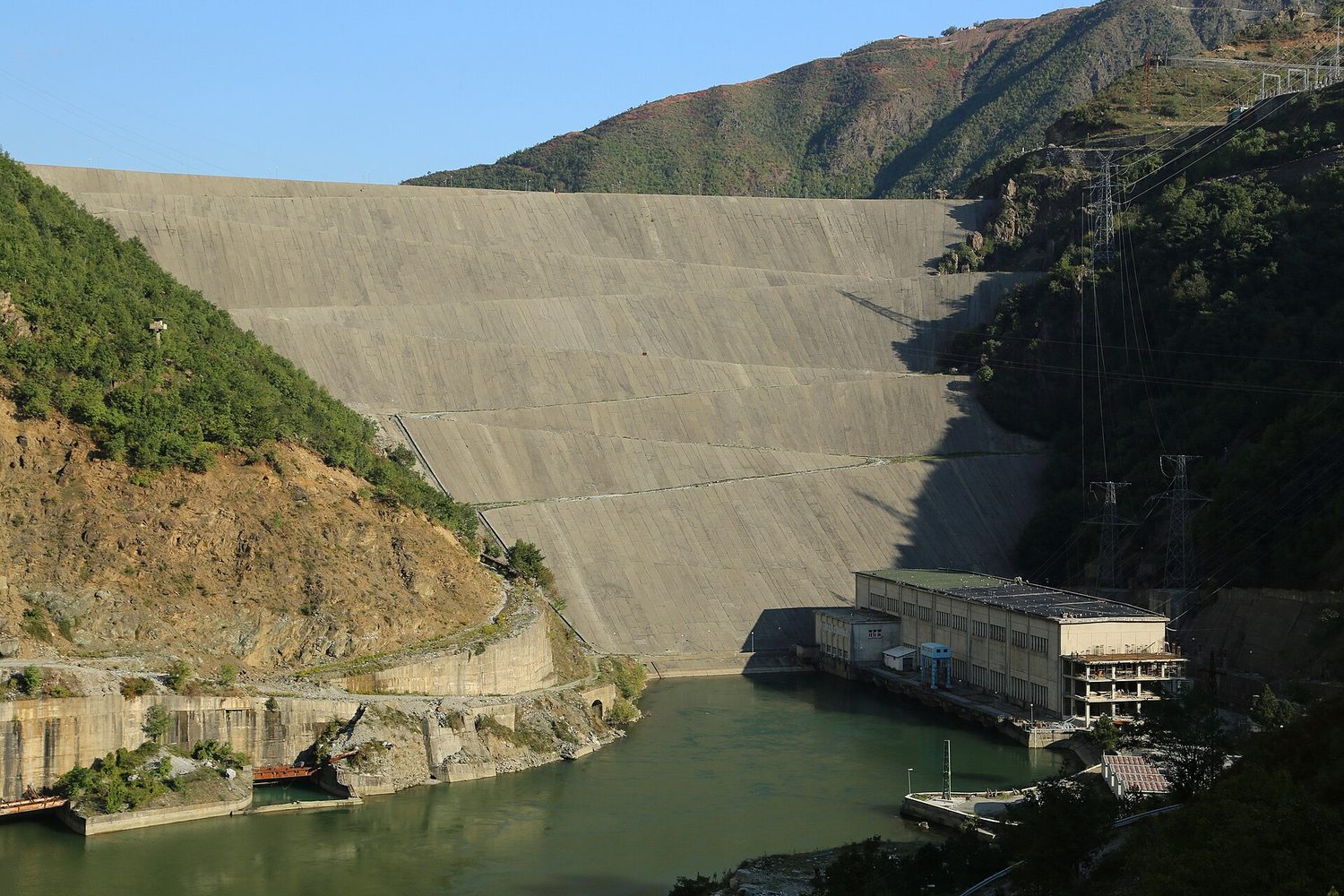
Una central hidroeléctrica tiene una potencia nominal en megavatios: la energía del agua almacenada dividida por el tiempo que tarda en liberarla
5.2
Gravitational potential energy · Energía potencial gravitatoria
Syllabus
English
derive, using $W = Fs$, the formula $\Delta E_{\text{P}} = mg\Delta h$ for gravitational potential energy changes in a uniform gravitational field
recall and use the formula $\Delta E_{\text{P}} = mg\Delta h$ for gravitational potential energy changes in a uniform gravitational field
derive, using the equations of motion, the formula for kinetic energy$E_{\text{K}} = \frac{1}{2}mv^2$
recall and use $E_{\text{K}} = \frac{1}{2}mv^2$
Español
derivar, utilizando $W = Fs$, la fórmula $\Delta E_{\text{P}} = mg\Delta h$ para los cambios en la energía potencial gravitatoria en un campo gravitatorio uniforme
recordar y utilizar la fórmula $\Delta E_{\text{P}} = mg\Delta h$ para los cambios en la energía potencial gravitatoria en un campo gravitatorio uniforme
derivar, utilizando las ecuaciones del movimiento, la fórmula para la energía cinética$E_{\text{K}} = \frac{1}{2}mv^2$
recordar y utilizar $E_{\text{K}} = \frac{1}{2}mv^2$
Source: Cambridge International syllabus · Fuente: Plan de estudios Cambridge International
English
Energy exchange in a pendulum
In a uniform gravitational field (close to a planet's surface), the change in gravitational potential energy of mass 质量$m$ rising or falling through a height $\Delta h$ is
$$\Delta E_{\text{P}} = m g \Delta h.$$
Where it comes from
The work done against gravity to raise a mass $m$ slowly (no change in kinetic energy) through height $\Delta h$ equals the gravitational potential energy gained:
the gravitational force on the mass is $mg$ downwards,
the force needed to lift it slowly is $mg$ upwards,
the work done by this force is $W = F \cdot s = mg \cdot \Delta h$,
this work becomes $\Delta E_{\text{P}}$.
So $\Delta E_{\text{P}} = mg \Delta h$. To use it you need $m$ and $\Delta h$ (and $g$). You do not need speed or time. The two-mark derivation wants the same four lines, with the condition stated: the block is raised at constant speed, so the lifting force equals the weight $mg$, and the work done by that force over the vertical distance $\Delta h$ is $mg\Delta h$, which is the gain in gravitational potential energy. A $100\ \text{g}$ object falling $10\ \text{m}$ loses $0.100 \times 9.81 \times 10 = 9.8\ \text{J}$, about $10\ \text{J}$; the mass must be in kilograms.
Español
Intercambio de energía en un péndulo
En un campo gravitatorio uniforme (cerca de la superficie de un planeta), el cambio en la energía potencial gravitatoria de una masa 质量$m$ que sube o baja a través de una altura $\Delta h$ es
$$\Delta E_{\text{P}} = m g \Delta h.$$
Origen del concepto
El trabajo realizado contra la gravedad para elevar una masa $m$ lentamente (sin cambio en la energía cinética) a través de una altura $\Delta h$ es igual a la energía potencial gravitatoria ganada:
la fuerza gravitatoria sobre la masa es $mg$ hacia abajo,
la fuerza necesaria para levantarlo lentamente es $mg$ hacia arriba,
el trabajo realizado por esta fuerza es $W = F \cdot s = mg \cdot \Delta h$,
este trabajo se convierte en $\Delta E_{\text{P}}$.
Así $\Delta E_{\text{P}} = mg \Delta h$. Para usarlo necesitas $m$ y $\Delta h$ (y $g$). No necesitas la velocidad ni el tiempo. La derivación de dos marcas quiere las mismas cuatro líneas, con la condición declarada: el bloque se eleva a velocidad constante, así que la fuerza de elevación es igual al peso $mg$, y el trabajo realizado por esa fuerza sobre la distancia vertical $\Delta h$ es $mg\Delta h$, que es la ganancia en energía potencial gravitacional. Un objeto $100\ \text{g}$ cayendo $10\ \text{m}$ pierde $0.100 \times 9.81 \times 10 = 9.8\ \text{J}$, aproximadamente $10\ \text{J}$; la masa debe estar en kilogramos.
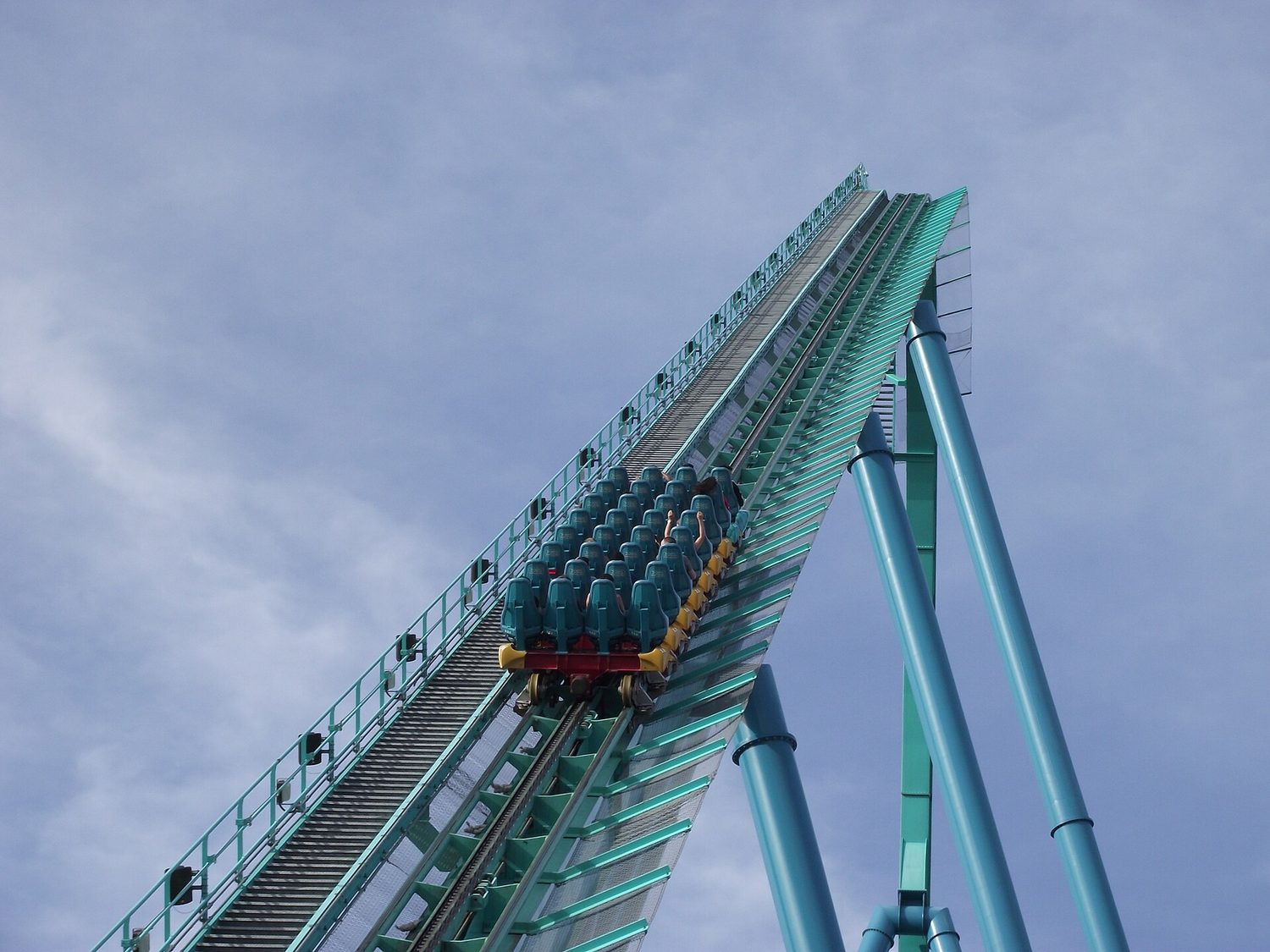
La energía potencial gravitatoria depende únicamente de la altura alcanzada, no del camino recorridoUn tren de montaña rusa arrastrado por la subida: el trabajo realizado contra la gravedad se almacena como energía potencial gravitatoria
5.2
Kinetic energy · Energía cinética
English
The kinetic energy of an object of mass $m$ moving at speed $v$ is
$$E_{\text{K}} = \tfrac{1}{2} m v^{2}.$$
Where it comes from
Apply a resultant force $F$ to a mass $m$ that starts at rest. It speeds up evenly from $0$ to $v$ over a displacement $s$. From $v^{2} = u^{2} + 2as$ with $u = 0$,
$$s = \frac{v^{2}}{2a}.$$
The work done on the mass is
$$W = F \cdot s = m a \cdot \frac{v^{2}}{2a} = \tfrac{1}{2} m v^{2}.$$
All this work becomes kinetic energy, so $E_{\text{K}} = \tfrac{1}{2} m v^{2}$. In the exam, state the assumptions as you go: the object starts from rest, the force is constant, so the acceleration is uniform, and $F = ma$ is Newton's second law.
Because $E_{\text{K}} \propto v^{2}$, quadrupling the speed multiplies the kinetic energy by sixteen: an object with $1500\ \text{J}$ at $10\ \text{m s}^{-1}$ has $24\,000\ \text{J}$ at $40\ \text{m s}^{-1}$. The same square is why a stopping force is found from energy: a ball of mass $1.2\ \text{kg}$ moving at $3.0\ \text{m s}^{-1}$ that is stopped by a cushion over $0.020\ \text{m}$ loses $\tfrac{1}{2} \times 1.2 \times 3.0^{2} = 5.4\ \text{J}$, so the average force on it is $5.4 / 0.020 = 270\ \text{N}$: the work done by the cushion equals the kinetic energy lost.
Kinetic energy and momentum
Combining $p = mv$ and $E_{\text{K}} = \tfrac{1}{2} m v^{2}$:
$$E_{\text{K}} = \frac{p^{2}}{2m}.$$
This is handy when the momentum 动量 is given but not the velocity. For a momentum change from $p_{1}$ to $p_{2}$ at constant mass, the change in kinetic energy is $(p_{2}^{2} - p_{1}^{2}) / (2m)$.
Español
La energía cinética de un objeto de masa $m$ que se mueve a una velocidad $v$ es
$$E_{\text{K}} = \tfrac{1}{2} m v^{2}.$$
Origen del concepto
Aplica una fuerza resultante $F$ a una masa $m$ que parte del reposo. Acelera uniformemente desde $0$ hasta $v$ a lo largo de un desplazamiento $s$. Partiendo de $v^{2} = u^{2} + 2as$ con $u = 0$,
$$s = \frac{v^{2}}{2a}.$$
El trabajo realizado sobre la masa es
$$W = F \cdot s = m a \cdot \frac{v^{2}}{2a} = \tfrac{1}{2} m v^{2}.$$
Todo este trabajo se convierte en energía cinética, de modo que $E_{\text{K}} = \tfrac{1}{2} m v^{2}$. En el examen, indica las suposiciones a medida que avanzas: el objeto parte del reposo, la fuerza es constante, por lo que la aceleración es uniforme, y $F = ma$ es la segunda ley de Newton.
Porque $E_{\text{K}} \propto v^{2}$, cuadruplicar la velocidad multiplica la energía cinética por dieciséis: un objeto con $1500\ \text{J}$ a $10\ \text{m s}^{-1}$ tiene $24\,000\ \text{J}$ a $40\ \text{m s}^{-1}$. La misma relación cuadrada es la razón por la que una fuerza de frenado se determina a partir de la energía: una bola de masa $1.2\ \text{kg}$ que se mueve a $3.0\ \text{m s}^{-1}$ y que es detenida por un cojín durante $0.020\ \text{m}$ pierde $\tfrac{1}{2} \times 1.2 \times 3.0^{2} = 5.4\ \text{J}$, por lo que la fuerza promedio sobre ella es $5.4 / 0.020 = 270\ \text{N}$: el trabajo realizado por el cojín es igual a la energía cinética perdida.
Energía cinética y momento
Combinando $p = mv$ y $E_{\text{K}} = \tfrac{1}{2} m v^{2}$:
$$E_{\text{K}} = \frac{p^{2}}{2m}.$$
Esto es útil cuando se conoce el momento 动量 pero no la velocidad. Para un cambio de momento desde $p_{1}$ hasta $p_{2}$ con masa constante, el cambio en la energía cinética es $(p_{2}^{2} - p_{1}^{2}) / (2m)$.
Un saltador con pértiga: la energía cinética del impulso inicial se almacena en la pértiga doblada y luego se devuelve como altura
Explore · Explorar
Energía cinética y potencial
PE + KE = constante
La energía potencial se convierte en energía cinética — el total nunca cambia.
5.2
Using energy methods · Usando métodos energéticos
English
A useful plan for problems that mix forces and energy:
Find the start and end states. Write the kinetic and potential energies in each.
List any work done by outside forces (friction, a push). Friction usually takes energy out; a push can add it.
Conservation of energy: $E_{\text{start}} + W_{\text{in}} = E_{\text{end}} + W_{\text{lost as heat etc.}}$.
Examples:
A box pushed at constant velocity up a ramp of length $L$ rising by $h$: $E_{\text{K}}$ does not change, so the work done by the push goes into $\Delta E_{\text{P}}$ plus the work done against friction.
A block sliding into a spring 弹簧 with kinetic energy $E_{\text{K}}$ on a frictionless surface: at greatest compression 压缩$x$, all the kinetic energy has become elastic potential energy $\tfrac{1}{2} k x^{2}$ (where $k$ is the spring constant 劲度系数).
A ball dropped from height $h_{1}$ that bounces to height $h_{2}$: the ratio $h_{2}/h_{1}$ is the fraction of mechanical energy kept, $h_{2}/h_{1} = (v_{\text{up}}/v_{\text{down}})^{2}$.
A projectile 抛体 thrown to the same height at different angles: the final speed is the same (only the height matters); use components to get its direction.
A bungee jumper 蹦极者: from the platform to the point where the cord goes taut, GPE becomes KE; from there the cord stretches and takes energy as elastic potential energy, so the KE reaches its maximum where the cord's pull first equals the weight, then falls to zero at the lowest point, where GPE lost $=$ elastic PE stored (plus any thermal energy).
Español
Un plan útil para problemas que combinan fuerzas y energía:
Encuentra los estados inicial y final. Escribe las energías cinéticas y potenciales en cada uno.
Lista cualquier trabajo realizado por fuerzas externas (fricción, un empujón). La fricción generalmente extrae energía; un empujón puede añadirla.
Conservación de la energía: $E_{\text{start}} + W_{\text{in}} = E_{\text{end}} + W_{\text{lost as heat etc.}}$.
Ejemplos:
Una caja empujada a velocidad constante por una rampa de longitud $L$ que asciende $h$: $E_{\text{K}}$ no cambia, por lo que el trabajo realizado por el empuje se destina a $\Delta E_{\text{P}}$ más el trabajo realizado contra la fricción.
Un bloque que se desliza hacia un resorte 弹簧 con energía cinética $E_{\text{K}}$ sobre una superficie sin fricción: en la compresión 压缩 máxima $x$, toda la energía cinética se ha convertido en energía potencial elástica $\tfrac{1}{2} k x^{2}$ (donde $k$ es la constante del resorte 劲度系数).
Una bola que cae desde una altura $h_{1}$ y rebota hasta una altura $h_{2}$: la razón $h_{2}/h_{1}$ es la fracción de energía mecánica conservada, $h_{2}/h_{1} = (v_{\text{up}}/v_{\text{down}})^{2}$.
Un proyectil lanzado a la misma altura con diferentes ángulos: la velocidad final es la misma (solo importa la altura); usa componentes para determinar su dirección.
Un saltador de bungee: desde la plataforma hasta el punto en que la cuerda se tensa, la energía potencial gravitatoria se convierte en energía cinética; a partir de ahí, la cuerda se estira y almacena energía como energía potencial elástica, por lo que la energía cinética alcanza su máximo cuando la tensión de la cuerda iguala por primera vez al peso, luego disminuye hasta cero en el punto más bajo, donde la pérdida de energía potencial gravitatoria $=$ la energía potencial elástica almacenada (más cualquier energía térmica).
La energía cinética de un bloque se convierte en energía potencial elástica mientras comprime el resorte
Explore · Explorar
Conservación de la energía
Deja caer la masa y observa cómo la GPE se convierte en KE. Sin fricción, la energía total permanece igual: ese es el método energético.
5.2
Definitions the examiner accepts · Definiciones aceptadas por el examinador
English
A definition question is marked against fixed wording. Learn these exactly, and give one answer only.
Term
Definition
work done by a force
the product of the force and the distance moved in the direction of the force
principle of conservation of energy
energy cannot be created or destroyed, only transferred from one form to another, so the total energy of a closed system is constant
efficiency
the ratio of useful energy (or power) output from a system to the total energy (or power) input, usually as a percentage
power
the work done per unit time, or the rate at which energy is transferred
gravitational potential energy
the energy an object has because of its position in a gravitational field
kinetic energy
the energy an object has because of its motion
elastic potential energy
the energy stored in an object that has been stretched or compressed
Español
Una pregunta de definición se califica según un texto fijo. Aprende estas definiciones exactamente, y da solo una respuesta.
Término
Definición
trabajo realizado por una fuerza
el producto de la fuerza y la distancia recorrida en la dirección de la fuerza
principio de conservación de la energía
la energía no se puede crear ni destruir, solo transferir de una forma a otra, por lo que la energía total de un sistema cerrado es constante
eficiencia
la relación entre la energía (o potencia) útil de salida de un sistema y la energía (o potencia) total de entrada, generalmente expresada como porcentaje
potencia
el trabajo realizado por unidad de tiempo, o la velocidad a la que se transfiere la energía
energía potencial gravitatoria
la energía que tiene un objeto debido a su posición en un campo gravitatorio
energía cinética
la energía que tiene un objeto debido a su movimiento
energía potencial elástica
la energía almacenada en un objeto que ha sido estirado o comprimido
5.2
Exam tips · Consejos para el examen
English
Work $=$ force $\times$ distance moved in the direction of the force — use $Fs\cos\theta$ when they are at an angle.
Use conservation of energy: loss in GPE $=$ gain in KE ($+$ work done against resistance).
Power $=$ work $/$ time $= Fv$; efficiency $=$ useful output $\div$ total input.
GPE uses the vertical height gained, not the distance along a slope.
Common mistakes
Giving the change in height as the answer to a change-in-energy question. Finish the calculation: $\Delta E_{\text{P}} = mg\Delta h$.
Using the distance along a slope as the height in $mg\Delta h$, or using mass where weight is needed. Use the vertical height gained, and check whether the quantity wanted is $m$ in kg or $W$ in N.
Putting the resistive force into $P = Fv$ for a car that is accelerating. $F$ is the driving force; only at constant speed does it equal the resistive force.
Efficiency above 100%, or efficiency as output divided by wasted. It is useful output divided by total input, and the total input is always the larger number.
Reading a force–extension graph's gradient when the question wants the energy. Energy stored is the area under the line, not its slope.
Español
Trabajo $=$ fuerza $\times$ distancia recorrida en la dirección de la fuerza — usa $Fs\cos\theta$ cuando están en ángulo.
Usa conservación de la energía: pérdida de EPG $=$ ganancia de EC ($+$ trabajo realizado contra la resistencia).
Potencia $=$ trabajo $/$ tiempo $= Fv$; eficiencia $=$ salida útil $\div$ entrada total.
La energía potencial gravitatoria utiliza la altura vertical alcanzada, no la distancia a lo largo de una pendiente.
Errores comunes
Dar el cambio de altura como respuesta a una pregunta sobre el cambio de energía. Termina el cálculo: $\Delta E_{\text{P}} = mg\Delta h$.
Utilizar la distancia a lo largo de una pendiente como altura en $mg\Delta h$, o usar la masa donde se necesita el peso. Utilizar la altura vertical ganada y verificar si la cantidad buscada está en kg para $m$ o en N para $W$.
Incluir la fuerza resistente en $P = Fv$ para un coche que está acelerando. $F$ es la fuerza motriz; solo a velocidad constante es igual a la fuerza resistente.
Una eficiencia superior al 100 %, o una eficiencia calculada como salida dividida por desperdiciada. Es la salida útil dividida por la entrada total, y la entrada total siempre es el número mayor.
Leer la pendiente de un gráfico fuerza–elongación cuando la pregunta pide la energía. La energía almacenada es el área bajo la línea, no su pendiente.
Interactive lessons on this topic · Lecciones interactivas sobre este tema
Work through it step by step, with instant-check exercises. · Trátalo paso a paso, con ejercicios de verificación instantánea.
Pick one and the site follows you — notes, papers, videos and practice all open on it. · Selecciona uno y el sitio te sigue — notas, documentos, videos y práctica se abren en él.
Type to search notes, lessons, code, vocabulary and past-paper questions across every subject. · Escribe para buscar notas, lecciones, código, vocabulario y preguntas de exámenes anteriores en todas las materias.