Skip to content · ⁨ข้ามไปยังเนื้อหา⁩

Energy and Momentum of Rotating Systems · ⁨พลังงานและโมเมนตัมของระบบหมุน⁩

AP Physics 1 · Topic 6 · ⁨หัวข้อ 6⁩

Video lesson for this topic · ⁨บทเรียนวิดีโอสำหรับหัวข้อนี้⁩ Open the video page · ⁨เปิดหน้าวิดีโอ⁩
7:54

พลังงานและโมเมนตัมของระบบหมุน

ดูนักสเก็ตที่หมุนตัวโดยกางแขนออก เธอดึงแขนเข้าหาตัว — และฉับพลันเธอหมุนเร็วขึ้นมาก ไม่มีใครผลักเธอ ไม่มีมอเตอร์เริ่มทำงาน ดังนั้นแรงนั้นจึงมาจาก…

English narration · English + 中文 subtitles burned in · ⁨การบรรยายภาษาอังกฤษ · คำบรรยายภาษาอังกฤษ + 中文 ลอยตัวบนภาพ⁩

6.1

Rotational Kinetic Energy · ⁨พลังงานจลน์จากการหมุน⁩

Syllabus · ⁨หลักสูตร⁩
English

Learning Objective 6.1.A: Describe the rotational kinetic energy of a rigid system in terms of the rotational inertia and angular velocity of that rigid system.

  • 6.1.A.1 The rotational kinetic energy of an object or rigid system is related to the rotational inertia and angular velocity of the rigid system and is given by the equation $K = \frac{1}{2} I \omega^2$.
    • 6.1.A.1.i The rotational inertia of an object about a fixed axis can be used to show that the rotational kinetic energy of that object is equivalent to its translational kinetic energy, which is its total kinetic energy.
    • 6.1.A.1.ii The total kinetic energy of a rigid system is the sum of its rotational kinetic energy due to its rotation about its center of mass and the translational kinetic energy due to the linear motion of its center of mass.
  • 6.1.A.2 A rigid system can have rotational kinetic energy while its center of mass is at rest due to the individual points within the rigid system having linear speed and, therefore, kinetic energy.
  • 6.1.A.3 Rotational kinetic energy is a scalar quantity.
ไทย

วัตถุประสงค์การเรียนรู้ 6.1.A: อธิบายพลังงานจลน์การหมุนของระบบแข็งในterms of ความเฉื่อยรอบแกนหมุนและความเร็วเชิงมุมของระบบแข็งนั้น

  • 6.1.A.1 พลังงานจลน์การหมุนของวัตถุหรือระบบแข็งมีความสัมพันธ์กับความเฉื่อยรอบแกนหมุนและความเร็วเชิงมุมของระบบแข็ง และกำหนดโดยสมการ $K = \frac{1}{2} I \omega^2$
    • 6.1.A.1.i ความเฉื่อยรอบแกนหมุนของวัตถุรอบแกนคงที่สามารถใช้เพื่อบ่งชี้ว่าพลังงานจลน์การหมุนของวัตถุนั้นเทียบเท่าพลังงานจลน์การเคลื่อนที่ ซึ่งคือพลังงานจลน์ทั้งหมดของมัน
    • 6.1.A.1.ii พลังงานจลน์รวมของระบบแข็งคือผลรวมของพลังงานจลน์การหมุนเนื่องจากหมุนรอบศูนย์กลางมวล และพลังงานจลน์การเคลื่อนที่เนื่องจากการเคลื่อนที่เชิงตรงของศูนย์กลางมวล
  • 6.1.A.2 ระบบแข็งสามารถมีพลังงานจลน์การหมุนในขณะที่ศูนย์กลางมวลหยุดนิ่งได้ เนื่องจากจุดต่างๆ ภายในระบบแข็งมีความเร็วเชิงเส้นและดังนั้นจึงมีพลังงานจลน์
  • 6.1.A.3 พลังงานจลน์การหมุนเป็นปริมาณสเกลาร์

Source: College Board AP Course and Exam Description · ⁨แหล่งที่มา: คำอธิบายหลักสูตรและข้อสอบ College Board AP⁩

English

A spinning object has rotational kinetic energy 转动动能, the rotational twin of $\tfrac12 mv^2$:

$$K_{\text{rot}}=\tfrac{1}{2}I\omega^2.$$
An object that both moves and spins (like a rolling ball) has both translational and rotational kinetic energy, and its total is $K=\tfrac12 mv^2+\tfrac12 I\omega^2$.

ไทย

วัตถุที่กำลังหมุนจะมี พลังงานจลน์จากการหมุน ซึ่งเป็นคู่แบบหมุนของ $\tfrac12 mv^2$:

$$K_{\text{rot}}=\tfrac{1}{2}I\omega^2.$$
วัตถุที่ทั้งเคลื่อนที่และหมุน (เช่น ลูกบอลกลิ้ง) จะมี ทั้ง พลังงานจลน์เชิงเส้นและการหมุน และผลรวมทั้งหมดคือ $K=\tfrac12 mv^2+\tfrac12 I\omega^2$

6.2

Torque and Work · ⁨โมเมนต์แรงและงาน⁩

Syllabus · ⁨หลักสูตร⁩
English

Learning Objective 6.2.A: Describe the work done on a rigid system by a given torque or collection of torques.

  • 6.2.A.1 A torque can transfer energy into or out of an object or rigid system if the torque is exerted over an angular displacement.
  • 6.2.A.2 The amount of work done on a rigid system by a torque is related to the magnitude of that torque and the angular displacement through which the rigid system rotates during the interval in which that torque is exerted.
    • Equation: $W = \tau \Delta\theta$
  • 6.2.A.3 Work done on a rigid system by a given torque can be found from the area under the curve of a graph of torque as a function of angular position.
ไทย

จุดประสงค์การเรียนรู้ 6.2.A: อธิบายงานที่ทำต่อระบบแข็งโดยโมเมนต์แรงหรือกลุ่มโมเมนต์ที่กำหนดให้

  • 6.2.A.1 โมเมนต์แรงสามารถถ่ายโอนพลังงานเข้าสู่หรือออกจากวัตถุหรือระบบแข็งได้ หากโมเมนต์แรงนั้นกระทำต่อวัตถุในระหว่างที่มีการเลื่อนตัวเชิงมุม
  • 6.2.A.2 ปริมาณงานที่ทำต่อระบบแข็งโดยโมเมนต์แรงมีสัมพันธ์กับความใหญ่ของโมเมนต์แรงนั้นและการเลื่อนตัวเชิงมุมที่ระบบแข็งหมุนไปในช่วงเวลาที่โมเมนต์แรงนั้นถูกกระทำ
    • สมการ: $W = \tau \Delta\theta$
  • 6.2.A.3 งานที่ทำต่อระบบแข็งโดยโมเมนต์แรงที่กำหนดให้สามารถหาได้จากพื้นที่ใต้กราฟของโมเมนต์แรงในฟังก์ชันของตำแหน่งเชิงมุม

Source: College Board AP Course and Exam Description · ⁨แหล่งที่มา: คำอธิบายหลักสูตรและข้อสอบ College Board AP⁩

English

A torque acting through an angular displacement does work, changing rotational kinetic energy:

$$W=\tau\,\Delta\theta,\qquad P=\tau\omega.$$
This is the rotational form of $W=Fd$ and $P=Fv$, and it extends the work–energy theorem to rotation.

Worked example. A motor applies a steady torque of $8.0\ \text{N m}$ to a flywheel while it turns through $10\ \text{rad}$. The work done is $W=\tau\,\Delta\theta=8.0\times10=80\ \text{J}$, and if the flywheel started from rest this all becomes rotational kinetic energy.

ไทย

โมเมนต์แรงที่กระทำผ่านมุมการหมุนจะสร้าง งาน เปลี่ยนแปลงพลังงานจลน์จากการหมุน:

$$W=\tau\,\Delta\theta,\qquad P=\tau\omega.$$
นี่คือรูปแบบการหมุนของ $W=Fd$ และ $P=Fv$ และเป็นการขยายทฤษฎีบทงาน-พลังงานไปสู่การหมุน

ตัวอย่างวิธีทำ. มอเตอร์ให้โมเมนต์คงที่ขนาด $8.0\ \text{N m}$ กับเฟลวHEEL mientras它旋转 $10\ \text{rad}$. งานที่ทำคือ $W=\tau\,\Delta\theta=8.0\times10=80\ \text{J}$, และถ้าเฟลวWheelเริ่มจากหยุดนิ่ง ทั้งหมดนี้จะกลายเป็นพลังงานจลน์จากการหมุน

Explore · ⁨สำรวจ⁩

Balance torques on a seesaw · ⁨ปรับสมดุลแรงบิดบนไม้กระดก⁩

Torque is force times perpendicular distance, $\tau = Fd$. The beam balances when the torques on each side are equal — move the forces and distances to find the balance point. · ⁨แรงบิด คือ แรงคูณด้วยระยะตั้งฉาก $\tau = Fd$ คานจะสมดุลเมื่อแรงบิดทั้งสองข้างมีค่าเท่ากัน — เคลื่อนย้ายแรงและระยะทางเพื่อหาจุดสมดุล⁩

6.3

Angular Momentum and Angular Impulse · ⁨โมเมนตัมเชิงมุมและแรงกระแทกเชิงมุม⁩

Syllabus · ⁨หลักสูตร⁩
English

Learning Objective 6.3.A: Describe the angular momentum of an object or rigid system.

  • 6.3.A.1 The magnitude of the angular momentum of a rigid system about a specific axis can be described with the equation $L = I\omega$.
  • 6.3.A.2 The magnitude of the angular momentum of an object about a given point is $L = rmv \sin\theta$.
    • 6.3.A.2.i The selection of the axis about which an object is considered to rotate influences the determination of the angular momentum of that object.
    • 6.3.A.2.ii The measured angular momentum of an object traveling in a straight line depends on the distance between the reference point and the object, the mass of the object, the speed of the object, and the angle between the radial distance and the velocity of the object.

Learning Objective 6.3.B: Describe the angular impulse delivered to an object or rigid system by a torque.

  • 6.3.B.1 Angular impulse is defined as the product of the torque exerted on an object or rigid system and the time interval during which the torque is exerted.
    • Equation: $\text{angular impulse} = \tau \Delta t$
  • 6.3.B.2 Angular impulse has the same direction as the torque exerted on the object or system.
  • 6.3.B.3 The angular impulse delivered to an object or rigid system by a torque can be found from the area under the curve of a graph of the torque as a function of time.

Learning Objective 6.3.C: Relate the change in angular momentum of an object or rigid system to the angular impulse given to that object or rigid system.

  • 6.3.C.1 The magnitude of the change in angular momentum can be described by comparing the magnitudes of the final and initial angular momenta of the object or rigid system: $\Delta L = L - L_0$
  • 6.3.C.2 A rotational form of the impulse–momentum theorem relates the angular impulse delivered to an object or rigid system and the change in angular momentum of that object or rigid system.
    • 6.3.C.2.i The angular impulse exerted on an object or rigid system is equal to the change in angular momentum of that object or rigid system.
      • Equation: $\Delta L = \tau \Delta t$
    • 6.3.C.2.ii The rotational form of the impulse–momentum theorem is a direct result of the rotational form of Newton's second law of motion for cases in which rotational inertia is constant: $\tau_{\text{net}} = \dfrac{\Delta L}{\Delta t} = I \dfrac{\Delta\omega}{\Delta t} = I\alpha$
  • 6.3.C.3 The net torque exerted on an object is equal to the slope of the graph of the angular momentum of an object as a function of time.
  • 6.3.C.4 The angular impulse delivered to an object is equal to the area under the curve of a graph of the net external torque exerted on an object as a function of time.

Boundary statement: While AP Physics 1 expects that students can mathematically manipulate the magnitude of angular momentum using one-dimensional vector conventions, the direction of angular momentum and angular impulse is beyond the scope of the course.

ไทย

จุดประสงค์การเรียนรู้ 6.3.A: อธิบายโมเมนตัมเชิงมุมของวัตถุหรือระบบแข็ง

  • 6.3.A.1 ความใหญ่ของโมเมนตัมเชิงมุมของระบบแข็งรอบแกนเฉพาะสามารถอธิบายได้ด้วยสมการ $L = I\omega$
  • 6.3.A.2 ความใหญ่ของโมเมนตัมเชิงมุมของวัตถุรอบจุดที่กำหนดคือ $L = rmv \sin\theta$
    • 6.3.A.2.i การเลือกแกนที่วัตถุถูกพิจารณาว่าหมุนรอบนั้นมีผลต่อการกำหนดโมเมนตัมเชิงมุมของวัตถุนั้น
    • 6.3.A.2.ii โมเมนตัมเชิงมุมที่วัดได้จากวัตถุที่เคลื่อนที่เป็นเส้นตรงขึ้นอยู่กับระยะห่างระหว่างจุดอ้างอิงกับวัตถุ มวลของวัตถุ ความเร็วของวัตถุ และมุมระหว่างระยะรัศมีและความเร็วของวัตถุ

จุดประสงค์การเรียนรู้ 6.3.B: อธิบายอิมพัลส์เชิงมุมที่ถูกส่งไปยังวัตถุหรือระบบแข็งโดยโมเมนต์แรง

  • 6.3.B.1 อิมพัลส์เชิงมุมนิยามเป็นผลคูณของโมเมนต์แรงที่ทำต่อวัตถุหรือระบบแข็งกับช่วงเวลาที่ใช้ในการกระทำโมเมนต์แรงนั้น
    • สมการ: $\text{angular impulse} = \tau \Delta t$
  • 6.3.B.2 อิมพัลส์เชิงมุมมีทิศทางเดียวกับโมเมนต์แรงที่ทำต่อวัตถุหรือระบบ
  • 6.3.B.3 อิมพัลส์เชิงมุมที่ถูกส่งไปยังวัตถุหรือระบบแข็งโดยโมเมนต์แรงสามารถหาได้จากพื้นที่ใต้กราฟของโมเมนต์แรงในฟังก์ชันของเวลา

จุดประสงค์การเรียนรู้ 6.3.C: เชื่อมโยงการเปลี่ยนแปลงโมเมนตัมเชิงมุมของวัตถุหรือระบบแข็งกับอิมพัลส์เชิงมุมที่ได้รับจากวัตถุนั้นหรือระบบนั้น

  • 6.3.C.1 ความใหญ่ของการเปลี่ยนแปลงโมเมนตัมเชิงมุมสามารถอธิบายได้โดยการเปรียบเทียบความใหญ่ของโมเมนตัมเชิงมุมสุดท้ายและเริ่มต้นของวัตถุหรือระบบแข็ง: $\Delta L = L - L_0$
  • 6.3.C.2 รูปแบบการหมุนของทฤษฎีบทอิมพัลส์-โมเมนตัมเชื่อมโยงอิมพัลส์เชิงมุมที่ถูกส่งไปยังวัตถุหรือระบบแข็งกับการเปลี่ยนแปลงโมเมนตัมเชิงมุมของวัตถุนั้นหรือระบบนั้น
    • 6.3.C.2.i อิมพัลส์เชิงมุมที่ทำต่อวัตถุหรือระบบแข็งมีค่าเท่ากับการเปลี่ยนแปลงโมเมนตัมเชิงมุมของวัตถุนั้นหรือระบบนั้น
      • สมการ: $\Delta L = \tau \Delta t$
    • 6.3.C.2.ii รูปแบบการหมุนของทฤษฎีบทอิมพัลส์-โมเมนตัมเป็นผลลัพธ์โดยตรงของรูปแบบการหมุนของกฎข้อที่สองของนิวตันสำหรับการเคลื่อนที่ในกรณีที่มีความเฉื่อยเชิงมุมคงที่: $\tau_{\text{net}} = \dfrac{\Delta L}{\Delta t} = I \dfrac{\Delta\omega}{\Delta t} = I\alpha$
  • 6.3.C.3 โมเมนต์แรงสุทธิที่ทำต่อวัตถุมีค่าเท่ากับความชันของกราฟของโมเมนตัมเชิงมุมของวัตถุในฟังก์ชันของเวลา
  • 6.3.C.4 อิมพัลส์เชิงมุมที่ถูกส่งไปยังวัตถุมีค่าเท่ากับพื้นที่ใต้กราฟของโมเมนต์แรงภายนอกสุทธิที่ทำต่อวัตถุในฟังก์ชันของเวลา

คำประกาศขอบเขต: แม้ AP Physics 1 จะคาดหวังให้นักเรียนสามารถจัดการทางคณิตศาสตร์ของความใหญ่ของโมเมนตัมเชิงมุมโดยใช้ระเบียบวิธีเวกเตอร์แบบหนึ่งมิติ แต่ทิศทางของโมเมนตัมเชิงมุมและอิมพัลส์เชิงมุมอยู่นอกขอบเขตของรายวิชานี้

Source: College Board AP Course and Exam Description · ⁨แหล่งที่มา: คำอธิบายหลักสูตรและข้อสอบ College Board AP⁩

English

Angular momentum 角动量 is the rotational version of linear momentum:

$$L=I\omega.$$
A net torque acting over time delivers an angular impulse 角冲量 that changes it: $\tau\,\Delta t=\Delta L$ – the rotational impulse–momentum theorem.

ไทย

โมเมนตัมเชิงมุม เป็นเวอร์ชันการหมุนของโมเมนตัมเชิงเส้น:

$$L=I\omega.$$
โมเมนต์แรงสุทธิที่กระทำในช่วงเวลาหนึ่งจะส่งผ่าน แรงกระแทกเชิงมุม ที่ทำให้มันเปลี่ยนไป: $\tau\,\Delta t=\Delta L$ – ทฤษฎีบทแรงกระแทก-โมเมนตัมสำหรับการหมุน

6.4

Conservation of Angular Momentum · ⁨การอนุรักษ์โมเมนตัมเชิงมุม⁩

Syllabus · ⁨หลักสูตร⁩
English

Learning Objective 6.4.A: Describe the behavior of a system using conservation of angular momentum.

  • 6.4.A.1 The total angular momentum of a system about a rotational axis is the sum of the angular momenta of the system's constituent parts about that axis.
  • 6.4.A.2 Any change to a system's angular momentum must be due to an interaction between the system and its surroundings.
    • 6.4.A.2.i The angular impulse exerted by one object or system on a second object or system is equal and opposite to the angular impulse exerted by the second object or system on the first. This is a direct result of Newton's third law.
    • 6.4.A.2.ii A system may be selected so that the total angular momentum of that system is constant.
    • 6.4.A.2.iii The angular speed of a nonrigid system may change without the angular momentum of the system changing if the system changes shape by moving mass closer to or further from the rotational axis.
    • 6.4.A.2.iv If the total angular momentum of a system changes, that change will be equivalent to the angular impulse exerted on the system.

Learning Objective 6.4.B: Describe how the selection of a system determines whether the angular momentum of that system changes.

  • 6.4.B.1 Angular momentum is conserved in all interactions.
  • 6.4.B.2 If the net external torque exerted on a selected object or rigid system is zero, the total angular momentum of that system is constant.
  • 6.4.B.3 If the net external torque exerted on a selected object or rigid system is nonzero, angular momentum is transferred between the system and the environment.
ไทย

จุดประสงค์การเรียนรู้ 6.4.A: อธิบายพฤติกรรมของระบบโดยใช้หลักการอนุรักษ์โมเมนตัมเชิงมุม

  • 6.4.A.1 โมเมนตัมเชิงมุมรวมของระบบรอบแกนหมุนคือผลบวกของโมเมนตัมเชิงมุมของส่วนประกอบต่างๆ ของระบบรอบแกนนั้น
  • 6.4.A.2 การเปลี่ยนแปลงใดๆ ต่อโมเมนตัมเชิงมุมของระบบต้องเกิดจากการมีปฏิสัมพันธ์ระหว่างระบบกับสิ่งแวดล้อมรอบข้าง
    • 6.4.A.2.i อิมพัลส์เชิงมุมที่ทำโดยวัตถุหรือระบบหนึ่งต่อวัตถุหรือระบบอีกแห่งหนึ่งมีขนาดเท่ากันแต่มีทิศทางตรงข้ามกับอิมพัลส์เชิงมุมที่ทำโดยวัตถุหรือระบบนั้นต่อวัตถุหรือระบบแรก นี่คือผลลัพธ์โดยตรงของกฎข้อที่สามของนิวตัน
    • 6.4.A.2.ii สามารถเลือกระบบได้这样一种使得该系统的总角动量保持不变。
    • 6.4.A.2.iii ความเร็วเชิงมุมของระบบที่ไม่แข็งอาจเปลี่ยนแปลงได้โดยไม่ทำให้โมเมนตัมเชิงมุมของระบบเปลี่ยนไป หากระบบมีการเปลี่ยนรูปโดยการย้ายมวลเข้าใกล้หรือไกลจากแกนหมุนมากขึ้น
    • 6.4.A.2.iv หากโมเมนตัมเชิงมุมรวมของระบบเปลี่ยนแปลง การเปลี่ยนแปลงนั้นจะเท่ากับอิมพัลส์เชิงมุมที่ทำต่อระบบ

จุดประสงค์การเรียนรู้ 6.4.B: อธิบายว่าการเลือกระบบมีผลอย่างไรต่อการ决定是否该系统的角动量是否改变。

  • 6.4.B.1 โมเมนตัมเชิงมุมจะถูกอนุรักษ์ในทุกการมีปฏิสัมพันธ์
  • 6.4.B.2 หากโมเมนต์แรงภายนอกสุทธิที่ทำต่อวัตถุหรือระบบแข็งที่ถูกเลือกมีค่าเป็นศูนย์ โมเมนตัมเชิงมุมรวมของระบบนั้นจะมีค่าคงที่
  • 6.4.B.3 หากโมเมนต์แรงภายนอกสุทธิที่ทำต่อวัตถุหรือระบบแข็งที่ถูกเลือกมีค่าน้อยกว่าหรือมากกว่าศูนย์ โมเมนตัมเชิงมุมจะถูกถ่ายโอนระหว่างระบบกับสภาพแวดล้อม

Source: College Board AP Course and Exam Description · ⁨แหล่งที่มา: คำอธิบายหลักสูตรและข้อสอบ College Board AP⁩

English

If the net external torque on a system is zero, its total angular momentum is conserved 守恒:

$$I_1\omega_1=I_2\omega_2.$$
So if $I$ decreases, $\omega$ increases to keep $L$ constant – this is why a spinning skater speeds up when pulling their arms in. It applies to collisions and explosions of rotating systems too.

Worked example. A skater spins at $2.0\ \text{rev/s}$ with rotational inertia $I_1=4.0\ \text{kg m}^2$. She pulls her arms in, dropping her rotational inertia to $I_2=1.6\ \text{kg m}^2$. With no external torque, angular momentum is conserved:

$$\omega_2=\frac{I_1}{I_2}\,\omega_1=\frac{4.0}{1.6}\times2.0=5.0\ \text{rev/s}.$$
Her kinetic energy actually rises – the extra energy comes from the work her muscles do pulling her arms in against the outward pull.

ไทย

หาก แรงบิดภายนอกสุทธิ ของระบบเป็นศูนย์ โมเมนตัมเชิงมุมรวมของ它会 คงที่:

$$I_1\omega_1=I_2\omega_2.$$
ดังนั้นหาก $I$ ลดลง $\omega$ จะเพิ่มขึ้นเพื่อรักษา $L$ ให้คงที่ – นี่คือเหตุผลว่าทำไมนักสเก็ตที่หมุนแล้วดึงแขนเข้าข้างกายจึงหมุนเร็วขึ้น มันใช้กับการชนและการระเบิดของระบบหมุนได้เช่นกัน

ตัวอย่างวิธีทำ. นักสเก็ตหมุนด้วยความเร็ว $2.0\ \text{rev/s}$ โดยมีโมเมนต์ความเฉื่อย $I_1=4.0\ \text{kg m}^2$. เธอลากแขนเข้าใกล้ลำตัว ทำให้โมเมนต์ความเฉื่อยลดลงเหลือ $I_2=1.6\ \text{kg m}^2$. โดยไม่มีแรงบิดภายนอก โมเมนตัมเชิงมุมจะคงที่:

$$\omega_2=\frac{I_1}{I_2}\,\omega_1=\frac{4.0}{1.6}\times2.0=5.0\ \text{rev/s}.$$
พลังงานจลน์ของเธอจริง ๆ แล้ว เพิ่มขึ้น – พลังงานส่วนเพิ่มมาจากงานที่กล้ามเนื้อของเธอทำในการดึงแขนเข้าหาแกนหมุนต่อต้านแรงเหวี่ยง

การดึงมวลเข้าใกล้แกนลด I ลง sehingga ω เพิ่มขึ้นเพื่อรักษา L = Iω ไว้
Vocabulary · ⁨คำศัพท์⁩ Train · ⁨ฝึกฝน⁩
English ไทย
rotational kinetic energy/rəʊˈteɪʃənl kɪˈnetɪk ˈenədʒi/ พลังงานจลน์เชิงหมุน
Angular momentum/ˈæŋɡjʊlə məʊˈmentəm/ โมเมนตัมเชิงมุม
angular impulse/ˈæŋɡjʊlə ˈɪmpʌls/ แรงกระแทกเชิงมุม
conserved/kənˈsɜːvd/ คงที่
6.5

Rolling · ⁨การกลิ้ง⁩

Syllabus · ⁨หลักสูตร⁩
English

Learning Objective 6.5.A: Describe the kinetic energy of a system that has translational and rotational motion.

  • 6.5.A.1 The total kinetic energy of a system is the sum of the system's translational and rotational kinetic energies.
    • Equation: $K_{\text{tot}} = K_{\text{trans}} + K_{\text{rot}}$

Learning Objective 6.5.B: Describe the motion of a system that is rolling without slipping.

  • 6.5.B.1 While rolling without slipping, the translational motion of a system's center of mass is related to the rotational motion of the system itself with the equations:
    • Equation: $\Delta x_{\text{cm}} = r\Delta\theta$
    • Equation: $v_{\text{cm}} = r\omega$
    • Equation: $a_{\text{cm}} = r\alpha$
  • 6.5.B.2 For ideal cases, rolling without slipping implies that the frictional force does not dissipate any energy from the rolling system.

Learning Objective 6.5.C: Describe the motion of a system that is rolling while slipping.

  • 6.5.C.1 When slipping, the motion of a system's center of mass and the system's rotational motion cannot be directly related.
  • 6.5.C.2 When a rotating system is slipping relative to another surface, the point of application of the force of kinetic friction exerted on the system moves with respect to the surface, so the force of kinetic friction will dissipate energy from the system.

Boundary statement: Rolling friction is beyond the scope of AP Physics 1.

Boundary statement: The precise mathematical relationships between linear and angular quantities while a rigid body is rolling while slipping are beyond the scope of AP Physics 1 and 2, and students will not be expected to model those relationships quantitatively. However, students are expected to qualitatively explain the changes to linear and angular quantities while a rigid body is rolling while slipping.

ไทย

จุดประสงค์การเรียนรู้ 6.5.A: อธิบายพลังงานจลน์ของระบบที่มีทั้งการเคลื่อนที่แบบแปลนและการเคลื่อนที่แบบหมุน

  • 6.5.A.1 พลังงานจลน์รวมของ系统是ผลบวกของพลังงานจลน์แบบแปลนและพลังงานจลน์แบบหมุนของระบบ
    • สมการ: $K_{\text{tot}} = K_{\text{trans}} + K_{\text{rot}}$

จุดประสงค์การเรียนรู้ 6.5.B: อธิบายการเคลื่อนที่ของระบบที่กลิ้งโดยไม่ลื่นไถล

  • 6.5.B.1 ขณะกลิ้งโดยไม่ลื่นไถล การเคลื่อนที่แบบแปลนของจุดศูนย์กลางมวลของระบบมีความสัมพันธ์กับการเคลื่อนที่แบบหมุนของระบบด้วยสมการ:
    • สมการ: $\Delta x_{\text{cm}} = r\Delta\theta$
    • สมการ: $v_{\text{cm}} = r\omega$
    • สมการ: $a_{\text{cm}} = r\alpha$
  • 6.5.B.2 สำหรับกรณีในอุดมคติ การกลิ้งโดยไม่ลื่นไถลหมายถึงแรงเสียดทานไม่ทำให้พลังงานของระบบกลิ้งลดลง

วัตถุประสงค์การเรียนรู้ 6.5.C: อธิบายการเคลื่อนที่ของระบบที่กำลังกลิ้งพร้อมทั้งลื่นไถล

  • 6.5.C.1 เมื่อมีการลื่นไถล การเคลื่อนที่ของจุดศูนย์กลางมวลและระบบไม่ได้มีความสัมพันธ์โดยตรงกับการเคลื่อนที่แบบหมุนของระบบ
  • 6.5.C.2 เมื่อระบบหมุนกำลังลื่นไถลเทียบกับพื้นผิวอื่น จุดที่แรงเสียดทานจลน์กระทำต่อระบบจะเคลื่อนที่เทียบกับพื้นผิวนั้น ดังนั้นแรงเสียดทานจลน์จึงทำให้พลังงานของระบบลดลง

ข้อจำกัด: แรงเสียดทานจากการกลิ้งอยู่นอกขอบเขตของ AP Physics 1

ข้อจำกัด: ความสัมพันธ์ทางคณิตศาสตร์ที่แม่นยำระหว่างปริมาณเชิงเส้นและเชิงมุมขณะวัตถุแข็งตัวกลิ้งพร้อมลื่นไถลอยู่นอกขอบเขตของ AP Physics 1 และ 2 และนักเรียนจะไม่ถูกคาดหวังให้สร้างแบบจำลองความสัมพันธ์เหล่านั้นเชิงปริมาณ อย่างไรก็ตาม นักเรียนจะถูกคาดหวังให้อธิบายเชิงคุณภาพถึงการเปลี่ยนแปลงของปริมาณเชิงเส้นและเชิงมุมขณะวัตถุแข็งตัวกลิ้งพร้อมลื่นไถล

Source: College Board AP Course and Exam Description · ⁨แหล่งที่มา: คำอธิบายหลักสูตรและข้อสอบ College Board AP⁩

English

Rolling without slipping 纯滚动 links the translational and rotational motions: the contact point is momentarily at rest, so

$$v=r\omega \qquad\text{and}\qquad a=r\alpha.$$
A rolling object's energy splits between translation and rotation, so on an incline it accelerates more slowly than a frictionless sliding object – some energy goes into spin.

Worked example. For a solid disk ($I=\tfrac12 mR^2$) that rolls without slipping, what fraction of its kinetic energy is rotational? Using $v=R\omega$, the rotational part is $\tfrac12 I\omega^2=\tfrac12(\tfrac12 mR^2)\omega^2=\tfrac14 mv^2$, while the translational part is $\tfrac12 mv^2$. So the total is $\tfrac34 mv^2$ and the rotational share is $\tfrac{1/4}{3/4}=\tfrac13$. A hoop, with its mass farther out, stores half its energy in spin and rolls down a ramp even more slowly.

ไทย

การกลิ้งโดยไม่ลื่นไถล เชื่อมโยงการเคลื่อนที่เชิงเส้นและการหมุน: จุดสัมผัสมีสถานะหยุดนิ่งชั่วคราว ดังนั้น

$$v=r\omega \qquad\text{and}\qquad a=r\alpha.$$
พลังงานของวัตถุที่กลิ้งจะแบ่งระหว่างการเคลื่อนที่และการหมุน ดังนั้นบนทางลาดมันจะเร่งความเร็ว ช้ากว่า วัตถุที่ลื่นไถลโดยไร้แรงเสียดทาน – บางส่วนพลังงานถูกนำไปใช้ในการหมุน

ตัวอย่างวิธีทำ. สำหรับดิสก์ทึบ ($I=\tfrac12 mR^2$) ที่กลิ้งโดยไม่ลื่นไถล ส่วนใดของพลังงานจลน์ทั้งหมดที่เป็นพลังงานจากการหมุน? โดยใช้ $v=R\omega$, ส่วนของการหมุนคือ $\tfrac12 I\omega^2=\tfrac12(\tfrac12 mR^2)\omega^2=\tfrac14 mv^2$, ในขณะที่ส่วนของการเคลื่อนที่คือ $\tfrac12 mv^2$. ดังนั้นผลรวมคือ $\tfrac34 mv^2$ และสัดส่วนของการหมุนคือ $\tfrac{1/4}{3/4}=\tfrac13$. ห่วงวงกลมซึ่งมวลอยู่ห่างจากแกนมากขึ้น เก็บพลังงานครึ่งหนึ่งในรูปของการหมุน และกลิ้งลงทางลาดได้ช้ายิ่งกว่า

ในการกลิ้งโดยไม่ลื่นไถล จุดสัมผัสจะหยุดนิ่ง ดังนั้น v = rω
Vocabulary · ⁨คำศัพท์⁩ Train · ⁨ฝึกฝน⁩
English ไทย
Rolling without slipping/ˈrəʊlɪŋ wɪˈðaʊt ˈslɪpɪŋ/ การกลิ้งโดยไม่ลื่นไถล
satellite/ˈsætəlaɪt/ ดาวเทียม
Escape velocity/eˈskeɪp vəˈlɒsɪti/ ความเร็ว 탈출 Escape velocity
6.6

Motion of Orbiting Satellites · ⁨การเคลื่อนที่ของดาวเทียมโคจร⁩

Syllabus · ⁨หลักสูตร⁩
English

Learning Objective 6.6.A: Describe the motions of a system consisting of two objects interacting only via gravitational forces.

  • 6.6.A.1 In a system consisting only of a massive central object and an orbiting satellite with mass that is negligible in comparison to the central object's mass, the motion of the central object itself is negligible.
  • 6.6.A.2 The motion of satellites in orbits is constrained by conservation laws.
    • 6.6.A.2.i In circular orbits, the system's total mechanical energy, the system's gravitational potential energy, and the satellite's angular momentum and kinetic energy are constant.
    • 6.6.A.2.ii In elliptical orbits, the system's total mechanical energy and the satellite's angular momentum are constant, but the system's gravitational potential energy and the satellite's kinetic energy can each change.
    • 6.6.A.2.iii The gravitational potential energy of a system consisting of a satellite and a massive central object is defined to be zero when the satellite is an infinite distance from the central object.
      • Equation: $U_g = -G\dfrac{m_1 m_2}{r}$
  • 6.6.A.3 The escape velocity of a satellite is the satellite's velocity such that the mechanical energy of the satellite–central-object system is equal to zero.
    • 6.6.A.3.i When the only force exerted on a satellite is gravity from a central object, a satellite that reaches escape velocity will move away from the central body until its speed reaches zero at an infinite distance from the central body.
    • 6.6.A.3.ii The escape velocity of a satellite from a central body of mass $M$ can be derived using conservation of energy laws.
      • Equation (derived): $v_{\text{esc}} = \sqrt{\dfrac{2GM}{r}}$
ไทย

วัตถุประสงค์การเรียนรู้ 6.6.A: อธิบายการเคลื่อนที่ของระบบที่มีวัตถุสองชิ้นซึ่งมีปฏิสัมพันธ์กันผ่านแรงโน้มถ่วงเท่านั้น

  • 6.6.A.1 ในระบบที่ประกอบด้วยวัตถุกลางที่มีมวลมากและดาวเทียมโคจรที่มีมวลน้อยเมื่อเทียบกับมวลของวัตถุกลาง การเคลื่อนที่ของวัตถุกลางเองนั้นน้อยมากจนสามารถละเลยได้
  • 6.6.A.2 การเคลื่อนที่ของดาวเทียมในวงโคจรถูกกำหนดโดยกฎการอนุรักษ์
    • 6.6.A.2.i ในวงโคจรเป็นวงกลม พลังงานกลรวมของระบบ พลังงานศักย์โน้มถ่วงของระบบ และโมเมนตัมเชิงมุมกับพลังงานจลน์ของดาวเทียมจะมีค่าคงที่
    • 6.6.A.2.ii ในวงโคจรเป็นวงรี พลังงานกลรวมของระบบและโมเมนตัมเชิงมุมของดาวเทียมจะมีค่าคงที่ แต่พลังงานศักย์โน้มถ่วงของระบบและพลังงานจลน์ของดาวเทียมสามารถเปลี่ยนแปลงได้
    • 6.6.A.2.iii พลังงานศักย์โน้มถ่วงของระบบที่ประกอบด้วยดาวเทียมและวัตถุกลางที่มีมวลมากถูกกำหนดให้มีค่าเป็นศูนย์เมื่อดาวเทียมอยู่ที่ระยะห่างอนันต์จากวัตถุกลาง
      • สมการ: $U_g = -G\dfrac{m_1 m_2}{r}$
  • 6.6.A.3 ความเร็วหลุดพ้นของดาวเทียมคือความเร็วที่ทำให้พลังงานกลของระบบดาวเทียม-วัตถุกลางมีค่าเท่ากับศูนย์
    • 6.6.A.3.i เมื่อแรงเดียวที่ทำต่อดาวเทียมคือแรงโน้มถ่วงจากวัตถุกลาง ดาวเทียมที่มีความเร็วหลุดพ้นจะเคลื่อนที่ออกจากวัตถุกลางไปจนถึงจุดที่ความเร็วลดลงเหลือศูนย์ที่ระยะห่างอนันต์จากวัตถุกลาง
    • 6.6.A.3.ii ความเร็วหลุดพ้นของดาวเทียมจากวัตถุกลางที่มีมวล $M$ สามารถหาได้จากกฎการอนุรักษ์พลังงาน
      • สมการ (หาได้): $v_{\text{esc}} = \sqrt{\dfrac{2GM}{r}}$

Source: College Board AP Course and Exam Description · ⁨แหล่งที่มา: คำอธิบายหลักสูตรและข้อสอบ College Board AP⁩

English
Orbital motion (Kepler's 2nd law)

A satellite 卫星 in orbit is in free fall: gravity provides the exact centripetal force needed to curve its path into an orbit. Setting gravity equal to the centripetal requirement,

$$\frac{GMm}{r^2}=\frac{mv^2}{r}\ \Rightarrow\ v=\sqrt{\frac{GM}{r}}.$$
So a larger orbit means a slower speed. For a circular orbit, angular momentum and mechanical energy are both constant; for an elliptical orbit, angular momentum is conserved (no torque about the planet) while speed varies – fastest when closest.

Worked example. Find the speed of a satellite in a low orbit just above the Earth, radius $r=6.4\times10^{6}\ \text{m}$, with $GM=4.0\times10^{14}\ \text{m}^3/\text{s}^2$:

$$v=\sqrt{\frac{GM}{r}}=\sqrt{\frac{4.0\times10^{14}}{6.4\times10^{6}}}=\sqrt{6.25\times10^{7}}\approx 7.9\times10^{3}\ \text{m/s},$$
about $7.9\ \text{km/s}$ – and notice that the satellite's mass cancels, so all low orbits share this speed.

Escape velocity 逃逸速度 is the launch speed that just lets an object leave for good: its total mechanical energy is exactly zero, so it slows to zero speed only at infinite distance. Setting $\tfrac12 mv^2 - \dfrac{GMm}{r}=0$ (using the general gravitational PE $U_g=-GMm/r$) and solving for $v$,

$$v_{\text{esc}}=\sqrt{\frac{2GM}{r}}.$$
It is $\sqrt2$ times the circular-orbit speed at the same radius, and (like orbital speed) does not depend on the escaping object's mass.

ไทย
Orbital motion (Kepler's 2nd law)

ดาวเทียม ที่โคจรอยู่ในวงโคจรกำลังตกอย่างอิสระ: แรงโน้มถ่วงให้ แรงสู่ศูนย์กลาง ที่จำเป็นพอดี чтобыโค้งเส้นทางของมันให้เป็นวงโคจร ตั้งให้แรงโน้มถ่วงเท่ากับความต้องการแรงสู่ศูนย์กลาง,

$$\frac{GMm}{r^2}=\frac{mv^2}{r}\ \Rightarrow\ v=\sqrt{\frac{GM}{r}}.$$
ดังนั้นวงโคจรที่ใหญ่กว่าจะมีความเร็วที่ช้ากว่า สำหรับวงโคจรวงกลม โมเมนตัมเชิงมุมและพลังงานกลเป็นค่าคงที่both; สำหรับวงโคจรวงรี โมเมนตัมเชิงมุมจะคงที่ (ไม่มีโมเมนต์รอบดาวเคราะห์) ความเร็วจะแปรผัน – เร็วที่สุดเมื่ออยู่ใกล้ที่สุด

แรงโน้มถ่วงให้แรงสู่ศูนย์กลางที่ยึดดาวเทียมไว้ในวงโคจร

ตัวอย่างวิธีทำ. หาความเร็วของดาวเทียมในวงโคจรต่ำเหนือพื้นผิวโลกมาก มีรัศมี $r=6.4\times10^{6}\ \text{m}$, และมี $GM=4.0\times10^{14}\ \text{m}^3/\text{s}^2$:

$$v=\sqrt{\frac{GM}{r}}=\sqrt{\frac{4.0\times10^{14}}{6.4\times10^{6}}}=\sqrt{6.25\times10^{7}}\approx 7.9\times10^{3}\ \text{m/s},$$
ประมาณ $7.9\ \text{km/s}$ – และสังเกตว่ามวลของดาวเทียมตัดกัน ดังนั้นวงโคจรต่ำทั้งหมดจึงมีความเร็วนี้

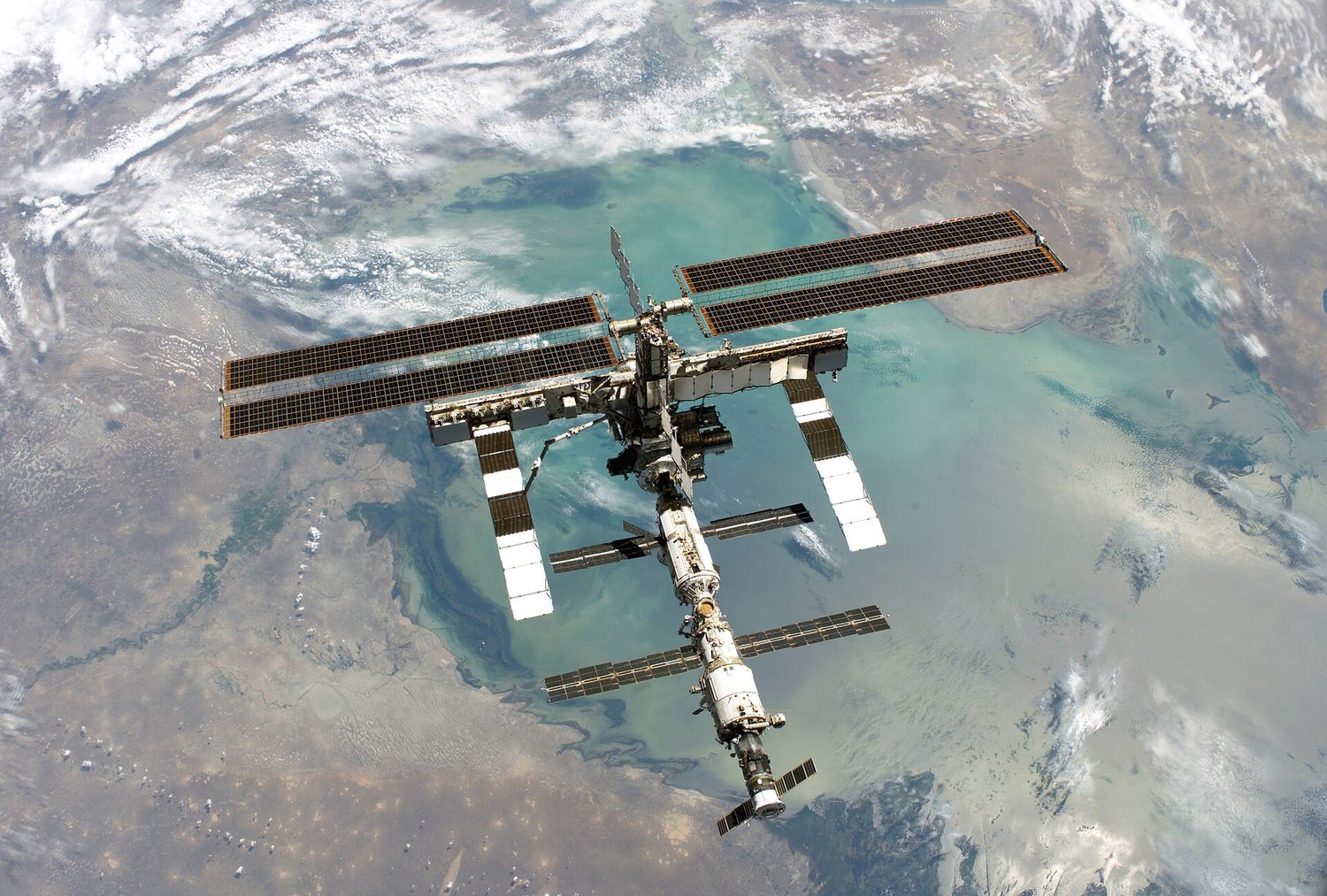
ภาพถ่ายสถานีอวกาศนานาชาติที่โคจรรอบโลก
สถานีอวกาศนานาชาติ: ดาวเทียมจริงที่ถูกยึดไว้ในวงโคจรด้วยแรงโน้มถ่วงเพียงอย่างเดียว

ความเร็วหลบหนี คือความเร็วในการปล่อยที่ทำให้วัตถุสามารถออกจากโลกไปตลอดกาลได้อย่างพอดี: พลังงานกลรวมของมันเป็นศูนย์พอดี ดังนั้นมันจึงชะลอความเร็วลงจนเหลือศูนย์ที่ระยะทางอนันต์ ตั้ง $\tfrac12 mv^2 - \dfrac{GMm}{r}=0$ (โดยใช้พลังงานศักย์โน้มถ่วงทั่วไป $U_g=-GMm/r$) และแก้สมการหา $v$,

$$v_{\text{esc}}=\sqrt{\frac{2GM}{r}}.$$
ค่ามันคือ $\sqrt2$ เท่าของความเร็วดวงโคจรวงกลมที่รัศมีเดียวกัน, และ (เหมือนความเร็ววงโคจร) ไม่ขึ้นอยู่กับมวลของวัตถุที่หลบหนี

Explore · ⁨สำรวจ⁩

Compare orbits at different radii · ⁨เปรียบเทียบวงโคจรที่รัศมิต่างๆ⁩

A satellite is in free fall, its gravity supplying the centripetal force. A larger orbit means a slower speed and a longer period — Kepler's third law. · ⁨ดาวเทียมอยู่ใน การตกอิสระ โดยแรงโน้มถ่วงทำหน้าที่เป็นแรงสู่ศูนย์กลาง วงโคจรที่ใหญ่ขึ้นหมายถึงความเร็วที่ช้าลงและรอบที่นานขึ้น — กฎที่สามของเคปเลอร์⁩

6.6

Exam tips · ⁨ข้อแนะนำสำหรับการสอบ⁩

English
  • Conserve angular momentum $L=I\omega$ when no external torque acts: a smaller $I$ (arms pulled in) gives a larger $\omega$.
  • A rolling object splits its energy between $\tfrac12 mv^2$ and $\tfrac12 I\omega^2$, linked by $v=r\omega$ — so it accelerates down a ramp more slowly than a sliding one.
  • For a circular orbit set gravity equal to the centripetal requirement: $v=\sqrt{GM/r}$, so a larger orbit is slower and the satellite's mass cancels.
  • Pulling in raises the spin and the kinetic energy — the extra energy comes from the work done pulling inward; $L$ is unchanged.
  • Watch which rotational quantity is conserved: $L$ (no torque) versus energy (no friction) are different conditions.
ไทย
  • รักษา โมเมนตัมเชิงมุม $L=I\omega$ เมื่อไม่มีโมเมนต์ภายนอกกระทำ: ค่า $I$ ที่เล็กลง (แขนดึงเข้าหาแกน) ให้ค่า $\omega$ ที่ใหญ่ขึ้น
  • วัตถุที่กลิ้งจะแบ่งพลังงานระหว่าง $\tfrac12 mv^2$ และ $\tfrac12 I\omega^2$, เชื่อมต่อกันด้วย $v=r\omega$ – ดังนั้นมันจะเร่งความเร็วลงทางลาด ช้ากว่า วัตถุที่ลื่นไถล
  • สำหรับวงโคจรวงกลม ให้ตั้งแรงโน้มถ่วงเท่ากับความต้องการแรงสู่ศูนย์กลาง: $v=\sqrt{GM/r}$, ดังนั้นวงโคจรที่ใหญ่กว่าจะ ช้ากว่า และมวลของดาวเทียมจะตัดกัน
  • การดึงแขนเข้าข้างกายทำให้การหมุน และ พลังงานจลน์เพิ่มขึ้น – พลังงานส่วนเพิ่มมาจากงานที่ทำในการดึงเข้าหาแกน; $L$ ไม่เปลี่ยนแปลง
  • สังเกตว่าปริมาณการหมุนชนิดใดถูกอนุรักษ์: $L$ (ไม่มีโมเมนต์) เทียบกับพลังงาน (ไม่มีแรงเสียดทาน) เป็นเงื่อนไขที่แตกต่างกัน

Interactive lessons on this topic · ⁨บทเรียนเชิงโต้ตอบสำหรับหัวข้อนี้⁩

Work through it step by step, with instant-check exercises. · ⁨ทำทีละขั้นตอน พร้อมแบบฝึกหัดตรวจสอบผลทันที⁩

Past Papers · ⁨ข้อสอบย้อนหลัง⁩

More topics in AP Physics 1 · ⁨หัวข้อเพิ่มเติมใน AP Physics 1⁩

Log in or create account · ⁨เข้าสู่ระบบหรือสร้างบัญชี⁩

IGCSE, A-Level & AP