Skip to content · ⁨ข้ามไปยังเนื้อหา⁩

Further Pure Mathematics 1 · ⁨คณิตศาสตร์บริสุทธิ์เพิ่มเติม 1⁩

A-Level Further Mathematics · ⁨Further Mathematics A-Level⁩ · Topic 1 · ⁨หัวข้อ 1⁩

Video lesson for this topic · ⁨บทเรียนวิดีโอสำหรับหัวข้อนี้⁩ Open the video page · ⁨เปิดหน้าวิดีโอ⁩
14:28

คณิตศาสตร์บริสุทธิ์เพิ่มเติม 1

นี่คือสมการลูกบาศก์ ตัดแกนที่รากสามจุด การหารากเหล่านั้นอย่างแม่นยำอาจยาก — หรือแม้แต่เป็นไปไม่ได้ด้วยมือ แต่ที่นี่มีสิ่งสวยงาม…

English narration · English + 中文 subtitles burned in · ⁨การบรรยายภาษาอังกฤษ · คำบรรยายภาษาอังกฤษ + 中文 ลอยตัวบนภาพ⁩

English

This handout covers Topic 1: Further Pure Mathematics 进阶纯数学 1. It adds new algebra, matrices, polar coordinates, more vectors, and proof by induction.

ไทย

เอกสารฉบับนี้ครอบคลุมหัวข้อที่ 1: คณิตศาสตร์บริสุทธิ์เพิ่มเติม 1 เพิ่มพีชคณิตใหม่ เมทริกซ์ พิกัดขั้วเวกเตอร์เพิ่มเติมและการพิสูจน์ด้วยการอุปนัย

1.1

Roots of polynomial equations · ⁨รากของสมการพหุนาม⁩

Syllabus · ⁨หลักสูตร⁩
English
Candidates should be able to: Notes and examples
• recall and use the relations between the roots and coefficients of polynomial equations e.g. to evaluate symmetric functions of the roots or to solve problems involving unknown coefficients in equations; restricted to equations of degree 2, 3 or 4 only.
• use a substitution to obtain an equation whose roots are related in a simple way to those of the original equation Substitutions will not be given for the easiest cases, e.g. where the new roots are reciprocals or squares or a simple linear function of the old roots.
ไทย
ผู้เข้าสอบควรสามารถ: หมายเหตุและตัวอย่าง
• จำและใช้ความสัมพันธ์ระหว่าง ราก และ สัมประสิทธิ์ ของสมการพหุนาม เช่น เพื่อคำนวณ ฟังก์ชันสมมาตร ของรากหรือแก้ปัญหาที่เกี่ยวข้องกับสัมประสิทธิ์ที่ไม่ทราบในสมการ; จำกัดเฉพาะสมการที่มีดีกรี 2, 3 หรือ 4 เท่านั้น.
• ใช้ การแทนค่า เพื่อให้ได้สมการwhose roots are related in a simple way to those of the original equation การแทนค่าจะไม่ให้สำหรับกรณีที่ง่ายที่สุด, เช่น ที่รากใหม่เป็น reciprocals หรือกำลังสองหรือฟังก์ชันเชิงเส้นที่เรียบง่ายของรากเก่า.

Source: Cambridge International syllabus · ⁨แหล่งที่มา: หลักสูตร Cambridge International⁩

English

For a polynomial equation, the roots 根 are linked to the coefficients 系数. For $ax^2 + bx + c = 0$ with roots $\alpha, \beta$:

$$\alpha + \beta = -\frac{b}{a}, \qquad \alpha\beta = \frac{c}{a}.$$
For a cubic $ax^3 + bx^2 + cx + d = 0$ with roots $\alpha, \beta, \gamma$:
$$\sum\alpha = -\frac{b}{a}, \qquad \sum\alpha\beta = \frac{c}{a}, \qquad \alpha\beta\gamma = -\frac{d}{a}.$$
Sums like $\sum\alpha$ and $\sum\alpha\beta$ are symmetric functions 对称函数 of the roots (unchanged if the roots are swapped). To find an equation whose roots are changed in a simple way, use a substitution 代换 (for example, put $w = \alpha + 1$).

Worked example. The equation $x^2 - 5x + 6 = 0$ has roots $\alpha, \beta$. Find the equation with roots $\alpha + 1, \beta + 1$.

Here $\alpha + \beta = 5$ and $\alpha\beta = 6$. The new sum is $(\alpha + 1) + (\beta + 1) = 7$, and the new product is $(\alpha + 1)(\beta + 1) = \alpha\beta + \alpha + \beta + 1 = 6 + 5 + 1 = 12$. So the new equation is

$$x^2 - 7x + 12 = 0.$$

ไทย

สำหรับสมการพหุนาม ราก จะเชื่อมโยงกับ สัมประสิทธิ์ สำหรับ $ax^2 + bx + c = 0$ ที่มีราก $\alpha, \beta$:

$$\alpha + \beta = -\frac{b}{a}, \qquad \alpha\beta = \frac{c}{a}.$$
สำหรับสมการกำลังสาม $ax^3 + bx^2 + cx + d = 0$ ที่มีราก $\alpha, \beta, \gamma$:
$$\sum\alpha = -\frac{b}{a}, \qquad \sum\alpha\beta = \frac{c}{a}, \qquad \alpha\beta\gamma = -\frac{d}{a}.$$
ผลบวกแบบ $\sum\alpha$ และ $\sum\alpha\beta$ เป็น ฟังก์ชันสมมาตร ของราก (ไม่เปลี่ยนแปลงหากสลับราก) เพื่อหาสมการwhose roots are changed in a simple way, ใช้ การแทนค่า (เช่น วาง $w = \alpha + 1$)

ตัวอย่างทำ. สมการ $x^2 - 5x + 6 = 0$ มีราก $\alpha, \beta$. หาสมการwhose roots are $\alpha + 1, \beta + 1$.

ที่นี่ $\alpha + \beta = 5$ และ $\alpha\beta = 6$. ผลบวกใหม่คือ $(\alpha + 1) + (\beta + 1) = 7$ และผลคูณใหม่คือ $(\alpha + 1)(\beta + 1) = \alpha\beta + \alpha + \beta + 1 = 6 + 5 + 1 = 12$. ดังนั้นสมการใหม่คือ

$$x^2 - 7x + 12 = 0.$$

Explore · ⁨สำรวจ⁩

Roots of a polynomial · ⁨รากของพหุนาม⁩

y = ax³ + bx² + cx + d

The roots are where the curve meets the x-axis — their sum and product link to the coefficients. · ⁨รากคือจุดที่กราฟตัดแกน x — ผลบวกและผลคูณของรากเชื่อมโยงกับสัมประสิทธิ์⁩

Vocabulary · ⁨คำศัพท์⁩ Train · ⁨ฝึกฝน⁩
English ไทย
Further Pure Mathematics/ˈfɜːðə pjʊə ˌmæθɪˈmætɪks/ คณิตศาสตร์บริสุทธิ์เพิ่มเติม
roots/ruːts/ ราก
coefficients/ˌkəʊɪˈfɪʃənts/ สัมประสิทธิ์
substitution/ˌsʌbstɪˈtjuːʃn/ substitution
rational function/ˈræʃənl ˈfʌŋkʃn/ ฟังก์ชันตรรกยะ
1.2

Rational functions and graphs · ⁨ฟังก์ชันตรรกยะและกราฟ⁩

Syllabus · ⁨หลักสูตร⁩
English
Candidates should be able to: Notes and examples
• sketch graphs of simple rational functions, including the determination of oblique asymptotes, in cases where the degree of the numerator and the denominator are at most 2 Including determination of the set of values taken by the function, e.g. by the use of a discriminant. Detailed plotting of curves will not be required, but sketches will generally be expected to show significant features, such as turning points, asymptotes and intersections with the axes.
• understand and use relationships between the graphs of $y = f(x)$, $y^2 = f(x)$, $y = \frac{1}{f(x)}$, $y = |f(x)|$ and $y = f(|x|)$ Including use of such sketch graphs in the course of solving equations or inequalities.
ไทย
ผู้เข้าสอบควรสามารถ: หมายเหตุและตัวอย่าง
• วาดกราฟของ ฟังก์ชันตรรกยะ แบบง่าย, بما其中包括การกำหนด เส้นสัมผัสเฉียง, ในกรณีที่ดีกรีของตัวเศษและตัวส่วนไม่เกิน 2 รวมถึงการกำหนดเซตของค่าที่ฟังก์ชันรับ, เช่น通过使用 discriminant. การวาดกราฟโดยละเอียดจะไม่ต้องการ, แต่จะคาดหวังให้ภาพร่างแสดงลักษณะสำคัญ, เช่น จุดเปลี่ยน, เส้นอสมптอท และจุดตัดกับแกน.
• เข้าใจและใช้ความสัมพันธ์ระหว่างกราฟของ $y = f(x)$, $y^2 = f(x)$, $y = \frac{1}{f(x)}$, $y = |f(x)|$ และ $y = f(|x|)$ รวมถึงการใช้กราฟภาพร่างเช่นนี้ในกระบวนการแก้สมการหรืออสมการ.

Source: Cambridge International syllabus · ⁨แหล่งที่มา: หลักสูตร Cambridge International⁩

English

A rational function 有理函数 is a fraction of two polynomials. When the top has degree exactly one higher than the bottom, the graph has an oblique asymptote 斜渐近线 (a slanted line the curve approaches); find it by dividing out. You should also be able to relate the graph of $y = f(x)$ to those of $y^2 = f(x)$, $y = \dfrac{1}{f(x)}$, $y = |f(x)|$ and $y = f(|x|)$. Find the set of values the function can take using the discriminant 判别式, and locate its turning points 驻点.

Worked example. Find the oblique asymptote of $y = \dfrac{x^2 + x + 1}{x + 1}$.

Divide out the fraction: $\dfrac{x^2 + x + 1}{x + 1} = x + \dfrac{1}{x + 1}$. As $x \to \pm\infty$ the remainder $\dfrac{1}{x+1} \to 0$, so the curve approaches the line $y = x$ — the oblique asymptote.

ไทย

ฟังก์ชันตรรกยะ เป็นเศษส่วนของพหุนามสองตัว เมื่อตัวบนมีดีกรีสูงกว่าตัวล่างพอดีหนึ่งขั้น กราฟจะมี เส้นเอียงอนันต์ (เส้นเฉียงที่เส้นโค้งเข้าใกล้); หาค่าได้โดยการหารออก คุณควร还能 connects the graph of $y = f(x)$ to those of $y^2 = f(x)$, $y = \dfrac{1}{f(x)}$, $y = |f(x)|$ and $y = f(|x|)$. หาเซตของค่าที่ฟังก์ชันสามารถรับได้โดยใช้ ดิสคริมิแนนต์ และระบุจุด เปลี่ยนทิศทาง ของมัน

เส้นโค้งตรรกยะสองสาขาวิ่งคู่ไปกับเส้นประเฉียง
ห่างจากจุดกำเนิด เส้นโค้งโอบล้อมเส้นเฉียง $y=x$; ใกล้ $x=0$ มันวิ่งออกไปตามเส้นอนันต์แนวตั้ง

ตัวอย่างทำ. หาเส้นเอียงอนันต์ของ $y = \dfrac{x^2 + x + 1}{x + 1}$.

หารเศษส่วนออก: $\dfrac{x^2 + x + 1}{x + 1} = x + \dfrac{1}{x + 1}$. เมื่อ $x \to \pm\infty$ เศษเหลือ $\dfrac{1}{x+1} \to 0$ ดังนั้นกราฟจะเข้าใกล้เส้น $y = x$ — ซึ่งคือเส้นอสมптอทเฉียง

Explore · ⁨สำรวจ⁩

Rational functions · ⁨ฟังก์ชันเศษส่วน⁩

y = a/(x − b) + c

A rational function has asymptotes the curve approaches but never touches. · ⁨ฟังก์ชันเศษส่วนมี เส้นประ ที่กราฟเข้าใกล้แต่ไม่เคยสัมผัส⁩

Vocabulary · ⁨คำศัพท์⁩ Train · ⁨ฝึกฝน⁩
English ไทย
oblique asymptote/əˈbliːk ˈæsɪmptəʊt/ เส้นเอียงลิมิต
method of differences/ˈmeθəd ɒv ˈdɪfrənsɪz/ วิธีผลต่าง
convergent/kənˈvɜːdʒənt/ การชนกัน (convergent)
sum to infinity/sʌm tʊ ɪnˈfɪnɪti/ ผลบวกถึงอนันต์
1.3

Summation of series · ⁨ผลรวมของอนุกรม⁩

Syllabus · ⁨หลักสูตร⁩
English
Candidates should be able to: Notes and examples
• use the standard results for $\sum r$, $\sum r^2$, $\sum r^3$ to find related sums
• use the method of differences to obtain the sum of a finite series Use of partial fractions to express a general term in a suitable form may be required.
• recognise, by direct consideration of a sum to $n$ terms, when a series is convergent, and find the sum to infinity in such cases
ไทย
ผู้เข้าสอบควรสามารถ: หมายเหตุและตัวอย่าง
• ใช้ผลลัพธ์มาตรฐานสำหรับ $\sum r$, $\sum r^2$, $\sum r^3$ เพื่อหาผลรวมที่เกี่ยวข้อง
• ใช้ วิธีผลต่าง เพื่อหาผลรวมของอนุกรมจำกัด การใช้ เศษส่วนย่อย เพื่อแสดงพจน์ทั่วไปในรูปแบบที่เหมาะสมอาจจำเป็น.
• ชี้ชัดว่าเมื่อใดอนุกรมหนึ่งจะเป็น ลู่เข้า โดยพิจารณาผลบวก $n$ พจน์โดยตรง และหาค่า ผลบวกอนันต์ ในกรณีดังกล่าว

Source: Cambridge International syllabus · ⁨แหล่งที่มา: หลักสูตร Cambridge International⁩

English

Learn the standard results:

$$\sum_{r=1}^{n} r = \tfrac12 n(n+1), \qquad \sum_{r=1}^{n} r^2 = \tfrac16 n(n+1)(2n+1), \qquad \sum_{r=1}^{n} r^3 = \tfrac14 n^2(n+1)^2.$$
The method of differences 差分法 sums a series by cancelling middle terms: if partial fractions 部分分式 write each term as $f(r) - f(r+1)$, almost everything cancels. From the sum to $n$ terms you can see whether a series is convergent 收敛 and, if so, find its sum to infinity 无穷和.

Worked example. Find $\displaystyle\sum_{r=1}^{n} (2r + 1)$.

$$\sum_{r=1}^{n}(2r + 1) = 2\sum_{r=1}^{n} r + \sum_{r=1}^{n} 1 = 2\cdot\tfrac12 n(n+1) + n = n(n+1) + n = n(n+2).$$

ไทย

เรียนรู้ผลลัพธ์มาตรฐาน:

$$\sum_{r=1}^{n} r = \tfrac12 n(n+1), \qquad \sum_{r=1}^{n} r^2 = \tfrac16 n(n+1)(2n+1), \qquad \sum_{r=1}^{n} r^3 = \tfrac14 n^2(n+1)^2.$$
วิธีผลต่าง รวมนิพจน์โดยตัดพจน์ตรงกลางออก: ถ้าใช้ เศษส่วนย่อย เขียนแต่ละพจน์ในรูป $f(r) - f(r+1)$, แทบทุกสิ่งจะตัดกัน จากผลรวมของ $n$ พจน์ คุณสามารถตรวจสอบว่าอนุกรมนี้เป็น อนุกรมลู่เข้า หรือไม่ และหากเป็น如此 จะหา ผลรวมอนันต์ ของมันได้

ตัวอย่างมีคำตอบ. หา $\displaystyle\sum_{r=1}^{n} (2r + 1)$.

$$\sum_{r=1}^{n}(2r + 1) = 2\sum_{r=1}^{n} r + \sum_{r=1}^{n} 1 = 2\cdot\tfrac12 n(n+1) + n = n(n+1) + n = n(n+2).$$

Explore · ⁨สำรวจ⁩

Sequences and their sums · ⁨อนุกรมและผลรวมของ它们⁩

Step through the terms and the running total — the idea behind a series and its sum to n terms. · ⁨เดินผ่านพจน์และผลรวมสะสม — แนวคิดเรื่อง อนุกรม และผลรวมถึง n พจน์⁩

1.4

Matrices · ⁨เมทริกซ์⁩

Syllabus · ⁨หลักสูตร⁩
English
Candidates should be able to: Notes and examples
carry out operations of matrix addition, subtraction and multiplication, and recognise the terms zero matrix and identity (or unit) matrix Including non-square matrices. Matrices will have at most 3 rows and columns.
recall the meaning of the terms singular and non-singular as applied to square matrices and, for $2 \times 2$ and $3 \times 3$ matrices, evaluate determinants and find inverses of non-singular matrices The notations $\det \mathbf{M}$ for the determinant of a matrix $\mathbf{M}$, and $\mathbf{I}$ for the identity matrix, will be used.
understand and use the result, for non-singular matrices, $(\mathbf{AB})^{-1} = \mathbf{B}^{-1}\mathbf{A}^{-1}$ Extension to the product of more than two matrices may be required.
understand the use of $2 \times 2$ matrices to represent certain geometric transformations in the $x$-$y$ plane, in particular: – understand the relationship between the transformations represented by $\mathbf{A}$ and $\mathbf{A}^{-1}$ – recognise that the matrix product $\mathbf{AB}$ represents the transformation that results from the transformation represented by $\mathbf{B}$ followed by the transformation represented by $\mathbf{A}$ – recall how the area scale factor of a transformation is related to the determinant of the corresponding matrix – find the matrix that represents a given transformation or sequence of transformations Understanding of the terms rotation, reflection, enlargement, stretch and shear for 2D transformations will be required. Other 2D transformations may be included, but no particular knowledge of them is expected.
understand the meaning of invariant as applied to points and lines in the context of transformations represented by matrices, and solve simple problems involving invariant points and invariant lines. e.g. to locate the invariant points of the transformation represented by $\begin{pmatrix} 6 & 5 \\ 2 & 3 \end{pmatrix}$, or to find the invariant lines through the origin for $\begin{pmatrix} 4 & -1 \\ 2 & 1 \end{pmatrix}$, or to show that any line with gradient 1 is invariant for $\begin{pmatrix} 2 & 0 \\ 1 & 1 \end{pmatrix}$.
ไทย
ผู้เข้าสอบควรสามารถ: หมายเหตุและตัวอย่าง
ทำการดำเนินการของ การบวกเมทริกซ์, การลบ และการคูณเมทริกซ์ และระบุคำศัพท์ เมทริกซ์ศูนย์ และ เมทริกซ์เอกลักษณ์ (หรือเมทริกซ์หน่วย) รวมถึงเมทริกซ์ที่ไม่เป็นสี่เหลี่ยม จตุรัส เมทริกซ์จะมีจำนวนแถวและหลักไม่เกิน 3
ทบทวนความหมายของคำว่า เอกฐาน และ ไม่เอกฐาน ที่ใช้กับเมทริกซ์สี่เหลี่ยมจตุรัส และสำหรับเมทริกซ์ขนาด $2 \times 2$ และ $3 \times 3$ ให้คำนวณ ดีเทอร์มิแนนต์ และหา อินเวอร์ส ของเมทริกซ์ที่ไม่เอกฐาน จะใช้สัญลักษณ์ $\det \mathbf{M}$ สำหรับดีเทอร์มิแนนต์ของเมทริกซ์ $\mathbf{M}$ และ $\mathbf{I}$ สำหรับเมทริกซ์เอกลักษณ์
เข้าใจและใช้ผลลัพธ์สำหรับเมทริกซ์ที่ไม่เอกฐาน: $(\mathbf{AB})^{-1} = \mathbf{B}^{-1}\mathbf{A}^{-1}$ อาจต้องการขยายไปยังผลคูณของเมทริกซ์มากกว่าสองเมทริกซ์
เข้าใจการใช้เมทริกซ์ $2 \times 2$ เพื่อแสดงการเปลี่ยนแปลงทางเรขาคณิตบางประเภทในระนาบ $x$-$y$ โดยเฉพาะ: – เข้าใจความสัมพันธ์ระหว่างการเปลี่ยนแปลงที่แทนด้วย $\mathbf{A}$ และ $\mathbf{A}^{-1}$ – ชี้ชัดว่าผลคูณเมทริกซ์ $\mathbf{AB}$ แสดงถึงการเปลี่ยนแปลงที่เกิดจากการเปลี่ยนแปลงที่แทนด้วย $\mathbf{B}$ ตามด้วยการเปลี่ยนแปลงที่แทนด้วย $\mathbf{A}$ – ทบทวนวิธีที่ ตัวคูณพื้นที่ ของการเปลี่ยนแปลงมีความสัมพันธ์กับดีเทอร์มิแนนต์ของเมทริกซ์ที่เกี่ยวข้อง – หาเมทริกซ์ที่แสดงการเปลี่ยนแปลงที่กำหนดให้หรือลำดับของการเปลี่ยนแปลง ต้องเข้าใจคำศัพท์ การหมุน, การสะท้อน, การขยาย, การยืด และ การคดเคี้ยว สำหรับการเปลี่ยนแปลง 2 มิติ อาจมีการเปลี่ยนแปลง 2 มิติอื่นๆ แต่ไม่จำเป็นต้องมีความรู้เฉพาะเจาะจงเกี่ยวกับพวกมัน
เข้าใจความหมายของ ค่าคงที่ ที่ใช้กับจุดและเส้นตรงในบริบทของการเปลี่ยนแปลงที่แทนด้วยเมทริกซ์ และแก้โจทย์ปัญหาพื้นฐานเกี่ยวกับ จุดคงที่ และ เส้นคงที่ เช่น: เพื่อหาจุดคงที่ของการเปลี่ยนแปลงที่แทนด้วย $\begin{pmatrix} 6 & 5 \\ 2 & 3 \end{pmatrix}$, หรือหาเส้นคงที่ผ่านจุดกำเนิดสำหรับ $\begin{pmatrix} 4 & -1 \\ 2 & 1 \end{pmatrix}$, หรือพิสูจน์ว่าเส้นตรงทุกเส้นที่มีความชัน 1 เป็นค่าคงที่สำหรับ $\begin{pmatrix} 2 & 0 \\ 1 & 1 \end{pmatrix}$

Source: Cambridge International syllabus · ⁨แหล่งที่มา: หลักสูตร Cambridge International⁩

English
A matrix moves the plane

A matrix 矩阵 is a rectangular block of numbers. Matrix addition adds entries in matching positions; you can also subtract and multiply matrices (multiplication is row $\times$ column). The zero matrix 零矩阵 has every entry $0$, and the identity matrix 单位矩阵 (or unit matrix) $I$ leaves any matrix unchanged under multiplication.

For a $2\times 2$ matrix $A = \begin{pmatrix} a & b \\ c & d \end{pmatrix}$, the determinant 行列式 is $\det A = ad - bc$. If $\det A \neq 0$ the matrix is non-singular (otherwise it is a singular matrix 奇异矩阵), and the inverse matrix 逆矩阵 is

$$A^{-1} = \frac{1}{ad - bc}\begin{pmatrix} d & -b \\ -c & a \end{pmatrix}.$$
For a product, $(AB)^{-1} = B^{-1}A^{-1}$. A $2\times 2$ matrix can represent a geometric transformation 几何变换 of the plane — a rotation 旋转, reflection 反射, enlargement 放大, stretch 拉伸 or shear 切变: the determinant gives the area scale factor, and a product $AB$ means "do $B$, then $A$". Points or lines that do not move are called invariant points 不变点 and invariant lines 不变直线.

Worked example. Find the inverse of $A = \begin{pmatrix} 3 & 1 \\ 2 & 4 \end{pmatrix}$.

$\det A = 3\times 4 - 1\times 2 = 10$, so

$$A^{-1} = \frac{1}{10}\begin{pmatrix} 4 & -1 \\ -2 & 3 \end{pmatrix}.$$

ไทย
เมทริกซ์เคลื่อนที่ระนาบ

เมทริกซ์ คือตารางสี่เหลี่ยมผืนผ้าของตัวเลข การบวกเมทริกซ์ บวกสมาชิกในตำแหน่งที่ตรงกัน; สามารถลบและคูณเมทริกซ์ได้ (การคูณคือแถว $\times$ คูณ คอลัมน์) เมทริกซ์ศูนย์ มีสมาชิกทุกตัวเป็น $0$, และ เมทริกซ์เอกลักษณ์ (หรือ เมทริกซ์หน่วย) $I$ ทำให้เมทริกซ์ใดไม่เปลี่ยนแปลงภายใต้การคูณ

สำหรับเมทริกซ์ขนาด $2\times 2$ $A = \begin{pmatrix} a & b \\ c & d \end{pmatrix}$, ดีเทอร์มิแนนต์ คือ $\det A = ad - bc$. ถ้า $\det A \neq 0$ เมทริกซ์นี้จะไม่ выроเจิด (non-singular) (แต่ถ้าไม่เป็นเช่นนั้นจะเป็น เมทริกซ์ выроเจิด / singular matrix), และ เมทริกซ์ผกผัน คือ

$$A^{-1} = \frac{1}{ad - bc}\begin{pmatrix} d & -b \\ -c & a \end{pmatrix}.$$
สำหรับผลิตภัณฑ์, $(AB)^{-1} = B^{-1}A^{-1}$. เมทริกซ์ $2\times 2$ สามารถแสดง การแปลงเรขาคณิต ของระนาบ — การหมุน, การสะท้อน, การขยายขนาด, การยืด หรือ การบิดเบี้ยว: ดีเทอร์มิแนนต์ให้ปัจจัยการปรับพื้นที่, และการคูณ $AB$ หมายถึง "ทำ $B$, แล้ว $A$" จุดหรือเส้นที่ไม่เคลื่อนที่เรียกว่า จุดคงที่ และ เส้นคงที่

 สี่เหลี่ยมจัตุรัสหน่วยและสี่เหลี่ยมด้านขนานขนาดใหญ่ที่มัน映射ไปยังภายใต้เมทริกซ์
เมทริกซ์ส่งสี่เหลี่ยมจัตุรัสหน่วยไปสู่สี่เหลี่ยมด้านขนานที่มีพื้นที่เท่ากับดีเทอร์มิแนนต์.

ตัวอย่างมีคำตอบ. หาผกผันของ $A = \begin{pmatrix} 3 & 1 \\ 2 & 4 \end{pmatrix}$.

$\det A = 3\times 4 - 1\times 2 = 10$, ดังนั้น

$$A^{-1} = \frac{1}{10}\begin{pmatrix} 4 & -1 \\ -2 & 3 \end{pmatrix}.$$

Explore · ⁨สำรวจ⁩

Matrices as transformations · ⁨เมทริกซ์ในฐานะการแปลง⁩

Change the four entries and watch the unit square map to a new shape. The determinant is the area scale factor. · ⁨เปลี่ยนองค์ประกอบทั้งสี่แล้วดูว่าสี่เหลี่ยมหน่วยถูกแปลงเป็นรูปร่างใหม่ ดีเทอร์มิแนนต์ คือปัจจัยขยายพื้นที่⁩

Vocabulary · ⁨คำศัพท์⁩ Train · ⁨ฝึกฝน⁩
English ไทย
matrix/ˈmeɪtrɪks/ เมทริกซ์
zero matrix/ˈzɪərəʊ ˈmeɪtrɪks/ เมทริกซ์ศูนย์
identity matrix/aɪˈdentɪti ˈmeɪtrɪks/ เมทริกซ์เอกลักษณ์
determinant/dɪˈtɜːmɪnənt/ ดีเทอร์มิแนนต์
singular matrix/ˈsɪŋɡjʊlə ˈmeɪtrɪks/ เมทริกซ์เอกฐาน
inverse matrix/ɪnˈvɜːs ˈmeɪtrɪks/ เมทริกซ์ผกผัน
geometric transformation/ˌdʒiːəʊˈmetrɪk trænsfɔːˈmeɪʃn/ การแปลงเรขาคณิต
invariant points/ɪnˈveərɪənt pɔɪnts/ จุดคงที่
invariant lines/ɪnˈveərɪənt laɪnz/ เส้นคงที่
polar coordinates/ˈpəʊlə kəʊˈɔːdɪnəts/ พิกัดขั้ว
Cartesian coordinates/kɑːˈtiːzɪən kəʊˈɔːdɪnəts/ พิกัดคาร์ทีเซียน
polar curves/ˈpəʊlə kɜːvz/ เส้นโค้งขั้ว
Watch lesson · ⁨ดูบทเรียน⁩
1.5

Polar coordinates · ⁨พิกัดเชิงขั้ว⁩

Syllabus · ⁨หลักสูตร⁩
English
Candidates should be able to: Notes and examples
understand the relations between Cartesian and polar coordinates, and convert equations of curves from Cartesian to polar form and vice versa The convention $r \geqslant 0$ will be used.
sketch simple polar curves, for $0 \leqslant \theta < 2\pi$ or $-\pi < \theta \leqslant \pi$ or a subset of either of these intervals Detailed plotting of curves will not be required, but sketches will generally be expected to show significant features, such as symmetry, coordinates of intersections with the initial line, the form of the curve at the pole and least/greatest values of $r$.
recall the formula $\frac{1}{2} \int r^2 \mathrm{d}\theta$ for the area of a sector, and use this formula in simple cases.
ไทย
ผู้เข้าสอบควรสามารถ: หมายเหตุและตัวอย่าง
เข้าใจความสัมพันธ์ระหว่าง พิกัดเดकारต และ พิกัดขั้ว และแปลงสมการของเส้นโค้งจากรูปแบบเดคารตเป็นรูปแบบขั้วและในทางกลับกัน ใช้ธรรมเนียม $r \geqslant 0$
วาดแผนภาพ เส้นโค้งขั้ว แบบง่าย สำหรับ $0 \leqslant \theta < 2\pi$ หรือ $-\pi < \theta \leqslant \pi$ หรือช่วงย่อยของช่วงเหล่านี้ ไม่จำเป็นต้องวาดกราฟเส้นโค้งอย่างละเอียด แต่แผนภาพควรแสดงลักษณะสำคัญโดยทั่วไป เช่น ความสมมาตร, พิกัดของจุดตัดกับเส้นเริ่มต้น, รูปแบบของเส้นโค้งที่จุดกำเนิด และค่าต่ำสุด/สูงสุดของ $r$
ทบทวนสูตร $\frac{1}{2} \int r^2 \mathrm{d}\theta$ สำหรับพื้นที่ของส่วนวงกลม และใช้สูตรนี้ในกรณีพื้นฐาน

Source: Cambridge International syllabus · ⁨แหล่งที่มา: หลักสูตร Cambridge International⁩

English
Tracing a polar curve: the cardioid

Polar coordinates 极坐标 give a point by its distance $r$ from the origin and its angle $\theta$. They link to Cartesian coordinates 直角坐标 by

$$x = r\cos\theta, \qquad y = r\sin\theta, \qquad r^2 = x^2 + y^2.$$

You should sketch simple polar curves 极坐标曲线, and find the area of a sector with

$$\text{area} = \tfrac12\int r^2\,d\theta.$$

Worked example. Convert the polar equation $r = 4\cos\theta$ to Cartesian form.

Multiply both sides by $r$: $r^2 = 4r\cos\theta$, so $x^2 + y^2 = 4x$. Completing the square gives $(x - 2)^2 + y^2 = 4$, a circle of radius $2$ centred at $(2, 0)$.

ไทย
การวาดเส้นโค้งเชิงขั้ว: คาร์ดิอยด์
 มองลงบันไดเกลียวขนาดใหญ่
บันไดเกลียว: เกลียวถูกอธิบายอย่างเป็นธรรมชาติโดยใช้พิกัดเชิงขั้ว.

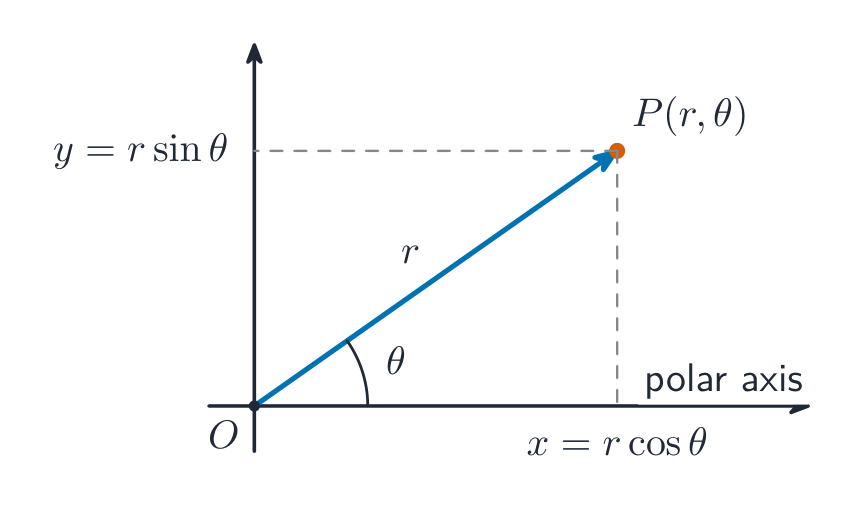
พิกัดเชิงขั้ว กำหนดจุดโดยระยะ $r$ จากจุดกำเนิดและมุม $\theta$.它们เชื่อมโยงกับ พิกัดคาร์ทีเซียน ผ่าน

$$x = r\cos\theta, \qquad y = r\sin\theta, \qquad r^2 = x^2 + y^2.$$

 จุดที่เข้าถึงได้ด้วยระยะ r ที่มุม theta, พร้อมองค์ประกอบ x และ y ของมัน
พิกัดเชิงขั้ว $(r,\theta)$ แปลงเป็นพิกัดคาร์ทีเซียนโดย $x=r\cos\theta$ และ $y=r\sin\theta$.

คุณควรวาดแผนภาพ เส้นโค้งเชิงขั้ว ง่ายๆ, และหาพื้นที่ของส่วนวงกลมด้วย

$$\text{area} = \tfrac12\int r^2\,d\theta.$$

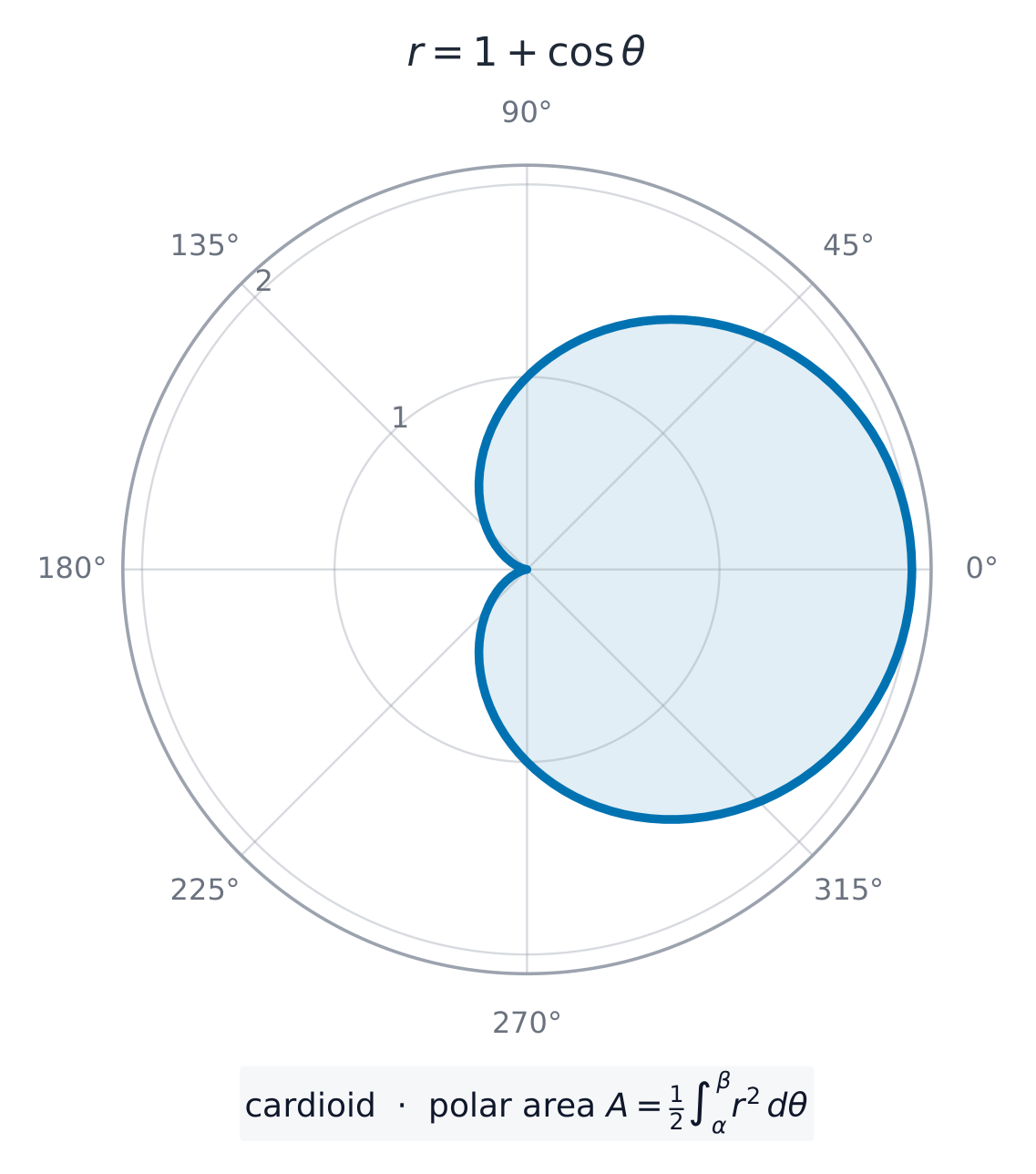
 คาร์ดิอยด์รูปหัวใจวาดบนตารางพิกัดเชิงขั้ว
คาร์ดิอยด์ $r=1+\cos\theta$, วาดโดยตรงจาก $r$ ในฐานะฟังก์ชันของ $\theta$

ตัวอย่างมีคำตอบ. แปลงสมการเชิงขั้ว $r = 4\cos\theta$ เป็นรูปแบบคาร์ทีเซียน.

คูณทั้งสองข้างด้วย $r$: $r^2 = 4r\cos\theta$, ดังนั้น $x^2 + y^2 = 4x$. การทำให้เป็นกำลังสองสมบูรณ์จะได้ $(x - 2)^2 + y^2 = 4$, ซึ่งเป็นวงกลมที่มีรัศมี $2$ และมีศูนย์กลางอยู่ที่ $(2, 0)$.

Explore · ⁨สำรวจ⁩

Polar curves · ⁨เส้นโค้งเชิงขั้ว⁩

Pick a curve and change a. In polar form a point is set by its distance r and angle θ — that draws roses, cardioids and spirals. · ⁨เลือกเส้นโค้งและเปลี่ยนค่า a ในรูปแบบเชิงขั้ว จุดกำหนดโดยระยะ r และมุม θ ซึ่งสร้างรูปกุหลาบ คาร์ดิอยด์ และสไปรัล⁩

Watch lesson · ⁨ดูบทเรียน⁩
1.6

Vectors · ⁨เวกเตอร์⁩

Syllabus · ⁨หลักสูตร⁩
English
Candidates should be able to: Notes and examples
use the equation of a plane in any of the forms $ax + by + cz = d$ or $\mathbf{r.n} = p$ or $\mathbf{r} = \mathbf{a} + \lambda\mathbf{b} + \mu\mathbf{c}$ and convert equations of planes from one form to another as necessary in solving problems
recall that the vector product $\mathbf{a} \times \mathbf{b}$ of two vectors can be expressed either as $|\mathbf{a}||\mathbf{b}|\sin\theta\hat{\mathbf{n}}$, where $\hat{\mathbf{n}}$ is a unit vector, or in component form as $(a_2b_3 - a_3b_2)\mathbf{i} + (a_3b_1 - a_1b_3)\mathbf{j} + (a_1b_2 - a_2b_1)\mathbf{k}$
use equations of lines and planes, together with scalar and vector products where appropriate, to solve problems concerning distances, angles and intersections, including: – determining whether a line lies in a plane, is parallel to a plane or intersects a plane, and finding the point of intersection of a line and a plane when it exists – finding the foot of the perpendicular from a point to a plane – finding the angle between a line and a plane, and the angle between two planes – finding an equation for the line of intersection of two planes – calculating the shortest distance between two skew lines – finding an equation for the common perpendicular to two skew lines.
ไทย
ผู้เข้าสอบควรสามารถ: หมายเหตุและตัวอย่าง
ใช้สมการของ ระนาบ ในรูปแบบใดๆ คือ $ax + by + cz = d$ หรือ $\mathbf{r.n} = p$ หรือ $\mathbf{r} = \mathbf{a} + \lambda\mathbf{b} + \mu\mathbf{c}$ และแปลงสมการระนาบจากรูปแบบหนึ่งไปเป็นอีก dạngหนึ่งตามจำเป็นในการแก้ปัญหา
ทบทวนว่า ผลคูณเวกเตอร์ $\mathbf{a} \times \mathbf{b}$ ของเวกเตอร์สองตัวสามารถเขียนได้ทั้งในรูป $|\mathbf{a}||\mathbf{b}|\sin\theta\hat{\mathbf{n}}$, ซึ่ง $\hat{\mathbf{n}}$ เป็นเวกเตอร์หน่วย, หรือในรูปแบบองค์ประกอบคือ $(a_2b_3 - a_3b_2)\mathbf{i} + (a_3b_1 - a_1b_3)\mathbf{j} + (a_1b_2 - a_2b_1)\mathbf{k}$
ใช้สมการของเส้นตรงและระนาบ ร่วมกับ ผลคูณสเกลาร์และผลคูณเวกเตอร์ เมื่อเหมาะสม เพื่อแก้โจทย์ปัญหาเกี่ยวกับระยะห่าง มุม และจุดตัด รวมถึง: – การตรวจสอบว่าเส้นตรงอยู่ในระนาบ, ขนานกับระนาบ หรือตัดกับระนาบ และหาจุดตัดของเส้นตรงกับระนาบเมื่อมีอยู่ – การหาจุดตกตั้งฉากจากจุดหนึ่งไปยังระนาบ – การหามุมระหว่างเส้นตรงกับระนาบ และมุมระหว่างระนาบสองระนาบ – การหาสมการของเส้นตรงที่เป็นรอยตัดของระนาบสองระนาบ – การคำนวณระยะสั้นที่สุดระหว่าง เส้นตรงอ้อม – การหาสมการของเส้นตรงตั้งฉากร่วมของเส้นตรงอ้อมสองเส้น

Source: Cambridge International syllabus · ⁨แหล่งที่มา: หลักสูตร Cambridge International⁩

English

In three dimensions a plane 平面 can be written as $ax + by + cz = d$, or $\mathbf{r}\cdot\mathbf{n} = p$, or $\mathbf{r} = \mathbf{a} + \lambda\mathbf{b} + \mu\mathbf{c}$. Besides the scalar product, there is the vector product 向量积 of two vectors 向量:

$$\mathbf{a}\times\mathbf{b} = |\mathbf{a}|\,|\mathbf{b}|\sin\theta\;\hat{\mathbf{n}},$$
which gives a vector at right angles to both. With scalar and vector products you can find distances, angles, and where lines and planes meet — including the shortest distance between skew lines 异面直线.

Worked example. Find $\mathbf{a}\times\mathbf{b}$ for $\mathbf{a} = \mathbf{i} + \mathbf{j}$ and $\mathbf{b} = \mathbf{j} + \mathbf{k}$.

$$\mathbf{a}\times\mathbf{b} = \begin{vmatrix} \mathbf{i} & \mathbf{j} & \mathbf{k} \\ 1 & 1 & 0 \\ 0 & 1 & 1 \end{vmatrix} = \mathbf{i}(1) - \mathbf{j}(1) + \mathbf{k}(1) = \mathbf{i} - \mathbf{j} + \mathbf{k}.$$

ไทย
 เรือใบพร้อม sail full spinnaker
แรงเช่นลมและน้ำคือเวกเตอร์ — พวกมันมีทั้งขนาดและทิศทาง.

ในสามมิติ ระนาบ สามารถเขียนได้เป็น $ax + by + cz = d$, หรือ $\mathbf{r}\cdot\mathbf{n} = p$, หรือ $\mathbf{r} = \mathbf{a} + \lambda\mathbf{b} + \mu\mathbf{c}$ นอกเหนือจากผลคูณสเกลาร์แล้ว ยังมี ผลคูณเวกเตอร์ ของ เวกเตอร์ สองตัว:

$$\mathbf{a}\times\mathbf{b} = |\mathbf{a}|\,|\mathbf{b}|\sin\theta\;\hat{\mathbf{n}},$$
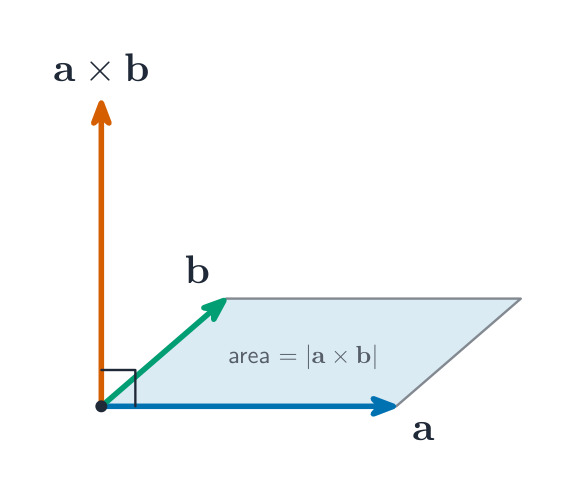
ซึ่งให้เวกเตอร์ที่ตั้งฉากกับทั้งสอง ตัว Using scalar and vector products you can find distances, angles, and where lines and planes meet — including the shortest distance between skew lines.

 Two vectors spanning a parallelogram with their vector product standing straight up
$\mathbf{a}\times\mathbf{b}$ ตั้งฉากกับเวกเตอร์ทั้งสอง; ความยาวของมันเท่ากับพื้นที่ของสี่เหลี่ยมด้านขนานที่พวกมันสร้าง.

ตัวอย่างมีคำตอบ. หา $\mathbf{a}\times\mathbf{b}$ สำหรับ $\mathbf{a} = \mathbf{i} + \mathbf{j}$ และ $\mathbf{b} = \mathbf{j} + \mathbf{k}$.

$$\mathbf{a}\times\mathbf{b} = \begin{vmatrix} \mathbf{i} & \mathbf{j} & \mathbf{k} \\ 1 & 1 & 0 \\ 0 & 1 & 1 \end{vmatrix} = \mathbf{i}(1) - \mathbf{j}(1) + \mathbf{k}(1) = \mathbf{i} - \mathbf{j} + \mathbf{k}.$$

Explore · ⁨สำรวจ⁩

Vectors · ⁨เวกเตอร์⁩

a · b = |a||b|cos θ

The dot product is zero exactly when two vectors are perpendicular. · ⁨ผลคูณสเกลาร์ เป็นศูนย์ก็ต่อเมื่อเวกเตอร์สองตัว ตั้งฉากกัน⁩

Vocabulary · ⁨คำศัพท์⁩ Train · ⁨ฝึกฝน⁩
English ไทย
plane/pleɪn/ ระนาบ
vector product/ˈvektə ˈprɒdʌkt/ ผลคูณเวกเตอร์
vectors/ˈvektəz/ เวกเตอร์
skew lines/skjuː laɪnz/ เส้นตรงไม่ตัดกัน
mathematical induction/ˌmæθɪˈmætɪkl ɪnˈdʌkʃn/ การพิสูจน์ด้วยอุปนัย
conjecture/kənˈdʒektʃə/ ข้อสันนิษฐาน
inductive proof/ɪnˈdʌktɪv pruːf/ การพิสูจน์แบบอุปนัย
symmetric functions/sɪˈmetrɪk ˈfʌŋkʃnz/ ฟังก์ชันสมมาตร
discriminant/dɪˈskrɪmɪnənt/ discriminant
turning points/ˈtɜːnɪŋ pɔɪnts/ จุดกลับตัว
partial fractions/ˈpɑːʃl ˈfrækʃnz/ การแยกเศษส่วนย่อย
rotation/rəʊˈteɪʃn/ 旋转
reflection/rɪˈflekʃn/ สะท้อน
enlargement/enˈlɑːdʒmənt/ การขยาย
stretch/stretʃ/ การขยาย
shear/ʃɪə/ การเฉือน
Watch lesson · ⁨ดูบทเรียน⁩
1.7

Proof by induction · ⁨การพิสูจน์โดยการอุปนัย⁩

Syllabus · ⁨หลักสูตร⁩
English
Candidates should be able to: Notes and examples
use the method of mathematical induction to establish a given result e.g. $\sum_{r=1}^{n} r^4 = \frac{1}{4}n^2(n+1)^2$, $u_n = \frac{1}{2}(1 + 3^{n-1})$ for the sequence given by $u_{n+1} = 3u_n - 1$ and $u_1 = 1$, $\begin{pmatrix} 4 & -1 \\ 6 & -1 \end{pmatrix}^n = \begin{pmatrix} 3 \times 2^n - 2 & 1 - 2^n \\ 3 \times 2^{n+1} - 6 & 3 - 2^{n+1} \end{pmatrix}$, $3^{2n} + 2 \times 5^n - 3$ is divisible by 8.
recognise situations where conjecture based on a limited trial followed by inductive proof is a useful strategy, and carry this out in simple cases. e.g. find the $n$th derivative of $x e^x$, find $\sum_{r=1}^{n} r \times r!$.
ไทย
ผู้เข้าสอบควรสามารถ: หมายเหตุและตัวอย่าง
ใช้วิธีการ อุปนัยทางคณิตศาสตร์ เพื่อยืนยันผลลัพธ์ที่กำหนดให้ เช่น: $\sum_{r=1}^{n} r^4 = \frac{1}{4}n^2(n+1)^2$, $u_n = \frac{1}{2}(1 + 3^{n-1})$ สำหรับลำดับที่กำหนดโดย $u_{n+1} = 3u_n - 1$ และ $u_1 = 1$, $\begin{pmatrix} 4 & -1 \\ 6 & -1 \end{pmatrix}^n = \begin{pmatrix} 3 \times 2^n - 2 & 1 - 2^n \\ 3 \times 2^{n+1} - 6 & 3 - 2^{n+1} \end{pmatrix}$, $3^{2n} + 2 \times 5^n - 3$ หารด้วย 8 ลงตัว
ชี้ชัดสถานการณ์ที่ การคาดเดา จากตัวอย่างจำกัดตามด้วยการ พิสูจน์ด้วยการอุปนัย เป็นกลยุทธ์ที่มีประโยชน์ และดำเนินการ这在ในกรณีพื้นฐาน เช่น: หาอนุพันธ์อันดับ $n$ ของ $x e^x$, หา $\sum_{r=1}^{n} r \times r!$

Source: Cambridge International syllabus · ⁨แหล่งที่มา: หลักสูตร Cambridge International⁩

English
Induction: the domino proof

Mathematical induction 数学归纳法 proves a result for every positive integer $n$ in two steps:

  1. Base case: show the result is true for $n = 1$.
  2. Inductive step: assume it is true for $n = k$, then prove it for $n = k + 1$.

If both steps work, the result is true for all $n$. Often you first make a conjecture 猜想 (a sensible guess) from a few cases, then confirm it by inductive proof 归纳证明.

Worked example. Prove that $\displaystyle\sum_{r=1}^{n} r = \tfrac12 n(n+1)$.

Base case $n = 1$: the left side is $1$ and the right side is $\tfrac12(1)(2) = 1$. True. Inductive step: assume $\displaystyle\sum_{r=1}^{k} r = \tfrac12 k(k+1)$. Then

$$\sum_{r=1}^{k+1} r = \tfrac12 k(k+1) + (k+1) = (k+1)\left(\tfrac{k}{2} + 1\right) = \tfrac12 (k+1)(k+2).$$
This is the formula with $n = k + 1$, so by induction it holds for all $n$.

ไทย
Induction: the domino proof

การพิสูจน์โดยอุปมากรรมทางคณิตศาสตร์ ใช้ยืนยันผลลัพธ์สำหรับจำนวนเต็มบวกทุก $n$ ในสองขั้นตอน:

  1. กรณีฐาน: แสดงให้เห็นว่าผลลัพธ์นั้นเป็นจริงสำหรับ $n = 1$.
  2. ขั้นอุปนัย: สมมติว่าเป็นจริงสำหรับ $n = k$, จากนั้นพิสูจน์它为 $n = k + 1$.

หากทั้งสองขั้นทำงานได้สำเร็จ, ผลลัพธ์จะเป็นจริงสำหรับทุก $n$. มักจะเริ่มจากการทำ ข้อสันนิษฐาน (การเดาอย่างมีเหตุผล) จากบางกรณี, แล้วยืนยันโดย การพิสูจน์แบบอุปนัย.

 A row of dominoes: the first is falling (the base case), and arrows show each one knocking over the next (the inductive step), so all of them fall
Induction resembles dominoes: the base case toppling the first, and the inductive step making each one knock over the next — so the result holds for every n

ตัวอย่างแบบฝึกหัด. พิสูจน์ว่า $\displaystyle\sum_{r=1}^{n} r = \tfrac12 n(n+1)$.

กรณีฐาน $n = 1$: ด้านซ้ายคือ $1$ และด้านขวาคือ $\tfrac12(1)(2) = 1$. เป็นจริง. ขั้นอุปนัย: สมมติ $\displaystyle\sum_{r=1}^{k} r = \tfrac12 k(k+1)$. ดังนั้น

$$\sum_{r=1}^{k+1} r = \tfrac12 k(k+1) + (k+1) = (k+1)\left(\tfrac{k}{2} + 1\right) = \tfrac12 (k+1)(k+2).$$
นี่คือสูตรที่มี $n = k + 1$, ดังนั้นโดยการอุปนัย มันจึงเป็นจริงสำหรับทุก $n$.

Explore · ⁨สำรวจ⁩

Proof by induction route · ⁨เส้นทางของการพิสูจน์โดยการเหนี่ยวนำ⁩

See induction as a first domino plus a rule that pushes every next case. · ⁨มองการเหนี่ยวนำเหมือนโดมิโนตัวแรกบวกกฎที่ดันกรณีถัดไปทุกครั้ง⁩

Watch lesson · ⁨ดูบทเรียน⁩
1.7

Exam tips · ⁨ข้อแนะนำสำหรับการสอบ⁩

English
  • Use the relationships between roots and coefficients (sum, sum of pairs, product) instead of solving the polynomial.
  • For proof by induction, set out the base case, assume the result for $n = k$, prove it for $n = k+1$, and write a clear closing statement.
  • Sketch rational-function graphs with their asymptotes and turning points; use the method of differences for a summation.
  • For matrices, know the determinant, inverse and invariant lines, and interpret each transformation geometrically.
ไทย
  • ใช้ ความสัมพันธ์ระหว่างรากและสัมประสิทธิ์ (ผลรวม, ผลรวมของคู่, ผลคูณ) แทนการแก้พหุนาม.
  • สำหรับ การพิสูจน์ด้วยการอุปนัย, จัดการกรณีฐาน, สมมติผลลัพธ์สำหรับ $n = k$, พิสูจน์它为 $n = k+1$, และเขียนบทสรุปที่ชัดเจน.
  • วาดแผนภาพ กราฟฟังก์ชันอัตราส่วน พร้อมเส้นประสมและจุดกลับตัว; ใช้ วิธีผลต่าง สำหรับการหาผลรวม.
  • สำหรับ เมทริกซ์, ต้องรู้ดีเทอร์มิแนนต์, ผกผัน, และเส้นคงที่, และตีความการแปลงแต่ละชนิดในเชิงเรขาคณิต.

Interactive lessons on this topic · ⁨บทเรียนเชิงโต้ตอบสำหรับหัวข้อนี้⁩

Work through it step by step, with instant-check exercises. · ⁨ทำทีละขั้นตอน พร้อมแบบฝึกหัดตรวจสอบผลทันที⁩

Past Papers · ⁨ข้อสอบย้อนหลัง⁩

More topics in A-Level Further Mathematics · ⁨Further Mathematics A-Level⁩ · ⁨หัวข้อเพิ่มเติมใน A-Level Further Mathematics · ⁨Further Mathematics A-Level⁩⁩

Log in or create account · ⁨เข้าสู่ระบบหรือสร้างบัญชี⁩

IGCSE, A-Level & AP