Polar coordinates
Introduced| English | Meaning |
|---|---|
| polar coordinates/ˈpəʊlə kəʊˈɔːdɪnəts/ | Coordinates specifying a point by its distance from an origin and its angle from a reference direction. |
| Cartesian/kɑːˈtiːzɪən/ | Using perpendicular coordinate axes to locate a point by its signed horizontal and vertical coordinates, x and y. |
| rotational symmetry/rəʊˈteɪʃənl ˈsɪmətri/ | The property of a shape that matches itself after a rotation of less than one full turn. |
| pole/pəʊl/ | The origin from which the radius is measured in polar coordinates. |
| initial line/ɪˈnɪʃl laɪn/ | The reference ray from the pole, along the positive x-axis, from which polar angles are measured. |
| cardioid/ˈkɑːdiɔɪd/ | A heart-shaped polar curve with one cusp, such as r=a(1+cos θ) for a positive a. |
| sector/ˈsektə/ | A radial region swept between two specified angles; its polar area is half the integral of the squared radius. |
Choose coordinates that fit the measurement
- A radar measures distance and direction. Polar coordinates 极坐标 store these as $(r,\theta)$, rather than the horizontal and vertical distances used by Cartesian 笛卡尔 coordinates.
- A circle centred at the radar has the simple equation $r=a$. Other circles need different equations: the choice of origin still matters. Even with rotational symmetry 旋转对称, the permitted interval may show only part of a curve; read the interval too.
Locate a point and choose its angle
- The pole 极点 is the origin; the initial line 极轴 points along the positive $x$-axis. Use $r\ge0$ in this course. Angles are measured anticlockwise from the initial line; use radians for calculus.
- Convert with $x=r\cos\theta$, $y=r\sin\theta$ and $r^2=x^2+y^2$. In the reverse direction, use $r=\sqrt{x^2+y^2}$ and select an angle in the stated interval using the quadrant, not just $\arctan(y/x)$.
For $(-\sqrt3,1)$, $r=2$. An angle in $0\le\theta<2\pi$ is $5\pi/6$, not $-\pi/6$: the point lies in quadrant II. At the pole $r=0$, all angle descriptions name the same point, so the angle is not unique.
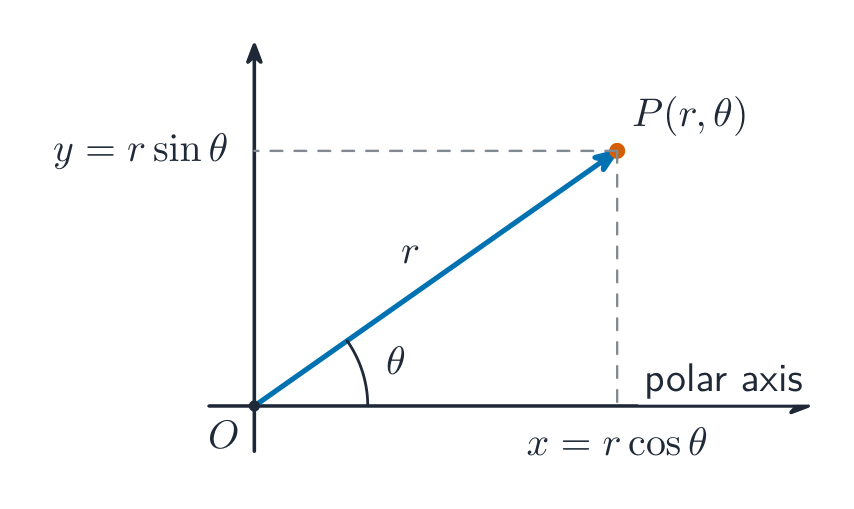
The radius is a distance. Its horizontal and vertical components may be negative even though r is non-negative.
In polar coordinates, the x-coordinate is given by:
Difficulty 1/5 · 100 coins + a small bonus on first completion today
x = r cos θ and y = r sin θ.
Convert (r, θ) = (5, 60°) to Cartesian. What is x = r cos 60°?
Difficulty 2/5 · 140 coins + a small bonus on first completion today
x = 5 cos 60° = 5 × 0.5 = 2.5.
For the point (3, 4) in Cartesian, r² = x² + y². Find r².
Difficulty 2/5 · 140 coins + a small bonus on first completion today
r² = 3² + 4² = 9 + 16 = 25.
Convert P=(−3,−3√3) to polar coordinates, first using 0≤θ<2π and then −π≤θ<π. Also give a polar description of Q=(0,−2). Why is the angle at the pole not unique?
State the radius convention and angle interval first. Verify the sketch or bounds before using algebra and calculus.
Convert equations and keep their domains
- Substitute the coordinate relations into an equation, simplify, then check any step that multiplied or divided by $r$. Dividing by $r$ can lose the pole; multiplying by $r$ can introduce it.
- For $r=4\cos\theta$, multiplying by $r$ gives $x^2+y^2=4x$, so $(x-2)^2+y^2=4$. The circle has centre $(2,0)$ and radius $2$, traced once on $-\pi/2\le\theta\le\pi/2$. A negative value from $4\cos\theta$ is not permitted under $r\ge0$.
The line $x=2$ becomes $r\cos\theta=2$, or $r=2\sec\theta$ with $-\pi/2<\theta<\pi/2$. Multiplying by $r$ would give $r^2\cos\theta=2r$, which also admits $r=0$: that extra point is not on $x=2$.
The polar curve r = 4cos θ is a circle. What is its radius?
Difficulty 2/5 · 140 coins + a small bonus on first completion today
r = 4cos θ gives x² + y² = 4x, i.e. (x−2)² + y² = 4 — a circle of radius 2.
Convert x²+y²=6y to a polar equation. State an angle interval that traces the circle once under r≥0, its centre and radius, and explain what happens to the pole when dividing by r.
State the radius convention and angle interval first. Verify the sketch or bounds before using algebra and calculus.
Convert the Cartesian line x=−3 to polar form with 0≤θ<2π. Give the allowed angles and explain why r²cos θ=−3r is not by itself an equivalent description.
State the radius convention and angle interval first. Verify the sketch or bounds before using algebra and calculus.
Build a sketch from features
- Mark the pole and initial line, the stated angle interval, points on the initial line, zero and greatest/least radii, and the shape near the pole. Use a few special angles to place the curve; detailed point-by-point plotting is unnecessary.
- Test symmetry using both the equation and the interval. Replacing $\theta$ by $-\theta$ tests reflection in the initial line; reflection in a line at angle $\alpha$ replaces $\theta$ by $2\alpha-\theta$. A symmetric formula on an asymmetric interval need not give a symmetric whole sketch.
For $r=2(1+\cos\theta)$ on $-\pi\le\theta\le\pi$, the curve is a cardioid 心脏线. It is symmetric about the initial line, reaches greatest radius $4$ at $\theta=0$, crosses the $y$-axis at $(0,\pm2)$ and has a cusp at the pole when $\theta=\pm\pi$. It is one closed curve, not a circle.
The moving radius shrinks to zero at the cusp. Check the displayed coefficient before comparing numerical radii.
Polar coordinates
r = f(θ)
For r=2(1+cos θ), compare symmetry, greatest radius 4 and the pole at θ=π. Keep r non-negative and check the plotted angle interval.
The polar curve r = a(1 + cos θ) is called a:
Difficulty 1/5 · 100 coins + a small bonus on first completion today
r = a(1 + cos θ) traces a heart-shaped curve called a cardioid.
Sketch r=3(1−cos θ) for −π≤θ≤π. Mark symmetry, the pole, greatest radius, intersections with both coordinate axes and the cusp direction. Do not use negative radii.
State the radius convention and angle interval first. Verify the sketch or bounds before using algebra and calculus.
A restricted interval can select one loop
- If $r^2$ is given, take the non-negative square root and check where it is real. For $r^2=\sin2\theta$ on $0\le\theta\le\pi/2$, the curve starts and ends at the pole, stays in the first quadrant and reaches $r=1$ at $\theta=\pi/4$.
- Since $\sin(2(\pi/2-\theta))=\sin2\theta$, this loop is symmetric about $\theta=\pi/4$. Near $\theta=0$, $r^2\approx2\theta$, so it leaves the pole along the initial line; near the other endpoint it returns along the positive $y$-direction.

Both endpoints are the same pole. The greatest radius lies on the symmetry line, not on either coordinate axis.
Find an area from radial sectors 扇形
- A thin sector has area approximately $\tfrac12r^2\,\Delta\theta$. Adding sectors gives the exact area below, when the selected region is swept once. Square $r$, retain the factor $1/2$ and use radian limits.
- For the loop above, $r^2$ is already $\sin2\theta$: do not square it again. The endpoints give the bounds, not a memorised full turn.
For a complete cardioid $r=a(1+\cos\theta)$, use $(1+\cos\theta)^2$ and $\cos^2\theta=(1+\cos2\theta)/2$. Its total area is $3\pi a^2/2$.
The area of a polar sector is ∫r dθ.
Difficulty 1/5 · 100 coins + a small bonus on first completion today
False. The polar area formula is ½∫r² dθ; each thin sector is approximately a triangle of area ½r² δθ.
The polar curve is r = 6 cos theta. What is its radius, what is r squared for the Cartesian point (5, 12), and why does the polar area formula include one half?
r = 2a cos theta is a circle of radius a. Cartesian r squared is x squared plus y squared.
For r=2 sin 3θ on 0≤θ≤π/3, sketch the selected curve and state its symmetry line and greatest radius. Find its exact enclosed area. Explain why the interval does not describe three petals.
State the radius convention and angle interval first. Verify the sketch or bounds before using algebra and calculus.
For r²=4cos 2θ on −π/4≤θ≤π/4, state the allowed r, sketch the loop, and find its exact area. Give the greatest-radius point and the directions at which the curve meets the pole.
State the radius convention and angle interval first. Verify the sketch or bounds before using algebra and calculus.
For r=3(1+sin θ), find the total enclosed area and the part swept by 0≤θ≤π/2. Identify the greatest radius and the pole, and show the trigonometric identity used in integration.
State the radius convention and angle interval first. Verify the sketch or bounds before using algebra and calculus.
Bound a region between two curves
- Find their common rays by solving their radii equal, and check the pole separately. Identify which radius is outer throughout each interval. The radial strip has area $\tfrac12(r_{\rm outer}^2-r_{\rm inner}^2)\,d\theta$; it is not the square of the difference of radii.
- In the first quadrant, the region inside $r=4\cos\theta$ but outside $r=2$ lies on $0\le\theta\le\pi/3$. The whole region also has a reflected lower half; include it only if the question asks for it.
The pole is not a common point: $r=2$ never reaches it. A point on one curve is not an intersection unless it lies on the other.
In the first quadrant, find the area inside r=6sin θ but outside r=3. Find the boundary angle first and explain the order of the squared radii. Is the pole a common point of the two circles?
State the radius convention and angle interval first. Verify the sketch or bounds before using algebra and calculus.
Furthest from the pole is not highest
- Distance from the pole is $r$. To find its extrema, compare the allowed endpoints and stationary values of $r$, or of $r^2$ when $r\ge0$. A point with largest $r$ need not have largest $x$ or $y$.
- Distance from the initial line for a first-quadrant point is $y=r\sin\theta$. Write the required distance before differentiating, then check its endpoints. For other regions, account for signs and whether the question names a full line or a half-line.
For $r=2\sin2\theta$, $0\le\theta\le\pi/2$, the largest radius is $2$ at $\theta=\pi/4$. However,
Writing $u=\cos\theta$ gives $y=4u(1-u^2)$ for $0\le u\le1$. Its maximum occurs at $u=1/\sqrt3$, giving $y_{\max}=8/(3\sqrt3)$ at a different angle. The endpoints both give $y=0$.
For r=3sin 2θ on 0≤θ≤π/2, find the point of greatest radius and the greatest distance from the initial line. Give the relevant angles and show that the two maximisations differ.
State the radius convention and angle interval first. Verify the sketch or bounds before using algebra and calculus.
Let r²=e^{2sin θ}cos θ for −π/2≤θ≤π/2 and r≥0. Find the angle and radius of the point furthest from the pole, giving exact expressions. Compare with both endpoints.
State the radius convention and angle interval first. Verify the sketch or bounds before using algebra and calculus.
Integrate an unfamiliar polar curve
- A polar equation need not be a named circle or cardioid. For $r=\theta e^{\theta/2}$ on $0\le\theta\le\pi$, the radius increases from $0$ to $\pi e^{\pi/2}$. The curve starts at the pole, turns anticlockwise through half a turn and ends on the negative $x$-axis.
- The region swept from the pole is bounded by the curve and the endpoint rays. Its area is $\tfrac12\int_0^\pi\theta^2e^\theta\,d\theta$. Integration by parts twice gives an exact value; do not replace it with the area of a circle having the largest radius.
For r=θe^θ on 0≤θ≤1, describe the radial behaviour and calculate the exact area swept from the pole. Show your integration rather than using the area of a circle.
State the radius convention and angle interval first. Verify the sketch or bounds before using algebra and calculus.
A curve has r²=2tan 3θ for 0≤θ≤π/12. State its greatest distance from the pole and find the exact area bounded by the curve and the endpoint ray. Explain why the area integrand is not 4tan²3θ.
State the radius convention and angle interval first. Verify the sketch or bounds before using algebra and calculus.
Read the region before choosing limits
- State the non-negative-radius convention and allowed angles, sketch the important features, and keep any lost or introduced pole under review when converting equations.
- For area, identify the region and sweep it once. For a greatest distance, decide whether the expression to optimise is $r$, $x$, $y$ or a distance to the specified line. Check endpoints as well as stationary values.
Keep the nonnegative-radius convention and the stated angle interval. Identify the region before integrating half the squared radius, and check endpoints for greatest-distance problems.
What is the radius of r = 6 cos theta?
Difficulty 1/5 · 100 coins + a small bonus on first completion today
Half of 6 is 3, which is the radius. Other options — 6 (the coefficient in the polar equation); 2 (the lesson radius of r = 4 cos theta).