AP Physics 1 é mecânica baseada em álgebra: cinemática, forças, trabalho, energia e potência, momento linear, torque e rotação, oscilações e fluidos. Não é necessário cálculo — o que torna o curso conceitualmente mais difícil, não mais fácil. Você raciocina sobre situações em vez de apenas manipular fórmulas.
A seção de respostas discursivas separa as pontuações. Ela pede para você justificar, comparar duas situações e explicar um resultado em palavras. Um número correto sem raciocínio obtém muito pouca pontuação.
Nome o princípio primeiro. "Como o momento linear é conservado e nenhuma força externa horizontal atua…" é a frase que o gabarito espera. Desenhe um diagrama de corpo livre para cada problema, mesmo quando parecer desnecessário — é o hábito de maior valor do curso.
As notas abaixo percorrem unidade por unidade através do CED, da cinemática ao movimento harmônico simples, cada uma com exemplos resolvidos. As questões de resposta discursiva liberadas e seus critérios de avaliação estão na biblioteca, e a questão de desenho experimental vale a pena praticar separadamente — ela aparece todos os anos e recompensa um procedimento claro em vez de uma fórmula.
Scalars and Vectors in One Dimension · Escalares e Vetores em Uma Dimensão
Syllabus · Programa
English
Learning Objective 1.1.A: Describe a scalar or vector quantity using magnitude and direction, as appropriate.
1.1.A.1 Scalars are quantities described by magnitude only; vectors are quantities described by both magnitude and direction.
1.1.A.2 Vectors can be visually modeled as arrows with appropriate direction and lengths proportional to their magnitude.
1.1.A.3 Distance and speed are examples of scalar quantities, while position, displacement, velocity, and acceleration are examples of vector quantities.
1.1.A.3.i Vectors are notated with an arrow above the symbol for that quantity.
Equation:$\vec{v} = \vec{v}_0 + \vec{a}t$
1.1.A.3.ii Vector notation is not required for vector components along an axis. In one dimension, the sign of the component completely describes the direction of that component.
Derived equation:$v_x = v_{x0} + a_x t$
Learning Objective 1.1.B: Describe a vector sum in one dimension.
1.1.B.1 When determining a vector sum in a given one-dimensional coordinate system, opposite directions are denoted by opposite signs.
Português
Objetivo de Aprendizagem 1.1.A: Descreva uma grandeza escalar ou vetorial usando magnitude e direção, conforme apropriado.
1.1.A.1 Escalares são grandezas descritas apenas por magnitude; vetores são grandezas descritas por magnitude e direção.
1.1.A.2 Vetores podem ser modelados visualmente como setas com direção adequada e comprimentos proporcionais à sua magnitude.
1.1.A.3 Distância e velocidade escalar são exemplos de grandezas escalares, enquanto posição, deslocamento, velocidade e aceleração são exemplos de grandezas vetoriais.
1.1.A.3.i Vetores são notados com uma seta acima do símbolo daquela grandeza.
Equação:$\vec{v} = \vec{v}_0 + \vec{a}t$
1.1.A.3.ii A notação vetorial não é necessária para componentes vetoriais ao longo de um eixo. Em uma dimensão, o sinal do componente descreve completamente a direção daquele componente.
Equação derivada:$v_x = v_{x0} + a_x t$
Objetivo de Aprendizagem 1.1.B: Descreva uma soma vetorial em uma dimensão.
1.1.B.1 Ao determinar uma soma vetorial em um sistema de coordenadas unidimensional dado, direções opostas são denotadas por sinais opostos.
Source: College Board AP Course and Exam Description · Fonte: College Board AP Course and Exam Description
English
Kinematics 运动学 describes how objects move, without asking why. First, two kinds of quantity:
A scalar 标量 has only size (magnitude 大小): distance 距离, speed, time, mass.
A vector 矢量 has magnitude and direction: displacement, velocity, acceleration, force.
The difference matters. Distance is the total path length travelled – a scalar that only grows. Displacement is the straight-line change in position, with a direction. Walk $3\ \text{m}$ east then $1\ \text{m}$ back west: the distance is $4\ \text{m}$, but the displacement is only $2\ \text{m}$ east.
In one dimension, direction is just a sign (+ or −) along a chosen axis. Choosing the positive direction first is essential – every vector's sign depends on it. A velocity of $-5\ \text{m/s}$ does not mean "slow"; it means $5\ \text{m/s}$ in the negative direction.
Português
Um velocímetro de carro: a velocidade escalar é a magnitude da velocidade — uma taxa escalar de movimento
Cinemática 运动学 descreve como os objetos se movem, sem perguntar porquê. Primeiro, dois tipos de grandezas:
Um escalar 标量 tem apenas tamanho (magnitude 大小): distância 距离, velocidade escalar, tempo, massa.
Um vetor 矢量 tem magnitude e direção: deslocação, velocidade, aceleração, força.
A diferença importa. Distância é o comprimento total do trajeto percorrido – um escalar que só cresce. Deslocação é a mudança de posição em linha reta, com uma direção. Caminhe $3\ \text{m}$ para leste e depois $1\ \text{m}$ para oeste: a distância é $4\ \text{m}$, mas a deslocação é apenas $2\ \text{m}$ para leste.
Em uma dimensão, a direção é apenas um sinal (+ ou −) ao longo de um eixo escolhido. Escolher a direção positiva primeiro é essencial – o sinal de cada vetor depende disso. Uma velocidade de $-5\ \text{m/s}$ não significa "lento"; significa $5\ \text{m/s}$ na direção negativa.
Displacement, Velocity, and Acceleration · Deslocação, Velocidade e Aceleração
Syllabus · Programa
English
Learning Objective 1.2.A: Describe a change in an object's position.
1.2.A.1 When using the object model, the size, shape, and internal configuration are ignored. The object may be treated as a single point with extensive properties such as mass and charge.
1.2.A.2 Displacement is the change in an object's position.
Equation:$\Delta x = x - x_0$
Learning Objective 1.2.B: Describe the average velocity and acceleration of an object.
1.2.B.1 Averages of velocity and acceleration are calculated considering the initial and final states of an object over an interval of time.
1.2.B.2 Average velocity is the displacement of an object divided by the interval of time in which that displacement occurs.
Learning Objective 1.2.B: Describe the velocity and acceleration of an object.
1.2.B.4 An object is accelerating if the magnitude and/or direction of the object's velocity are changing.
1.2.B.5 Calculating average velocity or average acceleration over a very small time interval yields a value that is very close to the instantaneous velocity or instantaneous acceleration.
Português
Objetivo de Aprendizagem 1.2.A: Descreva uma mudança na posição de um objeto.
1.2.A.1 Ao usar o modelo de objeto, o tamanho, a forma e a configuração interna são ignorados. O objeto pode ser tratado como um único ponto com propriedades extensivas como massa e carga.
1.2.A.2 Deslocamento é a mudança na posição de um objeto.
Equação:$\Delta x = x - x_0$
Objetivo de Aprendizagem 1.2.B: Descreva a velocidade média e a aceleração de um objeto.
1.2.B.1 As médias de velocidade e aceleração são calculadas considerando os estados inicial e final de um objeto ao longo de um intervalo de tempo.
1.2.B.2 A velocidade média é o deslocamento de um objeto dividido pelo intervalo de tempo em que esse deslocamento ocorre.
Objetivo de Aprendizagem 1.2.B: Descrever a velocidade e a aceleração de um objeto.
1.2.B.4 Um objeto está acelerando se a magnitude e/ou a direção da sua velocidade estiverem mudando.
1.2.B.5 O cálculo da velocidade ou aceleração média sobre um intervalo de tempo muito pequeno resulta em um valor muito próximo da velocidade ou aceleração instantânea.
Source: College Board AP Course and Exam Description · Fonte: College Board AP Course and Exam Description
English
Projectile motion is two independent motions
Three linked vectors describe motion along a line:
Displacement 位移$\Delta x$ is the change in position – a vector from start to end (not the total path length, which is distance).
Velocity 速度 is the rate of change of position, $v=\dfrac{\Delta x}{\Delta t}$. Its sign gives direction; its magnitude is speed 速率.
Acceleration 加速度 is the rate of change of velocity, $a=\dfrac{\Delta v}{\Delta t}$.
Be careful to separate average velocity 平均速度 (total displacement over total time) from instantaneous velocity 瞬时速度 (the velocity at one instant, the slope of the position–time graph at that point). They are equal only when the velocity is constant.
An object speeds up when $v$ and $a$ have the same sign, and slows down (deceleration 减速) when they have opposite signs. Note that a negative acceleration does not always mean slowing down – a ball falling faster and faster has negative velocity and negative acceleration.
For constant acceleration, the four kinematic equations (often called SUVAT) apply:
Pick the equation that contains the three quantities you know plus the one you want, so only one unknown is left. They apply only while $a$ is constant.
Worked example. A car starts from rest and accelerates uniformly at $2.0\ \text{m/s}^2$ for $6.0\ \text{s}$. Find its final velocity and the distance it travels.
List what you know: $v_0=0$, $a=2.0\ \text{m/s}^2$, $t=6.0\ \text{s}$.
Worked example (free fall). A ball is thrown straight up at $15\ \text{m/s}$. Taking $g=9.8\ \text{m/s}^2$ and up as positive, how high does it rise, and how long is it in the air before returning to the thrower's hand?
At the highest point the velocity is momentarily zero, and $a=-g=-9.8\ \text{m/s}^2$ throughout (this is free fall 自由落体, ignoring air resistance 空气阻力):
$$v^2=v_0^2+2a\,\Delta x \;\Rightarrow\; 0=15^2+2(-9.8)\Delta x \;\Rightarrow\; \Delta x=\frac{225}{19.6}=11.5\ \text{m}.$$
Time to the top: $0=15-9.8\,t \Rightarrow t=1.53\ \text{s}$. By symmetry the fall takes the same time, so the total is $3.1\ \text{s}$.
Português
Um comboio de alta velocidade: a cinemática descreve deslocação, velocidade e aceleração ao longo do tempoMovimento de projétil é dois movimentos independentes
Três vetores ligados descrevem o movimento numa linha:
Deslocação 位移$\Delta x$ é a mudança de posição – um vetor do início ao fim (não o comprimento total do trajeto, que é a distância).
Velocidade 速度 é a taxa de mudança de posição, $v=\dfrac{\Delta x}{\Delta t}$. O seu sinal dá a direção; a sua magnitude é a velocidade escalar 速率.
Aceleração 加速度 é a taxa de mudança de velocidade, $a=\dfrac{\Delta v}{\Delta t}$.
Tenha cuidado em separar a velocidade média 平均速度 (deslocação total sobre tempo total) da velocidade instantânea 瞬时速度 (a velocidade num instante, a inclinação do gráfico posição-tempo naquele ponto). São iguais apenas quando a velocidade é constante.
Um objeto acelera quando $v$ e $a$ têm o mesmo sinal, e desacelera (deceleração 减速) quando têm sinais opostos. Note que uma aceleração negativa nem sempre significa desacelerar – uma bola a cair cada vez mais rápido tem velocidade negativa e aceleração negativa.
Para aceleração constante, aplicam-se as quatro equações cinemáticas (muitas vezes chamadas SUVAT):
Escolha a equação que contém as três quantidades que conhece mais a que quer encontrar, para que reste apenas uma incógnita. Aplicam-se apenas enquanto $a$ é constante.
Exemplo resolvido. Um carro parte do repouso e acelera uniformemente a $2.0\ \text{m/s}^2$ durante $6.0\ \text{s}$. Encontre a sua velocidade final e a distância percorrida.
Liste o que você sabe: $v_0=0$, $a=2.0\ \text{m/s}^2$, $t=6.0\ \text{s}$.
Exemplo resolvido (queda livre). Uma bola é lançada verticalmente para cima a $15\ \text{m/s}$. Tomando $g=9.8\ \text{m/s}^2$ e para cima como positivo, quão alto sobe e quanto tempo permanece no ar antes de voltar à mão de quem a lançou?
No ponto mais alto a velocidade é momentaneamente zero, e $a=-g=-9.8\ \text{m/s}^2$ em todo o percurso (esta é queda livre 自由落ite, ignorando a resistência do ar 空气阻力):
$$v^2=v_0^2+2a\,\Delta x \;\Rightarrow\; 0=15^2+2(-9.8)\Delta x \;\Rightarrow\; \Delta x=\frac{225}{19.6}=11.5\ \text{m}.$$
Tempo até ao topo: $0=15-9.8\,t \Rightarrow t=1.53\ \text{s}$. Por simetria, a descida demora o mesmo tempo, logo o total é $3.1\ \text{s}$.
Note: The equations above are written to indicate motion in the x-direction, but these equations can be used in any single dimension as appropriate.
1.3.A.3 Near the surface of Earth, the vertical acceleration caused by the force of gravity is downward, constant, and has a measured value approximately equal to $a_g = g \approx 10 \ m/s^2$.
1.3.A.4 Graphs of position, velocity, and acceleration as functions of time can be used to find the relationships between those quantities.
1.3.A.4.i An object's instantaneous velocity is the rate of change of the object's position, which is equal to the slope of a line tangent to a point on a graph of the object's position as a function of time.
1.3.A.4.ii An object's instantaneous acceleration is the rate of change of the object's velocity, which is equal to the slope of a line tangent to a point on a graph of the object's velocity as a function of time.
1.3.A.4.iii The displacement of an object during a time interval is equal to the area under the curve of a graph of the object's velocity as a function of time (i.e., the area bounded by the function and the horizontal axis for the appropriate interval).
1.3.A.4.iv The change in velocity of an object during a time interval is equal to the area under the curve of a graph of the acceleration of the object as a function of time.
Boundary statement: AP Physics 1 does not expect students to quantitatively analyze nonuniform acceleration. However, students will be expected to be able to qualitatively analyze, sketch appropriate graphs of, and discuss situations in which acceleration is nonuniform.
Boundary statement: For all situations in which a numerical quantity is required for $g$, the value $g \approx 10 \ m/s^2$ will be used. However, students will not be penalized for correctly using the more precise commonly accepted values of $g = 9.81 \ \text{m/s}^2$ or $g = 9.8 \ \text{m/s}^2$.
Português
Objetivo de Aprendizagem 1.3.A: Descrever a posição, velocidade e aceleração de um objeto usando representações do movimento desse objeto.
1.3.A.1 O movimento pode ser representado por diagramas de movimento, figuras, gráficos, equações e descrições narrativas.
1.3.A.2 Para aceleração constante, três equações cinemáticas podem ser usadas para descrever o movimento linear instantâneo em uma dimensão:
Equação:$v_x = v_{x0} + a_x t$
Equação:$x = x_0 + v_{x0}t + \dfrac{1}{2}a_x t^2$
Equação:$v_x^2 = v_{x0}^2 + 2a_x(x - x_0)$
Nota: As equações acima são escritas para indicar movimento na direção x, mas essas equações podem ser usadas em qualquer única dimensão conforme apropriado.
1.3.A.3 Perto da superfície da Terra, a aceleração vertical causada pela força da gravidade é para baixo, constante e tem um valor medido aproximadamente igual a $a_g = g \approx 10 \ m/s^2$.
1.3.A.4 Gráficos de posição, velocidade e aceleração como funções do tempo podem ser usados para encontrar as relações entre essas grandezas.
1.3.A.4.i A velocidade instantânea de um objeto é a taxa de variação da posição do objeto, que é igual à inclinação (coeficiente angular) de uma linha tangente a um ponto em um gráfico da posição do objeto em função do tempo.
1.3.A.4.ii A aceleração instantânea de um objeto é a taxa de variação da velocidade do objeto, que é igual à inclinação (coeficiente angular) de uma linha tangente a um ponto em um gráfico da velocidade do objeto em função do tempo.
1.3.A.4.iii O deslocamento de um objeto durante um intervalo de tempo é igual à área sob a curva de um gráfico da velocidade do objeto em função do tempo (i.e., a área delimitada pela função e pelo eixo horizontal para o intervalo apropriado).
1.3.A.4.iv A variação da velocidade de um objeto durante um intervalo de tempo é igual à área sob a curva de um gráfico da aceleração do objeto em função do tempo.
Declaração de limite: AP Physics 1 não espera que os alunos analisem quantitativamente acelerações não uniformes. No entanto, espera-se que os alunos sejam capazes de analisar qualitativamente, esboçar gráficos adequados e discutir situações em que a aceleração é não uniforme.
Declaração de limite: Para todas as situações em que uma quantidade numérica é necessária para $g$, o valor $g \approx 10 \ m/s^2$ será usado. No entanto, os alunos não serão penalizados por usarem corretamente valores mais precisos comumente aceitos de $g = 9.81 \ \text{m/s}^2$ ou $g = 9.8 \ \text{m/s}^2$.
Source: College Board AP Course and Exam Description · Fonte: College Board AP Course and Exam Description
English
The same motion appears as a description, a graph, a table, or an equation, and you should move between them:
On a position–time graph, the slope is velocity (steeper = faster; a curve = changing velocity).
On a velocity–time graph, the slope is acceleration, and the area under the line is displacement.
Reading slopes and areas off graphs is a core exam skill. To get displacement from a velocity–time graph, split the area into triangles and rectangles and add them up; area below the time axis counts as negative displacement (motion the other way).
Worked example. A cyclist speeds up uniformly from rest to $8.0\ \text{m/s}$ in $4.0\ \text{s}$, then holds $8.0\ \text{m/s}$ for $6.0\ \text{s}$. Find the total distance from the velocity–time graph.
O mesmo movimento aparece como uma descrição, um gráfico, uma tabela ou uma equação, e deve mover-se entre eles:
Ler um gráfico de distância-tempo: plano significa parado, inclinação reta significa velocidade constante
Num gráfico posição-tempo, a inclinação é a velocidade (mais íngreme = mais rápido; uma curva = velocidade variável).
Num gráfico velocidade-tempo, a inclinação é a aceleração, e a área sob a linha é a deslocação.
Ler inclinações e áreas nos gráficos é uma habilidade central de exame. Para obter a deslocação de um gráfico velocidade-tempo, divida a área em triângulos e retângulos e some-os; a área abaixo do eixo temporal conta como deslocação negativa (movimento na direção oposta).
Em um gráfico de velocidade versus tempo, a inclinação é a aceleração e a área sombreada é o deslocamento
Exemplo resolvido. Um ciclista acelera uniformemente do repouso até $8.0\ \text{m/s}$ em $4.0\ \text{s}$, depois mantém $8.0\ \text{m/s}$ por $6.0\ \text{s}$. Encontre a distância total no gráfico de velocidade–tempo.
Altere a velocidade inicial $u$ e a aceleração $a$. O gradiente (inclinação) da linha é a aceleração; a área entre a linha e o eixo do tempo é o deslocamento.
Reference Frames and Relative Motion · Referenciais e Movimento Relativo
Syllabus · Programa
English
Learning Objective 1.4.A: Describe the reference frame of a given observer.
1.4.A.1 The choice of reference frame will determine the direction and magnitude of quantities measured by an observer in that reference frame.
Learning Objective 1.4.B: Describe the motion of objects as measured by observers in different inertial reference frames.
1.4.B.1 Measurements from a given reference frame may be converted to measurements from another reference frame.
1.4.B.2 The observed velocity of an object results from the combination of the object's velocity and the velocity of the observer's reference frame.
1.4.B.2.i Combining the motion of an object and the motion of an observer in a given reference frame involves the addition or subtraction of vectors.
1.4.B.2.ii The acceleration of any object is the same as measured from all inertial reference frames.
Boundary statement: Unless otherwise stated, the frame of reference of any problem may be assumed to be inertial.
Boundary statement: Adding or subtracting vectors to find relative velocities is restricted to motion along one dimension for AP Physics 1.
Português
Objetivo de Aprendizagem 1.4.A: Descrever o sistema de referência de um observador dado.
1.4.A.1 A escolha do sistema de referência determinará a direção e a magnitude das grandezas medidas por um observador nesse sistema de referência.
Objetivo de Aprendizagem 1.4.B: Descrever o movimento de objetos medidos por observadores em diferentes sistemas de referência inerciais.
1.4.B.1 Medições de um dado sistema de referência podem ser convertidas em medições de outro sistema de referência.
1.4.B.2 A velocidade observada de um objeto resulta da combinação da velocidade do objeto e da velocidade do sistema de referência do observador.
1.4.B.2.i A combinação do movimento de um objeto e do movimento de um observador em um dado sistema de referência envolve a adição ou subtração de vetores.
1.4.B.2.ii A aceleração de qualquer objeto é a mesma quando medida de todos os sistemas de referência inerciais.
Declaração de limite: A menos que indicado de outra forma, assume-se que o sistema de referência de qualquer problema seja inercial.
Declaração de limite: A adição ou subtração de vetores para encontrar velocidades relativas é restrita ao movimento ao longo de uma dimensão para AP Physics 1.
Source: College Board AP Course and Exam Description · Fonte: College Board AP Course and Exam Description
English
All motion is measured against a reference frame 参考系. Velocities measured in different frames differ, and you combine them by vector addition. The velocity of A relative to C is
$$\vec{v}_{A/C}=\vec{v}_{A/B}+\vec{v}_{B/C}.$$
A person walking on a moving train has one velocity relative to the train and another relative to the ground – this is relative motion 相对运动. A useful shortcut: the velocity of A relative to B is $\vec{v}_{A/B}=\vec{v}_A-\vec{v}_B$ (subtract B's velocity).
A frame that is not accelerating is an inertial reference frame 惯性参考系: one in which a free object (no net force) obeys Newton's first law, staying at rest or moving at constant velocity. A frame that accelerates – a braking car – is non-inertial, where objects seem to speed up with no force acting on them.
Worked example. A boat points straight across a river and moves at $3.0\ \text{m/s}$ relative to the water. The current flows at $4.0\ \text{m/s}$ along the river. Find the boat's speed and direction relative to the bank.
The two velocities are perpendicular, so add them as a right triangle:
$$v=\sqrt{3.0^2+4.0^2}=5.0\ \text{m/s},\qquad \theta=\tan^{-1}\!\frac{4.0}{3.0}=53^{\circ}\ \text{downstream from straight across.}$$
Português
Todo movimento é medido em relação a um referencial 参考系. Velocidades medidas em referenciais diferentes diferem entre si, e você as combina por adição vetorial. A velocidade de A relativa a C é
$$\vec{v}_{A/C}=\vec{v}_{A/B}+\vec{v}_{B/C}.$$
Uma pessoa caminhando em um trem em movimento tem uma velocidade relativa ao trem e outra relativa ao solo – isso é movimento relativo 相对运动. Um atalho útil: a velocidade de A relativa a B é $\vec{v}_{A/B}=\vec{v}_A-\vec{v}_B$ (subtraia a velocidade de B).
Um referencial que não está acelerando é um referencial inercial 惯性参考系: aquele em que um objeto livre (sem força resultante) obedece à primeira lei de Newton, permanecendo em repouso ou movendo-se com velocidade constante. Um referencial que acelera – um carro freando – é não-inercial, onde objetos parecem acelerar sem nenhuma força atuando sobre eles.
Exemplo resolvido. Uma bote aponta diretamente para cruzar um rio e move-se a $3.0\ \text{m/s}$ em relação à água. A correnteza flui a $4.0\ \text{m/s}$ ao longo do rio. Encontre a velocidade e a direção da bote em relação à margem.
As duas velocidades são perpendiculares, então some-as como um triângulo retângulo:
$$v=\sqrt{3.0^2+4.0^2}=5.0\ \text{m/s},\qquad \theta=\tan^{-1}\!\frac{4.0}{3.0}=53^{\circ}\ \text{downstream from straight across.}$$
1.5
Vectors and Motion in Two Dimensions · Vetores e Movimento em Duas Dimensões
Syllabus · Programa
English
Learning Objective 1.5.A: Describe the perpendicular components of a vector.
1.5.A.1 Vectors can be mathematically modeled as the resultant of two perpendicular components.
1.5.A.2 Vectors can be resolved into components using a chosen coordinate system.
1.5.A.3 Vectors can be resolved into perpendicular components using trigonometric functions and relationships.
Equation:$\sin \theta = \dfrac{a}{c}$
Equation:$\cos \theta = \dfrac{b}{c}$
Equation:$\tan \theta = \dfrac{a}{b}$
Equation:$a^2 + b^2 = c^2$
Learning Objective 1.5.B: Describe the motion of an object moving in two dimensions.
1.5.B.1 Motion in two dimensions can be analyzed using one-dimensional kinematic relationships if the motion is separated into components.
1.5.B.2 Projectile motion is a special case of two-dimensional motion that has zero acceleration in one dimension and constant, nonzero acceleration in the second dimension.
Português
Objetivo de Aprendizagem 1.5.A: Descrever as componentes perpendiculares de um vetor.
1.5.A.1 Vetores podem ser modelados matematicamente como o resultante de duas componentes perpendiculares.
1.5.A.2 Vetores podem ser decompostos em componentes usando um sistema de coordenadas escolhido.
1.5.A.3 Vetores podem ser decompostos em componentes perpendiculares usando funções trigonométricas e relações.
Equação:$\sin \theta = \dfrac{a}{c}$
Equação:$\cos \theta = \dfrac{b}{c}$
Equação:$\tan \theta = \dfrac{a}{b}$
Equação:$a^2 + b^2 = c^2$
Objetivo de Aprendizagem 1.5.B: Descrever o movimento de um objeto que se move em duas dimensões.
1.5.B.1 O movimento em duas dimensões pode ser analisado usando relações cinemáticas unidimensionais se o movimento for separado em componentes.
1.5.B.2 O movimento de projéteis é um caso especial de movimento bidimensional que possui aceleração zero em uma dimensão e aceleração constante e não nula na segunda dimensão.
Source: College Board AP Course and Exam Description · Fonte: College Board AP Course and Exam Description
English
In two dimensions, resolve each vector into components 分量 along perpendicular axes ($x$ and $y$), handle each axis separately, then recombine. A velocity $v$ at angle $\theta$ to the horizontal has components $v_x=v\cos\theta$ and $v_y=v\sin\theta$.
For projectile motion 抛体运动 (an object moving under gravity alone): the horizontal and vertical motions are independent. Horizontally, velocity is constant ($a_x=0$); vertically, acceleration is $-g$ (down). The two motions share only the time. So a projectile's path (its trajectory 轨迹) is a parabola, and you solve it as two one-dimensional problems joined by $t$.
Worked example. A ball is kicked at $20\ \text{m/s}$, $30^{\circ}$ above the horizontal. Taking $g=9.8\ \text{m/s}^2$, find the time of flight, the maximum height, and the horizontal range 射程 (assume it lands at launch height).
Vertical motion sets the time. At the top $v_y=0$, so $0=10-9.8\,t \Rightarrow t_{\text{up}}=1.02\ \text{s}$, and the total flight is $2t_{\text{up}}=2.0\ \text{s}$. The maximum height is
A common trap: at the top of the flight the vertical velocity is zero, but the ball is not at rest – its horizontal velocity $v_{0x}$ never changes. The speed at the top equals $v_{0x}=17.3\ \text{m/s}$.
Português
Em duas dimensões, decomponha cada vetor em componentes 分量 ao longo de eixos perpendiculares ($x$ e $y$), trate cada eixo separadamente e, em seguida, recombine. Uma velocidade $v$ com ângulo $\theta$ em relação à horizontal tem componentes $v_x=v\cos\theta$ e $v_y=v\sin\theta$.
Um vetor velocidade decomposto em suas componentes horizontal e vertical
Para movimento de projétil 抛体运动 (um objeto sob ação exclusiva da gravidade): os movimentos horizontal e vertical são independentes. Horizontalmente, a velocidade é constante ($a_x=0$); verticalmente, a aceleração é $-g$ (para baixo). Os dois movimentos compartilham apenas o tempo. Assim, a trajetória de um projétil (sua trajetória 轨迹) é uma parábola, e você a resolve como dois problemas unidimensionais unidos por $t$.
Um projétil lançado em um ângulo: os movimentos horizontal e vertical são independentesUma bola solta e uma bola lançada horizontalmente caem juntas – os movimentos verticais são idênticos
Exemplo resolvido. Uma bola é chutada a $20\ \text{m/s}$, $30^{\circ}$ acima da horizontal. Considerando $g=9.8\ \text{m/s}^2$, encontre o tempo de voo, a altura máxima e o alcance horizontal range 射程 (assuma que ela pousa na mesma altura de lançamento).
Movimento Vertical define o tempo. No topo $v_y=0$, logo $0=10-9.8\,t \Rightarrow t_{\text{up}}=1.02\ \text{s}$, e o voo total é $2t_{\text{up}}=2.0\ \text{s}$. A altura máxima é
Uma armadilha comum: no topo do voo a velocidade vertical é zero, mas a bola não está em repouso – sua velocidade horizontal $v_{0x}$ nunca muda. A velocidade no topo é igual a $v_{0x}=17.3\ \text{m/s}$.
Explore · Explorar
Explore o movimento balístico
Dispare a bola, depois altere o ângulo e a velocidade. O movimento horizontal permanece constante enquanto a gravidade a puxa para baixo — juntos traçam uma parábola. Encontre o ângulo de lançamento que dá o maior alcance, e tente a Lua.
Explore · Explorar
Explore vetores e seus componentes
Arraste os vetores para alterar suas componentes $x$ e $y$. Veja como um único vetor é construído a partir de partes independentes horizontal e vertical, e como dois vetores se somam cabeça-cauda em uma resultante.
Choose the right kinematic equation by listing the three quantities you know plus the one you want, so only one unknown remains; the SUVAT equations apply only while acceleration is constant.
Fix a positive direction first — every displacement, velocity, and acceleration then carries a sign; a negative velocity means "moving the other way", not "slow".
Treat a projectile as two independent 1-D problems sharing only the time $t$: constant velocity horizontally, $a=-g$ vertically. At the top $v_y=0$ but $v_x$ is unchanged.
On a velocity–time graph the gradient is the acceleration and the area is the displacement (area below the axis is negative).
Distinguish distance (scalar, total path) from displacement (vector, start-to-end), and speed from velocity.
Português
Escolha a equação cinemática correta listando as três quantidades que você conhece mais aquela que deseja encontrar, de modo que reste apenas uma incógnita; as equações SUVAT aplicam-se apenas enquanto a aceleração for constante.
Defina uma direção positiva primeiro – cada deslocamento, velocidade e aceleração carregarão um sinal; uma velocidade negativa significa "movendo-se na outra direção", não "lento".
Trate o projétil como dois problemas independentes em 1-D compartilhando apenas o tempo $t$: velocidade constante horizontalmente, $a=-g$ verticalmente. No ponto mais alto $v_y=0$, mas $v_x$ permanece inalterado.
Em um gráfico de velocidade–tempo, a inclinação é a aceleração e a área é o deslocamento (área abaixo do eixo é negativa).
Distinga distância (escalar, caminho total) de deslocamento (vetorial, início ao fim), e velocidade escalar de velocidade vetorial.
Systems and Center of Mass · Sistemas e Centro de Massa
Syllabus · Programa
English
Learning Objective 2.1.A: Describe the properties and interactions of a system.
2.1.A.1 System properties are determined by the interactions between objects within the system.
2.1.A.2 If the properties or interactions of the constituent objects within a system are not important in modeling the behavior of the macroscopic system, the system can itself be treated as a single object.
2.1.A.3 Systems may allow interactions between constituent parts of the system and the environment, which may result in the transfer of energy or mass.
2.1.A.4 Individual objects within a chosen system may behave differently from each other as well as from the system as a whole.
2.1.A.5 The internal structure of a system affects the analysis of that system.
2.1.A.6 As variables external to a system are changed, the system's substructure may change.
Learning Objective 2.1.B: Describe the location of a system's center of mass with respect to the system's constituent parts.
2.1.B.1 For systems with symmetrical mass distributions, the center of mass is located on lines of symmetry.
2.1.B.2 The location of a system's center of mass along a given axis can be calculated using the equation
2.1.B.3 A system can be modeled as a singular object that is located at the system's center of mass.
Boundary statement: AP Physics 1 only expects students to calculate the center of mass for systems of five or fewer particles arranged in a two-dimensional configuration or for systems that are highly symmetrical.
Português
Objetivo de Aprendizagem 2.1.A: Descrever as propriedades e interações de um sistema.
2.1.A.1 As propriedades do sistema são determinadas pelas interações entre os objetos dentro do sistema.
2.1.A.2 Se as propriedades ou interações dos objetos constituintes dentro de um sistema não forem importantes no modelamento do comportamento do sistema macroscópico, o próprio sistema pode ser tratado como um único objeto.
2.1.A.3 Sistemas podem permitir interações entre partes constituintes do sistema e o ambiente, o que pode resultar na transferência de energia ou massa.
2.1.A.4 Objetos individuais dentro de um sistema escolhido podem se comportar diferentemente uns dos outros, bem como do sistema como um todo.
2.1.A.5 A estrutura interna de um sistema afeta a análise desse sistema.
2.1.A.6 À medida que variáveis externas a um sistema são alteradas, a subestrutura do sistema pode mudar.
Objetivo de Aprendizagem 2.1.B: Descrever a localização do centro de massa de um sistema em relação às suas partes constituintes.
2.1.B.1 Para sistemas com distribuições de massa simétricas, o centro de massa está localizado em linhas de simetria.
2.1.B.2 A localização do centro de massa de um sistema ao longo de um eixo dado pode ser calculada usando a equação
2.1.B.3 Um sistema pode ser modelado como um objeto singular localizado no centro de massa do sistema.
Declaração de limite: AP Physics 1 apenas espera que os alunos calculem o centro de massa para sistemas de cinco partículas ou menos dispostos em uma configuração bidimensional ou para sistemas altamente simétricos.
Source: College Board AP Course and Exam Description · Fonte: College Board AP Course and Exam Description
English
A system 系统 is the object or group of objects you choose to analyze. A system can be treated as a single point at its center of mass 质心 – the average position of its mass. External forces change the motion of the center of mass; internal forces (between parts of the system) do not.
This is why a wrench spinning across a table still has its center of mass move in a straight line: the spinning is internal, and only the (near-zero) external force matters for the center of mass. For two masses $m_1,m_2$ on a line at positions $x_1,x_2$, the center of mass sits at $x_{\text{cm}}=\dfrac{m_1x_1+m_2x_2}{m_1+m_2}$ – always closer to the heavier mass.
Português
Um sistema 系统是所选要分析的物体或物体组。系统可视为位于其质心 质心的单个点——质量的平均位置。外力改变质心的运动;内力(系统各部分之间)不会。
É por isso que uma chave girando sobre uma mesa ainda tem seu centro de massa se movendo em linha reta: a rotação é interna, e apenas a (quase nula) força externa importa para o centro de massa. Para duas massas $m_1,m_2$ em uma linha nas posições $x_1,x_2$, o centro de massa fica em $x_{\text{cm}}=\dfrac{m_1x_1+m_2x_2}{m_1+m_2}$ – sempre mais próximo da massa maior.
2.2
Forces and Free-Body Diagrams · Forças e Diagramas de Corpo Livre
Syllabus · Programa
English
Learning Objective 2.2.A: Describe a force as an interaction between two objects or systems.
2.2.A.1 Forces are vector quantities that describe the interactions between objects or systems.
2.2.A.1.i A force exerted on an object or system is always due to the interaction of that object with another object or system.
2.2.A.1.ii An object or system cannot exert a net force on itself.
2.2.A.2 Contact forces describe the interaction of an object or system touching another object or system and are macroscopic effects of interatomic electric forces.
Learning Objective 2.2.B: Describe the forces exerted on an object or system using a free-body diagram.
2.2.B.1 Free-body diagrams are useful tools for visualizing forces being exerted on a single object or system and for determining the equations that represent a physical situation.
2.2.B.2 The free-body diagram of an object or system shows each of the forces exerted on the object by the environment.
2.2.B.3 Forces exerted on an object or system are represented as vectors originating from the representation of the center of mass, such as a dot. A system is treated as though all of its mass is located at the center of mass.
2.2.B.4 A coordinate system with one axis parallel to the direction of acceleration of the object or system simplifies the translation from free-body diagram to algebraic representation. For example, in a free-body diagram of an object on an inclined plane, it is useful to set one axis parallel to the surface of the incline.
Boundary statement: AP Physics 1 only expects students to depict the forces exerted on objects, not the force components on free-body diagrams. On the AP Physics exams, individual forces represented on a free-body diagram must be drawn as individual straight arrows, originating on the dot and pointing in the direction of the force. Individual forces that are in the same direction must be drawn side by side, not overlapping.
Português
Objetivo de Aprendizagem 2.2.A: Descrever uma força como uma interação entre dois objetos ou sistemas.
2.2.A.1 Forças são quantidades vetoriais que descrevem as interações entre objetos ou sistemas.
2.2.A.1.i Uma força exercida sobre um objeto ou sistema é sempre devida à interação desse objeto com outro objeto ou sistema.
2.2.A.1.ii Um objeto ou sistema não pode exercer uma força líquida sobre si mesmo.
2.2.A.2 Forças de contato descrevem a interação de um objeto ou sistema tocando outro objeto ou sistema e são efeitos macroscópicos de forças elétricas interatômicas.
Objetivo de Aprendizagem 2.2.B: Descrever as forças exercidas sobre um objeto ou sistema usando um diagrama de corpo livre.
2.2.B.1 Diagramas de corpo livre são ferramentas úteis para visualizar forças sendo exercidas sobre um único objeto ou sistema e para determinar as equações que representam uma situação física.
2.2.B.2 O diagrama de corpo livre de um objeto ou sistema mostra cada uma das forças exercidas sobre o objeto pelo ambiente.
2.2.B.3 Forças exercidas sobre um objeto ou sistema são representadas como vetores originando-se da representação do centro de massa, como um ponto. Um sistema é tratado como se toda a sua massa estivesse localizada no centro de massa.
2.2.B.4 Um sistema de coordenadas com um eixo paralelo à direção da aceleração do objeto ou sistema simplifica a tradução do diagrama de corpo livre para a representação algébrica. Por exemplo, em um diagrama de corpo livre de um objeto em um plano inclinado, é útil definir um eixo paralelo à superfície do plano inclinado.
Declaração de limite: AP Physics 1 apenas espera que os alunos representem as forças exercidas sobre objetos, não as componentes de força em diagramas de corpo livre. Nos exames AP Physics, as forças individuais representadas em um diagrama de corpo livre devem ser desenhadas como setas retas individuais, originando-se no ponto e apontando na direção da força. Forças individuais que estão na mesma direção devem ser desenhadas lado a lado, não sobrepostas.
Source: College Board AP Course and Exam Description · Fonte: College Board AP Course and Exam Description
English
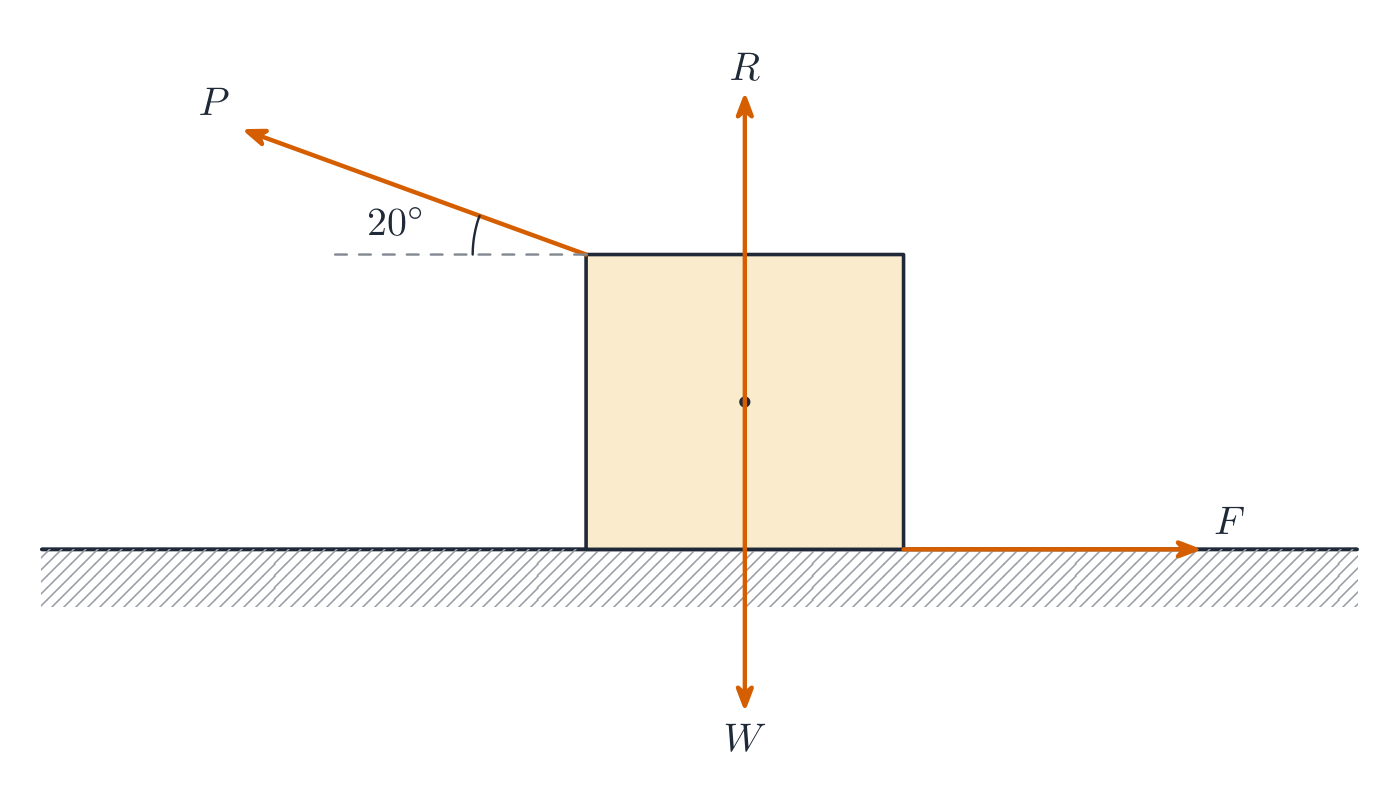
A force 力 is a push or pull – a vector, measured in newtons (N). A free-body diagram 受力图 shows one object as a dot with arrows for every force acting on it (weight 重力, normal, tension 张力, friction, applied), each labelled and pointing the right way. Draw it before any dynamics problem; it is where most marks are won or lost.
Two rules keep free-body diagrams honest: draw only forces acting on the chosen object (not forces it exerts on other things), and draw only real, physical forces (a rope, a surface, gravity, a hand) – never an "$ma$" arrow, which is the result of the forces, not a force itself.
Português
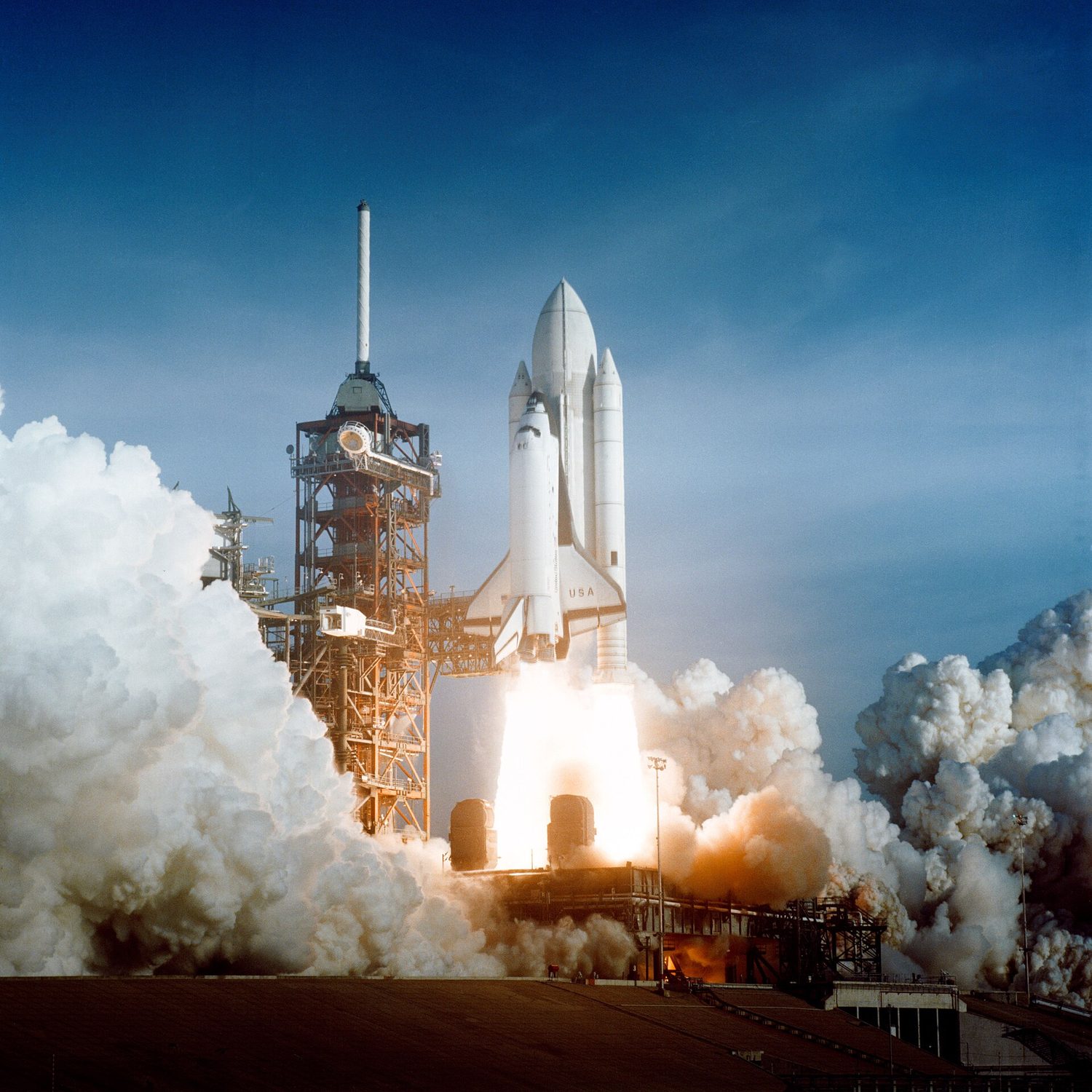
Um paraquedista: diagramas de corpo livre equilibram gravidade e resistência do ar na velocidade terminalLançamento de foguete: força resultante altera o momento linear — F_resultante = ma para dinâmica translacional
Uma força 力 é um empurrão ou puxão – um vetor, medido em newtons (N). Um diagrama de corpo livre 受力图 mostra um objeto como um ponto com setas para todas as forças atuando nele (peso 重力, normal, tensão 张力, atrito, aplicada), cada uma rotulada e apontando na direção correta. Desenhe-o antes de qualquer problema de dinâmica; é onde a maioria dos pontos é ganha ou perdida.
Um diagrama de corpo livre mostra todas as forças atuando em um único objeto
Duas regras mantêm os diagramas de corpo livre honestos: desenhe apenas forças atuando no objeto escolhido (não forças que ele exerce em outras coisas), e desenhe apenas forças físicas reais (uma corda, uma superfície, gravidade, uma mão) – nunca uma seta "$ma$", que é o resultado das forças, não uma força em si.
Explore · Explorar
Equilibre as forças em um diagrama de corpo livre
Um diagrama de corpo livre mostra todas as forças atuando sobre um objeto como setas. O objeto acelera apenas se as forças não se anularem — a força resultante determina $a=F/m$.
Learning Objective 2.3.A: Describe the interaction of two objects using Newton's third law and a representation of paired forces exerted on each object.
2.3.A.1 Newton's third law describes the interaction of two objects in terms of the paired forces that each exerts on the other.
Equation:$\vec{F}_{\text{A on B}} = -\vec{F}_{\text{B on A}}$
2.3.A.2 Interactions between objects within a system (internal forces) do not influence the motion of a system's center of mass.
2.3.A.3 Tension is the macroscopic net result of forces that segments of a string, cable, chain, or similar system exert on each other in response to an external force.
2.3.A.3.i An ideal string has negligible mass and does not stretch when under tension.
2.3.A.3.ii The tension in an ideal string is the same at all points within the string.
2.3.A.3.iii In a string with nonnegligible mass, tension may not be the same at all points within the string.
2.3.A.3.iv An ideal pulley is a pulley that has negligible mass and rotates about an axle through its center of mass with negligible friction.
Boundary statement: AP Physics 1 only expects students to describe tension qualitatively in a string, cable, chain, or similar system with mass. For example, students might note that the tension in a hanging chain is greater toward the top of the chain.
Boundary statement: The interaction between objects or systems at a distance is limited to gravitational forces in AP Physics 1. In AP Physics 2, gravitational, electric, and magnetic forces may be considered.
Português
Objetivo de Aprendizagem 2.3.A: Descrever a interação de dois objetos usando a terceira lei de Newton e uma representação de forças pareadas exercidas em cada objeto.
2.3.A.1 A terceira lei de Newton descreve a interação de dois objetos em termos das forças pareadas que cada um exerce sobre o outro.
Equação:$\vec{F}_{\text{A on B}} = -\vec{F}_{\text{B on A}}$
2.3.A.2 Interações entre objetos dentro de um sistema (forças internas) não influenciam o movimento do centro de massa de um sistema.
2.3.A.3 Tensão é o resultado líquido macroscópico de forças que segmentos de uma corda, cabo, corrente ou sistema similar exercem uns sobre os outros em resposta a uma força externa.
2.3.A.3.i Uma corda ideal tem massa desprezível e não se estica quando sob tensão.
2.3.A.3.ii A tensão em uma corda ideal é a mesma em todos os pontos dentro da corda.
2.3.A.3.iii Em uma corda com massa não desprezível, a tensão pode não ser a mesma em todos os pontos dentro da corda.
2.3.A.3.iv Uma polia ideal é uma polia que tem massa desprezível e gira em torno de um eixo através do seu centro de massa com atrito desprezível.
Declaração de escopo: AP Física 1 espera apenas que os alunos descrevam qualitativamente a tensão em uma corda, cabo, corrente ou sistema similar com massa. Por exemplo, os alunos podem notar que a tensão em uma corrente pendente é maior na parte superior da corrente.
Declaração de escopo: A interação entre objetos ou sistemas à distância é limitada às forças gravitacionais no AP Física 1. No AP Física 2, forças gravitacionais, elétricas e magnéticas podem ser consideradas.
Source: College Board AP Course and Exam Description · Fonte: College Board AP Course and Exam Description
English
Newton's third law 牛顿第三定律: if object A pushes on object B, then B pushes back on A with a force equal in size and opposite in direction. These two forces act on different objects, so they never cancel each other. Identify third-law pairs by the "A on B / B on A" wording.
A classic trap: the weight of a book and the normal force from the table are not a third-law pair – they act on the same object (the book). The partner of the book's weight is the pull the book exerts on the Earth; the partner of the table's push is the push the book makes on the table.
Português
Terceira Lei de Newton 牛顿第三定律: se o objeto A empurra o objeto B, então B empurra de volta A com uma força igual em magnitude e oposta em direção. Essas duas forças atuam em objetos diferentes, então nunca se cancelam. Identifique pares da terceira lei pela formulação "A em B / B em A".
Um par da Terceira Lei de Newton: forças iguais e opostas em dois objetos diferentes
Uma armadilha clássica: o peso de um livro e a força normal da mesa não formam um par da terceira lei – elas atuam no mesmo objeto (o livro). O parceiro do peso do livro é a tração que o livro exerce na Terra; o parceiro da empurrão da mesa é o empurrão que o livro faz na mesa.
2.4
Newton's First Law · Primeira Lei de Newton
Syllabus · Programa
English
Learning Objective 2.4.A: Describe the conditions under which a system's velocity remains constant.
2.4.A.1 The net force on a system is the vector sum of all forces exerted on the system.
2.4.A.2 Translational equilibrium is a configuration of forces such that the net force exerted on a system is zero.
Derived equation:$\sum_i \vec{F}_i = 0$
2.4.A.3 Newton's first law states that if the net force exerted on a system is zero, the velocity of that system will remain constant.
2.4.A.4 Forces may be balanced in one dimension but unbalanced in another. The system's velocity will change only in the direction of the unbalanced force.
2.4.A.5 An inertial reference frame is one from which an observer would verify Newton's first law of motion.
Português
Objetivo de Aprendizagem 2.4.A: Descrever as condições sob as quais a velocidade de um sistema permanece constante.
2.4.A.1 A força resultante sobre um sistema é a soma vetorial de todas as forças exercidas sobre o sistema.
2.4.A.2 O equilíbrio translacional é uma configuração de forças tal que a força resultante exercida sobre um sistema é zero.
Equação derivada:$\sum_i \vec{F}_i = 0$
2.4.A.3 A primeira lei de Newton afirma que se a força resultante exercida sobre um sistema for zero, a velocidade desse sistema permanecerá constante.
2.4.A.4 As forças podem estar equilibradas em uma dimensão, mas desequilibradas em outra. A velocidade do sistema mudará apenas na direção da força desequilibrada.
2.4.A.5 Um referencial inercial é aquele do qual um observador verificaria a primeira lei do movimento de Newton.
Source: College Board AP Course and Exam Description · Fonte: College Board AP Course and Exam Description
English
Newton's first law 牛顿第一定律 (the law of inertia 惯性): an object's velocity stays constant unless a net force 合力 acts on it. So zero net force means constant velocity (including rest) – the object is in translational equilibrium 平衡. Inertia is the tendency to resist changes in motion, measured by mass.
Worked example. A $1200\ \text{kg}$ car cruises at a steady $25\ \text{m/s}$ on a level road. What is the net force on it? Because the velocity is constant, the acceleration is zero, so by the first law the net force is zero – the forward drive force exactly balances drag and friction. "Steady speed" always means balanced forces.
Português
Primeira Lei de Newton 牛顿第一定律 (a lei da inércia 惯性): a velocidade de um objeto permanece constante a menos que uma força resultante 合力 atue sobre ela. Logo, força resultante zero significa velocidade constante (incluindo repouso) – o objeto está em equilíbrio translacional 平衡. Inércia é a tendência a resistir a mudanças no movimento, medida pela massa.
Exemplo resolvido. Um carro de $1200\ \text{kg}$ viaja a uma velocidade constante de $25\ \text{m/s}$ em uma estrada plana. Qual é a força resultante sobre ele? Como a velocidade é constante, a aceleração é zero, logo pela primeira lei a força resultante é zero – a força motora para frente equilibra exatamente o arrasto e o atrito. "Velocidade constante" sempre significa forças equilibradas.
2.5
Newton's Second Law · Segunda Lei de Newton
Syllabus · Programa
English
Learning Objective 2.5.A: Describe the conditions under which a system's velocity changes.
2.5.A.1 Unbalanced forces are a configuration of forces such that the net force exerted on a system is not equal to zero.
2.5.A.2 Newton's second law of motion states that the acceleration of a system's center of mass has a magnitude proportional to the magnitude of the net force exerted on the system and is in the same direction as that net force.
2.5.A.3 The velocity of a system's center of mass will only change if a nonzero net external force is exerted on that system.
Português
Objetivo de Aprendizagem 2.5.A: Descrever as condições sob as quais a velocidade de um sistema muda.
2.5.A.1 Forças desequilibradas são uma configuração de forças tal que a força resultante exercida sobre um sistema não é igual a zero.
2.5.A.2 A segunda lei de Newton afirma que a aceleração do centro de massa de um sistema tem magnitude proporcional à magnitude da força resultante exercida sobre o sistema e está na mesma direção dessa força resultante.
Apply it one axis at a time: add the force components along each axis and set the sum equal to $ma$ for that axis. Acceleration points the same way as the net force.
Worked example. A $4.0\ \text{kg}$ box is pulled along the floor by a horizontal force of $18\ \text{N}$. Friction on the box is $6.0\ \text{N}$. Find its acceleration. Along the direction of motion the net force is $18-6.0=12\ \text{N}$, so
Worked example (incline 斜面). A block of mass $m$ slides down a frictionless ramp tilted at angle $\theta$. Find its acceleration. Resolve gravity into components along and perpendicular to the ramp; only the along-ramp part, $mg\sin\theta$, drives the motion, so
$$a=\frac{mg\sin\theta}{m}=g\sin\theta.$$
The steeper the ramp, the larger $\sin\theta$ and the faster it accelerates; at $\theta=90^{\circ}$ it is free fall.
Português
Segunda Lei de Newton 牛顿第二定律 relaciona a força resultante à aceleração:
Aplique-a um eixo de cada vez: some as componentes de força ao longo de cada eixo e iguale a soma a $ma$ para esse eixo. A aceleração aponta na mesma direção da força resultante.
Exemplo resolvido. Uma caixa de $4.0\ \text{kg}$ é puxada pelo chão por uma força horizontal de $18\ \text{N}$. O atrito na caixa é $6.0\ \text{N}$. Encontre sua aceleração. Na direção do movimento, a força resultante é $18-6.0=12\ \text{N}$, logo
Exemplo resolvido (plano inclinado 斜面). Um bloco de massa $m$ desliza por uma rampa sem atrito inclinada em um ângulo $\theta$. Encontre sua aceleração. Decomponha a gravidade em componentes paralelas e perpendiculares à rampa; apenas a parte paralela à rampa, $mg\sin\theta$, impulsiona o movimento, logo
$$a=\frac{mg\sin\theta}{m}=g\sin\theta.$$
Quanto mais íngreme a rampa, maior $\sin\theta$ e mais rápida a aceleração; em $\theta=90^{\circ}$ é queda livre.
2.6
Gravitational Force · Força Gravitacional
Syllabus · Programa
English
Learning Objective 2.6.A: Describe the gravitational interaction between two objects or systems with mass.
2.6.A.1 Newton's law of universal gravitation describes the gravitational force between two objects or systems as directly proportional to each of their masses and inversely proportional to the square of the distance between the systems' centers of mass.
2.6.A.1.ii The gravitational force is always exerted along the line connecting the centers of mass of the two interacting systems.
2.6.A.1.iii The gravitational force on a system can be considered to be exerted on the system's center of mass.
2.6.A.2 A field models the effects of a noncontact force exerted on an object at various positions in space.
2.6.A.2.i The magnitude of the gravitational field created by a system of mass $M$ at a point in space is equal to the ratio of the gravitational force exerted by the system on a test object of mass $m$ to the mass of the test object.
2.6.A.2.ii If the gravitational force is the only force exerted on an object, the observed acceleration of the object (in m/s$^2$) is numerically equal to the magnitude of the gravitational field strength (in N/kg) at that location.
2.6.A.3 The gravitational force exerted by an astronomical body on a relatively small nearby object is called weight.
Equation:$\text{Weight} = F_g = mg$
Learning Objective 2.6.B: Describe situations in which the gravitational force can be considered constant.
2.6.B.1 If the gravitational force between two systems' centers of mass has a negligible change as the relative position of the two systems changes, the gravitational force can be considered constant at all points between the initial and final positions of the systems.
2.6.B.2 Near the surface of Earth, the strength of the gravitational field is $g \approx 10 \text{ N/kg}$
Learning Objective 2.6.C: Describe the conditions under which the magnitude of a system's apparent weight is different from the magnitude of the gravitational force exerted on that system.
2.6.C.1 The magnitude of the apparent weight of a system is the magnitude of the normal force exerted on the system.
2.6.C.2 If the system is accelerating, the apparent weight of the system is not equal to the magnitude of the gravitational force exerted on the system.
2.6.C.3 A system appears weightless when there are no forces exerted on the system or when the force of gravity is the only force exerted on the system.
2.6.C.4 The equivalence principle states that an observer in a noninertial reference frame is unable to distinguish between an object's apparent weight and the gravitational force exerted on the object by a gravitational field.
Learning Objective 2.6.D: Describe inertial and gravitational mass.
2.6.D.1 Objects have inertial mass, or inertia, a property that determines how much an object's motion resists changes when interacting with another object.
2.6.D.2 Gravitational mass is related to the force of attraction between two systems with mass.
2.6.D.3 Inertial mass and gravitational mass have been experimentally verified to be equivalent.
Português
Objetivo de Aprendizagem 2.6.A: Descrever a interação gravitacional entre dois objetos ou sistemas com massa.
2.6.A.1 A lei da gravitação universal de Newton descreve a força gravitacional entre dois objetos ou sistemas como diretamente proporcional a cada uma de suas massas e inversamente proporcional ao quadrado da distância entre os centros de massa dos sistemas.
2.6.A.1.ii A força gravitacional é sempre exercida ao longo da linha que conecta os centros de massa dos dois sistemas interagentes.
2.6.A.1.iii A força gravitacional sobre um sistema pode ser considerada exercida no centro de massa do sistema.
2.6.A.2 Um campo modela os efeitos de uma força de contato exercida sobre um objeto em várias posições no espaço.
2.6.A.2.i A magnitude do campo gravitacional criado por um sistema de massa $M$ em um ponto no espaço é igual à razão da força gravitacional exercida pelo sistema sobre um objeto de teste de massa $m$ pela massa do objeto de teste.
2.6.A.2.ii Se a força gravitacional for a única força exercida sobre um objeto, a aceleração observada do objeto (em m/s$^2$) é numericamente igual à magnitude da intensidade do campo gravitacional (em N/kg) naquele local.
2.6.A.3 A força gravitacional exercida por um corpo astronômico sobre um objeto pequeno próximo é chamada de peso.
Equação:$\text{Weight} = F_g = mg$
Objetivo de Aprendizagem 2.6.B: Descrever situações em que a força gravitacional pode ser considerada constante.
2.6.B.1 Se a força gravitacional entre os centros de massa de dois sistemas tiver uma mudança desprezível conforme a posição relativa dos dois sistemas muda, a força gravitacional pode ser considerada constante em todos os pontos entre as posições inicial e final dos sistemas.
2.6.B.2 Perto da superfície da Terra, a intensidade do campo gravitacional é $g \approx 10 \text{ N/kg}$
Objetivo de Aprendizagem 2.6.C: Descrever as condições sob as quais a magnitude do peso aparente de um sistema é diferente da magnitude da força gravitacional exercida sobre esse sistema.
2.6.C.1 A magnitude do peso aparente de um sistema é a magnitude da força normal exercida sobre o sistema.
2.6.C.2 Se o sistema estiver acelerando, o peso aparente do sistema não é igual à magnitude da força gravitacional exercida sobre o sistema.
2.6.C.3 Um sistema parece ter peso zero quando não há forças exercidas sobre ele ou quando a força da gravidade é a única força exercida sobre o sistema.
2.6.C.4 O princípio da equivalência afirma que um observador em um referencial não inercial não consegue distinguir entre o peso aparente de um objeto e a força gravitacional exercida sobre o objeto por um campo gravitacional.
Objetivo de Aprendizagem 2.6.D: Descrever massa inercial e massa gravitacional.
2.6.D.1 Objetos têm massa inercial, ou inércia, uma propriedade que determina quanto o movimento de um objeto resiste a mudanças ao interagir com outro objeto.
2.6.D.2 Massa gravitacional está relacionada à força de atração entre dois sistemas com massa.
2.6.D.3 Massa inercial e massa gravitacional foram experimentalmente verificadas como equivalentes.
Source: College Board AP Course and Exam Description · Fonte: College Board AP Course and Exam Description
English
Orbital motion (Kepler's 2nd law)
Near a planet's surface, the gravitational force (weight) is $F_g=mg$, directed down, where $g$ is the gravitational field strength 重力场强度. More generally, Newton's law of gravitation 万有引力定律 gives the attraction between any two masses:
$$F_g=\frac{G m_1 m_2}{r^2},$$
directed along the line joining them, weaker as the distance $r$ grows (an inverse-square law). Doubling the separation quarters the force.
Worked example. A $2.0\ \text{kg}$ object weighs $19.6\ \text{N}$ on Earth ($g=9.8\ \text{m/s}^2$). On the Moon $g_{\text{Moon}}=1.6\ \text{m/s}^2$. Its mass is unchanged ($2.0\ \text{kg}$), but its weight becomes $F_g=mg=2.0\times1.6=3.2\ \text{N}$. Mass measures inertia; weight is a force that depends on where you are.
Mass actually plays two distinct roles. Inertial mass 惯性质量 sets how strongly an object resists acceleration ($F=ma$); gravitational mass 引力质量 sets how strongly it attracts other masses ($F=Gm_1m_2/r^2$). Experiments confirm the two are equal – which is exactly why every object, heavy or light, falls with the same $g$.
Português
Movimento orbital (Lei de Kepler 2)
Perto da superfície de um planeta, a força gravitacional (peso) é $F_g=mg$, dirigida para baixo, onde $g$ é a intensidade do campo gravitacional 重力场强度. Mais geralmente, a Lei da Gravitação Universal 万有引力定律 dá a atração entre quaisquer duas massas:
$$F_g=\frac{G m_1 m_2}{r^2},$$
dirigida ao longo da linha que as une, diminui à medida que a distância $r$ aumenta (uma lei do inverso do quadrado). Dobrar a separação reduz a força a um quarto.
Duas massas atraem-se mutuamente com forças iguais, opostas e de lei do inverso do quadrado ao longo da linha que as une
Exemplo resolvido. Um objeto de $2.0\ \text{kg}$ pesa $19.6\ \text{N}$ na Terra ($g=9.8\ \text{m/s}^2$). Na Lua, $g_{\text{Moon}}=1.6\ \text{m/s}^2$. Sua massa não muda ($2.0\ \text{kg}$), mas seu peso torna-se $F_g=mg=2.0\times1.6=3.2\ \text{N}$. A massa mede a inércia; o peso é uma força que depende de onde você está.
A massa realmente desempenha dois papéis distintos. Massa inercial 惯性质量 define quão fortemente um objeto resiste à aceleração ($F=ma$); massa gravitacional 引力质量 define quão fortemente ele atrai outras massas ($F=Gm_1m_2/r^2$). Experimentos confirmam que as duas são iguais – o que é exatamente por isso que todos os objetos, pesados ou leves, caem com a mesma $g$.
2.7
Kinetic and Static Friction · Atrito Cinético e Estático
Syllabus · Programa
English
Learning Objective 2.7.A: Describe kinetic friction between two surfaces
2.7.A.1 Kinetic friction occurs when two surfaces in contact move relative to each other.
2.7.A.1.i The kinetic friction force is exerted in a direction opposite to the motion of each surface relative to the other surface.
2.7.A.1.ii The force of friction between two surfaces does not depend on the size of the surface area of contact.
2.7.A.2 The magnitude of the kinetic friction force exerted on an object is the product of the normal force the surface exerts on the object and the coefficient of kinetic friction.
2.7.A.2.i The coefficient of kinetic friction depends on the material properties of the surfaces that are in contact.
2.7.A.2.ii Normal force is the perpendicular component of the force exerted on an object by the surface with which it is in contact; it is directed away from the surface.
Learning Objective 2.7.B: Describe static friction between two surfaces.
2.7.B.1 Static friction may occur between the contacting surfaces of two objects that are not moving relative to each other.
2.7.B.2 Static friction adopts the value and direction required to prevent an object from slipping or sliding on a surface.
2.7.B.2.i Slipping and sliding refer to situations in which two surfaces are moving relative to each other.
2.7.B.2.ii There exists a maximum value for which static friction will prevent an object from slipping on a given surface.
Equation:$F_{f,s,\max} = \mu_s F_n$
2.7.B.3 The coefficient of static friction is typically greater than the coefficient of kinetic friction for a given pair of surfaces.
Português
Objetivo de Aprendizagem 2.7.A: Descrever o atrito cinético entre duas superfícies
2.7.A.1 O atrito cinético ocorre quando duas superfícies em contato se movem relativamente uma à outra.
2.7.A.1.i A força de atrito cinético é exercida em uma direção oposta ao movimento de cada superfície relativamente à outra superfície.
2.7.A.1.ii A força de atrito entre duas superfícies não depende do tamanho da área de contato das superfícies.
2.7.A.2 A magnitude da força de atrito cinético exercida sobre um objeto é o produto da força normal que a superfície exerce sobre o objeto e do coeficiente de atrito cinético.
2.7.A.2.i O coeficiente de atrito cinético depende das propriedades materiais das superfícies que estão em contato.
2.7.A.2.ii A força normal é a componente perpendicular da força exercida sobre um objeto pela superfície com a qual ele está em contato; ela é direcionada para longe da superfície.
Objetivo de Aprendizagem 2.7.B: Descrever o atrito estático entre duas superfícies.
2.7.B.1 O atrito estático pode ocorrer entre as superfícies de contato de dois objetos que não se movem relativamente um ao outro.
2.7.B.2 O atrito estático adota o valor e a direção necessários para impedir que um objeto escorregue ou deslize sobre uma superfície.
Static friction 静摩擦 (while not yet sliding): $f_s\le \mu_s N$ – it adjusts up to a maximum to prevent motion.
Here $N$ is the normal force 法向力 (surface push, perpendicular to the surface) and $\mu$ is the coefficient of friction 摩擦系数.
Worked example. A $5.0\ \text{kg}$ crate sits on a level floor with $\mu_s=0.40$. Will a horizontal push of $15\ \text{N}$ move it? On a level floor $N=mg=5.0\times9.8=49\ \text{N}$, so the largest static friction is $f_{s,\max}=\mu_s N=0.40\times49=19.6\ \text{N}$. The $15\ \text{N}$ push is smaller than $19.6\ \text{N}$, so friction rises to match it and the crate stays still.
Português
Atrito 摩擦力 atua ao longo de uma superfície, opondo-se ao deslizamento relativo (ou à tendência de deslizamento):
Atrito cinético 动摩擦 (durante o deslizamento): $f_k=\mu_k N$.
Atrito estático 静摩擦 (enquanto ainda não desliza): $f_s\le \mu_s N$ – ele se ajusta até um máximo para impedir o movimento.
Aqui $N$ é a força normal 法向力 (empurrão da superfície, perpendicular à superfície) e $\mu$ é o coeficiente de atrito 摩擦系数.
Exemplo resolvido. Uma caixa de $5.0\ \text{kg}$ está sobre um piso nivelado com $\mu_s=0.40$. Um empurrão horizontal de $15\ \text{N}$ a moverá? Em um piso nivelado $N=mg=5.0\times9.8=49\ \text{N}$, então o atrito estático máximo é $f_{s,\max}=\mu_s N=0.40\times49=19.6\ \text{N}$. O empurrão $15\ \text{N}$ é menor que $19.6\ \text{N}$, logo o atrito aumenta para igualá-lo e a caixa permanece parada.
Explore · Explorar
Deslize um bloco por uma rampa com atrito
O atrito se opõe ao movimento até um máximo $\mu N$. Incline a rampa até que a componente da gravidade ao longo dela supere o atrito estático e o bloco comece a deslizar.
2.8
Spring Forces · Forças em Molas
Syllabus · Programa
English
Learning Objective 2.8.A: Describe the force exerted on an object by an ideal spring
2.8.A.1 An ideal spring has negligible mass and exerts a force that is proportional to the change in its length as measured from its relaxed length.
2.8.A.2 The magnitude of the force exerted by an ideal spring on an object is given by Hooke's law:
Equation:$\vec{F}_s = -k\Delta\vec{x}$
2.8.A.3 The force exerted on an object by a spring is always directed toward the equilibrium position of the object–spring system.
Português
Objetivo de Aprendizagem 2.8.A: Descrever a força exercida sobre um objeto por uma mola ideal
2.8.A.1 Uma mola ideal tem massa desprezível e exerce uma força proporcional à mudança em seu comprimento medida a partir de seu comprimento relaxado.
2.8.A.2 A magnitude da força exercida por uma mola ideal sobre um objeto é dada pela lei de Hooke:
Equação:$\vec{F}_s = -k\Delta\vec{x}$
2.8.A.3 A força exercida sobre um objeto por uma mola é sempre direcionada em direção à posição de equilíbrio do sistema objeto-mola.
Source: College Board AP Course and Exam Description · Fonte: College Board AP Course and Exam Description
English
Hooke's law & the elastic limit
An ideal spring exerts a restoring force 回复力 proportional to its stretch or compression – Hooke's law 胡克定律:
$$F_s=-kx,$$
where $k$ is the spring constant 弹簧常数 (stiffness) and $x$ is the displacement from the spring's natural length. The minus sign means the force points back toward equilibrium.
Worked example. A spring with $k=200\ \text{N/m}$ hangs vertically and a $0.50\ \text{kg}$ mass is hung on it. How far does it stretch at rest? At rest the spring force balances the weight, $kx=mg$, so
Uma mola ideal exerce uma força restauradora 回复力 proporcional ao seu alongamento ou compressão – a Lei de Hooke 胡克定律:
$$F_s=-kx,$$
onde $k$ é a constante da mola 弹簧常数 (rigidez) e $x$ é o deslocamento em relação ao comprimento natural da mola. O sinal negativo indica que a força aponta de volta para a posição de equilíbrio.
Lei de Hooke: a extensão é proporcional à carga até o limite de proporcionalidade
Exemplo resolvido. Uma mola com $k=200\ \text{N/m}$ pende verticalmente e uma massa de $0.50\ \text{kg}$ é pendurada nela. Quanto ela se estica em repouso? Em repouso, a força da mola equilibra o peso, $kx=mg$, logo
A força de uma mola é proporcional à sua extensão, $F=kx$ (Lei de Hooke). Puxe com mais força e a extensão aumenta proporcionalmente — até o limite elástico da mola.
2.9
Circular Motion · Movimento Circular
Syllabus · Programa
English
Learning Objective 2.9.A: Describe the motion of an object traveling in a circular path.
2.9.A.1 Centripetal acceleration is the component of an object's acceleration directed toward the center of the object's circular path.
2.9.A.1.i The magnitude of centripetal acceleration for an object moving in a circular path is the ratio of the object's tangential speed squared to the radius of the circular path.
Equation:$a_c = \dfrac{v^2}{r}$
2.9.A.1.ii Centripetal acceleration is directed toward the center of an object's circular path.
2.9.A.2 Centripetal acceleration can result from a single force, more than one force, or components of forces exerted on an object in circular motion.
2.9.A.2.i At the top of a vertical, circular loop, an object requires a minimum speed to maintain circular motion. At this point, and with this minimum speed, the gravitational force is the only force that causes the centripetal acceleration.
Equation:$v = \sqrt{gr}$
2.9.A.2.ii Components of the static friction force and the normal force can contribute to the net force producing centripetal acceleration of an object traveling in a circle on a banked surface.
2.9.A.2.iii A component of tension contributes to the net force producing centripetal acceleration experienced by a conical pendulum.
2.9.A.3 Tangential acceleration is the rate at which an object's speed changes and is directed tangent to the object's circular path.
2.9.A.4 The net acceleration of an object moving in a circle is the vector sum of the centripetal acceleration and tangential acceleration.
2.9.A.5 The revolution of an object traveling in a circular path at a constant speed (uniform circular motion) can be described using period and frequency.
2.9.A.5.i The time to complete one full circular path, one full rotation, or a full cycle of oscillatory motion is defined as period, $T$.
2.9.A.5.ii The rate at which an object is completing revolutions is defined as frequency, $f$.
Equation:$T = \dfrac{1}{f}$
2.9.A.5.iii For an object traveling at a constant speed in a circular path, the period is given by the derived equation
Equation:$T = \dfrac{2\pi r}{v}$
Learning Objective 2.9.B: Describe circular orbits using Kepler's third law.
2.9.B.1 For a satellite in circular orbit around a central body, the satellite's centripetal acceleration is caused only by gravitational attraction. The period and radius of the circular orbit are related to the mass of the central body.
Equation:$T^2 = \dfrac{4\pi^2}{GM} R^3$
Boundary statement: AP Physics 1 only expects students to quantitatively analyze banked curves in which no friction is required to maintain uniform circular motion. Analysis of situations in which friction is required on a banked curve is limited to qualitative descriptions.
Boundary statement: AP Physics 1 does not expect students to know Kepler's first or second laws of planetary motion.
Português
Objetivo de Aprendizagem 2.9.A: Descrever o movimento de um objeto percorrendo um caminho circular.
2.9.A.1 A aceleração centrípeta é a componente da aceleração de um objeto direcionada para o centro do caminho circular do objeto.
2.9.A.1.i A magnitude da aceleração centrípeta para um objeto em movimento circular é a razão do quadrado da velocidade tangencial do objeto ao raio do caminho circular.
Equação:$a_c = \dfrac{v^2}{r}$
2.9.A.1.ii A aceleração centrípeta é direcionada para o centro do caminho circular de um objeto.
2.9.A.2 A aceleração centrípeta pode resultar de uma única força, mais de uma força, ou componentes de forças exercidas sobre um objeto em movimento circular.
2.9.A.2.i No topo de uma volta vertical circular, um objeto requer uma velocidade mínima para manter o movimento circular. Neste ponto, e com essa velocidade mínima, a força gravitacional é a única força que causa a aceleração centrípeta.
Equação:$v = \sqrt{gr}$
2.9.A.2.ii Componentes da força de atrito estático e da força normal podem contribuir para a força resultante produzindo aceleração centrípeta de um objeto viajando em círculo sobre uma superfície inclinada.
2.9.A.2.iii Um componente da tensão contribui para a força resultante produzindo aceleração centrípeta experimentada por um pêndulo cônico.
2.9.A.3 A aceleração tangencial é a taxa com que a velocidade de um objeto muda e é direcionada tangencialmente ao caminho circular do objeto.
2.9.A.4 A aceleração resultante de um objeto em movimento circular é a soma vetorial da aceleração centrípeta e da aceleração tangencial.
2.9.A.5 A revolução de um objeto percorrendo um caminho circular a uma velocidade constante (movimento circular uniforme) pode ser descrita usando período e frequência.
2.9.A.5.i O tempo para completar um caminho circular completo, uma rotação completa ou um ciclo completo de movimento oscilatório é definido como período, $T$.
2.9.A.5.ii A taxa com que um objeto completa revoluções é definida como frequência, $f$.
Equação:$T = \dfrac{1}{f}$
2.9.A.5.iii Para um objeto viajando a uma velocidade constante em um caminho circular, o período é dado pela equação derivada
Equação:$T = \dfrac{2\pi r}{v}$
Objetivo de Aprendizagem 2.9.B: Descrever órbitas circulares usando a terceira lei de Kepler.
2.9.B.1 Para um satélite em órbita circular em torno de um corpo central, a aceleração centrípeta do satélite é causada apenas pela atração gravitacional. O período e o raio da órbita circular estão relacionados à massa do corpo central.
Equação:$T^2 = \dfrac{4\pi^2}{GM} R^3$
Declaração de escopo: AP Physics 1 espera apenas que os alunos analisem quantitativamente curvas superadas nas quais não é necessária fricção para manter o movimento circular uniforme. A análise de situações em que a fricção é necessária em uma curva superada se limita a descrições qualitativas.
Declaração de escopo: AP Physics 1 não espera que os alunos saibam a primeira ou a segunda lei do movimento planetário de Kepler.
Source: College Board AP Course and Exam Description · Fonte: College Board AP Course and Exam Description
English
Uniform circular motion
An object moving in a circle at constant speed still accelerates, because its velocity direction keeps changing. This centripetal acceleration 向心加速度 points toward the center:
$$a_c=\frac{v^2}{r}.$$
It is produced by a net inward (centripetal) force 向心力$F_c=\dfrac{mv^2}{r}$ – supplied by whatever real force points inward (tension, gravity, friction, normal). The time for one full revolution is the period 周期$T$, and the number of revolutions per second is the frequency 频率$f$; they are reciprocals, $f = 1/T$, and the same definitions describe any rotation or oscillation.There is no separate outward force; "centrifugal" is only an apparent effect.
Worked example. A $0.30\ \text{kg}$ ball on a string is whirled in a horizontal circle of radius $0.80\ \text{m}$ at $4.0\ \text{m/s}$. Find the tension in the string. The tension supplies the whole centripetal force:
If the string can take at most $6.0\ \text{N}$, this is the fastest the ball can go at that radius – spin any faster and the string breaks.
Português
Movimento circular uniforme
Um objeto movendo-se em círculo a velocidade constante ainda acelera, porque a direção de sua velocidade muda continuamente. Essa aceleração centrípeta 向心加速度 aponta para o centro:
$$a_c=\frac{v^2}{r}.$$
Ela é produzida por uma força resultante interna (centrípeta) 向心力$F_c=\dfrac{mv^2}{r}$ – fornecida por qualquer força real que aponte para dentro (tensão, gravidade, atrito, normal). O tempo para uma revolução completa é o período 周期$T$, e o número de revoluções por segundo é a frequência 频率$f$; elas são recíprocas, $f = 1/T$, e as mesmas definições descrevem qualquer rotação ou oscilação. Não há força externa separada; "centrífuga" é apenas um efeito aparente.
A velocidade aponta ao longo da tangente; a força centrípeta e a aceleração apontam para o centro
Exemplo resolvido. Uma bola de $0.30\ \text{kg}$ presa a uma corda é girada em um círculo horizontal de raio $0.80\ \text{m}$ a $4.0\ \text{m/s}$. Encontre a tensão na corda. A tensão fornece toda a força centrípeta:
Se a corda suporta no máximo $6.0\ \text{N}$, essa é a velocidade máxima que a bola pode ter naquele raio – girar mais rápido e a corda quebrará.
2.9
Exam tips · Dicas de prova
English
Always draw a free-body diagram first: only real forces on the chosen object (weight, normal, tension, friction, applied) — never an "$ma$" arrow.
Apply $\sum F = ma$one axis at a time; on an incline resolve gravity into $mg\sin\theta$ (along) and $mg\cos\theta$ (perpendicular).
A Newton's third-law pair acts on two different objects — a book's weight and the table's normal force are not a pair (both act on the book).
Static friction adjusts up to $\mu_s N$ (use it to test whether motion starts); once sliding, use kinetic friction $f_k=\mu_k N$.
Circular motion needs a net inward (centripetal) force$mv^2/r$ supplied by a real force — there is no outward "centrifugal" force.
Português
Sempre faça primeiro um diagrama de corpo livre: apenas forças reais sobre o objeto escolhido (peso, normal, tensão, atrito, aplicada) — nunca uma seta de "$ma$".
Aplique $\sum F = ma$um eixo de cada vez; numa rampa, decomponha a gravidade em $mg\sin\theta$ (paralelo) e $mg\cos\theta$ (perpendicular).
Um par de ação e reação (Lei de Newton III) age em dois objetos diferentes – o peso de um livro e a força normal da mesa não formam um par (ambos atuam no livro).
O atrito estático ajusta-se até $\mu_s N$ (use-o para testar se o movimento começa); uma vez deslizante, use o atrito cinético$f_k=\mu_k N$.
O movimento circular precisa de uma força resultante interna (centrípeta)$mv^2/r$ fornecida por uma força real – não existe força "centrífuga" externa.
Translational Kinetic Energy · Energia Cinética Translacional
Syllabus · Programa
English
Learning Objective 3.1.A: Describe the translational kinetic energy of an object in terms of the object's mass and velocity.
3.1.A.1 An object's translational kinetic energy is given by the equation
Equation:$K = \dfrac{1}{2}mv^2$
3.1.A.2 Translational kinetic energy is a scalar quantity.
3.1.A.3 Different observers may measure different values of the translational kinetic energy of an object, depending on the observer's frame of reference.
Português
Objetivo de Aprendizagem 3.1.A: Descrever a energia cinética translacional de um objeto em termos da massa e da velocidade do objeto.
3.1.A.1 A energia cinética translacional de um objeto é dada pela equação
Equação:$K = \dfrac{1}{2}mv^2$
3.1.A.2 Energia cinética translacional é uma grandeza escalar.
3.1.A.3 Diferentes observadores podem medir diferentes valores da energia cinética translacional de um objeto, dependendo do referencial do observador.
Source: College Board AP Course and Exam Description · Fonte: College Board AP Course and Exam Description
English
Energy 能量 is the capacity to do work, measured in joules 焦耳 (J). A moving object has kinetic energy 动能:
$$K=\tfrac{1}{2}mv^2.$$
It depends on the square of the speed, so doubling the speed quadruples the kinetic energy. Kinetic energy is a scalar and is never negative.
Worked example. A $1500\ \text{kg}$ car travels at $20\ \text{m/s}$. Its kinetic energy is $K=\tfrac12\times1500\times20^2=3.0\times10^{5}\ \text{J}=300\ \text{kJ}$. If it speeds up to $40\ \text{m/s}$ (double), the kinetic energy becomes $4\times$ larger, $1200\ \text{kJ}$ – which is why stopping distance grows so fast with speed.
Português
Energia 能量 é a capacidade de realizar trabalho, medida em joules 焦耳 (J). Um objeto em movimento possui energia cinética 动能:
$$K=\tfrac{1}{2}mv^2.$$
Depende do quadrado da velocidade, portanto dobrar a velocidade quadruplica a energia cinética. A energia cinética é um escalar e nunca é negativa.
Exemplo resolvido. Um carro de $1500\ \text{kg}$ viaja a $20\ \text{m/s}$. Sua energia cinética é $K=\tfrac12\times1500\times20^2=3.0\times10^{5}\ \text{J}=300\ \text{kJ}$. Se ele acelerar para $40\ \text{m/s}$ (dobro), a energia cinética torna-se $4\times$ maior, $1200\ \text{kJ}$ – é por isso que a distância de frenagem cresce tão rapidamente com a velocidade.
Learning Objective 3.2.A: Describe the work done on an object or system by a given force or collection of forces.
3.2.A.1 Work is the amount of energy transferred into or out of a system by a force exerted on that system over a distance.
3.2.A.1.i The work done by a conservative force exerted on a system is path-independent and only depends on the initial and final configurations of that system.
3.2.A.1.ii The work done by a conservative force on a system—or the change in the potential energy of the system—will be zero if the system returns to its initial configuration.
3.2.A.1.iii Potential energies are associated only with conservative forces.
3.2.A.1.iv The work done by a nonconservative force is path-dependent.
3.2.A.1.v Examples of nonconservative forces are friction and air resistance.
3.2.A.2 Work is a scalar quantity that may be positive, negative, or zero.
3.2.A.3 The amount of work done on a system by a constant force is related to the components of that force and the displacement of the point at which that force is exerted.
3.2.A.3.i Only the component of the force exerted on a system that is parallel to the displacement of the point of application of the force will change the system's total energy.
Equation:$W = F_{\parallel}d = Fd\cos\theta$
3.2.A.3.ii The component of the force exerted on a system perpendicular to the direction of the displacement of the system's center of mass can change the direction of the system's motion without changing the system's kinetic energy.
3.2.A.4 The work-energy theorem states that the change in an object's kinetic energy is equal to the sum of the work (net work) being done by all forces exerted on the object.
Equation:$\Delta K = \sum_{i} W_i = \sum_{i} F_{\parallel,i}\,d$
3.2.A.4.i An external force may change the configuration of a system. The component of the external force parallel to the displacement times the displacement of the point of application of the force gives the change in kinetic energy of the system.
3.2.A.4.ii If the system's center of mass and the point of application of the force move the same distance when a force is exerted on a system, then the system may be modeled as an object, and only the system's kinetic energy can change.
3.2.A.4.iii The energy dissipated by friction is typically equated to the force of friction times the length of the path over which the force is exerted
3.2.A.5 Work is equal to the area under the curve of a graph of $F_{\parallel}$ as a function of displacement.
Boundary statement: AP Physics 1 only expects students to analyze the transfer of mechanical energy (as defined in Unit 3, Topic 4: Conservation of Energy), although students should be aware that mechanical energy may be dissipated in the form of thermal energy or sound. In AP Physics 2, students will also study how thermal energy can be transferred between systems through heating or cooling.
Português
Objetivo de Aprendizagem 3.2.A: Descrever o trabalho realizado sobre um objeto ou sistema por uma força dada ou conjunto de forças.
3.2.A.1 Trabalho é a quantidade de energia transferida para dentro ou para fora de um sistema por uma força exercida sobre esse sistema ao longo de uma distância.
3.2.A.1.i O trabalho realizado por uma força conservativa exercida sobre um sistema é independente do caminho e depende apenas das configurações inicial e final desse sistema.
3.2.A.1.ii O trabalho realizado por uma força conservativa sobre um sistema — ou a variação da energia potencial do sistema — será zero se o sistema retornar à sua configuração inicial.
3.2.A.1.iii As energias potenciais estão associadas apenas às forças conservativas.
3.2.A.1.iv O trabalho realizado por uma força não conservativa depende do caminho.
3.2.A.1.v Exemplos de forças não conservativas são atrito e resistência do ar.
3.2.A.2 Trabalho é uma grandeza escalar que pode ser positiva, negativa ou nula.
3.2.A.3 A quantidade de trabalho realizado sobre um sistema por uma força constante está relacionada aos componentes dessa força e ao deslocamento do ponto no qual essa força é exercida.
3.2.A.3.i Apenas o componente da força exercida sobre um sistema que é paralelo ao deslocamento do ponto de aplicação da força alterará a energia total do sistema.
Equação:$W = F_{\parallel}d = Fd\cos\theta$
3.2.A.3.ii O componente da força exercida sobre um sistema perpendicular à direção do deslocamento do centro de massa do sistema pode alterar a direção do movimento do sistema sem alterar a energia cinética do sistema.
3.2.A.4 O teorema do trabalho-energia afirma que a variação da energia cinética de um objeto é igual à soma do trabalho (trabalho líquido) realizado por todas as forças exercidas sobre o objeto.
Equação:$\Delta K = \sum_{i} W_i = \sum_{i} F_{\parallel,i}\,d$
3.2.A.4.i Uma força externa pode alterar a configuração de um sistema. O componente da força externa paralelo ao deslocamento multiplicado pelo deslocamento do ponto de aplicação da força dá a variação da energia cinética do sistema.
3.2.A.4.ii Se o centro de massa do sistema e o ponto de aplicação da força se moverem a mesma distância quando uma força é exercida sobre um sistema, então o sistema pode ser modelado como um objeto, e apenas a energia cinética do sistema pode mudar.
3.2.A.4.iii A energia dissipada pelo atrito geralmente é igualada à força de atrito vezes o comprimento do caminho ao longo do qual a força é exercida.
3.2.A.5 Trabalho é igual à área sob a curva de um gráfico de $F_{\parallel}$ em função do deslocamento.
Declaração de escopo: AP Physics 1 espera apenas que os alunos analisem a transferência de energia mecânica (conforme definida na Unidade 3, Tópico 4: Conservação de Energia), embora os alunos devem estar cientes de que a energia mecânica pode ser dissipada na forma de energia térmica ou som. No AP Physics 2, os alunos também estudarão como a energia térmica pode ser transferida entre sistemas através do aquecimento ou resfriamento.
Source: College Board AP Course and Exam Description · Fonte: College Board AP Course and Exam Description
English
Work 功 is energy transferred by a force acting over a displacement:
$$W=F\,d\cos\theta,$$
where $\theta$ is the angle between the force and the displacement. Work is positive when the force has a component along the motion (adds energy), negative when it opposes the motion (removes energy), and zero when the force is perpendicular. On a force–position graph, work is the area under the curve. The work–energy theorem 动能定理 states that the net work equals the change in kinetic energy: $W_{\text{net}}=\Delta K$.
Worked example. A $2.0\ \text{kg}$ block moving at $3.0\ \text{m/s}$ on a frictionless floor is pushed by a $5.0\ \text{N}$ force over $4.0\ \text{m}$ in the direction of motion. Find its final speed. The net work is $W=Fd=5.0\times4.0=20\ \text{J}$, and by the work–energy theorem $W=\tfrac12 m(v^2-v_0^2)$:
Trabalho 功 é energia transferida por uma força agindo sobre um deslocamento:
$$W=F\,d\cos\theta,$$
onde $\theta$ é o ângulo entre a força e o deslocamento. O trabalho é positivo quando a força tem componente ao longo do movimento (adiciona energia), negativo quando se opõe ao movimento (remove energia) e nulo quando a força é perpendicular. Num gráfico de força versus posição, o trabalho é a área sob a curva. O teorema do trabalho-energia 动能定理 afirma que o trabalho líquido é igual à variação da energia cinética: $W_{\text{net}}=\Delta K$.
Apenas a componente da força ao longo do deslocamento realiza trabalho
Exemplo resolvido. Um bloco de $2.0\ \text{kg}$ movendo-se a $3.0\ \text{m/s}$ sobre um piso sem atrito é empurrado por uma força de $5.0\ \text{N}$ por $4.0\ \text{m}$ na direção do movimento. Encontre sua velocidade final. O trabalho líquido é $W=Fd=5.0\times4.0=20\ \text{J}$, e pelo teorema do trabalho-energia $W=\tfrac12 m(v^2-v_0^2)$:
Learning Objective 3.3.A: Describe the potential energy of a system.
3.3.A.1 A system composed of two or more objects has potential energy if the objects within that system only interact with each other through conservative forces.
3.3.A.2 Potential energy is a scalar quantity associated with the position of objects within a system.
3.3.A.3 The definition of zero potential energy for a given system is a decision made by the observer considering the situation to simplify or otherwise assist in analysis.
3.3.A.4 The potential energy of common physical systems can be described using the physical properties of that system.
3.3.A.4.i The elastic potential energy of an ideal spring is given by the following equation, where $\Delta x$ is the distance the spring has been stretched or compressed from its equilibrium length.
Equation:$U_s = \dfrac{1}{2}k(\Delta x)^2$
3.3.A.4.ii The general form for the gravitational potential energy of a system consisting of two approximately spherical distributions of mass (e.g., moons, planets or stars) is given by the equation
Equation:$U_g = -G\dfrac{m_1 m_2}{r}$
3.3.A.4.iii Because the gravitational field near the surface of a planet is nearly constant, the change in gravitational potential energy in a system consisting of an object with mass $m$ and a planet with gravitational field of magnitude $g$ when the object is near the surface of the planet may be approximated by the equation
Equation:$\Delta U_g = mg\Delta y$
3.3.A.5 The total potential energy of a system containing more than two objects is the sum of the potential energy of each pair of objects within the system.
Português
Objetivo de Aprendizagem 3.3.A: Descrever a energia potencial de um sistema.
3.3.A.1 Um sistema composto por dois ou mais objetos tem energia potencial se os objetos dentro desse sistema interagem uns com os outros apenas através de forças conservativas.
3.3.A.2 Energia potencial é uma grandeza escalar associada à posição dos objetos dentro de um sistema.
3.3.A.3 A definição de energia potencial zero para um dado sistema é uma decisão tomada pelo observador considerando a situação para simplificar ou de outra forma auxiliar na análise.
3.3.A.4 A energia potencial de sistemas físicos comuns pode ser descrita usando as propriedades físicas desse sistema.
3.3.A.4.i A energia potencial elástica de uma mola ideal é dada pela seguinte equação, onde $\Delta x$ é a distância que a mola foi esticada ou comprimida em relação ao seu comprimento de equilíbrio.
Equação:$U_s = \dfrac{1}{2}k(\Delta x)^2$
3.3.A.4.ii A forma geral para a energia potencial gravitacional de um sistema consistindo em duas distribuições de massa aproximadamente esféricas (ex.: luas, planetas ou estrelas) é dada pela equação
Equação:$U_g = -G\dfrac{m_1 m_2}{r}$
3.3.A.4.iii Como o campo gravitacional próximo à superfície de um planeta é quase constante, a variação da energia potencial gravitacional em um sistema consisting de um objeto com massa $m$ e um planeta com campo gravitacional de magnitude $g$ quando o objeto está próximo à superfície do planeta pode ser aproximada pela equação
Equação:$\Delta U_g = mg\Delta y$
3.3.A.5 A energia potencial total de um sistema contendo mais de dois objetos é a soma da energia potencial de cada par de objetos dentro do sistema.
Source: College Board AP Course and Exam Description · Fonte: College Board AP Course and Exam Description
English
Potential energy 势能 is stored energy that depends on position or configuration:
Gravitational potential energy 重力势能 near the surface: $U_g=mgh$ (height $h$ above a reference level).
Elastic potential energy 弹性势能 in a spring: $U_s=\tfrac{1}{2}kx^2$.
Potential energy is defined only for conservative forces 保守力 (gravity, springs), for which the stored energy depends on position, not path. Only changes in potential energy matter, so you may put the zero level wherever is convenient.
The $U_g=mgh$ form only holds near a surface where $g$ is roughly constant. The general form, for two spherical masses a distance $r$ apart, is
$$U_g=-\frac{G m_1 m_2}{r}.$$
It is negative and defined to be zero at infinite separation, so gravitational PE rises toward zero as the masses move apart. $mgh$ is simply its near-surface approximation. (This is the form you need for satellites and escape speed.)
Português
Energia potencial 势能 é energia armazenada que depende da posição ou configuração:
Energia potencial gravitacional 重力势能 próxima à superfície: $U_g=mgh$ (altura $h$ acima de um nível de referência).
Energia potencial elástica 弹性势能 em uma mola: $U_s=\tfrac{1}{2}kx^2$.
A energia potencial é definida apenas para forças conservativas 保守力 (gravidade, molas), para as quais a energia armazenada depende da posição, não do caminho. Apenas as variações na energia potencial importam, portanto você pode colocar o nível zero onde for conveniente.
A forma $U_g=mgh$ só vale perto de uma superfície onde $g$ é aproximadamente constante. A forma geral, para duas massas esféricas separadas por uma distância $r$, é
$$U_g=-\frac{G m_1 m_2}{r}.$$
Ela é negativa e definida como zero em separação infinita, logo a EP gravitacional sobe em direção a zero conforme as massas se afastam. $mgh$ é simplesmente sua aproximação próxima à superfície. (Esta é a forma necessária para satélites e velocidade de escape.)
Explore · Explorar
Armazene energia potencial elástica em uma mola
Esticar uma mola armazena energia potencial elástica$\tfrac12 kx^2$ — a área sob a linha força-extensão. Solte-a e essa energia se converte em cinética.
3.4
Conservation of Energy · Conservação de Energia
Syllabus · Programa
English
Learning Objective 3.4.A: Describe the energies present in a system.
3.4.A.1 A system composed of only a single object can only have kinetic energy.
3.4.A.2 A system that contains objects that interact via conservative forces or that can change its shape reversibly may have both kinetic and potential energies.
Learning Objective 3.4.B: Describe the behavior of a system using conservation of mechanical energy principles.
3.4.B.1 Mechanical energy is the sum of a system's kinetic and potential energies.
3.4.B.2 Any change to a type of energy within a system must be balanced by an equivalent change of other types of energies within the system or by a transfer of energy between the system and its surroundings.
3.4.B.3 A system may be selected so that the total energy of that system is constant.
3.4.B.4 If the total energy of a system changes, that change will be equivalent to the energy transferred into or out of the system.
Learning Objective 3.4.C: Describe how the selection of a system determines whether the energy of that system changes.
3.4.C.1 Energy is conserved in all interactions.
3.4.C.2 If the work done on a selected system is zero and there are no nonconservative interactions within the system, the total mechanical energy of the system is constant.
3.4.C.3 If the work done on a selected system is nonzero, energy is transferred between the system and the environment.
Boundary statement: AP Physics 1 expects students to know that mechanical energy can be dissipated as thermal energy or sound by nonconservative forces.
Português
Objetivo de Aprendizagem 3.4.A: Descrever as energias presentes em um sistema.
3.4.A.1 Um sistema composto por apenas um único objeto só pode ter energia cinética.
3.4.A.2 Um sistema que contém objetos que interagem via forças conservativas ou que pode mudar sua forma reversivelmente pode ter tanto energias cinéticas quanto potenciais.
Objetivo de Aprendizagem 3.4.B: Descrever o comportamento de um sistema usando princípios de conservação de energia mecânica.
3.4.B.1 Energia mecânica é a soma das energias cinéticas e potenciais de um sistema.
3.4.B.2 Qualquer mudança em um tipo de energia dentro de um sistema deve ser equilibrada por uma mudança equivalente de outros tipos de energias dentro do sistema ou por uma transferência de energia entre o sistema e suas vizinhanças.
3.4.B.3 Um sistema pode ser selecionado de modo que a energia total desse sistema seja constante.
3.4.B.4 Se a energia total de um sistema muda, essa mudança será equivalente à energia transferida para dentro ou para fora do sistema.
Objetivo de Aprendizagem 3.4.C: Descrever como a seleção de um sistema determina se a energia desse sistema muda.
3.4.C.1 A energia é conservada em todas as interações.
3.4.C.2 Se o trabalho realizado sobre um sistema selecionado é zero e não há interações não conservativas dentro do sistema, a energia mecânica total do sistema é constante.
3.4.C.3 Se o trabalho realizado sobre um sistema selecionado é diferente de zero, energia é transferida entre o sistema e o ambiente.
Declaração de escopo: AP Physics 1 espera que os alunos saibam que a energia mecânica pode ser dissipada como energia térmica ou som por forças não conservativas.
Source: College Board AP Course and Exam Description · Fonte: College Board AP Course and Exam Description
English
Energy conservation: KE ⇄ PE
The total mechanical energy 机械能 is $E=K+U$. When only conservative forces do work, mechanical energy is conserved 守恒:
$$K_1+U_1=K_2+U_2.$$
When friction or other non-conservative forces act, they transfer mechanical energy to thermal energy 热能; then the general statement is that total energy (including thermal) is conserved. Energy bar charts are a good way to track where the energy goes.
Worked example. A ball is released from rest at the top of a frictionless ramp $5.0\ \text{m}$ high. Find its speed at the bottom. All the gravitational potential energy becomes kinetic energy:
The mass cancels, so every object reaches the same speed – exactly the free-fall result, now got from energy. If instead $30\ \text{J}$ were lost to friction, you would subtract it: $mgh-30=\tfrac12 mv^2$.
Português
Conservação de energia: KE ⇄ PEUma montanha-russa troca energia alternadamente: está mais alta (maior energia potencial) no topo e vai mais rápido (maior energia cinética) na base
A energia mecânica total 机械能 é $E=K+U$. Quando apenas forças conservativas realizam trabalho, a energia mecânica é conservada 守恒:
$$K_1+U_1=K_2+U_2.$$
Quando atrito ou outras forças não conservativas atuam, elas transferem energia mecânica para energia térmica 热能; então a afirmação geral é que a energia total (incluindo térmica) é conservada. Gráficos de barras de energia são uma boa forma de acompanhar para onde a energia vai.
Um pêndulo oscilante troca energia potencial gravitacional por energia cinética e vice-versa
Exemplo resolvido. Uma bola é solta do repouso no topo de uma rampa sem atrito de altura $5.0\ \text{m}$. Encontre sua velocidade na base. Toda a energia potencial gravitacional se transforma em energia cinética:
A massa cancela, então todos os objetos atingem a mesma velocidade – exatamente o resultado da queda livre, agora obtido pela energia. Se em vez disso $30\ \text{J}$ fosse perdido devido ao atrito, você subtrairia: $mgh-30=\tfrac12 mv^2$.
Explore · Explorar
Observe a conversão de energia durante a queda de um objeto
Sem atrito, a energia mecânica é conservada: enquanto um objeto cai, a energia potencial gravitacional se transforma em energia cinética, mantendo-se o total constante.
Learning Objective 3.5.A: Describe the transfer of energy into, out of, or within a system in terms of power.
3.5.A.1 Power is the rate at which energy changes with respect to time, either by transfer into or out of a system or by conversion from one type to another within a system.
3.5.A.2 Average power is the amount of energy being transferred or converted, divided by the time it took for that transfer or conversion to occur.
3.5.A.3 Because work is the change in energy of an object or system due to a force, average power is the total work done, divided by the time during which that work was done.
Equation:$P_{\text{avg}} = \dfrac{W}{\Delta t}$
3.5.A.4 The instantaneous power delivered to an object by the component of a constant force parallel to the object's velocity can be described with the derived equation.
Objetivo de Aprendizagem 3.5.A: Descrever a transferência de energia para dentro, para fora ou dentro de um sistema em termos de potência.
3.5.A.1 Potência é a taxa na qual a energia muda em relação ao tempo, seja por transferência para dentro ou para fora de um sistema ou por conversão de um tipo para outro dentro do sistema.
3.5.A.2 Potência média é a quantidade de energia sendo transferida ou convertida, dividida pelo tempo que levou para que essa transferência ou conversão ocorra.
3.5.A.3 Como o trabalho é a mudança na energia de um objeto ou sistema devido a uma força, a potência média é o trabalho total realizado, dividido pelo tempo durante o qual esse trabalho foi realizado.
Equação:$P_{\text{avg}} = \dfrac{W}{\Delta t}$
3.5.A.4 A potência instantânea fornecida a um objeto pelo componente de uma força constante paralela à velocidade do objeto pode ser descrita com a equação derivada.
So the same job done faster requires more power. On an energy–time graph, power is the slope.
Worked example. A motor lifts a $50\ \text{kg}$ load at a steady $2.0\ \text{m/s}$. Because it moves at constant speed, the lifting force equals the weight, so
$$P=Fv=mgv=50\times9.8\times2.0=980\ \text{W}.$$
Real machines waste some energy, so we quote efficiency 效率 – useful output power divided by total input power. If this motor draws $1400\ \text{W}$ of electrical power to deliver $980\ \text{W}$ of useful lifting, its efficiency is $980/1400=0.70$, or $70\%$; the other $30\%$ becomes heat and sound.
Português
Potência 功率 é a taxa de realização de trabalho ou transferência de energia, medida em watts 瓦特 (W):
Logo, fazer o mesmo trabalho mais rápido requer mais potência. Num gráfico de energia versus tempo, a potência é a inclinação.
Potência é a inclinação do gráfico de trabalho-tempo: o mesmo trabalho em menos tempo significa mais potência
Exemplo resolvido. Um motor levanta uma carga de $50\ \text{kg}$ a uma velocidade constante de $2.0\ \text{m/s}$. Como move-se a velocidade constante, a força de elevação é igual ao peso, logo
$$P=Fv=mgv=50\times9.8\times2.0=980\ \text{W}.$$
Máquinas reais desperdiçam alguma energia, então citamos a eficiência 效率 – potência útil de saída dividida pela potência total de entrada. Se este motor consome $1400\ \text{W}$ de potência elétrica para entregar $980\ \text{W}$ de elevação útil, sua eficiência é $980/1400=0.70$, ou $70\%$; os outros $30\%$ tornam-se calor e som.
Cachoeira: potência é quão rapidamente a energia é transferida – a mesma queda em menos tempo é mais potência
Use $W=Fd\cos\theta$: work is zero when the force is perpendicular to the motion, and negative when it opposes it.
Reach for the work–energy theorem ($W_{\text{net}}=\Delta K$) or energy conservation ($K_1+U_1=K_2+U_2$) instead of forces whenever the path is complicated.
When friction acts, mechanical energy is not conserved — subtract the energy lost to heat.
Remember $K\propto v^2$: doubling the speed quadruples the kinetic energy (and the stopping distance).
Use $P=Fv$ for power at a steady speed; at constant velocity the net force is zero but the power is not.
Português
Use $W=Fd\cos\theta$: o trabalho é nulo quando a força é perpendicular ao movimento, e negativo quando se opõe a ele.
Aponte para o teorema do trabalho-energia ($W_{\text{net}}=\Delta K$) ou conservação de energia ($K_1+U_1=K_2+U_2$) em vez de forças sempre que o trajeto for complicado.
Quando o atrito atua, a energia mecânica não é conservada – subtraia a energia perdida para calor.
Lembre-se $K\propto v^2$: dobrar a velocidade quadruplica a energia cinética (e a distância de frenagem).
Use $P=Fv$ para potência a velocidade constante; a velocidade constante implica força líquida nula, mas a potência não é nula.
Learning Objective 4.1.A: Describe the linear momentum of an object or system.
4.1.A.1 Linear momentum is defined by the equation $\vec{p} = m\vec{v}$.
Equation:$\vec{p} = m\vec{v}$
4.1.A.2 Momentum is a vector quantity and has the same direction as the velocity.
4.1.A.3 Momentum can be used to analyze collisions and explosions.
4.1.A.3.i A collision is a model for an interaction where the forces exerted between the involved objects in the system are much larger than the net external force exerted on those objects during the interaction.
4.1.A.3.ii As only the initial and final states of a collision are analyzed, the object model may be used to analyze collisions.
4.1.A.3.iii An explosion is a model for an interaction in which forces internal to the system move objects within that system apart.
Boundary statement: Unless otherwise stated, the general term "momentum" will refer specifically to linear momentum.
Português
Objetivo de Aprendizagem 4.1.A: Descrever o momento linear de um objeto ou sistema.
4.1.A.1 O momento linear é definido pela equação $\vec{p} = m\vec{v}$.
Equação:$\vec{p} = m\vec{v}$
4.1.A.2 Momento é uma grandeza vetorial e tem a mesma direção da velocidade.
4.1.A.3 O momento pode ser usado para analisar colisões e explosões.
4.1.A.3.i Uma colisão é um modelo para uma interação onde as forças exercidas entre os objetos envolvidos no sistema são muito maiores que a força externa líquida exercida sobre esses objetos durante a interação.
4.1.A.3.ii Como apenas os estados inicial e final de uma colisão são analisados, o modelo de objeto pode ser usado para analisar colisões.
4.1.A.3.iii Uma explosão é um modelo para uma interação em que forças internas ao sistema movem os objetos dentro desse sistema para longe uns dos outros.
Declaração de escopo: A menos que indicado de outra forma, o termo geral "momento" referir-se-á especificamente ao momento linear.
Source: College Board AP Course and Exam Description · Fonte: College Board AP Course and Exam Description
English
Linear momentum 动量 is mass times velocity – a vector pointing the same way as the velocity:
$$\vec{p}=m\vec{v}.$$
It measures "how hard it is to stop" a moving object. A heavy slow truck and a light fast ball can have the same momentum. Its unit is $\text{kg m/s}$, the same as $\text{N s}$.
Português
Momento linear 动量 é massa vezes velocidade – um vetor apontando na mesma direção da velocidade:
$$\vec{p}=m\vec{v}.$$
Mede "o quão difícil é parar" um objeto em movimento. Um caminhão pesado e lento e uma bola leve e rápida podem ter o mesmo momento. Sua unidade é $\text{kg m/s}$, a mesma de $\text{N s}$.
4.2
Change in Momentum and Impulse · Variação de Momento e Impulso
Syllabus · Programa
English
Learning Objective 4.2.A: Describe the impulse delivered to an object or system.
4.2.A.1 The rate of change of momentum is equal to the net external force exerted on an object or system.
4.2.A.2 Impulse is defined as the product of the average force exerted on a system and the time interval during which that force is exerted on the system.
4.2.A.3 Impulse is a vector quantity and has the same direction as the net force exerted on the system.
4.2.A.4 The impulse delivered to a system by a net external force is equal to the area under the curve of a graph of the net external force exerted on the system as a function of time.
4.2.A.5 The net external force exerted on a system is equal to the slope of a graph of the momentum of the system as a function of time.
Learning Objective 4.2.B: Describe the relationship between the impulse exerted on an object or a system and the change in momentum of the object or system.
4.2.B.1 Change in momentum is the difference between a system's final momentum and its initial momentum.
Equation:$\Delta \vec{p} = \vec{p} - \vec{p}_0$
4.2.B.2 The impulse–momentum theorem relates the impulse exerted on a system and the system's change in momentum.
Equation:$\vec{J} = \vec{F}_{\text{avg}} \Delta t = \Delta \vec{p}$
4.2.B.3 Newton's second law of motion is a direct result of the impulse–momentum theorem applied to systems with constant mass.
Boundary statement: AP Physics 1 does not require students to quantitatively analyze systems in which the mass of the system changes with respect to time.
Português
Objetivo de Aprendizagem 4.2.A: Descrever o impulso entregue a um objeto ou sistema.
4.2.A.1 A taxa de mudança do momento é igual à força externa líquida exercida sobre um objeto ou sistema.
4.2.A.2 Impulso é definido como o produto da força média exercida sobre um sistema e do intervalo de tempo durante o qual essa força é exercida sobre o sistema.
Equação:$\vec{J} = \vec{F}_{\text{avg}} \Delta t$
4.2.A.3 Impulso é uma grandeza vetorial e tem a mesma direção da força líquida exercida sobre o sistema.
4.2.A.4 O impulso entregue a um sistema por uma força externa líquida é igual à área sob a curva de um gráfico da força externa líquida exercida sobre o sistema em função do tempo.
4.2.A.5 A força externa líquida exercida sobre um sistema é igual à inclinação de um gráfico do momento do sistema em função do tempo.
Objetivo de Aprendizagem 4.2.B: Descrever a relação entre o impulso exercido sobre um objeto ou sistema e a mudança no momento do objeto ou sistema.
4.2.B.1 A mudança no momento é a diferença entre o momento final de um sistema e seu momento inicial.
Equação:$\Delta \vec{p} = \vec{p} - \vec{p}_0$
4.2.B.2 O teorema do impulso e quantidade de movimento relaciona o impulso exercido sobre um sistema e a variação da quantidade de movimento desse sistema.
Equação:$\vec{J} = \vec{F}_{\text{avg}} \Delta t = \Delta \vec{p}$
4.2.B.3 A segunda lei de Newton é uma consequência direta do teorema do impulso e quantidade de movimento aplicado a sistemas com massa constante.
Declaração de limite: AP Physics 1 não exige que os alunos analisem quantitativamente sistemas em que a massa do sistema varia em relação ao tempo.
Source: College Board AP Course and Exam Description · Fonte: College Board AP Course and Exam Description
English
A net force acting over time changes momentum. The impulse 冲量 delivered is
$$\vec{J}=\vec{F}\,\Delta t=\Delta\vec{p}.$$
This is the impulse–momentum theorem: impulse equals the change in momentum. On a force–time graph, impulse is the area under the curve. It explains why airbags and follow-through help – spreading the same momentum change over a longer time reduces the force.
Worked example. A $0.15\ \text{kg}$ ball hits a wall at $20\ \text{m/s}$ and bounces straight back at $15\ \text{m/s}$. The contact lasts $0.020\ \text{s}$. Find the average force on the ball. Take the rebound direction as positive, so $u=-20\ \text{m/s}$ and $v=+15\ \text{m/s}$:
The sign work matters: forgetting that the velocity reverses is the most common mistake here.
Português
Uma força resultante agindo ao longo do tempo altera o momento. O impulso 冲量 entregue é
$$\vec{J}=\vec{F}\,\Delta t=\Delta\vec{p}.$$
Este é o teorema do impulso-momento: o impulso é igual à variação do momento. Num gráfico de força versus tempo, o impulso é a área sob a curva. Explica por que airbags e o acompanhamento do movimento ajudam – espalhar a mesma variação de momento ao longo de um tempo maior reduz a força.
Impulso é a área sob a curva de força-tempo, igual à força média vezes o tempo de contato
Exemplo resolvido. Uma bola de $0.15\ \text{kg}$ atinge uma parede a $20\ \text{m/s}$ e quica reto de volta a $15\ \text{m/s}$. O contato dura $0.020\ \text{s}$. Encontre a força média sobre a bola. Considere a direção de rebote como positiva, logo $u=-20\ \text{m/s}$ e $v=+15\ \text{m/s}$:
Conservation of Linear Momentum · Conservação do Momento Linear
Syllabus · Programa
English
Learning Objective 4.3.A: Describe the behavior of a system using conservation of linear momentum.
4.3.A.1 A collection of objects with individual momenta can be described as one system with one center-of-mass velocity.
4.3.A.1.i For a collection of objects, the velocity of a system's center of mass can be calculated using the equation $\vec{v}_{\text{cm}} = \dfrac{\sum \vec{p}_i}{\sum m_i} = \dfrac{\sum m_i \vec{v}_i}{\sum m_i}$.
4.3.A.1.ii The velocity of a system's center of mass is constant in the absence of a net external force.
4.3.A.2 The total momentum of a system is the sum of the momenta of the system's constituent parts.
4.3.A.3 In the absence of net external forces, any change to the momentum of an object within a system must be balanced by an equivalent and opposite change of momentum elsewhere within the system. Any change to the momentum of a system is due to a transfer of momentum between the system and its surroundings.
4.3.A.3.i The impulse exerted by one object on a second object is equal and opposite to the impulse exerted by the second object on the first. This is a direct result of Newton's third law.
4.3.A.3.ii A system may be selected so that the total momentum of that system is constant.
4.3.A.3.iii If the total momentum of a system changes, that change will be equivalent to the impulse exerted on the system.
Equation:$\vec{J} = \Delta \vec{p}$
4.3.A.4 Correct application of conservation of momentum can be used to determine the velocity of a system immediately before and immediately after collisions or explosions.
Boundary statement: AP Physics 1 includes a quantitative and qualitative treatment of conservation of momentum in one dimension and a semiquantitative treatment of conservation of momentum in two dimensions. Exam questions involving solution of simultaneous equations are not included in AP Physics 1, but the AP Physics 1 Exam may include questions that assess whether students can set up the equations properly and reason about how changing a given mass, speed, or angle would affect other quantities. AP Physics 2 includes a full treatment of conservation of momentum in two dimensions for problems that include one unknown final velocity.
Learning Objective 4.3.B: Describe how the selection of a system determines whether the momentum of that system changes.
4.3.B.1 Momentum is conserved in all interactions.
4.3.B.2 If the net external force on the selected system is zero, the total momentum of the system is constant.
4.3.B.3 If the net external force on the selected system is nonzero, momentum is transferred between the system and the environment.
Português
Objetivo de Aprendizagem 4.3.A: Descrever o comportamento de um sistema usando a conservação da quantidade de movimento linear.
4.3.A.1 Um conjunto de objetos com quantidades de movimento individuais pode ser descrito como um único sistema com uma única velocidade do centro de massa.
4.3.A.1.i Para um conjunto de objetos, a velocidade do centro de massa de um sistema pode ser calculada usando a equação $\vec{v}_{\text{cm}} = \dfrac{\sum \vec{p}_i}{\sum m_i} = \dfrac{\sum m_i \vec{v}_i}{\sum m_i}$.
4.3.A.1.ii A velocidade do centro de massa de um sistema é constante na ausência de uma força externa resultante.
4.3.A.2 A quantidade de movimento total de um sistema é a soma das quantidades de movimento das partes constituintes do sistema.
4.3.A.3 Na ausência de forças externas resultantes, qualquer alteração na quantidade de movimento de um objeto dentro de um sistema deve ser compensada por uma alteração equivalente e oposta da quantidade de movimento em outro lugar dentro do sistema. Qualquer alteração na quantidade de movimento de um sistema deve-se à transferência de quantidade de movimento entre o sistema e seu entorno.
4.3.A.3.i O impulso exercido por um objeto sobre um segundo objeto é igual e oposto ao impulso exercido pelo segundo objeto sobre o primeiro. Esta é uma consequência direta da terceira lei de Newton.
4.3.A.3.ii Um sistema pode ser selecionado de modo que a quantidade de movimento total desse sistema seja constante.
4.3.A.3.iii Se a quantidade de movimento total de um sistema mudar, essa mudança será equivalente ao impulso exercido sobre o sistema.
Equação:$\vec{J} = \Delta \vec{p}$
4.3.A.4 A aplicação correta da conservação da quantidade de movimento pode ser usada para determinar a velocidade de um sistema imediatamente antes e imediatamente após colisões ou explosões.
Declaração de limite: AP Physics 1 inclui um tratamento quantitativo e qualitativo da conservação da quantidade de movimento em uma dimensão e um tratamento semiquantitativo da conservação da quantidade de movimento em duas dimensões. Questões de exame envolvendo solução de equações simultâneas não estão incluídas no AP Physics 1, mas o Exame AP Physics 1 pode incluir questões que avaliam se os alunos conseguem montar as equações corretamente e raciocinar sobre como alterar uma massa, velocidade ou ângulo dado afetaria outras quantidades. AP Physics 2 inclui um tratamento completo da conservação da quantidade de movimento em duas dimensões para problemas que incluem uma velocidade final desconhecida.
Objetivo de Aprendizagem 4.3.B: Descrever como a seleção de um sistema determina se a quantidade de movimento desse sistema muda.
4.3.B.1 A quantidade de movimento é conservada em todas as interações.
4.3.B.2 Se a força externa resultante sobre o sistema selecionado for zero, a quantidade de movimento total do sistema será constante.
4.3.B.3 Se a força externa resultante sobre o sistema selecionado for diferente de zero, haverá transferência de quantidade de movimento entre o sistema e o ambiente.
Source: College Board AP Course and Exam Description · Fonte: College Board AP Course and Exam Description
English
If the net external force on a system is zero, its total momentum is conserved 守恒:
Internal forces (like the push between two colliding carts) come in third-law pairs and cancel, so they cannot change the total momentum. This is the key tool for collisions 碰撞 and explosions – apply it separately in the $x$ and $y$ directions.
Worked example (recoil 反冲). A $60\ \text{kg}$ skater, initially at rest on frictionless ice, throws a $2.0\ \text{kg}$ ball at $8.0\ \text{m/s}$. Find her recoil speed. The total momentum starts at zero and stays zero:
Since total momentum is conserved when no net external force acts, $\vec{v}_{\text{cm}}$ then stays constant – a $v_{\text{cm}}$-versus-time graph is flat unless an outside force acts. An internal collision or explosion never changes it, however violently the parts fly apart.
Português
Se a força externa resultante sobre um sistema é nula, seu momento total é conservado 守恒:
Forças internas (como o empurrão entre dois carrinhos colidindo) vêm em pares de ação e reação e se cancelam, logo não podem alterar o momento total. Esta é a ferramenta chave para colisões 碰撞 e explosões – aplique-a separadamente nas direções $x$ e $y$.
Colisão frontal: o momento total antes é igual ao momento total depois
Exemplo resolvido (recoil 反冲). Uma patinadora de $60\ \text{kg}$, inicialmente em repouso sobre gelo sem atrito, lança uma bola de $2.0\ \text{kg}$ a $8.0\ \text{m/s}$. Encontre sua velocidade de recuo. O momento total começa em zero e permanece zero:
Como o momento total é conservado quando nenhuma força externa resultante atua, $\vec{v}_{\text{cm}}$ então permanece constante – um gráfico de $v_{\text{cm}}$ versus tempo é plano a menos que uma força externa atue. Uma colisão interna ou explosão nunca o altera, por mais violento que seja o afastamento das partes.
Explore · Explorar
Colida dois carrinhos e conserve o momento linear
Em qualquer colisão, o momento linear total$\sum mv$ antes é igual ao total depois. Defina as massas e velocidades e verifique a contabilidade do momento.
Elastic and Inelastic Collisions · Colisões Elásticas e Inelásticas
Syllabus · Programa
English
Learning Objective 4.4.A: Describe whether an interaction between objects is elastic or inelastic.
4.4.A.1 An elastic collision between objects is one in which the initial kinetic energy of the system is equal to the final kinetic energy of the system.
4.4.A.2 In an elastic collision, the final kinetic energies of each of the objects within the system may be different from their initial kinetic energies.
4.4.A.3 An inelastic collision between objects is one in which the total kinetic energy of the system decreases.
4.4.A.4 In an inelastic collision, some of the initial kinetic energy is not restored to kinetic energy but is transformed by nonconservative forces into other forms of energy.
4.4.A.5 In a perfectly inelastic collision, the objects stick together and move with the same velocity after the collision.
Português
Objetivo de Aprendizagem 4.4.A: Descrever se uma interação entre objetos é elástica ou inelástica.
4.4.A.1 Uma colisão elástica entre objetos é aquela em que a energia cinética inicial do sistema é igual à energia cinética final do sistema.
4.4.A.2 Em uma colisão elástica, as energias cinéticas finais de cada um dos objetos dentro do sistema podem ser diferentes de suas energias cinéticas iniciais.
4.4.A.3 Uma colisão inelástica entre objetos é aquela em que a energia cinética total do sistema diminui.
4.4.A.4 Em uma colisão inelástica, parte da energia cinética inicial não é restaurada como energia cinética, mas é transformada por forças não conservativas em outras formas de energia.
4.4.A.5 Em uma colisão perfeitamente inelástica, os objetos ficam presos uns aos outros e movem-se com a mesma velocidade após a colisão.
Source: College Board AP Course and Exam Description · Fonte: College Board AP Course and Exam Description
English
Conservation of momentum in a collision
Momentum is conserved in every collision (with no external force). Kinetic energy is not:
In an elastic collision 弹性碰撞, kinetic energy is also conserved (objects bounce apart cleanly).
In an inelastic collision 非弹性碰撞, some kinetic energy becomes heat or deformation. In a perfectly inelastic collision the objects stick together and move with one common velocity afterward.
Strategy: always write momentum conservation; add energy conservation only if the collision is stated to be elastic. One elastic fact worth memorising: in a 1D elastic collision between equal masses, the two objects simply swap velocities (a moving ball striking an identical stationary one stops dead, and the target flies off at the incoming speed).
Worked example. A $1000\ \text{kg}$ car moving at $20\ \text{m/s}$ runs into a stationary $1500\ \text{kg}$ car and they lock together. Find their common speed, and the kinetic energy lost. Momentum conservation gives
Kinetic energy before is $\tfrac12(1000)(20^2)=2.0\times10^{5}\ \text{J}$; after is $\tfrac12(2500)(8.0^2)=8.0\times10^{4}\ \text{J}$. So $1.2\times10^{5}\ \text{J}$ (about $60\%$) is lost to crumpling and heat – momentum is still conserved, but kinetic energy is not.
Português
Conservação do momento em uma colisão
O momento é conservado em todas as colisões (sem força externa). A energia cinética não é:
Uma colisão rasante, decomposta ao longo de dois eixos perpendiculares
Em uma colisão elástica 弹性碰撞, a energia cinética também é conservada (os objetos quicam limpos para longe).
Em uma colisão inelástica 非弹性碰撞, parte da energia cinética se transforma em calor ou deformação. Em uma colisão totalmente inelástica, os objetos ficam presos e se movem com uma única velocidade comum depois.
Estratégia: escreva sempre a conservação do momento; adicione a conservação da energia apenas se a colisão for declarada elástica. Um fato importante sobre colisões elásticas para memorizar: em uma colisão elástica em 1D entre massas iguais, os dois objetos simplesmente trocam de velocidades (uma bola em movimento que atinge outra idêntica e parada para completamente, e o alvo sai com a velocidade de entrada).
Exemplo resolvido. Um carro de $1000\ \text{kg}$ movendo-se a $20\ \text{m/s}$ bate em um carro estacionado de $1500\ \text{kg}$ e eles travam juntos. Encontre sua velocidade comum e a energia cinética perdida. A conservação do momento dá
A energia cinética antes é $\tfrac12(1000)(20^2)=2.0\times10^{5}\ \text{J}$; depois é $\tfrac12(2500)(8.0^2)=8.0\times10^{4}\ \text{J}$. Então $1.2\times10^{5}\ \text{J}$ (cerca de $60\%$) é perdido para amassamento e calor – o momento ainda é conservado, mas a energia cinética não é.
Um cradle de Newton mostra o momento e a energia cinética passando por uma linha de bolas em uma colisão quase elástica
Explore · Explorar
Compare colisões elásticas e inelásticas
O momento linear é sempre conservado, mas a energia cinética só é conservada em uma colisão elástica. Em uma inelástica, os carrinhos grudam e parte da energia se torna calor.
4.4
Exam tips · Dicas de prova
English
Momentum is a vector — assign $+$/$-$ signs before adding; a ball that rebounds reverses its velocity, giving a large $\Delta p$.
Momentum is conserved in every collision (no external force); kinetic energy is conserved only if the collision is stated to be elastic.
In a perfectly inelastic collision the objects stick and move with one common velocity.
Impulse $=F\,\Delta t=\Delta p$ = the area under a force–time graph; spreading a collision over a longer time reduces the force (airbags, bending knees).
For recoil/explosions, set the total momentum equal before and after (often zero before).
Português
O momento é um vetor – atribua sinais $+$/$-$ antes de somar; uma bola que rebota inverte sua velocidade, gerando uma grande $\Delta p$.
O momento é conservado em todas as colisões (sem força externa); a energia cinética é conservada apenas se a colisão for declarada como elástica.
Em uma colisão totalmente inelástica, os objetos ficam presos e se movem com uma única velocidade comum.
Impulso $=F\,\Delta t=\Delta p$ = a área sob um gráfico de força-tempo; espalhar uma colisão por um tempo maior reduz a força (airbags, dobrar os joelhos).
Para recuo/explosões, igualize o momento total antes e depois (muitas vezes zero antes).
Learning Objective 5.1.A: Describe the rotation of a system with respect to time using angular displacement, angular velocity, and angular acceleration.
5.1.A.1 Angular displacement is the measurement of the angle, in radians, through which a point on a rigid system rotates about a specified axis.
Equation:$\Delta\theta = \theta - \theta_0$
5.1.A.1.i A rigid system is one that holds its shape but in which different points on the system move in different directions during rotation. A rigid system cannot be modeled as an object.
5.1.A.1.ii One direction of angular displacement about an axis of rotation—clockwise or counterclockwise—is typically indicated as mathematically positive, with the other direction becoming mathematically negative.
5.1.A.1.iii If the rotation of a system about an axis may be well described using the motion of the system's center of mass, the system may be treated as a single object. For example, the rotation of Earth about its axis may be considered negligible when considering the revolution of Earth about the center of mass of the Earth–Sun system.
5.1.A.2 Average angular velocity is the average rate at which angular position changes with respect to time.
5.1.A.4 Angular displacement, angular velocity, and angular acceleration around one axis are analogous to linear displacement, velocity, and acceleration in one dimension and demonstrate the same mathematical relationships.
5.1.A.4.i For constant angular acceleration, the mathematical relationships between angular displacement, angular velocity, and angular acceleration can be described with the following equations:
Equation:$\omega = \omega_0 + \alpha t$
Equation:$\theta = \theta_0 + \omega_0 t + \dfrac{1}{2}\alpha t^2$
5.1.A.4.ii Graphs of angular displacement, angular velocity, and angular acceleration as functions of time can be used to find the relationships between those quantities.
Boundary statement: Descriptions of the directions of rotation for a point or object are limited to clockwise and counterclockwise with respect to a given axis of rotation.
Português
Objetivo de Aprendizagem 5.1.A: Descrever a rotação de um sistema em relação ao tempo usando deslocamento angular, velocidade angular e aceleração angular.
5.1.A.1 Deslocamento angular é a medida do ângulo, em radianos, através do qual um ponto em um sistema rígido gira em torno de um eixo especificado.
Equação:$\Delta\theta = \theta - \theta_0$
5.1.A.1.i Um sistema rígido é aquele que mantém sua forma, mas em que diferentes pontos do sistema se movem em direções diferentes durante a rotação. Um sistema rígido não pode ser modelado como um objeto.
5.1.A.1.ii Uma direção de deslocamento angular em torno de um eixo de rotação — horária ou anti-horária — geralmente é indicada como matematicamente positiva, sendo a outra direção matematicamente negativa.
5.1.A.1.iii Se a rotação de um sistema em torno de um eixo puder ser bem descrita usando o movimento do centro de massa do sistema, o sistema pode ser tratado como um único objeto. Por exemplo, a rotação da Terra em torno de seu eixo pode ser considerada desprezível ao considerar a revolução da Terra em torno do centro de massa do sistema Terra-Sol.
5.1.A.2 Velocidade angular média é a taxa média com que a posição angular muda em relação ao tempo.
5.1.A.4 Deslocamento angular, velocidade angular e aceleração angular em torno de um eixo são análogos ao deslocamento linear, velocidade e aceleração em uma dimensão e demonstram as mesmas relações matemáticas.
5.1.A.4.i Para aceleração angular constante, as relações matemáticas entre deslocamento angular, velocidade angular e aceleração angular podem ser descritas pelas seguintes equações:
Equação:$\omega = \omega_0 + \alpha t$
Equação:$\theta = \theta_0 + \omega_0 t + \dfrac{1}{2}\alpha t^2$
5.1.A.4.ii Gráficos de deslocamento angular, velocidade angular e aceleração angular como funções do tempo podem ser usados para encontrar as relações entre essas quantidades.
Declaração de limite: As descrições das direções de rotação para um ponto ou objeto são limitadas às direções horária e anti-horária em relação a um eixo de rotação específico.
Source: College Board AP Course and Exam Description · Fonte: College Board AP Course and Exam Description
English
Rotation is described by angular quantities that mirror the linear ones:
For constant $\alpha$, the rotational kinematic equations have the same form as the linear ones, with $\theta,\omega,\alpha$ replacing $x,v,a$: $\omega=\omega_0+\alpha t$, $\theta=\omega_0 t+\tfrac12\alpha t^2$, and $\omega^2=\omega_0^2+2\alpha\theta$.
Worked example. A wheel starts from rest and speeds up uniformly to $30\ \text{rad/s}$ in $6.0\ \text{s}$. Find its angular acceleration and the total angle turned:
Uma colisão de teste de impacto: grandes forças e torques produzem mudanças rápidas no movimento linear e angularUma mola sob carga: a lei de Hooke relaciona força e alongamento – contexto útil para energia em sistemas rotativos
A rotação é descrita por quantidades angulares que espelham as lineares:
Um radiano é o ângulo cujo comprimento de arco é igual ao raio
deslocamento angular 角位移$\theta$ (em radianos 弧度),
velocidade angular 角速度$\omega=\dfrac{\Delta\theta}{\Delta t}$,
Para $\alpha$ constante, as equações cinemáticas rotacionais têm a mesma forma que as lineares, com $\theta,\omega,\alpha$ substituindo $x,v,a$: $\omega=\omega_0+\alpha t$, $\theta=\omega_0 t+\tfrac12\alpha t^2$ e $\omega^2=\omega_0^2+2\alpha\theta$.
Exemplo resolvido. Uma roda parte do repouso e acelera uniformemente até $30\ \text{rad/s}$ em $6.0\ \text{s}$. Encontre sua aceleração angular e o ângulo total girado:
Connecting Linear and Rotational Motion · Conectando Movimento Linear e Rotacional
Syllabus · Programa
English
Learning Objective 5.2.A: Describe the linear motion of a point on a rotating rigid system that corresponds to the rotational motion of that point, and vice versa.
5.2.A.1 For a point at a distance $r$ from a fixed axis of rotation, the linear distance $s$ traveled by the point as the system rotates through an angle $\Delta\theta$ is given by the equation $\Delta s = r\Delta\theta$.
5.2.A.2 Derived relationships of linear velocity and of the tangential component of acceleration to their respective angular quantities are given by the following equations:
Equation:$s = r\theta$
Equation:$v = r\omega$
Equation:$a_T = r\alpha$
5.2.A.3 For a rigid system, all points within that system have the same angular velocity and angular acceleration.
Boundary statement: Descriptions of the directions of rotation for a point or object are limited to clockwise and counterclockwise with respect to a given axis of rotation.
Português
Objetivo de Aprendizagem 5.2.A: Descrever o movimento linear de um ponto em um sistema rígido rotativo que corresponde ao movimento rotacional desse ponto, e vice-versa.
5.2.A.1 Para um ponto a uma distância $r$ de um eixo de rotação fixo, a distância linear $s$ percorrida pelo ponto enquanto o sistema rotate através de um ângulo $\Delta\theta$ é dada pela equação $\Delta s = r\Delta\theta$.
5.2.A.2 Relações derivadas da velocidade linear e do componente tangencial da aceleração em relação às suas respectivas quantidades angulares são dadas pelas seguintes equações:
Equação:$s = r\theta$
Equação:$v = r\omega$
Equação:$a_T = r\alpha$
5.2.A.3 Para um sistema rígido, todos os pontos dentro desse sistema têm a mesma velocidade angular e aceleração angular.
Declaração de limite: As descrições das direções de rotação para um ponto ou objeto são limitadas às direções horária e anti-horária em relação a um eixo de rotação específico.
Source: College Board AP Course and Exam Description · Fonte: College Board AP Course and Exam Description
English
A point at radius $r$ from the axis has linear quantities tied to the angular ones:
Points farther from the axis move faster. This link lets you switch between "how fast the wheel spins" and "how fast a point on its rim moves."
Worked example. A bicycle wheel of radius $0.35\ \text{m}$ spins at $12\ \text{rad/s}$. A point on the rim (and so the bike) moves at $v=r\omega=0.35\times12=4.2\ \text{m/s}$. A point halfway to the axis moves at half that speed.
Português
Um ponto a um raio $r$ do eixo tem quantidades lineares ligadas às angulares:
Pontos mais distantes do eixo se movem mais rápido. Essa ligação permite alternar entre "quão rápido a roda gira" e "quão rápido um ponto em sua borda se move".
À medida que o raio gira através de um ângulo, um ponto se move ao longo de um arco na velocidade v
Exemplo resolvido. Uma roda de bicicleta de raio $0.35\ \text{m}$ gira a $12\ \text{rad/s}$. Um ponto na borda (e assim a bicicleta) se move a $v=r\omega=0.35\times12=4.2\ \text{m/s}$. Um ponto a meio caminho do eixo se move a metade dessa velocidade.
5.3
Torque
Syllabus · Programa
English
Learning Objective 5.3.A: Identify the torques exerted on a rigid system.
5.3.A.1 Torque results only from the force component perpendicular to the position vector from the axis of rotation to the point of application of the force.
5.3.A.2 The lever arm is the perpendicular distance from the axis of rotation to the line of action of the exerted force.
Learning Objective 5.3.B: Describe the torques exerted on a rigid system.
5.3.B.1 Torques can be described using force diagrams.
5.3.B.1.i Force diagrams are similar to free-body diagrams and are used to analyze the torques exerted on a rigid system.
5.3.B.1.ii Similar to free-body diagrams, force diagrams represent the relative magnitude and direction of the forces exerted on a rigid system. Force diagrams also depict the location at which those forces are exerted relative to the axis of rotation.
5.3.B.2 The magnitude of the torque exerted on a rigid system by a force is described by the following equation, where $\theta$ is the angle between the force vector and the position vector from the axis of rotation to the point of application of the force.
Equation:$\tau = rF_{\perp} = rF\sin\theta$
Boundary statement: While AP Physics 1 expects students to mathematically manipulate the magnitude of torque using vector conventions, the direction of torque is beyond the scope of the course.
Português
Objetivo de Aprendizagem 5.3.A: Identificar os torques exercidos sobre um sistema rígido.
5.3.A.1 O torque resulta apenas da componente da força perpendicular ao vetor posição do eixo de rotação até o ponto de aplicação da força.
5.3.A.2 O braço de alavanca é a distância perpendicular do eixo de rotação até a linha de ação da força exercida.
Objetivo de Aprendizagem 5.3.B: Descrever os torques exercidos sobre um sistema rígido.
5.3.B.1 Os torques podem ser descritos usando diagramas de forças.
5.3.B.1.i Diagramas de forças são semelhantes a diagramas de corpo livre e são usados para analisar os torques exercidos sobre um sistema rígido.
5.3.B.1.ii Semelhante aos diagramas de corpo livre, diagramas de forças representam a magnitude relativa e a direção das forças exercidas sobre um sistema rígido. Diagramas de forças também representam o local em que essas forças são exercidas em relação ao eixo de rotação.
5.3.B.2 A magnitude do torque exercido sobre um sistema rígido por uma força é descrita pela seguinte equação, onde $\theta$ é o ângulo entre o vetor força e o vetor posição do eixo de rotação até o ponto de aplicação da força.
Equação:$\tau = rF_{\perp} = rF\sin\theta$
Declaração de limite: Embora o AP Physics 1 espere que os alunos manipulem matematicamente a magnitude do torque usando convenções vetoriais, a direção do torque está fora do escopo do curso.
Source: College Board AP Course and Exam Description · Fonte: College Board AP Course and Exam Description
English
The principle of moments (torque)
Torque 力矩 is the rotational effect of a force – how effectively it turns an object about an axis:
$$\tau=r F\sin\theta = F\cdot r_\perp,$$
where $r_\perp$ is the moment arm 力臂 (the perpendicular distance from the axis to the force's line of action). A force applied farther out, or more perpendicular, produces more torque. Torque has a sign (clockwise vs counterclockwise).
Worked example. You push with $20\ \text{N}$ at the end of a $0.30\ \text{m}$ wrench. Perpendicular to the wrench the torque is $\tau=rF=0.30\times20=6.0\ \text{N m}$. If you push at $60^{\circ}$ to the wrench instead, only the perpendicular part counts: $\tau=rF\sin 60^{\circ}=0.30\times20\times0.87=5.2\ \text{N m}$ – which is why you push at a right angle for the most turning effect.
Português
O princípio dos momentos (torque)
Torque 力矩 é o efeito rotacional de uma força – quão efetivamente ela faz um objeto girar em torno de um eixo:
$$\tau=r F\sin\theta = F\cdot r_\perp,$$
onde $r_\perp$ é o braço de alavanca 力臂 (a distância perpendicular do eixo à linha de ação da força). Uma força aplicada mais longe, ou mais perpendicularmente, produz mais torque. O torque tem um sinal (horário vs anti-horário).
O momento de uma força depende da distância perpendicular ao ponto de apoio
Exemplo resolvido. Você empurra com $20\ \text{N}$ na extremidade de uma chave de $0.30\ \text{m}$. Perpendicularmente à chave, o torque é $\tau=rF=0.30\times20=6.0\ \text{N m}$. Se você empurrar em $60^{\circ}$ à chave em vez disso, apenas a componente perpendicular conta: $\tau=rF\sin 60^{\circ}=0.30\times20\times0.87=5.2\ \text{N m}$ – que é por que você empurra em ângulo reto para o maior efeito de giro.
Explore · Explorar
Equilibre os torques em uma viga
Torque é força vezes distância perpendicular, $\tau=Fd$. A viga está em equilíbrio rotacional quando os torques em cada lado são iguais.
Learning Objective 5.4.A: Describe the rotational inertia of a rigid system relative to a given axis of rotation.
5.4.A.1 Rotational inertia measures a rigid system's resistance to changes in rotation and is related to the mass of the system and the distribution of that mass relative to the axis of rotation.
5.4.A.2 The rotational inertia of an object rotating a perpendicular distance $r$ from an axis is described by the equation
Equation:$I = mr^2$
5.4.A.3 The total rotational inertia of a collection of objects about an axis is the sum of the rotational inertias of each object about that axis:
Learning Objective 5.4.B: Describe the rotational inertia of a rigid system rotating about an axis that does not pass through the system's center of mass.
5.4.B.1 A rigid system's rotational inertia in a given plane is at a minimum when the rotational axis passes through the system's center of mass.
5.4.B.2 The parallel axis theorem uses the following equation to relate the rotational inertia of a rigid system about any axis that is parallel to an axis through its center of mass:
Equation:$I' = I_{\text{cm}} + Md^2$
Boundary statement: AP Physics 1 only expects students to calculate the rotational inertia for systems of five or fewer objects arranged in a two-dimensional configuration.
Boundary statement: Students do not need to know the rotational inertia of extended rigid systems, as these will be provided within the exam. Students should have a qualitative understanding of the factors that affect rotational inertia; for example, how rotational inertia is greater when mass is farther from the axis of rotation, which is why a hoop has more rotational inertia than a solid disk of the same mass and radius.
Português
Objetivo de Aprendizagem 5.4.A: Descrever a inércia rotacional de um sistema rígido em relação a um eixo de rotação específico.
5.4.A.1 A inércia rotacional mede a resistência de um sistema rígido a mudanças na rotação e está relacionada à massa do sistema e à distribuição dessa massa em relação ao eixo de rotação.
5.4.A.2 A inércia rotacional de um objeto girando a uma distância perpendicular $r$ de um eixo é descrita pela equação
Equação:$I = mr^2$
5.4.A.3 A inércia rotacional total de um conjunto de objetos em torno de um eixo é a soma das inércias rotacionais de cada objeto em relação a esse eixo:
Objetivo de Aprendizagem 5.4.B: Descrever a inércia rotacional de um sistema rígido girando em torno de um eixo que não passa pelo centro de massa do sistema.
5.4.B.1 A inércia rotacional de um sistema rígido em um plano dado é mínima quando o eixo de rotação passa pelo centro de massa do sistema.
5.4.B.2 O teorema do eixo paralelo usa a seguinte equação para relacionar a inércia rotacional de um sistema rígido em torno de qualquer eixo que seja paralelo a um eixo que passa por seu centro de massa:
Equação:$I' = I_{\text{cm}} + Md^2$
Declaração de limite: AP Physics 1 apenas espera que os alunos calculem a inércia rotacional para sistemas de cinco ou menos objetos dispostos em uma configuração bidimensional.
Declaração de limite: Os alunos não precisam saber a inércia rotacional de sistemas rígidos estendidos, pois estes serão fornecidos dentro do exame. Os alunos devem ter uma compreensão qualitativa dos fatores que afetam a inércia rotacional; por exemplo, como a inércia rotacional é maior quando a massa está mais longe do eixo de rotação, razão pela qual um aro tem mais inércia rotacional do que um disco sólido de mesma massa e raio.
Source: College Board AP Course and Exam Description · Fonte: College Board AP Course and Exam Description
English
Rotational inertia 转动惯量 (moment of inertia) $I$ measures how hard it is to change an object's rotation – the rotational version of mass. It depends on both the mass and how far that mass sits from the axis: mass spread farther out gives a larger $I$. For a point mass, $I=mr^2$; for extended bodies, standard formulas are provided (a hoop is $mR^2$, a solid disk $\tfrac12 mR^2$). This is why a figure skater spins faster when she pulls her arms in – she reduces $I$.
Português
Inércia rotacional 转动惯量 (momento de inércia) $I$ mede quão difícil é alterar a rotação de um objeto – a versão rotacional da massa. Depende tanto da massa quanto da distância que essa massa está do eixo: massa espalhada mais longe resulta em uma $I$ maior. Para uma massa pontual, $I=mr^2$; para corpos estendidos, fórmulas padrão são fornecidas (um aro é $mR^2$, um disco sólido $\tfrac12 mR^2$). É por isso que uma patinadora gira mais rápido quando puxa os braços – ela reduz $I$.
5.5
Rotational Equilibrium · Equilíbrio Rotacional
Syllabus · Programa
English
Learning Objective 5.5.A: Describe the conditions under which a system's angular velocity remains constant.
5.5.A.1 A system may exhibit rotational equilibrium (constant angular velocity) without being in translational equilibrium, and vice versa.
5.5.A.1.i Free-body and force diagrams describe the nature of the forces and torques exerted on an object or rigid system.
5.5.A.1.ii Rotational equilibrium is a configuration of torques such that the net torque exerted on the system is zero.
Equation:$\sum \tau_i = 0$
5.5.A.1.iii The rotational analog of Newton's first law is that a system will have a constant angular velocity only if the net torque exerted on the system is zero.
5.5.A.2 A rotational corollary to Newton's second law states that if the torques exerted on a rigid system are not balanced, the system's angular velocity must be changing.
Boundary statement: AP Physics 1 does not expect students to simultaneously analyze rotation in multiple planes.
Português
Objetivo de Aprendizagem 5.5.A: Descrever as condições sob as quais a velocidade angular de um sistema permanece constante.
5.5.A.1 Um sistema pode exibir equilíbrio rotacional (velocidade angular constante) sem estar em equilíbrio translacional, e vice-versa.
5.5.A.1.i Diagramas de corpo livre e diagramas de forças descrevem a natureza das forças e torques exercidos sobre um objeto ou sistema rígido.
5.5.A.1.ii O equilíbrio rotacional é uma configuração de torques tal que o torque líquido exercido sobre o sistema seja zero.
Equação:$\sum \tau_i = 0$
5.5.A.1.iii O análogo rotacional da primeira lei de Newton afirma que um sistema terá velocidade angular constante apenas se o torque líquido exercido sobre o sistema for zero.
5.5.A.2 Um corolário rotacional da segunda lei de Newton estabelece que, se os torques exercidos sobre um sistema rígido não estiverem equilibrados, a velocidade angular do sistema deve estar mudando.
Declaração de limite: A AP Physics 1 não espera que os alunos analisem simultaneamente a rotação em múltiplos planos.
Source: College Board AP Course and Exam Description · Fonte: College Board AP Course and Exam Description
English
An object is in rotational equilibrium 转动平衡 when the net torque is zero, so its angular velocity stays constant. For a balanced (static) object, both the net force and the net torque are zero. Choosing the axis at an unknown force's location removes it from the torque equation – a useful trick for beam and ladder problems.
Worked example. A $30\ \text{kg}$ child sits $2.0\ \text{m}$ from the pivot of a seesaw. Where must a $40\ \text{kg}$ child sit on the other side to balance it? Set the clockwise torque equal to the anticlockwise torque (the $g$'s cancel):
The heavier child sits closer to the pivot – less distance, same torque.
Português
Um objeto está em equilíbrio rotacional 转动平衡 quando o torque líquido é zero, mantendo sua velocidade angular constante. Para um objeto equilibrado (estático), tanto a força líquida quanto o torque líquido são zero. Escolher o eixo na localização de uma força desconhecida elimina-a da equação do torque – uma técnica útil para problemas de vigas e escadas.
No equilíbrio, os momentos horários e anti-horários em relação ao ponto de apoio são iguais
Exemplo resolvido. Uma criança de $30\ \text{kg}$ senta-se a $2.0\ \text{m}$ do ponto de apoio de um balancim. Onde deve sentar-se uma criança de $40\ \text{kg}$ no outro lado para equilibrá-lo? Iguale o torque horário ao torque anti-horário (os $g$'s cancelam):
A criança mais pesada senta-se mais perto do ponto de apoio – menor distância, mesmo torque.
Explore · Explorar
Encontre o ponto de equilíbrio
Para o equilíbrio rotacional, o torque horário total deve ser igual ao torque anti-horário total. Mova as forças e distâncias até que a viga se equilibre.
5.6
Newton's Second Law in Rotational Form · Segunda Lei de Newton na Forma Rotacional
Syllabus · Programa
English
Learning Objective 5.6.A: Describe the conditions under which a system's angular velocity changes.
5.6.A.1 Angular velocity changes when the net torque exerted on the object or system is not equal to zero.
5.6.A.2 The rate at which the angular velocity of a rigid system changes is directly proportional to the net torque exerted on the rigid system and is in the same direction. The angular acceleration of the rigid system is inversely proportional to the rotational inertia of the rigid system.
5.6.A.3 To fully describe a rotating rigid system, linear and rotational analyses may need to be performed independently.
Português
Objetivo de Aprendizagem 5.6.A: Descrever as condições sob as quais a velocidade angular de um sistema muda.
5.6.A.1 A velocidade angular muda quando o torque líquido exercido sobre o objeto ou sistema não for igual a zero.
5.6.A.2 A taxa com que a velocidade angular de um sistema rígido muda é diretamente proporcional ao torque líquido exercido sobre o sistema rígido e está na mesma direção. A aceleração angular do sistema rígido é inversamente proporcional à inércia rotacional do sistema rígido.
5.6.A.3 Para descrever completamente um sistema rígido rotativo, análises lineares e rotacionais podem precisar ser realizadas independentemente.
Source: College Board AP Course and Exam Description · Fonte: College Board AP Course and Exam Description
English
Net torque produces angular acceleration, in direct analogy with $F=ma$:
$$\sum\tau = I\alpha.$$
So a larger net torque, or a smaller rotational inertia, gives a larger angular acceleration. Solve rotation problems just like translation problems, with $\tau\leftrightarrow F$, $I\leftrightarrow m$, and $\alpha\leftrightarrow a$.
Worked example. A net torque of $12\ \text{N m}$ acts on a wheel with rotational inertia $I=3.0\ \text{kg m}^2$. Its angular acceleration is $\alpha=\tau/I=12/3.0=4.0\ \text{rad/s}^2$ – the exact rotational twin of $a=F/m$.
Português
O torque líquido produz aceleração angular, em analogia direta com $F=ma$:
$$\sum\tau = I\alpha.$$
Portanto, um torque líquido maior, ou uma inércia rotacional menor, resulta em uma aceleração angular maior. Resolva problemas de rotação exatamente como problemas de translação, com $\tau\leftrightarrow F$, $I\leftrightarrow m$ e $\alpha\leftrightarrow a$.
Exemplo resolvido. Um torque líquido de $12\ \text{N m}$ age em uma roda com inércia rotacional $I=3.0\ \text{kg m}^2$. Sua aceleração angular é $\alpha=\tau/I=12/3.0=4.0\ \text{rad/s}^2$ – o gêmeo rotacional exato de $a=F/m$.
5.6
Exam tips · Dicas de prova
English
Torque $\tau=Fr_\perp$ uses the perpendicular distance from the pivot; a force through the pivot gives zero torque.
For balance, set clockwise torque = anticlockwise torque; choosing the pivot at an unknown force removes it from the equation.
Use the rotational analogues: $\tau\leftrightarrow F$, $I\leftrightarrow m$, $\alpha\leftrightarrow a$, so $\sum\tau=I\alpha$ mirrors $\sum F=ma$.
Rotational inertia depends on how far the mass sits from the axis, not just its amount — a hoop resists spinning more than a disc of equal mass.
Convert angles to radians and link linear to angular with $v=r\omega$, $a_t=r\alpha$.
Português
O torque $\tau=Fr_\perp$ usa a distância perpendicular ao ponto de apoio; uma força que passa pelo ponto de apoio gera torque zero.
Para equilíbrio, iguale o torque horário ao torque anti-horário; escolher o ponto de apoio em uma força desconhecida elimina-a da equação.
Use os análogos rotacionais: $\tau\leftrightarrow F$, $I\leftrightarrow m$, $\alpha\leftrightarrow a$, então $\sum\tau=I\alpha$ espelha $\sum F=ma$.
A inércia rotacional depende de quão longe a massa está do eixo, não apenas de sua quantidade – um aro resiste mais à rotação do que um disco de massa igual.
Converta ângulos para radianos e conecte o linear ao angular com $v=r\omega$, $a_t=r\alpha$.
Rotational Kinetic Energy · Energia Cinética Rotacional
Syllabus · Programa
English
Learning Objective 6.1.A: Describe the rotational kinetic energy of a rigid system in terms of the rotational inertia and angular velocity of that rigid system.
6.1.A.1 The rotational kinetic energy of an object or rigid system is related to the rotational inertia and angular velocity of the rigid system and is given by the equation $K = \frac{1}{2} I \omega^2$.
6.1.A.1.i The rotational inertia of an object about a fixed axis can be used to show that the rotational kinetic energy of that object is equivalent to its translational kinetic energy, which is its total kinetic energy.
6.1.A.1.ii The total kinetic energy of a rigid system is the sum of its rotational kinetic energy due to its rotation about its center of mass and the translational kinetic energy due to the linear motion of its center of mass.
6.1.A.2 A rigid system can have rotational kinetic energy while its center of mass is at rest due to the individual points within the rigid system having linear speed and, therefore, kinetic energy.
6.1.A.3 Rotational kinetic energy is a scalar quantity.
Português
Objetivo de Aprendizagem 6.1.A: Descrever a energia cinética rotacional de um sistema rígido em termos da inércia rotacional e da velocidade angular desse sistema rígido.
6.1.A.1 A energia cinética rotacional de um objeto ou sistema rígido está relacionada à inércia rotacional e à velocidade angular do sistema rígido e é dada pela equação $K = \frac{1}{2} I \omega^2$.
6.1.A.1.i A inércia rotacional de um objeto em relação a um eixo fixo pode ser usada para mostrar que a energia cinética rotacional desse objeto é equivalente à sua energia cinética translacional, que é sua energia cinética total.
6.1.A.1.ii A energia cinética total de um sistema rígido é a soma de sua energia cinética rotacional devido à rotação em torno de seu centro de massa e da energia cinética translacional devido ao movimento linear de seu centro de massa.
6.1.A.2 Um sistema rígido pode ter energia cinética rotacional enquanto seu centro de massa está parado devido aos pontos individuais dentro do sistema rígido terem velocidade linear e, portanto, energia cinética.
6.1.A.3 A energia cinética rotacional é uma quantidade escalar.
Source: College Board AP Course and Exam Description · Fonte: College Board AP Course and Exam Description
English
A spinning object has rotational kinetic energy 转动动能, the rotational twin of $\tfrac12 mv^2$:
$$K_{\text{rot}}=\tfrac{1}{2}I\omega^2.$$
An object that both moves and spins (like a rolling ball) has both translational and rotational kinetic energy, and its total is $K=\tfrac12 mv^2+\tfrac12 I\omega^2$.
Português
Um objeto giratório possui energia cinética rotacional 转动动能, o gêmeo rotacional de $\tfrac12 mv^2$:
$$K_{\text{rot}}=\tfrac{1}{2}I\omega^2.$$
Um objeto que se move e gira (como uma bola rolante) possui ambas as energias cinéticas translacional e rotacional, e seu total é $K=\tfrac12 mv^2+\tfrac12 I\omega^2$.
6.2
Torque and Work · Torque e Trabalho
Syllabus · Programa
English
Learning Objective 6.2.A: Describe the work done on a rigid system by a given torque or collection of torques.
6.2.A.1 A torque can transfer energy into or out of an object or rigid system if the torque is exerted over an angular displacement.
6.2.A.2 The amount of work done on a rigid system by a torque is related to the magnitude of that torque and the angular displacement through which the rigid system rotates during the interval in which that torque is exerted.
Equation:$W = \tau \Delta\theta$
6.2.A.3 Work done on a rigid system by a given torque can be found from the area under the curve of a graph of torque as a function of angular position.
Português
Objetivo de Aprendizagem 6.2.A: Descrever o trabalho realizado sobre um sistema rígido por um torque dado ou conjunto de torques.
6.2.A.1 Um torque pode transferir energia para dentro ou para fora de um objeto ou sistema rígido se o torque for exercido durante um deslocamento angular.
6.2.A.2 A quantidade de trabalho realizado sobre um sistema rígido por um torque está relacionada à magnitude desse torque e ao deslocamento angular pelo qual o sistema rígido gira durante o intervalo em que esse torque é exercido.
Equação:$W = \tau \Delta\theta$
6.2.A.3 O trabalho realizado sobre um sistema rígido por um torque dado pode ser encontrado pela área sob a curva de um gráfico de torque em função da posição angular.
Source: College Board AP Course and Exam Description · Fonte: College Board AP Course and Exam Description
English
A torque acting through an angular displacement does work, changing rotational kinetic energy:
$$W=\tau\,\Delta\theta,\qquad P=\tau\omega.$$
This is the rotational form of $W=Fd$ and $P=Fv$, and it extends the work–energy theorem to rotation.
Worked example. A motor applies a steady torque of $8.0\ \text{N m}$ to a flywheel while it turns through $10\ \text{rad}$. The work done is $W=\tau\,\Delta\theta=8.0\times10=80\ \text{J}$, and if the flywheel started from rest this all becomes rotational kinetic energy.
Português
Um torque atuando através de um deslocamento angular realiza trabalho, alterando a energia cinética rotacional:
$$W=\tau\,\Delta\theta,\qquad P=\tau\omega.$$
Esta é a forma rotacional de $W=Fd$ e $P=Fv$, e estende o teorema trabalho-energia à rotação.
Exemplo resolvido. Um motor aplica um torque constante de $8.0\ \text{N m}$ a um volante enquanto ele gira $10\ \text{rad}$. O trabalho realizado é $W=\tau\,\Delta\theta=8.0\times10=80\ \text{J}$, e se o volante partiu do repouso, tudo isso se torna energia cinética rotacional.
Explore · Explorar
Equilibre os torques em um balanço
Torque é força vezes distância perpendicular, $\tau = Fd$. A viga se equilibra quando os torques em cada lado são iguais — mova as forças e distâncias para encontrar o ponto de equilíbrio.
6.3
Angular Momentum and Angular Impulse · Momento Angular e Impulso Angular
Syllabus · Programa
English
Learning Objective 6.3.A: Describe the angular momentum of an object or rigid system.
6.3.A.1 The magnitude of the angular momentum of a rigid system about a specific axis can be described with the equation $L = I\omega$.
6.3.A.2 The magnitude of the angular momentum of an object about a given point is $L = rmv \sin\theta$.
6.3.A.2.i The selection of the axis about which an object is considered to rotate influences the determination of the angular momentum of that object.
6.3.A.2.ii The measured angular momentum of an object traveling in a straight line depends on the distance between the reference point and the object, the mass of the object, the speed of the object, and the angle between the radial distance and the velocity of the object.
Learning Objective 6.3.B: Describe the angular impulse delivered to an object or rigid system by a torque.
6.3.B.1 Angular impulse is defined as the product of the torque exerted on an object or rigid system and the time interval during which the torque is exerted.
Equation:$\text{angular impulse} = \tau \Delta t$
6.3.B.2 Angular impulse has the same direction as the torque exerted on the object or system.
6.3.B.3 The angular impulse delivered to an object or rigid system by a torque can be found from the area under the curve of a graph of the torque as a function of time.
Learning Objective 6.3.C: Relate the change in angular momentum of an object or rigid system to the angular impulse given to that object or rigid system.
6.3.C.1 The magnitude of the change in angular momentum can be described by comparing the magnitudes of the final and initial angular momenta of the object or rigid system: $\Delta L = L - L_0$
6.3.C.2 A rotational form of the impulse–momentum theorem relates the angular impulse delivered to an object or rigid system and the change in angular momentum of that object or rigid system.
6.3.C.2.i The angular impulse exerted on an object or rigid system is equal to the change in angular momentum of that object or rigid system.
Equation:$\Delta L = \tau \Delta t$
6.3.C.2.ii The rotational form of the impulse–momentum theorem is a direct result of the rotational form of Newton's second law of motion for cases in which rotational inertia is constant: $\tau_{\text{net}} = \dfrac{\Delta L}{\Delta t} = I \dfrac{\Delta\omega}{\Delta t} = I\alpha$
6.3.C.3 The net torque exerted on an object is equal to the slope of the graph of the angular momentum of an object as a function of time.
6.3.C.4 The angular impulse delivered to an object is equal to the area under the curve of a graph of the net external torque exerted on an object as a function of time.
Boundary statement: While AP Physics 1 expects that students can mathematically manipulate the magnitude of angular momentum using one-dimensional vector conventions, the direction of angular momentum and angular impulse is beyond the scope of the course.
Português
Objetivo de Aprendizagem 6.3.A: Descrever o momento angular de um objeto ou sistema rígido.
6.3.A.1 A magnitude do momento angular de um sistema rígido em relação a um eixo específico pode ser descrita pela equação $L = I\omega$.
6.3.A.2 A magnitude do momento angular de um objeto em relação a um ponto dado é $L = rmv \sin\theta$.
6.3.A.2.i A seleção do eixo em relação ao qual um objeto é considerado em rotação influencia a determinação do momento angular desse objeto.
6.3.A.2.ii O momento angular medido de um objeto movendo-se em linha reta depende da distância entre o ponto de referência e o objeto, da massa do objeto, da velocidade do objeto e do ângulo entre a distância radial e a velocidade do objeto.
Objetivo de Aprendizagem 6.3.B: Descrever o impulso angular fornecido a um objeto ou sistema rígido por um torque.
6.3.B.1 O impulso angular é definido como o produto do torque exercido sobre um objeto ou sistema rígido e o intervalo de tempo durante o qual o torque é exercido.
Equação:$\text{angular impulse} = \tau \Delta t$
6.3.B.2 O impulso angular tem a mesma direção do torque exercido sobre o objeto ou sistema.
6.3.B.3 O impulso angular fornecido a um objeto ou sistema rígido por um torque pode ser encontrado pela área sob a curva de um gráfico de torque em função do tempo.
Objetivo de Aprendizagem 6.3.C: Relacionar a mudança no momento angular de um objeto ou sistema rígido ao impulso angular dado a esse objeto ou sistema rígido.
6.3.C.1 A magnitude da mudança no momento angular pode ser descrita comparando as magnitudes dos momentos angulares final e inicial do objeto ou sistema rígido: $\Delta L = L - L_0$
6.3.C.2 Uma forma rotacional do teorema do impulso-momento relaciona o impulso angular fornecido a um objeto ou sistema rígido e a mudança no momento angular desse objeto ou sistema rígido.
6.3.C.2.i O impulso angular exercido sobre um objeto ou sistema rígido é igual à mudança no momento angular desse objeto ou sistema rígido.
Equação:$\Delta L = \tau \Delta t$
6.3.C.2.ii A forma rotacional do teorema do impulso-momento é um resultado direto da forma rotacional da segunda lei de Newton para casos em que a inércia rotacional é constante: $\tau_{\text{net}} = \dfrac{\Delta L}{\Delta t} = I \dfrac{\Delta\omega}{\Delta t} = I\alpha$
6.3.C.3 O torque líquido exercido sobre um objeto é igual à inclinação do gráfico do momento angular de um objeto em função do tempo.
6.3.C.4 O impulso angular fornecido a um objeto é igual à área sob a curva de um gráfico do torque externo líquido exercido sobre um objeto em função do tempo.
Declaração de limite: Embora a AP Physics 1 espere que os alunos possam manipular matematicamente a magnitude do momento angular usando convenções vetoriais unidimensionais, a direção do momento angular e do impulso angular está além do escopo do curso.
Source: College Board AP Course and Exam Description · Fonte: College Board AP Course and Exam Description
English
Angular momentum 角动量 is the rotational version of linear momentum:
$$L=I\omega.$$
A net torque acting over time delivers an angular impulse 角冲量 that changes it: $\tau\,\Delta t=\Delta L$ – the rotational impulse–momentum theorem.
Português
Momento angular 角动量 é a versão rotacional do momento linear:
$$L=I\omega.$$
Um torque líquido atuando ao longo do tempo entrega um impulso angular 角冲量 que o altera: $\tau\,\Delta t=\Delta L$ – o teorema impulso-momento angular rotacional.
6.4
Conservation of Angular Momentum · Conservação do Momento Angular
Syllabus · Programa
English
Learning Objective 6.4.A: Describe the behavior of a system using conservation of angular momentum.
6.4.A.1 The total angular momentum of a system about a rotational axis is the sum of the angular momenta of the system's constituent parts about that axis.
6.4.A.2 Any change to a system's angular momentum must be due to an interaction between the system and its surroundings.
6.4.A.2.i The angular impulse exerted by one object or system on a second object or system is equal and opposite to the angular impulse exerted by the second object or system on the first. This is a direct result of Newton's third law.
6.4.A.2.ii A system may be selected so that the total angular momentum of that system is constant.
6.4.A.2.iii The angular speed of a nonrigid system may change without the angular momentum of the system changing if the system changes shape by moving mass closer to or further from the rotational axis.
6.4.A.2.iv If the total angular momentum of a system changes, that change will be equivalent to the angular impulse exerted on the system.
Learning Objective 6.4.B: Describe how the selection of a system determines whether the angular momentum of that system changes.
6.4.B.1 Angular momentum is conserved in all interactions.
6.4.B.2 If the net external torque exerted on a selected object or rigid system is zero, the total angular momentum of that system is constant.
6.4.B.3 If the net external torque exerted on a selected object or rigid system is nonzero, angular momentum is transferred between the system and the environment.
Português
Objetivo de Aprendizagem 6.4.A: Descrever o comportamento de um sistema usando a conservação do momento angular.
6.4.A.1 O momento angular total de um sistema em relação a um eixo de rotação é a soma dos momentos angulares das partes constituintes do sistema em relação a esse eixo.
6.4.A.2 Qualquer mudança no momento angular de um sistema deve ser devida a uma interação entre o sistema e seus arredores.
6.4.A.2.i O impulso angular exercido por um objeto ou sistema sobre um segundo objeto ou sistema é igual e oposto ao impulso angular exercido pelo segundo objeto ou sistema sobre o primeiro. Este é um resultado direto da terceira lei de Newton.
6.4.A.2.ii Um sistema pode ser selecionado de modo que o momento angular total desse sistema seja constante.
6.4.A.2.iii A velocidade angular de um sistema não rígido pode mudar sem que o momento angular do sistema mude, se o sistema alterar sua forma movendo massa mais perto ou mais longe do eixo de rotação.
6.4.A.2.iv Se o momento angular total de um sistema mudar, essa mudança será equivalente ao impulso angular exercido sobre o sistema.
Objetivo de Aprendizagem 6.4.B: Descrever como a seleção de um sistema determina se o momento angular desse sistema muda.
6.4.B.1 O momento angular é conservado em todas as interações.
6.4.B.2 Se o torque externo líquido exercido sobre um objeto ou sistema rígido selecionado for zero, o momento angular total desse sistema será constante.
6.4.B.3 Se o torque externo líquido exercido sobre um objeto ou sistema rígido selecionado for diferente de zero, o momento angular será transferido entre o sistema e o ambiente.
Source: College Board AP Course and Exam Description · Fonte: College Board AP Course and Exam Description
English
If the net external torque on a system is zero, its total angular momentum is conserved 守恒:
$$I_1\omega_1=I_2\omega_2.$$
So if $I$ decreases, $\omega$ increases to keep $L$ constant – this is why a spinning skater speeds up when pulling their arms in. It applies to collisions and explosions of rotating systems too.
Worked example. A skater spins at $2.0\ \text{rev/s}$ with rotational inertia $I_1=4.0\ \text{kg m}^2$. She pulls her arms in, dropping her rotational inertia to $I_2=1.6\ \text{kg m}^2$. With no external torque, angular momentum is conserved:
Her kinetic energy actually rises – the extra energy comes from the work her muscles do pulling her arms in against the outward pull.
Português
Se o torque externo líquido sobre um sistema for zero, seu momento angular total é conservado 守恒:
$$I_1\omega_1=I_2\omega_2.$$
Então, se $I$ diminui, $\omega$ aumenta para manter $L$ constante – é por isso que uma patinadora gira mais rápido ao puxar os braços. Isso se aplica a colisões e explosões de sistemas rotativos também.
Exemplo resolvido. Uma patinadora gira a $2.0\ \text{rev/s}$ com inércia rotacional $I_1=4.0\ \text{kg m}^2$. Ela puxa os braços, reduzindo sua inércia rotacional para $I_2=1.6\ \text{kg m}^2$. Sem torque externo, o momento angular é conservado:
Sua energia cinética realmente aumenta – a energia extra vem do trabalho feito por seus músculos ao puxar os braços contra a tração para fora.
Puxar massa para dentro reduz I, então ω aumenta para conservar L = Iω
Learning Objective 6.5.B: Describe the motion of a system that is rolling without slipping.
6.5.B.1 While rolling without slipping, the translational motion of a system's center of mass is related to the rotational motion of the system itself with the equations:
Equation:$\Delta x_{\text{cm}} = r\Delta\theta$
Equation:$v_{\text{cm}} = r\omega$
Equation:$a_{\text{cm}} = r\alpha$
6.5.B.2 For ideal cases, rolling without slipping implies that the frictional force does not dissipate any energy from the rolling system.
Learning Objective 6.5.C: Describe the motion of a system that is rolling while slipping.
6.5.C.1 When slipping, the motion of a system's center of mass and the system's rotational motion cannot be directly related.
6.5.C.2 When a rotating system is slipping relative to another surface, the point of application of the force of kinetic friction exerted on the system moves with respect to the surface, so the force of kinetic friction will dissipate energy from the system.
Boundary statement: Rolling friction is beyond the scope of AP Physics 1.
Boundary statement: The precise mathematical relationships between linear and angular quantities while a rigid body is rolling while slipping are beyond the scope of AP Physics 1 and 2, and students will not be expected to model those relationships quantitatively. However, students are expected to qualitatively explain the changes to linear and angular quantities while a rigid body is rolling while slipping.
Português
Objetivo de Aprendizagem 6.5.A: Descrever a energia cinética de um sistema que possui movimento translacional e rotacional.
6.5.A.1 A energia cinética total de um sistema é a soma das energias cinéticas translacional e rotacional do sistema.
Objetivo de Aprendizagem 6.5.B: Descrever o movimento de um sistema que está rolando sem deslizamento.
6.5.B.1 Durante o rolamento sem deslizamento, o movimento translacional do centro de massa de um sistema está relacionado ao movimento rotacional do próprio sistema pelas equações:
Equação:$\Delta x_{\text{cm}} = r\Delta\theta$
Equação:$v_{\text{cm}} = r\omega$
Equação:$a_{\text{cm}} = r\alpha$
6.5.B.2 Para casos ideais, o rolamento sem deslizamento implica que a força de atrito não dissipará nenhuma energia do sistema em rotação.
Objetivo de Aprendizagem 6.5.C: Descrever o movimento de um sistema que está rolando enquanto desliza.
6.5.C.1 Quando há deslizamento, o movimento do centro de massa de um sistema e o movimento rotacional do sistema não podem ser diretamente relacionados.
6.5.C.2 Quando um sistema rotativo está deslizando em relação a outra superfície, o ponto de aplicação da força de atrito cinético exercida sobre o sistema move-se em relação à superfície, portanto a força de atrito cinético dissipará energia do sistema.
Declaração de limite: A resistência ao rolamento está além do escopo da AP Physics 1.
Declaração de limite: As relações matemáticas precisas entre quantidades lineares e angulares enquanto um corpo rígido rola enquanto desliza estão além do escopo da AP Physics 1 e 2, e os alunos não serão esperados para modelar essas relações quantitativamente. No entanto, espera-se que os alunos expliquem qualitativamente as mudanças nas quantidades lineares e angulares enquanto um corpo rígido rola enquanto desliza.
Source: College Board AP Course and Exam Description · Fonte: College Board AP Course and Exam Description
English
Rolling without slipping 纯滚动 links the translational and rotational motions: the contact point is momentarily at rest, so
$$v=r\omega \qquad\text{and}\qquad a=r\alpha.$$
A rolling object's energy splits between translation and rotation, so on an incline it accelerates more slowly than a frictionless sliding object – some energy goes into spin.
Worked example. For a solid disk ($I=\tfrac12 mR^2$) that rolls without slipping, what fraction of its kinetic energy is rotational? Using $v=R\omega$, the rotational part is $\tfrac12 I\omega^2=\tfrac12(\tfrac12 mR^2)\omega^2=\tfrac14 mv^2$, while the translational part is $\tfrac12 mv^2$. So the total is $\tfrac34 mv^2$ and the rotational share is $\tfrac{1/4}{3/4}=\tfrac13$. A hoop, with its mass farther out, stores half its energy in spin and rolls down a ramp even more slowly.
Português
Rolamento sem deslizamento 纯滚动 conecta os movimentos translacional e rotacional: o ponto de contato está momentaneamente em repouso, então
$$v=r\omega \qquad\text{and}\qquad a=r\alpha.$$
A energia de um objeto em rotação se divide entre translação e rotação, portanto, em uma inclinação ele acelera mais lentamente do que um objeto deslizante sem atrito — parte da energia é convertida em giro.
Exemplo resolvido. Para um disco sólido ($I=\tfrac12 mR^2$) que rola sem deslizar, qual fração de sua energia cinética é rotacional? Usando $v=R\omega$, a parte rotacional é $\tfrac12 I\omega^2=\tfrac12(\tfrac12 mR^2)\omega^2=\tfrac14 mv^2$, enquanto a parte translacional é $\tfrac12 mv^2$. Portanto, o total é $\tfrac34 mv^2$ e a fração rotacional é $\tfrac{1/4}{3/4}=\tfrac13$. Um aro, com sua massa mais afastada, armazena metade de sua energia no giro e desce uma rampa ainda mais lentamente.
Em rotação sem deslizar o ponto de contato está parado, então v = rω
Motion of Orbiting Satellites · Movimento de Satélites em Órbita
Syllabus · Programa
English
Learning Objective 6.6.A: Describe the motions of a system consisting of two objects interacting only via gravitational forces.
6.6.A.1 In a system consisting only of a massive central object and an orbiting satellite with mass that is negligible in comparison to the central object's mass, the motion of the central object itself is negligible.
6.6.A.2 The motion of satellites in orbits is constrained by conservation laws.
6.6.A.2.i In circular orbits, the system's total mechanical energy, the system's gravitational potential energy, and the satellite's angular momentum and kinetic energy are constant.
6.6.A.2.ii In elliptical orbits, the system's total mechanical energy and the satellite's angular momentum are constant, but the system's gravitational potential energy and the satellite's kinetic energy can each change.
6.6.A.2.iii The gravitational potential energy of a system consisting of a satellite and a massive central object is defined to be zero when the satellite is an infinite distance from the central object.
Equation:$U_g = -G\dfrac{m_1 m_2}{r}$
6.6.A.3 The escape velocity of a satellite is the satellite's velocity such that the mechanical energy of the satellite–central-object system is equal to zero.
6.6.A.3.i When the only force exerted on a satellite is gravity from a central object, a satellite that reaches escape velocity will move away from the central body until its speed reaches zero at an infinite distance from the central body.
6.6.A.3.ii The escape velocity of a satellite from a central body of mass $M$ can be derived using conservation of energy laws.
Objetivo de Aprendizagem 6.6.A: Descrever os movimentos de um sistema composto por dois objetos interagindo apenas através de forças gravitacionais.
6.6.A.1 Em um sistema composto apenas por um objeto central massivo e um satélite orbitante com massa desprezível em comparação à massa do objeto central, o movimento do próprio objeto central é desprezível.
6.6.A.2 O movimento de satélites em órbitas é limitado por leis de conservação.
6.6.A.2.i Em órbitas circulares, a energia mecânica total do sistema, a energia potencial gravitacional do sistema e o momento angular e a energia cinética do satélite são constantes.
6.6.A.2.ii Em órbitas elípticas, a energia mecânica total do sistema e o momento angular do satélite são constantes, mas a energia potencial gravitacional do sistema e a energia cinética do satélite podem variar.
6.6.A.2.iii A energia potencial gravitacional de um sistema constituído por um satélite e um objeto central massivo é definida como zero quando o satélite está a uma distância infinita do objeto central.
Equação:$U_g = -G\dfrac{m_1 m_2}{r}$
6.6.A.3 A velocidade de escape de um satélite é a velocidade tal que a energia mecânica do sistema satélite–objeto central é igual a zero.
6.6.A.3.i Quando a única força exercida sobre um satélite é a gravidade de um objeto central, um satélite que atinge a velocidade de escape se afastará do corpo central até que sua velocidade atinja zero a uma distância infinita do corpo central.
6.6.A.3.ii A velocidade de escape de um satélite de um corpo central de massa $M$ pode ser derivada usando as leis de conservação de energia.
Source: College Board AP Course and Exam Description · Fonte: College Board AP Course and Exam Description
English
Orbital motion (Kepler's 2nd law)
A satellite 卫星 in orbit is in free fall: gravity provides the exact centripetal force needed to curve its path into an orbit. Setting gravity equal to the centripetal requirement,
So a larger orbit means a slower speed. For a circular orbit, angular momentum and mechanical energy are both constant; for an elliptical orbit, angular momentum is conserved (no torque about the planet) while speed varies – fastest when closest.
Worked example. Find the speed of a satellite in a low orbit just above the Earth, radius $r=6.4\times10^{6}\ \text{m}$, with $GM=4.0\times10^{14}\ \text{m}^3/\text{s}^2$:
about $7.9\ \text{km/s}$ – and notice that the satellite's mass cancels, so all low orbits share this speed.
Escape velocity 逃逸速度 is the launch speed that just lets an object leave for good: its total mechanical energy is exactly zero, so it slows to zero speed only at infinite distance. Setting $\tfrac12 mv^2 - \dfrac{GMm}{r}=0$ (using the general gravitational PE $U_g=-GMm/r$) and solving for $v$,
$$v_{\text{esc}}=\sqrt{\frac{2GM}{r}}.$$
It is $\sqrt2$ times the circular-orbit speed at the same radius, and (like orbital speed) does not depend on the escaping object's mass.
Português
Movimento orbital (Lei de Kepler 2)
Um satélite 卫星 em órbita está em queda livre: a gravidade fornece a força centrípeta exata necessária para curvar sua trajetória em uma órbita. Igualando a gravidade à exigência centrípeta,
Assim, uma órbita maior significa velocidade menor. Para uma órbita circular, o momento angular e a energia mecânica são ambos constantes; para uma órbita elíptica, o momento angular é conservado (sem torque em relação ao planeta) enquanto a velocidade varia — mais rápida quando mais próximo.
A gravidade fornece a força centrípeta que mantém um satélite em órbita
Exemplo resolvido. Encontre a velocidade de um satélite em uma órbita baixa logo acima da Terra, raio $r=6.4\times10^{6}\ \text{m}$, com $GM=4.0\times10^{14}\ \text{m}^3/\text{s}^2$:
em torno de $7.9\ \text{km/s}$ — e note que a massa do satélite se cancela, portanto todas as órbitas baixas compartilham essa velocidade.
A Estação Espacial Internacional: um satélite real mantido em órbita apenas pela gravidade
Velocidade de escape 逃逸速度 é a velocidade de lançamento que permite exatamente que um objeto saia definitivamente: sua energia mecânica total é exatamente zero, então ele desacelera até velocidade zero apenas na distância infinita. Igualando $\tfrac12 mv^2 - \dfrac{GMm}{r}=0$ (usando a PE gravitacional geral $U_g=-GMm/r$) e resolvendo para $v$,
$$v_{\text{esc}}=\sqrt{\frac{2GM}{r}}.$$
É $\sqrt2$ vezes a velocidade da órbita circular no mesmo raio, e (como a velocidade orbital) não depende da massa do objeto que escapa.
Explore · Explorar
Compare órbitas em diferentes raios
Um satélite está em queda livre, com sua gravidade fornecendo a força centrípeta. Uma órbita maior implica velocidade menor e período mais longo — terceira lei de Kepler.
6.6
Exam tips · Dicas de prova
English
Conserve angular momentum$L=I\omega$ when no external torque acts: a smaller $I$ (arms pulled in) gives a larger $\omega$.
A rolling object splits its energy between $\tfrac12 mv^2$ and $\tfrac12 I\omega^2$, linked by $v=r\omega$ — so it accelerates down a ramp more slowly than a sliding one.
For a circular orbit set gravity equal to the centripetal requirement: $v=\sqrt{GM/r}$, so a larger orbit is slower and the satellite's mass cancels.
Pulling in raises the spin and the kinetic energy — the extra energy comes from the work done pulling inward; $L$ is unchanged.
Watch which rotational quantity is conserved: $L$ (no torque) versus energy (no friction) are different conditions.
Português
Conservar o momento angular$L=I\omega$ quando nenhum torque externo atua: um menor $I$ (braços puxados para dentro) resulta em um maior $\omega$.
Um objeto em rotação divide sua energia entre $\tfrac12 mv^2$ e $\tfrac12 I\omega^2$, ligados por $v=r\omega$ — então ele acelera descendo uma rampa mais lentamente do que um deslizante.
Para uma órbita circular, iguale a gravidade à exigência centrípeta: $v=\sqrt{GM/r}$, assim uma órbita maior é mais lenta e a massa do satélite se cancela.
Recolher aumenta o giro e a energia cinética — a energia extra vem do trabalho realizado ao puxar para dentro; $L$ permanece inalterado.
Observe qual quantidade rotacional é conservada: $L$ (sem torque) versus energia (sem atrito) são condições diferentes.
7.1.A.1 Simple harmonic motion is a special case of periodic motion.
7.1.A.2 SHM results when the magnitude of the restoring force exerted on an object is proportional to that object's displacement from its equilibrium position.
Equation:$ma_x = -k\Delta x$
7.1.A.2.i A restoring force is a force that is exerted in a direction opposite to the object's displacement from an equilibrium position.
7.1.A.2.ii An equilibrium position is a location at which the net force exerted on an object or system is zero.
7.1.A.2.iii The motion of a pendulum with a small angular displacement can be modeled as simple harmonic motion because the restoring torque is proportional to the angular displacement.
Português
Objetivo de Aprendizagem 7.1.A: Descrever o movimento harmônico simples.
7.1.A.1 O movimento harmônico simples é um caso especial de movimento periódico.
7.1.A.2 O MHS resulta quando a magnitude da força restauradora exercida sobre um objeto é proporcional ao deslocamento desse objeto em relação à sua posição de equilíbrio.
Equação:$ma_x = -k\Delta x$
7.1.A.2.i Uma força restauradora é uma força exercida em direção oposta ao deslocamento de um objeto em relação a uma posição de equilíbrio.
7.1.A.2.ii Uma posição de equilíbrio é um local no qual a força resultante exercida sobre um objeto ou sistema é zero.
7.1.A.2.iii O movimento de um pêndulo com pequeno deslocamento angular pode ser modelado como movimento harmônico simples porque o torque restaurador é proporcional ao deslocamento angular.
Source: College Board AP Course and Exam Description · Fonte: College Board AP Course and Exam Description
English
Simple harmonic motion
Simple harmonic motion 简谐运动 (SHM) is a back-and-forth oscillation 振动 caused by a restoring force 回复力 that is proportional to the displacement from equilibrium and always points back toward it: $F=-kx$. A mass on a spring and (for small angles) a pendulum are the standard examples. Because the force grows with displacement, the motion is smooth and repeating, tracing a sine curve in time.
The test for SHM is exactly this: acceleration proportional to displacement and opposite in direction, $a=-\dfrac{k}{m}x$. A pendulum only obeys it for small swings, where $\sin\theta\approx\theta$; large swings are not quite SHM.
Português
Movimento harmônico simples
Movimento harmônico simples 简谐运动 (MHS) é uma oscilação 振动 de vai-e-volta causada por uma força restauradora 回复力 que é proporcional ao deslocamento do equilíbrio e sempre aponta de volta para ele: $F=-kx$. Uma massa em uma mola e (para pequenos ângulos) um pêndulo são os exemplos padrão. Como a força cresce com o deslocamento, o movimento é suave e repetitivo, traçando uma curva senoidal no tempo.
No MHS a aceleração sempre aponta de volta para o equilíbrio, oposta ao deslocamento
O teste para MHS é exatamente este: aceleração proporcional ao deslocamento e oposta em direção, $a=-\dfrac{k}{m}x$. Um pêndulo só obedece isso para oscilações pequenas, onde $\sin\theta\approx\theta$; oscilações grandes não são exatamente MHS.
Uma mola sob carga: a lei de Hooke F = −kx é a força restauradora que produz MHS
7.2
Frequency and Period of SHM · Frequência e Período do MHS
Syllabus · Programa
English
Learning Objective 7.2.A: Describe the frequency and period of an object exhibiting SHM.
7.2.A.1 The period of SHM is related to the frequency $f$ of the object's motion by the following equation:
Equation:$T = \dfrac{1}{f}$
7.2.A.1.i The period of an object–ideal-spring oscillator is given by the equation $T_s = 2\pi\sqrt{\dfrac{m}{k}}$.
7.2.A.1.ii The period of a simple pendulum displaced by a small angle is given by the equation $T_p = 2\pi\sqrt{\dfrac{\ell}{g}}$.
Português
Objetivo de Aprendizagem 7.2.A: Descrever a frequência e o período de um objeto que exibe MHS.
7.2.A.1 O período do MHS está relacionado à frequência $f$ do movimento do objeto pela seguinte equação:
Equação:$T = \dfrac{1}{f}$
7.2.A.1.i O período de um oscilador objeto-mola ideal é dado pela equação $T_s = 2\pi\sqrt{\dfrac{m}{k}}$.
7.2.A.1.ii O período de um pêndulo simples deslocado por um ângulo pequeno é dado pela equação $T_p = 2\pi\sqrt{\dfrac{\ell}{g}}$.
Source: College Board AP Course and Exam Description · Fonte: College Board AP Course and Exam Description
English
The period 周期$T$ is the time for one full cycle.
The frequency 频率$f=\dfrac{1}{T}$ is cycles per second (hertz).
For SHM these depend only on the system, not on the amplitude:
Note que a amplitude nunca entrou — uma oscilação larga ou estreita mantém o mesmo tempo, o que torna os pêndulos bons relógios.
Diapasões: um diapasão mais longo e pesado vibra mais lentamente, produzindo uma frequência mais baixa
Explore · Explorar
Meça o período de oscilação de um pêndulo
O período de um pêndulo depende de seu comprimento e da gravidade, não de sua massa ou amplitude (pequena): $T=2\pi\sqrt{L/g}$. Alongue-o e cada oscilação levará mais tempo.
7.3
Representing and Analyzing SHM · Representando e Analisando MHS
Syllabus · Programa
English
Learning Objective 7.3.A: Describe the displacement, velocity, and acceleration of an object exhibiting SHM.
7.3.A.1 For an object exhibiting SHM, the displacement of that object measured from its equilibrium position can be represented by the equations $x = A\cos(2\pi ft)$ or $x = A\sin(2\pi ft)$.
7.3.A.1.i Minima, maxima, and zeros of displacement, velocity, and acceleration are features of harmonic motion.
7.3.A.1.ii Recognizing the positions or times at which the displacement, velocity, and acceleration for SHM have extrema or zeros can help in qualitatively describing the behavior of the motion.
7.3.A.2 Changing the amplitude of a system exhibiting SHM will not change the period of that system.
7.3.A.3 Properties of SHM can be determined and analyzed using graphical representations.
Português
Objetivo de Aprendizagem 7.3.A: Descrever o deslocamento, a velocidade e a aceleração de um objeto que exibe MHS.
7.3.A.1 Para um objeto que exibe MHS, o deslocamento desse objeto medido em relação à sua posição de equilíbrio pode ser representado pelas equações $x = A\cos(2\pi ft)$ ou $x = A\sin(2\pi ft)$.
7.3.A.1.i Mínimos, máximos e zeros de deslocamento, velocidade e aceleração são características do movimento harmônico.
7.3.A.1.ii Reconhecer as posições ou instantes nos quais o deslocamento, a velocidade e a aceleração para o MHS apresentam extremos ou zeros pode ajudar a descrever qualitativamente o comportamento do movimento.
7.3.A.2 Alterar a amplitude de um sistema que exibe MHS não alterará o período desse sistema.
7.3.A.3 As propriedades do MHS podem ser determinadas e analisadas usando representações gráficas.
Source: College Board AP Course and Exam Description · Fonte: College Board AP Course and Exam Description
English
The displacement varies sinusoidally: $x(t)=A\cos(\omega t)$ (or sine), where $A$ is the amplitude 振幅 (maximum displacement) and $\omega=2\pi f$ is the angular frequency 角频率. Reading the motion:
At the extremes ($x=\pm A$): displacement and restoring force are maximum, so acceleration is maximum, but velocity is zero.
At equilibrium 平衡 ($x=0$): force and acceleration are zero, but speed is maximum.
Velocity and acceleration are also sinusoidal, shifted in phase 相位 from the displacement – velocity leads displacement by a quarter cycle, and acceleration is exactly opposite to displacement.
Read the figure as a story: where $x$ is largest (the turning point), $v$ has just fallen to zero and $a$ is at its most negative, hauling the mass back; a quarter-cycle later the mass races through the middle at top speed with zero acceleration.
Português
O deslocamento varia sinusoidalmente: $x(t)=A\cos(\omega t)$ (ou seno), onde $A$ é a amplitude 振幅 (deslocamento máximo) e $\omega=2\pi f$ é a frequência angular 角频率. Lendo o movimento:
O deslocamento varia sinusoidalmente com o tempo no movimento harmônico simples
Nos extremos ($x=\pm A$): o deslocamento e a força restauradora são máximos, então a aceleração é máxima, mas a velocidade é zero.
No equilíbrio 平衡 ($x=0$): a força e a aceleração são zero, mas a velocidade é máxima.
A velocidade e a aceleração também são sinusoidais, defasadas em fase 相位 em relação ao deslocamento — a velocidade antecipa o deslocamento em um quarto de ciclo, e a aceleração é exatamente oposta ao deslocamento.
Deslocamento, velocidade e aceleração no MHS, cada um separado por um quarto de ciclo
Leia a figura como uma história: onde $x$ é maior (ponto de virada), $v$ acabou de cair para zero e $a$ está em seu valor mais negativo, puxando a massa de volta; um quarto de ciclo depois a massa passa pelo meio na velocidade máxima com aceleração zero.
Energy of Simple Harmonic Oscillators · Energia de Osciladores Harmônicos Simples
Syllabus · Programa
English
Learning Objective 7.4.A: Describe the mechanical energy of a system exhibiting SHM.
7.4.A.1 The total energy of a system exhibiting SHM is the sum of the system's kinetic and potential energies.
Equation:$E_{\text{total}} = U + K$
7.4.A.2 Conservation of energy indicates that the total energy of a system exhibiting SHM is constant.
7.4.A.3 The kinetic energy of a system exhibiting SHM is at a maximum when the system's potential energy is at a minimum.
7.4.A.4 The potential energy of a system exhibiting SHM is at a maximum when the system's kinetic energy is at a minimum.
7.4.A.4.i The minimum kinetic energy of a system exhibiting SHM is zero.
7.4.A.4.ii Changing the amplitude of a system exhibiting SHM will change the maximum potential energy of the system and, therefore, the total energy of the system.
Relevant equation for a spring–object system:$E_{\text{total}} = \dfrac{1}{2}kA^2$
Português
Objetivo de Aprendizagem 7.4.A: Descrever a energia mecânica de um sistema que exibe MHS.
7.4.A.1 A energia total de um sistema que exibe MHS é a soma das energias cinética e potencial do sistema.
Equação:$E_{\text{total}} = U + K$
7.4.A.2 A conservação de energia indica que a energia total de um sistema que exibe MHS é constante.
7.4.A.3 A energia cinética de um sistema que exibe MHS é máxima quando a energia potencial do sistema é mínima.
7.4.A.4 A energia potencial de um sistema que exibe MHS é máxima quando a energia cinética do sistema é mínima.
7.4.A.4.i A energia cinética mínima de um sistema que exibe MHS é zero.
7.4.A.4.ii Alterar a amplitude de um sistema que exibe MHS alterará a energia potencial máxima do sistema e, portanto, a energia total do sistema.
Equação relevante para um sistema objeto-mola:$E_{\text{total}} = \dfrac{1}{2}kA^2$
Source: College Board AP Course and Exam Description · Fonte: College Board AP Course and Exam Description
English
Energy conservation: KE ⇄ PE
Energy sloshes between kinetic and potential while the total stays constant (no friction):
At the extremes it is all potential; at equilibrium it is all kinetic (maximum speed). Because $E\propto A^2$, doubling the amplitude quadruples the energy.
Worked example. A $0.50\ \text{kg}$ mass on a spring of stiffness $k=200\ \text{N/m}$ oscillates with amplitude $A=0.10\ \text{m}$. Find its maximum speed. All the energy is kinetic at the equilibrium point, so $\tfrac12 kA^2=\tfrac12 mv_{\max}^2$:
Nos extremos é toda potencial; no equilíbrio é toda cinética (velocidade máxima). Como $E\propto A^2$, dobrar a amplitude quadruplica a energia.
Energia cinética e potencial trocam-se ao longo de um ciclo enquanto a energia total permanece constante
Exemplo resolvido. Uma massa $0.50\ \text{kg}$ em uma mola de rigidez $k=200\ \text{N/m}$ oscila com amplitude $A=0.10\ \text{m}$. Encontre sua velocidade máxima. Toda a energia é cinética no ponto de equilíbrio, então $\tfrac12 kA^2=\tfrac12 mv_{\max}^2$:
O método energético é mais rápido do que acompanhar as funções senoidais quando você precisa apenas da velocidade máxima.
Explore · Explorar
Troque energia cinética e potencial no MHS
No movimento harmônico simples, a energia oscila entre cinética (máxima no centro) e potencial (máxima nas extremidades), enquanto o total permanece constante.
7.4
Exam tips · Dicas de prova
English
Test for SHM: the acceleration must be proportional to the displacement and directed back toward the middle ($a=-\tfrac{k}{m}x$).
The period does not depend on amplitude — use $T=2\pi\sqrt{m/k}$ (spring) or $T=2\pi\sqrt{L/g}$ (pendulum, small angles).
Speed is maximum at the middle (all kinetic) and zero at the extremes (all potential); acceleration is largest at the extremes.
Use energy ($\tfrac12 kA^2 = \tfrac12 kx^2 + \tfrac12 mv^2$) to find the maximum speed quickly: $v_{\max}=A\sqrt{k/m}$.
Total energy $\propto A^2$, so doubling the amplitude quadruples the energy.
Português
Teste para MHS: a aceleração deve ser proporcional ao deslocamento e direcionada de volta para o centro ($a=-\tfrac{k}{m}x$).
O período não depende da amplitude — use $T=2\pi\sqrt{m/k}$ (mola) ou $T=2\pi\sqrt{L/g}$ (pêndulo, pequenos ângulos).
A velocidade é máxima no centro (toda cinética) e zero nas extremidades (toda potencial); a aceleração é máxima nas extremidades.
Use a energia ($\tfrac12 kA^2 = \tfrac12 kx^2 + \tfrac12 mv^2$) para encontrar a velocidade máxima rapidamente: $v_{\max}=A\sqrt{k/m}$.
Energia total $\propto A^2$, então dobrar a amplitude quadruplica a energia.
Internal Structure and Density · Estrutura Interna e Densidade
Syllabus · Programa
English
Learning Objective 8.1.A: Describe the properties of a fluid.
8.1.A.1 Distinguishing properties of solids, liquids, and gases stem from the varying interactions between atoms and molecules.
8.1.A.2 A fluid is a substance that has no fixed shape.
8.1.A.3 Fluids can be characterized by their density. Density is defined as a ratio of mass to volume.
Equation:$\rho = \dfrac{m}{V}$
8.1.A.4 An ideal fluid is incompressible and has no viscosity.
Português
Objetivo de Aprendizagem 8.1.A: Descrever as propriedades de um fluido.
8.1.A.1 Propriedades distintivas de sólidos, líquidos e gases decorrem das interações variadas entre átomos e moléculas.
8.1.A.2 Um fluido é uma substância que não possui forma fixa.
8.1.A.3 Fluidos podem ser caracterizados por sua densidade. A densidade é definida como uma razão entre massa e volume.
Equação:$\rho = \dfrac{m}{V}$
8.1.A.4 Um fluido ideal é incompressível e não possui viscosidade.
Source: College Board AP Course and Exam Description · Fonte: College Board AP Course and Exam Description
English
The differences between solids, liquids, and gases come from how strongly their particles interact. A fluid 流体 (liquid or gas) has no fixed shape – it flows because its particles move past one another. Density 密度 is mass per unit volume:
$$\rho=\frac{m}{V}.$$
It depends on the substance and its state. An object sinks or floats depending on how its density compares with the surrounding fluid's – less dense floats, more dense sinks. An ideal fluid 理想流体 is incompressible 不可压缩 (constant density, whatever the pressure) and has no viscosity 黏度 (internal friction) – the model AP uses throughout.
Português
As diferenças entre sólidos, líquidos e gases vêm da intensidade com que suas partículas interagem. Um fluido 流体 (líquido ou gás) não tem forma fixa — ele flui porque suas partículas passam umas pelas outras. Densidade 密度 é massa por unidade de volume:
$$\rho=\frac{m}{V}.$$
Depende da substância e de seu estado. Um objeto afunda ou flutua dependendo de como sua densidade se compara com a do fluido circundante — menos denso flutua, mais denso afunda. Um fluido ideal 理想流体 é incompressível 不可压缩 (densidade constante, independentemente da pressão) e não tem viscosidade 黏度 (atrito interno) — o modelo AP usa em toda parte.
Explore · Explorar
Flutue ou afunde pela densidade
Um objeto flutua se for menos denso que o fluido. Altere a densidade e observe-o subir mais ou afundar, deslocando seu próprio peso em fluido.
Learning Objective 8.2.A: Describe the pressure exerted on a surface by a given force.
8.2.A.1 Pressure is defined as the magnitude of the perpendicular force component exerted per unit area over a given surface area, as described by the equation
Equation:$P = \dfrac{F_\perp}{A}$
8.2.A.2 Pressure is a scalar quantity.
8.2.A.3 The volume and density of a given amount of an incompressible fluid is constant regardless of the pressure exerted on that fluid.
Learning Objective 8.2.B: Describe the pressure exerted by a fluid.
8.2.B.1 The pressure exerted by a fluid is the result of the entirety of the interactions between the fluid's constituent particles and the surface with which those particles interact.
8.2.B.2 The absolute pressure of a fluid at a given point is equal to the sum of a reference pressure $P_0$, such as the atmospheric pressure $P_{\text{atm}}$, and the gauge pressure $P_{\text{gauge}}$.
Equation:$P = P_0 + \rho g h$
8.2.B.3 The gauge pressure of a vertical column of fluid is described by the equation
Equation:$P_{\text{gauge}} = \rho g h$
Português
Objetivo de Aprendizagem 8.2.A: Descrever a pressão exercida sobre uma superfície por uma dada força.
8.2.A.1 Pressão é definida como a magnitude da componente perpendicular da força exercida por unidade de área sobre uma dada área superficial, conforme descrito pela equação
Equação:$P = \dfrac{F_\perp}{A}$
8.2.A.2 Pressão é uma grandeza escalar.
8.2.A.3 O volume e a densidade de uma dada quantidade de um fluido incompressível são constantes independentemente da pressão exercida sobre esse fluido.
Objetivo de Aprendizagem 8.2.B: Descrever a pressão exercida por um fluido.
8.2.B.1 A pressão exercida por um fluido é o resultado do conjunto de interações entre as partículas constituintes do fluido e a superfície com a qual essas partículas interagem.
8.2.B.2 A pressão absoluta de um fluido em um ponto dado é igual à soma de uma pressão de referência $P_0$, como a pressão atmosférica $P_{\text{atm}}$, e a pressão manométrica $P_{\text{gauge}}$.
Equação:$P = P_0 + \rho g h$
8.2.B.3 A pressão manométrica de uma coluna vertical de fluido é descrita pela equação
Equação:$P_{\text{gauge}} = \rho g h$
Source: College Board AP Course and Exam Description · Fonte: College Board AP Course and Exam Description
English
Pressure 压强 is the perpendicular force per unit area, a scalar 标量 measured in pascals (Pa):
$$P=\frac{F_\perp}{A}.$$
In a fluid at rest, pressure increases with depth 深度 because of the weight of fluid above:
$$P=P_0+\rho g h,$$
where $P_0$ is the pressure at the surface and $h$ is the depth. Pressure acts equally in all directions at a point and pushes perpendicular to any surface.
Distinguish the two pressures AP asks about: the gauge pressure 表压 is the extra pressure the fluid column adds, $P_{\text{gauge}}=\rho g h$, while the absolute pressure 绝对压强 is the total, $P=P_0+P_{\text{gauge}}$ (with $P_0$ usually atmospheric). A tyre gauge reading "$200\ \text{kPa}$" is gauge pressure; the air inside is really at about $300\ \text{kPa}$ absolute.
Worked example. Find the total pressure on a diver $10\ \text{m}$ below the surface of water ($\rho=1000\ \text{kg/m}^3$, surface pressure $P_0=1.0\times10^{5}\ \text{Pa}$):
$$P=P_0+\rho g h=1.0\times10^{5}+1000\times9.8\times10=1.98\times10^{5}\ \text{Pa}.$$
Every $10\ \text{m}$ of water adds roughly one extra atmosphere of pressure. Notice the pressure does not depend on the shape or width of the container, only on the depth.
Português
Pressão 压强 é a força perpendicular por unidade de área, uma escalar 标量 medida em pascals (Pa):
$$P=\frac{F_\perp}{A}.$$
Em um fluido em repouso, a pressão aumenta com a profundidade 深度 devido ao peso do fluido acima:
$$P=P_0+\rho g h,$$
onde $P_0$ é a pressão na superfície e $h$ é a profundidade. A pressão age igualmente em todas as direções em um ponto e empurra perpendicularmente a qualquer superfície.
Macacos hidráulicos: a pressão aplicada a um pistão pequeno é transmitida sem diminuição através do fluido para um grande, permitindo que uma pequena força levante um carro
Distinga as duas pressões que o AP pede: a pressão manométrica 表压 é a pressão extra que a coluna de fluido adiciona, $P_{\text{gauge}}=\rho g h$, enquanto a pressão absoluta 绝对压强 é o total, $P=P_0+P_{\text{gauge}}$ (com $P_0$ geralmente sendo a atmosférica). Um medidor de pneu marcando "$200\ \text{kPa}$" é pressão manométrica; o ar dentro está realmente em cerca de $300\ \text{kPa}$ absoluto.
O peso de uma coluna de líquido define a pressão extra em uma profundidade
Exemplo resolvido. Encontre a pressão total sobre um mergulhador $10\ \text{m}$ abaixo da superfície da água ($\rho=1000\ \text{kg/m}^3$, pressão na superfície $P_0=1.0\times10^{5}\ \text{Pa}$):
$$P=P_0+\rho g h=1.0\times10^{5}+1000\times9.8\times10=1.98\times10^{5}\ \text{Pa}.$$
Cada $10\ \text{m}$ de água adiciona aproximadamente uma atmosfera extra de pressão. Note que a pressão não depende da forma ou largura do recipiente, apenas da profundidade.
Um barômetro aneroide mede a pressão do ar com uma caixa de metal selada que se flexiona conforme a pressão externa muda
Fluids and Newton's Laws · Fluidos e Leis de Newton
Syllabus · Programa
English
Learning Objective 8.3.A: Describe the conditions under which a fluid's velocity changes.
8.3.A.1 Newton's laws can be used to describe the motion of particles within a fluid.
8.3.A.2 The macroscopic behavior of a fluid is a result of the internal interactions between the fluid's constituent particles and external forces exerted on the fluid.
Learning Objective 8.3.B: Describe the buoyant force exerted on an object interacting with a fluid.
8.3.B.1 The buoyant force is a net upward force exerted on an object by a fluid.
8.3.B.2 The buoyant force exerted on an object by a fluid is a result of the collective forces exerted on the object by the particles making up the fluid.
8.3.B.3 The magnitude of the buoyant force exerted on an object by a fluid is equivalent to the weight of the fluid displaced by the object.
Equation:$F_b = \rho V g$
Português
Objetivo de Aprendizagem 8.3.A: Descrever as condições sob as quais a velocidade de um fluido muda.
8.3.A.1 As leis de Newton podem ser usadas para descrever o movimento de partículas dentro de um fluido.
8.3.A.2 O comportamento macroscópico de um fluido é resultado das interações internas entre as partículas constituintes do fluido e das forças externas exercidas sobre o fluido.
Objetivo de Aprendizagem 8.3.B: Descrever a força de empuxo exercida sobre um objeto interagindo com um fluido.
8.3.B.1 A força de empuxo é uma força líquida para cima exercida sobre um objeto por um fluido.
8.3.B.2 A força de empuxo exercida sobre um objeto por um fluido é resultado das forças coletivas exercidas sobre o objeto pelas partículas que compõem o fluido.
8.3.B.3 A magnitude da força de empuxo exercida sobre um objeto por um fluido é equivalente ao peso do fluido deslocado pelo objeto.
Equação:$F_b = \rho V g$
Source: College Board AP Course and Exam Description · Fonte: College Board AP Course and Exam Description
English
Buoyancy: float or sink
An object in a fluid feels an upward buoyant force 浮力 equal to the weight of the fluid it displaces – Archimedes' principle 阿基米德原理:
Combine this with Newton's laws: the object floats when buoyancy balances weight, sinks when weight wins, and rises when buoyancy wins. A floating object displaces exactly its own weight of fluid.
Worked example. A block of density $600\ \text{kg/m}^3$ floats in water ($1000\ \text{kg/m}^3$). What fraction is under the surface? For floating, the buoyant force equals the weight, so $\rho_{\text{fluid}}\,g\,V_{\text{sub}}=\rho_{\text{object}}\,g\,V$:
Combine isso com as leis de Newton: o objeto flutua quando o empuxo equilibra o peso, afunda quando o peso vence, e sobe quando o empuxo vence. Um objeto flutuante desloca exatamente seu próprio peso de fluido.
Exemplo resolvido. Um bloco de densidade $600\ \text{kg/m}^3$ flutua na água ($1000\ \text{kg/m}^3$). Que fração está submersa? Para flutuação, a força de empuxo é igual ao peso, então $\rho_{\text{fluid}}\,g\,V_{\text{sub}}=\rho_{\text{object}}\,g\,V$:
Então $60\%$ fica abaixo da água — a mesma razão pela qual a maior parte de um iceberg (densidade $\approx 900$) fica escondido debaixo d'água.
8.4
Fluids and Conservation Laws · Fluidos e Leis de Conservação
Syllabus · Programa
English
Learning Objective 8.4.A: Describe the flow of an incompressible fluid through a cross-sectional area by using mass conservation.
8.4.A.1 A difference in pressure between two locations causes a fluid to flow.
8.4.A.1.i The rate at which matter enters a fluid-filled tube open at both ends must equal the rate at which matter exits the tube.
8.4.A.1.ii The rate at which matter flows into a location is proportional to the cross-sectional area of the flow and the speed at which the fluid flows.
Derived equation:$\dfrac{V}{t} = A v$
8.4.A.2 The continuity equation for fluid flow describes conservation of mass flow rate in incompressible fluids.
Equation:$A_1 v_1 = A_2 v_2$
Português
Objetivo de Aprendizagem 8.4.A: Descrever o fluxo de um fluido incompressível através de uma área transversal usando a conservação de massa.
8.4.A.1 Uma diferença de pressão entre dois locais causa o fluxo de um fluido.
8.4.A.1.i A taxa na qual a matéria entra em um tubo preenchido com fluido aberto em ambas as extremidades deve ser igual à taxa na qual a matéria sai do tubo.
8.4.A.1.ii A taxa na qual a matéria flui para um local é proporcional à área transversal do fluxo e à velocidade com que o fluido flui.
Equação derivada:$\dfrac{V}{t} = A v$
8.4.A.2 A equação da continuidade para o fluxo de fluidos descreve a conservação da vazão mássica em fluidos incompressíveis.
Equação:$A_1 v_1 = A_2 v_2$
Source: College Board AP Course and Exam Description · Fonte: College Board AP Course and Exam Description
English
For an ideal fluid flowing steadily, two conservation ideas apply:
Continuity 连续性 (conservation of mass): the volume flow rate is constant, so $A_1 v_1 = A_2 v_2$. A narrower pipe forces faster flow.
Bernoulli's equation 伯努利方程 (conservation of energy per volume): along a streamline,
$$P+\tfrac{1}{2}\rho v^2+\rho g y = \text{constant}.$$
Together they explain why fluid speeds up and its pressure drops where a pipe narrows or where flow is fastest.
Worked example. Water flows at $2.0\ \text{m/s}$ through a pipe of cross-section $0.010\ \text{m}^2$, then enters a narrower section of $0.0040\ \text{m}^2$. By continuity the speed there is
By Bernoulli's equation this faster stream is at lower pressure – the effect that lifts an aeroplane wing and pulls two passing ships together.
Exam skill. Choose the right law by what changes. If the pipe changes width, start with continuity ($A_1v_1=A_2v_2$) to get the speeds; if you then need a pressure, feed those speeds into Bernoulli. Watch the height term $\rho g y$ only when the pipe also changes level.
Português
Para um fluido ideal em escoamento estacionário, dois princípios de conservação se aplicam:
O empuxo surge porque a pressão na parte inferior de um objeto excede a pressão na parte superior
Continuidade 连续性 (conservação da massa): a vazão volumétrica é constante, então $A_1 v_1 = A_2 v_2$. Um tubo mais estreito força um fluxo mais rápido.
Equação de Bernoulli 伯努利方程 (conservação de energia por volume): ao longo de uma linha de corrente,
$$P+\tfrac{1}{2}\rho v^2+\rho g y = \text{constant}.$$
Juntos, eles explicam por que a velocidade do fluido aumenta e sua pressão diminui onde o tubo se estreita ou onde o fluxo é mais rápido.
Onde o tubo se estreita, o fluido acelera (continuidade) e sua pressão cai (Bernoulli)
Exemplo resolvido. A água flui a $2.0\ \text{m/s}$ através de um tubo com área transversal $0.010\ \text{m}^2$, depois entra em uma seção mais estreita de $0.0040\ \text{m}^2$. Pela continuidade, a velocidade lá é
Pela equação de Bernoulli, esse fluxo mais rápido está sob pressão menor — o efeito que levanta a asa de um avião e aproxima dois navios que passam.
Habilidade para prova. Escolha a lei certa baseada nas mudanças. Se o tubo muda de largura, comece com a continuidade ($A_1v_1=A_2v_2$) para obter as velocidades; se você precisar de pressão depois, insira essas velocidades em Bernoulli. Atenção ao termo de altura $\rho g y$ apenas quando o tubo também mudar de nível.
8.4
Exam tips · Dicas de prova
English
Pressure with depth is $P=P_0+\rho g h$ — it depends on depth only, not the container's shape or width.
Buoyant force = weight of fluid displaced ($\rho_{\text{fluid}}\,gV_{\text{disp}}$); a floating object displaces its own weight, so the fraction submerged is $\rho_{\text{object}}/\rho_{\text{fluid}}$.
Compare densities to predict floating vs sinking; a floating object is in equilibrium (buoyancy = weight), not weightless.
Use continuity$A_1v_1=A_2v_2$: a narrower pipe means faster flow.
Bernoulli: where a fluid flows faster its pressure is lower (wing lift, spray).
Português
Pressão com profundidade é $P=P_0+\rho g h$ — depende apenas da profundade, não da forma ou largura do recipiente.
Força de empuxo = peso do fluido deslocado ($\rho_{\text{fluid}}\,gV_{\text{disp}}$); um objeto flutuante desloca seu próprio peso, então a fração submersa é $\rho_{\text{object}}/\rho_{\text{fluid}}$.
Compare densidades para prever flutuação vs afundamento; um objeto flutuante está em equilíbrio (empuxo = peso), não é sem peso.
Use continuidade$A_1v_1=A_2v_2$: um tubo mais estreito significa fluxo mais rápido.
Bernoulli: onde um fluido flui mais rápido, sua pressão é menor (levantamento de asas, neblina).
Pick one and the site follows you — notes, papers, videos and practice all open on it. · Escolha uma e o site te seguirá — notas, provas, vídeos e prática abrirão nela.
Type to search notes, lessons, code, vocabulary and past-paper questions across every subject. · Digite para pesquisar notas, aulas, código, vocabulário e questões de provas anteriores em todas as disciplinas.