Skip to content · ⁨Pular para o conteúdo⁩

Indicadores Econômicos e Ciclo Empresarial

Macroeconomia do AP · Topic 2 · ⁨Tópico 2⁩

Train · ⁨Treinar⁩
Video lesson for this topic · ⁨Videoaula para este tópico⁩ Open the video page · ⁨Abrir a página do vídeo⁩
9:58

Indicadores Econômicos e Ciclo Empresarial

Duas cenas comuns. Um corredor de supermercado, onde a mesma cesta de comida custa mais do que custava no ano passado. E uma longa fila de pessoas, esperando. Nenhuma é um…

English narration · English + 中文 subtitles burned in · ⁨Narração em inglês · Legendas em inglês + 中文 gravadas⁩

2.1

The Circular Flow and GDP · ⁨Fluxo Circular e PIB⁩

Syllabus · ⁨Programa⁩
English

Enduring Understanding (MEA-1): An economy's performance can be measured by different indicators such as gross domestic product (GDP), the inflation rate, and the unemployment rate.

Learning Objective MEA-1.A: a. Define (using the circular flow diagram as appropriate) how GDP is measured and its components. b. Calculate nominal GDP.

  • MEA-1.A.1 GDP is a measure of final output of the economy.
  • MEA-1.A.2 GDP as a total flow of income and expenditure can be represented by the circular flow diagram.
  • MEA-1.A.3 There are three ways of measuring GDP: the expenditures approach, the income approach, and the value-added approach.
Português

Compreensão Permanente (MEA-1): O desempenho de uma economia pode ser medido por diferentes indicadores, como Produto Interno Bruto (PIB), taxa de inflação e taxa de desemprego.

Objetivo de Aprendizagem MEA-1.A: a. Definir (usando o diagrama do fluxo circular quando apropriado) como o PIB é medido e seus componentes. b. Calcular o PIB nominal.

  • MEA-1.A.1 O PIB é uma medida da produção final da economia.
  • MEA-1.A.2 O PIB como um fluxo total de renda e despesa pode ser representado pelo diagrama do fluxo circular.
  • MEA-1.A.3 Existem três formas de medir o PIB: a abordagem das despesas, a abordagem da renda e a abordagem do valor adicionado.

Source: College Board AP Course and Exam Description · ⁨Fonte: College Board AP Course and Exam Description⁩

English

The circular-flow model 循环流动模型 shows money moving between households and firms: households supply factors and earn income; firms sell goods and earn revenue. Every dollar of spending is someone's income, which is why output and income are two sides of the same total.

Gross domestic product (GDP) 国内生产总值 is the market value of all final goods and services produced within a country in a year. Three ways to measure it give the same number:

  • Expenditure approach: $GDP = C + I + G + X_n$ – consumption 消费, investment 投资 (business spending on capital, plus new housing and inventory), government purchases 政府购买, and net exports 净出口 (exports minus imports).
  • Income approach: add up all wages, rent, interest, and profit.

Exclude intermediate goods (avoid double counting), used goods, purely financial transactions, and transfer payments.

Português

O modelo de fluxo circular 循环流动 modelo mostra o dinheiro fluindo entre famílias e empresas: famílias fornecem fatores e recebem renda; empresas vendem bens e recebem receita. Todo dólar de gasto é renda de alguém, razão pela qual produto e renda são dois lados da mesma totalidade.

O fluxo circular de renda, com suas vazamentos e injeções

Produto Interno Bruto (PIB) 国内生产总值 é o valor de mercado de todos os bens e serviços finais produzidos dentro de um país em um ano. Três formas de mensurá-lo dão o mesmo número:

  • Abordagem do gasto: $GDP = C + I + G + X_n$ – consumo 消费, investimento 投资 (gastos empresariais em capital, mais novas residências e estoques), compras governamentais 政府购买 e exportações líquidas 净出口 (exportações menos importações).
  • Abordagem da renda: some todos os salários, aluguéis, juros e lucros.

Exclua bens intermediários (evitar dupla contagem), bens usados, transações puramente financeiras e transferências.

Explore · ⁨Explorar⁩

Siga o dinheiro pelo fluxo circular

O dinheiro flui das famílias para as empresas (gastos) e volta (salários), enquanto injeções (investimento, governo, exportações) e vazamentos (poupança, impostos, importações) podem aumentar ou diminuir o fluxo — o tamanho desse fluxo é o PIB.

2.2

Limitations of GDP · ⁨Limitações do PIB⁩

Syllabus · ⁨Programa⁩
English

Enduring Understanding (MEA-1): An economy's performance can be measured by different indicators such as gross domestic product (GDP), the inflation rate, and the unemployment rate.

Learning Objective MEA-1.B: Define the limitations of GDP.

  • MEA-1.B.1 GDP is a useful indicator of a nation's economic performance, but it has some limitations, such as failing to account for nonmarket transactions.
Português

Compreensão Permanente (MEA-1): O desempenho de uma economia pode ser medido por diferentes indicadores, como Produto Interno Bruto (PIB), taxa de inflação e taxa de desemprego.

Objetivo de Aprendizagem MEA-1.B: Definir as limitações do PIB.

  • MEA-1.B.1 O PIB é um indicador útil do desempenho econômico de uma nação, mas possui algumas limitações, como não contabilizar transações fora do mercado.

Source: College Board AP Course and Exam Description · ⁨Fonte: College Board AP Course and Exam Description⁩

English

GDP measures market output, not well-being. It omits non-market production (unpaid housework, volunteering), the underground economy 地下经济, leisure, and the distribution of income, and it ignores environmental damage and resource depletion. So a higher GDP does not automatically mean a better standard of living. GDP per capita (GDP $\div$ population) is a better welfare proxy than total GDP.

Português

O PIB mede output de mercado, não bem-estar. Ele omite produção não de mercado (trabalho doméstico não remunerado, voluntariado), a economia subterrânea 地下经济, lazer e a distribuição de renda, ignorando danos ambientais e esgotamento de recursos. Portanto, um PIB maior não significa automaticamente melhor padrão de vida. PIB per capita (PIB $\div$ população) é um proxy melhor de bem-estar que o PIB total.

PIB per capita mostra output médio, mas ignora distribuição, trabalho não remunerado e muito mais
2.3

Unemployment · ⁨Desemprego⁩

Syllabus · ⁨Programa⁩
English

Enduring Understanding (MEA-1): An economy's performance can be measured by different indicators such as gross domestic product (GDP), the inflation rate, and the unemployment rate.

Learning Objective MEA-1.C: a. Define the labor force, the unemployment rate, and the labor force participation rate. b. Explain how changes in employment and the labor market affect the unemployment rate and the labor force participation rate. c. Calculate the unemployment rate and the labor force participation rate.

  • MEA-1.C.1 The unemployment rate is the percentage of the labor force that is out of work.
  • MEA-1.C.2 The labor force participation rate is another measure of the labor market activity in an economy. The labor force participation rate is the percentage of the adult population that is in the labor force.

Learning Objective MEA-1.D: Define the limitations of the unemployment rate.

  • MEA-1.D.1 The measured unemployment rate is often criticized for understating the level of joblessness because it excludes groups such as discouraged workers and part-time workers.

Learning Objective MEA-1.E: a. Define the types of unemployment and the natural rate of unemployment. b. Explain changes in the types of unemployment.

  • MEA-1.E.1 Economists primarily focus on three types of unemployment: cyclical, frictional, and structural.
  • MEA-1.E.2 The natural rate of unemployment is the unemployment rate that would exist when the economy produces full-employment real output. It is equal to the sum of frictional and structural unemployment.
  • MEA-1.E.3 The deviation of the actual unemployment rate from the natural rate is cyclical unemployment.
  • MEA-1.E.4 The natural rate of unemployment can gradually change over time because of such things as changes in labor force characteristics.
Português

Compreensão Permanente (MEA-1): O desempenho de uma economia pode ser medido por diferentes indicadores, como Produto Interno Bruto (PIB), taxa de inflação e taxa de desemprego.

Objetivo de Aprendizagem MEA-1.C: a. Definir força de trabalho, taxa de desemprego e taxa de participação da força de trabalho. b. Explicar como mudanças no emprego e no mercado de trabalho afetam a taxa de desemprego e a taxa de participação da força de trabalho. c. Calcular a taxa de desemprego e a taxa de participação da força de trabalho.

  • MEA-1.C.1 A taxa de desemprego é a porcentagem da força de trabalho que está sem trabalho.
  • MEA-1.C.2 A taxa de participação da força de trabalho é outra medida da atividade do mercado de trabalho em uma economia. A taxa de participação da força de trabalho é a porcentagem da população adulta que está na força de trabalho.

Objetivo de Aprendizagem MEA-1.D: Definir as limitações da taxa de desemprego.

  • MEA-1.D.1 A taxa de desemprego medida é frequentemente criticada por subestimar o nível de desocupação, pois exclui grupos como trabalhadores desencorajados e trabalhadores de tempo parcial.

Objetivo de Aprendizagem MEA-1.E: a. Definir os tipos de desemprego e a taxa natural de desemprego. b. Explicar as mudanças nos tipos de desemprego.

  • MEA-1.E.1 Os economistas focam principalmente em três tipos de desemprego: cíclico, friccional e estrutural.
  • MEA-1.E.2 A taxa natural de desemprego é a taxa de desemprego que existiria quando a economia produz uma produção real de pleno emprego. Ela é igual à soma do desemprego friccional e estrutural.
  • MEA-1.E.3 O desvio da taxa de desemprego real em relação à taxa natural é o desemprego cíclico.
  • MEA-1.E.4 A taxa natural de desemprego pode mudar gradualmente ao longo do tempo devido a fatores como mudanças nas características da força de trabalho.

Source: College Board AP Course and Exam Description · ⁨Fonte: College Board AP Course and Exam Description⁩

English

The labor force 劳动力 is the employed plus the unemployed (those without work who are actively looking). People not looking are not in the labor force.

$$\text{Unemployment rate}=\frac{\text{unemployed}}{\text{labor force}}\times 100\%,\qquad \text{Labor-force participation}=\frac{\text{labor force}}{\text{working-age population}}\times100\%.$$

Worked example. A country has $150$ million employed and $10$ million unemployed (actively looking), with $40$ million working-age adults not looking. The labor force is $150+10=160$ million, so the unemployment rate is $\dfrac{10}{160}=6.25\%$ and the participation rate is $\dfrac{160}{200}=80\%$.

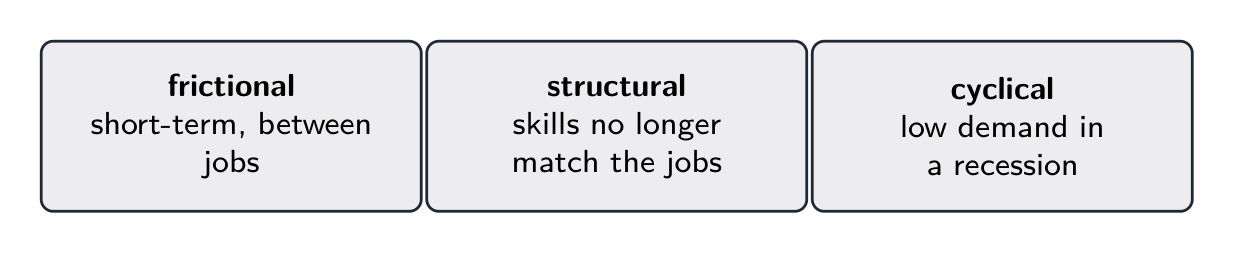
Three types of unemployment:

  • Frictional 摩擦性失业: between jobs or searching for a first job (normal, short).
  • Structural 结构性失业: skills or location don't match available jobs (technology, trade).
  • Cyclical 周期性失业: caused by a recession (a downturn in the business cycle).

Frictional + structural make up the natural rate of unemployment 自然失业率. At the natural rate cyclical unemployment is zero and the economy is at full employment 充分就业. The rate understates joblessness because it omits discouraged workers 灰心工人 and the underemployed.

Português
Uma longa fila de pessoas — desemprego são pessoas dispostas e capazes de trabalhar que não conseguem encontrar emprego

A força de trabalho 劳动力 são os empregados mais os desempregados (aqueles sem trabalho que buscam ativamente). Pessoas que não buscam não estão na força de trabalho.

Três tipos de desemprego: friccional, estrutural e cíclico
$$\text{Unemployment rate}=\frac{\text{unemployed}}{\text{labor force}}\times 100\%,\qquad \text{Labor-force participation}=\frac{\text{labor force}}{\text{working-age population}}\times100\%.$$

Exemplo resolvido. Um país tem $150$ milhões de empregados e $10$ milhão de desempregados (buscando ativamente), com $40$ milhões de adultos em idade working que não buscam. A força de trabalho é $150+10=160$ milhões, então a taxa de desemprego é $\dfrac{10}{160}=6.25\%$ e a taxa de participação é $\dfrac{160}{200}=80\%$.

Três tipos de desemprego:

  • Friccional 摩擦性失业: entre empregos ou buscando primeiro emprego (normal, curto).
  • Estrutural 结构性失业: habilidades ou localização não correspondem aos empregos disponíveis (tecnologia, comércio).
  • Cyclical 周期性失业: causado por uma recessão (uma desaceleração no ciclo econômico).

A friccional + estrutural compõem a taxa natural de desemprego 自然失业率. À taxa natural, o desemprego cíclico é zero e a economia está em pleno emprego 充分就业. A taxa subestima o desemprego porque omite trabalhadores desencorajados 灰心工人 e os subempregados.

Vocabulary · ⁨Vocabulário⁩ Train · ⁨Treinar⁩
English · ⁨Inglês⁩ Chinese · ⁨Chinês⁩ Pinyin
labor force/ˈleɪbə fɔːs/ 劳动力 láo dòng lì
Frictional/ˈfrɪkʃənl/ 摩擦性失业 mó cā xìng shī yè
Structural/ˈstrʌktʃərəl/ 结构性失业 jié gòu xìng shī yè
Cyclical/ˈsaɪklɪkl/ 周期性失业 zhōu qī xìng shī yè
natural rate of unemployment/ˈnætʃərəl reɪt ɒv ʌnemˈplɔɪmənt/ 自然失业率 zì rán shī yè lǜ
full employment/fʊl emˈplɔɪmənt/ 充分就业 chōng fèn jiù yè
discouraged workers/dɪˈskʌrɪdʒd ˈwɜːkəz/ 灰心工人 huī xīn gōng rén
2.4

Índices de Preços e Inflação

Syllabus · ⁨Programa⁩
English

Enduring Understanding (MEA-1): An economy's performance can be measured by different indicators such as gross domestic product (GDP), the inflation rate, and the unemployment rate.

Learning Objective MEA-1.F: a. Define the consumer price index (CPI), inflation, deflation, disinflation, the inflation rate, and real variables. b. Explain how price indices can be used to calculate the inflation rate and to compare nominal variables over time periods. c. Calculate the CPI, the inflation rate, and changes in real variables.

  • MEA-1.F.1 The consumer price index (CPI) measures the change in income a consumer would need in order to maintain the same standard of living over time under a new set of prices as under the original set of prices.
  • MEA-1.F.2 The CPI measures the cost of a fixed basket of goods and services in a given year relative to the base year.
    • Exclusion statement: Calculating the producer price index (PPI) is beyond the scope of the course and AP Exam.
  • MEA-1.F.3 The inflation rate is determined by calculating the percentage change in a price index, such as CPI or the GDP deflator.
  • MEA-1.F.4 Real variables, such as real wages, are the nominal variables deflated by the price level.

Learning Objective MEA-1.G: Define the shortcomings of the CPI as a true measure of inflation.

  • MEA-1.G.1 The CPI as a measure of inflation has some shortcomings, such as substitution bias, causing it to overstate the true inflation rate.
Português

Compreensão Permanente (MEA-1): O desempenho de uma economia pode ser medido por diferentes indicadores, como Produto Interno Bruto (PIB), taxa de inflação e taxa de desemprego.

Objetivo de Aprendizagem MEA-1.F: a. Definir o índice de preços ao consumidor (IPC), inflação, deflação, desinflação, a taxa de inflação e as variáveis reais. b. Explicar como os índices de preços podem ser usados para calcular a taxa de inflação e comparar variáveis nominais entre períodos. c. Calcular o IPC, a taxa de inflação e as mudanças nas variáveis reais.

  • MEA-1.F.1 O índice de preços ao consumidor (IPC) mede a mudança na renda que um consumidor precisaria para manter o mesmo padrão de vida ao longo do tempo sob um novo conjunto de preços em relação ao conjunto original de preços.
  • MEA-1.F.2 O IPC mede o custo de uma cesta fixa de bens e serviços em um ano dado em relação ao ano-base.
    • Declaração de exclusão: O cálculo do índice de preços ao produtor (IPP) está fora do escopo do curso e do Exame AP.
  • MEA-1.F.3 A taxa de inflação é determinada pelo cálculo da variação percentual em um índice de preços, como o IPC ou o deflator do PIB.
  • MEA-1.F.4 Variáveis reais, como salários reais, são as variáveis nominais deflacionadas pelo nível de preços.

Objetivo de Aprendizagem MEA-1.G: Definir as falhas do IPC como verdadeira medida de inflação.

  • MEA-1.G.1 O IPC como medida de inflação tem algumas falhas, como o viés de substituição, o que causa uma superestimação da taxa real de inflação.

Source: College Board AP Course and Exam Description · ⁨Fonte: College Board AP Course and Exam Description⁩

English

Inflation 通货膨胀 is a sustained rise in the average price level. It is measured with a price index 价格指数, most often the consumer price index (CPI) 消费者价格指数, built from a fixed market basket of goods a typical household buys:

$$CPI=\frac{\text{cost of basket this year}}{\text{cost of basket in base year}}\times100.$$

The inflation rate is the percent change in the index between two years. Deflation 通货紧缩 is a falling price level; disinflation is a slowing of inflation.

Worked example. If the CPI is $200$ this year and was $190$ last year, the inflation rate is $\dfrac{200-190}{190}\times100\%=5.3\%$. A basket that cost $\$190$ then costs $\$200$ – the same goods, more dollars.

Português
A aisle de um supermercado: uma cesta fixa de bens mede a inflação através de um índice de preços

Inflação é um aumento sustentado no nível médio de preços. É medida com um índice de preços 价格指数, mais frequentemente o índice de preços ao consumidor (IPC) 消费者价格指数, construído a partir de uma cesta de mercado fixa de bens que uma família típica compra:

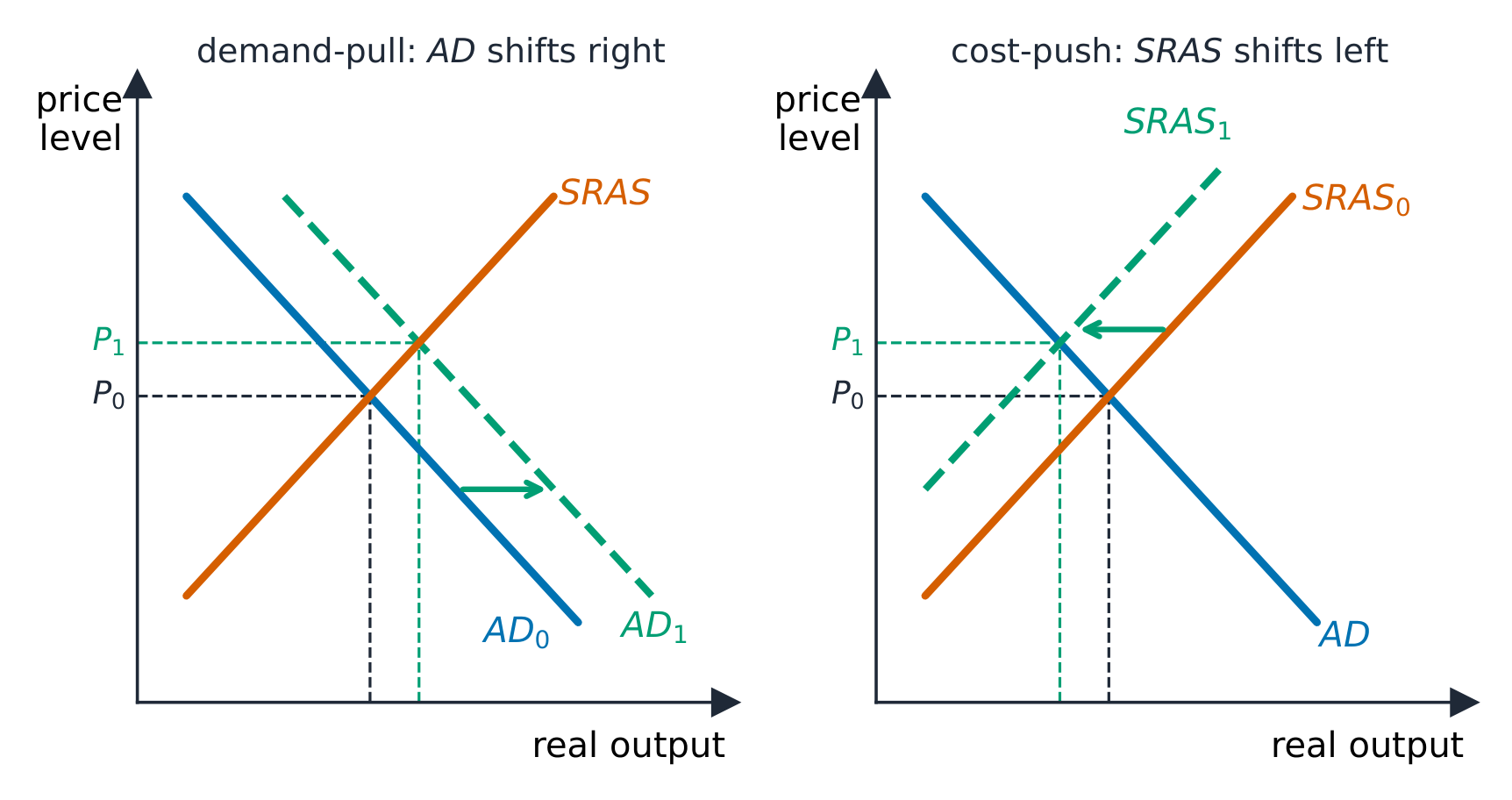
Inflação de demanda puxada e de custos empurrados no diagrama DA-OA
Inflação puxada por demanda e empurrada por custos no diagrama DA-OF
$$CPI=\frac{\text{cost of basket this year}}{\text{cost of basket in base year}}\times100.$$

A taxa de inflação é a variação percentual no índice entre dois anos. Deflação 通货紧缩 é um nível de preços em queda; desinflação é um desacelerar da inflação.

Exemplo resolvido. Se o IPC é $200$ este ano e era $190$ no ano passado, a taxa de inflação é $\dfrac{200-190}{190}\times100\%=5.3\%$. Um cesto que custava $\$190$ then costs $\$200$ – os mesmos bens, mais dólares.

Vocabulary · ⁨Vocabulário⁩ Train · ⁨Treinar⁩
English · ⁨Inglês⁩ Chinese · ⁨Chinês⁩ Pinyin
Inflation/ɪnˈfleɪʃn/ 通货膨胀 tōng huò péng zhàng
2.5

Custos da Inflação

Syllabus · ⁨Programa⁩
English

Enduring Understanding (MEA-1): An economy's performance can be measured by different indicators such as gross domestic product (GDP), the inflation rate, and the unemployment rate.

Learning Objective MEA-1.H: Explain the costs that unexpected inflation (deflation) imposes on individuals and the economy.

  • MEA-1.H.1 Unexpected inflation arbitrarily redistributes wealth from one group of individuals to another group, such as lenders to borrowers.
Português

Compreensão Permanente (MEA-1): O desempenho de uma economia pode ser medido por diferentes indicadores, como Produto Interno Bruto (PIB), taxa de inflação e taxa de desemprego.

Objetivo de Aprendizagem MEA-1.H: Explicar os custos que a inflação inesperada (deflação) impõe aos indivíduos e à economia.

  • MEA-1.H.1 A inflação inesperada redistribui arbitrariamente a riqueza de um grupo de indivíduos para outro, como de credores para devedores.

Source: College Board AP Course and Exam Description · ⁨Fonte: College Board AP Course and Exam Description⁩

English

Inflation redistributes and distorts:

  • It hurts lenders and savers and helps borrowers when it is unexpected, because loans are repaid in cheaper dollars. It erodes the value of money and fixed incomes.
  • Menu costs and uncertainty discourage investment.
  • Anticipated inflation is less harmful because contracts and interest rates adjust for it. This is why we separate nominal and real values.
Português

Inflation redistributes and distorts:

  • Prejudica credores e poupadores e ajuda devedores quando é inesperada, porque os empréstimos são reembolsados em dólares mais baratos. Erode o valor do dinheiro e dos rendimentos fixos.
  • Menu costs and uncertainty discourage investment.
  • A inflação antecipada é menos prejudicial porque contratos e taxas de juros se ajustam a ela. É por isso que separamos valores nominais e reais.
Vocabulary · ⁨Vocabulário⁩ Train · ⁨Treinar⁩
English · ⁨Inglês⁩ Chinese · ⁨Chinês⁩ Pinyin
circular-flow model/ˈsɜːkjʊlə fləʊ ˈmɒdl/ 循环流动模型 xún huán liú dòng mó xíng
Gross domestic product (GDP)/ɡrəʊs dəˈmestɪk ˈprɒdʌkt/ 国内生产总值 guó nèi shēng chǎn zǒng zhí
consumption/kənˈsʌmpʃn/ 消费 xiāo fèi
investment/ɪnˈvestmənt/ 投资 tóu zī
government purchases/ˈɡʌvənmənt ˈpɜːtʃɪsɪz/ 政府购买 zhèng fǔ gòu mǎi
net exports/net ˈekspɔːts/ 净出口 jìng chū kǒu
underground economy/ˌʌndəˈɡraʊnd ɪˈkɒnəmi/ 地下经济 dì xià jīng jì
2.6

PIB Real vs. PIB Nominal

Syllabus · ⁨Programa⁩
English

Enduring Understanding (MEA-1): An economy's performance can be measured by different indicators such as gross domestic product (GDP), the inflation rate, and the unemployment rate.

Learning Objective MEA-1.I: Define nominal GDP and real GDP.

  • MEA-1.I.1 Nominal GDP is a measure of how much is spent on output. Real GDP is a measure of how much is produced.
  • MEA-1.I.2 Nominal GDP measures aggregate output using current prices. Real GDP measures aggregate output using constant prices, thus removing the effect of changes in the overall price level.

Learning Objective MEA-1.J: Calculate real GDP and the GDP deflator.

  • MEA-1.J.1 One way of measuring real GDP is to weigh final goods and services by their prices in a base year. Because this can lead to overstatement of real GDP growth, statistical agencies actually use different methods.
  • MEA-1.J.2 Nominal GDP can be converted to real GDP by using the GDP deflator.
Português

Compreensão Permanente (MEA-1): O desempenho de uma economia pode ser medido por diferentes indicadores, como Produto Interno Bruto (PIB), taxa de inflação e taxa de desemprego.

Objetivo de Aprendizagem MEA-1.I: Definir o PIB nominal e o PIB real.

  • MEA-1.I.1 O PIB nominal é uma medida do quanto é gasto com a produção. O PIB real é uma medida do quanto é produzido.
  • MEA-1.I.2 O PIB nominal mede a produção agregada usando preços correntes. O PIB real mede a produção agregada usando preços constantes, eliminando assim o efeito das mudanças no nível geral de preços.

Objetivo de Aprendizagem MEA-1.J: Calcular o PIB real e o deflator do PIB.

  • MEA-1.J.1 Uma maneira de medir o PIB real é ponderar os bens finais e serviços pelos seus preços em um ano-base. Como isso pode levar a uma superestimação do crescimento do PIB real, as agências estatísticas usam na verdade métodos diferentes.
  • MEA-1.J.2 O PIB nominal pode ser convertido em PIB real usando o deflator do PIB.

Source: College Board AP Course and Exam Description · ⁨Fonte: College Board AP Course and Exam Description⁩

English
  • Nominal GDP 名义GDP is valued at current prices, so it rises with both output and prices.
  • Real GDP 实际GDP is valued at constant (base-year) prices, stripping out inflation, so it reflects true output. Real GDP is the honest measure of growth.
$$\text{Real GDP}=\frac{\text{Nominal GDP}}{\text{price index}}\times100,\qquad \text{GDP deflator}=\frac{\text{Nominal GDP}}{\text{Real GDP}}\times100.$$

Worked example. Nominal GDP is $\$22$ trillion and the GDP deflator is $110$. Real GDP is $\dfrac{22}{110}\times100=\$20$ trillion. The extra $\$2$ trillion of nominal GDP is pure price rise, not real output – which is why growth is always measured with real GDP.

Exam skill: be fluent converting nominal to real using a price index, and computing an inflation rate or a growth rate as a percent change.

Português
  • PIB nominal é avaliado a preços atuais, pelo que sobe tanto com a produção como com os preços.
  • PIB real é avaliado a preços constantes (do ano-base), eliminando a inflação, pelo que reflete a produção verdadeira. O PIB real é a medida honesta do crescimento.
$$\text{Real GDP}=\frac{\text{Nominal GDP}}{\text{price index}}\times100,\qquad \text{GDP deflator}=\frac{\text{Nominal GDP}}{\text{Real GDP}}\times100.$$

Exemplo resolvido. O PIB nominal é $\$22$ trillion and the GDP deflator is $110$. Real GDP is $\dfrac{22}{110}\times100=\$20$ triliões. Os $\$2$ triliões extras de PIB nominal são apenas um aumento de preços, não de produção real – é por isso que o crescimento é sempre medido com o PIB real.

Habilidade de exame: seja fluente na conversão de nominal para real usando um índice de preços, e no cálculo de uma taxa de inflação ou de uma taxa de crescimento como uma variação percentual.

Vocabulary · ⁨Vocabulário⁩ Train · ⁨Treinar⁩
English · ⁨Inglês⁩ Chinese · ⁨Chinês⁩ Pinyin
price index/praɪs ˈɪndeks/ 价格指数 jià gé zhǐ shù
consumer price index (CPI)/kənˈsuːmə praɪs ˈɪndeks/ 消费者价格指数 xiāo fèi zhě jià gé zhǐ shù
Deflation/diːˈfleɪʃn/ 通货紧缩 tōng huò jǐn suō
Nominal GDP/ˈnɒmɪnl ˌdʒiː diː ˈpiː/ 名义 míng yì
Real GDP/rɪəl ˌdʒiː diː ˈpiː/ 实际 shí jì
2.7

Ciclos Econômicos

Syllabus · ⁨Programa⁩
English

Enduring Understanding (MEA-2): The economy fluctuates between periods of expansion and contraction in the short run, but economic growth can occur in the long run.

Learning Objective MEA-2.A: a. Define (using graphs and data as appropriate) turning points and phases of the business cycle. b. Explain (using graphs and data as appropriate) turning points and phases of the business cycle.

  • MEA-2.A.1 Business cycles are fluctuations in aggregate output and employment because of changes in aggregate supply and/or aggregate demand.
  • MEA-2.A.2 The phases of a business cycle are recession and expansion.
  • MEA-2.A.3 The turning points of a business cycle are peak and trough.
  • MEA-2.A.4 The difference between actual output and potential output is the output gap.
  • MEA-2.A.5 Potential output is also called full-employment output. It is the level of GDP where unemployment is equal to the natural rate of unemployment. [See EK MEA-1.E.2]
Português

Entendimento Duradouro (MEA-2): A economia flutua entre períodos de expansão e contração no curto prazo, mas o crescimento econômico pode ocorrer no longo prazo.

Objetivo de Aprendizagem MEA-2.A: a. Definir (usando gráficos e dados, conforme apropriado) pontos de virada e fases do ciclo empresarial. b. Explicar (usando gráficos e dados, conforme apropriado) pontos de virada e fases do ciclo empresarial.

  • MEA-2.A.1 Ciclos empresariais são flutuações na produção agregada e no emprego devido a mudanças na oferta agregada e/ou demanda agregada.
  • MEA-2.A.2 As fases de um ciclo empresarial são recessão e expansão.
  • MEA-2.A.3 Os pontos de virada de um ciclo empresarial são pico e vale.
  • MEA-2.A.4 A diferença entre a produção real e a produção potencial é o hiato de produção.
  • MEA-2.A.5 A produção potencial também é chamada de produção de pleno emprego. É o nível de PIB onde o desemprego é igual à taxa natural de desemprego. [Ver EK MEA-1.E.2]

Source: College Board AP Course and Exam Description · ⁨Fonte: College Board AP Course and Exam Description⁩

English
The business cycle

The business cycle 经济周期 is the economy's short-run ups and downs in real GDP around its long-run growth trend: expansion 扩张 (rising output, falling unemployment) up to a peak 顶峰, then contraction/recession 衰退 (falling output, rising cyclical unemployment) down to a trough 谷底, then recovery. A recession is commonly two consecutive quarters of falling real GDP. Unemployment and inflation move roughly opposite over the cycle – the tension the rest of the course tries to manage.

Português
The business cycle

O ciclo económico 经济周期 são as oscilações de curto prazo da economia no PIB real em torno da sua tendência de crescimento de longo prazo: expansão 扩张 (produção crescente, desemprego decrescente) até um pico 顶峰, depois contração/recessão 衰退 (produção decrescente, aumento do desemprego cíclico) até um vale 谷底, depois recuperação. Uma recessão é comumente dois trimestres consecutivos de queda do PIB real. Desemprego e inflação movem-se aproximadamente em direções opostas ao longo do ciclo – a tensão que o resto do curso tenta gerir.

PIB real oscilando em torno de sua tendência de longo prazo
O PIB real oscilando em torno de sua tendência de longo prazo
Vocabulary · ⁨Vocabulário⁩ Train · ⁨Treinar⁩
English · ⁨Inglês⁩ Chinese · ⁨Chinês⁩ Pinyin
business cycle/ˈbɪznəs ˈsaɪkl/ 经济周期 jīng jì zhōu qī
expansion/ekˈspænʃn/ 扩张 kuò zhāng
peak/piːk/ 顶峰 dǐng fēng
contraction/recession/kənˈtrækʃn rɪˈseʃn/ 衰退 shuāi tuì
trough/trɒf/ 谷底 gǔ dǐ
2.7

Exam tips · ⁨Dicas de prova⁩

English
  • Compute GDP by the expenditure method $C+I+G+X_n$ and count only final goods (avoid double counting).
  • Unemployment rate = unemployed ÷ labor force; discouraged workers leave the labor force (so the rate can understate joblessness).
  • Know the three unemployment types (frictional, structural, cyclical) and that the natural rate excludes cyclical.
  • Inflation is the % change in the CPI; convert nominal to real with a price index and always use real GDP for growth.
  • Place events on the business cycle (expansion → peak → contraction → trough).
Português
  • Calcule o PIB pelo método da despesa $C+I+G+X_n$ e conte apenas os bens finais (evite a dupla contagem).
  • Taxa de desemprego = desempregados ÷ força de trabalho; os trabalhadores desencorajados saem da força de trabalho (por isso a taxa pode subestimar o desemprego).
  • Conheça os três tipos de desemprego (friccional, estrutural, cíclico) e que a taxa natural exclui o cíclico.
  • A inflação é a % de variação no IPC; converta nominal para real com um índice de preços e use sempre o PIB real para o crescimento.
  • Coloque os eventos no ciclo económico (expansão → pico → contração → vale).

Interactive lessons on this topic · ⁨Aulas interativas sobre este tópico⁩

Work through it step by step, with instant-check exercises. · ⁨Passe por ele passo a passo, com exercícios de verificação instantânea.⁩

Past Papers · ⁨Provas Anteriores⁩

More topics in Macroeconomia do AP · ⁨Mais tópicos em Macroeconomia do AP⁩

Log in or create account · ⁨Entrar ou criar conta⁩

IGCSE, A-Level & AP