Costs of Inflation
Introduced| English | Meaning |
|---|---|
| anticipated/ænˈtɪsɪpeɪtɪd/ | Expected in advance by households, firms or other decision-makers, as with an inflation rate built into contracts. |
| unanticipated/ʌnænˈtɪsɪpeɪtɪd/ | Not expected in advance by the decision-makers affected, as with inflation that differs from the rate assumed in contracts. |
| lenders/ˈlendəz/ | People or institutions that provide funds to borrowers with an agreement for repayment. |
| interest/ˈɪntrest/ | A payment for borrowing money or a return earned by lending or depositing it. |
| redistributes purchasing power/ˌriːˈdɪstrɪbjuːts ˈpɜːtʃɪsɪŋ ˈpaʊə/ | Changes which groups can buy goods and services, for example when unexpected inflation reduces the real value of fixed nominal debts. |
| borrowers/ˈbɒrəʊəz/ | People or institutions that receive funds with an obligation to repay them. |
| shoe-leather costs/ʃuː ˈleðə kɒsts/ | The time and resources spent reducing holdings of money when inflation makes holding it more costly. |
| menu costs/ˈmenjuː kɒsts/ | The costs businesses incur when changing their stated prices, including updating labels, catalogues or computer systems. |
| savings/ˈseɪvɪŋz/ | Income not spent on consumption and retained for future use. |
| pension/ˈpenʃn/ | Income paid to a person after retirement, usually through a public or private scheme. |
| hyperinflation/ˌhaɪpərɪnˈfleɪʃn/ | An extremely rapid and sustained rise in the general price level. |
Inflation picks winners and losers
- Inflation doesn't hurt everyone equally — and some people even gain.
- The key is whether people saw it coming.
- A surprise inflation quietly moves wealth from one group to another.
- Understanding who wins and who loses is the heart of this topic.
Anticipated vs unanticipated
- Anticipated 预期到的 inflation is expected, so people plan — workers ask for raises, lenders charge higher interest 利息. The harm is small.
- Unanticipated 未预期到的 inflation is a surprise that cannot be planned for.
- A surprise redistributes purchasing power 重新分配购买力 between borrowers 借款人 and lenders 放款人.
- Borrowers gain (they repay with cheaper money); lenders lose (the dollars back buy less).
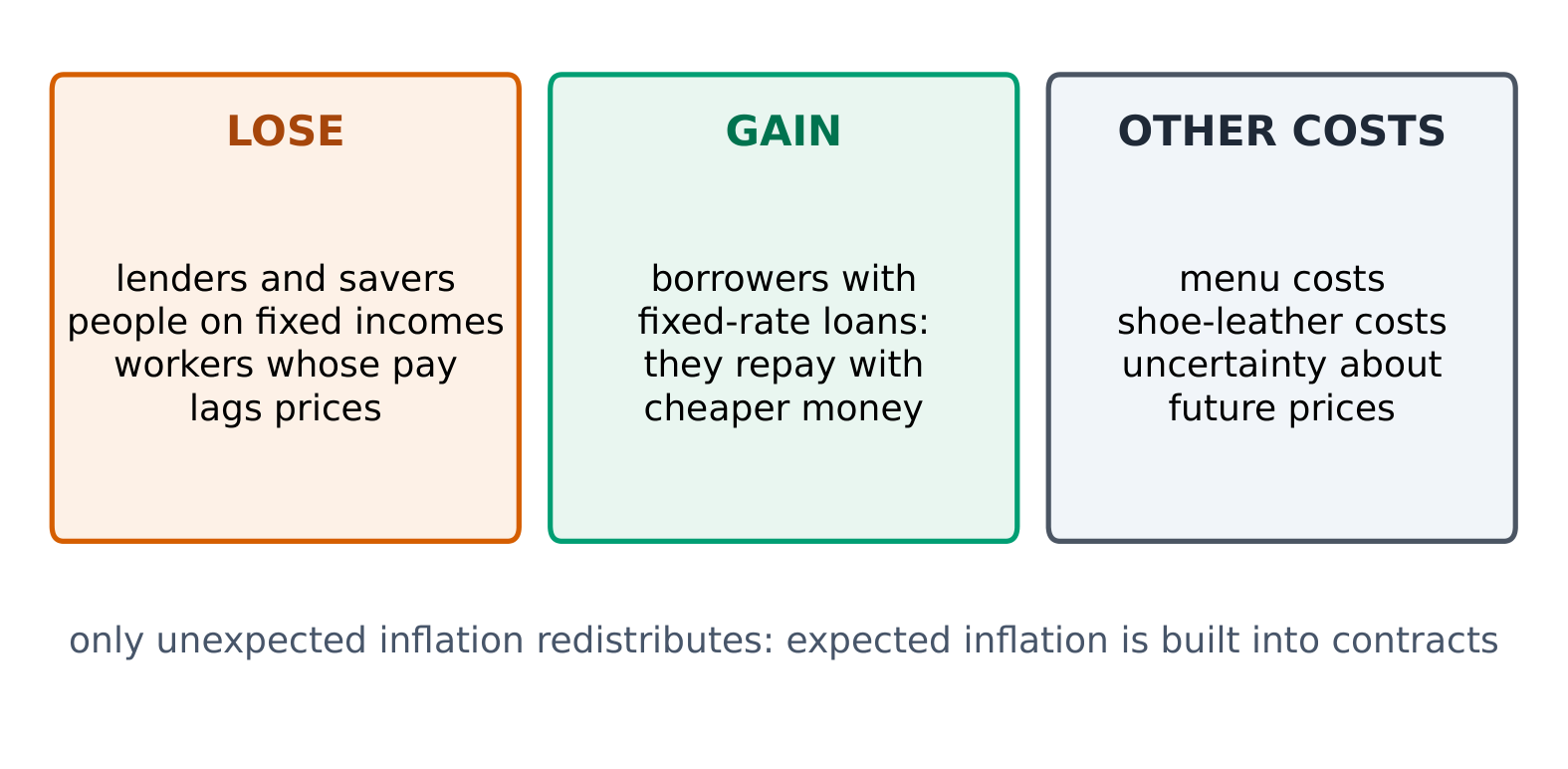
Unexpected inflation hurts lenders and fixed incomes and helps borrowers; it also brings menu and shoe-leather costs 皮鞋成本
Who gains, who loses?
Unanticipated inflation helps borrowers and hurts lenders and cash savers, and adds real costs like menu and shoe-leather costs.
Which kind of inflation does the least harm, because people can plan for it?
Difficulty 1/5 · 100 coins + a small bonus on first completion today
When inflation is expected, workers and lenders build it into wages and interest rates.
Unexpected inflation tends to:
Difficulty 1/5 · 100 coins + a small bonus on first completion today
Borrowers repay with money worth less; lenders get back dollars that buy less.
The running costs
- Menu costs 菜单成本 — the effort of changing prices: reprinting menus, tags, and catalogues.
- Shoe-leather costs — holding less cash and making more trips to the bank, because cash loses value.
- Inflation also erodes savings 储蓄 held as cash and fixed incomes like a pension 养老金.
The cost of reprinting menus, tags, and catalogues when prices change is called ______ costs.
Difficulty 1/5 · 100 coins + a small bonus on first completion today
Menu costs are the real effort of updating posted prices during inflation.
Select all real costs that inflation imposes.
Difficulty 2/5 · 140 coins + a small bonus on first completion today
Menu costs, shoe-leather costs and eroded savings are real harms; inflation does not raise real output.
When inflation runs wild
- Worked idea. You lend 1,000 at 5%, expecting 1,050 back. But surprise inflation is 8%, so the 1,050 buys about $1{,}050 / 1.08 \approx 972$ — less than you lent.
- You (the lender) lost; your friend (the borrower) gained.
- At the extreme, hyperinflation 恶性通货膨胀 (often over 50% per month) makes money almost worthless.
- People rush to spend, savings vanish, and confidence in money collapses.
You expect 1,050 back on a loan, but inflation is 8%. In real terms the 1,050 buys about 1,050 ÷ 1.08 = how much? (round to the nearest dollar)
Difficulty 2/5 · 140 coins + a small bonus on first completion today
1,050 ÷ 1.08 ≈ 972 — less than the 1,000 you lent, so the lender loses.
Under hyperinflation, people tend to spend money quickly because it loses value fast.
Difficulty 1/5 · 100 coins + a small bonus on first completion today
Money loses value so fast that holding it is a loss — so people rush to spend it.
Anticipated inflation does little harm; unanticipated inflation redistributes wealth — borrowers gain, lenders lose. It adds menu and shoe-leather costs and erodes cash savings. At the extreme, hyperinflation destroys the value of money.
Write from a real repayment of 750
- A lender is repaid 900.
- Inflation over the loan was 20 percent.
A lender is repaid 900 after inflation of 20 percent. About how much buying power does that 900 have, in starting dollars, and who is hurt?
1.20 times 750 is 900.
What is the real value of the 900 repayment?
Difficulty 1/5 · 100 coins + a small bonus on first completion today
900 divided by 1.20 is 750 of starting buying power. Other options — 972 (the lesson real value); 900 (because the number of dollars did not change).