Unemployment
Introduced| English | Meaning |
|---|---|
| unemployed/ʌnemˈplɔɪd/ | Without employment, available for work and actively seeking work under the applicable statistical definition; some definitions also include workers awaiting recall from temporary layoff. |
| labor force/ˈleɪbə fɔːs/ | The people classified as employed plus those classified as unemployed under the applicable statistical definition. |
| employed/emˈplɔɪd/ | Classified as working in the reference period, or temporarily absent from a job, under the applicable labour-statistics definition. |
| unemployment rate/ʌnemˈplɔɪmənt reɪt/ | The percentage of the labour force that is unemployed under the measure being used. |
| labor force participation rate/ˈleɪbə fɔːs pɑːˈtɪsɪpeɪʃn reɪt/ | The labour force as a percentage of the relevant working-age population used in the statistical measure. |
| working-age population/ˈwɜːkɪŋ eɪdʒ ˌpɒpjʊˈleɪʃn/ | The population within the age and eligibility boundaries used for a particular labour-market statistic; the exact boundaries depend on the measure. |
| frictional/ˈfrɪkʃənl/ | Describing unemployment that occurs while people search for jobs or move between jobs. |
| structural/ˈstrʌktʃərəl/ | Describing unemployment caused by a mismatch between workers' skills or locations and the jobs available. |
| technology/tekˈnɒlədʒi/ | The application of knowledge, methods and tools to practical tasks. |
| cyclical/ˈsaɪklɪkl/ | Describing unemployment caused by reduced demand for labour during a downturn in economic activity. |
| downturn/ˈdaʊntɜːn/ | A period of declining economic activity, often involving weaker output, spending and employment. |
| full employment/fʊl emˈplɔɪmənt/ | A situation in which available labour resources are employed at their sustainable potential, allowing normal frictional and structural unemployment. |
| natural rate of unemployment/ˈnætʃərəl reɪt ɒv ʌnemˈplɔɪmənt/ | The unemployment rate associated with normal frictional and structural unemployment when the economy has no cyclical unemployment. |
| discouraged workers/dɪˈskʌrɪdʒd ˈwɜːkəz/ | People who want work but have stopped looking because they believe suitable jobs are unavailable. |
Who counts as unemployed?
- Not everyone without a job is "unemployed" in the official sense.
- A retiree or a full-time student isn't looking for work.
- To measure the job market, we first decide who is even in it.
- That group is the labor force 劳动力.
The labour force and two rates
- The labor force is everyone employed 就业 plus everyone unemployed 失业 (jobless but actively looking).
- The unemployment rate 失业率 = unemployed ÷ labor force × 100.
- The labor force participation rate 劳动力参与率 = labor force ÷ working-age population 劳动年龄人口 × 100.
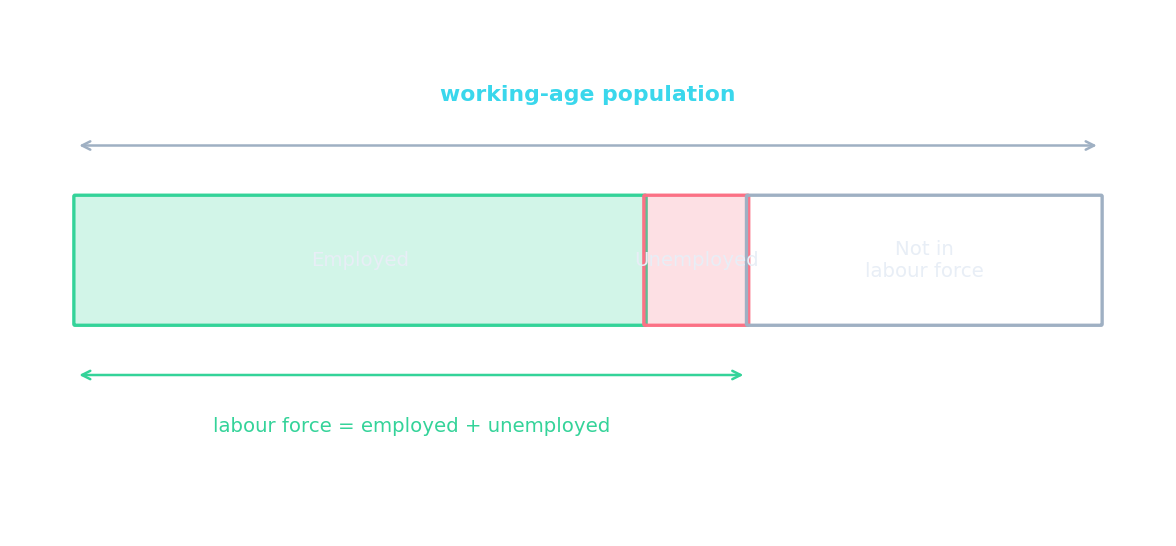
The labour force includes:
Difficulty 1/5 · 100 coins + a small bonus on first completion today
It leaves out people not seeking work — retirees, full-time students, stay-at-home parents.
A town has 95,000 employed and 5,000 unemployed. What is the unemployment rate, in percent?
Difficulty 2/5 · 140 coins + a small bonus on first completion today
Labour force = 100,000; rate = 5,000 ÷ 100,000 × 100 = 5%.
Three types of unemployment
- Frictional 摩擦性失业 — short-term, while people move between jobs. Normal and even healthy.
- Structural 结构性失业 — workers' skills or locations no longer match the jobs, often from new technology 技术.
- Cyclical 周期性失业 — caused by a downturn 经济下行, when weak demand means fewer workers are needed.
Which type of unemployment?
Frictional unemployment is short-term job switching; structural is a skills or location mismatch; cyclical comes from a downturn in the business cycle.
Unemployment caused by a recession (weak demand) is called:
Difficulty 1/5 · 100 coins + a small bonus on first completion today
Cyclical unemployment rises in a downturn and falls in an expansion.
The natural rate and full employment
- The natural rate of unemployment 自然失业率 = frictional + structural (when cyclical is zero).
- The economy is at full employment 充分就业 when the actual rate equals the natural rate.
- Full employment does not mean zero unemployment — some frictional and structural always exists.
- Discouraged workers 灰心工人 who stop looking leave the labor force, making the rate look lower than reality.
Full employment means the unemployment rate is zero.
Difficulty 1/5 · 100 coins + a small bonus on first completion today
Full employment means the actual rate equals the natural rate — some frictional and structural remain.
The natural rate of unemployment equals frictional plus ______ unemployment.
Difficulty 1/5 · 100 coins + a small bonus on first completion today
At the natural rate, cyclical unemployment is zero.
When discouraged workers stop looking for a job, the measured unemployment rate:
Difficulty 1/5 · 100 coins + a small bonus on first completion today
They leave the labour force, so both it and the unemployed count fall — the rate understates reality.
The labor force = employed + unemployed. The unemployment rate is unemployed ÷ labor force. Unemployment is frictional, structural, or cyclical; the natural rate (frictional + structural) defines full employment — which is not zero unemployment.
Write from an unemployment rate of 10 percent
- 180000 people are employed and 20000 are unemployed and looking.
- Find the unemployment rate.
A town has 180000 employed people and 20000 unemployed people who are looking for work. What is the unemployment rate, in percent?
20000 is 10 percent of 200000.
What is the unemployment rate?
Difficulty 1/5 · 100 coins + a small bonus on first completion today
20000 unemployed out of a labour force of 200000 is 10 percent. Other options — 5 percent (the lesson rate); 20000 percent (the unemployed count used as the rate).