Real v. Nominal GDP
Introduced| English | Meaning |
|---|---|
| nominal GDP/ˈnɒmɪnl ˌdʒiː diː ˈpiː/ | The value of an economy's output measured at current prices. |
| current prices/ˈkʌrənt ˈpraɪsɪz/ | The prices prevailing in the period being measured, used to value nominal output without removing price changes. |
| real GDP/rɪəl ˌdʒiː diː ˈpiː/ | The value of an economy's output adjusted for changes in prices. |
| GDP deflator/ˌdʒiː diː ˈpiː diːˈfleɪtə/ | A price measure calculated as nominal GDP divided by real GDP and multiplied by 100, covering domestically produced final output rather than imported output. |
Did we make more, or just charge more?
- GDP can jump for two very different reasons.
- Maybe the country truly made more stuff.
- Or maybe prices simply went up while output stood still.
- To tell them apart, we split GDP into two versions.
Nominal vs real
- Nominal GDP 名义国内生产总值 is measured at current prices 当年价格 — it mixes changes in output and prices.
- Real GDP 实际国内生产总值 is measured at constant base-year prices — it strips out inflation and shows only actual output.
- If nominal GDP doubles only because prices doubled, real GDP is unchanged — nobody is better off.
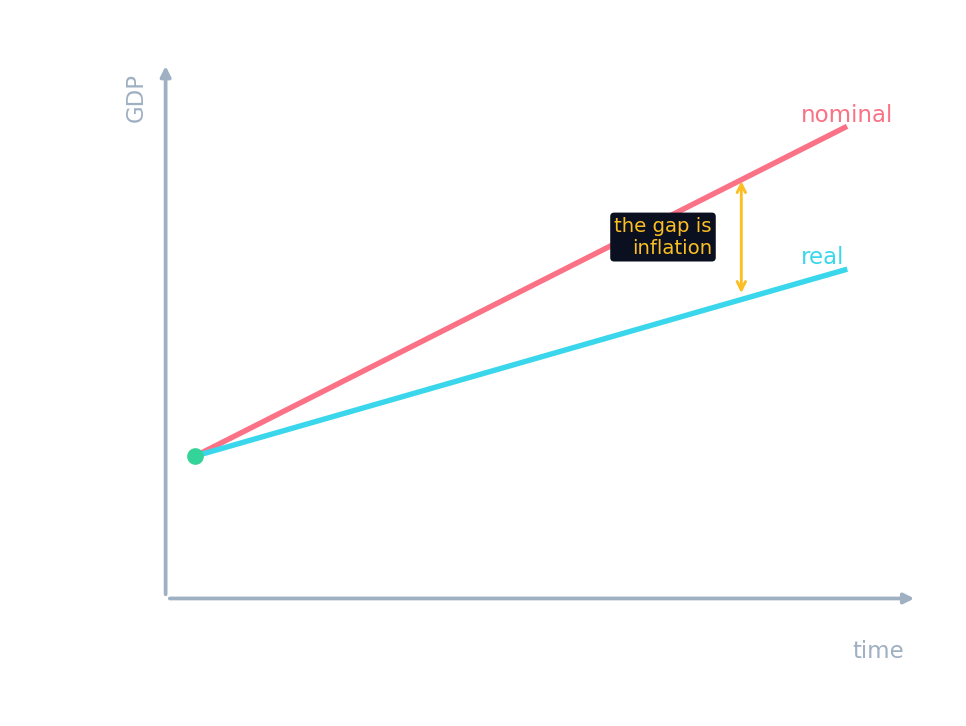
Real or nominal?
Nominal GDP uses current prices and mixes output with inflation; real GDP holds prices at a base year, so it shows only the change in output.
Real GDP is measured at:
Difficulty 1/5 · 100 coins + a small bonus on first completion today
Holding prices fixed removes inflation, so real GDP shows only the change in output.
If nominal GDP doubles only because prices doubled, real GDP also doubles.
Difficulty 1/5 · 100 coins + a small bonus on first completion today
False. No extra output was produced, so real GDP, which strips out price changes, stays the same.
To measure how much an economy's output really grew, economists prefer:
Difficulty 1/5 · 100 coins + a small bonus on first completion today
Real GDP removes price changes, so it reflects genuine growth in output.
The GDP deflator
- To move between them we use the GDP deflator 国内生产总值平减指数.
- $\text{GDP deflator} = \dfrac{\text{nominal GDP}}{\text{real GDP}} \times 100$, so $\text{real} = \dfrac{\text{nominal}}{\text{price index}} \times 100$.
- The CPI tracks a fixed consumer basket; the deflator tracks all goods produced at home, and its basket changes each year.
The price index used to convert nominal to real GDP is the GDP ______.
Difficulty 1/5 · 100 coins + a small bonus on first completion today
GDP deflator = (nominal GDP ÷ real GDP) × 100.
Unlike the CPI (a fixed consumer basket), the GDP deflator tracks:
Difficulty 1/5 · 100 coins + a small bonus on first completion today
The deflator covers everything in GDP, and its basket changes each year with what is made.
A worked case
- Worked idea. Nominal GDP is 1,320b and the deflator is 110.
- Real GDP $= \dfrac{1{,}320}{110} \times 100 = 1{,}200$b.
- So real output grew from 1,000b to 1,200b — a 20% real rise — even though nominal GDP jumped 32%.
- The extra 12 points were just higher prices, not more output.
Nominal GDP is 1,320 and the GDP deflator is 110. What is real GDP?
Difficulty 2/5 · 140 coins + a small bonus on first completion today
Real GDP = (nominal ÷ price index) × 100 = (1,320 ÷ 110) × 100 = 1,200.
Nominal GDP uses current prices (output + inflation); real GDP uses base-year prices (output only), so it is the true measure of growth. Convert with the GDP deflator: $\text{real} = \dfrac{\text{nominal}}{\text{price index}} \times 100$.
Write from a real GDP of 1500
- Nominal GDP is 1800. The GDP deflator is 120.
- Find real GDP.
Nominal GDP is 1800 and the GDP deflator is 120. What is real GDP?
1800 divided by 120 is 15, and 15 times 100 is 1500.
What is real GDP?
Difficulty 1/5 · 100 coins + a small bonus on first completion today
1800 divided by the deflator 120, times 100, is 1500.