본문 바로가기

Energy and Momentum of Rotating Systems

AP 물리학 1 · 주제 6

이 주제용 영상 수업 영상 페이지 열기
7:54

회전 시스템의 에너지 및 운동량

팔을 펴고 회전하는 스케이터의 모습을 보십시오. 팔을 안으로 당기면 — 갑자기 훨씬 빠르게 회전합니다. 아무도 밀어주지 않았습니다. 모터도 시작되지 않았습니다. 그렇다면 …在哪里 came from?

영어 내레이션 · 영어 + 중국어 자막 burned-in

6.1

회전 운동 에너지

Syllabus

학습 목표 6.1.A: 강체 시스템의 회전 운동 에너지를该系统의회전 관성과 각속도를 통해 설명하시오.

  • 6.1.A.1 물체나 강체 시스템의 회전 운동 에너지는该系统的回전 관성과 각속도에 관련되며, 다음 식으로 주어집니다: $K = \frac{1}{2} I \omega^2$.
    • 6.1.A.1.i 고정 축에 대한 물체의 회전 관성을 사용하면,该系统의回전 운동 에너지가该系统的平动 운동 에너지(총 운동 에너지)와 동등함을 보여줄 수 있습니다.
    • 6.1.A.1.ii 강체 시스템의 총 운동 에너지는该系统的center of mass에 대한 회전 운동 에너지와该系统的center of mass의 선형 운동에 의한 평동 운동 에너지의 합입니다.
  • 6.1.A.2 강체 시스템은该系统的center of mass가 정지해 있더라도该系统의internal points가 선형 속도를 가지므로 운동 에너지를 가지고 있어回전 운동 에너지를 가질 수 있습니다.
  • 6.1.A.3回전 운동 에너지는 스칼라 양입니다.

출처: College Board AP Course and Exam Description

회전하는 물체는 회전 운동 에너지를 가지며, 이는 $\tfrac12 mv^2$의 회전적 쌍인 양입니다:

$$K_{\text{rot}}=\tfrac{1}{2}I\omega^2.$$
이동하며 동시에 회전하는 물체(예: 굴러가는 공)는 선형 운동 에너지와 회전 운동 에너지를 모두 가지며, 총합은 $K=\tfrac12 mv^2+\tfrac12 I\omega^2$입니다.

6.2

토크와 일

Syllabus

학습 목표 6.2.A: 주어진 토크 또는 일련의 토크가 강체 시스템에 가하는 일을 설명하시오.

  • 6.2.A.1 토크가 각 변위 동안 작용할 경우, 그 토크는 물체나 강체 시스템에 에너지를 전달하거나 빼낼 수 있다.
  • 6.2.A.2 토크에 의해 강체 시스템에 가해지는일의 양은 해당 토크의 크기와 토크가 작용하는 구간 동안 강체 시스템이 회전하는 각 변위에 관련되어 있다.
    • 식: $W = \tau \Delta\theta$
  • 6.2.A.3 주어진 토크에 의해 강체 시스템에 가해지는 일은 토크를 각 위치의 함수로 나타낸 그래프 아랫면적을 통해 구할 수 있다.

출처: College Board AP Course and Exam Description

각변위를 통해 작용하는 토크는 일을 하며, 회전 운동 에너지를 변화시킵니다:

$$W=\tau\,\Delta\theta,\qquad P=\tau\omega.$$
이는 $W=Fd$과 $P=Fv$의 회전적 형태이며, 일-에너지 정리를 회전 운동으로 확장한 것입니다.

풀이 예제. 모터가 날개바퀴에 $8.0\ \text{N m}$의 일정 토크를 가하여 $10\ \text{rad}$만큼 회전할 때, 이루어진 일은 $W=\tau\,\Delta\theta=8.0\times10=80\ \text{J}$입니다. 날개바퀴가 정지 상태에서 시작했다면 이 일 전체가 회전 운동 에너지가 됩니다.

탐색하기

Balance torques on a seesaw

Torque is force times perpendicular distance, $\tau = Fd$. The beam balances when the torques on each side are equal — move the forces and distances to find the balance point.

6.3

각운동량과 각충량

Syllabus
Learning ObjectiveEssential Knowledge

6.3.A
Describe the angular momentum of an object or rigid system.

  • 6.3.A.1 The magnitude of the angular momentum of a rigid system about a specific axis can be described with the equation $L = I\omega$.
  • 6.3.A.2 The magnitude of the angular momentum of an object about a given point is $L = rmv \sin\theta$.
    • 6.3.A.2.i The selection of the axis about which an object is considered to rotate influences the determination of the angular momentum of that object.
    • 6.3.A.2.ii The measured angular momentum of an object traveling in a straight line depends on the distance between the reference point and the object, the mass of the object, the speed of the object, and the angle between the radial distance and the velocity of the object.

6.3.B
Describe the angular impulse delivered to an object or rigid system by a torque.

  • 6.3.B.1 Angular impulse is defined as the product of the torque exerted on an object or rigid system and the time interval during which the torque is exerted.
    • Equation: $\text{angular impulse} = \tau \Delta t$
  • 6.3.B.2 Angular impulse has the same direction as the torque exerted on the object or system.
  • 6.3.B.3 The angular impulse delivered to an object or rigid system by a torque can be found from the area under the curve of a graph of the torque as a function of time.

6.3.C
Relate the change in angular momentum of an object or rigid system to the angular impulse given to that object or rigid system.

  • 6.3.C.1 The magnitude of the change in angular momentum can be described by comparing the magnitudes of the final and initial angular momenta of the object or rigid system: $\Delta L = L - L_0$
  • 6.3.C.2 A rotational form of the impulse–momentum theorem relates the angular impulse delivered to an object or rigid system and the change in angular momentum of that object or rigid system.
    • 6.3.C.2.i The angular impulse exerted on an object or rigid system is equal to the change in angular momentum of that object or rigid system.
      • Equation: $\Delta L = \tau \Delta t$
    • 6.3.C.2.ii The rotational form of the impulse–momentum theorem is a direct result of the rotational form of Newton's second law of motion for cases in which rotational inertia is constant: $\tau_{\text{net}} = \dfrac{\Delta L}{\Delta t} = I \dfrac{\Delta\omega}{\Delta t} = I\alpha$
  • 6.3.C.3 The net torque exerted on an object is equal to the slope of the graph of the angular momentum of an object as a function of time.
  • 6.3.C.4 The angular impulse delivered to an object is equal to the area under the curve of a graph of the net external torque exerted on an object as a function of time.

Boundary statement: While AP Physics 1 expects that students can mathematically manipulate the magnitude of angular momentum using one-dimensional vector conventions, the direction of angular momentum and angular impulse is beyond the scope of the course.

출처: College Board AP Course and Exam Description

각운동량은 선형 운동량의 회전적 형태입니다:

$$L=I\omega.$$
시간 동안 작용하는 합성 토크는 이를 변화시키는 각충량을 전달합니다: $\tau\,\Delta t=\Delta L$ — 회전적 충량-운동량 정리입니다.

6.4

각운동량 보존 법칙

Syllabus
Learning ObjectiveEssential Knowledge

6.4.A
Describe the behavior of a system using conservation of angular momentum.

  • 6.4.A.1 The total angular momentum of a system about a rotational axis is the sum of the angular momenta of the system's constituent parts about that axis.
  • 6.4.A.2 Any change to a system's angular momentum must be due to an interaction between the system and its surroundings.
    • 6.4.A.2.i The angular impulse exerted by one object or system on a second object or system is equal and opposite to the angular impulse exerted by the second object or system on the first. This is a direct result of Newton's third law.
    • 6.4.A.2.ii A system may be selected so that the total angular momentum of that system is constant.
    • 6.4.A.2.iii The angular speed of a nonrigid system may change without the angular momentum of the system changing if the system changes shape by moving mass closer to or further from the rotational axis.
    • 6.4.A.2.iv If the total angular momentum of a system changes, that change will be equivalent to the angular impulse exerted on the system.

6.4.B
Describe how the selection of a system determines whether the angular momentum of that system changes.

  • 6.4.B.1 Angular momentum is conserved in all interactions.
  • 6.4.B.2 If the net external torque exerted on a selected object or rigid system is zero, the total angular momentum of that system is constant.
  • 6.4.B.3 If the net external torque exerted on a selected object or rigid system is nonzero, angular momentum is transferred between the system and the environment.

출처: College Board AP Course and Exam Description

시스템에 작용하는 합성 외부 토크가 0이면, 총각운동량은 보존됩니다:

$$I_1\omega_1=I_2\omega_2.$$
따라서 ⟨$I$⟩이 감소하면 ⟨$\omega$⟩는 증가하여 ⟨$L$⟩를 일정하게 유지합니다 – 이것이 스피너 스케이터가 팔을 당겨들일 때 회전 속도가 빨라지는 이유입니다. 회전 시스템의 충돌 및 폭발에도 적용됩니다.

풀이 예제. 스키터가 $2.0\ \text{rev/s}$의 각속도로 $I_1=4.0\ \text{kg m}^2$의 관성 모멘트로 회전합니다. 팔을 안으로 당겨 관성 모멘트를 $I_2=1.6\ \text{kg m}^2$으로 낮춥니다. 외부 토크가 없으므로 각운동량이 보존됩니다:

$$\omega_2=\frac{I_1}{I_2}\,\omega_1=\frac{4.0}{1.6}\times2.0=5.0\ \text{rev/s}.$$
그녀의 운동 에너지는 실제로 증가합니다 — 추가된 에너지는 팔을 안으로 당기는 데 필요한 근력 muscles이 바깥쪽 장력을 이기며 한 일에서 나옵니다.

질량을 안쪽으로 당이면 I가 감소하므로 L = Iω를 보존하기 위해 ω가 증가함
massa 안쪽으로 당기면 I가 감소하므로 L = Iω를 보존하기 위해 ω가 증가함
English 한국어
rotational kinetic energy/rəʊˈteɪʃənl kɪˈnetɪk ˈenədʒi/ 회전 운동 에너지
Angular momentum/ˈæŋɡjʊlə məʊˈmentəm/ 각운동량
angular impulse/ˈæŋɡjʊlə ˈɪmpʌls/ 각 충량
conserved/kənˈsɜːvd/ 보존된다
6.5

굴림 운동

Syllabus

학습 목표 6.5.A: 병진 운동과 회전 운동을 모두 가지는 시스템의 운동 에너지를 설명하시오。

  • 6.5.A.1 시스템의 총 운동 에너지는该系统的平动动能和转动动能之和。
    • 식: $K_{\text{tot}} = K_{\text{trans}} + K_{\text{rot}}$

학습 목표 6.5.B: 미끄러짐 없이 굴리는 시스템의 운동을 설명하시오。

  • 6.5.B.1 미끄러짐 없이 굴러갈 때, 시스템의 질량 중심의 병진 운동은 다음 식을 통해 시스템 자체의 회전 운동과 관련된다:
    • 식: $\Delta x_{\text{cm}} = r\Delta\theta$
    • 식: $v_{\text{cm}} = r\omega$
    • 식: $a_{\text{cm}} = r\alpha$
  • 6.5.B.2 이상적인 경우, 미끄러짐 없이 굴러가는 것은 마찰력이 굴리는 시스템으로부터 에너지를 소산시키지 않음을 의미한다.

학습 목표 6.5.C: 미끄러지며 굴러가는 시스템의 운동을 설명하시오.

  • 6.5.C.1 미끄러질 때, 시스템의 질량 중심의 운동과 시스템의 회전 운동은 직접적으로 관련될 수 없다.
  • 6.5.C.2 회전하는 시스템이 다른 표면相对于로 미끄러질 때, 운동 마찰력의 작용점에Applied된 힘은 표면에 대해 이동하므로 운동 마찰력은 시스템으로부터 에너지를 소산시킨다.

경계 문구: 구동 마찰력은 AP 물리학 1의 범위를 벗어난다.

경계 문구: 강체가 미끄러지며 굴러갈 때 선량과 각량의 정확한 수학적 관계는 AP 물리학 1 및 2의 범위를 벗어난다. 학생들은 이러한 관계를 정량적으로 모델링할 것으로 기대되지 않는다. 그러나 강체가 미끄러지며 굴러갈 때 선량과 각량에发生改变되는 것을 정성적으로 설명할 것으로 기대된다.

출처: College Board AP Course and Exam Description

미끄러짐 없는 굴림은 선형 운동과 회전 운동을 연결합니다: 접촉점은 순간적으로 정지해 있으므로,

$$v=r\omega \qquad\text{and}\qquad a=r\alpha.$$
굴리는 물체의 에너지는 선형 운동과 회전에 나뉘므로, 경사면에서는 마찰이 없는 미끄럼 물체보다 더 느리게 가속합니다 — 일부 에너지가 회전 운동에 쓰이기 때문입니다.

풀이 예제. 미끄러짐 없이 굴리는 실린더 원판($I=\tfrac12 mR^2$)의 운동 에너지 중 회전 부분이 차지하는 비율은 무엇인가? $v=R\omega$을 사용하면, 회전 부분은 $\tfrac12 I\omega^2=\tfrac12(\tfrac12 mR^2)\omega^2=\tfrac14 mv^2$, 선형 부분은 $\tfrac12 mv^2$입니다. 따라서 총합은 $\tfrac34 mv^2$이고 회전 분율은 $\tfrac{1/4}{3/4}=\tfrac13$입니다. 질량이 바깥쪽에 분포된 고리는 에너지의 절반을 회전 운동에 저장하여 경사면을 더 느리게 내려갑니다.

미끄러짐 없는 굴림에서 접촉점은 정지하므로 v = rω
English 한국어
Rolling without slipping/ˈrəʊlɪŋ wɪˈðaʊt ˈslɪpɪŋ/ 미끄러짐 없는 굴림
satellite/ˈsætəlaɪt/ 위성
Escape velocity/eˈskeɪp vəˈlɒsɪti/ 탈출 속도
6.6

궤도 위 인공위성의 운동

Syllabus

학습 목표 6.6.A: 중력 상호작용만 있는 두 개 objekts가 이루어진 시스템의 운동을 설명하시오.

  • 6.6.A.1 질량이 매우 큰 중심 천체와 그 질량에 비해 질량이 무시할 수 있는 궤도 위 인공위성으로만 구성된 시스템에서, 중심 천체 자체의 운동은 무시할 수 있다.
  • 6.6.A.2 궤도 위 인공위성의 운동은 보존 법칙에 의해 제한받는다.
    • 6.6.A.2.i 원형 궤도에서 시스템의 총 역학적 에너지, 시스템의 중력ポテン셜에너지, 인공위성의 각운동량 및 운동에너지는 일정하다.
    • 6.6.A.2.ii 타원 궤도에서 시스템의 총 역학적 에너지와 인공위성의 각운동량은 일정하지만, 시스템의 중력ポテン셜에너지와 인공위성의 운동에너지는 각각 변할 수 있다.
    • 6.6.A.2.iii 인공위성과 질량이 매우 큰 중심 천체로 구성된 시스템의 중력ポテン셜에너지는 인공위성이 중심 천체로부터 무한한 거리에 있을 때 0으로 정의한다.
      • 식: $U_g = -G\dfrac{m_1 m_2}{r}$
  • 6.6.A.3 인공위성의 탈출속도는 인공위성-중심 천체 시스템의 역학적 에너지가 0이 되는 인공위성의 속도이다.
    • 6.6.A.3.i 중심 천체로부터의 중력만이 인공위성에 작용할 때, 탈출속도에 도달한 인공위성은 중심 천체로부터 무한한 거리에서 속도가 0이 될 때까지 중심 천체로부터 멀어진다.
    • 6.6.A.3.ii 질량 $M$인 중심 천체로부터 인공위성의 탈출속도는 에너지 보존 법칙을 사용하여 유도할 수 있다.
      • 식(유도): $v_{\text{esc}} = \sqrt{\dfrac{2GM}{r}}$

출처: College Board AP Course and Exam Description

궤도 운동 (케플러의 2법)

궤도에 있는 인공위성은 자유 낙하 상태입니다: 중력은 궤도로 궤적을 휘게 만드는 데 필요한 정확한 원심력을 제공합니다. 중력을 원心力 요구량과 같게 놓으면,

$$\frac{GMm}{r^2}=\frac{mv^2}{r}\ \Rightarrow\ v=\sqrt{\frac{GM}{r}}.$$
따라서 큰 궤도는 더 느린 속도를 의미합니다. 원형 궤도에서는 각운동량과 기계적 에너지가 모두 일정하지만, 타원 궤도에서는 행성에 대한 토크가 없으므로 각운동량은 보존되고 속도는 변합니다 — 행성에 가장 가까울 때 가장 빠릅니다.

중력이 인공위성을 궤道上에 유지시키는 원心力을 제공함

풀이 예제. 지구 바로 위의 저궤도 인공위성의 속도를 구하십시오. 반지름 $r=6.4\times10^{6}\ \text{m}$, 중력加速度 $GM=4.0\times10^{14}\ \text{m}^3/\text{s}^2$:

$$v=\sqrt{\frac{GM}{r}}=\sqrt{\frac{4.0\times10^{14}}{6.4\times10^{6}}}=\sqrt{6.25\times10^{7}}\approx 7.9\times10^{3}\ \text{m/s},$$
약 $7.9\ \text{km/s}$ — 그리고 인공위성의 질량이 소거됨을 주의하십시오. 모든 저궤도는 이 속도를 공유합니다.

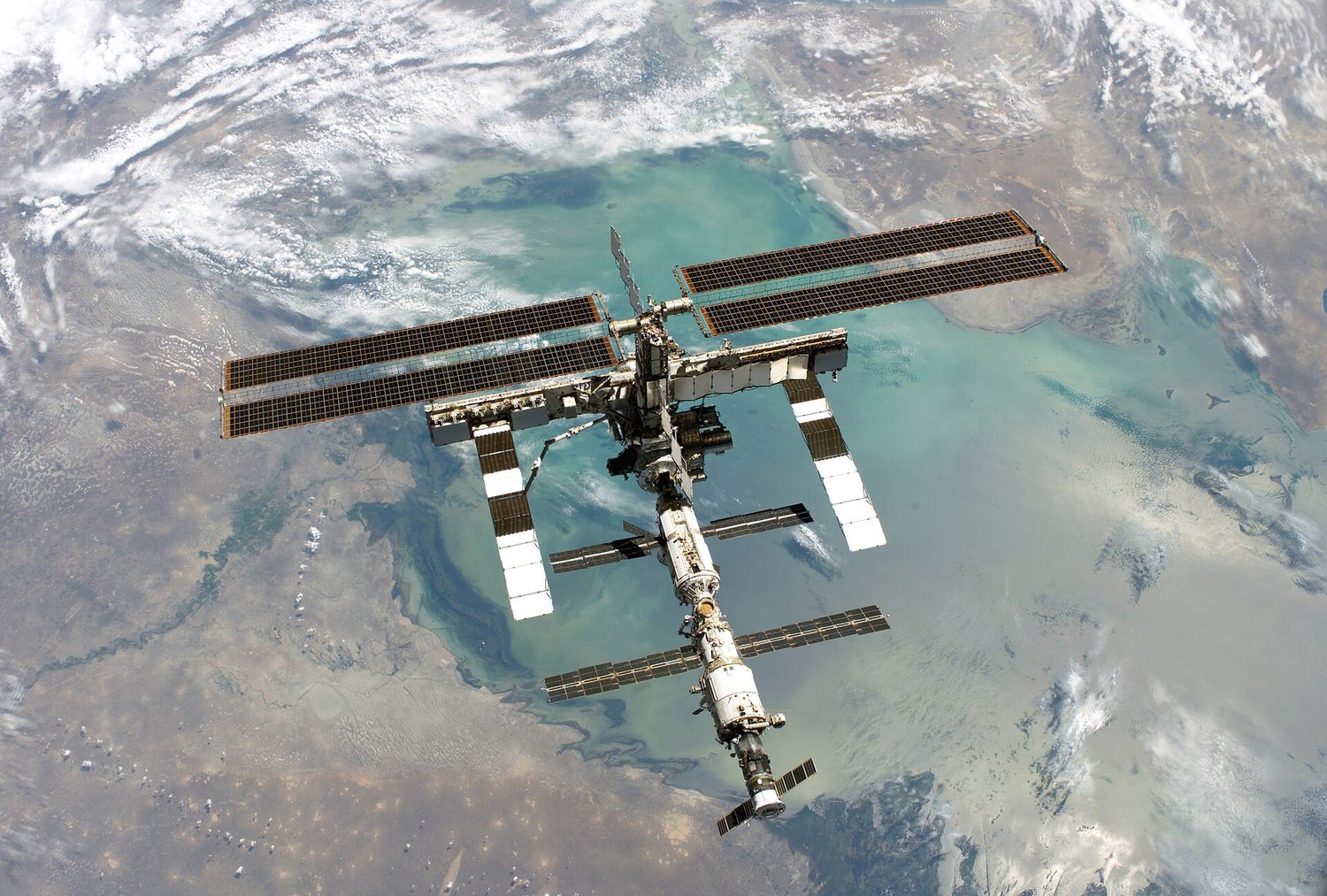
국제우주정거장이 지구를 도는 모습 사진
국제우주정거장: 중력만으로 道上에 고정된 실제 인공위성

탈출 속도는 물체가 영구히 떠날 수 있게 해주는 발사 속도입니다: 총기계적 에너지가 정확히 0이므로 무한 거리에서만 속도가 0이 됩니다. $\tfrac12 mv^2 - \dfrac{GMm}{r}=0$(일반 중력ポテン셜에너지 $U_g=-GMm/r$ 사용)을 놓고 $v$에 대해 풀면,

$$v_{\text{esc}}=\sqrt{\frac{2GM}{r}}.$$
같은 반지름에서의 원형궤도 속도의 $\sqrt2$배이며, 궤도 속도처럼 탈출하는 물체의 질량에는 의존하지 않습니다.

탐색하기

Compare orbits at different radii

A satellite is in free fall, its gravity supplying the centripetal force. A larger orbit means a slower speed and a longer period — Kepler's third law.

6.6

시험 팁

  • 외부 토크가 작용하지 않을 때 각운동량 $L=I\omega$을 보존하십시오: 팔을 당긴 등 작은 $I$은 큰 $\omega$을 만듭니다.
  • 굴리는 물체는 $\tfrac12 mv^2$과 $\tfrac12 I\omega^2$ 사이로 에너지를 나누며, $v=r\omega$로 연결되므로 미끄럼 물체보다 경사면을 더 느리게 가속합니다.
  • 원형 궤도에서는 원心力 요구량과 중력을 같게 놓으십시오: $v=\sqrt{GM/r}$, 따라서 큰 궤도는 느리고 인공위성의 질량은 소거됩니다.
  • 안으로 당기면 회전 및 운동 에너지가 증가합니다 — 추가된 에너지는 안으로 당기는 데 이루어진 일에서 나옵니다; $L$은 변하지 않습니다.
  • 어떤 회전량이 보존되는지 확인하십시오: 크가 없을 때의 $L$과 마찰이 없을 때의 에너지는 서로 다른 조건입니다.

이 주제에 대한 인터랙티브 수업

즉시 체크 기능 exercises를 통해 단계별로 진행하세요.

과거 시험지

AP 물리학 1 내 추가 주제

로그인 또는 계정 만들기

IGCSE, A-Level & AP