Skip to content · ⁨본문 바로가기⁩

Work, Energy, and Power

AP Physics 1 · ⁨AP 물리학 1⁩ · Topic 3 · ⁨주제 3⁩

Video lesson for this topic · ⁨이 주제용 영상 수업⁩ Open the video page · ⁨영상 페이지 열기⁩
8:07

일, 에너지 및aces

롤러코스터 첫 언덕을 위로 바라보십시오. 체인이 열차를 꼭대기로 끌고 간 후 놓습니다. 열차에 엔진이 없으며, 다시 밀어주는 것은 …

English narration · English + 中文 subtitles burned in · ⁨영어 내레이션 · 영어 + 중국어 자막 burned-in⁩

3.1

Translational Kinetic Energy · ⁨평동 운동 에너지⁩

Syllabus
English

Learning Objective 3.1.A: Describe the translational kinetic energy of an object in terms of the object's mass and velocity.

  • 3.1.A.1 An object's translational kinetic energy is given by the equation
    • Equation: $K = \dfrac{1}{2}mv^2$
  • 3.1.A.2 Translational kinetic energy is a scalar quantity.
  • 3.1.A.3 Different observers may measure different values of the translational kinetic energy of an object, depending on the observer's frame of reference.
한국어

학습 목표 3.1.A: 물체의 질량과 속도를 통해 물체의 병진 운동 에너지를 설명한다.

  • 3.1.A.1 물체의 병진 운동 에너지는 다음 식으로 주어진다.
    • 식: $K = \dfrac{1}{2}mv^2$
  • 3.1.A.2 병진 운동 에너지는 스칼라량이다.
  • 3.1.A.3 관측자의 기준계에 따라 물체의 병진 운동 에너지 측정값이 다를 수 있다.

Source: College Board AP Course and Exam Description · ⁨출처: College Board AP Course and Exam Description⁩

English

Energy 能量 is the capacity to do work, measured in joules 焦耳 (J). A moving object has kinetic energy 动能:

$$K=\tfrac{1}{2}mv^2.$$
It depends on the square of the speed, so doubling the speed quadruples the kinetic energy. Kinetic energy is a scalar and is never negative.

Worked example. A $1500\ \text{kg}$ car travels at $20\ \text{m/s}$. Its kinetic energy is $K=\tfrac12\times1500\times20^2=3.0\times10^{5}\ \text{J}=300\ \text{kJ}$. If it speeds up to $40\ \text{m/s}$ (double), the kinetic energy becomes $4\times$ larger, $1200\ \text{kJ}$ – which is why stopping distance grows so fast with speed.

한국어

에너지는 일을 할 수 있는 능력이며, 단위는 줄(J)이다. 움직이는 물체는 운동 에너지를 가진다:

$$K=\tfrac{1}{2}mv^2.$$
속도의 제곱에 비례하므로 속도를 두 배로 하면 운동 에너지는 네 배가 된다. 운동 에너지는 스칼라 quantity이며 절대 음수가 될 수 없다.

해설 예제. 질량 $1500\ \text{kg}$인 자동차가 속도 $20\ \text{m/s}$로 주행 중이다. 이 때 운동 에너지는 $K=\tfrac12\times1500\times20^2=3.0\times10^{5}\ \text{J}=300\ \text{kJ}$이다. 만약 속도가 $40\ \text{m/s}$(두 배)로 증가하면 운동 에너지는 $4\times$만큼 커지며, 이는 $1200\ \text{kJ}$ — 이것이 속도에 따라 정지 거리가 급격히 증가하는 이유이다.

3.2

Work · ⁨일⁩

Syllabus
English

Learning Objective 3.2.A: Describe the work done on an object or system by a given force or collection of forces.

  • 3.2.A.1 Work is the amount of energy transferred into or out of a system by a force exerted on that system over a distance.
    • 3.2.A.1.i The work done by a conservative force exerted on a system is path-independent and only depends on the initial and final configurations of that system.
    • 3.2.A.1.ii The work done by a conservative force on a system—or the change in the potential energy of the system—will be zero if the system returns to its initial configuration.
    • 3.2.A.1.iii Potential energies are associated only with conservative forces.
    • 3.2.A.1.iv The work done by a nonconservative force is path-dependent.
    • 3.2.A.1.v Examples of nonconservative forces are friction and air resistance.
  • 3.2.A.2 Work is a scalar quantity that may be positive, negative, or zero.
  • 3.2.A.3 The amount of work done on a system by a constant force is related to the components of that force and the displacement of the point at which that force is exerted.
    • 3.2.A.3.i Only the component of the force exerted on a system that is parallel to the displacement of the point of application of the force will change the system's total energy.
      • Equation: $W = F_{\parallel}d = Fd\cos\theta$
    • 3.2.A.3.ii The component of the force exerted on a system perpendicular to the direction of the displacement of the system's center of mass can change the direction of the system's motion without changing the system's kinetic energy.
  • 3.2.A.4 The work-energy theorem states that the change in an object's kinetic energy is equal to the sum of the work (net work) being done by all forces exerted on the object.
    • Equation: $\Delta K = \sum_{i} W_i = \sum_{i} F_{\parallel,i}\,d$
    • 3.2.A.4.i An external force may change the configuration of a system. The component of the external force parallel to the displacement times the displacement of the point of application of the force gives the change in kinetic energy of the system.
    • 3.2.A.4.ii If the system's center of mass and the point of application of the force move the same distance when a force is exerted on a system, then the system may be modeled as an object, and only the system's kinetic energy can change.
    • 3.2.A.4.iii The energy dissipated by friction is typically equated to the force of friction times the length of the path over which the force is exerted
      • Equation: $\Delta E_{\text{mech}} = F_f\,d\cos\theta$
  • 3.2.A.5 Work is equal to the area under the curve of a graph of $F_{\parallel}$ as a function of displacement.

Boundary statement: AP Physics 1 only expects students to analyze the transfer of mechanical energy (as defined in Unit 3, Topic 4: Conservation of Energy), although students should be aware that mechanical energy may be dissipated in the form of thermal energy or sound. In AP Physics 2, students will also study how thermal energy can be transferred between systems through heating or cooling.

한국어

학습 목표 3.2.A: 주어진 힘이나 힘의 집합에 의해 물체나 계에 가해진 일을 설명한다.

  • 3.2.A.1 일은 한 힘이 그系统进行 거리 동안 가할 때 시스템으로 들어오거나 나가는 에너지의 양이다.
    • 3.2.A.1.i 보존력에 의한 시스템에 대한 일은 경로와 무관하며 오직该系统의 초기 및 최종 구성에만 의존한다.
    • 3.2.A.1.ii 보존력에 의한 시스템에 대한 일, 혹은 시스템의ポテンシャル 에너지의 변화량은该系统가 초기 구성으로 돌아갈 경우 0이 된다.
    • 3.2.A.1.iii 포텐셜 에너지는 오직 보존력과 관련된다.
    • 3.2.A.1.iv 비보존력에 의한 일은 경로에 의존한다.
    • 3.2.A.1.v 비보존력의 예로는 마찰력과 공기 저항이 있다.
  • 3.2.A.2 일은 양수, 음수, 또는 0이 될 수 있는 스칼라량이다.
  • 3.2.A.3 상수력에 의한 시스템에 대한 일의 양은 해당 힘의 성분과 해당 힘이 가해지는 점의 변위와 관련된다.
    • 3.2.A.3.i 힘의 적용점의 변위에 평행한 힘의 성분만이 시스템의 총 에너지를 변경시킨다.
      • 식: $W = F_{\parallel}d = Fd\cos\theta$
    • 3.2.A.3.ii 시스템의 질량 중심의 변위 방향에 수직인 힘의 성분은 시스템의 운동 방향을 변경시킬 수 있으나 시스템의 운동 에너지는 변경시키지 못한다.
  • 3.2.A.4 운동 에너지 정리(Work-Energy Theorem)에 따르면 물체의 운동 에너지 변화량은 물체에 가해지는 모든 힘에 의해 이루어지는 일(순일)의 합과 같다.
    • 식: $\Delta K = \sum_{i} W_i = \sum_{i} F_{\parallel,i}\,d$
    • 3.2.A.4.i 외부 힘은 시스템의 구성을 변경시킬 수 있다. 변위에 평행한 외부 힘의 성분과 힘의 적용점의 변위를 곱하면 시스템의 운동 에너지 변화량을 구할 수 있다.
    • 3.2.A.4.ii 시스템의 질량 중심과 힘의 적용점이 같은 거리를 이동한다면,该系统는 물체로 모델링될 수 있으며 시스템의 운동 에너지만 변경될 수 있다.
    • 3.2.A.4.iii 마찰에 의해 소산되는 에너지는 일반적으로 마찰력 크기와 해당 힘이 가해진 경로의 길이의 곱과 동일시된다.
      • 식: $\Delta E_{\text{mech}} = F_f\,d\cos\theta$
  • 3.2.A.5 일은 $F_{\parallel}$를 변위의 함수로 나타낸 그래프 아래 면적과 같다.

경계 설명: AP 물리학 1에서는 학생들에게 단원 3, 주제 4: 에너지 보존에서 정의된 대로 역학적 에너지(mechanical energy)의 전달만을 분석할 것을 기대한다. 다만 역학적 에너지가 열에너지나 소리 형태로 소산될 수 있다는 점을 인지하고 있어야 한다. AP 물리학 2에서는 학생들은 열에너지를 가열이나 냉각을 통해 시스템 간에 전달하는 방식도 연구하게 된다.

Source: College Board AP Course and Exam Description · ⁨출처: College Board AP Course and Exam Description⁩

English

Work 功 is energy transferred by a force acting over a displacement:

$$W=F\,d\cos\theta,$$
where $\theta$ is the angle between the force and the displacement. Work is positive when the force has a component along the motion (adds energy), negative when it opposes the motion (removes energy), and zero when the force is perpendicular. On a force–position graph, work is the area under the curve. The work–energy theorem 动能定理 states that the net work equals the change in kinetic energy: $W_{\text{net}}=\Delta K$.

Worked example. A $2.0\ \text{kg}$ block moving at $3.0\ \text{m/s}$ on a frictionless floor is pushed by a $5.0\ \text{N}$ force over $4.0\ \text{m}$ in the direction of motion. Find its final speed. The net work is $W=Fd=5.0\times4.0=20\ \text{J}$, and by the work–energy theorem $W=\tfrac12 m(v^2-v_0^2)$:

$$20=\tfrac12\times2.0\times(v^2-3.0^2)\;\Rightarrow\;v^2=29\;\Rightarrow\;v=5.4\ \text{m/s}.$$

한국어

일은 변위 동안 힘에 의해 전달된 에너지이다:

$$W=F\,d\cos\theta,$$
여기서 $\theta$는 힘과 변위 사이의 각도이다. 힘이 운동 방향으로 성분을 가질 때는 양수이며 에너지를 더하고, 운동과 반대 방향일 때는 음수이며 에너지를 빼며, 힘과 수직일 때는 영점이다. 힘-위치 그래프에서 일은 곡선 아래의 면적이다. 일-에너지 정리는 순일이 운동 에너지의 변화량과 같다고 말한다: $W_{\text{net}}=\Delta K$.

변위 방향으로만 힘의 성분이 일을 한다

해설 예제. 질량 $2.0\ \text{kg}$인 블록이 마찰 없는 바닥 위에서 속도 $3.0\ \text{m/s}$로 움직이고 있으며, 운동 방향과 동일한 $5.0\ \text{N}$의 힘에 의해 $4.0\ \text{m}$만큼 밀려나고 있다. 최종 속도를 구하시오. 순일은 $W=Fd=5.0\times4.0=20\ \text{J}$이며, 일-에너지 정리에 의하면 $W=\tfrac12 m(v^2-v_0^2)$:

$$20=\tfrac12\times2.0\times(v^2-3.0^2)\;\Rightarrow\;v^2=29\;\Rightarrow\;v=5.4\ \text{m/s}.$$

Vocabulary · ⁨어휘⁩ Train · ⁨연습하기⁩
English 한국어
Work/wɜːk/ 일
work–energy theorem/wɜːk ˈenədʒi ˈθɪərəm/ 일-에너지 정리
Potential energy/pəˈtenʃl ˈenədʒi/ 위치 에너지
Gravitational potential energy/ˌɡrævɪˈteɪʃənl pəˈtenʃl ˈenədʒi/ 중력 포텐셜 에너지
Elastic potential energy/ɪˈlæstɪk pəˈtenʃl ˈenədʒi/ 탄성Potential 에너지
conservative forces/kənˈsɜːvətɪv ˈfɔːsɪz/ 보존력
total mechanical energy/ˈtəʊtl mɪˈkænɪkl ˈenədʒi/ 총 역학적 에너지
conserved/kənˈsɜːvd/ 보존된다
thermal energy/ˈθɜːml ˈenədʒi/ 열에너지
3.3

Potential Energy · ⁨위치 에너지⁩

Syllabus
English

Learning Objective 3.3.A: Describe the potential energy of a system.

  • 3.3.A.1 A system composed of two or more objects has potential energy if the objects within that system only interact with each other through conservative forces.
  • 3.3.A.2 Potential energy is a scalar quantity associated with the position of objects within a system.
  • 3.3.A.3 The definition of zero potential energy for a given system is a decision made by the observer considering the situation to simplify or otherwise assist in analysis.
  • 3.3.A.4 The potential energy of common physical systems can be described using the physical properties of that system.
    • 3.3.A.4.i The elastic potential energy of an ideal spring is given by the following equation, where $\Delta x$ is the distance the spring has been stretched or compressed from its equilibrium length.
      • Equation: $U_s = \dfrac{1}{2}k(\Delta x)^2$
    • 3.3.A.4.ii The general form for the gravitational potential energy of a system consisting of two approximately spherical distributions of mass (e.g., moons, planets or stars) is given by the equation
      • Equation: $U_g = -G\dfrac{m_1 m_2}{r}$
    • 3.3.A.4.iii Because the gravitational field near the surface of a planet is nearly constant, the change in gravitational potential energy in a system consisting of an object with mass $m$ and a planet with gravitational field of magnitude $g$ when the object is near the surface of the planet may be approximated by the equation
      • Equation: $\Delta U_g = mg\Delta y$
  • 3.3.A.5 The total potential energy of a system containing more than two objects is the sum of the potential energy of each pair of objects within the system.
한국어

학습 목표 3.3.A: 시스템의 포텐셜 에너지를 설명한다.

  • 3.3.A.1 두 개 이상의 물체로 구성된 시스템은该系统 내의 물체들이 서로 보존력만으로 상호작용할 경우 포텐셜 에너지를 가진다.
  • 3.3.A.2 포텐셜 에너지는该系统 내의 물체의 위치와 관련된 스칼라량이다.
  • 3.3.A.3 특정 시스템에 대한 포텐셜 에너지의 0점 정의는 상황을 고려하여 분석을 단순화하거나 돕기 위해 관측자가 결정하는 사항이다.
  • 3.3.A.4 일반적인 물리 시스템의 포텐셜 에너지는该系统의 물리적 특성을 사용하여 설명할 수 있다.
    • 3.3.A.4.i 이상적인 스프링의 탄성 포텐셜 에너지는 다음 식으로 주어지며, 여기서 $\Delta x$는 스프링이 평형 길이로부터 늘어나거나 압축된 거리이다.
      • 식: $U_s = \dfrac{1}{2}k(\Delta x)^2$
    • 3.3.A.4.ii 대략적인 구형 질량 분포(예: 위성, 행성 또는 별)로 구성된 시스템의 중력 포텐셜 에너지의 일반 형태는 다음 식으로 주어진다.
      • 식: $U_g = -G\dfrac{m_1 m_2}{r}$
    • 3.3.A.4.iii 행성 표면 근처의 중력장은 거의 일정하므로, 질량이 $m$인 물체와 중력장 세기가 $g$인 행성이 있는 시스템에서 물체가 행성 표면 근처에 있을 때 중력 포텐셜 에너지의 변화량은 다음 식으로 근사할 수 있다.
      • 식: $\Delta U_g = mg\Delta y$
  • 3.3.A.5 두 개 이상의 물체를 포함하는 시스템의 총 포텐셜 에너지는该系统 내의 각 물체 쌍의 포텐셜 에너지의 합이다.

Source: College Board AP Course and Exam Description · ⁨출처: College Board AP Course and Exam Description⁩

English

Potential energy 势能 is stored energy that depends on position or configuration:

  • Gravitational potential energy 重力势能 near the surface: $U_g=mgh$ (height $h$ above a reference level).
  • Elastic potential energy 弹性势能 in a spring: $U_s=\tfrac{1}{2}kx^2$.

Potential energy is defined only for conservative forces 保守力 (gravity, springs), for which the stored energy depends on position, not path. Only changes in potential energy matter, so you may put the zero level wherever is convenient.

The $U_g=mgh$ form only holds near a surface where $g$ is roughly constant. The general form, for two spherical masses a distance $r$ apart, is

$$U_g=-\frac{G m_1 m_2}{r}.$$
It is negative and defined to be zero at infinite separation, so gravitational PE rises toward zero as the masses move apart. $mgh$ is simply its near-surface approximation. (This is the form you need for satellites and escape speed.)

한국어

위치 에너지는 위치 또는 구성에 따라 저장된 에너지이다:

  • 중력 위치 에너지 (표면 근처): $U_g=mgh$ (기준 수준으로부터 높이 $h$).
  • 탄성 위치 에너지 (스프링): $U_s=\tfrac{1}{2}kx^2$.

위치 에너지는 보존력(중력, 스프링 등)에만 정의되며, 이때 저장된 에너지는 경로가 아닌 위치에 의존한다. 오직 위치 에너지의 변화량만이 중요하므로, 편하게 설정할 수 있는 어디든 영점을 둘 수 있다.

$U_g=mgh$ 형태는 오직 표면에 가까운 곳에서만 유효하며, 이때 $g$은 대략 일정하다. 일반적인 형태는 거리 $r$만큼 떨어진 두 구형 질량에 대해 다음과 같다

$$U_g=-\frac{G m_1 m_2}{r}.$$
이것은 음수이며 무한한 거리에서의 분리를 기준으로 영점으로 정의되므로, 질량들이 멀어질수록 중력 PE는 영점 쪽으로 상승한다. $mgh$는 단순히 그 표면 근처 근사값이다. (위성과 탈출 속도에 필요한 형태는 이 것이다.)

Explore · ⁨탐색하기⁩

Store elastic potential energy in a spring · ⁨스프링에 탄성 위치에너지 저장하기⁩

Stretching a spring stores elastic potential energy $\tfrac12 kx^2$ — the area under the force-extension line. Release it and that energy becomes kinetic. · ⁨스프링을 늘리면 탄력 Potential 에너지 $\tfrac12 kx^2$가 저장되는데 — 이는 힘-신도 선 아랫면적입니다. 놓아주면 이 에너지가 운동 에너지로 전환됩니다.⁩

3.4

Conservation of Energy · ⁨에너지 보존⁩

Syllabus
English

Learning Objective 3.4.A: Describe the energies present in a system.

  • 3.4.A.1 A system composed of only a single object can only have kinetic energy.
  • 3.4.A.2 A system that contains objects that interact via conservative forces or that can change its shape reversibly may have both kinetic and potential energies.

Learning Objective 3.4.B: Describe the behavior of a system using conservation of mechanical energy principles.

  • 3.4.B.1 Mechanical energy is the sum of a system's kinetic and potential energies.
  • 3.4.B.2 Any change to a type of energy within a system must be balanced by an equivalent change of other types of energies within the system or by a transfer of energy between the system and its surroundings.
  • 3.4.B.3 A system may be selected so that the total energy of that system is constant.
  • 3.4.B.4 If the total energy of a system changes, that change will be equivalent to the energy transferred into or out of the system.

Learning Objective 3.4.C: Describe how the selection of a system determines whether the energy of that system changes.

  • 3.4.C.1 Energy is conserved in all interactions.
  • 3.4.C.2 If the work done on a selected system is zero and there are no nonconservative interactions within the system, the total mechanical energy of the system is constant.
  • 3.4.C.3 If the work done on a selected system is nonzero, energy is transferred between the system and the environment.

Boundary statement: AP Physics 1 expects students to know that mechanical energy can be dissipated as thermal energy or sound by nonconservative forces.

한국어

학습 목표 3.4.A: 시스템에 존재하는 에너지를 설명한다.

  • 3.4.A.1 단일 물체만으로 구성된 시스템은 운동 에너지만 가질 수 있다.
  • 3.4.A.2 보존력을 통해 상호작용하거나 형상을 가역적으로 변경할 수 있는 물체를 포함하는 시스템은 운동 에너지와 포텐셜 에너지를 모두 가질 수 있다.

학습 목표 3.4.B: 역학적 에너지 보존 원리를 사용하여 시스템의 거동을 설명한다.

  • 3.4.B.1 역학적 에너지는 시스템의 운동에너지와 위치에너지의 합이다.
  • 3.4.B.2 시스템 내 한 형태의 에너지가 변화할 경우,该系统 내 다른 형태의 에너지에 동일한 크기의 변화가 일어나거나 시스템과 주변 환경 간에 에너지가 이동해야 한다.
  • 3.4.B.3 특정 시스템의 총 에너지를 일정하게 만들 수 있도록 시스템을 선택할 수 있다.
  • 3.4.B.4 시스템의 총 에너지가 변화할 경우, 그 변화량은 시스템으로 유입되거나 시스템에서 유출된 에너지와 동일하다.

학습 목표 3.4.C: 시스템의 선택이 해당 시스템의 에너지 변화 여부에 미치는 영향을 설명하라.

  • 3.4.C.1 모든 상호작용에서 에너지는 보존된다.
  • 3.4.C.2 선택된 시스템에 가해진仕事が 0이며 시스템 내에 비보존적 상호작용이 없으면, 시스템의 총 역학적 에너지는 일정하다.
  • 3.4.C.3 선택한 물체에 가해진 일이 영이 아닌 경우, 에너지가 물체와 환경 사이를 이동한다.

경계 선언: AP 물리학 1은 학생이 비보존적 힘에 의해 역학적 에너지가 열에너지나 소리로 산란될 수 있음을 알아야 한다고 기대한다.

Source: College Board AP Course and Exam Description · ⁨출처: College Board AP Course and Exam Description⁩

English
Energy conservation: KE ⇄ PE

The total mechanical energy 机械能 is $E=K+U$. When only conservative forces do work, mechanical energy is conserved 守恒:

$$K_1+U_1=K_2+U_2.$$
When friction or other non-conservative forces act, they transfer mechanical energy to thermal energy 热能; then the general statement is that total energy (including thermal) is conserved. Energy bar charts are a good way to track where the energy goes.

Worked example. A ball is released from rest at the top of a frictionless ramp $5.0\ \text{m}$ high. Find its speed at the bottom. All the gravitational potential energy becomes kinetic energy:

$$mgh=\tfrac12 mv^2\;\Rightarrow\;v=\sqrt{2gh}=\sqrt{2\times9.8\times5.0}=9.9\ \text{m/s}.$$
The mass cancels, so every object reaches the same speed – exactly the free-fall result, now got from energy. If instead $30\ \text{J}$ were lost to friction, you would subtract it: $mgh-30=\tfrac12 mv^2$.

한국어
에너지 보존: KE ⇄ PE
하늘을 배경으로 한 높고 긴 루프가 있는 녹색 및 빨간색 레일의 롤러코스터
롤러코스터는 에너지를 오고가며 교환합니다: 가장 높은 지점(최대 위치 에너지)과 가장 빠른 지점(최대 운동 에너지)에서 각각 최대값을 가집니다

총 기계적 에너지는 $E=K+U$입니다. 비소멸력만 작용할 때 기계적 에너지는 보존됩니다:

$$K_1+U_1=K_2+U_2.$$
마찰력이나 다른 비보존력이 작용하면 기계적 에너지를 열에너지로 전달합니다. 이때 총 에너지(열에너지 포함)는 보존된다는 일반적인 진술이 성립합니다. 에너지 막대 차트는 에너지가 어디로 가는지를 추적하는 데 유용한 방법입니다.

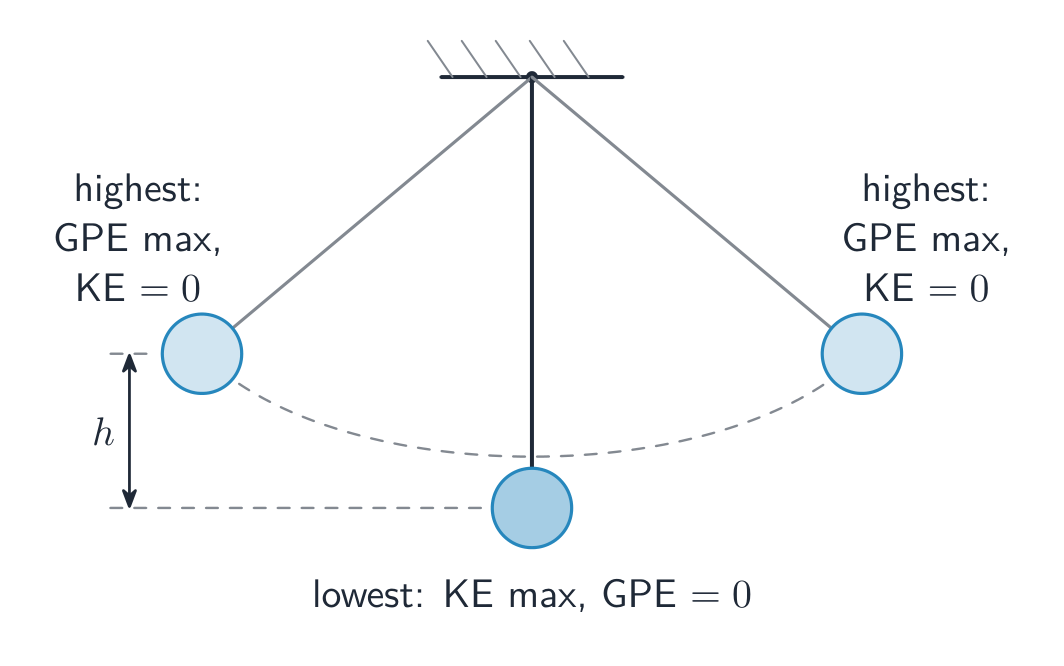
흔들리는 진자는 중력포텐셜 에너지를 운동 에너지로 바꾸고 다시 되돌린다

해설 예제. 마찰 없는 경사 $5.0\ \text{m}$ 높이에서 정지 상태에서 공을 놓습니다. 바닥에서의 속도를 구하십시오. 중력ポ텐셜 에너지가 모두 운동 에너지로 변합니다:

$$mgh=\tfrac12 mv^2\;\Rightarrow\;v=\sqrt{2gh}=\sqrt{2\times9.8\times5.0}=9.9\ \text{m/s}.$$
질량이 소거되므로 모든 물체는 같은 속도에 도달합니다 – 이는 자유 낙하의 결과와 정확히 일치하며, 이제는 에너지를 통해 얻은 것입니다. 만약 $30\ \text{J}$가 마찰로 인해 손실된다면 이를 빼야 합니다: $mgh-30=\tfrac12 mv^2$.

Explore · ⁨탐색하기⁩

Watch energy convert as an object falls · ⁨物体 falling 시 에너지 변환 Watching⁩

With no friction, mechanical energy is conserved: as an object falls, gravitational potential energy turns into kinetic energy while the total stays fixed. · ⁨마찰이 없을 때, 기계적 에너지 보존: Object falling 시 중력 **위치에너지(potential energy)**가 **운동에너지(kinetic energy)**로 전환되며 총량은 일정합니다.⁩

Vocabulary · ⁨어휘⁩ Train · ⁨연습하기⁩
English 한국어
Energy/ˈenədʒi/ 에너지
joules/dʒuːlz/ 줄
kinetic energy/kɪˈnetɪk ˈenədʒi/ 운동 에너지Unless kinetic energy.
3.5

Power · ⁨비율(Power)⁩

Syllabus
English

Learning Objective 3.5.A: Describe the transfer of energy into, out of, or within a system in terms of power.

  • 3.5.A.1 Power is the rate at which energy changes with respect to time, either by transfer into or out of a system or by conversion from one type to another within a system.
  • 3.5.A.2 Average power is the amount of energy being transferred or converted, divided by the time it took for that transfer or conversion to occur.
    • Equation: $P_{\text{avg}} = \dfrac{\Delta E}{\Delta t}$
  • 3.5.A.3 Because work is the change in energy of an object or system due to a force, average power is the total work done, divided by the time during which that work was done.
    • Equation: $P_{\text{avg}} = \dfrac{W}{\Delta t}$
  • 3.5.A.4 The instantaneous power delivered to an object by the component of a constant force parallel to the object's velocity can be described with the derived equation.
    • Equation: $P_{\text{inst}} = F_{\parallel}v = Fv\cos\theta$
한국어

학습 목표 3.5.A: 출력을 사용하여 시스템 안으로, 밖으로, 혹은 내부로 에너지가 이동하는 과정을 설명하라.

  • 3.5.A.1 출력은 시간당 에너지의 변화율로, 시스템으로 유입되거나 유출되는 경우이거나 시스템 내에서 한 형태에서 다른 형태로 전환되는 경우를 의미한다.
  • 3.5.A.2 평균 출력은 이동하거나 전환된 에너지의 양을, 해당 이동이나 전환이发生的所需时间로 나눈 값이다.
    • 식: $P_{\text{avg}} = \dfrac{\Delta E}{\Delta t}$
  • 3.5.A.3 일은 힘에 의해 물체나 시스템의 에너지가 변한 것이므로, 평균 출력은 행해진 총 일량을 그 일이 행해진 시간으로 나눈 값이다.
    • 식: $P_{\text{avg}} = \dfrac{W}{\Delta t}$
  • 3.5.A.4 상수 힘의 성분이 물체의 속도 방향과 평행할 때 물체에 전달되는 순간 출력은 유도된 식으로 기술할 수 있다.
    • 식: $P_{\text{inst}} = F_{\parallel}v = Fv\cos\theta$

Source: College Board AP Course and Exam Description · ⁨출처: College Board AP Course and Exam Description⁩

English

Power 功率 is the rate of doing work or transferring energy, measured in watts 瓦特 (W):

$$P=\frac{W}{\Delta t}=\frac{\Delta E}{\Delta t},\qquad\text{and instantaneously}\qquad P=Fv.$$
So the same job done faster requires more power. On an energy–time graph, power is the slope.

Worked example. A motor lifts a $50\ \text{kg}$ load at a steady $2.0\ \text{m/s}$. Because it moves at constant speed, the lifting force equals the weight, so

$$P=Fv=mgv=50\times9.8\times2.0=980\ \text{W}.$$

Real machines waste some energy, so we quote efficiency 效率 – useful output power divided by total input power. If this motor draws $1400\ \text{W}$ of electrical power to deliver $980\ \text{W}$ of useful lifting, its efficiency is $980/1400=0.70$, or $70\%$; the other $30\%$ becomes heat and sound.

한국어

출력(Power) 은 일 또는 에너지 전달의 속도이며, 단위는 와트(W) 입니다:

$$P=\frac{W}{\Delta t}=\frac{\Delta E}{\Delta t},\qquad\text{and instantaneously}\qquad P=Fv.$$
따라서 동일한 일을 더 빠르게 수행하려면 더 많은 출력이 필요합니다. 에너지-시간 그래프에서 출력은 기울기입니다.

Power is the slope of the work-time graph: the same work in less time means more power

해설 예제. 모터가 $50\ \text{kg}$ 하중을 일정한 $2.0\ \text{m/s}$ 속도로 들어 올립니다. 속도가 일정하므로 들어 올리는 힘은 무게와 같으므로,

$$P=Fv=mgv=50\times9.8\times2.0=980\ \text{W}.$$

실제 기계는 일부 에너지를 손실하므로 효율성을 제시합니다. 이는 유용한 출력력을 총 입력력으로 나눈 값입니다. 이 모터가 $1400\ \text{W}$의 전기입력을 받아 $980\ \text{W}$의 유효한 들어올림 출력을 제공한다면, 그 효율성은 $980/1400=0.70$, 즉 $70\%$이며, 나머지 $30\%$는 열과 소리로 변합니다.

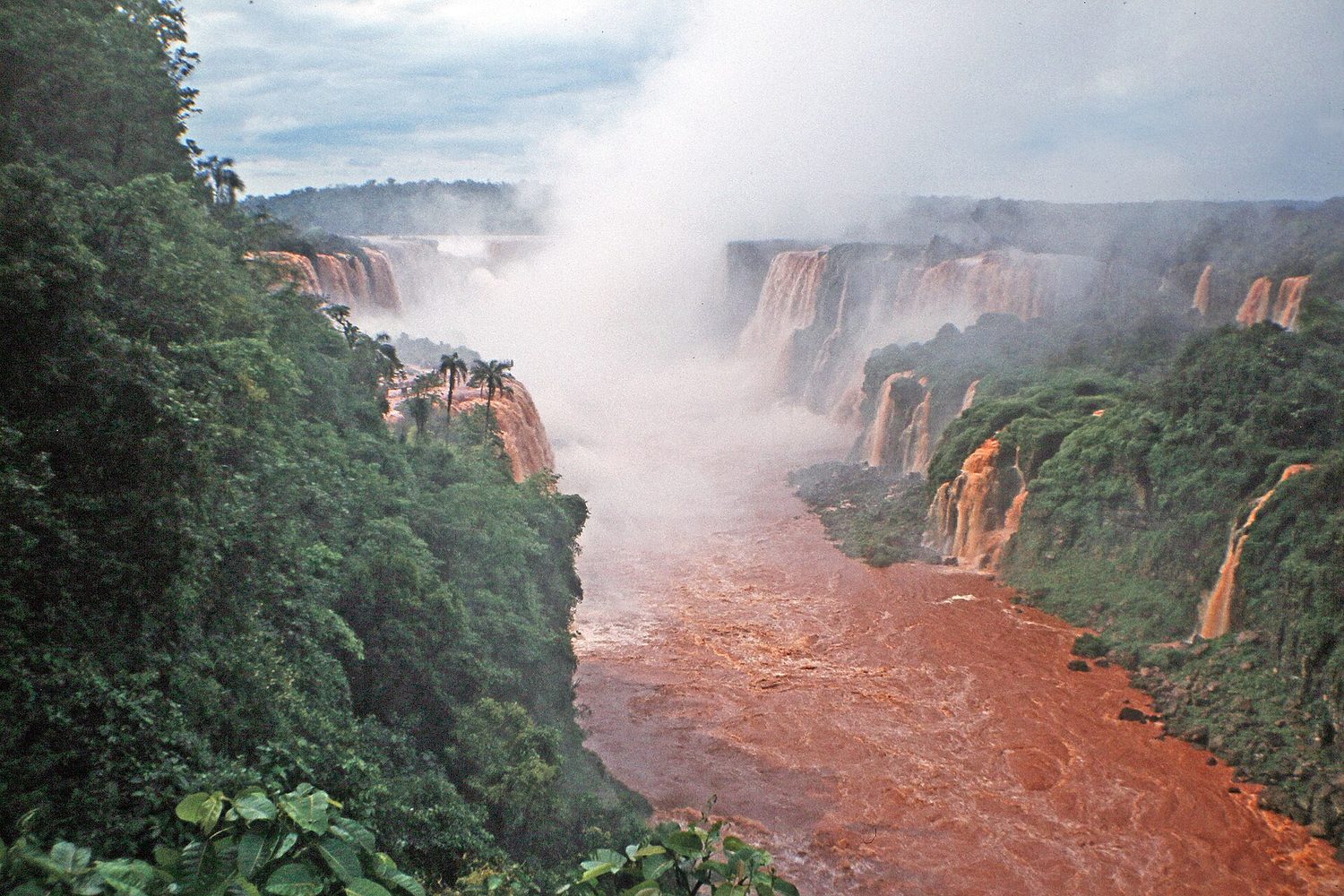
A waterfall: power is how quickly energy is transferred — the same drop in less time is more power
Vocabulary · ⁨어휘⁩ Train · ⁨연습하기⁩
English 한국어
Power/ˈpaʊə/ 출력
watts/wɒts/ 와트(watts)
efficiency/ɪˈfɪʃənsi/ 효율(efficiency)
3.5

Exam tips · ⁨시험 팁⁩

English
  • Use $W=Fd\cos\theta$: work is zero when the force is perpendicular to the motion, and negative when it opposes it.
  • Reach for the work–energy theorem ($W_{\text{net}}=\Delta K$) or energy conservation ($K_1+U_1=K_2+U_2$) instead of forces whenever the path is complicated.
  • When friction acts, mechanical energy is not conserved — subtract the energy lost to heat.
  • Remember $K\propto v^2$: doubling the speed quadruples the kinetic energy (and the stopping distance).
  • Use $P=Fv$ for power at a steady speed; at constant velocity the net force is zero but the power is not.
한국어
  • $W=Fd\cos\theta$를 사용하십시오: 힘의 방향이 운동에 수직이면 일은 0이며, 반대方向이면 일은 음수입니다.
  • 경로가 복잡할 경우Force 대신 일-에너지 정리($W_{\text{net}}=\Delta K$) 또는 에너지 보존($K_1+U_1=K_2+U_2$)을 적용하십시오.
  • 마찰력이 작용하면 기계적 에너지는 보존되지 않습니다 – 열로 손실된 에너지를 빼십시오.
  • $K\propto v^2$를 기억하십시오: 속도를 두 배로 하면 운동 에너지는 네 배가 됩니다 (정지 거리도 네 배).
  • 일정한 속도에서의aces에 $P=Fv$를 사용하십시오; 일정 속도로 이동할 때 합力は 제로이지만aces는 아닙니다.

Interactive lessons on this topic · ⁨이 주제에 대한 인터랙티브 수업⁩

Work through it step by step, with instant-check exercises. · ⁨즉시 체크 기능 exercises를 통해 단계별로 진행하세요.⁩

Past Papers · ⁨과거 시험지⁩

More topics in AP Physics 1 · ⁨AP 물리학 1⁩ · ⁨AP Physics 1 · ⁨AP 물리학 1⁩ 내 추가 주제⁩

Log in or create account · ⁨로그인 또는 계정 만들기⁩

IGCSE, A-Level & AP