What this course is, and how to use it
This is the seventh course in University Computer Science: operating systems 操作系统 — the layer that turns one processor into an illusion of many machines: processes, scheduling, synchronisation, virtual memory, files, and the walls between users.
Scope limit, stated once: a study course, not a degree; the teaching kernel is an original small design, and every scheduling table, interleaving and page-table walk in this handout is deterministic — computed by the course suite, never simulated by hand-waving.
- Units 7.1–7.3 are the CPU's illusions: processes, turns, and safe sharing.
- Units 7.4–7.5 are memory and storage illusions: address spaces and files.
- Unit 7.6 is the wall: protection and security.
The OS habit: an operating system is a resource accountant — every mechanism in this course is a ledger of who owns what turn.
Processes and threads
Why it matters. A process 进程 is a program in motion: its own address space, registers, and open files. The OS's first illusion is running hundreds of them on a handful of cores.
The idea, with a picture. A process lives through five states 状态: new, ready 就绪, running 运行, blocked 阻塞 (waiting on I/O), terminated. The scheduler moves processes between ready and running; devices wake the blocked. A thread 线程 is a execution flow inside a process: threads share the address space and files, but each owns its stack and registers.
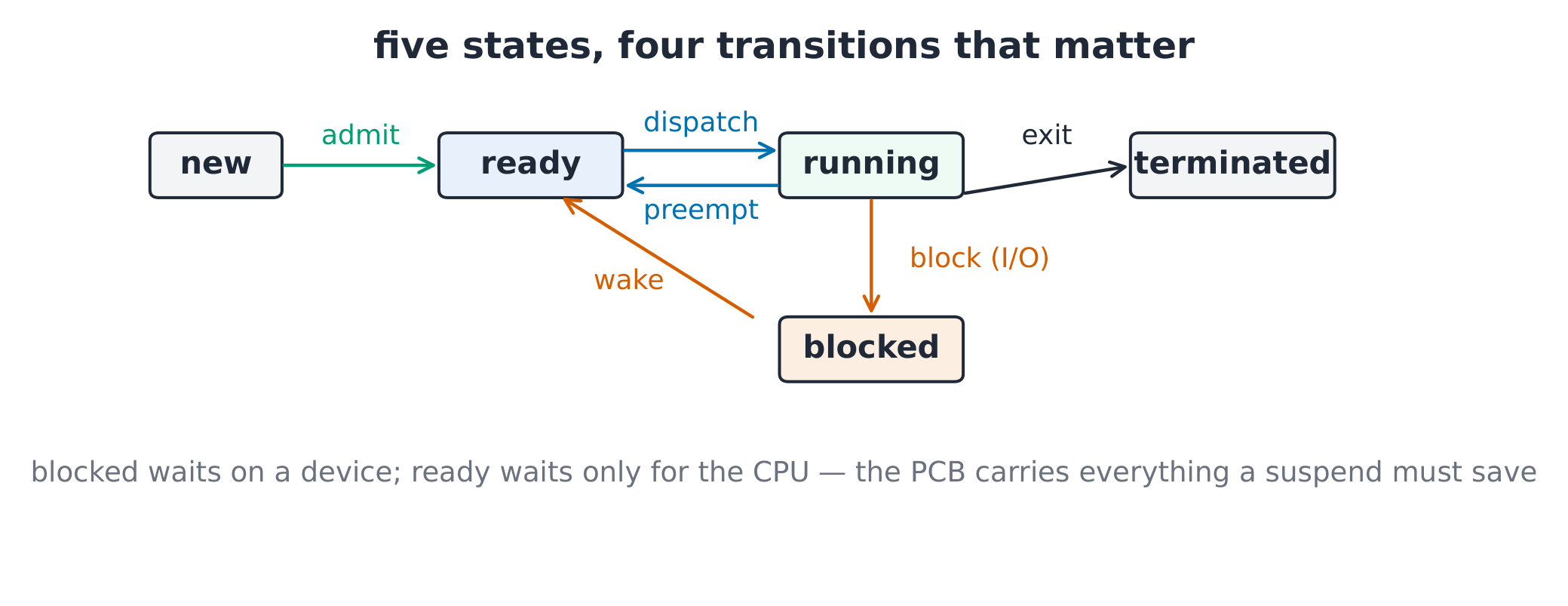
The derivation (why the PCB exists). To suspend a process the OS must save everything that defines it — the process control block 进程控制块 (PCB): register values, program counter, page-table pointer, open files. The context switch 上下文切换 is exactly this save-and-restore: with our course timings, saving and restoring $2000$ bytes of state at $2$ GB/s costs $1$ µs — plus cache pollution that makes the next runs slower. Switching threads skips the address space (shared), so it is cheaper; switching processes pays the full PCB.
Worked example 1 — a page fault's journey. Process A runs, faults on a page: running $\to$ blocked (disk), the scheduler dispatches B, the disk completes, A $\to$ ready, and later A $\to$ running again with the faulting instruction restarted. Four state changes, two processes, zero lost work — the restartable instruction is the condition that makes preemption safe at all.
Worked example 2 — thread versus process. A web server spawns a thread per connection: shared cache and configuration, $50$ µs create-and-switch. The same as processes costs $500$ µs (address space copy — well, with copy-on-write mostly the page-table setup) plus separate caches to fill. Sharing is the thread's whole point — and, as unit 7.3 shows, its whole danger.
Common mistakes. Confusing blocked with ready (blocked waits on a device; ready waits only for the CPU). Believing a thread crash stays local (it takes the process — one address space). Counting the context-switch cost as pure CPU time (cache refill dominates).
Summary. Process = address space + PCB; thread = stack + registers inside it; five states with dispatch/preempt/block/wake; switching threads is cheaper because the space is shared.
Scheduling
Why it matters. More processes than cores means somebody decides the turns. The scheduler is that somebody, and its policy is a values statement: throughput, fairness, or latency — pick two.
The idea, with a picture. Our teaching queues: FCFS 先来先服务 (first-come-first-served), SJF 短作业优先 (shortest job first), round robin 时间片轮转 (RR, quantum $q = 2$), priority with aging. The Gantt chart 甘特图 shows who ran when.
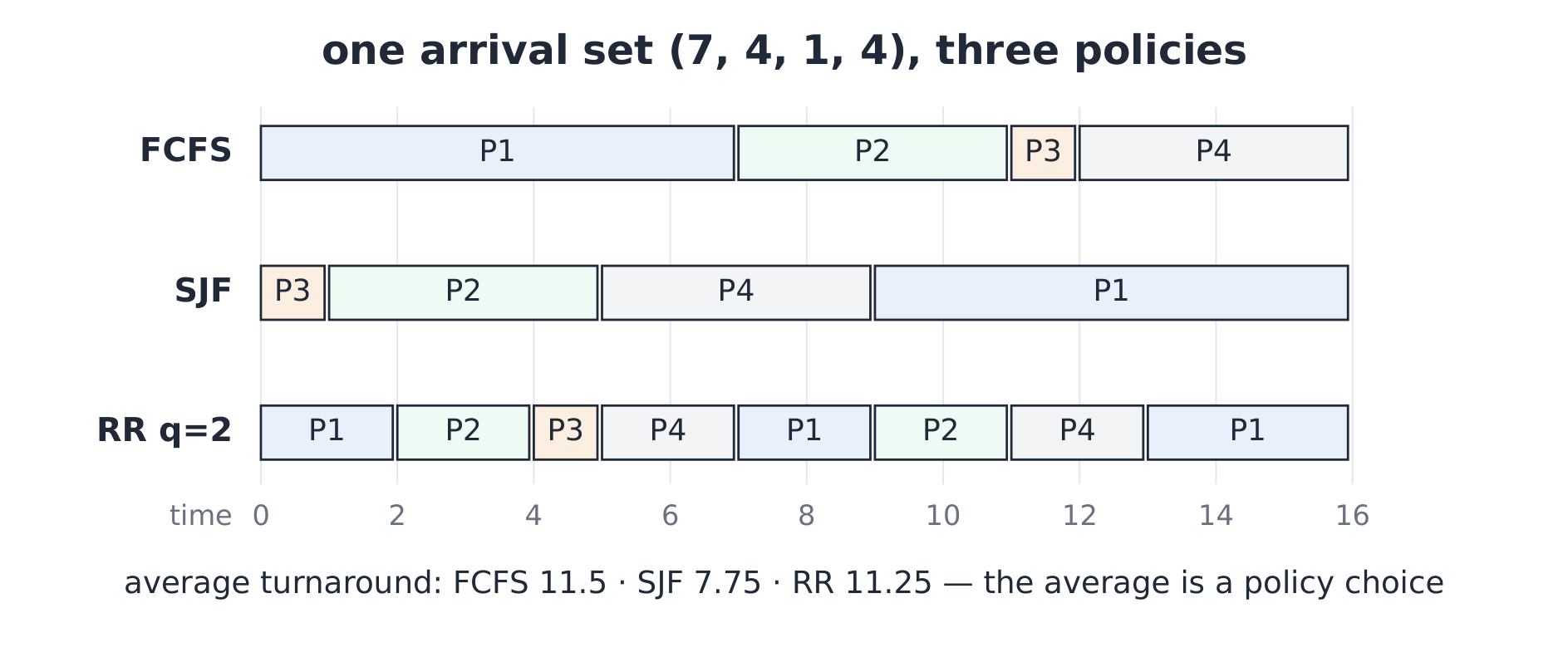
The derivation (the turnaround formula). Turnaround time 周转时间 $=$ finish $-$ arrival; waiting time 等待时间 $=$ turnaround $-$ burst. For the course set — arrivals at $0$ with bursts P1 $= 7$, P2 $= 4$, P3 $= 1$, P4 $= 4$ — FCFS finishes at $7, 11, 12, 16$: turnarounds $7, 11, 12, 16$ (all arrive at $0$), average $\mathbf{11.5}$. SJF order P3, P2, P4, P1 finishes at $1, 5, 9, 16$: turnarounds $1, 5, 9, 16$, average $\mathbf{7.75}$. RR ($q = 2$) interleaves: the trace is P1 P1 $|$ P2 P2 $|$ P3 $|$ P4 P4 $|$ P1 P1 $|$ P2 P2 $|$ P4 P4 $|$ P1 P1 $|$ P1 — finishes P3 $= 5$, P2 $= 11$, P4 $= 13$, P1 $= 16$: average turnaround $\mathbf{11.25}$. Same jobs, three policies, three answers — SJF wins the average, RR wins the worst-case wait.
Worked example 1 — convoy effect. Under FCFS a long job (P1, 7) arrives first and everything queues behind it: P3 waits $11$ units for $1$ unit of work. SJF would run P3 first (wait $0$) — the convoy is FCFS's signature failure with interactive users in the mix.
Worked example 2 — quantum choice. RR with $q = 2$: $9$ run segments, so $8$ preemptions in our trace; with $q = 7$: P1 finishes in one slice — fewer switches, but short P3 waits $6+$ before its first run. The rule: $q$ large degenerates to FCFS; $q$ tiny spends the CPU on switching (our course bound: switch cost $1$ µs in a $2$ ms quantum wastes $0.05\%$; at $20$ µs quantum, $5\%$).
Common mistakes. Averaging completion times instead of turnarounds. Forgetting SJF needs burst foreknowledge (it is theoretical; MLFQ approximates it). Calling a small quantum faster (switches are work, not progress).
Summary. Turnaround = finish − arrival; SJF minimises average turnaround among non-preemptive policies; RR trades average for fairness and latency; the quantum prices the trade.
Synchronisation
Why it matters. Threads share memory, and unsynchronised sharing corrupts it: the lost update is the smallest and most expensive bug in computing.
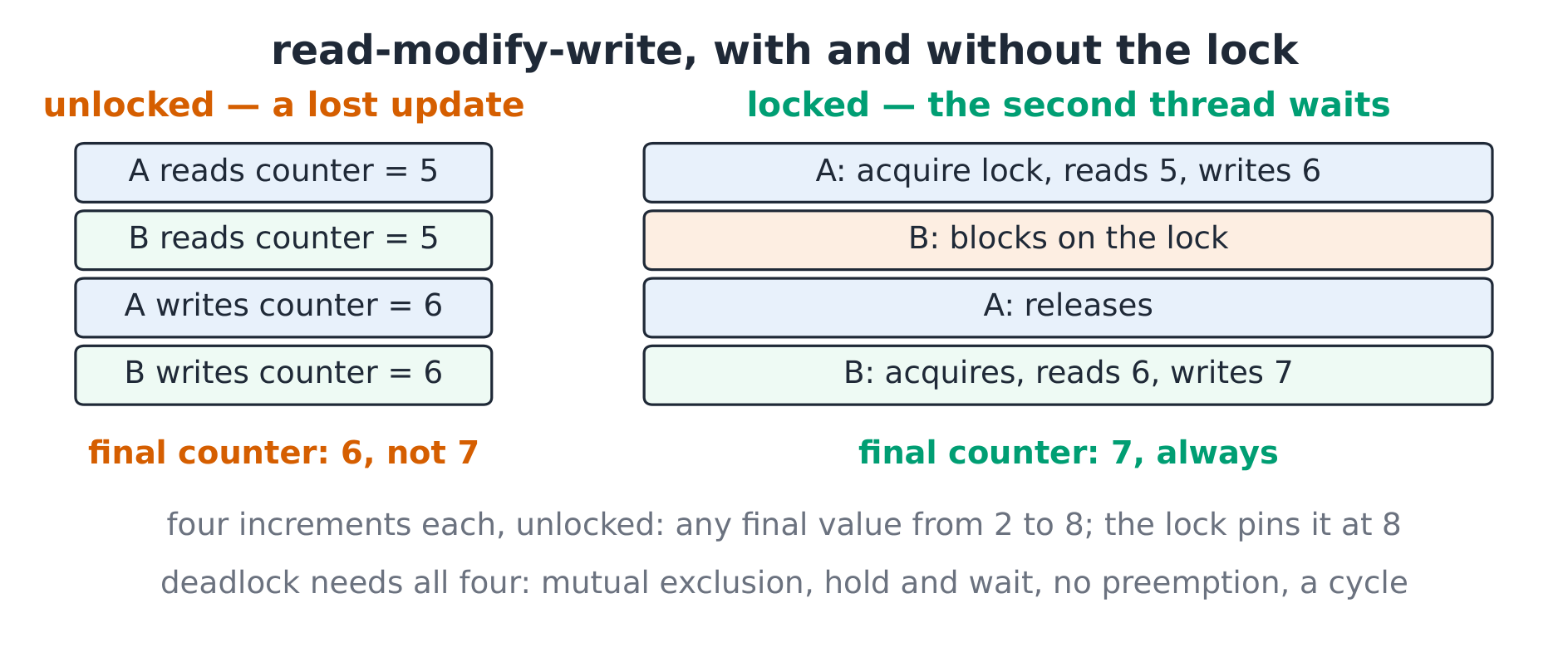
The idea, with a picture. The classic race: two threads run
counter = counter + 1 on counter = 5. Each reads, adds, writes;
the interleaving 交错 R1 R2 W1 W2 leaves $6$, not $7$ — one
update is lost. The fix is mutual exclusion 互斥: a lock
锁 makes read-modify-write atomic.
The derivation (the critical section bound). A correct
synchronisation primitive for $N$ threads must satisfy: mutual
exclusion (one inside), progress (someone enters if free), bounded
waiting (no thread starves). Peterson's algorithm meets all three
with two flags and a turn variable; hardware test-and-set meets
them with one atomic instruction — but both spin 自旋, burning
the CPU. Semaphores and mutexes add the OS queue: the blocked waiter
sleeps instead, which is why real systems layer them.
Worked example 1 — counting deterministically. Two threads increment a shared counter $4$ times each, unlocked. The worst case: A reads $0$ and stalls; B runs three full increments; A writes $1$, wiping them out; B reads that $1$ and stalls; A finishes its last three increments; B writes $2$. The counter ends at $\mathbf{2}$: six of the eight increments vanish. A thread's next read always follows its own last write, so $1$ is impossible. The suite enumerates the interleavings with per-increment registers: every final value from $2$ to $8$ is reachable — the race does not corrupt loudly, it undercounts quietly. Locked: always $8$.
Worked example 2 — deadlock's four horsemen. Two threads, locks L1, L2: A holds L1 wants L2; B holds L2 wants L1. Deadlock needs mutual exclusion, hold-and-wait, no preemption, and circular wait — break any one and it cannot happen. The engineer's favourite to break: circular wait, by ordering the locks (always L1 before L2).
Common mistakes. Fixing races by inserting sleeps (narrows the window, closes nothing). Taking locks in different orders across threads (the deadlock recipe). Believing a single-core machine is safe (preemption between the read and the write still races).
Summary. Races come from non-atomic read-modify-write; locks make them atomic at the price of waiting; correctness is exclusion + progress + bounded waiting; break one of the four deadlock conditions — ordering locks is the cheap one.
Virtual memory
Why it matters. Every process believing it owns the whole address space — while sharing one physical RAM — is the OS's grandest illusion and the source of both its speed and its worst failures.
The idea, with a picture. The virtual address 虚拟地址 splits into page number and offset; the page table 页表 maps virtual pages to physical frames 物理页框, one entry per page; the TLB 快表 caches translations. Our course machine: virtual $16$ bits, page $256$ bytes $\Rightarrow$ $256$ virtual pages; physical $12$ bits $\Rightarrow$ $16$ frames.
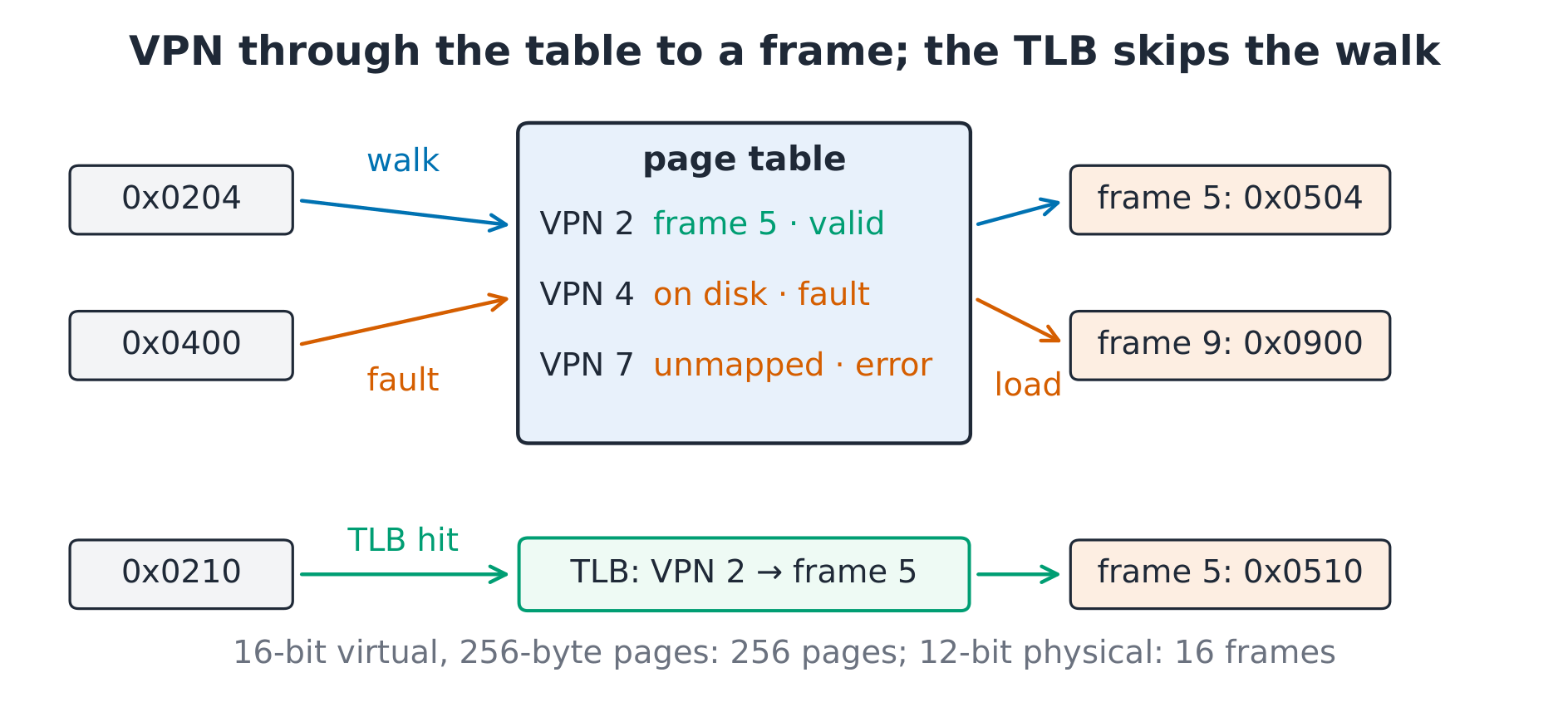
The derivation (the size of the illusion). Address width sets the space: $16$-bit virtual, $256$-byte pages $\Rightarrow$ VPN $= 8$ bits $\Rightarrow$ $256$ pages; a process may address $64$ KiB while physical frames number $16$ ($4$ KiB). The page table is the ledger: $256$ entries $\times$ (frame $4$ bits $+$ valid $1$ $+$ dirty $1$) $= 1536$ bits. Two processes each get all $256$ virtual pages — overcommit is free until someone touches an unmapped page.
Worked example 1 — the walk, then the hit. Address $0x0204$: offset $0x04$ (low 8 bits), VPN $0x02$. First access: TLB miss, page-table read: VPN 2 $\to$ frame 5, physical $= 5 \times 256 + 4 = 0x0504$; the TLB caches VPN 2. Address $0x0210$ next cycle: same VPN $2$ — TLB hit, physical $0x0510$, no table walk. The 10-entry TLB on our $256$-page space: an 8-page loop of $8000$ accesses misses $8$ times (compulsory) — a $99.9\%$ hit rate (suite-simulated, LRU).
Worked example 2 — the fault and its price. Address $0x0400$: VPN $4$, table entry invalid $\to$ page fault 缺页. The process blocks, the OS finds a victim (LRU: frame $9$'s page, dirty — write it back), reads VPN 4 into frame $9$, updates the table and TLB, restarts the instruction. Cost model: TLB hit $1$ ns, table walk $10$ ns, fault $+$ disk $5$ ms — one fault per million accesses still costs $5$ ns per access on average ($5\,\mathrm{ms} / 10^6$): the hierarchy tolerates rarity, not frequency.
Common mistakes. Computing the physical address without the frame multiply. Forgetting the dirty bit doubles a victim's cost. Treating every page fault as either a disk fetch or an invalid access: a valid nonresident page may be loaded, a new page may be allocated, and a protection violation may terminate the process.
Summary. VPN $+$ offset through the page table to frame $+$ offset; the TLB makes walks rare; faults make overcommit safe at disk prices; the bits (valid, dirty) are the ledger's footnotes.
File systems
Why it matters. Files are the illusion that outlives the process: the layout beneath decides speed, reliability, and what a crash eats.
The idea, with a picture. Our teaching disk: $32$ blocks of $1$ KiB. The inode 索引节点 holds the metadata and $4$ direct pointers plus one indirect (pointing at a block of $256$ pointers); the directory is a file of name $\to$ inode entries; FAT 链表式分配 chains blocks instead.
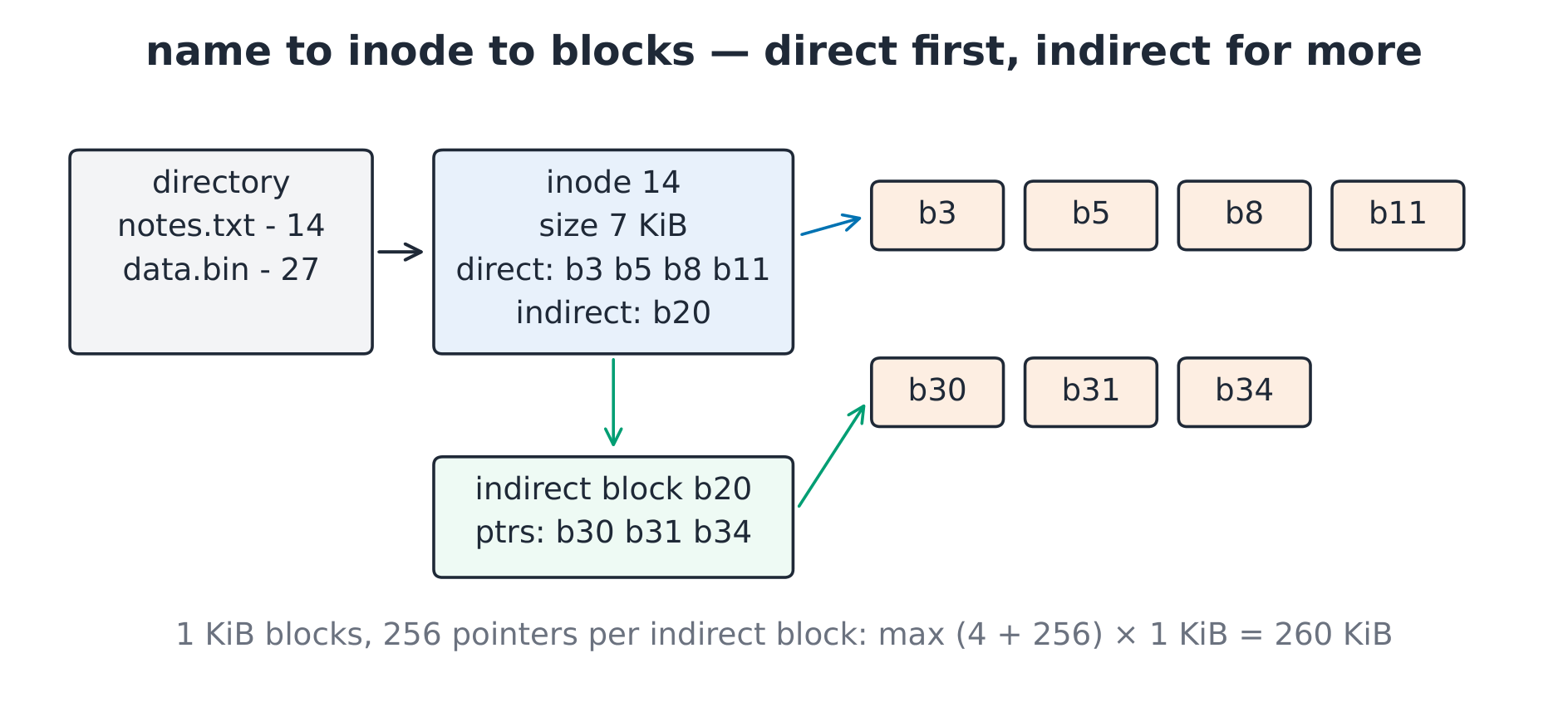
The derivation (the file size bound). With $4$ KiB blocks the arithmetic scales: $4$ direct $+$ one indirect block holding $1024$ pointers $\Rightarrow$ max file $= (4 + 1024) \times 4\,\mathrm{KiB} \approx 4$ MiB. Our teaching size ($1$ KiB blocks, $256$ pointers): $(4 + 256) \times 1\,\mathrm{KiB} = 260$ KiB. Access cost: block $n < 4$ costs one disk read (plus the inode, cached); block $n \ge 4$ adds the indirect block read. Fragmentation: chained layouts spread a file, so sequential reads become seeks — contiguity is a speed decision, not a correctness one.
Worked example 1 — read /notes/x, block 6. The directory lookup finds the inode (cached), block $6$ is beyond the four direct pointers: read the indirect block (pointer $6 - 4 = 2$), then the data block — two disk reads for one logical block. Block $2$ would have cost one. The suite counts: reading a $100$-block file sequentially = $100 + 1$ indirect reads, best case.
Worked example 2 — the crash question. Append writes the data block, then the free-list bit, then the inode size. Crash between writes: which order loses what? Data-then-inode loses nothing but space (orphan block); inode-then-data lies about size (reads return garbage). Journaling 日志 writes the intent first and replays — the reason modern file systems pay a small write tax for crash consistency.
Common mistakes. Forgetting the directory is itself a file (lookups are reads). Assuming the indirect pointer is free (it is a disk read). Believing deletion erases (it clears pointers — the data stays until reused).
Summary. Directory $\to$ inode $\to$ direct/indirect pointers $\to$ blocks; size bound $= (\text{direct} + \text{pointers per block}) \times \text{block size}$; write order decides what a crash eats; journaling buys consistency.
Protection and security
Why it matters. Everything above assumed the programs cooperate. Protection is the hardware-plus-OS wall that makes the assumption unnecessary — and security is the practice of keeping that wall standing.
The idea, with a picture. Two rings 特权级: user mode runs application code; kernel mode 特权模式 runs the OS and can touch devices and page tables. The crossing points are system calls 系统调用 — the wall's only doors — and the mode bit on the CPU enforces them.
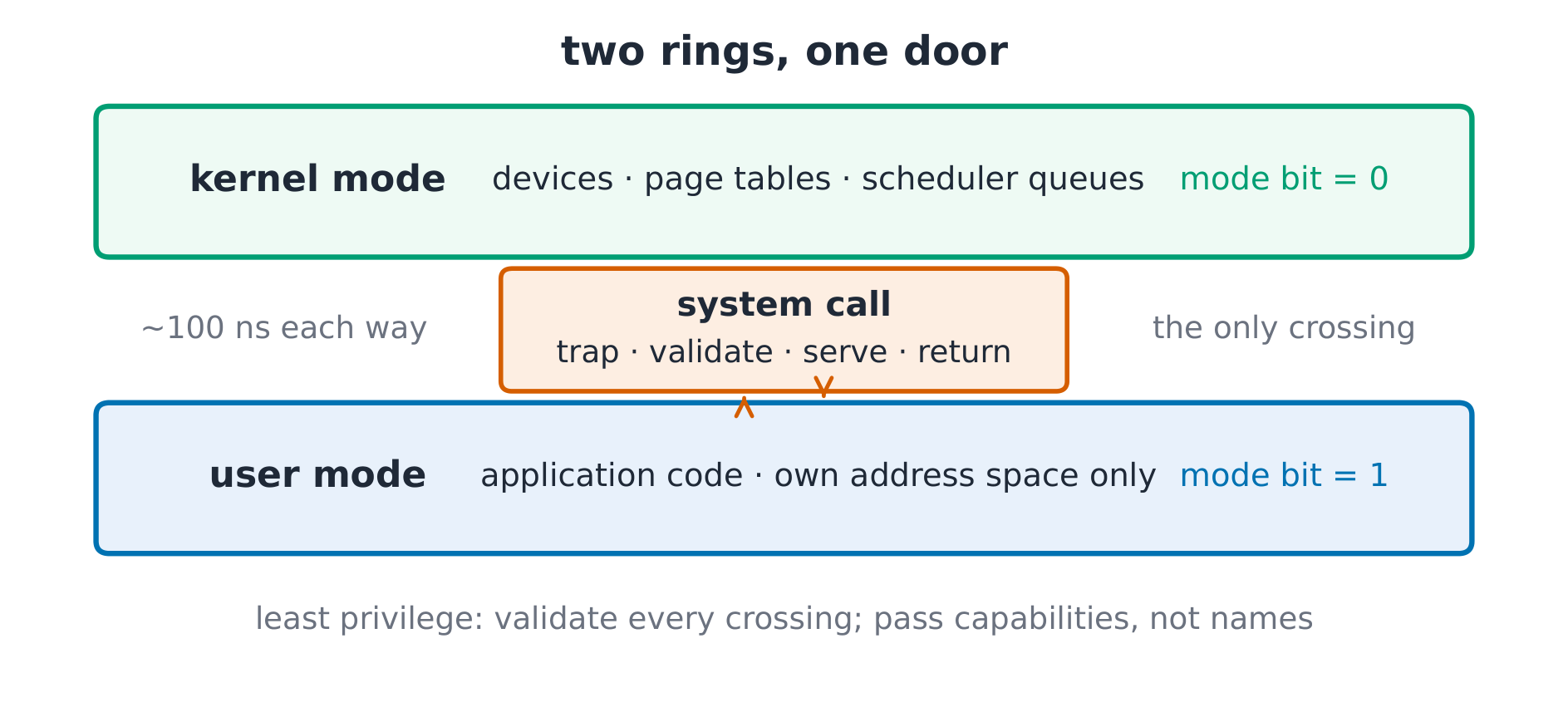
The derivation (the principle of least privilege). Every mechanism above is an attack surface: the scheduler's queues, the page table's bits, the file metadata. Least privilege 特权最小化 gives each process only what it needs: the page tables already do it per process (unit 7.4), file permissions do it per user (read/write/execute $\times$ owner/group/other $= 9$ bits), and capabilities do it per object. The economics: a bug in a smaller privileged base is a smaller target — the reason microkernels and sandboxed browsers exist.
Worked example 1 — one syscall's crossing. open("/notes/x")
from user mode: the trap instruction switches the mode bit, saves
user registers, jumps to a fixed vector; the kernel validates the
path (permissions), fills a file descriptor, returns — and the mode
bit flips back. Two crossings per syscall at $\approx 100$ ns each:
a program doing $10^6$ syscalls pays $0.2$ s — the reason libraries
buffer and batch.
Worked example 2 — the confused deputy. A privileged printer
daemon asked to print /salary.db by an unprivileged user: the
daemon's authority, not the user's, opens the file — a deputy
confused about whose wishes to execute. The fix is to pass
capabilities (open descriptors), not names: the deputy can only use
what it was handed. The wall's doors must check identity at every
crossing, or the wall itself becomes the weapon.
Common mistakes. Calling security a layer (it is a property of every layer). Checking permissions at open but not at use (TOCTOU: time-of-check to time-of-use). Trusting the pointer because it came from user space (validate at the boundary, always).
Summary. The mode bit makes the wall, syscalls are its doors, least privilege sizes the rooms; validate every crossing; pass capabilities, not names.