What this course is, and how to use it
This is the third course in University Computer Science: computer systems fundamentals 计算机系统基础 — from a bit to a running program: how numbers live in wires, how gates decide, how a processor steps, and how the OS and the toolchain deliver your program to silicon.
Scope limit, stated once: a study course, not a degree; every program fragment is original and self-contained.
- Units 3.1–3.2 are the machine's alphabet: bits, encoding, gates.
- Units 3.3–3.4 are the machine itself: processor, memory, instructions.
- Units 3.5–3.6 are the machinery around it: OS services, the compilation pipeline.
The systems habit: every abstraction is a contract with the layer below — each unit names the contract, and every conversion is something you can verify by script.
Binary and data encoding
Why it matters. Everything below the source code is bits: knowing how numbers, fractions and text are encoded explains every surprise from overflowing counters to 0.1 + 0.2 ≠ 0.3.
The idea, with a picture. Base-2 positional notation; $n$-bit unsigned 无符号 range $0$ to $2^n - 1$; two's complement 二进制补码 for signed: flip all bits, add 1 — range $-2^{n-1}$ to $2^{n-1} - 1$ ✓. The carry out of the top bit is always discarded; overflow 溢出 happens only when two operands of the same sign give a result of the other sign. IEEE-754 IEEE-754 浮点: sign, exponent (biased), fraction ✓; text: ASCII ASCII 码 (7 bits, 128 codes) and Unicode 统一码 (code points, UTF-8 variable width).
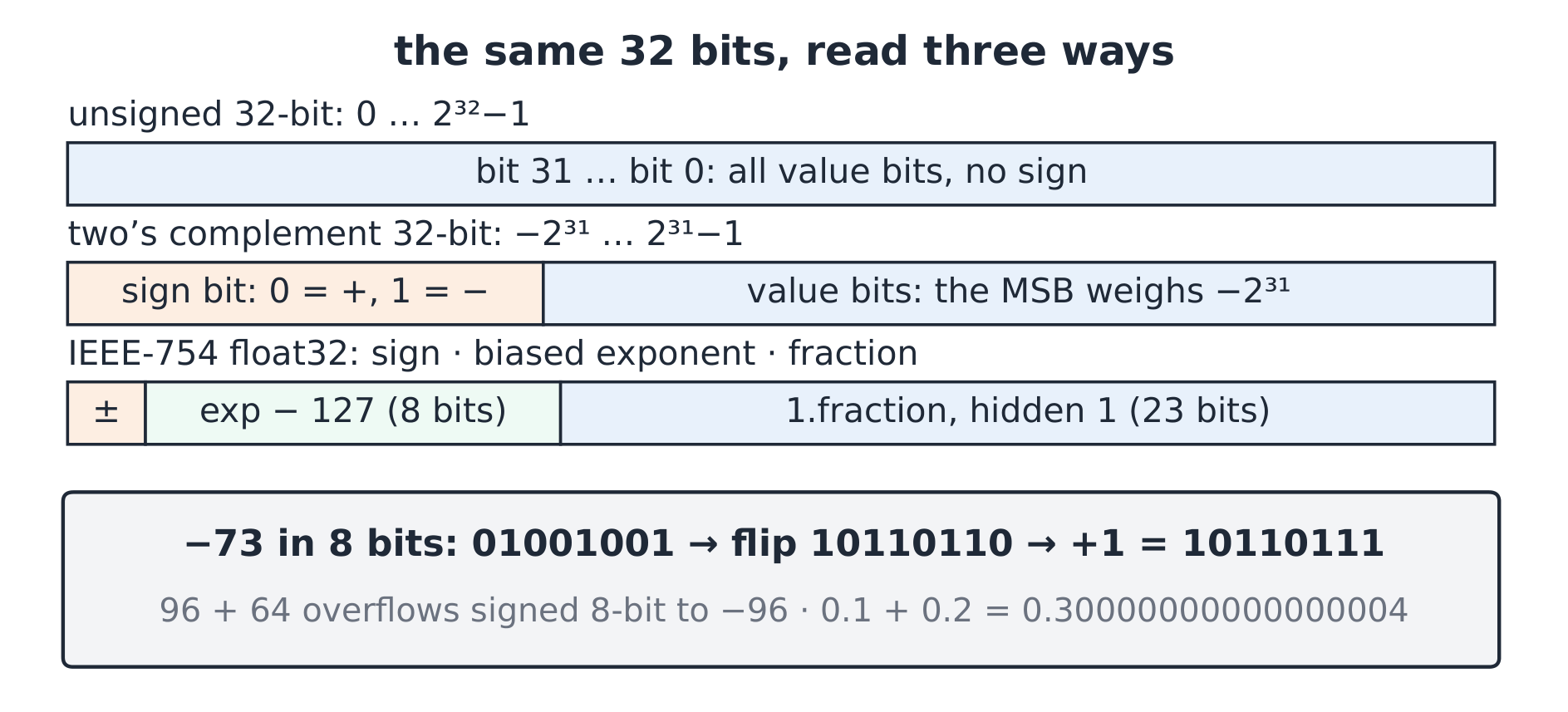
The derivation (why two's complement wins). Two's complement makes subtraction an addition: $a - b = a + (-b)$ with one adder. The proof is modular: $-b \equiv 2^n - b \pmod{2^n}$, and flip-plus-one computes exactly $2^n - b$ ✓. One circuit for + and −; that economy is why it became universal.
Worked example 1 — conversions and overflow. 8-bit two's complement: $-73$? $73 = 01001001_2$; flip $\to 10110110$; add 1 $\to 10110111 = -73$ ✓. Add $96 + 64 = 160$: unsigned fine ($10100000_2$), but signed 8-bit max is $127$ — overflow, and the stored pattern reads $-96$ ✓.
Worked example 2 — float surprises. $0.1$ in binary is infinite ($0.000110011\ldots$); IEEE rounds — so $0.1 + 0.2$ yields $0.30000000000000004$: a rounding 舍入 error, not a language bug ✓. Also: because the exponent scales the gap, adjacent floats are NOT evenly spaced — dense near zero, sparse far away.
Common mistakes. Assuming a bit pattern has one value: $10110111$ is $183$ unsigned but $-73$ signed (the bits are the bits; the type reads them). Expecting float equality after arithmetic. Confusing character code with number (the character 1 stores the code $49$, not $1$).
Summary. Unsigned $0..2^n-1$; two's complement flip-and-add-1, one adder for + and −; discard the sign carry; IEEE: sign-exponent-fraction with rounding; ASCII 7-bit, Unicode code points, UTF-8 variable width; $0.1 + 0.2 \ne 0.3$ by rounding.
Logic gates and digital building blocks
Why it matters. Gates are the physics-to-logic boundary: every program is ANDs, ORs and NOTs in the end, and boolean algebra is the optimiser.
The idea, with a picture. AND, OR, NOT; combine into NAND 与非门 (universal — every gate can be built from it ✓). Building blocks: the half adder 半加器 (XOR = sum, AND = carry), full adder 全加器 (two half adders + OR, carries chained into a ripple-carry adder), the multiplexer 多路选择器 (select line picks one input) ✓.
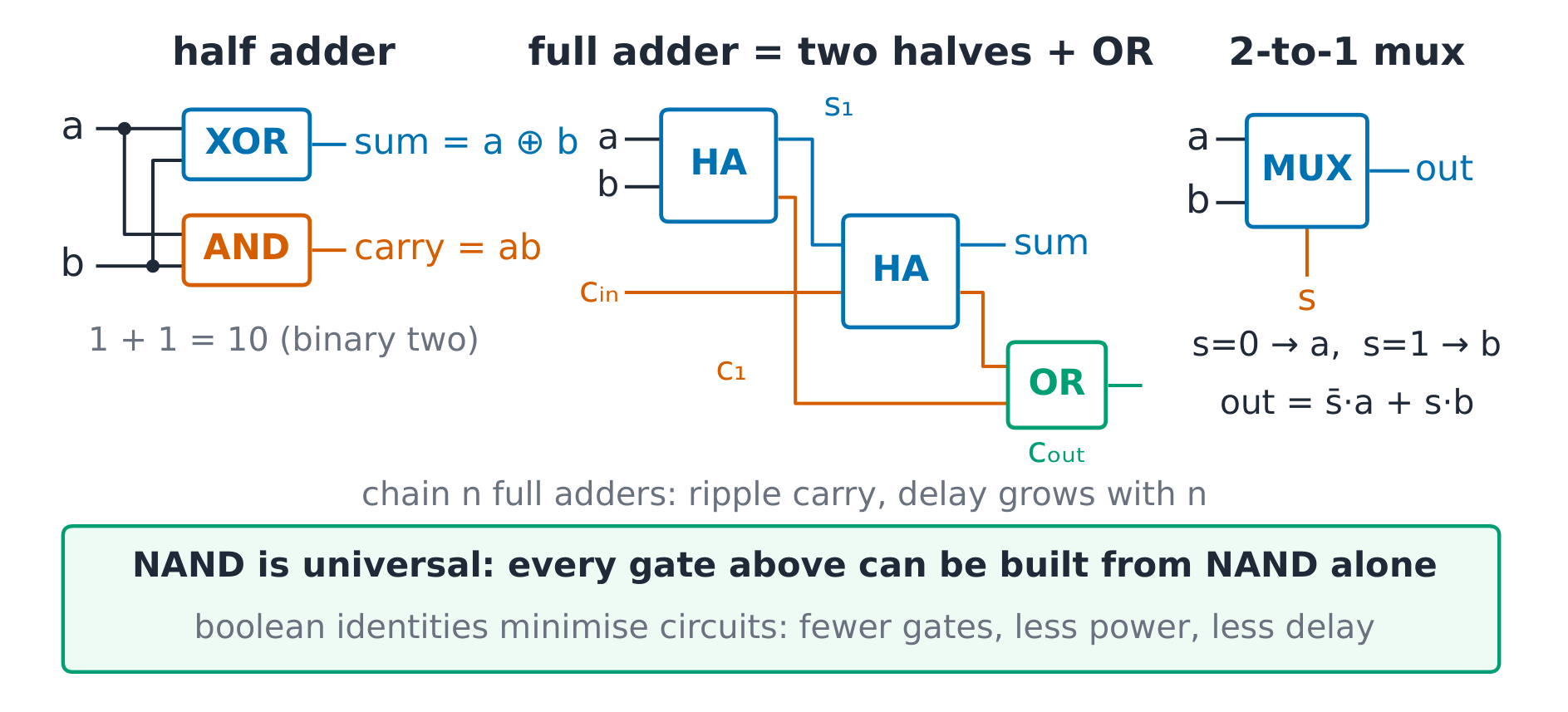
The derivation (why boolean algebra optimises circuits). Identities ($x + x = x$, $x \cdot x = x$, $x + \bar{x} = 1$) let two expressions with one truth table collapse into one circuit — e.g. the mux expression $x = \bar{s}\,a + s\,b$ is already minimal, while a naive OR of the four rows where the output is 1 is not ✓. Fewer gates, less power, less delay.
Worked example 1 — one-bit addition. Sum $s = a \oplus b$, carry $c = ab$: rows $1+0 \to s=1, c=0$; $1+1 \to s=0, c=1$ (binary 10) ✓ — two gates, correct arithmetic. Chain four for 0101 + 0011.
Worked example 2 — a 2-to-1 mux in gates. Output $= \bar{s}a + sb$: when $s = 0$, $a$ passes; when $s = 1$, $b$ passes ✓. Then 4-to-1 = three 2-to-1 stages. A 32-to-1 is the same idea, five layers deep.
Common mistakes. Writing XOR as OR (the $1+1$ row). Forgetting the carry chain's propagation delay (ripple adds gate-delays per bit). Believing gates are instantaneous (delay is what limits clock speed).
Summary. NAND universal; half adder XOR+AND; full adder chains; ripple-carry delay grows with width; mux $\bar{s}a + sb$; boolean identities minimise circuits.
Processor and memory overview
Why it matters. The CPU is a loop and the memory is a pyramid: both pictures explain speed, cost and why the cache 高速缓存 decides performance more than the clock.
The idea, with a picture. Fetch-decode-execute cycle 取指-译码-执行周期: fetch (PC $\to$ memory $\to$ IR), decode (instruction $\to$ control signals), execute (ALU / memory / PC update), PC $\to$ PC + 4 ✓. The memory hierarchy: registers (ns) $\to$ L1/L2/L3 cache $\to$ DRAM ($\sim$100 ns) $\to$ SSD $\to$ disk — each layer bigger and slower ✓.
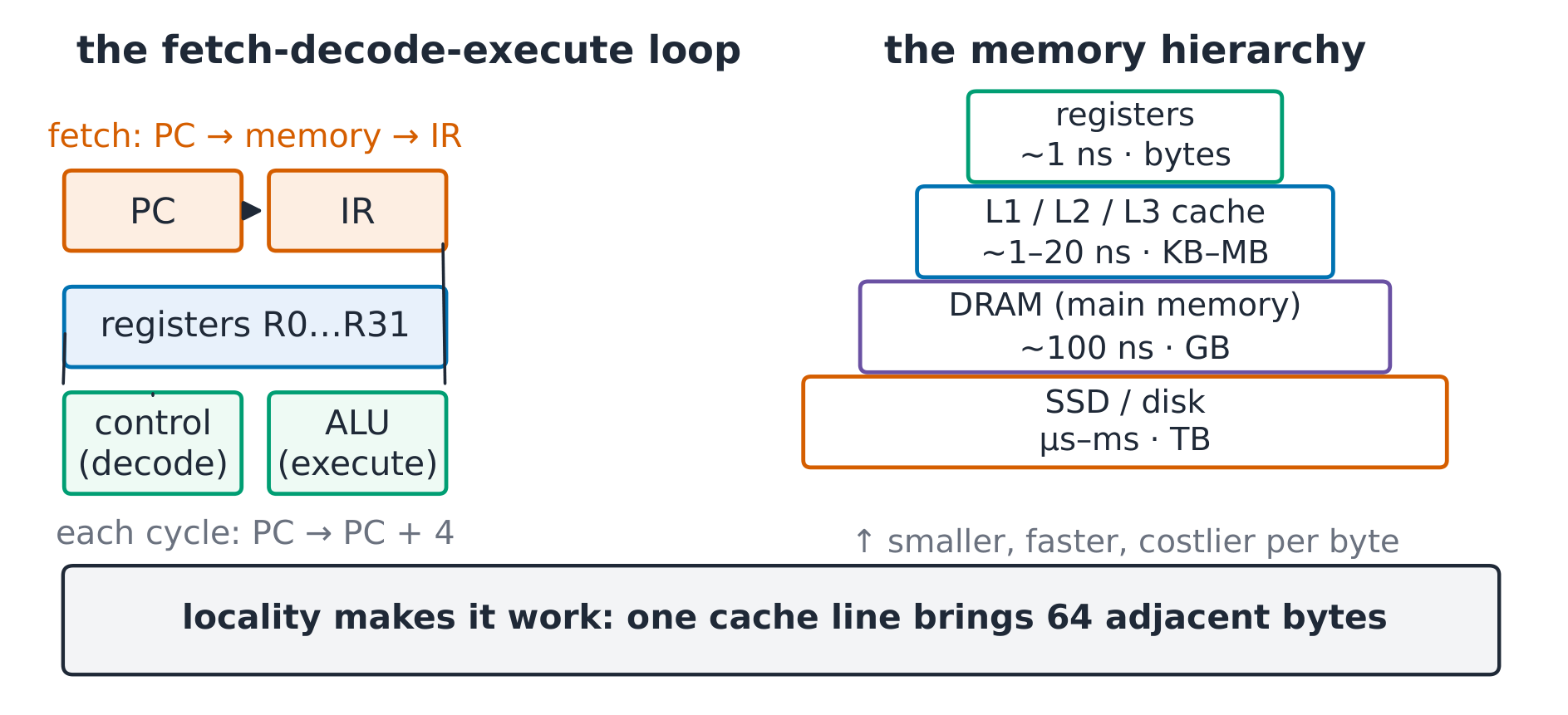
The derivation (why the hierarchy exists). Speed vs cost vs size is a physical trade-off: fast memory is expensive per byte, big memory is slow. The hierarchy exploits locality 局部性 — programs touch a small working set repeatedly (temporal) and nearby addresses (spatial) — so a small fast cache holds most references ✓.
Worked example 1 — tracing three instructions. LOAD R1, 0(R2) /
ADD R3, R1, R1 / STORE R3, 0(R2): each step registers change
(R1, then R3, then memory) ✓; the PC advances by 4 after each
instruction; a branch writes a new address into the PC.
Worked example 2 — why data layout matters. An array sum is limited by memory, not arithmetic: reading one cache line brings 64 adjacent bytes, so row-major access is fast; a transposed loop is many times slower at the same operation count ✓. The hierarchy, not the clock, decides.
Common mistakes. Confusing IR (instruction register) and PC. Reading DRAM latency in cycles as if constant (cache hits and misses differ by orders of magnitude). Assuming the CPU's view of memory is the physical one (3.5's virtual memory interposes).
Summary. Fetch $\to$ decode $\to$ execute, PC+4; registers-file-IR-ALU around the loop; hierarchy: registers-cache-DRAM-SSD; locality makes it work; data layout can dominate arithmetic.
Machine instructions
Why it matters. Assembly is the contract every compiler targets and every performance question bottoms out in: registers, immediates and memory moves.
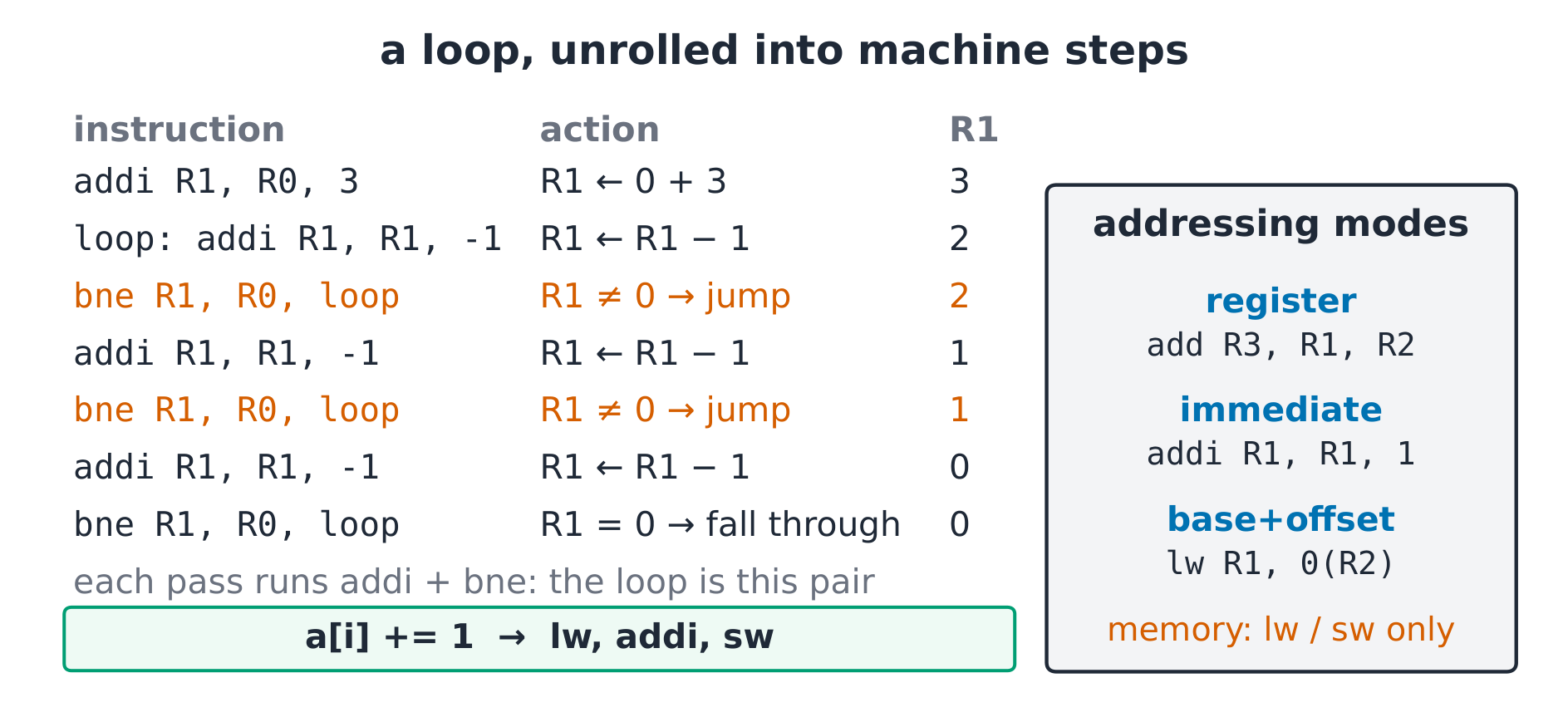
The idea, with a picture. RISC instructions: add rd, rs1, rs2
(registers only), addi (immediate), lw/sw (memory, addressing
like 0(R2)), beq/bne (compare and jump) ✓. Addressing modes
寻址方式: register, immediate, base+offset — memory only via
load/store.
The derivation (why RISC is load/store only). One instruction
shape decodes fast and pipelines well: every memory touch is an explicit
lw/sw; arithmetic is register-to-register. CISC packs memory access
into arithmetic — more compact, harder to pipeline ✓. The trade is
instruction count against per-instruction speed.
Worked example 1 — a loop in machine steps.
loop: addi R1, R1, -1; bne R1, R0, loop: subtract, compare-with-zero,
jump back — two instructions per iteration; a C while loop maps to
exactly this pair plus the body ✓.
Worked example 2 — mapping C to instructions. a[i] = a[i] + 1
compiles to lw (load), addi, sw (store) with the index scaled
into the offset ✓. Array indexing is address arithmetic; pointers are
base registers; that is the whole secret.
Common mistakes. Reading 0(R2) as the value 0 (it is the
offset 0 on base R2). Forgetting to initialise the loop counter
register. Using the index $i$ as the byte offset without scaling it by
the element width ($4i$ for 4-byte words).
Summary. add/addi/lw/sw/beq; memory only via load/store base+offset; while $\to$ decrement-and-branch; array indexing is scaled address arithmetic; a[i]+1 is lw-addi-sw.
The operating-system interface
Why it matters. No program touches hardware: the OS shares the machine safely — processes, virtual memory and files are the services every program consumes.
The idea, with a picture. A process 进程 = program + execution
state (address space, registers, open files); a context switch
上下文切换 saves and restores that state ✓. Virtual memory 虚拟内存:
each process sees its own addresses; the OS + hardware (TLB, page
tables) map virtual $\to$ physical. Files 文件 are named byte
streams; system calls 系统调用 (open, read, write, fork, execve) are
the boundary where your code asks the kernel ✓.
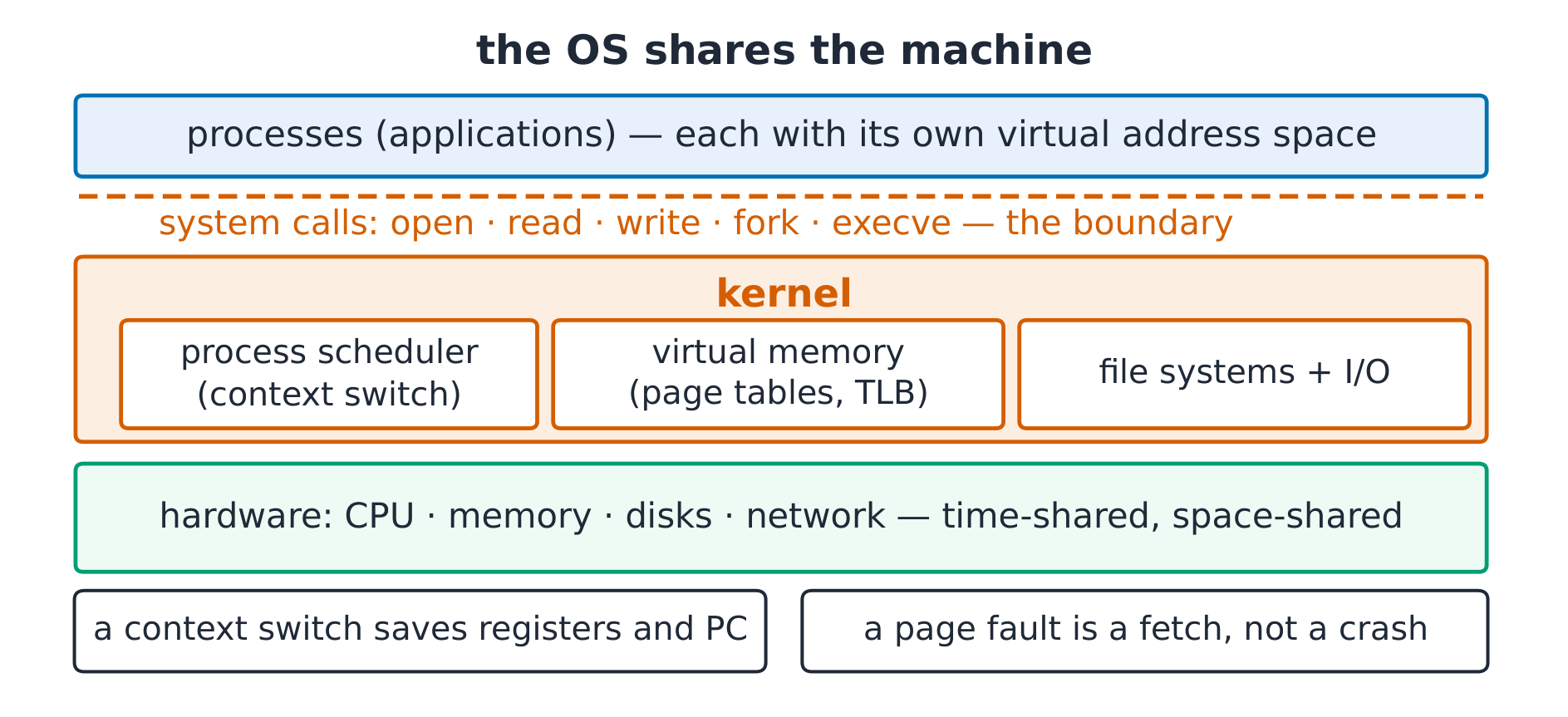
The derivation (why virtual memory). Isolation (one process cannot read another's pages), illusion (more memory than physical, via paging to disk), and convenience (programs link to fixed addresses) — three needs one abstraction serves ✓. A page fault 缺页 occurs when an access cannot proceed with the current page mapping or permissions. The OS may load or allocate a valid page; an invalid access may instead terminate the process.
Worked example 1 — what a context switch preserves. Registers, PC, memory mappings, open-file table: everything the next instruction of that process needs; what does NOT carry: CPU caches (shared, just cold) ✓. The save area per process is exactly this list.
Worked example 2 — a system call in C.
int fd = open(path, O_RDONLY); read(fd, buf, 4096); —
each call traps into the kernel, runs with kernel privileges, returns ✓.
The same trio from Python: open, read — the interface is the
contract, the language wraps it.
Common mistakes. Mixing process (own memory) and thread (shares memory). Believing malloc touches disk (memory, not files). Reading a page fault as always a crash or always a disk fetch (many valid faults are recoverable, while invalid accesses can fail).
Summary. Process = program + state; switch saves/loads it; virtual $\to$ physical via page tables; page faults require OS handling; system calls are the boundary; open/read/write/fork/execve.
Compilation and execution path
Why it matters. Source is not a program: the pipeline from .c to
a running process has four stages, each with its own error class — and
each stage's output is inspectable.
The idea, with a picture. Preprocessor 预处理 (expand #include
and #define — text only) $\to$ compiler 编译器 (C $\to$ assembly)
$\to$ assembler 汇编器 (assembly $\to$ object code, relocations
unresolved) $\to$ linker 链接器 (resolve symbols across objects +
libraries $\to$ executable) ✓; the loader starts it as a process (3.5).
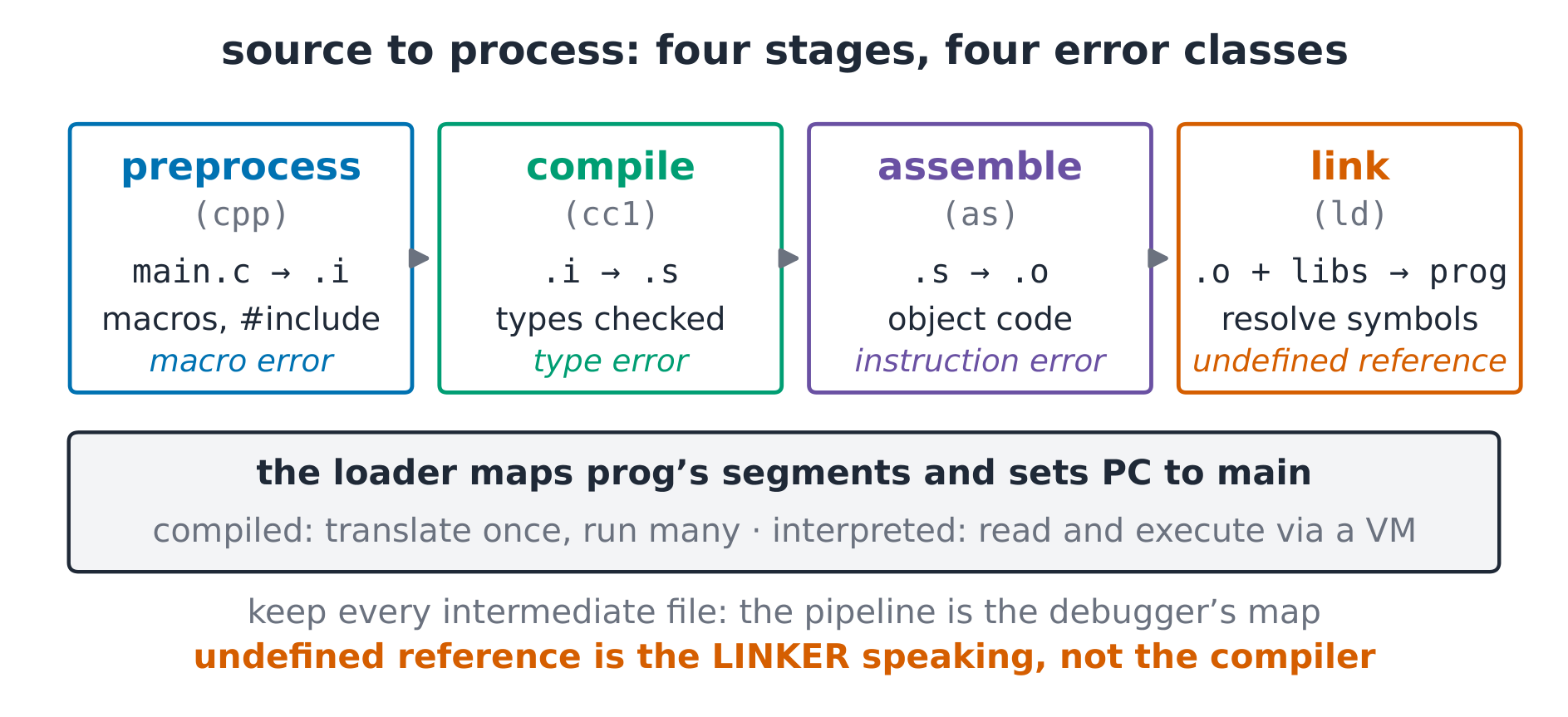
The derivation (why stages separate). Separate compilation: a million-line program recompiles one changed file; libraries distribute as objects/so-files; each error localises to one stage — macro errors, type errors, instruction errors, symbol errors ✓. The pipeline is an engineering economy, not a formality.
Worked example 1 — the four files. main.c $\to$ (cpp) main.i
$\to$ (cc1) main.s $\to$ (as) main.o $\to$ (ld) prog; the
extensions name the stages ✓. Any intermediate can be inspected with
the right flag.
Worked example 2 — compiled vs interpreted. C: all four stages before running (fast, machine-specific binary). Python: source is read and executed by an interpreter (CPython compiles to bytecode, the VM runs it) ✓. Compile once-run-many vs read-every-run: the trade in one line.
Common mistakes. Calling every failure a compile error (undefined reference is the LINKER). Forgetting headers are text (macros have no type). Assuming optimisation cannot change float results (reassociation can).
Summary. cpp (text) $\to$ cc (types) $\to$ as (instructions) $\to$ ld (symbols); undefined reference = linker; compiled vs interpreted is when translation happens.