What this course is, and how to use it
This is the fourth course in University Computer Science: object-oriented programming 面向对象程序设计 — how to grow a small script into a system that other people can safely change: objects that own their state, interfaces that hide their machinery, and tests that hold the line while you refactor.
Scope limit, stated once: a study course, not a degree; Python 3 is the vehicle, and every program fragment is original, self-contained, and was executed to produce the outputs shown.
- Units 4.1–4.2 build the object (classes, references, walls); 4.3–4.4 connect them; 4.5–4.6 keep the system alive.
The design habit: every class is a contract with its callers — each unit names the contract, and every example is a program you can run.
Objects and classes
Why it matters. Programs fail when state lives everywhere: a class 类 bundles state and behaviour so there is exactly one place to look. From here on, every system you build is classes talking.
The idea, with a picture. A class is a blueprint; an instance
实例 (an object 对象) is one thing built from it. __init__ runs at
construction and seeds the instance attributes 实例属性; methods
take self, the instance itself. Class attributes 类属性 live on
the class and are shared by all instances. Assignment never copies: a
variable is a reference 引用 to an object, so two names can be
aliases 别名 of one object.
class Book:
    next_id = 1                # class attribute, shared

    def __init__(self, title, copies):
        self.id = Book.next_id; Book.next_id += 1
        self.title = title
        self.copies = copies   # instance attribute

    def take(self):
        self.copies -= 1; return self.copies
The lookup order (a derivation). obj.x resolves by walking outward:
the instance dict first (obj.__dict__), then the class dict, then the
base classes. That single rule explains the classic trap: assigning
obj.next_id = 9 does not touch the class — it shadows it for that one
instance. id above lands in the instance dict; next_id stays in the
class dict, so the books get ids 1, 2, 3, … and Book.next_id always
holds the next free number.
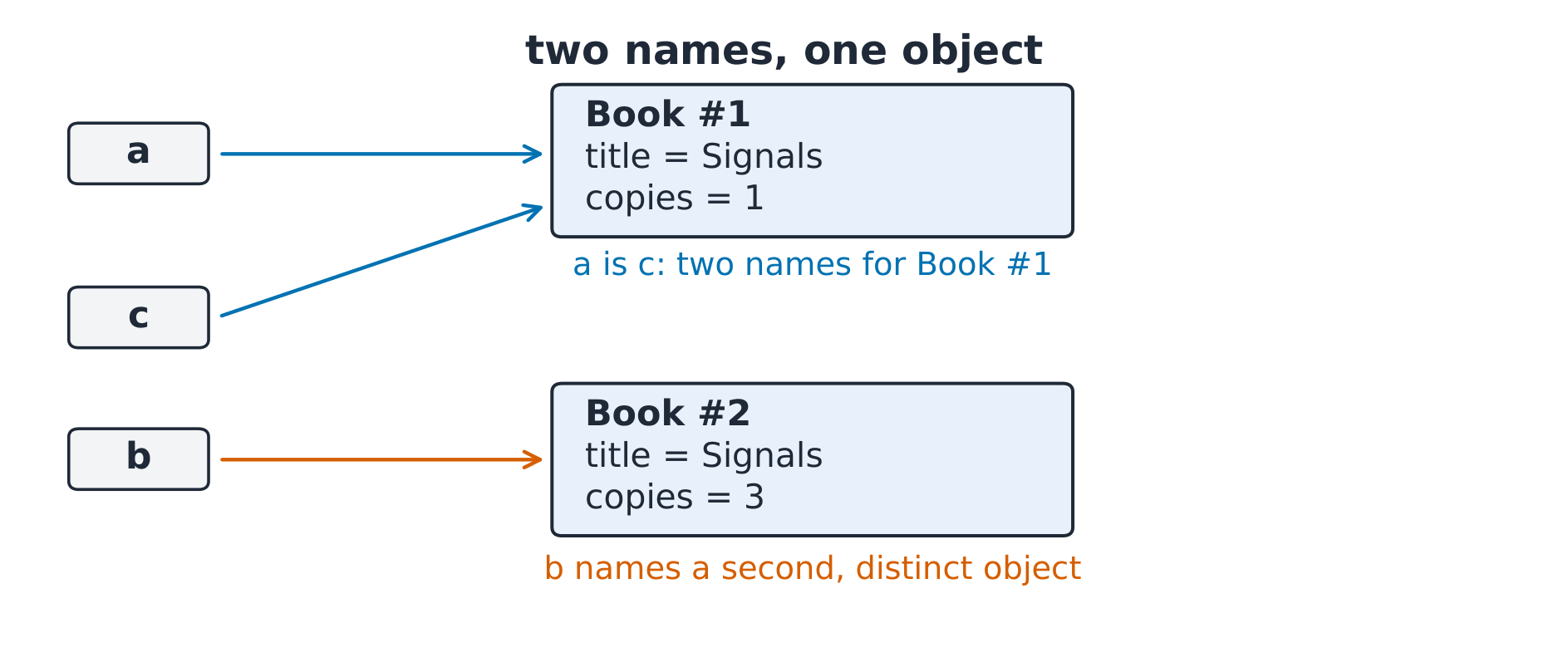
Worked example 1 — one class, traced. With Book above:
a = Book('Signals', 3)
b = Book('Signals', 3)
c = a
a.take(); a.take()
State after: a.copies is $1$, b.copies is $3$ (untouched), and
because c is a, c.copies is also $1$ — one object, two names.
a == b is False (default equality is identity) while a is c is
True: equality 相等 compares values (once you define how), identity
同一 (is) compares objects.
Worked example 2 — the shared counter. After a and b above,
Book.next_id, a.next_id and b.next_id all read $3$ — the counter
belongs to the class, so every caller agrees. Write a.next_id = 9
and only a reads $9$: the class still says $3$, and the next book
still gets id $3$.
Common mistakes. Forgetting self in a method header. Mutating a
class attribute through an instance and wondering why others disagree.
Expecting d = c to copy — it aliases.
Summary. Class = blueprint, instance = thing; instance dict shadows
class dict; assignment aliases, never copies; is is identity, ==
is (defined) equality.
Encapsulation
Why it matters. Every class owns an invariant 不变量 — a statement that is true between calls (a copy is either on the shelf or out to one borrower, nothing else). Encapsulation 封装 is the discipline of letting that statement stay true: state is private, changes pass through methods that check it.
The idea, with a picture. By convention a leading underscore marks
internal state (_copies); callers use the public methods — the
interface boundary. Validate at the gate: the constructor and every
mutating method re-establish the invariant or refuse.
class Copy:
    def __init__(self, title):
        if title == '': raise ValueError('empty title')
        self._title = title; self._out = False

    def issue(self):
        if self._out: raise ValueError('already out')
        self._out = True

    def give_back(self):
        if not self._out: raise ValueError('not out')
        self._out = False

    def is_out(self):        # public reader, no wall breach
        return self._out
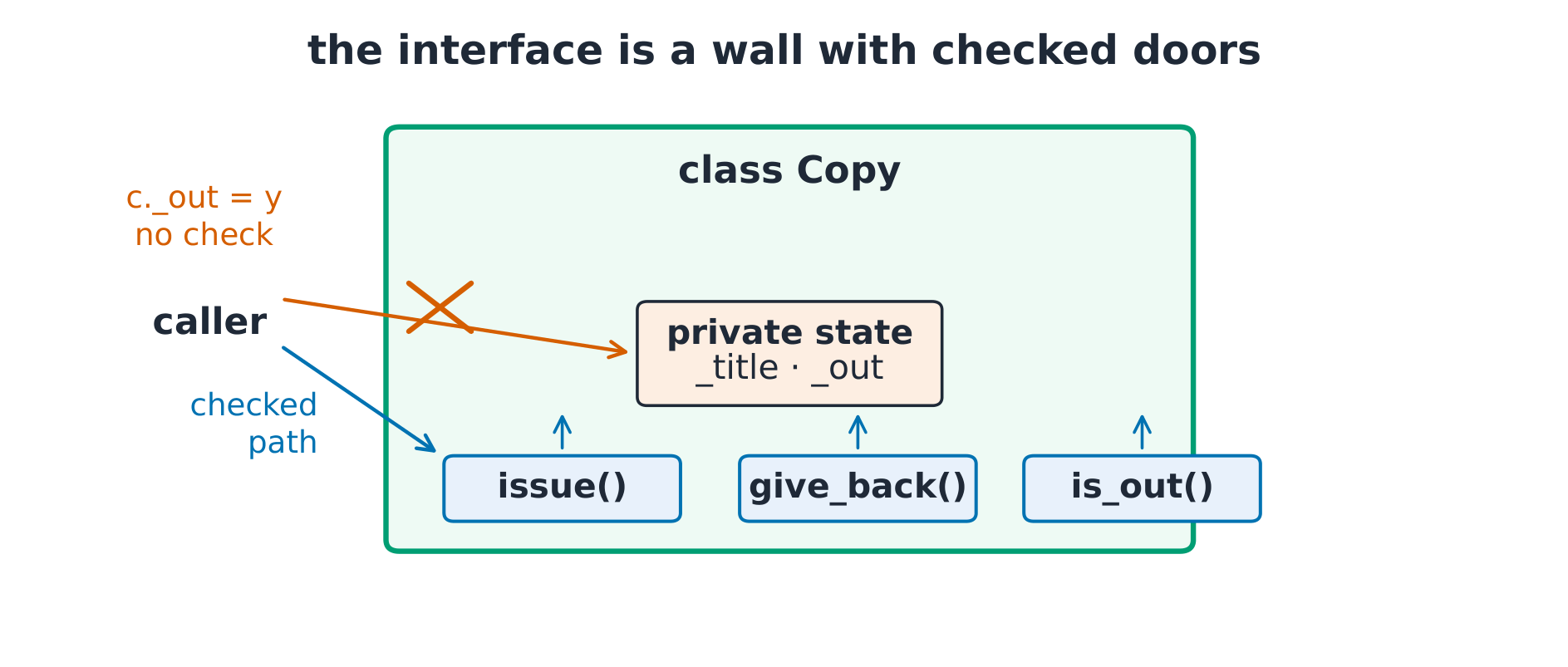
The derivation (why one gate is enough). If every path that touches
_out goes through issue/give_back, the invariant (_out is exactly
True or False) is provable from two small
methods. Add one unchecked writer and the proof is gone — the number of
places to check grows with every caller, and so does the bug rate.
Worked example 1 — the wall holds. c.issue() succeeds;
c.issue() again raises ValueError — the caller cannot reach an
impossible state, and after the failed call the object is unchanged
(check-first, so no rollback is needed). c.give_back(); c._out is
False, and c.issue() works again: exactly the states True /
False, nothing else, forever.
Worked example 2 — the cost of a leak. A teammate in a hurry writes
c._out = 'y'. Nothing stops them — underscore is convention — and now
is_out() answers 'y': truthy but not True. One caller
(if c.is_out():) shelves the copy as out; another
(if c.is_out() is True:) shelves it as available — two readers
disagree about one object, a state no method could ever produce.
Repair cost scales with every reader of _out; the validation cost was
two if statements. That asymmetry is the whole argument.
Common mistakes. Returning the internal list (return self._loans)
— callers mutate your private state; return a copy. Validating in the
constructor but not in the setter. Writing get/set pairs for everything:
expose behaviour (available()), not storage.
Summary. Underscore marks intent; methods validate at the gate; one checked path per change keeps invariants provable; expose behaviour, not fields.
Composition and inheritance
Why it matters. Objects connect two ways: inheritance 继承
(is-a: a Member is a Person) and composition 组合 (has-a: a
Library has a Catalog). Choosing wrong couples classes so tightly
that a base-class fix breaks its children — the fragile base class
脆弱基类 problem.
The idea, with a picture. Inheritance chains initialisation:
super().__init__(...) walks up the chain, base first. Composition
delegates: the whole object owns parts and forwards calls.
class Person:
    def __init__(self, name):
        self._name = name

class Member(Person):
    def __init__(self, name, card_no):
        super().__init__(name)      # base first
        self._card = card_no; self._loans = 0

    def borrow(self):
        self._loans += 1; return self._loans
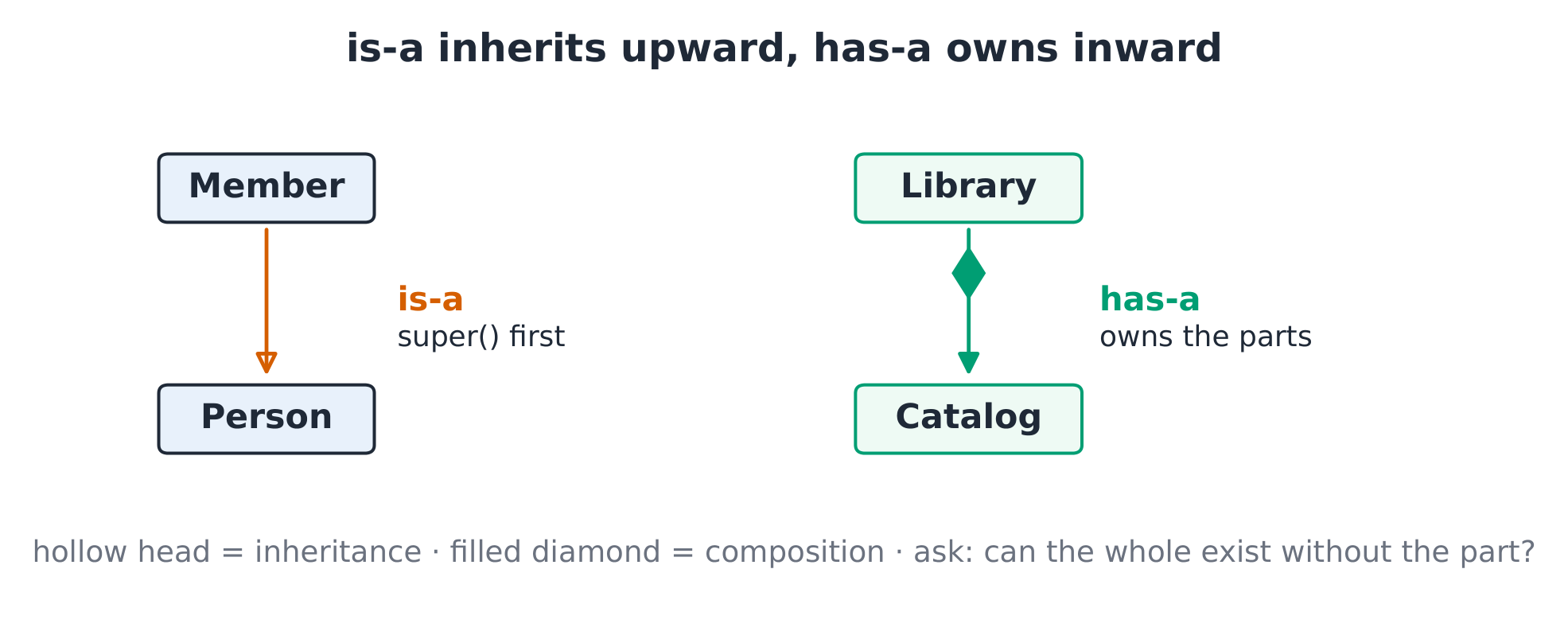
The derivation (initialisation order). Member('Ana', 7) runs
Member.__init__, whose first act is super().__init__('Ana') — so
Person.__init__ completes before any Member line executes. Order is
always base-first down the chain; skip the super() call and self._name
does not exist when Member needs it, failing with a clear AttributeError
instead of corrupting quietly.
Worked example 1 — composition delegates. A Library has a
Catalog (a list of Copy):
class Library:
    def __init__(self):
        self._shelves = []          # composition

    def add(self, copy): self._shelves.append(copy)

    def available(self):
        return sum(1 for c in self._shelves if not c.is_out())
After adding 5 copies and issuing 2, available() is $3$ — the library
owns no borrowing logic; it asks its part. Swap the list for a database
listalike and Library is untouched: parts change, the whole keeps its
interface.
Worked example 2 — the fragile base. Base Receipt.total() sums
items; a subclass overrides by copying the summing code and subtracting
$10$. The base then gains a loyalty line — every discount receipt
silently loses it: the copy is a fork. Repair: return super().total() - 10 — override by delegating. Inheritance for is-a,
composition for everything else.
Common mistakes. Inheriting to reuse two methods (composition or a
module function instead). Forgetting super().__init__. Duplicating
base logic in an override — the fork that goes stale.
Summary. is-a inherits (and calls super()); has-a composes (and
delegates); never copy base logic into an override.
Interfaces and polymorphism
Why it matters. Big systems survive change when callers depend on what a thing does, not which class it is. An interface 接口 names the behaviour; polymorphism 多态 is one call site running many implementations.
The idea, with a picture. Python is dynamically typed: any object
with the right methods fits — duck typing 鸭子类型. To make the
contract explicit, write a Protocol (or abc.ABC) naming the methods.
class Notifier(Protocol):
    def send(self, text: str) -> str: ...

class EmailNotify:
    def send(self, text): return f'email: {text}'

class SmsNotify:
    def send(self, text): return f'sms: {text}'
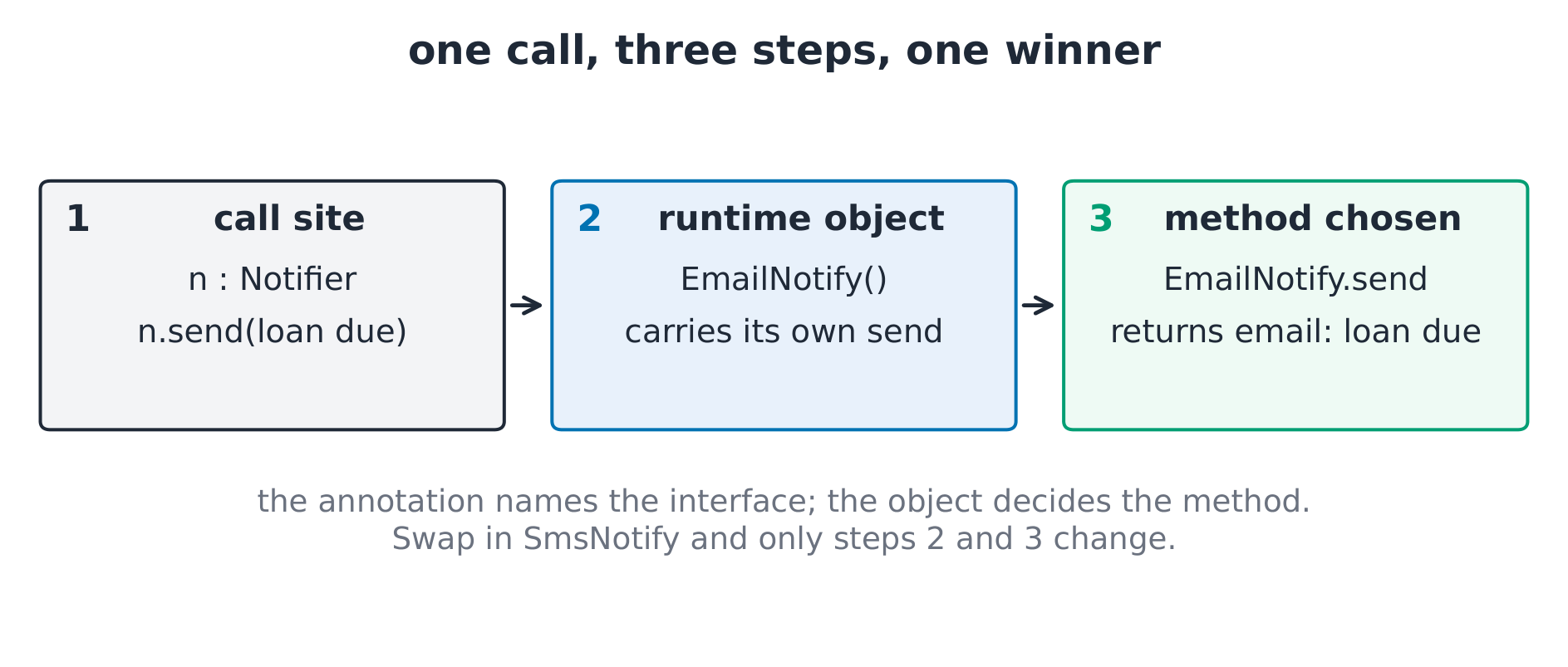
The derivation (dynamic dispatch). When n.send('due') runs, the
attribute lookup of 4.1 resolves on the runtime type 运行时类型 —
the object itself, not the variable's annotation. So one loop body
dispatches to a different send per element. That is dynamic
dispatch 动态绑定: the call site is written once, the selection
happens per object at call time.
Worked example 1 — one loop, three senders. With a third sender
QueueNotify of the same shape and team = [EmailNotify(), SmsNotify(), QueueNotify()]:
for n in team:
    print(n.send('loan due'))
Three lines out — email: loan due, sms: loan due, queue: loan due — and adding a fourth sender touches no existing line: the caller
was never told the concrete classes. This is the open/closed 开闭
shape: open to new types, closed to edit.
Worked example 2 — substitution and its trap. A substitute that
honours the contract slots in invisibly. One that narrows it fails
silently: a SilentNotify.send that raises on an empty string breaks a
caller whose contract said send never raises. The rule of
substitution 替换 (Liskov): preconditions may only widen,
guarantees only grow.
Common mistakes. isinstance chains — replace with a method each
class implements. An override that adds a precondition or drops a
guarantee: the caller cannot tell, until it breaks.
Summary. Name behaviour with a Protocol; depend on the name; dispatch follows the runtime type; substitutes must honour the whole contract.
Exceptions and error handling
Why it matters. Errors travel. A function three frames down cannot fix a failure, but it must not ignore it. Exceptions 异常 carry an error to the frame that can decide, running each frame's cleanup on the way.
The idea, with a picture. raise throws; try/except catches by
type; finally runs on every path. A custom hierarchy lets
callers catch precisely: broad base, specific children.
class LoanError(Exception): ...
class RenewalError(LoanError): ...
class LimitError(RenewalError): ...

class Loan:
    def __init__(self, days):
        self.days = days

def renew(loan, extra):
    if loan.days + extra > 30:
        raise LimitError(f'{loan.days}+{extra} exceeds 30')
    loan.days += extra
    return loan.days
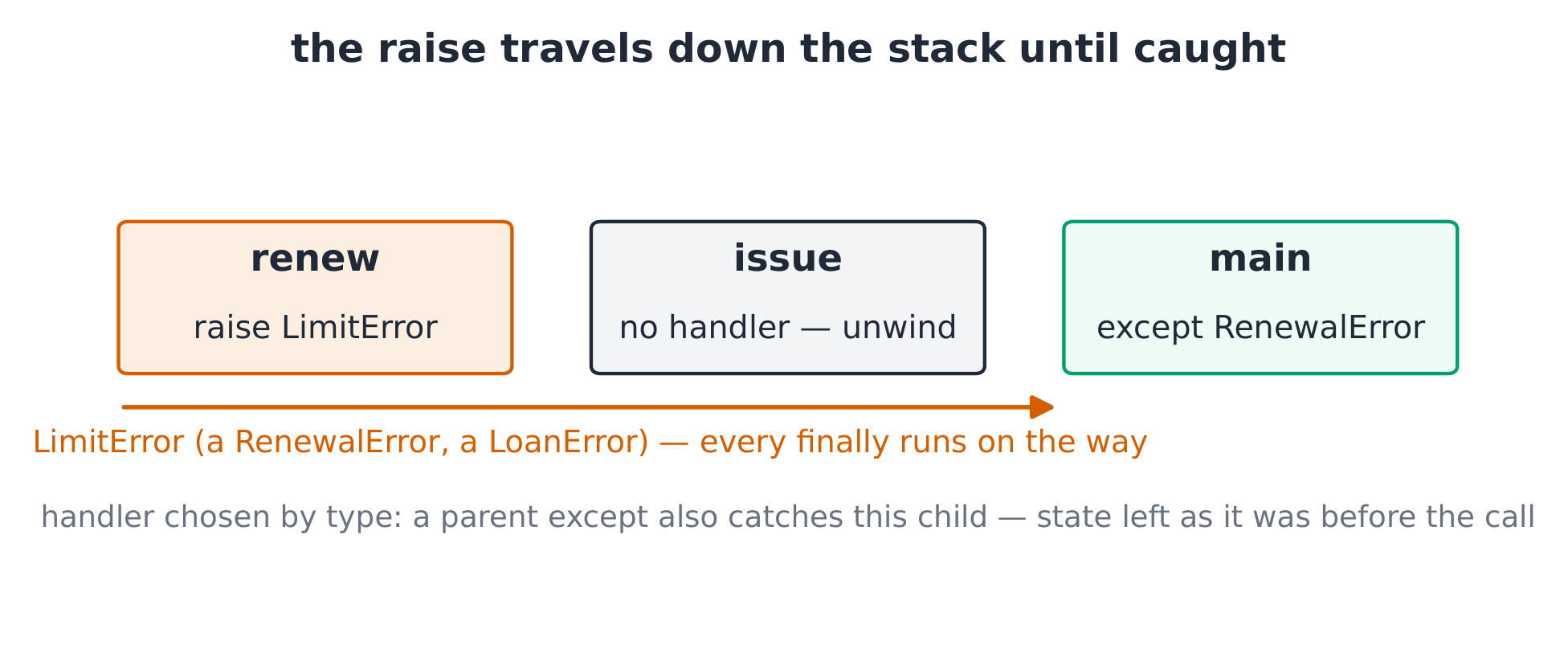
The derivation (status values vs exceptions). A return of $-1$ is a
normal value: the compiler and runtime attach nothing to it, so a caller
that forgets to check keeps computing with nonsense — the failure
spreads silently. An exception, once raised, cannot be ignored: it
unwinds frame by frame (running each finally) until some except
matches; if none does, the program stops loudly. Ignorable errors get
ignored; unignorable errors get handled. Choose status values for
expected, caller-adjacent outcomes (a miss in a lookup), exceptions
for broken contracts and failures the immediate caller cannot fix.
Worked example 1 — precise catch. renew(Loan(20), 15) raises
LimitError with message 20+15 exceeds 30; the caller catches
RenewalError (a parent) and the loan still reads $20$: check-first
means failed calls leave state untouched. Hierarchy is a filter — the
caller picks the grain.
Worked example 2 — cleanup on both paths. A lock guard:
locked = True
loan = Loan(28)
try:
    total = renew(loan, 10)          # raises
except RenewalError:
    kept = 'handled'
finally:
    locked = False
Trace: renew raises; except runs (kept = 'handled'); finally
runs; afterwards locked is False and the loan still reads $28$ —
released on the failing path. On the success path finally runs just
the same. Cleanup that must happen goes in finally (or a
with block), never after the last statement.
Common mistakes. except: bare — catches KeyboardInterrupt and
hides real bugs. except ... pass — the failure vanishes and state is
half-updated. Catching Exception when you meant one specific child.
Summary. Raise on broken contracts, catch at the frame that can
decide, finally for cleanup; a small hierarchy buys precise handling;
failed calls must leave state unchanged.
Testing and design quality
Why it matters. Refactoring — changing structure without changing behaviour — is only safe when behaviour is pinned. Unit tests 单元测试 are that pin, and the good ones test behaviour, not methods.
The idea, with a picture. One test = one behaviour: arrange
准备 the objects, act 执行 one call, assert 断言 the observable
outcome. Behaviours, not methods: renew past the limit raises is a
behaviour; test_days is a method.
def test_renew_ok():
    loan = Loan(20)                  # arrange
    out = renew(loan, 7)             # act
    assert out == 27                 # assert

def test_renew_boundary():
    assert renew(Loan(20), 10) == 30     # exactly 30 is allowed

def test_renew_limit():
    loan = Loan(20)
    try:
        renew(loan, 11); assert False
    except LimitError:
        assert loan.days == 20       # unchanged
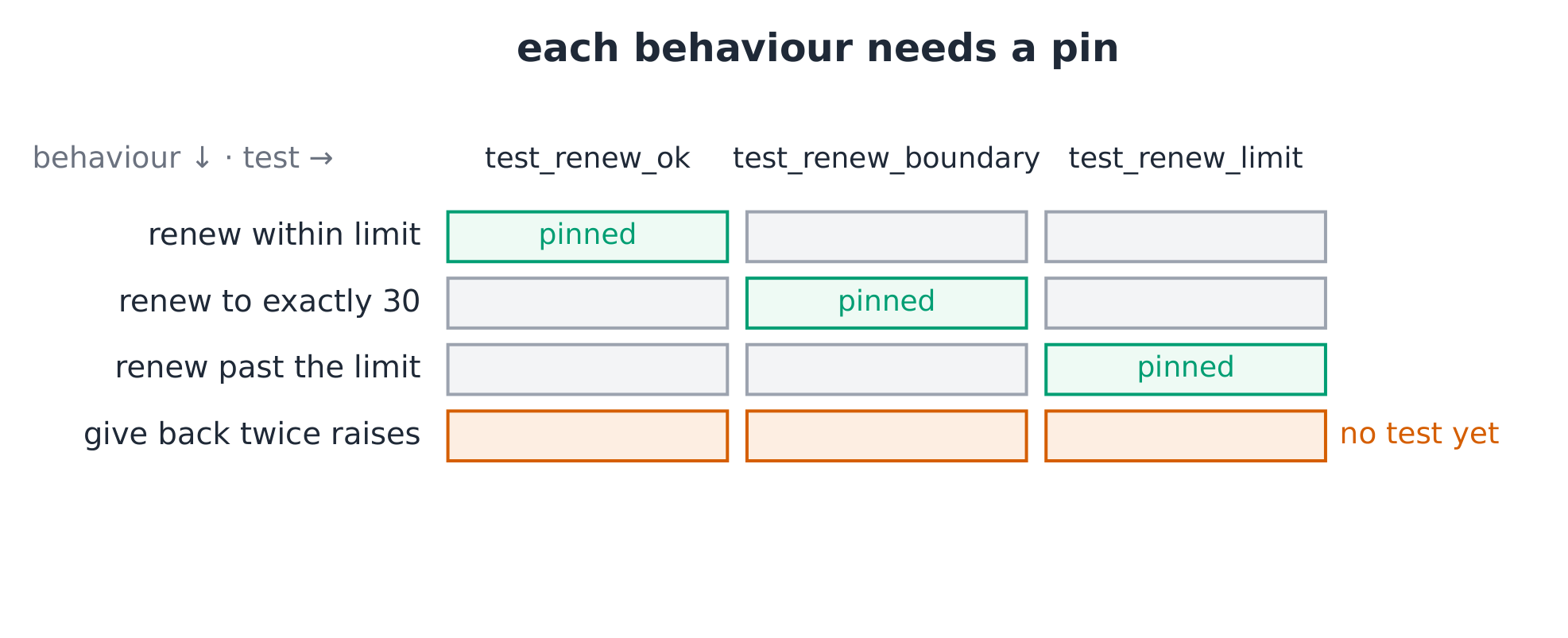
The derivation (why behaviour-first). A method-named test breaks on every rename and survives every behaviour change — noise without safety; a behaviour-named test does the opposite. Coverage follows the behaviour list: every branch of the contract is one row, and the grid shows the next hole.
Worked example 1 — three behaviours, three tests. For renew:
within the limit ($20 + 7 = 27$), exactly at the limit ($20 + 10 = 30$
is allowed, because the check is $> 30$), and past it ($20 + 11$
raises, state unchanged). The boundary test catches the classic slip
of writing >= for >. Running them prints 3 passed.
Worked example 2 — refactor under green. The loan's fine
calculation moves out of Loan into a FineCalculator class (single
responsibility principle 单一职责原则: one reason to change). The
three tests are untouched, still 3 passed — behaviour preserved while
structure moved: coupling 耦合 went down, cohesion 内聚 went
up.
Common mistakes. Asserting private internals — refactors break such tests. Shared mutable test state (test B passes only after test A ran). Chasing line coverage on getters while the limit branch has no test.
Summary. Arrange-act-assert per behaviour; tests pin behaviour so refactors are safe; SRP lowers the cost of change; low coupling and high cohesion are the direction of every move.