Skip to content · ⁨コンテンツへスキップ⁩
Subjects · ⁨科目⁩

AP Calculus BC

Tips · ⁨ヒント⁩

AP計算BCにはAB全部内容に加え、パラメータ曲線・極座標・ベクトル関数、高度な積分法、反常積分、ロジスティック成長、そして最大の追加内容として無限級数(誤差範囲を含むテイラー級数・マクローリン級数など)が含まれます。

級数はBC合格の鍵となります。 収束判定法は次々と試すのではなく、適切に選び取ることが必要です。級数を与えられた瞬間にその形に対応する判定法を秒単位で特定し、判定法の名称を述べてその条件を満たすことを確認できるようになっていなければなりません。

BCはABのサブスコアも提出するため、ABの内容は完全に評価対象であり、後回しにしてはいけません。

本ノートはCED順にABおよびBCの内容を網羅しており、級数には十分な篇幅を割いています。公開された過去問題はライブラリにあります。ABサブスコアは同一の試験紙から算出されるため、AB単元は要約されずに完全な深さでノートに含まれています。

  • 1

    Limits and Continuity

    Watch lesson · ⁨レッスンを視聴⁩
    1.1

    Introducing Calculus: Can Change Occur at an Instant?

    Syllabus · ⁨シラバス⁩
    English

    Enduring Understanding (CHA-1): Calculus allows us to generalize knowledge about motion to diverse problems involving change.

    Learning Objective CHA-1.A: Interpret the rate of change at an instant in terms of average rates of change over intervals containing that instant.

    • CHA-1.A.1 Calculus uses limits to understand and model dynamic change.
    • CHA-1.A.2 Because an average rate of change divides the change in one variable by the change in another, the average rate of change is undefined at a point where the change in the independent variable would be zero.
    • CHA-1.A.3 The limit concept allows us to define instantaneous rate of change in terms of average rates of change.
    日本語

    持続的認識 (CHA-1): 微分積分学により、運動に関する知識を、変化を含む多様な問題に一般化できる。

    学習目標 CHA-1.A: 平均変化率を用いて、ある瞬間における変化の割合を解釈する。

    • CHA-1.A.1 微分積分学は極限を用いて、動的な変化を理解しモデル化する。
    • CHA-1.A.2 平均変化率は、ある変数の変化量を他の変数の変化量で割ることで定義されるため、独立変数の変化量がゼロとなる点では平均変化率は定義されない。
    • CHA-1.A.3 極限の概念により、瞬間的な変化の割合を平均変化率として定義できる。

    Source: College Board AP Course and Exam Description · ⁨出典: College Board AP コースおよび試験説明書⁩

    English

    Calculus is the mathematics of change 变化 and of accumulation 累积. It answers two big questions: how fast is something changing right now, and how much has piled up so far? Unit 1 builds the one tool both questions rest on – the limit 极限.

    Start with a puzzle. A car's speedometer reads $60$ km/h. What does that mean at a single instant 瞬间? Speed is distance over time. But at one instant no time passes and no distance is covered, so the fraction looks like $\tfrac{0}{0}$ – undefined.

    • The average rate of change 平均变化率 uses a whole interval 区间: the change in one quantity divided by the change in another. It divides by zero, and so is undefined, when the change in the input would be zero.
    • The instantaneous rate of change 瞬时变化率 is what we want at a point. It is the value the average rate approaches 趋近 as the interval shrinks toward zero length.

    The clever move is not to plug in zero (undefined), but to watch what the average rate approaches as the interval gets smaller and smaller. That approaching value is a limit. So calculus lets us describe change at an instant – as a limit of average rates over ever-shorter intervals. This one idea powers the derivative 导数 (Unit 2) and, run in reverse, the integral 积分 (Unit 6). Everything else in this unit defines limits carefully and computes them reliably.

    日本語

    Calculus is the mathematics of change 变化 and of accumulation 累积. It answers two big questions: how fast is something changing right now, and how much has piled up so far? Unit 1 builds the one tool both questions rest on – the limit 极限.

    Start with a puzzle. A car's speedometer reads $60$ km/h. What does that mean at a single instant 瞬间? Speed is distance over time. But at one instant no time passes and no distance is covered, so the fraction looks like $\tfrac{0}{0}$ – undefined.

    • The average rate of change 平均变化率 uses a whole interval 区间: the change in one quantity divided by the change in another. It divides by zero, and so is undefined, when the change in the input would be zero.
    • The instantaneous rate of change 瞬时变化率 is what we want at a point. It is the value the average rate approaches 趋近 as the interval shrinks toward zero length.

    The clever move is not to plug in zero (undefined), but to watch what the average rate approaches as the interval gets smaller and smaller. That approaching value is a limit. So calculus lets us describe change at an instant – as a limit of average rates over ever-shorter intervals. This one idea powers the derivative 导数 (Unit 2) and, run in reverse, the integral 积分 (Unit 6). Everything else in this unit defines limits carefully and computes them reliably.

    Explore · ⁨探索⁩

    Explore the slope at an instant

    y = bx² + d

    Slide the point along the curve. The tangent line shows the exact rate of change $\frac{dy}{dx}$ there — the value the average rates approach as the interval shrinks to a single instant. The slope changes with position, so change does have a value at each instant.

    Vocabulary · ⁨語彙⁩ Train · ⁨練習する⁩
    English 日本語
    change/tʃeɪndʒ/ 変化量
    accumulation/əˌkjuːmjʊˈleɪʃn/ 蓄積
    limit/ˈlɪmɪt/ 限界
    at a single instant/ætə ˈsɪŋɡl ˈɪnstənt/ 一点瞬間において
    average rate of change/ˈævrɪdʒ reɪt ɒv tʃeɪndʒ/ 平均変化率
    interval/ˈɪntəvl/ 区間
    instantaneous rate of change/ˌɪnstənˈteɪnɪəs reɪt ɒv tʃeɪndʒ/ 瞬間変化率
    approaches/əˈprəʊtʃɪz/ 近傍
    derivative/dɪˈrɪvətɪv/ 導関数
    integral/ˈɪntɪɡrəl/ 積分
    hole/həʊl/ 穴
    1.2

    Defining Limits and Using Limit Notation

    Syllabus · ⁨シラバス⁩
    Enduring UnderstandingLearning ObjectiveEssential Knowledge

    LIM-1
    Reasoning with definitions, theorems, and properties can be used to justify claims about limits.

    LIM-1.A
    Represent limits analytically using correct notation.

    • LIM-1.A.1 Given a function $f$, the limit of $f(x)$ as $x$ approaches $c$ is a real number $R$ if $f(x)$ can be made arbitrarily close to $R$ by taking $x$ sufficiently close to $c$ (but not equal to $c$). If the limit exists and is a real number, then the common notation is $\lim_{x \to c} f(x) = R$.
      • Exclusion statement: The epsilon-delta definition of a limit is not assessed on the AP Calculus AB or BC Exam. However, teachers may include this topic in the course if time permits.

    LIM-1.B
    Interpret limits expressed in analytic notation.

    • LIM-1.B.1 A limit can be expressed in multiple ways, including graphically, numerically, and analytically.

    Source: College Board AP Course and Exam Description · ⁨出典: College Board AP コースおよび試験説明書⁩

    English

    Given a function $f$, the limit of $f(x)$ as $x$ approaches $c$ is a real number $R$ if $f(x)$ can be made arbitrarily 任意地 close to $R$ by taking $x$ sufficiently 足够 close to $c$ – but not equal to $c$. We write

    $$\lim_{x \to c} f(x) = R$$
    and read it: "the limit of $f(x)$, as $x$ approaches $c$, equals $R$."

    The last words are the heart of a limit: it describes the behavior 行为 of $f$ near $c$, not the value at $c$. The function may be undefined at $c$, or defined but equal to something else – the limit does not care.

    A limit can be shown in three ways: graphically 用图象, numerically 用数值 (a table), and analytically 用解析式 (algebra). Learning to move between these representations is a core skill.

    (Note: the epsilon-delta definition of a limit is not tested on the AP Exam, so this handout does not use it.)

    日本語
    A smooth bridge curve: limits describe the value a graph approaches as we zoom in
    A smooth bridge curve: limits describe the value a graph approaches as we zoom in

    Given a function $f$, the limit of $f(x)$ as $x$ approaches $c$ is a real number $R$ if $f(x)$ can be made arbitrarily 任意地 close to $R$ by taking $x$ sufficiently 足够 close to $c$ – but not equal to $c$. We write

    $$\lim_{x \to c} f(x) = R$$
    and read it: "the limit of $f(x)$, as $x$ approaches $c$, equals $R$."

    The last words are the heart of a limit: it describes the behavior 行为 of $f$ near $c$, not the value at $c$. The function may be undefined at $c$, or defined but equal to something else – the limit does not care.

    A limit can be shown in three ways: graphically 用图象, numerically 用数值 (a table), and analytically 用解析式 (algebra). Learning to move between these representations is a core skill.

    (Note: the epsilon-delta definition of a limit is not tested on the AP Exam, so this handout does not use it.)

    Vocabulary · ⁨語彙⁩ Train · ⁨練習する⁩
    English 日本語
    arbitrarily/ˌɑːbɪˈtrerɪli/ 任意に
    sufficiently/səˈfɪʃəntli/ 十分十分に
    behavior/bɪˈheɪvjə/ 振る舞い
    graphically/ˈɡræfɪkli/ グラフで表示する
    numerically/njuːˈmerɪkli/ 数値的に
    analytically/ˌænəˈlɪtɪkli/ 解析的に
    1.3

    Estimating Limit Values from Graphs

    Syllabus · ⁨シラバス⁩
    English

    Enduring Understanding (LIM-1): Reasoning with definitions, theorems, and properties can be used to justify claims about limits.

    Learning Objective LIM-1.C: Estimate limits of functions.

    • LIM-1.C.1 The concept of a limit includes one sided limits.
    • LIM-1.C.2 Graphical information about a function can be used to estimate limits.
    • LIM-1.C.3 Because of issues of scale, graphical representations of functions may miss important function behavior.
    • LIM-1.C.4 A limit might not exist for some functions at particular values of $x$. Some ways that the limit might not exist are if the function is unbounded, if the function is oscillating near this value, or if the limit from the left does not equal the limit from the right.
      • Illustrative examples for LIM-1.C.4:
        • $\lim_{x \to 0} \dfrac{1}{x^2} = \infty$
        • $\lim_{x \to 0} \dfrac{|x|}{x}$ does not exist.
        • $\lim_{x \to 0} \sin\left(\dfrac{1}{x}\right)$ does not exist.
        • $\lim_{x \to 0} \dfrac{1}{x}$ does not exist.
    日本語

    持続的認識 (LIM-1): 定義、定理、性質を用いた推論により、極限に関する主張を正当化できる。

    学習目標 LIM-1.C: 関数の極限を推定する。

    • LIM-1.C.1 極限の概念には片側極限が含まれる。
    • LIM-1.C.2 関数のグラフ情報を用いて極限を推定できる。
    • LIM-1.C.3 スケールの問題により、関数のグラフ表現では重要な関数の挙動を見落とすことがある。
    • LIM-1.C.4 $x$における特定の値において、ある関数の極限が存在しないことがあります。極限が存在しない例として、関数が有界でない場合、この値の近傍で振動している場合、あるいは左側からの極限と右側からの極限が等しくない場合が挙げられます。
      • LIM-1.C.4の参考例:
        • $\lim_{x \to 0} \dfrac{1}{x^2} = \infty$
        • $\lim_{x \to 0} \dfrac{|x|}{x}$は存在しない。
        • $\lim_{x \to 0} \sin\left(\dfrac{1}{x}\right)$は存在しない。
        • $\lim_{x \to 0} \dfrac{1}{x}$は存在しない。

    Source: College Board AP Course and Exam Description · ⁨出典: College Board AP コースおよび試験説明書⁩

    English

    A graph is often the fastest way to read a limit. To find $\displaystyle \lim_{x \to c} f(x)$, run your finger along the curve toward $x = c$ from each side and ask: what height is the curve heading for?

    • Trace from the left (inputs smaller than $c$): this gives the left-hand limit 左极限, $\displaystyle \lim_{x \to c^-} f(x)$.
    • Trace from the right (inputs larger than $c$): this gives the right-hand limit 右极限, $\displaystyle \lim_{x \to c^+} f(x)$.
    • These are the one-sided limits 单侧极限. If both head to the same height $R$, then the two-sided limit exists and $\displaystyle \lim_{x \to c} f(x) = R$.

    Crucially, ignore the point itself. Graphs mark the difference between the limit and the value:

    • An open circle 空心圆 marks a height the curve approaches but does not reach – a "hole" 空洞.
    • A closed circle 实心圆 marks the actual value $f(c)$.

    So a curve may approach $R = 3$ from both sides (limit is $3$) while a filled dot sits at height $5$ (value $f(c) = 5$). The limit is $3$; the two need not match.

    A limit does not exist (often written DNE) when the two sides disagree (a jump 跳跃), when the function is unbounded 无界 (grows without limit), or when it oscillates 振荡 forever near $c$. For example:

    $$\lim_{x \to 0} \frac{1}{x^2} = \infty, \qquad \lim_{x \to 0} \frac{|x|}{x}\ \text{DNE}, \qquad \lim_{x \to 0} \sin\!\left(\frac{1}{x}\right)\ \text{DNE}.$$

    Watch the scale 比例 of a graph: a zoomed-out picture can hide important behavior near a point, so confirm with algebra when you can.

    日本語

    A graph is often the fastest way to read a limit. To find $\displaystyle \lim_{x \to c} f(x)$, run your finger along the curve toward $x = c$ from each side and ask: what height is the curve heading for?

    • Trace from the left (inputs smaller than $c$): this gives the left-hand limit 左极限, $\displaystyle \lim_{x \to c^-} f(x)$.
    • Trace from the right (inputs larger than $c$): this gives the right-hand limit 右极限, $\displaystyle \lim_{x \to c^+} f(x)$.
    • These are the one-sided limits 单侧极限. If both head to the same height $R$, then the two-sided limit exists and $\displaystyle \lim_{x \to c} f(x) = R$.

    Crucially, ignore the point itself. Graphs mark the difference between the limit and the value:

    • An open circle 空心圆 marks a height the curve approaches but does not reach – a "hole" 空洞.
    • A closed circle 实心圆 marks the actual value $f(c)$.

    So a curve may approach $R = 3$ from both sides (limit is $3$) while a filled dot sits at height $5$ (value $f(c) = 5$). The limit is $3$; the two need not match.

    A limit does not exist (often written DNE) when the two sides disagree (a jump 跳跃), when the function is unbounded 无界 (grows without limit), or when it oscillates 振荡 forever near $c$. For example:

    $$\lim_{x \to 0} \frac{1}{x^2} = \infty, \qquad \lim_{x \to 0} \frac{|x|}{x}\ \text{DNE}, \qquad \lim_{x \to 0} \sin\!\left(\frac{1}{x}\right)\ \text{DNE}.$$

    Watch the scale 比例 of a graph: a zoomed-out picture can hide important behavior near a point, so confirm with algebra when you can.

    A limit exists at x=2 even though the function value f(2) is different
    The open circle is the height the curve approaches (the limit); the filled dot is the actual value $f(2)$ -- they need not agree.
    Explore · ⁨探索⁩

    Read a limit off the graph

    y = ax² + bx + c

    The limit as $x\to c$ is the height the curve heads toward from both sides — it is about where the function is going, not its value at $c$. Follow the curve toward an $x$ and read the $y$ it approaches.

    Vocabulary · ⁨語彙⁩ Train · ⁨練習する⁩
    English 日本語
    left-hand limit/left hænd ˈlɪmɪt/ 左側極限
    right-hand limit/raɪt hænd ˈlɪmɪt/ 右側極限
    one-sided limits/wʌn ˈsaɪdɪd ˈlɪmɪts/ 片側極限
    open circle/ˈəʊpən ˈsɜːkl/ 開いた円
    closed circle/kləʊzd ˈsɜːkl/ 閉じた円
    jump/dʒʌmp/ ジャンプ
    unbounded/ʌnˈbaʊndɪd/ 制限されていなかった
    oscillates/ˈɒsɪleɪts/ 振動する
    scale/skeɪl/ スケール
    1.4

    Estimating Limit Values from Tables

    Syllabus · ⁨シラバス⁩
    English

    Enduring Understanding (LIM-1): Reasoning with definitions, theorems, and properties can be used to justify claims about limits.

    Learning Objective LIM-1.C: Estimate limits of functions.

    • LIM-1.C.5 Numerical information can be used to estimate limits.
    日本語

    持続的認識 (LIM-1): 定義、定理、性質を用いた推論により、極限に関する主張を正当化できる。

    学習目標 LIM-1.C: 関数の極限を推定する。

    • LIM-1.C.5 数値情報を用いて極限を推定できる。

    Source: College Board AP Course and Exam Description · ⁨出典: College Board AP コースおよび試験説明書⁩

    English

    When you have data or a formula but no picture, a table 表格 of values estimates a limit numerically. Choose inputs that creep toward $c$ from both sides and watch the outputs.

    For example, to estimate $\displaystyle \lim_{x \to 2} \frac{x^2 - 4}{x - 2}$ (which is $\tfrac{0}{0}$ at $x=2$):

    $x$ $1.9$ $1.99$ $1.999$ $\to 2 \leftarrow$ $2.001$ $2.01$ $2.1$
    $f(x)$ $3.9$ $3.99$ $3.999$ ? $4.001$ $4.01$ $4.1$

    Both sides march toward $4$, so we estimate the limit is $4$. A table only suggests a value – it is a numerical estimate, not a proof.

    日本語

    When you have data or a formula but no picture, a table 表格 of values estimates a limit numerically. Choose inputs that creep toward $c$ from both sides and watch the outputs.

    For example, to estimate $\displaystyle \lim_{x \to 2} \frac{x^2 - 4}{x - 2}$ (which is $\tfrac{0}{0}$ at $x=2$):

    $x$ $1.9$ $1.99$ $1.999$ $\to 2 \leftarrow$ $2.001$ $2.01$ $2.1$
    $f(x)$ $3.9$ $3.99$ $3.999$ ? $4.001$ $4.01$ $4.1$

    Both sides march toward $4$, so we estimate the limit is $4$. A table only suggests a value – it is a numerical estimate, not a proof.

    Vocabulary · ⁨語彙⁩ Train · ⁨練習する⁩
    English 日本語
    table/ˈteɪbl/ テーブル
    1.5

    Determining Limits Using Algebraic Properties of Limits

    Syllabus · ⁨シラバス⁩
    English

    Enduring Understanding (LIM-1): Reasoning with definitions, theorems, and properties can be used to justify claims about limits.

    Learning Objective LIM-1.D: Determine the limits of functions using limit theorems.

    • LIM-1.D.1 One-sided limits can be determined analytically or graphically.
    • LIM-1.D.2 Limits of sums, differences, products, quotients, and composite functions can be found using limit theorems.
    日本語

    持続的認識 (LIM-1): 定義、定理、性質を用いた推論により、極限に関する主張を正当化できる。

    学習目標 LIM-1.D: 極限定理を用いて関数の極限を求める。

    • LIM-1.D.1 片側極限は解析的または図形的に求めることができる。
    • LIM-1.D.2 和、差、積、商、合成関数の極限は極限定理を用いて求めることができる。

    Source: College Board AP Course and Exam Description · ⁨出典: College Board AP コースおよび試験説明書⁩

    English

    Most limits are found analytically using limit theorems 极限定理. If $\lim_{x\to c} f(x)$ and $\lim_{x\to c} g(x)$ both exist, the limit of a combination is the same combination of the limits:

    • Sum / difference: $\displaystyle \lim_{x\to c}\big[f(x)\pm g(x)\big] = \lim_{x\to c}f(x) \pm \lim_{x\to c}g(x)$
    • Product: $\displaystyle \lim_{x\to c}\big[f(x)\,g(x)\big] = \lim_{x\to c}f(x)\cdot\lim_{x\to c}g(x)$
    • Quotient: $\displaystyle \lim_{x\to c}\frac{f(x)}{g(x)} = \frac{\lim_{x\to c}f(x)}{\lim_{x\to c}g(x)}$, provided the bottom limit is not $0$.
    • Composite 复合函数: if $g$ is continuous at $\lim_{x\to c} f(x)$, then $\displaystyle \lim_{x\to c} g\big(f(x)\big) = g\!\left(\lim_{x\to c} f(x)\right)$.

    The practical rule: for a function built from polynomials, roots, and the like, first try direct substitution 直接代入 – put $x = c$ in. If you get a real number, that is the limit. One-sided limits obey the same theorems, read from one direction only.

    日本語

    Most limits are found analytically using limit theorems 极限定理. If $\lim_{x\to c} f(x)$ and $\lim_{x\to c} g(x)$ both exist, the limit of a combination is the same combination of the limits:

    • Sum / difference: $\displaystyle \lim_{x\to c}\big[f(x)\pm g(x)\big] = \lim_{x\to c}f(x) \pm \lim_{x\to c}g(x)$
    • Product: $\displaystyle \lim_{x\to c}\big[f(x)\,g(x)\big] = \lim_{x\to c}f(x)\cdot\lim_{x\to c}g(x)$
    • Quotient: $\displaystyle \lim_{x\to c}\frac{f(x)}{g(x)} = \frac{\lim_{x\to c}f(x)}{\lim_{x\to c}g(x)}$, provided the bottom limit is not $0$.
    • Composite 复合函数: if $g$ is continuous at $\lim_{x\to c} f(x)$, then $\displaystyle \lim_{x\to c} g\big(f(x)\big) = g\!\left(\lim_{x\to c} f(x)\right)$.

    The practical rule: for a function built from polynomials, roots, and the like, first try direct substitution 直接代入 – put $x = c$ in. If you get a real number, that is the limit. One-sided limits obey the same theorems, read from one direction only.

    Vocabulary · ⁨語彙⁩ Train · ⁨練習する⁩
    English 日本語
    limit theorems/ˈlɪmɪt ˈθɪərəmz/ 極限定理
    Composite/ˈkɒmpəzɪt/ 合成
    direct substitution/daɪˈrekt ˌsʌbstɪˈtjuːʃn/ 直接代入
    1.6

    Determining Limits Using Algebraic Manipulation

    Syllabus · ⁨シラバス⁩
    English

    Enduring Understanding (LIM-1): Reasoning with definitions, theorems, and properties can be used to justify claims about limits.

    Learning Objective LIM-1.E: Determine the limits of functions using equivalent expressions for the function or the squeeze theorem.

    • LIM-1.E.1 It may be necessary or helpful to rearrange expressions into equivalent forms before evaluating limits.
      • Illustrative examples for LIM-1.E.1:
        • Factoring and dividing common factors of rational functions
        • Multiplying by an expression involving the conjugate of a sum or difference in order to simplify functions involving radicals
        • Using alternate forms of trigonometric functions
    日本語

    持続的認識 (LIM-1): 定義、定理、性質を用いた推論により、極限に関する主張を正当化できる。

    学習目標 LIM-1.E: 関数の同値な表現または挟み撃ちの定理(サンドイッチの定理)を用いて関数の極限を求める。

    • LIM-1.E.1 極限を評価する前に、式を同値な形に変形することが必要または有用な場合がある。
      • LIM-1.E.1の参考例:
        • 有理関数の共通因数の因数分解および除法
        • 根号を含む関数を単純化するために、和または差の共役な式を含む式との乗算
        • 三角関数の別の形式的利用

    Source: College Board AP Course and Exam Description · ⁨出典: College Board AP コースおよび試験説明書⁩

    English

    Direct substitution sometimes gives the indeterminate form 未定式 $\tfrac{0}{0}$. This does not mean the limit fails – it means you must rewrite the function into an equivalent form 等价形式 that removes the trouble, then substitute. Three standard moves:

    • Factor and cancel 因式分解并约分 a rational function 有理函数. Example: $\displaystyle \lim_{x\to 2}\frac{x^2-4}{x-2} = \lim_{x\to 2}\frac{(x-2)(x+2)}{x-2} = \lim_{x\to 2}(x+2) = 4$.
    • Multiply by the conjugate 共轭 to simplify a radical 根式. Example: $\displaystyle \lim_{x\to 0}\frac{\sqrt{x+1}-1}{x} = \lim_{x\to 0}\frac{x}{x\big(\sqrt{x+1}+1\big)} = \frac{1}{2}$.
    • Use alternate forms of trigonometric functions (identities) to simplify.

    The cancelled factor is why the original graph had a hole: the two functions agree everywhere except at $x=c$, so they share the same limit there.

    日本語

    Direct substitution sometimes gives the indeterminate form 未定式 $\tfrac{0}{0}$. This does not mean the limit fails – it means you must rewrite the function into an equivalent form 等价形式 that removes the trouble, then substitute. Three standard moves:

    • Factor and cancel 因式分解并约分 a rational function 有理函数. Example: $\displaystyle \lim_{x\to 2}\frac{x^2-4}{x-2} = \lim_{x\to 2}\frac{(x-2)(x+2)}{x-2} = \lim_{x\to 2}(x+2) = 4$.
    • Multiply by the conjugate 共轭 to simplify a radical 根式. Example: $\displaystyle \lim_{x\to 0}\frac{\sqrt{x+1}-1}{x} = \lim_{x\to 0}\frac{x}{x\big(\sqrt{x+1}+1\big)} = \frac{1}{2}$.
    • Use alternate forms of trigonometric functions (identities) to simplify.

    The cancelled factor is why the original graph had a hole: the two functions agree everywhere except at $x=c$, so they share the same limit there.

    Vocabulary · ⁨語彙⁩ Train · ⁨練習する⁩
    English 日本語
    indeterminate form/ˌɪndɪˈtɜːmɪnət fɔːm/ 不定形
    equivalent form/ɪˈkwɪvələnt fɔːm/ 等価形式
    Factor and cancel/ˈfæktə ænd ˈkænsl/ 因数分解と約分
    rational function/ˈræʃənl ˈfʌŋkʃn/ 有理関数
    conjugate/ˈkɒndʒuːɡeɪt/ 共役
    radical/ˈrædɪkl/ 急進派
    1.7

    Selecting Procedures for Determining Limits

    Syllabus · ⁨シラバス⁩
    English

    This topic is intended to focus on the skill of selecting an appropriate procedure for determining limits. Students should be given opportunities to practice when and how to apply all learning objectives relating to determining limits.

    日本語

    このトピックは、極限を求める適切な手順を選択する技能に焦点を当てることを意図しています。学生には、極限に関するすべての学習目標何时以及如何适用应给予练习机会。

    Source: College Board AP Course and Exam Description · ⁨出典: College Board AP コースおよび試験説明書⁩

    English

    This is a skill topic, not new content: choose the right tool for the limit in front of you.

    1. Try direct substitution first. A real answer means you are done.
    2. Getting $\tfrac{0}{0}$? Rewrite – factor and cancel, or use the conjugate, or a trig identity – then substitute.
    3. A non-zero number over $0$ (like $\tfrac{5}{0}$)? The limit is infinite or DNE – check the sign from each side (see vertical asymptotes below).
    4. As $x\to\pm\infty$? Compare the dominant 主导 terms (see limits at infinity).
    5. Trapped between two functions? The squeeze theorem may apply.
    日本語

    This is a skill topic, not new content: choose the right tool for the limit in front of you.

    1. Try direct substitution first. A real answer means you are done.
    2. Getting $\tfrac{0}{0}$? Rewrite – factor and cancel, or use the conjugate, or a trig identity – then substitute.
    3. A non-zero number over $0$ (like $\tfrac{5}{0}$)? The limit is infinite or DNE – check the sign from each side (see vertical asymptotes below).
    4. As $x\to\pm\infty$? Compare the dominant 主导 terms (see limits at infinity).
    5. Trapped between two functions? The squeeze theorem may apply.
    Vocabulary · ⁨語彙⁩ Train · ⁨練習する⁩
    English 日本語
    dominant/ˈdɒmɪnənt/ 優位な
    1.8

    Determining Limits Using the Squeeze Theorem

    Syllabus · ⁨シラバス⁩
    English

    Enduring Understanding (LIM-1): Reasoning with definitions, theorems, and properties can be used to justify claims about limits.

    Learning Objective LIM-1.E: Determine the limits of functions using equivalent expressions for the function or the squeeze theorem.

    • LIM-1.E.2 The limit of a function may be found by using the squeeze theorem.
      • Illustrative examples for LIM-1.E.2: The squeeze theorem can be used to show $\lim_{x \to 0} \dfrac{\sin x}{x} = 1$ and $\lim_{x \to 0} \dfrac{1 - \cos x}{x} = 0$.
    日本語

    持続的認識 (LIM-1): 定義、定理、性質を用いた推論により、極限に関する主張を正当化できる。

    学習目標 LIM-1.E: 関数の同値な表現または挟み撃ちの定理(サンドイッチの定理)を用いて関数の極限を求める。

    • LIM-1.E.2 挟み撃ちの定理を用いて関数の極限を求めることができる。
      • LIM-1.E.2の参考例: 挟み撃ちの定理を用いて $\lim_{x \to 0} \dfrac{\sin x}{x} = 1$ および $\lim_{x \to 0} \dfrac{1 - \cos x}{x} = 0$ を示すことができる。

    Source: College Board AP Course and Exam Description · ⁨出典: College Board AP コースおよび試験説明書⁩

    English

    The squeeze theorem 夹逼定理 (also called the sandwich theorem) finds a limit by trapping the function between two others. If $g(x) \le f(x) \le h(x)$ near $c$, and

    $$\lim_{x\to c} g(x) = \lim_{x\to c} h(x) = L,$$
    then $f$ is squeezed to the same place: $\displaystyle \lim_{x\to c} f(x) = L$.

    The two famous results proved this way, both used throughout calculus, are:

    $$\lim_{x\to 0}\frac{\sin x}{x} = 1 \qquad\text{and}\qquad \lim_{x\to 0}\frac{1-\cos x}{x} = 0.$$

    日本語

    The squeeze theorem 夹逼定理 (also called the sandwich theorem) finds a limit by trapping the function between two others. If $g(x) \le f(x) \le h(x)$ near $c$, and

    $$\lim_{x\to c} g(x) = \lim_{x\to c} h(x) = L,$$
    then $f$ is squeezed to the same place: $\displaystyle \lim_{x\to c} f(x) = L$.

    The two famous results proved this way, both used throughout calculus, are:

    $$\lim_{x\to 0}\frac{\sin x}{x} = 1 \qquad\text{and}\qquad \lim_{x\to 0}\frac{1-\cos x}{x} = 0.$$

    The Squeeze Theorem traps x squared sin(1/x) between minus x squared and x squared
    The Squeeze Theorem traps x squared sin(1/x) between minus x squared and x squared
    Vocabulary · ⁨語彙⁩ Train · ⁨練習する⁩
    English 日本語
    squeeze theorem/skwiːz ˈθɪərəm/ 挟み撃ちの定理
    1.9

    Connecting Multiple Representations of Limits

    Syllabus · ⁨シラバス⁩
    English

    This topic is intended to focus on connecting representations. Students should be given opportunities to practice when and how to apply all learning objectives relating to limits and translating mathematical information from a single representation or across multiple representations.

    日本語

    このトピックは、表現を結びつけることに焦点を当てることを意図しています。学生には、極限に関するすべての学習目标何时以及如何适用应给予练习机会,以及从单一表现或跨多种表现转换数学信息的机会。

    Source: College Board AP Course and Exam Description · ⁨出典: College Board AP コースおよび試験説明書⁩

    Another skill topic: the same limit lives in a graph, a table, and an algebraic form, and you should be able to translate between them. A graph shows the shape and any holes or jumps; a table gives numerical evidence; algebra gives an exact value and a reason. Strong answers use one representation to confirm another.

    1.10

    Exploring Types of Discontinuities

    Syllabus · ⁨シラバス⁩
    English

    Enduring Understanding (LIM-2): Reasoning with definitions, theorems, and properties can be used to justify claims about continuity.

    Learning Objective LIM-2.A: Justify conclusions about continuity at a point using the definition.

    • LIM-2.A.1 Types of discontinuities include removable discontinuities, jump discontinuities, and discontinuities due to vertical asymptotes.
    日本語

    持続的認識 (LIM-2): 定義、定理、性質を用いた推論により、連続性に関する主張を正当化できる。

    学習目標 LIM-2.A: 定義を用いて、ある点における連続性についての結論を正当化する。

    • LIM-2.A.1 不連続性の種類には、除去可能な不連続、ジャンプ不連続、および垂直渐近線に起因する不連続が含まれる。

    Source: College Board AP Course and Exam Description · ⁨出典: College Board AP コースおよび試験説明書⁩

    English

    A function is discontinuous 间断 at $c$ when its graph "breaks" there. There are three types:

    • Removable discontinuity 可去间断 – a single hole. The two-sided limit exists, but the point is missing or misplaced.
    • Jump discontinuity 跳跃间断 – the two one-sided limits exist but disagree, so the curve jumps.
    • Infinite discontinuity 无穷间断 – the function blows up to $\pm\infty$ at a vertical asymptote 垂直渐近线.
    日本語

    A function is discontinuous 间断 at $c$ when its graph "breaks" there. There are three types:

    • Removable discontinuity 可去间断 – a single hole. The two-sided limit exists, but the point is missing or misplaced.
    • Jump discontinuity 跳跃间断 – the two one-sided limits exist but disagree, so the curve jumps.
    • Infinite discontinuity 无穷间断 – the function blows up to $\pm\infty$ at a vertical asymptote 垂直渐近线.
    The three types of discontinuity: removable, jump, and infinite
    The three types of discontinuity: removable, jump, and infinite
    Vocabulary · ⁨語彙⁩ Train · ⁨練習する⁩
    English 日本語
    discontinuous/dɪskənˈtɪnjuːəs/ 不連続
    Removable discontinuity/rɪˈmuːvəbl dɪskɒntɪˈnjuːɪti/ 除去可能な不連続点
    Jump discontinuity/dʒʌmp dɪskɒntɪˈnjuːɪti/ ジャンプ不連続点
    Infinite discontinuity/ˈɪnfɪnət dɪskɒntɪˈnjuːɪti/ 無限不連続点
    vertical asymptote/ˈvɜːtɪkl ˈæsɪmptəʊt/ 垂直漸近線
    1.11

    Defining Continuity at a Point

    Syllabus · ⁨シラバス⁩
    English

    Enduring Understanding (LIM-2): Reasoning with definitions, theorems, and properties can be used to justify claims about continuity.

    Learning Objective LIM-2.A: Justify conclusions about continuity at a point using the definition.

    • LIM-2.A.2 A function $f$ is continuous at $x = c$ provided that $f(c)$ exists, $\lim_{x \to c} f(x)$ exists, and $\lim_{x \to c} f(x) = f(c)$.
    日本語

    持続的認識 (LIM-2): 定義、定理、性質を用いた推論により、連続性に関する主張を正当化できる。

    学習目標 LIM-2.A: 定義を用いて、ある点における連続性についての結論を正当化する。

    • LIM-2.A.2 関数 $f$ が $x = c$ で連続であるためには、$f(c)$ が存在し、$\lim_{x \to c} f(x)$ が存在し、かつ $\lim_{x \to c} f(x) = f(c)$ である必要がある。

    Source: College Board AP Course and Exam Description · ⁨出典: College Board AP コースおよび試験説明書⁩

    English

    Continuity is defined by a three-part test. A function $f$ is continuous 连续 at $x=c$ exactly when all three hold:

    $$\boxed{\;f(c)\text{ exists}\quad\text{and}\quad \lim_{x\to c} f(x)\text{ exists}\quad\text{and}\quad \lim_{x\to c} f(x) = f(c)\;}$$

    In words: the point is there, the limit is there, and the two agree. If any one fails, $f$ is discontinuous at $c$. This test is the backbone of nearly every continuity question, so learn it as a checklist.

    日本語

    Continuity is defined by a three-part test. A function $f$ is continuous 连续 at $x=c$ exactly when all three hold:

    $$\boxed{\;f(c)\text{ exists}\quad\text{and}\quad \lim_{x\to c} f(x)\text{ exists}\quad\text{and}\quad \lim_{x\to c} f(x) = f(c)\;}$$

    In words: the point is there, the limit is there, and the two agree. If any one fails, $f$ is discontinuous at $c$. This test is the backbone of nearly every continuity question, so learn it as a checklist.

    Vocabulary · ⁨語彙⁩ Train · ⁨練習する⁩
    English 日本語
    continuous/kənˈtɪnjuːəs/ 連続的である
    1.12

    Confirming Continuity over an Interval

    Syllabus · ⁨シラバス⁩
    English

    Enduring Understanding (LIM-2): Reasoning with definitions, theorems, and properties can be used to justify claims about continuity.

    Learning Objective LIM-2.B: Determine intervals over which a function is continuous.

    • LIM-2.B.1 A function is continuous on an interval if the function is continuous at each point in the interval.
    • LIM-2.B.2 Polynomial, rational, power, exponential, logarithmic, and trigonometric functions are continuous on all points in their domains.
    日本語

    持続的認識 (LIM-2): 定義、定理、性質を用いた推論により、連続性に関する主張を正当化できる。

    学習目標 LIM-2.B: 関数が連続である区間を決定する。

    • LIM-2.B.1 関数が区間全体で連続であるとは、その区間内のすべての点で連続であることを意味する。
    • LIM-2.B.2 多項式関数、有理関数、べき関数、指数関数、対数関数、三角関数は、それらの定義域内のすべての点で連続である。

    Source: College Board AP Course and Exam Description · ⁨出典: College Board AP コースおよび試験説明書⁩

    English

    A function is continuous on an interval 在区间上连续 if it is continuous at every point of that interval. You rarely check point by point, because whole families are continuous on their domains:

    Polynomial, rational, power, exponential 指数, logarithmic 对数, and trigonometric 三角 functions are continuous at every point of their domains.

    So a rational function is continuous everywhere except where its denominator is zero; $\ln x$ is continuous for $x>0$; and so on. Knowing this lets you declare continuity quickly and correctly.

    日本語

    A function is continuous on an interval 在区间上连续 if it is continuous at every point of that interval. You rarely check point by point, because whole families are continuous on their domains:

    Polynomial, rational, power, exponential 指数, logarithmic 对数, and trigonometric 三角 functions are continuous at every point of their domains.

    So a rational function is continuous everywhere except where its denominator is zero; $\ln x$ is continuous for $x>0$; and so on. Knowing this lets you declare continuity quickly and correctly.

    Vocabulary · ⁨語彙⁩ Train · ⁨練習する⁩
    English 日本語
    continuous on an interval/kənˈtɪnjuːəs ɒn ən ˈɪntəvl/ 区間で連続である
    exponential/ˌekspəˈnenʃl/ 指数関数
    logarithmic/ˌlɒɡəˈrɪθmɪk/ 対数的
    trigonometric/ˌtrɪɡənəʊˈmetrɪk/ 三角関数
    1.13

    Removing Discontinuities

    Syllabus · ⁨シラバス⁩
    English

    Enduring Understanding (LIM-2): Reasoning with definitions, theorems, and properties can be used to justify claims about continuity.

    Learning Objective LIM-2.C: Determine values of $x$ or solve for parameters that make discontinuous functions continuous, if possible.

    • LIM-2.C.1 If the limit of a function exists at a discontinuity in its graph, then it is possible to remove the discontinuity by defining or redefining the value of the function at that point, so it equals the value of the limit of the function as $x$ approaches that point.
    • LIM-2.C.2 In order for a piecewise-defined function to be continuous at a boundary to the partition of its domain, the value of the expression defining the function on one side of the boundary must equal the value of the expression defining the other side of the boundary, as well as the value of the function at the boundary.
    日本語

    持続的認識 (LIM-2): 定義、定理、性質を用いた推論により、連続性に関する主張を正当化できる。

    学習目標 LIM-2.C: $x$ の値を決定するか、不連続な関数を連続にするためのパラメータを求める(可能であれば)。

    • LIM-2.C.1 不連続なグラフにおいて関数の極限が存在する場合、その点での関数の値を定義または再定義することで、極限の値と等しくなるように不連続性を除去することができる。このとき $x$ はその点に漸近する。
    • LIM-2.C.2 分割された定義域の境界において、分段定義関数が連続であるためには、境界の片側における関数を定義する式の値が、他方の側の式の値および境界における関数の値と等しい必要がある。

    Source: College Board AP Course and Exam Description · ⁨出典: College Board AP コースおよび試験説明書⁩

    English

    If the limit exists at a hole, the discontinuity is removable: redefine the function at that one point to equal the limit, and the graph is repaired. Formally, set the missing value to $\displaystyle \lim_{x\to c} f(x)$.

    For a piecewise-defined function 分段函数, continuity at a boundary $x=c$ needs the two pieces to meet: the left piece's value, the right piece's value, and $f(c)$ must all be equal. This is a common exam setup – you solve for a parameter 参数 (an unknown constant) that makes the pieces match:

    $$\lim_{x\to c^-} f(x) = \lim_{x\to c^+} f(x) = f(c).$$

    日本語

    If the limit exists at a hole, the discontinuity is removable: redefine the function at that one point to equal the limit, and the graph is repaired. Formally, set the missing value to $\displaystyle \lim_{x\to c} f(x)$.

    For a piecewise-defined function 分段函数, continuity at a boundary $x=c$ needs the two pieces to meet: the left piece's value, the right piece's value, and $f(c)$ must all be equal. This is a common exam setup – you solve for a parameter 参数 (an unknown constant) that makes the pieces match:

    $$\lim_{x\to c^-} f(x) = \lim_{x\to c^+} f(x) = f(c).$$

    Vocabulary · ⁨語彙⁩ Train · ⁨練習する⁩
    English 日本語
    piecewise-defined function/ˈpiːswaɪz dɪˈfaɪnd ˈfʌŋkʃn/ 分段定義関数
    parameter/pəˈræmɪtə/ パラメータ
    1.14

    Connecting Infinite Limits and Vertical Asymptotes

    Syllabus · ⁨シラバス⁩
    English

    Enduring Understanding (LIM-2): Reasoning with definitions, theorems, and properties can be used to justify claims about continuity.

    Learning Objective LIM-2.D: Interpret the behavior of functions using limits involving infinity.

    • LIM-2.D.1 The concept of a limit can be extended to include infinite limits.
    • LIM-2.D.2 Asymptotic and unbounded behavior of functions can be described and explained using limits.
    日本語

    持続的認識 (LIM-2): 定義、定理、性質を用いた推論により、連続性に関する主張を正当化できる。

    学習目標 LIM-2.D: 無限大を含む極限を用いて、関数の挙動を解釈する。

    • LIM-2.D.1 極限の概念は、無限大の極限を含むように拡張できる。
    • LIM-2.D.2 関数の渐近的挙動や有界でない挙動は、極限を用いて説明できる。

    Source: College Board AP Course and Exam Description · ⁨出典: College Board AP コースおよび試験説明書⁩

    English

    The idea of a limit extends to infinite limits 无穷极限. When a function grows without bound near $x=c$, we write $\lim_{x\to c} f(x) = \pm\infty$. This describes a vertical asymptote at $x=c$: the graph hugs the vertical line $x=c$ and shoots off toward $\pm\infty$.

    This happens where a non-zero number is divided by something approaching $0$, such as at a zero of a denominator that does not cancel. Always check each side separately – the two sides can shoot opposite ways (one to $+\infty$, one to $-\infty$).

    日本語

    The idea of a limit extends to infinite limits 无穷极限. When a function grows without bound near $x=c$, we write $\lim_{x\to c} f(x) = \pm\infty$. This describes a vertical asymptote at $x=c$: the graph hugs the vertical line $x=c$ and shoots off toward $\pm\infty$.

    This happens where a non-zero number is divided by something approaching $0$, such as at a zero of a denominator that does not cancel. Always check each side separately – the two sides can shoot opposite ways (one to $+\infty$, one to $-\infty$).

    An infinite limit at a vertical asymptote x = c, where the two sides shoot to opposite infinities
    Near a vertical asymptote the graph hugs the line $x=c$, and the two sides can shoot to opposite infinities.
    Explore · ⁨探索⁩

    Explore an infinite limit at a vertical asymptote

    y = a/(x − b) + c

    As $x \to 0$ the curve $y=\frac{1}{x}$ shoots to $+\infty$ from the right and $-\infty$ from the left — the line $x=0$ is a vertical asymptote the graph hugs but never touches.

    Vocabulary · ⁨語彙⁩ Train · ⁨練習する⁩
    English 日本語
    infinite limits/ˈɪnfɪnət ˈlɪmɪts/ 無限極限
    1.15

    Connecting Limits at Infinity and Horizontal Asymptotes

    Syllabus · ⁨シラバス⁩
    English

    Enduring Understanding (LIM-2): Reasoning with definitions, theorems, and properties can be used to justify claims about continuity.

    Learning Objective LIM-2.D: Interpret the behavior of functions using limits involving infinity.

    • LIM-2.D.3 The concept of a limit can be extended to include limits at infinity.
    • LIM-2.D.4 Limits at infinity describe end behavior.
    • LIM-2.D.5 Relative magnitudes of functions and their rates of change can be compared using limits.
    日本語

    持続的認識 (LIM-2): 定義、定理、性質を用いた推論により、連続性に関する主張を正当化できる。

    学習目標 LIM-2.D: 無限大を含む極限を用いて、関数の挙動を解釈する。

    • LIM-2.D.3 極限の概念は、無限大での極限を含むように拡張できる。
    • LIM-2.D.4 無限大での極限は、関数の終端挙動を記述する。
    • LIM-2.D.5 関数とその変化の割合の相対的な大きさは、極限を用いて比較できる。

    Source: College Board AP Course and Exam Description · ⁨出典: College Board AP コースおよび試験説明書⁩

    English

    We can also let the input grow: limits at infinity 无穷远处的极限 describe the end behavior 末端行为 of a function as $x\to\pm\infty$. If the outputs settle toward a finite value $L$, then $y=L$ is a horizontal asymptote 水平渐近线.

    For a rational function, compare the degrees 次数 of the top and bottom:

    • top degree < bottom degree $\Rightarrow$ limit is $0$ (asymptote $y=0$);
    • top degree = bottom degree $\Rightarrow$ limit is the ratio of the leading coefficients 首项系数之比;
    • top degree > bottom degree $\Rightarrow$ the function is unbounded (no horizontal asymptote).

    More generally, we compare the relative magnitudes 相对大小 (relative growth rates) of functions: far out, an exponential beats any polynomial, and a polynomial beats any logarithm. On the exam, "as $t\to\infty$, which quantity is larger/where does the rate settle?" is answered with a limit at infinity.

    日本語

    We can also let the input grow: limits at infinity 无穷远处的极限 describe the end behavior 末端行为 of a function as $x\to\pm\infty$. If the outputs settle toward a finite value $L$, then $y=L$ is a horizontal asymptote 水平渐近线.

    For a rational function, compare the degrees 次数 of the top and bottom:

    • top degree < bottom degree $\Rightarrow$ limit is $0$ (asymptote $y=0$);
    • top degree = bottom degree $\Rightarrow$ limit is the ratio of the leading coefficients 首项系数之比;
    • top degree > bottom degree $\Rightarrow$ the function is unbounded (no horizontal asymptote).

    More generally, we compare the relative magnitudes 相对大小 (relative growth rates) of functions: far out, an exponential beats any polynomial, and a polynomial beats any logarithm. On the exam, "as $t\to\infty$, which quantity is larger/where does the rate settle?" is answered with a limit at infinity.

    A limit at infinity produces a horizontal asymptote
    A limit at infinity produces a horizontal asymptote
    Explore · ⁨探索⁩

    Explore end behavior and a horizontal asymptote

    y = a/(x − b) + c

    Far out to the left and right the curve levels off toward $y=\mathbf{c}$ — that is $\lim_{x\to\pm\infty}f(x)$, the horizontal asymptote. Change $\mathbf{c}$ to move the level it settles at.

    Vocabulary · ⁨語彙⁩ Train · ⁨練習する⁩
    English 日本語
    limits at infinity/ˈlɪmɪts æt ɪnˈfɪnɪti/ 無限における極限
    end behavior/end bɪˈheɪvjə/ 終端挙動
    horizontal asymptote/ˌhɒrɪˈzɒntl ˈæsɪmptəʊt/ 水平漸近線
    degrees/dɪˈɡriːz/ 度
    ratio of the leading coefficients/ˈreɪʃɪəʊ ɒvðə ˈliːdɪŋ ˌkəʊɪˈfɪʃənts/ 最高次項の係数の比
    relative magnitudes/ˈrelətɪv ˈmæɡnɪtjuːdz/ 相対的な大きさ
    1.16

    Working with the Intermediate Value Theorem (IVT)

    Syllabus · ⁨シラバス⁩
    Enduring UnderstandingLearning ObjectiveEssential Knowledge

    FUN-1
    Existence theorems allow us to draw conclusions about a function's behavior on an interval without precisely locating that behavior.

    FUN-1.A
    Explain the behavior of a function on an interval using the Intermediate Value Theorem.

    • FUN-1.A.1 If $f$ is a continuous function on the closed interval $[a, b]$ and $d$ is a number between $f(a)$ and $f(b)$, then the Intermediate Value Theorem guarantees that there is at least one number $c$ between $a$ and $b$, such that $f(c) = d$.

    Source: College Board AP Course and Exam Description · ⁨出典: College Board AP コースおよび試験説明書⁩

    English

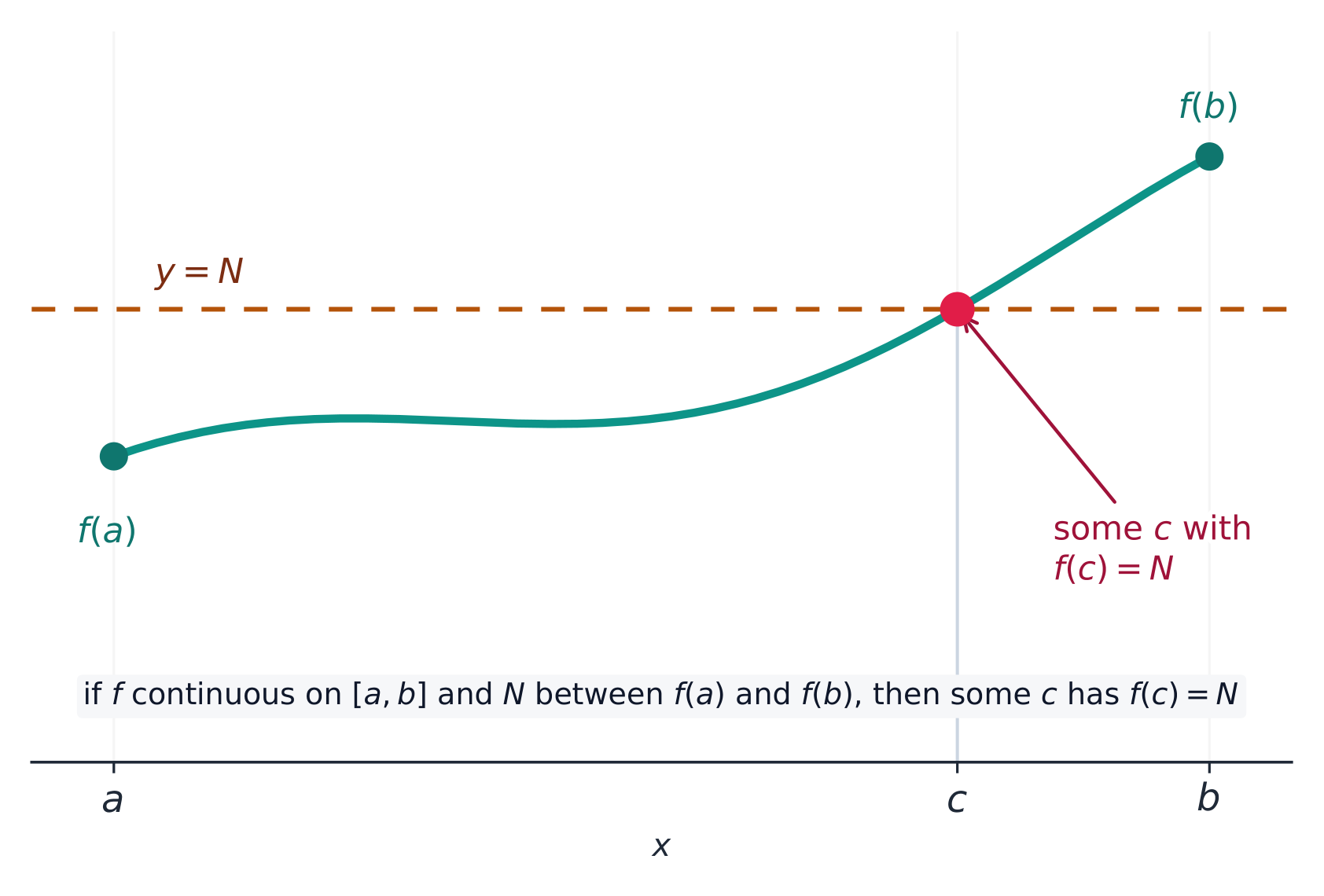
    The Intermediate Value Theorem 介值定理 is an existence theorem 存在性定理 – it guarantees a value exists without telling you where:

    If $f$ is continuous on the closed interval $[a,b]$, and $d$ is any number between $f(a)$ and $f(b)$, then there is at least one number $c$ in $(a,b)$ with $f(c)=d$.

    An unbroken curve cannot skip a height between its endpoints – it must pass through every one.

    Exam skill – how to justify with the IVT. These questions appear almost every year (for example, "Must there be a value $c$ with $R(c)=155$?" or "Is there a time when $r'(t)=-6$?"). A full-credit justification has three moves:

    1. State continuity. Say the function is continuous on $[a,b]$ (often because it is differentiable, or given continuous).
    2. Show $d$ is trapped. Compute the two endpoint values and show the target $d$ lies between them, e.g. $f(a) < d < f(b)$.
    3. Conclude by name. "By the Intermediate Value Theorem, there is a $c$ in $(a,b)$ with $f(c)=d$."

    Skipping the continuity statement, or not showing $d$ is between the endpoints, loses the point – the theorem requires both conditions.

    Worked example. Evaluate $\lim_{x\to\infty}\dfrac{3x^2-5}{2x^2+x}$. Divide top and bottom by the highest power, $x^2$: $\dfrac{3-5/x^2}{2+1/x}\to\dfrac{3-0}{2+0}=\dfrac{3}{2}$. Because the limit is a finite number, the line $y=\tfrac{3}{2}$ is a horizontal asymptote of the graph.

    日本語

    The Intermediate Value Theorem 介值定理 is an existence theorem 存在性定理 – it guarantees a value exists without telling you where:

    Opposite signs of f(a) and f(b) trap a root between a and b
    Opposite signs of f(a) and f(b) trap a root between a and b

    If $f$ is continuous on the closed interval $[a,b]$, and $d$ is any number between $f(a)$ and $f(b)$, then there is at least one number $c$ in $(a,b)$ with $f(c)=d$.

    An unbroken curve cannot skip a height between its endpoints – it must pass through every one.

    Exam skill – how to justify with the IVT. These questions appear almost every year (for example, "Must there be a value $c$ with $R(c)=155$?" or "Is there a time when $r'(t)=-6$?"). A full-credit justification has three moves:

    1. State continuity. Say the function is continuous on $[a,b]$ (often because it is differentiable, or given continuous).
    2. Show $d$ is trapped. Compute the two endpoint values and show the target $d$ lies between them, e.g. $f(a) < d < f(b)$.
    3. Conclude by name. "By the Intermediate Value Theorem, there is a $c$ in $(a,b)$ with $f(c)=d$."

    Skipping the continuity statement, or not showing $d$ is between the endpoints, loses the point – the theorem requires both conditions.

    Worked example. Evaluate $\lim_{x\to\infty}\dfrac{3x^2-5}{2x^2+x}$. Divide top and bottom by the highest power, $x^2$: $\dfrac{3-5/x^2}{2+1/x}\to\dfrac{3-0}{2+0}=\dfrac{3}{2}$. Because the limit is a finite number, the line $y=\tfrac{3}{2}$ is a horizontal asymptote of the graph.

    The Intermediate Value Theorem: a continuous curve hits every height between f(a) and f(b)
    A continuous curve from $(a,f(a))$ to $(b,f(b))$ must cross every height $d$ in between at least once.
    Explore · ⁨探索⁩

    Why a continuous curve can't skip a value

    y = ax³ + bx² + cx + d

    The Intermediate Value Theorem: a function continuous on $[a,b]$ takes every $y$ between $f(a)$ and $f(b)$ at some point inside. An unbroken curve cannot leap over a height — it must pass through it.

    Vocabulary · ⁨語彙⁩ Train · ⁨練習する⁩
    English 日本語
    Intermediate Value Theorem/ˌɪntəˈmiːdɪət ˈvæljuː ˈθɪərəm/ 中間値の定理
    existence theorem/eɡˈzɪstəns ˈθɪərəm/ 存在定理
    1.16

    Exam tips

    • A limit describes what $f(x)$ approaches, which need not equal $f(a)$ — the two-sided limit exists only if both sides agree.
    • Try direct substitution first; for a $\tfrac00$ form, factor and cancel or rationalise before substituting.
    • A function is continuous at $a$ when the limit exists, $f(a)$ is defined, and they are equal.
    • Use the Intermediate Value Theorem to guarantee a root: a continuous function that changes sign on $[a,b]$ takes every value between.
    • Read horizontal asymptotes from end behaviour (limits at $\pm\infty$) and vertical asymptotes where the denominator (not the numerator) is zero.
  • 2

    Differentiation: Definition and Fundamental Properties

    Watch lesson · ⁨レッスンを視聴⁩
    2.1

    Average and Instantaneous Rates of Change at a Point

    Syllabus · ⁨シラバス⁩
    English

    Enduring Understanding (CHA-2): Derivatives allow us to determine rates of change at an instant by applying limits to knowledge about rates of change over intervals.

    Learning Objective CHA-2.A: Determine average rates of change using difference quotients.

    • CHA-2.A.1 The difference quotients $\dfrac{f(a+h)-f(a)}{h}$ and $\dfrac{f(x)-f(a)}{x-a}$ express the average rate of change of a function over an interval.

    Learning Objective CHA-2.B: Represent the derivative of a function as the limit of a difference quotient.

    • CHA-2.B.1 The instantaneous rate of change of a function at $x=a$ can be expressed by $\lim\limits_{h\to 0}\dfrac{f(a+h)-f(a)}{h}$ or $\lim\limits_{x\to a}\dfrac{f(x)-f(a)}{x-a}$, provided the limit exists. These are equivalent forms of the definition of the derivative and are denoted $f'(a)$.
    日本語

    持続的理解 (CHA-2): 区間における変化率に関する知識に極限を適用することで、微分は瞬時の変化率を求めることを可能にする。

    学習目標 CHA-2.A: 差分商を用いて平均変化率を求める。

    • CHA-2.A.1 差分商 $\dfrac{f(a+h)-f(a)}{h}$ および $\dfrac{f(x)-f(a)}{x-a}$ は、区間における関数の平均変化率を表す。

    学習目標 CHA-2.B: 関数の微分を差分商の極限として表す。

    • CHA-2.B.1 $x=a$ における関数の瞬時変化率は、極限が存在する場合に $\lim\limits_{h\to 0}\dfrac{f(a+h)-f(a)}{h}$ または $\lim\limits_{x\to a}\dfrac{f(x)-f(a)}{x-a}$ で表せる。これらは微分の定義の同値な形式であり、$f'(a)$ と表記される。

    Source: College Board AP Course and Exam Description · ⁨出典: College Board AP コースおよび試験説明書⁩

    English
    The derivative from first principles

    Unit 1 built the limit. Unit 2 uses it to define the derivative 导数 – the exact rate of change at a point.

    Over an interval, the average rate of change is a difference quotient 差商. Two equivalent forms appear:

    $$\frac{f(a+h)-f(a)}{h} \qquad\text{and}\qquad \frac{f(x)-f(a)}{x-a}.$$
    The first uses a step of size $h$ from $a$; the second uses two points $x$ and $a$. Both compute $\dfrac{\text{change in output}}{\text{change in input}}$ over the interval.

    The instantaneous 瞬时 rate of change at $x=a$ is what the difference quotient approaches as the interval shrinks to zero. This limit is the derivative at $a$, written $f'(a)$:

    $$f'(a) = \lim_{h\to 0}\frac{f(a+h)-f(a)}{h} = \lim_{x\to a}\frac{f(x)-f(a)}{x-a},$$
    provided the limit exists.

    日本語
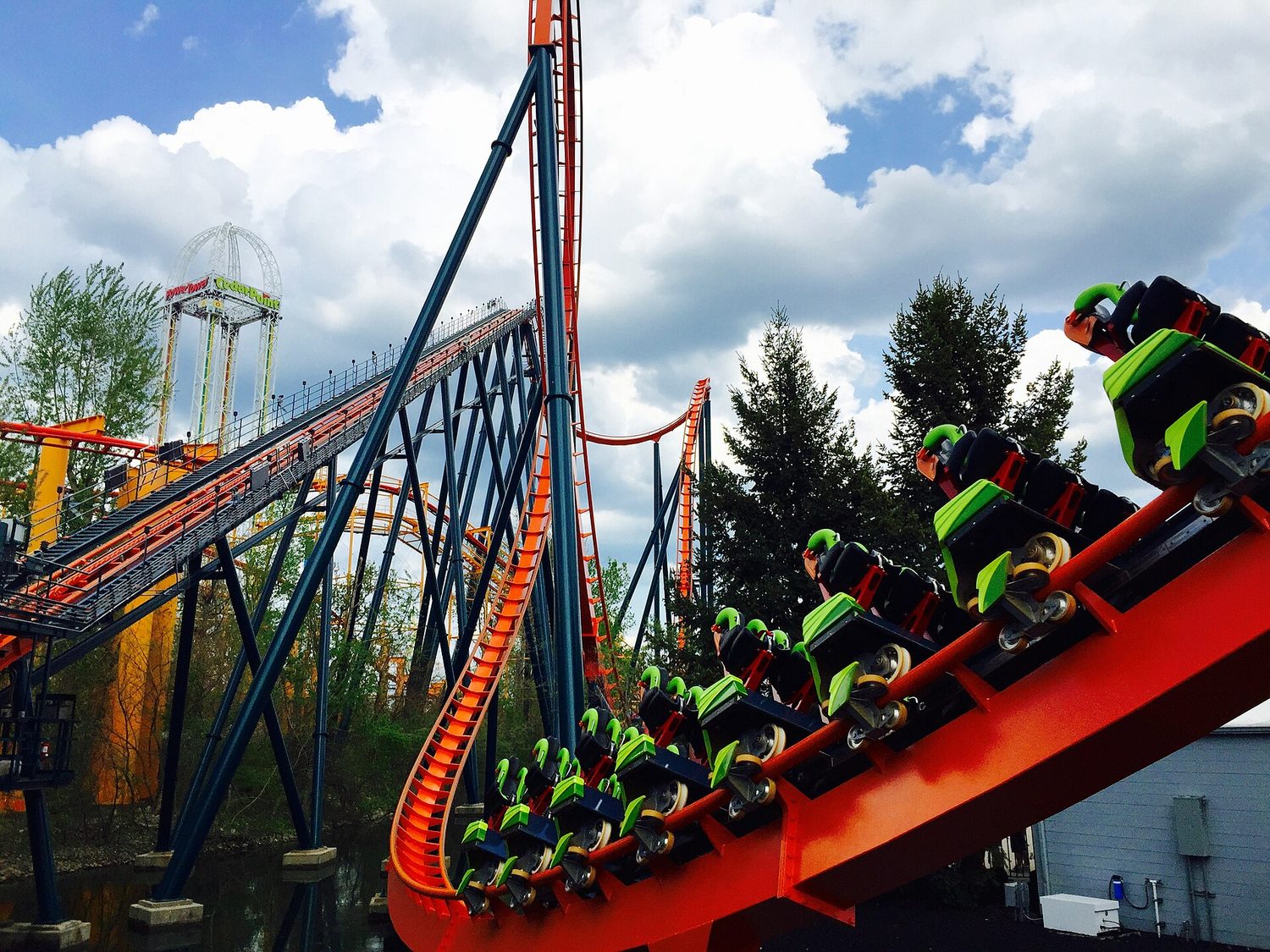
    A roller coaster on a lift hill: the derivative measures instantaneous rate of change
    A roller coaster on a lift hill: the derivative measures instantaneous rate of change
    The derivative from first principles

    Unit 1 built the limit. Unit 2 uses it to define the derivative 导数 – the exact rate of change at a point.

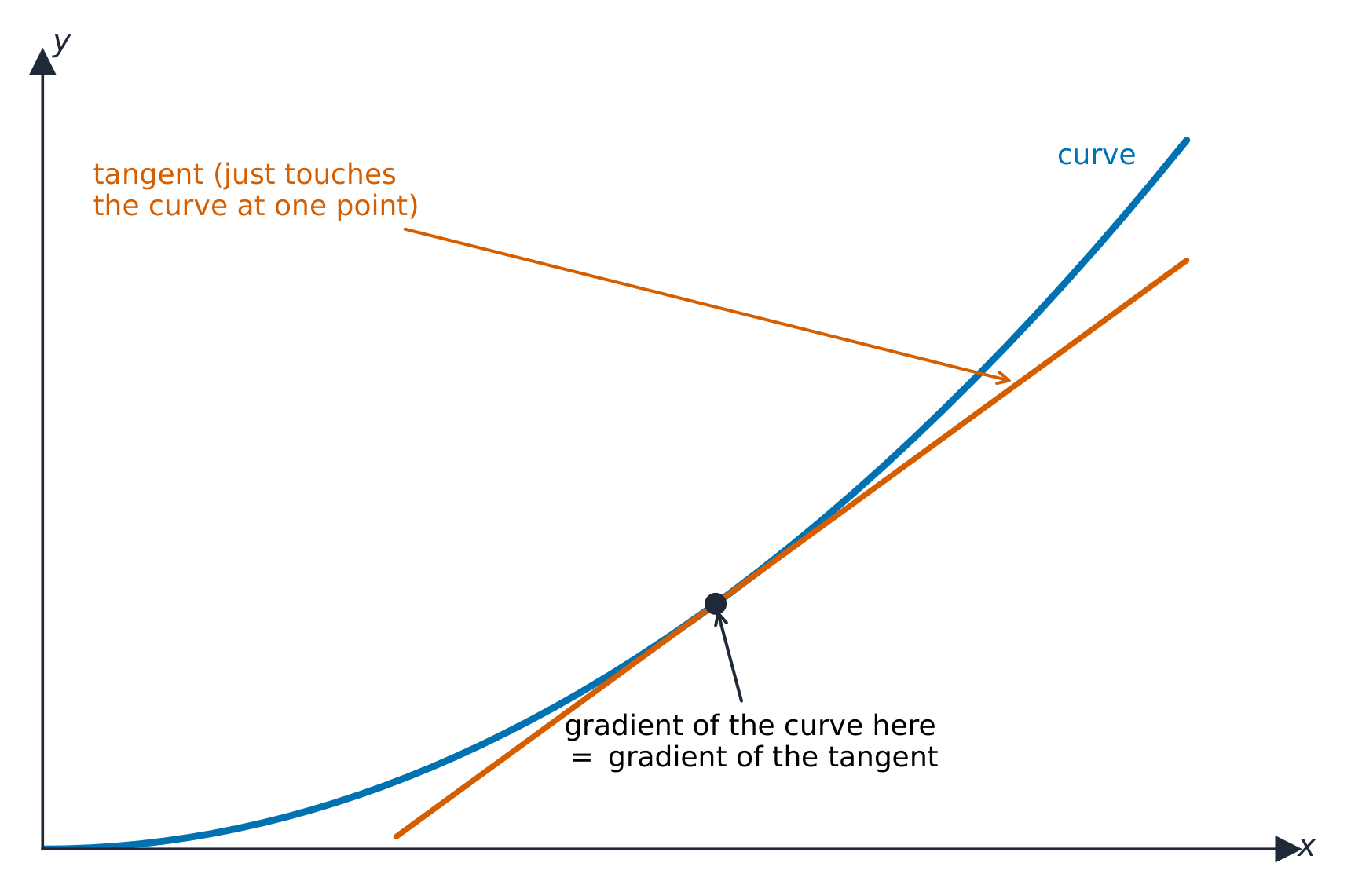
    The instantaneous rate of change is the gradient of the tangent at a point
    The instantaneous rate of change is the gradient of the tangent at a point

    Over an interval, the average rate of change is a difference quotient 差商. Two equivalent forms appear:

    $$\frac{f(a+h)-f(a)}{h} \qquad\text{and}\qquad \frac{f(x)-f(a)}{x-a}.$$
    The first uses a step of size $h$ from $a$; the second uses two points $x$ and $a$. Both compute $\dfrac{\text{change in output}}{\text{change in input}}$ over the interval.

    The instantaneous 瞬时 rate of change at $x=a$ is what the difference quotient approaches as the interval shrinks to zero. This limit is the derivative at $a$, written $f'(a)$:

    $$f'(a) = \lim_{h\to 0}\frac{f(a+h)-f(a)}{h} = \lim_{x\to a}\frac{f(x)-f(a)}{x-a},$$
    provided the limit exists.

    Explore · ⁨探索⁩

    From average rate to instantaneous rate · ⁨平均速度から瞬間速度へ⁩

    y = ax³ + bx² + cx + d

    Slide the point: the secant through two nearby points tips toward the tangent as they merge. The tangent's slope is the derivative — the instantaneous rate of change. · ⁨点をスライドする:2つの近い点を通る割線は点が統合されるにつれて接線に向かう。接線の傾きは導関数——瞬間変化率である。⁩

    Vocabulary · ⁨語彙⁩ Train · ⁨練習する⁩
    English 日本語
    derivative/dɪˈrɪvətɪv/ 導関数
    difference quotient/ˈdɪfrəns ˈkwəʊʃənt/ 差商
    instantaneous/ˌɪnstənˈteɪnɪəs/ 瞬間的
    first principles/fɜːst ˈprɪnsɪplz/ 第一原理
    2.2

    Defining the Derivative and Reading Its Notation

    Syllabus · ⁨シラバス⁩
    English

    Enduring Understanding (CHA-2): Derivatives allow us to determine rates of change at an instant by applying limits to knowledge about rates of change over intervals.

    Learning Objective CHA-2.B: Represent the derivative of a function as the limit of a difference quotient.

    • CHA-2.B.2 The derivative of $f$ is the function whose value at $x$ is $\lim\limits_{h\to 0}\dfrac{f(x+h)-f(x)}{h}$, provided this limit exists.
    • CHA-2.B.3 For $y=f(x)$, notations for the derivative include $\dfrac{dy}{dx}$, $f'(x)$, and $y'$.
    • CHA-2.B.4 The derivative can be represented graphically, numerically, analytically, and verbally.

    Learning Objective CHA-2.C: Determine the equation of a line tangent to a curve at a given point.

    • CHA-2.C.1 The derivative of a function at a point is the slope of the line tangent to a graph of the function at that point.
    日本語

    持続的理解 (CHA-2): 区間における変化率に関する知識に極限を適用することで、微分は瞬時の変化率を求めることを可能にする。

    学習目標 CHA-2.B: 関数の微分を差分商の極限として表す。

    • CHA-2.B.2 $f$ の導関数は、$x$ におけるその値が $\lim\limits_{h\to 0}\dfrac{f(x+h)-f(x)}{h}$ となる関数である(ただし、この極限が存在する場合)。
    • CHA-2.B.3 $y=f(x)$ に対する導関数の記法には、$\dfrac{dy}{dx}$、$f'(x)$、$y'$ が含まれる。
    • CHA-2.B.4 導関数は、図形的、数值的、解析的、言語的に表現できる。

    学習目標 CHA-2.C: 与えられた点における曲線に接する直線の方程式を求める。

    • CHA-2.C.1 点における関数の導関数は、その点における関数のグラフに接する直線の傾きである。

    Source: College Board AP Course and Exam Description · ⁨出典: College Board AP コースおよび試験説明書⁩

    English

    Let the point $a$ vary and the derivative becomes a new function:

    $$f'(x) = \lim_{h\to 0}\frac{f(x+h)-f(x)}{h}.$$
    This is the definition of the derivative (sometimes called differentiating "by first principles" 用定义求导). Its value at each $x$ is the instantaneous rate of change there.

    Common notations 记号 for the derivative of $y=f(x)$ are:

    $$\frac{dy}{dx}, \qquad f'(x), \qquad y'.$$
    The derivative can be represented graphically, numerically, analytically, and verbally – be ready to move between them.

    Geometric meaning. The derivative at a point is the slope 斜率 of the tangent line 切线 to the graph there. So the tangent line at $x=a$ passes through $\big(a, f(a)\big)$ with slope $f'(a)$:

    $$y - f(a) = f'(a)\,(x-a).$$
    Writing this line is a routine exam task, so keep the point-slope form ready.

    日本語

    Let the point $a$ vary and the derivative becomes a new function:

    $$f'(x) = \lim_{h\to 0}\frac{f(x+h)-f(x)}{h}.$$
    This is the definition of the derivative (sometimes called differentiating "by first principles" 用定义求导). Its value at each $x$ is the instantaneous rate of change there.

    Common notations 记号 for the derivative of $y=f(x)$ are:

    $$\frac{dy}{dx}, \qquad f'(x), \qquad y'.$$
    The derivative can be represented graphically, numerically, analytically, and verbally – be ready to move between them.

    Geometric meaning. The derivative at a point is the slope 斜率 of the tangent line 切线 to the graph there. So the tangent line at $x=a$ passes through $\big(a, f(a)\big)$ with slope $f'(a)$:

    $$y - f(a) = f'(a)\,(x-a).$$
    Writing this line is a routine exam task, so keep the point-slope form ready.

    Secant slopes approach the tangent slope: the derivative is the limit of average rates
    Secant slopes approach the tangent slope: the derivative is the limit of average rates
    Vocabulary · ⁨語彙⁩ Train · ⁨練習する⁩
    English 日本語
    notations/nəʊˈteɪʃnz/ 記号
    slope/sləʊp/ 傾き
    tangent line/ˈtændʒənt laɪn/ 接線
    2.3

    Estimating a Derivative at a Point

    Syllabus · ⁨シラバス⁩
    English

    Enduring Understanding (CHA-2): Derivatives allow us to determine rates of change at an instant by applying limits to knowledge about rates of change over intervals.

    Learning Objective CHA-2.D: Estimate derivatives.

    • CHA-2.D.1 The derivative at a point can be estimated from information given in tables or graphs.
    • CHA-2.D.2 Technology can be used to calculate or estimate the value of a derivative of a function at a point.
    日本語

    持続的理解 (CHA-2): 区間における変化率に関する知識に極限を適用することで、微分は瞬時の変化率を求めることを可能にする。

    学習目標 CHA-2.D: 導関数を推定する。

    • CHA-2.D.1 点における導関数は、数表やグラフに示された情報から推定できる。
    • CHA-2.D.2 テクノロジーを用いて、点における関数の導関数の値を計算または推定できる。

    Source: College Board AP Course and Exam Description · ⁨出典: College Board AP コースおよび試験説明書⁩

    English

    You do not always have a formula. When a function is given by a table 表格 or a graph, estimate the derivative $f'(a)$ with a difference quotient over a small interval around $a$. A table with values on both sides of $a$ gives the best estimate:

    $$f'(a) \approx \frac{f(b)-f(c)}{b-c},\qquad \text{where } c < a < b \text{ are the closest table inputs}.$$
    Technology (a calculator) can also estimate a derivative at a point.

    Exam skill (appears almost every year). Questions such as "Approximate $M'(7.5)$ using the average rate of change of $M$ over the interval $5 \le t \le 10$" ask for exactly this difference quotient. Show the setup:

    $$M'(7.5) \approx \frac{M(10)-M(5)}{10-5}.$$
    Full credit needs the numbers plugged in and the correct units 单位 (output units per input unit), since these come from real-world models.

    日本語

    You do not always have a formula. When a function is given by a table 表格 or a graph, estimate the derivative $f'(a)$ with a difference quotient over a small interval around $a$. A table with values on both sides of $a$ gives the best estimate:

    $$f'(a) \approx \frac{f(b)-f(c)}{b-c},\qquad \text{where } c < a < b \text{ are the closest table inputs}.$$
    Technology (a calculator) can also estimate a derivative at a point.

    Exam skill (appears almost every year). Questions such as "Approximate $M'(7.5)$ using the average rate of change of $M$ over the interval $5 \le t \le 10$" ask for exactly this difference quotient. Show the setup:

    $$M'(7.5) \approx \frac{M(10)-M(5)}{10-5}.$$
    Full credit needs the numbers plugged in and the correct units 单位 (output units per input unit), since these come from real-world models.

    Vocabulary · ⁨語彙⁩ Train · ⁨練習する⁩
    English 日本語
    table/ˈteɪbl/ テーブル
    units/ˈjuːnɪts/ 単位
    2.4

    Differentiability and Continuity: When a Derivative Exists

    Syllabus · ⁨シラバス⁩
    English

    Enduring Understanding (FUN-2): Recognizing that a function's derivative may also be a function allows us to develop knowledge about the related behaviors of both.

    Learning Objective FUN-2.A: Explain the relationship between differentiability and continuity.

    • FUN-2.A.1 If a function is differentiable at a point, then it is continuous at that point. In particular, if a point is not in the domain of $f$, then it is not in the domain of $f'$.
    • FUN-2.A.2 A continuous function may fail to be differentiable at a point in its domain.
      • Illustrative examples for FUN-2.A.2:
        • The left hand and right hand limits of the difference quotient are not equal, as in $f(x)=|x|$ at $x=0$.
        • The tangent line is vertical and has no slope, as in $f(x)=\sqrt[3]{x}$ at $x=0$.
    日本語

    持続的理解 (FUN-2): 関数の導関数もまた一つの関数であることを認識することで、両者の関連する挙動についての知識を深めることができる。

    学習目標 FUN-2.A: 可微分性と連続性の関係について説明する。

    • FUN-2.A.1 関数が一点で可微分であれば、その点で連続である。特に、$f$ の定義域に含まれない点は、$f'$ の定義域にも含まれない。
    • FUN-2.A.2 連続な関数であっても、その定義域内の一点で可微分でないことがある。
      • FUN-2.A.2の参考例:
        • 差分商の左側極限と右側極限が等しくない場合(例:$f(x)=|x|$ における $x=0$)。
        • 接線が垂直であり、傾きを持たない場合(例:$f(x)=\sqrt[3]{x}$ における $x=0$)。

    Source: College Board AP Course and Exam Description · ⁨出典: College Board AP コースおよび試験説明書⁩

    English

    Differentiability is stronger than continuity. The key relationship:

    If $f$ is differentiable 可导 at a point, then $f$ is continuous 连续 there.

    So differentiability implies continuity. The reverse is false: a continuous function can fail to be differentiable. Two ways this happens:

    • A corner 尖点: the left and right difference-quotient limits disagree, as with $f(x)=|x|$ at $x=0$.
    • A vertical tangent 垂直切线: the slope is infinite (no real number), as with $f(x)=\sqrt[3]{x}$ at $x=0$.

    Also, a point outside the domain of $f$ cannot be in the domain of $f'$. Use the contrapositive on the exam: if $f$ is not continuous at $a$, then $f$ is not differentiable at $a$.

    日本語

    Differentiability is stronger than continuity. The key relationship:

    If $f$ is differentiable 可导 at a point, then $f$ is continuous 连续 there.

    So differentiability implies continuity. The reverse is false: a continuous function can fail to be differentiable. Two ways this happens:

    • A corner 尖点: the left and right difference-quotient limits disagree, as with $f(x)=|x|$ at $x=0$.
    • A vertical tangent 垂直切线: the slope is infinite (no real number), as with $f(x)=\sqrt[3]{x}$ at $x=0$.
    Two ways a continuous function is not differentiable: a corner and a vertical tangent
    Two ways a continuous function is not differentiable: a corner and a vertical tangent

    Also, a point outside the domain of $f$ cannot be in the domain of $f'$. Use the contrapositive on the exam: if $f$ is not continuous at $a$, then $f$ is not differentiable at $a$.

    Vocabulary · ⁨語彙⁩ Train · ⁨練習する⁩
    English 日本語
    differentiable/ˈdɪfərenʃɪəbl/ 微分可能である
    continuous/kənˈtɪnjuːəs/ 連続的である
    corner/ˈkɔːnə/ 角点
    vertical tangent/ˈvɜːtɪkl ˈtændʒənt/ 垂直接線
    2.5

    The Power Rule

    Syllabus · ⁨シラバス⁩
    English

    Enduring Understanding (FUN-3): Recognizing opportunities to apply derivative rules can simplify differentiation.

    Learning Objective FUN-3.A: Calculate derivatives of familiar functions.

    • FUN-3.A.1 Direct application of the definition of the derivative and specific rules can be used to calculate the derivative for functions of the form $f(x)=x^{r}$.
    日本語

    持続的理解 (FUN-3): 導関数の法則を適用する機会を見出すことで、微分が単純化される。

    学習目標 FUN-3.A: 一般的な関数の導関数を計算する。

    • FUN-3.A.1 導関数の定義と特定の規則を直接適用することで、 $f(x)=x^{r}$ の形の関数の導関数を計算できる。

    Source: College Board AP Course and Exam Description · ⁨出典: College Board AP コースおよび試験説明書⁩

    English

    From here we use rules instead of the limit definition each time. The power rule 幂法则 handles any power of $x$:

    $$\frac{d}{dx}\,x^{r} = r\,x^{\,r-1}\qquad\text{for any real } r.$$
    It works for whole-number powers, negative powers ($\tfrac{1}{x}=x^{-1}$), and roots ($\sqrt{x}=x^{1/2}$) – rewrite as a power first, then apply the rule.

    日本語

    From here we use rules instead of the limit definition each time. The power rule 幂法则 handles any power of $x$:

    $$\frac{d}{dx}\,x^{r} = r\,x^{\,r-1}\qquad\text{for any real } r.$$
    It works for whole-number powers, negative powers ($\tfrac{1}{x}=x^{-1}$), and roots ($\sqrt{x}=x^{1/2}$) – rewrite as a power first, then apply the rule.

    Explore · ⁨探索⁩

    A power function and its steepening slope · ⁨べき関数とその急になる傾き⁩

    y = ax³ + bx² + cx + d

    The power rule $\frac{d}{dx}x^n = nx^{n-1}$ drops the exponent as a factor. For $x^3$ the slope grows quickly as $x$ leaves 0 — the curve steepens. · ⁨累乗の法則 $\frac{d}{dx}x^n = nx^{n-1}$ は指数を係数として下ろします。 $x^3$ において、 $x$ が 0 から離れるにつれ傾きが急激に大きくなり、曲線は急峻になります。⁩

    Vocabulary · ⁨語彙⁩ Train · ⁨練習する⁩
    English 日本語
    power rule/ˈpaʊə ruːl/ べき乗の法則
    2.6

    Constant, Sum, Difference, and Constant Multiple Rules

    Syllabus · ⁨シラバス⁩
    English

    Enduring Understanding (FUN-3): Recognizing opportunities to apply derivative rules can simplify differentiation.

    Learning Objective FUN-3.A: Calculate derivatives of familiar functions.

    • FUN-3.A.2 Sums, differences, and constant multiples of functions can be differentiated using derivative rules.
    • FUN-3.A.3 The power rule combined with sum, difference, and constant multiple properties can be used to find the derivatives for polynomial functions.
    日本語

    持続的理解 (FUN-3): 導関数の法則を適用する機会を見出すことで、微分が単純化される。

    学習目標 FUN-3.A: 一般的な関数の導関数を計算する。

    • FUN-3.A.2 関数の和、差、定数倍は導関数の規則を用いて微分できる。
    • FUN-3.A.3 べき則と和、差、定数倍の性質を組み合わせることで、多項式関数の導関数を求めることができる。

    Source: College Board AP Course and Exam Description · ⁨出典: College Board AP コースおよび試験説明書⁩

    English

    These rules let you differentiate term by term:

    • Constant: $\dfrac{d}{dx}\,k = 0$ (a constant does not change).
    • Constant multiple 常数倍: $\dfrac{d}{dx}\big[k\,f(x)\big] = k\,f'(x)$.
    • Sum / difference: $\dfrac{d}{dx}\big[f(x)\pm g(x)\big] = f'(x)\pm g'(x)$.

    Combined with the power rule, they differentiate any polynomial 多项式 term by term. Example:

    $$\frac{d}{dx}\big(4x^3 - 5x + 7\big) = 12x^2 - 5.$$

    日本語

    These rules let you differentiate term by term:

    • Constant: $\dfrac{d}{dx}\,k = 0$ (a constant does not change).
    • Constant multiple 常数倍: $\dfrac{d}{dx}\big[k\,f(x)\big] = k\,f'(x)$.
    • Sum / difference: $\dfrac{d}{dx}\big[f(x)\pm g(x)\big] = f'(x)\pm g'(x)$.

    Combined with the power rule, they differentiate any polynomial 多项式 term by term. Example:

    $$\frac{d}{dx}\big(4x^3 - 5x + 7\big) = 12x^2 - 5.$$

    Vocabulary · ⁨語彙⁩ Train · ⁨練習する⁩
    English 日本語
    Constant multiple/ˈkɒnstənt ˈmʌltɪpl/ 定数倍
    polynomial/ˌpɒlɪˈnəʊmɪəl/ 多項式
    2.7

    Derivatives of cos x, sin x, e^x, and ln x

    Syllabus · ⁨シラバス⁩
    English

    Enduring Understanding (FUN-3): Recognizing opportunities to apply derivative rules can simplify differentiation.

    Learning Objective FUN-3.A: Calculate derivatives of familiar functions.

    • FUN-3.A.4 Specific rules can be used to find the derivatives for sine, cosine, exponential, and logarithmic functions.

    Enduring Understanding (LIM-3): Reasoning with definitions, theorems, and properties can be used to determine a limit.

    Learning Objective LIM-3.A: Interpret a limit as a definition of a derivative.

    • LIM-3.A.1 In some cases, recognizing an expression for the definition of the derivative of a function whose derivative is known offers a strategy for determining a limit.
    日本語

    持続的理解 (FUN-3): 導関数の法則を適用する機会を見出すことで、微分が単純化される。

    学習目標 FUN-3.A: 一般的な関数の導関数を計算する。

    • FUN-3.A.4 特定の規則を用いることで、正弦関数、余弦関数、指数関数、対数関数の導関数を求めることができる。

    持続的理解 (LIM-3): 定義、定理、性質を用いた推論によって極限を求めることができる。

    学習目標 LIM-3.A: 極限を導関数の定義として解釈する。

    • LIM-3.A.1 場合によっては、既知の導関数を持つ関数の導関数の定義を表す式を認識することが、極限を求めるための戦略となる。

    Source: College Board AP Course and Exam Description · ⁨出典: College Board AP コースおよび試験説明書⁩

    Learn these four building-block derivatives by heart:

    $$\frac{d}{dx}\sin x = \cos x, \qquad \frac{d}{dx}\cos x = -\sin x,$$
    $$\frac{d}{dx}e^{x} = e^{x}, \qquad \frac{d}{dx}\ln x = \frac{1}{x}\ \ (x>0).$$
    Note the minus sign on the derivative of cosine, and that $e^{x}$ is its own derivative.

    A limit that is really a derivative (LIM-3.A.1). Sometimes a limit is secretly the definition of a known derivative. If you recognize

    $$\lim_{h\to 0}\frac{f(a+h)-f(a)}{h}$$
    for a function $f$ whose derivative you know, just evaluate $f'(a)$. For example, $\displaystyle \lim_{h\to 0}\frac{\sin\!\big(\tfrac{\pi}{2}+h\big)-1}{h} = \left.\frac{d}{dx}\sin x\right|_{x=\pi/2} = \cos\tfrac{\pi}{2} = 0$.

    Explore · ⁨探索⁩

    The shape of sin x (whose slope is cos x) · ⁨sin x の形状(その傾きは cos x)⁩

    y = asin(bx + c) + d

    The derivative of $\sin x$ is $\cos x$: the slope of the sine curve is largest where sine crosses zero and zero at its peaks. Watch the curve to feel where its slope is steep or flat. · ⁨$\sin x$の導関数は$\cos x$です:正弦曲線の傾きは、正弦がゼロを横切る点で最大となり、頂点ではゼロになります。曲線を観察し、傾きが急か平らかの位置を感じ取ってください。⁩

    2.8

    The Product Rule

    Syllabus · ⁨シラバス⁩
    English

    Enduring Understanding (FUN-3): Recognizing opportunities to apply derivative rules can simplify differentiation.

    Learning Objective FUN-3.B: Calculate derivatives of products and quotients of differentiable functions.

    • FUN-3.B.1 Derivatives of products of differentiable functions can be found using the product rule.
    日本語

    持続的理解 (FUN-3): 導関数の法則を適用する機会を見出すことで、微分が単純化される。

    学習目標 FUN-3.B: 可微分関数の积和商の導関数を計算する。

    • FUN-3.B.1 微分可能な関数の积の導関数は、積の法則を用いて求めることができる。

    Source: College Board AP Course and Exam Description · ⁨出典: College Board AP コースおよび試験説明書⁩

    English

    A product of two functions is not differentiated by multiplying the derivatives. Use the product rule 乘积法则:

    $$\frac{d}{dx}\big[u\,v\big] = u'v + uv'.$$
    "Derivative of the first times the second, plus the first times the derivative of the second." Example:
    $$\frac{d}{dx}\big(x^2 e^{x}\big) = 2x\,e^{x} + x^2 e^{x}.$$
    Exam questions often build a new function from given pieces, e.g. $k'(x) = \big(f(x)\big)^2 g(x)$, and ask you to combine rules while reading values from a table.

    日本語

    A product of two functions is not differentiated by multiplying the derivatives. Use the product rule 乘积法则:

    $$\frac{d}{dx}\big[u\,v\big] = u'v + uv'.$$
    "Derivative of the first times the second, plus the first times the derivative of the second." Example:
    $$\frac{d}{dx}\big(x^2 e^{x}\big) = 2x\,e^{x} + x^2 e^{x}.$$
    Exam questions often build a new function from given pieces, e.g. $k'(x) = \big(f(x)\big)^2 g(x)$, and ask you to combine rules while reading values from a table.

    Vocabulary · ⁨語彙⁩ Train · ⁨練習する⁩
    English 日本語
    product rule/ˈprɒdʌkt ruːl/ 積の法則を用いる
    2.9

    The Quotient Rule

    Syllabus · ⁨シラバス⁩
    English

    Enduring Understanding (FUN-3): Recognizing opportunities to apply derivative rules can simplify differentiation.

    Learning Objective FUN-3.B: Calculate derivatives of products and quotients of differentiable functions.

    • FUN-3.B.2 Derivatives of quotients of differentiable functions can be found using the quotient rule.
    日本語

    持続的理解 (FUN-3): 導関数の法則を適用する機会を見出すことで、微分が単純化される。

    学習目標 FUN-3.B: 可微分関数の积和商の導関数を計算する。

    • FUN-3.B.2 微分可能な関数の商の導関数は、商の法則を用いて求めることができる。

    Source: College Board AP Course and Exam Description · ⁨出典: College Board AP コースおよび試験説明書⁩

    English

    For a quotient, use the quotient rule 商法则:

    $$\frac{d}{dx}\!\left[\frac{u}{v}\right] = \frac{u'v - uv'}{v^{2}}.$$
    "Bottom times derivative of top, minus top times derivative of bottom, all over bottom squared." The order matters because of the minus sign, so write the numerator carefully. Example:
    $$\frac{d}{dx}\!\left(\frac{x}{\cos x}\right) = \frac{1\cdot\cos x - x\cdot(-\sin x)}{\cos^2 x} = \frac{\cos x + x\sin x}{\cos^2 x}.$$

    日本語

    For a quotient, use the quotient rule 商法则:

    $$\frac{d}{dx}\!\left[\frac{u}{v}\right] = \frac{u'v - uv'}{v^{2}}.$$
    "Bottom times derivative of top, minus top times derivative of bottom, all over bottom squared." The order matters because of the minus sign, so write the numerator carefully. Example:
    $$\frac{d}{dx}\!\left(\frac{x}{\cos x}\right) = \frac{1\cdot\cos x - x\cdot(-\sin x)}{\cos^2 x} = \frac{\cos x + x\sin x}{\cos^2 x}.$$

    Vocabulary · ⁨語彙⁩ Train · ⁨練習する⁩
    English 日本語
    quotient rule/ˈkwəʊʃənt ruːl/ 商の法則を用いる
    2.10

    Derivatives of Tangent, Cotangent, Secant, and Cosecant

    Syllabus · ⁨シラバス⁩
    English

    Enduring Understanding (FUN-3): Recognizing opportunities to apply derivative rules can simplify differentiation.

    Learning Objective FUN-3.B: Calculate derivatives of products and quotients of differentiable functions.

    • FUN-3.B.3 Rearranging tangent, cotangent, secant, and cosecant functions using identities allows differentiation using derivative rules.
    日本語

    持続的理解 (FUN-3): 導関数の法則を適用する機会を見出すことで、微分が単純化される。

    学習目標 FUN-3.B: 可微分関数の积和商の導関数を計算する。

    • FUN-3.B.3 恒等式を用いて正接、余接、正割、および余割関数を変形することで、導関数の法則を用いて微分できる。

    Source: College Board AP Course and Exam Description · ⁨出典: College Board AP コースおよび試験説明書⁩

    English

    The remaining trigonometric derivatives are not memorized separately – you rewrite them with identities 恒等式 and apply the quotient (or product) rule. For instance, $\tan x = \dfrac{\sin x}{\cos x}$, so the quotient rule gives

    $$\frac{d}{dx}\tan x = \frac{\cos x\cos x - \sin x(-\sin x)}{\cos^2 x} = \frac{1}{\cos^2 x} = \sec^2 x.$$
    The same method (writing $\cot x=\tfrac{\cos x}{\sin x}$, $\sec x=\tfrac{1}{\cos x}$, $\csc x=\tfrac{1}{\sin x}$) gives $-\csc^2 x$, $\sec x\tan x$, and $-\csc x\cot x$.

    Higher-order derivatives. Differentiating $f'$ again gives the second derivative 二阶导数 $f''(x)$ (or $\tfrac{d^2y}{dx^2}$) – the rate of change of the rate of change. An exam part like "Find $k''(3)$" just means differentiate twice, then substitute. You can also estimate a second derivative from a table by applying the average-rate-of-change method to the $f'$ values.

    Worked example. Differentiate $g(x)=\dfrac{\sin x}{x}$ with the quotient rule $\left(\tfrac{u}{v}\right)'=\dfrac{u'v-uv'}{v^2}$: take $u=\sin x$, $v=x$, giving $g'(x)=\dfrac{x\cos x-\sin x}{x^2}$. Keep the order $u'v-uv'$ in the numerator — swapping the terms flips the sign and loses the mark.

    日本語

    The remaining trigonometric derivatives are not memorized separately – you rewrite them with identities 恒等式 and apply the quotient (or product) rule. For instance, $\tan x = \dfrac{\sin x}{\cos x}$, so the quotient rule gives

    $$\frac{d}{dx}\tan x = \frac{\cos x\cos x - \sin x(-\sin x)}{\cos^2 x} = \frac{1}{\cos^2 x} = \sec^2 x.$$
    The same method (writing $\cot x=\tfrac{\cos x}{\sin x}$, $\sec x=\tfrac{1}{\cos x}$, $\csc x=\tfrac{1}{\sin x}$) gives $-\csc^2 x$, $\sec x\tan x$, and $-\csc x\cot x$.

    Higher-order derivatives. Differentiating $f'$ again gives the second derivative 二阶导数 $f''(x)$ (or $\tfrac{d^2y}{dx^2}$) – the rate of change of the rate of change. An exam part like "Find $k''(3)$" just means differentiate twice, then substitute. You can also estimate a second derivative from a table by applying the average-rate-of-change method to the $f'$ values.

    Worked example. Differentiate $g(x)=\dfrac{\sin x}{x}$ with the quotient rule $\left(\tfrac{u}{v}\right)'=\dfrac{u'v-uv'}{v^2}$: take $u=\sin x$, $v=x$, giving $g'(x)=\dfrac{x\cos x-\sin x}{x^2}$. Keep the order $u'v-uv'$ in the numerator — swapping the terms flips the sign and loses the mark.

    Vocabulary · ⁨語彙⁩ Train · ⁨練習する⁩
    English 日本語
    identities/aɪˈdentɪtiz/ 恒等式
    second derivative/ˈsekənd dɪˈrɪvətɪv/ 二階微分
    2.10

    Exam tips

    • The derivative is the slope of the tangent — the limit of the secant slope $\tfrac{f(x+h)-f(x)}{h}$ as $h\to0$.
    • Memorise the rules: power, product, quotient, and the derivatives of $\sin$, $\cos$, $e^x$, and $\ln x$.
    • Differentiability implies continuity, but not the reverse (a corner or cusp is continuous yet not differentiable).
    • Distinguish average rate of change (secant slope over an interval) from instantaneous rate (the derivative at a point).
    • Give a tangent-line equation as $y-f(a)=f'(a)(x-a)$.
  • 3

    Differentiation: Composite, Implicit, and Inverse Functions

    Watch lesson · ⁨レッスンを視聴⁩
    3.1

    The Chain Rule

    Syllabus · ⁨シラバス⁩
    English

    Enduring Understanding (FUN-3): Recognizing opportunities to apply derivative rules can simplify differentiation.

    Learning Objective FUN-3.C: Calculate derivatives of compositions of differentiable functions.

    • FUN-3.C.1 The chain rule provides a way to differentiate composite functions.
    日本語

    持続的理解 (FUN-3): 導関数の法則を適用する機会を見出すことで、微分が単純化される。

    学習目標 FUN-3.C: 微分可能な関数の合成の導関数を計算する。

    • FUN-3.C.1 連鎖律は、合成関数を微分するための方法を提供する。

    Source: College Board AP Course and Exam Description · ⁨出典: College Board AP コースおよび試験説明書⁩

    English
    The chain rule

    Unit 2 differentiated single functions. Unit 3 differentiates functions built inside other functions. The chain rule 链式法则 differentiates a composite function 复合函数 $f\big(g(x)\big)$:

    $$\frac{d}{dx}\,f\big(g(x)\big) = f'\big(g(x)\big)\cdot g'(x).$$
    "Derivative of the outer function (leaving the inside alone), times the derivative of the inside." The inner derivative $g'(x)$ is the piece students forget, so always ask "what is the inside, and what is its derivative?" Example:
    $$\frac{d}{dx}\sin(x^2) = \cos(x^2)\cdot 2x.$$

    In Leibniz notation, with $y=f(u)$ and $u=g(x)$, the rule reads $\dfrac{dy}{dx}=\dfrac{dy}{du}\cdot\dfrac{du}{dx}$ – the intermediate $du$ appears to "cancel." Exam questions often give a table for $f$, $g$, $f'$, $g'$ and ask for $h'(a)$ where $h(x)=f\big(g(x)\big)$; evaluate $f'\big(g(a)\big)\cdot g'(a)$ by reading values.

    Worked example. Differentiate $h(x)=(2x^2+1)^5$. The outer function is "(something)$^5$" and the inner is $2x^2+1$:

    $$h'(x)=5(2x^2+1)^4\cdot 4x=20x(2x^2+1)^4.$$

    日本語
    A mountain path: composite functions nest rates of change (chain rule)
    A mountain path: composite functions nest rates of change (chain rule)
    The chain rule

    Unit 2 differentiated single functions. Unit 3 differentiates functions built inside other functions. The chain rule 链式法则 differentiates a composite function 复合函数 $f\big(g(x)\big)$:

    $$\frac{d}{dx}\,f\big(g(x)\big) = f'\big(g(x)\big)\cdot g'(x).$$
    "Derivative of the outer function (leaving the inside alone), times the derivative of the inside." The inner derivative $g'(x)$ is the piece students forget, so always ask "what is the inside, and what is its derivative?" Example:
    $$\frac{d}{dx}\sin(x^2) = \cos(x^2)\cdot 2x.$$

    In Leibniz notation, with $y=f(u)$ and $u=g(x)$, the rule reads $\dfrac{dy}{dx}=\dfrac{dy}{du}\cdot\dfrac{du}{dx}$ – the intermediate $du$ appears to "cancel." Exam questions often give a table for $f$, $g$, $f'$, $g'$ and ask for $h'(a)$ where $h(x)=f\big(g(x)\big)$; evaluate $f'\big(g(a)\big)\cdot g'(a)$ by reading values.

    Worked example. Differentiate $h(x)=(2x^2+1)^5$. The outer function is "(something)$^5$" and the inner is $2x^2+1$:

    $$h'(x)=5(2x^2+1)^4\cdot 4x=20x(2x^2+1)^4.$$

    Vocabulary · ⁨語彙⁩ Train · ⁨練習する⁩
    English 日本語
    chain rule/tʃeɪn ruːl/ 連鎖の法則を用いる
    composite function/ˈkɒmpəzɪt ˈfʌŋkʃn/ 合成関数
    3.2

    Implicit Differentiation

    Syllabus · ⁨シラバス⁩
    English

    Enduring Understanding (FUN-3): Recognizing opportunities to apply derivative rules can simplify differentiation.

    Learning Objective FUN-3.D: Calculate derivatives of implicitly defined functions.

    • FUN-3.D.1 The chain rule is the basis for implicit differentiation.
    日本語

    持続的理解 (FUN-3): 導関数の法則を適用する機会を見出すことで、微分が単純化される。

    学習目標 FUN-3.D: 暗に定義された関数の導関数を計算する。

    • FUN-3.D.1 連鎖律は陰微分の基礎である。

    Source: College Board AP Course and Exam Description · ⁨出典: College Board AP コースおよび試験説明書⁩

    English

    Some curves are defined implicitly – by an equation in $x$ and $y$ that is not solved for $y$, such as $x^2+y^2=25$. Implicit differentiation 隐函数求导 finds $\dfrac{dy}{dx}$ without solving for $y$ first. It is just the chain rule, treating $y$ as a function of $x$.

    The method: differentiate both sides with respect to $x$; every time you differentiate a $y$-term, multiply by $\dfrac{dy}{dx}$ (the chain rule); then solve algebraically for $\dfrac{dy}{dx}$. For $x^2+y^2=25$:

    $$2x + 2y\frac{dy}{dx}=0 \;\Longrightarrow\; \frac{dy}{dx} = -\frac{x}{y}.$$

    Worked example. Find the tangent to $x^2+y^2=25$ at $(3,4)$. Here $\dfrac{dy}{dx}=-\dfrac{3}{4}$, so the tangent line is $y-4=-\tfrac{3}{4}(x-3)$ – perpendicular to the radius, as geometry predicts.

    Exam skill – "Show that $\dfrac{dy}{dx}=\ldots$". This exact prompt appears most years (e.g. "Show that $\dfrac{dy}{dx}=\dfrac{2y}{y^2-2x}$"). Because the target is given, you must show every algebra step cleanly: differentiate both sides, use the product/chain rules on mixed $xy$ terms, collect all $\dfrac{dy}{dx}$ terms on one side, factor, and divide. A correct final line that skips the algebra earns little. Follow-up parts then ask for a tangent line, or where the tangent is horizontal ($\tfrac{dy}{dx}=0$, so the numerator is $0$) or vertical (the denominator is $0$).

    日本語

    Some curves are defined implicitly – by an equation in $x$ and $y$ that is not solved for $y$, such as $x^2+y^2=25$. Implicit differentiation 隐函数求导 finds $\dfrac{dy}{dx}$ without solving for $y$ first. It is just the chain rule, treating $y$ as a function of $x$.

    The method: differentiate both sides with respect to $x$; every time you differentiate a $y$-term, multiply by $\dfrac{dy}{dx}$ (the chain rule); then solve algebraically for $\dfrac{dy}{dx}$. For $x^2+y^2=25$:

    $$2x + 2y\frac{dy}{dx}=0 \;\Longrightarrow\; \frac{dy}{dx} = -\frac{x}{y}.$$

    Worked example. Find the tangent to $x^2+y^2=25$ at $(3,4)$. Here $\dfrac{dy}{dx}=-\dfrac{3}{4}$, so the tangent line is $y-4=-\tfrac{3}{4}(x-3)$ – perpendicular to the radius, as geometry predicts.

    Implicit differentiation gives the tangent to a circle, perpendicular to the radius
    Implicit differentiation gives the tangent to a circle, perpendicular to the radius

    Exam skill – "Show that $\dfrac{dy}{dx}=\ldots$". This exact prompt appears most years (e.g. "Show that $\dfrac{dy}{dx}=\dfrac{2y}{y^2-2x}$"). Because the target is given, you must show every algebra step cleanly: differentiate both sides, use the product/chain rules on mixed $xy$ terms, collect all $\dfrac{dy}{dx}$ terms on one side, factor, and divide. A correct final line that skips the algebra earns little. Follow-up parts then ask for a tangent line, or where the tangent is horizontal ($\tfrac{dy}{dx}=0$, so the numerator is $0$) or vertical (the denominator is $0$).

    Vocabulary · ⁨語彙⁩ Train · ⁨練習する⁩
    English 日本語
    Implicit differentiation/ɪmˈplɪsɪt ˌdɪfəˌrenʃɪˈeɪʃn/ 暗黙微分
    3.3

    Differentiating Inverse Functions

    Syllabus · ⁨シラバス⁩
    English

    Enduring Understanding (FUN-3): Recognizing opportunities to apply derivative rules can simplify differentiation.

    Learning Objective FUN-3.E: Calculate derivatives of inverse and inverse trigonometric functions.

    • FUN-3.E.1 The chain rule and definition of an inverse function can be used to find the derivative of an inverse function, provided the derivative exists.
    日本語

    持続的理解 (FUN-3): 導関数の法則を適用する機会を見出すことで、微分が単純化される。

    学習目標 FUN-3.E: 逆関数および逆三角関数の導関数を計算する。

    • FUN-3.E.1 連鎖律と逆関数の定義を用いることで、導関数が存在する限り逆関数の導関数を求めることができる。

    Source: College Board AP Course and Exam Description · ⁨出典: College Board AP コースおよび試験説明書⁩

    English

    If $g$ is the inverse function 反函数 of $f$ (so $f(g(x))=x$), the chain rule links their derivatives:

    $$g'(x) = \frac{1}{f'\big(g(x)\big)},\qquad\text{provided } f'\big(g(x)\big)\neq 0.$$
    In words: the derivative of the inverse at a point is the reciprocal 倒数 of the derivative of the original function at the matching point. A common exam setup gives a table and a point $(a,b)$ on $f$ (so $(b,a)$ is on $g$), then asks for $g'(b)=\dfrac{1}{f'(a)}$.

    Worked example. If $f(2)=5$ and $f'(2)=3$, and $g$ is the inverse of $f$, then $(5,2)$ lies on $g$ and $g'(5)=\dfrac{1}{f'(2)}=\dfrac{1}{3}$.

    日本語

    If $g$ is the inverse function 反函数 of $f$ (so $f(g(x))=x$), the chain rule links their derivatives:

    $$g'(x) = \frac{1}{f'\big(g(x)\big)},\qquad\text{provided } f'\big(g(x)\big)\neq 0.$$
    In words: the derivative of the inverse at a point is the reciprocal 倒数 of the derivative of the original function at the matching point. A common exam setup gives a table and a point $(a,b)$ on $f$ (so $(b,a)$ is on $g$), then asks for $g'(b)=\dfrac{1}{f'(a)}$.

    Worked example. If $f(2)=5$ and $f'(2)=3$, and $g$ is the inverse of $f$, then $(5,2)$ lies on $g$ and $g'(5)=\dfrac{1}{f'(2)}=\dfrac{1}{3}$.

    The inverse function is the mirror image of the function in the line y = x
    The inverse function is the mirror image of the function in the line y = x
    Explore · ⁨探索⁩

    An exponential and its inverse the log · ⁨指数関数とその逆関数である対数⁩

    y = a·e^(bx) + c

    Inverse functions mirror across $y=x$ and their slopes are reciprocals. Where one is steep, its inverse is shallow. · ⁨逆関数は $y=x$ について対称であり、その傾きの値は互いに逆数です。片方が急な場合、逆関数は緩やかになります。⁩

    Vocabulary · ⁨語彙⁩ Train · ⁨練習する⁩
    English 日本語
    inverse function/ɪnˈvɜːs ˈfʌŋkʃn/ 逆関数
    reciprocal/rɪˈsɪprəkl/ 逆数
    3.4

    Differentiating Inverse Trigonometric Functions

    Syllabus · ⁨シラバス⁩
    English

    Enduring Understanding (FUN-3): Recognizing opportunities to apply derivative rules can simplify differentiation.

    Learning Objective FUN-3.E: Calculate derivatives of inverse and inverse trigonometric functions.

    • FUN-3.E.2 The chain rule applied with the definition of an inverse function, or the formula for the derivative of an inverse function, can be used to find the derivatives of inverse trigonometric functions.
    日本語

    持続的理解 (FUN-3): 導関数の法則を適用する機会を見出すことで、微分が単純化される。

    学習目標 FUN-3.E: 逆関数および逆三角関数の導関数を計算する。

    • FUN-3.E.2 逆関数の定義に連鎖律を適用するか、逆関数の導関数の公式を用いることで、逆三角関数の導関数を求めることができる。

    Source: College Board AP Course and Exam Description · ⁨出典: College Board AP コースおよび試験説明書⁩

    English

    The same idea gives the derivatives of the inverse trigonometric functions 反三角函数. The three you should know:

    $$\frac{d}{dx}\arcsin x = \frac{1}{\sqrt{1-x^2}}, \quad \frac{d}{dx}\arctan x = \frac{1}{1+x^2}, \quad \frac{d}{dx}\text{arcsec}\,x = \frac{1}{|x|\sqrt{x^2-1}}.$$
    Combine these with the chain rule when the input is itself a function, e.g. $\dfrac{d}{dx}\arctan(3x)=\dfrac{3}{1+9x^2}$.

    日本語

    The same idea gives the derivatives of the inverse trigonometric functions 反三角函数. The three you should know:

    $$\frac{d}{dx}\arcsin x = \frac{1}{\sqrt{1-x^2}}, \quad \frac{d}{dx}\arctan x = \frac{1}{1+x^2}, \quad \frac{d}{dx}\text{arcsec}\,x = \frac{1}{|x|\sqrt{x^2-1}}.$$
    Combine these with the chain rule when the input is itself a function, e.g. $\dfrac{d}{dx}\arctan(3x)=\dfrac{3}{1+9x^2}$.

    Vocabulary · ⁨語彙⁩ Train · ⁨練習する⁩
    English 日本語
    inverse trigonometric functions/ɪnˈvɜːs ˌtrɪɡənəʊˈmetrɪk ˈfʌŋkʃnz/ 逆三角関数
    3.5

    Selecting Procedures for Calculating Derivatives

    Syllabus · ⁨シラバス⁩
    English

    This topic is intended to focus on the skill of selecting an appropriate procedure for calculating derivatives. Students should be given opportunities to practice when and how to apply all learning objectives relating to calculating derivatives.

    日本語

    このトピックは、導関数を計算するための適切な手順を選択する技能に焦点を当てることを意図している。学生は、導関数の計算に関するすべての学習目標について、何时以及如何适用这些目标进行练习的机会应被提供。

    Source: College Board AP Course and Exam Description · ⁨出典: College Board AP コースおよび試験説明書⁩

    A skill topic: real derivatives mix several rules, so read the structure of the expression first, from the outside in.

    • Is it a sum? Differentiate term by term.
    • A product or quotient? Apply that rule, and expect to use the chain rule inside.
    • A composite (something inside something)? Chain rule.
    • Given implicitly? Implicit differentiation.

    Name the outermost operation, apply its rule, and recurse inward. Neatness prevents the sign and bookkeeping errors that cost marks.

    3.6

    Calculating Higher-Order Derivatives

    Syllabus · ⁨シラバス⁩
    Enduring UnderstandingLearning ObjectiveEssential Knowledge

    FUN-3
    Recognizing opportunities to apply derivative rules can simplify differentiation.

    FUN-3.F
    Determine higher order derivatives of a function.

    • FUN-3.F.1 Differentiating $f'$ produces the second derivative $f''$, provided the derivative of $f'$ exists; repeating this process produces higher-order derivatives of $f$.
    • FUN-3.F.2 Higher-order derivatives are represented with a variety of notations. For $y = f(x)$, notations for the second derivative include $\dfrac{d^2 y}{dx^2}$, $f''(x)$, and $y''$. Higher-order derivatives can be denoted $\dfrac{d^n y}{dx^n}$ or $f^{(n)}(x)$.

    Source: College Board AP Course and Exam Description · ⁨出典: College Board AP コースおよび試験説明書⁩

    English

    Differentiating $f'$ produces the second derivative 二阶导数 $f''$; repeating gives higher-order derivatives. The notations:

    $$f''(x)=\frac{d^2y}{dx^2}=y'', \qquad\text{and in general}\qquad f^{(n)}(x)=\frac{d^n y}{dx^n}.$$
    The second derivative measures how the slope is changing; it drives concavity 凹凸性 and acceleration in later units. To find $f''$ implicitly, differentiate the expression for $\dfrac{dy}{dx}$ again (with the quotient and chain rules), then substitute $\dfrac{dy}{dx}$ back in.

    日本語

    Differentiating $f'$ produces the second derivative 二阶导数 $f''$; repeating gives higher-order derivatives. The notations:

    $$f''(x)=\frac{d^2y}{dx^2}=y'', \qquad\text{and in general}\qquad f^{(n)}(x)=\frac{d^n y}{dx^n}.$$
    The second derivative measures how the slope is changing; it drives concavity 凹凸性 and acceleration in later units. To find $f''$ implicitly, differentiate the expression for $\dfrac{dy}{dx}$ again (with the quotient and chain rules), then substitute $\dfrac{dy}{dx}$ back in.

    Explore · ⁨探索⁩

    The second derivative is the slope of the slope · ⁨二階微分は「傾きの傾き」です⁩

    y = ax³ + bx² + cx + d

    Differentiating again gives $f''$, the rate the slope changes. Where the slope is increasing the curve bends upward. · ⁨さらに微分すると $f''$ が得られ、これが傾きが変化している速さ(変化的率)を表します。傾きが増加する領域では曲線は上に凸になります。⁩

    Vocabulary · ⁨語彙⁩ Train · ⁨練習する⁩
    English 日本語
    second derivative/ˈsekənd dɪˈrɪvətɪv/ 二階微分
    concavity/kənˈkævɪti/ 凸凹性
    3.6

    Exam tips

    • Use the chain rule for composite functions — differentiate the outside, then multiply by the derivative of the inside (the most-forgotten factor).
    • For implicit differentiation, differentiate both sides with respect to $x$ and attach $\tfrac{dy}{dx}$ each time $y$ is differentiated, then solve.
    • Get the second derivative by differentiating twice (velocity → acceleration).
    • Combine rules carefully in layered expressions (chain inside product, etc.).
    • The inverse function's graph is the reflection in $y=x$; its slope is the reciprocal of the original's at the matching point.
  • 4

    Contextual Applications of Differentiation

    Watch lesson · ⁨レッスンを視聴⁩
    4.1

    Interpreting the Meaning of the Derivative in Context

    Syllabus · ⁨シラバス⁩
    English

    Enduring Understanding (CHA-3): Derivatives allow us to solve real-world problems involving rates of change.

    Learning Objective CHA-3.A: Interpret the meaning of a derivative in context.

    • CHA-3.A.1 The derivative of a function can be interpreted as the instantaneous rate of change with respect to its independent variable.
    • CHA-3.A.2 The derivative can be used to express information about rates of change in applied contexts.
    • CHA-3.A.3 The unit for $f'(x)$ is the unit for $f$ divided by the unit for $x$.
    日本語

    持続的理解 (CHA-3): 導関数を用いることで、変化率に関連する現実世界の問題を解決できる。

    学習目標 CHA-3.A: 文脈における導関数の意味を解釈する。

    • CHA-3.A.1 関数の導関数は、独立変数に対する瞬間的な変化率として解釈できる。
    • CHA-3.A.2 導関数は、実用的な文脈における変化率に関する情報を表現するために使用できる。
    • CHA-3.A.3 $f'(x)$ の単位は、 $f$ の単位を $x$ の単位で割ったものとなる。

    Source: College Board AP Course and Exam Description · ⁨出典: College Board AP コースおよび試験説明書⁩

    Once you can compute derivatives, you use them to describe the real world. The derivative $f'(x)$ is the instantaneous rate of change of $f$ with respect to its input. Reading and reporting this rate correctly is a graded skill.

    Units matter. The unit of $f'(x)$ is the unit of $f$ divided by the unit of $x$. If $C(t)$ is a number of acres and $t$ is in weeks, then $C'(t)$ is in acres per week. On the exam, "Using correct units, interpret the meaning of $g'(140)$" wants a full sentence: the value, the quantity, the rate word "per", and the moment. For example: "$g'(140)=2.3$ means that at $x=140$, the quantity is increasing at about $2.3$ units per unit of $x$."

    4.2

    Straight-Line Motion: Position, Velocity, and Acceleration

    Syllabus · ⁨シラバス⁩
    English

    Enduring Understanding (CHA-3): Derivatives allow us to solve real-world problems involving rates of change.

    Learning Objective CHA-3.B: Calculate rates of change in applied contexts.

    • CHA-3.B.1 The derivative can be used to solve rectilinear motion problems involving position, speed, velocity, and acceleration.
    日本語

    持続的理解 (CHA-3): 導関数を用いることで、変化率に関連する現実世界の問題を解決できる。

    学習目標 CHA-3.B: 実用的な文脈における変化率を計算する。

    • CHA-3.B.1 導関数は、位置、速さ、速度、加速度を含む直線運動問題を解くために使用できる。

    Source: College Board AP Course and Exam Description · ⁨出典: College Board AP コースおよび試験説明書⁩

    English

    For a particle moving on a line, three functions of time are linked by differentiation:

    • position 位置 $s(t)$;
    • velocity 速度 $v(t)=s'(t)$ – signed; its sign gives direction;
    • acceleration 加速度 $a(t)=v'(t)=s''(t)$.

    Key readings (frequent exam parts):

    • The particle is at rest 静止 when $v(t)=0$.
    • It moves right/up when $v(t)>0$ and left/down when $v(t)<0$; it changes direction where $v$ changes sign.
    • Speed 速率 is $|v(t)|$. Speed is increasing when $v$ and $a$ have the same sign (the particle is speeding up), and decreasing when they have opposite signs.

    Distinguish carefully between velocity (has direction) and speed (does not) – the exam tests this exact difference.

    Worked example. A particle moves with $s(t)=t^3-6t^2+9t$. Then $v(t)=3(t-1)(t-3)$, so it is at rest at $t=1$ and $t=3$ and changes direction at each. At $t=2$, $v=-3<0$ and $a(2)=6(2)-12=0$; just after, $a>0$ while $v<0$, so the particle is slowing down there.

    日本語

    For a particle moving on a line, three functions of time are linked by differentiation:

    On a velocity-time graph, the area is displacement and the gradient is acceleration
    On a velocity-time graph, the area is displacement and the gradient is acceleration
    • position 位置 $s(t)$;
    • velocity 速度 $v(t)=s'(t)$ – signed; its sign gives direction;
    • acceleration 加速度 $a(t)=v'(t)=s''(t)$.

    Key readings (frequent exam parts):

    • The particle is at rest 静止 when $v(t)=0$.
    • It moves right/up when $v(t)>0$ and left/down when $v(t)<0$; it changes direction where $v$ changes sign.
    • Speed 速率 is $|v(t)|$. Speed is increasing when $v$ and $a$ have the same sign (the particle is speeding up), and decreasing when they have opposite signs.

    Distinguish carefully between velocity (has direction) and speed (does not) – the exam tests this exact difference.

    Worked example. A particle moves with $s(t)=t^3-6t^2+9t$. Then $v(t)=3(t-1)(t-3)$, so it is at rest at $t=1$ and $t=3$ and changes direction at each. At $t=2$, $v=-3<0$ and $a(2)=6(2)-12=0$; just after, $a>0$ while $v<0$, so the particle is slowing down there.

    Explore · ⁨探索⁩

    Velocity is the slope of position · ⁨速度は位置の傾き⁩

    y = ax³ + bx² + cx + d

    For straight-line motion, velocity is the derivative (slope) of position and acceleration the derivative of velocity. Slide the point to read the instantaneous velocity. · ⁨直線運動において、速度は位置の導関数(傾き)、加速度は速度の導関数です。点をスライドさせて瞬間的な速度を読み取ってください。⁩

    Vocabulary · ⁨語彙⁩ Train · ⁨練習する⁩
    English 日本語
    position/pəˈzɪʃn/ 位置
    velocity/vəˈlɒsɪti/ 速度
    acceleration/əkˌseləˈreɪʃn/ 加速度
    at rest/æt rest/ 静止している
    Speed/spiːd/ 速度
    4.3

    Rates of Change in Applied Contexts Other Than Motion

    Syllabus · ⁨シラバス⁩
    English

    Enduring Understanding (CHA-3): Derivatives allow us to solve real-world problems involving rates of change.

    Learning Objective CHA-3.C: Interpret rates of change in applied contexts.

    • CHA-3.C.1 The derivative can be used to solve problems involving rates of change in applied contexts.
    日本語

    持続的理解 (CHA-3): 導関数を用いることで、変化率に関連する現実世界の問題を解決できる。

    学習目標 CHA-3.C: 実用的な文脈における変化率を解釈する。

    • CHA-3.C.1 導関数は、実用的な文脈における変化率に関連する問題を解くために使用できる。

    Source: College Board AP Course and Exam Description · ⁨出典: College Board AP コースおよび試験説明書⁩

    The same derivative idea models any changing quantity: a draining tank, a spreading population, a cooling cup. Whenever a problem says "the rate at which...", it is describing a derivative. Read the units to know which quantity's rate you have, then interpret in context.

    4.4

    Introduction to Related Rates

    Syllabus · ⁨シラバス⁩
    English

    Enduring Understanding (CHA-3): Derivatives allow us to solve real-world problems involving rates of change.

    Learning Objective CHA-3.D: Calculate related rates in applied contexts.

    • CHA-3.D.1 The chain rule is the basis for differentiating variables in a related rates problem with respect to the same independent variable.
    • CHA-3.D.2 Other differentiation rules, such as the product rule and the quotient rule, may also be necessary to differentiate all variables with respect to the same independent variable.
    日本語

    持続的理解 (CHA-3): 導関数を用いることで、変化率に関連する現実世界の問題を解決できる。

    学習目標 CHA-3.D: 実用的な文脈における連動変化率を計算する。

    • CHA-3.D.1 連鎖律は、連動変化率の問題において、同じ独立変数に対して変数を微分するための基礎となる。
    • CHA-3.D.2 積の法則や商の法則などの他の微分規則も、同じ独立変数に対してすべての変数を微分するために必要になることがある。

    Source: College Board AP Course and Exam Description · ⁨出典: College Board AP コースおよび試験説明書⁩

    English

    In a related rates 相关变化率 problem, several quantities change together over time, and you know some rates but want another. The engine is the chain rule: differentiate a relationship with respect to time $t$. Every variable becomes a function of $t$, so each derivative picks up a "$\,/\,dt$" factor. Product and quotient rules may also be needed.

    日本語
    A roller coaster: related rates connect how fast linked quantities change together
    A roller coaster: related rates connect how fast linked quantities change together

    In a related rates 相关变化率 problem, several quantities change together over time, and you know some rates but want another. The engine is the chain rule: differentiate a relationship with respect to time $t$. Every variable becomes a function of $t$, so each derivative picks up a "$\,/\,dt$" factor. Product and quotient rules may also be needed.

    A rising balloon: related rates link how fast radius, volume and height change together
    A rising balloon: related rates link how fast radius, volume and height change together
    Vocabulary · ⁨語彙⁩ Train · ⁨練習する⁩
    English 日本語
    related rates/rɪˈleɪtɪd reɪts/ 関連する変化率
    4.5

    Solving Related Rates Problems

    Syllabus · ⁨シラバス⁩
    English

    Enduring Understanding (CHA-3): Derivatives allow us to solve real-world problems involving rates of change.

    Learning Objective CHA-3.E: Interpret related rates in applied contexts.

    • CHA-3.E.1 The derivative can be used to solve related rates problems; that is, finding a rate at which one quantity is changing by relating it to other quantities whose rates of change are known.
    日本語

    持続的理解 (CHA-3): 導関数を用いることで、変化率に関連する現実世界の問題を解決できる。

    学習目標 CHA-3.E: 実用的な文脈における連動変化率を解釈する。

    • CHA-3.E.1 導関数は連動変化率の問題を解くために使用でき、すなわち、変化率が既知である他の quantity と関連付けることで、ある quantity が変化している rate を求めることである。

    Source: College Board AP Course and Exam Description · ⁨出典: College Board AP コースおよび試験説明書⁩

    A reliable procedure – and a full-credit template on the exam:

    1. Name the variables and write down the given rates and the unknown rate (e.g. "$\dfrac{dh}{dt}=-2$ cm/day, find $\dfrac{dV}{dt}$").
    2. Write an equation relating the quantities (often a geometric or volume formula).
    3. Differentiate both sides with respect to $t$ (chain rule) – before substituting numbers.
    4. Substitute the known values at the instant of interest, and solve for the unknown rate.
    5. State the answer with units and the correct sign (a decreasing quantity has a negative rate).

    Substituting numbers too early is the classic error: differentiate the general relationship first, then plug in.

    Worked example. A spherical balloon's volume grows at $\dfrac{dV}{dt}=100\ \text{cm}^3/\text{s}$. From $V=\tfrac43\pi r^3$, differentiate first: $\dfrac{dV}{dt}=4\pi r^2\dfrac{dr}{dt}$. At $r=5$, $100=4\pi(25)\dfrac{dr}{dt}$, so $\dfrac{dr}{dt}=\dfrac{1}{\pi}\approx0.32\ \text{cm/s}$.

    An inflating balloon links dV/dt and dr/dt through the chain rule
    An inflating balloon links dV/dt and dr/dt through the chain rule
    4.6

    Approximating Values Using Local Linearity and Linearization

    Syllabus · ⁨シラバス⁩
    English

    Enduring Understanding (CHA-3): Derivatives allow us to solve real-world problems involving rates of change.

    Learning Objective CHA-3.F: Approximate a value on a curve using the equation of a tangent line.

    • CHA-3.F.1 The tangent line is the graph of a locally linear approximation of the function near the point of tangency.
    • CHA-3.F.2 For a tangent line approximation, the function's behavior near the point of tangency may determine whether a tangent line value is an underestimate or an overestimate of the corresponding function value.
    日本語

    持続的理解 (CHA-3): 導関数を用いることで、変化率に関連する現実世界の問題を解決できる。

    学習目標 CHA-3.F: 接線の方程式を用いて曲線上の値を近似する。

    • CHA-3.F.1 接線は、接点付近における関数の局所直線近似のグラフである。
    • CHA-3.F.2 接線近似において、接点近傍における関数の振る舞いは、接線の値が対応する関数値に対して過小評価か過大評価かを決定することがある。

    Source: College Board AP Course and Exam Description · ⁨出典: College Board AP コースおよび試験説明書⁩

    English
    Local linearity and linearisation

    Near a point of tangency, a smooth curve looks like its tangent line – this is local linearity 局部线性. So the tangent line gives a linear approximation 线性近似 (linearization) of the function near that point:

    $$f(x) \approx L(x) = f(a) + f'(a)(x-a).$$
    Use it to estimate $f$ at an $x$ close to $a$.

    Over- or underestimate? The answer follows from concavity 凹凸性. If the graph is concave up near $a$ (it curves above its tangent), the tangent-line value is an underestimate 低估. If it is concave down, the tangent line lies above the curve, giving an overestimate 高估. Exam parts test this reasoning, so justify with the sign of $f''$.

    日本語
    Local linearity and linearisation

    Near a point of tangency, a smooth curve looks like its tangent line – this is local linearity 局部线性. So the tangent line gives a linear approximation 线性近似 (linearization) of the function near that point:

    $$f(x) \approx L(x) = f(a) + f'(a)(x-a).$$
    Use it to estimate $f$ at an $x$ close to $a$.

    Over- or underestimate? The answer follows from concavity 凹凸性. If the graph is concave up near $a$ (it curves above its tangent), the tangent-line value is an underestimate 低估. If it is concave down, the tangent line lies above the curve, giving an overestimate 高估. Exam parts test this reasoning, so justify with the sign of $f''$.

    The tangent line is a local linear approximation; concavity fixes over- or under-estimate
    The tangent line is a local linear approximation; concavity fixes over- or under-estimate
    Explore · ⁨探索⁩

    Approximate a curve with its tangent line · ⁨曲線を接線で近似する⁩

    y = ax³ + bx² + cx + d

    Local linearity: near a point a smooth curve looks like its tangent line, so the tangent gives a good linear approximation of nearby values. · ⁨局所直線性:ある点の近くにある滑らかな曲線は、その接線のように見えるため、接線は周辺の値に対する良好な直線近似を提供します。⁩

    Vocabulary · ⁨語彙⁩ Train · ⁨練習する⁩
    English 日本語
    local linearity/ˈləʊkl lɪˈnɪərɪti/ 局所直線性
    linear approximation/ˈlɪnɪə əˌprɒksɪˈmeɪʃn/ 線形近似
    concavity/kənˈkævɪti/ 凸凹性
    underestimate/ˌʌndəˈrestɪmət/ 過小評価
    overestimate/ˌəʊvəˈrestɪmət/ 過大評価
    4.7

    Using L'Hospital's Rule for Indeterminate Forms

    Syllabus · ⁨シラバス⁩
    English

    Enduring Understanding (LIM-4): L'Hospital's Rule allows us to determine the limits of some indeterminate forms.

    Learning Objective LIM-4.A: Determine limits of functions that result in indeterminate forms.

    • LIM-4.A.1 When the ratio of two functions tends to $\dfrac{0}{0}$ or $\dfrac{\infty}{\infty}$ in the limit, such forms are said to be indeterminate.
      • Exclusion statement: There are many other indeterminate forms, such as $\infty - \infty$, for example, but these will not be assessed on either the AP Calculus AB or BC Exam. However, teachers may include these topics, if time permits.
    • LIM-4.A.2 Limits of the indeterminate forms $\dfrac{0}{0}$ or $\dfrac{\infty}{\infty}$ may be evaluated using L'Hospital's Rule.
    日本語

    長期的理解 (LIM-4): ロピタルの法則により、いくつかの不定形の極限を求めることができる。

    学習目標 LIM-4.A: 不定形となる関数の極限を求める。

    • LIM-4.A.1 2つの関数の比の極限が $\dfrac{0}{0}$ または $\dfrac{\infty}{\infty}$ に近づく場合、そのような不定形は「不定形」と呼ばれる。
      • 除外事項: 「$\infty - \infty$」など他の多くの不定形が存在するが、これらはAP計算ABまたはBC試験では評価されない。ただし、時間的余裕があれば、教員はこれらのトピックを授業に含めることができる。
    • LIM-4.A.2 不定形 $\dfrac{0}{0}$ や $\dfrac{\infty}{\infty}$ の極限は、ロピタルの法則を用いて評価できる。

    Source: College Board AP Course and Exam Description · ⁨出典: College Board AP コースおよび試験説明書⁩

    English

    When direct substitution in a quotient of limits gives the indeterminate form 未定式 $\dfrac{0}{0}$ or $\dfrac{\infty}{\infty}$, you may use L'Hospital's Rule 洛必达法则:

    $$\lim_{x\to c}\frac{f(x)}{g(x)} = \lim_{x\to c}\frac{f'(x)}{g'(x)},$$
    provided the right-hand limit exists. Differentiate the top and bottom separately (this is not the quotient rule), then try the limit again. First confirm the form really is $\tfrac{0}{0}$ or $\tfrac{\infty}{\infty}$ – applying the rule to any other form is a mistake.

    Worked example. $\displaystyle\lim_{x\to0}\frac{\sin x}{x}$ gives $\tfrac00$, so differentiate top and bottom: $\displaystyle\lim_{x\to0}\frac{\cos x}{1}=1$. And $\displaystyle\lim_{x\to0}\frac{e^{2x}-1}{x}$ is also $\tfrac00$; it becomes $\displaystyle\lim_{x\to0}\frac{2e^{2x}}{1}=2$.

    日本語

    When direct substitution in a quotient of limits gives the indeterminate form 未定式 $\dfrac{0}{0}$ or $\dfrac{\infty}{\infty}$, you may use L'Hospital's Rule 洛必达法则:

    $$\lim_{x\to c}\frac{f(x)}{g(x)} = \lim_{x\to c}\frac{f'(x)}{g'(x)},$$
    provided the right-hand limit exists. Differentiate the top and bottom separately (this is not the quotient rule), then try the limit again. First confirm the form really is $\tfrac{0}{0}$ or $\tfrac{\infty}{\infty}$ – applying the rule to any other form is a mistake.

    Worked example. $\displaystyle\lim_{x\to0}\frac{\sin x}{x}$ gives $\tfrac00$, so differentiate top and bottom: $\displaystyle\lim_{x\to0}\frac{\cos x}{1}=1$. And $\displaystyle\lim_{x\to0}\frac{e^{2x}-1}{x}$ is also $\tfrac00$; it becomes $\displaystyle\lim_{x\to0}\frac{2e^{2x}}{1}=2$.

    Vocabulary · ⁨語彙⁩ Train · ⁨練習する⁩
    English 日本語
    indeterminate form/ˌɪndɪˈtɜːmɪnət fɔːm/ 不定形
    L'Hospital's Rule/ˈelhɒspɪtlz ruːl/ ロピタルの法則
    4.7

    Exam tips

    • In motion problems: velocity is the derivative of position, acceleration the derivative of velocity; speed increases when velocity and acceleration share a sign.
    • For related rates, differentiate the relating equation with respect to time, then substitute the given values last.
    • Use the tangent line for a linear approximation near a known point; it is accurate only close by.
    • Read the sign of a rate: positive means the quantities move together, negative means opposite.
    • Always state units and interpret the answer in context.
  • 5

    Analytical Applications of Differentiation

    Watch lesson · ⁨レッスンを視聴⁩
    5.1

    Using the Mean Value Theorem

    Syllabus · ⁨シラバス⁩
    English

    Enduring Understanding (FUN-1): Existence theorems allow us to draw conclusions about a function's behavior on an interval without precisely locating that behavior.

    Learning Objective FUN-1.B: Justify conclusions about functions by applying the Mean Value Theorem over an interval.

    • FUN-1.B.1 If a function $f$ is continuous over the interval $[a, b]$ and differentiable over the interval $(a, b)$, then the Mean Value Theorem guarantees a point within that open interval where the instantaneous rate of change equals the average rate of change over the interval.
    日本語

    持続的認識 (FUN-1): 存在定理により、区間内での関数の挙動を正確に特定することなく、その挙動について結論を下すことができる。

    学習目標 FUN-1.B: 平均値の定理を区間に適用して、関数に関する結論を正当化する。

    • FUN-1.B.1 関数 $f$ が閉区間 $[a, b]$ で連続であり、開区間 $(a, b)$ で微分可能である場合、平均値の定理により、その開区間内に瞬时変化率が区間全体での平均変化率と等しくなる点が必ず存在することが保証される。

    Source: College Board AP Course and Exam Description · ⁨出典: College Board AP コースおよび試験説明書⁩

    English
    The Mean Value Theorem

    The Mean Value Theorem 中值定理 (MVT) links the average rate of change to an instantaneous one:

    If $f$ is continuous on $[a,b]$ and differentiable on $(a,b)$, then there is at least one point $c$ in $(a,b)$ where

    $$f'(c) = \frac{f(b)-f(a)}{b-a}.$$

    In words: somewhere inside the interval, the instantaneous rate equals the average rate. Geometrically, some tangent line is parallel to the line joining the endpoints.

    Exam skill. Like the IVT, the MVT is an existence theorem, and questions ask you to justify. Full credit needs: (1) state $f$ is continuous on $[a,b]$ and differentiable on $(a,b)$; (2) compute the average rate $\frac{f(b)-f(a)}{b-a}$; (3) conclude "by the MVT there is a $c$ in $(a,b)$ with $f'(c)$ equal to that value." Both hypotheses must be named.

    Worked example. For $f(x)=x^2$ on $[1,3]$ the average rate is $\dfrac{9-1}{2}=4$; setting $f'(c)=2c=4$ gives $c=2$, which lies in $(1,3)$ – the guaranteed point.

    日本語
    The Mean Value Theorem

    The Mean Value Theorem 中值定理 (MVT) links the average rate of change to an instantaneous one:

    If $f$ is continuous on $[a,b]$ and differentiable on $(a,b)$, then there is at least one point $c$ in $(a,b)$ where

    $$f'(c) = \frac{f(b)-f(a)}{b-a}.$$

    In words: somewhere inside the interval, the instantaneous rate equals the average rate. Geometrically, some tangent line is parallel to the line joining the endpoints.

    The Mean Value Theorem: some tangent is parallel to the secant over the interval
    The Mean Value Theorem: some tangent is parallel to the secant over the interval

    Exam skill. Like the IVT, the MVT is an existence theorem, and questions ask you to justify. Full credit needs: (1) state $f$ is continuous on $[a,b]$ and differentiable on $(a,b)$; (2) compute the average rate $\frac{f(b)-f(a)}{b-a}$; (3) conclude "by the MVT there is a $c$ in $(a,b)$ with $f'(c)$ equal to that value." Both hypotheses must be named.

    Worked example. For $f(x)=x^2$ on $[1,3]$ the average rate is $\dfrac{9-1}{2}=4$; setting $f'(c)=2c=4$ gives $c=2$, which lies in $(1,3)$ – the guaranteed point.

    Explore · ⁨探索⁩

    The Mean Value Theorem in action · ⁨中間値の定理の具体的な例⁩

    y = ax³ + bx² + cx + d

    The Mean Value Theorem guarantees a point where the tangent is parallel to the secant across an interval — the instantaneous rate equals the average rate somewhere inside. · ⁨中間値の定理は、ある区間における 接線 が 割線 と平行になる点の存在を保証します。つまり、その区間内のどこかにおいて瞬間的な変化率が平均的な変化率に等しくなります。⁩

    Vocabulary · ⁨語彙⁩ Train · ⁨練習する⁩
    English 日本語
    Mean Value Theorem/miːn ˈvæljuː ˈθɪərəm/ 平均値の定理
    5.2

    Extreme Values, Global vs Local Extrema, and Critical Points

    Syllabus · ⁨シラバス⁩
    English

    Enduring Understanding (FUN-1): Existence theorems allow us to draw conclusions about a function's behavior on an interval without precisely locating that behavior.

    Learning Objective FUN-1.C: Justify conclusions about functions by applying the Extreme Value Theorem.

    • FUN-1.C.1 If a function $f$ is continuous over the interval $(a, b)$, then the Extreme Value Theorem guarantees that $f$ has at least one minimum value and at least one maximum value on $[a, b]$.
    • FUN-1.C.2 A point on a function where the first derivative equals zero or fails to exist is a critical point of the function.
    • FUN-1.C.3 All local (relative) extrema occur at critical points of a function, though not all critical points are local extrema.
    日本語

    持続的認識 (FUN-1): 存在定理により、区間内での関数の挙動を正確に特定することなく、その挙動について結論を下すことができる。

    学習目標 FUN-1.C: 極値定理を適用して、関数に関する結論を正当化する。

    • FUN-1.C.1 関数 $f$ が閉区間 $(a, b)$ で連続である場合、極値定理により、関数 $f$ は区間 $[a, b]$ において少なくとも1つの最小値と少なくとも1つの最大値を持つことが保証される。
    • FUN-1.C.2 関数上の点において一階導関数が零または存在しない点は、その関数の特異点(臨界点)である。
    • FUN-1.C.3 すべての局所(相対)極値は関数の臨界点に現れるが、すべての臨界点が局所極値とは限らない。

    Source: College Board AP Course and Exam Description · ⁨出典: College Board AP コースおよび試験説明書⁩

    English

    The Extreme Value Theorem 极值定理 (EVT) guarantees extremes exist: a function continuous on a closed interval $[a,b]$ attains both an absolute maximum and an absolute minimum on it.

    A critical point 临界点 is an interior point where $f'(x)=0$ or $f'(x)$ does not exist. All local (relative) extrema 局部极值 occur at critical points – but not every critical point is an extremum. So critical points are the candidates; you must test each.

    日本語
    A mountain peak: extrema and critical points mark highest and lowest values
    A mountain peak: extrema and critical points mark highest and lowest values

    The Extreme Value Theorem 极值定理 (EVT) guarantees extremes exist: a function continuous on a closed interval $[a,b]$ attains both an absolute maximum and an absolute minimum on it.

    At a maximum or minimum the derivative is zero
    At a maximum or minimum the derivative is zero

    A critical point 临界点 is an interior point where $f'(x)=0$ or $f'(x)$ does not exist. All local (relative) extrema 局部极值 occur at critical points – but not every critical point is an extremum. So critical points are the candidates; you must test each.

    Vocabulary · ⁨語彙⁩ Train · ⁨練習する⁩
    English 日本語
    Extreme Value Theorem/ekˈstriːm ˈvæljuː ˈθɪərəm/ 極値の定理
    critical point/ˈkrɪtɪkl pɔɪnt/ 臨界点
    local (relative) extrema/ˈləʊkl ekˈstremə/ 局所極(相対極)
    5.3

    Where a Function Increases or Decreases

    Syllabus · ⁨シラバス⁩
    English

    Enduring Understanding (FUN-4): A function's derivative can be used to understand some behaviors of the function.

    Learning Objective FUN-4.A: Justify conclusions about the behavior of a function based on the behavior of its derivatives.

    • FUN-4.A.1 The first derivative of a function can provide information about the function and its graph, including intervals where the function is increasing or decreasing.
    日本語

    長期的理解 (FUN-4): 関数の導関数を用いることで、関数の一部のある振る舞いを理解できる。

    学習目標 FUN-4.A: 導関数の振る舞いに基づいて、関数の振る舞いに関する結論を正当化する。

    • FUN-4.A.1 関数の一階導関数は、関数およびそのグラフに関する情報、特に関数が増加または減少する区間などの情報を提供できる。

    Source: College Board AP Course and Exam Description · ⁨出典: College Board AP コースおよび試験説明書⁩

    English

    The first derivative tells you where $f$ rises or falls:

    • $f'(x) > 0$ on an interval $\Rightarrow$ $f$ is increasing 递增 there;
    • $f'(x) < 0$ $\Rightarrow$ $f$ is decreasing 递减.

    On the exam, "find the intervals where $f$ is increasing" means: find the critical points, then test the sign of $f'$ between them, and justify with the sign of $f'$ (a stated reason, not just an interval).

    日本語

    The first derivative tells you where $f$ rises or falls:

    • $f'(x) > 0$ on an interval $\Rightarrow$ $f$ is increasing 递增 there;
    • $f'(x) < 0$ $\Rightarrow$ $f$ is decreasing 递减.

    On the exam, "find the intervals where $f$ is increasing" means: find the critical points, then test the sign of $f'$ between them, and justify with the sign of $f'$ (a stated reason, not just an interval).

    Vocabulary · ⁨語彙⁩ Train · ⁨練習する⁩
    English 日本語
    increasing/ɪnˈkriːsɪŋ/ 増加していることを意味する
    decreasing/ˈdiːkriːsɪŋ/ 減少していることを意味する
    5.4

    The First Derivative Test for Local Extrema

    Syllabus · ⁨シラバス⁩
    English

    Enduring Understanding (FUN-4): A function's derivative can be used to understand some behaviors of the function.

    Learning Objective FUN-4.A: Justify conclusions about the behavior of a function based on the behavior of its derivatives.

    • FUN-4.A.2 The first derivative of a function can determine the location of relative (local) extrema of the function.
    日本語

    長期的理解 (FUN-4): 関数の導関数を用いることで、関数の一部のある振る舞いを理解できる。

    学習目標 FUN-4.A: 導関数の振る舞いに基づいて、関数の振る舞いに関する結論を正当化する。

    • FUN-4.A.2 関数の一階導関数は、関数の相対(局所)極大・極小値の位置を決定できる。

    Source: College Board AP Course and Exam Description · ⁨出典: College Board AP コースおよび試験説明書⁩

    English

    To classify a critical point $x=c$ as a local max, local min, or neither, check how $f'$ changes sign there:

    • $f'$ changes $+$ to $-$ at $c$ $\Rightarrow$ local maximum 极大值;
    • $f'$ changes $-$ to $+$ at $c$ $\Rightarrow$ local minimum 极小值;
    • $f'$ does not change sign $\Rightarrow$ neither.

    Always state the sign change as your justification.

    Worked example. For $f(x)=x^3-3x^2$, $f'(x)=3x(x-2)$ is zero at $x=0,2$. Signs give $+,-,+$, so $x=0$ is a local maximum ($f=0$) and $x=2$ a local minimum ($f=-4$).

    日本語

    To classify a critical point $x=c$ as a local max, local min, or neither, check how $f'$ changes sign there:

    • $f'$ changes $+$ to $-$ at $c$ $\Rightarrow$ local maximum 极大值;
    • $f'$ changes $-$ to $+$ at $c$ $\Rightarrow$ local minimum 极小值;
    • $f'$ does not change sign $\Rightarrow$ neither.

    Always state the sign change as your justification.

    Worked example. For $f(x)=x^3-3x^2$, $f'(x)=3x(x-2)$ is zero at $x=0,2$. Signs give $+,-,+$, so $x=0$ is a local maximum ($f=0$) and $x=2$ a local minimum ($f=-4$).

    The sign of f-prime sets where a function increases or decreases and locates its local extrema
    Where $f' > 0$ the graph rises and where $f' < 0$ it falls; a local max sits where $f'$ turns $+$ to $-$, a local min where it turns $-$ to $+$.
    Vocabulary · ⁨語彙⁩ Train · ⁨練習する⁩
    English 日本語
    local maximum/ˈləʊkl ˈmæksɪməm/ 局所最大値
    local minimum/ˈləʊkl ˈmɪnɪməm/ 局所最小値
    5.5

    The Candidates Test for Absolute Extrema

    Syllabus · ⁨シラバス⁩
    English

    Enduring Understanding (FUN-4): A function's derivative can be used to understand some behaviors of the function.

    Learning Objective FUN-4.A: Justify conclusions about the behavior of a function based on the behavior of its derivatives.

    • FUN-4.A.3 Absolute (global) extrema of a function on a closed interval can only occur at critical points or at endpoints.
    日本語

    長期的理解 (FUN-4): 関数の導関数を用いることで、関数の一部のある振る舞いを理解できる。

    学習目標 FUN-4.A: 導関数の振る舞いに基づいて、関数の振る舞いに関する結論を正当化する。

    • FUN-4.A.3 閉区間における関数の全域(絶対)極値は、常に臨界点または端点のみで生じる。

    Source: College Board AP Course and Exam Description · ⁨出典: College Board AP コースおよび試験説明書⁩

    On a closed interval, absolute (global) extrema occur only at critical points or endpoints. The candidates test:

    1. List all critical points in $[a,b]$ and the two endpoints.
    2. Evaluate $f$ at each candidate.
    3. The largest output is the absolute maximum; the smallest is the absolute minimum.

    Show the table of values – the comparison is the argument.

    5.6

    Concavity and Points of Inflection

    Syllabus · ⁨シラバス⁩
    English

    Enduring Understanding (FUN-4): A function's derivative can be used to understand some behaviors of the function.

    Learning Objective FUN-4.A: Justify conclusions about the behavior of a function based on the behavior of its derivatives.

    • FUN-4.A.4 The graph of a function is concave up (down) on an open interval if the function's derivative is increasing (decreasing) on that interval.
    • FUN-4.A.5 The second derivative of a function provides information about the function and its graph, including intervals of upward or downward concavity.
    • FUN-4.A.6 The second derivative of a function may be used to locate points of inflection for the graph of the original function.
    日本語

    長期的理解 (FUN-4): 関数の導関数を用いることで、関数の一部のある振る舞いを理解できる。

    学習目標 FUN-4.A: 導関数の振る舞いに基づいて、関数の振る舞いに関する結論を正当化する。

    • FUN-4.A.4 関数の導関数がその区間で増加(減少)する場合、関数のグラフはその開区間で上に凸(下に凸)となります。
    • FUN-4.A.5 関数の二階導関数は、関数およびそのグラフに関する情報、特に上方または下方に凹な区間などの情報を提供する。
    • FUN-4.A.6 関数の二階導関数は、元の関数のグラフにおける変曲点を特定するために使用されることもある。

    Source: College Board AP Course and Exam Description · ⁨出典: College Board AP コースおよび試験説明書⁩

    English

    The second derivative describes bending:

    • $f'' > 0$ $\Rightarrow$ $f$ is concave up 上凹 (curving like a cup; $f'$ is increasing);
    • $f'' < 0$ $\Rightarrow$ $f$ is concave down 下凹 ($f'$ is decreasing).

    A point of inflection 拐点 is where concavity changes, i.e. where $f''$ changes sign (not merely where $f''=0$). Report its $x$-coordinate and justify with the sign change of $f''$.

    日本語

    The second derivative describes bending:

    • $f'' > 0$ $\Rightarrow$ $f$ is concave up 上凹 (curving like a cup; $f'$ is increasing);
    • $f'' < 0$ $\Rightarrow$ $f$ is concave down 下凹 ($f'$ is decreasing).

    A point of inflection 拐点 is where concavity changes, i.e. where $f''$ changes sign (not merely where $f''=0$). Report its $x$-coordinate and justify with the sign change of $f''$.

    Concavity comes from the sign of the second derivative; it flips at an inflection point
    Concavity comes from the sign of the second derivative; it flips at an inflection point
    Explore · ⁨探索⁩

    Find where concavity flips · ⁨凹性が反転する地点を見つける⁩

    y = ax³ + bx² + cx + d

    Concavity is the sign of the second derivative: concave up where the curve holds water, concave down where it spills. A point of inflection is where it switches. · ⁨凹性 は二階微分の符号で決まります:曲線が水を溜められる形(上に凸)なら正、流れてしまう形(下に凸)なら負です。変曲点 はこの凹性が切り替わる地点です。⁩

    Vocabulary · ⁨語彙⁩ Train · ⁨練習する⁩
    English 日本語
    concave up/kɒnˈkeɪv ʌp/ 上に凸(凹)
    concave down/kɒnˈkeɪv daʊn/ 上に凸
    point of inflection/pɔɪnt ɒv ɪnˈflekʃn/ 変曲点
    5.7

    The Second Derivative Test for Extrema

    Syllabus · ⁨シラバス⁩
    Enduring UnderstandingLearning ObjectiveEssential Knowledge

    FUN-4
    A function's derivative can be used to understand some behaviors of the function.

    FUN-4.A
    Justify conclusions about the behavior of a function based on the behavior of its derivatives.

    • FUN-4.A.7 The second derivative of a function may determine whether a critical point is the location of a relative (local) maximum or minimum.
    • FUN-4.A.8 When a continuous function has only one critical point on an interval on its domain and the critical point corresponds to a relative (local) extremum of the function on the interval, then that critical point also corresponds to the absolute (global) extremum of the function on the interval.

    Source: College Board AP Course and Exam Description · ⁨出典: College Board AP コースおよび試験説明書⁩

    An alternative way to classify a critical point $c$ where $f'(c)=0$:

    • $f''(c) > 0$ $\Rightarrow$ concave up $\Rightarrow$ local minimum;
    • $f''(c) < 0$ $\Rightarrow$ concave down $\Rightarrow$ local maximum;
    • $f''(c) = 0$ $\Rightarrow$ the test is inconclusive – fall back on the first derivative test.

    Special case: if a continuous function has only one critical point on an interval and it is a local extremum, that point is also the absolute extremum there.

    5.8

    Sketching a Function and Its Derivative

    Syllabus · ⁨シラバス⁩
    English

    Enduring Understanding (FUN-4): A function's derivative can be used to understand some behaviors of the function.

    Learning Objective FUN-4.A: Justify conclusions about the behavior of a function based on the behavior of its derivatives.

    • FUN-4.A.9 Key features of functions and their derivatives can be identified and related to their graphical, numerical, and analytical representations.
    • FUN-4.A.10 Graphical, numerical, and analytical information from $f'$ and $f''$ can be used to predict and explain the behavior of $f$.
    日本語

    長期的理解 (FUN-4): 関数の導関数を用いることで、関数の一部のある振る舞いを理解できる。

    学習目標 FUN-4.A: 導関数の振る舞いに基づいて、関数の振る舞いに関する結論を正当化する。

    • FUN-4.A.9 関数およびその導関数の重要な特徴を特定し、それらをグラフ的、数値的、解析的な表現と関連づけることができる。
    • FUN-4.A.10 $f'$ および $f''$ から得られるグラフ的、数値的、解析的な情報を用いて、$f$ の振る舞いを予測・説明することができる。

    Source: College Board AP Course and Exam Description · ⁨出典: College Board AP コースおよび試験説明書⁩

    Key features of $f$, $f'$, and $f''$ mirror each other. To sketch or read graphs:

    • $f$ increasing $\Leftrightarrow$ $f'$ above the axis; $f$ has a local max $\Leftrightarrow$ $f'$ crosses from $+$ to $-$.
    • $f$ concave up $\Leftrightarrow$ $f'$ increasing $\Leftrightarrow$ $f''$ above the axis; $f$ has an inflection point $\Leftrightarrow$ $f'$ has a local extremum $\Leftrightarrow$ $f''$ crosses zero.
    5.9

    Connecting $f$, $f'$, and $f''$

    Syllabus · ⁨シラバス⁩
    Enduring UnderstandingLearning ObjectiveEssential Knowledge

    FUN-4
    A function's derivative can be used to understand some behaviors of the function.

    FUN-4.A
    Justify conclusions about the behavior of a function based on the behavior of its derivatives.

    • FUN-4.A.11 Key features of the graphs of $f$, $f'$, and $f''$ are related to one another.

    Source: College Board AP Course and Exam Description · ⁨出典: College Board AP コースおよび試験説明書⁩

    This is the skill of reading one graph to describe another. A very common exam setup gives the graph of $f'$ and asks about $f$: where is $f$ increasing (where $f'>0$), where are $f$'s extrema (where $f'$ crosses zero, with a sign change), where is $f$ concave up (where $f'$ is increasing). Answer questions about $f$ using the height and slope of the $f'$ graph.

    Explore · ⁨探索⁩

    Read slope and bend off the graph · ⁨グラフから傾きと湾曲を読み取る⁩

    y = ax³ + bx² + cx + d

    Where $f'>0$ the function rises; where $f''>0$ it bends upward. Slide the tangent to connect the shape of $f$ to the signs of its first and second derivatives. · ⁨$f'>0$ で関数が上昇し、$f''>0$ で曲線が上に凸になります。接線 をスライドさせて移動させ、$f$ の形状をその一階微分および二階微分の符号と結びつけてください。⁩

    5.10

    Introduction to Optimization Problems

    Syllabus · ⁨シラバス⁩
    English

    Enduring Understanding (FUN-4): A function's derivative can be used to understand some behaviors of the function.

    Learning Objective FUN-4.B: Calculate minimum and maximum values in applied contexts or analysis of functions.

    • FUN-4.B.1 The derivative can be used to solve optimization problems; that is, finding a minimum or maximum value of a function on a given interval.
    日本語

    長期的理解 (FUN-4): 関数の導関数を用いることで、関数の一部のある振る舞いを理解できる。

    学習目標 FUN-4.B: 応用文脈や関数の解析において、最小値および最大値を計算する。

    • FUN-4.B.1 導関数は最適化問題を解くために使用できる。すなわち、与えられた区間における関数の最小値または最大値を見つけることである。

    Source: College Board AP Course and Exam Description · ⁨出典: College Board AP コースおよび試験説明書⁩

    English
    Optimisation: the best box

    Optimization 最优化 uses the derivative to find the largest or smallest value of a quantity on an interval. It is the candidates/derivative-test machinery applied to a real goal.

    日本語
    Optimisation: the best box

    Optimization 最优化 uses the derivative to find the largest or smallest value of a quantity on an interval. It is the candidates/derivative-test machinery applied to a real goal.

    Fenced enclosures: optimization finds the dimensions that maximise area for a fixed fence length
    Fenced enclosures: optimization finds the dimensions that maximise area for a fixed fence length
    Vocabulary · ⁨語彙⁩ Train · ⁨練習する⁩
    English 日本語
    Optimization/ˌɒptɪmaɪˈzeɪʃn/ 最適化
    5.11

    Solving Optimization Problems

    Syllabus · ⁨シラバス⁩
    English

    Enduring Understanding (FUN-4): A function's derivative can be used to understand some behaviors of the function.

    Learning Objective FUN-4.C: Interpret minimum and maximum values calculated in applied contexts.

    • FUN-4.C.1 Minimum and maximum values of a function take on specific meanings in applied contexts.
    日本語

    長期的理解 (FUN-4): 関数の導関数を用いることで、関数の一部のある振る舞いを理解できる。

    学習目標 FUN-4.C: 応用文脈で計算された最小値および最大値を解釈する。

    • FUN-4.C.1 関数の最小値および最大値は、応用文脈において特定の意味を持つ。

    Source: College Board AP Course and Exam Description · ⁨出典: College Board AP コースおよび試験説明書⁩

    A dependable procedure:

    1. Write the quantity to optimize as a function of one variable (use a constraint equation to eliminate extras).
    2. State the interval of allowed inputs.
    3. Find critical points ($f'=0$ or undefined) and test them (first- or second-derivative test, or candidates test if the interval is closed).
    4. Answer the question asked, with units and interpretation in context – the maximum area, the minimum cost, etc.

    Worked example. With $100\ \text{m}$ of fence for a rectangular pen against a wall (only three sides fenced), let the ends be $x$ and the far side $y=100-2x$. The area $A(x)=x(100-2x)=100x-2x^2$ has $A'(x)=100-4x=0$ at $x=25$; since $A''=-4<0$ this is the maximum, giving $y=50$ and $A=1250\ \text{m}^2$.

    5.12

    Exploring Behaviors of Implicit Relations

    Syllabus · ⁨シラバス⁩
    English

    Enduring Understanding (FUN-4): A function's derivative can be used to understand some behaviors of the function.

    Learning Objective FUN-4.D: Determine critical points of implicit relations.

    • FUN-4.D.1 A point on an implicit relation where the first derivative equals zero or does not exist is a critical point of the function.

    Learning Objective FUN-4.E: Justify conclusions about the behavior of an implicitly defined function based on evidence from its derivatives.

    • FUN-4.E.1 Applications of derivatives can be extended to implicitly defined functions.
    • FUN-4.E.2 Second derivatives involving implicit differentiation may be relations of $x$, $y$, and $\dfrac{dy}{dx}$.
    日本語

    長期的理解 (FUN-4): 関数の導関数を用いることで、関数の一部のある振る舞いを理解できる。

    学習目標 FUN-4.D: 暗黙関係の臨界点を求める。

    • FUN-4.D.1 暗黙的な関係式上の点において一階導関数が零または存在しない点は、その関数の特異点(臨界点)である。

    学習目標 FUN-4.E: 導関数からの証拠に基づいて、暗黙的に定義された関数の振る舞いに関する結論を正当化する。

    • FUN-4.E.1 導関数の応用は、暗黙的に定義された関数へ拡張できる。
    • FUN-4.E.2 暗黙的微分を含む二階導関数は、$x$、$y$、および$\dfrac{dy}{dx}$の間の関係式として表されることがある。

    Source: College Board AP Course and Exam Description · ⁨出典: College Board AP コースおよび試験説明書⁩

    All of this extends to implicitly defined relations. A critical point of an implicit relation is where $\dfrac{dy}{dx}=0$ (horizontal tangent) or is undefined (vertical tangent). Because $\dfrac{dy}{dx}$ is usually a relation in $x$ and $y$, and the second derivative involves $x$, $y$, and $\dfrac{dy}{dx}$, substitute your first-derivative expression back in when finding $\dfrac{d^2y}{dx^2}$, then reason about concavity from its sign.

    5.12

    Exam tips

    • $f'>0$ means increasing, $f'<0$ decreasing; candidates for extrema are where $f'=0$ or is undefined.
    • Classify a critical point with the first-derivative sign change or the second-derivative test ($f''>0$ minimum, $f''<0$ maximum).
    • $f''>0$ is concave up, $f''<0$ concave down; a point of inflection is where concavity changes ($f''$ changes sign).
    • For an absolute extremum on a closed interval, also check the endpoints.
    • Justify every conclusion by citing the sign of $f'$ or $f''$ — the exam demands the reasoning, not just the answer.
  • 6

    Integration and Accumulation of Change

    Watch lesson · ⁨レッスンを視聴⁩
    6.1

    Exploring Accumulations of Change

    Syllabus · ⁨シラバス⁩
    English

    Enduring Understanding (CHA-4): Definite integrals allow us to solve problems involving the accumulation of change over an interval.

    Learning Objective CHA-4.A: Interpret the meaning of areas associated with the graph of a rate of change in context.

    • CHA-4.A.1 The area of the region between the graph of a rate of change function and the $x$ axis gives the accumulation of change.
    • CHA-4.A.2 In some cases, accumulation of change can be evaluated by using geometry.
    • CHA-4.A.3 If a rate of change is positive (negative) over an interval, then the accumulated change is positive (negative).
    • CHA-4.A.4 The unit for the area of a region defined by rate of change is the unit for the rate of change multiplied by the unit for the independent variable.
    日本語

    持続的認識 (CHA-4): 定積分により、区間における変化の蓄積に関する問題を解くことができる。

    学習目標 CHA-4.A: 文脈において、変化率のグラフに関連する面積の意味を解釈する。

    • CHA-4.A.1 変化率関数のグラフと $x$ 軸との間の領域の面積は、変化の蓄積を示す。
    • CHA-4.A.2 場合によっては、幾何学を用いて変化の蓄積を評価できる。
    • CHA-4.A.3 変化率が区間で正(負)である場合、蓄積された変化も正(負)となる。
    • CHA-4.A.4 変化率で定義される領域の面積の単位は、変化率の単位に独立変数の単位を掛けたものとなる。

    Source: College Board AP Course and Exam Description · ⁨出典: College Board AP コースおよび試験説明書⁩

    English

    Where a derivative measures a rate, an integral 积分 measures an accumulation 累积 – a total built up from a rate. If a rate of change acts over an interval, the area between its graph and the axis gives the net accumulated change. This "area = total change" idea is the foundation of integral calculus.

    日本語
    A water tank: integration accumulates change — total volume from a rate of flow
    A water tank: integration accumulates change — total volume from a rate of flow

    Where a derivative measures a rate, an integral 积分 measures an accumulation 累积 – a total built up from a rate. If a rate of change acts over an interval, the area between its graph and the axis gives the net accumulated change. This "area = total change" idea is the foundation of integral calculus.

    Vocabulary · ⁨語彙⁩ Train · ⁨練習する⁩
    English 日本語
    integral/ˈɪntɪɡrəl/ 積分
    accumulation/əˌkjuːmjʊˈleɪʃn/ 蓄積
    6.2

    Approximating Areas with Riemann Sums

    Syllabus · ⁨シラバス⁩
    English

    Enduring Understanding (LIM-5): Definite integrals can be approximated using geometric and numerical methods.

    Learning Objective LIM-5.A: Approximate a definite integral using geometric and numerical methods.

    • LIM-5.A.1 Definite integrals can be approximated for functions that are represented graphically, numerically, analytically, and verbally.
    • LIM-5.A.2 Definite integrals can be approximated using a left Riemann sum, a right Riemann sum, a midpoint Riemann sum, or a trapezoidal sum; approximations can be computed using either uniform or nonuniform partitions.
    • LIM-5.A.3 Definite integrals can be approximated using numerical methods, with or without technology.
    • LIM-5.A.4 Depending on the behavior of a function, it may be possible to determine whether an approximation for a definite integral is an underestimate or overestimate for the value of the definite integral.
    日本語

    持続的認識 (LIM-5): 定積分は、幾何学的・数値的方法を用いて近似できる。

    学習目標 LIM-5.A: 幾何学的・数値的方法を用いて定積分を近似する。

    • LIM-5.A.1 定積分は、グラフ上、数値的、解析的、および言語的に表された関数に対して近似できる。
    • LIM-5.A.2 定積分は、左リーマン和、右リーマン和、中点リーマン和、または台形和を用いて近似でき、均等分割または不均等分割のいずれかを用いて計算できる。
    • LIM-5.A.3 定積分は、技術的使用の有無に関わらず、数値的方法を用いて近似できる。
    • LIM-5.A.4 関数の振る舞いに応じて、定積分の近似値が真の値に対する過小評価または過大評価かどうかを判定することが可能である。

    Source: College Board AP Course and Exam Description · ⁨出典: College Board AP コースおよび試験説明書⁩

    English
    The integral as area (Riemann sums)
    Trapezoidal sums approximate area

    A Riemann sum 黎曼和 estimates the area under a curve by adding the areas of thin rectangles. Split $[a,b]$ into subintervals and use the function's height at the left endpoint, right endpoint, or midpoint of each. A trapezoidal sum 梯形法 uses trapezoids instead, averaging the two endpoint heights – usually more accurate. With more, thinner rectangles the estimate improves.

    Exam skill: be able to compute left, right, midpoint, and trapezoidal estimates from a table or graph, and state whether each over- or under-estimates based on whether the function is increasing/decreasing or concave up/down.

    日本語
    The integral as area (Riemann sums)
    Trapezoidal sums approximate area

    A Riemann sum 黎曼和 estimates the area under a curve by adding the areas of thin rectangles. Split $[a,b]$ into subintervals and use the function's height at the left endpoint, right endpoint, or midpoint of each. A trapezoidal sum 梯形法 uses trapezoids instead, averaging the two endpoint heights – usually more accurate. With more, thinner rectangles the estimate improves.

    A Riemann sum approximates the area under a curve with rectangles
    A Riemann sum approximates the area under a curve with rectangles
    Strips of width h approximate the area under a curve
    Strips of width h approximate the area under a curve

    Exam skill: be able to compute left, right, midpoint, and trapezoidal estimates from a table or graph, and state whether each over- or under-estimates based on whether the function is increasing/decreasing or concave up/down.

    Explore · ⁨探索⁩

    Approximate area with rectangles · ⁨長方形で面積を近似する⁩

    y = ax³ + bx² + cx + d

    A Riemann sum approximates the area under a curve with rectangles. Add more, thinner rectangles and the estimate converges to the exact definite integral. · ⁨リーマン和 は長方形を用いて曲線下の面積を近似します。より多くの細長い長方形を追加すると、推定値は正確な 定積分 に収束します。⁩

    Vocabulary · ⁨語彙⁩ Train · ⁨練習する⁩
    English 日本語
    Riemann sum/ˈriːmən sʌm/ リーマン和
    trapezoidal sum/ˈtræpɪzɔɪdl sʌm/ 台形和
    6.3

    Riemann Sums, Summation Notation, and Definite Integral Notation

    Syllabus · ⁨シラバス⁩
    English

    Enduring Understanding (LIM-5): Definite integrals can be approximated using geometric and numerical methods.

    Learning Objective LIM-5.B: Interpret the limiting case of the Riemann sum as a definite integral.

    • LIM-5.B.1 The limit of an approximating Riemann sum can be interpreted as a definite integral.
    • LIM-5.B.2 A Riemann sum, which requires a partition of an interval $I$, is the sum of products, each of which is the value of the function at a point in a subinterval multiplied by the length of that subinterval of the partition.

    Learning Objective LIM-5.C: Represent the limiting case of the Riemann sum as a definite integral.

    • LIM-5.C.1 The definite integral of a continuous function $f$ over the interval $[a, b]$, denoted by $\int_{a}^{b} f(x)\,dx$, is the limit of Riemann sums as the widths of the subintervals approach 0. That is, $\int_{a}^{b} f(x)\,dx = \lim_{\max \Delta x_i \to 0} \sum_{i=1}^{n} f(x_i^*)\Delta x_i$, where $n$ is the number of subintervals, $\Delta x_i$ is the width of the $i$th subinterval, and $x_i^*$ is a value in the $i$th subinterval.
    • LIM-5.C.2 A definite integral can be translated into the limit of a related Riemann sum, and the limit of a Riemann sum can be written as a definite integral.
    日本語

    持続的認識 (LIM-5): 定積分は、幾何学的・数値的方法を用いて近似できる。

    学習目標 LIM-5.B: リーマン和の極限を定積分として解釈する。

    • LIM-5.B.1 近似リーマン和の極限は、定積分として解釈できる。
    • LIM-5.B.2 区間 $I$ の分割を必要とするリーマン和は、各項が部分区間内の点における関数の値にその部分区間の長さの分割を掛けた积之和。

    学習目標 LIM-5.C: リーマン和の極限を定積分として表現する。

    • LIM-5.C.1 連続関数 $f$ の区間 $[a, b]$ における定積分 $\int_{a}^{b} f(x)\,dx$ は、部分区間の幅が0に近づくときのリーマン和の極限である。すなわち、$\int_{a}^{b} f(x)\,dx = \lim_{\max \Delta x_i \to 0} \sum_{i=1}^{n} f(x_i^*)\Delta x_i$ であり、ここで $n$ は部分区間の個数、$\Delta x_i$ は $i$ 番目の部分区間の幅、$x_i^*$ は $i$ 番目の部分区間内の一点である。
    • LIM-5.C.2 定積分は関連するリーマン和の極限に変換でき、リーマン和の極限は定積分として書ける。

    Source: College Board AP Course and Exam Description · ⁨出典: College Board AP コースおよび試験説明書⁩

    English

    Writing a Riemann sum with summation notation $\sum_{k=1}^{n} f(x_k)\,\Delta x$ and letting the number of rectangles grow without bound gives the exact area – the definite integral 定积分:

    $$\int_a^b f(x)\,dx=\lim_{n\to\infty}\sum_{k=1}^{n} f(x_k)\,\Delta x.$$
    The integral is the limit of Riemann sums; $a$ and $b$ are the limits of integration.

    日本語

    Writing a Riemann sum with summation notation $\sum_{k=1}^{n} f(x_k)\,\Delta x$ and letting the number of rectangles grow without bound gives the exact area – the definite integral 定积分:

    $$\int_a^b f(x)\,dx=\lim_{n\to\infty}\sum_{k=1}^{n} f(x_k)\,\Delta x.$$
    The integral is the limit of Riemann sums; $a$ and $b$ are the limits of integration.

    Vocabulary · ⁨語彙⁩ Train · ⁨練習する⁩
    English 日本語
    definite integral/ˈdefɪnət ˈɪntɪɡrəl/ 定義積分
    6.4

    The Fundamental Theorem of Calculus and Accumulation Functions

    Syllabus · ⁨シラバス⁩
    English

    Enduring Understanding (FUN-5): The Fundamental Theorem of Calculus connects differentiation and integration.

    Learning Objective FUN-5.A: Represent accumulation functions using definite integrals.

    • FUN-5.A.1 The definite integral can be used to define new functions.
      • Illustrative examples for FUN-5.A.1: $f(x) = \int_{0}^{x} e^{-t^2}\,dt$.
    • FUN-5.A.2 If $f$ is a continuous function on an interval containing $a$, then $\dfrac{d}{dx}\left( \int_{a}^{x} f(t)\,dt \right) = f(x)$, where $x$ is in the interval.
    日本語

    持続的認識 (FUN-5): 微積分の基本定理は微分法と積分法を結びつける。

    学習目標 FUN-5.A: 定積分を用いて蓄積関数を表現する。

    • FUN-5.A.1 定積分を用いて新しい関数を定義できる。
      • FUN-5.A.1 ための例示: $f(x) = \int_{0}^{x} e^{-t^2}\,dt$。
    • FUN-5.A.2 $f$ が $a$ を含む区間で連続関数である場合、$\dfrac{d}{dx}\left( \int_{a}^{x} f(t)\,dt \right) = f(x)$ であり、ここで $x$ は区間内にある。

    Source: College Board AP Course and Exam Description · ⁨出典: College Board AP コースおよび試験説明書⁩

    English
    The Fundamental Theorem of Calculus

    An accumulation function 累积函数 $g(x)=\int_a^x f(t)\,dt$ gives the accumulated area from $a$ up to $x$. The Fundamental Theorem of Calculus (FTC) 微积分基本定理 says its derivative is the integrand:

    $$\frac{d}{dx}\int_a^x f(t)\,dt=f(x).$$
    Differentiation and integration are inverse operations. With a variable upper limit and the chain rule, $\dfrac{d}{dx}\int_a^{u(x)} f(t)\,dt=f(u(x))\,u'(x)$.

    日本語
    The Fundamental Theorem of Calculus

    An accumulation function 累积函数 $g(x)=\int_a^x f(t)\,dt$ gives the accumulated area from $a$ up to $x$. The Fundamental Theorem of Calculus (FTC) 微积分基本定理 says its derivative is the integrand:

    $$\frac{d}{dx}\int_a^x f(t)\,dt=f(x).$$
    Differentiation and integration are inverse operations. With a variable upper limit and the chain rule, $\dfrac{d}{dx}\int_a^{u(x)} f(t)\,dt=f(u(x))\,u'(x)$.

    The accumulation function adds signed area; the FTC says its derivative is f
    The accumulation function adds signed area; the FTC says its derivative is f
    Explore · ⁨探索⁩

    Accumulate area as an integral · ⁨積分として面積を蓄積する⁩

    y = ax³ + bx² + cx + d

    An accumulation function $\int_a^x f(t)\,dt$ builds up signed area as $x$ moves. The Fundamental Theorem says its derivative is just $f(x)$. · ⁨蓄積関数 $\int_a^x f(t)\,dt$ は $x$ が動くにつれて正負の面積を蓄積していきます。微積分の基本定理 によれば、その導関数は単に $f(x)$ です。⁩

    Vocabulary · ⁨語彙⁩ Train · ⁨練習する⁩
    English 日本語
    accumulation function/əˌkjuːmjʊˈleɪʃn ˈfʌŋkʃn/ 蓄積関数
    Fundamental Theorem of Calculus (FTC)/ˌfʌndəˈmentl ˈθɪərəm ɒv ˈkælkjʊləs/ 微積分の基本定理 (FTC)
    6.5

    Interpreting the Behavior of Accumulation Functions

    Syllabus · ⁨シラバス⁩
    English

    Enduring Understanding (FUN-5): The Fundamental Theorem of Calculus connects differentiation and integration.

    Learning Objective FUN-5.A: Represent accumulation functions using definite integrals.

    • FUN-5.A.3 Graphical, numerical, analytical, and verbal representations of a function $f$ provide information about the function $g$ defined as $g(x) = \int_{a}^{x} f(t)\,dt$.
    日本語

    持続的認識 (FUN-5): 微積分の基本定理は微分法と積分法を結びつける。

    学習目標 FUN-5.A: 定積分を用いて蓄積関数を表現する。

    • FUN-5.A.3 関数 $f$ のグラフ、数値、解析的、および言語による表現は、関数 $g$ $g(x) = \int_{a}^{x} f(t)\,dt$ として定義された情報を与える。

    Source: College Board AP Course and Exam Description · ⁨出典: College Board AP コースおよび試験説明書⁩

    Because $g'(x)=f(x)$, the graph of $f$ tells you everything about $g$: $g$ increases where $f>0$, decreases where $f<0$, has extrema where $f$ crosses zero, and is concave up where $f$ is increasing. Reading these connections off a graph of $f$ is a classic free-response task.

    6.6

    Applying Properties of Definite Integrals

    Syllabus · ⁨シラバス⁩
    English

    Enduring Understanding (FUN-6): Recognizing opportunities to apply knowledge of geometry and mathematical rules can simplify integration.

    Learning Objective FUN-6.A: Calculate a definite integral using areas and properties of definite integrals.

    • FUN-6.A.1 In some cases, a definite integral can be evaluated by using geometry and the connection between the definite integral and area.
    • FUN-6.A.2 Properties of definite integrals include the integral of a constant times a function, the integral of the sum of two functions, reversal of limits of integration, and the integral of a function over adjacent intervals.
    • FUN-6.A.3 The definition of the definite integral may be extended to functions with removable or jump discontinuities.
    日本語

    持続的認識 (FUN-6): 幾何学や数学的规则の適用機会を見極めることで、積分が簡素化されることがある。

    学習目標 FUN-6.A: 面積および定積分の性質を用いて定積分を計算する。

    • FUN-6.A.1 場合によっては、幾何学および定積分と面積の関係を用いて定積分を評価できる。
    • FUN-6.A.2 定積分の性質には、定数倍の関数の積分、2つの関数の和の積分、積分の上下限の反転、隣接する区間における関数の積分が含まれる。
    • FUN-6.A.3 定積分の定義は、除去可能な不連続点やジャンプ不連続点を持つ関数に拡張できる。

    Source: College Board AP Course and Exam Description · ⁨出典: College Board AP コースおよび試験説明書⁩

    Definite integrals obey useful rules: reversing the limits negates the value ($\int_b^a=-\int_a^b$), an integral over a zero-width interval is $0$, they add over adjacent intervals ($\int_a^c=\int_a^b+\int_b^c$), and constants factor out. Use these to combine or split given integral values.

    6.7

    The Fundamental Theorem of Calculus and Definite Integrals

    Syllabus · ⁨シラバス⁩
    Enduring UnderstandingLearning ObjectiveEssential Knowledge

    FUN-6
    Recognizing opportunities to apply knowledge of geometry and mathematical rules can simplify integration.

    FUN-6.B
    Evaluate definite integrals analytically using the Fundamental Theorem of Calculus.

    • FUN-6.B.1 An antiderivative of a function $f$ is a function $g$ whose derivative is $f$.
    • FUN-6.B.2 If a function $f$ is continuous on an interval containing $a$, the function defined by $F(x) = \int_{a}^{x} f(t)\,dt$ is an antiderivative of $f$ for $x$ in the interval.
    • FUN-6.B.3 If $f$ is continuous on the interval $[a, b]$ and $F$ is an antiderivative of $f$, then $\int_{a}^{b} f(x)\,dx = F(b) - F(a)$.

    Source: College Board AP Course and Exam Description · ⁨出典: College Board AP コースおよび試験説明書⁩

    English

    The evaluation form of the FTC computes a definite integral from an antiderivative 原函数 $F$ (where $F'=f$):

    $$\int_a^b f(x)\,dx=F(b)-F(a).$$
    So integrating a rate of change over $[a,b]$ gives the net change in the quantity – the single most-used result in the course.

    Worked example. $\displaystyle\int_1^3 (2x+1)\,dx$: an antiderivative is $F(x)=x^2+x$, so the value is $F(3)-F(1)=12-2=10$.

    日本語

    The evaluation form of the FTC computes a definite integral from an antiderivative 原函数 $F$ (where $F'=f$):

    $$\int_a^b f(x)\,dx=F(b)-F(a).$$
    So integrating a rate of change over $[a,b]$ gives the net change in the quantity – the single most-used result in the course.

    Worked example. $\displaystyle\int_1^3 (2x+1)\,dx$: an antiderivative is $F(x)=x^2+x$, so the value is $F(3)-F(1)=12-2=10$.

    A definite integral is the signed area between the curve and the x-axis
    A definite integral is the signed area between the curve and the x-axis
    Vocabulary · ⁨語彙⁩ Train · ⁨練習する⁩
    English 日本語
    antiderivative/ˌæntɪdɪˈrɪvətɪv/ 原始関数
    6.8

    Finding Antiderivatives and Indefinite Integrals

    Syllabus · ⁨シラバス⁩
    English

    Enduring Understanding (FUN-6): Recognizing opportunities to apply knowledge of geometry and mathematical rules can simplify integration.

    Learning Objective FUN-6.C: Determine antiderivatives of functions and indefinite integrals, using knowledge of derivatives.

    • FUN-6.C.1 $\int f(x)\,dx$ is an indefinite integral of the function $f$ and can be expressed as $\int f(x)\,dx = F(x) + C$, where $F'(x) = f(x)$ and $C$ is any constant.
    • FUN-6.C.2 Differentiation rules provide the foundation for finding antiderivatives.
    • FUN-6.C.3 Many functions do not have closed-form antiderivatives.
    日本語

    持続的認識 (FUN-6): 幾何学や数学的规则の適用機会を見極めることで、積分が簡素化されることがある。
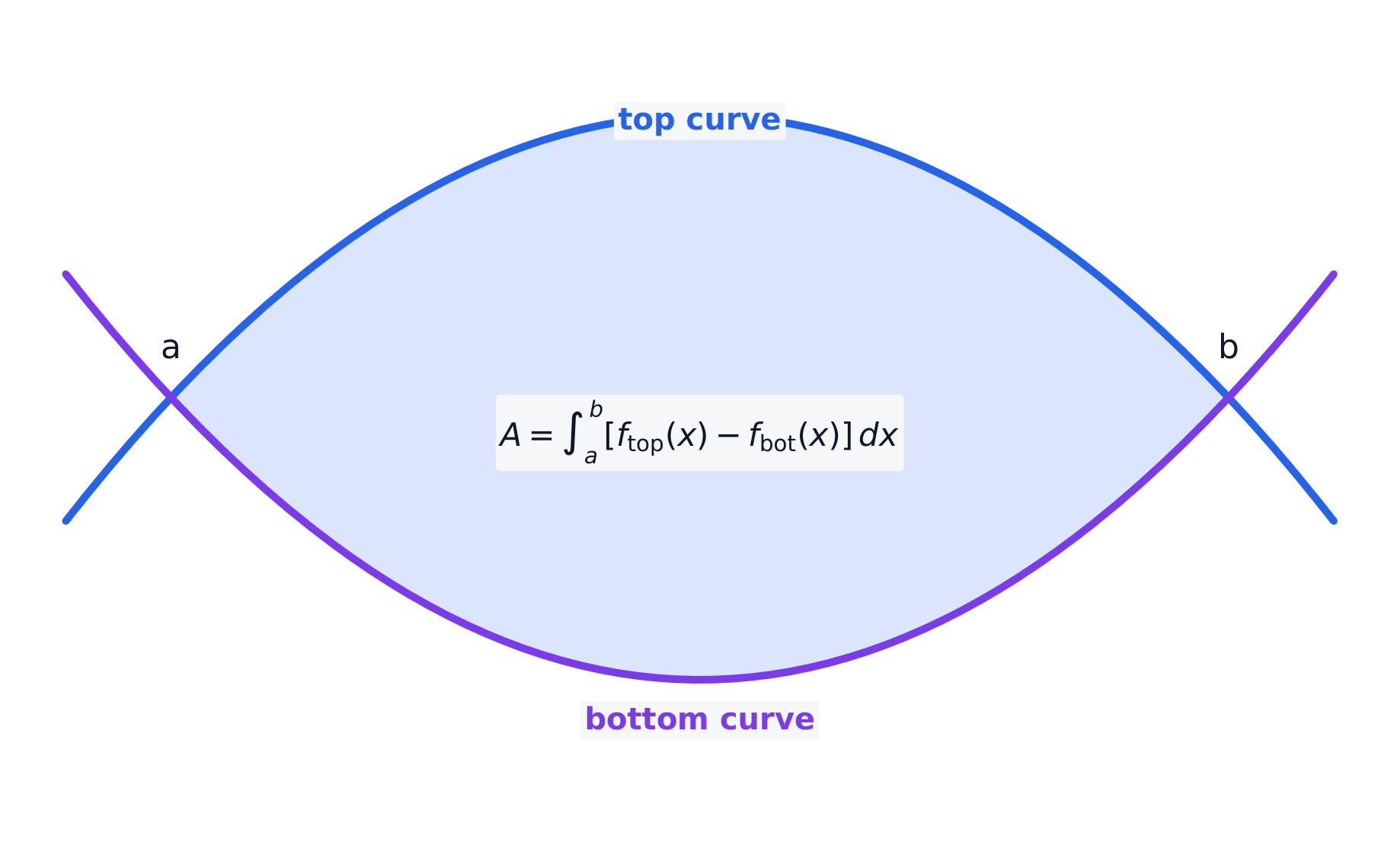
    学習目標 FUN-6.C: 導関数の知識を用いて、関数の原始関数および不定積分を求める。

    • FUN-6.C.1 $\int f(x)\,dx$ は関数 $f$ の不定積分であり、 $\int f(x)\,dx = F(x) + C$ と表すことができ、ここで $F'(x) = f(x)$ と $C$ は任意の定数である。
    • FUN-6.C.2 導関数の法則は、原始関数を求めるための基礎となる。
    • FUN-6.C.3 多くの関数には、閉じた形の原始関数が存在しない。

    Source: College Board AP Course and Exam Description · ⁨出典: College Board AP コースおよび試験説明書⁩

    English

    An indefinite integral 不定积分 $\int f(x)\,dx=F(x)+C$ is the family of all antiderivatives (hence the constant of integration $C$). Reverse each derivative rule: the power rule becomes $\int x^n\,dx=\dfrac{x^{n+1}}{n+1}+C$ (for $n\neq-1$), with $\int \frac1x\,dx=\ln|x|+C$, and the antiderivatives of $e^x$, $\sin x$, $\cos x$, and $\sec^2 x$ come straight from their derivatives.

    日本語

    An indefinite integral 不定积分 $\int f(x)\,dx=F(x)+C$ is the family of all antiderivatives (hence the constant of integration $C$). Reverse each derivative rule: the power rule becomes $\int x^n\,dx=\dfrac{x^{n+1}}{n+1}+C$ (for $n\neq-1$), with $\int \frac1x\,dx=\ln|x|+C$, and the antiderivatives of $e^x$, $\sin x$, $\cos x$, and $\sec^2 x$ come straight from their derivatives.

    Vocabulary · ⁨語彙⁩ Train · ⁨練習する⁩
    English 日本語
    indefinite integral/ɪnˈdefɪnət ˈɪntɪɡrəl/ 不定積分
    6.9

    Integrating Using Substitution

    Syllabus · ⁨シラバス⁩
    English

    Enduring Understanding (FUN-6): Recognizing opportunities to apply knowledge of geometry and mathematical rules can simplify integration.

    Learning Objective FUN-6.D: For integrands requiring substitution or rearrangements into equivalent forms: (a) Determine indefinite integrals. (b) Evaluate definite integrals.

    • FUN-6.D.1 Substitution of variables is a technique for finding antiderivatives.
    • FUN-6.D.2 For a definite integral, substitution of variables requires corresponding changes to the limits of integration.
    日本語

    持続的認識 (FUN-6): 幾何学や数学的规则の適用機会を見極めることで、積分が簡素化されることがある。

    学習目標 FUN-6.D: 置換や同等な形への変形が必要な被積分関数について: (a) 不定積分を求める。 (b) 定積分を計算する。

    • FUN-6.D.1 変数の置換は、原始関数を求める技法である。
    • FUN-6.D.2 定積分の場合、変数の置換には積分の積分区間の対応する変更が必要である。

    Source: College Board AP Course and Exam Description · ⁨出典: College Board AP コースおよび試験説明書⁩

    English

    u-substitution 换元积分 reverses the chain rule: choose $u=g(x)$ so that $g'(x)$ also appears, turning $\int f(g(x))g'(x)\,dx$ into $\int f(u)\,du$. Remember to convert $dx$ to $du$ and, for a definite integral, either change the limits to $u$-values or convert back to $x$ at the end.

    日本語

    u-substitution 换元积分 reverses the chain rule: choose $u=g(x)$ so that $g'(x)$ also appears, turning $\int f(g(x))g'(x)\,dx$ into $\int f(u)\,du$. Remember to convert $dx$ to $du$ and, for a definite integral, either change the limits to $u$-values or convert back to $x$ at the end.

    Vocabulary · ⁨語彙⁩ Train · ⁨練習する⁩
    English 日本語
    u-substitution/juː ˌsʌbstɪˈtjuːʃn/ u置換
    6.10

    Integrating Using Long Division and Completing the Square

    Syllabus · ⁨シラバス⁩
    English

    Enduring Understanding (FUN-6): Recognizing opportunities to apply knowledge of geometry and mathematical rules can simplify integration.

    Learning Objective FUN-6.D: For integrands requiring substitution or rearrangements into equivalent forms: (a) Determine indefinite integrals. (b) Evaluate definite integrals.

    • FUN-6.D.3 Techniques for finding antiderivatives include rearrangements into equivalent forms, such as long division and completing the square.
    日本語

    持続的認識 (FUN-6): 幾何学や数学的规则の適用機会を見極めることで、積分が簡素化されることがある。

    学習目標 FUN-6.D: 置換や同等な形への変形が必要な被積分関数について: (a) 不定積分を求める。 (b) 定積分を計算する。

    • FUN-6.D.3 原函数を求める技法には、長除法や平方完成などの同等な形への整理が含まれる。

    Source: College Board AP Course and Exam Description · ⁨出典: College Board AP コースおよび試験説明書⁩

    When a rational integrand is "top-heavy" (numerator degree $\ge$ denominator degree), long division rewrites it as a polynomial plus a proper fraction you can integrate. Completing the square in a denominator turns it into a form like $u^2+a^2$, leading to an arctangent antiderivative $\frac1a\arctan\frac{u}{a}+C$.

    6.11

    Integrating Using Integration by Parts

    Syllabus · ⁨シラバス⁩
    English

    Enduring Understanding (FUN-6): Recognizing opportunities to apply knowledge of geometry and mathematical rules can simplify integration.

    Learning Objective FUN-6.E: For integrands requiring integration by parts: (a) Determine indefinite integrals. BC ONLY (b) Evaluate definite integrals. BC ONLY

    • FUN-6.E.1 Integration by parts is a technique for finding antiderivatives. BC ONLY
    日本語

    持続的認識 (FUN-6): 幾何学や数学的规则の適用機会を見極めることで、積分が簡素化されることがある。

    学習目標 FUN-6.E: 部分積分が必要な被積分関数について: (a) 不定積分を求める。BCのみ (b) 定積分を計算する。BCのみ

    • FUN-6.E.1 部分積分は、原関数(反復積分)を求める技法である。BCのみ

    Source: College Board AP Course and Exam Description · ⁨出典: College Board AP コースおよび試験説明書⁩

    English

    Integration by parts 分部积分 reverses the product rule:

    $$\int u\,dv = uv-\int v\,du.$$
    Choose $u$ to simplify when differentiated and $dv$ to be easy to integrate (the LIATE guide: logs, inverse-trig, algebraic, trig, exponential). It handles products like $\int x e^x\,dx$ and $\int x\ln x\,dx$, sometimes applied twice.

    Worked example. For $\int x e^x\,dx$, choose $u=x$ ($du=dx$) and $dv=e^x\,dx$ ($v=e^x$):

    $$\int x e^x\,dx = x e^x-\int e^x\,dx = x e^x - e^x + C = e^x(x-1)+C.$$

    日本語

    Integration by parts 分部积分 reverses the product rule:

    $$\int u\,dv = uv-\int v\,du.$$
    Choose $u$ to simplify when differentiated and $dv$ to be easy to integrate (the LIATE guide: logs, inverse-trig, algebraic, trig, exponential). It handles products like $\int x e^x\,dx$ and $\int x\ln x\,dx$, sometimes applied twice.

    Worked example. For $\int x e^x\,dx$, choose $u=x$ ($du=dx$) and $dv=e^x\,dx$ ($v=e^x$):

    $$\int x e^x\,dx = x e^x-\int e^x\,dx = x e^x - e^x + C = e^x(x-1)+C.$$

    Vocabulary · ⁨語彙⁩ Train · ⁨練習する⁩
    English 日本語
    Integration by parts/ˌɪntɪˈɡreɪʃn baɪ pɑːts/ 部分積分
    6.12

    Integrating Using Linear Partial Fractions

    Syllabus · ⁨シラバス⁩
    English

    Enduring Understanding (FUN-6): Recognizing opportunities to apply knowledge of geometry and mathematical rules can simplify integration.

    Learning Objective FUN-6.F: For integrands requiring integration by linear partial fractions: (a) Determine indefinite integrals. BC ONLY (b) Evaluate definite integrals. BC ONLY

    • FUN-6.F.1 Some rational functions can be decomposed into sums of ratios of linear, nonrepeating factors to which basic integration techniques can be applied. BC ONLY
    日本語

    持続的認識 (FUN-6): 幾何学や数学的规则の適用機会を見極めることで、積分が簡素化されることがある。

    学習目標 FUN-6.F: 一次部分分数による積分が必要な被積分関数について: (a) 不定積分を求める。BCのみ (b) 定積分を計算する。BCのみ

    • FUN-6.F.1 有理関数の一部は、基本積分手法が適用できる線形で重複しない因数の比の和に分解できる。BCのみ

    Source: College Board AP Course and Exam Description · ⁨出典: College Board AP コースおよび試験説明書⁩

    English

    Partial fractions 部分分式 split a rational function with a factorable denominator into a sum of simpler fractions:

    $$\frac{1}{(x-a)(x-b)}=\frac{A}{x-a}+\frac{B}{x-b},$$
    each of which integrates to a logarithm. This technique is essential for the logistic differential equation in the next unit.

    日本語

    Partial fractions 部分分式 split a rational function with a factorable denominator into a sum of simpler fractions:

    $$\frac{1}{(x-a)(x-b)}=\frac{A}{x-a}+\frac{B}{x-b},$$
    each of which integrates to a logarithm. This technique is essential for the logistic differential equation in the next unit.

    Vocabulary · ⁨語彙⁩ Train · ⁨練習する⁩
    English 日本語
    Partial fractions/ˈpɑːʃl ˈfrækʃnz/ 部分分数
    6.13

    Evaluating Improper Integrals

    Syllabus · ⁨シラバス⁩
    English

    Enduring Understanding (LIM-6): The use of limits allows us to show that the areas of unbounded regions may be finite.

    Learning Objective LIM-6.A: Evaluate an improper integral or determine that the integral diverges. BC ONLY

    • LIM-6.A.1 An improper integral is an integral that has one or both limits infinite or has an integrand that is unbounded in the interval of integration. BC ONLY
    • LIM-6.A.2 Improper integrals can be determined using limits of definite integrals. BC ONLY
    日本語

    長期的理解 (LIM-6): 極限の活用により、有界でない領域の面積が有限であることが示せる。

    学習目標 LIM-6.A: 不積分区間を評価するか、積分が発散することを判定する。BCのみ

    • LIM-6.A.1 不整合分は、積分の下限または上限のいずれか(両方)が無限大であるか、あるいは被積分関数が積分区間で有界でないintegralである。BC ONLY
    • LIM-6.A.2 不整合分は、確定积分の極限を用いて計算できる。BC ONLY

    Source: College Board AP Course and Exam Description · ⁨出典: College Board AP コースおよび試験説明書⁩

    English
    Improper integrals: converge or diverge

    An improper integral 反常积分 has an infinite limit of integration or an infinite discontinuity in the integrand. Evaluate it as a limit: $\int_a^\infty f\,dx=\lim_{b\to\infty}\int_a^b f\,dx$. If the limit is a finite number the integral converges 收敛; otherwise it diverges 发散.

    Worked example. $\displaystyle\int_1^\infty \frac{1}{x^2}\,dx=\lim_{b\to\infty}\left[-\frac1x\right]_1^b=\lim_{b\to\infty}\left(1-\frac1b\right)=1$, so it converges to $1$. By contrast $\int_1^\infty \frac1x\,dx$ gives $\lim_{b\to\infty}\ln b=\infty$ and diverges – the same integrand-shape can go either way.

    日本語
    Improper integrals: converge or diverge

    An improper integral 反常积分 has an infinite limit of integration or an infinite discontinuity in the integrand. Evaluate it as a limit: $\int_a^\infty f\,dx=\lim_{b\to\infty}\int_a^b f\,dx$. If the limit is a finite number the integral converges 收敛; otherwise it diverges 发散.

    Worked example. $\displaystyle\int_1^\infty \frac{1}{x^2}\,dx=\lim_{b\to\infty}\left[-\frac1x\right]_1^b=\lim_{b\to\infty}\left(1-\frac1b\right)=1$, so it converges to $1$. By contrast $\int_1^\infty \frac1x\,dx$ gives $\lim_{b\to\infty}\ln b=\infty$ and diverges – the same integrand-shape can go either way.

    Vocabulary · ⁨語彙⁩ Train · ⁨練習する⁩
    English 日本語
    improper integral/ɪmˈprɒpə ˈɪntɪɡrəl/ 反 improper integral
    converges/kənˈvɜːdʒɪz/ 収束する
    diverges/daɪˈvɜːdʒɪz/ 発散する
    6.14

    Selecting Techniques for Antidifferentiation

    Syllabus · ⁨シラバス⁩
    English

    This topic is intended to focus on the skill of selecting an appropriate procedure for antidifferentiation. Students should be given opportunities to practice when and how to apply all learning objectives relating to antidifferentiation.

    日本語

    このトピックは、逆微分法に適した手順を選択するスキルに焦点を当てることを意図している。学生は、逆微分法に関連するすべての学習目標について、何时以及如何应用这些目标进行练习。

    Source: College Board AP Course and Exam Description · ⁨出典: College Board AP コースおよび試験説明書⁩

    The BC exam expects you to recognize which method fits: basic rules, substitution (a chain-rule pattern), by parts (a product), partial fractions (a factorable rational), or long division/completing the square. Being able to look at an integral and pick the right tool quickly is itself a tested skill.

    6.14

    Exam tips

    • Integration is antidifferentiation; use the power rule $\int x^n\,dx=\tfrac{x^{n+1}}{n+1}+C$ and don't forget the $+C$.
    • The Fundamental Theorem links the two: $\int_a^b f'(x)\,dx=f(b)-f(a)$, and $\tfrac{d}{dx}\int_a^x f(t)\,dt=f(x)$.
    • Approximate a definite integral with Riemann sums or the trapezoidal rule from a table of values.
    • A definite integral is a signed area (below the axis counts negative); split at sign changes for total area.
    • Use u-substitution and remember to change the limits (or back-substitute) accordingly.
  • 7

    Differential Equations

    Watch lesson · ⁨レッスンを視聴⁩
    7.1

    Modeling Situations with Differential Equations · ⁨微分方程式によるモデル化⁩

    Syllabus · ⁨シラバス⁩
    English

    Enduring Understanding (FUN-7): Solving differential equations allows us to determine functions and develop models.

    Learning Objective FUN-7.A: Interpret verbal statements of problems as differential equations involving a derivative expression.

    • FUN-7.A.1 Differential equations relate a function of an independent variable and the function's derivatives.
    日本語

    持続的理解 (FUN-7): 微分方程式を解くことで、関数を決定し、モデルを作成できる。

    学習目標 FUN-7.A: 問題の言語的な記述を、導関数式を含む微分方程式として解釈する。

    • FUN-7.A.1 微分方程式は、独立変数の関数とその導関数の関係を表す。

    Source: College Board AP Course and Exam Description · ⁨出典: College Board AP コースおよび試験説明書⁩

    English

    A differential equation 微分方程 relates a function to its derivatives. Many real situations are described by a rate: "the population grows at a rate proportional to its size" becomes $\dfrac{dP}{dt}=kP$. Setting up the equation from a verbal description – identifying what changes and what it is proportional to – is the first skill.

    日本語

    微分方程式は関数とその導関数との関係を表します。多くの現実の事象は変化率で記述されます。「個体数がその大きさに比例して増加する」ことは $\dfrac{dP}{dt}=kP$ となります。言葉での説明から方程式を立てる(何が変化しているか、それに比例的是什么かを特定する)ことが最初のスキルです。

    7.2

    Verifying Solutions for Differential Equations · ⁨微分方程式の解の確認⁩

    Syllabus · ⁨シラバス⁩
    English

    Enduring Understanding (FUN-7): Solving differential equations allows us to determine functions and develop models.

    Learning Objective FUN-7.B: Verify solutions to differential equations.

    • FUN-7.B.1 Derivatives can be used to verify that a function is a solution to a given differential equation.
    • FUN-7.B.2 There may be infinitely many general solutions to a differential equation.
    日本語

    持続的理解 (FUN-7): 微分方程式を解くことで、関数を決定し、モデルを作成できる。

    学習目標 FUN-7.B: 微分方程式の解を検証する。

    • FUN-7.B.1 導関数を用いて、ある関数が与えられた微分方程式の解であることを確認できる。
    • FUN-7.B.2 微分方程式には、無数の一般解が存在することがある。

    Source: College Board AP Course and Exam Description · ⁨出典: College Board AP コースおよび試験説明書⁩

    English

    A solution is a function that satisfies the equation. To verify a proposed solution, differentiate it and substitute into the equation, checking that both sides agree. A general solution contains a constant $C$; a particular solution fixes $C$ from a condition.

    日本語

    解とは、方程式を満たす関数のことです。検証するには、提案された解を微分して方程式に代入し、両辺が一致するか確認します。一般解には定数 $C$ が含まれ、特殊解は条件から $C$ を固定したものです。

    7.3

    Sketching Slope Fields · ⁨傾き場の描画⁩

    Syllabus · ⁨シラバス⁩
    Enduring UnderstandingLearning ObjectiveEssential Knowledge

    FUN-7
    Solving differential equations allows us to determine functions and develop models.

    FUN-7.C
    Estimate solutions to differential equations.

    • FUN-7.C.1 A slope field is a graphical representation of a differential equation on a finite set of points in the plane.
    • FUN-7.C.2 Slope fields provide information about the behavior of solutions to first-order differential equations.

    Source: College Board AP Course and Exam Description · ⁨出典: College Board AP コースおよび試験説明書⁩

    English
    Slope fields & solution curves

    A slope field 斜率场 draws a short line segment at many points, each with the slope $\dfrac{dy}{dx}$ the equation gives there. It pictures the family of solution curves without solving. To sketch one, evaluate the right-hand side at each grid point and draw a segment of that slope.

    日本語
    傾き場と解曲線

    傾き場は、方程式が示す傾き $\dfrac{dy}{dx}$ を持つ短い線分を多数の点に描きます。解を解くことなく、解曲線の家族を可視化します。スケッチするには、各格子点で右辺を計算し、その傾きの線分を描きます。

    傾き場はすべての地点で勾配を示し、解曲線はその方向に従います
    傾き場はすべての地点で勾配を示し、解曲線はその方向に従います
    Explore · ⁨探索⁩

    Read a differential equation as a slope field · ⁨微分方程式を傾き場として読む⁩

    A slope field draws the slope $dy/dx$ at each point. A solution curve threads through, always tangent to the little segments — you can sketch it by following the flow. · ⁨傾き場 は各点における傾き $dy/dx$ を描きます。解曲線は小さな線分常に接しながら通っていき、流れに沿ってスケッチすることができます。⁩

    Vocabulary · ⁨語彙⁩ Train · ⁨練習する⁩
    English 日本語
    differential equation/ˌdɪfəˈrenʃl ɪˈkweɪʒn/ 微分方程式
    slope field/sləʊp fiːld/ 傾き場
    7.4

    Reasoning Using Slope Fields · ⁨傾き場を用いた推論⁩

    Syllabus · ⁨シラバス⁩
    English

    Enduring Understanding (FUN-7): Solving differential equations allows us to determine functions and develop models.

    Learning Objective FUN-7.C: Estimate solutions to differential equations.

    • FUN-7.C.3 Solutions to differential equations are functions or families of functions.
    日本語

    持続的理解 (FUN-7): 微分方程式を解くことで、関数を決定し、モデルを作成できる。

    学習目標 FUN-7.C: 微分方程式の解を推定する。

    • FUN-7.C.3 微分方程式の解は、関数または関数の族である。

    Source: College Board AP Course and Exam Description · ⁨出典: College Board AP コースおよび試験説明書⁩

    English

    A solution curve follows the segments like a boat following a current. From a slope field you can sketch the particular solution through a given point, describe long-run behavior, and locate where solutions level off (slopes near zero) – reasoning about solutions purely from the picture.

    日本語

    解曲線は川の流れに従う船のように、線分に沿って進みます。傾き場から特定の点を通る特殊解をスケッチしたり、長期行動を記述したり、解が平坦になる場所(傾きがゼロに近い場所)を特定したりできます – 図のみから解について推論する能力です。

    7.5

    Approximating Solutions Using Euler's Method · ⁨Euler法を用いた近似解⁩

    Syllabus · ⁨シラバス⁩
    English

    Enduring Understanding (FUN-7): Solving differential equations allows us to determine functions and develop models.

    Learning Objective FUN-7.C: Estimate solutions to differential equations.

    • FUN-7.C.4 Euler's method provides a procedure for approximating a solution to a differential equation or a point on a solution curve. BC ONLY
    日本語

    持続的理解 (FUN-7): 微分方程式を解くことで、関数を決定し、モデルを作成できる。

    学習目標 FUN-7.C: 微分方程式の解を推定する。

    • FUN-7.C.4 オイラー法は、微分方程式の解を近似したり、解曲線上の点を求めたりするための手順を提供する。BC ONLY

    Source: College Board AP Course and Exam Description · ⁨出典: College Board AP コースおよび試験説明書⁩

    English
    Euler's method

    Euler's method 欧拉方法 approximates a solution numerically by stepping along the slope field. Starting from a known point, take a small step $\Delta x$ and update:

    $$y_{\text{new}}=y_{\text{old}}+\frac{dy}{dx}\cdot\Delta x.$$
    Repeat for each step. Smaller steps give a better approximation. (This is a BC-only technique.)

    Exam skill: be able to carry out two or three Euler steps by hand from a table, and know that Euler's method under- or over-estimates depending on the solution's concavity.

    Worked example. Approximate $y(1)$ for $\dfrac{dy}{dx}=x+y$, $y(0)=1$, with step $\Delta x=0.5$. Step 1: slope at $(0,1)$ is $0+1=1$, so $y(0.5)\approx 1+1(0.5)=1.5$. Step 2: slope at $(0.5,1.5)$ is $0.5+1.5=2$, so $y(1)\approx 1.5+2(0.5)=2.5$.

    日本語
    Euler's method

    Euler法は、傾き場に沿ってステップを踏むことで数値的に解を近似します。既知の点から始め、小さなステップ $\Delta x$ を取り、更新します:

    $$y_{\text{new}}=y_{\text{old}}+\frac{dy}{dx}\cdot\Delta x.$$
    各ステップで繰り返します。ステップが小さいほど近似は良くなります。(これはBC-onlyの技法です。)

    Exam skill: テーブルから手動でEulerステップを2〜3回実行でき、Euler法が解のconcavityに応じてunder- or over-estimates(過小評価または過大評価)することを知っています。

    Worked example. $y(1)$ を近似します。 $\dfrac{dy}{dx}=x+y$ 、 $y(0)=1$ で、ステップ $\Delta x=0.5$ を使用します。 Step 1: $(0,1)$ での傾きは $0+1=1$ なので、 $y(0.5)\approx 1+1(0.5)=1.5$ です。 Step 2: $(0.5,1.5)$ での傾きは $0.5+1.5=2$ なので、 $y(1)\approx 1.5+2(0.5)=2.5$ です。

    Vocabulary · ⁨語彙⁩ Train · ⁨練習する⁩
    English 日本語
    Euler's method/ˈɔɪləz ˈmeθəd/ オイラー法
    separable/ˈsepərəbl/ 変数分離可能
    initial condition/ɪˈnɪʃl kənˈdɪʃn/ 初期条件
    exponential growth or decay/ˌekspəˈnenʃl ɡrəʊθ ɔː dɪˈkeɪ/ 指数関数的増加または減少
    logistic model/ləˈdʒɪstɪk ˈmɒdl/ ロジスティックモデル
    7.6

    Finding General Solutions Using Separation of Variables · ⁨変数分離法による一般解の導出⁩

    Syllabus · ⁨シラバス⁩
    English

    Enduring Understanding (FUN-7): Solving differential equations allows us to determine functions and develop models.

    Learning Objective FUN-7.D: Determine general solutions to differential equations.

    • FUN-7.D.1 Some differential equations can be solved by separation of variables.
    • FUN-7.D.2 Antidifferentiation can be used to find general solutions to differential equations.
    日本語

    持続的理解 (FUN-7): 微分方程式を解くことで、関数を決定し、モデルを作成できる。

    学習目標 FUN-7.D: 微分方程式の一般解を求める。

    • FUN-7.D.1 一部の微分方程式は、変数分離法によって解ける。
    • FUN-7.D.2 原始積分を用いて、微分方程式の一般解を求めることができる。

    Source: College Board AP Course and Exam Description · ⁨出典: College Board AP コースおよび試験説明書⁩

    English

    A separable 可分离 differential equation can be written with all the $y$'s on one side and all the $x$'s on the other, then integrated:

    $$\frac{dy}{dx}=g(x)h(y)\ \Rightarrow\ \int\frac{dy}{h(y)}=\int g(x)\,dx.$$
    This produces the general solution (with a $+C$), the main analytic method for solving differential equations in this course.

    Worked example. Solve $\dfrac{dy}{dx}=xy$ with $y(0)=2$. Separating, $\int\frac{dy}{y}=\int x\,dx$ gives $\ln|y|=\frac{x^2}{2}+C$, so $y=Ae^{x^2/2}$. The condition $y(0)=2$ gives $A=2$, so $y=2e^{x^2/2}$.

    日本語
    顕微鏡下の大腸菌:微分方程式は指数関数的増殖をモデル化します
    顕微鏡下の大腸菌:微分方程式は指数関数的増殖をモデル化します

    可分微分方程式は、すべての $y$ を片側に、すべての $x$ を他方に置いてから積分できる形に書けます:

    $$\frac{dy}{dx}=g(x)h(y)\ \Rightarrow\ \int\frac{dy}{h(y)}=\int g(x)\,dx.$$
    これにより一般解(定数 $+C$ を含む)が得られ、これが本課程における微分方程式を解く主要な解析的手法です。

    Worked example. $\dfrac{dy}{dx}=xy$ を $y(0)=2$ で解きます。可分化すると、 $\int\frac{dy}{y}=\int x\,dx$ から $\ln|y|=\frac{x^2}{2}+C$ となり、したがって $y=Ae^{x^2/2}$ です。条件 $y(0)=2$ から $A=2$ が得られるため、 $y=2e^{x^2/2}$ となります。

    7.7

    Finding Particular Solutions Using Initial Conditions · ⁨初期条件を用いた特殊解の探索⁩

    Syllabus · ⁨シラバス⁩
    English

    Enduring Understanding (FUN-7): Solving differential equations allows us to determine functions and develop models.

    Learning Objective FUN-7.E: Determine particular solutions to differential equations.

    • FUN-7.E.1 A general solution may describe infinitely many solutions to a differential equation. There is only one particular solution passing through a given point.
    • FUN-7.E.2 The function $F$ defined by $F(x) = y_0 + \int_a^x f(t)\,dt$ is a particular solution to the differential equation $\dfrac{dy}{dx} = f(x)$, satisfying $F(a) = y_0$.
    • FUN-7.E.3 Solutions to differential equations may be subject to domain restrictions.
    日本語

    持続的理解 (FUN-7): 微分方程式を解くことで、関数を決定し、モデルを作成できる。

    学習目標 FUN-7.E: 微分方程式の特解を求める。

    • FUN-7.E.1 一般解は、微分方程式の無数の解を表すことがある。ある点を通る特解は一つだけである。
    • FUN-7.E.2 関数 $F$ は、関数 $F(x) = y_0 + \int_a^x f(t)\,dt$ によって定義され、微分方程式 $\dfrac{dy}{dx} = f(x)$ の particular solution であり、$F(a) = y_0$ を満たす。
    • FUN-7.E.3 微分方程式の解には、定義域の制限が課されることがある。

    Source: College Board AP Course and Exam Description · ⁨出典: College Board AP コースおよび試験説明書⁩

    English

    An initial condition 初始条件 (a known point, e.g. $y(0)=5$) pins down the constant $C$. Solve for the general solution, substitute the condition to find $C$, then write the particular solution. Watch the domain – a particular solution is valid only on the interval containing the initial point.

    日本語

    初期条件(既知の点、例: $y(0)=5$ )は定数 $C$ を決定します。一般解を解き、条件を代入して $C$ を見つけ、特殊解を書きます。定義域に注意してください – 特殊解は初期点を含む区間でのみ有効です。

    定数により曲線の族が得られ、初期条件によって1つの曲線が選ばれる
    定数により曲線の族が得られ、初期条件によって1つの曲線が選ばれる
    7.8

    Exponential Models with Differential Equations · ⁨微分方程式による指数関数モデル⁩

    Syllabus · ⁨シラバス⁩
    Enduring UnderstandingLearning ObjectiveEssential Knowledge

    FUN-7
    Solving differential equations allows us to determine functions and develop models.

    FUN-7.F
    Interpret the meaning of a differential equation and its variables in context.

    • FUN-7.F.1 Specific applications of finding general and particular solutions to differential equations include motion along a line and exponential growth and decay.
    • FUN-7.F.2 The model for exponential growth and decay that arises from the statement "The rate of change of a quantity is proportional to the size of the quantity" is $\dfrac{dy}{dt} = ky$.

    FUN-7.G
    Determine general and particular solutions for problems involving differential equations in context.

    • FUN-7.G.1 The exponential growth and decay model, $\dfrac{dy}{dt} = ky$, with initial condition $y = y_0$ when $t = 0$, has solutions of the form $y = y_0 e^{kt}$.

    Source: College Board AP Course and Exam Description · ⁨出典: College Board AP コースおよび試験説明書⁩

    English
    Exponential vs logistic growth

    The equation $\dfrac{dy}{dt}=ky$ says the rate of change is proportional to the amount – giving exponential growth or decay 指数增长. Separating variables yields

    $$y=y_0 e^{kt},$$
    with $k>0$ for growth and $k<0$ for decay. This models unrestricted population growth, radioactive decay, and continuously compounded interest.

    日本語
    指数関数的成長とロジスティック成長

    方程式 $\dfrac{dy}{dt}=ky$ は、変化率が量に proportional (比例)であることを示しており、指数関数的増減を与えます。変数分離を行うと

    $$y=y_0 e^{kt},$$
    が得られ、 $k>0$ は増減、 $k<0$ は減少を表します。これは無制限の個体数増減、放射性崩壊、複利の連続複利をモデル化します。

    冷めていくコーヒー:ニュートンの冷却則は古典的な微分方程式モデルです
    冷めていくコーヒー:ニュートンの冷却則は古典的な微分方程式モデルです
    Explore · ⁨探索⁩

    An exponential growth/decay model · ⁨指数関数的増減モデル⁩

    y = a·e^(bx) + c

    The equation $dy/dt=ky$ has exponential solutions: quantity changes at a rate proportional to itself, giving unbounded growth ($k>0$) or decay to zero ($k<0$). · ⁨方程式 $dy/dt=ky$ には 指数関数 的な解があります:量は自身に比例した速度で変化し、無制限の増加($k>0$)またはゼロへの減少($k<0$)をもたらします。⁩

    7.9

    Logistic Models with Differential Equations · ⁨微分方程式によるロジスティックモデル⁩

    Syllabus · ⁨シラバス⁩
    English

    Enduring Understanding (FUN-7): Solving differential equations allows us to determine functions and develop models.

    Learning Objective FUN-7.H: Interpret the meaning of the logistic growth model in context. BC ONLY

    • FUN-7.H.1 The model for logistic growth that arises from the statement "The rate of change of a quantity is jointly proportional to the size of the quantity and the difference between the quantity and the carrying capacity" is $\dfrac{dy}{dt} = ky(a - y)$. BC ONLY
    • FUN-7.H.2 The logistic differential equation and initial conditions can be interpreted without solving the differential equation. BC ONLY
    • FUN-7.H.3 The limiting value (carrying capacity) of a logistic differential equation as the independent variable approaches infinity can be determined using the logistic growth model and initial conditions. BC ONLY
    • FUN-7.H.4 The value of the dependent variable in a logistic differential equation at the point when it is changing fastest can be determined using the logistic growth model and initial conditions. BC ONLY
    日本語

    持続的理解 (FUN-7): 微分方程式を解くことで、関数を決定し、モデルを作成できる。

    学習目標 FUN-7.H: コンテキストにおけるロジスティック成長モデルの意味を解釈する。BC ONLY

    • FUN-7.H.1 「ある量の変化率が、その量の大きさとその量と carrying capacity の差との積に比例する」という記述から導かれるロジスティック成長のモデルは $\dfrac{dy}{dt} = ky(a - y)$ である。BC ONLY
    • FUN-7.H.2 ロジスティック微分方程式と初期条件は、微分方程式を解くことなく解釈できる。BC ONLY
    • FUN-7.H.3 独立変数が無限大に近づくときのロジスティック微分方程式の極限値(carrying capacity)は、ロジスティック成長モデルと初期条件を用いて決定できる。BC ONLY
    • FUN-7.H.4 ロジスティック微分方程式において依存変数の値が最も速く変化している時点での値は、ロジスティック成長モデルと初期条件を用いて決定できる。BC ONLY

    Source: College Board AP Course and Exam Description · ⁨出典: College Board AP コースおよび試験説明書⁩

    English

    Real growth is limited by resources, so the logistic model 逻辑斯蒂模型 adds a carrying capacity 环境容纳量 $L$:

    $$\frac{dP}{dt}=kP\!\left(1-\frac{P}{L}\right).$$
    Growth is nearly exponential when $P$ is small, slows as $P$ approaches $L$, and stops at $P=L$. Key BC facts: the population levels off at $L$ ($\lim_{t\to\infty}P=L$), and it grows fastest when $P=\tfrac{L}{2}$ (the inflection point of the S-shaped curve). You are expected to read $L$ and the fastest-growth value directly from the equation.

    Worked example. For $\dfrac{dP}{dt}=0.05\,P\!\left(1-\dfrac{P}{2000}\right)$, the carrying capacity is $L=2000$ (the population levels off there), and growth is fastest when $P=\dfrac{L}{2}=1000$ – both read straight off the equation, no solving needed.

    日本語

    実際の成長は資源によって制限されるため、ロジスティックモデルは carrying capacity $L$ を追加します:

    $$\frac{dP}{dt}=kP\!\left(1-\frac{P}{L}\right).$$
    $P$ が小さいとき、増殖はほぼ指数関数的であり、$P$ が $L$ に近づくにつれて減速し、$P=L$ で停止します。AP BCの重要な事実: 個体数は $L$ で一定になる ($\lim_{t\to\infty}P=L$)、また $P=\tfrac{L}{2}$ のときに最も速く増殖する (S字曲線の変曲点)。$L$ と最大増殖値を方程式から直接読み取ることを期待されます。

    ** worked example.** $\dfrac{dP}{dt}=0.05\,P\!\left(1-\dfrac{P}{2000}\right)$ について、環境収容力は $L=2000$ (個体数がそこで一定になる) であり、増殖が最も速いのは $P=\dfrac{L}{2}=1000$ です – これらは方程式からそのまま読み取れます。計算は不要です。

    logisticモデルはP=L/2で最も速く増殖し、環境収容力Lで一定になります
    logisticモデルはP=L/2で最も速く増殖し、環境収容力Lで一定になります
    Vocabulary · ⁨語彙⁩ Train · ⁨練習する⁩
    English 日本語
    carrying capacity/ˈkæriɪŋ kəˈpæsɪti/ 環境収容力
    7.9

    Exam tips · ⁨試験対策⁩

    English
    • Solve a separable equation by getting all $y$ on one side and all $x$ on the other, then integrating both sides (add $+C$ once).
    • Use the initial condition to find $C$ (a particular solution).
    • Sketch or read a slope field: the little segments show $\tfrac{dy}{dx}$ at each point, and a solution curve follows them.
    • Recognise exponential models $\tfrac{dy}{dt}=ky\Rightarrow y=Ce^{kt}$ (growth/decay).
    • A differential equation gives the slope — you must integrate to recover the function.
    日本語
    • 可分方程式 を解くには、$y$ を片方、$x$ を他方に集め、両辺を積分します(定数 $+C$ を加えます)。
    • 初期条件を用いて $C$ を見つけ(特殊解を得ます)。
    • 傾き場 を描画または読み取ります。各点における小さな線分は $\tfrac{dy}{dx}$ を示しており、解曲線はその方向に従います。
    • 指数関数モデル $\tfrac{dy}{dt}=ky\Rightarrow y=Ce^{kt}$(増減)を識別します。
    • 微分方程式は傾きを与えます。関数を復元するためには積分を行う必要があります。
  • 8

    Applications of Integration

    Watch lesson · ⁨レッスンを視聴⁩
    8.1

    Finding the Average Value of a Function on an Interval

    Syllabus · ⁨シラバス⁩
    Enduring UnderstandingLearning ObjectiveEssential Knowledge

    CHA-4
    Definite integrals allow us to solve problems involving the accumulation of change over an interval.

    CHA-4.B
    Determine the average value of a function using definite integrals.

    • CHA-4.B.1 The average value of a continuous function $f$ over an interval $[a, b]$ is $\dfrac{1}{b-a}\int_a^b f(x)\,dx$.

    Source: College Board AP Course and Exam Description · ⁨出典: College Board AP コースおよび試験説明書⁩

    English

    The average value 平均值 of $f$ over $[a,b]$ is the integral divided by the width:

    $$f_{\text{avg}}=\frac{1}{b-a}\int_a^b f(x)\,dx.$$
    It is the constant height a rectangle would need to have the same area as the region under $f$. Do not confuse this with the average rate of change (which uses the derivative).

    Worked example. The average value of $f(x)=x^2$ on $[0,3]$ is $\dfrac{1}{3}\displaystyle\int_0^3 x^2\,dx=\dfrac13\left[\dfrac{x^3}{3}\right]_0^3=\dfrac13(9)=3$.

    日本語

    The average value 平均值 of $f$ over $[a,b]$ is the integral divided by the width:

    $$f_{\text{avg}}=\frac{1}{b-a}\int_a^b f(x)\,dx.$$
    It is the constant height a rectangle would need to have the same area as the region under $f$. Do not confuse this with the average rate of change (which uses the derivative).

    Worked example. The average value of $f(x)=x^2$ on $[0,3]$ is $\dfrac{1}{3}\displaystyle\int_0^3 x^2\,dx=\dfrac13\left[\dfrac{x^3}{3}\right]_0^3=\dfrac13(9)=3$.

    Explore · ⁨探索⁩

    The average value of a function · ⁨関数の平均値⁩

    y = ax³ + bx² + cx + d

    The average value of $f$ on $[a,b]$ is its integral divided by the width — the constant height whose rectangle has the same area as under the curve. · ⁨$f$の$[a,b]$における平均値とは、その定積分を幅で割ったものであり、曲線の下の面積と同じを持つ長方形の一定の高さです。⁩

    Vocabulary · ⁨語彙⁩ Train · ⁨練習する⁩
    English 日本語
    average value/ˈævrɪdʒ ˈvæljuː/ 平均値
    8.2

    Connecting Position, Velocity, and Acceleration Using Integrals

    Syllabus · ⁨シラバス⁩
    English

    Enduring Understanding (CHA-4): Definite integrals allow us to solve problems involving the accumulation of change over an interval.

    Learning Objective CHA-4.C: Determine values for positions and rates of change using definite integrals in problems involving rectilinear motion.

    • CHA-4.C.1 For a particle in rectilinear motion over an interval of time, the definite integral of velocity represents the particle's displacement over the interval of time, and the definite integral of speed represents the particle's total distance traveled over the interval of time.
    日本語

    持続的認識 (CHA-4): 定積分により、区間における変化の蓄積に関する問題を解くことができる。

    学習目標 CHA-4.C: 直線運動に関する問題において、定積分を用いて位置および変化率の値を求める。

    • CHA-4.C.1 ある時間区間における直線運動をする粒子について、速度の定積分はその区間における粒子の変位を表し、速さの定積分はその区間における粒子が移動した全距離を表す。

    Source: College Board AP Course and Exam Description · ⁨出典: College Board AP コースおよび試験説明書⁩

    English

    For straight-line motion, integration reverses differentiation:

    $$v(t)=\int a(t)\,dt,\qquad s(t)=\int v(t)\,dt.$$
    Two key distinctions: displacement 位移 is $\int_a^b v\,dt$ (net change in position), while total distance 总路程 is $\int_a^b |v|\,dt$ (splitting where $v$ changes sign). Speed is $|v|$.

    日本語

    For straight-line motion, integration reverses differentiation:

    $$v(t)=\int a(t)\,dt,\qquad s(t)=\int v(t)\,dt.$$
    Two key distinctions: displacement 位移 is $\int_a^b v\,dt$ (net change in position), while total distance 总路程 is $\int_a^b |v|\,dt$ (splitting where $v$ changes sign). Speed is $|v|$.

    Vocabulary · ⁨語彙⁩ Train · ⁨練習する⁩
    English 日本語
    displacement/dɪˈspleɪsmənt/ 変位
    total distance/ˈtəʊtl ˈdɪstəns/ 移動距離の総和
    8.3

    Using Accumulation Functions and Definite Integrals in Applied Contexts

    Syllabus · ⁨シラバス⁩
    English

    Enduring Understanding (CHA-4): Definite integrals allow us to solve problems involving the accumulation of change over an interval.

    Learning Objective CHA-4.D: Interpret the meaning of a definite integral in accumulation problems.

    • CHA-4.D.1 A function defined as an integral represents an accumulation of a rate of change.
    • CHA-4.D.2 The definite integral of the rate of change of a quantity over an interval gives the net change of that quantity over that interval.

    Learning Objective CHA-4.E: Determine net change using definite integrals in applied contexts.

    • CHA-4.E.1 The definite integral can be used to express information about accumulation and net change in many applied contexts.
    日本語

    持続的認識 (CHA-4): 定積分により、区間における変化の蓄積に関する問題を解くことができる。

    学習目標 CHA-4.D: 蓄積問題における定積分の意味を解釈する。

    • CHA-4.D.1 積分として定義された関数は、変化率の蓄積を表す。
    • CHA-4.D.2 ある量の変化率の定積分は、その区間におけるその量の正味の変化(純増減)を与える。

    学習目標 CHA-4.E: 実用的な文脈において、定積分を用いて正味の変化を求める。

    • CHA-4.E.1 定積分は、多くの実用的な文脈において、蓄積や正味の変化に関する情報を表現するために使用できる。

    Source: College Board AP Course and Exam Description · ⁨出典: College Board AP コースおよび試験説明書⁩

    When a rate is given (flow rate, sales per day), the definite integral gives the accumulated total, and $\int_a^b R(t)\,dt$ carries the units of $R$ times time. A common setup: initial amount $+\int(\text{rate in}-\text{rate out})\,dt$ gives the amount at a later time. Always interpret the answer in context, with units.

    8.4

    Finding the Area Between Curves Expressed as Functions of x

    Syllabus · ⁨シラバス⁩
    English

    Enduring Understanding (CHA-5): Definite integrals allow us to solve problems involving the accumulation of change in area or volume over an interval.

    Learning Objective CHA-5.A: Calculate areas in the plane using the definite integral.

    • CHA-5.A.1 Areas of regions in the plane can be calculated with definite integrals.
    日本語

    持続的理解 (CHA-5): 定積分を用いることで、区間における面積または体積の変化の蓄積に関する問題を解くことができる。

    学習目標 CHA-5.A: 定積分を用いて平面上の面積を求める。

    • CHA-5.A.1 平面上の領域の面積は、定積分によって計算できる。

    Source: College Board AP Course and Exam Description · ⁨出典: College Board AP コースおよび試験説明書⁩

    A potter shaping a vessel: volumes of revolution rotate a plane region about an axis
    A potter shaping a vessel: volumes of revolution rotate a plane region about an axis

    The area between $y=f(x)$ (top) and $y=g(x)$ (bottom) from $a$ to $b$ is

    $$\int_a^b\big(f(x)-g(x)\big)\,dx.$$
    Find the intersection points for the limits, and always subtract top minus bottom.

    The area between two curves is the integral of top minus bottom
    The area between two curves is the integral of top minus bottom

    Worked example. Between $y=x$ and $y=x^2$ (crossing at $x=0,1$, with $y=x$ on top), the area is $\displaystyle\int_0^1 (x-x^2)\,dx=\left[\dfrac{x^2}{2}-\dfrac{x^3}{3}\right]_0^1=\dfrac16$.

    8.5

    Finding the Area Between Curves Expressed as Functions of y

    Syllabus · ⁨シラバス⁩
    English

    Enduring Understanding (CHA-5): Definite integrals allow us to solve problems involving the accumulation of change in area or volume over an interval.

    Learning Objective CHA-5.A: Calculate areas in the plane using the definite integral.

    • CHA-5.A.2 Areas of regions in the plane can be calculated using functions of either $x$ or $y$.
    日本語

    持続的理解 (CHA-5): 定積分を用いることで、区間における面積または体積の変化の蓄積に関する問題を解くことができる。

    学習目標 CHA-5.A: 定積分を用いて平面上の面積を求める。

    • CHA-5.A.2 平面上の領域の面積は、either $x$ または $y$ の関数を用いて計算できる。

    Source: College Board AP Course and Exam Description · ⁨出典: College Board AP コースおよび試験説明書⁩

    When curves are easier to describe as $x=f(y)$, integrate with respect to $y$ instead, using right minus left:

    $$\int_c^d\big(f_{\text{right}}(y)-g_{\text{left}}(y)\big)\,dy.$$
    Choosing to integrate in $y$ can avoid splitting the region into several pieces.

    8.6

    Finding the Area Between Curves That Intersect More Than Twice

    Syllabus · ⁨シラバス⁩
    English

    Enduring Understanding (CHA-5): Definite integrals allow us to solve problems involving the accumulation of change in area or volume over an interval.

    Learning Objective CHA-5.A: Calculate areas in the plane using the definite integral.

    • CHA-5.A.3 Areas of certain regions in the plane may be calculated using a sum of two or more definite integrals or by evaluating a definite integral of the absolute value of the difference of two functions.
    日本語

    持続的理解 (CHA-5): 定積分を用いることで、区間における面積または体積の変化の蓄積に関する問題を解くことができる。

    学習目標 CHA-5.A: 定積分を用いて平面上の面積を求める。

    • CHA-5.A.3 特定の平面上の領域の面積は、2つ以上の定積分の和として計算するか、あるいは2つの関数の差の絶対値の定積分を評価することで求めることができる。

    Source: College Board AP Course and Exam Description · ⁨出典: College Board AP コースおよび試験説明書⁩

    If two curves cross several times, the top and bottom switch. Split the region at each intersection and integrate each piece with the correct top-minus-bottom (or use $\int|f-g|$), then add the pieces.

    8.7

    Volumes with Cross Sections: Squares and Rectangles

    Syllabus · ⁨シラバス⁩
    English

    Enduring Understanding (CHA-5): Definite integrals allow us to solve problems involving the accumulation of change in area or volume over an interval.

    Learning Objective CHA-5.B: Calculate volumes of solids with known cross sections using definite integrals.

    • CHA-5.B.1 Volumes of solids with square and rectangular cross sections can be found using definite integrals and the area formulas for these shapes.
    日本語

    持続的理解 (CHA-5): 定積分を用いることで、区間における面積または体積の変化の蓄積に関する問題を解くことができる。

    学習目標 CHA-5.B: 定積分を用いて既知の断面を持つ立体の体積を求める。

    • CHA-5.B.1 正方形および長方形の断面を持つ立体の体積は、これらの形状の面積公式および定積分を用いて求めることができる。

    Source: College Board AP Course and Exam Description · ⁨出典: College Board AP コースおよび試験説明書⁩

    English

    If a solid's cross sections 横截面 perpendicular to the $x$-axis are squares or rectangles, integrate their area. With side length equal to the distance between two curves, a square cross section gives

    $$V=\int_a^b \big(f(x)-g(x)\big)^2\,dx.$$
    The method is always "integrate the cross-sectional area."

    日本語

    If a solid's cross sections 横截面 perpendicular to the $x$-axis are squares or rectangles, integrate their area. With side length equal to the distance between two curves, a square cross section gives

    $$V=\int_a^b \big(f(x)-g(x)\big)^2\,dx.$$
    The method is always "integrate the cross-sectional area."

    Vocabulary · ⁨語彙⁩ Train · ⁨練習する⁩
    English 日本語
    cross sections/krɒs ˈsekʃnz/ 断面
    8.8

    Volumes with Cross Sections: Triangles and Semicircles

    Syllabus · ⁨シラバス⁩
    English

    Enduring Understanding (CHA-5): Definite integrals allow us to solve problems involving the accumulation of change in area or volume over an interval.

    Learning Objective CHA-5.B: Calculate volumes of solids with known cross sections using definite integrals.

    • CHA-5.B.2 Volumes of solids with triangular cross sections can be found using definite integrals and the area formulas for these shapes.
    • CHA-5.B.3 Volumes of solids with semicircular and other geometrically defined cross sections can be found using definite integrals and the area formulas for these shapes.
      • Illustrative examples for CHA-5.B.3:
        • The volume of a funnel whose cross sections are circles can be found using the area formula for a circle and definite integrals (see 2016 AB Exam FRQ #5(b)).
        • The volume of a solid whose cross sectional area is defined using a function can be found using the known area function and a definite integral (see 2009 AB Exam FRQ #4(c)).
    日本語

    持続的理解 (CHA-5): 定積分を用いることで、区間における面積または体積の変化の蓄積に関する問題を解くことができる。

    学習目標 CHA-5.B: 定積分を用いて既知の断面を持つ立体の体積を求める。

    • CHA-5.B.2 三角形の断面を持つ立体の体積は、これらの形状の面積公式および定積分を用いて求めることができる。
    • CHA-5.B.3 半円または他の幾何学的に定義された断面を持つ立体の体積は、これらの形状の面積公式および定積分を用いて求めることができる。
      • *CHA-5.B.3 のための例示:
        • 断面が円であるサイレンの体積は、円の面積公式および定積分を用いて求めることができる(2016年AB試験自由回答問題 #5(b) を参照)。
        • 断面積が関数によって定義される立体の体積は、既知の面積関数および定積分を用いて求めることができる(2009年AB試験自由回答問題 #4(c) を参照)。

    Source: College Board AP Course and Exam Description · ⁨出典: College Board AP コースおよび試験説明書⁩

    Same idea, different area formula: for equilateral-triangle cross sections use $A=\tfrac{\sqrt3}{4}s^2$, and for semicircular ones $A=\tfrac{\pi}{8}s^2$ (with $s$ the distance between the curves). Substitute the area formula and integrate.

    8.9

    Volume with Disc Method: Revolving Around the x- or y-Axis

    Syllabus · ⁨シラバス⁩
    English

    Enduring Understanding (CHA-5): Definite integrals allow us to solve problems involving the accumulation of change in area or volume over an interval.

    Learning Objective CHA-5.C: Calculate volumes of solids of revolution using definite integrals.

    • CHA-5.C.1 Volumes of solids of revolution around the $x$- or $y$-axis may be found by using definite integrals with the disc method.
    日本語

    持続的理解 (CHA-5): 定積分を用いることで、区間における面積または体積の変化の蓄積に関する問題を解くことができる。

    学習目標 CHA-5.C: 定積分を用いて、回転体の体積を計算する。

    • CHA-5.C.1 $x$軸または$y$軸回りの回転体(回転立体)の体積は、ディスク法を用いた定積分によって求めることができる。

    Source: College Board AP Course and Exam Description · ⁨出典: College Board AP コースおよび試験説明書⁩

    English
    Solids of revolution: the disc method

    Revolving a region around an axis makes a solid whose cross sections are discs. The disc method 圆盘法 integrates $\pi(\text{radius})^2$:

    $$V=\pi\int_a^b \big(R(x)\big)^2\,dx,$$
    where the radius $R$ is the distance from the curve to the axis. Use $dy$ when revolving around the $y$-axis.

    Worked example. Revolving the region under $y=\sqrt{x}$ from $0$ to $4$ about the $x$-axis gives discs of radius $\sqrt{x}$: $V=\pi\displaystyle\int_0^4 (\sqrt{x})^2\,dx=\pi\int_0^4 x\,dx=8\pi$.

    日本語
    Solids of revolution: the disc method

    Revolving a region around an axis makes a solid whose cross sections are discs. The disc method 圆盘法 integrates $\pi(\text{radius})^2$:

    $$V=\pi\int_a^b \big(R(x)\big)^2\,dx,$$
    where the radius $R$ is the distance from the curve to the axis. Use $dy$ when revolving around the $y$-axis.

    The disc method: rotating y=f(x) about the axis sweeps out disks of radius f(x)
    The disc method: rotating y=f(x) about the axis sweeps out disks of radius f(x)

    Worked example. Revolving the region under $y=\sqrt{x}$ from $0$ to $4$ about the $x$-axis gives discs of radius $\sqrt{x}$: $V=\pi\displaystyle\int_0^4 (\sqrt{x})^2\,dx=\pi\int_0^4 x\,dx=8\pi$.

    Rotating a region about an axis sweeps out a solid of revolution
    Rotating a region about an axis sweeps out a solid of revolution
    Vocabulary · ⁨語彙⁩ Train · ⁨練習する⁩
    English 日本語
    disc method/dɪsk ˈmeθəd/ 円板法
    8.10

    Volume with Disc Method: Revolving Around Other Axes

    Syllabus · ⁨シラバス⁩
    English

    Enduring Understanding (CHA-5): Definite integrals allow us to solve problems involving the accumulation of change in area or volume over an interval.

    Learning Objective CHA-5.C: Calculate volumes of solids of revolution using definite integrals.

    • CHA-5.C.2 Volumes of solids of revolution around any horizontal or vertical line in the plane may be found by using definite integrals with the disc method.
    日本語

    持続的理解 (CHA-5): 定積分を用いることで、区間における面積または体積の変化の蓄積に関する問題を解くことができる。

    学習目標 CHA-5.C: 定積分を用いて、回転体の体積を計算する。

    • CHA-5.C.2 平面上の任意の水平線または垂直線回りの回転体の体積は、ディスク法を用いた定積分で求めることができる。

    Source: College Board AP Course and Exam Description · ⁨出典: College Board AP コースおよび試験説明書⁩

    When the axis of revolution is a horizontal or vertical line like $y=k$ (not an axis), the radius adjusts: $R=|f(x)-k|$. Set up the radius as the distance from the curve to that line, then integrate $\pi R^2$ as before.

    8.11

    Volume with Washer Method: Revolving Around the x- or y-Axis

    Syllabus · ⁨シラバス⁩
    English

    Enduring Understanding (CHA-5): Definite integrals allow us to solve problems involving the accumulation of change in area or volume over an interval.

    Learning Objective CHA-5.C: Calculate volumes of solids of revolution using definite integrals.

    • CHA-5.C.3 Volumes of solids of revolution around the $x$- or $y$-axis whose cross sections are ring shaped may be found using definite integrals with the washer method.
    日本語

    持続的理解 (CHA-5): 定積分を用いることで、区間における面積または体積の変化の蓄積に関する問題を解くことができる。

    学習目標 CHA-5.C: 定積分を用いて、回転体の体積を計算する。

    • CHA-5.C.3 $x$ 軸または $y$ 軸回りの回転体で断面がリング状のものについては、ウェッシャー法を用いた定積分で体積を求めることができる。

    Source: College Board AP Course and Exam Description · ⁨出典: College Board AP コースおよび試験説明書⁩

    English
    Volume by the washer method

    If the region does not touch the axis, revolving leaves a hole, so cross sections are washers (rings). The washer method 垫圈法 subtracts the inner disc:

    $$V=\pi\int_a^b\Big(R_{\text{outer}}^2-R_{\text{inner}}^2\Big)\,dx.$$
    Identify the outer and inner radii as distances from each curve to the axis.

    日本語
    Volume by the washer method

    If the region does not touch the axis, revolving leaves a hole, so cross sections are washers (rings). The washer method 垫圈法 subtracts the inner disc:

    $$V=\pi\int_a^b\Big(R_{\text{outer}}^2-R_{\text{inner}}^2\Big)\,dx.$$
    Identify the outer and inner radii as distances from each curve to the axis.

    Vocabulary · ⁨語彙⁩ Train · ⁨練習する⁩
    English 日本語
    washer method/ˈwɒʃə ˈmeθəd/ ワッシャー法
    8.12

    Volume with Washer Method: Revolving Around Other Axes

    Syllabus · ⁨シラバス⁩
    English

    Enduring Understanding (CHA-5): Definite integrals allow us to solve problems involving the accumulation of change in area or volume over an interval.

    Learning Objective CHA-5.C: Calculate volumes of solids of revolution using definite integrals.

    • CHA-5.C.4 Volumes of solids of revolution around any horizontal or vertical line whose cross sections are ring shaped may be found using definite integrals with the washer method.
    日本語

    持続的理解 (CHA-5): 定積分を用いることで、区間における面積または体積の変化の蓄積に関する問題を解くことができる。

    学習目標 CHA-5.C: 定積分を用いて、回転体の体積を計算する。

    • CHA-5.C.4 断面がリング状である任意の水平線または垂直線回りの回転体の体積は、ウェッシャー法を用いた定積分で求めることができる。

    Source: College Board AP Course and Exam Description · ⁨出典: College Board AP コースおよび試験説明書⁩

    As with discs, revolving around a line $y=k$ or $x=k$ shifts both radii – each becomes the distance from its curve to that line. Sketch the region and the axis, label $R_{\text{outer}}$ and $R_{\text{inner}}$, then integrate the difference of squares.

    8.13

    The Arc Length of a Smooth Curve and Distance Traveled

    Syllabus · ⁨シラバス⁩
    English

    Enduring Understanding (CHA-6): Definite integrals allow us to solve problems involving the accumulation of change in length over an interval.

    Learning Objective CHA-6.A: Determine the length of a curve in the plane defined by a function, using a definite integral. BC ONLY

    • CHA-6.A.1 The length of a planar curve defined by a function can be calculated using a definite integral. BC ONLY
    日本語

    持続的知識 (CHA-6): 確定积分は、区間における長さの変化の蓄積に関する問題を解決するために用いられる。

    学習目標 CHA-6.A: 関数によって定義された平面内の曲線の長さを、確定积分を用いて求める。BC ONLY

    • CHA-6.A.1 関数によって定義された平面曲線の長さは、確定积分を用いて計算できる。BC ONLY

    Source: College Board AP Course and Exam Description · ⁨出典: College Board AP コースおよび試験説明書⁩

    English

    The arc length 弧长 of $y=f(x)$ from $a$ to $b$ is

    $$L=\int_a^b\sqrt{1+\big(f'(x)\big)^2}\,dx.$$
    This BC-only formula comes from summing tiny hypotenuses $\sqrt{dx^2+dy^2}$. The same idea gives the distance a particle travels along a curved path.

    Worked example. Find the arc length of $y=\tfrac{2}{3}x^{3/2}$ from $x=0$ to $x=3$. Here $f'(x)=x^{1/2}$, so $1+(f')^2=1+x$ and

    $$L=\int_0^3\sqrt{1+x}\,dx=\left[\tfrac{2}{3}(1+x)^{3/2}\right]_0^3=\tfrac{2}{3}(8-1)=\tfrac{14}{3}.$$

    日本語

    The arc length 弧长 of $y=f(x)$ from $a$ to $b$ is

    $$L=\int_a^b\sqrt{1+\big(f'(x)\big)^2}\,dx.$$
    This BC-only formula comes from summing tiny hypotenuses $\sqrt{dx^2+dy^2}$. The same idea gives the distance a particle travels along a curved path.

    Worked example. Find the arc length of $y=\tfrac{2}{3}x^{3/2}$ from $x=0$ to $x=3$. Here $f'(x)=x^{1/2}$, so $1+(f')^2=1+x$ and

    $$L=\int_0^3\sqrt{1+x}\,dx=\left[\tfrac{2}{3}(1+x)^{3/2}\right]_0^3=\tfrac{2}{3}(8-1)=\tfrac{14}{3}.$$

    The Golden Gate Bridge and its sweeping main cables
    The bridge's main cable hangs as a smooth curve; an integral gives its exact length
    Vocabulary · ⁨語彙⁩ Train · ⁨練習する⁩
    English 日本語
    arc length/ɑːk leŋθ/ 弧の長さを持つ
    8.13

    Exam tips

    • Area between curves is $\int(\text{top}-\text{bottom})\,dx$ — find the intersection points for the limits and keep top minus bottom.
    • For a volume of revolution, add up disc/washer cross-sections of area $\pi r^2$ (or $\pi(R^2-r^2)$).
    • The average value of $f$ on $[a,b]$ is $\tfrac{1}{b-a}\int_a^b f\,dx$.
    • Accumulated change is $\int$ of a rate: total = initial value $+\int_a^b(\text{rate})\,dt$.
    • Integration means "adding up infinitely many tiny pieces" — set up the integrand as one thin slice.
  • 9

    Parametric Equations, Polar Coordinates, and Vector-Valued Functions

    Watch lesson · ⁨レッスンを視聴⁩
    9.1

    Defining and Differentiating Parametric Equations · ⁨パラメータ方程式の定義と微分⁩

    Syllabus · ⁨シラバス⁩
    English

    Enduring Understanding (CHA-3): Derivatives allow us to solve real-world problems involving rates of change.

    Learning Objective CHA-3.G: Calculate derivatives of parametric functions. BC ONLY

    • CHA-3.G.1 Methods for calculating derivatives of real-valued functions can be extended to parametric functions. BC ONLY
    • CHA-3.G.2 For a curve defined parametrically, the value of $\dfrac{dy}{dx}$ at a point on the curve is the slope of the line tangent to the curve at that point. $\dfrac{dy}{dx}$, the slope of the line tangent to a curve defined using parametric equations, can be determined by dividing $\dfrac{dy}{dt}$ by $\dfrac{dx}{dt}$, provided $\dfrac{dx}{dt}$ does not equal zero. BC ONLY
    日本語

    持続的理解 (CHA-3): 導関数を用いることで、変化率に関連する現実世界の問題を解決できる。

    学習目標 CHA-3.G: 参数函数の導関数を計算する。BC ONLY

    • CHA-3.G.1 実数値関数の導関数を計算する方法は、parameter functions に拡張できる。BC ONLY
    • CHA-3.G.2 parameterで定義された曲線において、曲線上の一点における $\dfrac{dy}{dx}$ の値は、その点における接線の傾きである。$\dfrac{dy}{dx}$、parameter方程式で定義された曲線の接線の傾きは、$\dfrac{dy}{dt}$ を $\dfrac{dx}{dt}$ で割ることで求められる。ただし、$\dfrac{dx}{dt}$ が零ではない場合に限る。BC ONLY

    Source: College Board AP Course and Exam Description · ⁨出典: College Board AP コースおよび試験説明書⁩

    English

    Parametric equations 参数方程 give $x$ and $y$ each as functions of a parameter $t$ (often time): $x=x(t)$, $y=y(t)$. They trace a curve that need not be a function of $x$. The slope of the curve is found with the chain rule:

    $$\frac{dy}{dx}=\frac{dy/dt}{dx/dt}\qquad(dx/dt\neq0).$$

    Worked example. For $x=t^2$, $y=t^3-t$, find the slope at $t=2$. Here $\dfrac{dx}{dt}=2t$ and $\dfrac{dy}{dt}=3t^2-1$, so $\dfrac{dy}{dx}=\dfrac{3t^2-1}{2t}$; at $t=2$ this is $\dfrac{11}{4}$.

    日本語
    軌道上のISS: パラメータ方程式は時間を関数とした位置を表す
    軌道上のISS: パラメータ方程式は時間を関数とした位置を表す

    パラメータ方程式は、$x$ と $y$ をそれぞれ パラメータ $t$(多くの場合、時間)の関数として表します:$x=x(t)$, $y=y(t)$。これらは曲線を描きますが、必ずしも $x$ の関数であるとは限りません。この曲線の傾きは連鎖律を用いて求められます:

    $$\frac{dy}{dx}=\frac{dy/dt}{dx/dt}\qquad(dx/dt\neq0).$$

    ** worked example.** $x=t^2$ 、 $y=t^3-t$ に対して、 $t=2$ における接線の傾きを求めます。ここでは $\dfrac{dx}{dt}=2t$ および $\dfrac{dy}{dt}=3t^2-1$ なので、 $\dfrac{dy}{dx}=\dfrac{3t^2-1}{2t}$ となります; $t=2$ においてこれは $\dfrac{11}{4}$ です。

    Vocabulary · ⁨語彙⁩ Train · ⁨練習する⁩
    English 日本語
    Parametric equations/ˌpærəˈmetrɪk ɪˈkweɪʒnz/ パラメータ方程式
    vector-valued function/ˈvektə ˈvæljuːd ˈfʌŋkʃn/ ベクトル値関数
    Polar coordinates/ˈpəʊlə kəʊˈɔːdɪnəts/ 極座標
    9.2

    Second Derivatives of Parametric Equations · ⁨パラメータ方程式の二階導関数⁩

    Syllabus · ⁨シラバス⁩
    English

    Enduring Understanding (CHA-3): Derivatives allow us to solve real-world problems involving rates of change.

    Learning Objective CHA-3.G: Calculate derivatives of parametric functions. BC ONLY

    • CHA-3.G.3 $\dfrac{d^2 y}{dx^2}$ can be calculated by dividing $\dfrac{d}{dt}\left(\dfrac{dy}{dx}\right)$ by $\dfrac{dx}{dt}$. BC ONLY
    日本語

    持続的理解 (CHA-3): 導関数を用いることで、変化率に関連する現実世界の問題を解決できる。

    学習目標 CHA-3.G: 参数函数の導関数を計算する。BC ONLY

    • CHA-3.G.3 $\dfrac{d^2 y}{dx^2}$ は、$\dfrac{d}{dt}\left(\dfrac{dy}{dx}\right)$ を $\dfrac{dx}{dt}$ で割ることで計算できる。BC ONLY

    Source: College Board AP Course and Exam Description · ⁨出典: College Board AP コースおよび試験説明書⁩

    English

    The second derivative is not $\dfrac{d^2y/dt^2}{d^2x/dt^2}$. Instead, differentiate the first derivative with respect to $t$, then divide by $dx/dt$ again:

    $$\frac{d^2y}{dx^2}=\frac{\dfrac{d}{dt}\!\left(\dfrac{dy}{dx}\right)}{dx/dt}.$$
    Use it to test concavity of a parametric curve.

    日本語

    二階導関数は $\dfrac{d^2y/dt^2}{d^2x/dt^2}$ ではない。代わりに、第一導関数を $t$ で微分し、さらに $dx/dt$ で割る必要がある:

    $$\frac{d^2y}{dx^2}=\frac{\dfrac{d}{dt}\!\left(\dfrac{dy}{dx}\right)}{dx/dt}.$$
    これを使って、パラメータ曲線の凹凸性を判定する。

    9.3

    Finding Arc Lengths of Curves Given by Parametric Equations · ⁨パラメータ方程式で与えられた曲線の弧長を求める⁩

    Syllabus · ⁨シラバス⁩
    English

    Enduring Understanding (CHA-6): Definite integrals allow us to solve problems involving the accumulation of change in length over an interval.

    Learning Objective CHA-6.B: Determine the length of a curve in the plane defined by parametric functions, using a definite integral. BC ONLY

    • CHA-6.B.1 The length of a parametrically defined curve can be calculated using a definite integral. BC ONLY
    日本語

    持続的知識 (CHA-6): 確定积分は、区間における長さの変化の蓄積に関する問題を解決するために用いられる。

    学習目標 CHA-6.B: parameter函数によって定義された平面内の曲線の長さを、确定积分を用いて求める。BC ONLY

    • CHA-6.B.1 parameterで定義された曲線の長さは、确定积分を用いて計算できる。BC ONLY

    Source: College Board AP Course and Exam Description · ⁨出典: College Board AP コースおよび試験説明書⁩

    English

    The length of a parametric curve for $t$ from $a$ to $b$ is

    $$L=\int_a^b\sqrt{\left(\frac{dx}{dt}\right)^2+\left(\frac{dy}{dt}\right)^2}\,dt.$$
    This is the parametric version of arc length – summing tiny hypotenuses $\sqrt{dx^2+dy^2}$ over the parameter.

    日本語

    $t$ におけるパラメータ曲線の $a$ から $b$ までの弧長は以下の通りである

    $$L=\int_a^b\sqrt{\left(\frac{dx}{dt}\right)^2+\left(\frac{dy}{dt}\right)^2}\,dt.$$
    これはパラメータ方向に微小な斜辺 $\sqrt{dx^2+dy^2}$ を足し合わせる弧長のパラメータ版である。

    9.4

    Defining and Differentiating Vector-Valued Functions · ⁨ベクトル値関数の定義と微分⁩

    Syllabus · ⁨シラバス⁩
    English

    Enduring Understanding (CHA-3): Derivatives allow us to solve real-world problems involving rates of change.

    Learning Objective CHA-3.H: Calculate derivatives of vector-valued functions. BC ONLY

    • CHA-3.H.1 Methods for calculating derivatives of real-valued functions can be extended to vector-valued functions. BC ONLY
    日本語

    持続的理解 (CHA-3): 導関数を用いることで、変化率に関連する現実世界の問題を解決できる。

    学習目標 CHA-3.H: ベクトル値関数の導関数を計算する。BC ONLY

    • CHA-3.H.1 実数値関数の導関数を計算する方法は、ベクトル値関数に拡張できる。BC ONLY

    Source: College Board AP Course and Exam Description · ⁨出典: College Board AP コースおよび試験説明書⁩

    English

    A vector-valued function 向量值函数 $\vec{r}(t)=\langle x(t),\,y(t)\rangle$ gives a position vector for each $t$. Differentiate component-wise: the velocity is $\vec{v}(t)=\langle x'(t),\,y'(t)\rangle$ and the acceleration is $\vec{a}(t)=\langle x''(t),\,y''(t)\rangle$. The speed is the magnitude $|\vec{v}|=\sqrt{x'^2+y'^2}$.

    日本語

    ベクトル値関数 $\vec{r}(t)=\langle x(t),\,y(t)\rangle$ は、各 $t$ に対して位置ベクトルを対応させる。成分ごとに微分すると、速度は $\vec{v}(t)=\langle x'(t),\,y'(t)\rangle$ 、加速度は $\vec{a}(t)=\langle x''(t),\,y''(t)\rangle$ となる。速さは大きさ $|\vec{v}|=\sqrt{x'^2+y'^2}$ である。

    ベクトル値関数の直線:a から始まり、t だけの b の方向へスライドする
    ベクトル値の直線:点 a を始点とし、方向 b の t 倍だけ移動する
    Explore · ⁨探索⁩

    Add vector-valued components

    A vector-valued function packs an $x(t)$ and $y(t)$ into one vector. Differentiating each component gives the velocity vector, tangent to the path.

    9.5

    Integrating Vector-Valued Functions · ⁨ベクトル値関数の積分⁩

    Syllabus · ⁨シラバス⁩
    English

    Enduring Understanding (FUN-8): Solving an initial value problem allows us to determine an expression for the position of a particle moving in the plane.

    Learning Objective FUN-8.A: Determine a particular solution given a rate vector and initial conditions. BC ONLY

    • FUN-8.A.1 Methods for calculating integrals of real-valued functions can be extended to parametric or vector-valued functions. BC ONLY
    日本語

    持続的知識 (FUN-8): 初期値問題の解くことにより、平面内を動く粒子の位置を表す式を求めることができる。

    学習目標 FUN-8.A: 速度ベクトルと初期条件が与えられたとき、特定の解を求める。BC ONLY

    • FUN-8.A.1 実数値関数の積分を計算する方法は、parameter関数やベクトル値関数に拡張できる。BC ONLY

    Source: College Board AP Course and Exam Description · ⁨出典: College Board AP コースおよび試験説明書⁩

    English

    Integrate a vector function component by component. Given acceleration or velocity plus an initial condition, integrate each component and use the condition to find the constants – recovering velocity from acceleration, or position from velocity.

    日本語

    ベクトル関数を 成分ごとに積分する。加速度または速度と初期条件が与えられた場合、各成分を積分して定数を見つけ、初期条件を用いて速度(加速度から)や位置(速度から)を取り戻す。

    9.6

    Solving Motion Problems Using Parametric and Vector-Valued Functions · ⁨パラメータ方程式およびベクトル値関数を用いた運動問題の解法⁩

    Syllabus · ⁨シラバス⁩
    English

    Enduring Understanding (FUN-8): Solving an initial value problem allows us to determine an expression for the position of a particle moving in the plane.

    Learning Objective FUN-8.B: Determine values for positions and rates of change in problems involving planar motion. BC ONLY

    • FUN-8.B.1 Derivatives can be used to determine velocity, speed, and acceleration for a particle moving along a curve in the plane defined using parametric or vector-valued functions. BC ONLY
    • FUN-8.B.2 For a particle in planar motion over an interval of time, the definite integral of the velocity vector represents the particle's displacement (net change in position) over the interval of time, from which we might determine its position. The definite integral of speed represents the particle's total distance traveled over the interval of time. BC ONLY
    日本語

    持続的知識 (FUN-8): 初期値問題の解くことにより、平面内を動く粒子の位置を表す式を求めることができる。

    学習目標 FUN-8.B: 平面運動に関する問題における位置および変化率の値を求める。BC ONLY

    • FUN-8.B.1 導関数は、parameter方程式またはベクトル値関数によって定義された平面内の曲線上を動く粒子について、速度、速さ、加速度を求めるために用いられる。BC ONLY
    • FUN-8.B.2 時間区間における平面運動の粒子について、速度ベクトルの确定积分は、その時間区間における粒子の変位(位置の総変化量)を表し、そこから位置を決定することができる。速さの确定积分は、その時間区間における粒子の移動総距離を表す。BC ONLY

    Source: College Board AP Course and Exam Description · ⁨出典: College Board AP コースおよび試験説明書⁩

    English

    For a particle moving in a plane: position is $\langle x(t),y(t)\rangle$, velocity and acceleration are its derivatives, speed is $|\vec v|$, and the distance traveled over $[a,b]$ is

    $$\int_a^b\sqrt{x'(t)^2+y'(t)^2}\,dt.$$

    Exam skill: these plane-motion problems appear on the BC free-response nearly every year – be fluent finding speed, the position at a later time (initial point plus the integral of velocity), and total distance.

    Worked example. A particle has position $\langle t^2,\ t^3-t\rangle$. Its velocity is $\langle 2t,\ 3t^2-1\rangle$, so at $t=1$ the velocity is $\langle 2,\ 2\rangle$ and the speed is $\sqrt{2^2+2^2}=2\sqrt{2}$. Its position at $t=2$ is $\langle 4,\ 6\rangle$.

    日本語

    平面内を動く粒子について:位置は $\langle x(t),y(t)\rangle$ 、速度と加速度はその導関数であり、速さは $|\vec v|$ であり、$[a,b]$ 間に移動した 距離 は以下の通りである

    $$\int_a^b\sqrt{x'(t)^2+y'(t)^2}\,dt.$$

    Exam skill: これらの平面運動問題は、ほぼ毎年BC自由回答問題に出題される——速さ、後続の時刻における位置(初期点+速度の積分)、総移動距離の求め方を習熟しておくこと。

    ** worked example.** 位置が $\langle t^2,\ t^3-t\rangle$ である粒子がある。その速度は $\langle 2t,\ 3t^2-1\rangle$ であるため、$t=1$ における速度は $\langle 2,\ 2\rangle$ 、速さは $\sqrt{2^2+2^2}=2\sqrt{2}$ となる。$t=2$ における位置は $\langle 4,\ 6\rangle$ である。

    9.7

    Defining Polar Coordinates and Differentiating in Polar Form · ⁨極座標の定義と極形式での微分⁩

    Syllabus · ⁨シラバス⁩
    English

    Enduring Understanding (FUN-3): Recognizing opportunities to apply derivative rules can simplify differentiation.

    Learning Objective FUN-3.G: Calculate derivatives of functions written in polar coordinates. BC ONLY

    • FUN-3.G.1 Methods for calculating derivatives of real-valued functions can be extended to functions in polar coordinates. BC ONLY
    • FUN-3.G.2 For a curve given by a polar equation $r = f(\theta)$, derivatives of $r$, $x$, and $y$ with respect to $\theta$, and first and second derivatives of $y$ with respect to $x$ can provide information about the curve. BC ONLY
    日本語

    持続的理解 (FUN-3): 導関数の法則を適用する機会を見出すことで、微分が単純化される。

    学習目標 FUN-3.G: 極座標で表された関数の導関数を計算する。BC ONLY

    • FUN-3.G.1 実数値関数の導関数を計算する方法は、極座標で表された関数に拡張できる。BC ONLY
    • FUN-3.G.2 極方程式 $r = f(\theta)$ で与えられた曲線において、$r$、$x$、$y$ の $\theta$ に対する導関数、および $y$ の $x$ に対する一階および二階導関数は、曲線に関する情報を提供する。BC ONLY

    Source: College Board AP Course and Exam Description · ⁨出典: College Board AP コースおよび試験説明書⁩

    English
    Tracing a polar curve

    Polar coordinates 极坐标 locate a point by its distance $r$ from the origin and angle $\theta$: convert with $x=r\cos\theta$, $y=r\sin\theta$. A polar curve $r=f(\theta)$ is a parametric curve in $\theta$, so its slope is

    $$\frac{dy}{dx}=\frac{dy/d\theta}{dx/d\theta},\quad\text{with } x=r\cos\theta,\ y=r\sin\theta.$$

    日本語
    Tracing a polar curve

    極座標は、原点からの距離 $r$ と角度 $\theta$ で点を指定する:$x=r\cos\theta$, $y=r\sin\theta$ で変換できる。極曲線 $r=f(\theta)$ は $\theta$ におけるパラメータ曲線であるため、その傾きは以下となる

    $$\frac{dy}{dx}=\frac{dy/d\theta}{dx/d\theta},\quad\text{with } x=r\cos\theta,\ y=r\sin\theta.$$

    極座標は点の距離 r と角度 theta で表す
    極座標は点の距離 r と角度 theta で表す
    Explore · ⁨探索⁩

    Plot a polar curve

    In polar coordinates a point is a distance $r$ at angle $\theta$. Letting $r$ depend on $\theta$ traces curves like this cardioid.

    9.8

    Finding the Area of a Polar Region · ⁨極領域の面積を求める⁩

    Syllabus · ⁨シラバス⁩
    English

    Enduring Understanding (CHA-5): Definite integrals allow us to solve problems involving the accumulation of change in area or volume over an interval.

    Learning Objective CHA-5.D: Calculate areas of regions defined by polar curves using definite integrals. BC ONLY

    • CHA-5.D.1 The concept of calculating areas in rectangular coordinates can be extended to polar coordinates. BC ONLY
    日本語

    持続的理解 (CHA-5): 定積分を用いることで、区間における面積または体積の変化の蓄積に関する問題を解くことができる。

    学習目標 CHA-5.D: 确定积分を用いて、極曲線で定義された領域の面積を計算する。BC ONLY

    • CHA-5.D.1 直交座標系における面積の計算概念は、極座標系に拡張できる。BC ONLY

    Source: College Board AP Course and Exam Description · ⁨出典: College Board AP コースおよび試験説明書⁩

    English

    The area swept out by a polar curve $r=f(\theta)$ from $\alpha$ to $\beta$ is

    $$A=\frac12\int_\alpha^\beta \big(f(\theta)\big)^2\,d\theta.$$
    The region is a "fan" of thin triangular sectors; choosing the correct $\theta$-limits (where the curve starts and finishes tracing the region) is the main challenge.

    Worked example. Find the area of one petal of the rose $r=2\sin(2\theta)$ (traced for $\theta$ from $0$ to $\tfrac{\pi}{2}$). Using $\sin^2 u=\tfrac12(1-\cos 2u)$,

    $$A=\frac12\int_0^{\pi/2}(2\sin 2\theta)^2\,d\theta=\int_0^{\pi/2}(1-\cos 4\theta)\,d\theta=\left[\theta-\tfrac{\sin 4\theta}{4}\right]_0^{\pi/2}=\frac{\pi}{2}.$$

    日本語

    極曲線 $r=f(\theta)$ が $\alpha$ から $\beta$ まで描き出す面積は以下の通りである

    $$A=\frac12\int_\alpha^\beta \big(f(\theta)\big)^2\,d\theta.$$
    領域は細い三角形セクターの「扇」である;正しい $\theta$ の限界(曲線が領域の描画を始めると終わる場所)を選ぶことが最大の難しさである。

    ** worked example.** 薔薇曲線 $r=2\sin(2\theta)$ の一輪の面積を求めよ($\theta$ が ⟨$0$⟩ から ⟨$\tfrac{\pi}{2}$⟩ まで描かれる)。$\sin^2 u=\tfrac12(1-\cos 2u)$ を用いると、

    $$A=\frac12\int_0^{\pi/2}(2\sin 2\theta)^2\,d\theta=\int_0^{\pi/2}(1-\cos 4\theta)\,d\theta=\left[\theta-\tfrac{\sin 4\theta}{4}\right]_0^{\pi/2}=\frac{\pi}{2}.$$

    極領域の面積は、r の二乗 d theta の積分の半分として掃き出される
    影付き領域は、$\alpha$ から $\beta$ まで掃き出された細い扇形の集合であり、各扇形の面積は $\tfrac12 r^2\,d\theta$ であるため、総和は $\tfrac12\int_\alpha^\beta r^2\,d\theta$ となる。
    9.9

    Finding the Area of the Region Bounded by Two Polar Curves · ⁨2つの極曲線で囲まれた領域の面積を求める⁩

    Syllabus · ⁨シラバス⁩
    English

    Enduring Understanding (CHA-5): Definite integrals allow us to solve problems involving the accumulation of change in area or volume over an interval.

    Learning Objective CHA-5.D: Calculate areas of regions defined by polar curves using definite integrals. BC ONLY

    • CHA-5.D.2 Areas of regions bounded by polar curves can be calculated with definite integrals. BC ONLY
    日本語

    持続的理解 (CHA-5): 定積分を用いることで、区間における面積または体積の変化の蓄積に関する問題を解くことができる。

    学習目標 CHA-5.D: 确定积分を用いて、極曲線で定義された領域の面積を計算する。BC ONLY

    • CHA-5.D.2 極曲線で囲まれた領域の面積は、定積分を用いて計算できる。BCのみ

    Source: College Board AP Course and Exam Description · ⁨出典: College Board AP コースおよび試験説明書⁩

    English

    For the area between an outer curve $r_1$ and an inner curve $r_2$, subtract the sectors:

    $$A=\frac12\int_\alpha^\beta\big(r_1^2-r_2^2\big)\,d\theta.$$
    Find the intersection angles first (set $r_1=r_2$), and be careful which curve is outer over each interval – they can swap.

    日本語

    外側の曲線 $r_1$ と内側の曲線 $r_2$ の間の面積については、セクターを引く:

    $$A=\frac12\int_\alpha^\beta\big(r_1^2-r_2^2\big)\,d\theta.$$
    まず 交点の角度 を求める($r_1=r_2$ と置く)、各区間でどの曲線が外側にあるか注意すること——入れ替わることがある。

    9.9

    Exam tips · ⁨試験対策⁩

    English
    • For parametric curves, $\tfrac{dy}{dx}=\tfrac{dy/dt}{dx/dt}$; speed is $\sqrt{(dx/dt)^2+(dy/dt)^2}$.
    • A vector-valued function carries the same information — differentiate/integrate it component by component.
    • In polar, convert with $x=r\cos\theta$, $y=r\sin\theta$; area swept is $\tfrac12\int r^2\,d\theta$.
    • Watch the direction of tracing (the sign of $dx/dt$) and set correct $\theta$-limits for polar area.
    • Eliminate the parameter to recover the ordinary $y$-vs-$x$ shape when it helps.
    日本語
    • パラメータ曲線の場合、$\tfrac{dy}{dx}=\tfrac{dy/dt}{dx/dt}$;速さは $\sqrt{(dx/dt)^2+(dy/dt)^2}$ 。
    • ベクトル値関数も同じ情報を持つ——成分ごとに微分・積分する。
    • 極座標では、$x=r\cos\theta$, $y=r\sin\theta$ で変換し、掃過面積は $\tfrac12\int r^2\,d\theta$ 。
    • 描画の向き($dx/dt$ の符号)に注意し、極面積のための正しい $\theta$ の限界を設定する。
    • 必要に応じてパラメータを消去して、通常の $y$ vs $x$ の形に戻す。
  • 10

    Infinite Sequences and Series

    Watch lesson · ⁨レッスンを視聴⁩
    10.1

    Defining Convergent and Divergent Infinite Series

    Syllabus · ⁨シラバス⁩
    Enduring UnderstandingLearning ObjectiveEssential Knowledge

    LIM-7
    Applying limits may allow us to determine the finite sum of infinitely many terms.

    LIM-7.A
    Determine whether a series converges or diverges. BC ONLY

    • LIM-7.A.1 The $n$th partial sum is defined as the sum of the first $n$ terms of a series. BC ONLY
    • LIM-7.A.2 An infinite series of numbers converges to a real number $S$ (or has sum $S$), if and only if the limit of its sequence of partial sums exists and equals $S$. BC ONLY

    Source: College Board AP Course and Exam Description · ⁨出典: College Board AP コースおよび試験説明書⁩

    English

    An infinite series 无穷级数 adds infinitely many terms, $\sum_{n=1}^\infty a_n$. Its value is defined as the limit of the partial sums 部分和 $S_N=a_1+a_2+\cdots+a_N$. If $S_N$ approaches a finite number $L$, the series converges 收敛 to $L$; otherwise it diverges 发散. Every convergence question is really a question about the limit of the partial sums.

    日本語
    Nested matryoshka dolls: an infinite series keeps adding terms — some converge, some diverge
    Nested matryoshka dolls: an infinite series keeps adding terms — some converge, some diverge

    An infinite series 无穷级数 adds infinitely many terms, $\sum_{n=1}^\infty a_n$. Its value is defined as the limit of the partial sums 部分和 $S_N=a_1+a_2+\cdots+a_N$. If $S_N$ approaches a finite number $L$, the series converges 收敛 to $L$; otherwise it diverges 发散. Every convergence question is really a question about the limit of the partial sums.

    Partial sums of a convergent geometric series climb toward a over one minus r
    For the geometric series with $a=1,\ r=\tfrac12$, the partial sums $S_1,S_2,S_3,\dots$ climb toward the limit $\dfrac{a}{1-r}=2$ – that limit is the series' value.
    Vocabulary · ⁨語彙⁩ Train · ⁨練習する⁩
    English 日本語
    infinite series/ˈɪnfɪnət ˈsɪəriːz/ 無窮級数
    partial sums/ˈpɑːʃl sʌmz/ 部分和
    converges/kənˈvɜːdʒɪz/ 収束する
    diverges/daɪˈvɜːdʒɪz/ 発散する
    10.2

    Working with Geometric Series

    Syllabus · ⁨シラバス⁩
    English

    Enduring Understanding (LIM-7): Applying limits may allow us to determine the finite sum of infinitely many terms.

    Learning Objective LIM-7.A: Determine whether a series converges or diverges. BC ONLY

    • LIM-7.A.3 A geometric series is a series with a constant ratio between successive terms. BC ONLY
    • LIM-7.A.4 If $a$ is a real number and $r$ is a real number such that $|r| < 1$, then the geometric series $\sum_{n=0}^{\infty} ar^n = \dfrac{a}{1-r}$. BC ONLY
    日本語

    持続的理解 (LIM-7): 極限を適用することで、無限個の項の有限和を求めることができる可能性がある。

    学習目標 LIM-7.A: 級数が収束するか発散するかを判定する。BCのみ

    • LIM-7.A.3 幾何級数は、連続する項の間に一定の比がある級数である。BCのみ
    • LIM-7.A.4 $a$ が実数であり、$r$ が $|r| < 1$ を満たす実数である場合、幾何級数 $\sum_{n=0}^{\infty} ar^n = \dfrac{a}{1-r}$ は収束する。BCのみ

    Source: College Board AP Course and Exam Description · ⁨出典: College Board AP コースおよび試験説明書⁩

    English
    Geometric series & convergence

    A geometric series 几何级数 $\sum ar^{n}$ has a constant ratio $r$ between terms. It converges exactly when $|r|<1$, and then

    $$\sum_{n=0}^\infty ar^n=\frac{a}{1-r}.$$
    This is the one series whose sum you can find exactly, and it underlies power series later in the unit.

    Worked example. Sum $3+\tfrac32+\tfrac34+\tfrac38+\cdots$. Here $a=3$ and $r=\tfrac12$ (with $|r|<1$), so the sum is $\dfrac{a}{1-r}=\dfrac{3}{1-\tfrac12}=6$.

    日本語
    Geometric series & convergence

    A geometric series 几何级数 $\sum ar^{n}$ has a constant ratio $r$ between terms. It converges exactly when $|r|<1$, and then

    $$\sum_{n=0}^\infty ar^n=\frac{a}{1-r}.$$
    This is the one series whose sum you can find exactly, and it underlies power series later in the unit.

    Worked example. Sum $3+\tfrac32+\tfrac34+\tfrac38+\cdots$. Here $a=3$ and $r=\tfrac12$ (with $|r|<1$), so the sum is $\dfrac{a}{1-r}=\dfrac{3}{1-\tfrac12}=6$.

    A geometric sequence multiplies by the same ratio at each step
    A geometric sequence multiplies by the same ratio at each step
    Explore · ⁨探索⁩

    When a geometric series converges · ⁨幾何級数が収束する条件⁩

    A geometric series $\sum ar^n$ converges only when $|r|<1$, summing to $\frac{a}{1-r}$. Change the ratio and watch the partial sums settle or blow up. · ⁨幾何級数 $\sum ar^n$ は、$|r|<1$ のときのみ収束し、その和は $\frac{a}{1-r}$ となります。公比を変化させると、部分和が安定するか発散する様子がわかります。⁩

    Vocabulary · ⁨語彙⁩ Train · ⁨練習する⁩
    English 日本語
    geometric series/ˌdʒiːəʊˈmetrɪk ˈsɪəriːz/ 幾何級数
    10.3

    The nth Term Test for Divergence

    Syllabus · ⁨シラバス⁩
    English

    Enduring Understanding (LIM-7): Applying limits may allow us to determine the finite sum of infinitely many terms.

    Learning Objective LIM-7.A: Determine whether a series converges or diverges. BC ONLY

    • LIM-7.A.5 The $n$th term test is a test for divergence of a series. BC ONLY
    日本語

    持続的理解 (LIM-7): 極限を適用することで、無限個の項の有限和を求めることができる可能性がある。

    学習目標 LIM-7.A: 級数が収束するか発散するかを判定する。BCのみ

    • LIM-7.A.5 $n$ 項テストは、級数の発散を判定するためのテストです。BCのみ

    Source: College Board AP Course and Exam Description · ⁨出典: College Board AP コースおよび試験説明書⁩

    If the terms do not shrink to zero, the sum cannot settle: if $\lim_{n\to\infty}a_n\neq0$, the series diverges. This is only a test for divergence – if the terms do go to zero, the test is inconclusive (the series may still diverge, like the harmonic series). Always check this quick test first.

    10.4

    Integral Test for Convergence

    Syllabus · ⁨シラバス⁩
    English

    Enduring Understanding (LIM-7): Applying limits may allow us to determine the finite sum of infinitely many terms.

    Learning Objective LIM-7.A: Determine whether a series converges or diverges. BC ONLY

    • LIM-7.A.6 The integral test is a method to determine whether a series converges or diverges. BC ONLY
    日本語

    持続的理解 (LIM-7): 極限を適用することで、無限個の項の有限和を求めることができる可能性がある。

    学習目標 LIM-7.A: 級数が収束するか発散するかを判定する。BCのみ

    • LIM-7.A.6 積分テストは、級数が収束するか発散するかを決定する方法である。BCのみ

    Source: College Board AP Course and Exam Description · ⁨出典: College Board AP コースおよび試験説明書⁩

    English

    If $a_n=f(n)$ for a positive, decreasing, continuous $f$, then $\sum a_n$ and $\int_1^\infty f(x)\,dx$ both converge or both diverge. The integral test 积分判别法 turns a series question into an improper-integral question, and it is what proves the p-series rule below.

    日本語

    If $a_n=f(n)$ for a positive, decreasing, continuous $f$, then $\sum a_n$ and $\int_1^\infty f(x)\,dx$ both converge or both diverge. The integral test 积分判别法 turns a series question into an improper-integral question, and it is what proves the p-series rule below.

    Vocabulary · ⁨語彙⁩ Train · ⁨練習する⁩
    English 日本語
    integral test/ˈɪntɪɡrəl test/ 積分判定法
    10.5

    Harmonic Series and p-Series

    Syllabus · ⁨シラバス⁩
    English

    Enduring Understanding (LIM-7): Applying limits may allow us to determine the finite sum of infinitely many terms.

    Learning Objective LIM-7.A: Determine whether a series converges or diverges. BC ONLY

    • LIM-7.A.7 In addition to geometric series, common series of numbers include the harmonic series, the alternating harmonic series, and $p$-series. BC ONLY
    日本語

    持続的理解 (LIM-7): 極限を適用することで、無限個の項の有限和を求めることができる可能性がある。

    学習目標 LIM-7.A: 級数が収束するか発散するかを判定する。BCのみ

    • LIM-7.A.7 幾何級数に加え、一般的な級数には調和級数、交互調和級数、および$p$-級数が含まれる。BCのみ

    Source: College Board AP Course and Exam Description · ⁨出典: College Board AP コースおよび試験説明書⁩

    English

    A p-series $\sum \dfrac{1}{n^p}$ converges if $p>1$ and diverges if $p\le1$. The special case $p=1$, $\sum\dfrac1n$, is the harmonic series 调和级数 – it diverges even though its terms go to zero (a famous, must-know fact). The p-series family is the standard yardstick for comparison tests.

    日本語

    A p-series $\sum \dfrac{1}{n^p}$ converges if $p>1$ and diverges if $p\le1$. The special case $p=1$, $\sum\dfrac1n$, is the harmonic series 调和级数 – it diverges even though its terms go to zero (a famous, must-know fact). The p-series family is the standard yardstick for comparison tests.

    Vocabulary · ⁨語彙⁩ Train · ⁨練習する⁩
    English 日本語
    harmonic series/hɑːˈmɒnɪk ˈsɪəriːz/ 調和級数
    10.6

    Comparison Tests for Convergence

    Syllabus · ⁨シラバス⁩
    English

    Enduring Understanding (LIM-7): Applying limits may allow us to determine the finite sum of infinitely many terms.

    Learning Objective LIM-7.A: Determine whether a series converges or diverges. BC ONLY

    • LIM-7.A.8 The comparison test is a method to determine whether a series converges or diverges. BC ONLY
    • LIM-7.A.9 The limit comparison test is a method to determine whether a series converges or diverges. BC ONLY
    日本語

    持続的理解 (LIM-7): 極限を適用することで、無限個の項の有限和を求めることができる可能性がある。

    学習目標 LIM-7.A: 級数が収束するか発散するかを判定する。BCのみ

    • LIM-7.A.8 比較テストは、級数が収束するか発散するかを決定する方法である。BCのみ
    • LIM-7.A.9 極限比較テストは、級数が収束するか発散するかを決定する方法である。BCのみ

    Source: College Board AP Course and Exam Description · ⁨出典: College Board AP コースおよび試験説明書⁩

    English

    Compare an unfamiliar series to a known one (a p-series or geometric series):

    • Direct comparison 直接比较: if $0\le a_n\le b_n$ and $\sum b_n$ converges, so does $\sum a_n$; if $a_n\ge b_n\ge0$ and $\sum b_n$ diverges, so does $\sum a_n$.
    • Limit comparison 极限比较: if $\lim\dfrac{a_n}{b_n}$ is a finite positive number, the two series do the same thing. This is easier when the terms only behave like a known series.
    日本語

    Compare an unfamiliar series to a known one (a p-series or geometric series):

    • Direct comparison 直接比较: if $0\le a_n\le b_n$ and $\sum b_n$ converges, so does $\sum a_n$; if $a_n\ge b_n\ge0$ and $\sum b_n$ diverges, so does $\sum a_n$.
    • Limit comparison 极限比较: if $\lim\dfrac{a_n}{b_n}$ is a finite positive number, the two series do the same thing. This is easier when the terms only behave like a known series.
    Vocabulary · ⁨語彙⁩ Train · ⁨練習する⁩
    English 日本語
    Direct comparison/daɪˈrekt kəmˈpærɪsn/ 直接比較
    Limit comparison/ˈlɪmɪt kəmˈpærɪsn/ 極限比較
    10.7

    Alternating Series Test for Convergence

    Syllabus · ⁨シラバス⁩
    English

    Enduring Understanding (LIM-7): Applying limits may allow us to determine the finite sum of infinitely many terms.

    Learning Objective LIM-7.A: Determine whether a series converges or diverges. BC ONLY

    • LIM-7.A.10 The alternating series test is a method to determine whether an alternating series converges. BC ONLY
    日本語

    持続的理解 (LIM-7): 極限を適用することで、無限個の項の有限和を求めることができる可能性がある。

    学習目標 LIM-7.A: 級数が収束するか発散するかを判定する。BCのみ

    • LIM-7.A.10 交互級数テストは、交互級数が収束するかを決定する方法である。BCのみ

    Source: College Board AP Course and Exam Description · ⁨出典: College Board AP コースおよび試験説明書⁩

    English

    An alternating series 交错级数 has terms that switch sign, $\sum(-1)^n b_n$. It converges if the $b_n$ are positive, decreasing, and $\lim b_n=0$. This lets series like $\sum\dfrac{(-1)^n}{n}$ converge even though the same terms without the signs (the harmonic series) diverge.

    日本語

    An alternating series 交错级数 has terms that switch sign, $\sum(-1)^n b_n$. It converges if the $b_n$ are positive, decreasing, and $\lim b_n=0$. This lets series like $\sum\dfrac{(-1)^n}{n}$ converge even though the same terms without the signs (the harmonic series) diverge.

    Vocabulary · ⁨語彙⁩ Train · ⁨練習する⁩
    English 日本語
    alternating series/ˈɔːltəneɪtɪŋ ˈsɪəriːz/ 交互級数
    10.8

    Ratio Test for Convergence

    Syllabus · ⁨シラバス⁩
    English

    Enduring Understanding (LIM-7): Applying limits may allow us to determine the finite sum of infinitely many terms.

    Learning Objective LIM-7.A: Determine whether a series converges or diverges. BC ONLY

    • LIM-7.A.11 The ratio test is a method to determine whether a series of numbers converges or diverges. BC ONLY
      • Exclusion statement: The nth term test for divergence, and the integral test, comparison test, limit comparison test, alternating series test, and ratio test for convergence are assessed on the AP Calculus BC Exam. Other methods are not assessed on the exam. However, teachers may include additional methods in the course, if time permits.
    日本語

    持続的理解 (LIM-7): 極限を適用することで、無限個の項の有限和を求めることができる可能性がある。

    学習目標 LIM-7.A: 級数が収束するか発散するかを判定する。BCのみ

    • LIM-7.A.11 比テストは、級数が収束するか発散するかを決定する方法である。BCのみ
      • 除外事項: 発散のための第n項テスト、および収束のための積分テスト、比較テスト、極限比較テスト、交互級数テスト、比テストはAPカルクスBC試験で評価対象となる。他の手法は試験では評価されない。ただし、時間許容内であれば、教師は授業に追加の手法を含めることができる。

    Source: College Board AP Course and Exam Description · ⁨出典: College Board AP コースおよび試験説明書⁩

    English

    The ratio test 比值判别法 examines $L=\lim_{n\to\infty}\left|\dfrac{a_{n+1}}{a_n}\right|$:

    • $L<1$: the series converges absolutely;
    • $L>1$: it diverges;
    • $L=1$: inconclusive.

    It is the go-to test for series with factorials or $n$th powers, and it is exactly how you find the radius of convergence of a power series.

    Worked example. Test $\displaystyle\sum \frac{n}{2^n}$. The ratio is $\left|\dfrac{a_{n+1}}{a_n}\right|=\dfrac{n+1}{2^{n+1}}\cdot\dfrac{2^n}{n}=\dfrac{n+1}{2n}\to\dfrac12<1$, so the series converges.

    日本語

    The ratio test 比值判别法 examines $L=\lim_{n\to\infty}\left|\dfrac{a_{n+1}}{a_n}\right|$:

    • $L<1$: the series converges absolutely;
    • $L>1$: it diverges;
    • $L=1$: inconclusive.

    It is the go-to test for series with factorials or $n$th powers, and it is exactly how you find the radius of convergence of a power series.

    Worked example. Test $\displaystyle\sum \frac{n}{2^n}$. The ratio is $\left|\dfrac{a_{n+1}}{a_n}\right|=\dfrac{n+1}{2^{n+1}}\cdot\dfrac{2^n}{n}=\dfrac{n+1}{2n}\to\dfrac12<1$, so the series converges.

    Vocabulary · ⁨語彙⁩ Train · ⁨練習する⁩
    English 日本語
    ratio test/ˈreɪʃɪəʊ test/ 比判定法
    10.9

    Determining Absolute or Conditional Convergence

    Syllabus · ⁨シラバス⁩
    English

    Enduring Understanding (LIM-7): Applying limits may allow us to determine the finite sum of infinitely many terms.

    Learning Objective LIM-7.A: Determine whether a series converges or diverges. BC ONLY

    • LIM-7.A.12 A series may be absolutely convergent, conditionally convergent, or divergent. BC ONLY
    • LIM-7.A.13 If a series converges absolutely, then it converges. BC ONLY
    • LIM-7.A.14 If a series converges absolutely, then any series obtained from it by regrouping or rearranging the terms has the same value. BC ONLY
    日本語

    持続的理解 (LIM-7): 極限を適用することで、無限個の項の有限和を求めることができる可能性がある。

    学習目標 LIM-7.A: 級数が収束するか発散するかを判定する。BCのみ

    • LIM-7.A.12 級数は絶対収束、条件収束、または発散のいずれかである。BCのみ
    • LIM-7.A.13 級数が絶対収束する場合、その級数は収束する。BCのみ
    • LIM-7.A.14 級数が絶対収束する場合、項の再配置や並べ替えによって得られる任意の級数は同じ値を持つ。BCのみ

    Source: College Board AP Course and Exam Description · ⁨出典: College Board AP コースおよび試験説明書⁩

    English

    A series converges absolutely 绝对收敛 if $\sum|a_n|$ converges. It converges conditionally 条件收敛 if $\sum a_n$ converges but $\sum|a_n|$ diverges (the classic example is $\sum\dfrac{(-1)^n}{n}$). Absolute convergence is the stronger property; conditional convergence relies on the cancellation of signs.

    日本語

    A series converges absolutely 绝对收敛 if $\sum|a_n|$ converges. It converges conditionally 条件收敛 if $\sum a_n$ converges but $\sum|a_n|$ diverges (the classic example is $\sum\dfrac{(-1)^n}{n}$). Absolute convergence is the stronger property; conditional convergence relies on the cancellation of signs.

    Vocabulary · ⁨語彙⁩ Train · ⁨練習する⁩
    English 日本語
    converges absolutely/kənˈvɜːdʒɪz ˌæbsəˈluːtli/ 絶対収束する
    converges conditionally/kənˈvɜːdʒɪz kənˈdɪʃənəli/ 条件付き収束する
    10.10

    Alternating Series Error Bound

    Syllabus · ⁨シラバス⁩
    English

    Enduring Understanding (LIM-7): Applying limits may allow us to determine the finite sum of infinitely many terms.

    Learning Objective LIM-7.B: Approximate the sum of a series. BC ONLY

    • LIM-7.B.1 If an alternating series converges by the alternating series test, then the alternating series error bound can be used to bound how far a partial sum is from the value of the infinite series. BC ONLY
    日本語

    持続的理解 (LIM-7): 極限を適用することで、無限個の項の有限和を求めることができる可能性がある。

    学習目標 LIM-7.B: 級数の和を近似する。BCのみ

    • LIM-7.B.1 交互級数テストにより収束する交互級数については、交互級数の誤差の上限を用いて、部分和が無限級数の値からどれだけ離れているかを限定することができる。BCのみ

    Source: College Board AP Course and Exam Description · ⁨出典: College Board AP コースおよび試験説明書⁩

    For a convergent alternating series, the error in stopping at the $N$th partial sum is no larger than the first omitted term:

    $$|S-S_N|\le b_{N+1}.$$
    This simple, powerful bound lets you say how many terms guarantee a desired accuracy.

    10.11

    Finding Taylor Polynomial Approximations of Functions

    Syllabus · ⁨シラバス⁩
    Enduring UnderstandingLearning ObjectiveEssential Knowledge

    LIM-8
    Power series allow us to represent associated functions on an appropriate interval.

    LIM-8.A
    Represent a function at a point as a Taylor polynomial. BC ONLY

    • LIM-8.A.1 The coefficient of the $n$th degree term in a Taylor polynomial for a function $f$ centered at $x = a$ is $\dfrac{f^{(n)}(a)}{n!}$. BC ONLY
    • LIM-8.A.2 In many cases, as the degree of a Taylor polynomial increases, the $n$th degree polynomial will approach the original function over some interval. BC ONLY

    LIM-8.B
    Approximate function values using a Taylor polynomial. BC ONLY

    • LIM-8.B.1 Taylor polynomials for a function $f$ centered at $x = a$ can be used to approximate function values of $f$ near $x = a$. BC ONLY

    Source: College Board AP Course and Exam Description · ⁨出典: College Board AP コースおよび試験説明書⁩

    English
    Taylor series approximation

    A Taylor polynomial 泰勒多项式 approximates a function near a center $x=a$ using its derivatives there:

    $$P_n(x)=\sum_{k=0}^{n}\frac{f^{(k)}(a)}{k!}(x-a)^k.$$
    Each added term matches one more derivative, so the polynomial hugs the curve more closely near $a$. Centered at $a=0$ it is a Maclaurin polynomial.

    Exam skill: be able to build a Taylor polynomial from a table of derivative values and use it to estimate a function value.

    日本語
    Taylor series approximation

    A Taylor polynomial 泰勒多项式 approximates a function near a center $x=a$ using its derivatives there:

    $$P_n(x)=\sum_{k=0}^{n}\frac{f^{(k)}(a)}{k!}(x-a)^k.$$
    Each added term matches one more derivative, so the polynomial hugs the curve more closely near $a$. Centered at $a=0$ it is a Maclaurin polynomial.

    Taylor polynomials of sin x hug the curve more closely as the degree grows
    The Maclaurin polynomials of $\sin x$ – $T_1=x$, $T_3$, $T_5$ – each match one more derivative at $0$, so each hugs $\sin x$ over a wider interval before peeling away.

    Exam skill: be able to build a Taylor polynomial from a table of derivative values and use it to estimate a function value.

    Vocabulary · ⁨語彙⁩ Train · ⁨練習する⁩
    English 日本語
    Taylor polynomial/ˈteɪlə ˌpɒlɪˈnəʊmɪəl/ テイラー多項式
    10.12

    Lagrange Error Bound

    Syllabus · ⁨シラバス⁩
    English

    Enduring Understanding (LIM-8): Power series allow us to represent associated functions on an appropriate interval.

    Learning Objective LIM-8.C: Determine the error bound associated with a Taylor polynomial approximation. BC ONLY

    • LIM-8.C.1 The Lagrange error bound can be used to determine a maximum interval for the error of a Taylor polynomial approximation to a function. BC ONLY
    • LIM-8.C.2 In some situations, the alternating series error bound can be used to bound the error of a Taylor polynomial approximation to the value of a function. BC ONLY
    日本語

    持続的理解 (LIM-8): 冪級数は、適切な区間において関連する関数を表現するために用いられる。

    学習目標 LIM-8.C: テイラー多項式による近似に関連する誤差の上限を決定する。BCのみ

    • LIM-8.C.1 ラグランジュの誤差の上限は、関数に対するテイラー多項式近似の誤差の最大区間を決定するために使用できる。BCのみ
    • LIM-8.C.2 場合によっては、交互級数の誤差の上限を用いて、関数の値に対するテイラー多項式近似の誤差を限定することができる。BCのみ

    Source: College Board AP Course and Exam Description · ⁨出典: College Board AP コースおよび試験説明書⁩

    English

    The Lagrange error bound 拉格朗日误差界 bounds how far a Taylor polynomial can be from the true value:

    $$|R_n(x)|\le\frac{\max\big|f^{(n+1)}(z)\big|}{(n+1)!}\,|x-a|^{\,n+1}.$$
    You bound the $(n+1)$th derivative on the interval, then compute – the standard way to prove a Taylor estimate is accurate enough.

    日本語

    The Lagrange error bound 拉格朗日误差界 bounds how far a Taylor polynomial can be from the true value:

    $$|R_n(x)|\le\frac{\max\big|f^{(n+1)}(z)\big|}{(n+1)!}\,|x-a|^{\,n+1}.$$
    You bound the $(n+1)$th derivative on the interval, then compute – the standard way to prove a Taylor estimate is accurate enough.

    Vocabulary · ⁨語彙⁩ Train · ⁨練習する⁩
    English 日本語
    Lagrange error bound/ˈlæɡreɪndʒ ˈerə baʊnd/ ラグランジュの誤差の上限
    10.13

    Radius and Interval of Convergence of Power Series

    Syllabus · ⁨シラバス⁩
    English

    Enduring Understanding (LIM-8): Power series allow us to represent associated functions on an appropriate interval.

    Learning Objective LIM-8.D: Determine the radius of convergence and interval of convergence for a power series. BC ONLY

    • LIM-8.D.1 A power series is a series of the form $\sum_{n=0}^{\infty} a_n (x-r)^n$, where $n$ is a non-negative integer, $\{a_n\}$ is a sequence of real numbers, and $r$ is a real number. BC ONLY
    • LIM-8.D.2 If a power series converges, it either converges at a single point or has an interval of convergence. BC ONLY
    • LIM-8.D.3 The ratio test can be used to determine the radius of convergence of a power series. BC ONLY
    • LIM-8.D.4 The radius of convergence of a power series can be used to identify an open interval on which the series converges, but it is necessary to test both endpoints of the interval to determine the interval of convergence. BC ONLY
    • LIM-8.D.5 If a power series has a positive radius of convergence, then the power series is the Taylor series of the function to which it converges over the open interval. BC ONLY
    • LIM-8.D.6 The radius of convergence of a power series obtained by term-by-term differentiation or term-by-term integration is the same as the radius of convergence of the original power series. BC ONLY
    日本語

    持続的理解 (LIM-8): 冪級数は、適切な区間において関連する関数を表現するために用いられる。

    学習目標 LIM-8.D: 冪級数の収束半径と収束区間を決定する。BCのみ

    • LIM-8.D.1 冪級数は $\sum_{n=0}^{\infty} a_n (x-r)^n$ の形の級数であり、ここで $n$ は非負整数、$\{a_n\}$ は実数列、$r$ は実数である。BCのみ
    • LIM-8.D.2 冪級数が収束する場合、それは単一の点でのみ収束するか、あるいは収束区間を持つ。BCのみ
    • LIM-8.D.3 比テストを用いて、冪級数の収束半径を決定することができる。BCのみ
    • LIM-8.D.4 冪級数の収束半径は、級数が収束する開区間を特定するために用いられるが、収束区間を決定するには区間の両端の点も検証する必要がある。BCのみ
    • LIM-8.D.5 冪級数の収束半径が正であれば、その冪級数は開区間において収束する関数のテイラー級数である。BCのみ
    • LIM-8.D.6 項ごとの微分や項ごとの積分によって得られた冪級数の収束半径は、元の冪級数の収束半径と同じである。BCのみ

    Source: College Board AP Course and Exam Description · ⁨出典: College Board AP コースおよび試験説明書⁩

    English

    A power series 幂级数 $\sum c_n(x-a)^n$ converges for $x$ within a radius of convergence 收敛半径 $R$ of the center $a$. Find $R$ with the ratio test. Then test the two endpoints separately (the ratio test is inconclusive there) to state the full interval of convergence 收敛区间 – including or excluding each endpoint.

    Worked example. Find the radius of convergence of $\displaystyle\sum \frac{x^n}{n}$. The ratio test gives $\left|\dfrac{x^{n+1}}{n+1}\cdot\dfrac{n}{x^n}\right|=|x|\dfrac{n}{n+1}\to|x|$, which is $<1$ when $|x|<1$, so $R=1$. Testing the endpoints, $x=-1$ gives the convergent alternating harmonic series and $x=1$ the divergent harmonic series, so the interval is $[-1,1)$.

    日本語

    A power series 幂级数 $\sum c_n(x-a)^n$ converges for $x$ within a radius of convergence 收敛半径 $R$ of the center $a$. Find $R$ with the ratio test. Then test the two endpoints separately (the ratio test is inconclusive there) to state the full interval of convergence 收敛区间 – including or excluding each endpoint.

    Worked example. Find the radius of convergence of $\displaystyle\sum \frac{x^n}{n}$. The ratio test gives $\left|\dfrac{x^{n+1}}{n+1}\cdot\dfrac{n}{x^n}\right|=|x|\dfrac{n}{n+1}\to|x|$, which is $<1$ when $|x|<1$, so $R=1$. Testing the endpoints, $x=-1$ gives the convergent alternating harmonic series and $x=1$ the divergent harmonic series, so the interval is $[-1,1)$.

    Vocabulary · ⁨語彙⁩ Train · ⁨練習する⁩
    English 日本語
    power series/ˈpaʊə ˈsɪəriːz/ べき級数
    radius of convergence/ˈreɪdɪəs ɒv kənˈvɜːdʒəns/ 収束半径
    interval of convergence/ˈɪntəvl ɒv kənˈvɜːdʒəns/ 収束区間
    10.14

    Finding Taylor or Maclaurin Series for a Function

    Syllabus · ⁨シラバス⁩
    English

    Enduring Understanding (LIM-8): Power series allow us to represent associated functions on an appropriate interval.

    Learning Objective LIM-8.E: Represent a function as a Taylor series or a Maclaurin series. BC ONLY

    • LIM-8.E.1 A Taylor polynomial for $f(x)$ is a partial sum of the Taylor series for $f(x)$. BC ONLY

    Learning Objective LIM-8.F: Interpret Taylor series and Maclaurin series. BC ONLY

    • LIM-8.F.1 The Maclaurin series for $\dfrac{1}{1-x}$ is a geometric series. BC ONLY
    • LIM-8.F.2 The Maclaurin series for $\sin x$, $\cos x$, and $e^x$ provides the foundation for constructing the Maclaurin series for other functions. BC ONLY
    日本語

    持続的理解 (LIM-8): 冪級数は、適切な区間において関連する関数を表現するために用いられる。

    学習目標 LIM-8.E: 関数をテイラー級数またはマクローリン級数として表す。BCのみ

    • LIM-8.E.1 $f(x)$ のためのテイラー多項式は、$f(x)$ のためのテイラー級数の部分和である。BCのみ

    学習目標 LIM-8.F: テイラー級数およびマクローリン級数を解釈する。BCのみ

    • LIM-8.F.1 $\dfrac{1}{1-x}$ のためのマクローリン級数は幾何級数である。BCのみ
    • LIM-8.F.2 $\sin x$, $\cos x$, $e^x$ のためのマクローリン級数は、他の関数のマクローリン級数を構成するための基礎となる。BCのみ

    Source: College Board AP Course and Exam Description · ⁨出典: College Board AP コースおよび試験説明書⁩

    Extending a Taylor polynomial to infinitely many terms gives a Taylor (or Maclaurin) series. Memorize the key Maclaurin series:

    $$e^x=\sum\frac{x^n}{n!},\quad \sin x=\sum\frac{(-1)^n x^{2n+1}}{(2n+1)!},\quad \cos x=\sum\frac{(-1)^n x^{2n}}{(2n)!},\quad \frac{1}{1-x}=\sum x^n.$$
    New series come from manipulating these – substituting, differentiating, integrating, or multiplying.

    Worked example. Find the Maclaurin series for $e^{x^2}$. Substitute $x^2$ for $x$ in $e^x=\sum\dfrac{x^n}{n!}$:

    $$e^{x^2}=\sum_{n=0}^{\infty}\frac{(x^2)^n}{n!}=1+x^2+\frac{x^4}{2!}+\frac{x^6}{3!}+\cdots,$$
    which converges for all $x$. This substitution trick is far faster than differentiating $e^{x^2}$ six times.

    Each extra Maclaurin term hugs the function over a wider range
    Each extra Maclaurin term hugs the function over a wider range
    Explore · ⁨探索⁩

    The function a Taylor series approximates · ⁨テイラー級数が近似する関数⁩

    y = asin(bx + c) + d

    A Taylor series builds a function from its derivatives at a point; more terms hug the curve (here $\sin x$) over a wider range. · ⁨テイラー級数 は、ある点における関数の導関数を組み合わせて構築されます。項を増やすほど、より広い範囲で曲線に追従します(ここでは $\sin x$)。⁩

    10.15

    Representing Functions as Power Series

    Syllabus · ⁨シラバス⁩
    English

    Enduring Understanding (LIM-8): Power series allow us to represent associated functions on an appropriate interval.

    Learning Objective LIM-8.G: Represent a given function as a power series. BC ONLY

    • LIM-8.G.1 Using a known series, a power series for a given function can be derived using operations such as term-by-term differentiation or term-by-term integration, and by various methods (e.g., algebraic processes, substitutions, or using properties of geometric series). BC ONLY
    日本語

    持続的理解 (LIM-8): 冪級数は、適切な区間において関連する関数を表現するために用いられる。

    学習目標 LIM-8.G: 与えられた関数を冪級数として表す。BCのみ

    • LIM-8.G.1 既知の級数を用いて、項ごとの微分や項ごとの積分などの演算、および代数的処理、置換法、幾何級数の性質の利用など、さまざまな方法によって、与えられた関数の冪級数を導出できる。BCのみ

    Source: College Board AP Course and Exam Description · ⁨出典: College Board AP コースおよび試験説明書⁩

    Because a power series can be differentiated and integrated term by term (within its radius), you can build new series from known ones – e.g. integrate the geometric series for $\dfrac{1}{1-x}$ to get the series for $-\ln(1-x)=\sum_{n\ge 1}\dfrac{x^n}{n}$, or substitute $-x^2$ to get the series for $\dfrac{1}{1+x^2}$. Representing a function as a power series lets you approximate values and integrals that have no elementary antiderivative.

    Exam skill: the BC series free-response usually asks you to derive a new Maclaurin series from a known one, find its interval of convergence, and use the alternating-series or Lagrange bound to estimate the error – the capstone skills of the course.

    10.15

    Exam tips

    • Test a series for convergence with the right tool: geometric ($|r|<1$, sum $\tfrac{a}{1-r}$), $n$th-term, ratio, integral, comparison, or alternating-series test.
    • A geometric infinite sum converges only when $|r|<1$; otherwise it diverges.
    • Build a Taylor/Maclaurin series to approximate a function; more terms give a better fit near the centre.
    • Know the standard Maclaurin series for $e^x$, $\sin x$, $\cos x$, and $\tfrac{1}{1-x}$.
    • Find the radius/interval of convergence with the ratio test, then check the endpoints separately.

Log in or create account · ⁨ログインまたはアカウント作成⁩

IGCSE, A-Level & AP