Skip to content · ⁨Lompat ke konten⁩

Energy and Momentum of Rotating Systems · ⁨Energi dan Momentum Sistem Berputar⁩

AP Physics 1 · ⁨AP Fisika 1⁩ · Topic 6 · ⁨Topik 6⁩

Video lesson for this topic · ⁨Pelajaran video untuk topik ini⁩ Open the video page · ⁨Buka halaman video⁩
7:54

Energi dan Momentum Sistem Berputar

Perhatikan seorang peseluncur es berputar dengan lengannya terbentang. Dia menariknya ke dalam — dan tiba-tiba dia berputar jauh lebih cepat. Tidak ada yang mendorongnya. Tidak ada mesin yang dinyalakan. Jadi dari mana asalnya…

English narration · English + 中文 subtitles burned in · ⁨Narasi bahasa Inggris · Subtitle bahasa Inggris + 中文 disematkan langsung⁩

6.1

Rotational Kinetic Energy · ⁨Energi Kinetik Rotasi⁩

Syllabus · ⁨Silabus⁩
English

Learning Objective 6.1.A: Describe the rotational kinetic energy of a rigid system in terms of the rotational inertia and angular velocity of that rigid system.

  • 6.1.A.1 The rotational kinetic energy of an object or rigid system is related to the rotational inertia and angular velocity of the rigid system and is given by the equation $K = \frac{1}{2} I \omega^2$.
    • 6.1.A.1.i The rotational inertia of an object about a fixed axis can be used to show that the rotational kinetic energy of that object is equivalent to its translational kinetic energy, which is its total kinetic energy.
    • 6.1.A.1.ii The total kinetic energy of a rigid system is the sum of its rotational kinetic energy due to its rotation about its center of mass and the translational kinetic energy due to the linear motion of its center of mass.
  • 6.1.A.2 A rigid system can have rotational kinetic energy while its center of mass is at rest due to the individual points within the rigid system having linear speed and, therefore, kinetic energy.
  • 6.1.A.3 Rotational kinetic energy is a scalar quantity.
Bahasa Indonesia

Tujuan Pembelajaran 6.1.A: Jelaskan energi kinetik rotasi sistem kaku dalam istilah inersia rotasi dan kecepatan sudut sistem kaku tersebut.

  • 6.1.A.1 Energi kinetik rotasi dari suatu objek atau sistem kaku berkaitan dengan inersia rotasi dan kecepatan sudut sistem kaku tersebut dan diberikan oleh persamaan $K = \frac{1}{2} I \omega^2$.
    • 6.1.A.1.i Inersia rotasi dari suatu objek tentang sumbu tetap dapat digunakan untuk menunjukkan bahwa energi kinetik rotasi dari objek tersebut setara dengan energi kinetik translasinya, yaitu total energi kinetiknya.
    • 6.1.A.1.ii Total energi kinetik sistem kaku adalah jumlah dari energi kinetik rotasinya akibat rotasi tentang pusat massanya dan energi kinetik translasinya akibat gerak linear pusat massanya.
  • 6.1.A.2 Sistem kaku dapat memiliki energi kinetik rotasi meskipun pusat massanya diam karena titik-titik individu di dalam sistem kaku memiliki kecepatan linear dan, karenanya, energi kinetik.
  • 6.1.A.3 Energi kinetik rotasi adalah besaran skalar.

Source: College Board AP Course and Exam Description · ⁨Sumber: Deskripsi Kursus dan Ujian College Board AP⁩

English

A spinning object has rotational kinetic energy 转动动能, the rotational twin of $\tfrac12 mv^2$:

$$K_{\text{rot}}=\tfrac{1}{2}I\omega^2.$$
An object that both moves and spins (like a rolling ball) has both translational and rotational kinetic energy, and its total is $K=\tfrac12 mv^2+\tfrac12 I\omega^2$.

Bahasa Indonesia

Benda yang berputar memiliki energi kinetik rotasi, pasangan rotasi dari $\tfrac12 mv^2$:

$$K_{\text{rot}}=\tfrac{1}{2}I\omega^2.$$
Benda yang bergerak sekaligus berputar (seperti bola bergulir) memiliki keduanya, yaitu energi kinetik translasi dan rotasi, dan totalnya adalah $K=\tfrac12 mv^2+\tfrac12 I\omega^2$.

6.2

Torque and Work · ⁨Torsi dan Usaha⁩

Syllabus · ⁨Silabus⁩
English

Learning Objective 6.2.A: Describe the work done on a rigid system by a given torque or collection of torques.

  • 6.2.A.1 A torque can transfer energy into or out of an object or rigid system if the torque is exerted over an angular displacement.
  • 6.2.A.2 The amount of work done on a rigid system by a torque is related to the magnitude of that torque and the angular displacement through which the rigid system rotates during the interval in which that torque is exerted.
    • Equation: $W = \tau \Delta\theta$
  • 6.2.A.3 Work done on a rigid system by a given torque can be found from the area under the curve of a graph of torque as a function of angular position.
Bahasa Indonesia

Tujuan Pembelajaran 6.2.A: Jelaskan usaha yang dilakukan pada sistem kaku oleh torsi tertentu atau kumpulan torsi.

  • 6.2.A.1 Torsi dapat mentransfer energi masuk ke dalam atau keluar dari suatu objek atau sistem kaku jika torsi tersebut diberikan selama perpindahan sudut.
  • 6.2.A.2 Besarnya usaha yang dilakukan pada sistem kaku oleh sebuah torsi berkaitan dengan besaran torsi tersebut dan perpindahan sudut yang dilalui sistem kaku saat berotasi selama selang waktu torsi diberikan.
    • Persamaan: $W = \tau \Delta\theta$
  • 6.2.A.3 Usaha yang dilakukan pada sistem kaku oleh torsi tertentu dapat ditemukan dari luas di bawah kurva grafik torsi sebagai fungsi posisi sudut.

Source: College Board AP Course and Exam Description · ⁨Sumber: Deskripsi Kursus dan Ujian College Board AP⁩

English

A torque acting through an angular displacement does work, changing rotational kinetic energy:

$$W=\tau\,\Delta\theta,\qquad P=\tau\omega.$$
This is the rotational form of $W=Fd$ and $P=Fv$, and it extends the work–energy theorem to rotation.

Worked example. A motor applies a steady torque of $8.0\ \text{N m}$ to a flywheel while it turns through $10\ \text{rad}$. The work done is $W=\tau\,\Delta\theta=8.0\times10=80\ \text{J}$, and if the flywheel started from rest this all becomes rotational kinetic energy.

Bahasa Indonesia

Torsi yang bekerja melalui perpindahan sudut melakukan usaha, mengubah energi kinetik rotasi:

$$W=\tau\,\Delta\theta,\qquad P=\tau\omega.$$
Ini adalah bentuk rotasi dari $W=Fd$ dan $P=Fv$, serta memperluas teorema usaha-energi ke dalam rotasi.

Contoh terkerjakan. Sebuah motor menerapkan torsi konstan sebesar $8.0\ \text{N m}$ pada roda gila saat ia berputar sejauh $10\ \text{rad}$. Usaha yang dilakukan adalah $W=\tau\,\Delta\theta=8.0\times10=80\ \text{J}$, dan jika roda gila dimulai dari keadaan diam, seluruhnya berubah menjadi energi kinetik rotasi.

Explore · ⁨Jelajahi⁩

Balance torques on a seesaw · ⁨Seimbangkan torsi pada ayunan⁩

Torque is force times perpendicular distance, $\tau = Fd$. The beam balances when the torques on each side are equal — move the forces and distances to find the balance point. · ⁨Torsi adalah gaya dikali jarak tegak lurus, $\tau = Fd$. Balok seimbang ketika torsi di kedua sisi sama — gerakkan gaya dan jarak untuk menemukan titik keseimbangan.⁩

6.3

Angular Momentum and Angular Impulse · ⁨Momentum Sudut dan Impuls Sudut⁩

Syllabus · ⁨Silabus⁩
English

Learning Objective 6.3.A: Describe the angular momentum of an object or rigid system.

  • 6.3.A.1 The magnitude of the angular momentum of a rigid system about a specific axis can be described with the equation $L = I\omega$.
  • 6.3.A.2 The magnitude of the angular momentum of an object about a given point is $L = rmv \sin\theta$.
    • 6.3.A.2.i The selection of the axis about which an object is considered to rotate influences the determination of the angular momentum of that object.
    • 6.3.A.2.ii The measured angular momentum of an object traveling in a straight line depends on the distance between the reference point and the object, the mass of the object, the speed of the object, and the angle between the radial distance and the velocity of the object.

Learning Objective 6.3.B: Describe the angular impulse delivered to an object or rigid system by a torque.

  • 6.3.B.1 Angular impulse is defined as the product of the torque exerted on an object or rigid system and the time interval during which the torque is exerted.
    • Equation: $\text{angular impulse} = \tau \Delta t$
  • 6.3.B.2 Angular impulse has the same direction as the torque exerted on the object or system.
  • 6.3.B.3 The angular impulse delivered to an object or rigid system by a torque can be found from the area under the curve of a graph of the torque as a function of time.

Learning Objective 6.3.C: Relate the change in angular momentum of an object or rigid system to the angular impulse given to that object or rigid system.

  • 6.3.C.1 The magnitude of the change in angular momentum can be described by comparing the magnitudes of the final and initial angular momenta of the object or rigid system: $\Delta L = L - L_0$
  • 6.3.C.2 A rotational form of the impulse–momentum theorem relates the angular impulse delivered to an object or rigid system and the change in angular momentum of that object or rigid system.
    • 6.3.C.2.i The angular impulse exerted on an object or rigid system is equal to the change in angular momentum of that object or rigid system.
      • Equation: $\Delta L = \tau \Delta t$
    • 6.3.C.2.ii The rotational form of the impulse–momentum theorem is a direct result of the rotational form of Newton's second law of motion for cases in which rotational inertia is constant: $\tau_{\text{net}} = \dfrac{\Delta L}{\Delta t} = I \dfrac{\Delta\omega}{\Delta t} = I\alpha$
  • 6.3.C.3 The net torque exerted on an object is equal to the slope of the graph of the angular momentum of an object as a function of time.
  • 6.3.C.4 The angular impulse delivered to an object is equal to the area under the curve of a graph of the net external torque exerted on an object as a function of time.

Boundary statement: While AP Physics 1 expects that students can mathematically manipulate the magnitude of angular momentum using one-dimensional vector conventions, the direction of angular momentum and angular impulse is beyond the scope of the course.

Bahasa Indonesia

Tujuan Pembelajaran 6.3.A: Jelaskan momentum sudut dari sebuah objek atau sistem kaku.

  • 6.3.A.1 Besar momentum sudut dari sistem kaku terhadap sumbu tertentu dapat dijelaskan dengan persamaan $L = I\omega$.
  • 6.3.A.2 Besar momentum sudut dari sebuah objek terhadap titik tertentu adalah $L = rmv \sin\theta$.
    • 6.3.A.2.i Pemilihan sumbu tentang mana objek dianggap berotasi mempengaruhi penentuan momentum sudut objek tersebut.
    • 6.3.A.2.ii Momentum sudut terukur dari objek yang bergerak lurus bergantung pada jarak antara titik referensi dan objek, massa objek, kecepatan objek, serta sudut antara jarak radial dan kecepatan objek.

Tujuan Pembelajaran 6.3.B: Jelaskan impuls sudut yang diberikan kepada objek atau sistem kaku oleh torsi.

  • 6.3.B.1 Impuls sudut didefinisikan sebagai hasil kali torsi yang diberikan pada objek atau sistem kaku dengan selang waktu torsi tersebut diberikan.
    • Persamaan: $\text{angular impulse} = \tau \Delta t$
  • 6.3.B.2 Impuls sudut memiliki arah yang sama dengan torsi yang diberikan pada objek atau sistem.
  • 6.3.B.3 Impuls sudut yang diberikan kepada objek atau sistem kaku oleh torsi dapat ditemukan dari luas di bawah kurva grafik torsi sebagai fungsi waktu.

Tujuan Pembelajaran 6.3.C: Hubungkan perubahan momentum sudut dari objek atau sistem kaku dengan impuls sudut yang diberikan kepada objek atau sistem kaku tersebut.

  • 6.3.C.1 Besar perubahan momentum sudut dapat dijelaskan dengan membandingkan besar momentum sudut akhir dan awal objek atau sistem kaku: $\Delta L = L - L_0$
  • 6.3.C.2 Bentuk rotasi dari teorem impuls-momentum menghubungkan impuls sudut yang diberikan kepada objek atau sistem kaku dengan perubahan momentum sudut dari objek atau sistem kaku tersebut.
    • 6.3.C.2.i Impuls sudut yang diberikan pada objek atau sistem kaku sama dengan perubahan momentum sudut dari objek atau sistem kaku tersebut.
      • Persamaan: $\Delta L = \tau \Delta t$
    • 6.3.C.2.ii Bentuk rotasi dari teorem impuls-momentum merupakan akibat langsung dari bentuk rotasi hukum kedua Newton untuk gerak pada kasus di mana inersia rotasi konstan: $\tau_{\text{net}} = \dfrac{\Delta L}{\Delta t} = I \dfrac{\Delta\omega}{\Delta t} = I\alpha$
  • 6.3.C.3 Torsi bersih yang diberikan pada objek sama dengan kemiringan grafik momentum sudut objek sebagai fungsi waktu.
  • 6.3.C.4 Impuls sudut yang diberikan kepada objek sama dengan luas di bawah kurva grafik torsi eksternal bersih yang diberikan pada objek sebagai fungsi waktu.

Pernyataan Batasan: Meskipun AP Physics 1 mengharapkan siswa dapat memanipulasi secara matematis besar momentum sudut menggunakan konvensi vektor satu dimensi, arah momentum sudut dan impuls sudut berada di luar cakupan kursus ini.

Source: College Board AP Course and Exam Description · ⁨Sumber: Deskripsi Kursus dan Ujian College Board AP⁩

English

Angular momentum 角动量 is the rotational version of linear momentum:

$$L=I\omega.$$
A net torque acting over time delivers an angular impulse 角冲量 that changes it: $\tau\,\Delta t=\Delta L$ – the rotational impulse–momentum theorem.

Bahasa Indonesia

Momentum sudut adalah versi rotasi dari momentum linear:

$$L=I\omega.$$
Torsi bersih yang bekerja selama waktu memberikan impuls sudut yang mengubahnya: $\tau\,\Delta t=\Delta L$ – teorema impuls-momentum rotasi.

6.4

Conservation of Angular Momentum · ⁨Kekekalan Momentum Sudut⁩

Syllabus · ⁨Silabus⁩
English

Learning Objective 6.4.A: Describe the behavior of a system using conservation of angular momentum.

  • 6.4.A.1 The total angular momentum of a system about a rotational axis is the sum of the angular momenta of the system's constituent parts about that axis.
  • 6.4.A.2 Any change to a system's angular momentum must be due to an interaction between the system and its surroundings.
    • 6.4.A.2.i The angular impulse exerted by one object or system on a second object or system is equal and opposite to the angular impulse exerted by the second object or system on the first. This is a direct result of Newton's third law.
    • 6.4.A.2.ii A system may be selected so that the total angular momentum of that system is constant.
    • 6.4.A.2.iii The angular speed of a nonrigid system may change without the angular momentum of the system changing if the system changes shape by moving mass closer to or further from the rotational axis.
    • 6.4.A.2.iv If the total angular momentum of a system changes, that change will be equivalent to the angular impulse exerted on the system.

Learning Objective 6.4.B: Describe how the selection of a system determines whether the angular momentum of that system changes.

  • 6.4.B.1 Angular momentum is conserved in all interactions.
  • 6.4.B.2 If the net external torque exerted on a selected object or rigid system is zero, the total angular momentum of that system is constant.
  • 6.4.B.3 If the net external torque exerted on a selected object or rigid system is nonzero, angular momentum is transferred between the system and the environment.
Bahasa Indonesia

Tujuan Pembelajaran 6.4.A: Jelaskan perilaku sistem menggunakan kekekalan momentum sudut.

  • 6.4.A.1 Total momentum sudut dari sistem terhadap sumbu rotasi adalah jumlah dari momentum sudut bagian-bagian penyusun sistem terhadap sumbu tersebut.
  • 6.4.A.2 Setiap perubahan pada momentum sudut sistem harus disebabkan oleh interaksi antara sistem dan lingkungannya.
    • 6.4.A.2.i Impuls sudut yang diberikan oleh satu objek atau sistem kepada objek atau sistem kedua sama besar dan berlawanan arah dengan impuls sudut yang diberikan oleh objek atau sistem kedua kepada yang pertama. Ini merupakan akibat langsung dari hukum ketiga Newton.
    • 6.4.A.2.ii Sistem dapat dipilih sedemikian rupa sehingga total momentum sudut sistem tersebut konstan.
    • 6.4.A.2.iii Kecepatan sudut dari sistem nonkaku dapat berubah tanpa mengubah momentum sudut sistem jika sistem mengubah bentuknya dengan memindahkan massa lebih dekat atau lebih jauh dari sumbu rotasi.
    • 6.4.A.2.iv Jika total momentum sudut sistem berubah, perubahan tersebut akan setara dengan impuls sudut yang diberikan kepada sistem.

Tujuan Pembelajaran 6.4.B: Jelaskan bagaimana pemilihan sistem menentukan apakah momentum sudut dari sistem tersebut berubah.

  • 6.4.B.1 Momentum sudut kekal dalam semua interaksi.
  • 6.4.B.2 Jika torsi eksternal bersih yang diberikan pada objek atau sistem kaku yang dipilih adalah nol, total momentum sudut sistem tersebut konstan.
  • 6.4.B.3 Jika torsi eksternal bersih yang diberikan pada objek atau sistem kaku yang dipilih tidak nol, momentum sudut ditransfer antara sistem dan lingkungan.

Source: College Board AP Course and Exam Description · ⁨Sumber: Deskripsi Kursus dan Ujian College Board AP⁩

English

If the net external torque on a system is zero, its total angular momentum is conserved 守恒:

$$I_1\omega_1=I_2\omega_2.$$
So if $I$ decreases, $\omega$ increases to keep $L$ constant – this is why a spinning skater speeds up when pulling their arms in. It applies to collisions and explosions of rotating systems too.

Worked example. A skater spins at $2.0\ \text{rev/s}$ with rotational inertia $I_1=4.0\ \text{kg m}^2$. She pulls her arms in, dropping her rotational inertia to $I_2=1.6\ \text{kg m}^2$. With no external torque, angular momentum is conserved:

$$\omega_2=\frac{I_1}{I_2}\,\omega_1=\frac{4.0}{1.6}\times2.0=5.0\ \text{rev/s}.$$
Her kinetic energy actually rises – the extra energy comes from the work her muscles do pulling her arms in against the outward pull.

Bahasa Indonesia

Jika torsi eksternal bersih pada suatu sistem adalah nol, total momentum sudutnya terkonservasi:

$$I_1\omega_1=I_2\omega_2.$$
Jadi jika $I$ menurun, $\omega$ meningkat untuk mempertahankan $L$ tetap konstan – inilah sebabnya peluncur es berputar semakin cepat saat menarik lengannya ke dalam. Hal ini juga berlaku pada tumbukan dan ledakan sistem berputar.

Contoh terkerjakan. Seorang penari es berputar dengan kecepatan sudut $2.0\ \text{rev/s}$ dan inersia rotasi $I_1=4.0\ \text{kg m}^2$. Ia menarik lengannya, menurunkan inersia rotasinya menjadi $I_2=1.6\ \text{kg m}^2$. Tanpa torsi eksternal, momentum sudut terkonservasi:

$$\omega_2=\frac{I_1}{I_2}\,\omega_1=\frac{4.0}{1.6}\times2.0=5.0\ \text{rev/s}.$$
Energi kinetiknya sebenarnya meningkat – energi tambahan berasal dari usaha yang dilakukan otot-ototnya saat menarik lengannya melawan gaya tarik ke luar.

Menarik massa ke dalam menurunkan I, sehingga ω naik untuk mengkonservasi L = Iω
Vocabulary · ⁨Kosa kata⁩ Train · ⁨Latih⁩
English Bahasa Indonesia
rotational kinetic energy/rəʊˈteɪʃənl kɪˈnetɪk ˈenədʒi/ energi kinetik rotasi
Angular momentum/ˈæŋɡjʊlə məʊˈmentəm/ Momentum sudut
angular impulse/ˈæŋɡjʊlə ˈɪmpʌls/ impuls sudut
conserved/kənˈsɜːvd/ terjaga
6.5

Rolling · ⁨Pengguliran⁩

Syllabus · ⁨Silabus⁩
English

Learning Objective 6.5.A: Describe the kinetic energy of a system that has translational and rotational motion.

  • 6.5.A.1 The total kinetic energy of a system is the sum of the system's translational and rotational kinetic energies.
    • Equation: $K_{\text{tot}} = K_{\text{trans}} + K_{\text{rot}}$

Learning Objective 6.5.B: Describe the motion of a system that is rolling without slipping.

  • 6.5.B.1 While rolling without slipping, the translational motion of a system's center of mass is related to the rotational motion of the system itself with the equations:
    • Equation: $\Delta x_{\text{cm}} = r\Delta\theta$
    • Equation: $v_{\text{cm}} = r\omega$
    • Equation: $a_{\text{cm}} = r\alpha$
  • 6.5.B.2 For ideal cases, rolling without slipping implies that the frictional force does not dissipate any energy from the rolling system.

Learning Objective 6.5.C: Describe the motion of a system that is rolling while slipping.

  • 6.5.C.1 When slipping, the motion of a system's center of mass and the system's rotational motion cannot be directly related.
  • 6.5.C.2 When a rotating system is slipping relative to another surface, the point of application of the force of kinetic friction exerted on the system moves with respect to the surface, so the force of kinetic friction will dissipate energy from the system.

Boundary statement: Rolling friction is beyond the scope of AP Physics 1.

Boundary statement: The precise mathematical relationships between linear and angular quantities while a rigid body is rolling while slipping are beyond the scope of AP Physics 1 and 2, and students will not be expected to model those relationships quantitatively. However, students are expected to qualitatively explain the changes to linear and angular quantities while a rigid body is rolling while slipping.

Bahasa Indonesia

Tujuan Pembelajaran 6.5.A: Jelaskan energi kinetik dari sistem yang memiliki gerak translasi dan rotasi.

  • 6.5.A.1 Total energi kinetik dari sistem adalah jumlah dari energi kinetik translasi dan rotasi sistem.
    • Persamaan: $K_{\text{tot}} = K_{\text{trans}} + K_{\text{rot}}$

Tujuan Pembelajaran 6.5.B: Jelaskan gerak sistem yang menggulung tanpa tergelincir.

  • 6.5.B.1 Saat menggulir tanpa tergelincir, gerak translasi pusat massa sistem terkait dengan gerak rotasi sistem itu sendiri melalui persamaan-persamaan berikut:
    • Persamaan: $\Delta x_{\text{cm}} = r\Delta\theta$
    • Persamaan: $v_{\text{cm}} = r\omega$
    • Persamaan: $a_{\text{cm}} = r\alpha$
  • 6.5.B.2 Untuk kasus ideal, menggulir tanpa tergelincir berarti gaya gesek tidak meng dissipasi energi dari sistem yang menggulir.

Tujuan Pembelajaran 6.5.C: Jelaskan gerak sistem yang menggulir sambil tergelincir.

  • 6.5.C.1 Saat tergelincir, gerak pusat massa sistem dan gerak rotasi sistem tidak dapat dihubungkan secara langsung.
  • 6.5.C.2 Ketika sistem berputar tergelincir relatif terhadap permukaan lain, titik aplikasi gaya gesek kinetik yang bekerja pada sistem bergerak relatif terhadap permukaan, sehingga gaya gesek kinetik akan meng dissipasi energi dari sistem.

Pernyataan Batas: Gesekan gulir berada di luar jangkauan AP Physics 1.

Pernyataan Batas: Hubungan matematis yang presisi antara besaran linear dan sudut saat benda kaku menggulir sambil tergelincir berada di luar jangkauan AP Physics 1 dan 2, dan siswa tidak diharapkan memodelkan hubungan tersebut secara kuantitatif. Namun, siswa diharapkan menjelaskan secara kualitatif perubahan pada besaran linear dan sudut saat benda kaku menggulir sambil tergelincir.

Source: College Board AP Course and Exam Description · ⁨Sumber: Deskripsi Kursus dan Ujian College Board AP⁩

English

Rolling without slipping 纯滚动 links the translational and rotational motions: the contact point is momentarily at rest, so

$$v=r\omega \qquad\text{and}\qquad a=r\alpha.$$
A rolling object's energy splits between translation and rotation, so on an incline it accelerates more slowly than a frictionless sliding object – some energy goes into spin.

Worked example. For a solid disk ($I=\tfrac12 mR^2$) that rolls without slipping, what fraction of its kinetic energy is rotational? Using $v=R\omega$, the rotational part is $\tfrac12 I\omega^2=\tfrac12(\tfrac12 mR^2)\omega^2=\tfrac14 mv^2$, while the translational part is $\tfrac12 mv^2$. So the total is $\tfrac34 mv^2$ and the rotational share is $\tfrac{1/4}{3/4}=\tfrac13$. A hoop, with its mass farther out, stores half its energy in spin and rolls down a ramp even more slowly.

Bahasa Indonesia

Pengguliran tanpa selip menghubungkan gerak translasi dan rotasi: titik kontak sesaat berada dalam keadaan diam, sehingga

$$v=r\omega \qquad\text{and}\qquad a=r\alpha.$$
Energi benda yang menggulir terbagi antara translasi dan rotasi, sehingga pada bidang miring percepatannya lebih lambat daripada benda yang meluncur tanpa gesekan – sebagian energi masuk ke dalam putaran.

Contoh terkerjakan. Untuk cakram pejal ($I=\tfrac12 mR^2$) yang menggelinding tanpa selip, berapa fraksi energi kinetiknya yang bersifat rotasi? Menggunakan $v=R\omega$, bagian rotasinya adalah $\tfrac12 I\omega^2=\tfrac12(\tfrac12 mR^2)\omega^2=\tfrac14 mv^2$, sementara bagian translasinya adalah $\tfrac12 mv^2$. Jadi totalnya adalah $\tfrac34 mv^2$ dan porsi rotasinya adalah $\tfrac{1/4}{3/4}=\tfrac13$. Cincin, dengan massanya yang lebih jauh di tepi, menyimpan separuh energinya dalam putaran dan menggelinding turun ramp bahkan lebih lambat.

Dalam pengguliran tanpa selip, titik kontak berada dalam keadaan diam, sehingga v = rω
Vocabulary · ⁨Kosa kata⁩ Train · ⁨Latih⁩
English Bahasa Indonesia
Rolling without slipping/ˈrəʊlɪŋ wɪˈðaʊt ˈslɪpɪŋ/ Bergulir tanpa selip
satellite/ˈsætəlaɪt/ satelit
Escape velocity/eˈskeɪp vəˈlɒsɪti/ Kecepatan lepas
6.6

Motion of Orbiting Satellites · ⁨Gerak Satelit Berorbit⁩

Syllabus · ⁨Silabus⁩
English

Learning Objective 6.6.A: Describe the motions of a system consisting of two objects interacting only via gravitational forces.

  • 6.6.A.1 In a system consisting only of a massive central object and an orbiting satellite with mass that is negligible in comparison to the central object's mass, the motion of the central object itself is negligible.
  • 6.6.A.2 The motion of satellites in orbits is constrained by conservation laws.
    • 6.6.A.2.i In circular orbits, the system's total mechanical energy, the system's gravitational potential energy, and the satellite's angular momentum and kinetic energy are constant.
    • 6.6.A.2.ii In elliptical orbits, the system's total mechanical energy and the satellite's angular momentum are constant, but the system's gravitational potential energy and the satellite's kinetic energy can each change.
    • 6.6.A.2.iii The gravitational potential energy of a system consisting of a satellite and a massive central object is defined to be zero when the satellite is an infinite distance from the central object.
      • Equation: $U_g = -G\dfrac{m_1 m_2}{r}$
  • 6.6.A.3 The escape velocity of a satellite is the satellite's velocity such that the mechanical energy of the satellite–central-object system is equal to zero.
    • 6.6.A.3.i When the only force exerted on a satellite is gravity from a central object, a satellite that reaches escape velocity will move away from the central body until its speed reaches zero at an infinite distance from the central body.
    • 6.6.A.3.ii The escape velocity of a satellite from a central body of mass $M$ can be derived using conservation of energy laws.
      • Equation (derived): $v_{\text{esc}} = \sqrt{\dfrac{2GM}{r}}$
Bahasa Indonesia

Tujuan Pembelajaran 6.6.A: Jelaskan gerak sistem yang terdiri dari dua objek yang berinteraksi hanya melalui gaya gravitasi.

  • 6.6.A.1 Dalam sistem yang hanya terdiri dari objek pusat bermassa besar dan satelit pengelilingi yang massanya dapat diabaikan dibandingkan massa objek pusat, gerak objek pusat itu sendiri dapat diabaikan.
  • 6.6.A.2 Gerak satelit dalam orbit dibatasi oleh hukum-hukum kekekalan.
    • 6.6.A.2.i Dalam orbit lingkaran, energi mekanik total sistem, energi potensial gravitasi sistem, serta momentum sudut dan energi kinetik satelit adalah konstan.
    • 6.6.A.2.ii Dalam orbit elips, energi mekanik total sistem dan momentum sudut satelit adalah konstan, tetapi energi potensial gravitasi sistem dan energi kinetik satelit masing-masing dapat berubah.
    • 6.6.A.2.iii Energi potensial gravitasi sistem yang terdiri dari satelit dan objek pusat bermassa besar didefinisikan bernilai nol ketika satelit berada pada jarak tak hingga dari objek pusat.
      • Persamaan: $U_g = -G\dfrac{m_1 m_2}{r}$
  • 6.6.A.3 Kecepatan lepas sebuah satelit adalah kecepatan satelit sedemikian rupa sehingga energi mekanik sistem satelit-objek pusat sama dengan nol.
    • 6.6.A.3.i Ketika satu-satunya gaya yang bekerja pada satelit adalah gravitasi dari objek pusat, satelit yang mencapai kecepatan lepas akan menjauh dari benda pusat hingga kecepatannya mencapai nol pada jarak tak hingga dari benda pusat.
    • 6.6.A.3.ii Kecepatan lepas satelit dari benda pusat bermassa $M$ dapat diturunkan menggunakan hukum kekekalan energi.
      • Persamaan (turunan): $v_{\text{esc}} = \sqrt{\dfrac{2GM}{r}}$

Source: College Board AP Course and Exam Description · ⁨Sumber: Deskripsi Kursus dan Ujian College Board AP⁩

English
Orbital motion (Kepler's 2nd law)

A satellite 卫星 in orbit is in free fall: gravity provides the exact centripetal force needed to curve its path into an orbit. Setting gravity equal to the centripetal requirement,

$$\frac{GMm}{r^2}=\frac{mv^2}{r}\ \Rightarrow\ v=\sqrt{\frac{GM}{r}}.$$
So a larger orbit means a slower speed. For a circular orbit, angular momentum and mechanical energy are both constant; for an elliptical orbit, angular momentum is conserved (no torque about the planet) while speed varies – fastest when closest.

Worked example. Find the speed of a satellite in a low orbit just above the Earth, radius $r=6.4\times10^{6}\ \text{m}$, with $GM=4.0\times10^{14}\ \text{m}^3/\text{s}^2$:

$$v=\sqrt{\frac{GM}{r}}=\sqrt{\frac{4.0\times10^{14}}{6.4\times10^{6}}}=\sqrt{6.25\times10^{7}}\approx 7.9\times10^{3}\ \text{m/s},$$
about $7.9\ \text{km/s}$ – and notice that the satellite's mass cancels, so all low orbits share this speed.

Escape velocity 逃逸速度 is the launch speed that just lets an object leave for good: its total mechanical energy is exactly zero, so it slows to zero speed only at infinite distance. Setting $\tfrac12 mv^2 - \dfrac{GMm}{r}=0$ (using the general gravitational PE $U_g=-GMm/r$) and solving for $v$,

$$v_{\text{esc}}=\sqrt{\frac{2GM}{r}}.$$
It is $\sqrt2$ times the circular-orbit speed at the same radius, and (like orbital speed) does not depend on the escaping object's mass.

Bahasa Indonesia
Gerak orbital (Hukum Kepler ke-2)

Sebuah satelit dalam orbit sedang dalam jatuh bebas: gravitasi menyediakan gaya sentripetal yang tepat diperlukan untuk membengkokkan lintasannya menjadi orbit. Menyamakan gravitasi dengan persyaratan sentripetal,

$$\frac{GMm}{r^2}=\frac{mv^2}{r}\ \Rightarrow\ v=\sqrt{\frac{GM}{r}}.$$
Jadi orbit yang lebih besar berarti kecepatan yang lebih lambat. Untuk orbit melingkar, momentum sudut dan energi mekanik keduanya konstan; untuk orbit elips, momentum sudut terkonservasi (tidak ada torsi terhadap planet) sementara kecepatannya bervariasi – tercepat saat terdekat.

Gravitasi menyediakan gaya sentripetal yang menjaga satelit tetap dalam orbit

Contoh terkerjakan. Tentukan kecepatan satelit dalam orbit rendah tepat di atas Bumi, jari-jari $r=6.4\times10^{6}\ \text{m}$, dengan $GM=4.0\times10^{14}\ \text{m}^3/\text{s}^2$:

$$v=\sqrt{\frac{GM}{r}}=\sqrt{\frac{4.0\times10^{14}}{6.4\times10^{6}}}=\sqrt{6.25\times10^{7}}\approx 7.9\times10^{3}\ \text{m/s},$$
seputar $7.9\ \text{km/s}$ – dan perhatikan bahwa massa satelit saling menghilangkan, sehingga semua orbit rendah memiliki kecepatan ini.

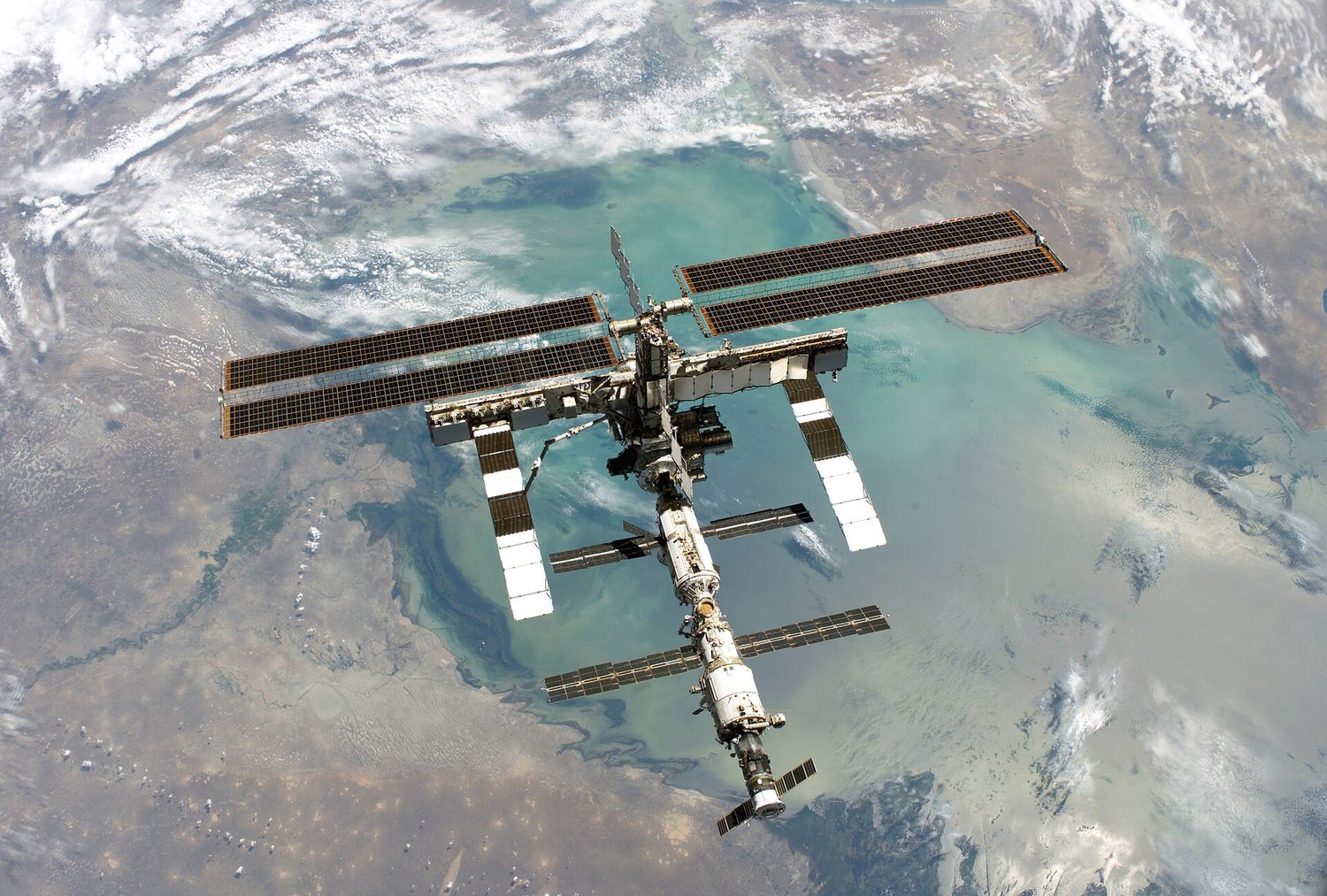
Foto Stasiun Luar Angkasa Internasional mengorbit Bumi
Stasiun Luar Angkasa Internasional: satelit nyata yang dijaga dalam orbit oleh gravitasi semata

Kecepatan lepas adalah kecepatan peluncuran yang cukup membiarkan objek pergi selamanya: total energi mekaniknya tepat nol, sehingga ia melambat hingga kecepatan nol hanya pada jarak tak terhingga. Menyamakan $\tfrac12 mv^2 - \dfrac{GMm}{r}=0$ (menggunakan PE gravitasi umum $U_g=-GMm/r$) dan menyelesaikan untuk $v$,

$$v_{\text{esc}}=\sqrt{\frac{2GM}{r}}.$$
Nilainya adalah $\sqrt2$ kali kecepatan orbit melingkar pada jari-jari yang sama, dan (seperti kecepatan orbit) tidak bergantung pada massa objek yang lepas.

Explore · ⁨Jelajahi⁩

Compare orbits at different radii · ⁨Bandingkan orbit pada jari-jari berbeda⁩

A satellite is in free fall, its gravity supplying the centripetal force. A larger orbit means a slower speed and a longer period — Kepler's third law. · ⁨Satelit berada dalam jatuh bebas, gravitasinya menyediakan gaya sentripetal. Orbit yang lebih besar berarti kecepatan lebih lambat dan periode lebih panjang — hukum Kepler ketiga.⁩

6.6

Exam tips · ⁨Tips ujian⁩

English
  • Conserve angular momentum $L=I\omega$ when no external torque acts: a smaller $I$ (arms pulled in) gives a larger $\omega$.
  • A rolling object splits its energy between $\tfrac12 mv^2$ and $\tfrac12 I\omega^2$, linked by $v=r\omega$ — so it accelerates down a ramp more slowly than a sliding one.
  • For a circular orbit set gravity equal to the centripetal requirement: $v=\sqrt{GM/r}$, so a larger orbit is slower and the satellite's mass cancels.
  • Pulling in raises the spin and the kinetic energy — the extra energy comes from the work done pulling inward; $L$ is unchanged.
  • Watch which rotational quantity is conserved: $L$ (no torque) versus energy (no friction) are different conditions.
Bahasa Indonesia
  • Konservasikan momentum sudut $L=I\omega$ ketika tidak ada torsi eksternal: $I$ yang lebih kecil (lengan ditarik) menghasilkan $\omega$ yang lebih besar.
  • Benda yang menggelinding membagi energinya antara $\tfrac12 mv^2$ dan $\tfrac12 I\omega^2$, yang dihubungkan oleh $v=r\omega$ – sehingga ia berakselerasi turun ramp lebih lambat daripada benda yang meluncur.
  • Untuk orbit melingkar samakan gravitasi dengan persyaratan sentripetal: $v=\sqrt{GM/r}$, sehingga orbit yang lebih besar lebih lambat dan massa satelit saling menghilangkan.
  • Menarik ke dalam meningkatkan spin dan energi kinetik – energi tambahan berasal dari usaha yang dilakukan menarik ke dalam; $L$ tidak berubah.
  • Perhatikan besaran rotasi mana yang dikonservasikan: $L$ (tanpa torsi) versus energi (tanpa gesekan) adalah kondisi yang berbeda.

Interactive lessons on this topic · ⁨Pelajaran interaktif untuk topik ini⁩

Work through it step by step, with instant-check exercises. · ⁨Kerjakan langkah demi langkah, dengan latihan pengecekan instan.⁩

Past Papers · ⁨Soal-Soil Masa Lalu⁩

More topics in AP Physics 1 · ⁨AP Fisika 1⁩ · ⁨Topik lain dalam AP Physics 1 · ⁨AP Fisika 1⁩⁩

Log in or create account · ⁨Masuk atau buat akun⁩

IGCSE, A-Level & AP