Skip to content · ⁨Lompat ke konten⁩

Linear Momentum · ⁨Momentum Linear⁩

AP Physics 1 · ⁨AP Fisika 1⁩ · Topic 4 · ⁨Topik 4⁩

Video lesson for this topic · ⁨Pelajaran video untuk topik ini⁩ Open the video page · ⁨Buka halaman video⁩
7:49

Momentum Linear

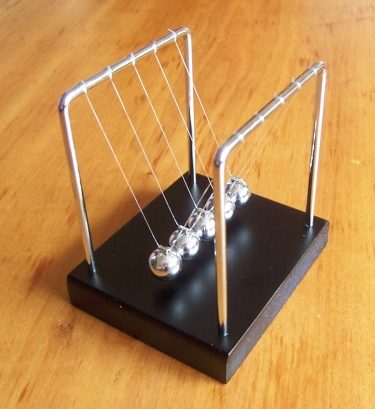
Lima bola baja menggantung berjajar, saling bersentuhan. Angkat satu, lepaskan, dan satu bola terbang dari ujung paling jauh. Hanya satu. Angkat dua, dan tepat dua terbang keluar. Sesuatu…

English narration · English + 中文 subtitles burned in · ⁨Narasi bahasa Inggris · Subtitle bahasa Inggris + 中文 disematkan langsung⁩

4.1

Linear Momentum · ⁨Momentum Linear⁩

Syllabus · ⁨Silabus⁩
English

Learning Objective 4.1.A: Describe the linear momentum of an object or system.

  • 4.1.A.1 Linear momentum is defined by the equation $\vec{p} = m\vec{v}$.
    • Equation: $\vec{p} = m\vec{v}$
  • 4.1.A.2 Momentum is a vector quantity and has the same direction as the velocity.
  • 4.1.A.3 Momentum can be used to analyze collisions and explosions.
    • 4.1.A.3.i A collision is a model for an interaction where the forces exerted between the involved objects in the system are much larger than the net external force exerted on those objects during the interaction.
    • 4.1.A.3.ii As only the initial and final states of a collision are analyzed, the object model may be used to analyze collisions.
    • 4.1.A.3.iii An explosion is a model for an interaction in which forces internal to the system move objects within that system apart.

Boundary statement: Unless otherwise stated, the general term "momentum" will refer specifically to linear momentum.

Bahasa Indonesia

Tujuan Pembelajaran 4.1.A: Jelaskan momentum linear suatu objek atau sistem.

  • 4.1.A.1 Momentum linear didefinisikan oleh persamaan $\vec{p} = m\vec{v}$.
    • Persamaan: $\vec{p} = m\vec{v}$
  • 4.1.A.2 Momentum adalah besaran vektor dan memiliki arah yang sama dengan kecepatan.
  • 4.1.A.3 Momentum dapat digunakan untuk menganalisis tumbukan dan ledakan.
    • 4.1.A.3.i Tumbukan adalah model interaksi di mana gaya yang dikeluarkan antar objek yang terlibat dalam sistem jauh lebih besar daripada resultan gaya eksternal yang bekerja pada objek-objek tersebut selama interaksi.
    • 4.1.A.3.ii Karena hanya keadaan awal dan akhir tumbukan yang dianalisis, model objek dapat digunakan untuk menganalisis tumbukan.
    • 4.1.A.3.iii Ledakan adalah model interaksi di mana gaya internal sistem memisahkan objek-objek di dalamnya.

Pernyataan Batas: Kecuali dinyatakan lain, istilah umum "momentum" akan merujuk secara khusus pada momentum linear.

Source: College Board AP Course and Exam Description · ⁨Sumber: Deskripsi Kursus dan Ujian College Board AP⁩

English

Linear momentum 动量 is mass times velocity – a vector pointing the same way as the velocity:

$$\vec{p}=m\vec{v}.$$
It measures "how hard it is to stop" a moving object. A heavy slow truck and a light fast ball can have the same momentum. Its unit is $\text{kg m/s}$, the same as $\text{N s}$.

Bahasa Indonesia

Momentum linear adalah massa dikali kecepatan – sebuah vektor yang mengarah sama dengan kecepatan:

$$\vec{p}=m\vec{v}.$$
Ini mengukur "seberapa sulit menghentikan" benda yang bergerak. Truk berat yang lambat dan bola ringan yang cepat dapat memiliki momentum yang sama. Satuannya adalah $\text{kg m/s}$, sama dengan $\text{N s}$.

4.2

Change in Momentum and Impulse · ⁨Perubahan Momentum dan Impuls⁩

Syllabus · ⁨Silabus⁩
English

Learning Objective 4.2.A: Describe the impulse delivered to an object or system.

  • 4.2.A.1 The rate of change of momentum is equal to the net external force exerted on an object or system.
    • Equation: $\vec{F}_{\text{net}} = \dfrac{\Delta \vec{p}}{\Delta t}$
  • 4.2.A.2 Impulse is defined as the product of the average force exerted on a system and the time interval during which that force is exerted on the system.
    • Equation: $\vec{J} = \vec{F}_{\text{avg}} \Delta t$
  • 4.2.A.3 Impulse is a vector quantity and has the same direction as the net force exerted on the system.
  • 4.2.A.4 The impulse delivered to a system by a net external force is equal to the area under the curve of a graph of the net external force exerted on the system as a function of time.
  • 4.2.A.5 The net external force exerted on a system is equal to the slope of a graph of the momentum of the system as a function of time.

Learning Objective 4.2.B: Describe the relationship between the impulse exerted on an object or a system and the change in momentum of the object or system.

  • 4.2.B.1 Change in momentum is the difference between a system's final momentum and its initial momentum.
    • Equation: $\Delta \vec{p} = \vec{p} - \vec{p}_0$
  • 4.2.B.2 The impulse–momentum theorem relates the impulse exerted on a system and the system's change in momentum.
    • Equation: $\vec{J} = \vec{F}_{\text{avg}} \Delta t = \Delta \vec{p}$
  • 4.2.B.3 Newton's second law of motion is a direct result of the impulse–momentum theorem applied to systems with constant mass.
    • Equation: $\vec{F}_{\text{net}} = \dfrac{\Delta \vec{p}}{\Delta t} = m\dfrac{\Delta \vec{v}}{\Delta t} = m\vec{a}$

Boundary statement: AP Physics 1 does not require students to quantitatively analyze systems in which the mass of the system changes with respect to time.

Bahasa Indonesia

Tujuan Pembelajaran 4.2.A: Jelaskan impuls yang diberikan kepada objek atau sistem.

  • 4.2.A.1 Laju perubahan momentum sama dengan resultan gaya eksternal yang bekerja pada objek atau sistem.
    • Persamaan: $\vec{F}_{\text{net}} = \dfrac{\Delta \vec{p}}{\Delta t}$
  • 4.2.A.2 Impuls didefinisikan sebagai hasil kali gaya rata-rata yang diberikan pada sistem dan selang waktu selama gaya tersebut diberikan pada sistem.
    • Persamaan: $\vec{J} = \vec{F}_{\text{avg}} \Delta t$
  • 4.2.A.3 Impuls adalah besaran vektor dan memiliki arah yang sama dengan resultan gaya yang diberikan pada sistem.
  • 4.2.A.4 Impuls yang diberikan kepada sistem oleh resultan gaya eksternal sama dengan luas di bawah kurva grafik resultan gaya eksternal yang diberikan pada sistem sebagai fungsi waktu.
  • 4.2.A.5 Resultan gaya eksternal yang diberikan pada sistem sama dengan kemiringan grafik momentum sistem sebagai fungsi waktu.

Tujuan Pembelajaran 4.2.B: Jelaskan hubungan antara impuls yang diberikan kepada objek atau sistem dan perubahan momentum objek atau sistem tersebut.

  • 4.2.B.1 Perubahan momentum adalah perbedaan antara momentum akhir sistem dan momentum awalnya.
    • Persamaan: $\Delta \vec{p} = \vec{p} - \vec{p}_0$
  • 4.2.B.2 Teorema impuls-momentum menghubungkan impuls yang diberikan pada sistem dan perubahan momentum sistem tersebut.
    • Persamaan: $\vec{J} = \vec{F}_{\text{avg}} \Delta t = \Delta \vec{p}$
  • 4.2.B.3 Hukum kedua Newton tentang gerak merupakan hasil langsung dari teorema impuls-momentum yang diterapkan pada sistem dengan massa konstan.
    • Persamaan: $\vec{F}_{\text{net}} = \dfrac{\Delta \vec{p}}{\Delta t} = m\dfrac{\Delta \vec{v}}{\Delta t} = m\vec{a}$

Pernyataan Batas: AP Physics 1 tidak mensyaratkan siswa untuk melakukan analisis kuantitatif pada sistem di mana massa sistem berubah seiring waktu.

Source: College Board AP Course and Exam Description · ⁨Sumber: Deskripsi Kursus dan Ujian College Board AP⁩

English

A net force acting over time changes momentum. The impulse 冲量 delivered is

$$\vec{J}=\vec{F}\,\Delta t=\Delta\vec{p}.$$
This is the impulse–momentum theorem: impulse equals the change in momentum. On a force–time graph, impulse is the area under the curve. It explains why airbags and follow-through help – spreading the same momentum change over a longer time reduces the force.

Worked example. A $0.15\ \text{kg}$ ball hits a wall at $20\ \text{m/s}$ and bounces straight back at $15\ \text{m/s}$. The contact lasts $0.020\ \text{s}$. Find the average force on the ball. Take the rebound direction as positive, so $u=-20\ \text{m/s}$ and $v=+15\ \text{m/s}$:

$$\Delta p=m(v-u)=0.15\big(15-(-20)\big)=5.25\ \text{kg m/s},\qquad F=\frac{\Delta p}{\Delta t}=\frac{5.25}{0.020}=260\ \text{N}.$$
The sign work matters: forgetting that the velocity reverses is the most common mistake here.

Bahasa Indonesia

Gaya resultan yang bekerja selama waktu mengubah momentum. Impuls yang diberikan adalah

$$\vec{J}=\vec{F}\,\Delta t=\Delta\vec{p}.$$
Ini adalah teorema impuls-momentum: impuls sama dengan perubahan momentum. Pada grafik gaya–waktu, impuls adalah luas di bawah kurva. Ini menjelaskan mengapa airbag dan gerakan lanjutan membantu – menyebarkan perubahan momentum yang sama selama waktu yang lebih lama mengurangi gaya.

Impuls adalah luas di bawah kurva gaya-waktu, sama dengan gaya rata-rata dikali waktu kontak

Contoh terpecahkan. Sebuah bola $0.15\ \text{kg}$ menabrak dinding pada $20\ \text{m/s}$ dan memantul lurus kembali pada $15\ \text{m/s}$. Kontak berlangsung selama $0.020\ \text{s}$. Temukan gaya rata-rata pada bola. Ambil arah pantulan sebagai positif, sehingga $u=-20\ \text{m/s}$ dan $v=+15\ \text{m/s}$:

$$\Delta p=m(v-u)=0.15\big(15-(-20)\big)=5.25\ \text{kg m/s},\qquad F=\frac{\Delta p}{\Delta t}=\frac{5.25}{0.020}=260\ \text{N}.$$
Tanda penting: lupa bahwa kecepatan berbalik adalah kesalahan paling umum di sini.

Vocabulary · ⁨Kosa kata⁩ Train · ⁨Latih⁩
English Bahasa Indonesia
Linear momentum/ˈlɪnɪə məʊˈmentəm/ Momentum linear
impulse/ˈɪmpʌls/ impuls
conserved/kənˈsɜːvd/ terjaga
collisions/kəˈlɪʒnz/ Tumbukan
center-of-mass velocity/ˈsentə ɒv mæs vəˈlɒsɪti/ Kecepatan pusat massa
4.3

Conservation of Linear Momentum · ⁨Kekekalan Momentum Linear⁩

Syllabus · ⁨Silabus⁩
English

Learning Objective 4.3.A: Describe the behavior of a system using conservation of linear momentum.

  • 4.3.A.1 A collection of objects with individual momenta can be described as one system with one center-of-mass velocity.
    • 4.3.A.1.i For a collection of objects, the velocity of a system's center of mass can be calculated using the equation $\vec{v}_{\text{cm}} = \dfrac{\sum \vec{p}_i}{\sum m_i} = \dfrac{\sum m_i \vec{v}_i}{\sum m_i}$.
    • 4.3.A.1.ii The velocity of a system's center of mass is constant in the absence of a net external force.
  • 4.3.A.2 The total momentum of a system is the sum of the momenta of the system's constituent parts.
  • 4.3.A.3 In the absence of net external forces, any change to the momentum of an object within a system must be balanced by an equivalent and opposite change of momentum elsewhere within the system. Any change to the momentum of a system is due to a transfer of momentum between the system and its surroundings.
    • 4.3.A.3.i The impulse exerted by one object on a second object is equal and opposite to the impulse exerted by the second object on the first. This is a direct result of Newton's third law.
    • 4.3.A.3.ii A system may be selected so that the total momentum of that system is constant.
    • 4.3.A.3.iii If the total momentum of a system changes, that change will be equivalent to the impulse exerted on the system.
      • Equation: $\vec{J} = \Delta \vec{p}$
  • 4.3.A.4 Correct application of conservation of momentum can be used to determine the velocity of a system immediately before and immediately after collisions or explosions.

Boundary statement: AP Physics 1 includes a quantitative and qualitative treatment of conservation of momentum in one dimension and a semiquantitative treatment of conservation of momentum in two dimensions. Exam questions involving solution of simultaneous equations are not included in AP Physics 1, but the AP Physics 1 Exam may include questions that assess whether students can set up the equations properly and reason about how changing a given mass, speed, or angle would affect other quantities. AP Physics 2 includes a full treatment of conservation of momentum in two dimensions for problems that include one unknown final velocity.

Learning Objective 4.3.B: Describe how the selection of a system determines whether the momentum of that system changes.

  • 4.3.B.1 Momentum is conserved in all interactions.
  • 4.3.B.2 If the net external force on the selected system is zero, the total momentum of the system is constant.
  • 4.3.B.3 If the net external force on the selected system is nonzero, momentum is transferred between the system and the environment.
Bahasa Indonesia

Tujuan Pembelajaran 4.3.A: Jelaskan perilaku sistem menggunakan kekekalan momentum linear.

  • 4.3.A.1 Kumpulan objek dengan momentum individu dapat digambarkan sebagai satu sistem dengan satu kecepatan pusat massa.
    • 4.3.A.1.i Untuk kumpulan objek, kecepatan pusat massa sistem dapat dihitung menggunakan persamaan $\vec{v}_{\text{cm}} = \dfrac{\sum \vec{p}_i}{\sum m_i} = \dfrac{\sum m_i \vec{v}_i}{\sum m_i}$.
    • 4.3.A.1.ii Kecepatan pusat massa sistem adalah konstan jika tidak ada resultan gaya eksternal.
  • 4.3.A.2 Total momentum sistem adalah jumlah momentum bagian-bagian penyusun sistem.
  • 4.3.A.3 Dalam ketiadaan resultan gaya eksternal, perubahan apa pun pada momentum objek di dalam sistem harus seimbang dengan perubahan momentum yang setara dan berlawanan di tempat lain dalam sistem. Perubahan apa pun pada momentum sistem disebabkan oleh transfer momentum antara sistem dan lingkungannya.
    • 4.3.A.3.i Impuls yang diberikan satu objek kepada objek kedua sama besar dan berlawanan arah dengan impuls yang diberikan objek kedua kepada objek pertama. Ini merupakan hasil langsung dari hukum ketiga Newton.
    • 4.3.A.3.ii Sistem dapat dipilih sedemikian rupa sehingga total momentum sistem tersebut konstan.
    • 4.3.A.3.iii Jika total momentum sistem berubah, perubahan tersebut setara dengan impuls yang diberikan pada sistem.
      • Persamaan: $\vec{J} = \Delta \vec{p}$
  • 4.3.A.4 Penerapan konservasi momentum yang benar dapat digunakan untuk menentukan kecepatan sistem segera sebelum dan segera setelah tabrakan atau ledakan.

Pernyataan Batas: AP Physics 1 mencakup penanganan kuantitatif dan kualitatif tentang konservasi momentum dalam satu dimensi serta penanganan semi-kuantitatif tentang konservasi momentum dalam dua dimensi. Soal ujian yang melibatkan penyelesaian persamaan simultan tidak termasuk dalam AP Physics 1, namun Ujian AP Physics 1 mungkin memuat soal yang menilai apakah siswa dapat menyusun persamaan dengan benar dan beralasan mengenai bagaimana perubahan massa, kecepatan, atau sudut tertentu akan mempengaruhi besaran lainnya. AP Physics 2 mencakup penanganan penuh tentang konservasi momentum dalam dua dimensi untuk masalah yang mencakup satu variabel kecepatan akhir yang belum diketahui.

Tujuan Pembelajaran 4.3.B: Jelaskan bagaimana pemilihan suatu sistem menentukan apakah momentum sistem tersebut berubah.

  • 4.3.B.1 Momentum kekal dalam semua interaksi.
  • 4.3.B.2 Jika resultan gaya eksternal pada sistem yang dipilih adalah nol, total momentum sistem tersebut konstan.
  • 4.3.B.3 Jika resultan gaya eksternal pada sistem yang dipilih bukan nol, momentum ditransfer antara sistem dan lingkungan.

Source: College Board AP Course and Exam Description · ⁨Sumber: Deskripsi Kursus dan Ujian College Board AP⁩

English

If the net external force on a system is zero, its total momentum is conserved 守恒:

$$\sum \vec{p}_{\text{before}}=\sum \vec{p}_{\text{after}}.$$
Internal forces (like the push between two colliding carts) come in third-law pairs and cancel, so they cannot change the total momentum. This is the key tool for collisions 碰撞 and explosions – apply it separately in the $x$ and $y$ directions.

Worked example (recoil 反冲). A $60\ \text{kg}$ skater, initially at rest on frictionless ice, throws a $2.0\ \text{kg}$ ball at $8.0\ \text{m/s}$. Find her recoil speed. The total momentum starts at zero and stays zero:

$$0=(60)v+(2.0)(8.0)\;\Rightarrow\;v=-\frac{16}{60}=-0.27\ \text{m/s},$$
so she moves at $0.27\ \text{m/s}$ in the opposite direction to the ball – the principle behind rockets and guns.

A whole collection of objects can be described by a single center-of-mass velocity 质心速度:

$$\vec{v}_{\text{cm}}=\frac{\sum m_i\vec{v}_i}{\sum m_i}=\frac{\vec{p}_{\text{total}}}{M_{\text{total}}}.$$
Since total momentum is conserved when no net external force acts, $\vec{v}_{\text{cm}}$ then stays constant – a $v_{\text{cm}}$-versus-time graph is flat unless an outside force acts. An internal collision or explosion never changes it, however violently the parts fly apart.

Bahasa Indonesia

Jika gaya eksternal resultan pada sistem adalah nol, total momennya kekal:

$$\sum \vec{p}_{\text{before}}=\sum \vec{p}_{\text{after}}.$$
Gaya internal (seperti dorongan antara dua troli bertabrakan) muncul dalam pasangan hukum ketiga dan saling menghilangkan, sehingga tidak dapat mengubah total momentum. Ini adalah alat kunci untuk tabrakan dan ledakan – terapkan secara terpisah dalam arah $x$ dan $y$.

Tabrakan searah: total momentum sebelum sama dengan total momentum setelah

Contoh terpecahkan (recoil). Seorang pembeku $60\ \text{kg}$, awalnya diam di atas es tanpa gesekan, melempar bola $2.0\ \text{kg}$ pada $8.0\ \text{m/s}$. Temukan kecepatan recoil-nya. Total momentum dimulai dari nol dan tetap nol:

$$0=(60)v+(2.0)(8.0)\;\Rightarrow\;v=-\frac{16}{60}=-0.27\ \text{m/s},$$
sehingga dia bergerak pada $0.27\ \text{m/s}$ ke arah berlawanan dengan bola – prinsip di balik roket dan senjata api.

Kumpulan seluruh benda dapat dijelaskan oleh satu kecepatan pusat massa:

$$\vec{v}_{\text{cm}}=\frac{\sum m_i\vec{v}_i}{\sum m_i}=\frac{\vec{p}_{\text{total}}}{M_{\text{total}}}.$$
Karena total momentum kekal ketika tidak ada gaya eksternal resultan, $\vec{v}_{\text{cm}}$ kemudian tetap konstan – grafik $v_{\text{cm}}$-vs-waktu datar kecuali ada gaya luar yang bekerja. Tabrakan internal atau ledakan tidak pernah mengubahnya, bagaimanapun kerasnya bagian-bagian itu terbang menjauh.

Explore · ⁨Jelajahi⁩

Collide two carts and conserve momentum · ⁨Tabrakan dua gerbong dan守恒 momentum⁩

In any collision the total momentum $\sum mv$ before equals the total after. Set the masses and speeds and check the momentum bookkeeping. · ⁨Dalam tabrakan apa pun, total momentum $\sum mv$ sebelum sama dengan total setelahnya. Tetapkan massa dan kecepatan lalu periksa pencatatan momentum.⁩

Vocabulary · ⁨Kosa kata⁩ Train · ⁨Latih⁩
English Bahasa Indonesia
recoil/rɪˈkɔɪl/ recoil
4.4

Elastic and Inelastic Collisions · ⁨Tabrakan Elastis dan Inelastis⁩

Syllabus · ⁨Silabus⁩
English

Learning Objective 4.4.A: Describe whether an interaction between objects is elastic or inelastic.

  • 4.4.A.1 An elastic collision between objects is one in which the initial kinetic energy of the system is equal to the final kinetic energy of the system.
  • 4.4.A.2 In an elastic collision, the final kinetic energies of each of the objects within the system may be different from their initial kinetic energies.
  • 4.4.A.3 An inelastic collision between objects is one in which the total kinetic energy of the system decreases.
  • 4.4.A.4 In an inelastic collision, some of the initial kinetic energy is not restored to kinetic energy but is transformed by nonconservative forces into other forms of energy.
  • 4.4.A.5 In a perfectly inelastic collision, the objects stick together and move with the same velocity after the collision.
Bahasa Indonesia

Tujuan Pembelajaran 4.4.A: Jelaskan apakah interaksi antar benda bersifat elastis atau inelastis.

  • 4.4.A.1 Tabrakan elastis antara benda-benda adalah tabrakan di mana energi kinetik awal sistem sama dengan energi kinetik akhir sistem.
  • 4.4.A.2 Dalam tabrakan elastis, energi kinetik akhir dari setiap benda dalam sistem mungkin berbeda dari energi kinetik awalnya.
  • 4.4.A.3 Tabrakan inelastis antara benda-benda adalah tabrakan di mana total energi kinetik sistem berkurang.
  • 4.4.A.4 Dalam tabrakan inelastis, sebagian energi kinetik awal tidak dikembalikan menjadi energi kinetik melainkan diubah oleh gaya non-konservatif menjadi bentuk energi lain.
  • 4.4.A.5 Dalam tabrakan inelastis sempurna, benda-benda saling menempel dan bergerak dengan kecepatan yang sama setelah tabrakan.

Source: College Board AP Course and Exam Description · ⁨Sumber: Deskripsi Kursus dan Ujian College Board AP⁩

English
Conservation of momentum in a collision

Momentum is conserved in every collision (with no external force). Kinetic energy is not:

  • In an elastic collision 弹性碰撞, kinetic energy is also conserved (objects bounce apart cleanly).
  • In an inelastic collision 非弹性碰撞, some kinetic energy becomes heat or deformation. In a perfectly inelastic collision the objects stick together and move with one common velocity afterward.

Strategy: always write momentum conservation; add energy conservation only if the collision is stated to be elastic. One elastic fact worth memorising: in a 1D elastic collision between equal masses, the two objects simply swap velocities (a moving ball striking an identical stationary one stops dead, and the target flies off at the incoming speed).

Worked example. A $1000\ \text{kg}$ car moving at $20\ \text{m/s}$ runs into a stationary $1500\ \text{kg}$ car and they lock together. Find their common speed, and the kinetic energy lost. Momentum conservation gives

$$1000\times20=(1000+1500)\,v\;\Rightarrow\;v=\frac{20000}{2500}=8.0\ \text{m/s}.$$
Kinetic energy before is $\tfrac12(1000)(20^2)=2.0\times10^{5}\ \text{J}$; after is $\tfrac12(2500)(8.0^2)=8.0\times10^{4}\ \text{J}$. So $1.2\times10^{5}\ \text{J}$ (about $60\%$) is lost to crumpling and heat – momentum is still conserved, but kinetic energy is not.

Bahasa Indonesia
Kekekalan momentum dalam tabrakan

Momentum kekal dalam setiap tabrakan (tanpa gaya eksternal). Energi kinetik tidak:

Tabrakan menyamping, diuraikan sepanjang dua sumbu tegak lurus
  • Dalam tabrakan elastis, energi kinetik juga kekal (benda memantul bersih).
  • Dalam tabrakan inelastis, sebagian energi kinetik berubah menjadi panas atau deformasi. Dalam tabrakan inelastis sempurna benda-benda menempel bersama dan bergerak dengan satu kecepatan bersama setelahnya.

Strategi: selalu tulis kekekalan momentum; tambahkan kekekalan energi hanya jika tabrakan dinyatakan elastis. Satu fakta elastis yang layak diingat: dalam tabrakan elastis 1D antara massa yang sama, kedua benda sekadar menukar kecepatan (bola yang bergerak menabrak bola identik yang diam berhenti total, dan target terbang keluar pada kecepatan datang).

Contoh terpecahkan. Mobil $1000\ \text{kg}$ yang bergerak dengan kecepatan $20\ \text{m/s}$ menabrak mobil $1500\ \text{kg}$ yang diam, dan keduanya terkunci bersama. Temukan kecepatan bersama mereka, serta energi kinetik yang hilang. Kekekalan momentum memberikan

$$1000\times20=(1000+1500)\,v\;\Rightarrow\;v=\frac{20000}{2500}=8.0\ \text{m/s}.$$
Energi kinetik sebelum adalah $\tfrac12(1000)(20^2)=2.0\times10^{5}\ \text{J}$; setelahnya adalah $\tfrac12(2500)(8.0^2)=8.0\times10^{4}\ \text{J}$. Jadi $1.2\times10^{5}\ \text{J}$ (sekitar $60\%$) hilang karena penumpukan dan panas – momentum tetap kekal, tetapi energi kinetik tidak.

A Newton's cradle: five steel balls hanging in a row
A Newton's cradle shows momentum and kinetic energy passing through a line of balls in a near-elastic collision
Explore · ⁨Jelajahi⁩

Compare elastic and inelastic collisions · ⁨Bandingkan tabrakan elastis dan inelastis⁩

Momentum is always conserved, but kinetic energy is only conserved in an elastic collision. In an inelastic one the carts stick and some energy becomes heat. · ⁨Momentum selalu守恒, tetapi energi kinetik hanya守恒 dalam tabrakan elastis. Dalam tabrakan inelastis, gerbong saling menempel dan sebagian energi berubah menjadi panas.⁩

Vocabulary · ⁨Kosa kata⁩ Train · ⁨Latih⁩
English Bahasa Indonesia
elastic collision/ɪˈlæstɪk kəˈlɪʒn/ tabrakan elastis
inelastic collision/ɪnɪˈlæstɪk kəˈlɪʒn/ tabrakan inelastis
4.4

Exam tips · ⁨Tips ujian⁩

English
  • Momentum is a vector — assign $+$/$-$ signs before adding; a ball that rebounds reverses its velocity, giving a large $\Delta p$.
  • Momentum is conserved in every collision (no external force); kinetic energy is conserved only if the collision is stated to be elastic.
  • In a perfectly inelastic collision the objects stick and move with one common velocity.
  • Impulse $=F\,\Delta t=\Delta p$ = the area under a force–time graph; spreading a collision over a longer time reduces the force (airbags, bending knees).
  • For recoil/explosions, set the total momentum equal before and after (often zero before).
Bahasa Indonesia
  • Momentum adalah vektor — tentukan tanda $+$/$-$ sebelum menjumlahkan; bola yang memantul membalik kecepatannya, menghasilkan $\Delta p$ besar.
  • Momentum kekal dalam setiap tabrakan (tanpa gaya eksternal); energi kinetik kekal hanya jika tabrakan dinyatakan sebagai elastis.
  • Dalam tabrakan inelastis sempurna, benda-benda itu melekat dan bergerak dengan satu kecepatan bersama.
  • Impuls $=F\,\Delta t=\Delta p$ = luas di bawah grafik gaya–waktu; memperpanjang durasi tabrakan selama waktu lebih lama mengurangi gaya (airbag, membungkuk lutut).
  • Untuk rekoil/ledakan, samakan total momentum sebelum dan sesudah (sering nol sebelum).

Interactive lessons on this topic · ⁨Pelajaran interaktif untuk topik ini⁩

Work through it step by step, with instant-check exercises. · ⁨Kerjakan langkah demi langkah, dengan latihan pengecekan instan.⁩

Past Papers · ⁨Soal-Soil Masa Lalu⁩

More topics in AP Physics 1 · ⁨AP Fisika 1⁩ · ⁨Topik lain dalam AP Physics 1 · ⁨AP Fisika 1⁩⁩

Log in or create account · ⁨Masuk atau buat akun⁩

IGCSE, A-Level & AP