Skip to content · ⁨Lompat ke konten⁩

Work, Energy, and Power · ⁨Usaha, Energi, dan Daya⁩

AP Physics 1 · ⁨AP Fisika 1⁩ · Topic 3 · ⁨Topik 3⁩

Video lesson for this topic · ⁨Pelajaran video untuk topik ini⁩ Open the video page · ⁨Buka halaman video⁩
8:07

Usaha, Energi, dan Daya

Menatap bukit pertama roller coaster. Rantai menarik kereta ke puncak, lalu melepaskannya. Tidak ada mesin di kereta — tidak ada yang mendorongnya lagi selama…

English narration · English + 中文 subtitles burned in · ⁨Narasi bahasa Inggris · Subtitle bahasa Inggris + 中文 disematkan langsung⁩

3.1

Translational Kinetic Energy · ⁨Energi Kinetik Translasi⁩

Syllabus · ⁨Silabus⁩
English

Learning Objective 3.1.A: Describe the translational kinetic energy of an object in terms of the object's mass and velocity.

  • 3.1.A.1 An object's translational kinetic energy is given by the equation
    • Equation: $K = \dfrac{1}{2}mv^2$
  • 3.1.A.2 Translational kinetic energy is a scalar quantity.
  • 3.1.A.3 Different observers may measure different values of the translational kinetic energy of an object, depending on the observer's frame of reference.
Bahasa Indonesia

Tujuan Pembelajaran 3.1.A: Jelaskan energi kinetik translasi suatu benda dalam hubungannya dengan massa dan kecepatan benda tersebut.

  • 3.1.A.1 Energi kinetik translasi suatu benda diberikan oleh persamaan
    • Persamaan: $K = \dfrac{1}{2}mv^2$
  • 3.1.A.2 Energi kinetik translasi adalah besaran skalar.
  • 3.1.A.3 Pengamat yang berbeda mungkin mengukur nilai energi kinetik translasi yang berbeda, tergantung pada kerangka acuan pengamat tersebut.

Source: College Board AP Course and Exam Description · ⁨Sumber: Deskripsi Kursus dan Ujian College Board AP⁩

English

Energy 能量 is the capacity to do work, measured in joules 焦耳 (J). A moving object has kinetic energy 动能:

$$K=\tfrac{1}{2}mv^2.$$
It depends on the square of the speed, so doubling the speed quadruples the kinetic energy. Kinetic energy is a scalar and is never negative.

Worked example. A $1500\ \text{kg}$ car travels at $20\ \text{m/s}$. Its kinetic energy is $K=\tfrac12\times1500\times20^2=3.0\times10^{5}\ \text{J}=300\ \text{kJ}$. If it speeds up to $40\ \text{m/s}$ (double), the kinetic energy becomes $4\times$ larger, $1200\ \text{kJ}$ – which is why stopping distance grows so fast with speed.

Bahasa Indonesia

Energi adalah kemampuan untuk melakukan usaha, diukur dalam joule (J). Benda yang bergerak memiliki energi kinetik:

$$K=\tfrac{1}{2}mv^2.$$
Energi ini bergantung pada kuadrat kecepatan, sehingga menggandakan kecepatan akan menggandakan empat kali energi kinetik. Energi kinetik adalah besaran skalar dan tidak pernah negatif.

Contoh terarah. Sebuah mobil $1500\ \text{kg}$ melaju dengan kecepatan $20\ \text{m/s}$. Energi kinetiknya adalah $K=\tfrac12\times1500\times20^2=3.0\times10^{5}\ \text{J}=300\ \text{kJ}$. Jika mobil mempercepat menjadi $40\ \text{m/s}$ (dua kali lipat), energi kinetiknya menjadi $4\times$ lebih besar, $1200\ \text{kJ}$ – inilah mengapa jarak pengereman meningkat sangat cepat seiring kecepatan.

3.2

Work · ⁨Usaha⁩

Syllabus · ⁨Silabus⁩
English

Learning Objective 3.2.A: Describe the work done on an object or system by a given force or collection of forces.

  • 3.2.A.1 Work is the amount of energy transferred into or out of a system by a force exerted on that system over a distance.
    • 3.2.A.1.i The work done by a conservative force exerted on a system is path-independent and only depends on the initial and final configurations of that system.
    • 3.2.A.1.ii The work done by a conservative force on a system—or the change in the potential energy of the system—will be zero if the system returns to its initial configuration.
    • 3.2.A.1.iii Potential energies are associated only with conservative forces.
    • 3.2.A.1.iv The work done by a nonconservative force is path-dependent.
    • 3.2.A.1.v Examples of nonconservative forces are friction and air resistance.
  • 3.2.A.2 Work is a scalar quantity that may be positive, negative, or zero.
  • 3.2.A.3 The amount of work done on a system by a constant force is related to the components of that force and the displacement of the point at which that force is exerted.
    • 3.2.A.3.i Only the component of the force exerted on a system that is parallel to the displacement of the point of application of the force will change the system's total energy.
      • Equation: $W = F_{\parallel}d = Fd\cos\theta$
    • 3.2.A.3.ii The component of the force exerted on a system perpendicular to the direction of the displacement of the system's center of mass can change the direction of the system's motion without changing the system's kinetic energy.
  • 3.2.A.4 The work-energy theorem states that the change in an object's kinetic energy is equal to the sum of the work (net work) being done by all forces exerted on the object.
    • Equation: $\Delta K = \sum_{i} W_i = \sum_{i} F_{\parallel,i}\,d$
    • 3.2.A.4.i An external force may change the configuration of a system. The component of the external force parallel to the displacement times the displacement of the point of application of the force gives the change in kinetic energy of the system.
    • 3.2.A.4.ii If the system's center of mass and the point of application of the force move the same distance when a force is exerted on a system, then the system may be modeled as an object, and only the system's kinetic energy can change.
    • 3.2.A.4.iii The energy dissipated by friction is typically equated to the force of friction times the length of the path over which the force is exerted
      • Equation: $\Delta E_{\text{mech}} = F_f\,d\cos\theta$
  • 3.2.A.5 Work is equal to the area under the curve of a graph of $F_{\parallel}$ as a function of displacement.

Boundary statement: AP Physics 1 only expects students to analyze the transfer of mechanical energy (as defined in Unit 3, Topic 4: Conservation of Energy), although students should be aware that mechanical energy may be dissipated in the form of thermal energy or sound. In AP Physics 2, students will also study how thermal energy can be transferred between systems through heating or cooling.

Bahasa Indonesia

Tujuan Pembelajaran 3.2.A: Jelaskan usaha yang dilakukan pada suatu benda atau sistem oleh gaya tertentu atau kumpulan gaya.

  • 3.2.A.1 Usaha adalah jumlah energi yang ditransfer masuk atau keluar dari sebuah sistem melalui gaya yang bekerja pada sistem tersebut sepanjang jarak tempuh.
    • 3.2.A.1.i Usaha yang dilakukan oleh gaya konservatif pada suatu sistem bersifat independen terhadap lintasan dan hanya bergantung pada konfigurasi awal dan akhir sistem tersebut.
    • 3.2.A.1.ii Usaha yang dilakukan oleh gaya konservatif pada suatu sistem—atau perubahan energi potensial sistem—akan bernilai nol jika sistem kembali ke konfigurasi awalnya.
    • 3.2.A.1.iii Energi potensial hanya terkait dengan gaya-gaya konservatif.
    • 3.2.A.1.iv Usaha yang dilakukan oleh gaya nonkonservatif bergantung pada lintasan.
    • 3.2.A.1.v Contoh gaya nonkonservatif meliputi gesekan dan hambatan udara.
  • 3.2.A.2 Usaha adalah besaran skalar yang dapat bernilai positif, negatif, atau nol.
  • 3.2.A.3 Besar usaha yang dilakukan pada suatu sistem oleh gaya konstan berkaitan dengan komponen gaya tersebut dan perpindahan titik tempat gaya tersebut bekerja.
    • 3.2.A.3.i Hanya komponen gaya yang bekerja pada sistem yang sejajar dengan perpindahan titik aplikasi gaya yang akan mengubah total energi sistem.
      • Persamaan: $W = F_{\parallel}d = Fd\cos\theta$
    • 3.2.A.3.ii Komponen gaya yang bekerja pada sistem tegak lurus terhadap arah perpindahan pusat massa sistem dapat mengubah arah gerak sistem tanpa mengubah energi kinetik sistem.
  • 3.2.A.4 Teorema usaha-energi menyatakan bahwa perubahan energi kinetik suatu benda sama dengan jumlah usaha (usaha bersih) yang dilakukan oleh semua gaya yang bekerja pada benda tersebut.
    • Persamaan: $\Delta K = \sum_{i} W_i = \sum_{i} F_{\parallel,i}\,d$
    • 3.2.A.4.i Gaya eksternal dapat mengubah konfigurasi suatu sistem. Komponen gaya eksternal yang sejajar dengan perpindahan dikali perpindahan titik aplikasi gaya memberikan perubahan energi kinetik sistem.
    • 3.2.A.4.ii Jika pusat massa sistem dan titik aplikasi gaya bergerak sejauh yang sama ketika gaya bekerja pada sistem, maka sistem dapat dimodelkan sebagai benda tunggal, dan hanya energi kinetik sistem yang dapat berubah.
    • 3.2.A.4.iii Energi yang terdisipasi oleh gesekan biasanya setara dengan gaya gesek dikali panjang lintasan di mana gaya tersebut bekerja.
      • Persamaan: $\Delta E_{\text{mech}} = F_f\,d\cos\theta$
  • 3.2.A.5 Usaha sama dengan luas di bawah kurva grafik $F_{\parallel}$ sebagai fungsi perpindahan.

Pernyataan Batas: AP Physics 1 hanya mengharapkan siswa menganalisis transfer energi mekanik (seperti yang didefinisikan dalam Unit 3, Topik 4: Kekekalan Energi), meskipun siswa harus menyadari bahwa energi mekanik dapat terdisipasi dalam bentuk energi termal atau bunyi. Dalam AP Physics 2, siswa juga akan mempelajari bagaimana energi termal dapat ditransfer antar sistem melalui pemanasan atau pendinginan.

Source: College Board AP Course and Exam Description · ⁨Sumber: Deskripsi Kursus dan Ujian College Board AP⁩

English

Work 功 is energy transferred by a force acting over a displacement:

$$W=F\,d\cos\theta,$$
where $\theta$ is the angle between the force and the displacement. Work is positive when the force has a component along the motion (adds energy), negative when it opposes the motion (removes energy), and zero when the force is perpendicular. On a force–position graph, work is the area under the curve. The work–energy theorem 动能定理 states that the net work equals the change in kinetic energy: $W_{\text{net}}=\Delta K$.

Worked example. A $2.0\ \text{kg}$ block moving at $3.0\ \text{m/s}$ on a frictionless floor is pushed by a $5.0\ \text{N}$ force over $4.0\ \text{m}$ in the direction of motion. Find its final speed. The net work is $W=Fd=5.0\times4.0=20\ \text{J}$, and by the work–energy theorem $W=\tfrac12 m(v^2-v_0^2)$:

$$20=\tfrac12\times2.0\times(v^2-3.0^2)\;\Rightarrow\;v^2=29\;\Rightarrow\;v=5.4\ \text{m/s}.$$

Bahasa Indonesia

Usaha adalah energi yang ditransfer oleh gaya yang bekerja sepanjang perpindahan:

$$W=F\,d\cos\theta,$$
di mana $\theta$ adalah sudut antara gaya dan perpindahan. Usaha bernilai positif ketika gaya memiliki komponen sepanjang gerak (menambah energi), negatif ketika melawan gerak (mengurangi energi), dan nol ketika gaya tegak lurus. Pada grafik gaya–posisi, usaha adalah luas di bawah kurva. Teorema usaha-energi menyatakan bahwa usaha total sama dengan perubahan energi kinetik: $W_{\text{net}}=\Delta K$.

Hanya komponen gaya sepanjang perpindahan yang melakukan usaha

Contoh terarah. Sebuah balok $2.0\ \text{kg}$ bergerak dengan kecepatan $3.0\ \text{m/s}$ di lantai tanpa gesekan didorong oleh gaya $5.0\ \text{N}$ sejauh $4.0\ \text{m}$ searah gerak. Tentukan kecepatan akhirnya. Usaha total adalah $W=Fd=5.0\times4.0=20\ \text{J}$, dan berdasarkan teorema usaha-energi $W=\tfrac12 m(v^2-v_0^2)$:

$$20=\tfrac12\times2.0\times(v^2-3.0^2)\;\Rightarrow\;v^2=29\;\Rightarrow\;v=5.4\ \text{m/s}.$$

Vocabulary · ⁨Kosa kata⁩ Train · ⁨Latih⁩
English Bahasa Indonesia
Work/wɜːk/ Usaha
work–energy theorem/wɜːk ˈenədʒi ˈθɪərəm/ Teorema usaha-energi
Potential energy/pəˈtenʃl ˈenədʒi/ Energi potensial
Gravitational potential energy/ˌɡrævɪˈteɪʃənl pəˈtenʃl ˈenədʒi/ Energi potensial gravitasi
Elastic potential energy/ɪˈlæstɪk pəˈtenʃl ˈenədʒi/ Energi potensial elastis
conservative forces/kənˈsɜːvətɪv ˈfɔːsɪz/ Gaya konservatif
total mechanical energy/ˈtəʊtl mɪˈkænɪkl ˈenədʒi/ Energi mekanik total
conserved/kənˈsɜːvd/ terjaga
thermal energy/ˈθɜːml ˈenədʒi/ energi termal
3.3

Potential Energy · ⁨Energi Potensial⁩

Syllabus · ⁨Silabus⁩
English

Learning Objective 3.3.A: Describe the potential energy of a system.

  • 3.3.A.1 A system composed of two or more objects has potential energy if the objects within that system only interact with each other through conservative forces.
  • 3.3.A.2 Potential energy is a scalar quantity associated with the position of objects within a system.
  • 3.3.A.3 The definition of zero potential energy for a given system is a decision made by the observer considering the situation to simplify or otherwise assist in analysis.
  • 3.3.A.4 The potential energy of common physical systems can be described using the physical properties of that system.
    • 3.3.A.4.i The elastic potential energy of an ideal spring is given by the following equation, where $\Delta x$ is the distance the spring has been stretched or compressed from its equilibrium length.
      • Equation: $U_s = \dfrac{1}{2}k(\Delta x)^2$
    • 3.3.A.4.ii The general form for the gravitational potential energy of a system consisting of two approximately spherical distributions of mass (e.g., moons, planets or stars) is given by the equation
      • Equation: $U_g = -G\dfrac{m_1 m_2}{r}$
    • 3.3.A.4.iii Because the gravitational field near the surface of a planet is nearly constant, the change in gravitational potential energy in a system consisting of an object with mass $m$ and a planet with gravitational field of magnitude $g$ when the object is near the surface of the planet may be approximated by the equation
      • Equation: $\Delta U_g = mg\Delta y$
  • 3.3.A.5 The total potential energy of a system containing more than two objects is the sum of the potential energy of each pair of objects within the system.
Bahasa Indonesia

Tujuan Pembelajaran 3.3.A: Jelaskan energi potensial suatu sistem.

  • 3.3.A.1 Sistem yang terdiri dari dua atau lebih benda memiliki energi potensial jika benda-benda di dalamnya hanya berinteraksi satu sama lain melalui gaya-gaya konservatif.
  • 3.3.A.2 Energi potensial adalah besaran skalar yang terkait dengan posisi benda-benda di dalam suatu sistem.
  • 3.3.A.3 Definisi nol energi potensial untuk suatu sistem tertentu merupakan keputusan yang diambil oleh pengamat berdasarkan situasi untuk menyederhanakan atau membantu analisis.
  • 3.3.A.4 Energi potensial dari sistem fisik umum dapat dijelaskan menggunakan sifat-sifat fisik dari sistem tersebut.
    • 3.3.A.4.i Energi potensial elastis pegas ideal diberikan oleh persamaan berikut, di mana $\Delta x$ adalah jarak pegas telah diregangkan atau ditekan dari panjang kesetimbangannya.
      • Persamaan: $U_s = \dfrac{1}{2}k(\Delta x)^2$
    • 3.3.A.4.ii Bentuk umum untuk energi potensial gravitasi sistem yang terdiri dari dua distribusi massa yang hampir berbentuk bola (misalnya, bulan, planet, atau bintang) diberikan oleh persamaan
      • Persamaan: $U_g = -G\dfrac{m_1 m_2}{r}$
    • 3.3.A.4.iii Karena medan gravitasi dekat permukaan planet hampir konstan, perubahan energi potensial gravitasi pada sistem yang terdiri dari benda bermassa $m$ dan planet dengan besar medan gravitasi $g$ saat benda berada dekat permukaan planet dapat diaproksimasi dengan persamaan
      • Persamaan: $\Delta U_g = mg\Delta y$
  • 3.3.A.5 Total energi potensial sistem yang berisi lebih dari dua benda adalah jumlah energi potensial dari setiap pasangan benda di dalam sistem tersebut.

Source: College Board AP Course and Exam Description · ⁨Sumber: Deskripsi Kursus dan Ujian College Board AP⁩

English

Potential energy 势能 is stored energy that depends on position or configuration:

  • Gravitational potential energy 重力势能 near the surface: $U_g=mgh$ (height $h$ above a reference level).
  • Elastic potential energy 弹性势能 in a spring: $U_s=\tfrac{1}{2}kx^2$.

Potential energy is defined only for conservative forces 保守力 (gravity, springs), for which the stored energy depends on position, not path. Only changes in potential energy matter, so you may put the zero level wherever is convenient.

The $U_g=mgh$ form only holds near a surface where $g$ is roughly constant. The general form, for two spherical masses a distance $r$ apart, is

$$U_g=-\frac{G m_1 m_2}{r}.$$
It is negative and defined to be zero at infinite separation, so gravitational PE rises toward zero as the masses move apart. $mgh$ is simply its near-surface approximation. (This is the form you need for satellites and escape speed.)

Bahasa Indonesia

Energi potensial adalah energi tersimpan yang bergantung pada posisi atau konfigurasi:

  • Energi potensial gravitasi dekat permukaan: $U_g=mgh$ (ketinggian $h$ di atas tingkat referensi).
  • Energi potensial elastis dalam pegas: $U_s=\tfrac{1}{2}kx^2$.

Energi potensial hanya didefinisikan untuk gaya konservatif (gravitasi, pegas), di mana energi tersimpan bergantung pada posisi, bukan lintasan. Hanya perubahan energi potensial yang penting, sehingga Anda dapat menempatkan level nol di mana saja yang nyaman.

Bentuk $U_g=mgh$ hanya berlaku dekat permukaan tempat $g$ hampir konstan. Bentuk umum, untuk dua massa bulat berjarak $r$, adalah

$$U_g=-\frac{G m_1 m_2}{r}.$$
Nilainya negatif dan didefinisikan nol pada jarak tak terhingga, sehingga energi potensial gravitasi naik menuju nol saat massa menjauh. $mgh$ hanyalah pendekatan dekat permukaannya. (Ini adalah bentuk yang diperlukan untuk satelit dan kecepatan lepas.)

Explore · ⁨Jelajahi⁩

Store elastic potential energy in a spring · ⁨Simpan energi potensial elastis dalam pegas⁩

Stretching a spring stores elastic potential energy $\tfrac12 kx^2$ — the area under the force-extension line. Release it and that energy becomes kinetic. · ⁨Meregangkan pegas menyimpan energi potensial elastis $\tfrac12 kx^2$ — yaitu area di bawah garis gaya-perpanjangan. Lepaskan dan energi tersebut berubah menjadi energi kinetik.⁩

3.4

Conservation of Energy · ⁨Kekekalan Energi⁩

Syllabus · ⁨Silabus⁩
English

Learning Objective 3.4.A: Describe the energies present in a system.

  • 3.4.A.1 A system composed of only a single object can only have kinetic energy.
  • 3.4.A.2 A system that contains objects that interact via conservative forces or that can change its shape reversibly may have both kinetic and potential energies.

Learning Objective 3.4.B: Describe the behavior of a system using conservation of mechanical energy principles.

  • 3.4.B.1 Mechanical energy is the sum of a system's kinetic and potential energies.
  • 3.4.B.2 Any change to a type of energy within a system must be balanced by an equivalent change of other types of energies within the system or by a transfer of energy between the system and its surroundings.
  • 3.4.B.3 A system may be selected so that the total energy of that system is constant.
  • 3.4.B.4 If the total energy of a system changes, that change will be equivalent to the energy transferred into or out of the system.

Learning Objective 3.4.C: Describe how the selection of a system determines whether the energy of that system changes.

  • 3.4.C.1 Energy is conserved in all interactions.
  • 3.4.C.2 If the work done on a selected system is zero and there are no nonconservative interactions within the system, the total mechanical energy of the system is constant.
  • 3.4.C.3 If the work done on a selected system is nonzero, energy is transferred between the system and the environment.

Boundary statement: AP Physics 1 expects students to know that mechanical energy can be dissipated as thermal energy or sound by nonconservative forces.

Bahasa Indonesia

Tujuan Pembelajaran 3.4.A: Jelaskan energi-energi yang ada dalam suatu sistem.

  • 3.4.A.1 Sistem yang terdiri hanya dari satu benda hanya dapat memiliki energi kinetik.
  • 3.4.A.2 Sistem yang berisi benda-benda yang berinteraksi melalui gaya konservatif atau yang dapat mengubah bentuknya secara reversibel dapat memiliki energi kinetik maupun potensial.

Tujuan Pembelajaran 3.4.B: Jelaskan perilaku sistem menggunakan prinsip-prinsip kekekalan energi mekanik.

  • 3.4.B.1 Energi mekanik adalah jumlah energi kinetik dan potensial suatu sistem.
  • 3.4.B.2 Perubahan apa pun pada jenis energi dalam suatu sistem harus seimbang dengan perubahan ekuivalen dari jenis energi lainnya dalam sistem atau melalui perpindahan energi antara sistem dan lingkungannya.
  • 3.4.B.3 Suatu sistem dapat dipilih sedemikian rupa sehingga total energi sistem tersebut konstan.
  • 3.4.B.4 Jika total energi sistem berubah, perubahan tersebut akan setara dengan energi yang ditransfer masuk atau keluar dari sistem.

Tujuan Pembelajaran 3.4.C: Jelaskan bagaimana pemilihan sistem menentukan apakah energi sistem tersebut berubah.

  • 3.4.C.1 Energi kekal dalam semua interaksi.
  • 3.4.C.2 Jika usaha yang dilakukan pada sistem yang dipilih adalah nol dan tidak ada interaksi nonkonservatif di dalam sistem, maka total energi mekanik sistem adalah konstan.
  • 3.4.C.3 Jika usaha yang dilakukan pada sistem yang dipilih tidak nol, energi ditransfer antara sistem dan lingkungan.

Pernyataan Batas: AP Physics 1 mengharapkan siswa mengetahui bahwa energi mekanik dapat terdispersi menjadi energi termal atau suara oleh gaya-gaya nonkonservatif.

Source: College Board AP Course and Exam Description · ⁨Sumber: Deskripsi Kursus dan Ujian College Board AP⁩

English
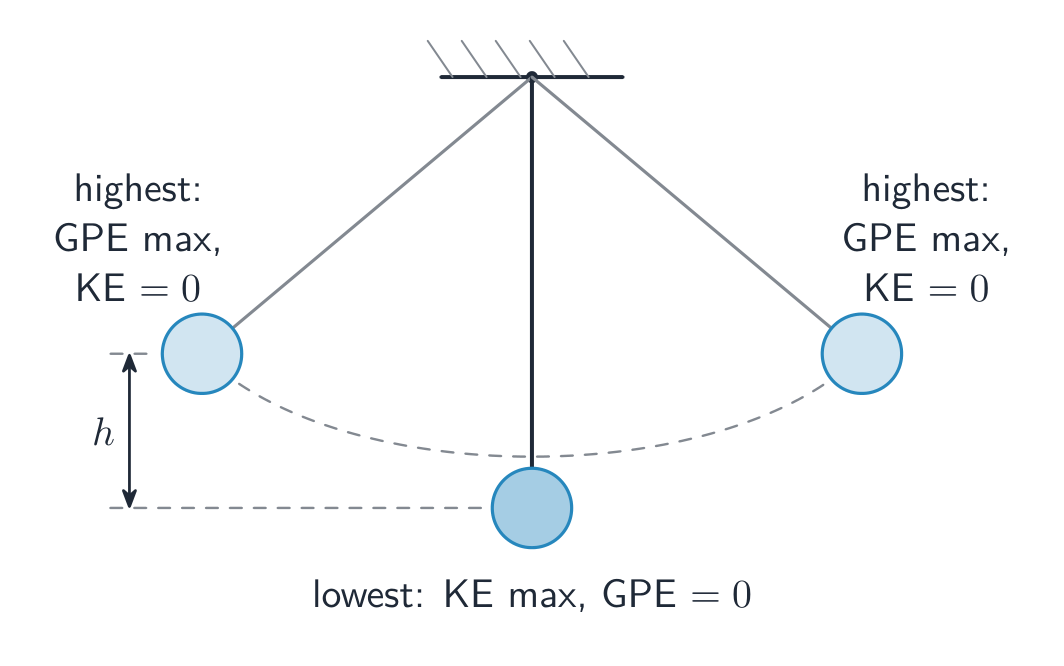
Energy conservation: KE ⇄ PE

The total mechanical energy 机械能 is $E=K+U$. When only conservative forces do work, mechanical energy is conserved 守恒:

$$K_1+U_1=K_2+U_2.$$
When friction or other non-conservative forces act, they transfer mechanical energy to thermal energy 热能; then the general statement is that total energy (including thermal) is conserved. Energy bar charts are a good way to track where the energy goes.

Worked example. A ball is released from rest at the top of a frictionless ramp $5.0\ \text{m}$ high. Find its speed at the bottom. All the gravitational potential energy becomes kinetic energy:

$$mgh=\tfrac12 mv^2\;\Rightarrow\;v=\sqrt{2gh}=\sqrt{2\times9.8\times5.0}=9.9\ \text{m/s}.$$
The mass cancels, so every object reaches the same speed – exactly the free-fall result, now got from energy. If instead $30\ \text{J}$ were lost to friction, you would subtract it: $mgh-30=\tfrac12 mv^2$.

Bahasa Indonesia
Kekekalan energi: KE ⇄ PE
Luncuran roller coaster dengan lintasan hijau dan merah tinggi di langit
Luncuran roller coaster menukar energi bolak-balik: berada di titik tertinggi (paling banyak energi potensial) di puncak dan tercepat (paling banyak energi kinetik) di dasar

Energi mekanik total adalah $E=K+U$. Ketika hanya gaya konservatif yang melakukan usaha, energi mekanik **terjaga

$$K_1+U_1=K_2+U_2.$$
Ketika gesekan atau gaya non-konservatif lainnya bekerja, mereka mentransfer energi mekanik ke energi termal; maka pernyataan umumnya adalah total energi (termasuk termal) kekal. Diagram batang energi adalah cara yang baik untuk melacak ke mana energi tersebut pergi.

Pendulum berayun menukar energi potensial gravitasi untuk energi kinetik dan sebaliknya

Contoh terpecahkan. Sebuah bola dilepaskan dari keadaan diam di bagian atas landasan tanpa gesekan $5.0\ \text{m}$ tinggi. Temukan kecepatannya di bagian bawah. Seluruh energi potensial gravitasi berubah menjadi energi kinetik:

$$mgh=\tfrac12 mv^2\;\Rightarrow\;v=\sqrt{2gh}=\sqrt{2\times9.8\times5.0}=9.9\ \text{m/s}.$$
Massa saling menghilangkan, sehingga setiap benda mencapai kecepatan yang sama – tepat seperti hasil jatuh bebas, kini diperoleh dari energi. Jika sebaliknya $30\ \text{J}$ hilang karena gesekan, Anda harus mengurangkannya: $mgh-30=\tfrac12 mv^2$.

Explore · ⁨Jelajahi⁩

Watch energy convert as an object falls · ⁨Amati konversi energi saat benda jatuh⁩

With no friction, mechanical energy is conserved: as an object falls, gravitational potential energy turns into kinetic energy while the total stays fixed. · ⁨Tanpa gesekan, energi mekanik kekal: saat benda jatuh, energi potensial gravitasi berubah menjadi energi kinetik sementara totalnya tetap.⁩

Vocabulary · ⁨Kosa kata⁩ Train · ⁨Latih⁩
English Bahasa Indonesia
Energy/ˈenədʒi/ Energi
joules/dʒuːlz/ joule
kinetic energy/kɪˈnetɪk ˈenədʒi/ energi kinetik
3.5

Power · ⁨Daya⁩

Syllabus · ⁨Silabus⁩
English

Learning Objective 3.5.A: Describe the transfer of energy into, out of, or within a system in terms of power.

  • 3.5.A.1 Power is the rate at which energy changes with respect to time, either by transfer into or out of a system or by conversion from one type to another within a system.
  • 3.5.A.2 Average power is the amount of energy being transferred or converted, divided by the time it took for that transfer or conversion to occur.
    • Equation: $P_{\text{avg}} = \dfrac{\Delta E}{\Delta t}$
  • 3.5.A.3 Because work is the change in energy of an object or system due to a force, average power is the total work done, divided by the time during which that work was done.
    • Equation: $P_{\text{avg}} = \dfrac{W}{\Delta t}$
  • 3.5.A.4 The instantaneous power delivered to an object by the component of a constant force parallel to the object's velocity can be described with the derived equation.
    • Equation: $P_{\text{inst}} = F_{\parallel}v = Fv\cos\theta$
Bahasa Indonesia

Tujuan Pembelajaran 3.5.A: Jelaskan perpindahan energi masuk, keluar, atau di dalam suatu sistem dalam istilah daya.

  • 3.5.A.1 Daya adalah laju perubahan energi terhadap waktu, baik melalui transfer masuk atau keluar dari sistem maupun melalui konversi dari satu jenis ke jenis lain di dalam sistem.
  • 3.5.A.2 Daya rata-rata adalah jumlah energi yang ditransfer atau dikonversi, dibagi dengan waktu yang dibutuhkan untuk transfer atau konversi tersebut terjadi.
    • Persamaan: $P_{\text{avg}} = \dfrac{\Delta E}{\Delta t}$
  • 3.5.A.3 Karena usaha adalah perubahan energi suatu objek atau sistem akibat gaya, daya rata-rata adalah total usaha yang dilakukan, dibagi dengan waktu selama usaha itu dilakukan.
    • Persamaan: $P_{\text{avg}} = \dfrac{W}{\Delta t}$
  • 3.5.A.4 Daya sesaat yang disalurkan ke suatu objek oleh komponen gaya konstan sejajar dengan kecepatan objek dapat dijelaskan dengan persamaan turunan.
    • Persamaan: $P_{\text{inst}} = F_{\parallel}v = Fv\cos\theta$

Source: College Board AP Course and Exam Description · ⁨Sumber: Deskripsi Kursus dan Ujian College Board AP⁩

English

Power 功率 is the rate of doing work or transferring energy, measured in watts 瓦特 (W):

$$P=\frac{W}{\Delta t}=\frac{\Delta E}{\Delta t},\qquad\text{and instantaneously}\qquad P=Fv.$$
So the same job done faster requires more power. On an energy–time graph, power is the slope.

Worked example. A motor lifts a $50\ \text{kg}$ load at a steady $2.0\ \text{m/s}$. Because it moves at constant speed, the lifting force equals the weight, so

$$P=Fv=mgv=50\times9.8\times2.0=980\ \text{W}.$$

Real machines waste some energy, so we quote efficiency 效率 – useful output power divided by total input power. If this motor draws $1400\ \text{W}$ of electrical power to deliver $980\ \text{W}$ of useful lifting, its efficiency is $980/1400=0.70$, or $70\%$; the other $30\%$ becomes heat and sound.

Bahasa Indonesia

Daya adalah laju melakukan usaha atau mentransfer energi, diukur dalam watt (W):

$$P=\frac{W}{\Delta t}=\frac{\Delta E}{\Delta t},\qquad\text{and instantaneously}\qquad P=Fv.$$
Jadi pekerjaan yang sama dilakukan lebih cepat memerlukan daya lebih besar. Pada grafik energi–waktu, daya adalah kemiringan.

Daya adalah kemiringan grafik usaha-waktu: usaha yang sama dalam waktu lebih sedikit berarti daya lebih besar

Contoh terpecahkan. Sebuah motor mengangkat beban $50\ \text{kg}$ dengan laju konstan $2.0\ \text{m/s}$. Karena bergerak dengan kecepatan konstan, gaya angkat sama dengan beratnya, sehingga

$$P=Fv=mgv=50\times9.8\times2.0=980\ \text{W}.$$

Mesin nyata membuang sebagian energi, jadi kita menyatakan efisiensi – daya output yang berguna dibagi dengan daya input total. Jika motor ini menarik $1400\ \text{W}$ daya listrik untuk menghasilkan $980\ \text{W}$ daya angkat yang berguna, efisiensinya adalah $980/1400=0.70$, atau $70\%$; sisanya $30\%$ berubah menjadi panas dan suara.

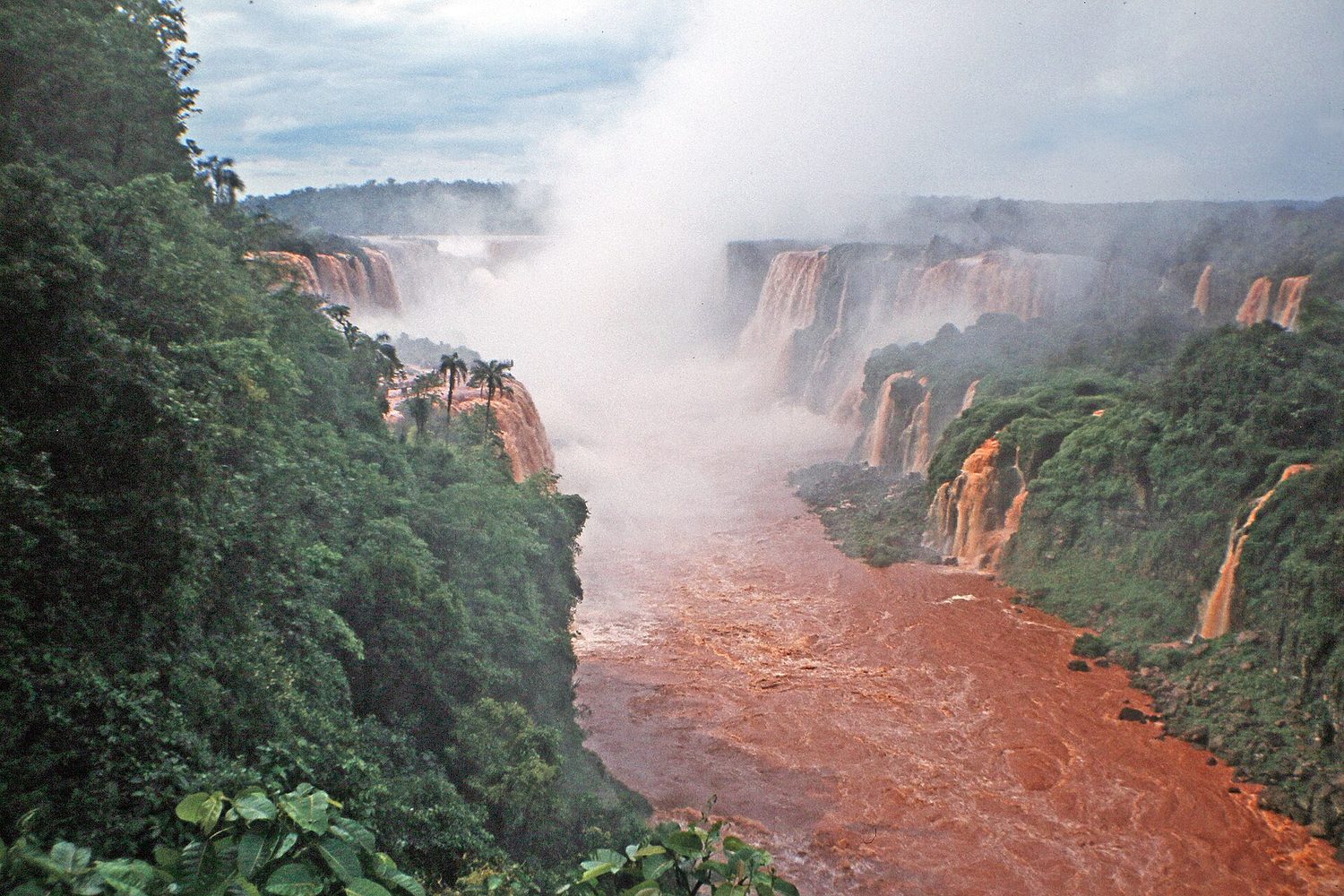
Air terjun: daya adalah seberapa cepat energi ditransfer – penurunan yang sama dalam waktu lebih sedikit berarti daya lebih besar
Vocabulary · ⁨Kosa kata⁩ Train · ⁨Latih⁩
English Bahasa Indonesia
Power/ˈpaʊə/ Daya
watts/wɒts/ watt
efficiency/ɪˈfɪʃənsi/ efisiensi
3.5

Exam tips · ⁨Tips ujian⁩

English
  • Use $W=Fd\cos\theta$: work is zero when the force is perpendicular to the motion, and negative when it opposes it.
  • Reach for the work–energy theorem ($W_{\text{net}}=\Delta K$) or energy conservation ($K_1+U_1=K_2+U_2$) instead of forces whenever the path is complicated.
  • When friction acts, mechanical energy is not conserved — subtract the energy lost to heat.
  • Remember $K\propto v^2$: doubling the speed quadruples the kinetic energy (and the stopping distance).
  • Use $P=Fv$ for power at a steady speed; at constant velocity the net force is zero but the power is not.
Bahasa Indonesia
  • Gunakan $W=Fd\cos\theta$: usaha bernilai nol ketika gaya tegak lurus terhadap gerakan, dan negatif ketika berlawanan arah.
  • Rujuk pada teorema usaha-energi ($W_{\text{net}}=\Delta K$) atau kekekalan energi ($K_1+U_1=K_2+U_2$) alih-alih gaya whenever lintasannya rumit.
  • Ketika gesekan bekerja, energi mekanik tidak kekal – kurangi energi yang hilang menjadi panas.
  • Ingat $K\propto v^2$: menggandakan kecepatan mengkuadratkan energi kinetik (dan jarak pengereman).
  • Gunakan $P=Fv$ untuk daya pada kecepatan konstan; pada kecepatan konstan resultan gaya adalah nol tetapi dayanya bukan.

Interactive lessons on this topic · ⁨Pelajaran interaktif untuk topik ini⁩

Work through it step by step, with instant-check exercises. · ⁨Kerjakan langkah demi langkah, dengan latihan pengecekan instan.⁩

Past Papers · ⁨Soal-Soil Masa Lalu⁩

More topics in AP Physics 1 · ⁨AP Fisika 1⁩ · ⁨Topik lain dalam AP Physics 1 · ⁨AP Fisika 1⁩⁩

Log in or create account · ⁨Masuk atau buat akun⁩

IGCSE, A-Level & AP