Skip to content · ⁨דלג לתוכן⁩

Oscillations · ⁨תנודות⁩

AP Physics 1 · ⁨פיזיקה AP 1⁩ · Topic 7 · ⁨נושא 7⁩

Video lesson for this topic · ⁨שיעור וידאו לנושא זה⁩ Open the video page · ⁨פתח את עמוד הוידאו⁩
7:48

תנודות

שני קפיצים זהים, שתי מסות זהות. משוך אחד מהם למטה רחוק. משוך את השני רק מעט. שחרר את שניהם בו-זמנית. איזה מהם יחזור…

English narration · English + 中文 subtitles burned in · ⁨קריאת קול באנגלית · תרגום אנגלי + סינית שרוף בתוך הסרטון⁩

7.1

Defining Simple Harmonic Motion · ⁨הגדרת תנועה הרמונית פשוטה⁩

Syllabus · ⁨סיילבוס⁩
English

Learning Objective 7.1.A: Describe simple harmonic motion.

  • 7.1.A.1 Simple harmonic motion is a special case of periodic motion.
  • 7.1.A.2 SHM results when the magnitude of the restoring force exerted on an object is proportional to that object's displacement from its equilibrium position.
    • Equation: $ma_x = -k\Delta x$
    • 7.1.A.2.i A restoring force is a force that is exerted in a direction opposite to the object's displacement from an equilibrium position.
    • 7.1.A.2.ii An equilibrium position is a location at which the net force exerted on an object or system is zero.
    • 7.1.A.2.iii The motion of a pendulum with a small angular displacement can be modeled as simple harmonic motion because the restoring torque is proportional to the angular displacement.
עברית

מטרת למידה 7.1.A: לתאר תנועה הרמונית פשוטה.

  • 7.1.A.1 תנועה הרמונית פשוטה היא מקרה מיוחד של תנועה מחזורית.
  • 7.1.A.2 SHM נוצר כאשר גודל כוח ההשבה הפועל על גוף הוא פרופורציונלי להזזה של אותו גוף ממיקום האיזון שלו.
    • משוואה: $ma_x = -k\Delta x$
    • 7.1.A.2.i כוח השבה הוא כוח הפועל בכיוון הנגדי להזזה של הגוף ממיקום איזון.
    • 7.1.A.2.ii מיקום איזון הוא מיקום שבו הכוח הכולל הפועל על גוף או מערכת הוא אפס.
    • 7.1.A.2.iii התנועה של דודק עם סטייה זוויתית קטנה יכולה להיות מדומה כתנועה הרמונית פשוטה, משום שהמומנט המשיב פרופורציונלי לסטייה הזוויתית.
Source: College Board AP Course and Exam Description · ⁨מקור: תיאור הקורס והמבחן של College Board AP⁩

English
Simple harmonic motion

Simple harmonic motion 简谐运动 (SHM) is a back-and-forth oscillation 振动 caused by a restoring force 回复力 that is proportional to the displacement from equilibrium and always points back toward it: $F=-kx$. A mass on a spring and (for small angles) a pendulum are the standard examples. Because the force grows with displacement, the motion is smooth and repeating, tracing a sine curve in time.

The test for SHM is exactly this: acceleration proportional to displacement and opposite in direction, $a=-\dfrac{k}{m}x$. A pendulum only obeys it for small swings, where $\sin\theta\approx\theta$; large swings are not quite SHM.

עברית
תנועה הרמונית פשוטה

תנועה הרמונית פשוטה (SHM) היא תנודה חוזרת-ונחזרת הנובעת מ-כוח מחזיר פרופורציונלי להזזה מאיזון ועובר תמיד בחזרה אליו: $F=-kx$. מסה על קפיץ ו-(לזוויות קטנות) מטטול הם הדוגמאות הסטנדרטיות. מכיוון שכוח גדל בהזזה, התנועה חלקה וחוזרת על עצמה, ומציירת קמט סינואידלי בזמן.

בתנועה הרמונית פשוטה האוצר תמיד מצביע חזרה לאיזון, הפוך להזזה

המבחן לתנועה הרמונית פשוטה הוא בדיוק זה: אוצר פרופורציונלי להזזה והפוך בכיוון, $a=-\dfrac{k}{m}x$. למטטול יש פועל כך רק עבור תנודות קטנות, כאשר $\sin\theta\approx\theta$; תנודות גדולות הן לא בדיוק תנועה הרמונית פשוטה.

קפיץ בעומס: חוק הוק F = −kx הוא כוח המחזיר היוצר תנועה הרמונית פשוטה
7.2

Frequency and Period of SHM · ⁨תדירות ותקופה של תנודות הרמוניות פשוטות⁩

Syllabus · ⁨סיילבוס⁩
English

Learning Objective 7.2.A: Describe the frequency and period of an object exhibiting SHM.

  • 7.2.A.1 The period of SHM is related to the frequency $f$ of the object's motion by the following equation:
    • Equation: $T = \dfrac{1}{f}$
    • 7.2.A.1.i The period of an object–ideal-spring oscillator is given by the equation $T_s = 2\pi\sqrt{\dfrac{m}{k}}$.
    • 7.2.A.1.ii The period of a simple pendulum displaced by a small angle is given by the equation $T_p = 2\pi\sqrt{\dfrac{\ell}{g}}$.
עברית

מטרת למידה 7.2.A: לתאר את התדירות והתקופה של גוף המציג SHM.

  • 7.2.A.1 התקופה של SHM קשורה לתדירות $f$ של תנועת הגוף באמצעות המשוואה הבאה:
    • משוואה: $T = \dfrac{1}{f}$
    • 7.2.A.1.i תקופת מתנד קפיץ-גוף אידיאלי נתונה על ידי המשוואה $T_s = 2\pi\sqrt{\dfrac{m}{k}}$.
    • 7.2.A.1.ii תקופת דודק פשוט שמוסח בזווית קטנה נתונה על ידי המשוואה $T_p = 2\pi\sqrt{\dfrac{\ell}{g}}$.

Source: College Board AP Course and Exam Description · ⁨מקור: תיאור הקורס והמבחן של College Board AP⁩

English
  • The period 周期 $T$ is the time for one full cycle.
  • The frequency 频率 $f=\dfrac{1}{T}$ is cycles per second (hertz).

For SHM these depend only on the system, not on the amplitude:

$$T_{\text{spring}}=2\pi\sqrt{\frac{m}{k}},\qquad T_{\text{pendulum}}=2\pi\sqrt{\frac{L}{g}}.$$
So a stiffer spring or smaller mass oscillates faster; a longer pendulum swings slower.

Worked example. A $0.25\ \text{kg}$ mass hangs on a spring of stiffness $k=100\ \text{N/m}$. Its period is

$$T=2\pi\sqrt{\frac{m}{k}}=2\pi\sqrt{\frac{0.25}{100}}=0.31\ \text{s},\qquad f=\frac{1}{T}=3.2\ \text{Hz}.$$

Worked example. A pendulum clock ticks with a period of exactly $2.0\ \text{s}$. How long is it? Rearranging $T=2\pi\sqrt{L/g}$,

$$L=g\left(\frac{T}{2\pi}\right)^2=9.8\times\left(\frac{2.0}{2\pi}\right)^2=0.99\ \text{m}.$$
Notice the amplitude never entered – a wide or narrow swing keeps the same time, which is what makes pendulums good clocks.

עברית
  • התקופה $T$ היא הזמן למחזור מלא אחד.
  • תדירות $f=\dfrac{1}{T}$ היא מחזור לשנייה (הרץ).

בתנודות הרמוניות פשוטות, הן תלויות רק במערכת, ולא במשרעת:

$$T_{\text{spring}}=2\pi\sqrt{\frac{m}{k}},\qquad T_{\text{pendulum}}=2\pi\sqrt{\frac{L}{g}}.$$
לכן קפיץ קשיח יותר או מסה קטנה יותר מתנודת מהר יותר; נדוד ארוך יותר מתנדנד לאט יותר.

דוגמה מוצגת. מסה $0.25\ \text{kg}$ תלויה על קפיץ בעובי $k=100\ \text{N/m}$. התקופה שלה היא

$$T=2\pi\sqrt{\frac{m}{k}}=2\pi\sqrt{\frac{0.25}{100}}=0.31\ \text{s},\qquad f=\frac{1}{T}=3.2\ \text{Hz}.$$

דוגמה מוצגת. שעון נדוד מקצב בתקופה של בדיוק $2.0\ \text{s}$. כמה הוא ארוך? פירוק $T=2\pi\sqrt{L/g}$,

$$L=g\left(\frac{T}{2\pi}\right)^2=9.8\times\left(\frac{2.0}{2\pi}\right)^2=0.99\ \text{m}.$$
שים לב שמשרעת מעולם לא נכנסה לחשבון – נדוד רחב או צר שומר על אותו זמן, וזה מה שהופך נדודים לשעונים טובים.

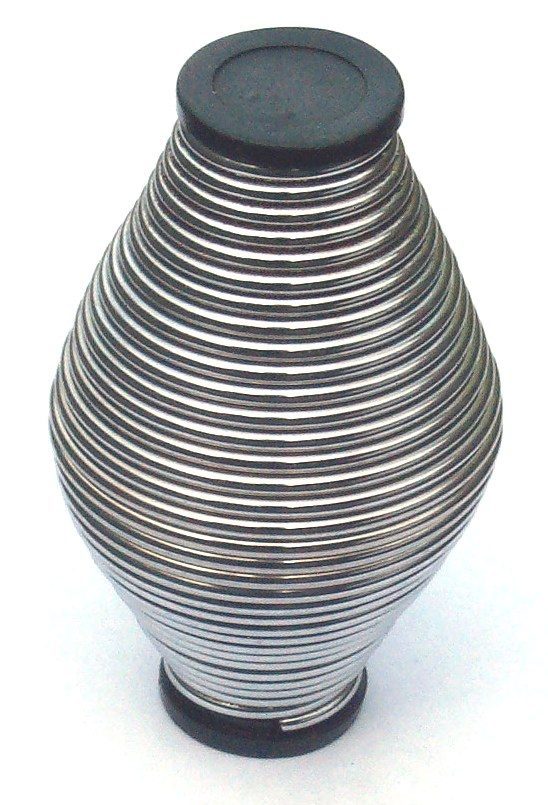
סט של מזמזמים בגדלים שונים
מזמזמים: מזמזם ארוך וכבד יותר רועד לאט יותר, ומפיק תדירות נמוכה
Explore · ⁨חקור⁩

Time a pendulum's swing · ⁨מדוד זמן תנודת מתלה⁩

A pendulum's period depends on its length and gravity, not its mass or (small) amplitude: $T=2\pi\sqrt{L/g}$. Lengthen it and each swing takes longer. · ⁨התקופה של מתלה תלויה באורכו ובכובד, ולא במסתו או במשרעתו (הקטנה): $T=2\pi\sqrt{L/g}$. אם מאריכים אותו, כל תנודה לוקחת יותר זמן.⁩

7.3

Representing and Analyzing SHM · ⁨ייצוג וניתוח של תנודות הרמוניות פשוטות⁩

Syllabus · ⁨סיילבוס⁩
English

Learning Objective 7.3.A: Describe the displacement, velocity, and acceleration of an object exhibiting SHM.

  • 7.3.A.1 For an object exhibiting SHM, the displacement of that object measured from its equilibrium position can be represented by the equations $x = A\cos(2\pi ft)$ or $x = A\sin(2\pi ft)$.
    • 7.3.A.1.i Minima, maxima, and zeros of displacement, velocity, and acceleration are features of harmonic motion.
    • 7.3.A.1.ii Recognizing the positions or times at which the displacement, velocity, and acceleration for SHM have extrema or zeros can help in qualitatively describing the behavior of the motion.
  • 7.3.A.2 Changing the amplitude of a system exhibiting SHM will not change the period of that system.
  • 7.3.A.3 Properties of SHM can be determined and analyzed using graphical representations.
עברית

מטרת למידה 7.3.A: לתאר את ההזזה, המהירות והתאוצה של גוף המציג SHM.

  • 7.3.A.1 עבור גוף המציג SHM, ההזזה של אותו גוף הנמדדת ממיקום האיזון שלו יכולה להיות מיוצגת על ידי המשוואות $x = A\cos(2\pi ft)$ או $x = A\sin(2\pi ft)$.
    • 7.3.A.1.i מינימום, מקסימום ואפסים של הזזה, מהירות ותאוצה הם מאפיינים של תנועה הרמונית.
    • 7.3.A.1.ii זיהוי המיקומים או הזמנים שבהם ההזזה, המהירות והתאוצה ל-SHM מגיעים לקיצונים או לאפסים יכול לעזור בתיאור איכותני של התנהגות התנועה.
  • 7.3.A.2 שינוי במשרעת של מערכת המציגת SHM לא ישנה את תקופת המערכת.
  • 7.3.A.3 ניתן לקבוע ולנתח מאפיינים של SHM באמצעות ייצוגים גרפיים.

Source: College Board AP Course and Exam Description · ⁨מקור: תיאור הקורס והמבחן של College Board AP⁩

English

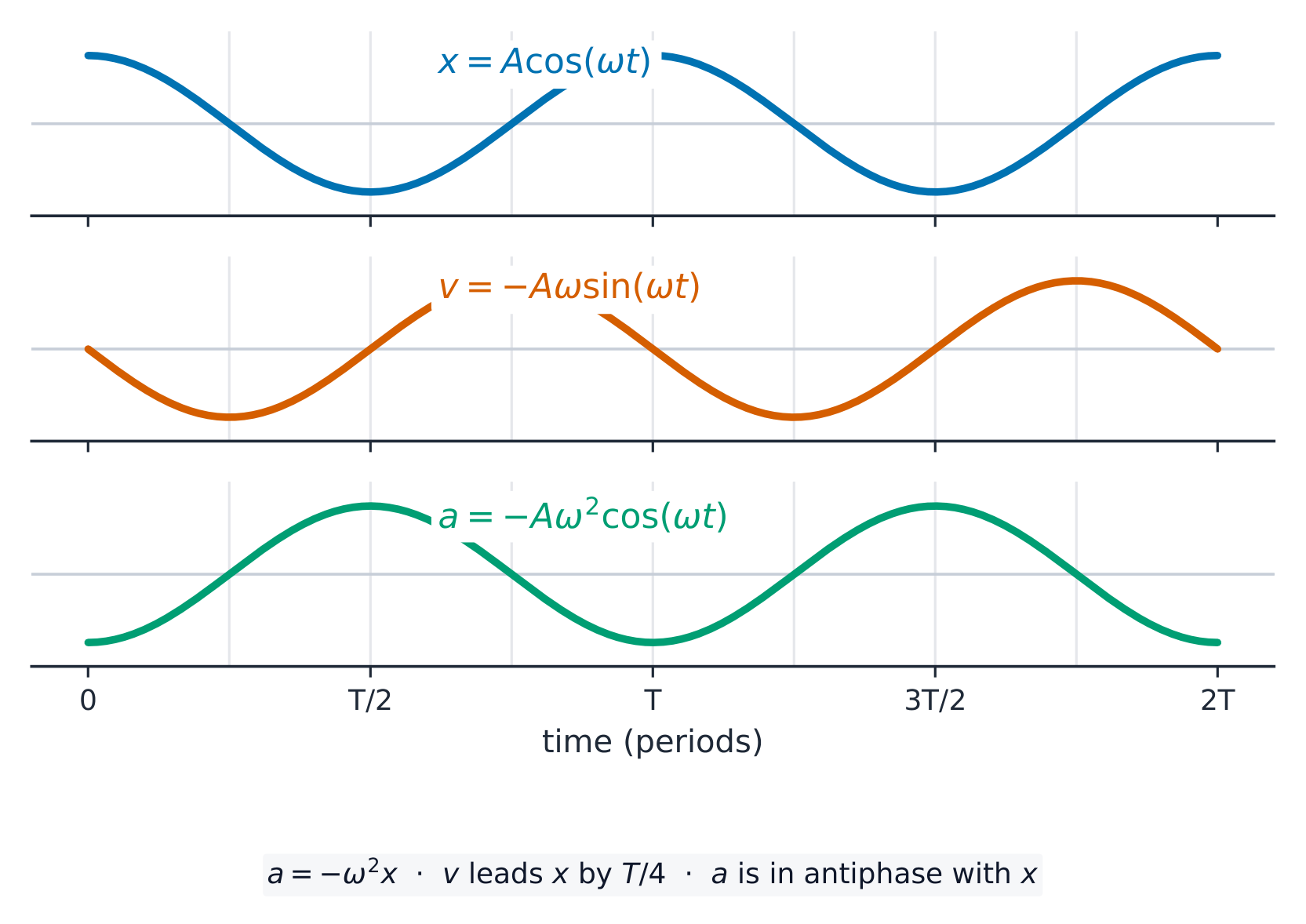
The displacement varies sinusoidally: $x(t)=A\cos(\omega t)$ (or sine), where $A$ is the amplitude 振幅 (maximum displacement) and $\omega=2\pi f$ is the angular frequency 角频率. Reading the motion:

  • At the extremes ($x=\pm A$): displacement and restoring force are maximum, so acceleration is maximum, but velocity is zero.
  • At equilibrium 平衡 ($x=0$): force and acceleration are zero, but speed is maximum.

Velocity and acceleration are also sinusoidal, shifted in phase 相位 from the displacement – velocity leads displacement by a quarter cycle, and acceleration is exactly opposite to displacement.

Read the figure as a story: where $x$ is largest (the turning point), $v$ has just fallen to zero and $a$ is at its most negative, hauling the mass back; a quarter-cycle later the mass races through the middle at top speed with zero acceleration.

עברית

ההיסחנות משתנה באופן סינוסואידלי: $x(t)=A\cos(\omega t)$ (או סינוס), כאשר $A$ היא המשרעת (ההיסחנות המקסימלית) ו$\omega=2\pi f$ הוא תדר זוויתי. קריאת התנועה:

ההסתירה משתנה סינוסואידלית עם הזמן בתנועה סינוסואידלית
המיקום משתנה סינוסואידלית עם הזמן בתנועה פשוטה הרמונית
  • בקצוות ($x=\pm A$): ההיסחנות והכוח המשחזר הם מקסימליים, ולכן האצטות מקסימלית, אך המהירות היא אפס.
  • באיזון ($x=0$): הכוח והאצטות הם אפס, אך המהירות מקסימלית.

המהירות והאצטות גם הן סינוסואידליות, עם הזזה ב-פאזה בהשוואה להיסחנות – המהירות מובילה את ההיסחנות ברביע מחזור, והאצטות הפוכה בדיוק להיסחנות.

הזזה, מהירות ותאוצה בתנועה הרמונית פשוטה, כל אחד במרחק של רבע מחזור *היסחנות, מהירות ואצטות בתנודות הרמוניות פשוטות, כל אחת בשוני של רביע מחזור

קראו בתמונה כסיפור: כאשר $x$ גדולה ביותר (נקודת ההפיכה), $v$ חדשה לצמצם לאפס ו$a$ נמצאת בערך השלילי הגדול ביותר, מושכת את המסה בחזרה; רביע מחזור מאוחר יותר המסה עוברת דרך האמצע במהירות מרבית עם אצטות אפס.

Vocabulary · ⁨מילון מונחים⁩ Train · ⁨אימון⁩
English עברית
Simple harmonic motion/ˈsɪmpl hɑːˈmɒnɪk ˈməʊʃn/ תנועה הרמונית פשוטה
oscillation/ˌɒsɪˈleɪʃn/ תנודה
restoring force/rɪˈstɔːrɪŋ fɔːs/ כוח משחזר
period/ˈpɪərɪəd/ תקופה
frequency/ˈfriːkwənsi/ תדר
amplitude/ˈæmplɪtjuːd/ משרעת
angular frequency/ˈæŋɡjʊlə ˈfriːkwənsi/ תדירות זוויתית
phase/feɪz/ פאזה
equilibrium/ˌiːkwɪˈlɪbrɪəm/ איזון
7.4

Energy of Simple Harmonic Oscillators · ⁨אנרגיה של מתנדדים הרמוניים פשוטים⁩

Syllabus · ⁨סיילבוס⁩
English

Learning Objective 7.4.A: Describe the mechanical energy of a system exhibiting SHM.

  • 7.4.A.1 The total energy of a system exhibiting SHM is the sum of the system's kinetic and potential energies.
    • Equation: $E_{\text{total}} = U + K$
  • 7.4.A.2 Conservation of energy indicates that the total energy of a system exhibiting SHM is constant.
  • 7.4.A.3 The kinetic energy of a system exhibiting SHM is at a maximum when the system's potential energy is at a minimum.
  • 7.4.A.4 The potential energy of a system exhibiting SHM is at a maximum when the system's kinetic energy is at a minimum.
    • 7.4.A.4.i The minimum kinetic energy of a system exhibiting SHM is zero.
    • 7.4.A.4.ii Changing the amplitude of a system exhibiting SHM will change the maximum potential energy of the system and, therefore, the total energy of the system.
    • Relevant equation for a spring–object system: $E_{\text{total}} = \dfrac{1}{2}kA^2$
עברית

מטרת למידה 7.4.A: תאר את האנרגיה המכנית של מערכת המציגה תנועה הרמונית פשוטה (SHM).

  • 7.4.A.1 האנרגיה הכוללת של מערכת המציגה תנועה הרמונית פשוטה היא סכום האנרגיה הקינטית והאנרגיה הפוטנציאלית של המערכת.
    • משוואה: $E_{\text{total}} = U + K$
  • 7.4.A.2 חוק שימור האנרגיה קובע שאנרגיה כוללת של מערכת המציגה תנועה הרמונית פשוטה היא קבועה.
  • 7.4.A.3 האנרגיה הקינטית של מערכת המציגה תנועה הרמונית פשוטה נמצאת בשיאה כאשר האנרגיה הפוטנציאלית של המערכת נמצאת במינימום.
  • 7.4.A.4 האנרגיה הפוטנציאלית של מערכת המציגה תנועה הרמונית פשוטה נמצאת בשיאה כאשר האנרגיה הקינטית של המערכת נמצאת במינימום.
    • 7.4.A.4.i האנרגיה הקינטית המינימלית של מערכת המציגה תנועה הרמונית פשוטה היא אפס.
    • 7.4.A.4.ii שינוי בהיקף התנודה של מערכת המציגה תנועה הרמונית פשוטה ישנה את האנרגיה הפוטנציאלית המקסימלית של המערכת ולכן גם את האנרגיה הכוללת שלה.
    • משוואה רלוונטית למערכת קפיץ-גוף: $E_{\text{total}} = \dfrac{1}{2}kA^2$

Source: College Board AP Course and Exam Description · ⁨מקור: תיאור הקורס והמבחן של College Board AP⁩

English
Energy conservation: KE ⇄ PE

Energy sloshes between kinetic and potential while the total stays constant (no friction):

$$E=\tfrac{1}{2}kA^2 = \tfrac{1}{2}kx^2+\tfrac{1}{2}mv^2.$$
At the extremes it is all potential; at equilibrium it is all kinetic (maximum speed). Because $E\propto A^2$, doubling the amplitude quadruples the energy.

Worked example. A $0.50\ \text{kg}$ mass on a spring of stiffness $k=200\ \text{N/m}$ oscillates with amplitude $A=0.10\ \text{m}$. Find its maximum speed. All the energy is kinetic at the equilibrium point, so $\tfrac12 kA^2=\tfrac12 mv_{\max}^2$:

$$v_{\max}=A\sqrt{\frac{k}{m}}=0.10\times\sqrt{\frac{200}{0.50}}=0.10\times20=2.0\ \text{m/s}.$$
The energy method is faster than tracking the sine functions when you only need the greatest speed.

עברית
שימור אנרגיה: KE ⇄ PE

אנרגיה זורמת בין קינטית לפוטנציאלית בעוד שהסך הכל נשאר קבוע (ללא חיכוך):

$$E=\tfrac{1}{2}kA^2 = \tfrac{1}{2}kx^2+\tfrac{1}{2}mv^2.$$
בקצוות זה כולו פוטנציאל; באיזון זה כולו קינטי (מהירות מקסימלית). מכיוון ש$E\propto A^2$, הכפלת המשרעת מכפילה את האנרגיה פי ארבע.

החלפה בין אנרגיה קינטית לאנרגיה פוטנציאלית במהלך מחזור בעוד שאנרגיה כוללת נשארת קבועה
אנרגיה קינטית ופוטנציאלית מתחלפות במהלך מחזור בעוד שהאנרגיה הכוללת נשארת קבועה

דוגמה מפורטת. גוף בעל מסה $0.50\ \text{kg}$ על קפיץ בקשיחות $k=200\ \text{N/m}$ מתנודת עם משרעת $A=0.10\ \text{m}$. חשב את מהירותו המקסימלית. כל האנרגיה היא אנרגיה קינטית בנקודת האיזון, ולכן $\tfrac12 kA^2=\tfrac12 mv_{\max}^2$:

$$v_{\max}=A\sqrt{\frac{k}{m}}=0.10\times\sqrt{\frac{200}{0.50}}=0.10\times20=2.0\ \text{m/s}.$$
שיטת האנרגיה היא מהירה יותר מעקוב אחר פונקציות הסינוס כאשר צריך רק את המהירות הגדולה ביותר.

Explore · ⁨חקור⁩

Trade kinetic and potential energy in SHM · ⁨חילוף אנרגיה קינטית ופוטנציאלית בתנועה הרמונית פשוטה⁩

In simple harmonic motion, energy sloshes between kinetic (fastest at the centre) and potential (greatest at the extremes) while the total stays constant. · ⁨בתנועה רמונית פשוטה, האנרגיה מתחלפת בין קינטית (מהירה ביותר במרכז) לפוטנציאלית (גבוהה ביותר בקצוות), בעוד שהסך הכל נשאר קבוע.⁩

7.4

Exam tips · ⁨טיפים לבחינות⁩

English
  • Test for SHM: the acceleration must be proportional to the displacement and directed back toward the middle ($a=-\tfrac{k}{m}x$).
  • The period does not depend on amplitude — use $T=2\pi\sqrt{m/k}$ (spring) or $T=2\pi\sqrt{L/g}$ (pendulum, small angles).
  • Speed is maximum at the middle (all kinetic) and zero at the extremes (all potential); acceleration is largest at the extremes.
  • Use energy ($\tfrac12 kA^2 = \tfrac12 kx^2 + \tfrac12 mv^2$) to find the maximum speed quickly: $v_{\max}=A\sqrt{k/m}$.
  • Total energy $\propto A^2$, so doubling the amplitude quadruples the energy.
עברית
  • בדיקה ל-תנועה סינוסואידלית: התאוצה חייבת להיות פרופורציונלית להזחה וכיוונה חוזר למרכז ($a=-\tfrac{k}{m}x$).
  • התקופה אינה תלויה במשרעת – השתמש ב-$T=2\pi\sqrt{m/k}$ (קפיץ) או ב-$T=2\pi\sqrt{L/g}$ (מתלה, זוויות קטנות).
  • המהירות היא מקסימלית באמצע (כלה קינטי) ואפס בקצוות (כלה פוטנציאל); התאוצה היא הגדולה ביותר בקצוות.
  • השתמש באנרגיה ($\tfrac12 kA^2 = \tfrac12 kx^2 + \tfrac12 mv^2$) כדי למצוא במהירות את המהירות המקסימלית: $v_{\max}=A\sqrt{k/m}$.
  • האנרגיה הכוללת $\propto A^2$, ולכן הכפלת המשרעת מארבע את האנרגיה.

Interactive lessons on this topic · ⁨שיעורים אינטראקטיביים בנושא זה⁩

Work through it step by step, with instant-check exercises. · ⁨לעבור על הדברים צעד אחר צעד, עם תרגילים לבדיקה מיידית.⁩

Past Papers · ⁨מבחני עבר⁩

More topics in AP Physics 1 · ⁨פיזיקה AP 1⁩ · ⁨נושאים נוספים בAP Physics 1 · ⁨פיזיקה AP 1⁩⁩

Log in or create account · ⁨היכנס או צור חשבון⁩

IGCSE, A-Level & AP