Skip to content · ⁨דלג לתוכן⁩

Linear Momentum · ⁨תנע ליניארי⁩

AP Physics 1 · ⁨פיזיקה AP 1⁩ · Topic 4 · ⁨נושא 4⁩

Video lesson for this topic · ⁨שיעור וידאו לנושא זה⁩ Open the video page · ⁨פתח את עמוד הוידאו⁩
7:49

תנע ליניארי

חמישה כדורי פלדה תלויים בשורה, נוגעים זה בזה בדיוק. מרים אחד, משחררים אותו, וכדור אחד מתעוף בקצה הרחוק. רק אחד. מרים שניים, ובדיוק שניים מתעופפים. משהו…

English narration · English + 中文 subtitles burned in · ⁨קריאת קול באנגלית · תרגום אנגלי + סינית שרוף בתוך הסרטון⁩

4.1

Linear Momentum · ⁨תנע ליני⁩

Syllabus · ⁨סיילבוס⁩
English

Learning Objective 4.1.A: Describe the linear momentum of an object or system.

  • 4.1.A.1 Linear momentum is defined by the equation $\vec{p} = m\vec{v}$.
    • Equation: $\vec{p} = m\vec{v}$
  • 4.1.A.2 Momentum is a vector quantity and has the same direction as the velocity.
  • 4.1.A.3 Momentum can be used to analyze collisions and explosions.
    • 4.1.A.3.i A collision is a model for an interaction where the forces exerted between the involved objects in the system are much larger than the net external force exerted on those objects during the interaction.
    • 4.1.A.3.ii As only the initial and final states of a collision are analyzed, the object model may be used to analyze collisions.
    • 4.1.A.3.iii An explosion is a model for an interaction in which forces internal to the system move objects within that system apart.

Boundary statement: Unless otherwise stated, the general term "momentum" will refer specifically to linear momentum.

עברית

מטרות למידה 4.1.A: תיאור התנע הליניארי של גוף או מערכת.

  • 4.1.A.1 התנע הליניארי מוגדר על ידי המשוואה $\vec{p} = m\vec{v}$.
    • משוואה: $\vec{p} = m\vec{v}$
  • 4.1.A.2 התנע הוא גודל וקטורי ולו אותה כיוון כמו המהירות.
  • 4.1.A.3 ניתן להשתמש בתנע כדי לנתח התנגשויות והתפוצצויות.
    • 4.1.A.3.i התנגשות היא דגם לאינטראקציה שבה הכוחות המופעלים בין הגופים המעורבים במערכת הם גדולים משמעותית מהכוח החיצוני הכולל הפועל עליהם במהלך האינטראקציה.
    • 4.1.A.3.ii מכיוון שננתחים רק המצבים ההתחלתי והסופי של התנגשות, ניתן להשתמש בדגם הגוף כדי לנתח התנגשויות.
    • 4.1.A.3.iii התפוצצות היא דגם לאינטראקציה שבה כוחות פנימיים למערכת מזיזים גופים בתוך המערכת זה הרחק מזה.

הצהרת גבול: אלא אם כן צוין אחרת, הביטוי הכללי "תנע" יתייחס ספציפית לתנע ליניארי.

Source: College Board AP Course and Exam Description · ⁨מקור: תיאור הקורס והמבחן של College Board AP⁩

English

Linear momentum 动量 is mass times velocity – a vector pointing the same way as the velocity:

$$\vec{p}=m\vec{v}.$$
It measures "how hard it is to stop" a moving object. A heavy slow truck and a light fast ball can have the same momentum. Its unit is $\text{kg m/s}$, the same as $\text{N s}$.

עברית

תנע ליני הוא מכפלת המסה במהירות – וקטור המצביע באותה כיוון כמו המהירות:

$$\vec{p}=m\vec{v}.$$
זהו מדד ל"כמה קשה לעצור" גוף נע. משאית כבדה ואטית וכדור קל ומהיר יכולים להיות אותם תנע. היחידה שלו היא $\text{kg m/s}$, אותה כמו $\text{N s}$.

4.2

Change in Momentum and Impulse · ⁨שינוי בתנע ותנופה⁩

Syllabus · ⁨סיילבוס⁩
English

Learning Objective 4.2.A: Describe the impulse delivered to an object or system.

  • 4.2.A.1 The rate of change of momentum is equal to the net external force exerted on an object or system.
    • Equation: $\vec{F}_{\text{net}} = \dfrac{\Delta \vec{p}}{\Delta t}$
  • 4.2.A.2 Impulse is defined as the product of the average force exerted on a system and the time interval during which that force is exerted on the system.
    • Equation: $\vec{J} = \vec{F}_{\text{avg}} \Delta t$
  • 4.2.A.3 Impulse is a vector quantity and has the same direction as the net force exerted on the system.
  • 4.2.A.4 The impulse delivered to a system by a net external force is equal to the area under the curve of a graph of the net external force exerted on the system as a function of time.
  • 4.2.A.5 The net external force exerted on a system is equal to the slope of a graph of the momentum of the system as a function of time.

Learning Objective 4.2.B: Describe the relationship between the impulse exerted on an object or a system and the change in momentum of the object or system.

  • 4.2.B.1 Change in momentum is the difference between a system's final momentum and its initial momentum.
    • Equation: $\Delta \vec{p} = \vec{p} - \vec{p}_0$
  • 4.2.B.2 The impulse–momentum theorem relates the impulse exerted on a system and the system's change in momentum.
    • Equation: $\vec{J} = \vec{F}_{\text{avg}} \Delta t = \Delta \vec{p}$
  • 4.2.B.3 Newton's second law of motion is a direct result of the impulse–momentum theorem applied to systems with constant mass.
    • Equation: $\vec{F}_{\text{net}} = \dfrac{\Delta \vec{p}}{\Delta t} = m\dfrac{\Delta \vec{v}}{\Delta t} = m\vec{a}$

Boundary statement: AP Physics 1 does not require students to quantitatively analyze systems in which the mass of the system changes with respect to time.

עברית

מטרות למידה 4.2.A: תיאור התנופה המסופקת לגוף או למערכת.

  • 4.2.A.1 קצב השינוי בתנע שווה לכוח החיצוני הכולל הפועל על גוף או מערכת.
    • משוואה: $\vec{F}_{\text{net}} = \dfrac{\Delta \vec{p}}{\Delta t}$
  • 4.2.A.2 תנופה מוגדרת כמכפלת הכוח הממוצע הפועל על מערכת ופרקי הזמן שבו כוח זה פועל על המערכת.
    • משוואה: $\vec{J} = \vec{F}_{\text{avg}} \Delta t$
  • 4.2.A.3 תנופה היא גודל וקטורי ולו אותה כיוון כמו הכוח הכולל הפועל על המערכת.
  • 4.2.A.4 התנופה המסופקת למערכת על ידי כוח חיצוני כולל שווה לשטח מתחת לעקומה בגרף של הכוח החיצוני הכולל הפועל על המערכת כתלות בזמן.
  • 4.2.A.5 הכוח החיצוני הכולל הפועל על מערכת שווה לשיפוע בגרף של התנע של המערכת כתלות בזמן.

מטרות למידה 4.2.B: תיאור הקשר בין התנופה הפועלת על גוף או מערכת לבין שינוי התנע של הגוף או המערכת.

  • 4.2.B.1 שינוי בתנע הוא ההפרש בין התנע הסופי של המערכת לתנע ההתחלתי שלה.
    • משוואה: $\Delta \vec{p} = \vec{p} - \vec{p}_0$
  • 4.2.B.2 משפט הדחיפה-תנע מקשר בין הדחיפה הפועלת על מערכת לבין השינוי בתנע של המערכת.
    • משוואה: $\vec{J} = \vec{F}_{\text{avg}} \Delta t = \Delta \vec{p}$
  • 4.2.B.3 חוק התנועה השני של ניוטון הוא תוצאה ישירה של יישום משפט הדחיפה-תנע על מערכות בעלות מסה קבועה.
    • משוואה: $\vec{F}_{\text{net}} = \dfrac{\Delta \vec{p}}{\Delta t} = m\dfrac{\Delta \vec{v}}{\Delta t} = m\vec{a}$

הצהרת גבול: בפיזיקה AP 1 אינה דורשת מהתלמידים לבצע ניתוח כמותי של מערכות שבהן המסה משתנה לאורך הזמן.

Source: College Board AP Course and Exam Description · ⁨מקור: תיאור הקורס והמבחן של College Board AP⁩

English

A net force acting over time changes momentum. The impulse 冲量 delivered is

$$\vec{J}=\vec{F}\,\Delta t=\Delta\vec{p}.$$
This is the impulse–momentum theorem: impulse equals the change in momentum. On a force–time graph, impulse is the area under the curve. It explains why airbags and follow-through help – spreading the same momentum change over a longer time reduces the force.

Worked example. A $0.15\ \text{kg}$ ball hits a wall at $20\ \text{m/s}$ and bounces straight back at $15\ \text{m/s}$. The contact lasts $0.020\ \text{s}$. Find the average force on the ball. Take the rebound direction as positive, so $u=-20\ \text{m/s}$ and $v=+15\ \text{m/s}$:

$$\Delta p=m(v-u)=0.15\big(15-(-20)\big)=5.25\ \text{kg m/s},\qquad F=\frac{\Delta p}{\Delta t}=\frac{5.25}{0.020}=260\ \text{N}.$$
The sign work matters: forgetting that the velocity reverses is the most common mistake here.

עברית

כוח ניקוד הפועל לאורך זמן משנה תנע. התנופה המוסקת היא

$$\vec{J}=\vec{F}\,\Delta t=\Delta\vec{p}.$$
זהו משפט העתק-תנע: עתק שווה לשינוי בתנע. בגרף כוח-זמן, העתק הוא השטח מתחת לעקומה. זה מסביר מדוע כריות אוויר ו"מעקב" עוזרים – פיזור אותו שינוי תנע על פני זמן ארוך יותר מפחית את הכוח.

העתק הוא השטח מתחת לעקומת הכוח-זמן, שווה לכוח הממוצע כפול זמן המגע

דוגמה מופת. כדור בעל $0.15\ \text{kg}$ נוגע בקיר במהירות $20\ \text{m/s}$ ומתנגש ישר אחורה במהירות $15\ \text{m/s}$. זמן המגע הוא $0.020\ \text{s}$. חשב את הכוח הממוצע על הכדור. קח את כיוון ההתנגשות החוזרת כחיובי, ולכן $u=-20\ \text{m/s}$ ו$v=+15\ \text{m/s}$:

$$\Delta p=m(v-u)=0.15\big(15-(-20)\big)=5.25\ \text{kg m/s},\qquad F=\frac{\Delta p}{\Delta t}=\frac{5.25}{0.020}=260\ \text{N}.$$
סימן העבודה חשוב: שוכחים שהמהירות מתהפכת היא הטעות הנפוצה ביותר כאן.

Vocabulary · ⁨מילון מונחים⁩ Train · ⁨אימון⁩
English עברית
Linear momentum/ˈlɪnɪə məʊˈmentəm/ תנע קווי
impulse/ˈɪmpʌls/ תנע כוח
conserved/kənˈsɜːvd/ שמור על ערכו
collisions/kəˈlɪʒnz/ התנגשויות
center-of-mass velocity/ˈsentə ɒv mæs vəˈlɒsɪti/ מהירות מרכז המסה
elastic collision/ɪˈlæstɪk kəˈlɪʒn/ התנגשות אלסטית
inelastic collision/ɪnɪˈlæstɪk kəˈlɪʒn/ התנגשות לא-אלסטית
recoil/rɪˈkɔɪl/ החזר
4.3

Conservation of Linear Momentum · ⁨שימור תנע ליני⁩

Syllabus · ⁨סיילבוס⁩
English

Learning Objective 4.3.A: Describe the behavior of a system using conservation of linear momentum.

  • 4.3.A.1 A collection of objects with individual momenta can be described as one system with one center-of-mass velocity.
    • 4.3.A.1.i For a collection of objects, the velocity of a system's center of mass can be calculated using the equation $\vec{v}_{\text{cm}} = \dfrac{\sum \vec{p}_i}{\sum m_i} = \dfrac{\sum m_i \vec{v}_i}{\sum m_i}$.
    • 4.3.A.1.ii The velocity of a system's center of mass is constant in the absence of a net external force.
  • 4.3.A.2 The total momentum of a system is the sum of the momenta of the system's constituent parts.
  • 4.3.A.3 In the absence of net external forces, any change to the momentum of an object within a system must be balanced by an equivalent and opposite change of momentum elsewhere within the system. Any change to the momentum of a system is due to a transfer of momentum between the system and its surroundings.
    • 4.3.A.3.i The impulse exerted by one object on a second object is equal and opposite to the impulse exerted by the second object on the first. This is a direct result of Newton's third law.
    • 4.3.A.3.ii A system may be selected so that the total momentum of that system is constant.
    • 4.3.A.3.iii If the total momentum of a system changes, that change will be equivalent to the impulse exerted on the system.
      • Equation: $\vec{J} = \Delta \vec{p}$
  • 4.3.A.4 Correct application of conservation of momentum can be used to determine the velocity of a system immediately before and immediately after collisions or explosions.

Boundary statement: AP Physics 1 includes a quantitative and qualitative treatment of conservation of momentum in one dimension and a semiquantitative treatment of conservation of momentum in two dimensions. Exam questions involving solution of simultaneous equations are not included in AP Physics 1, but the AP Physics 1 Exam may include questions that assess whether students can set up the equations properly and reason about how changing a given mass, speed, or angle would affect other quantities. AP Physics 2 includes a full treatment of conservation of momentum in two dimensions for problems that include one unknown final velocity.

Learning Objective 4.3.B: Describe how the selection of a system determines whether the momentum of that system changes.

  • 4.3.B.1 Momentum is conserved in all interactions.
  • 4.3.B.2 If the net external force on the selected system is zero, the total momentum of the system is constant.
  • 4.3.B.3 If the net external force on the selected system is nonzero, momentum is transferred between the system and the environment.
עברית

מטרות למידה 4.3.A: לתאר את התנהגות המערכת באמצעות שימור תנע ליני.

  • 4.3.A.1 אוסף של עצמים עם תנעים פרטיים ניתן לתיאור כמערכת אחת עם מהירות מרכז המסה אחת.
    • 4.3.A.1.i עבור אוסף של עצמים, מהירות מרכז המסה של המערכת ניתן לחשב באמצעות המשוואה $\vec{v}_{\text{cm}} = \dfrac{\sum \vec{p}_i}{\sum m_i} = \dfrac{\sum m_i \vec{v}_i}{\sum m_i}$.
    • 4.3.A.1.ii מהירות מרכז המסה של המערכת היא קבועה בהיעדר כוח חיצוני נטו.
  • 4.3.A.2 התנע הכולל של מערכת הוא סכום התנעים של החלקים המרכיבים אותה.
  • 4.3.A.3 בהיעדר כוחות חיצוניים נטו, כל שינוי בתנע של גוף כלשהו בתוך המערכת חייב להיות מאוזן על ידי שינוי תנע שווה בגודלו אך מנוגד בכיוונו במקום אחר בתוך המערכת. כל שינוי בתנע המערכת נובע מהעברת תנע בין המערכת לסביבתה.
    • 4.3.A.3.i הדחיפה שמפעיל גוף אחד על גוף שני שווה בגודלה ומנוגדת בכיוונה לדחיפה שמפעיל הגוף השני על הראשון. זהו תוצאה ישירה של חוק השלישי של ניוטון.
    • 4.3.A.3.ii ניתן לבחור מערכת כך שתנעה הכולל שלה יהיה קבוע.
    • 4.3.A.3.iii אם התנע הכולל של המערכת משתנה, השינוי הזה יהיה שקול לדחיפה שהופעלה על המערכת.
      • משוואה: $\vec{J} = \Delta \vec{p}$
  • 4.3.A.4 יישום נכון של שימור התנע יכול לשמש לקביעת מהירות המערכת מיד לפני ומיד לאחר התנגשות או פיצוץ.

הצהרת גבול: בפיזיקה AP 1 כלול טיפול כמותי ואיכותי בשימור התנע בממד אחד וטיפול סמי-כמותי בשימור התנע בממד שני. שאלות במבחן AP 1 שאינן דורשות פתרון של מערכת משוואות אינן כלולות, אך מבחן AP 1 עשוי לכלול שאלות המודדות האם התלמידים יכולים להציב את המשוואות בצורה הנכונה ולנתח כיצד שינוי במסה, מהירות או זווית נתונים ישפיע על גדלים אחרים. בפיזיקה AP 2 כלול טיפול מלא בשימור התנע בממד שני לבעיות הכוללות מהירות סופית אחת לא ידועה.

מטרות למידה 4.3.B: לתאר כיצד בחירת המערכת קובעת האם תנעה שלה משתנה.

  • 4.3.B.1 תנע נשמר בכל האינטראקציות.
  • 4.3.B.2 אם הכוח החיצוני הנטו על המערכת הנבחרת הוא אפס, התנע הכולל של המערכת הוא קבוע.
  • 4.3.B.3 אם הכוח החיצוני הנטו על המערכת הנבחרת אינו אפס, מתבצע העברת תנע בין המערכת לסביבה.

Source: College Board AP Course and Exam Description · ⁨מקור: תיאור הקורס והמבחן של College Board AP⁩

English

If the net external force on a system is zero, its total momentum is conserved 守恒:

$$\sum \vec{p}_{\text{before}}=\sum \vec{p}_{\text{after}}.$$
Internal forces (like the push between two colliding carts) come in third-law pairs and cancel, so they cannot change the total momentum. This is the key tool for collisions 碰撞 and explosions – apply it separately in the $x$ and $y$ directions.

Worked example (recoil 反冲). A $60\ \text{kg}$ skater, initially at rest on frictionless ice, throws a $2.0\ \text{kg}$ ball at $8.0\ \text{m/s}$. Find her recoil speed. The total momentum starts at zero and stays zero:

$$0=(60)v+(2.0)(8.0)\;\Rightarrow\;v=-\frac{16}{60}=-0.27\ \text{m/s},$$
so she moves at $0.27\ \text{m/s}$ in the opposite direction to the ball – the principle behind rockets and guns.

A whole collection of objects can be described by a single center-of-mass velocity 质心速度:

$$\vec{v}_{\text{cm}}=\frac{\sum m_i\vec{v}_i}{\sum m_i}=\frac{\vec{p}_{\text{total}}}{M_{\text{total}}}.$$
Since total momentum is conserved when no net external force acts, $\vec{v}_{\text{cm}}$ then stays constant – a $v_{\text{cm}}$-versus-time graph is flat unless an outside force acts. An internal collision or explosion never changes it, however violently the parts fly apart.

עברית

אם הכוח החיצוני הכולל על מערכת הוא אפס, התנע הכולל שלה שמור:

$$\sum \vec{p}_{\text{before}}=\sum \vec{p}_{\text{after}}.$$
כוחות פנימיים (כמו הדחיפה בין שני עגלות המתייחסות) מגיעים בזוגות החוק השלישי של ניוטון ומתאפסים, ולכן אינם יכולים לשנות את התנע הכולל. זהו הכלי המרכזי להתנגשויות והתפוצצויות – יש להשתמש בו בנפרד בכיווני ה$x$ וה$y$.

התנגשות ראש-בראש: התנע הכולל לפני שווה להתנע הכולל אחרי

דוגמה מופת (התרחקות). רץ בעל $60\ \text{kg}$, שתחילה היה בשקט על קרח חסר חיכוך, משליך כדור בעל $2.0\ \text{kg}$ במהירות $8.0\ \text{m/s}$. חשב את מהירות ההתרחקות שלו/היא. התנע הכולל מתחיל מאפס ונשאר אפס:

$$0=(60)v+(2.0)(8.0)\;\Rightarrow\;v=-\frac{16}{60}=-0.27\ \text{m/s},$$
ולכן הוא/היא נע/ת במהירות $0.27\ \text{m/s}$ בכיוון הפוך לכדור – העיקרון שעומד מאחורי רקטות ואקדחים.

מאגר שלם של גופים ניתן לתאר באמצעות מהירות מרכז המסה אחת:

$$\vec{v}_{\text{cm}}=\frac{\sum m_i\vec{v}_i}{\sum m_i}=\frac{\vec{p}_{\text{total}}}{M_{\text{total}}}.$$
מכיוון ששימור התנך מתקיים כאשר אין כוח חיצוני נטו, ה$\vec{v}_{\text{cm}}$ נשאר קבוע – גרף של $v_{\text{cm}}$-מול-זמן יהיה שטוח אלא אם כן פועל כוח חיצוני. התנגשות פנימית או התפוצצות לעולם לא משנות אותה, בין אם חלקי המערכת מתפוצצים באופן אלים.

Explore · ⁨חקור⁩

Collide two carts and conserve momentum · ⁨התנגשות בין שני עגלות ושימור תנע⁩

In any collision the total momentum $\sum mv$ before equals the total after. Set the masses and speeds and check the momentum bookkeeping. · ⁨בהתנגשות כלשהי ה-תנע הכולל $\sum mv$ לפני שווה לזה לאחר. הגדר את המסות והמהירויות ובדוק את חשבונות התנע.⁩

4.4

Elastic and Inelastic Collisions · ⁨התנגשויות אלסטיות ולא-אלסטיות⁩

Syllabus · ⁨סיילבוס⁩
English

Learning Objective 4.4.A: Describe whether an interaction between objects is elastic or inelastic.

  • 4.4.A.1 An elastic collision between objects is one in which the initial kinetic energy of the system is equal to the final kinetic energy of the system.
  • 4.4.A.2 In an elastic collision, the final kinetic energies of each of the objects within the system may be different from their initial kinetic energies.
  • 4.4.A.3 An inelastic collision between objects is one in which the total kinetic energy of the system decreases.
  • 4.4.A.4 In an inelastic collision, some of the initial kinetic energy is not restored to kinetic energy but is transformed by nonconservative forces into other forms of energy.
  • 4.4.A.5 In a perfectly inelastic collision, the objects stick together and move with the same velocity after the collision.
עברית

מטרת למידה 4.4.A: תאר האם האינטראקציה בין גופים היא אלסטית או לא-אלסטית.

  • 4.4.A.1 התנגשות אלסטית בין גופים היא זו שבה אנרגיית הקינטיקה ההתחלתית של המערכת שווה לאנרגיית הקינטיקה הסופית של המערכת.
  • 4.4.A.2 בהתנגשות אלסטית, אנרגיות הקינטיקה הסופיות של כל אחד מהגופים בתוך המערכת עשויות להיות שונות מאנרגיות הקינטיקה ההתחלתיות שלהם.
  • 4.4.A.3 התנגשות לא-אלסטית בין גופים היא זו שבה סך אנרגיית הקינטיקה של המערכת יורדת.
  • 4.4.A.4 בהתנגשות לא-אלסטית, חלק מאנרגיית הקינטיקה ההתחלתית אינו מוחזר כאנרגיית קינטיקה אלא הופץ על ידי כוחות לא-שמרניים לצורות אנרגיה אחרות.
  • 4.4.A.5 בהתנגשות לא-אלסטית מושלמת, הגופים נדבקים זה לזה ונעים במהירות זהה לאחר ההתנגשות.

Source: College Board AP Course and Exam Description · ⁨מקור: תיאור הקורס והמבחן של College Board AP⁩

English
Conservation of momentum in a collision

Momentum is conserved in every collision (with no external force). Kinetic energy is not:

  • In an elastic collision 弹性碰撞, kinetic energy is also conserved (objects bounce apart cleanly).
  • In an inelastic collision 非弹性碰撞, some kinetic energy becomes heat or deformation. In a perfectly inelastic collision the objects stick together and move with one common velocity afterward.

Strategy: always write momentum conservation; add energy conservation only if the collision is stated to be elastic. One elastic fact worth memorising: in a 1D elastic collision between equal masses, the two objects simply swap velocities (a moving ball striking an identical stationary one stops dead, and the target flies off at the incoming speed).

Worked example. A $1000\ \text{kg}$ car moving at $20\ \text{m/s}$ runs into a stationary $1500\ \text{kg}$ car and they lock together. Find their common speed, and the kinetic energy lost. Momentum conservation gives

$$1000\times20=(1000+1500)\,v\;\Rightarrow\;v=\frac{20000}{2500}=8.0\ \text{m/s}.$$
Kinetic energy before is $\tfrac12(1000)(20^2)=2.0\times10^{5}\ \text{J}$; after is $\tfrac12(2500)(8.0^2)=8.0\times10^{4}\ \text{J}$. So $1.2\times10^{5}\ \text{J}$ (about $60\%$) is lost to crumpling and heat – momentum is still conserved, but kinetic energy is not.

עברית
שימור תנע בהתנגשות

תנע שמור בכל התנגשות (ללא כוח חיצוני). אנרגיה קינטית אינה שמורה:

התנגשות צדדית, פרוקה לאורך שני צירים מאונכים
  • בהתנגשות אלסטית, אנרגיה קינטית גם שמורה (הגופים מתנגשים יחד וחוזרים בחוד).
  • בהתנגשות לא-אלסטית, חלק מהאנרגיה הקינטית הופכת לחום או לעיוות. בהתנגשות לא-אלסטית מושלמת הגופים נדבקים זה לזה ונעים עם מהירות משותפת אחת לאחר מכן.

אסטרטגיה: תמיד כתוב שימור תנע; הוסף שימור אנרגיה רק אם התנגשות מצוינת כאלסטית. עובדה אלסטית אחת ששווה לשנן: בהתנגשות אלסטית ב-1D בין מסות שוות, שני הגוף פשוט מחליפים מהירויות (כדור הנע הופך לפגיע בכדור זהה וניצב, והמטרה טסה במהירות ההפגעה).

דוגמה מודגמת. רכב $1000\ \text{kg}$ הנע במהירות $20\ \text{m/s}$ התנגש ברכב רדום מסך $1500\ \text{kg}$ והם ננערו יחד. מצאו את המהירות המשותפת שלהם, ואת האנרגיה הקינטית שהושקעה. שימור תנע נותן

$$1000\times20=(1000+1500)\,v\;\Rightarrow\;v=\frac{20000}{2500}=8.0\ \text{m/s}.$$
האנרגיה הקינטית לפני היא $\tfrac12(1000)(20^2)=2.0\times10^{5}\ \text{J}$; אחר כך היא $\tfrac12(2500)(8.0^2)=8.0\times10^{4}\ \text{J}$. לכן $1.2\times10^{5}\ \text{J}$ (בערך $60\%$) הושקע בעיקום ובחום – התנע עדיין שמר על עצמו, אך האנרגיה הקינטית לא.

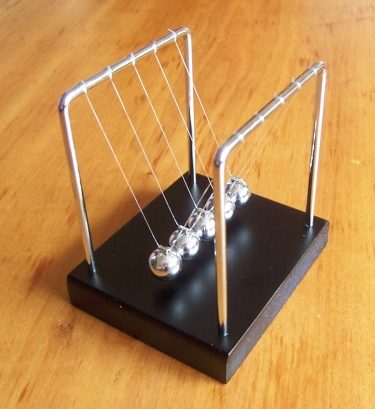
עגלת ניוטון: חמישה כדורי פלדה תלויים בשורה
עגלת ניוטון מדגימה מעבר של תנע ואנרגיה קינטית דרך שורת כדורים בהתנגשות כמעט אלסטית
Explore · ⁨חקור⁩

Compare elastic and inelastic collisions · ⁨השוואת התנגשות אלסטית ולא-אלסטית⁩

Momentum is always conserved, but kinetic energy is only conserved in an elastic collision. In an inelastic one the carts stick and some energy becomes heat. · ⁨תנע תמיד נשמר, אך אנרגיה קינטית נשמרת רק בהתנגשות אלסטית. בהתנגשות לא-אלסטית העגלות נדבקות וחלק מהאנרגיה הופך לחום.⁩

4.4

Exam tips · ⁨טיפים לבחינות⁩

English
  • Momentum is a vector — assign $+$/$-$ signs before adding; a ball that rebounds reverses its velocity, giving a large $\Delta p$.
  • Momentum is conserved in every collision (no external force); kinetic energy is conserved only if the collision is stated to be elastic.
  • In a perfectly inelastic collision the objects stick and move with one common velocity.
  • Impulse $=F\,\Delta t=\Delta p$ = the area under a force–time graph; spreading a collision over a longer time reduces the force (airbags, bending knees).
  • For recoil/explosions, set the total momentum equal before and after (often zero before).
עברית
  • תנע הוא וקטורי – הקבעו סימנים $+$/$-$ לפני החיבור; כדור שנהפך משנה את כיוון המהירות שלו, מה שמניב שינוי גדול ב$\Delta p$.
  • תנע שמר על עצמו בכל התנגשות (בהיעדר כוח חיצוני); אנרגיה קינטית שמרה על עצמה רק אם נאמר במפורש שההתנגשות היא אלסטית.
  • בהתנגשות לא אלסטית מוחלטת הגופים נדבקו ונעים במהירות משותפת אחת.
  • תנועה (אימפולס) $=F\,\Delta t=\Delta p$ = השטח מתחת לגרף כוח-זמן; פריסת ההתנגשות על פני זמן ארוך יותר מפחיתה את הכוח (כריות אוויר, כיפוף ברכיים).
  • עבור רתע/פיצוצים, השוו את התנע הכולל לפני ואחרי (לרוב אפס לפני).

Interactive lessons on this topic · ⁨שיעורים אינטראקטיביים בנושא זה⁩

Work through it step by step, with instant-check exercises. · ⁨לעבור על הדברים צעד אחר צעד, עם תרגילים לבדיקה מיידית.⁩

Past Papers · ⁨מבחני עבר⁩

More topics in AP Physics 1 · ⁨פיזיקה AP 1⁩ · ⁨נושאים נוספים בAP Physics 1 · ⁨פיזיקה AP 1⁩⁩

Log in or create account · ⁨היכנס או צור חשבון⁩

IGCSE, A-Level & AP