Skip to content · ⁨דלג לתוכן⁩

Work, Energy, and Power · ⁨עבודה, אנרגיה והספק⁩

AP Physics 1 · ⁨פיזיקה AP 1⁩ · Topic 3 · ⁨נושא 3⁩

Video lesson for this topic · ⁨שיעור וידאו לנושא זה⁩ Open the video page · ⁨פתח את עמוד הוידאו⁩
8:07

עבודה, אנרגיה והספק

הסתכל על הגבעה הראשונה של רכבת הרים. שרשרת גוררת את הרכבת לפסגה, ואז משחררת אותה. אין מנוע ברכבת — כלום לא דוחף אותה שוב…

English narration · English + 中文 subtitles burned in · ⁨קריאת קול באנגלית · תרגום אנגלי + סינית שרוף בתוך הסרטון⁩

3.1

Translational Kinetic Energy · ⁨אנרגיה קינטית תרגולית⁩

Syllabus · ⁨סיילבוס⁩
English

Learning Objective 3.1.A: Describe the translational kinetic energy of an object in terms of the object's mass and velocity.

  • 3.1.A.1 An object's translational kinetic energy is given by the equation
    • Equation: $K = \dfrac{1}{2}mv^2$
  • 3.1.A.2 Translational kinetic energy is a scalar quantity.
  • 3.1.A.3 Different observers may measure different values of the translational kinetic energy of an object, depending on the observer's frame of reference.
עברית

מטרות למידה 3.1.A: לתאר את האנרגיה הקינטית התרגולית של גוף בהתאם למסתו ולמהירותו.

  • 3.1.A.1 האנרגיה הקינטית התרגולית של גוף נתונה על ידי המשוואה
    • משוואה: $K = \dfrac{1}{2}mv^2$
  • 3.1.A.2 אנרגיה קינטית תרגולית היא גודל סקלרי.
  • 3.1.A.3 צופים שונים עשויים למדוד ערכים שונים של האנרגיה הקינטית התרגולית של גוף, בהתאם למערכת הייחוס שלהם.

Source: College Board AP Course and Exam Description · ⁨מקור: תיאור הקורס והמבחן של College Board AP⁩

English

Energy 能量 is the capacity to do work, measured in joules 焦耳 (J). A moving object has kinetic energy 动能:

$$K=\tfrac{1}{2}mv^2.$$
It depends on the square of the speed, so doubling the speed quadruples the kinetic energy. Kinetic energy is a scalar and is never negative.

Worked example. A $1500\ \text{kg}$ car travels at $20\ \text{m/s}$. Its kinetic energy is $K=\tfrac12\times1500\times20^2=3.0\times10^{5}\ \text{J}=300\ \text{kJ}$. If it speeds up to $40\ \text{m/s}$ (double), the kinetic energy becomes $4\times$ larger, $1200\ \text{kJ}$ – which is why stopping distance grows so fast with speed.

עברית

אנרגיה היא היכולת לבצע עבודה, נמדדת בג'ואלים (J). לגוף הנע יש אנרגיה קינטית:

$$K=\tfrac{1}{2}mv^2.$$
היא תלויה בריבוע המהירות, ולכן הכפלת המהירות מארבע את האנרגיה הקינטית. אנרגיה קינטית היא סקלרית ואינו שלילית לעולם.

דוגמה מפורטת. רכב בעל מסה של $1500\ \text{kg}$ נוסע במהירות של $20\ \text{m/s}$. האנרגיה הקינטית שלו היא $K=\tfrac12\times1500\times20^2=3.0\times10^{5}\ \text{J}=300\ \text{kJ}$. אם הוא מגיע למהירות של $40\ \text{m/s}$ (כפול), האנרגיה הקינטית הופכת להיות גדולה ב-$4\times$, כלומר $1200\ \text{kJ}$ – וזהו הסיבה לכך שמרחק עצירה עולה כל כך מהר עם המהירות.

3.2

Work · ⁨עבודה⁩

Syllabus · ⁨סיילבוס⁩
Learning ObjectiveEssential Knowledge

3.2.A
Describe the work done on an object or system by a given force or collection of forces.

  • 3.2.A.1 Work is the amount of energy transferred into or out of a system by a force exerted on that system over a distance.
    • 3.2.A.1.i The work done by a conservative force exerted on a system is path-independent and only depends on the initial and final configurations of that system.
    • 3.2.A.1.ii The work done by a conservative force on a system—or the change in the potential energy of the system—will be zero if the system returns to its initial configuration.
    • 3.2.A.1.iii Potential energies are associated only with conservative forces.
    • 3.2.A.1.iv The work done by a nonconservative force is path-dependent.
    • 3.2.A.1.v Examples of nonconservative forces are friction and air resistance.
  • 3.2.A.2 Work is a scalar quantity that may be positive, negative, or zero.
  • 3.2.A.3 The amount of work done on a system by a constant force is related to the components of that force and the displacement of the point at which that force is exerted.
    • 3.2.A.3.i Only the component of the force exerted on a system that is parallel to the displacement of the point of application of the force will change the system's total energy.
      • Equation: $W = F_{\parallel}d = Fd\cos\theta$
    • 3.2.A.3.ii The component of the force exerted on a system perpendicular to the direction of the displacement of the system's center of mass can change the direction of the system's motion without changing the system's kinetic energy.
  • 3.2.A.4 The work-energy theorem states that the change in an object's kinetic energy is equal to the sum of the work (net work) being done by all forces exerted on the object.
    • Equation: $\Delta K = \sum_{i} W_i = \sum_{i} F_{\parallel,i}\,d$
    • 3.2.A.4.i An external force may change the configuration of a system. The component of the external force parallel to the displacement times the displacement of the point of application of the force gives the change in kinetic energy of the system.
    • 3.2.A.4.ii If the system's center of mass and the point of application of the force move the same distance when a force is exerted on a system, then the system may be modeled as an object, and only the system's kinetic energy can change.
    • 3.2.A.4.iii The energy dissipated by friction is typically equated to the force of friction times the length of the path over which the force is exerted
      • Equation: $\Delta E_{\text{mech}} = F_f\,d\cos\theta$
  • 3.2.A.5 Work is equal to the area under the curve of a graph of $F_{\parallel}$ as a function of displacement.

Boundary statement: AP Physics 1 only expects students to analyze the transfer of mechanical energy (as defined in Unit 3, Topic 4: Conservation of Energy), although students should be aware that mechanical energy may be dissipated in the form of thermal energy or sound. In AP Physics 2, students will also study how thermal energy can be transferred between systems through heating or cooling.

Source: College Board AP Course and Exam Description · ⁨מקור: תיאור הקורס והמבחן של College Board AP⁩

English

Work 功 is energy transferred by a force acting over a displacement:

$$W=F\,d\cos\theta,$$
where $\theta$ is the angle between the force and the displacement. Work is positive when the force has a component along the motion (adds energy), negative when it opposes the motion (removes energy), and zero when the force is perpendicular. On a force–position graph, work is the area under the curve. The work–energy theorem 动能定理 states that the net work equals the change in kinetic energy: $W_{\text{net}}=\Delta K$.

Worked example. A $2.0\ \text{kg}$ block moving at $3.0\ \text{m/s}$ on a frictionless floor is pushed by a $5.0\ \text{N}$ force over $4.0\ \text{m}$ in the direction of motion. Find its final speed. The net work is $W=Fd=5.0\times4.0=20\ \text{J}$, and by the work–energy theorem $W=\tfrac12 m(v^2-v_0^2)$:

$$20=\tfrac12\times2.0\times(v^2-3.0^2)\;\Rightarrow\;v^2=29\;\Rightarrow\;v=5.4\ \text{m/s}.$$

עברית

עבודה היא אנרגיה המועברת על ידי כוח הפועל לאורך תזוזה:

$$W=F\,d\cos\theta,$$
כאן $\theta$ הוא הזווית בין הכוח לבין התזוזה. עבודה היא חיובית כאשר לכוח יש רכיב לאורך התנועה (מוסיף אנרגיה), שלילית כאשר היא נגד התנועה (מורידה אנרגיה), ואפס כאשר הכוח מאונך לתזוזה. בגרף כוח-מיקום, העבודה היא ה-שטח מתחת לעקומה. משפט העבודה-אנרגיה קובע שסך העבודות שווה לשינוי באנרגיה הקינטית: $W_{\text{net}}=\Delta K$.

רק רכיב הכוח לאורך התזוזה מבצע עבודה

דוגמה מופרדת. בלוק בעל מסה $2.0\ \text{kg}$ הנע במהירות $3.0\ \text{m/s}$ על רצפה חסרת חיכוך דוחף אותו כוח של $5.0\ \text{N}$ לאורך מרחק של $4.0\ \text{m}$ בכיוון התנועה. מצאו את מהירותו הסופית. סך העבודות הוא $W=Fd=5.0\times4.0=20\ \text{J}$, ולפי משפט העבודה-אנרגיה $W=\tfrac12 m(v^2-v_0^2)$:

$$20=\tfrac12\times2.0\times(v^2-3.0^2)\;\Rightarrow\;v^2=29\;\Rightarrow\;v=5.4\ \text{m/s}.$$

Vocabulary · ⁨מילון מונחים⁩ Train · ⁨אימון⁩
English עברית
Work/wɜːk/ עבודה
work–energy theorem/wɜːk ˈenədʒi ˈθɪərəm/ משפט העבודה-אנרגיה
Potential energy/pəˈtenʃl ˈenədʒi/ אנרגיה פוטנציאלית
Gravitational potential energy/ˌɡrævɪˈteɪʃənl pəˈtenʃl ˈenədʒi/ אנרגיה פוטנציאלית כבידתית
Elastic potential energy/ɪˈlæstɪk pəˈtenʃl ˈenədʒi/ אנרגיה פוטנציאלית אלסטית
conservative forces/kənˈsɜːvətɪv ˈfɔːsɪz/ כוחות שמרניים
total mechanical energy/ˈtəʊtl mɪˈkænɪkl ˈenədʒi/ אנרגיה מכנית כוללת
conserved/kənˈsɜːvd/ שמור על ערכו
thermal energy/ˈθɜːml ˈenədʒi/ אנרגיה תרמית
3.3

Potential Energy · ⁨אנרגיה פוטנציאלית⁩

Syllabus · ⁨סיילבוס⁩
English

Learning Objective 3.3.A: Describe the potential energy of a system.

  • 3.3.A.1 A system composed of two or more objects has potential energy if the objects within that system only interact with each other through conservative forces.
  • 3.3.A.2 Potential energy is a scalar quantity associated with the position of objects within a system.
  • 3.3.A.3 The definition of zero potential energy for a given system is a decision made by the observer considering the situation to simplify or otherwise assist in analysis.
  • 3.3.A.4 The potential energy of common physical systems can be described using the physical properties of that system.
    • 3.3.A.4.i The elastic potential energy of an ideal spring is given by the following equation, where $\Delta x$ is the distance the spring has been stretched or compressed from its equilibrium length.
      • Equation: $U_s = \dfrac{1}{2}k(\Delta x)^2$
    • 3.3.A.4.ii The general form for the gravitational potential energy of a system consisting of two approximately spherical distributions of mass (e.g., moons, planets or stars) is given by the equation
      • Equation: $U_g = -G\dfrac{m_1 m_2}{r}$
    • 3.3.A.4.iii Because the gravitational field near the surface of a planet is nearly constant, the change in gravitational potential energy in a system consisting of an object with mass $m$ and a planet with gravitational field of magnitude $g$ when the object is near the surface of the planet may be approximated by the equation
      • Equation: $\Delta U_g = mg\Delta y$
  • 3.3.A.5 The total potential energy of a system containing more than two objects is the sum of the potential energy of each pair of objects within the system.
עברית

מטרות למידה 3.3.A: לתאר את האנרגיה הפוטנציאלית של מערכת.

  • 3.3.A.1 למערכת המורכבת משני גופים או יותר יש אנרגיה פוטנציאלית אם הגופים בתוך המערכת אינטראקטים זה עם זה רק דרך כוחות שימוריים.
  • 3.3.A.2 אנרגיה פוטנציאלית היא גודל סקלארי הקשור למיקום גופים בתוך מערכת.
  • 3.3.A.3 הגדרת אפס לאנרגיה פוטנציאלית עבור מערכת נתונה היא החלטתו של הצופה בהתבונן במצב כדי לפשט או לסייע אחרת בניתוח.
  • 3.3.A.4 את האנרגיה הפוטנציאלית של מערכות פיזיקליות רגילות ניתן לתאר באמצעות המאפיינים הפיזיקליים של המערכת.
    • 3.3.A.4.i האנרגיה הפוטנציאלית האלסטית של קפיץ אידיאלי נתונה על ידי המשוואה הבאה, כאשר $\Delta x$ הוא המרחק שהקפיץ נמתח או הדחוס מהאורך האיזון שלו.
      • משוואה: $U_s = \dfrac{1}{2}k(\Delta x)^2$
    • 3.3.A.4.ii הצורה הכללית עבור האנרגיה הפוטנציאלית הכבידתית של מערכת המורכבת משני חלוקי מסה ספריים בקירוב (למשל, ירחים, כוכבי לכת או כוכבים) נתונה על ידי המשוואה
      • משוואה: $U_g = -G\dfrac{m_1 m_2}{r}$
    • 3.3.A.4.iii מכיוון ששדה הכבידית בקרבת פני כוכב לכת הוא קבוע כמעט, השינוי באנרגיה הפוטנציאלית הכבידתית במערכת המורכבת מחפץ בעל מסה $m$ וכוכב לכת עם שדה כבידית בגודל $g$ כאשר החפץ נמצא בקרבת פני כוכב הלכת ניתן לקרוב על ידי המשוואה
      • משוואה: $\Delta U_g = mg\Delta y$
  • 3.3.A.5 האנרגיה הפוטנציאלית הכוללת של מערכת המכילה יותר משני אובייקטים היא סכום האנרגיה הפוטנציאלית של כל זוג אובייקטים בתוך המערכת.

Source: College Board AP Course and Exam Description · ⁨מקור: תיאור הקורס והמבחן של College Board AP⁩

English

Potential energy 势能 is stored energy that depends on position or configuration:

  • Gravitational potential energy 重力势能 near the surface: $U_g=mgh$ (height $h$ above a reference level).
  • Elastic potential energy 弹性势能 in a spring: $U_s=\tfrac{1}{2}kx^2$.

Potential energy is defined only for conservative forces 保守力 (gravity, springs), for which the stored energy depends on position, not path. Only changes in potential energy matter, so you may put the zero level wherever is convenient.

The $U_g=mgh$ form only holds near a surface where $g$ is roughly constant. The general form, for two spherical masses a distance $r$ apart, is

$$U_g=-\frac{G m_1 m_2}{r}.$$
It is negative and defined to be zero at infinite separation, so gravitational PE rises toward zero as the masses move apart. $mgh$ is simply its near-surface approximation. (This is the form you need for satellites and escape speed.)

עברית

אנרגיה פוטנציאלית היא אנרגיה מאגרת התלויה במיקום או בתצורה:

  • אנרגיה פוטנציאלית כבידתית בסמוך לפני השטח: $U_g=mgh$ (גובה $h$ מעל מפלס ייחוס).
  • אנרגיה פוטנציאלית אלסטית בקפיץ: $U_s=\tfrac{1}{2}kx^2$.

אנרגיה פוטנציאלית מוגדרת רק עבור כוחות שמירה (כבידה, קפיצים), עבורם האנרגיה המאגרת תלויה במיקום ולא במסלול. רק שינויים באנרגיה פוטנציאלית הם רלוונטיים, ולכן ניתן לקבוע את מפלס האפס בכל מקום הנוח.

הצורה $U_g=mgh$ תקפה רק בסמוך לפני השטח שבו $g$ הוא קבוע לערך. הצורה כללית, לשני גופים כדוריים במרחק $r$ זה מזה, היא

$$U_g=-\frac{G m_1 m_2}{r}.$$
היא שלילית ומוגדרת להיות אפס במרחק אינסופי, ולכן PE כבידתית עולה לכיוון אפס כשהגופים מתרחקים זה מזה. $mgh$ היא פשוט הקירוב לסמוך לפני השטח. (זוהי הצורה שהינה נדרשת עבור לוויינים ומהירות בריחה.)

Explore · ⁨חקור⁩

Store elastic potential energy in a spring · ⁨אחסון אנרגיה פוטנציאלית אלסטית בקפיץ⁩

Stretching a spring stores elastic potential energy $\tfrac12 kx^2$ — the area under the force-extension line. Release it and that energy becomes kinetic. · ⁨מתיחת קפיץ אוכפת אנרגיה פוטנציאלית אלסטית $\tfrac12 kx^2$ — השטח מתחת לקו הכוח-המתיחה. שחרר אותו ואותה אנרגיה הופכת לקינטית.⁩

3.4

Conservation of Energy · ⁨שימור אנרגיה⁩

Syllabus · ⁨סיילבוס⁩
English

Learning Objective 3.4.A: Describe the energies present in a system.

  • 3.4.A.1 A system composed of only a single object can only have kinetic energy.
  • 3.4.A.2 A system that contains objects that interact via conservative forces or that can change its shape reversibly may have both kinetic and potential energies.

Learning Objective 3.4.B: Describe the behavior of a system using conservation of mechanical energy principles.

  • 3.4.B.1 Mechanical energy is the sum of a system's kinetic and potential energies.
  • 3.4.B.2 Any change to a type of energy within a system must be balanced by an equivalent change of other types of energies within the system or by a transfer of energy between the system and its surroundings.
  • 3.4.B.3 A system may be selected so that the total energy of that system is constant.
  • 3.4.B.4 If the total energy of a system changes, that change will be equivalent to the energy transferred into or out of the system.

Learning Objective 3.4.C: Describe how the selection of a system determines whether the energy of that system changes.

  • 3.4.C.1 Energy is conserved in all interactions.
  • 3.4.C.2 If the work done on a selected system is zero and there are no nonconservative interactions within the system, the total mechanical energy of the system is constant.
  • 3.4.C.3 If the work done on a selected system is nonzero, energy is transferred between the system and the environment.

Boundary statement: AP Physics 1 expects students to know that mechanical energy can be dissipated as thermal energy or sound by nonconservative forces.

עברית

מטרות למידה 3.4.A: לתאר את האנרגיות הקיימות במערכת.

  • 3.4.A.1 מערכת המורכבת מאובייקט יחיד יכולה להיות לה רק אנרגיה קינטית.
  • 3.4.A.2 מערכת המכילה אובייקטים המגיבים זה לזה באמצעות כוחות שימוריים או שמסוגלים לשנות את צורתם באופן הפיכי יכולה להיות לה גם אנרגיה קינטית וגם אנרגיה פוטנציאלית.

מטרות למידה 3.4.B: לתאר את התנהגות מערכת באמצעות עקרונות שימור אנרגיה מכנית.

  • 3.4.B.1 האנרגיה המכנית היא סכום האנרגיה הקינטית והפוטנציאלית של מערכת.
  • 3.4.B.2 כל שינוי בסוג אנרגיה בתוך מערכת חייב להיות מאוזן על ידי שינוי שווה בסוגי אנרגיה אחרים בתוך המערכת או על ידי העברת אנרגיה בין המערכת לסביבתה.
  • 3.4.B.3 ניתן לבחור מערכת כך שהאנרגיה הכוללת שלה תהיה קבועה.
  • 3.4.B.4 אם האנרגיה הכוללת של מערכת משתנה, השינוי יהיה שווה לאנרגיה שהועברה לתוך המערכת או מחוץ לה.

מטרת למידה 3.4.C: תאר כיצד בחירת המערכת קובעת האם האנרגיה שלה משתנה.

  • 3.4.C.1 האנרגיה נשמרת בכל האינטראקציות.
  • 3.4.C.2 אם העבודה שנעשתה על מערכת הנבחרת היא אפס ואין אינטראקציות לא-שימוריות בתוך המערכת, האנרגיה המכנית הכוללת שלה תהיה קבועה.
  • 3.4.C.3 אם העבודה שנעשתה על מערכת הנבחרת אינה אפס, אנרגיה מועברת בין המערכת לסביבה.

הצהרת גבול: AP Physics 1 מצפה מהתלמידים לדעת שאנרגיה מכנית יכולה להתפרק לאנרגיה תרמית או לקול על ידי כוחות לא-שימוריים.

Source: College Board AP Course and Exam Description · ⁨מקור: תיאור הקורס והמבחן של College Board AP⁩

English
Energy conservation: KE ⇄ PE

The total mechanical energy 机械能 is $E=K+U$. When only conservative forces do work, mechanical energy is conserved 守恒:

$$K_1+U_1=K_2+U_2.$$
When friction or other non-conservative forces act, they transfer mechanical energy to thermal energy 热能; then the general statement is that total energy (including thermal) is conserved. Energy bar charts are a good way to track where the energy goes.

Worked example. A ball is released from rest at the top of a frictionless ramp $5.0\ \text{m}$ high. Find its speed at the bottom. All the gravitational potential energy becomes kinetic energy:

$$mgh=\tfrac12 mv^2\;\Rightarrow\;v=\sqrt{2gh}=\sqrt{2\times9.8\times5.0}=9.9\ \text{m/s}.$$
The mass cancels, so every object reaches the same speed – exactly the free-fall result, now got from energy. If instead $30\ \text{J}$ were lost to friction, you would subtract it: $mgh-30=\tfrac12 mv^2$.

עברית
שימור אנרגיה: KE ⇄ PE
רכבת הרים עם לולאות גבוהות של מסילה ירוקה ואדומה נגד השמיים
רוכבת הרים משנה אנרגיה חוזר וחזור: היא הגבוהה ביותר (יש לה את האנרגיה הפוטנציאלית המקסימלית) בראש והיא הנעה במהירות המקסימלית (יש לה את האנרגיה הקינטית המקסימלית) בתחתית

האנרגיה המכנית הכוללת היא $E=K+U$. כאשר רק כוחות שמירה מבצעים עבודה, האנרגיה המכנית שמורה:

$$K_1+U_1=K_2+U_2.$$
כאשר חיכוך או כוחות אחרים שאינם שמירה פועלים, הם ממירים אנרגיה מכנית לאנרגיה תרמית; אזי ההצהרה הכללית היא שאנרגיה כוללת (כולל תרמית) שמורה. גרפי עמודות אנרגיה הם דרך טובה לעקוב אחר למי האנרגיה הולכת.

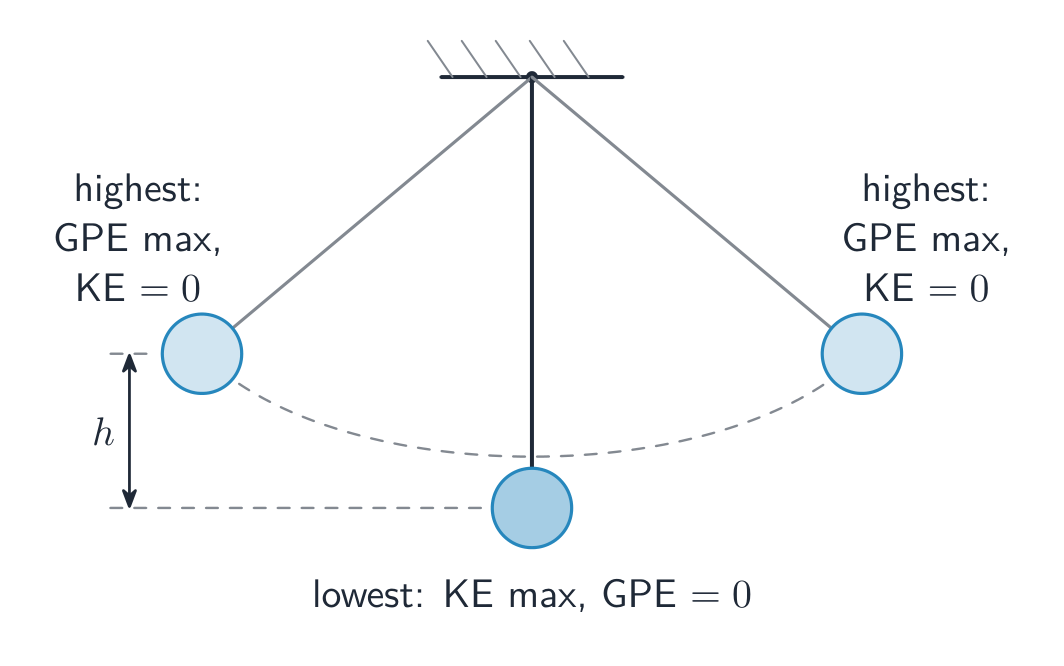
מטוטלת מתנדדת מחליפה אנרגיה פוטנציאלית כבידתית לאנרגיה קינטית ולהפך

דוגמה מופת. כדור משוחרר ממצב רךוק בראש מסלול חסר חיכוך בגובה $5.0\ \text{m}$. מצאו את מהירותו בתחתית. כל האנרגיה הפוטנציאלית הכבדית הופכת לאנרגיה קינטית:

$$mgh=\tfrac12 mv^2\;\Rightarrow\;v=\sqrt{2gh}=\sqrt{2\times9.8\times5.0}=9.9\ \text{m/s}.$$
המסה מתבטלת, ולכן לכל גוף נגיע אותה מהירות – בדיוק תוצאת הנפילת החופש, אך הפעם דרך אנרגיות. אם במקום זאת $30\ \text{J}$ אובדו עקב חיכוך, יש לחסר אותם: $mgh-30=\tfrac12 mv^2$.

Explore · ⁨חקור⁩

Watch energy convert as an object falls · ⁨צפה בהמרת אנרגיה כאשר גוף צולל⁩

With no friction, mechanical energy is conserved: as an object falls, gravitational potential energy turns into kinetic energy while the total stays fixed. · ⁨ללא חיכוך, אנרגיה מכנית נשמרת: כאשר גוף צולל, אנרגיה פוטנציאלית כבידתית הופכת לאנרגיה קינטית בעוד שהסך הכל נשאר קבוע.⁩

Vocabulary · ⁨מילון מונחים⁩ Train · ⁨אימון⁩
English עברית
Energy/ˈenədʒi/ אנרגיה
joules/dʒuːlz/ ג'ואול
kinetic energy/kɪˈnetɪk ˈenədʒi/ אנרגיה קינטית
3.5

Power · ⁨הסק⁩

Syllabus · ⁨סיילבוס⁩
English

Learning Objective 3.5.A: Describe the transfer of energy into, out of, or within a system in terms of power.

  • 3.5.A.1 Power is the rate at which energy changes with respect to time, either by transfer into or out of a system or by conversion from one type to another within a system.
  • 3.5.A.2 Average power is the amount of energy being transferred or converted, divided by the time it took for that transfer or conversion to occur.
    • Equation: $P_{\text{avg}} = \dfrac{\Delta E}{\Delta t}$
  • 3.5.A.3 Because work is the change in energy of an object or system due to a force, average power is the total work done, divided by the time during which that work was done.
    • Equation: $P_{\text{avg}} = \dfrac{W}{\Delta t}$
  • 3.5.A.4 The instantaneous power delivered to an object by the component of a constant force parallel to the object's velocity can be described with the derived equation.
    • Equation: $P_{\text{inst}} = F_{\parallel}v = Fv\cos\theta$
עברית

מטרת למידה 3.5.A: תאר את ההעברה של אנרגיה לתוך, מחוץ או בתוך מערכת באמצעות הספק.

  • 3.5.A.1 הספק הוא הקצב שבו אנרגיה משתנה בהתאם לזמן, הן על ידי העברה לתוך או מחוץ למערכת והן על ידי המרה מסוג אחד לשני בתוך המערכת.
  • 3.5.A.2 הספק ממוצע הוא כמות האנרגיה המועברת או המומרת, חלקי הזמן שגם להעברה זו או המרה זו התרחשה.
    • משוואה: $P_{\text{avg}} = \dfrac{\Delta E}{\Delta t}$
  • 3.5.A.3 מכיוון שעבודה היא השינוי באנרגיה של גוף או מערכת בשל כוח, הספק ממוצע הוא העבודה הכוללת שביוצעה, חלקית בזמן שבו עבודה זו בוצעה.
    • משוואה: $P_{\text{avg}} = \dfrac{W}{\Delta t}$
  • 3.5.A.4 את ההספק הרגעי המסופק לגוף על ידי רכיב הכוח הקבוע המקביל למהירות הגוף ניתן לתאר באמצעות המשוואה הנגזרת.
    • משוואה: $P_{\text{inst}} = F_{\parallel}v = Fv\cos\theta$

Source: College Board AP Course and Exam Description · ⁨מקור: תיאור הקורס והמבחן של College Board AP⁩

English

Power 功率 is the rate of doing work or transferring energy, measured in watts 瓦特 (W):

$$P=\frac{W}{\Delta t}=\frac{\Delta E}{\Delta t},\qquad\text{and instantaneously}\qquad P=Fv.$$
So the same job done faster requires more power. On an energy–time graph, power is the slope.

Worked example. A motor lifts a $50\ \text{kg}$ load at a steady $2.0\ \text{m/s}$. Because it moves at constant speed, the lifting force equals the weight, so

$$P=Fv=mgv=50\times9.8\times2.0=980\ \text{W}.$$

Real machines waste some energy, so we quote efficiency 效率 – useful output power divided by total input power. If this motor draws $1400\ \text{W}$ of electrical power to deliver $980\ \text{W}$ of useful lifting, its efficiency is $980/1400=0.70$, or $70\%$; the other $30\%$ becomes heat and sound.

עברית

הספק הוא קצב ביצוע עבודה או העברת אנרגיה, שנמדד בואטים (W):

$$P=\frac{W}{\Delta t}=\frac{\Delta E}{\Delta t},\qquad\text{and instantaneously}\qquad P=Fv.$$
לכן, ביצוע אותו עבודה בזמן קצר יותר דורש הספק גבוה יותר. בגרף אנרגיה-זמן, ההספק הוא השיפוע.

הספק הוא השיפוע בגרף עבודה-זמן: אותה עבודה בזמן פחות משמעו הספק גבוה יותר

דוגמה מופת. מנוע מרים עומס של $50\ \text{kg}$ בקצב יציב של $2.0\ \text{m/s}$. מכיוון שהעומס נע במהירות קבועה, כוח הרמה שווה למשקלו, ולכן

$$P=Fv=mgv=50\times9.8\times2.0=980\ \text{W}.$$

מכונות אמיתיות מבזבזות חלק מאנרגיה, ולכן מציינים יעילות – הספק יציא שימושי חלוקת בסך כל ההספק הנכנס. אם מנוע זה צורך $1400\ \text{W}$ של הספק חשמלי כדי לספק $980\ \text{W}$ של הספק רמה שימושי, היעילות שלו היא $980/1400=0.70$, או $70\%$; היתר $30\%$ הופך לחום וצליל.

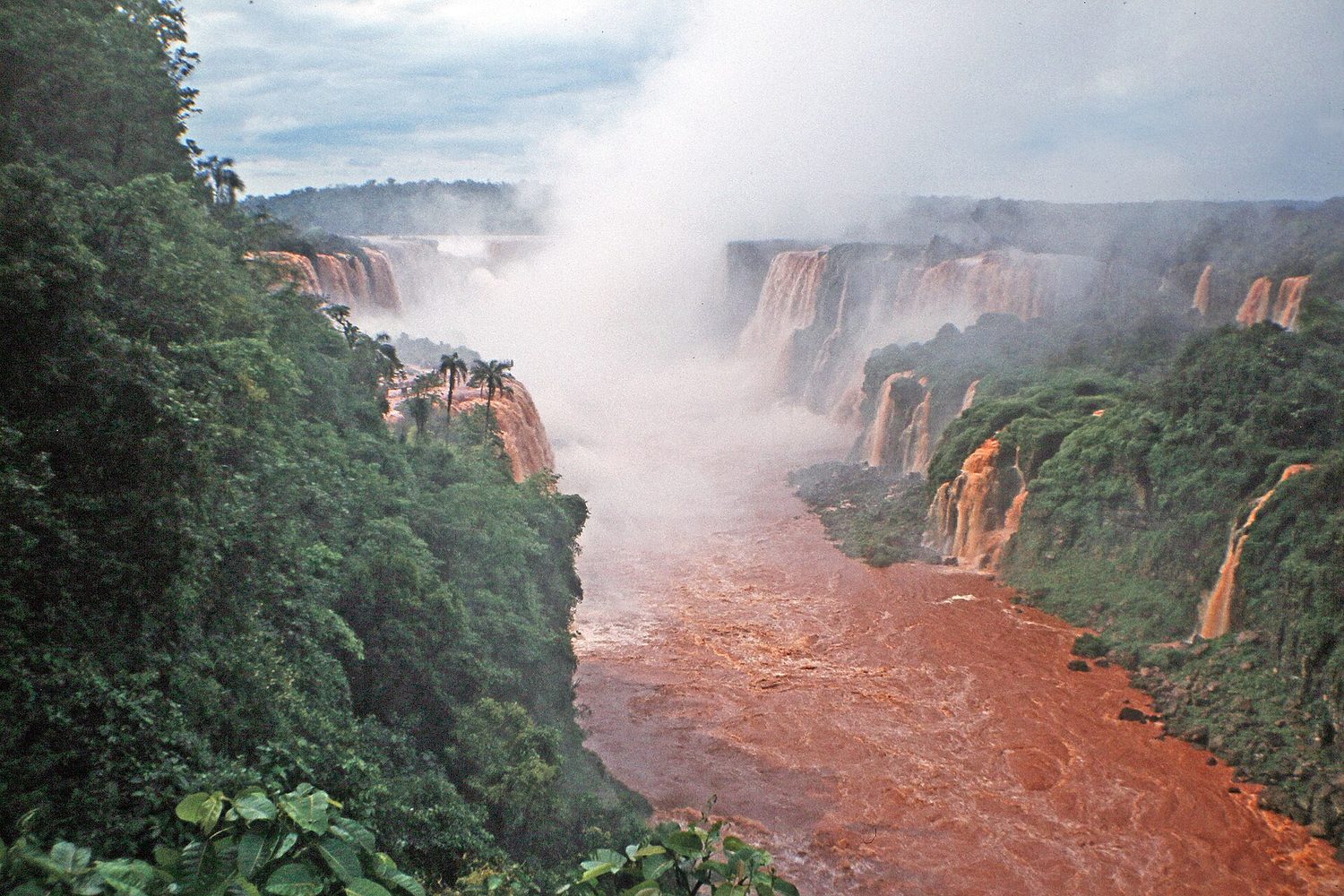
מפל מים: הספק הוא עד כמה מהר אנרגיה מועברת – אותה נפילה בזמן פחות משמעו הספק גבוה יותר
Vocabulary · ⁨מילון מונחים⁩ Train · ⁨אימון⁩
English עברית
Power/ˈpaʊə/ הספק
watts/wɒts/ וואט
efficiency/ɪˈfɪʃənsi/ יעילות
3.5

Exam tips · ⁨טיפים לבחינות⁩

English
  • Use $W=Fd\cos\theta$: work is zero when the force is perpendicular to the motion, and negative when it opposes it.
  • Reach for the work–energy theorem ($W_{\text{net}}=\Delta K$) or energy conservation ($K_1+U_1=K_2+U_2$) instead of forces whenever the path is complicated.
  • When friction acts, mechanical energy is not conserved — subtract the energy lost to heat.
  • Remember $K\propto v^2$: doubling the speed quadruples the kinetic energy (and the stopping distance).
  • Use $P=Fv$ for power at a steady speed; at constant velocity the net force is zero but the power is not.
עברית
  • השתמשו ב$W=Fd\cos\theta$: עבודה היא אפס כאשר הכוח מאונך לתנועה, והיא שלילית כאשר הכוח נגד התנועה.
  • פנו למשפט עבודה-אנרגיה ($W_{\text{net}}=\Delta K$) או לשימור אנרגיה ($K_1+U_1=K_2+U_2$) במקום כוחות כשהמסלול מורכב.
  • כאשר פועל חיכוך, אנרגיה מכנית אינה שמורה – יש לחסר את האנרגיה שאבדה לחום.
  • זכרו ב$K\propto v^2$: הכפלת המהירות מארבע את האנרגיה הקינטית (וגם את מרחק הבלמה).
  • השתמשו ב$P=Fv$ להספק במהירות קבועה; במהירות קבועה הכוח הניקוד הוא אפס אך ההספק אינו אפס.

Interactive lessons on this topic · ⁨שיעורים אינטראקטיביים בנושא זה⁩

Work through it step by step, with instant-check exercises. · ⁨לעבור על הדברים צעד אחר צעד, עם תרגילים לבדיקה מיידית.⁩

Past Papers · ⁨מבחני עבר⁩

More topics in AP Physics 1 · ⁨פיזיקה AP 1⁩ · ⁨נושאים נוספים בAP Physics 1 · ⁨פיזיקה AP 1⁩⁩

Log in or create account · ⁨היכנס או צור חשבון⁩

IGCSE, A-Level & AP