Skip to content · ⁨Passer au contenu⁩

Ligne de raisonnement et méthodes de développement

AP Langue et composition anglaise · Topic 3 · ⁨Sujet 3⁩

Train · ⁨Entrainer⁩
Video lesson for this topic · ⁨Leçon vidéo pour ce sujet⁩ Open the video page · ⁨Ouvrir la page vidéo⁩
5:57

Unité 3 : Ligne de raisonnement et Méthodes de développement

L'Unité 3 est là où le cours cesse de porter sur les pièces et commence à porter sur la structure, et voici le test qui vous dira si vous en avez. Prenez votre essai…

English narration · English + 中文 subtitles burned in · ⁨Narration en anglais · Sous-titres anglais + 中文 incrustés⁩

3.1

Identifying Claims and Evidence · ⁨Identifier les thèses et les preuves⁩

Syllabus · ⁨Programme⁩
English

Enduring Understanding (CLE-1): Writers make claims about subjects, rely on evidence that supports the reasoning that justifies the claim, and often acknowledge or respond to other, possibly opposing, arguments.

Learning Objective 3.A: Reading – Identify and explain claims and evidence within an argument.

  • CLE-1.K Effective use of evidence uses commentary to establish a logical relationship between the evidence and the claim it supports.
  • CLE-1.L Writers introduce source material by using commentary to properly integrate it into their line of reasoning.
  • CLE-1.M Synthesis requires consideration, explanation, and integration of others’ arguments into one’s own argument.
  • CLE-1.N Writers must acknowledge words, ideas, images, texts, and other intellectual property of others through attribution, citation, or reference.
Français

Compréhension durable (CLE-1) : Les auteurs formulent des affirmations sur des sujets, s'appuient sur des preuves soutenant le raisonnement justifiant l'affirmation, et reconnaissent souvent ou répondent à d'autres arguments, possiblement opposants.

Objectif d'apprentissage 3.A : Lecture – Identifier et expliquer les affirmations et les preuves au sein d'un argument.

  • CLE-1.K Une utilisation efficace des preuves recourt au commentaire pour établir une relation logique entre la preuve et l'affirmation qu'elle soutient.
  • CLE-1.L Les auteurs introduisent les matériaux sources en utilisant du commentaire pour les intégrer correctement dans leur ligne de raisonnement.
  • CLE-1.M La synthèse exige l'examen, l'explication et l'intégration des arguments d'autrui dans son propre argument.
  • CLE-1.N Les auteurs doivent reconnaître les mots, idées, images, textes et autres propriété intellectuelle d'autrui par l'attribution, la citation ou la référence.

Source: College Board AP Course and Exam Description · ⁨Source : Description du cours et de l'examen AP College Board⁩

English

Unit 3 is where the course stops being about parts and starts being about structure. Its subject is the line of reasoning 推理线索 - the path an argument takes from where it starts to what it proves.

First, four claims about how evidence gets into an argument properly:

  • Effective use of evidence uses commentary 评述 to establish a logical relationship between the evidence and the claim.
  • Writers introduce source material using commentary to integrate it into their line of reasoning - so commentary comes before as well as after.
  • Synthesis 综合 requires consideration, explanation, and integration of others' arguments into one's own. That is the exact skill Question 1 tests, and the word integration rules out a paragraph that simply summarises each source in turn.
  • Writers must acknowledge the words, ideas, images, and texts of others through attribution and citation 归属与引用.
Français

L'Unité 3 est là où le cours cesse d'être sur les parties pour devenir sur la structure. Son sujet est la ligne de raisonnement 推理线索 - le chemin qu'un argument suit depuis son point de départ jusqu'à ce qu'il prouve.

D'abord, quatre affirmations sur la manière dont les preuves entrent correctement dans un argument :

  • Une utilisation efficace des preuves utilise le commentaire 评述 pour établir une relation logique entre les preuves et l'affirmation.
  • Les auteurs présentent le matériel source en utilisant le commentaire pour l'intégrer dans leur ligne de raisonnement - de sorte que le commentaire précède autant qu'il suit.
  • Synthèse 综合 requires consideration, explanation, and integration of others' arguments into one's own. That is the exact skill Question 1 tests, and the word integration rules out a paragraph that simply summarises each source in turn.
  • Writers must acknowledge the words, ideas, images, and texts of others through attribution and citation 归属与引用.
Vocabulary · ⁨Vocabulaire⁩ Train · ⁨Entrainer⁩
English · ⁨Anglais⁩ Chinese · ⁨Chinois⁩ Pinyin
attribution and citation/ətrɪˈbjuːʃn ænd saɪˈteɪʃn/ 归属与引用 guī shǔ yǔ yǐn yòng
Methods of development/ˈmeθədz ɒv dɪˈveləpmənt/ 展开方法 zhǎn kāi fāng fǎ
3.2

Developing a Paragraph with Claim and Evidence · ⁨Développer un paragraphe avec une affirmation et des preuves⁩

Syllabus · ⁨Programme⁩
English

Enduring Understanding (CLE-1): Writers make claims about subjects, rely on evidence that supports the reasoning that justifies the claim, and often acknowledge or respond to other, possibly opposing, arguments.

Learning Objective 4.A: Writing – Develop a paragraph that includes a claim and evidence supporting the claim.

  • CLE-1.K Effective use of evidence uses commentary to establish a logical relationship between the evidence and the claim it supports.
  • CLE-1.L Writers introduce source material by using commentary to properly integrate it into their line of reasoning.
  • CLE-1.M Synthesis requires consideration, explanation, and integration of others’ arguments into one’s own argument.
  • CLE-1.N Writers must acknowledge words, ideas, images, texts, and other intellectual property of others through attribution, citation, or reference.
Français

Compréhension durable (CLE-1) : Les auteurs formulent des affirmations sur des sujets, s'appuient sur des preuves soutenant le raisonnement justifiant l'affirmation, et reconnaissent souvent ou répondent à d'autres arguments, possiblement opposants.

Objectif d'apprentissage 4.A : Écriture – Développer un paragraphe comportant une affirmation et des preuves la soutenant.

  • CLE-1.K Une utilisation efficace des preuves recourt au commentaire pour établir une relation logique entre la preuve et l'affirmation qu'elle soutient.
  • CLE-1.L Les auteurs introduisent les matériaux sources en utilisant du commentaire pour les intégrer correctement dans leur ligne de raisonnement.
  • CLE-1.M La synthèse exige l'examen, l'explication et l'intégration des arguments d'autrui dans son propre argument.
  • CLE-1.N Les auteurs doivent reconnaître les mots, idées, images, textes et autres propriété intellectuelle d'autrui par l'attribution, la citation ou la référence.
Source: College Board AP Course and Exam Description · ⁨Source : Description du cours et de l'examen AP College Board⁩

English

Applied to your own writing, the change from Unit 2 is that commentary now has two jobs, not one: it introduces the evidence into the reasoning, and it explains the relationship afterwards.

A paragraph that does both reads: claim - a sentence positioning the evidence - the evidence, embedded - commentary establishing the logical relationship - the link onward. The sentence before the quotation is doing as much work as the one after it, and most students write neither.

Français

Appliqué à votre propre écriture, le changement par rapport à l'Unité 2 est que le commentaire a maintenant deux fonctions, pas une : il introduit la preuve dans le raisonnement, et il explique la relation ensuite.

Un paragraphe qui fait les deux se lit : affirmation - une phrase positionnant la preuve - la preuve, intégrée - commentaire établissant la relation logique - le lien vers la suite. La phrase précédant la citation effectue autant de travail que celle qui la suit, et la plupart des étudiants n'en écrivent aucune.

Relevant and sufficient are two different failures with two opposite fixes
Explore · ⁨Explorer⁩

Diagnostiquez le problème de preuve

Pertinent et suffisant sont deux échecs différents avec deux réparations opposées.

3.3

Describing the Line of Reasoning

Syllabus · ⁨Programme⁩
English

Enduring Understanding (REO-1): Writers guide understanding of a text’s lines of reasoning and claims through that text’s organization and integration of evidence.

Learning Objective 5.A: Reading – Describe the line of reasoning and explain whether it supports an argument’s overarching thesis.

  • REO-1.A Writers may lead readers through a line of reasoning and then arrive at a thesis.
  • REO-1.B Writers may express a claim and then develop a line of reasoning to justify the claim.
  • REO-1.C Writers explain their reasoning through commentary that connects chosen evidence to a claim.
  • REO-1.D Commentary explains the significance and relevance of evidence in relation to the line of reasoning.
  • REO-1.E The sequence of paragraphs in a text reveals the argument’s line of reasoning.
  • REO-1.F Flaws in a line of reasoning may render an argument specious or illogical.
Français

Compréhension durable (REO-1) : Les auteurs guident la compréhension des lignes de raisonnement et des affirmations d'un texte par l'organisation et l'intégration des preuves au sein de celui-ci.

Objectif d'apprentissage 5.A : Lecture – Décrire la ligne de raisonnement et expliquer si elle soutient la thèse générale d'un argument.

  • REO-1.A Les auteurs peuvent guider les lecteurs à travers une ligne de raisonnement avant d'aboutir à une thèse.
  • REO-1.B Les auteurs peuvent exprimer une affirmation puis développer une ligne de raisonnement pour justifier cette affirmation.
  • REO-1.C Les auteurs expliquent leur raisonnement par un commentaire reliant les preuves choisies à une affirmation.
  • REO-1.D Le commentaire explique la signification et la pertinence des preuves par rapport à la ligne de raisonnement.
  • REO-1.E La séquence des paragraphes dans un texte révèle la ligne de raisonnement de l'argument.
  • REO-1.F Des failles dans une ligne de raisonnement peuvent rendre un argument spécieux ou illogique.

Source: College Board AP Course and Exam Description · ⁨Source : Description du cours et de l'examen AP College Board⁩

English

The CED allows two arrangements, and both are valid:

  • Writers may lead readers through a line of reasoning and then arrive at a thesis - the argument builds to its claim.
  • Writers may express a claim and then develop a line of reasoning to justify it - the argument declares and then defends.

Whichever order is used, the same requirements hold:

  • Writers explain their reasoning through commentary that connects chosen evidence to a claim.
  • Commentary explains the significance and relevance of evidence in relation to the line of reasoning.
  • The sequence of paragraphs in a text reveals the argument's line of reasoning - which is the practical tool for reading. To find a writer's reasoning, write one sentence per paragraph and read the list.
  • Flaws in a line of reasoning may render an argument specious or illogical.
Français
Two legitimate orders, one requirement - and the requirement is the commentary
The order is a choice; the connective tissue is not

The CED allows two arrangements, and both are valid:

  • Writers may lead readers through a line of reasoning and then arrive at a thesis - the argument builds to its claim.
  • Writers may express a claim and then develop a line of reasoning to justify it - the argument declares and then defends.

Whichever order is used, the same requirements hold:

  • Les auteurs expliquent leur raisonnement par un commentaire qui relie les preuves choisies à une affirmation.
  • Le commentaire explique la signification et la pertinence des preuves par rapport à la ligne de raisonnement.
  • La séquence des paragraphes dans un texte révèle la ligne de raisonnement de l'argument - ce qui est l'outil pratique pour la lecture. Pour trouver le raisonnement d'un auteur, écrivez une phrase par paragraphe et lisez la liste.
  • Flaws in a line of reasoning may render an argument specious or illogical.
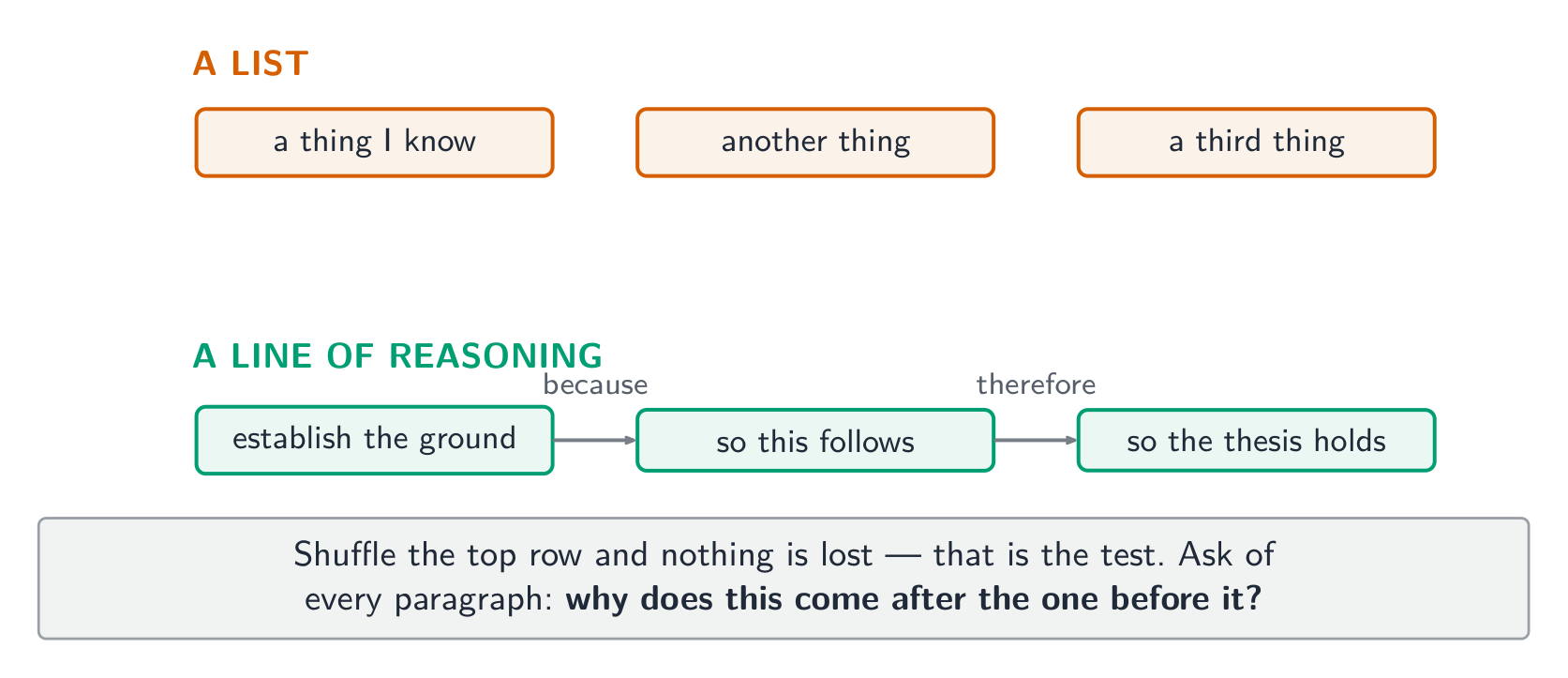
Le test du mélange : si les paragraphes peuvent être réordonnés sans perte, il s'agit d'une liste
Vocabulary · ⁨Vocabulaire⁩ Train · ⁨Entrainer⁩
English · ⁨Anglais⁩ Chinese · ⁨Chinois⁩ Pinyin
line of reasoning/laɪn ɒv ˈriːzənɪŋ/ 推理线索 tuī lǐ xiàn suǒ
commentary/ˈkɒməntri/ 评述 píng shù
3.4

Developing a Line of Reasoning and Commentary

Syllabus · ⁨Programme⁩
English

Enduring Understanding (REO-1): Writers guide understanding of a text’s lines of reasoning and claims through that text’s organization and integration of evidence.

Learning Objective 6.A: Writing – Develop a line of reasoning and commentary that explains it throughout an argument.

  • REO-1.A Writers may lead readers through a line of reasoning and then arrive at a thesis.
  • REO-1.B Writers may express a claim and then develop a line of reasoning to justify the claim.
  • REO-1.C Writers explain their reasoning through commentary that connects chosen evidence to a claim.
  • REO-1.D Commentary explains the significance and relevance of evidence in relation to the line of reasoning.
  • REO-1.E The sequence of paragraphs in a text reveals the argument’s line of reasoning.
  • REO-1.F Flaws in a line of reasoning may render an argument specious or illogical.
Français

Compréhension durable (REO-1) : Les auteurs guident la compréhension des lignes de raisonnement et des affirmations d'un texte par l'organisation et l'intégration des preuves au sein de celui-ci.

Objectif d'apprentissage 6.A : Écriture – Développer une ligne de raisonnement et du commentaire qui l'explique tout au long d'un argument.

  • REO-1.A Les auteurs peuvent guider les lecteurs à travers une ligne de raisonnement avant d'aboutir à une thèse.
  • REO-1.B Les auteurs peuvent exprimer une affirmation puis développer une ligne de raisonnement pour justifier cette affirmation.
  • REO-1.C Les auteurs expliquent leur raisonnement par un commentaire reliant les preuves choisies à une affirmation.
  • REO-1.D Le commentaire explique la signification et la pertinence des preuves par rapport à la ligne de raisonnement.
  • REO-1.E La séquence des paragraphes dans un texte révèle la ligne de raisonnement de l'argument.
  • REO-1.F Des failles dans une ligne de raisonnement peuvent rendre un argument spécieux ou illogique.

Source: College Board AP Course and Exam Description · ⁨Source : Description du cours et de l'examen AP College Board⁩

English

For your own essays, the useful discipline is to decide the order of your claims before writing any of them. An essay whose paragraphs could be shuffled without loss has no line of reasoning - it has a list.

Test a draft by asking of each paragraph: why does this come after the one before it? If the only answer is "it is another thing I know about the topic", the structure is a list and the reasoning point is at risk.

Français

Pour vos propres dissertations, la discipline utile est de décider l'ordre de vos affirmations avant d'en écrire aucune. Une dissertation dont les paragraphes pourraient être mélangés sans perte n'a pas de ligne de raisonnement - c'est une liste.

Testez un brouillon en demandant à chaque paragraphe : pourquoi vient-il après celui d'avant ? Si la seule réponse est « c'est une autre chose que je sais sur le sujet », la structure est une liste et le point de raisonnement est risqué.

Commentary as four rungs - the reasoning point is awarded for the last one
Explore · ⁨Explorer⁩

Escaladez les quatre marches du commentaire

'Expliquez votre preuve' est inutilisable. Quatre questions, chacune répondable en une phrase, en font une procédure.

3.5

Reconnaître les méthodes de développement

Syllabus · ⁨Programme⁩
English

Enduring Understanding (REO-1): Writers guide understanding of a text’s lines of reasoning and claims through that text’s organization and integration of evidence.

Learning Objective 5.C: Reading – Recognize and explain the use of methods of development to accomplish a purpose.

  • REO-1.G Methods of development are common approaches writers frequently use to develop and organize the reasoning of their arguments. A method of development provides an audience with the means to trace a writer’s reasoning in an argument.
  • REO-1.H Some typical methods of development are narration, cause-effect, comparison-contrast, definition, and description.
  • REO-1.I When developing ideas through narration, writers offer details about real-life experiences and offer reflections and insights on the significance of those experiences.
  • REO-1.J When developing ideas through cause-effect, writers present a cause, assert effects or consequences of that cause, or present a series of causes and the subsequent effect(s).
Français

Compréhension durable (REO-1) : Les auteurs guident la compréhension des lignes de raisonnement et des affirmations d'un texte par l'organisation et l'intégration des preuves au sein de celui-ci.

Objectif d'apprentissage 5.C : Lecture – Reconnaître et expliquer l'utilisation des méthodes de développement pour atteindre un but.

  • REO-1.G Les méthodes de développement sont des approches courantes utilisées fréquemment par les auteurs pour développer et organiser le raisonnement de leurs arguments. Une méthode de développement offre au public les moyens de suivre le raisonnement de l'auteur dans un argument.
  • REO-1.H Certaines méthodes de développement typiques sont la narration, cause-effet, comparaison-contraste, définition et description.
  • REO-1.I Lorsqu'ils développent des idées par la narration, les auteurs offrent des détails sur des expériences réelles et proposent des réflexions et des aperçus sur la signification de ces expériences.
  • REO-1.J Lorsqu'ils développent des idées par cause-effet, les auteurs présentent une cause, affirment des effets ou conséquences de cette cause, ou présentent une série de causes et l'effet subséquent.

Source: College Board AP Course and Exam Description · ⁨Source : Description du cours et de l'examen AP College Board⁩

English

Methods of development 展开方法 are common approaches writers use to develop and organise the reasoning of an argument. The CED's list: narration, cause-effect, comparison-contrast, definition, and description. This unit treats the first two.

  • Developing through narration 叙述: writers offer details about real-life experiences and reflections on them. The reflection is what makes narration an argument rather than a story - an anecdote with no reflection has supplied no reasoning.
  • Developing through cause-effect 因果: writers present a cause, then assert the effects or consequences of that cause - or begin from an effect and trace it back.
Français

Méthodes de développement 展开方法 sont des approches courantes utilisées par les auteurs pour développer et organiser le raisonnement d'un argument. La liste du CED : narration, cause-effet, comparaison-contraste, définition et description. Cette unité traite des deux premières.

  • Developing through narration 叙述: writers offer details about real-life experiences and reflections on them. The reflection is what makes narration an argument rather than a story - an anecdote with no reflection has supplied no reasoning.
  • Developing through cause-effect 因果: writers present a cause, then assert the effects or consequences of that cause - or begin from an effect and trace it back.
Vocabulary · ⁨Vocabulaire⁩ Train · ⁨Entrainer⁩
English · ⁨Anglais⁩ Chinese · ⁨Chinois⁩ Pinyin
narration/nəˈreɪʃn/ 叙述 xù shù
cause-effect/kɔːz ɪˈfekt/ 因果 yīn guǒ
3.6

Utiliser les méthodes de développement

Syllabus · ⁨Programme⁩
English

Enduring Understanding (REO-1): Writers guide understanding of a text’s lines of reasoning and claims through that text’s organization and integration of evidence.

Learning Objective 6.C: Writing – Use appropriate methods of development to advance an argument.

  • REO-1.G Methods of development are common approaches writers frequently use to develop and organize the reasoning of their arguments. A method of development provides an audience with the means to trace a writer’s reasoning in an argument.
  • REO-1.H Some typical methods of development are narration, cause-effect, comparison-contrast, definition, and description.
  • REO-1.I When developing ideas through narration, writers offer details about real-life experiences and offer reflections and insights on the significance of those experiences.
  • REO-1.J When developing ideas through cause-effect, writers present a cause, assert effects or consequences of that cause, or present a series of causes and the subsequent effect(s).
Français

Compréhension durable (REO-1) : Les auteurs guident la compréhension des lignes de raisonnement et des affirmations d'un texte par l'organisation et l'intégration des preuves au sein de celui-ci.

Objectif d'apprentissage 6.C : Écriture – Utiliser des méthodes de développement appropriées pour faire progresser un argument.

  • REO-1.G Les méthodes de développement sont des approches courantes utilisées fréquemment par les auteurs pour développer et organiser le raisonnement de leurs arguments. Une méthode de développement offre au public les moyens de suivre le raisonnement de l'auteur dans un argument.
  • REO-1.H Certaines méthodes de développement typiques sont la narration, cause-effet, comparaison-contraste, définition et description.
  • REO-1.I Lorsqu'ils développent des idées par la narration, les auteurs offrent des détails sur des expériences réelles et proposent des réflexions et des aperçus sur la signification de ces expériences.
  • REO-1.J Lorsqu'ils développent des idées par cause-effet, les auteurs présentent une cause, affirment des effets ou conséquences de cette cause, ou présentent une série de causes et l'effet subséquent.

Source: College Board AP Course and Exam Description · ⁨Source : Description du cours et de l'examen AP College Board⁩

English

Choosing a method is a rhetorical decision, not a stylistic one. Narration works when the audience needs to feel the situation before they will accept a claim about it. Cause-effect works when the audience already accepts the facts but not the connection between them.

Worked example (a real AP exam task). On a Question 1 synthesis prompt, compare two paragraphs using the same two sources. The weak version: "Source A says X. Source C says Y. Both discuss the issue." That is summary in sequence - no claim, no integration, no reasoning. The strong version: "The strongest objection to the proposal is not that it fails but that it succeeds too narrowly: Source A's data show the intended outcome improving, while Source C's account of the same programme records the second-order costs that the measurement in Source A was never designed to capture." Here the sources are integrated into the writer's own claim, and the commentary establishes the logical relationship - which is what the four evidence-and-commentary points are awarded for.

Français

Choisir une méthode est une décision rhétorique, pas stylistique. La narration fonctionne lorsque le public a besoin de ressentir la situation avant d'accepter une affirmation à ce sujet. Cause-effet fonctionne lorsque le public accepte déjà les faits mais pas la connexion entre eux.

Exemple résolu (une vraie tâche d'examen AP). Sur une invite de synthèse Question 1, comparez deux paragraphes utilisant les mêmes deux sources. La version faible : « Source A dit X. Source C dit Y. Les deux discutent du problème. » C'est un résumé séquentiel - aucune affirmation, aucune intégration, aucun raisonnement. La version forte : « La meilleure objection à la proposition n'est pas qu'elle échoue mais qu'elle réussit trop étroitement : les données de Source A montrent l'amélioration du résultat prévu, tandis que le récit de Source C sur le même programme enregistre les coûts secondaires que la mesure de Source A n'était jamais conçue pour capturer. » Ici, les sources sont intégrées dans l'affirmation propre de l'auteur, et le commentaire établit la relation logique - c'est ce pour quoi les quatre points de preuve-et-commentaire sont attribués.

3.6

Exam tips · ⁨Conseils d'examen⁩

English
  • Commentary has two jobs: introducing evidence into the reasoning, and explaining the relationship afterwards. Write both sentences.
  • Synthesis means integration, not summary in sequence. A paragraph per source is the classic low-scoring shape.
  • To find a writer's line of reasoning, summarise each paragraph in one sentence and read the list.
  • Ask of your own paragraphs: why does this one follow that one? No answer means no line of reasoning.
  • Narration needs reflection. An anecdote without it has told a story, not made an argument.
  • Choose a method of development for a rhetorical reason and be able to say what it is.
Français
  • Commentary has two jobs: introducing evidence into the reasoning, and explaining the relationship afterwards. Write both sentences.
  • Synthesis means integration, not summary in sequence. A paragraph per source is the classic low-scoring shape.
  • To find a writer's line of reasoning, summarise each paragraph in one sentence and read the list.
  • Demandez à vos propres paragraphes : pourquoi celui-ci suit-il celui-là ? Pas de réponse signifie pas de ligne de raisonnement.
  • Narration needs reflection. An anecdote without it has told a story, not made an argument.
  • Choose a method of development for a rhetorical reason and be able to say what it is.
Vocabulary · ⁨Vocabulaire⁩ Train · ⁨Entrainer⁩
English · ⁨Anglais⁩ Chinese · ⁨Chinois⁩ Pinyin
Synthesis/ˈsɪnθəsɪs/ 综合 zōng hé

Interactive lessons on this topic · ⁨Leçons interactives sur ce sujet⁩

Work through it step by step, with instant-check exercises. · ⁨Traversez-le étape par étape, avec des exercices à vérification instantanée.⁩

Past Papers · ⁨Épreuves Passées⁩

More topics in AP Langue et composition anglaise · ⁨Plus de sujets dans AP Langue et composition anglaise⁩

Log in or create account · ⁨Se connecter ou créer un compte⁩

IGCSE, A-Level & AP