Building Your Own Line of Reasoning
IntroducedDecide the order before you write any of it
- Most essays that lose the reasoning marks were planned as a list of things to say.
- A plan is not a list of topics — it is an order with a reason for the order.
- Draft your claims first, as a list, and check that the list moves.
A list of points is a shopping list; an argument still needs a recipe.
Put the planning steps in order.
Difficulty 3/5 · 200 coins + a small bonus on first completion today
The order is decided before the writing, and tested after it.
The question that tests an order
- For each paragraph ask: why does this come after the one before it?
- If the only answer is "it is another thing I know about the topic", you have a list.
- A good answer sounds like: because the previous paragraph raised an objection this one answers.
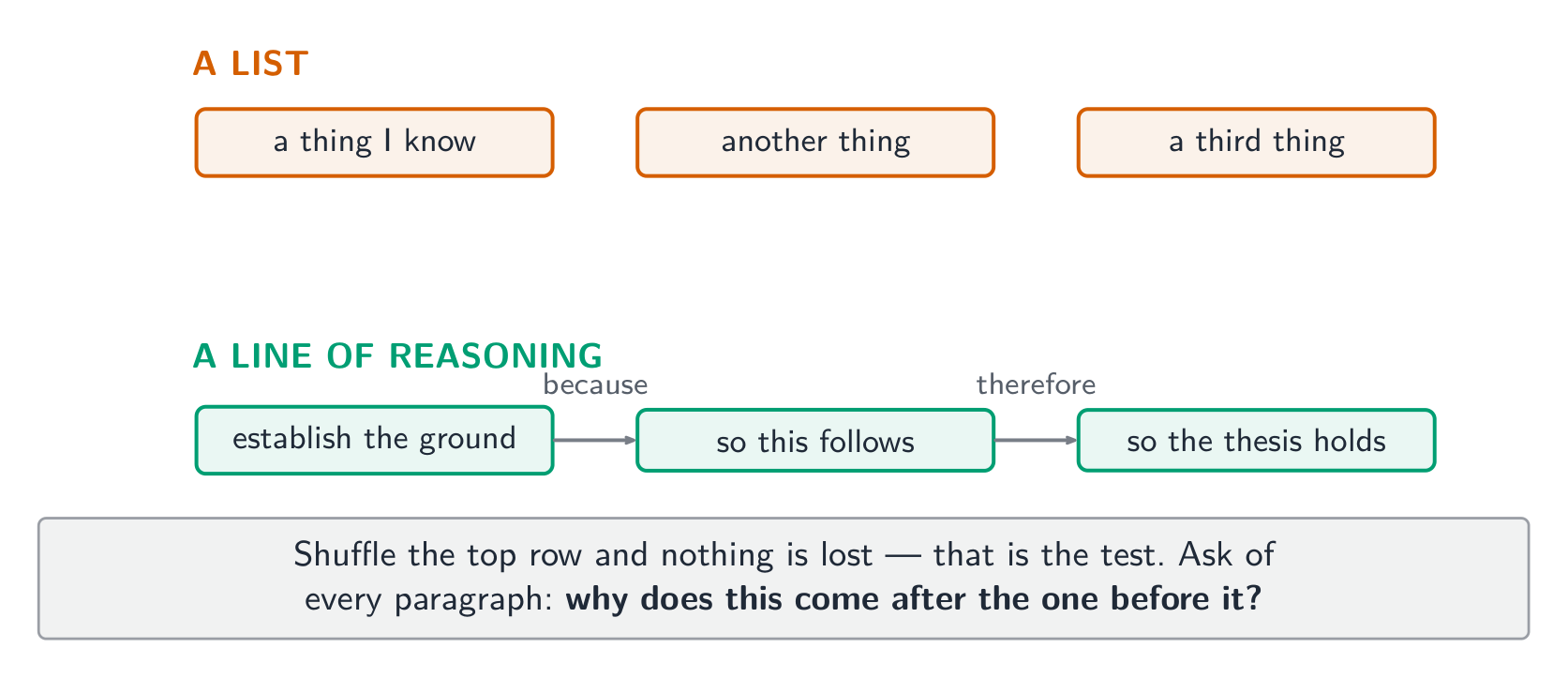
The shuffle test: if the paragraphs can be reordered without loss, it is a list
An essay with strong paragraphs necessarily has a strong line of reasoning.
Difficulty 1/5 · 100 coins + a small bonus on first completion today
Reasoning is a property of the sequence; strong paragraphs in no order still lose the marks.
For each paragraph, ask why it comes ____ the one before it.
Difficulty 1/5 · 100 coins + a small bonus on first completion today
If the only answer is "it is another thing I know", the essay is a list.
Commentary carries the path
- Each paragraph's commentary must connect its evidence to its own claim.
- The last sentence should also point at the next claim, so the reader is carried forward.
- That forward pointer is the difference between paragraphs in a row and paragraphs in a path.
Climb the four rungs of commentary
'Explain your evidence' is unusable; four questions, each answerable in a sentence, make it a procedure.
An essay can have a defensible thesis, apt evidence and real commentary in every paragraph and still lose the reasoning marks — because the paragraphs are in no particular order. Reasoning is a property of the sequence, not of any single paragraph.
Select all the deliberate orders this lesson suggests.
Difficulty 2/5 · 140 coins + a small bonus on first completion today
Paragraph length is never a reason for an order.
Choosing your order
- Weakest-to-strongest ends on your best point, which is where a reader stops.
- Objection-first earns credibility before you press your case.
- Chronological or causal order works when the argument is a sequence.
A good test of whether an essay has a line of reasoning is to read only...
Difficulty 1/5 · 100 coins + a small bonus on first completion today
If the topic sentences alone make an argument, the reasoning is in the essay.
Testing a draft
- Read only your topic sentences, in order, and nothing else.
- Do they make an argument on their own? They should.
- If they read as a list of subheadings, the reasoning is not in the essay yet.
Topic sentences read alone: "The policy's stated aim is reasonable." → "Its measure of success does not track that aim." → "So the reported success is real and irrelevant." Three sentences, and the argument is already complete — that is what a line of reasoning looks like.
Draft your claims as a list and check the order moves. For each paragraph, answer why it follows the one before. Let commentary point forward as well as back, choose an order deliberately, and test the draft by reading only the topic sentences.
Write from a cause that has to follow
- Paragraph 1 names the problem. Paragraph 2 gives the cause.
- Say the check the writer should make before drafting either paragraph.
A writer plans paragraph 1 as the problem and paragraph 2 as the cause. What question should be answered before either paragraph is drafted?
The reason for the sequence is part of the plan.
What should be settled before the cause paragraph is written?
Difficulty 1/5 · 100 coins + a small bonus on first completion today
A deliberate order has a reason for each step.