Skip to content · ⁨Saltar al contenido⁩

Redacción de una carta o correo formal

IGCSE Inglés · Topic 4 · ⁨Tema 4⁩

Train · ⁨Entrenar⁩
Video lesson for this topic · ⁨Lección de video para este tema⁩ Open the video page · ⁨Abrir la página de video⁩
8:04

Redacción de una carta o correo formal

Un estudiante descubre que el nuevo horario de autobuses la hace llegar tarde a la escuela cada mañana. Decide escribir a la empresa de autobuses. Su primer borrador dice: <slow>Este…

English narration · English + 中文 subtitles burned in · ⁨Narración en inglés · Subtítulos en inglés + 中文 quemados en pantalla⁩

4.1

When to write formally · ⁨Cuándo escribir de forma formal⁩

Syllabus
English
  1. recognise when a task needs a formal or semi-formal response (for example, to a teacher or an event organiser)
  2. cover the purpose, format and audience information given in the task
  3. keep a polite, formal tone throughout
Español
  1. reconocer cuándo una tarea requiere una respuesta formal o semiformal (por ejemplo, dirigida a un profesor u organizador de un evento)
  2. abordar la información sobre el propósito, formato y destinatario proporcionada en la tarea
  3. mantener un tono educado y formal a lo largo de todo el escrito
Source: Cambridge International syllabus · ⁨Fuente: Plan de estudios Cambridge International⁩

English

The second writing task sometimes asks for a formal 正式 or semi-formal 半正式 letter or email.

Spot a formal task

  • A formal task is written to someone you do not know well — a head teacher 校长, a manager 经理, or an event organiser 活动组织者.
  • The task tells you the format 格式, the purpose 目的 and the reader. Use all three.

Keep a polite tone

  • Be polite 礼貌 and respectful. Do not use slang 俚语 or jokes.
  • Do not use short forms. Write "I am", not "I'm".
Español

La segunda tarea de escritura a veces pide una carta o correo electrónico formal 正式 or semi-formal 半正式.

Identificar una tarea formal

  • Una tarea formal se escribe a alguien que no conoces bien: un director(a) 校长, un gerente 经理, o un organizador de eventos 活动组织者.
  • La tarea te indica el formato 格式, el propósito 目的 y el destinatario. Utiliza los tres elementos.
A tidy office desk with a computer, a plant and a wall calendar, nobody sitting at it
Una carta formal es leída en un escritorio como este — por alguien que no te conoce y que está ocupado

Mantener un tono educado

  • Sé educado 礼貌 y respetuoso. No uses jerga 俚语 ni chistes.
  • No uses formas abreviadas. Escribe "I am", no "I'm".
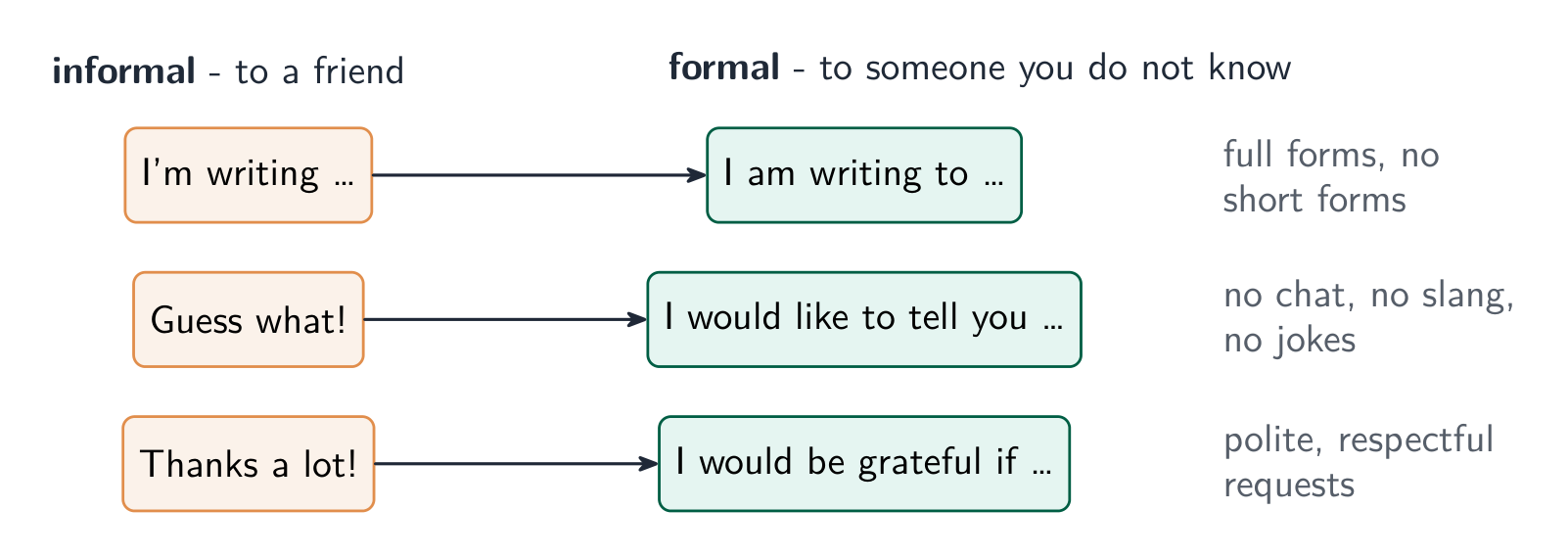
Three informal phrases turn into formal ones: I'm writing becomes I am writing to, Guess what becomes I would like to tell you, Thanks a lot becomes I would be grateful if
Cambiar frases amistosas por otras formales
A formal letter: careful structure, polite register and a clear reason for writing
Una carta formal: estructura cuidadosa, registro educado y un motivo claro para escribir
Vocabulary · ⁨Vocabulario⁩ Train · ⁨Entrenar⁩
English · ⁨Inglés⁩ Chinese · ⁨Chino⁩ Pinyin
formal/ˈfɔːml/ 正式 zhèng shì
semi-formal/ˈsemi ˈfɔːml/ 半正式 bàn zhèng shì
head teacher/hed ˈtiːtʃə/ 校长 xiào zhǎng
manager/ˈmænɪdʒə/ 经理 jīng lǐ
event organiser/ɪˈvent ˈɔːɡənaɪzə/ 活动组织者 huó dòng zǔ zhī zhě
format/ˈfɔːmæt/ 格式 gé shì
purpose/ˈpɜːpəs/ 目的 mù dì
polite/pəˈlaɪt/ 礼貌 lǐ mào
slang/slæŋ/ 俚语 lǐ yǔ
4.2

Building a formal letter or email · ⁨Construir una carta o correo electrónico formal⁩

Syllabus
English
  1. open and close a formal letter or email appropriately (for example: Dear … / Yours sincerely …)
  2. organise your points into clear paragraphs with a beginning, middle and end
  3. use formal language and avoid contractions and slang
Español
  1. abrir y cerrar una carta o correo electrónico formal de manera adecuada (por ejemplo: Estimado/a … / Atentamente …)
  2. organizar sus ideas en párrafos claros con un inicio, un desarrollo y un cierre
  3. utilizar un lenguaje formal y evitar contracciones y coloquialismos

Source: Cambridge International syllabus · ⁨Fuente: Plan de estudios Cambridge International⁩

English

A formal letter follows a clear order.

Opening and closing

  • Open with Dear Sir/Madam, or Dear Mr Lee,
  • If you start with a name, close with Yours sincerely,. If you start with Sir/Madam, close with Yours faithfully,.

Clear paragraphs

  • First paragraph: say why you are writing.
  • Middle paragraphs: give your points, one idea in each.
  • Last paragraph: say what you would like to happen next.

Formal language

  • Use formal phrases: I would like to…, I am writing to…, I would be grateful 感激 if…
  • Keep sentences clear and complete. Check your grammar and spelling.

A model formal letter

See how a polite, complete opening sets the right tone.

Dear Sir or Madam,

I am writing to suggest an improvement to the town library. At present it closes at five o'clock, which is too early for students who finish school at four. I would be grateful if the council could consider opening it until seven in the evening on weekdays.

Thank you for taking the time to read my letter.

Yours faithfully, J. Chen

Notice the Dear Sir or Madam / Yours faithfully pair, the clear first line stating the purpose, the polite request, and the complete sentences with no short forms.

Español

Una carta formal sigue un orden claro.

A formal letter with labels: the first paragraph says why you are writing, middle paragraphs give one point each, the end says what you would like to happen, and a box shows that Dear Sir or Madam pairs with Yours faithfully while Dear Mr Lee pairs with Yours sincerely
La estructura de una carta formal — y la despedida depende del saludo inicial

Apertura y cierre

  • Inicia con Dear Sir/Madam, (Estimado Sr./Sra.) o Dear Mr Lee, (Estimado Sr. Lee).
  • Si empiezas con un nombre, cierra con Yours sincerely, (Atentamente). Si empiezas con Sir/Madam, cierra con Yours faithfully, (Cordialmente / Muy atentamente).

Párrafos claros

  • Primer párrafo: explica por qué estás escribiendo.
  • Párrafos intermedios: presenta tus puntos, una idea en cada uno.
  • Último párrafo: indica lo que te gustaría que ocurriera a continuación.

Lenguaje formal

  • Usa frases formales: I would like to… (Me gustaría…), I am writing to… (Le escribo para…), I would be grateful 感激 if… (Agradecería si…).
  • Mantén las oraciones claras y completas. Revisa tu gramática y ortografía.

Ejemplo de carta formal

Observa cómo una apertura educada y completa establece el tono adecuado.

Dear Sir or Madam,

I am writing to suggest an improvement to the town library. At present it closes at five o'clock, which is too early for students who finish school at four. I would be grateful if the council could consider opening it until seven in the evening on weekdays.

Thank you for taking the time to read my letter.

Yours faithfully, J. Chen

Fíjate en la combinación Dear Sir or Madam / Yours faithfully, la primera línea clara que establece el propósito, la petición educada y las oraciones completas sin formas abreviadas.

Vocabulary · ⁨Vocabulario⁩ Train · ⁨Entrenar⁩
English · ⁨Inglés⁩ Chinese · ⁨Chino⁩ Pinyin
grateful/ˈɡreɪtfl/ 感激 gǎn jī
4.2

Exam tips · ⁨Consejos para el examen⁩

English
  • Match the greeting to the ending: Dear Mr Lee → Yours sincerely; Dear Sir or Madam → Yours faithfully.
  • Say why you are writing in the first line: "I am writing to apply for…" saves words and sounds formal.
  • Do not use short forms: write "I am" and "do not", never "I'm" or "don't".
  • One paragraph per point, and end by naming the action you hope for: "I would be grateful if…".
  • Stay polite even in a complaint: "I was disappointed to find…" wins marks; "This is terrible!" loses the tone.
Español
  • Coincide el saludo con la despedida: Dear Mr Lee → Yours sincerely; Dear Sir or Madam → Yours faithfully.
  • Explica por qué escribes en la primera línea: "I am writing to apply for…" ahorra palabras y suena formal.
  • No uses formas abreviadas: escribe "I am" y "do not", nunca "I'm" o "don't".
  • Un párrafo por punto, y termina nombrando la acción que esperas: "I would be grateful if…".
  • Mantente educado incluso en una queja: "I was disappointed to find…" obtiene puntos; "This is terrible!" pierde el tono adecuado.

Interactive lessons on this topic · ⁨Lecciones interactivas sobre este tema⁩

Work through it step by step, with instant-check exercises. · ⁨Trátalo paso a paso, con ejercicios de verificación instantánea.⁩

Past Papers · ⁨Exámenes Anteriores⁩

More topics in IGCSE Inglés · ⁨Más temas en IGCSE Inglés⁩

Log in or create account · ⁨Iniciar sesión o crear cuenta⁩

IGCSE, A-Level & AP