Skip to content · ⁨Saltar al contenido⁩

Trabajo, energía y potencia

AP Física C: Mecánica · Topic 3 · ⁨Tema 3⁩

Train · ⁨Entrenar⁩
Video lesson for this topic · ⁨Lección de video para este tema⁩ Open the video page · ⁨Abrir la página de video⁩
7:46

Trabajo, Energía y Potencia

Un bloque desliza hacia un resorte y lo comprime hasta detenerse. ¿Cuánto se comprime el resorte? Intenta eso con una ecuación cinemática. No puedes —la fuerza crece…

English narration · English + 中文 subtitles burned in · ⁨Narración en inglés · Subtítulos en inglés + 中文 quemados en pantalla⁩

3.1

Translational Kinetic Energy · ⁨Energía Cinética de Traslación⁩

Syllabus
English

Learning Objective 3.1.A: Describe the translational kinetic energy of an object in terms of the object's mass and velocity.

  • 3.1.A.1 An object's translational kinetic energy is given by the equation
    • Equation: $K = \dfrac{1}{2}mv^2$
  • 3.1.A.2 Translational kinetic energy is a scalar quantity.
  • 3.1.A.3 Different observers may measure different values of the translational kinetic energy of an object, depending on the observer's frame of reference.
Español

Objetivo de Aprendizaje 3.1.A: Describir la energía cinética traslacional de un objeto en términos de la masa y la velocidad del mismo.

  • 3.1.A.1 La energía cinética traslacional de un objeto viene dada por la ecuación
    • Ecuación: $K = \dfrac{1}{2}mv^2$
  • 3.1.A.2 La energía cinética traslacional es una cantidad escalar.
  • 3.1.A.3 Diferentes observadores pueden medir diferentes valores de la energía cinética traslacional de un objeto, dependiendo del sistema de referencia del observador.
Source: College Board AP Course and Exam Description · ⁨Fuente: College Board AP Course and Exam Description⁩

English

Kinetic energy 动能 is the energy of motion, a scalar 标量 measured in joules 焦耳 (J):

$$K=\tfrac{1}{2}mv^2.$$

It grows with the square of speed – doubling the speed quadruples $K$. One subtlety worth knowing: kinetic energy depends on the observer's reference frame 参考系. A passenger walking down a train has a small $K$ measured inside the train and a huge one measured from the ground – both observers are right, each in their own frame.

Español

La energía cinética 动能 es la energía del movimiento, una magnitud escalar 标量 medida en jules 焦耳 (J):

$$K=\tfrac{1}{2}mv^2.$$

Aumenta con el cuadrado de la velocidad: duplicar la velocidad cuadruplica $K$. Un matiz importante a conocer: la energía cinética depende del sistema de referencia 参考系 del observador. Un pasajero caminando por un tren tiene una pequeña $K$ medida desde dentro del tren y una enorme medida desde el suelo; ambos observadores tienen razón, cada uno en su propio marco de referencia.

Vocabulary · ⁨Vocabulario⁩ Train · ⁨Entrenar⁩
English · ⁨Inglés⁩ Chinese · ⁨Chino⁩ Pinyin
Kinetic energy/kɪˈnetɪk ˈenədʒi/ 动能 dòng néng
scalar/ˈskeɪlə/ 标量 biāo liàng
joules/dʒuːlz/ 焦耳 jiāo ěr
reference frame/ˈrefrəns freɪm/ 参考系 cān kǎo xì
3.2

Work · ⁨Trabajo⁩

Syllabus
English

Learning Objective 3.2.A: Describe the work done on an object or system by a given force or collection of forces.

  • 3.2.A.1 Work is the amount of energy transferred into or out of a system by a force exerted on that system over a distance.
    • 3.2.A.1.i The work done by a conservative force exerted on a system is path-independent and only depends on the initial and final configurations of that system.
    • 3.2.A.1.ii The work done by a conservative force on a system—or the change in the potential energy of the system—will be zero if the system returns to its initial configuration.
    • 3.2.A.1.iii Potential energies are associated only with conservative forces.
    • 3.2.A.1.iv The work done by a nonconservative force is path-dependent.
    • 3.2.A.1.v The most common nonconservative forces are friction and air resistance.
  • 3.2.A.2 Work is a scalar quantity that may be positive, negative, or zero.
  • 3.2.A.3 The work done on an object by a variable force is calculated using
    • Equation: $W = \displaystyle\int_a^b \vec{F}(r) \cdot d\vec{r}$, where the integral is taken over the path from point $a$ to point $b$.
    • 3.2.A.3.i The dot product between two vectors, $\vec{A}$ and $\vec{B}$, results in a scalar quantity of magnitude $\vec{A} \cdot \vec{B} = AB\cos\theta$.
    • 3.2.A.3.ii Only the component of the force exerted on a system that is parallel to the displacement of the point of application of the force will change the system's total energy.
    • 3.2.A.3.iii If the component of the force exerted on a system that is parallel to the displacement is constant, the work done on the system by the force is given by the derived equation $W = F_{\parallel}d = Fd\cos\theta$.
    • 3.2.A.3.iv The component of the force exerted on a system perpendicular to the direction of the displacement of the system's center of mass can change the direction of the system's motion without changing the system's kinetic energy.
  • 3.2.A.4 The work–energy theorem states that the change in an object's kinetic energy is equal to the sum of the work (net work) being done by all forces exerted on the object.
    • Equation: $\Delta K = \displaystyle\sum W_i = \sum F_{\parallel,i}\, d_i$
    • 3.2.A.4.i An external force may change the configuration of a system. The component of the external force parallel to the displacement times the displacement of the point of application of the force gives the change in kinetic energy of the system.
    • 3.2.A.4.ii If the system's center of mass and the point of application of the force move the same distance when a force is exerted on a system, then the system may be modeled as an object, and only the system's kinetic energy can change.
    • 3.2.A.4.iii The energy dissipated by friction is typically equated to the force of friction times the length of the path over which the force is exerted.
      • Equation: $\Delta E_{\text{mech}} = F_f d\cos\theta$
    • 3.2.A.5 Work is equal to the area under the curve of a graph of $F_{\parallel}$ as a function of displacement.

Boundary statement: AP Physics C: Mechanics only expects students to analyze the transfer of mechanical energy, although students should be aware that mechanical energy may be dissipated in the form of thermal energy or sound.

Español

Objetivo de aprendizaje 3.2.A: Describir el trabajo realizado sobre un objeto o sistema por una fuerza dada o por un conjunto de fuerzas.

  • 3.2.A.1 El trabajo es la cantidad de energía transferida hacia adentro o hacia afuera de un sistema mediante una fuerza ejercida sobre ese sistema a lo largo de una distancia.
    • 3.2.A.1.i El trabajo realizado por una fuerza conservativa ejercida sobre un sistema es independiente de la trayectoria y depende únicamente de las configuraciones inicial y final del sistema.
    • 3.2.A.1.ii El trabajo realizado por una fuerza conservativa sobre un sistema —o el cambio en la energía potencial del sistema— será cero si el sistema regresa a su configuración inicial.
    • 3.2.A.1.iii Las energías potenciales están asociadas únicamente con fuerzas conservativas.
    • 3.2.A.1.iv El trabajo realizado por una fuerza no conservativa depende de la trayectoria.
    • 3.2.A.1.v Las fuerzas no conservativas más comunes son la fricción y la resistencia del aire.
  • 3.2.A.2 El trabajo es una magnitud escalar que puede ser positiva, negativa o cero.
  • 3.2.A.3 El trabajo realizado sobre un objeto por una fuerza variable se calcula mediante
    • Ecuación: $W = \displaystyle\int_a^b \vec{F}(r) \cdot d\vec{r}$, donde la integral se toma a lo largo de la trayectoria desde el punto $a$ hasta el punto $b$.
    • 3.2.A.3.i El producto punto entre dos vectores, $\vec{A}$ y $\vec{B}$, resulta en una magnitud escalar dada por $\vec{A} \cdot \vec{B} = AB\cos\theta$.
    • 3.2.A.3.ii Solo el componente de la fuerza ejercida sobre un sistema que es paralelo al desplazamiento del punto de aplicación de la fuerza cambiará la energía total del sistema.
    • 3.2.A.3.iii Si el componente de la fuerza ejercida sobre un sistema que es paralelo al desplazamiento es constante, el trabajo realizado sobre el sistema por la fuerza está dado por la ecuación derivada $W = F_{\parallel}d = Fd\cos\theta$.
    • 3.2.A.3.iv El componente de la fuerza ejercida sobre un sistema perpendicular a la dirección del desplazamiento del centro de masa del sistema puede cambiar la dirección del movimiento del sistema sin alterar su energía cinética.
  • 3.2.A.4 El teorema del trabajo y la energía establece que el cambio en la energía cinética de un objeto es igual a la suma del trabajo (trabajo neto) realizado por todas las fuerzas exertidas sobre el objeto.
    • Ecuación: $\Delta K = \displaystyle\sum W_i = \sum F_{\parallel,i}\, d_i$
    • 3.2.A.4.i Una fuerza externa puede cambiar la configuración de un sistema. El componente de la fuerza externa paralelo al desplazamiento multiplicado por el desplazamiento del punto de aplicación de la fuerza da como resultado el cambio en la energía cinética del sistema.
    • 3.2.A.4.ii Si el centro de masa del sistema y el punto de aplicación de la fuerza se desplazan la misma distancia cuando se ejerce una fuerza sobre un sistema, entonces el sistema puede modelarse como un objeto, y solo la energía cinética del sistema puede cambiar.
    • 3.2.A.4.iii La energía disipada por la fricción suele equipararse a la fuerza de fricción multiplicada por la longitud de la trayectoria sobre la cual se ejerce la fuerza.
      • Ecuación: $\Delta E_{\text{mech}} = F_f d\cos\theta$
    • 3.2.A.5 El trabajo es igual al área bajo la curva de un gráfico de $F_{\parallel}$ en función del desplazamiento.

Enunciado de límite: AP Physics C: Mechanics solo espera que los estudiantes analicen la transferencia de energía mecánica, aunque deben estar conscientes de que la energía mecánica puede disiparse en forma de energía térmica o sonido.

Source: College Board AP Course and Exam Description · ⁨Fuente: College Board AP Course and Exam Description⁩

English

Work 功 is energy transferred into or out of a system by a force acting over a distance. For a variable force it is an integral 积分 along the path:

$$W=\int_a^b \vec{F}\cdot d\vec{r}=\int F\cos\theta\,dr.$$

For a constant force this reduces to $W=Fd\cos\theta$; on a force–position graph, work is the area under the curve. Work is a scalar with a sign, and the sign is physics, not bookkeeping:

  • Positive – force has a component along the motion (it speeds the object up).
  • Negative – force opposes the motion (friction 摩擦力 and air drag do negative work).
  • Zero – force perpendicular to the motion (the normal force 法向力 on a sliding block, gravity on a horizontal move, tension in a circular swing).

The work–energy theorem 动能定理 collects every force's contribution: the net work equals the change in kinetic energy,

$$W_{\text{net}}=\sum W_i=\Delta K.$$

Worked example. A variable force $F(x)=3x^2\ \text{N}$ (along the motion) acts from $x=0$ to $x=2\ \text{m}$: $W=\displaystyle\int_0^2 3x^2\,dx=\big[x^3\big]_0^2=8\ \text{J}$. Acting alone on a body starting from rest, it would raise the kinetic energy to exactly $8\ \text{J}$.

Español

El trabajo 功 es la energía transferida hacia o fuera de un sistema mediante una fuerza que actúa sobre una distancia. Para una fuerza variable, es una integral 积分 a lo largo de la trayectoria:

$$W=\int_a^b \vec{F}\cdot d\vec{r}=\int F\cos\theta\,dr.$$

Para una fuerza constante, esto se reduce a $W=Fd\cos\theta$; en una gráfica de fuerza contra posición, el trabajo es el área bajo la curva. El trabajo es un escalar con signo, y ese signo es física, no contabilidad:

  • Positivo – la fuerza tiene una componente a lo largo del movimiento (acelera al objeto).
  • Negativo – la fuerza se opone al movimiento (fricción 摩擦力 y la resistencia del aire realizan trabajo negativo).
  • Cero – la fuerza es perpendicular al movimiento (la fuerza normal 法向力 sobre un bloque deslizante, la gravedad en un movimiento horizontal, la tensión en un balanceo circular).
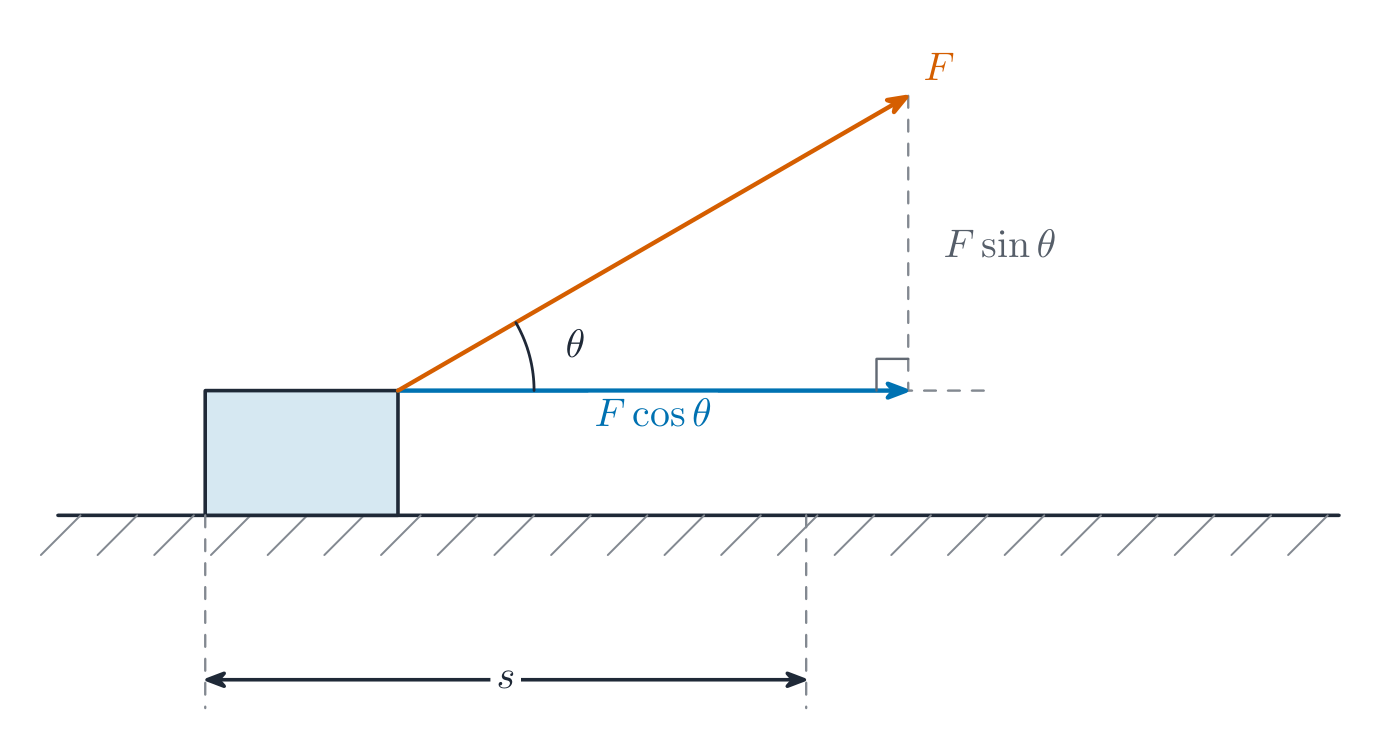
Solo la componente de la fuerza a lo largo del desplazamiento realiza trabajo

El teorema del trabajo y la energía 动能定理 recopila la contribución de todas las fuerzas: el trabajo neto es igual al cambio en la energía cinética,

$$W_{\text{net}}=\sum W_i=\Delta K.$$

Ejemplo resuelto. Una fuerza variable $F(x)=3x^2\ \text{N}$ (a lo largo del movimiento) actúa desde $x=0$ hasta $x=2\ \text{m}$: $W=\displaystyle\int_0^2 3x^2\,dx=\big[x^3\big]_0^2=8\ \text{J}$. Actuando sola sobre un cuerpo que parte del reposo, elevaría la energía cinética exactamente a $8\ \text{J}$.

Vocabulary · ⁨Vocabulario⁩ Train · ⁨Entrenar⁩
English · ⁨Inglés⁩ Chinese · ⁨Chino⁩ Pinyin
Work/wɜːk/ 功 gōng
integral/ˈɪntɪɡrəl/ 积分 jī fēn
friction/ˈfrɪkʃn/ 摩擦力 mó cā lì
normal force/ˈnɔːml fɔːs/ 法向力 fǎ xiàng lì
work–energy theorem/wɜːk ˈenədʒi ˈθɪərəm/ 动能定理 dòng néng dìng lǐ
3.3

Potential Energy · ⁨Energía Potencial⁩

Syllabus
English

Learning Objective 3.3.A: Describe the potential energy of a system.

  • 3.3.A.1 A system composed of two or more objects has potential energy if the objects within that system only interact with each other through conservative forces.
  • 3.3.A.2 Potential energy is a scalar quantity associated with the position of objects within a system.
  • 3.3.A.3 The definition of zero potential energy for a given system is a decision made by the observer considering the situation to simplify or otherwise assist in analysis.
  • 3.3.A.4 The relationship between conservative forces exerted on a system and the system's potential energy is
    • Equation: $\Delta U = -\displaystyle\int_a^b \vec{F}_{cf}(r) \cdot d\vec{r}$
  • 3.3.A.5 The conservative forces exerted on a system in a single dimension can be determined using the slope of the system's potential energy with respect to position in that dimension; these forces point in the direction of decreasing potential energy.
    • Equation: $F_x = -\dfrac{dU(x)}{dx}$
  • 3.3.A.6 Graphs of a system's potential energy as a function of its position can be useful in determining physical properties of that system.
    • 3.3.A.6.i Stable equilibrium is a location at which a small displacement in an object's position results in a force exerted on the object opposite to the direction of the small displacement, accelerating the object back toward the equilibrium position.
    • 3.3.A.6.ii Unstable equilibrium is a location at which a small displacement in an object's position results in a force exerted on the object in the same direction as the small displacement, accelerating the object away from the equilibrium position.
    • 3.3.A.6.iii In a given dimension, stable equilibrium positions exist at locations where the potential energy as a function of position in that dimension has a local minimum.
    • 3.3.A.6.iv In a given dimension, unstable equilibrium positions occur at locations where the potential energy as a function of position in that dimension has a local maximum.
  • 3.3.A.7 The potential energy of common physical systems can be described using the physical properties of that system.
    • 3.3.A.7.i The elastic potential energy of an ideal spring is given by the following equation, where $\Delta x$ is the distance the spring has been stretched or compressed from its equilibrium length.
      • Equation: $U_s = \dfrac{1}{2}k(\Delta x)^2$
    • 3.3.A.7.ii The general form for the gravitational potential energy of a system consisting of two approximately spherical distributions of mass (e.g., moons, planets, or stars) is given by the equation
      • Equation: $U_g = -G\dfrac{m_1 m_2}{r}$
    • 3.3.A.7.iii Because the gravitational field near the surface of a planet is nearly constant, the change in gravitational potential energy in a system consisting of an object with mass $m$ and a planet with gravitational field of magnitude $g$ when the object is near the surface of the planet may be approximated by the equation
      • Equation: $\Delta U_g = mg\Delta y$
  • 3.3.A.8 The total potential energy of a system containing more than two objects is the sum of the potential energy of each pair of objects within the system.
Español

Objetivo de aprendizaje 3.3.A: Describir la energía potencial de un sistema.

  • 3.3.A.1 Un sistema compuesto por dos o más objetos tiene energía potencial si los objetos dentro de ese sistema solo interactúan entre sí a través de fuerzas conservativas.
  • 3.3.A.2 La energía potencial es una cantidad escalar asociada con la posición de los objetos dentro de un sistema.
  • 3.3.A.3 La definición de energía potencial cero para un sistema dado es una decisión tomada por el observador considerando la situación para simplificar o de otra manera facilitar el análisis.
  • 3.3.A.4 La relación entre las fuerzas conservativas que actúan sobre un sistema y su energía potencial es
    • Ecuación: $\Delta U = -\displaystyle\int_a^b \vec{F}_{cf}(r) \cdot d\vec{r}$
  • 3.3.A.5 Las fuerzas conservativas que actúan sobre un sistema en una sola dimensión pueden determinarse utilizando la pendiente de la energía potencial del sistema con respecto a la posición en esa dimensión; estas fuerzas apuntan en la dirección de disminución de la energía potencial.
    • Ecuación: $F_x = -\dfrac{dU(x)}{dx}$
  • 3.3.A.6 Los gráficos de la energía potencial de un sistema en función de su posición pueden ser útiles para determinar propiedades físicas de dicho sistema.
    • 3.3.A.6.i El equilibrio estable es una ubicación en la cual un pequeño desplazamiento en la posición de un objeto resulta en una fuerza ejercida sobre el objeto opuesta a la dirección del pequeño desplazamiento, acelerando al objeto de vuelta hacia la posición de equilibrio.
    • 3.3.A.6.ii El equilibrio inestable es una ubicación en la cual un pequeño desplazamiento en la posición de un objeto resulta en una fuerza ejercida sobre el objeto en la misma dirección que el pequeño desplazamiento, acelerando al objeto alejándose de la posición de equilibrio.
    • 3.3.A.6.iii En una dimensión dada, las posiciones de equilibrio estable existen en lugares donde la energía potencial como función de la posición en esa dimensión tiene un mínimo local.
    • 3.3.A.6.iv En una dimensión dada, las posiciones de equilibrio inestable ocurren en lugares donde la energía potencial como función de la posición en esa dimensión tiene un máximo local.
  • 3.3.A.7 La energía potencial de sistemas físicos comunes puede describirse utilizando las propiedades físicas de dicho sistema.
    • 3.3.A.7.i La energía potencial elástica de un resorte ideal está dada por la siguiente ecuación, donde $\Delta x$ es la distancia que el resorte se ha estirado o comprimido desde su longitud de equilibrio.
      • Ecuación: $U_s = \dfrac{1}{2}k(\Delta x)^2$
    • 3.3.A.7.ii La forma general para la energía potencial gravitatoria de un sistema que consiste en dos distribuciones de masa aproximadamente esféricas (p. ej., lunas, planetas o estrellas) está dada por la ecuación
      • Ecuación: $U_g = -G\dfrac{m_1 m_2}{r}$
    • 3.3.A.7.iii Debido a que el campo gravitatorio cerca de la superficie de un planeta es casi constante, el cambio en la energía potencial gravitatoria en un sistema que consiste en un objeto de masa $m$ y un planeta con un campo gravitatorio de magnitud $g$ cuando el objeto está cerca de la superficie del planeta puede aproximarse mediante la ecuación
      • Ecuación: $\Delta U_g = mg\Delta y$
  • 3.3.A.8 La energía potencial total de un sistema que contiene más de dos objetos es la suma de la energía potencial de cada par de objetos dentro del sistema.

Source: College Board AP Course and Exam Description · ⁨Fuente: College Board AP Course and Exam Description⁩

English

Potential energy 势能 is energy a system stores by the positions of its parts – it exists only for conservative forces 保守力, whose work is path independent. It is defined through work:

$$\Delta U=-\int_a^b\vec{F}\cdot d\vec{r},$$

and you are free to choose where $U=0$ – only changes in $U$ matter, so pick the zero that makes the problem simplest. The standard results:

  • Gravity near a surface: $\Delta U_g=mg\,\Delta y$.
  • Gravity in general: $U_g=-\dfrac{Gm_1m_2}{r}$ (zero at infinite separation).
  • Spring: $U_s=\tfrac12k(\Delta x)^2$, with $\Delta x$ measured from natural length.

For systems of several objects, add the potential energy of each pair. Turning the definition around, a conservative force is minus the derivative 导数 of its potential energy:

$$F_x=-\frac{dU}{dx}.$$

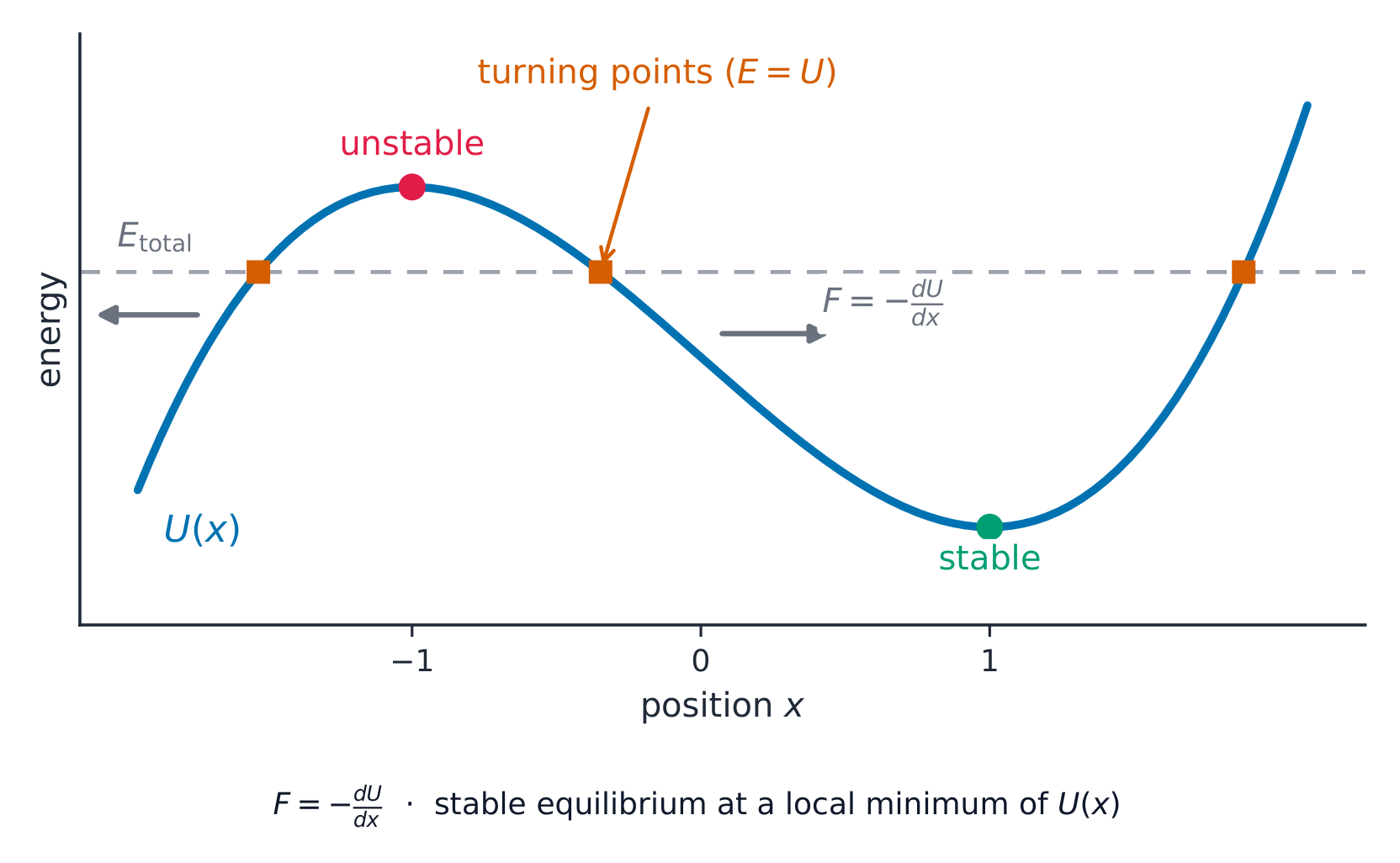
The force points "downhill" on the $U(x)$ curve. Equilibrium sits where the slope is zero: a minimum is a stable equilibrium 稳定平衡 (displaced, the force pushes back), a maximum is an unstable equilibrium 不稳定平衡 (displaced, the force pushes away).

Worked example. Given $U(x)=2x^3-6x$ (joules), the force is $F=-\dfrac{dU}{dx}=6-6x^2$. Equilibria sit at $F=0$: $x=\pm1$. Since $\dfrac{d^2U}{dx^2}=12x$ is positive at $x=+1$ (a minimum – stable) and negative at $x=-1$ (a maximum – unstable), the two points behave oppositely.

Español

La energía potencial 势能 es la energía que almacena un sistema debido a la posición de sus partes; existe solo para fuerzas conservativas 保守力, cuyo trabajo es independiente de la trayectoria. Se define mediante el trabajo:

$$\Delta U=-\int_a^b\vec{F}\cdot d\vec{r},$$

y tienes libertad para elegir dónde $U=0$; solo importan los cambios en $U$, así que elige el cero que haga el problema más simple. Los resultados estándar son:

  • Gravedad cerca de una superficie: $\Delta U_g=mg\,\Delta y$.
  • Gravedad en general: $U_g=-\dfrac{Gm_1m_2}{r}$ (cero a separación infinita).
  • Resorte: $U_s=\tfrac12k(\Delta x)^2$, con $\Delta x$ medido desde la longitud natural.

Para sistemas de varios objetos, suma la energía potencial de cada par. Invertiendo la definición, una fuerza conservativa es menos la derivada 导数 de su energía potencial:

$$F_x=-\frac{dU}{dx}.$$

La fuerza apunta "cuesta abajo" en la curva de $U(x)$. El equilibrio se encuentra donde la pendiente es cero: un mínimo es un equilibrio estable 稳定平衡 (si se desplaza, la fuerza empuja de vuelta), un máximo es un equilibrio inestable 不稳定平衡 (si se desplaza, la fuerza empuja lejos).

En una curva de energía potencial, la fuerza apunta hacia abajo y E = U marca los puntos de giro
En una curva de energía potencial, la fuerza apunta cuesta abajo y E = U marca los puntos de retorno

Ejemplo resuelto. Dado $U(x)=2x^3-6x$ (jules), la fuerza es $F=-\dfrac{dU}{dx}=6-6x^2$. Los equilibrios están en $F=0$: $x=\pm1$. Dado que $\dfrac{d^2U}{dx^2}=12x$ es positivo en $x=+1$ (un mínimo – estable) y negativo en $x=-1$ (un máximo – inestable), los dos puntos se comportan de manera opuesta.

Explore · ⁨Explorar⁩

Almacenar energía potencial elástica en un resorte

Estirar un resorte almacena energía potencial elástica $\tfrac12 kx^2$ — el área bajo la línea de fuerza-extensión. Libéralo y esa energía se convierte en cinética.

Vocabulary · ⁨Vocabulario⁩ Train · ⁨Entrenar⁩
English · ⁨Inglés⁩ Chinese · ⁨Chino⁩ Pinyin
Potential energy/pəˈtenʃl ˈenədʒi/ 势能 shì néng
conservative forces/kənˈsɜːvətɪv ˈfɔːsɪz/ 保守力 bǎo shǒu lì
derivative/dɪˈrɪvətɪv/ 导数 dǎo shù
stable equilibrium/ˈsteɪbl ˌiːkwɪˈlɪbrɪəm/ 稳定平衡 wěn dìng píng héng
unstable equilibrium/ʌnˈsteɪbl ˌiːkwɪˈlɪbrɪəm/ 不稳定平衡 bù wěn dìng píng héng
Mechanical energy/mɪˈkænɪkl ˈenədʒi/ 机械能 jī xiè néng
nonconservative forces/ˌnɒŋkənˈsɜːvətɪv ˈfɔːsɪz/ 非保守力 fēi bǎo shǒu lì
thermal energy/ˈθɜːml ˈenədʒi/ 热能 rè néng
turning points/ˈtɜːnɪŋ pɔɪnts/ 转折点 zhuǎn zhé diǎn
3.4

Conservation of Energy · ⁨Conservación de la Energía⁩

Syllabus
English

Learning Objective 3.4.A: Describe the energies present in a system.

  • 3.4.A.1 A system composed of only a single object can only have kinetic energy.
  • 3.4.A.2 A system that contains objects that interact via conservative forces or that can change its shape reversibly may have both kinetic and potential energies.

Learning Objective 3.4.B: Describe the behavior of a system using conservation of mechanical energy principles.

  • 3.4.B.1 Mechanical energy is the sum of a system's kinetic and potential energies.
  • 3.4.B.2 Any change to a type of energy within a system must be balanced by an equivalent change of other types of energies within the system or by a transfer of energy between the system and its surroundings.
  • 3.4.B.3 A system may be selected so that the total energy of that system is constant.
  • 3.4.B.4 If the total energy of a system changes, that change will be equivalent to the energy transferred into or out of the system.

Learning Objective 3.4.C: Describe how the selection of a system determines whether the energy of that system changes.

  • 3.4.C.1 Energy is conserved in all interactions.
  • 3.4.C.2 If the work done on a selected system is zero and there are no nonconservative interactions within the system, the total mechanical energy of the system is constant.
  • 3.4.C.3 If the work done on a selected system is nonzero, energy is transferred between the system and the environment.

Boundary statement: AP Physics C: Mechanics expects students to know that mechanical energy can be dissipated as thermal energy or sound by nonconservative forces.

Español

Objetivo de Aprendizaje 3.4.A: Describir las energías presentes en un sistema.

  • 3.4.A.1 Un sistema compuesto únicamente por un solo objeto solo puede tener energía cinética.
  • 3.4.A.2 Un sistema que contiene objetos que interactúan mediante fuerzas conservativas o que puede cambiar su forma de manera reversible puede tener tanto energía cinética como potencial.

Objetivo de Aprendizaje 3.4.B: Describir el comportamiento de un sistema utilizando los principios de conservación de la energía mecánica.

  • 3.4.B.1 La energía mecánica es la suma de las energías cinéticas y potenciales de un sistema.
  • 3.4.B.2 Cualquier cambio en un tipo de energía dentro de un sistema debe estar equilibrado por un cambio equivalente de otros tipos de energías dentro del sistema o por una transferencia de energía entre el sistema y sus alrededores.
  • 3.4.B.3 Se puede seleccionar un sistema tal que la energía total de ese sistema sea constante.
  • 3.4.B.4 Si la energía total de un sistema cambia, ese cambio será equivalente a la energía transferida hacia o fuera del sistema.

Objetivo de Aprendizaje 3.4.C: Describir cómo la selección de un sistema determina si la energía de ese sistema cambia.

  • 3.4.C.1 La energía se conserva en todas las interacciones.
  • 3.4.C.2 Si el trabajo realizado sobre un sistema seleccionado es cero y no hay interacciones no conservativas dentro del sistema, la energía mecánica total del sistema es constante.
  • 3.4.C.3 Si el trabajo realizado sobre un sistema seleccionado es distinto de cero, hay transferencia de energía entre el sistema y el entorno.

Declaración de límite: AP Physics C: Mecánica espera que los estudiantes sepan que la energía mecánica puede disiparse como energía térmica o sonido debido a fuerzas no conservativas.

Source: College Board AP Course and Exam Description · ⁨Fuente: College Board AP Course and Exam Description⁩

English
Energy conservation: KE ⇄ PE

Energy is conserved in all interactions – the question is only where it goes. Mechanical energy 机械能 is the sum $E=K+U$. If the external work on a system is zero and nothing inside it acts through nonconservative forces 非保守力, then

$$K_1+U_1=K_2+U_2.$$

When friction or drag act, they convert mechanical energy into thermal energy 热能 ($\Delta E_{\text{mech}}=-F_fd$), and the balance must include that term. If external work is done, the system's total energy changes by exactly the energy transferred: $W_{\text{ext}}=\Delta E_{\text{sys}}$. Choosing the system is choosing the bookkeeping – a single object can only have kinetic energy; include the Earth or the spring and the system can store potential energy too.

A potential-energy graph is a complete motion map: the horizontal line at height $E$ is the total energy, the gap $E-U(x)$ is the kinetic energy at each $x$, and the crossings $E=U$ are the turning points 转折点 where the object momentarily stops and reverses.

Worked example. A $2.0\ \text{kg}$ block slides down a ramp from rest at height $1.5\ \text{m}$, arriving at the bottom at $4.0\ \text{m/s}$. Energy accounting: $mgh=29.4\ \text{J}$ available; $\tfrac12mv^2=16\ \text{J}$ arrives as kinetic energy; so friction converted $29.4-16=13\ \text{J}$ into thermal energy along the way.

Español
Conservación de energía: KE ⇄ PE

La energía se conserva en todas las interacciones; la pregunta es solo adónde va. La energía mecánica 机械能 es la suma $E=K+U$. Si el trabajo externo sobre un sistema es cero y nada en su interior actúa a través de fuerzas no conservativas 非保守力, entonces

$$K_1+U_1=K_2+U_2.$$

Cuando actúan fricción o resistencia, convierten la energía mecánica en energía térmica 热能 ($\Delta E_{\text{mech}}=-F_fd$), y el balance debe incluir ese término. Si se realiza trabajo externo, la energía total del sistema cambia exactamente en la cantidad transferida: $W_{\text{ext}}=\Delta E_{\text{sys}}$. Elegir el sistema es elegir la contabilidad; un solo objeto solo puede tener energía cinética; incluye la Tierra o el resorte y el sistema también puede almacenar energía potencial.

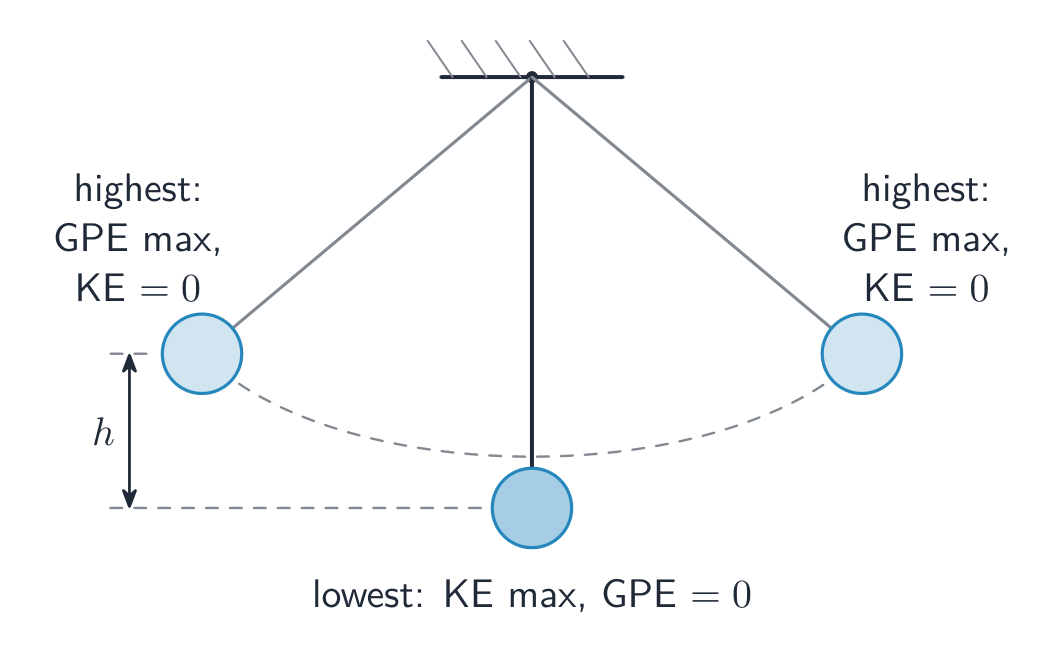
Un péndulo intercambia energía potencial gravitatoria por energía cinética y viceversa

Una gráfica de energía potencial es un mapa completo del movimiento: la línea horizontal a altura $E$ es la energía total, la diferencia $E-U(x)$ es la energía cinética en cada $x$, y los cruces $E=U$ son los puntos de retorno 转折点 donde el objeto se detiene momentáneamente e invierte su dirección.

Ejemplo resuelto. Un bloque $2.0\ \text{kg}$ se desliza por una rampa partiendo del reposo desde una altura $1.5\ \text{m}$, llegando a la base con una velocidad de $4.0\ \text{m/s}$. Contabilidad energética: $mgh=29.4\ \text{J}$ disponible inicialmente; $\tfrac12mv^2=16\ \text{J}$ llega como energía cinética; por lo tanto, la fricción convirtió $29.4-16=13\ \text{J}$ en energía térmica durante el trayecto.

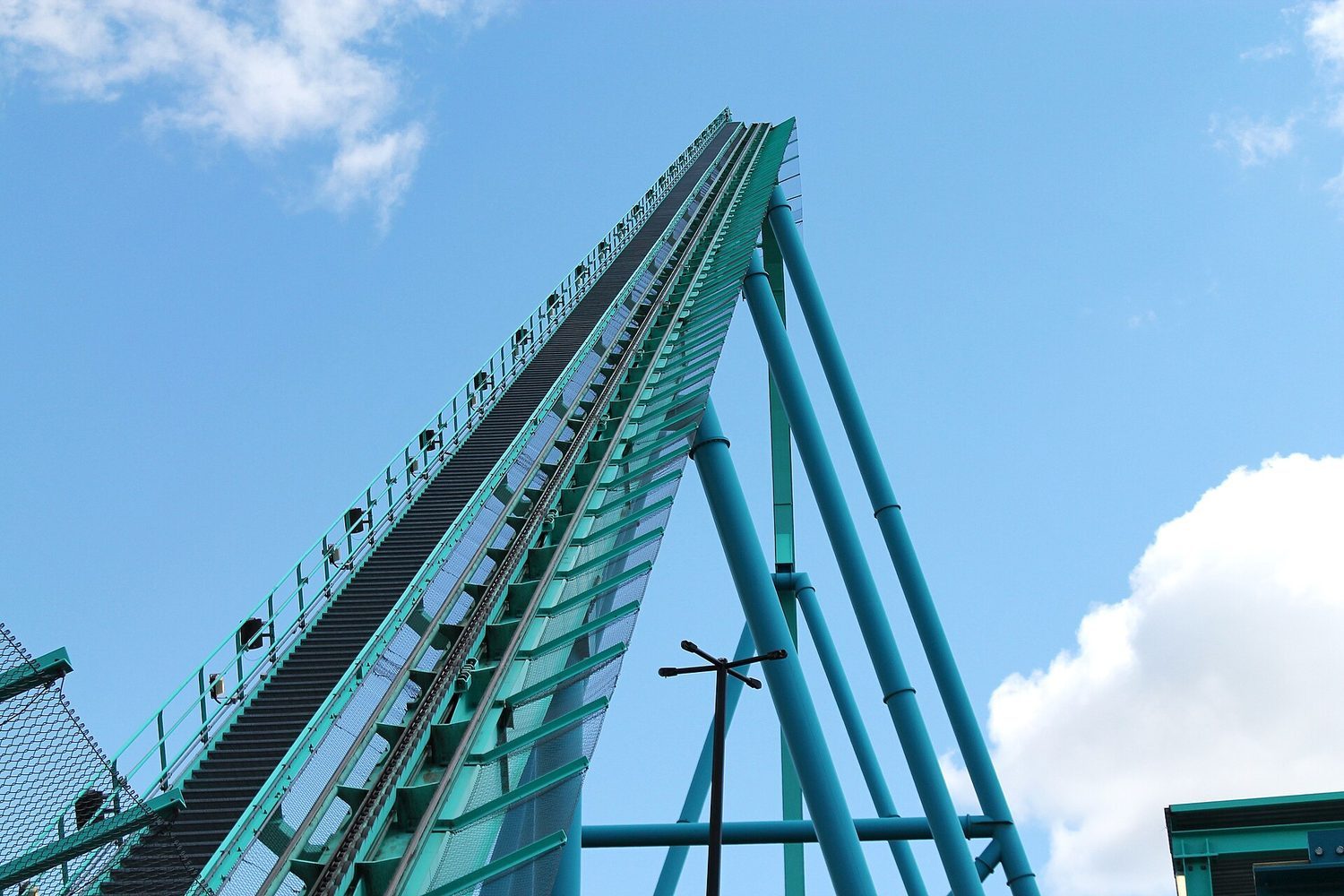
Una montaña rusa intercambia energía adelante y atrás: máxima (mayor PE) en la cima, más rápida (mayor KE) en la base
Un carrusel intercambia energía constantemente: mayor (más PE) en la cima, más rápido (más KE) en la base
Explore · ⁨Explorar⁩

Observar la conversión de energía cuando un objeto cae

Sin fricción, la energía mecánica se conserva: a medida que un objeto cae, la energía potencial gravitatoria se convierte en energía cinética mientras el total permanece fijo.

Watch lesson · ⁨Ver lección⁩
3.5

Power · ⁨Potencia⁩

Syllabus
English

Learning Objective 3.5.A: Describe the transfer of energy into, out of, or within a system in terms of power.

  • 3.5.A.1 Power is the rate at which energy changes with respect to time, either by transfer into or out of a system or by conversion from one type to another within a system.
  • 3.5.A.2 Average power is the amount of energy being transferred or converted, divided by the time it took for that transfer or conversion to occur.
    • Equation: $P_{\text{avg}} = \dfrac{\Delta E}{\Delta t}$
  • 3.5.A.3 Because work is the change in energy of an object or system due to a force, average power is the total work done, divided by the time during which that work was done.
    • Equation: $P_{\text{avg}} = \dfrac{W}{\Delta t}$
  • 3.5.A.4 The instantaneous power delivered to an object by a force is given by the equation
    • Equation: $P_{\text{inst}} = \dfrac{dW}{dt}$
  • 3.5.A.5 The instantaneous power delivered to an object by the component of a constant force parallel to the object's velocity can be described with the derived equation
    • Equation: $P_{\text{inst}} = F_{\parallel}v = Fv\cos\theta$
Español

Objetivo de aprendizaje 3.5.A: Describir la transferencia de energía hacia, desde o dentro de un sistema en términos de potencia.

  • 3.5.A.1 La potencia es la tasa a la que cambia la energía con respecto al tiempo, ya sea mediante transferencia hacia o desde un sistema o por conversión de un tipo a otro dentro de un sistema.
  • 3.5.A.2 La potencia promedio es la cantidad de energía que se transfiere o convierte, dividida por el tiempo que tomó ocurrir dicha transferencia o conversión.
    • Ecuación: $P_{\text{avg}} = \dfrac{\Delta E}{\Delta t}$
  • 3.5.A.3 Debido a que el trabajo es el cambio en la energía de un objeto o sistema debido a una fuerza, la potencia promedio es el trabajo total realizado, dividido por el tiempo durante el cual se realizó ese trabajo.
    • Ecuación: $P_{\text{avg}} = \dfrac{W}{\Delta t}$
  • 3.5.A.4 La potencia instantánea entregada a un objeto por una fuerza está dada por la ecuación
    • Ecuación: $P_{\text{inst}} = \dfrac{dW}{dt}$
  • 3.5.A.5 La potencia instantánea entregada a un objeto por la componente de una fuerza constante paralela a la velocidad del objeto puede describirse con la ecuación derivada
    • Ecuación: $P_{\text{inst}} = F_{\parallel}v = Fv\cos\theta$

Source: College Board AP Course and Exam Description · ⁨Fuente: College Board AP Course and Exam Description⁩

English

Power 功率 is the rate of energy transfer, in watts 瓦特 (W):

$$P_{\text{avg}}=\frac{\Delta E}{\Delta t}=\frac{W}{\Delta t},\qquad P_{\text{inst}}=\frac{dW}{dt}=\vec{F}\cdot\vec{v}.$$

It measures how fast work is done, not how much. The dot product matters: only the force component along the velocity delivers power.

Worked example. A block released from rest at the top of a frictionless $3.0\ \text{m}$-high ramp reaches the bottom at $v=\sqrt{2gh}=7.7\ \text{m/s}$ (from $mgh=\tfrac12mv^2$). A motor that then drives it at a steady $7.7\ \text{m/s}$ against a $20\ \text{N}$ resistance delivers $P=Fv=20(7.7)\approx150\ \text{W}$.

Worked example. A $1200\ \text{kg}$ car climbs a hill that rises $1.0\ \text{m}$ for every $20\ \text{m}$ of road, at a steady $15\ \text{m/s}$. The engine must supply gravity's power drain: $P=mg\,v\sin\theta=1200(9.8)(15)\big(\tfrac{1}{20}\big)\approx8.8\ \text{kW}$ – before adding air resistance.

Exam skill. Energy FRQs reward the accounting sentence: name your system, state which forces do work on it, and write the balance ($W_{\text{ext}}=\Delta K+\Delta U+\Delta E_{\text{thermal}}$) before plugging in numbers. "Friction is present, so mechanical energy is not conserved" is a scored statement.

Español

Potencia 功率 es la tasa de transferencia de energía, medida en vatios 瓦特 (W):

$$P_{\text{avg}}=\frac{\Delta E}{\Delta t}=\frac{W}{\Delta t},\qquad P_{\text{inst}}=\frac{dW}{dt}=\vec{F}\cdot\vec{v}.$$

Mide qué tan rápido se realiza un trabajo, no cuánto trabajo se hace. El producto punto es relevante: solo la componente de la fuerza en la dirección de la velocidad aporta potencia.

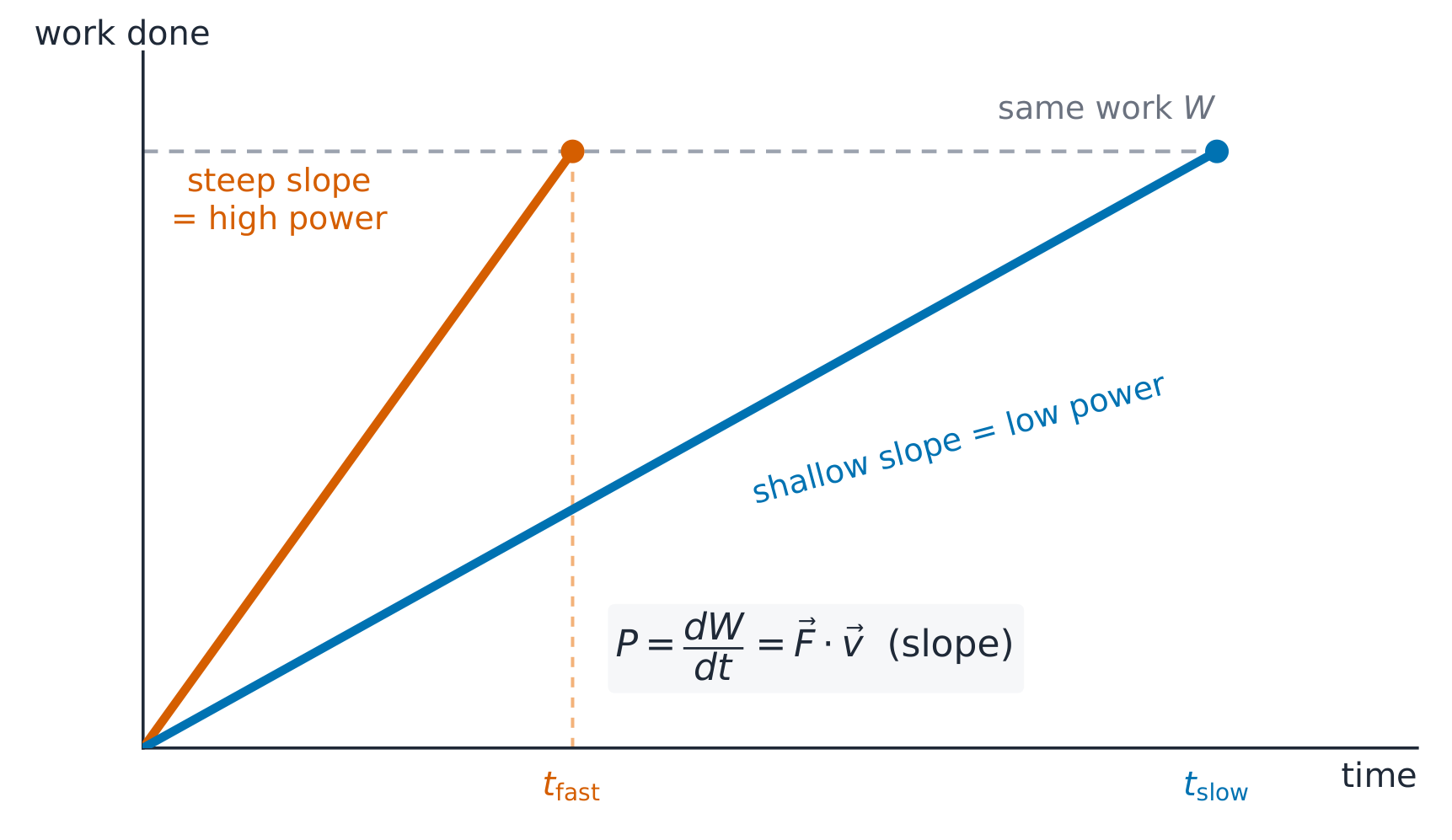
La potencia es la pendiente de la gráfica de trabajo-tiempo: el mismo trabajo en menos tiempo significa más potencia

Ejemplo resuelto. Un bloque liberado desde el reposo en la parte superior de una rampa sin fricción de altura $3.0\ \text{m}$ alcanza la base con una velocidad de $v=\sqrt{2gh}=7.7\ \text{m/s}$ (calculado a partir de $mgh=\tfrac12mv^2$). Un motor que luego lo impulsa a una velocidad constante de $7.7\ \text{m/s}$ contra una resistencia de $20\ \text{N}$ entrega una potencia de $P=Fv=20(7.7)\approx150\ \text{W}$.

Ejemplo resuelto. Un automóvil de masa $1200\ \text{kg}$ asciende una colina que sube $1.0\ \text{m}$ por cada $20\ \text{m}$ de carretera, manteniendo una velocidad constante de $15\ \text{m/s}$. El motor debe suplir la potencia consumida por la gravedad: $P=mg\,v\sin\theta=1200(9.8)(15)\big(\tfrac{1}{20}\big)\approx8.8\ \text{kW}$ – antes de considerar la resistencia del aire.

Habilidad para exámenes. Las preguntas de respuesta libre (FRQ) sobre energía premian la oración de contabilidad: nombra tu sistema, indica qué fuerzas realizan trabajo sobre él y establece el balance ($W_{\text{ext}}=\Delta K+\Delta U+\Delta E_{\text{thermal}}$) antes de sustituir los valores numéricos. La frase "Está presente la fricción, por lo tanto la energía mecánica no se conserva" es una afirmación calificable.

Vocabulary · ⁨Vocabulario⁩ Train · ⁨Entrenar⁩
English · ⁨Inglés⁩ Chinese · ⁨Chino⁩ Pinyin
Power/ˈpaʊə/ 功率 gōng lǜ
watts/wɒts/ 瓦特 wǎ tè
3.5

Exam tips · ⁨Consejos para el examen⁩

English
  • Use the work–energy theorem $W_{net}=\Delta KE$ and compute work as $W=\int \vec F\cdot d\vec r$ for a variable force.
  • Read work off a force–position graph as the area under the curve.
  • Power is $P=\tfrac{dW}{dt}=\vec F\cdot\vec v$; watch instantaneous vs average.
  • Split forces into conservative (define a potential energy) and non-conservative (dissipate energy).
  • Choose energy methods over kinematics when the force varies or the path is complex.
Español
  • Aplica el teorema del trabajo y la energía $W_{net}=\Delta KE$ y calcula el trabajo como $W=\int \vec F\cdot d\vec r$ para una fuerza variable.
  • Lee el valor del trabajo en una gráfica de fuerza-posición como el área bajo la curva.
  • Distingue entre potencia $P=\tfrac{dW}{dt}=\vec F\cdot\vec v$ instantánea y promedio; presta atención a esta distinción.
  • Descompón las fuerzas en conservativas (definen una energía potencial) y no conservativas (disipan energía).
  • Elige métodos energéticos sobre cinemáticos cuando la fuerza varía o la trayectoria es compleja.

Interactive lessons on this topic · ⁨Lecciones interactivas sobre este tema⁩

Work through it step by step, with instant-check exercises. · ⁨Trátalo paso a paso, con ejercicios de verificación instantánea.⁩

Past Papers · ⁨Exámenes Anteriores⁩

More topics in AP Física C: Mecánica · ⁨Más temas en AP Física C: Mecánica⁩

Log in or create account · ⁨Iniciar sesión o crear cuenta⁩

IGCSE, A-Level & AP