Skip to content · ⁨Saltar al contenido⁩

Poesía II

AP Literatura Inglesa y Composición · Topic 5 · ⁨Tema 5⁩

Train · ⁨Entrenar⁩
Video lesson for this topic · ⁨Lección de video para este tema⁩ Open the video page · ⁨Abrir la página de video⁩
9:03

Unidad 5: Poesía II

La Unidad 5 es la segunda unidad de poesía, y hace dos cosas: nombra las formas que puede tomar un poema, y completa el toolkit figurado. Las formas cerradas incluyen…

English narration · English + 中文 subtitles burned in · ⁨Narración en inglés · Subtítulos en inglés + 中文 quemados en pantalla⁩

5.1

The Function of Structure in a Text · ⁨La función de la estructura en un texto⁩

Syllabus
English

Enduring Understanding (STR-1): The arrangement of the parts and sections of a text, the relationship of the parts to each other, and the sequence in which the text reveals information are all structural choices made by a writer that contribute to the reader’s interpretation of a text.

Learning Objective 3.C: Explain the function of structure in a text.

  • STR-1.U Closed forms of poetry include predictable patterns in the structure of lines, stanzas, meter, and rhyme, which develop relationships among ideas in the poem. Note: The AP Exam will not require students to label or identify specific rhyme schemes, metrical patterns, or forms of poetry.
  • STR-1.V Open forms of poetry may not follow expected or predictable patterns in the structure of their lines or stanzas, but they may still have structures that develop relationships between ideas in the poem.
  • STR-1.W Structures combine in texts to emphasize certain ideas and concepts.
Español

Comprensión duradera (STR-1): La disposición de las partes y secciones de un texto, la relación entre dichas partes y la secuencia mediante la cual el texto revela información son todas decisiones estructurales tomadas por un escritor que contribuyen a la interpretación del lector sobre el texto.

Objetivo de aprendizaje 3.C: Explicar la función de la estructura en un texto.

  • STR-1.U Las formas cerradas de la poesía incluyen patrones predecibles en la estructura de los versos, estrofas, métrica y rima, los cuales establecen relaciones entre las ideas del poema. Nota: El examen AP no requerirá que los estudiantes etiqueten o identifiquen esquemas rimáticos, patrones métricos o formas poéticas específicas.
  • STR-1.V Las formas abiertas de la poesía pueden no seguir patrones esperados o predecibles en la estructura de sus versos o estrofas, pero aún pueden contar con estructuras que desarrollan relaciones entre las ideas del poema.
  • STR-1.W Las estructuras se combinan en los textos para enfatizar ciertas ideas y conceptos.

Source: College Board AP Course and Exam Description · ⁨Fuente: College Board AP Course and Exam Description⁩

English

Unit 5 is the second poetry unit, and it does two things: it names the forms a poem can take, and it completes the figurative toolkit.

  • Closed forms 格律诗体 include predictable patterns in lines, stanzas, metre, and rhyme.
  • Open forms 自由诗体 may not follow expected or predictable patterns.
  • Structures combine in texts to emphasise certain ideas.

The examinable question is never "which form is this?" but what the form does. In a closed form, the interesting moment is the departure - the line that runs long, the rhyme that fails to arrive. In an open form, the interesting moment is the imposition - the sudden regularity in a poem that has refused it.

Español

La Unidad 5 es el segundo módulo de poesía y cumple dos funciones: nombra las formas que puede adoptar un poema y completa el kit de herramientas figurativas.

  • Formas cerradas (poesía métrica) incluyen patrones predecibles en las líneas, estrofas, métrica y rima.
  • Formas abiertas (poesía libre) pueden no seguir patrones esperados o predecibles.
  • Las estructuras se combinan en los textos para enfatizar ciertas ideas.

La pregunta examinable nunca es "¿qué forma es esta?", sino qué hace la forma. En una forma cerrada, el momento interesante es la desviación: la línea que se alarga, la rima que no llega a aparecer. En una forma abierta, el momento interesante es la imposición: la regularidad repentina en un poema que la ha rechazado.

5.2

Literal and Figurative Meaning · ⁨Significado literal y figurativo⁩

Syllabus
English

Enduring Understanding (FIG-1): Comparisons, representations, and associations shift meaning from the literal to the figurative and invite readers to interpret a text.

Learning Objective 5.A: Distinguish between the literal and figurative meanings of words and phrases.

  • FIG-1.L Words with multiple meanings or connotations add nuance or complexity that can contribute to interpretations of a text.
Español

Comprensión perdurable (FIG-1): Las comparaciones, representaciones y asociaciones desplazan el significado del ámbito literal al figurado e invitan al lector a interpretar un texto.

Objetivo de aprendizaje 5.A: Distinguir entre los significados literales y figurados de palabras y frases.

  • FIG-1.L Las palabras con múltiples significados o connotaciones añaden matices o complejidad que pueden contribuir a las interpretaciones de un texto.

Source: College Board AP Course and Exam Description · ⁨Fuente: College Board AP Course and Exam Description⁩

English

Words with multiple meanings or connotations add nuance or complexity that can contribute to interpretation.

In poetry, a word that could mean two things frequently means both. Resist choosing.

Español

Las palabras con múltiples significados o connotaciones añaden matices o complejidad que pueden contribuir a la interpretación.

En la poesía, una palabra que podría significar dos cosas frecuentemente significa ambas. Resista la tentación de elegir solo una.

5.3

The Function of Specific Words and Phrases · ⁨La función de palabras y frases específicas⁩

Syllabus
English

Enduring Understanding (FIG-1): Comparisons, representations, and associations shift meaning from the literal to the figurative and invite readers to interpret a text.

Learning Objective 5.B: Explain the function of specific words and phrases in a text.

  • FIG-1.M Descriptive words, such as adjectives and adverbs, qualify or modify the things they describe and affect readers’ interaction with the text.
  • FIG-1.N Hyperbole exaggerates while understatement minimizes. Exaggerating or minimizing an aspect of an object focuses attention on that trait and conveys a perspective about the object.
Español

Comprensión duradera (FIG-1): Las comparaciones, representaciones y asociaciones desplazan el significado desde lo literal hacia lo figurado e invitan al lector a interpretar un texto.

Objetivo de aprendizaje 5.B: Explicar la función de palabras y frases específicas en un texto.

  • FIG-1.M Las palabras descriptivas, como los adjetivos y adverbios, califican o modifican las cosas que describen y afectan la interacción del lector con el texto.
  • FIG-1.N La hipérbole exagera, mientras que la metáfora minimiza. Exagerar o minimizar un aspecto de un objeto centra la atención en esa característica y transmite una perspectiva sobre dicho objeto.

Source: College Board AP Course and Exam Description · ⁨Fuente: College Board AP Course and Exam Description⁩

English
  • Descriptive words qualify or modify what they describe and affect how the reader perceives it.
  • Hyperbole 夸张 exaggerates while understatement 低调陈述 minimises. Exaggerating or minimising an aspect of a thing has an effect on how it is understood.

Understatement is the more powerful of the pair and the more often missed by second-language readers. A poem that describes a catastrophe as inconvenient is not being calm; the gap between the event and the word is the poem's whole comment on it.

Español
  • Palabras descriptivas califican o modifican lo que describen y afectan cómo el lector lo percibe.
  • La hipérbole exagera mientras que la metáfora retórica minimiza. Exagerar o minimizar un aspecto de algo tiene un efecto en cómo se entiende.

La metáfora retórica es la más poderosa de la pareja y la que con mayor frecuencia pasa desapercibida para lectores de idiomas distintos al inglés. Un poema que describe una catástrofe como incomodidad no está siendo calmado; la brecha entre el evento y la palabra es todo el comentario del poema sobre él.

5.4

The Function of an Image or Imagery · ⁨La función de una imagen o de imágenes⁩

Syllabus
English

Enduring Understanding (FIG-1): Comparisons, representations, and associations shift meaning from the literal to the figurative and invite readers to interpret a text.

Learning Objective 5.D: Identify and explain the function of an image or imagery.

  • FIG-1.O Descriptive words, such as adjectives and adverbs, contribute to sensory imagery.
  • FIG-1.P An image can be literal or it can be a form of a comparison that represents something in a text through associations with the senses.
  • FIG-1.Q A collection of images, known as imagery, may emphasize ideas in parts of or throughout a text.
Español

Comprensión duradera (FIG-1): Las comparaciones, las representaciones y las asociaciones desplazan el significado desde lo literal hacia lo figurado e invitan al lector a interpretar un texto.

Objetivo de aprendizaje 5.D: Identificar y explicar la función de una imagen o de la imagen.

  • FIG-1.O Las palabras descriptivas, como los adjetivos y los adverbios, contribuyen a crear imágenes sensoriales.
  • FIG-1.P Una imagen puede ser literal o bien una forma de comparación que representa algo en un texto mediante asociaciones con los sentidos.
  • FIG-1.Q Un conjunto de imágenes, conocido como imagen, puede enfatizar ideas en partes del texto o a lo largo de todo él.

Source: College Board AP Course and Exam Description · ⁨Fuente: College Board AP Course and Exam Description⁩

English
  • Descriptive words contribute to sensory imagery 感官意象.
  • An image can be literal, or a form of comparison representing something through another thing.
  • A collection of images - imagery - may emphasise ideas in parts of, or throughout, a text.

The plural matters. A single image is a detail; a pattern of images running through a poem is a claim the poem is making without stating it.

Español
Los dispositivos de la Poesía II, clasificados según lo que cada uno hace en el lector
Nombrar un dispositivo no obtiene puntos. Decir qué hace en el lector es el análisis.
  • Las palabras descriptivas contribuyen a la imagen sensorial.
  • Una imagen puede ser literal, o una forma de comparación que representa algo a través de otra cosa.
  • Una colección de imágenes — las imágenes poéticas — puede enfatizar ideas en partes del texto o a lo largo de todo él.

El plural importa. Una sola imagen es un detalle; un patrón de imágenes que recorre un poema es una afirmación que el poema realiza sin decirla explícitamente.

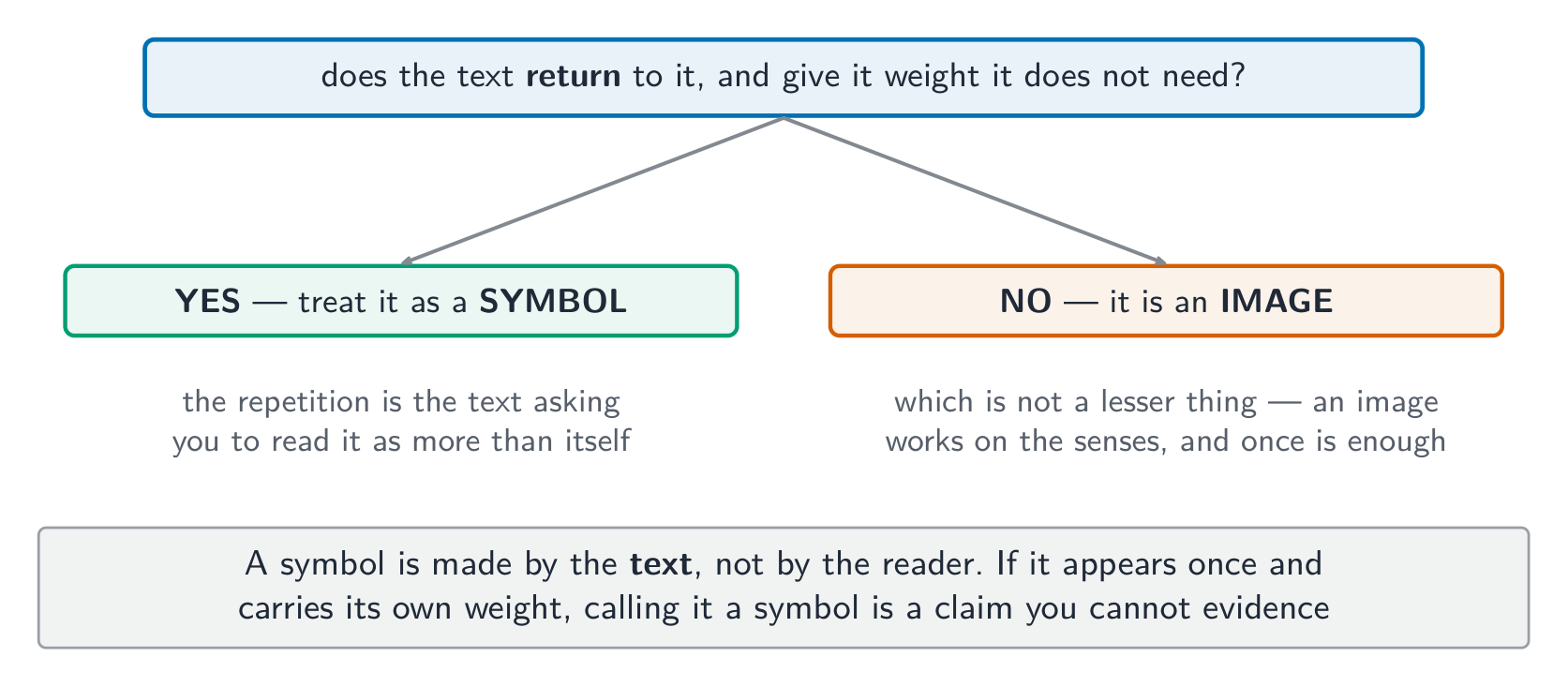
Un símbolo lo crea el texto, no el lector
Explore · ⁨Explorar⁩

¿Imagen o símbolo? Aplicar la prueba

Un símbolo lo crea el texto, no el lector: la prueba es si el texto vuelve a él y le da un peso que no necesita.

5.5

The Function of a Metaphor · ⁨La función de una metáfora⁩

Syllabus
English

Enduring Understanding (FIG-1): Comparisons, representations, and associations shift meaning from the literal to the figurative and invite readers to interpret a text.

Learning Objective 6.B: Identify and explain the function of a metaphor.

  • FIG-1.R Metaphorical comparisons do not focus solely on the objects being compared; they focus on the particular traits, qualities, or characteristics of the things being compared.
  • FIG-1.S Comparisons not only communicate literal meaning but may also convey figurative meaning or transmit a perspective.
  • FIG-1.T An extended metaphor is created when the comparison of a main subject and comparison subject persists through parts of or an entire text, and when the comparison is expanded through additional details, similes, and images.
  • FIG-1.U Interpretation of an extended metaphor may depend on the context of its use; that is, what is happening in a text may determine what is transferred in the comparison.
Español

Comprensión perdurable (FIG-1): Las comparaciones, representaciones y asociaciones desplazan el significado del plano literal al figurado e invitan a los lectores a interpretar un texto.

Objetivo de aprendizaje 6.B: Identificar y explicar la función de una metáfora.

  • FIG-1.R Las comparaciones metafóricas no se centran únicamente en los objetos que se comparan; sino que se enfocan en las rasgos, cualidades o características particulares de lo que se compara.
  • FIG-1.S Las comparaciones no solo comunican un significado literal, sino que también pueden transmitir un significado figurado o una perspectiva.
  • FIG-1.T Una metáfora extendida se crea cuando la comparación entre un sujeto principal y un sujeto comparativo persiste a lo largo de partes o de todo un texto, y cuando dicha comparación se amplía mediante detalles adicionales, símiles e imágenes.
  • FIG-1.U La interpretación de una metáfora extendida puede depender del contexto en que se utiliza; es decir, lo que ocurre en un texto puede determinar qué elementos se transfieren en la comparación.

Source: College Board AP Course and Exam Description · ⁨Fuente: College Board AP Course and Exam Description⁩

English
  • Metaphorical comparisons do not focus solely on the objects compared; they focus on the particular qualities the comparison brings out.
  • Comparisons communicate literal meaning and may also convey figurative meaning.
  • An extended metaphor 延伸隐喻 is created when the comparison of a main subject and comparison subject persists across a passage or a whole text.
  • Interpretation of an extended metaphor may depend on the context of its use.

An extended metaphor is the most rewarding thing to find in an unseen poem, because it gives you structure and meaning at once: you can trace how the comparison develops, and a comparison that changes as it extends is the poem's argument in motion.

Español
  • Las comparaciones metafóricas no se centran únicamente en los objetos comparados; se centran en las calidades particulares que la comparación pone de manifiesto.
  • Las comparaciones comunican significado literal y también pueden transmitir significado figurado.
  • Una metáfora extendida se crea cuando la comparación entre el sujeto principal y el sujeto comparativo persiste a lo largo de un pasaje o de todo el texto.
  • La interpretación de una metáfora extendida puede depender del contexto de su uso.

Una metáfora extendida es lo más gratificante que se puede encontrar en un poema desconocido, porque te ofrece estructura y significado a la vez: puedes rastrear cómo se desarrolla la comparación, y una comparación que cambia a medida que se extiende es el argumento del poema en movimiento.

5.6

The Function of Personification · ⁨La función de la personificación⁩

Syllabus
English

Enduring Understanding (FIG-1): Comparisons, representations, and associations shift meaning from the literal to the figurative and invite readers to interpret a text.

Learning Objective 6.C: Identify and explain the function of personification.

  • FIG-1.V Personification is a type of comparison that assigns a human trait or quality to a nonhuman object, entity, or idea, thus characterizing that object, entity, or idea.
Español

Comprensión duradera (FIG-1): Las comparaciones, representaciones y asociaciones desplazan el significado desde lo literal hacia lo figurado e invitan al lector a interpretar un texto.

Objetivo de aprendizaje 6.C: Identificar y explicar la función de la personificación.

  • FIG-1.V La personificación es un tipo de comparación que asigna una cualidad o rasgo humano a un objeto, entidad o idea no humana, caracterizando así dicho objeto, entidad o idea.

Source: College Board AP Course and Exam Description · ⁨Fuente: College Board AP Course and Exam Description⁩

English

Personification 拟人 is a type of comparison that assigns a human trait or quality to a nonhuman object, animal, or idea.

Treat it as a comparison with the same parts as any other: the main subject is the nonhuman thing, the comparison subject is a person, and the transferred quality is the human trait. Then ask the useful question - what does granting this thing agency do? A wind that decides is not the same claim as a wind that blows.

Español

La personificación es un tipo de comparación que asigna un rasgo o cualidad humana a un objeto, animal o idea no humano.

Trátela como una comparación con las mismas partes que cualquier otra: el sujeto principal es la cosa no humana, el sujeto comparativo es una persona, y la calidad transferida es el rasgo humano. Luego hazte la pregunta útil: ¿qué hace concederle agencia a esta cosa? Un viento que decide no es la misma afirmación que un viento que sopla.

'Lo trae a la vida' es la definición; la tercera columna es el comentario
Vocabulary · ⁨Vocabulario⁩ Train · ⁨Entrenar⁩
English · ⁨Inglés⁩ Chinese · ⁨Chino⁩ Pinyin
Closed forms/kləʊzd fɔːmz/ 格律诗体 gé lǜ shī tǐ
Open forms/ˈəʊpən fɔːmz/ 自由诗体 zì yóu shī tǐ
Hyperbole/haɪˈpɜːbəli/ 夸张 kuā zhāng
understatement/ˌʌndəˈsteɪtmənt/ 低调陈述 dī diào chén shù
contribute to sensory imagery/kənˈtrɪbjuːt tə ˈsensəri ˈɪmɪdʒri/ 感官意象 gǎn guān yì xiàng
extended metaphor/ekˈstendɪd ˈmetəfɔː/ 延伸隐喻 yán shēn yǐn yù
Personification/pɜːˈsɒnɪfɪkeɪʃn/ 拟人 nǐ rén
Allusions/əˈluːʒnz/ 典故 diǎn gù
5.7

The Function of an Allusion · ⁨La función de una alusión⁩

Syllabus
English

Enduring Understanding (FIG-1): Comparisons, representations, and associations shift meaning from the literal to the figurative and invite readers to interpret a text.

Learning Objective 6.D: Identify and explain the function of an allusion.

  • FIG-1.W Allusions in a text can reference literary works including myths and sacred texts; other works of art including paintings and music; or people, places, or events outside the text.
Español

Comprensión duradera (FIG-1): Las comparaciones, representaciones y asociaciones desplazan el significado desde lo literal hacia lo figurado e invitan a los lectores a interpretar un texto.

Objetivo de aprendizaje 6.D: Identificar y explicar la función de una alusión.

  • FIG-1.W Las alusiones en un texto pueden referirse a obras literarias que incluyen mitos y textos sagrados; otras obras de arte como pinturas y música; o personas, lugares o eventos fuera del texto.

Source: College Board AP Course and Exam Description · ⁨Fuente: College Board AP Course and Exam Description⁩

English

Allusions 典故 may reference literary works including myths and sacred texts, other works of art, and historical events.

An allusion imports meaning the poem has not written. That is its efficiency and its risk: it works only for readers who recognise it. When you meet one you do not know, say what the poem does with it structurally - where it is placed, what it interrupts - rather than pretending to a recognition you lack.

Español

Las alusiones pueden referirse a obras literarias que incluyen mitos y textos sagrados, otras obras de arte y eventos históricos.

Una alusión introduce un significado que el poema no ha escrito. Esa es su eficiencia y su riesgo: funciona solo para los lectores que la reconocen. Cuando te encuentres con una que no conozcas, describe lo que el poema hace con ella estructuralmente: dónde está colocada, qué interrumpe, en lugar de fingir un reconocimiento que careces.

Una alusión importa una situación y un juicio —y también tiene un costo—
Explore · ⁨Explorar⁩

Llevar una alusión más allá de la fuente

Nombrar la fuente no es el análisis. Una alusión importa una situación y un juicio, y también tiene un costo.

5.8

Developing a Literary Thesis Statement · ⁨Elaboración de una tesis literaria⁩

Syllabus
English

Enduring Understanding (LAN-1): Readers establish and communicate their interpretations of literature through arguments supported by textual evidence.

Learning Objective 7.B: Develop a thesis statement that conveys a defensible claim about an interpretation of literature and that may establish a line of reasoning.

  • LAN-1.D A thesis statement expresses an interpretation of a literary text, and requires a defense, through use of textual evidence and a line of reasoning, both of which are explained in an essay through commentary.
  • LAN-1.E A thesis statement may preview the development or line of reasoning of an interpretation. This is not to say that a thesis statement must list the points of an interpretation, literary elements to be analyzed, or specific evidence to be used in the argument.
Español

Comprensión duradera (LAN-1): Los lectores establecen y comunican sus interpretaciones de la literatura mediante argumentos respaldados por evidencia textual.

Objetivo de aprendizaje 7.B: Desarrollar una tesis que exprese un argumento defendible sobre una interpretación literaria y que pueda establecer una línea de razonamiento.

  • LAN-1.D Una tesis expresa una interpretación de un texto literario y requiere defensa, mediante el uso de evidencia textual y una línea de razonamiento, ambas las cuales se explican en un ensayo a través de comentarios.
  • LAN-1.E Una tesis puede anticipar el desarrollo o la línea de razonamiento de una interpretación. Esto no significa que una tesis deba enumerar los puntos de una interpretación, los elementos literarios que se analizarán o la evidencia específica que se utilizará en el argumento.

Source: College Board AP Course and Exam Description · ⁨Fuente: College Board AP Course and Exam Description⁩

English

Unchanged: an interpretation requiring textual defence, which may preview the line of reasoning.

Español

Inalterado: una interpretación que requiere defensa textual, la cual puede anticipar la línea de razonamiento.

5.9

Developing Commentary · ⁨Desarrollo de comentarios⁩

Syllabus
English

Enduring Understanding (LAN-1): Readers establish and communicate their interpretations of literature through arguments supported by textual evidence.

Learning Objective 7.C: Develop commentary that establishes and explains relationships among textual evidence, the line of reasoning, and the thesis.

  • LAN-1.F A line of reasoning is the logical sequence of claims that work together to defend the overarching thesis statement.
  • LAN-1.G A line of reasoning is communicated through commentary that explains the logical relationship between the overarching thesis statement and the claims/evidence within the body of an essay.
Español

Comprensión perdurable (LAN-1): Los lectores establecen y comunican sus interpretaciones de la literatura a través de argumentos respaldados por evidencia textual.

Objetivo de aprendizaje 7.C: Desarrollar comentarios que establezcan y expliquen las relaciones entre la evidencia textual, la línea de razonamiento y la tesis.

  • LAN-1.F Una línea de razonamiento es la secuencia lógica de afirmaciones que trabajan conjuntamente para defender la afirmación de tesis general.
  • LAN-1.G Una línea de razonamiento se comunica mediante comentarios que explican la relación lógica entre la afirmación de tesis general y las afirmaciones/evidencias dentro del cuerpo de un ensayo.

Source: College Board AP Course and Exam Description · ⁨Fuente: College Board AP Course and Exam Description⁩

English

A line of reasoning is the logical sequence of claims defending the thesis, communicated through commentary explaining the relationship between evidence and claim.

Español

Una línea de razonamiento es la secuencia lógica de afirmaciones que defienden la tesis, comunicada a través de comentarios que explican la relación entre la evidencia y la afirmación.

5.10

Selecting Relevant and Sufficient Evidence · ⁨Selección de evidencia relevante y suficiente⁩

Syllabus
English

Enduring Understanding (LAN-1): Readers establish and communicate their interpretations of literature through arguments supported by textual evidence.

Learning Objective 7.D: Select and use relevant and sufficient evidence to both develop and support a line of reasoning.

  • LAN-1.H Writers use evidence strategically and purposefully to illustrate, clarify, exemplify, associate, amplify, or qualify a point.
  • LAN-1.I Evidence is effective when the writer of the essay uses commentary to explain a logical relationship between the evidence and the claim.
  • LAN-1.J Evidence is sufficient when its quantity and quality provide apt support for the line of reasoning.
  • LAN-1.K Developing and supporting an interpretation of a text is a recursive process; an interpretation can emerge from analyzing evidence and then forming a line of reasoning, or the interpretation can emerge from forming a line of reasoning and then identifying relevant evidence to support that line of reasoning.
Español

Comprensión perdurable (LAN-1): Los lectores establecen y comunican sus interpretaciones de la literatura a través de argumentos respaldados por evidencia textual.

Objetivo de aprendizaje 7.D: Seleccionar y utilizar evidencia relevante y suficiente para desarrollar y sustentar una línea de razonamiento.

  • LAN-1.H Los escritores utilizan la evidencia de manera estratégica y con propósito para ilustrar, aclarar, ejemplificar, asociar, amplificar o matizar un punto.
  • LAN-1.I La evidencia es efectiva cuando el autor del ensayo utiliza comentarios para explicar una relación lógica entre la evidencia y la afirmación.
  • LAN-1.J La evidencia es suficiente cuando su cantidad y calidad brindan un apoyo adecuado a la línea de razonamiento.
  • LAN-1.K El desarrollo y sustento de una interpretación de un texto es un proceso recursivo; una interpretación puede emerger del análisis de la evidencia y posterior formación de una línea de razonamiento, o bien la interpretación puede emerger de la formación de una línea de razonamiento y posterior identificación de evidencia relevante para sustentarla.

Source: College Board AP Course and Exam Description · ⁨Fuente: College Board AP Course and Exam Description⁩

English

Evidence used strategically, effective with commentary, sufficient in quantity and quality, and interpretation as a recursive process.

Español

Evidencia utilizada estratégicamente, eficaz junto con comentarios, suficiente en cantidad y calidad, e interpretación como un proceso recursivo.

5.11

Control Over the Elements of Composition · ⁨Control sobre los elementos de composición⁩

Syllabus
English

Enduring Understanding (LAN-1): Readers establish and communicate their interpretations of literature through arguments supported by textual evidence.

Learning Objective 7.E: Demonstrate control over the elements of composition to communicate clearly.

  • LAN-1.Q Transitional elements are words or other elements (phrases, clauses, sentences, or paragraphs) that assist in creating coherence between sentences and paragraphs by showing relationships between ideas.
Español

Comprensión perdurable (LAN-1): Los lectores establecen y comunican sus interpretaciones de la literatura a través de argumentos respaldados por evidencia textual.

Objetivo de aprendizaje 7.E: Demostrar control sobre los elementos de la composición para comunicarse con claridad.

  • LAN-1.Q Los elementos transitivos son palabras u otros elementos (frases, oraciones o párrafos) que ayudan a crear coherencia entre oraciones y párrafos al mostrar las relaciones entre ideas.

Source: College Board AP Course and Exam Description · ⁨Fuente: College Board AP Course and Exam Description⁩

English

Transitional elements - words, phrases, clauses, sentences, or paragraphs - assist in creating coherence.

Worked example (a real AP exam task). A poetry-analysis prompt asks how the poet's use of figurative language conveys the speaker's attitude. A weak answer catalogues: "The poet uses personification, imagery, and a metaphor." A scoring answer traces one device developing: "The extended comparison of the tide to a creditor runs the length of the poem, but the terms change: in the first stanza it 'asks', by the third it 'takes what was always owed'. The comparison subject stays constant while the speaker's account of the relationship hardens - so the attitude the poem conveys is not fear of loss but the recognition that the loss was never hers to prevent." One device, traced, with the attitude it produces.

Español

Elementos de transición —palabras, frases, cláusulas, oraciones o párrafos— ayudan a crear coherencia.

Ejemplo resuelto (una tarea real del examen AP). Un enunciado de análisis de poesía pregunta cómo el uso del lenguaje figurativo del poeta transmite la actitud del hablante. Una respuesta débil cataloga: "El poeta usa personificación, imágenes y una metáfora." Una respuesta con puntuación completa traza un dispositivo en desarrollo: "La comparación extendida de la marea con un acreedor recorre todo el poema, pero los términos cambian: en la primera estrofa 'pide', para la tercera 'toma lo que siempre se debía'. El sujeto comparativo permanece constante mientras la descripción del hablante sobre la relación se endurece; por lo tanto, la actitud que transmite el poema no es el miedo a la pérdida, sino el reconocimiento de que esa pérdida nunca fue suya para prevenir." Un solo dispositivo, trazado, con la actitud que produce.

5.11

Exam tips · ⁨Consejos para el examen⁩

English
  • Never ask "which form is this?" Ask what the form does - and look for the departure or the imposition.
  • A word with two meanings often means both. Do not choose prematurely.
  • Understatement is the more powerful half of the pair, and the more often missed. The gap is the comment.
  • A pattern of images is a claim the poem makes without stating it. A single image is only a detail.
  • An extended metaphor that changes as it extends is the poem's argument in motion. Trace it.
  • Cataloguing devices earns nothing. One device traced beats four devices named.
Español
  • Nunca preguntes "¿qué forma es esta?". Pregunta qué hace la forma —y busca la desviación o la imposición.
  • Una palabra con dos significados a menudo significa ambos. No elijas prematuramente.
  • La metáfora retórica es la mitad más poderosa de la pareja y la que con mayor frecuencia se pasa por alto. La brecha es el comentario.
  • Un patrón de imágenes es una afirmación que el poema hace sin decirlo. Una sola imagen es solo un detalle.
  • Una metáfora extendida que cambia a medida que se extiende es el argumento del poema en movimiento. Rastrea ese cambio.
  • Catalogar dispositivos no obtiene puntos. Trazar un solo dispositivo supera a nombrar cuatro dispositivos.

Interactive lessons on this topic · ⁨Lecciones interactivas sobre este tema⁩

Work through it step by step, with instant-check exercises. · ⁨Trátalo paso a paso, con ejercicios de verificación instantánea.⁩

Past Papers · ⁨Exámenes Anteriores⁩

More topics in AP Literatura Inglesa y Composición · ⁨Más temas en AP Literatura Inglesa y Composición⁩

Log in or create account · ⁨Iniciar sesión o crear cuenta⁩

IGCSE, A-Level & AP