Skip to content · ⁨Saltar al contenido⁩

Ficción corta I

AP Literatura Inglesa y Composición · Topic 1 · ⁨Tema 1⁩

Train · ⁨Entrenar⁩
Video lesson for this topic · ⁨Lección de video para este tema⁩ Open the video page · ⁨Abrir la página de video⁩
6:43

Unidad 1: Ficción corta I

AP English Literature lee textos en tres géneros a través de nueve unidades — ficción corta, poesía y ficción larga o drama — visitando cada uno tres veces en…

English narration · English + 中文 subtitles burned in · ⁨Narración en inglés · Subtítulos en inglés + 中文 quemados en pantalla⁩

1.1

What Textual Details Reveal About a Character · ⁨¿Qué revelan los detalles textuales sobre un personaje⁩

Syllabus
English

Enduring Understanding (CHR-1): Characters in literature allow readers to study and explore a range of values, beliefs, assumptions, biases, and cultural norms represented by those characters.

Learning Objective 1.A: Identify and describe what specific textual details reveal about a character, that character’s perspective, and that character’s motives.

  • CHR-1.A Description, dialogue, and behavior reveal characters to readers.
  • CHR-1.B Descriptions of characters may come from a speaker, narrator, other characters, or the characters themselves.
  • CHR-1.C Perspective is how narrators, characters, or speakers understand their circumstances, and is informed by background, personality traits, biases, and relationships.
  • CHR-1.D A character’s perspective is both shaped and revealed by relationships with other characters, the environment, the events of the plot, and the ideas expressed in the text.
Español

Comprensión duradera (CHR-1): Los personajes en la literatura permiten a los lectores estudiar y explorar una variedad de valores, creencias, supuestos, prejuicios y normas culturales representados por dichos personajes.

Objetivo de aprendizaje 1.A: Identificar y describir qué detalles textuales específicos revelan sobre un personaje, la perspectiva de ese personaje y los motivos de dicho personaje.

  • CHR-1.A La descripción, el diálogo y el comportamiento revelan a los personajes ante los lectores.
  • CHR-1.B Las descripciones de los personajes pueden provenir de un hablante, un narrador, otros personajes o los propios personajes.
  • CHR-1.C La perspectiva es la forma en que los narradores, los personajes o los hablantes comprenden sus circunstancias, y está informada por su fondo, rasgos de personalidad, prejuicios y relaciones.
  • CHR-1.D La perspectiva de un personaje se ve tanto moldeada como revelada por las relaciones con otros personajes, el entorno, los eventos de la trama y las ideas expresadas en el texto.

Source: College Board AP Course and Exam Description · ⁨Fuente: College Board AP Course and Exam Description⁩

English

AP English Literature reads texts in three genres across nine units - short fiction, poetry, and longer fiction or drama, each visited three times at increasing difficulty. Unit 1 installs the tools for all of them.

Character 人物 is revealed by three things, and the CED names them exactly:

  • Description, dialogue, and behaviour 描写、对话与行为 reveal characters to readers.
  • Descriptions may come from a speaker, narrator, other characters, or the characters themselves - so who is describing is part of the evidence.
  • Perspective 视角 is how narrators, characters, or speakers understand their circumstances, informed by background, experience, and values.
  • A character's perspective is both shaped and revealed by relationships with other characters, the environment, and events.

That last point is the one that turns character notes into analysis. A character is not a list of adjectives; a character is a way of seeing, which becomes visible in what they notice, what they misread, and how they respond.

Español

El AP English Literature lee textos en tres géneros a lo largo de nueve unidades: ficción corta, poesía y ficción larga o drama, cada uno abordado tres veces con dificultad progresiva. La Unidad 1 introduce las herramientas para todos ellos.

Personaje 人物 es revelado por tres elementos, y el CED los nombra exactamente:

  • Descripción, diálogo y comportamiento 描写、对话与行为 revelan los personajes al lector.
  • Las descripciones pueden provenir de un locutor, narrador, otros personajes o los propios personajes; por tanto, quién describe forma parte de la evidencia.
  • Perspectiva 视角 es cómo narradores, personajes o locutores comprenden sus circunstancias, informada por su trasfondo, experiencia y valores.
  • La perspectiva de un personaje está moldeada y revelada por sus relaciones con otros personajes, el entorno y los acontecimientos.

Ese último punto es lo que convierte las notas sobre personajes en análisis. Un personaje no es una lista de adjetivos; un personaje es una manera de ver, que se hace visible en lo que nota, en lo que malinterpreta y en cómo responde.

Di qué establece el detalle y detente donde termina la evidencia
Explore · ⁨Explorar⁩

Tomar un detalle exactamente hasta donde llega

Leer demasiado pierde tantas marcas como leer poco: di lo que establece el detalle, y detente donde termina la evidencia.

1.2

Textual Details That Convey Setting · ⁨Detalles textuales que transmiten el escenario⁩

Syllabus
English

Enduring Understanding (SET-1): Setting and the details associated with it not only depict a time and place, but also convey values associated with that setting.

Learning Objective 2.A: Identify and describe specific textual details that convey or reveal a setting.

  • SET-1.A Setting includes the time and place during which the events of the text occur.
Español

Comprensión perdurable (SET-1): El entorno y los detalles asociados a él no solo representan un tiempo y un lugar, sino que también transmiten valores vinculados a dicho entorno.

Objetivo de aprendizaje 2.A: Identificar y describir detalles textuales específicos que transmitan o revelen un entorno.

  • SET-1.A El entorno incluye el tiempo y el lugar en que ocurren los eventos del texto.

Source: College Board AP Course and Exam Description · ⁨Fuente: College Board AP Course and Exam Description⁩

English

Setting 背景 includes the time and place during which the events of the text occur.

The CED's definition is deliberately minimal, and that is the trap. Setting earns marks not when it is described but when it is shown doing something - constraining a character, explaining a value, or contrasting with an interior state. A paragraph that establishes where a story happens has not yet made a claim.

Español

Escenario 背景 incluye el tiempo y lugar durante los cuales ocurren los eventos del texto.

La definición del CED es deliberadamente mínima, y esa es la trampa. El escenario obtiene puntuación no cuando se describe, sino cuando se muestra haciendo algo: restringiendo a un personaje, explicando un valor o contrastando con un estado interior. Un párrafo que establece dónde sucede una historia aún no ha formulado una afirmación.

1.3

How Plot Orders Events · ⁨Cómo ordena los eventos la trama⁩

Syllabus
English

Enduring Understanding (STR-1): The arrangement of the parts and sections of a text, the relationship of the parts to each other, and the sequence in which the text reveals information are all structural choices made by a writer that contribute to the reader’s interpretation of a text.

Learning Objective 3.A: Identify and describe how plot orders events in a narrative.

  • STR-1.A Plot is the sequence of events in a narrative; events throughout a narrative are connected, with each event building on the others, often with a cause-and-effect relationship.
  • STR-1.B The dramatic situation of a narrative includes the setting and action of the plot and how that narrative develops to place characters in conflict(s), and often involves the rising or falling fortunes of a main character or set of characters.
Español

Comprensión perdurable (STR-1): La disposición de las partes y secciones de un texto, la relación entre esas partes y la secuencia en que el texto revela información son todas elecciones estructurales realizadas por un escritor que contribuyen a la interpretación del lector sobre el mismo.

Objetivo de aprendizaje 3.A: Identificar y describir cómo la trama ordena los eventos en una narración.

  • STR-1.A La trama es la secuencia de eventos en una narración; los eventos a lo largo de la narración están conectados, con cada evento construyéndose sobre los anteriores, a menudo mediante relaciones de causa y efecto.
  • STR-1.B La situación dramática de una narración incluye el escenario y la acción de la trama, así como el desarrollo de dicha narración para situar a los personajes en conflicto(s), e implica frecuentemente el ascenso o declive de la fortuna de un personaje principal o conjunto de personajes.

Source: College Board AP Course and Exam Description · ⁨Fuente: College Board AP Course and Exam Description⁩

English
  • Plot 情节 is the sequence of events in a narrative; events are connected, each building on those before it.
  • The dramatic situation 戏剧情境 includes the setting and action of the plot and how the narrative develops to place characters in conflict.

The word sequence is doing work. Plot is not the events but their order - and an author who reveals something late that happened early has made a choice you can analyse.

Español
  • Trama 情节 es la secuencia de eventos en una narrativa; los eventos están conectados, cada uno construyéndose sobre los anteriores.
  • La situación dramática 戏剧情情境 incluye el escenario y la acción de la trama y cómo se desarrolla la narrativa para situar a los personajes en conflicto.

La palabra secuencia cumple una función clave. La trama no son los eventos, sino su orden; y un autor que revela algo tarde que ocurrió temprano ha tomado una elección que puedes analizar.

El orden en que ocurrieron los eventos frente al orden en que te los contaron: la diferencia es una elección
Vocabulary · ⁨Vocabulario⁩ Train · ⁨Entrenar⁩
English · ⁨Inglés⁩ Chinese · ⁨Chino⁩ Pinyin
Character/ˈkærɪktə/ 人物 rén wù
Description, dialogue, and behaviour/dɪˈskrɪpʃn ˈdaɪəlɒɡ ænd bɪˈheɪvjə/ 描写、对话与行为 miáo xiě 、 duì huà yǔ xíng wéi
Perspective/pəˈspektɪv/ 视角 shì jiǎo
Setting/ˈsetɪŋ/ 背景 bèi jǐng
Plot/plɒt/ 情节 qíng jié
dramatic situation/drəˈmætɪk ˌsɪtʃuːˈeɪʃn/ 戏剧情境 xì jù qíng jìng
1.4

The Function of a Sequence of Events · ⁨La función de una secuencia de eventos⁩

Syllabus
English

Enduring Understanding (STR-1): The arrangement of the parts and sections of a text, the relationship of the parts to each other, and the sequence in which the text reveals information are all structural choices made by a writer that contribute to the reader’s interpretation of a text.

Learning Objective 3.B: Explain the function of a particular sequence of events in a plot.

  • STR-1.C Plot and the exposition that accompanies it focus readers’ attention on the parts of the narrative that matter most to its development, including characters, their relationships, and their roles in the narrative, as well as setting and the relationship between characters and setting.
Español

Comprensión perdurable (STR-1): La disposición de las partes y secciones de un texto, la relación entre esas partes y la secuencia mediante la cual el texto revela información son todas decisiones estructurales tomadas por un escritor que contribuyen a la interpretación del lector sobre el texto.

Objetivo de aprendizaje 3.B: Explicar la función de una secuencia de eventos particular en una trama.

  • STR-1.C La trama y la exposición que la acompañan centran la atención del lector en las partes de la narrativa que más importan para su desarrollo, incluidos los personajes, sus relaciones y sus roles en la narrativa, así como el escenario y la relación entre los personajes y el escenario.

Source: College Board AP Course and Exam Description · ⁨Fuente: College Board AP Course and Exam Description⁩

English

Plot and the exposition that accompanies it focus readers' attention on the parts of the narrative that matter most to the text's meaning.

That sentence is the whole method for prose analysis: proportion is evidence. What the text lingers over, and what it passes in a clause, is the author telling you where to look.

Español

La trama y la exposición que la acompaña centran la atención del lector en las partes de la narrativa que más importan para el significado del texto.

Esa oración es todo el método para el análisis de prosa: la proporción es evidencia. Lo que el texto prolonga y lo que pasa rápidamente en una cláusula es el autor indicándote dónde mirar.

1.5

Identifying the Narrator or Speaker · ⁨Identificar al narrador o locutor⁩

Syllabus
English

Enduring Understanding (NAR-1): A narrator’s or speaker’s perspective controls the details and emphases that affect how readers experience and interpret a text.

Learning Objective 4.A: Identify and describe the narrator or speaker of a text.

  • NAR-1.A Narrators or speakers relate accounts to readers and establish a relationship between the text and the reader.
  • NAR-1.B Perspective refers to how narrators, characters, or speakers see their circumstances, while point of view refers to the position from which a narrator or speaker relates the events of a narrative.
  • NAR-1.C A speaker or narrator is not necessarily the author.
Español

Comprensión perdurable (NAR-1): La perspectiva de un narrador o hablante controla los detalles y las énfasis que afectan cómo los lectores experimentan e interpretan un texto.

Objetivo de aprendizaje 4.A: Identificar y describir el narrador o hablante de un texto.

  • NAR-1.A Los narradores o hablantes relatan cuentas a los lectores y establecen una relación entre el texto y el lector.
  • NAR-1.B La perspectiva se refiere a cómo los narradores, personajes o hablantes ven sus circunstancias, mientras que el punto de vista se refiere a la posición desde la cual un narrador o hablante relata los eventos de una narrativa.
  • NAR-1.C Un hablante o narrador no es necesariamente el autor.

Source: College Board AP Course and Exam Description · ⁨Fuente: College Board AP Course and Exam Description⁩

English
  • Narrators or speakers relate accounts and establish a relationship between the text and the reader.
  • Perspective refers to how narrators, characters, or speakers see their circumstances; point of view 叙述视点 refers to the position from which they relate the account.
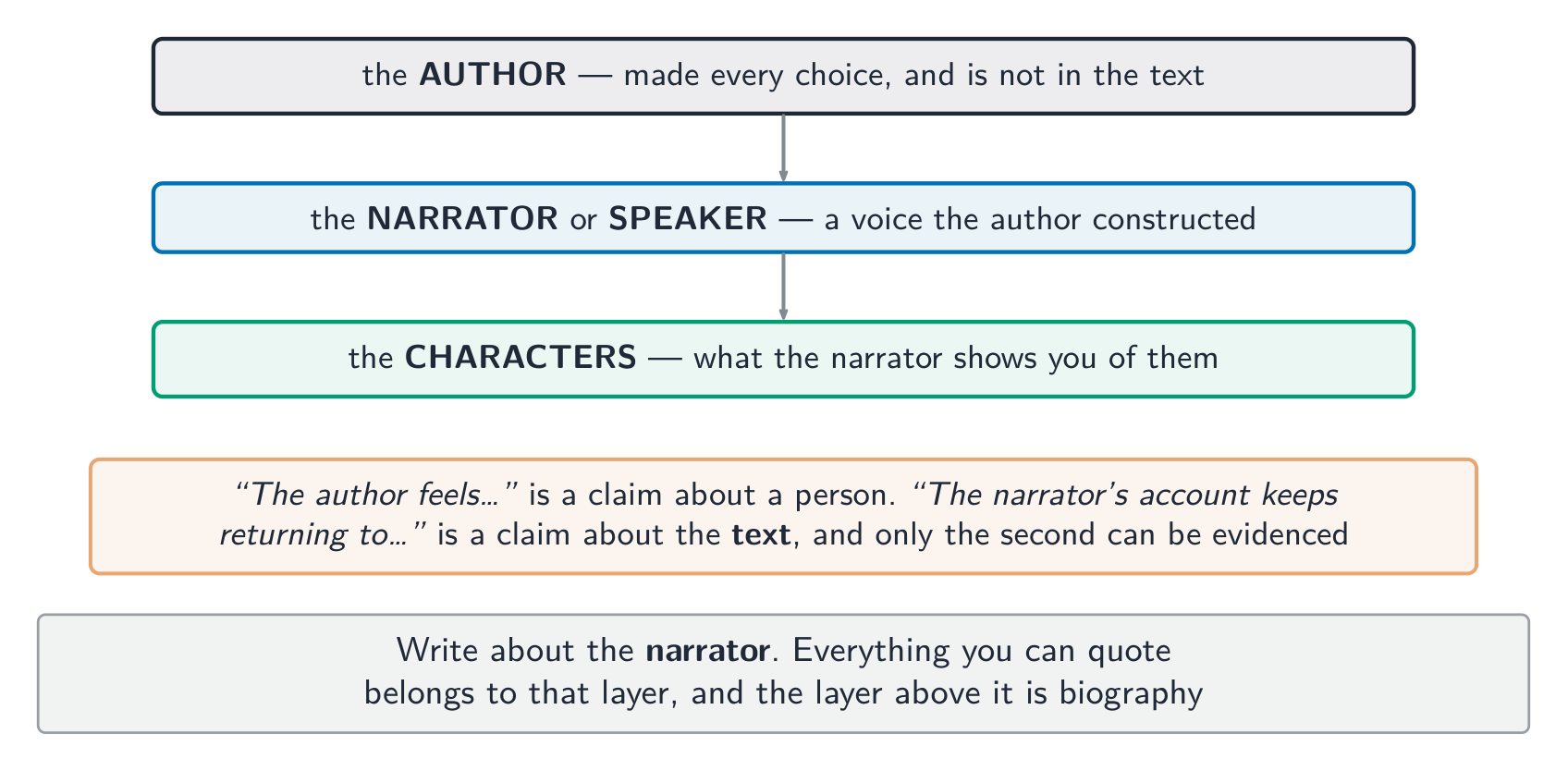
  • A speaker or narrator is not necessarily the author. Never write "the author feels" about a first-person narrator.
Español
Lo que cada punto de vista puede y no puede darte, y ese límite es el análisis
La perspectiva es cómo ven; el punto de vista es desde dónde están. El CED los separa, y tú también debes hacerlo.
  • Narradores o locutores relatan cuentas y establecen una relación entre el texto y el lector.
  • Perspectiva se refiere a cómo narradores, personajes o locutores ven sus circunstancias; punto de vista 叙述视点 se refiere a la posición desde la cual relatan la cuenta.
  • Un locutor o narrador no es necesariamente el autor. Nunca escribas "el autor siente" sobre un narrador en primera persona.
Escribe sobre el narrador: todo lo que puedas citar pertenece a esa capa
Explore · ⁨Explorar⁩

Clasificar cada declaración según la capa a la que pertenece

Todo lo que puedes citar pertenece a la capa del narrador. La capa superior es la biografía.

Vocabulary · ⁨Vocabulario⁩ Train · ⁨Entrenar⁩
English · ⁨Inglés⁩ Chinese · ⁨Chino⁩ Pinyin
point of view/pɔɪnt ɒv vjuː/ 叙述视点 xù shù shì diǎn
observational to all-knowing/ɒbzəˈveɪʃənl tʊ ɔːl ˈnəʊɪŋ/ 全知 quán zhī
1.6

The Function of Point of View · ⁨La función del punto de vista⁩

Syllabus
English

Enduring Understanding (NAR-1): A narrator’s or speaker’s perspective controls the details and emphases that affect how readers experience and interpret a text.

Learning Objective 4.B: Identify and explain the function of point of view in a narrative.

  • NAR-1.D The point of view contributes to what narrators, characters, or speakers can and cannot provide in a text based on their level of involvement and intimacy with the details, events, or characters.
  • NAR-1.E Narrators may also be characters, and their role as characters may influence their perspective.
  • NAR-1.F First-person narrators are involved in the narrative; their relationship to the events of the plot and the other characters shapes their perspective.
  • NAR-1.G Third-person narrators are outside observers.
  • NAR-1.H Third-person narrators’ knowledge about events and characters may range from observational to all-knowing, which shapes their perspective.
  • NAR-1.I The outside perspective of third-person narrators may not be affected by the events of the narrative.
Español

Comprensión duradera (NAR-1): La perspectiva de un narrador o hablante controla los detalles y las énfasis que influyen en cómo los lectores experimentan e interpretan un texto.

Objetivo de aprendizaje 4.B: Identificar y explicar la función del punto de vista en una narrativa.

  • NAR-1.D El punto de vista contribuye a lo que los narradores, personajes o hablantes pueden y no pueden ofrecer en un texto según su nivel de implicación e intimidad con los detalles, eventos o personajes.
  • NAR-1.E Los narradores también pueden ser personajes, y su rol como personajes puede influir en su perspectiva.
  • NAR-1.F Los narradores en primera persona están involucrados en la narrativa; su relación con los eventos de la trama y los otros personajes moldea su perspectiva.
  • NAR-1.G Los narradores en tercera persona son observadores externos.
  • NAR-1.H El conocimiento de los narradores en tercera persona sobre eventos y personajes puede variar desde lo observacional hasta lo omnisciente, lo cual moldea su perspectiva.
  • NAR-1.I La perspectiva externa de los narradores en tercera persona puede no verse afectada por los eventos de la narrativa.

Source: College Board AP Course and Exam Description · ⁨Fuente: College Board AP Course and Exam Description⁩

English
  • Point of view contributes to what narrators can and cannot provide in a text, based on their position.
  • Narrators may also be characters, and that role may influence their perspective.
  • First-person narrators are involved in the narrative; their relationship to events and to other characters shapes what they can tell you.
  • Third-person narrators are outside observers, and their knowledge may range from observational to all-knowing 全知.
  • The outside perspective of a third-person narrator may not be affected by the events of the narrative.

The analytical payoff is the cannot. A first-person narrator cannot report what they did not witness or will not admit, and every gap is meaningful. A limited third-person narrator confines you to one consciousness, which is a choice about whose experience counts.

Español
  • El punto de vista contribuye a lo que los narradores pueden y no pueden ofrecer en un texto, según su posición.
  • Los narradores también pueden ser personajes, y ese rol puede influir en su perspectiva.
  • Los narradores en primera persona están implicados en la narrativa; su relación con los eventos y con otros personajes moldea lo que pueden contarte.
  • Los narradores en tercera persona son observadores externos, y su conocimiento puede variar desde lo observacional hasta lo omnisciente 全知.
  • La perspectiva externa de un narrador en tercera persona puede no verse afectada por los eventos de la narrativa.

La recompensa analítica reside en el no poder. Un narrador en primera persona no puede reportar lo que no presenció ni lo que no admitirá, y cada omisión es significativa. Un narrador en tercera persona limitado te confina a una sola conciencia, lo cual es una elección sobre cuya experiencia importa.

1.7

Developing a Paragraph with Claim and Evidence · ⁨Desarrollar un párrafo con afirmación y evidencia⁩

Syllabus
English

Enduring Understanding (LAN-1): Readers establish and communicate their interpretations of literature through arguments supported by textual evidence.

Learning Objective 7.A: Develop a paragraph that includes 1) a claim that requires defense with evidence from the text and 2) the evidence itself.

  • LAN-1.A In literary analysis, writers read a text closely to identify details that, in combination, enable them to make and defend a claim about an aspect of the text.
  • LAN-1.B A claim is a statement that requires defense with evidence from the text.
  • LAN-1.C In literary analysis, the initial components of a paragraph are the claim and textual evidence that defends the claim.
Español

Comprensión perdurable (LAN-1): Los lectores establecen y comunican sus interpretaciones de la literatura mediante argumentos respaldados por evidencia textual.

Objetivo de aprendizaje 7.A: Desarrollar un párrafo que incluya 1) una afirmación que requiera defensa con evidencia del texto y 2) la evidencia misma.

  • LAN-1.A En el análisis literario, los escritores leen un texto con detenimiento para identificar detalles que, en conjunto, les permiten formular y defender una afirmación sobre un aspecto del texto.
  • LAN-1.B Una afirmación es una declaración que requiere defensa con evidencia del texto.
  • LAN-1.C En el análisis literario, los componentes iniciales de un párrafo son la afirmación y la evidencia textual que la respalda.

Source: College Board AP Course and Exam Description · ⁨Fuente: College Board AP Course and Exam Description⁩

English
  • In literary analysis, writers read a text closely to identify details that, in combination, enable them to make and defend a claim.
  • A claim is a statement that requires defence with evidence from the text.
  • The initial components of a paragraph are the claim and the textual evidence that defends it.

Note in combination. A single detail rarely supports an interpretive claim; two or three details that point the same way do.

Worked example (a real AP exam task). The AP Literature free-response section has three questions - poetry analysis, prose fiction analysis, and a literary argument on a work you choose - all marked on a six-point rubric: thesis 1, evidence and commentary 4, sophistication 1. For a prose fiction prompt asking how the author uses narrative techniques to reveal a character's attitude, a weak answer writes "the narrator is first-person, which makes it personal." A scoring answer uses the cannot: "Because the narrator is a participant recounting events years later, the account gives us his present judgement of his younger self and withholds what the other characters thought - so the reader receives his self-criticism as the only available evidence, and must decide whether the harshness of it is accuracy or performance." Point of view, its limit, and the effect on the reader.

Español
  • En el análisis literario, los escritores leen un texto detenidamente para identificar detalles que, en combinación, les permitan formular y defender una afirmación.
  • Una afirmación es una declaración que requiere defensa con evidencia del texto.
  • Los componentes iniciales de un párrafo son la afirmación y la evidencia textual que la respalda.

Nota en combinación. Un solo detalle rara vez apoya una interpretación; dos o tres detalles que apuntan en la misma dirección sí lo hacen.

Ejemplo resuelto (una tarea real del examen AP). La sección de respuestas libres del AP Literature tiene tres preguntas: análisis de poesía, análisis de ficción en prosa y un argumento literario sobre una obra que tú elijas; todas se califican según una rúbrica de seis puntos: tesis 1, evidencia y comentario 4, sofisticación 1. Para un prompt de ficción en prosa que pregunta cómo usa el autor las técnicas narrativas para revelar la actitud de un personaje, una respuesta débil escribe "el narrador es en primera persona, lo que lo hace personal." Una respuesta que obtiene puntuación utiliza el no poder: "Como el narrador es un participante que relata eventos años después, la cuenta nos da su juicio actual sobre su yo más joven y oculta lo que pensaban los otros personajes; así, el lector recibe su autocritica como la única evidencia disponible, y debe decidir si la dureza de esta es exactitud o actuación." Punto de vista, su límite y el efecto en el lector.

1.7

Exam tips · ⁨Consejos para el examen⁩

English
  • Character is a way of seeing, not a list of adjectives. Analyse what they notice and misread.
  • Setting must do something. Describing where a story happens is not yet a claim.
  • Plot is the order of events. A late revelation of an early event is an authorial choice worth analysing.
  • Proportion is evidence. What the text lingers over is where the meaning is.
  • The narrator is not the author. Never write "the author feels" about a first-person narrator.
  • The analytical gold in point of view is what the narrator cannot provide.
Español
  • El personaje es una manera de ver, no una lista de adjetivos. Analiza lo que nota y lo que malinterpreta.
  • El escenario debe hacer algo. Describir dónde sucede una historia aún no es una afirmación.
  • La trama es el orden de los eventos. Una revelación tardía de un evento temprano es una elección autoral digna de análisis.
  • La proporción es evidencia. Lo que el texto prolonga es donde reside el significado.
  • El narrador no es el autor. Nunca escribas "el autor siente" sobre un narrador en primera persona.
  • El oro analítico del punto de vista es lo que el narrador no puede ofrecer.

Interactive lessons on this topic · ⁨Lecciones interactivas sobre este tema⁩

Work through it step by step, with instant-check exercises. · ⁨Trátalo paso a paso, con ejercicios de verificación instantánea.⁩

Past Papers · ⁨Exámenes Anteriores⁩

More topics in AP Literatura Inglesa y Composición · ⁨Más temas en AP Literatura Inglesa y Composición⁩

Log in or create account · ⁨Iniciar sesión o crear cuenta⁩

IGCSE, A-Level & AP