Skip to content · ⁨Saltar al contenido⁩
Subjects · ⁨Temas⁩

AP Literatura Inglesa y Composición

Tips · ⁨Consejos⁩

AP English Literature and Composition enseña la lectura atenta y el argumento literario a través de tres tipos de textos, cada uno visitado tres veces: ficción corta, poesía y ficción larga o drama. Las unidades tienen un enfoque espiralado, por lo que las mismas habilidades se retoman con mayor profundidad.

El curso está organizado por elementos literarios: personaje, ambientación, estructura, narración, lenguaje figurado y argumentación literaria. Cada elemento tiene sus propias habilidades y cada uno plantea la misma pregunta subyacente: ¿qué hace esta elección *en* el texto?

"La función de" es la frase clave para prestar atención. El marco solicita repetidamente la función de un símbolo, un contraste, un cambio en la narración. Identificar un recurso es el primer paso; explicar la labor que realiza es la respuesta.

La interpretación debe ser defendible, no meramente personal. Una lectura obtiene crédito cuando está respaldada por detalles del texto y desarrollada mediante razonamiento, razón por la cual la argumentación literaria acompaña a cada elemento.

Las notas a continuación siguen las nueve unidades en el orden establecido por College Board, de modo que la ficción corta, la poesía y las obras largas alternan exactamente como en el curso.

  • 1

    Ficción corta I

    Watch lesson · ⁨Ver lección⁩
    1.1

    What Textual Details Reveal About a Character · ⁨¿Qué revelan los detalles textuales sobre un personaje⁩

    Syllabus
    English

    Enduring Understanding (CHR-1): Characters in literature allow readers to study and explore a range of values, beliefs, assumptions, biases, and cultural norms represented by those characters.

    Learning Objective 1.A: Identify and describe what specific textual details reveal about a character, that character’s perspective, and that character’s motives.

    • CHR-1.A Description, dialogue, and behavior reveal characters to readers.
    • CHR-1.B Descriptions of characters may come from a speaker, narrator, other characters, or the characters themselves.
    • CHR-1.C Perspective is how narrators, characters, or speakers understand their circumstances, and is informed by background, personality traits, biases, and relationships.
    • CHR-1.D A character’s perspective is both shaped and revealed by relationships with other characters, the environment, the events of the plot, and the ideas expressed in the text.
    Español

    Comprensión duradera (CHR-1): Los personajes en la literatura permiten a los lectores estudiar y explorar una variedad de valores, creencias, supuestos, prejuicios y normas culturales representados por dichos personajes.

    Objetivo de aprendizaje 1.A: Identificar y describir qué detalles textuales específicos revelan sobre un personaje, la perspectiva de ese personaje y los motivos de dicho personaje.

    • CHR-1.A La descripción, el diálogo y el comportamiento revelan a los personajes ante los lectores.
    • CHR-1.B Las descripciones de los personajes pueden provenir de un hablante, un narrador, otros personajes o los propios personajes.
    • CHR-1.C La perspectiva es la forma en que los narradores, los personajes o los hablantes comprenden sus circunstancias, y está informada por su fondo, rasgos de personalidad, prejuicios y relaciones.
    • CHR-1.D La perspectiva de un personaje se ve tanto moldeada como revelada por las relaciones con otros personajes, el entorno, los eventos de la trama y las ideas expresadas en el texto.

    Source: College Board AP Course and Exam Description · ⁨Fuente: College Board AP Course and Exam Description⁩

    English

    AP English Literature reads texts in three genres across nine units - short fiction, poetry, and longer fiction or drama, each visited three times at increasing difficulty. Unit 1 installs the tools for all of them.

    Character 人物 is revealed by three things, and the CED names them exactly:

    • Description, dialogue, and behaviour 描写、对话与行为 reveal characters to readers.
    • Descriptions may come from a speaker, narrator, other characters, or the characters themselves - so who is describing is part of the evidence.
    • Perspective 视角 is how narrators, characters, or speakers understand their circumstances, informed by background, experience, and values.
    • A character's perspective is both shaped and revealed by relationships with other characters, the environment, and events.

    That last point is the one that turns character notes into analysis. A character is not a list of adjectives; a character is a way of seeing, which becomes visible in what they notice, what they misread, and how they respond.

    Español

    El AP English Literature lee textos en tres géneros a lo largo de nueve unidades: ficción corta, poesía y ficción larga o drama, cada uno abordado tres veces con dificultad progresiva. La Unidad 1 introduce las herramientas para todos ellos.

    Personaje 人物 es revelado por tres elementos, y el CED los nombra exactamente:

    • Descripción, diálogo y comportamiento 描写、对话与行为 revelan los personajes al lector.
    • Las descripciones pueden provenir de un locutor, narrador, otros personajes o los propios personajes; por tanto, quién describe forma parte de la evidencia.
    • Perspectiva 视角 es cómo narradores, personajes o locutores comprenden sus circunstancias, informada por su trasfondo, experiencia y valores.
    • La perspectiva de un personaje está moldeada y revelada por sus relaciones con otros personajes, el entorno y los acontecimientos.

    Ese último punto es lo que convierte las notas sobre personajes en análisis. Un personaje no es una lista de adjetivos; un personaje es una manera de ver, que se hace visible en lo que nota, en lo que malinterpreta y en cómo responde.

    Di qué establece el detalle y detente donde termina la evidencia
    Explore · ⁨Explorar⁩

    Tomar un detalle exactamente hasta donde llega

    Leer demasiado pierde tantas marcas como leer poco: di lo que establece el detalle, y detente donde termina la evidencia.

    1.2

    Textual Details That Convey Setting · ⁨Detalles textuales que transmiten el escenario⁩

    Syllabus
    English

    Enduring Understanding (SET-1): Setting and the details associated with it not only depict a time and place, but also convey values associated with that setting.

    Learning Objective 2.A: Identify and describe specific textual details that convey or reveal a setting.

    • SET-1.A Setting includes the time and place during which the events of the text occur.
    Español

    Comprensión perdurable (SET-1): El entorno y los detalles asociados a él no solo representan un tiempo y un lugar, sino que también transmiten valores vinculados a dicho entorno.

    Objetivo de aprendizaje 2.A: Identificar y describir detalles textuales específicos que transmitan o revelen un entorno.

    • SET-1.A El entorno incluye el tiempo y el lugar en que ocurren los eventos del texto.

    Source: College Board AP Course and Exam Description · ⁨Fuente: College Board AP Course and Exam Description⁩

    English

    Setting 背景 includes the time and place during which the events of the text occur.

    The CED's definition is deliberately minimal, and that is the trap. Setting earns marks not when it is described but when it is shown doing something - constraining a character, explaining a value, or contrasting with an interior state. A paragraph that establishes where a story happens has not yet made a claim.

    Español

    Escenario 背景 incluye el tiempo y lugar durante los cuales ocurren los eventos del texto.

    La definición del CED es deliberadamente mínima, y esa es la trampa. El escenario obtiene puntuación no cuando se describe, sino cuando se muestra haciendo algo: restringiendo a un personaje, explicando un valor o contrastando con un estado interior. Un párrafo que establece dónde sucede una historia aún no ha formulado una afirmación.

    1.3

    How Plot Orders Events · ⁨Cómo ordena los eventos la trama⁩

    Syllabus
    English

    Enduring Understanding (STR-1): The arrangement of the parts and sections of a text, the relationship of the parts to each other, and the sequence in which the text reveals information are all structural choices made by a writer that contribute to the reader’s interpretation of a text.

    Learning Objective 3.A: Identify and describe how plot orders events in a narrative.

    • STR-1.A Plot is the sequence of events in a narrative; events throughout a narrative are connected, with each event building on the others, often with a cause-and-effect relationship.
    • STR-1.B The dramatic situation of a narrative includes the setting and action of the plot and how that narrative develops to place characters in conflict(s), and often involves the rising or falling fortunes of a main character or set of characters.
    Español

    Comprensión perdurable (STR-1): La disposición de las partes y secciones de un texto, la relación entre esas partes y la secuencia en que el texto revela información son todas elecciones estructurales realizadas por un escritor que contribuyen a la interpretación del lector sobre el mismo.

    Objetivo de aprendizaje 3.A: Identificar y describir cómo la trama ordena los eventos en una narración.

    • STR-1.A La trama es la secuencia de eventos en una narración; los eventos a lo largo de la narración están conectados, con cada evento construyéndose sobre los anteriores, a menudo mediante relaciones de causa y efecto.
    • STR-1.B La situación dramática de una narración incluye el escenario y la acción de la trama, así como el desarrollo de dicha narración para situar a los personajes en conflicto(s), e implica frecuentemente el ascenso o declive de la fortuna de un personaje principal o conjunto de personajes.

    Source: College Board AP Course and Exam Description · ⁨Fuente: College Board AP Course and Exam Description⁩

    English
    • Plot 情节 is the sequence of events in a narrative; events are connected, each building on those before it.
    • The dramatic situation 戏剧情境 includes the setting and action of the plot and how the narrative develops to place characters in conflict.

    The word sequence is doing work. Plot is not the events but their order - and an author who reveals something late that happened early has made a choice you can analyse.

    Español
    • Trama 情节 es la secuencia de eventos en una narrativa; los eventos están conectados, cada uno construyéndose sobre los anteriores.
    • La situación dramática 戏剧情情境 incluye el escenario y la acción de la trama y cómo se desarrolla la narrativa para situar a los personajes en conflicto.

    La palabra secuencia cumple una función clave. La trama no son los eventos, sino su orden; y un autor que revela algo tarde que ocurrió temprano ha tomado una elección que puedes analizar.

    El orden en que ocurrieron los eventos frente al orden en que te los contaron: la diferencia es una elección
    Vocabulary · ⁨Vocabulario⁩ Train · ⁨Entrenar⁩
    English · ⁨Inglés⁩ Chinese · ⁨Chino⁩ Pinyin
    Character/ˈkærɪktə/ 人物 rén wù
    Description, dialogue, and behaviour/dɪˈskrɪpʃn ˈdaɪəlɒɡ ænd bɪˈheɪvjə/ 描写、对话与行为 miáo xiě 、 duì huà yǔ xíng wéi
    Perspective/pəˈspektɪv/ 视角 shì jiǎo
    Setting/ˈsetɪŋ/ 背景 bèi jǐng
    Plot/plɒt/ 情节 qíng jié
    dramatic situation/drəˈmætɪk ˌsɪtʃuːˈeɪʃn/ 戏剧情境 xì jù qíng jìng
    1.4

    The Function of a Sequence of Events · ⁨La función de una secuencia de eventos⁩

    Syllabus
    English

    Enduring Understanding (STR-1): The arrangement of the parts and sections of a text, the relationship of the parts to each other, and the sequence in which the text reveals information are all structural choices made by a writer that contribute to the reader’s interpretation of a text.

    Learning Objective 3.B: Explain the function of a particular sequence of events in a plot.

    • STR-1.C Plot and the exposition that accompanies it focus readers’ attention on the parts of the narrative that matter most to its development, including characters, their relationships, and their roles in the narrative, as well as setting and the relationship between characters and setting.
    Español

    Comprensión perdurable (STR-1): La disposición de las partes y secciones de un texto, la relación entre esas partes y la secuencia mediante la cual el texto revela información son todas decisiones estructurales tomadas por un escritor que contribuyen a la interpretación del lector sobre el texto.

    Objetivo de aprendizaje 3.B: Explicar la función de una secuencia de eventos particular en una trama.

    • STR-1.C La trama y la exposición que la acompañan centran la atención del lector en las partes de la narrativa que más importan para su desarrollo, incluidos los personajes, sus relaciones y sus roles en la narrativa, así como el escenario y la relación entre los personajes y el escenario.

    Source: College Board AP Course and Exam Description · ⁨Fuente: College Board AP Course and Exam Description⁩

    English

    Plot and the exposition that accompanies it focus readers' attention on the parts of the narrative that matter most to the text's meaning.

    That sentence is the whole method for prose analysis: proportion is evidence. What the text lingers over, and what it passes in a clause, is the author telling you where to look.

    Español

    La trama y la exposición que la acompaña centran la atención del lector en las partes de la narrativa que más importan para el significado del texto.

    Esa oración es todo el método para el análisis de prosa: la proporción es evidencia. Lo que el texto prolonga y lo que pasa rápidamente en una cláusula es el autor indicándote dónde mirar.

    1.5

    Identifying the Narrator or Speaker · ⁨Identificar al narrador o locutor⁩

    Syllabus
    English

    Enduring Understanding (NAR-1): A narrator’s or speaker’s perspective controls the details and emphases that affect how readers experience and interpret a text.

    Learning Objective 4.A: Identify and describe the narrator or speaker of a text.

    • NAR-1.A Narrators or speakers relate accounts to readers and establish a relationship between the text and the reader.
    • NAR-1.B Perspective refers to how narrators, characters, or speakers see their circumstances, while point of view refers to the position from which a narrator or speaker relates the events of a narrative.
    • NAR-1.C A speaker or narrator is not necessarily the author.
    Español

    Comprensión perdurable (NAR-1): La perspectiva de un narrador o hablante controla los detalles y las énfasis que afectan cómo los lectores experimentan e interpretan un texto.

    Objetivo de aprendizaje 4.A: Identificar y describir el narrador o hablante de un texto.

    • NAR-1.A Los narradores o hablantes relatan cuentas a los lectores y establecen una relación entre el texto y el lector.
    • NAR-1.B La perspectiva se refiere a cómo los narradores, personajes o hablantes ven sus circunstancias, mientras que el punto de vista se refiere a la posición desde la cual un narrador o hablante relata los eventos de una narrativa.
    • NAR-1.C Un hablante o narrador no es necesariamente el autor.

    Source: College Board AP Course and Exam Description · ⁨Fuente: College Board AP Course and Exam Description⁩

    English
    • Narrators or speakers relate accounts and establish a relationship between the text and the reader.
    • Perspective refers to how narrators, characters, or speakers see their circumstances; point of view 叙述视点 refers to the position from which they relate the account.
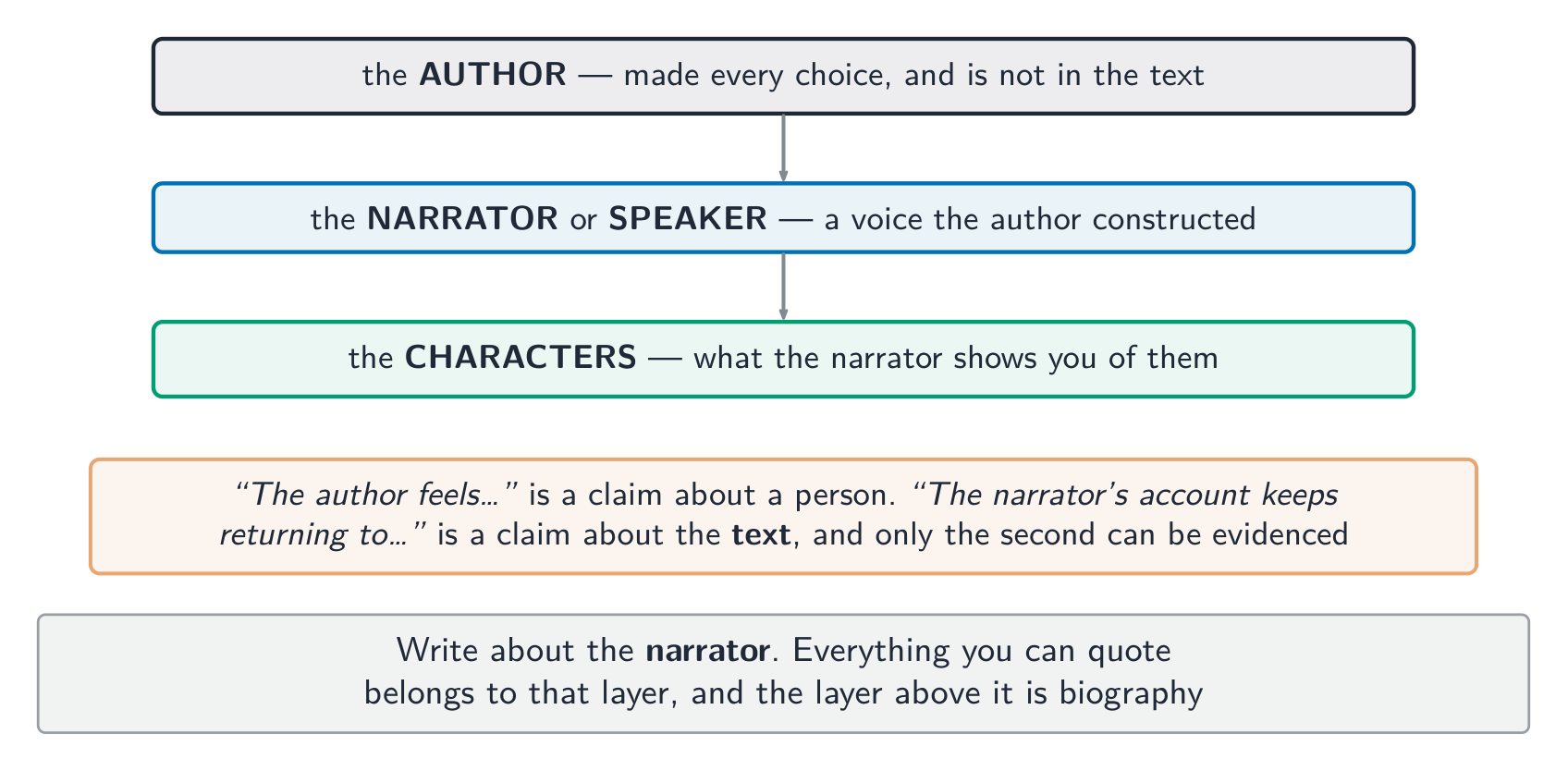
    • A speaker or narrator is not necessarily the author. Never write "the author feels" about a first-person narrator.
    Español
    Lo que cada punto de vista puede y no puede darte, y ese límite es el análisis
    La perspectiva es cómo ven; el punto de vista es desde dónde están. El CED los separa, y tú también debes hacerlo.
    • Narradores o locutores relatan cuentas y establecen una relación entre el texto y el lector.
    • Perspectiva se refiere a cómo narradores, personajes o locutores ven sus circunstancias; punto de vista 叙述视点 se refiere a la posición desde la cual relatan la cuenta.
    • Un locutor o narrador no es necesariamente el autor. Nunca escribas "el autor siente" sobre un narrador en primera persona.
    Escribe sobre el narrador: todo lo que puedas citar pertenece a esa capa
    Explore · ⁨Explorar⁩

    Clasificar cada declaración según la capa a la que pertenece

    Todo lo que puedes citar pertenece a la capa del narrador. La capa superior es la biografía.

    Vocabulary · ⁨Vocabulario⁩ Train · ⁨Entrenar⁩
    English · ⁨Inglés⁩ Chinese · ⁨Chino⁩ Pinyin
    point of view/pɔɪnt ɒv vjuː/ 叙述视点 xù shù shì diǎn
    observational to all-knowing/ɒbzəˈveɪʃənl tʊ ɔːl ˈnəʊɪŋ/ 全知 quán zhī
    1.6

    The Function of Point of View · ⁨La función del punto de vista⁩

    Syllabus
    English

    Enduring Understanding (NAR-1): A narrator’s or speaker’s perspective controls the details and emphases that affect how readers experience and interpret a text.

    Learning Objective 4.B: Identify and explain the function of point of view in a narrative.

    • NAR-1.D The point of view contributes to what narrators, characters, or speakers can and cannot provide in a text based on their level of involvement and intimacy with the details, events, or characters.
    • NAR-1.E Narrators may also be characters, and their role as characters may influence their perspective.
    • NAR-1.F First-person narrators are involved in the narrative; their relationship to the events of the plot and the other characters shapes their perspective.
    • NAR-1.G Third-person narrators are outside observers.
    • NAR-1.H Third-person narrators’ knowledge about events and characters may range from observational to all-knowing, which shapes their perspective.
    • NAR-1.I The outside perspective of third-person narrators may not be affected by the events of the narrative.
    Español

    Comprensión duradera (NAR-1): La perspectiva de un narrador o hablante controla los detalles y las énfasis que influyen en cómo los lectores experimentan e interpretan un texto.

    Objetivo de aprendizaje 4.B: Identificar y explicar la función del punto de vista en una narrativa.

    • NAR-1.D El punto de vista contribuye a lo que los narradores, personajes o hablantes pueden y no pueden ofrecer en un texto según su nivel de implicación e intimidad con los detalles, eventos o personajes.
    • NAR-1.E Los narradores también pueden ser personajes, y su rol como personajes puede influir en su perspectiva.
    • NAR-1.F Los narradores en primera persona están involucrados en la narrativa; su relación con los eventos de la trama y los otros personajes moldea su perspectiva.
    • NAR-1.G Los narradores en tercera persona son observadores externos.
    • NAR-1.H El conocimiento de los narradores en tercera persona sobre eventos y personajes puede variar desde lo observacional hasta lo omnisciente, lo cual moldea su perspectiva.
    • NAR-1.I La perspectiva externa de los narradores en tercera persona puede no verse afectada por los eventos de la narrativa.

    Source: College Board AP Course and Exam Description · ⁨Fuente: College Board AP Course and Exam Description⁩

    English
    • Point of view contributes to what narrators can and cannot provide in a text, based on their position.
    • Narrators may also be characters, and that role may influence their perspective.
    • First-person narrators are involved in the narrative; their relationship to events and to other characters shapes what they can tell you.
    • Third-person narrators are outside observers, and their knowledge may range from observational to all-knowing 全知.
    • The outside perspective of a third-person narrator may not be affected by the events of the narrative.

    The analytical payoff is the cannot. A first-person narrator cannot report what they did not witness or will not admit, and every gap is meaningful. A limited third-person narrator confines you to one consciousness, which is a choice about whose experience counts.

    Español
    • El punto de vista contribuye a lo que los narradores pueden y no pueden ofrecer en un texto, según su posición.
    • Los narradores también pueden ser personajes, y ese rol puede influir en su perspectiva.
    • Los narradores en primera persona están implicados en la narrativa; su relación con los eventos y con otros personajes moldea lo que pueden contarte.
    • Los narradores en tercera persona son observadores externos, y su conocimiento puede variar desde lo observacional hasta lo omnisciente 全知.
    • La perspectiva externa de un narrador en tercera persona puede no verse afectada por los eventos de la narrativa.

    La recompensa analítica reside en el no poder. Un narrador en primera persona no puede reportar lo que no presenció ni lo que no admitirá, y cada omisión es significativa. Un narrador en tercera persona limitado te confina a una sola conciencia, lo cual es una elección sobre cuya experiencia importa.

    1.7

    Developing a Paragraph with Claim and Evidence · ⁨Desarrollar un párrafo con afirmación y evidencia⁩

    Syllabus
    English

    Enduring Understanding (LAN-1): Readers establish and communicate their interpretations of literature through arguments supported by textual evidence.

    Learning Objective 7.A: Develop a paragraph that includes 1) a claim that requires defense with evidence from the text and 2) the evidence itself.

    • LAN-1.A In literary analysis, writers read a text closely to identify details that, in combination, enable them to make and defend a claim about an aspect of the text.
    • LAN-1.B A claim is a statement that requires defense with evidence from the text.
    • LAN-1.C In literary analysis, the initial components of a paragraph are the claim and textual evidence that defends the claim.
    Español

    Comprensión perdurable (LAN-1): Los lectores establecen y comunican sus interpretaciones de la literatura mediante argumentos respaldados por evidencia textual.

    Objetivo de aprendizaje 7.A: Desarrollar un párrafo que incluya 1) una afirmación que requiera defensa con evidencia del texto y 2) la evidencia misma.

    • LAN-1.A En el análisis literario, los escritores leen un texto con detenimiento para identificar detalles que, en conjunto, les permiten formular y defender una afirmación sobre un aspecto del texto.
    • LAN-1.B Una afirmación es una declaración que requiere defensa con evidencia del texto.
    • LAN-1.C En el análisis literario, los componentes iniciales de un párrafo son la afirmación y la evidencia textual que la respalda.

    Source: College Board AP Course and Exam Description · ⁨Fuente: College Board AP Course and Exam Description⁩

    English
    • In literary analysis, writers read a text closely to identify details that, in combination, enable them to make and defend a claim.
    • A claim is a statement that requires defence with evidence from the text.
    • The initial components of a paragraph are the claim and the textual evidence that defends it.

    Note in combination. A single detail rarely supports an interpretive claim; two or three details that point the same way do.

    Worked example (a real AP exam task). The AP Literature free-response section has three questions - poetry analysis, prose fiction analysis, and a literary argument on a work you choose - all marked on a six-point rubric: thesis 1, evidence and commentary 4, sophistication 1. For a prose fiction prompt asking how the author uses narrative techniques to reveal a character's attitude, a weak answer writes "the narrator is first-person, which makes it personal." A scoring answer uses the cannot: "Because the narrator is a participant recounting events years later, the account gives us his present judgement of his younger self and withholds what the other characters thought - so the reader receives his self-criticism as the only available evidence, and must decide whether the harshness of it is accuracy or performance." Point of view, its limit, and the effect on the reader.

    Español
    • En el análisis literario, los escritores leen un texto detenidamente para identificar detalles que, en combinación, les permitan formular y defender una afirmación.
    • Una afirmación es una declaración que requiere defensa con evidencia del texto.
    • Los componentes iniciales de un párrafo son la afirmación y la evidencia textual que la respalda.

    Nota en combinación. Un solo detalle rara vez apoya una interpretación; dos o tres detalles que apuntan en la misma dirección sí lo hacen.

    Ejemplo resuelto (una tarea real del examen AP). La sección de respuestas libres del AP Literature tiene tres preguntas: análisis de poesía, análisis de ficción en prosa y un argumento literario sobre una obra que tú elijas; todas se califican según una rúbrica de seis puntos: tesis 1, evidencia y comentario 4, sofisticación 1. Para un prompt de ficción en prosa que pregunta cómo usa el autor las técnicas narrativas para revelar la actitud de un personaje, una respuesta débil escribe "el narrador es en primera persona, lo que lo hace personal." Una respuesta que obtiene puntuación utiliza el no poder: "Como el narrador es un participante que relata eventos años después, la cuenta nos da su juicio actual sobre su yo más joven y oculta lo que pensaban los otros personajes; así, el lector recibe su autocritica como la única evidencia disponible, y debe decidir si la dureza de esta es exactitud o actuación." Punto de vista, su límite y el efecto en el lector.

    1.7

    Exam tips · ⁨Consejos para el examen⁩

    English
    • Character is a way of seeing, not a list of adjectives. Analyse what they notice and misread.
    • Setting must do something. Describing where a story happens is not yet a claim.
    • Plot is the order of events. A late revelation of an early event is an authorial choice worth analysing.
    • Proportion is evidence. What the text lingers over is where the meaning is.
    • The narrator is not the author. Never write "the author feels" about a first-person narrator.
    • The analytical gold in point of view is what the narrator cannot provide.
    Español
    • El personaje es una manera de ver, no una lista de adjetivos. Analiza lo que nota y lo que malinterpreta.
    • El escenario debe hacer algo. Describir dónde sucede una historia aún no es una afirmación.
    • La trama es el orden de los eventos. Una revelación tardía de un evento temprano es una elección autoral digna de análisis.
    • La proporción es evidencia. Lo que el texto prolonga es donde reside el significado.
    • El narrador no es el autor. Nunca escribas "el autor siente" sobre un narrador en primera persona.
    • El oro analítico del punto de vista es lo que el narrador no puede ofrecer.
  • 2

    Poesía I

    Watch lesson · ⁨Ver lección⁩
    2.1

    What Textual Details Reveal About a Character · ⁨Lo que los detalles textuales revelan sobre un personaje⁩

    Syllabus
    English

    Enduring Understanding (CHR-1): Characters in literature allow readers to study and explore a range of values, beliefs, assumptions, biases, and cultural norms represented by those characters.

    Learning Objective 1.A: Identify and describe what specific textual details reveal about a character, that character’s perspective, and that character’s motives.

    • CHR-1.E Characters reveal their perspectives and biases through the words they use, the details they provide in the text, the organization of their thinking, the decisions they make, and the actions they take.
    Español

    Comprensión perdurable (CHR-1): Los personajes en la literatura permiten a los lectores estudiar y explorar una variedad de valores, creencias, supuestos, prejuicios y normas culturales representados por dichos personajes.

    Objetivo de aprendizaje 1.A: Identificar y describir qué detalles textuales específicos revelan sobre un personaje, la perspectiva de ese personaje y los motivos de ese personaje.

    • CHR-1.E Los personajes revelan sus perspectivas y prejuicios a través de las palabras que utilizan, los detalles que proporcionan en el texto, la organización de su pensamiento, las decisiones que toman y las acciones que realizan.

    Source: College Board AP Course and Exam Description · ⁨Fuente: College Board AP Course and Exam Description⁩

    English

    Unit 2 is the course's first poetry unit, and it adds two things to Unit 1's toolkit: structure as an object of analysis, and figurative language 比喻性语言 handled precisely rather than by name-dropping.

    One addition on character first: characters reveal their perspectives and biases through the words they use, the details they provide, and the details they omit.

    That last item is the analytical opening. What a speaker does not mention, in a poem where everything is chosen, is evidence.

    Español

    La Unidad 2 es la primera unidad de poesía del curso y añade dos elementos al kit de herramientas de la Unidad 1: la estructura como objeto de análisis y el lenguaje figurado, abordado con precisión en lugar de nombrarlo superficialmente.

    Una adición sobre el personaje primero: los personajes revelan sus perspectivas y sesgos a través de las palabras que usan, los detalles que proporcionan y los detalles que omiten.

    Este último punto es la apertura analítica. Lo que un hablante no menciona, en un poema donde todo está elegido, es evidencia.

    2.2

    The Function of Structure in a Text · ⁨La función de la estructura en un texto⁩

    Syllabus
    English

    Enduring Understanding (STR-1): The arrangement of the parts and sections of a text, the relationship of the parts to each other, and the sequence in which the text reveals information are all structural choices made by a writer that contribute to the reader’s interpretation of a text.

    Learning Objective 3.C: Explain the function of structure in a text.

    • STR-1.D Line and stanza breaks contribute to the development and relationship of ideas in a poem.
    • STR-1.E The arrangement of lines and stanzas contributes to the development and relationship of ideas in a poem.
    • STR-1.F A text’s structure affects readers’ reactions and expectations by presenting the relationships among the ideas of the text via their relative positions and their placement within the text as a whole.
    Español

    Comprensión duradera (STR-1): La disposición de las partes y secciones de un texto, la relación entre dichas partes y la secuencia mediante la cual el texto revela información son todas decisiones estructurales tomadas por un escritor que contribuyen a la interpretación del lector sobre el mismo.

    Objetivo de aprendizaje 3.C: Explicar la función de la estructura en un texto.

    • STR-1.D Los saltos de línea y estrofa contribuyen al desarrollo y la relación de ideas en un poema.
    • STR-1.E La disposición de líneas y estrofas contribuye al desarrollo y la relación de ideas en un poema.
    • STR-1.F La estructura de un texto afecta las reacciones y expectativas del lector al presentar las relaciones entre las ideas del texto a través de sus posiciones relativas y su colocación dentro del texto en su conjunto.

    Source: College Board AP Course and Exam Description · ⁨Fuente: College Board AP Course and Exam Description⁩

    English
    • Line and stanza breaks 行与诗节的断开 contribute to the development and relationship of ideas in a poem.
    • The arrangement of lines and stanzas contributes to that development.
    • A text's structure affects readers' reactions and expectations by presenting the relationships among ideas.

    Structure in poetry is not decoration; it is punctuation for thought. Where a line breaks decides which words sit at the ends of lines, and the end of a line is the most emphatic position available. A sentence that runs past a line break asks the reader to hold something unresolved; one that stops at the break closes it.

    Español
    • Los saltos de línea y estrofa contribuyen al desarrollo y la relación de ideas en un poema.
    • La disposición de líneas y estrofas contribuye a ese desarrollo.
    • La estructura de un texto afecta las reacciones y expectativas de los lectores al presentar las relaciones entre las ideas.

    La estructura en la poesía no es decoración; es puntuación para el pensamiento. Dónde se rompe una línea decide qué palabras quedan al final de la línea, y el final de una línea es la posición más enfática disponible. Una oración que continúa más allá de un salto de línea obliga al lector a mantener algo sin resolver; una que se detiene en el salto lo cierra.

    Describir la forma no es nombrar la función - diga qué se le hace hacer al lector
    Una página que lleva su propio comentario en los márgenes - lectura atenta, siglos antes de tiempo
    Explore · ⁨Explorar⁩

    Asociar cada elección estructural con su función

    Describir la forma no es nombrar la función. Di lo que se obliga a hacer al lector, y dónde.

    2.3

    The Function of Contrasts Within a Text · ⁨La función de los contrastes dentro de un texto⁩

    Syllabus
    English

    Enduring Understanding (STR-1): The arrangement of the parts and sections of a text, the relationship of the parts to each other, and the sequence in which the text reveals information are all structural choices made by a writer that contribute to the reader’s interpretation of a text.

    Learning Objective 3.D: Explain the function of contrasts within a text.

    • STR-1.G Contrast can be introduced through focus; tone; point of view; character, narrator, or speaker perspective; dramatic situation or moment; settings or time; or imagery.
    • STR-1.H Contrasts are the result of shifts or juxtapositions or both.
    • STR-1.I Shifts may be signaled by a word, a structural convention, or punctuation.
    • STR-1.J Shifts may emphasize contrasts between particular segments of a text.
    Español

    Comprensión perdurable (STR-1): La disposición de las partes y secciones de un texto, la relación entre esas partes y la secuencia mediante la cual el texto revela información son todas elecciones estructurales realizadas por el autor que contribuyen a la interpretación del lector sobre el texto.

    Objetivo de aprendizaje 3.D: Explicar la función de los contrastes dentro de un texto.

    • STR-1.G El contraste puede introducirse mediante el enfoque; el tono; el punto de vista; la perspectiva del personaje, narrador o hablante; la situación dramática o momento; los escenarios o el tiempo; o la imagen.
    • STR-1.H Los contrastes son el resultado de cambios o yuxtaposiciones, o de ambos.
    • STR-1.I Los cambios pueden estar señalados por una palabra, una convención estructural o la puntuación.
    • STR-1.J Los cambios pueden enfatizar los contrastes entre segmentos específicos de un texto.

    Source: College Board AP Course and Exam Description · ⁨Fuente: College Board AP Course and Exam Description⁩

    English
    • Contrast 对照 can be introduced through focus, tone, point of view, character or speaker perspective, and dramatic situation.
    • Contrasts are the result of shifts or juxtapositions or both.
    • Shifts may be signalled by a word, a structural convention, or punctuation.
    • Shifts may emphasise contrasts between particular segments of a text.

    This is the most reliable route into an unseen poem. Find the shift - a but, a stanza break, a change of tense or address - and the poem divides into a before and an after. What changed, and what the change costs or gains, is very often the poem's argument.

    Español
    • El contraste puede introducirse a través del foco, el tono, el punto de vista, la perspectiva del personaje o del hablante, y la situación dramática.
    • Los contrastes son el resultado de cambios, yuxtaposiciones o ambos.
    • Los cambios pueden ser señalados por una palabra, una convención estructural o la puntuación.
    • Los cambios pueden acentuar los contrastes entre segmentos específicos de un texto.

    Esta es la ruta más confiable para acceder a un poema desconocido. Encuentre el cambio —un pero, un salto de estrofa, un cambio de tiempo verbal o de dirección— y el poema se divide en un antes y un después. Qué cambió y cuál es el costo o ganancia del cambio es muy a menudo el argumento del poema.

    Cuatro lugares para buscar contraste, no uno solo
    Explore · ⁨Explorar⁩

    Encontrar el contraste en cuatro lugares, no en uno

    Los estudiantes encuentran el emparejamiento obvio y se detienen — y el contraste dentro de un personaje suele llevar la pregunta de complejidad.

    Vocabulary · ⁨Vocabulario⁩ Train · ⁨Entrenar⁩
    English · ⁨Inglés⁩ Chinese · ⁨Chino⁩ Pinyin
    figurative language/ˈfɪɡjərətɪv ˈlæŋɡwɪdʒ/ 比喻性语言 bǐ yù xìng yǔ yán
    Line and stanza breaks/laɪn ænd ˈstænzə breɪks/ 行与诗节的断开 xíng yǔ shī jié de duàn kāi
    Contrast/ˈkɒntræst/ 对照 duì zhào
    2.4

    The Function of Specific Words and Phrases · ⁨La función de palabras y frases específicas⁩

    Syllabus
    English

    Enduring Understanding (FIG-1): Comparisons, representations, and associations shift meaning from the literal to the figurative and invite readers to interpret a text.

    Learning Objective 5.B: Explain the function of specific words and phrases in a text.

    • FIG-1.A An antecedent is a word, phrase, or clause that precedes its referent. Referents may include pronouns, nouns, phrases, or clauses.
    • FIG-1.B Referents are ambiguous if they can refer to more than one antecedent, which affects interpretation.
    • FIG-1.C Words or phrases may be repeated to emphasize ideas or associations.
    • FIG-1.D Alliteration is the repetition of the same letter sound at the beginning of adjacent or nearby words to emphasize those words and their associations or representations.
    Español

    Comprensión duradera (FIG-1): Las comparaciones, representaciones y asociaciones desplazan el significado del sentido literal al figurado e invitan a los lectores a interpretar un texto.

    Objetivo de aprendizaje 5.B: Explicar la función de palabras y frases específicas en un texto.

    • FIG-1.A Un antecedente es una palabra, frase o cláusula que precede a su referente. Los referentes pueden incluir pronombres, sustantivos, frases o cláusulas.
    • FIG-1.B Los referentes son ambiguos si pueden referirse a más de un antecedente, lo cual afecta la interpretación.
    • FIG-1.C Las palabras o frases pueden repetirse para enfatizar ideas o asociaciones.
    • FIG-1.D La aliteración es la repetición del mismo sonido de letra al inicio de palabras adyacentes o cercanas para enfatizar dichas palabras y sus asociaciones o representaciones.

    Source: College Board AP Course and Exam Description · ⁨Fuente: College Board AP Course and Exam Description⁩

    English
    • An antecedent 先行词 is a word, phrase, or clause that precedes its referent.
    • Referents are ambiguous if they can refer to more than one antecedent, which affects interpretation 影响阐释.
    • Words or phrases may be repeated to emphasise ideas or associations.
    • Alliteration 头韵 is the repetition of the same initial sound in adjacent or nearby words, emphasising those words.

    Ambiguous reference is worth special attention. In prose it is usually a fault; in poetry it is often a device, and a pronoun that could point two ways may be holding both meanings deliberately.

    Español
    • Un antecedente es una palabra, frase o cláusula que precede a su referente.
    • Los referentes son ambiguos si pueden referirse a más de un antecedente, lo cual afecta la interpretación.
    • Las palabras o frases pueden repetirse para enfatizar ideas o asociaciones.
    • La aliteración es la repetición del mismo sonido inicial en palabras adyacentes o cercanas, enfatizando esas palabras.

    La referencia ambigua merece atención especial. En la prosa suele ser un defecto; en la poesía es a menudo un dispositivo, y un pronombre que podría apuntar en dos direcciones puede estar manteniendo ambos significados deliberadamente.

    Una sola palabra elegida realizando hasta cuatro funciones - 'poderosa' no es una de ellas
    Vocabulary · ⁨Vocabulario⁩ Train · ⁨Entrenar⁩
    English · ⁨Inglés⁩ Chinese · ⁨Chino⁩ Pinyin
    antecedent/ˌæntɪˈsiːdənt/ 先行词 xiān xíng cí
    affects interpretation/əˈfekts ɪnˌtɜːprɪˈteɪʃn/ 影响阐释 yǐng xiǎng chǎn shì
    Alliteration/əˌlɪtəˈreɪʃn/ 头韵 tóu yùn
    2.5

    The Function of a Simile · ⁨La función de una símil⁩

    Syllabus
    English

    Enduring Understanding (FIG-1): Comparisons, representations, and associations shift meaning from the literal to the figurative and invite readers to interpret a text.

    Learning Objective 6.A: Identify and explain the function of a simile.

    • FIG-1.E A simile uses the words “like” or “as” to liken two objects or concepts to each other.
    • FIG-1.F Similes liken two different things to transfer the traits or qualities of one to the other.
    • FIG-1.G In a simile, the thing being compared is the main subject; the thing to which it is being compared is the comparison subject.
    Español

    Comprensión perdurable (FIG-1): Las comparaciones, representaciones y asociaciones desplazan el significado de lo literal a lo figurado e invitan al lector a interpretar un texto.

    Objetivo de aprendizaje 6.A: Identificar y explicar la función de un símil.

    • FIG-1.E Un símil utiliza las palabras "like" o "as" para asemejar dos objetos o conceptos entre sí.
    • FIG-1.F Los similes asemejan dos cosas distintas para transferir las características o cualidades de una a la otra.
    • FIG-1.G En un símil, el objeto que se compara es el sujeto principal; el objeto al que se compara es el sujeto de comparación.

    Source: College Board AP Course and Exam Description · ⁨Fuente: College Board AP Course and Exam Description⁩

    English
    • A simile 明喻 uses "like" or "as" to liken two objects or concepts.
    • Similes liken two different things to transfer the traits or qualities of one to the other.
    • In a simile, the thing being compared is the main subject; the thing to which it is compared is the comparison subject.

    Those two terms are the whole method. A scoring answer names the main subject, names the comparison subject, and then says which quality was transferred - because that quality is the claim the poem is making.

    Español
    Los términos mismos del CED, y la transferencia solo ocurre en una dirección
    Nombre el sujeto principal, nombre el sujeto de comparación, luego diga qué calidad cruzó
    • Una símil utiliza "como" o "de" para asemejar dos objetos o conceptos.
    • Las símiles asemejan dos cosas diferentes para transferir las rasgos o cualidades de una a la otra.
    • En una símil, la cosa que se compara es el sujeto principal; la cosa a la que se compara es el sujeto de comparación.

    Esos dos términos son todo el método. Una respuesta evaluadora nombra el sujeto principal, nombra el sujeto de comparación, y luego dice qué calidad fue transferida —porque esa calidad es la afirmación que el poema está haciendo.

    Vocabulary · ⁨Vocabulario⁩ Train · ⁨Entrenar⁩
    English · ⁨Inglés⁩ Chinese · ⁨Chino⁩ Pinyin
    simile/ˈsɪmɪlɪ/ 明喻 míng yù
    metaphor/ˈmetəfɔː/ 隐喻 yǐn yù
    2.6

    The Function of a Metaphor · ⁨La función de una metáfora⁩

    Syllabus
    English

    Enduring Understanding (FIG-1): Comparisons, representations, and associations shift meaning from the literal to the figurative and invite readers to interpret a text.

    Learning Objective 6.B: Identify and explain the function of a metaphor.

    • FIG-1.H A metaphor implies similarities between two (usually unrelated) concepts or objects in order to reveal or emphasize one or more things about one of them, though the differences between the two may also be revealing.
    • FIG-1.I In a metaphor, as in a simile, the thing being compared is the main subject; the thing to which it is being compared is the comparison subject.
    • FIG-1.J Comparisons between objects or concepts draw on the experiences and associations readers already have with those objects and concepts.
    • FIG-1.K Interpretation of a metaphor may depend on the context of its use; that is, what is happening in a text may determine what is transferred in the comparison.
    Español

    Comprensión perdurable (FIG-1): Las comparaciones, representaciones y asociaciones desplazan el significado desde lo literal hacia lo figurado e invitan a los lectores a interpretar un texto.

    Objetivo de aprendizaje 6.B: Identificar y explicar la función de una metáfora.

    • FIG-1.H Una metáfora implica similitudes entre dos conceptos o objetos (generalmente no relacionados) con el fin de revelar o enfatizar una o más características de uno de ellos, aunque las diferencias entre ambos también pueden ser reveladoras.
    • FIG-1.I En una metáfora, al igual que en una símil, el elemento que se compara es el sujeto principal; el elemento al cual se compara es el sujeto de comparación.
    • FIG-1.J Las comparaciones entre objetos o conceptos recurren a las experiencias y asociaciones que los lectores ya poseen sobre dichos objetos y conceptos.
    • FIG-1.K La interpretación de una metáfora puede depender del contexto de su uso; es decir, lo que sucede en un texto puede determinar qué elementos se transfieren en la comparación.

    Source: College Board AP Course and Exam Description · ⁨Fuente: College Board AP Course and Exam Description⁩

    English
    • A metaphor 隐喻 implies similarities between two usually unrelated concepts to reveal or emphasise qualities of the main subject.
    • The same main-subject and comparison-subject structure applies.
    • Comparisons draw on the experiences and associations readers already have with the comparison subject - which is why a metaphor can fail with an audience that lacks those associations.
    • Interpretation of a metaphor may depend on the context of its use: what is happening in the text may determine which of the comparison subject's qualities is meant.

    That last point protects you from the commonest error, which is importing every association a word has. If a poem calls grief a house, the relevant quality might be shelter, or confinement, or the fact that one must live inside it. The text decides which.

    Español
    • Una metáfora implica similitudes entre dos conceptos usualmente no relacionados para revelar o enfatizar cualidades del sujeto principal.
    • Se aplica la misma estructura de sujeto principal y sujeto de comparación.
    • Las comparaciones apelan a las experiencias y asociaciones que los lectores ya tienen con el sujeto de comparación —por eso una metáfora puede fallar con una audiencia que carece de esas asociaciones.
    • La interpretación de una metáfora puede depender del contexto de su uso: lo que sucede en el texto puede determinar cuál de las cualidades del sujeto de comparación se pretende.

    Ese último punto lo protege del error más común, que es importar todas las asociaciones que tiene una palabra. Si un poema llama al duelo una casa, la cualidad relevante podría ser el refugio, la confinamiento, o el hecho de que uno debe vivir dentro de ella. El texto decide cuál.

    2.7

    Developing a Paragraph with Claim and Evidence · ⁨Desarrollo de un párrafo con afirmación y evidencia⁩

    Syllabus
    English

    Enduring Understanding (LAN-1): Readers establish and communicate their interpretations of literature through arguments supported by textual evidence.

    Learning Objective 7.A: Develop a paragraph that includes 1) a claim that requires defense with evidence from the text and 2) the evidence itself.

    • LAN-1.A In literary analysis, writers read a text closely to identify details that, in combination, enable them to make and defend a claim about an aspect of the text.
    • LAN-1.B A claim is a statement that requires defense with evidence from the text.
    • LAN-1.C In literary analysis, the initial components of a paragraph are the claim and textual evidence that defends the claim.
    Español

    Comprensión duradera (LAN-1): Los lectores establecen y comunican sus interpretaciones de la literatura mediante argumentos respaldados por evidencia textual.

    Objetivo de aprendizaje 7.A: Desarrollar un párrafo que incluya: 1) una afirmación que requiera defensa con evidencia del texto y 2) la evidencia misma.

    • LAN-1.A En el análisis literario, los escritores leen un texto detenidamente para identificar detalles que, en conjunto, les permiten formular y defender una afirmación sobre algún aspecto del texto.
    • LAN-1.B Una afirmación es una declaración que requiere defensa mediante evidencia del texto.
    • LAN-1.C En el análisis literario, los componentes iniciales de un párrafo son la afirmación y la evidencia textual que la respalda.

    Source: College Board AP Course and Exam Description · ⁨Fuente: College Board AP Course and Exam Description⁩

    English

    Same three components as Unit 1: a claim requiring textual defence, the textual evidence, and details identified in combination.

    Worked example (a real AP exam task). A poetry-analysis prompt asks how the speaker's use of comparison conveys their attitude. A weak answer: "The poet uses a metaphor comparing memory to a house, which is effective." A scoring answer uses the CED's terms and the context rule: "The main subject is memory and the comparison subject a house, but the poem withholds warmth from the comparison: the house has 'rooms she no longer enters'. The quality transferred is therefore not shelter but confinement by a structure one built oneself - so the speaker's attitude to her own past is presented as inhabiting something she can neither leave nor fully occupy." Main subject, comparison subject, transferred quality, and the attitude it conveys.

    Español

    Mismos tres componentes que en la Unidad 1: una afirmación que requiere defensa textual, la evidencia textual y detalles identificados en combinación.

    Ejemplo resuelto (una tarea real del examen AP). Un enunciado de análisis poético pregunta cómo el uso de la comparación por parte del hablante transmite su actitud. Una respuesta débil: "El poeta usa una metáfora comparando la memoria con una casa, lo cual es efectivo." Una respuesta evaluadora usa los términos del CED y la regla del contexto: "El sujeto principal es la memoria y el sujeto de comparación una casa, pero el poema retiene la calidez de la comparación: la casa tiene 'habitaciones que ella ya no entra'. Por lo tanto, la calidad transferida no es el refugio sino el confinamiento por una estructura construida por uno mismo —así que la actitud del hablante hacia su propio pasado se presenta como habitar algo que ni puede dejar ni ocupar plenamente." Sujeto principal, sujeto de comparación, calidad transferida y la actitud que transmite.

    2.7

    Exam tips · ⁨Consejos para el examen⁩

    English
    • What a speaker omits is evidence. In a poem, everything present was chosen.
    • Find the shift first. A but, a stanza break, a change of tense - the poem divides there.
    • Line endings are the emphatic position. Say which words the poet put there.
    • An ambiguous referent in poetry is usually a device, not an error.
    • Always name main subject and comparison subject, then the quality transferred. That quality is the claim.
    • Context decides which quality a metaphor imports. Do not list every association the word has.
    Español
    • Lo que un hablante omite es evidencia. En un poema, todo lo presente fue elegido.
    • Encuentre el cambio primero. Un pero, un salto de estrofa, un cambio de tiempo verbal: ahí se divide el poema.
    • Los finales de línea son la posición enfática. Diga qué palabras puso el poeta allí.
    • Un referente ambiguo en la poesía es generalmente un dispositivo, no un error.
    • Siempre nombre sujeto principal y sujeto de comparación, luego la calidad transferida. Esa calidad es la afirmación.
    • El contexto decide qué calidad importa una metáfora. No enumere cada asociación que tiene la palabra.
  • 3

    Ficción larga o drama I

    Watch lesson · ⁨Ver lección⁩
    3.1

    What Textual Details Reveal About a Character · ⁨Qué revelan los detalles textuales sobre un personaje⁩

    Syllabus
    English

    Enduring Understanding (CHR-1): Characters in literature allow readers to study and explore a range of values, beliefs, assumptions, biases, and cultural norms represented by those characters.

    Learning Objective 1.A: Identify and describe what specific textual details reveal about a character, that character’s perspective, and that character’s motives.

    • CHR-1.F The description of a character creates certain expectations for that character’s behaviors; how a character does or does not meet those expectations affects a reader’s interpretation of that character.
    • CHR-1.G Details associated with a character and/or used to describe a character contribute to a reader’s interpretation of that character.
    • CHR-1.H Readers’ understanding of a character’s perspective may depend on the perspective of the narrator or speaker.
    • CHR-1.I A character’s perspective may shift during the course of a narrative.
    • CHR-1.J When narrators, characters, or speakers compare another character to something or someone else, they reveal their perspective on the compared character and may also reveal something innate about the compared character.
    • CHR-1.K Readers can infer a character’s motives from that character’s actions or inactions.
    Español

    Comprensión duradera (CHR-1): Los personajes en la literatura permiten a los lectores estudiar y explorar una variedad de valores, creencias, supuestos, prejuicios y normas culturales representados por dichos personajes.

    Objetivo de aprendizaje 1.A: Identificar y describir qué detalles textuales específicos revelan sobre un personaje, la perspectiva de ese personaje y los motivos de ese personaje.

    • CHR-1.F La descripción de un personaje crea ciertas expectativas sobre su comportamiento; el hecho de que un personaje cumpla o no con esas expectativas afecta la interpretación que el lector hace de dicho personaje.
    • CHR-1.G Los detalles asociados con un personaje y/o utilizados para describirlo contribuyen a la interpretación que el lector hace de dicho personaje.
    • CHR-1.H La comprensión del lector sobre la perspectiva de un personaje puede depender de la perspectiva del narrador o del hablante.
    • CHR-1.I La perspectiva de un personaje puede cambiar durante el desarrollo de una narrativa.
    • CHR-1.J Cuando los narradores, personajes o hablantes comparan a otro personaje con algo o alguien más, revelan su perspectiva sobre el personaje comparado y también pueden revelar algo inherente al personaje comparado.
    • CHR-1.K Los lectores pueden inferir los motivos de un personaje a partir de las acciones o inacciones de dicho personaje.

    Source: College Board AP Course and Exam Description · ⁨Fuente: College Board AP Course and Exam Description⁩

    English

    Unit 3 is the first longer-fiction-or-drama unit, and the length changes what is analysable: characters can now change, conflicts can intersect, and setting acquires a social and historical dimension.

    The CED's additions on character:

    • The description of a character creates expectations for that character's behaviour, and how a character meets or fails those expectations is meaningful.
    • Details associated with a character contribute to a reader's interpretation of them.
    • A reader's understanding of a character's perspective may depend on the perspective of the narrator.
    • A character's perspective may shift during the narrative.
    • When narrators or characters compare another character to something else, they reveal their own perspective as much as the compared character's.
    • Readers can infer motive from a character's actions or inactions.

    That last word - inactions - is the one worth keeping. What a character declines to do is evidence, and it is usually more revealing than what they do.

    Español

    La Unidad 3 es la primera unidad centrada en ficción o drama de extensión mayor, y el aumento de longitud cambia lo que puede analizarse: los personajes ahora pueden cambiar, los conflictos pueden intersecarse y el escenario adquiere una dimensión social e histórica.

    Las adiciones del CED sobre personajes:

    • La descripción de un personaje crea expectativas respecto al comportamiento de ese personaje, y cómo un personaje cumple o no cumple esas expectativas tiene significado.
    • Los detalles asociados con un personaje contribuyen a la interpretación que hace el lector de él.
    • La comprensión del lector sobre la perspectiva de un personaje puede depender de la perspectiva del narrador.
    • La perspectiva de un personaje puede cambiar durante la narrativa.
    • Cuando los narradores o personajes comparan a otro personaje con algo más, revelan su propia perspectiva tanto como la del personaje comparado.
    • Los lectores pueden inferir motivos a partir de las acciones o inacciones de un personaje.

    Esa última palabra —inacciones— es la que vale la pena conservar. Lo que un personaje se niega a hacer es evidencia, y suele ser más reveladora que lo que sí hace.

    Vocabulary · ⁨Vocabulario⁩ Train · ⁨Entrenar⁩
    English · ⁨Inglés⁩ Chinese · ⁨Chino⁩ Pinyin
    dynamic character/daɪˈnæmɪk ˈkærɪktə/ 动态人物 dòng tài rén wù
    Some characters remain unchanged/sʌm ˈkærɪktəz rɪˈmeɪn ʌnˈtʃeɪndʒd/ 静态人物 jìng tài rén wù
    Conflict/ˈkɒnflɪkt/ 冲突 chōng tū
    intersect/ˌɪntəˈsekt/ 交叉 jiāo chā
    line of reasoning/laɪn ɒv ˈriːzənɪŋ/ 推理线索 tuī lǐ xiàn suǒ
    3.2

    Characters Who Change or Remain Unchanged · ⁨Personajes que cambian o permanecen sin cambios⁩

    Syllabus
    English

    Enduring Understanding (CHR-1): Characters in literature allow readers to study and explore a range of values, beliefs, assumptions, biases, and cultural norms represented by those characters.

    Learning Objective 1.B: Explain the function of a character changing or remaining unchanged.

    • CHR-1.L A dynamic character who develops over the course of the narrative often makes choices that directly or indirectly affect the climax and/or the resolution of that narrative.
    • CHR-1.M Character changes can be visible and external, such as changes to health or wealth, or can be internal, psychological, or emotional changes; external changes can lead to internal changes, and vice versa.
    • CHR-1.N Some characters remain unchanged or are largely unaffected by the events of the narrative.
    Español

    Comprensión perdurable (CHR-1): Los personajes en la literatura permiten a los lectores estudiar y explorar una variedad de valores, creencias, supuestos, prejuicios y normas culturales representados por dichos personajes.

    Objetivo de aprendizaje 1.B: Explicar la función de un personaje que cambia o permanece inalterado.

    • CHR-1.L Un personaje dinámico que se desarrolla a lo largo de la narrativa suele tomar decisiones que afectan directa o indirectamente el clímax y/o la resolución de dicha narrativa.
    • CHR-1.M Los cambios en los personajes pueden ser visibles y externos, como cambios en la salud o la riqueza, o pueden ser cambios internos, psicológicos o emocionales; los cambios externos pueden conducir a cambios internos, y viceversa.
    • CHR-1.N Algunos personajes permanecen inalterados o no se ven significativamente afectados por los eventos de la narrativa.

    Source: College Board AP Course and Exam Description · ⁨Fuente: College Board AP Course and Exam Description⁩

    English
    • A dynamic character 动态人物 develops over the narrative and often makes choices that directly or indirectly cause change.
    • Character change can be visible and external - health, wealth, circumstance - or internal, in belief, value, or understanding.
    • Some characters remain unchanged 静态人物 or are largely unaffected by events.

    The unchanged character is not a failure of characterisation; it is often the measure by which the change in others is visible.

    Español
    • Un personaje dinámico (动态人物) se desarrolla a lo largo de la narrativa y a menudo toma decisiones que causan cambio directa o indirectamente.
    • El cambio de personaje puede ser visible y externo —salud, riqueza, circunstancias— o interno, en creencias, valores o comprensión.
    • Algunos personajes permanecen sin cambios (静态人物) o resultan poco afectados por los eventos.

    El personaje sin cambios no es un fracaso en la caracterización; a menudo es la medida mediante la cual se hace visible el cambio en otros.

    Tres citas, y la del medio es la que los estudiantes suelen omitir
    Explore · ⁨Explorar⁩

    Demostrar un cambio con tres citas

    Antes, punto de inflexión, después — y el punto de inflexión es lo que los estudiantes omiten, lo que deja el cambio como una mera afirmación.

    3.3

    Textual Details That Convey Setting · ⁨Detalles textuales que transmiten el escenario⁩

    Syllabus
    English

    Enduring Understanding (SET-1): Setting and the details associated with it not only depict a time and place, but also convey values associated with that setting.

    Learning Objective 2.A: Identify and describe specific textual details that convey or reveal a setting.

    • SET-1.B Setting includes the social, cultural, and historical situation during which the events of the text occur.
    Español

    Comprensión duradera (SET-1): El entorno y los detalles asociados a él no solo representan un tiempo y un lugar, sino que también transmiten valores vinculados a dicho entorno.

    Objetivo de aprendizaje 2.A: Identificar y describir detalles textuales específicos que transmiten o revelan un entorno.

    • SET-1.B El entorno incluye la situación social, cultural e histórica durante la cual ocurren los eventos del texto.

    Source: College Board AP Course and Exam Description · ⁨Fuente: College Board AP Course and Exam Description⁩

    English

    Setting now includes the social, cultural, and historical situation in which the events occur - not only time and place.

    This widens what setting can do. A social setting supplies the constraints a character must act within, and constraint is what turns a choice into a revealing one.

    Español

    El escenario ahora incluye la situación social, cultural e histórica en la que ocurren los eventos, no solo el tiempo y el lugar.

    Esto amplía lo que el escenario puede lograr. Un escenario social proporciona las restricciones dentro de las cuales debe actuar un personaje, y la restricción es lo que convierte una elección en algo revelador.

    3.4

    Significant Events in a Plot · ⁨Eventos significativos en una trama⁩

    Syllabus
    English

    Enduring Understanding (STR-1): The arrangement of the parts and sections of a text, the relationship of the parts to each other, and the sequence in which the text reveals information are all structural choices made by a writer that contribute to the reader’s interpretation of a text.

    Learning Objective 3.E: Explain the function of a significant event or related set of significant events in a plot.

    • STR-1.K A story, or narrative, is delivered through a series of events that relate to a conflict.
    • STR-1.L Events include episodes, encounters, and scenes in a narrative that can introduce and develop a plot.
    • STR-1.M The significance of an event depends on its relationship to the narrative, the conflict, and the development of characters.
    Español

    Comprensión duradera (STR-1): La disposición de las partes y secciones de un texto, la relación entre ellas y la secuencia mediante la cual el texto revela información son todas decisiones estructurales tomadas por un escritor que contribuyen a la interpretación del lector sobre el texto.

    Objetivo de aprendizaje 3.E: Explicar la función de un evento significativo o un conjunto relacionado de eventos significativos en una trama.

    • STR-1.K Una historia, o narrativa, se presenta a través de una serie de eventos relacionados con un conflicto.
    • STR-1.L Los eventos incluyen episodios, encuentros y escenas en una narrativa que pueden introducir y desarrollar una trama.
    • STR-1.M La importancia de un evento depende de su relación con la narrativa, el conflicto y el desarrollo de los personajes.

    Source: College Board AP Course and Exam Description · ⁨Fuente: College Board AP Course and Exam Description⁩

    English
    • A narrative is delivered through a series of events that relate to a conflict.
    • Events include episodes, encounters, and scenes that introduce and develop plot.
    • The significance of an event depends on its relationship to the narrative, the conflict, and character development.

    That third statement is the test for essay selection: an event matters to your argument only if you can say what it does to the conflict or to a character. Retelling a striking scene that does neither is plot summary, which earns nothing.

    Español
    • Una narrativa se presenta a través de una serie de eventos relacionados con un conflicto.
    • Los eventos incluyen episodios, encuentros y escenas que introducen y desarrollan la trama.
    • La importancia de un evento depende de su relación con la narrativa, el conflicto y el desarrollo de los personajes.

    Esta tercera afirmación es la prueba para la selección en ensayos: un evento importa para tu argumento solo si puedes decir qué hace al conflicto o a un personaje. Recontar una escena impactante que no hace ninguna de estas dos cosas es un resumen de trama, lo cual no otorga puntos.

    3.5

    The Function of Conflict in a Text · ⁨La función del conflicto en un texto⁩

    Syllabus
    English

    Enduring Understanding (STR-1): The arrangement of the parts and sections of a text, the relationship of the parts to each other, and the sequence in which the text reveals information are all structural choices made by a writer that contribute to the reader’s interpretation of a text.

    Learning Objective 3.F: Explain the function of conflict in a text.

    • STR-1.N Conflict is tension between competing values either within a character, known as internal or psychological conflict, or with outside forces that obstruct a character in some way, known as external conflict.
    • STR-1.O A text may contain multiple conflicts. Often two or more conflicts in a text intersect.
    • STR-1.P A primary conflict can be heightened by the presence of additional conflicts that intersect with it.
    • STR-1.Q Inconsistencies in a text may create contrasts that represent conflicts of values or perspectives.
    Español

    Comprensión duradera (STR-1): La disposición de las partes y secciones de un texto, la relación entre ellas y la secuencia con la que el texto revela información son todas decisiones estructurales tomadas por un escritor que contribuyen a la interpretación del lector.

    Objetivo de aprendizaje 3.F: Explicar la función del conflicto en un texto.

    • STR-1.N El conflicto es la tensión entre valores competidores, ya sea dentro de un personaje, lo cual se conoce como conflicto interno o psicológico, o con fuerzas externas que obstaculizan de alguna manera a un personaje, lo cual se conoce como conflicto externo.
    • STR-1.O Un texto puede contener múltiples conflictos. A menudo, dos o más conflictos en un texto se cruzan.
    • STR-1.P Un conflicto principal puede intensarse por la presencia de conflictos adicionales que se cruzan con él.
    • STR-1.Q Las inconsistencias en un texto pueden crear contrastes que representan conflictos de valores o perspectivas.

    Source: College Board AP Course and Exam Description · ⁨Fuente: College Board AP Course and Exam Description⁩

    English
    • Conflict 冲突 is tension between competing values, either within a character - internal or psychological conflict - or between a character and an external force.
    • A text may contain multiple conflicts, and often two or more intersect 交叉.
    • A primary conflict can be heightened by additional conflicts that intersect with it.
    • Inconsistencies in a text may create contrasts that represent conflicts of values or perspectives.

    Note the definition: conflict is between competing values, not merely between people. Two characters who want the same object are in a dispute; two characters who want incompatible goods are in a conflict, and only the second produces meaning.

    Español
    El conflicto tiene dos ubicaciones y se acumulan, lo cual es lo que hace analizable la ficción larga
    Un conflicto primario intensificado por uno intersecante es la forma estándar de una novela o obra de teatro
    • Conflicto (冲突) es la tensión entre valores competidores, ya sea dentro de un personaje —conflicto interno o psicológico— o entre un personaje y una fuerza externa.
    • Un texto puede contener múltiples conflictos, y a menudo dos o más se intersecan (交叉).
    • Un conflicto primario puede intensificarse mediante conflictos adicionales que se intersecan con él.
    • Las inconsistencias en un texto pueden crear contrastes que representan conflictos de valores o perspectivas.

    Nota la definición: el conflicto está entre valores competidores, no simplemente entre personas. Dos personajes que desean el mismo objeto están en disputa; dos personajes que desean bienes incompatibles están en conflicto, y solo el segundo produce significado.

    3.6

    Developing a Paragraph with Claim and Evidence · ⁨Desarrollo de un párrafo con afirmación y evidencia⁩

    Syllabus
    English

    Enduring Understanding (LAN-1): Readers establish and communicate their interpretations of literature through arguments supported by textual evidence.

    Learning Objective 7.A: Develop a paragraph that includes 1) a claim that requires defense with evidence from the text and 2) the evidence itself.

    • LAN-1.A In literary analysis, writers read a text closely to identify details that, in combination, enable them to make and defend a claim about an aspect of the text.
    • LAN-1.B A claim is a statement that requires defense with evidence from the text.
    • LAN-1.C In literary analysis, the initial components of a paragraph are the claim and textual evidence that defends the claim.
    Español

    Comprensión perdurable (LAN-1): Los lectores establecen y comunican sus interpretaciones de la literatura a través de argumentos respaldados por evidencia textual.

    Objetivo de aprendizaje 7.A: Desarrollar un párrafo que incluya: 1) una tesis que requiera defensa mediante evidencia del texto y 2) la evidencia misma.

    • LAN-1.A En el análisis literario, los escritores leen un texto con detenimiento para identificar detalles que, en conjunto, les permitan formular y defender una tesis sobre un aspecto del texto.
    • LAN-1.B Una tesis es una afirmación que requiere ser defendida con evidencia del texto.
    • LAN-1.C En el análisis literario, los componentes iniciales de un párrafo son la tesis y la evidencia textual que la sustenta.

    Source: College Board AP Course and Exam Description · ⁨Fuente: College Board AP Course and Exam Description⁩

    English

    Unchanged from Units 1 and 2: a claim requiring textual defence, textual evidence, and details identified in combination.

    Español

    Sin cambios respecto a las Unidades 1 y 2: una afirmación que requiere defensa textual, evidencia textual y detalles identificados en combinación.

    3.7

    Developing a Literary Thesis Statement · ⁨Elaboración de una tesis literaria⁩

    Syllabus
    English

    Enduring Understanding (LAN-1): Readers establish and communicate their interpretations of literature through arguments supported by textual evidence.

    Learning Objective 7.B: Develop a thesis statement that conveys a defensible claim about an interpretation of literature and that may establish a line of reasoning.

    • LAN-1.D A thesis statement expresses an interpretation of a literary text and requires a defense through use of textual evidence and a line of reasoning, both of which are explained in an essay through commentary.
    • LAN-1.E A thesis statement may preview the development or line of reasoning of an interpretation. This is not to say that a thesis statement must list the points of an interpretation, literary elements to be analyzed, or specific evidence to be used in the argument.
    Español

    Comprensión duradera (LAN-1): Los lectores establecen y comunican sus interpretaciones de la literatura mediante argumentos respaldados por evidencia textual.

    Objetivo de aprendizaje 7.B: Desarrollar una tesis que exprese un afirmación defendible sobre una interpretación literaria y que pueda establecer una línea de razonamiento.

    • LAN-1.D Una tesis expresa una interpretación de un texto literario y requiere defensa mediante el uso de evidencia textual y una línea de razonamiento, los cuales se explican en el ensayo a través del comentario.
    • LAN-1.E Una tesis puede anticipar el desarrollo o la línea de razonamiento de una interpretación. Esto no significa que una tesis deba enumerar los puntos de una interpretación, los elementos literarios que se analizarán o la evidencia específica que se utilizará en el argumento.

    Source: College Board AP Course and Exam Description · ⁨Fuente: College Board AP Course and Exam Description⁩

    English
    • A thesis statement expresses an interpretation of a literary text and requires defence through textual evidence.
    • It may preview the development or line of reasoning of that interpretation - but is not required to list the reasons.

    The key word is interpretation. A thesis that states what happens in the text is not a thesis; it is a summary. A thesis must say what the text means or does, which is by definition arguable.

    Español
    • Una tesis literaria expresa una interpretación de un texto literario y requiere defensa mediante evidencia textual.
    • Puede previsualizar el desarrollo o la línea de razonamiento de esa interpretación, pero no está obligada a listar las razones.

    La palabra clave es interpretación. Una tesis que establece qué sucede en el texto no es una tesis; es un resumen. Una tesis debe decir qué significa o qué hace el texto, lo cual, por definición, es debatible.

    Una tesis literaria trata sobre lo que hace el texto, no sobre lo que contiene
    Explore · ⁨Explorar⁩

    Clasificar resumen frente a tesis literaria

    Una tesis literaria trata sobre lo que hace el texto, no sobre lo que contiene — lo cual también evita que un ensayo se desvíe hacia el resumen.

    3.8

    Developing Commentary · ⁨Desarrollo de comentarios⁩

    Syllabus
    English

    Enduring Understanding (LAN-1): Readers establish and communicate their interpretations of literature through arguments supported by textual evidence.

    Learning Objective 7.C: Develop commentary that establishes and explains relationships among textual evidence, the line of reasoning, and the thesis.

    • LAN-1.F A line of reasoning is the logical sequence of claims that work together to defend the overarching thesis statement.
    • LAN-1.G A line of reasoning is communicated through commentary that explains the logical relationship between the overarching thesis statement and the claims/evidence within the body of an essay.
    Español

    Comprensión perdurable (LAN-1): Los lectores establecen y comunican sus interpretaciones de la literatura a través de argumentos respaldados con evidencia textual.

    Objetivo de aprendizaje 7.C: Desarrollar comentarios que establezcan y expliquen las relaciones entre la evidencia textual, la línea de razonamiento y la tesis.

    • LAN-1.F Una línea de razonamiento es la secuencia lógica de afirmaciones que trabajan conjuntamente para defender la afirmación central de la tesis.
    • LAN-1.G Una línea de razonamiento se comunica a través de comentarios que explican la relación lógica entre la afirmación central de la tesis y las afirmaciones/evidencia dentro del cuerpo del ensayo.

    Source: College Board AP Course and Exam Description · ⁨Fuente: College Board AP Course and Exam Description⁩

    English
    • A line of reasoning 推理线索 is the logical sequence of claims that together defend the overarching thesis.
    • It is communicated through commentary explaining the logical relationship between evidence and claim.
    Español
    • Una línea de razonamiento (推理线索) es la secuencia lógica de afirmaciones que juntas defienden la tesis general.
    • Se comunica a través de comentarios que explican la relación lógica entre la evidencia y la afirmación.
    3.9

    Selecting Relevant and Sufficient Evidence · ⁨Selección de evidencia relevante y suficiente⁩

    Syllabus
    English

    Enduring Understanding (LAN-1): Readers establish and communicate their interpretations of literature through arguments supported by textual evidence.

    Learning Objective 7.D: Select and use relevant and sufficient evidence to both develop and support a line of reasoning.

    • LAN-1.H Writers use evidence strategically and purposefully to illustrate, clarify, exemplify, associate, amplify, or qualify a point.
    • LAN-1.I Evidence is effective when the writer of the essay uses commentary to explain a logical relationship between the evidence and the claim.
    • LAN-1.J Evidence is sufficient when its quantity and quality provide apt support for the line of reasoning.
    • LAN-1.K Developing and supporting an interpretation of a text is a recursive process; an interpretation can emerge from analyzing evidence and then forming a line of reasoning, or the interpretation can emerge from forming a line of reasoning and then identifying relevant evidence to support that line of reasoning.
    Español

    Comprensión perdurable (LAN-1): Los lectores establecen y comunican sus interpretaciones de la literatura a través de argumentos respaldados por evidencia textual.

    Objetivo de aprendizaje 7.D: Seleccionar y utilizar evidencia relevante y suficiente para desarrollar y sustentar una línea de razonamiento.

    • LAN-1.H Los escritores utilizan la evidencia de manera estratégica y con propósito para ilustrar, aclarar, ejemplificar, asociar, amplificar o matizar un punto.
    • LAN-1.I La evidencia es efectiva cuando el autor del ensayo utiliza comentarios para explicar una relación lógica entre la evidencia y la afirmación.
    • LAN-1.J La evidencia es suficiente cuando su cantidad y calidad proporcionan un apoyo adecuado para la línea de razonamiento.
    • LAN-1.K Desarrollar y sustentar una interpretación de un texto es un proceso recursivo; una interpretación puede emerger del análisis de la evidencia y posteriormente la formación de una línea de razonamiento, o bien la interpretación puede emerger de la formación de una línea de razonamiento y luego la identificación de evidencia relevante para sustentar dicha línea de razonamiento.

    Source: College Board AP Course and Exam Description · ⁨Fuente: College Board AP Course and Exam Description⁩

    English
    • Writers use evidence strategically - to illustrate, clarify, exemplify, associate, or amplify.
    • Evidence is effective when commentary explains its logical relationship to the claim.
    • Evidence is sufficient when its quantity and quality provide apt support.
    • Developing an interpretation is a recursive process: an interpretation can emerge, and change, as you read and write.

    That last point is permission worth taking. If your reading changes while you draft, revise the thesis to match it.

    Español
    • Los escritores utilizan la evidencia de manera estratégica: para ilustrar, aclarar, ejemplificar, asociar o amplificar.
    • La evidencia es eficaz cuando los comentarios explican su relación lógica con la afirmación.
    • La evidencia es suficiente cuando su cantidad y calidad proporcionan un apoyo adecuado.
    • Desarrollar una interpretación es un proceso recursivo: una interpretación puede emerger y cambiar a medida que lees y escribes.

    Ese último punto es una licencia que conviene aprovechar. Si tu lectura cambia mientras redactas, revisa la tesis para que coincida con ello.

    Dos errores con dos soluciones opuestas: una cita diferente, o una más rica
    3.10

    Control Over the Elements of Composition · ⁨Control sobre los elementos de la composición⁩

    Syllabus
    English

    Enduring Understanding (LAN-1): Readers establish and communicate their interpretations of literature through arguments supported by textual evidence.

    Learning Objective 7.E: Demonstrate control over the elements of composition to communicate clearly.

    • LAN-1.L Grammar and mechanics that follow established conventions of language allow writers to clearly communicate their interpretation of a text.
    Español

    Comprensión duradera (LAN-1): Los lectores establecen y comunican sus interpretaciones de la literatura a través de argumentos respaldados por evidencia textual.

    Objetivo de aprendizaje 7.E: Demostrar control sobre los elementos de la composición para comunicar con claridad.

    • LAN-1.L La gramática y la mecánica que siguen las convenciones establecidas del lenguaje permiten a los escritores comunicar claramente su interpretación de un texto.

    Source: College Board AP Course and Exam Description · ⁨Fuente: College Board AP Course and Exam Description⁩

    English

    Grammar and mechanics that follow established conventions allow writers to communicate clearly. On this exam, control of language is not a separate mark but a condition of the others: an unclear sentence cannot deliver commentary a reader can credit.

    Worked example (a real AP exam task). A Question 3 literary-argument prompt asks you to choose a work and analyse how a character's conflict contributes to an interpretation of the work as a whole. A weak answer narrates the plot around the conflict. A scoring answer identifies competing values and lets them intersect: "The protagonist's external conflict with his family over the inheritance is heightened by an internal one: he wants the independence the money would buy, and he wants to remain the son who never asked for it. Because the two conflicts share a single object, resolving either resolves neither - which is why the novel ends with a choice that satisfies no one, including him." Two conflicts, named as values, and an interpretation of the whole.

    Español

    La gramática y la mecánica que siguen las convenciones establecidas permiten a los escritores comunicarse con claridad. En este examen, el control del lenguaje no es una calificación separada, sino una condición de las demás: una oración poco clara no puede transmitir comentarios que el lector pueda validar.

    Ejemplo resuelto (una tarea real del examen AP). Una instrucción de argumentación literaria Pregunta 3 te pide elegir una obra y analizar cómo el conflicto de un personaje contribuye a una interpretación de la obra en su conjunto. Una respuesta débil narra la trama alrededor del conflicto. Una respuesta evaluada identifica valores competidores y permite que se intersecuen: "El conflicto externo del protagonista con su familia sobre la herencia se intensifica por un conflicto interno: desea la independencia que el dinero compraría, y desea seguir siendo el hijo que nunca pidió. Dado que ambos conflictos comparten un único objetivo, resolver cualquiera de ellos no resuelve ninguno, razón por la cual la novela termina con una elección que satisface a nadie, incluido él." Dos conflictos, nombrados como valores, y una interpretación de la obra completa.

    3.10

    Exam tips · ⁨Consejos para el examen⁩

    English
    • Inactions reveal motive. What a character declines to do is often the strongest evidence available.
    • The unchanged character is the measure by which change in others becomes visible.
    • Setting now includes the social and historical situation - it supplies the constraint that makes choices meaningful.
    • Conflict is between competing values, not merely between people. Name the values.
    • An event matters only if you can say what it does to the conflict or to a character. Otherwise it is plot summary.
    • A thesis must state an interpretation, not what happens. Summary cannot be defended.
    Español
    • Las inacciones revelan motivos. Lo que un personaje se niega a hacer suele ser la evidencia más fuerte disponible.
    • El personaje sin cambios es la medida mediante la cual el cambio en otros se vuelve visible.
    • El escenario ahora incluye la situación social e histórica; provee la restricción que da sentido a las elecciones.
    • El conflicto está entre valores competidores, no simplemente entre personas. Nombra los valores.
    • Un evento importa solo si puedes decir qué hace al conflicto o a un personaje. De lo contrario, es un resumen de trama.
    • Una tesis debe expresar una interpretación, no lo que sucede. Un resumen no puede defenderse.
  • 4

    Ficción corta II

    Watch lesson · ⁨Ver lección⁩
    4.1

    What Textual Details Reveal About a Character · ⁨Qué revelan los detalles textuales sobre un personaje⁩

    Syllabus
    English

    Enduring Understanding (CHR-1): Characters in literature allow readers to study and explore a range of values, beliefs, assumptions, biases, and cultural norms represented by those characters.

    Learning Objective 1.A: Identify and describe what specific textual details reveal about a character, that character’s perspective, and that character’s motives.

    • CHR-1.O The significance of characters is often revealed through their agency and through nuanced descriptions.
    • CHR-1.P Characters’ choices—in speech, action, and inaction— reveal what they value.
    Español

    Comprensión duradera (CHR-1): Los personajes en la literatura permiten a los lectores estudiar y explorar una variedad de valores, creencias, supuestos, prejuicios y normas culturales representados por dichos personajes.

    Objetivo de aprendizaje 1.A: Identificar y describir qué detalles textuales específicos revelan sobre un personaje, la perspectiva de ese personaje y los motivos de ese personaje.

    • CHR-1.O La importancia de los personajes a menudo se revela a través de su agencia y mediante descripciones matizadas.
    • CHR-1.P Las elecciones de los personajes —en el habla, la acción y la inacción— revelan lo que valoran.

    Source: College Board AP Course and Exam Description · ⁨Fuente: College Board AP Course and Exam Description⁩

    English

    Unit 4 returns to short fiction with a much larger toolkit. Its two most valuable additions are narrative distance and the idea that choices reveal values.

    • The significance of characters is often revealed through their agency 能动性 and through nuanced descriptions.
    • Characters' choices - in speech, action, and inaction - reveal what they value.

    That second statement is the most practical sentence in the whole course for essay-writing. Whenever you need a claim about a character, look at a choice and ask what it must be true for that choice to have made sense to them.

    Español

    La Unidad 4 retoma la narrativa corta con un kit de herramientas mucho más amplio. Sus dos aportes más valiosos son la distancia narrativa y la idea de que las elecciones revelan valores.

    • La importancia de los personajes a menudo se revela a través de su agencia y mediante descripciones matizadas.
    • Las elecciones de los personajes —en el habla, en la acción y en la omisión— revelan lo que valoran.

    Esta segunda afirmación es la oración más práctica de todo el curso para la escritura de ensayos. Cada vez que necesites hacer una afirmación sobre un personaje, observa una elección y pregúntate qué debe ser cierto para que esa elección tenga sentido para él o ella.

    4.2

    The Function of Contrasting Characters · ⁨La función de los personajes contrastantes⁩

    Syllabus
    English

    Enduring Understanding (CHR-1): Characters in literature allow readers to study and explore a range of values, beliefs, assumptions, biases, and cultural norms represented by those characters.

    Learning Objective 1.C: Explain the function of contrasting characters.

    • CHR-1.Q The main character in a narrative is the protagonist; the antagonist in the narrative opposes the protagonist and may be another character, the internal conflicts of the protagonist, a collective (such as society), or nature.
    • CHR-1.R Protagonists and antagonists may represent contrasting values.
    Español

    Comprensión perdurable (CHR-1): Los personajes en la literatura permiten a los lectores estudiar y explorar una variedad de valores, creencias, supuestos, prejuicios y normas culturales representados por dichos personajes.

    Objetivo de aprendizaje 1.C: Explicar la función de los personajes contrastantes.

    • CHR-1.Q El personaje principal en un relato es el protagonista; el antagonista del relato se opone al protagonista y puede ser otro personaje, los conflictos internos del protagonista, un colectivo (como la sociedad) o la naturaleza.
    • CHR-1.R Los protagonistas y antagonistas pueden representar valores contrastantes.

    Source: College Board AP Course and Exam Description · ⁨Fuente: College Board AP Course and Exam Description⁩

    English
    • The main character is the protagonist 主人公; the antagonist 对立者 opposes them.
    • Protagonists and antagonists may represent contrasting values.

    The word may is doing careful work. An antagonist is not necessarily a villain; the strongest antagonists hold a value the reader can also recognise as good, which is why the conflict is a conflict rather than a rout.

    Español
    • El personaje principal es el protagonista; el antagonista se opone a él.
    • Los protagonistas y antagonistas pueden representar valores contrastantes.

    La palabra pueden está haciendo un trabajo cuidadoso. Un antagonista no es necesariamente un villano; los mejores antagonistas poseen un valor que el lector también puede reconocer como bueno, y es por eso que el conflicto es un conflicto genuino y no una huida desordenada.

    Un contraste no revela nada sin la mitad compartida: nómbrala primero
    Vocabulary · ⁨Vocabulario⁩ Train · ⁨Entrenar⁩
    English · ⁨Inglés⁩ Chinese · ⁨Chino⁩ Pinyin
    agency/ˈeɪdʒənsi/ 能动性 néng dòng xìng
    protagonist/ˈprəʊtəɡənɪst/ 主人公 zhǔ rén gōng
    antagonist/ænˈtæɡənɪst/ 对立者 duì lì zhě
    archetypes/ˈɑːkɪtaɪps/ 原型 yuán xíng
    4.3

    Nuances in Characters' Relationships · ⁨Matiz en las relaciones entre personajes⁩

    Syllabus
    English

    Enduring Understanding (CHR-1): Characters in literature allow readers to study and explore a range of values, beliefs, assumptions, biases, and cultural norms represented by those characters.

    Learning Objective 1.D: Describe how textual details reveal nuances and complexities in characters’ relationships with one another.

    • CHR-1.S Conflict among characters often arises from tensions generated by their different value systems.
    Español

    Comprensión duradera (CHR-1): Los personajes de la literatura permiten a los lectores estudiar y explorar una variedad de valores, creencias, supuestos, prejuicios y normas culturales representados por dichos personajes.

    Objetivo de aprendizaje 1.D: Describir cómo los detalles textuales revelan matices y complejidades en las relaciones entre los personajes.

    • CHR-1.S El conflicto entre los personajes suele surgir de tensiones generadas por sus diferentes sistemas de valores.

    Source: College Board AP Course and Exam Description · ⁨Fuente: College Board AP Course and Exam Description⁩

    English

    Conflict among characters often arises from tensions generated by their different value systems.

    This is Unit 3's definition applied to relationships. Two characters in a long-running disagreement usually disagree about something prior to the argument they are having.

    Español

    El conflicto entre personajes a menudo surge de tensiones generadas por sus diferentes sistemas de valores.

    Esta es la definición de la Unidad 3 aplicada a las relaciones. Dos personajes en un desacuerdo prolongado suelen estar en desacuerdo sobre algo anterior al argumento específico que están teniendo.

    4.4

    The Function of Setting in a Narrative · ⁨La función del escenario en una narrativa⁩

    Syllabus
    English

    Enduring Understanding (SET-1): Setting and the details associated with it not only depict a time and place, but also convey values associated with that setting.

    Learning Objective 2.B: Explain the function of setting in a narrative.

    • SET-1.C A setting may help establish the mood and atmosphere of a narrative.
    Español

    Comprensión duradera (SET-1): El escenario y los detalles asociados a él no solo representan un tiempo y un lugar, sino que también transmiten valores vinculados a dicho entorno.

    Objetivo de aprendizaje 2.B: Explicar la función del escenario en una narrativa.

    • SET-1.C Un escenario puede ayudar a establecer el estado de ánimo y la atmósfera de una narrativa.

    Source: College Board AP Course and Exam Description · ⁨Fuente: College Board AP Course and Exam Description⁩

    English

    A setting may help establish the mood and atmosphere of a narrative.

    Mood is the reader's feeling; atmosphere is the quality the text creates around events. Both are produced by selection - which details of a place the text mentions, and which it does not.

    Español

    Un escenario puede ayudar a establecer el estado de ánimo y la atmósfera de una narrativa.

    El estado de ánimo es el sentimiento del lector; la atmósfera es la calidad que el texto crea alrededor de los eventos. Ambos se producen mediante la selección: qué detalles de un lugar menciona el texto y cuáles omite.

    El escenario cumple cuatro funciones, y la fila inferior trabaja la trama
    Explore · ⁨Explorar⁩

    Clasificar cada entorno según el trabajo que está realizando

    Los dos inferiores realizan trabajo de trama: un entorno que restringe u opone a un personaje no es decoración.

    4.5

    The Relationship Between Character and Setting · ⁨La relación entre personaje y escenario⁩

    Syllabus
    English

    Enduring Understanding (SET-1): Setting and the details associated with it not only depict a time and place, but also convey values associated with that setting.

    Learning Objective 2.C: Describe the relationship between a character and a setting.

    • SET-1.D The environment a character inhabits provides information about that character.
    Español

    Comprensión duradera (SET-1): El escenario y los detalles asociados a él no solo representan un tiempo y un lugar, sino que también transmiten valores vinculados a dicho escenario.

    Objetivo de aprendizaje 2.C: Describir la relación entre un personaje y su escenario.

    • SET-1.D El entorno en el que vive un personaje proporciona información sobre ese personaje.

    Source: College Board AP Course and Exam Description · ⁨Fuente: College Board AP Course and Exam Description⁩

    English

    The environment a character inhabits provides information about that character.

    This is a second route into character that avoids the trap of psychologising. A room described through its neglect, its order, or its borrowed furniture tells you about the person who lives there, and it is textual evidence rather than speculation.

    Español

    El entorno que habita un personaje proporciona información sobre ese personaje.

    Esta es una segunda vía para analizar al personaje que evita la trampa de la psicologización. Una habitación descrita a través de su abandono, su orden o sus muebles prestados te dice algo sobre la persona que vive allí, y constituye evidencia textual en lugar de especulación.

    4.6

    How Plot Orders Events · ⁨Cómo la trama ordena los eventos⁩

    Syllabus
    English

    Enduring Understanding (STR-1): The arrangement of the parts and sections of a text, the relationship of the parts to each other, and the sequence in which the text reveals information are all structural choices made by a writer that contribute to the reader’s interpretation of a text.

    Learning Objective 3.A: Identify and describe how plot orders events in a narrative.

    • STR-1.R Some patterns in dramatic situations are so common that they are considered archetypes, and these archetypes create certain expectations for how the dramatic situations will progress and be resolved. Note: For the exam, students are not expected to identify or label archetypes.
    Español

    Comprensión duradera (STR-1): La disposición de las partes y secciones de un texto, la relación de unas con otras y la secuencia en que el texto revela información son todas decisiones estructurales tomadas por un escritor que contribuyen a la interpretación del lector sobre un texto.

    Objetivo de aprendizaje 3.A: Identificar y describir cómo la trama ordena los eventos en una narrativa.

    • STR-1.R Algunos patrones en situaciones dramáticas son tan comunes que se consideran arquetipos, y estos arquetipos generan ciertas expectativas sobre cómo progresarán y se resolverán las situaciones dramáticas. Nota: Para el examen, no se espera que los estudiantes identifiquen o etiqueten arquetipos.

    Source: College Board AP Course and Exam Description · ⁨Fuente: College Board AP Course and Exam Description⁩

    English

    Some patterns in dramatic situations are so common that they are considered archetypes 原型, and these archetypes carry associations readers bring with them.

    Use archetypes carefully: recognising one is a starting point, and the interesting analysis is almost always where a text departs from the pattern it invoked.

    Español

    Algunos patrones en situaciones dramáticas son tan comunes que se consideran arquetipos, y estos arquetipos traen consigo asociaciones que los lectores aportan.

    Usa los arquetipos con cuidado: reconocerlos es un punto de partida, y el análisis interesante casi siempre se encuentra donde el texto se desvía del patrón que invoca.

    4.7

    The Function of Contrasts Within a Text · ⁨La función de los contrastes dentro de un texto⁩

    Syllabus
    English

    Enduring Understanding (STR-1): The arrangement of the parts and sections of a text, the relationship of the parts to each other, and the sequence in which the text reveals information are all structural choices made by a writer that contribute to the reader’s interpretation of a text.

    Learning Objective 3.D: Explain the function of contrasts within a text.

    • STR-1.S The differences highlighted by a contrast emphasize the particular traits, aspects, or characteristics important for comparison of the things being contrasted.
    • STR-1.T Contrasts often represent conflicts in values related to character, narrator, or speaker perspectives on ideas represented by a text.
    Español

    Comprensión duradera (STR-1): La disposición de las partes y secciones de un texto, la relación entre ellas y la secuencia en que el texto revela información son todas decisiones estructurales tomadas por un escritor que contribuyen a la interpretación del lector sobre el texto.

    Objetivo de aprendizaje 3.D: Explicar la función de los contrastes dentro de un texto.

    • STR-1.S Las diferencias resaltadas por un contraste enfatizan los rasgos, aspectos o características particulares importantes para la comparación de los elementos que se están contrastando.
    • STR-1.T Los contrastes suelen representar conflictos de valores relacionados con las perspectivas de personajes, narradores o hablantes sobre las ideas representadas en un texto.

    Source: College Board AP Course and Exam Description · ⁨Fuente: College Board AP Course and Exam Description⁩

    English
    • The differences highlighted by a contrast emphasise particular traits or characteristics in the things contrasted.
    • Contrasts often represent conflicts in values related to character, narrator, or speaker perspectives.
    Español
    • Las diferencias destacadas por un contraste enfatizan rasgos o características particulares en los elementos contrastados.
    • Los contrastes a menudo representan conflictos de valores relacionados con perspectivas de personajes, narradores o hablantes.
    4.8

    Identifying the Narrator or Speaker · ⁨Identificar al narrador o al hablante⁩

    Syllabus
    English

    Enduring Understanding (NAR-1): A narrator’s or speaker’s perspective controls the details and emphases that affect how readers experience and interpret a text.

    Learning Objective 4.A: Identify and describe the narrator or speaker of a text.

    • NAR-1.J Narrators may function as characters in the narrative who directly address readers and either recall events or describe them as they occur.
    Español

    Comprensión perdurable (NAR-1): La perspectiva de un narrador o hablante controla los detalles y las énfasis que afectan cómo los lectores experimentan e interpretan un texto.

    Objetivo de aprendizaje 4.A: Identificar y describir al narrador o al hablante de un texto.

    • NAR-1.J Los narradores pueden funcionar como personajes dentro de la narrativa que se dirigen directamente a los lectores y ya sea recuerdan eventos o los describen a medida que ocurren.

    Source: College Board AP Course and Exam Description · ⁨Fuente: College Board AP Course and Exam Description⁩

    English

    Narrators may function as characters who directly address readers, and who either recall events or relate them as they occur.

    That distinction - recalling versus relating as they occur - is the first axis of narrative distance below.

    Español

    Los narradores pueden funcionar como personajes que se dirigen directamente a los lectores, y que ya sea recuerdan eventos o los relatan a medida que ocurren.

    Esa distinción —recordar versus relatar a medida que ocurre— es el primer eje de distancia narrativa que sigue.

    4.9

    The Function of Point of View · ⁨La función del punto de vista⁩

    Syllabus
    English

    Enduring Understanding (NAR-1): A narrator’s or speaker’s perspective controls the details and emphases that affect how readers experience and interpret a text.

    Learning Objective 4.B: Identify and explain the function of point of view in a narrative.

    • NAR-1.K Narrative distance refers to the physical distance, chronological distance, relationships, or emotional investment of the narrator to the events or characters of the narrative.
    • NAR-1.L Stream of consciousness is a type of narration in which a character’s thoughts are related through a continuous dialogue or description.
    Español

    Comprensión duradera (NAR-1): La perspectiva del narrador o el locutor controla los detalles y las énfasis que afectan cómo los lectores experimentan e interpretan un texto.

    Objetivo de aprendizaje 4.B: Identificar y explicar la función del punto de vista en una narrativa.

    • NAR-1.K La distancia narrativa se refiere a la distancia física, cronológica, relacional o al compromiso emocional del narrador con los eventos o personajes de la narrativa.
    • NAR-1.L El flujo de conciencia es un tipo de narración mediante el cual se exponen los pensamientos de un personaje a través de un diálogo continuo o una descripción.

    Source: College Board AP Course and Exam Description · ⁨Fuente: College Board AP Course and Exam Description⁩

    English
    • Narrative distance 叙述距离 refers to the physical distance, chronological distance, relationships, or emotional distance between the narrator and the events or characters.
    • Stream of consciousness 意识流 is narration in which a character's thoughts are related through a continuous flow, often with little conventional ordering.

    Narrative distance is the most powerful and least-used tool in this course. A narrator recounting their childhood forty years later is chronologically distant, and that distance supplies irony the child could not have had. Reduce the distance - a narrator relating events as they occur - and the irony vanishes, replaced by immediacy and unreliability.

    Español
    Cuatro distancias entre el narrador y los eventos, y cada una es una elección
    La posición de un narrador no es un solo dato, sino cuatro, y cualquiera de ellas puede ser el foco del análisis
    • La distancia narrativa se refiere a la distancia física, cronológica, relacional o emocional entre el narrador y los eventos o personajes.
    • El monólogo interior (stream of consciousness) es la narración en la que los pensamientos de un personaje se relatan a través de un flujo continuo, a menudo con poco orden convencional.

    La distancia narrativa es la herramienta más poderosa y menos utilizada en este curso. Un narrador que relata su infancia cuarenta años después tiene una distancia cronológica, y esa distancia proporciona ironía que el niño no podría haber tenido. Reducir la distancia —un narrador que relata eventos a medida que ocurren— hace que la ironía desaparezca, siendo reemplazada por inmediatez e inconsistencia.

    Vocabulary · ⁨Vocabulario⁩ Train · ⁨Entrenar⁩
    English · ⁨Inglés⁩ Chinese · ⁨Chino⁩ Pinyin
    Narrative distance/ˈnærətɪv ˈdɪstəns/ 叙述距离 xù shù jù lí
    Stream of consciousness/striːm ɒv ˈkɒnʃəsnəs/ 意识流 yì shí liú
    topic sentences/ˈtɒpɪk ˈsentənsɪz/ 主题句 zhǔ tí jù
    4.10

    Details, Diction, and Syntax Reveal Perspective · ⁨Los detalles, el léxico y la sintaxis revelan la perspectiva⁩

    Syllabus
    English

    Enduring Understanding (NAR-1): A narrator’s or speaker’s perspective controls the details and emphases that affect how readers experience and interpret a text.

    Learning Objective 4.C: Identify and describe details, diction, or syntax in a text that reveal a narrator’s or speaker’s perspective.

    • NAR-1.M The narrators’, characters’, or speakers’ backgrounds and perspectives shape the tone they convey about subjects or events in the text.
    • NAR-1.N Descriptive words, such as adjectives and adverbs, not only qualify or modify the things they describe but also convey a perspective toward those things.
    • NAR-1.O The attitude of narrators, characters, or speakers toward an idea, character, or situation emerges from their perspective and may be referred to as tone.
    Español

    Comprensión perdurable (NAR-1): La perspectiva de un narrador o locutor controla los detalles y énfasis que influyen en cómo los lectores experimentan e interpretan un texto.

    Objetivo de aprendizaje 4.C: Identificar y describir detalles, léxico o sintaxis en un texto que revelen la perspectiva de un narrador o locutor.

    • NAR-1.M El fondo y las perspectivas de los narradores, personajes o locutores moldean el tono que transmiten sobre temas o eventos del texto.
    • NAR-1.N Las palabras descriptivas, como adjetivos y adverbios, no solo califican o modifican lo que describen, sino que también expresan una perspectiva hacia esas cosas.
    • NAR-1.O La actitud de los narradores, personajes o locutores hacia una idea, personaje o situación se desprende de su perspectiva y puede denominarse tono.

    Source: College Board AP Course and Exam Description · ⁨Fuente: College Board AP Course and Exam Description⁩

    English
    • Narrators' and characters' backgrounds and perspectives shape the tone they convey.
    • Descriptive words not only qualify what they describe but convey a perspective toward it.
    • The attitude of a narrator or speaker toward an idea, character, or situation emerges from these choices.
    Español
    • Los contextos y perspectivas de los narradores y personajes dan forma al tono que transmiten.
    • Las palabras descriptivas no solo califican lo que describen, sino que también transmiten una perspectiva hacia ello.
    • La actitud de un narrador o hablante hacia una idea, personaje o situación emerge de estas elecciones.
    La perspectiva se construye a partir de tres cosas observables, y lo que no se nota también cuenta
    Explore · ⁨Explorar⁩

    Construir una perspectiva desde tres observables

    Lo que no se nota es evidencia también: un narrador que nunca describe una cara te ha dicho algo.

    4.11

    Developing a Literary Thesis Statement · ⁨Elaboración de una tesis literaria⁩

    Syllabus
    English

    Enduring Understanding (LAN-1): Readers establish and communicate their interpretations of literature through arguments supported by textual evidence.

    Learning Objective 7.B: Develop a thesis statement that conveys a defensible claim about an interpretation of literature and that may establish a line of reasoning.

    • LAN-1.D A thesis statement expresses an interpretation of a literary text, and requires a defense, through use of textual evidence and a line of reasoning, both of which are explained in an essay through commentary.
    • LAN-1.E A thesis statement may preview the development or line of reasoning of an interpretation. This is not to say that a thesis statement must list the points of an interpretation, literary elements to be analyzed, or specific evidence to be used in the argument.
    Español

    Comprensión duradera (LAN-1): Los lectores establecen y comunican sus interpretaciones de la literatura a través de argumentos respaldados por evidencia textual.

    Objetivo de aprendizaje 7.B: Desarrollar una tesis que exprese una afirmación defendible sobre una interpretación literaria y que pueda establecer una línea de razonamiento.

    • LAN-1.D Una tesis expresa una interpretación de un texto literario y requiere ser sustentada mediante el uso de evidencia textual y una línea de razonamiento, los cuales se explican en un ensayo a través del comentario.
    • LAN-1.E Una tesis puede anticipar el desarrollo o la línea de razonamiento de una interpretación. Esto no significa que una tesis deba enumerar los puntos de una interpretación, los elementos literarios que se analizarán o la evidencia específica que se utilizará en el argumento.

    Source: College Board AP Course and Exam Description · ⁨Fuente: College Board AP Course and Exam Description⁩

    English

    Unchanged: a thesis expresses an interpretation and requires textual defence; it may preview the line of reasoning.

    Español

    Inalterado: una tesis expresa una interpretación y requiere defensa textual; puede anticipar la línea de razonamiento.

    4.12

    Developing Commentary · ⁨Desarrollo de comentarios⁩

    Syllabus
    English

    Enduring Understanding (LAN-1): Readers establish and communicate their interpretations of literature through arguments supported by textual evidence.

    Learning Objective 7.C: Develop commentary that establishes and explains relationships among textual evidence, the line of reasoning, and the thesis.

    • LAN-1.F A line of reasoning is the logical sequence of claims that work together to defend the overarching thesis statement.
    • LAN-1.G A line of reasoning is communicated through commentary that explains the logical relationship between the overarching thesis statement and the claims/evidence within the body of an essay.
    • LAN-1.M The body paragraphs of a written argument develop the reasoning and justify claims using evidence and providing commentary that links the evidence to the overall thesis.
    • LAN-1.N Effective paragraphs are cohesive and often use topic sentences to state a claim and explain the reasoning that connects the various claims and evidence that make up the body of an essay.
    Español

    Comprensión duradera (LAN-1): Los lectores establecen y comunican sus interpretaciones de la literatura a través de argumentos respaldados por evidencia textual.

    Objetivo de aprendizaje 7.C: Desarrollar comentarios que establezcan y expliquen las relaciones entre la evidencia textual, la línea de razonamiento y la tesis.

    • LAN-1.F Una línea de razonamiento es la secuencia lógica de afirmaciones que trabajan conjuntamente para defender la afirmación tesis principal.
    • LAN-1.G Una línea de razonamiento se comunica mediante un comentario que explica la relación lógica entre la afirmación tesis principal y las afirmaciones/evidencia contenidas en el cuerpo del ensayo.
    • LAN-1.M Los párrafos del cuerpo de un argumento escrito desarrollan el razonamiento y justifican las afirmaciones utilizando evidencia y proporcionando comentarios que vinculan la evidencia con la tesis general.
    • LAN-1.N Los párrafos efectivos son cohesivos y suelen utilizar oraciones temáticas para expresar una afirmación y explicar el razonamiento que conecta las diversas afirmaciones y evidencias que conforman el cuerpo de un ensayo.

    Source: College Board AP Course and Exam Description · ⁨Fuente: College Board AP Course and Exam Description⁩

    English
    • A line of reasoning is the logical sequence of claims defending the thesis, communicated through commentary.
    • Body paragraphs develop the reasoning and justify claims using evidence.
    • Effective paragraphs are cohesive and often use topic sentences 主题句 to state a claim and explain the reasoning.
    Español
    • Una línea de razonamiento es la secuencia lógica de afirmaciones que defienden la tesis, comunicada a través de comentarios.
    • Los párrafos de desarrollo elaboran el razonamiento y justifican las afirmaciones utilizando evidencias.
    • Los párrafos efectivos son cohesivos y a menudo utilizan oraciones temáticas para plantear una afirmación y explicar el razonamiento.
    4.13

    Selecting Relevant and Sufficient Evidence · ⁨Selección de evidencia relevante y suficiente⁩

    Syllabus
    English

    Enduring Understanding (LAN-1): Readers establish and communicate their interpretations of literature through arguments supported by textual evidence.

    Learning Objective 7.D: Select and use relevant and sufficient evidence to both develop and support a line of reasoning.

    • LAN-1.H Writers use evidence strategically and purposefully to illustrate, clarify, exemplify, associate, amplify, or qualify a point.
    • LAN-1.I Evidence is effective when the writer of the essay uses commentary to explain a logical relationship between the evidence and the claim.
    • LAN-1.J Evidence is sufficient when its quantity and quality provide apt support for the line of reasoning.
    • LAN-1.K Developing and supporting an interpretation of a text is a recursive process; an interpretation can emerge from analyzing evidence and then forming a line of reasoning, or the interpretation can emerge from forming a line of reasoning and then identifying relevant evidence to support that line of reasoning.
    Español

    Comprensión duradera (LAN-1): Los lectores establecen y comunican sus interpretaciones de la literatura a través de argumentos respaldados por evidencia textual.

    Objetivo de aprendizaje 7.D: Seleccionar y utilizar evidencia relevante y suficiente para desarrollar y sustentar una línea de razonamiento.

    • LAN-1.H Los escritores utilizan la evidencia de manera estratégica y con propósito para ilustrar, aclarar, ejemplificar, asociar, amplificar o matizar un punto.
    • LAN-1.I La evidencia es efectiva cuando el autor del ensayo utiliza comentarios para explicar una relación lógica entre la evidencia y la afirmación.
    • LAN-1.J La evidencia es suficiente cuando su cantidad y calidad brindan un apoyo adecuado a la línea de razonamiento.
    • LAN-1.K El desarrollo y el sustento de una interpretación de un texto son procesos recursivos; una interpretación puede surgir del análisis de la evidencia y posteriormente de la formación de una línea de razonamiento, o bien puede emerger de la formación de una línea de razonamiento y, a continuación, de la identificación de evidencia relevante para sustentarla.

    Source: College Board AP Course and Exam Description · ⁨Fuente: College Board AP Course and Exam Description⁩

    English

    Same four points as Unit 3: evidence used strategically; effective when commentary explains the relationship; sufficient in quantity and quality; and interpretation as a recursive process.

    Español

    Mismos cuatro puntos que en la Unidad 3: la evidencia se usa estratégicamente; es eficaz cuando el comentario explica la relación; es suficiente en cantidad y calidad; y la interpretación es un proceso recursivo.

    4.14

    Control Over the Elements of Composition · ⁨Control sobre los elementos de la composición⁩

    Syllabus
    English

    Enduring Understanding (LAN-1): Readers establish and communicate their interpretations of literature through arguments supported by textual evidence.

    Learning Objective 7.E: Demonstrate control over the elements of composition to communicate clearly.

    • LAN-1.O Coherence occurs at different levels in a piece of writing. In a sentence, the idea in one clause logically links to an idea in the next. In a paragraph, the idea in one sentence logically links to an idea in the next. In a text, the ideas in one paragraph logically link to the ideas in the next.
    • LAN-1.P Writers achieve coherence when the arrangement and organization of reasons, evidence, ideas, or details is logical. Writers may use transitions, repetition, synonyms, pronoun references, or parallel structure to indicate relationships between and among those reasons, evidence, ideas, or details.
    Español

    Comprensión perdurable (LAN-1): Los lectores establecen y comunican sus interpretaciones de la literatura a través de argumentos respaldados por evidencia textual.

    Objetivo de aprendizaje 7.E: Demostrar control sobre los elementos de la composición para comunicar con claridad.

    • LAN-1.O La coherencia se manifiesta en diferentes niveles dentro de un texto escrito. En una oración, la idea de una cláusula se vincula lógicamente con la idea de la siguiente. En un párrafo, la idea de una oración se vincula lógicamente con la idea de la siguiente. En un texto, las ideas de un párrafo se vinculan lógicamente con las ideas del siguiente.
    • LAN-1.P Los escritores logran coherencia cuando el arreglo y la organización de razones, evidencias, ideas o detalles son lógicos. Los escritores pueden utilizar conectores, repeticiones, sinónimos, referencias pronominales o estructura paralela para indicar las relaciones entre y entre esas razones, evidencias, ideas o detalles.

    Source: College Board AP Course and Exam Description · ⁨Fuente: College Board AP Course and Exam Description⁩

    English

    Coherence occurs at different levels - within a sentence, between sentences, across the essay - and writers achieve it when the arrangement of reasons, evidence, and details makes the line of reasoning followable.

    Worked example (a real AP exam task). A prose fiction prompt asks how the author's narrative choices convey the narrator's attitude to a remembered event. A weak answer: "The narrator is nostalgic and uses descriptive language." A scoring answer uses narrative distance: "The narrator relates a single afternoon from a distance of decades, and the distance is doing the work: he describes his own excitement in the third person - 'the boy ran' - before returning to 'I' for the disappointment. Choosing where to close the chronological gap lets him withhold sympathy from his younger self while claiming the loss as his own." Distance, its variation, and the attitude it produces.

    Español

    La coherencia ocurre en diferentes niveles —dentro de una oración, entre oraciones, a lo largo del ensayo— y los escritores la logran cuando la disposición de razones, evidencias y detalles hace que la línea de razonamiento sea fácil de seguir.

    Ejemplo resuelto (una tarea real del examen AP). Un prompt de ficción en prosa pregunta cómo las decisiones narrativas del autor transmiten la actitud del narrador hacia un evento recordado. Una respuesta débil: "El narrador siente nostalgia y utiliza lenguaje descriptivo." Una respuesta con puntuación alta utiliza la distancia narrativa: "El narrador relata una sola tarde desde una distancia de décadas, y es esa distancia la que realiza el trabajo: describe su propia emoción en tercera persona —'el niño corrió'— antes de volver a 'yo' para expresar la decepción. Elegir dónde cerrar la brecha cronológica le permite omitir la simpatía hacia su yo más joven mientras afirma la pérdida como propia." Distancia, su variación y la actitud que produce.

    4.14

    Exam tips · ⁨Consejos para el examen⁩

    English
    • Choices reveal values. Ask what must have been true for the choice to make sense to that character.
    • An antagonist is not a villain. The strongest hold a value the reader can also recognise as good.
    • The environment tells you about the character - and it is textual evidence, not speculation.
    • Archetypes are a starting point. The analysis is where the text departs from the pattern.
    • Narrative distance has four kinds - physical, chronological, relational, emotional. It is the most underused tool here.
    • A narrator who closes or opens the distance mid-text has made a choice. Say what it produces.
    Español
    • Las elecciones revelan valores. Pregúntate qué debe haber sido cierto para que esa elección tuviera sentido para ese personaje.
    • Un antagonista no es un villano. Los mejores poseen un valor que el lector también puede reconocer como bueno.
    • El entorno te dice algo sobre el personaje, y es evidencia textual, no especulación.
    • Los arquetipos son un punto de partida. El análisis se encuentra donde el texto se desvía del patrón.
    • La distancia narrativa tiene cuatro tipos —física, cronológica, relacional, emocional—. Es la herramienta menos utilizada aquí.
    • Un narrador que cierra o abre la distancia a mitad del texto ha tomado una decisión. Di lo que eso produce.
  • 5

    Poesía II

    Watch lesson · ⁨Ver lección⁩
    5.1

    The Function of Structure in a Text · ⁨La función de la estructura en un texto⁩

    Syllabus
    English

    Enduring Understanding (STR-1): The arrangement of the parts and sections of a text, the relationship of the parts to each other, and the sequence in which the text reveals information are all structural choices made by a writer that contribute to the reader’s interpretation of a text.

    Learning Objective 3.C: Explain the function of structure in a text.

    • STR-1.U Closed forms of poetry include predictable patterns in the structure of lines, stanzas, meter, and rhyme, which develop relationships among ideas in the poem. Note: The AP Exam will not require students to label or identify specific rhyme schemes, metrical patterns, or forms of poetry.
    • STR-1.V Open forms of poetry may not follow expected or predictable patterns in the structure of their lines or stanzas, but they may still have structures that develop relationships between ideas in the poem.
    • STR-1.W Structures combine in texts to emphasize certain ideas and concepts.
    Español

    Comprensión duradera (STR-1): La disposición de las partes y secciones de un texto, la relación entre dichas partes y la secuencia mediante la cual el texto revela información son todas decisiones estructurales tomadas por un escritor que contribuyen a la interpretación del lector sobre el texto.

    Objetivo de aprendizaje 3.C: Explicar la función de la estructura en un texto.

    • STR-1.U Las formas cerradas de la poesía incluyen patrones predecibles en la estructura de los versos, estrofas, métrica y rima, los cuales establecen relaciones entre las ideas del poema. Nota: El examen AP no requerirá que los estudiantes etiqueten o identifiquen esquemas rimáticos, patrones métricos o formas poéticas específicas.
    • STR-1.V Las formas abiertas de la poesía pueden no seguir patrones esperados o predecibles en la estructura de sus versos o estrofas, pero aún pueden contar con estructuras que desarrollan relaciones entre las ideas del poema.
    • STR-1.W Las estructuras se combinan en los textos para enfatizar ciertas ideas y conceptos.

    Source: College Board AP Course and Exam Description · ⁨Fuente: College Board AP Course and Exam Description⁩

    English

    Unit 5 is the second poetry unit, and it does two things: it names the forms a poem can take, and it completes the figurative toolkit.

    • Closed forms 格律诗体 include predictable patterns in lines, stanzas, metre, and rhyme.
    • Open forms 自由诗体 may not follow expected or predictable patterns.
    • Structures combine in texts to emphasise certain ideas.

    The examinable question is never "which form is this?" but what the form does. In a closed form, the interesting moment is the departure - the line that runs long, the rhyme that fails to arrive. In an open form, the interesting moment is the imposition - the sudden regularity in a poem that has refused it.

    Español

    La Unidad 5 es el segundo módulo de poesía y cumple dos funciones: nombra las formas que puede adoptar un poema y completa el kit de herramientas figurativas.

    • Formas cerradas (poesía métrica) incluyen patrones predecibles en las líneas, estrofas, métrica y rima.
    • Formas abiertas (poesía libre) pueden no seguir patrones esperados o predecibles.
    • Las estructuras se combinan en los textos para enfatizar ciertas ideas.

    La pregunta examinable nunca es "¿qué forma es esta?", sino qué hace la forma. En una forma cerrada, el momento interesante es la desviación: la línea que se alarga, la rima que no llega a aparecer. En una forma abierta, el momento interesante es la imposición: la regularidad repentina en un poema que la ha rechazado.

    5.2

    Literal and Figurative Meaning · ⁨Significado literal y figurativo⁩

    Syllabus
    English

    Enduring Understanding (FIG-1): Comparisons, representations, and associations shift meaning from the literal to the figurative and invite readers to interpret a text.

    Learning Objective 5.A: Distinguish between the literal and figurative meanings of words and phrases.

    • FIG-1.L Words with multiple meanings or connotations add nuance or complexity that can contribute to interpretations of a text.
    Español

    Comprensión perdurable (FIG-1): Las comparaciones, representaciones y asociaciones desplazan el significado del ámbito literal al figurado e invitan al lector a interpretar un texto.

    Objetivo de aprendizaje 5.A: Distinguir entre los significados literales y figurados de palabras y frases.

    • FIG-1.L Las palabras con múltiples significados o connotaciones añaden matices o complejidad que pueden contribuir a las interpretaciones de un texto.

    Source: College Board AP Course and Exam Description · ⁨Fuente: College Board AP Course and Exam Description⁩

    English

    Words with multiple meanings or connotations add nuance or complexity that can contribute to interpretation.

    In poetry, a word that could mean two things frequently means both. Resist choosing.

    Español

    Las palabras con múltiples significados o connotaciones añaden matices o complejidad que pueden contribuir a la interpretación.

    En la poesía, una palabra que podría significar dos cosas frecuentemente significa ambas. Resista la tentación de elegir solo una.

    5.3

    The Function of Specific Words and Phrases · ⁨La función de palabras y frases específicas⁩

    Syllabus
    English

    Enduring Understanding (FIG-1): Comparisons, representations, and associations shift meaning from the literal to the figurative and invite readers to interpret a text.

    Learning Objective 5.B: Explain the function of specific words and phrases in a text.

    • FIG-1.M Descriptive words, such as adjectives and adverbs, qualify or modify the things they describe and affect readers’ interaction with the text.
    • FIG-1.N Hyperbole exaggerates while understatement minimizes. Exaggerating or minimizing an aspect of an object focuses attention on that trait and conveys a perspective about the object.
    Español

    Comprensión duradera (FIG-1): Las comparaciones, representaciones y asociaciones desplazan el significado desde lo literal hacia lo figurado e invitan al lector a interpretar un texto.

    Objetivo de aprendizaje 5.B: Explicar la función de palabras y frases específicas en un texto.

    • FIG-1.M Las palabras descriptivas, como los adjetivos y adverbios, califican o modifican las cosas que describen y afectan la interacción del lector con el texto.
    • FIG-1.N La hipérbole exagera, mientras que la metáfora minimiza. Exagerar o minimizar un aspecto de un objeto centra la atención en esa característica y transmite una perspectiva sobre dicho objeto.

    Source: College Board AP Course and Exam Description · ⁨Fuente: College Board AP Course and Exam Description⁩

    English
    • Descriptive words qualify or modify what they describe and affect how the reader perceives it.
    • Hyperbole 夸张 exaggerates while understatement 低调陈述 minimises. Exaggerating or minimising an aspect of a thing has an effect on how it is understood.

    Understatement is the more powerful of the pair and the more often missed by second-language readers. A poem that describes a catastrophe as inconvenient is not being calm; the gap between the event and the word is the poem's whole comment on it.

    Español
    • Palabras descriptivas califican o modifican lo que describen y afectan cómo el lector lo percibe.
    • La hipérbole exagera mientras que la metáfora retórica minimiza. Exagerar o minimizar un aspecto de algo tiene un efecto en cómo se entiende.

    La metáfora retórica es la más poderosa de la pareja y la que con mayor frecuencia pasa desapercibida para lectores de idiomas distintos al inglés. Un poema que describe una catástrofe como incomodidad no está siendo calmado; la brecha entre el evento y la palabra es todo el comentario del poema sobre él.

    5.4

    The Function of an Image or Imagery · ⁨La función de una imagen o de imágenes⁩

    Syllabus
    English

    Enduring Understanding (FIG-1): Comparisons, representations, and associations shift meaning from the literal to the figurative and invite readers to interpret a text.

    Learning Objective 5.D: Identify and explain the function of an image or imagery.

    • FIG-1.O Descriptive words, such as adjectives and adverbs, contribute to sensory imagery.
    • FIG-1.P An image can be literal or it can be a form of a comparison that represents something in a text through associations with the senses.
    • FIG-1.Q A collection of images, known as imagery, may emphasize ideas in parts of or throughout a text.
    Español

    Comprensión duradera (FIG-1): Las comparaciones, las representaciones y las asociaciones desplazan el significado desde lo literal hacia lo figurado e invitan al lector a interpretar un texto.

    Objetivo de aprendizaje 5.D: Identificar y explicar la función de una imagen o de la imagen.

    • FIG-1.O Las palabras descriptivas, como los adjetivos y los adverbios, contribuyen a crear imágenes sensoriales.
    • FIG-1.P Una imagen puede ser literal o bien una forma de comparación que representa algo en un texto mediante asociaciones con los sentidos.
    • FIG-1.Q Un conjunto de imágenes, conocido como imagen, puede enfatizar ideas en partes del texto o a lo largo de todo él.

    Source: College Board AP Course and Exam Description · ⁨Fuente: College Board AP Course and Exam Description⁩

    English
    • Descriptive words contribute to sensory imagery 感官意象.
    • An image can be literal, or a form of comparison representing something through another thing.
    • A collection of images - imagery - may emphasise ideas in parts of, or throughout, a text.

    The plural matters. A single image is a detail; a pattern of images running through a poem is a claim the poem is making without stating it.

    Español
    Los dispositivos de la Poesía II, clasificados según lo que cada uno hace en el lector
    Nombrar un dispositivo no obtiene puntos. Decir qué hace en el lector es el análisis.
    • Las palabras descriptivas contribuyen a la imagen sensorial.
    • Una imagen puede ser literal, o una forma de comparación que representa algo a través de otra cosa.
    • Una colección de imágenes — las imágenes poéticas — puede enfatizar ideas en partes del texto o a lo largo de todo él.

    El plural importa. Una sola imagen es un detalle; un patrón de imágenes que recorre un poema es una afirmación que el poema realiza sin decirla explícitamente.

    Un símbolo lo crea el texto, no el lector
    Explore · ⁨Explorar⁩

    ¿Imagen o símbolo? Aplicar la prueba

    Un símbolo lo crea el texto, no el lector: la prueba es si el texto vuelve a él y le da un peso que no necesita.

    5.5

    The Function of a Metaphor · ⁨La función de una metáfora⁩

    Syllabus
    English

    Enduring Understanding (FIG-1): Comparisons, representations, and associations shift meaning from the literal to the figurative and invite readers to interpret a text.

    Learning Objective 6.B: Identify and explain the function of a metaphor.

    • FIG-1.R Metaphorical comparisons do not focus solely on the objects being compared; they focus on the particular traits, qualities, or characteristics of the things being compared.
    • FIG-1.S Comparisons not only communicate literal meaning but may also convey figurative meaning or transmit a perspective.
    • FIG-1.T An extended metaphor is created when the comparison of a main subject and comparison subject persists through parts of or an entire text, and when the comparison is expanded through additional details, similes, and images.
    • FIG-1.U Interpretation of an extended metaphor may depend on the context of its use; that is, what is happening in a text may determine what is transferred in the comparison.
    Español

    Comprensión perdurable (FIG-1): Las comparaciones, representaciones y asociaciones desplazan el significado del plano literal al figurado e invitan a los lectores a interpretar un texto.

    Objetivo de aprendizaje 6.B: Identificar y explicar la función de una metáfora.

    • FIG-1.R Las comparaciones metafóricas no se centran únicamente en los objetos que se comparan; sino que se enfocan en las rasgos, cualidades o características particulares de lo que se compara.
    • FIG-1.S Las comparaciones no solo comunican un significado literal, sino que también pueden transmitir un significado figurado o una perspectiva.
    • FIG-1.T Una metáfora extendida se crea cuando la comparación entre un sujeto principal y un sujeto comparativo persiste a lo largo de partes o de todo un texto, y cuando dicha comparación se amplía mediante detalles adicionales, símiles e imágenes.
    • FIG-1.U La interpretación de una metáfora extendida puede depender del contexto en que se utiliza; es decir, lo que ocurre en un texto puede determinar qué elementos se transfieren en la comparación.

    Source: College Board AP Course and Exam Description · ⁨Fuente: College Board AP Course and Exam Description⁩

    English
    • Metaphorical comparisons do not focus solely on the objects compared; they focus on the particular qualities the comparison brings out.
    • Comparisons communicate literal meaning and may also convey figurative meaning.
    • An extended metaphor 延伸隐喻 is created when the comparison of a main subject and comparison subject persists across a passage or a whole text.
    • Interpretation of an extended metaphor may depend on the context of its use.

    An extended metaphor is the most rewarding thing to find in an unseen poem, because it gives you structure and meaning at once: you can trace how the comparison develops, and a comparison that changes as it extends is the poem's argument in motion.

    Español
    • Las comparaciones metafóricas no se centran únicamente en los objetos comparados; se centran en las calidades particulares que la comparación pone de manifiesto.
    • Las comparaciones comunican significado literal y también pueden transmitir significado figurado.
    • Una metáfora extendida se crea cuando la comparación entre el sujeto principal y el sujeto comparativo persiste a lo largo de un pasaje o de todo el texto.
    • La interpretación de una metáfora extendida puede depender del contexto de su uso.

    Una metáfora extendida es lo más gratificante que se puede encontrar en un poema desconocido, porque te ofrece estructura y significado a la vez: puedes rastrear cómo se desarrolla la comparación, y una comparación que cambia a medida que se extiende es el argumento del poema en movimiento.

    5.6

    The Function of Personification · ⁨La función de la personificación⁩

    Syllabus
    English

    Enduring Understanding (FIG-1): Comparisons, representations, and associations shift meaning from the literal to the figurative and invite readers to interpret a text.

    Learning Objective 6.C: Identify and explain the function of personification.

    • FIG-1.V Personification is a type of comparison that assigns a human trait or quality to a nonhuman object, entity, or idea, thus characterizing that object, entity, or idea.
    Español

    Comprensión duradera (FIG-1): Las comparaciones, representaciones y asociaciones desplazan el significado desde lo literal hacia lo figurado e invitan al lector a interpretar un texto.

    Objetivo de aprendizaje 6.C: Identificar y explicar la función de la personificación.

    • FIG-1.V La personificación es un tipo de comparación que asigna una cualidad o rasgo humano a un objeto, entidad o idea no humana, caracterizando así dicho objeto, entidad o idea.

    Source: College Board AP Course and Exam Description · ⁨Fuente: College Board AP Course and Exam Description⁩

    English

    Personification 拟人 is a type of comparison that assigns a human trait or quality to a nonhuman object, animal, or idea.

    Treat it as a comparison with the same parts as any other: the main subject is the nonhuman thing, the comparison subject is a person, and the transferred quality is the human trait. Then ask the useful question - what does granting this thing agency do? A wind that decides is not the same claim as a wind that blows.

    Español

    La personificación es un tipo de comparación que asigna un rasgo o cualidad humana a un objeto, animal o idea no humano.

    Trátela como una comparación con las mismas partes que cualquier otra: el sujeto principal es la cosa no humana, el sujeto comparativo es una persona, y la calidad transferida es el rasgo humano. Luego hazte la pregunta útil: ¿qué hace concederle agencia a esta cosa? Un viento que decide no es la misma afirmación que un viento que sopla.

    'Lo trae a la vida' es la definición; la tercera columna es el comentario
    Vocabulary · ⁨Vocabulario⁩ Train · ⁨Entrenar⁩
    English · ⁨Inglés⁩ Chinese · ⁨Chino⁩ Pinyin
    Closed forms/kləʊzd fɔːmz/ 格律诗体 gé lǜ shī tǐ
    Open forms/ˈəʊpən fɔːmz/ 自由诗体 zì yóu shī tǐ
    Hyperbole/haɪˈpɜːbəli/ 夸张 kuā zhāng
    understatement/ˌʌndəˈsteɪtmənt/ 低调陈述 dī diào chén shù
    contribute to sensory imagery/kənˈtrɪbjuːt tə ˈsensəri ˈɪmɪdʒri/ 感官意象 gǎn guān yì xiàng
    extended metaphor/ekˈstendɪd ˈmetəfɔː/ 延伸隐喻 yán shēn yǐn yù
    Personification/pɜːˈsɒnɪfɪkeɪʃn/ 拟人 nǐ rén
    Allusions/əˈluːʒnz/ 典故 diǎn gù
    5.7

    The Function of an Allusion · ⁨La función de una alusión⁩

    Syllabus
    English

    Enduring Understanding (FIG-1): Comparisons, representations, and associations shift meaning from the literal to the figurative and invite readers to interpret a text.

    Learning Objective 6.D: Identify and explain the function of an allusion.

    • FIG-1.W Allusions in a text can reference literary works including myths and sacred texts; other works of art including paintings and music; or people, places, or events outside the text.
    Español

    Comprensión duradera (FIG-1): Las comparaciones, representaciones y asociaciones desplazan el significado desde lo literal hacia lo figurado e invitan a los lectores a interpretar un texto.

    Objetivo de aprendizaje 6.D: Identificar y explicar la función de una alusión.

    • FIG-1.W Las alusiones en un texto pueden referirse a obras literarias que incluyen mitos y textos sagrados; otras obras de arte como pinturas y música; o personas, lugares o eventos fuera del texto.

    Source: College Board AP Course and Exam Description · ⁨Fuente: College Board AP Course and Exam Description⁩

    English

    Allusions 典故 may reference literary works including myths and sacred texts, other works of art, and historical events.

    An allusion imports meaning the poem has not written. That is its efficiency and its risk: it works only for readers who recognise it. When you meet one you do not know, say what the poem does with it structurally - where it is placed, what it interrupts - rather than pretending to a recognition you lack.

    Español

    Las alusiones pueden referirse a obras literarias que incluyen mitos y textos sagrados, otras obras de arte y eventos históricos.

    Una alusión introduce un significado que el poema no ha escrito. Esa es su eficiencia y su riesgo: funciona solo para los lectores que la reconocen. Cuando te encuentres con una que no conozcas, describe lo que el poema hace con ella estructuralmente: dónde está colocada, qué interrumpe, en lugar de fingir un reconocimiento que careces.

    Una alusión importa una situación y un juicio —y también tiene un costo—
    Explore · ⁨Explorar⁩

    Llevar una alusión más allá de la fuente

    Nombrar la fuente no es el análisis. Una alusión importa una situación y un juicio, y también tiene un costo.

    5.8

    Developing a Literary Thesis Statement · ⁨Elaboración de una tesis literaria⁩

    Syllabus
    English

    Enduring Understanding (LAN-1): Readers establish and communicate their interpretations of literature through arguments supported by textual evidence.

    Learning Objective 7.B: Develop a thesis statement that conveys a defensible claim about an interpretation of literature and that may establish a line of reasoning.

    • LAN-1.D A thesis statement expresses an interpretation of a literary text, and requires a defense, through use of textual evidence and a line of reasoning, both of which are explained in an essay through commentary.
    • LAN-1.E A thesis statement may preview the development or line of reasoning of an interpretation. This is not to say that a thesis statement must list the points of an interpretation, literary elements to be analyzed, or specific evidence to be used in the argument.
    Español

    Comprensión duradera (LAN-1): Los lectores establecen y comunican sus interpretaciones de la literatura mediante argumentos respaldados por evidencia textual.

    Objetivo de aprendizaje 7.B: Desarrollar una tesis que exprese un argumento defendible sobre una interpretación literaria y que pueda establecer una línea de razonamiento.

    • LAN-1.D Una tesis expresa una interpretación de un texto literario y requiere defensa, mediante el uso de evidencia textual y una línea de razonamiento, ambas las cuales se explican en un ensayo a través de comentarios.
    • LAN-1.E Una tesis puede anticipar el desarrollo o la línea de razonamiento de una interpretación. Esto no significa que una tesis deba enumerar los puntos de una interpretación, los elementos literarios que se analizarán o la evidencia específica que se utilizará en el argumento.

    Source: College Board AP Course and Exam Description · ⁨Fuente: College Board AP Course and Exam Description⁩

    English

    Unchanged: an interpretation requiring textual defence, which may preview the line of reasoning.

    Español

    Inalterado: una interpretación que requiere defensa textual, la cual puede anticipar la línea de razonamiento.

    5.9

    Developing Commentary · ⁨Desarrollo de comentarios⁩

    Syllabus
    English

    Enduring Understanding (LAN-1): Readers establish and communicate their interpretations of literature through arguments supported by textual evidence.

    Learning Objective 7.C: Develop commentary that establishes and explains relationships among textual evidence, the line of reasoning, and the thesis.

    • LAN-1.F A line of reasoning is the logical sequence of claims that work together to defend the overarching thesis statement.
    • LAN-1.G A line of reasoning is communicated through commentary that explains the logical relationship between the overarching thesis statement and the claims/evidence within the body of an essay.
    Español

    Comprensión perdurable (LAN-1): Los lectores establecen y comunican sus interpretaciones de la literatura a través de argumentos respaldados por evidencia textual.

    Objetivo de aprendizaje 7.C: Desarrollar comentarios que establezcan y expliquen las relaciones entre la evidencia textual, la línea de razonamiento y la tesis.

    • LAN-1.F Una línea de razonamiento es la secuencia lógica de afirmaciones que trabajan conjuntamente para defender la afirmación de tesis general.
    • LAN-1.G Una línea de razonamiento se comunica mediante comentarios que explican la relación lógica entre la afirmación de tesis general y las afirmaciones/evidencias dentro del cuerpo de un ensayo.

    Source: College Board AP Course and Exam Description · ⁨Fuente: College Board AP Course and Exam Description⁩

    English

    A line of reasoning is the logical sequence of claims defending the thesis, communicated through commentary explaining the relationship between evidence and claim.

    Español

    Una línea de razonamiento es la secuencia lógica de afirmaciones que defienden la tesis, comunicada a través de comentarios que explican la relación entre la evidencia y la afirmación.

    5.10

    Selecting Relevant and Sufficient Evidence · ⁨Selección de evidencia relevante y suficiente⁩

    Syllabus
    English

    Enduring Understanding (LAN-1): Readers establish and communicate their interpretations of literature through arguments supported by textual evidence.

    Learning Objective 7.D: Select and use relevant and sufficient evidence to both develop and support a line of reasoning.

    • LAN-1.H Writers use evidence strategically and purposefully to illustrate, clarify, exemplify, associate, amplify, or qualify a point.
    • LAN-1.I Evidence is effective when the writer of the essay uses commentary to explain a logical relationship between the evidence and the claim.
    • LAN-1.J Evidence is sufficient when its quantity and quality provide apt support for the line of reasoning.
    • LAN-1.K Developing and supporting an interpretation of a text is a recursive process; an interpretation can emerge from analyzing evidence and then forming a line of reasoning, or the interpretation can emerge from forming a line of reasoning and then identifying relevant evidence to support that line of reasoning.
    Español

    Comprensión perdurable (LAN-1): Los lectores establecen y comunican sus interpretaciones de la literatura a través de argumentos respaldados por evidencia textual.

    Objetivo de aprendizaje 7.D: Seleccionar y utilizar evidencia relevante y suficiente para desarrollar y sustentar una línea de razonamiento.

    • LAN-1.H Los escritores utilizan la evidencia de manera estratégica y con propósito para ilustrar, aclarar, ejemplificar, asociar, amplificar o matizar un punto.
    • LAN-1.I La evidencia es efectiva cuando el autor del ensayo utiliza comentarios para explicar una relación lógica entre la evidencia y la afirmación.
    • LAN-1.J La evidencia es suficiente cuando su cantidad y calidad brindan un apoyo adecuado a la línea de razonamiento.
    • LAN-1.K El desarrollo y sustento de una interpretación de un texto es un proceso recursivo; una interpretación puede emerger del análisis de la evidencia y posterior formación de una línea de razonamiento, o bien la interpretación puede emerger de la formación de una línea de razonamiento y posterior identificación de evidencia relevante para sustentarla.

    Source: College Board AP Course and Exam Description · ⁨Fuente: College Board AP Course and Exam Description⁩

    English

    Evidence used strategically, effective with commentary, sufficient in quantity and quality, and interpretation as a recursive process.

    Español

    Evidencia utilizada estratégicamente, eficaz junto con comentarios, suficiente en cantidad y calidad, e interpretación como un proceso recursivo.

    5.11

    Control Over the Elements of Composition · ⁨Control sobre los elementos de composición⁩

    Syllabus
    English

    Enduring Understanding (LAN-1): Readers establish and communicate their interpretations of literature through arguments supported by textual evidence.

    Learning Objective 7.E: Demonstrate control over the elements of composition to communicate clearly.

    • LAN-1.Q Transitional elements are words or other elements (phrases, clauses, sentences, or paragraphs) that assist in creating coherence between sentences and paragraphs by showing relationships between ideas.
    Español

    Comprensión perdurable (LAN-1): Los lectores establecen y comunican sus interpretaciones de la literatura a través de argumentos respaldados por evidencia textual.

    Objetivo de aprendizaje 7.E: Demostrar control sobre los elementos de la composición para comunicarse con claridad.

    • LAN-1.Q Los elementos transitivos son palabras u otros elementos (frases, oraciones o párrafos) que ayudan a crear coherencia entre oraciones y párrafos al mostrar las relaciones entre ideas.

    Source: College Board AP Course and Exam Description · ⁨Fuente: College Board AP Course and Exam Description⁩

    English

    Transitional elements - words, phrases, clauses, sentences, or paragraphs - assist in creating coherence.

    Worked example (a real AP exam task). A poetry-analysis prompt asks how the poet's use of figurative language conveys the speaker's attitude. A weak answer catalogues: "The poet uses personification, imagery, and a metaphor." A scoring answer traces one device developing: "The extended comparison of the tide to a creditor runs the length of the poem, but the terms change: in the first stanza it 'asks', by the third it 'takes what was always owed'. The comparison subject stays constant while the speaker's account of the relationship hardens - so the attitude the poem conveys is not fear of loss but the recognition that the loss was never hers to prevent." One device, traced, with the attitude it produces.

    Español

    Elementos de transición —palabras, frases, cláusulas, oraciones o párrafos— ayudan a crear coherencia.

    Ejemplo resuelto (una tarea real del examen AP). Un enunciado de análisis de poesía pregunta cómo el uso del lenguaje figurativo del poeta transmite la actitud del hablante. Una respuesta débil cataloga: "El poeta usa personificación, imágenes y una metáfora." Una respuesta con puntuación completa traza un dispositivo en desarrollo: "La comparación extendida de la marea con un acreedor recorre todo el poema, pero los términos cambian: en la primera estrofa 'pide', para la tercera 'toma lo que siempre se debía'. El sujeto comparativo permanece constante mientras la descripción del hablante sobre la relación se endurece; por lo tanto, la actitud que transmite el poema no es el miedo a la pérdida, sino el reconocimiento de que esa pérdida nunca fue suya para prevenir." Un solo dispositivo, trazado, con la actitud que produce.

    5.11

    Exam tips · ⁨Consejos para el examen⁩

    English
    • Never ask "which form is this?" Ask what the form does - and look for the departure or the imposition.
    • A word with two meanings often means both. Do not choose prematurely.
    • Understatement is the more powerful half of the pair, and the more often missed. The gap is the comment.
    • A pattern of images is a claim the poem makes without stating it. A single image is only a detail.
    • An extended metaphor that changes as it extends is the poem's argument in motion. Trace it.
    • Cataloguing devices earns nothing. One device traced beats four devices named.
    Español
    • Nunca preguntes "¿qué forma es esta?". Pregunta qué hace la forma —y busca la desviación o la imposición.
    • Una palabra con dos significados a menudo significa ambos. No elijas prematuramente.
    • La metáfora retórica es la mitad más poderosa de la pareja y la que con mayor frecuencia se pasa por alto. La brecha es el comentario.
    • Un patrón de imágenes es una afirmación que el poema hace sin decirlo. Una sola imagen es solo un detalle.
    • Una metáfora extendida que cambia a medida que se extiende es el argumento del poema en movimiento. Rastrea ese cambio.
    • Catalogar dispositivos no obtiene puntos. Trazar un solo dispositivo supera a nombrar cuatro dispositivos.
  • 6

    Ficción larga o drama II

    Watch lesson · ⁨Ver lección⁩
    6.1

    What Textual Details Reveal About a Character · ⁨¿Qué revelan los detalles textuales sobre un personaje⁩

    Syllabus
    English

    Enduring Understanding (CHR-1): Characters in literature allow readers to study and explore a range of values, beliefs, assumptions, biases, and cultural norms represented by those characters.

    Learning Objective 1.A: Identify and describe what specific textual details reveal about a character, that character’s perspective, and that character’s motives.

    • CHR-1.T Different character, narrator, or speaker perspectives often reveal different information, develop different attitudes, and influence different interpretations of a text and the ideas in it.
    Español

    Comprensión duradera (CHR-1): Los personajes en la literatura permiten a los lectores estudiar y explorar una variedad de valores, creencias, supuestos, prejuicios y normas culturales representados por dichos personajes.

    Objetivo de aprendizaje 1.A: Identificar y describir qué detalles textuales específicos revelan sobre un personaje, la perspectiva de ese personaje y sus motivaciones.

    • CHR-1.T Las diferentes perspectivas de personajes, narradores o hablantes suelen revelar información distinta, desarrollar actitudes distintas e influir en interpretaciones distintas del texto y de las ideas que contiene.

    Source: College Board AP Course and Exam Description · ⁨Fuente: College Board AP Course and Exam Description⁩

    English

    Unit 6 is the second longer-fiction-or-drama unit and it adds the two most sophisticated tools in the course: narrator reliability and the symbol.

    Different character, narrator, or speaker perspectives often reveal different information and develop different interpretations of the same events.

    In a long work with several perspectives, the discrepancies between them are not a problem to reconcile. They are the text's method.

    Español

    La Unidad 6 es la segunda unidad de ficción larga o drama e introduce las dos herramientas más sofisticadas del curso: la fiabilidad del narrador y el símbolo.

    Las perspectivas diferentes de personajes, narradores o hablantes a menudo revelan información distinta y desarrollan interpretaciones diferentes de los mismos eventos.

    En una obra extensa con varias perspectivas, las discrepancias entre ellas no son un problema por resolver. Son el método del texto.

    6.2

    The Function of Contrasting Characters · ⁨La función de los personajes en contraste⁩

    Syllabus
    English

    Enduring Understanding (CHR-1): Characters in literature allow readers to study and explore a range of values, beliefs, assumptions, biases, and cultural norms represented by those characters.

    Learning Objective 1.C: Explain the function of contrasting characters.

    • CHR-1.U Foil characters (foils) serve to illuminate, through contrast, the traits, attributes, or values of another character.
    Español

    Comprensión perdurable (CHR-1): Los personajes en la literatura permiten a los lectores estudiar y explorar una variedad de valores, creencias, supuestos, prejuicios y normas culturales representados por dichos personajes.

    Objetivo de aprendizaje 1.C: Explicar la función de los personajes contrastantes.

    • CHR-1.U Los personajes de contraste (foils) sirven para iluminar, mediante el contraste, los rasgos, atributos o valores de otro personaje.

    Source: College Board AP Course and Exam Description · ⁨Fuente: College Board AP Course and Exam Description⁩

    English

    Foil characters 陪衬人物 serve to illuminate, through contrast, the traits, attributes, or values of another character.

    A foil is not an antagonist. A foil may be an ally, a sibling, a friend - what makes them a foil is that they are similar enough for the difference to be visible. The useful question is always: what does this character have that the protagonist lacks, and what does the text do with that gap?

    Español

    Los personajes en contraste (foil characters) sirven para iluminar, mediante el contraste, los rasgos, atributos o valores de otro personaje.

    Un personaje en contraste no es un antagonista. Puede ser un aliado, un hermano/a, un amigo; lo que los convierte en personajes en contraste es que son lo suficientemente similares como para que la diferencia sea visible. La pregunta útil siempre es: ¿qué tiene este personaje que le falta al protagonista, y qué hace el texto con esa brecha?

    Vocabulary · ⁨Vocabulario⁩ Train · ⁨Entrenar⁩
    English · ⁨Inglés⁩ Chinese · ⁨Chino⁩ Pinyin
    Foil characters/fɔɪl ˈkærɪktəz/ 陪衬人物 péi chèn rén wù
    6.3

    Choices, Actions, and Speech Reveal Complexity · ⁨Las elecciones, acciones y discursos revelan complejidad⁩

    Syllabus
    English

    Enduring Understanding (CHR-1): Characters in literature allow readers to study and explore a range of values, beliefs, assumptions, biases, and cultural norms represented by those characters.

    Learning Objective 1.E: Explain how a character’s own choices, actions, and speech reveal complexities in that character, and explain the function of those complexities.

    • CHR-1.V Inconsistencies between the private thoughts of characters and their actual behavior reveal tensions and complexities between private and professed values.
    • CHR-1.W A character’s competing, conflicting, or inconsistent choices or actions contribute to complexity in a text.
    Español

    Comprensión duradera (CHR-1): Los personajes de la literatura permiten a los lectores estudiar y explorar una variedad de valores, creencias, supuestos, prejuicios y normas culturales representados por dichos personajes.

    Objetivo de aprendizaje 1.E: Explicar cómo las propias decisiones, acciones y palabras de un personaje revelan complejidades en ese personaje, y explicar la función de esas complejidades.

    • CHR-1.V Las inconsistencias entre los pensamientos privados de los personajes y su comportamiento real revelan tensiones y complejidades entre los valores privados y los profésados.
    • CHR-1.W Las decisiones o acciones contradictorias, conflictivas o inconsistentes de un personaje contribuyen a la complejidad de un texto.

    Source: College Board AP Course and Exam Description · ⁨Fuente: College Board AP Course and Exam Description⁩

    English
    • Inconsistencies between the private thoughts of characters and their actual behaviour reveal tensions.
    • A character's competing, conflicting, or inconsistent choices contribute to complexity.

    This is where AP Literature parts company with simpler reading. Inconsistency is not a flaw in a character; it is the evidence that the character has an interior. A character who always acts on what they think is a position, not a person.

    Español
    • Las inconsistencias entre los pensamientos privados de los personajes y su comportamiento real revelan tensiones.
    • Las elecciones competidoras, conflictivas o inconsistentes de un personaje contribuyen a su complejidad.

    Aquí es donde la Literatura AP se separa de la lectura más simple. La inconsistencia no es un defecto en un personaje; es la evidencia de que dicho personaje posee un interior. Un personaje que siempre actúa según lo que piensa es una postura, no una persona.

    Cuatro patrones citables - la rúbrica valora la demostración, no la afirmación
    Explore · ⁨Explorar⁩

    Encontrar la señal citable de complejidad

    La rúbrica marca la demostración, no la afirmación — y cada una de estas es algo que puedes citar.

    6.4

    How Plot Orders Events · ⁨Cómo el orden cronológico de los eventos⁩

    Syllabus
    English

    Enduring Understanding (STR-1): The arrangement of the parts and sections of a text, the relationship of the parts to each other, and the sequence in which the text reveals information are all structural choices made by a writer that contribute to the reader’s interpretation of a text.

    Learning Objective 3.A: Identify and describe how plot orders events in a narrative.

    • STR-1.X Some narrative structures interrupt the chronology of a plot; such structures include flashback, foreshadowing, in medias res, and stream of consciousness.
    Español

    Comprensión duradera (STR-1): La disposición de las partes y secciones de un texto, la relación entre ellas y la secuencia en que el texto revela la información son todas elecciones estructurales realizadas por un escritor que contribuyen a la interpretación del lector sobre el texto.

    Objetivo de aprendizaje 3.A: Identificar y describir cómo la trama ordena los eventos en una narración.

    • STR-1.X Algunas estructuras narrativas interrumpen la cronología de una trama; tales estructuras incluyen el flashback, el presagio, el in medias res y el monólogo interior.

    Source: College Board AP Course and Exam Description · ⁨Fuente: College Board AP Course and Exam Description⁩

    English

    Some narrative structures interrupt the chronology of a plot: flashback 倒叙, foreshadowing 伏笔, and in medias res 从中间开始.

    Español

    Algunas estructuras narrativas interrumpen la cronología de la trama: flashback (recuerdo), foreshadowing (pressentimiento) e in medias res (en medio de las cosas).

    Vocabulary · ⁨Vocabulario⁩ Train · ⁨Entrenar⁩
    English · ⁨Inglés⁩ Chinese · ⁨Chino⁩ Pinyin
    flashback/ˈflæʃbæk/ 倒叙 dào xù
    foreshadowing/fɔːˈʃædəʊɪŋ/ 伏笔 fú bǐ
    in medias res/ɪn ˈmiːdiːəz rez/ 从中间开始 cóng zhōng jiān kāi shǐ
    6.5

    The Function of a Sequence of Events · ⁨La función de una secuencia de eventos⁩

    Syllabus
    English

    Enduring Understanding (STR-1): The arrangement of the parts and sections of a text, the relationship of the parts to each other, and the sequence in which the text reveals information are all structural choices made by a writer that contribute to the reader’s interpretation of a text.

    Learning Objective 3.B: Explain the function of a particular sequence of events in a plot.

    • STR-1.Y Narrative structures that interrupt the chronology of a plot, such as flashback, foreshadowing, in medias res, and stream of consciousness, can directly affect readers’ experiences with a text by creating anticipation or suspense or building tension.
    Español

    Comprensión duradera (STR-1): La disposición de las partes y secciones de un texto, la relación entre ellas y la secuencia en que el texto revela información son todas decisiones estructurales tomadas por un escritor que contribuyen a la interpretación del lector sobre el texto.

    Objetivo de aprendizaje 3.B: Explicar la función de una secuencia de eventos particular en una trama.

    • STR-1.Y Las estructuras narrativas que interrumpen la cronología de una trama, como los flashbacks, los presagios, in media res y el flujo de conciencia, pueden afectar directamente la experiencia del lector con un texto al crear anticipación o suspense o al construir tensión.

    Source: College Board AP Course and Exam Description · ⁨Fuente: College Board AP Course and Exam Description⁩

    English

    Those interrupting structures affect the reader's experience of the narrative - what is known when, and therefore what is felt when.

    The analytical move is always to ask what the reader knows at that moment. Foreshadowing gives the reader knowledge the characters lack, which converts suspense into dread. A flashback withholds until a later point, so the earlier scenes are read twice - once in ignorance and once in retrospect.

    Español

    Esas estructuras interruptoras afectan la experiencia del lector de la narrativa —lo que sabe cuándo, y por tanto, lo que siente cuándo—.

    El movimiento analítico siempre consiste en preguntar qué sabe el lector en ese momento. El foreshadowing otorga al lector conocimiento que carecen los personajes, lo que convierte la suspense en angustia. Un flashback retiene información hasta un punto posterior, por lo que las escenas anteriores se leen dos veces: una vez en ignorancia y una vez en retrospectiva.

    Respuesta en la tercera columna: lo que sabe un lector y cuándo
    Explore · ⁨Explorar⁩

    Asociar cada dispositivo con lo que hace entonces el lector

    Una pregunta sobre secuencias trata sobre lo que sabe un lector y cuándo, no sobre el orden de los eventos.

    6.6

    The Function of Contrasts Within a Text · ⁨La función de los contrastes dentro de un texto⁩

    Syllabus
    English

    Enduring Understanding (STR-1): The arrangement of the parts and sections of a text, the relationship of the parts to each other, and the sequence in which the text reveals information are all structural choices made by a writer that contribute to the reader’s interpretation of a text.

    Learning Objective 3.D: Explain the function of contrasts within a text.

    • STR-1.Z Contrasts often represent contradictions or inconsistencies that introduce nuance, ambiguity, or contradiction into a text. As a result, contrasts make texts more complex.
    Español

    Comprensión duradera (STR-1): La disposición de las partes y secciones de un texto, la relación entre esas partes y la secuencia en que el texto revela información son todas elecciones estructurales realizadas por un escritor que contribuyen a la interpretación del lector sobre el texto.

    Objetivo de aprendizaje 3.D: Explicar la función de los contrastes dentro de un texto.

    • STR-1.Z Los contrastes suelen representar contradicciones o inconsistencias que introducen matices, ambigüedades o contradicciones en un texto. Como resultado, los contrastes hacen que los textos sean más complejos.

    Source: College Board AP Course and Exam Description · ⁨Fuente: College Board AP Course and Exam Description⁩

    English

    Contrasts often represent contradictions or inconsistencies that introduce nuance, ambiguity, or contradictory interpretations.

    Note the last phrase. The CED explicitly permits a text to support more than one reading. An essay that acknowledges a competing interpretation and shows why its own is better is doing exactly what the sophistication point rewards.

    Español

    Los contrastes a menudo representan contradicciones o inconsistencias que introducen matices, ambigüedades o interpretaciones contradictorias.

    Observe la última frase. El CED permite explícitamente que un texto soporte más de una interpretación. Un ensayo que reconoce una interpretación competidora y demuestra por qué la propia es mejor está haciendo exactamente lo que premia el criterio de sofisticación.

    6.7

    Details, Diction, and Syntax Reveal Perspective · ⁨Los detalles, la dicción y la sintaxis revelan la perspectiva⁩

    Syllabus
    English

    Enduring Understanding (NAR-1): A narrator’s or speaker’s perspective controls the details and emphases that affect how readers experience and interpret a text.

    Learning Objective 4.C: Identify and describe details, diction, or syntax in a text that reveal a narrator’s or speaker’s perspective.

    • NAR-1.P The narrator’s or speaker’s tone toward events or characters in a text influences readers’ interpretation of the ideas associated with those things.
    • NAR-1.Q The syntactical arrangement of phrases and clauses in a sentence can emphasize details or ideas and convey a narrator’s or speaker’s tone.
    • NAR-1.R Information included and/or not included in a text conveys the perspective of characters, narrators, and/ or speakers.
    • NAR-1.S A narrator’s or speaker’s perspective may influence the details and amount of detail in a text and may reveal biases, motivations, or understandings.
    Español

    Comprensión perdurable (NAR-1): La perspectiva de un narrador o locutor controla los detalles y las énfasis que influyen en cómo los lectores experimentan e interpretan un texto.

    Objetivo de aprendizaje 4.C: Identificar y describir detalles, dicción o sintaxis en un texto que revelen la perspectiva de un narrador o locutor.

    • NAR-1.P El tono del narrador o locutor hacia los eventos o personajes en un texto influye en la interpretación de los lectores sobre las ideas asociadas a esos elementos.
    • NAR-1.Q La disposición sintáctica de frases y cláusulas en una oración puede enfatizar detalles o ideas y transmitir el tono de un narrador o locutor.
    • NAR-1.R La información incluida y/o no incluida en un texto transmite la perspectiva de personajes, narradores y/o locutores.
    • NAR-1.S La perspectiva de un narrador o locutor puede influir en los detalles y la cantidad de detalles en un texto, y puede revelar prejuicios, motivaciones o comprensiones.

    Source: College Board AP Course and Exam Description · ⁨Fuente: College Board AP Course and Exam Description⁩

    English
    • A narrator's or speaker's tone toward events or characters influences readers' interpretations.
    • The syntactical arrangement of phrases and clauses can emphasise details or ideas.
    • Information included and not included conveys the perspective of characters and narrators.
    • A narrator's perspective may influence the details and the amount of detail in a text.
    Español
    • El tono de un narrador o hablador hacia los eventos o personajes influye en las interpretaciones de los lectores.
    • La disposición sintáctica de frases y cláusulas puede resaltar detalles o ideas.
    • La información incluida y excluida transmite la perspectiva de los personajes y narradores.
    • La perspectiva de un narrador puede influir en los detalles y en la cantidad de detalles de un texto.
    6.8

    How a Narrator's Reliability Affects a Narrative · ⁨Cómo la fiabilidad de un narrador afecta a la narrativa⁩

    Syllabus
    English

    Enduring Understanding (NAR-1): A narrator’s or speaker’s perspective controls the details and emphases that affect how readers experience and interpret a text.

    Learning Objective 4.D: Explain how a narrator’s reliability affects a narrative.

    • NAR-1.T Readers can infer narrators’ biases by noting which details they choose to include in a narrative and which they choose to omit.
    • NAR-1.U Readers who detect bias in a narrator may find that narrator less reliable.
    • NAR-1.V The reliability of a narrator may influence a reader’s understanding of a character’s motives.
    Español

    Comprensión perdurable (NAR-1): La perspectiva de un narrador o locutor controla los detalles y las énfasis que influyen en cómo los lectores experimentan e interpretan un texto.

    Objetivo de aprendizaje 4.D: Explicar cómo la fiabilidad de un narrador afecta una narrativa.

    • NAR-1.T Los lectores pueden inferir los sesgos de los narradores al observar qué detalles eligen incluir en una narrativa y cuáles omiten.
    • NAR-1.U Los lectores que detectan sesgo en un narrador pueden considerar a ese narrador menos fiable.
    • NAR-1.V La fiabilidad de un narrador puede influir en la comprensión que tiene un lector sobre los motivos de un personaje.

    Source: College Board AP Course and Exam Description · ⁨Fuente: College Board AP Course and Exam Description⁩

    English
    • Readers can infer narrators' biases by noting which details they choose to include and which they omit.
    • Readers who detect bias in a narrator may find that narrator less reliable.
    • The reliability of a narrator may influence a reader's understanding of a character's motives.

    The CED gives this as a chain, and reproducing the chain is what makes an answer analytical rather than impressionistic. You do not assert that a narrator is unreliable; you show the pattern of inclusion and omission, name the bias it implies, and then say what that bias prevents you from concluding.

    Español
    Cómo se juzga la fiabilidad - y se juzga desde el texto, no desde una sensación
    El sesgo se infiere de lo incluido y omitido. El sesgo detectado reduce la fiabilidad. Una fiabilidad reducida cambia lo que puedes concluir sobre los motivos.
    • Los lectores pueden inferir los sesgos de los narradores al notar qué detalles eligen incluir y cuáles omiten.
    • Los lectores que detectan sesgos en un narrador pueden encontrar que ese narrador es menos fiable.
    • La fiabilidad de un narrador puede influir en la comprensión de los lectores sobre los motivos de un personaje.

    El CED presenta esto como una cadena, y reproducir la cadena es lo que convierte una respuesta en analítica en lugar de impresionista. No afirmas que un narrador es poco fiable; muestras el patrón de inclusión y omisión, nombras el sesgo que implica y luego dices qué impide ese sesgo que puedas concluir.

    6.9

    The Function of a Symbol · ⁨La función de un símbolo⁩

    Syllabus
    English

    Enduring Understanding (FIG-1): Comparisons, representations, and associations shift meaning from the literal to the figurative and invite readers to interpret a text.

    Learning Objective 5.C: Identify and explain the function of a symbol.

    • FIG-1.AA When a character comes to represent, or stand for, an idea or concept, that character becomes symbolic; some symbolic characters have become so common they are archetypal. Note: The AP Exam will not require students to identify or label archetypes.
    • FIG-1.X When a material object comes to represent, or stand for, an idea or concept, it becomes a symbol.
    • FIG-1.Y A symbol is an object that represents a meaning, so it is said to be symbolic or representative of that meaning. A symbol can represent different things depending on the experiences of a reader or the context of its use in a text.
    • FIG-1.Z Certain symbols are so common and recurrent that many readers have associations with them prior to reading a text. Other symbols are more contextualized and only come to represent certain things through their use in a particular text.
    Español

    Comprensión perdurable (FIG-1): Las comparaciones, las representaciones y las asociaciones desplazan el significado desde lo literal hacia lo figurado e invitan al lector a interpretar un texto.

    Objetivo de aprendizaje 5.C: Identificar y explicar la función de un símbolo.

    • FIG-1.AA Cuando un personaje llega a representar o simbolizar una idea o concepto, dicho personaje se vuelve simbólico; algunos personajes simbólicos se han vuelto tan comunes que son arquetípicos. Nota: El examen AP no requerirá que los estudiantes identifiquen o etiqueten arquetipos.
    • FIG-1.X Cuando un objeto material llega a representar o simbolizar una idea o concepto, se convierte en un símbolo.
    • FIG-1.Y Un símbolo es un objeto que representa un significado, por lo que se dice que es simbólico o representativo de ese significado. Un símbolo puede representar diferentes cosas dependiendo de las experiencias del lector o del contexto de su uso en un texto.
    • FIG-1.Z Ciertos símbolos son tan comunes y recurrentes que muchos lectores tienen asociaciones con ellos antes de leer un texto. Otros símbolos están más contextualizados y solo llegan a representar ciertas cosas a través de su uso en un texto particular.

    Source: College Board AP Course and Exam Description · ⁨Fuente: College Board AP Course and Exam Description⁩

    English
    • When a material object comes to represent an idea or concept, it becomes a symbol 象征.
    • When a character comes to represent an idea, that character becomes symbolic.
    • A symbol is an object that represents a meaning, so it is said to be symbolic or representative of that meaning.
    • Certain symbols are so common and recurrent that readers bring associations to them before reading.

    The last point is a warning. A conventional symbol arrives with meanings attached, and the text may be using them, refusing them, or inverting them. Check what the text does before importing the convention.

    Español
    • Cuando un objeto material llega a representar una idea o concepto, se convierte en un símbolo.
    • Cuando un personaje llega a representar una idea, dicho personaje se vuelve simbólico.
    • Un símbolo es un objeto que representa un significado, por lo que se dice que es simbólico o representativo de ese significado.
    • Ciertos símbolos son tan comunes y recurrentes que los lectores traen asociaciones a ellos antes de leerlos.

    El último punto es una advertencia. Un símbolo convencional llega con significados adjuntos, y el texto puede estar usándolos, rechazándolos o invirtiéndolos. Verifica qué hace el texto antes de importar la convención.

    Escribe la banda intermedia - 'está asociado con' es defendible donde 'representa' no lo es
    Vocabulary · ⁨Vocabulario⁩ Train · ⁨Entrenar⁩
    English · ⁨Inglés⁩ Chinese · ⁨Chino⁩ Pinyin
    symbol/ˈsɪmbl/ 象征 xiàng zhēng
    6.10 6.11 6.12

    Developing a Literary Thesis, Commentary, and Evidence · ⁨Desarrollo de una tesis literaria, comentario y evidencia⁩

    Syllabus
    English

    Enduring Understanding (LAN-1): Readers establish and communicate their interpretations of literature through arguments supported by textual evidence.

    Learning Objective 7.B: Develop a thesis statement that conveys a defensible claim about an interpretation of literature and that may establish a line of reasoning.

    • LAN-1.D A thesis statement expresses an interpretation of a literary text, and requires a defense, through use of textual evidence and a line of reasoning, both of which are explained in an essay through commentary.
    • LAN-1.E A thesis statement may preview the development or line of reasoning of an interpretation. This is not to say that a thesis statement must list the points of an interpretation, literary elements to be analyzed, or specific evidence to be used in the argument.
    Español

    Comprensión perdurable (LAN-1): Los lectores establecen y comunican sus interpretaciones de la literatura mediante argumentos respaldados por evidencia textual.

    Objetivo de aprendizaje 7.B: Desarrollar una tesis que exprese una afirmación defendible sobre una interpretación literaria y que pueda establecer una línea de razonamiento.

    • LAN-1.D Una tesis expresa una interpretación de un texto literario y requiere defensa, mediante el uso de evidencia textual y una línea de razonamiento, ambas las cuales se explican en un ensayo a través de comentarios.
    • LAN-1.E Una tesis puede anticipar el desarrollo o la línea de razonamiento de una interpretación. Esto no significa que una tesis deba enumerar los puntos de una interpretación, los elementos literarios que se analizarán o la evidencia específica que se utilizará en el argumento.
    English

    Enduring Understanding (LAN-1): Readers establish and communicate their interpretations of literature through arguments supported by textual evidence.

    Learning Objective 7.C: Develop commentary that establishes and explains relationships among textual evidence, the line of reasoning, and the thesis.

    • LAN-1.F A line of reasoning is the logical sequence of claims that work together to defend the overarching thesis statement.
    • LAN-1.G A line of reasoning is communicated through commentary that explains the logical relationship between the overarching thesis statement and the claims/evidence within the body of an essay.
    Español

    Comprensión perdurable (LAN-1): Los lectores establecen y comunican sus interpretaciones de la literatura a través de argumentos respaldados con evidencia textual.

    Objetivo de aprendizaje 7.C: Desarrollar comentarios que establezcan y expliquen las relaciones entre la evidencia textual, la línea de razonamiento y la tesis.

    • LAN-1.F Una línea de razonamiento es la secuencia lógica de afirmaciones que trabajan en conjunto para defender la tesis principal.
    • LAN-1.G Una línea de razonamiento se comunica mediante comentarios que explican la relación lógica entre la tesis principal y las afirmaciones/evidencia contenidas en el cuerpo del ensayo.
    English

    Enduring Understanding (LAN-1): Readers establish and communicate their interpretations of literature through arguments supported by textual evidence.

    Learning Objective 7.D: Select and use relevant and sufficient evidence to both develop and support a line of reasoning.

    • LAN-1.H Writers use evidence strategically and purposefully to illustrate, clarify, exemplify, associate, amplify, or qualify a point.
    • LAN-1.I Evidence is effective when the writer of the essay uses commentary to explain a logical relationship between the evidence and the claim.
    • LAN-1.J Evidence is sufficient when its quantity and quality provide apt support for the line of reasoning.
    • LAN-1.K Developing and supporting an interpretation of a text is a recursive process; an interpretation can emerge from analyzing evidence and then forming a line of reasoning, or the interpretation can emerge from forming a line of reasoning and then identifying relevant evidence to support that line of reasoning.
    Español

    Comprensión duradera (LAN-1): Los lectores establecen y comunican sus interpretaciones de la literatura a través de argumentos respaldados por evidencia textual.

    Objetivo de aprendizaje 7.D: Seleccionar y utilizar evidencia relevante y suficiente para desarrollar y apoyar una línea de razonamiento.

    • LAN-1.H Los escritores utilizan la evidencia de manera estratégica y con propósito para ilustrar, aclarar, ejemplificar, asociar, amplificar o matizar un punto.
    • LAN-1.I La evidencia es efectiva cuando el autor del ensayo utiliza comentarios para explicar una relación lógica entre la evidencia y la afirmación.
    • LAN-1.J La evidencia es suficiente cuando su cantidad y calidad proporcionan un apoyo adecuado para la línea de razonamiento.
    • LAN-1.K El desarrollo y apoyo de una interpretación de un texto es un proceso recursivo; una interpretación puede surgir del análisis de la evidencia y luego formar una línea de razonamiento, o bien la interpretación puede surgir al formar una línea de razonamiento y luego identificar evidencia relevante que la apoye.

    Source: College Board AP Course and Exam Description · ⁨Fuente: College Board AP Course and Exam Description⁩

    English

    Unchanged from Units 3-5: an interpretation requiring textual defence; a line of reasoning of claims communicated through commentary; evidence used strategically, effective with commentary, sufficient in quantity and quality, developed recursively.

    Español

    Inalterado de las Unidades 3-5: una interpretación que requiere defensa textual; una línea de razonamiento de afirmaciones comunicadas a través de comentarios; evidencia usada estratégicamente, eficaz con comentarios, suficiente en cantidad y calidad, desarrollada recurativamente.

    6.13

    Control Over the Elements of Composition · ⁨Control sobre los elementos de la composición⁩

    Syllabus
    English

    Enduring Understanding (LAN-1): Readers establish and communicate their interpretations of literature through arguments supported by textual evidence.

    Learning Objective 7.E: Demonstrate control over the elements of composition to communicate clearly.

    • LAN-1.R Writers convey their ideas in a sentence through strategic selection and placement of phrases and clauses. Writers may use coordination to illustrate a balance or equality between ideas or subordination to illustrate an imbalance or inequality.
    • LAN-1.S Writers use words that enhance the clear communication of an interpretation.
    • LAN-1.T Punctuation conveys relationships between and among parts of a sentence.
    Español

    Comprensión duradera (LAN-1): Los lectores establecen y comunican sus interpretaciones de la literatura mediante argumentos respaldados por evidencia textual.

    Objetivo de aprendizaje 7.E: Demostrar control sobre los elementos de la composición para comunicar con claridad.

    • LAN-1.R Los escritores expresan sus ideas en una oración mediante la selección estratégica y la colocación de frases y cláusulas. Los escritores pueden usar la coordinación para ilustrar un equilibrio o igualdad entre ideas, o la subordinación para ilustrar un desequilibrio o desigualdad.
    • LAN-1.S Los escritores utilizan palabras que mejoran la comunicación clara de una interpretación.
    • LAN-1.T La puntuación comunica las relaciones entre y dentro de las partes de una oración.

    Source: College Board AP Course and Exam Description · ⁨Fuente: College Board AP Course and Exam Description⁩

    English
    • Writers convey ideas through the strategic selection and placement of phrases and clauses.
    • Writers use words that enhance the clear communication of an interpretation.
    • Punctuation conveys relationships between parts of a sentence.

    Worked example (a real AP exam task). A Question 3 literary-argument prompt asks how an unreliable narrator contributes to an interpretation of a work as a whole. A weak answer asserts: "The narrator is unreliable because he lies." A scoring answer runs the CED's chain: "The narrator records every slight he received in exact detail and summarises his own conduct in a clause - 'there was an argument, and I left'. The asymmetry of detail implies a bias toward self-exculpation, which means his account of the other characters' motives cannot be taken at face value. The novel therefore asks the reader to reconstruct a story the narrator is committed to not telling, and its subject is less the events than his need to arrange them." Inclusion and omission, the bias inferred, and what that bias prevents.

    Español
    • Los escritores transmiten ideas mediante la selección estratégica y colocación de frases y cláusulas.
    • Los escritores usan palabras que mejoran la comunicación clara de una interpretación.
    • La puntuación transmite relaciones entre partes de una oración.

    Ejemplo resuelto (una tarea real del examen AP). Un enunciado de argumento literario Pregunta 3 pide cómo un narrador poco fiable contribuye a una interpretación de una obra en su conjunto. Una respuesta débil afirma: "El narrador es poco fiable porque miente." Una respuesta que obtiene calificación sigue la cadena del CED: "El narrador registra cada leve ofensa recibida en detalle exacto y resume su propia conducta en una cláusula —'hubo una discusión y me marché'. La asimetría del detalle implica un sesgo hacia la auto-exculpación, lo que significa que su relato sobre los motivos de los otros personajes no puede tomarse a pie de letra. Por lo tanto, la novela pide al lector reconstruir una historia a la que el narrador está comprometido a no contar, y su tema es menos los eventos que su necesidad de ordenarlos." Inclusión y omisión, el sesgo inferido y lo que ese sesgo impide.

    6.13

    Exam tips · ⁨Consejos para el examen⁩

    English
    • Discrepancies between perspectives are the method, not a problem to reconcile.
    • A foil is similar enough for the difference to show. Ask what they have that the protagonist lacks.
    • Inconsistency is evidence of an interior. A perfectly consistent character is a position, not a person.
    • For any structural interruption, ask what the reader knows at that moment. That is the effect.
    • Reliability is a chain: inclusion and omission, then bias, then what you cannot conclude. Show all three.
    • With a conventional symbol, check whether the text uses, refuses, or inverts the association before importing it.
    Español
    • Las discrepancias entre perspectivas son el método, no un problema por resolver.
    • Un personaje en contraste es lo suficientemente similar como para que la diferencia se muestre. Pregunta qué tienen que le falta al protagonista.
    • La inconsistencia es evidencia de un interior. Un personaje perfectamente consistente es una postura, no una persona.
    • Para cualquier interrupción estructural, pregunta qué sabe el lector en ese momento. Ese es el efecto.
    • La fiabilidad es una cadena: inclusión y omisión, luego sesgo, luego lo que no puedes concluir. Muestra los tres.
    • Con un símbolo convencional, verifica si el texto usa, rechaza o invierte la asociación antes de importarla.
  • 7

    Ficción corta III

    Watch lesson · ⁨Ver lección⁩
    7.1

    Characters Who Change or Remain Unchanged · ⁨Personajes que Cambian o Permanecen Inalterados⁩

    Syllabus
    English

    Enduring Understanding (CHR-1): Characters in literature allow readers to study and explore a range of values, beliefs, assumptions, biases, and cultural norms represented by those characters.

    Learning Objective 1.B: Explain the function of a character changing or remaining unchanged.

    • CHR-1.AA An epiphany may affect the plot by causing a character to act on his or her sudden realization.
    • CHR-1.X Often the change in a character emerges directly from a conflict of values represented in the narrative.
    • CHR-1.Y Changes in a character’s circumstances may lead to changes in that character.
    • CHR-1.Z While characters can change gradually over the course of a narrative, they can also change suddenly as the result of a moment of realization, known as an epiphany. An epiphany allows a character to see things in a new light and is often directly related to a central conflict of the narrative.
    Español

    Comprensión perdurable (CHR-1): Los personajes de la literatura permiten a los lectores estudiar y explorar una variedad de valores, creencias, supuestos, prejuicios y normas culturales representados por dichos personajes.

    Objetivo de aprendizaje 1.B: Explicar la función de un personaje que cambia o permanece inalterado.

    • CHR-1.AA Una epifanía puede afectar la trama al hacer que un personaje actúe en base a su repentina revelación.
    • CHR-1.X A menudo, el cambio en un personaje surge directamente de un conflicto de valores representado en la narrativa.
    • CHR-1.Y Los cambios en las circunstancias de un personaje pueden conducir a cambios en dicho personaje.
    • CHR-1.Z Si bien los personajes pueden cambiar gradualmente a lo largo de una narrativa, también pueden cambiar súbitamente como resultado de un momento de revelación, conocido como epifanía. Una epifanía permite a un personaje ver las cosas con nueva luz y suele estar directamente relacionada con un conflicto central de la narrativa.

    Source: College Board AP Course and Exam Description · ⁨Fuente: College Board AP Course and Exam Description⁩

    English

    Unit 7 is the last short-fiction unit, and it sharpens two things: how change happens in a character, and pacing as a deliberate manipulation of time.

    • Often the change in a character emerges directly from a conflict of values represented in the narrative.
    • Changes in a character's circumstances may lead to changes in that character.
    • Characters can change gradually, but they can also change suddenly 骤然.
    • An epiphany 顿悟 may affect the plot by causing a character to act on a sudden realisation.

    The two axes are independent, which is what makes them useful. A change caused by a conflict of values can arrive gradually or in an instant, and an epiphany is only examinable when the character acts on it - a realisation that changes nothing has not affected the plot.

    Español

    La Unidad 7 es la última unidad de ficción breve, y afina dos aspectos: cómo ocurre el cambio en un personaje y el ritmo narrativo como manipulación deliberada del tiempo.

    • A menudo, el cambio en un personaje emerge directamente de un conflicto de valores representado en la narrativa.
    • Los cambios en las circunstancias de un personaje pueden conducir a cambios en ese mismo personaje.
    • Los personajes pueden cambiar gradualmente, pero también pueden cambiar bruscamente.
    • Una epifanía puede afectar la trama al hacer que un personaje actúe sobre una repentina revelación.
    De dónde proviene un cambio y qué tan rápido llega - dos preguntas independientes
    Un cambio sin origen es una afirmación; un cambio sin consecuencias en la trama es adorno

    Los dos ejes son independientes, lo cual es lo que los hace útiles. Un cambio causado por un conflicto de valores puede llegar gradualmente o instantáneamente, y una epifanía solo es evaluable cuando el personaje actúa sobre ella; una revelación que no cambia nada no ha afectado la trama.

    7.2

    Nuances in Characters' Relationships · ⁨Matiz en las Relaciones de los Personajes⁩

    Syllabus
    English

    Enduring Understanding (CHR-1): Characters in literature allow readers to study and explore a range of values, beliefs, assumptions, biases, and cultural norms represented by those characters.

    Learning Objective 1.D: Describe how textual details reveal nuances and complexities in characters’ relationships with one another.

    • CHR-1.AB A group or force can function as a character.
    • CHR-1.AC When readers consider a character, they should examine how that character interacts with other characters, groups, or forces and what those interactions may indicate about the character.
    • CHR-1.AD The relationship between a character and a group, including the inclusion or exclusion of that character, reveals the collective attitude of the group toward that character and possibly the character’s attitude toward the group.
    Español

    Comprensión duradera (CHR-1): Los personajes de la literatura permiten a los lectores estudiar y explorar una variedad de valores, creencias, supuestos, prejuicios y normas culturales representados por dichos personajes.

    Objetivo de aprendizaje 1.D: Describir cómo los detalles textuales revelan matices y complejidades en las relaciones entre los personajes.

    • CHR-1.AB Un grupo o una fuerza puede funcionar como un personaje.
    • CHR-1.AC Cuando los lectores analizan a un personaje, deben examinar cómo interactúa con otros personajes, grupos o fuerzas y qué pueden indicar esas interacciones sobre dicho personaje.
    • CHR-1.AD La relación entre un personaje y un grupo, incluida la inclusión o exclusión de ese personaje, revela la actitud colectiva del grupo hacia él y posiblemente la actitud del personaje hacia el grupo.

    Source: College Board AP Course and Exam Description · ⁨Fuente: College Board AP Course and Exam Description⁩

    English
    • A group or force can function as a character.
    • Readers should examine how a character interacts with other characters.
    • The relationship between a character and a group - including their inclusion in or exclusion from it - is significant.

    The group-as-character idea is worth taking literally. A town, a family, an institution can hold values, exert pressure, and oppose a protagonist exactly as an individual antagonist would, and reading it that way often unlocks a story with no obvious opponent.

    Español
    • Un grupo o fuerza puede funcionar como un personaje.
    • Los lectores deben examinar cómo interactúa un personaje con otros personajes.
    • La relación entre un personaje y un grupo —incluyendo su inclusión o exclusión del mismo— es significativa.

    La idea de que un grupo funciona como un personaje debe tomarse literalmente. Un pueblo, una familia o una institución pueden poseer valores, ejercer presión y oponerse a un protagonista exactamente como lo haría un antagonista individual, y leerlo de esa manera a menudo desbloquea una historia sin un oponente obvio.

    Un cambio se muestra mediante la misma cosa medida dos veces, muy separadas en el texto
    7.3

    The Function of Setting in a Narrative · ⁨La Función del Entorno en una Narrativa⁩

    Syllabus
    English

    Enduring Understanding (SET-1): Setting and the details associated with it not only depict a time and place, but also convey values associated with that setting.

    Learning Objective 2.B: Explain the function of setting in a narrative.

    • SET-1.E When a setting changes, it may suggest other movements, changes, or shifts in the narrative.
    • SET-1.F Settings may be contrasted in order to establish a conflict of values or ideas associated with those settings.
    Español

    Comprensión perdurable (SET-1): El escenario y los detalles asociados a él no solo representan un tiempo y un lugar, sino que también transmiten valores vinculados a dicho escenario.

    Objetivo de aprendizaje 2.B: Explicar la función del escenario en una narrativa.

    • SET-1.E Cuando cambia el escenario, puede sugerir otros movimientos, cambios o traslados dentro de la narrativa.
    • SET-1.F Los escenarios pueden contrastarse con el fin de establecer un conflicto de valores o ideas asociados a dichos escenarios.

    Source: College Board AP Course and Exam Description · ⁨Fuente: College Board AP Course and Exam Description⁩

    English
    • When a setting changes, it may suggest other movements, changes, or shifts in the narrative.
    • Settings may be contrasted to establish a conflict of values or ideas associated with them.

    Two settings placed against each other are rarely just two places. They usually carry the competing value systems the plot is testing.

    Español
    • Cuando cambia el entorno, puede sugerir otros movimientos, cambios o transiciones en la narrativa.
    • Los entornos pueden contrastarse para establecer un conflicto de valores o ideas asociados a ellos.

    Dos entornos situados uno frente al otro rara vez son simplemente dos lugares. Generalmente portan los sistemas de valores competentes que la trama está poniendo a prueba.

    7.4

    The Relationship Between Character and Setting · ⁨La Relación entre Personaje y Entorno⁩

    Syllabus
    English

    Enduring Understanding (SET-1): Setting and the details associated with it not only depict a time and place, but also convey values associated with that setting.

    Learning Objective 2.C: Describe the relationship between a character and a setting.

    • SET-1.G The way characters interact with their surroundings provides insights about those characters and the setting(s) they inhabit.
    • SET-1.H The way characters behave in or describe their surroundings reveals an attitude about those surroundings and contributes to the development of those characters and readers’ interpretations of them.
    Español

    Comprensión duradera (SET-1): El escenario y los detalles asociados a él no solo representan un tiempo y un lugar, sino que también transmiten valores vinculados a dicho entorno.

    Objetivo de aprendizaje 2.C: Describir la relación entre un personaje y su escenario.

    • SET-1.G La manera en que los personajes interactúan con su entorno proporciona información sobre ellos mismos y sobre el/los escenario(s) que habitan.
    • SET-1.H La forma en que los personajes se comportan en o describen su entorno revela una actitud hacia ese entorno y contribuye al desarrollo de esos personajes e interpretaciones de los lectores sobre ellos.

    Source: College Board AP Course and Exam Description · ⁨Fuente: College Board AP Course and Exam Description⁩

    English
    • The way characters interact with their surroundings provides insights about them.
    • The way characters behave in or describe their surroundings reveals an attitude toward those surroundings.
    Español
    • La forma en que los personajes interaccionan con su entorno ofrece información sobre ellos.
    • La forma en que los personajes se comportan en o describen su entorno revela una actitud hacia dicho entorno.
    7.5

    How Plot Orders Events · ⁨Cómo la Trama Ordena los Eventos⁩

    Syllabus
    English

    Enduring Understanding (STR-1): The arrangement of the parts and sections of a text, the relationship of the parts to each other, and the sequence in which the text reveals information are all structural choices made by a writer that contribute to the reader’s interpretation of a text.

    Learning Objective 3.A: Identify and describe how plot orders events in a narrative.

    • STR-1.AA Pacing is the manipulation of time in a text. Several factors contribute to the pace of a narrative, including arrangement of details, frequency of events, narrative structures, syntax, the tempo or speed at which events occur, or shifts in tense and chronology in the narrative.
    Español

    Comprensión duradera (STR-1): La disposición de las partes y secciones de un texto, la relación entre dichas partes y la secuencia mediante la cual el texto revela información son todas decisiones estructurales tomadas por un escritor que contribuyen a la interpretación del lector sobre el mismo.

    Objetivo de aprendizaje 3.A: Identificar y describir cómo la trama ordena los eventos en una narración.

    • STR-1.AA El ritmo es la manipulación del tiempo en un texto. Varios factores contribuyen al ritmo de una narración, incluyendo la organización de los detalles, la frecuencia de los eventos, las estructuras narrativas, la sintaxis, el tempo o velocidad a la que ocurren los eventos, o cambios en el tiempo verbal y la cronología dentro de la narración.

    Source: College Board AP Course and Exam Description · ⁨Fuente: College Board AP Course and Exam Description⁩

    English

    Pacing 节奏 is the manipulation of time in a text, and several factors contribute to it - the length given to an event, the compression of long periods, the interruption of chronology.

    Español

    El ritmo narrativo es la manipulación del tiempo en un texto, y varios factores contribuyen a él: la extensión dada a un evento, la compresión de largos periodos y la interrupción de la cronología.

    7.6

    The Function of a Sequence of Events · ⁨La Función de una Secuencia de Eventos⁩

    Syllabus
    English

    Enduring Understanding (STR-1): The arrangement of the parts and sections of a text, the relationship of the parts to each other, and the sequence in which the text reveals information are all structural choices made by a writer that contribute to the reader’s interpretation of a text.

    Learning Objective 3.B: Explain the function of a particular sequence of events in a plot.

    • STR-1.AB Narrative pacing may evoke an emotional reaction in readers by the order in which information is revealed; the relationships between the information, when it is provided, and other parts of the narrative; and the significance of the revealed information to other parts of the narrative.
    Español

    Comprensión perdurable (STR-1): La disposición de las partes y secciones de un texto, la relación entre esas partes y la secuencia en que el texto revela información son todas decisiones estructurales tomadas por un escritor que contribuyen a la interpretación del lector sobre dicho texto.

    Objetivo de aprendizaje 3.B: Explicar la función de una secuencia particular de eventos en una trama.

    • STR-1.AB El ritmo narrativo puede evocar una reacción emocional en los lectores mediante el orden en que se revela la información; las relaciones entre dicha información, cuándo se proporciona y otras partes de la narrativa; y la importancia de la información revelada para otras partes de la narrativa.

    Source: College Board AP Course and Exam Description · ⁨Fuente: College Board AP Course and Exam Description⁩

    English

    Narrative pacing may evoke an emotional reaction in readers by the order in which information is revealed.

    Pacing is measurable and therefore very usable as evidence. Count the pages a text gives to an afternoon and to the following decade, and the disproportion is a claim about what mattered.

    Español

    El ritmo narrativo puede evocar una reacción emocional en los lectores mediante el orden en que se revela la información.

    El ritmo es medible y, por tanto, muy útil como evidencia. Cuente las páginas que el texto dedica a una tarde y a la década siguiente; la desproporción es una afirmación sobre lo que fue importante.

    7.7

    How a Narrator's Reliability Affects a Narrative · ⁨Cómo la Fiabilidad del Narrador Afecta una Narrativa⁩

    Syllabus
    English

    Enduring Understanding (NAR-1): A narrator’s or speaker’s perspective controls the details and emphases that affect how readers experience and interpret a text.

    Learning Objective 4.D: Explain how a narrator’s reliability affects a narrative.

    • NAR-1.W Some narrators or speakers may provide details and information that others do not or cannot provide. Multiple narrators or speakers may provide contradictory information in a text.
    Español

    Comprensión duradera (NAR-1): La perspectiva de un narrador o locutor controla los detalles y énfasis que influyen en cómo los lectores experimentan e interpretan un texto.

    Objetivo de aprendizaje 4.D: Explicar cómo la fiabilidad de un narrador afecta una narrativa.

    • NAR-1.W Algunos narradores o locutores pueden proporcionar detalles e información que otros no tienen ni pueden ofrecer. Múltiples narradores o locutores pueden presentar información contradictoria dentro de un mismo texto.

    Source: College Board AP Course and Exam Description · ⁨Fuente: College Board AP Course and Exam Description⁩

    English

    Some narrators or speakers may provide details and information that others do not or cannot provide.

    Compare narrators where a text offers more than one. What one can say and another cannot is the clearest possible evidence of how the text is constructed.

    Español

    Algunos narradores o hablantes pueden proporcionar detalles e información que otros no tienen ni pueden proporcionar.

    Compare narradores cuando un texto ofrece más de uno. Lo que uno puede decir y otro no es la evidencia más clara posible de cómo está construido el texto.

    7.8

    The Function of a Symbol · ⁨La Función de un Símbolo⁩

    Syllabus
    English

    Enduring Understanding (FIG-1): Comparisons, representations, and associations shift meaning from the literal to the figurative and invite readers to interpret a text.

    Learning Objective 5.C: Identify and explain the function of a symbol.

    • FIG-1.AB A setting may become symbolic when it is, or comes to be, associated with abstractions such as emotions, ideologies, and beliefs.
    • FIG-1.AC Over time, some settings have developed certain associations such that they almost universally symbolize particular concepts.
    Español

    Comprensión duradera (FIG-1): Las comparaciones, representaciones y asociaciones desplazan el significado de lo literal a lo figurado e invitan al lector a interpretar un texto.

    Objetivo de aprendizaje 5.C: Identificar y explicar la función de un símbolo.

    • FIG-1.AB Un escenario puede volverse simbólico cuando es o llega a estar asociado con abstracciones como emociones, ideologías y creencias.
    • FIG-1.AC Con el tiempo, algunos escenarios han desarrollado ciertas asociaciones que casi universalmente simbolizan conceptos particulares.

    Source: College Board AP Course and Exam Description · ⁨Fuente: College Board AP Course and Exam Description⁩

    English
    • A setting may become symbolic when it is associated with abstractions - emotions, ideas, times of life.
    • Over time, some settings have developed associations so strong that they almost universally symbolise something.
    Español
    • Un entorno puede volverse simbólico cuando se asocia con abstracciones: emociones, ideas, etapas de la vida.
    • Con el tiempo, algunos entornos han desarrollado asociaciones tan fuertes que casi universalmente simbolizan algo.
    Nada es un símbolo en su primera aparición - cite las recurrencias
    Explore · ⁨Explorar⁩

    Observa cómo la repetición construye un símbolo

    Nada es un símbolo en su primera aparición. Cita las recurrencias y la afirmación queda evidenciada por la propia estructura del texto.

    Vocabulary · ⁨Vocabulario⁩ Train · ⁨Entrenar⁩
    English · ⁨Inglés⁩ Chinese · ⁨Chino⁩ Pinyin
    suddenly/ˈsʌdənli/ 骤然 zhòu rán
    epiphany/ɪˈpɪfənɪ/ 顿悟 dùn wù
    Pacing/ˈpeɪsɪŋ/ 节奏 jié zòu
    motif/məʊˈtiːf/ 母题 mǔ tí
    7.9

    The Function of an Image or Imagery · ⁨La Función de una Imagen o Imaginería⁩

    Syllabus
    English

    Enduring Understanding (FIG-1): Comparisons, representations, and associations shift meaning from the literal to the figurative and invite readers to interpret a text.

    Learning Objective 5.D: Identify and explain the function of an image or imagery.

    • FIG-1.AD A motif is a unified pattern of recurring objects or images used to emphasize a significant idea in large parts of or throughout a text.
    Español

    Comprensión duradera (FIG-1): Las comparaciones, representaciones y asociaciones desplazan el significado desde lo literal hacia lo figurado e invitan al lector a interpretar un texto.

    Objetivo de aprendizaje 5.D: Identificar y explicar la función de una imagen o de la imaginería.

    • FIG-1.AD: Un motivo es un patrón unificado de objetos o imágenes recurrentes que se utilizan para enfatizar una idea significativa en grandes partes del texto o a lo largo de él.

    Source: College Board AP Course and Exam Description · ⁨Fuente: College Board AP Course and Exam Description⁩

    English

    A motif 母题 is a unified pattern of recurring objects or images used to emphasise a significant idea.

    A motif differs from a symbol in that it need not stand for one thing. It accumulates: each recurrence adds to what the pattern means, which is why noting the first and last appearance is usually more productive than listing them all.

    Español

    Un motivo es un patrón unificado de objetos o imágenes recurrentes utilizado para enfatizar una idea importante.

    Un motivo difiere de un símbolo en que no necesita representar una sola cosa. Se acumula: cada recurrencia añade significado al patrón, por lo que notar la primera y la última aparición suele ser más productivo que listarlas todas.

    7.10

    The Function of a Simile · ⁨La Función de una Símil⁩

    Syllabus
    English

    Enduring Understanding (FIG-1): Comparisons, representations, and associations shift meaning from the literal to the figurative and invite readers to interpret a text.

    Learning Objective 6.A: Identify and explain the function of a simile.

    • FIG-1.AE The function of a simile relies on the selection of the objects being compared as well as the traits of the objects.
    Español

    Comprensión perdurable (FIG-1): Las comparaciones, representaciones y asociaciones desplazan el significado desde lo literal hacia lo figurado e invitan a los lectores a interpretar un texto.

    Objetivo de aprendizaje 6.A: Identificar y explicar la función de un símil.

    • FIG-1.AE La función de un símil depende tanto de la selección de los objetos que se comparan como de las características de dichos objetos.

    Source: College Board AP Course and Exam Description · ⁨Fuente: College Board AP Course and Exam Description⁩

    English

    The function of a simile relies on the selection of the objects being compared as well as the traits transferred. Both halves are choices, and both can be analysed.

    Español

    La función de una símil depende tanto de la selección de los objetos comparados como de los rasgos transferidos. Ambas mitades son elecciones y ambas pueden analizarse.

    Identifique la base: un vehículo transporta muchas similitudes posibles
    Explore · ⁨Explorar⁩

    Nombrar el fundamento de la comparación

    Un vehículo transporta muchas posibles semejanzas. Decir cuál está operando es todo el comentario.

    7.11

    The Function of Personification · ⁨La Función de la Personificación⁩

    Syllabus
    English

    Enduring Understanding (FIG-1): Comparisons, representations, and associations shift meaning from the literal to the figurative and invite readers to interpret a text.

    Learning Objective 6.C: Identify and explain the function of personification.

    • FIG-1.AF By assigning the qualities of a nonhuman object, entity, or idea to a person or character, the narrator, character, or speaker communicates an attitude about that person or character.
    Español

    Comprensión duradera (FIG-1): Las comparaciones, representaciones y asociaciones desplazan el significado del sentido literal al figurado e invitan a los lectores a interpretar un texto.

    Objetivo de aprendizaje 6.C: Identificar y explicar la función de la personificación.

    • FIG-1.AF: Al asignar cualidades de un objeto, entidad o idea no humana a una persona o personaje, el narrador, el personaje o el hablante comunican una actitud hacia esa persona o personaje.

    Source: College Board AP Course and Exam Description · ⁨Fuente: College Board AP Course and Exam Description⁩

    English

    The CED adds the reverse move here: assigning the qualities of a nonhuman object, entity, or idea to a person or character - describing a person as mechanical, as weather, as an animal.

    This is worth watching for, because it usually indicates a judgement. A character described in the vocabulary of machinery has been characterised, and by someone.

    Español

    El CED añade aquí el movimiento inverso: asignar las cualidades de un objeto, entidad o idea no humana a una persona o personaje: describir a una persona como mecánica, como clima, como animal.

    Vale la pena vigilar esto, porque generalmente indica un juicio. Un personaje descrito con el vocabulario de la maquinaria ha sido caracterizado, y por alguien.

    7.12 7.13 7.14

    Developing a Literary Thesis, Commentary, and Evidence · ⁨Desarrollo de una Tesis Literaria, Comentario y Evidencia⁩

    Syllabus
    English

    Enduring Understanding (LAN-1): Readers establish and communicate their interpretations of literature through arguments supported by textual evidence.

    Learning Objective 7.B: Develop a thesis statement that conveys a defensible claim about an interpretation of literature and that may establish a line of reasoning.

    • LAN-1.D A thesis statement expresses an interpretation of a literary text, and requires a defense, through use of textual evidence and a line of reasoning, both of which are explained in an essay through commentary.
    • LAN-1.E A thesis statement may preview the development or line of reasoning of an interpretation. This is not to say that a thesis statement must list the points of an interpretation, literary elements to be analyzed, or specific evidence to be used in the argument.
    Español

    Comprensión perdurable (LAN-1): Los lectores establecen y comunican sus interpretaciones de la literatura a través de argumentos respaldados por evidencia textual.

    Objetivo de aprendizaje 7.B: Desarrollar una tesis que exprese una afirmación defendible sobre una interpretación literaria y que pueda establecer una línea de razonamiento.

    • LAN-1.D Una tesis expresa una interpretación de un texto literario y requiere defensa, mediante el uso de evidencia textual y una línea de razonamiento, ambas las cuales se explican en un ensayo a través del comentario.
    • LAN-1.E Una tesis puede anticipar el desarrollo o la línea de razonamiento de una interpretación. Esto no significa que una tesis deba enumerar los puntos de una interpretación, los elementos literarios que se analizarán o la evidencia específica que se utilizará en el argumento.
    English

    Enduring Understanding (LAN-1): Readers establish and communicate their interpretations of literature through arguments supported by textual evidence.

    Learning Objective 7.C: Develop commentary that establishes and explains relationships among textual evidence, the line of reasoning, and the thesis.

    • LAN-1.F A line of reasoning is the logical sequence of claims that work together to defend the overarching thesis statement.
    • LAN-1.G A line of reasoning is communicated through commentary that explains the logical relationship between the overarching thesis statement and the claims/evidence within the body of an essay.
    • LAN-1.U More sophisticated literary arguments may explain the significance or relevance of an interpretation within a broader context, discuss alternative interpretations of a text, or use relevant analogies to help an audience better understand an interpretation.
    Español

    Comprensión perdurable (LAN-1): Los lectores establecen y comunican sus interpretaciones de la literatura mediante argumentos respaldados por evidencia textual.

    Objetivo de aprendizaje 7.C: Desarrollar comentarios que establezcan y expliquen las relaciones entre la evidencia textual, la línea de razonamiento y la tesis.

    • LAN-1.F Una línea de razonamiento es la secuencia lógica de afirmaciones que trabajan conjuntamente para defender la tesis general.
    • LAN-1.G Una línea de razonamiento se comunica a través de comentarios que explican la relación lógica entre la tesis general y las afirmaciones/evidencia dentro del cuerpo de un ensayo.
    • LAN-1.U Argumentos literarios más sofisticados pueden explicar la significancia o relevancia de una interpretación dentro de un contexto más amplio, discutir interpretaciones alternativas de un texto o utilizar analogías relevantes para ayudar al público a comprender mejor una interpretación.
    English

    Enduring Understanding (LAN-1): Readers establish and communicate their interpretations of literature through arguments supported by textual evidence.

    Learning Objective 7.D: Select and use relevant and sufficient evidence to both develop and support a line of reasoning.

    • LAN-1.H Writers use evidence strategically and purposefully to illustrate, clarify, exemplify, associate, amplify, or qualify a point.
    • LAN-1.I Evidence is effective when the writer of the essay uses commentary to explain a logical relationship between the evidence and the claim.
    • LAN-1.J Evidence is sufficient when its quantity and quality provide apt support for the line of reasoning.
    • LAN-1.K Developing and supporting an interpretation of a text is a recursive process; an interpretation can emerge from analyzing evidence and then forming a line of reasoning, or the interpretation can emerge from forming a line of reasoning and then identifying relevant evidence to support that line of reasoning.
    • LAN-1.V Textual evidence may require revision to an interpretation and a line of reasoning if the evidence does not sufficiently support the initial interpretation and line of reasoning.
    Español

    Comprensión duradera (LAN-1): Los lectores establecen y comunican sus interpretaciones de la literatura a través de argumentos respaldados por evidencia textual.

    Objetivo de aprendizaje 7.D: Seleccionar y utilizar evidencia relevante y suficiente para desarrollar y apoyar una línea de razonamiento.

    • LAN-1.H Los escritores utilizan la evidencia de manera estratégica y con propósito para ilustrar, aclarar, ejemplificar, asociar, amplificar o matizar un punto.
    • LAN-1.I La evidencia es efectiva cuando el autor del ensayo utiliza comentarios para explicar una relación lógica entre la evidencia y la afirmación.
    • LAN-1.J La evidencia es suficiente cuando su cantidad y calidad brindan un apoyo adecuado a la línea de razonamiento.
    • LAN-1.K El desarrollo y apoyo de una interpretación de un texto es un proceso recursivo; una interpretación puede emerger del análisis de la evidencia y luego formar una línea de razonamiento, o bien la interpretación puede emerger al formar una línea de razonamiento y luego identificar evidencia relevante que la apoye.
    • LAN-1.V La evidencia textual puede requerir una revisión de la interpretación y la línea de razonamiento si la evidencia no apoya suficientemente la interpretación y la línea de razonamiento iniciales.

    Source: College Board AP Course and Exam Description · ⁨Fuente: College Board AP Course and Exam Description⁩

    English
    • Unchanged: a thesis expresses an interpretation requiring textual defence.
    • New: more sophisticated literary arguments may explain the significance or relevance of an interpretation - why this reading matters, not only that it is supportable. This is the sophistication point stated directly.
    • New: textual evidence may require revision to an interpretation if the evidence does not support it.

    Worked example (a real AP exam task). A prose fiction prompt asks how the author's use of pacing conveys the significance of an event. A weak answer: "The story slows down at the important part." A scoring answer measures and interprets: "The story gives four pages to a conversation lasting minutes and a single sentence to the three years that follow. The disproportion refuses the reader the consolation of aftermath: we are held in the moment of the decision and then denied any account of whether it was right, so the story's subject becomes the irreversibility of the choice rather than its consequences." Pacing measured, and its effect on what the reader is allowed to know.

    Español
    • Invariable: una tesis expresa una interpretación que requiere defensa textual.
    • Novedad: argumentaciones literarias más sofisticadas pueden explicar la significancia o relevancia de una interpretación: por qué esta lectura importa, no solo que sea sustentable. Este es el punto de sofisticación expresado directamente.
    • Novedad: la evidencia textual puede requerir una revisión de la interpretación si la evidencia no la respalda.

    Ejemplo resuelto (una tarea real del examen AP). Un enunciado de ficción en prosa pregunta cómo el uso del ritmo por parte del autor transmite la importancia de un evento. Una respuesta débil: "La historia se ralentiza en la parte importante." Una respuesta evaluativa mide e interpreta: "La historia dedica cuatro páginas a una conversación que dura minutos y una sola oración a los tres años siguientes. La desproporción le niega al lector la consolación de las secuelas: nos mantiene en el momento de la decisión y luego nos niegan cualquier relato sobre si fue correcta, por lo que el tema de la historia se convierte en la irreversibilidad de la elección en lugar de sus consecuencias." Ritmo medido, y su efecto sobre lo que se permite saber al lector.

    7.12 7.13 7.14

    Exam tips · ⁨Consejos para el Examen⁩

    English
    • A change needs a source (a conflict of values, or changed circumstances) and a consequence in the plot.
    • An epiphany is examinable when the character acts on it. A realisation that changes nothing is decoration.
    • A group can function as a character. Try it on any story with no obvious antagonist.
    • Two contrasted settings usually carry the competing values the plot is testing.
    • Pacing is measurable. Count what gets space and what gets a clause; the disproportion is a claim.
    • For a motif, compare the first and last appearance rather than listing every one.
    Español
    • Un cambio necesita una fuente (un conflicto de valores o circunstancias cambiadas) y una consecuencia en la trama.
    • Una epifanía es evaluable cuando el personaje actúa sobre ella. Una revelación que no cambia nada es adorno.
    • Un grupo puede funcionar como un personaje. Pruébelo en cualquier historia sin antagonista obvio.
    • Dos entornos contrastados generalmente portan los valores competentes que la trama está poniendo a prueba.
    • El ritmo es medible. Cuente cuánto espacio se le da a algo y cuántas cláusulas; la desproporción es una afirmación.
    • Para un motivo, compare la primera y la última aparición en lugar de listar cada una.
  • 8

    Poesía III

    Watch lesson · ⁨Ver lección⁩
    8.1

    The Function of Structure in a Text · ⁨La función de la estructura en un texto⁩

    Syllabus
    English

    Enduring Understanding (STR-1): The arrangement of the parts and sections of a text, the relationship of the parts to each other, and the sequence in which the text reveals information are all structural choices made by a writer that contribute to the reader’s interpretation of a text.

    Learning Objective 3.C: Explain the function of structure in a text.

    • STR-1.AC Ideas and images in a poem may extend beyond a single line or stanza.
    • STR-1.AD Punctuation is often crucial to the understanding of a text.
    • STR-1.AE When structural patterns are created in a text, any interruption in the pattern creates a point of emphasis.
    Español

    Comprensión duradera (STR-1): La disposición de las partes y secciones de un texto, la relación entre dichas partes y la secuencia mediante la cual el texto revela información son todas decisiones estructurales tomadas por un autor que contribuyen a la interpretación del lector sobre el texto.

    Objetivo de aprendizaje 3.C: Explicar la función de la estructura en un texto.

    • STR-1.AC Las ideas y las imágenes en un poema pueden extenderse más allá de una sola línea o estrofa.
    • STR-1.AD La puntuación suele ser crucial para la comprensión de un texto.
    • STR-1.AE Cuando se crean patrones estructurales en un texto, cualquier interrupción en dicho patrón genera un punto de énfasis.

    Source: College Board AP Course and Exam Description · ⁨Fuente: College Board AP Course and Exam Description⁩

    English

    Unit 8 is the last poetry unit and it handles the hardest material in the course: the family of devices built on contradiction.

    • Ideas and images in a poem may extend beyond a single line or stanza.
    • Punctuation is often crucial to understanding a text.
    • When structural patterns are created, any interruption in the pattern creates a point of emphasis.

    That third statement is the most efficient reading tool in the course. Establish what the poem has been doing, then find the moment it stops doing it. That moment is where the poem points.

    Punctuation deserves the emphasis it gets. In a poem, a semicolon and a full stop are different claims about how tightly two statements are joined, and a poem without punctuation has made a decision about how you must read it.

    Español

    La Unidad 8 es la última unidad de poesía y aborda el material más difícil del curso: la familia de dispositivos basados en la contradicción.

    • Las ideas y las imágenes en un poema pueden extenderse más allá de una sola línea o estrofa.
    • La puntuación suele ser crucial para comprender un texto.
    • Cuando se crean patrones estructurales, cualquier interrupción en el patrón genera un punto de énfasis.

    La tercera afirmación es la herramienta de lectura más eficiente del curso. Establezca qué ha estado haciendo el poema y luego encuentre el momento en que deja de hacerlo. Ese momento es donde el poema señala su dirección.

    La puntuación merece el énfasis que recibe. En un poema, un punto y coma y un punto final son afirmaciones diferentes sobre cuán estrechamente están unidas dos proposiciones, y un poema sin puntuación ha tomado una decisión sobre cómo debe leerse.

    Cuatro señales que marcan dónde cambia de dirección un poema
    8.2

    The Function of Contrasts Within a Text · ⁨La función de los contrastes dentro de un texto⁩

    Syllabus
    English

    Enduring Understanding (STR-1): The arrangement of the parts and sections of a text, the relationship of the parts to each other, and the sequence in which the text reveals information are all structural choices made by a writer that contribute to the reader’s interpretation of a text.

    Learning Objective 3.D: Explain the function of contrasts within a text.

    • STR-1.AF Juxtaposition may create or demonstrate an antithesis.
    • STR-1.AG Situational or verbal irony is created when events or statements in a text are inconsistent with either the expectations readers bring to a text or the expectations established by the text itself.
    • STR-1.AH Paradox occurs when seemingly contradictory elements are juxtaposed, but the contradiction—which may or may not be reconciled—can reveal a hidden or unexpected idea.
    Español

    Comprensión duradera (STR-1): La disposición de las partes y secciones de un texto, la relación entre esas partes y la secuencia mediante la cual el texto revela información son todas decisiones estructurales tomadas por un escritor que contribuyen a la interpretación del lector respecto al texto.

    Objetivo de aprendizaje 3.D: Explicar la función de los contrastes dentro de un texto.

    • STR-1.AF La yuxtaposición puede crear o demostrar una antítesis.
    • STR-1.AG La ironía situacional o verbal se crea cuando los eventos o declaraciones en un texto son inconsistentes con las expectativas que los lectores traen al texto o con las expectativas establecidas por el propio texto.
    • STR-1.AH El paradoja ocurre cuando elementos aparentemente contradictorios están yuxtapuestos, pero la contradicción —la cual puede o no resolverse— puede revelar una idea oculta o inesperada.

    Source: College Board AP Course and Exam Description · ⁨Fuente: College Board AP Course and Exam Description⁩

    English
    • Juxtaposition may create or demonstrate an antithesis.
    • Situational or verbal irony 情境反讽与言语反讽 is created when events or statements are inconsistent with what is expected.
    • Paradox 悖论 occurs when seemingly contradictory elements are juxtaposed, but the contradiction - which may be at odds with ordinary logic - reveals a deeper truth.

    The distinction matters and students routinely collapse it. An antithesis places two opposed things together, and both remain true in their own terms. An irony is a gap between the expected and the actual - and someone, the writer or the reader, is aware of the gap. A paradox looks like a contradiction and survives inspection: the contradiction is the point, not an error.

    Español
    Tres dispositivos basados en la contradicción —y no son el mismo dispositivo—
    La antítesis pone opuestos uno al lado del otro. La ironía es una incongruencia. Una paradoja se contradice y sigue siendo verdadera.
    • La yuxtaposición puede crear o demostrar una antítesis.
    • La ironía situacional o verbal se crea cuando los eventos o las declaraciones son inconsistentes con lo esperado.
    • La paradoja ocurre cuando elementos aparentemente contradictorios se yuxtaponen, pero la contradicción —que puede ir en contra de la lógica ordinaria— revela una verdad más profunda.

    La distinción es importante y los estudiantes suelen confundirla. Una antítesis coloca dos cosas opuestas juntas, y ambas permanecen verdaderas en sus propios términos. Una ironía es la brecha entre lo esperado y lo real —y alguien, el escritor o el lector, es consciente de esa brecha—. Una paradoja parece una contradicción y resiste el análisis: la contradicción es el punto, no un error.

    Vocabulary · ⁨Vocabulario⁩ Train · ⁨Entrenar⁩
    English · ⁨Inglés⁩ Chinese · ⁨Chino⁩ Pinyin
    Situational or verbal irony/ˌsɪtʃuːˈeɪʃənl ɔː ˈvɜːbl ˈaɪrəni/ 情境反讽与言语反讽 qíng jìng fǎn fěng yǔ yán yǔ fǎn fěng
    Paradox/ˈpærədɒks/ 悖论 bèi lùn
    8.3

    The Function of Specific Words and Phrases · ⁨La función de palabras y frases específicas⁩

    Syllabus
    English

    Enduring Understanding (FIG-1): Comparisons, representations, and associations shift meaning from the literal to the figurative and invite readers to interpret a text.

    Learning Objective 5.B: Explain the function of specific words and phrases in a text.

    • FIG-1.AG Ambiguity allows for different readings and understandings of a text by different readers.
    Español

    Comprensión perdurable (FIG-1): Las comparaciones, representaciones y asociaciones desplazan el significado desde lo literal hacia lo figurado e invitan a los lectores a interpretar un texto.

    Objetivo de aprendizaje 5.B: Explicar la función de palabras y frases específicas en un texto.

    • FIG-1.AG La ambigüedad permite diferentes lecturas y comprensiones de un texto por parte de distintos lectores.

    Source: College Board AP Course and Exam Description · ⁨Fuente: College Board AP Course and Exam Description⁩

    English

    Ambiguity allows for different readings and understandings of a text by different readers.

    In this course, ambiguity is a resource. An essay that identifies a genuinely ambiguous element, explores both readings, and then argues for one is doing exactly what the sophistication point rewards - far more than an essay that pretends the text is simpler than it is.

    Español

    La ambigüedad permite lecturas y comprensiones distintas de un texto por parte de diferentes lectores.

    En este curso, la ambigüedad es un recurso. Un ensayo que identifica un elemento genuinamente ambiguo, explora ambas lecturas y luego argumenta a favor de una está haciendo exactamente lo que recompensa el criterio de sofisticación —mucho más que un ensayo que fingiera que el texto es más simple de lo que es—.

    Afirmar la ambigüedad es comprometerse a mostrar ambas lecturas
    Explore · ⁨Explorar⁩

    ¿Ambigüedad o vaguedad?

    Afirmar ambigüedad te compromete a mostrar ambas lecturas. Sin las dos citas se lee como declinar a decidir.

    8.4

    The Function of a Symbol · ⁨La función de un símbolo⁩

    Syllabus
    English

    Enduring Understanding (FIG-1): Comparisons, representations, and associations shift meaning from the literal to the figurative and invite readers to interpret a text.

    Learning Objective 5.C: Identify and explain the function of a symbol.

    • FIG-1.AH Symbols in a text and the way they are used may imply that a narrator, character, or speaker has a particular attitude or perspective.
    Español

    Comprensión perdurable (FIG-1): Las comparaciones, representaciones y asociaciones desplazan el significado desde lo literal hacia lo figurado e invitan al lector a interpretar un texto.

    Objetivo de aprendizaje 5.C: Identificar y explicar la función de un símbolo.

    • FIG-1.AH Los símbolos en un texto y la manera en que se utilizan pueden implicar que un narrador, personaje o hablante tiene una actitud o perspectiva particular.

    Source: College Board AP Course and Exam Description · ⁨Fuente: College Board AP Course and Exam Description⁩

    English

    Symbols in a text, and the way they are used, may imply that a narrator, character, or speaker has a particular perspective.

    A symbol is not free-floating. Someone in the text is treating that object as meaningful, and asking who attaches this meaning is often more productive than asking what the meaning is.

    Español

    Los símbolos en un texto, y la forma en que se utilizan, pueden implicar que un narrador, personaje o hablante tiene una perspectiva particular.

    Un símbolo no flota libremente. Alguien en el texto está tratando ese objeto como significativo, y preguntar quién le asigna este significado suele ser más productivo que preguntar cuál es el significado.

    8.5

    The Function of a Metaphor · ⁨La función de una metáfora⁩

    Syllabus
    English

    Enduring Understanding (FIG-1): Comparisons, representations, and associations shift meaning from the literal to the figurative and invite readers to interpret a text.

    Learning Objective 6.B: Identify and explain the function of a metaphor.

    • FIG-1.AI A conceit is a form of extended metaphor that often appears in poetry. Conceits develop complex comparisons that present images, concepts, and associations in surprising or paradoxical ways.
    • FIG-1.AJ Often, conceits are used to make complex comparisons between the natural world and an individual.
    • FIG-1.AK Multiple comparisons, representations, or associations may combine to affect one another in complex ways.
    Español

    Comprensión perdurable (FIG-1): Las comparaciones, representaciones y asociaciones desplazan el significado del sentido literal al figurado e invitan a los lectores a interpretar un texto.

    Objetivo de aprendizaje 6.B: Identificar y explicar la función de una metáfora.

    • FIG-1.AI Un conceptismo es una forma de metáfora extendida que suele aparecer en la poesía. Los conceptismos desarrollan comparaciones complejas que presentan imágenes, conceptos y asociaciones de formas sorprendentes o paradójicas.
    • FIG-1.AJ A menudo, los conceptismos se utilizan para establecer comparaciones complejas entre el mundo natural y un individuo.
    • FIG-1.AK Varias comparaciones, representaciones o asociaciones pueden combinarse para afectarse mutuamente de manera compleja.

    Source: College Board AP Course and Exam Description · ⁨Fuente: College Board AP Course and Exam Description⁩

    English
    • A conceit 奇喻 is a form of extended metaphor, common in poetry, developing complex comparisons.
    • Conceits are often used to make complex comparisons between the natural world and an individual.
    • Multiple comparisons, representations, or associations may combine to affect one another in complex ways.

    A conceit is an extended metaphor that has been pushed further than seems reasonable, and the strain is deliberate. When analysing one, follow how far the poet takes the comparison and where it starts to resist - the resistance is usually the poem's real subject.

    Español
    • Una conceit (metáfora extendida o conceito) es una forma de metáfora extendida, común en la poesía, que desarrolla comparaciones complejas.
    • Las conceits suelen usarse para hacer comparaciones complejas entre el mundo natural y un individuo.
    • Múltiples comparaciones, representaciones o asociaciones pueden combinarse para afectarse mutuamente de formas complejas.

    Una conceit es una metáfora extendida que se ha llevado más allá de lo razonable, y el esfuerzo es deliberado. Al analizarla, siga hasta dónde el poeta lleva la comparación y dónde comienza a resistirse; la resistencia suele ser el verdadero tema del poema.

    El quiebre es el momento evaluable —un texto controlado no rompe un marco por accidente—
    Explore · ⁨Explorar⁩

    Sigue una metáfora extendida hasta su ruptura

    Una metáfora extendida es una metáfora con obligaciones — y el lugar donde el escritor rompe el marco es deliberado y analizable.

    Vocabulary · ⁨Vocabulario⁩ Train · ⁨Entrenar⁩
    English · ⁨Inglés⁩ Chinese · ⁨Chino⁩ Pinyin
    conceit/kənˈsiːt/ 奇喻 qí yù
    8.6

    The Function of an Allusion · ⁨La función de una alusión⁩

    Syllabus
    English

    Enduring Understanding (FIG-1): Comparisons, representations, and associations shift meaning from the literal to the figurative and invite readers to interpret a text.

    Learning Objective 6.D: Identify and explain the function of an allusion.

    • FIG-1.AL Because of shared knowledge about a reference, allusions create emotional or intellectual associations and understandings.
    Español

    Comprensión duradera (FIG-1): Las comparaciones, representaciones y asociaciones desplazan el significado del plano literal al figurado e invitan a los lectores a interpretar un texto.

    Objetivo de aprendizaje 6.D: Identificar y explicar la función de una alusión.

    • FIG-1.AL: Debido al conocimiento compartido sobre una referencia, las alusiones crean asociaciones y comprensiones emocionales o intelectuales.

    Source: College Board AP Course and Exam Description · ⁨Fuente: College Board AP Course and Exam Description⁩

    English

    Because of shared knowledge about a reference, allusions create emotional or intellectual associations in readers who recognise them.

    Note the condition: shared knowledge. An allusion is a bet on the reader's memory, and a poem that alludes heavily has chosen its audience.

    Español

    Debido al conocimiento compartido sobre una referencia, las alusiones crean asociaciones emocionales o intelectuales en los lectores que las reconocen.

    Observe la condición: conocimiento compartido. Una alusión es una apuesta por la memoria del lector, y un poema que alude abundantemente ha elegido a su audiencia.

    8.7 8.8 8.9

    Developing a Literary Thesis, Commentary, and Evidence · ⁨Desarrollo de una tesis literaria, comentario y evidencia⁩

    Syllabus
    English

    Enduring Understanding (LAN-1): Readers establish and communicate their interpretations of literature through arguments supported by textual evidence.

    Learning Objective 7.B: Develop a thesis statement that conveys a defensible claim about an interpretation of literature and that may establish a line of reasoning.

    • LAN-1.D A thesis statement expresses an interpretation of a literary text, and requires a defense, through use of textual evidence and a line of reasoning, both of which are explained in an essay through commentary.
    • LAN-1.E A thesis statement may preview the development or line of reasoning of an interpretation. This is not to say that a thesis statement must list the points of an interpretation, literary elements to be analyzed, or specific evidence to be used in the argument.
    Español

    Comprensión duradera (LAN-1): Los lectores establecen y comunican sus interpretaciones de la literatura mediante argumentos respaldados por evidencia textual.

    Objetivo de aprendizaje 7.B: Desarrollar una tesis que exprese un argumento defendible sobre una interpretación literaria y que pueda establecer una línea de razonamiento.

    • LAN-1.D Una tesis expresa una interpretación de un texto literario y requiere defensa, mediante el uso de evidencia textual y una línea de razonamiento, ambos los cuales se explican en un ensayo a través de comentarios.
    • LAN-1.E Una tesis puede anticipar el desarrollo o la línea de razonamiento de una interpretación. Esto no significa que una tesis deba enumerar los puntos de una interpretación, los elementos literarios que se analizarán o la evidencia específica que se utilizará en el argumento.
    English

    Enduring Understanding (LAN-1): Readers establish and communicate their interpretations of literature through arguments supported by textual evidence.

    Learning Objective 7.C: Develop commentary that establishes and explains relationships among textual evidence, the line of reasoning, and the thesis.

    • LAN-1.F A line of reasoning is the logical sequence of claims that work together to defend the overarching thesis statement.
    • LAN-1.G A line of reasoning is communicated through commentary that explains the logical relationship between the overarching thesis statement and the claims/evidence within the body of an essay.
    • LAN-1.U More sophisticated literary arguments may explain the significance or relevance of an interpretation within a broader context, discuss alternative interpretations of a text, or use relevant analogies to help an audience better understand an interpretation.
    Español

    Comprensión perdurable (LAN-1): Los lectores establecen y comunican sus interpretaciones de la literatura a través de argumentos respaldados con evidencia textual.

    Objetivo de aprendizaje 7.C: Desarrollar comentarios que establezcan y expliquen las relaciones entre la evidencia textual, la línea de razonamiento y la tesis.

    • LAN-1.F Una línea de razonamiento es la secuencia lógica de afirmaciones que trabajan conjuntamente para defender la afirmación de tesis general.
    • LAN-1.G Una línea de razonamiento se comunica a través de comentarios que explican la relación lógica entre la afirmación de tesis general y las afirmaciones/evidencia dentro del cuerpo de un ensayo.
    • LAN-1.U Argumentos literarios más sofisticados pueden explicar la importancia o relevancia de una interpretación dentro de un contexto más amplio, discutir interpretaciones alternativas de un texto o utilizar analogías pertinentes para ayudar al público a comprender mejor una interpretación.
    English

    Enduring Understanding (LAN-1): Readers establish and communicate their interpretations of literature through arguments supported by textual evidence.

    Learning Objective 7.D: Select and use relevant and sufficient evidence to both develop and support a line of reasoning.

    • LAN-1.H Writers use evidence strategically and purposefully to illustrate, clarify, exemplify, associate, amplify, or qualify a point.
    • LAN-1.I Evidence is effective when the writer of the essay uses commentary to explain a logical relationship between the evidence and the claim.
    • LAN-1.J Evidence is sufficient when its quantity and quality provide apt support for the line of reasoning.
    • LAN-1.K Developing and supporting an interpretation of a text is a recursive process; an interpretation can emerge from analyzing evidence and then forming a line of reasoning, or the interpretation can emerge from forming a line of reasoning and then identifying relevant evidence to support that line of reasoning.
    Español

    Comprensión duradera (LAN-1): Los lectores establecen y comunican sus interpretaciones de la literatura mediante argumentos respaldados por evidencia textual.

    Objetivo de aprendizaje 7.D: Seleccionar y utilizar evidencia relevante y suficiente tanto para desarrollar como para sustentar una línea de razonamiento.

    • LAN-1.H Los escritores utilizan la evidencia de manera estratégica y con propósito para ilustrar, aclarar, ejemplificar, asociar, amplificar o matizar un punto.
    • LAN-1.I La evidencia es efectiva cuando el autor del ensayo utiliza comentarios para explicar una relación lógica entre la evidencia y la afirmación.
    • LAN-1.J La evidencia es suficiente cuando su cantidad y calidad brindan un apoyo adecuado a la línea de razonamiento.
    • LAN-1.K El desarrollo y la sustentación de una interpretación de un texto son procesos recursivos; una interpretación puede emerger del análisis de la evidencia y posterior formación de una línea de razonamiento, o bien puede emerger de la formación de una línea de razonamiento y posterior identificación de evidencia relevante para sustentar dicha línea.

    Source: College Board AP Course and Exam Description · ⁨Fuente: College Board AP Course and Exam Description⁩

    English
    • A thesis expresses an interpretation requiring textual defence.
    • More sophisticated literary arguments explain the significance or relevance of an interpretation - the sophistication point, stated by the CED.
    • Evidence: strategic, effective with commentary, sufficient in quantity and quality, developed recursively.
    Español
    • Una tesis expresa una interpretación que requiere defensa textual.
    • Los argumentos literarios más sofisticados explican la importancia o relevancia de una interpretación —el criterio de sofisticación, según el CED—.
    • Evidencia: estratégica, eficaz con comentario, suficiente en cantidad y calidad, desarrollada de manera recursiva.
    8.10

    Control Over the Elements of Composition · ⁨Control sobre los elementos de la composición⁩

    Syllabus
    English

    Enduring Understanding (LAN-1): Readers establish and communicate their interpretations of literature through arguments supported by textual evidence.

    Learning Objective 7.E: Demonstrate control over the elements of composition to communicate clearly.

    • LAN-1.W Writers must acknowledge words, ideas, images, texts, and other intellectual property of others through attribution, citation, or reference. Note: Students are not expected to use a specific attribution style (like MLA) within the timed essays on the AP Exam, but should follow such guidelines for any extended papers they develop in class through multiple revisions.
    Español

    Comprensión perdurable (LAN-1): Los lectores establecen y comunican sus interpretaciones de la literatura mediante argumentos respaldados por evidencia textual.

    Objetivo de aprendizaje 7.E: Demostrar control sobre los elementos de la composición para comunicar con claridad.

    • LAN-1.W Los escritores deben reconocer las palabras, ideas, imágenes, textos y otra propiedad intelectual de terceros mediante atribución, citación o referencia. Nota: No se espera que los estudiantes utilicen un estilo específico de atribución (como MLA) dentro de los ensayos cronometrados del Examen AP, pero deben seguir estas pautas para cualquier trabajo extenso que desarrollen en clase a través de múltiples revisiones.

    Source: College Board AP Course and Exam Description · ⁨Fuente: College Board AP Course and Exam Description⁩

    English

    Writers must acknowledge the words, ideas, images, texts, and intellectual property of others through attribution and citation.

    Worked example (a real AP exam task). A poetry-analysis prompt asks how the poet's use of contrast conveys a complex attitude. A weak answer calls everything irony. A scoring answer separates the devices: "The poem places the harvest against the emptied village - an antithesis, in which both are simply true. But the speaker calls the year 'generous', and the surrounding stanzas have shown what the generosity cost; that mismatch is verbal irony. The final line is neither: 'the fuller the barn, the fewer to eat from it' is a paradox, and it is the only statement the poem does not undercut - the contradiction is exactly the truth the speaker has arrived at." Three devices, correctly distinguished, and an interpretation that needs all three.

    Español

    Los escritores deben reconocer las palabras, ideas, imágenes, textos y propiedad intelectual de otros mediante atribución y citación.

    Ejemplo resuelto (una tarea real del examen AP). Un enunciado de análisis de poesía pregunta cómo el uso del contraste del poeta transmite una actitud compleja. Una respuesta débil califica todo como ironía. Una respuesta bien puntuada separa los dispositivos: "El poema contrapone la cosecha contra el pueblo despoblado —una antítesis, en la que ambos son simplemente verdaderos—. Pero el hablante llama 'generoso' al año, y las estrofas circundantes han mostrado cuánto costó esa generosidad; esa incongruencia es ironía verbal. La línea final no es ninguna de las anteriores: 'cuanto más lleno está el granero, menos hay que comerlo' es una paradoja, y es la única afirmación que el poema no socava; la contradicción es exactamente la verdad a la que ha llegado el hablante." Tres dispositivos, correctamente diferenciados, y una interpretación que necesita los tres.

    8.10

    Exam tips · ⁨Consejos para el examen⁩

    English
    • Establish the pattern, then find the interruption. The interruption is where the poem points.
    • Punctuation is a claim about how tightly statements are joined. A poem without it has made a decision too.
    • Antithesis, irony, paradox are not synonyms. Learn the three definitions precisely; conflating them costs marks.
    • Ambiguity is a resource. Explore both readings, then argue for one. That is the sophistication point.
    • Ask who attaches the meaning to a symbol. It is usually more productive than asking what it means.
    • A conceit is a comparison pushed past comfort. Follow it to where it resists - that is the subject.
    Español
    • Establezca el patrón, luego encuentre la interrupción. La interrupción es donde el poema señala su dirección.
    • La puntuación es una afirmación sobre cuán estrechamente están unidas las proposiciones. Un poema sin ella también ha tomado una decisión.
    • Antítesis, ironía y paradoja no son sinónimos. Aprenda las tres definiciones con precisión; confundirlas cuesta puntos.
    • La ambigüedad es un recurso. Explore ambas lecturas, luego argumente a favor de una. Ese es el criterio de sofisticación.
    • Pregunte quién asigna el significado a un símbolo. Suele ser más productivo que preguntar qué significa.
    • Una conceit es una comparación llevada más allá de la comodidad. Sígala hasta donde resista; ese es el tema.
  • 9

    Ficción larga o drama III

    Watch lesson · ⁨Ver lección⁩
    9.1

    Characters Who Change or Remain Unchanged · ⁨Personajes que cambian o permanecen inalterados⁩

    Syllabus
    English

    Enduring Understanding (CHR-1): Characters in literature allow readers to study and explore a range of values, beliefs, assumptions, biases, and cultural norms represented by those characters.

    Learning Objective 1.B: Explain the function of a character changing or remaining unchanged.

    • CHR-1.AE Minor characters often remain unchanged because the narrative doesn’t focus on them. They may only be part of the narrative to advance the plot or to interact with major characters.
    • CHR-1.AF Readers’ interpretations of a text are often affected by a character changing—or not—and the meaning conveyed by such changes or lack thereof.
    Español

    Comprensión duradera (CHR-1): Los personajes en la literatura permiten a los lectores estudiar y explorar una variedad de valores, creencias, supuestos, prejuicios y normas culturales representados por dichos personajes.

    Objetivo de aprendizaje 1.B: Explicar la función de un personaje que cambia o permanece invariable.

    • CHR-1.AE Los personajes secundarios suelen permanecer invariables porque la narrativa no se centra en ellos. Pueden formar parte de la narración únicamente para avanzar la trama o interactuar con los personajes principales.
    • CHR-1.AF Las interpretaciones que los lectores hacen de un texto suelen verse afectadas por el cambio de un personaje —o su falta de él— y por el significado que transmiten dichos cambios o su ausencia.

    Source: College Board AP Course and Exam Description · ⁨Fuente: College Board AP Course and Exam Description⁩

    English

    Unit 9 is the final unit, and its subject is how texts end - and what an ending lets a reader conclude about the whole work.

    • Minor characters often remain unchanged because the narrative does not focus on them; they may serve other functions.
    • Readers' interpretations are often affected by a character changing - or not - and by the nature of that change.

    The second is the interpretive move the whole course has been building toward. Whether a character changes is not a fact to report; it is the ground on which a reading of the work stands.

    Español

    La Unidad 9 es la unidad final, y su tema es cómo terminan los textos y qué permite concluir un lector sobre la obra en su conjunto.

    • Los personajes secundarios a menudo permanecen inalterados porque la narrativa no se centra en ellos; pueden cumplir otras funciones.
    • Las interpretaciones de los lectores suelen verse afectadas por si un personaje cambia —o no— y por la naturaleza de ese cambio.

    El segundo punto es el movimiento interpretativo hacia el cual ha estado apuntando todo el curso. Que un personaje cambie no es un dato que reportar; es el terreno sobre el que se sostiene una lectura de la obra.

    9.2

    Choices, Actions, and Speech Reveal Complexity · ⁨Las elecciones, acciones y discursos revelan complejidad⁩

    Syllabus
    English

    Enduring Understanding (CHR-1): Characters in literature allow readers to study and explore a range of values, beliefs, assumptions, biases, and cultural norms represented by those characters.

    Learning Objective 1.E: Explain how a character’s own choices, actions, and speech reveal complexities in that character, and explain the function of those complexities.

    • CHR-1.AG A character’s responses to the resolution of the narrative—in their words or in their actions—reveal something about that character’s own values; these responses may be inconsistent with the previously established behaviors or perspectives of that character.
    • CHR-1.AH Inconsistencies and unexpected developments in a character affect readers’ interpretation of that character; other characters; events in the plot; conflicts; the perspective of the narrator, character, or speaker; and/or setting.
    Español

    Comprensión duradera (CHR-1): Los personajes de la literatura permiten a los lectores estudiar y explorar una variedad de valores, creencias, supuestos, prejuicios y normas culturales representados por dichos personajes.

    Objetivo de aprendizaje 1.E: Explicar cómo las propias elecciones, acciones y palabras de un personaje revelan su complejidad, y explicar la función de dicha complejidad.

    • CHR-1.AG Las respuestas de un personaje ante la resolución narrativa —en sus palabras o en sus acciones— revelan algo sobre sus propios valores; estas respuestas pueden ser inconsistentes con el comportamiento o las perspectivas previamente establecidos de dicho personaje.
    • CHR-1.AH Las inconsistencias y los desarrollos inesperados de un personaje afectan la interpretación que hacen los lectores de ese personaje; de otros personajes; de los eventos de la trama; de los conflictos; de la perspectiva del narrador, personaje o hablante; y/o del entorno.

    Source: College Board AP Course and Exam Description · ⁨Fuente: College Board AP Course and Exam Description⁩

    English
    • A character's responses to the resolution of the narrative - in words or in actions - are revealing.
    • Inconsistencies and unexpected developments in a character affect readers' interpretations.

    How a character behaves after the crisis is resolved is often the most compressed evidence in a text, and it is almost always overlooked, because by then the reader is finishing.

    Español
    • Las respuestas de un personaje ante la resolución de la trama —en palabras o en acciones— son reveladoras.
    • Las inconsistencias y los desarrollos inesperados en un personaje afectan las interpretaciones de los lectores.

    Cómo se comporta un personaje después de resuelta la crisis suele ser la evidencia más condensada en un texto, y casi siempre pasa desapercibida, porque para entonces el lector ya está terminando la lectura.

    9.3

    Significant Events in a Plot · ⁨Eventos significativos en una trama⁩

    Syllabus
    English

    Enduring Understanding (STR-1): The arrangement of the parts and sections of a text, the relationship of the parts to each other, and the sequence in which the text reveals information are all structural choices made by a writer that contribute to the reader’s interpretation of a text.

    Learning Objective 3.E: Explain the function of a significant event or related set of significant events in a plot.

    • STR-1.AI Significant events often illustrate competing value systems that relate to a conflict present in the text.
    • STR-1.AJ Events in a plot collide and accumulate to create a sense of anticipation and suspense.
    Español

    Comprensión perdurable (STR-1): La disposición de las partes y secciones de un texto, la relación entre dichas partes y la secuencia mediante la cual el texto revela información son todas elecciones estructurales realizadas por un escritor que contribuyen a la interpretación del lector sobre el mismo.

    Objetivo de aprendizaje 3.E: Explicar la función de un evento significativo o de un conjunto relacionado de eventos significativos en una trama.

    • STR-1.AI Los eventos significativos suelen ilustrar sistemas de valores competentes que guardan relación con un conflicto presente en el texto.
    • STR-1.AJ Los eventos en una trama chocan y se acumulan para crear una sensación de anticipación y suspense.

    Source: College Board AP Course and Exam Description · ⁨Fuente: College Board AP Course and Exam Description⁩

    English
    • Significant events often illustrate competing value systems related to a conflict in the text.
    • Events collide and accumulate to create anticipation and suspense.

    Note accumulate. Suspense is not produced by a single event but by a series that narrows what can still happen.

    Español
    • Los eventos significativos a menudo ilustran sistemas de valores competidores relacionados con un conflicto en el texto.
    • Los eventos colisionan y se acumulan para crear anticipación y suspense.

    Observe el término acumulan. El suspense no lo produce un único evento, sino una serie que reduce lo que aún puede ocurrir.

    9.4

    The Function of Conflict in a Text · ⁨La función del conflicto en un texto⁩

    Syllabus
    English

    Enduring Understanding (STR-1): The arrangement of the parts and sections of a text, the relationship of the parts to each other, and the sequence in which the text reveals information are all structural choices made by a writer that contribute to the reader’s interpretation of a text.

    Learning Objective 3.F: Explain the function of conflict in a text.

    • STR-1.AK The resolution of the anticipation, suspense, or central conflicts of a plot may be referred to as the moment of catharsis or emotional release.
    • STR-1.AL Sometimes things not actually shown in a narrative, such as an unseen character or a preceding action, may be in conflict with or result in conflict for a character.
    • STR-1.AM Although most plots end in resolution of the central conflicts, some have unresolved endings, and the lack of resolution may contribute to interpretations of the text.
    Español

    Comprensión perdurable (STR-1): La disposición de las partes y secciones de un texto, la relación entre esas partes y la secuencia mediante la cual el texto revela información son todas decisiones estructurales tomadas por un escritor que contribuyen a la interpretación del lector sobre una obra.

    Objetivo de aprendizaje 3.F: Explicar la función del conflicto en un texto.

    • STR-1.AK La resolución de la anticipación, la tensión o los conflictos centrales de una trama puede denominarse momento de catarsis o liberación emocional.
    • STR-1.AL A veces, elementos que no se muestran explícitamente en una narrativa, como un personaje invisible o una acción previa, pueden entrar en conflicto con un personaje o ser causa de sus conflictos.
    • STR-1.AM Aunque la mayoría de las tramas terminan con la resolución de los conflictos centrales, algunas presentan finales sin resolución, y esta ausencia de desenlace puede influir en las interpretaciones del texto.

    Source: College Board AP Course and Exam Description · ⁨Fuente: College Board AP Course and Exam Description⁩

    English
    • The resolution of the anticipation, suspense, or central conflicts of a plot may be called the denouement 结局.
    • Sometimes things not actually shown in a narrative - an unseen character, a preceding action - affect the interpretation of what is shown.
    • Although most plots end in resolution, some have unresolved endings, and those affect interpretation too.

    The middle point is the least used and often the most powerful. What a text keeps offstage - a death that happened before the first page, a character who is discussed and never appears - shapes everything the reader is shown, and is textual evidence like any other.

    Español
    Tres cosas que establecer sobre cualquier final —y el tercero es al que fallan la mayoría de las respuestas
    ¿Qué fue resuelto, qué nunca se mostró y si el texto resuelve algo en absoluto
    • La resolución de la anticipación, el suspense o los conflictos centrales de una trama puede denominarse denouement.
    • A veces las cosas que no se muestran realmente en una narrativa —un personaje invisible, una acción previa— afectan la interpretación de lo que sí se muestra.
    • Aunque la mayoría de las tramas terminan con resolución, algunas tienen finales sin resolver, y esos también afectan la interpretación.

    El punto medio es el menos utilizado y a menudo el más poderoso. Lo que un texto mantiene fuera de escena —una muerte que ocurrió antes de la primera página, un personaje del que se habla pero que nunca aparece— moldea todo lo que se le muestra al lector, y constituye evidencia textual como cualquier otra.

    Tres formas en las que puede terminar un conflicto, y solo una de ellas es una resolución
    Explore · ⁨Explorar⁩

    Clasificar cada final según cómo cierra el conflicto

    Solo uno de los tres es resolución. Un texto que se niega a resolver está haciendo una afirmación sobre el tipo de problema que te mostró.

    Vocabulary · ⁨Vocabulario⁩ Train · ⁨Entrenar⁩
    English · ⁨Inglés⁩ Chinese · ⁨Chino⁩ Pinyin
    denouement/deɪˈnuːmɒ/ 结局 jié jú
    9.5

    Details, Diction, and Syntax Reveal Perspective · ⁨Los detalles, la dicción y la sintaxis revelan la perspectiva⁩

    Syllabus
    English

    Enduring Understanding (NAR-1): A narrator’s or speaker’s perspective controls the details and emphases that affect how readers experience and interpret a text.

    Learning Objective 4.C: Identify and describe details, diction, or syntax in a text that reveal a narrator’s or speaker’s perspective.

    • NAR-1.X Multiple, and even contrasting, perspectives can occur within a single text and contribute to the complexity of the text.
    • NAR-1.Y A narrator or speaker may change over the course of a text as a result of actions and interactions.
    • NAR-1.Z Changes and inconsistencies in a narrator’s or speaker’s perspective may contribute to irony or the complexity of the text.
    Español

    Comprensión perdurable (NAR-1): La perspectiva de un narrador o hablante controla los detalles y las énfasis que afectan cómo los lectores experimentan e interpretan un texto.

    Objetivo de aprendizaje 4.C: Identificar y describir detalles, dicción o sintaxis en un texto que revelen la perspectiva de un narrador o hablante.

    • NAR-1.X Pueden existir múltiples perspectivas, e incluso perspectivas contrapuestas, dentro de un mismo texto, contribuyendo a su complejidad.
    • NAR-1.Y Un narrador o hablante puede cambiar a lo largo de un texto como resultado de acciones e interacciones.
    • NAR-1.Z Los cambios e inconsistencias en la perspectiva de un narrador o hablante pueden contribuir a la ironía o a la complejidad del texto.

    Source: College Board AP Course and Exam Description · ⁨Fuente: College Board AP Course and Exam Description⁩

    English
    • Multiple, and even contrasting, perspectives can occur within a single text and contribute to its complexity.
    • A narrator or speaker may change over the course of a text as a result of actions and interactions.
    • Changes and inconsistencies in a narrator's or speaker's perspective may contribute to irony or to a reader's judgement of reliability.

    A narrator who changes is doubly analysable: as a character who developed, and as a lens that altered. When the lens changes, everything seen through it before is retrospectively re-lit.

    Español
    • Pueden coexistir múltiples, e incluso contrastantes, perspectivas dentro de un mismo texto y contribuir a su complejidad.
    • Un narrador o hablante puede cambiar a lo largo de un texto como resultado de acciones e interacciones.
    • Los cambios y las inconsistencias en la perspectiva de un narrador o hablante pueden contribuir a la ironía o al juicio del lector sobre la fiabilidad.

    Un narrador que cambia es doblemente analizable: como un personaje que evolucionó, y como una lente que se alteró. Cuando la lente cambia, todo lo visto a través de ella antes es retroactivamente reiluminado.

    9.6

    Developing a Literary Thesis Statement · ⁨Elaboración de una tesis literaria⁩

    Syllabus
    English

    Enduring Understanding (LAN-1): Readers establish and communicate their interpretations of literature through arguments supported by textual evidence.

    Learning Objective 7.B: Develop a thesis statement that conveys a defensible claim about an interpretation of literature and that may establish a line of reasoning.

    • LAN-1.D A thesis statement expresses an interpretation of a literary text, and requires a defense, through use of textual evidence and a line of reasoning, both of which are explained in an essay through commentary.
    • LAN-1.E A thesis statement may preview the development or line of reasoning of an interpretation. This is not to say that a thesis statement must list the points of an interpretation, literary elements to be analyzed, or specific evidence to be used in the argument.
    Español

    Comprensión duradera (LAN-1): Los lectores establecen y comunican sus interpretaciones de la literatura mediante argumentos respaldados por evidencia textual.

    Objetivo de aprendizaje 7.B: Desarrollar una tesis que exprese una afirmación defendible sobre una interpretación literaria y que pueda establecer una línea de razonamiento.

    • LAN-1.D Una tesis expresa una interpretación de un texto literario y requiere ser defendida mediante el uso de evidencia textual y una línea de razonamiento, ambos de los cuales se explican en un ensayo a través de comentarios.
    • LAN-1.E Una tesis puede anticipar el desarrollo o la línea de razonamiento de una interpretación. Esto no significa que una tesis deba enumerar los puntos de una interpretación, los elementos literarios que se van a analizar o la evidencia específica que se utilizará en el argumento.

    Source: College Board AP Course and Exam Description · ⁨Fuente: College Board AP Course and Exam Description⁩

    English

    Unchanged: an interpretation requiring textual defence, which may preview the line of reasoning. At this stage, the thesis you are aiming for is one that could not be written before reading the whole work - a claim about how the parts add up.

    Español

    Inalterado: una interpretación que requiere defensa textual, la cual puede anticipar la línea de razonamiento. En esta etapa, la tesis a la que se aspira es aquella que no podría haberse escrito antes de leer toda la obra —una afirmación sobre cómo las partes se articulan—.

    Ordenar por afirmación hace que el resumen sea estructuralmente difícil
    9.7

    Developing Commentary · ⁨Desarrollo del comentario⁩

    Syllabus
    English

    Enduring Understanding (LAN-1): Readers establish and communicate their interpretations of literature through arguments supported by textual evidence.

    Learning Objective 7.C: Develop commentary that establishes and explains relationships among textual evidence, the line of reasoning, and the thesis.

    • LAN-1.F A line of reasoning is the logical sequence of claims that work together to defend the overarching thesis statement.
    • LAN-1.G A line of reasoning is communicated through commentary that explains the logical relationship between the overarching thesis statement and the claims/evidence within the body of an essay.
    • LAN-1.U More sophisticated literary arguments may explain the significance or relevance of an interpretation within a broader context, discuss alternative interpretations of a text, or use relevant analogies to help an audience better understand an interpretation.
    Español

    Comprensión duradera (LAN-1): Los lectores establecen y comunican sus interpretaciones de la literatura a través de argumentos respaldados por evidencia textual.

    Objetivo de aprendizaje 7.C: Desarrollar un comentario que establezca y explique las relaciones entre la evidencia textual, la línea de razonamiento y la tesis.

    • LAN-1.F Una línea de razonamiento es la secuencia lógica de afirmaciones que trabajan en conjunto para defender la afirmación tesis principal.
    • LAN-1.G Una línea de razonamiento se comunica a través de un comentario que explica la relación lógica entre la afirmación tesis principal y las afirmaciones/evidencia dentro del cuerpo de un ensayo.
    • LAN-1.U Argumentos literarios más sofisticados pueden explicar la significancia o relevancia de una interpretación dentro de un contexto más amplio, discutir interpretaciones alternativas de un texto, o usar analogías relevantes para ayudar al público a comprender mejor una interpretación.

    Source: College Board AP Course and Exam Description · ⁨Fuente: College Board AP Course and Exam Description⁩

    English
    • A line of reasoning is the sequence of claims defending the thesis, communicated through commentary.
    • More sophisticated literary arguments explain the significance or relevance of an interpretation.

    For the Question 3 literary argument in particular, the phrase in the prompt is almost always "an interpretation of the work as a whole". That phrase is a requirement: your claim must be about the whole, and the passage or character you analyse must be shown to bear on it.

    Español
    • Una línea de razonamiento es la secuencia de afirmaciones que defienden la tesis, comunicadas a través del comentario.
    • Los argumentos literarios más sofisticados explican la importancia o relevancia de una interpretación.

    En particular, para el argumento literario de la Pregunta 3, la frase en el enunciado es casi siempre "una interpretación de la obra en su conjunto". Esa frase es un requisito: su afirmación debe referirse al todo, y el pasaje o personaje que analice debe demostrarse que incide en él.

    Cuatro hábitos, y la revisión que cada uno se convierte —ninguno necesita nueva evidencia
    Explore · ⁨Explorar⁩

    Convertir cada hábito perdedor en su revisión

    Ninguna de las cuatro necesidades requiere nueva evidencia; solo se necesita una pregunta diferente formulada sobre la evidencia ya existente.

    9.8

    Selecting Relevant and Sufficient Evidence · ⁨Selección de evidencia relevante y suficiente⁩

    Syllabus
    English

    Enduring Understanding (LAN-1): Readers establish and communicate their interpretations of literature through arguments supported by textual evidence.

    Learning Objective 7.D: Select and use relevant and sufficient evidence to both develop and support a line of reasoning.

    • LAN-1.H Writers use evidence strategically and purposefully to illustrate, clarify, exemplify, associate, amplify, or qualify a point.
    • LAN-1.I Evidence is effective when the writer of the essay uses commentary to explain a logical relationship between the evidence and the claim.
    • LAN-1.J Evidence is sufficient when its quantity and quality provide apt support for the line of reasoning.
    • LAN-1.K Developing and supporting an interpretation of a text is a recursive process; an interpretation can emerge from analyzing evidence and then forming a line of reasoning, or the interpretation can emerge from forming a line of reasoning and then identifying relevant evidence to support that line of reasoning.
    Español

    Comprensión perdurable (LAN-1): Los lectores establecen y comunican sus interpretaciones de la literatura mediante argumentos respaldados por evidencia textual.

    Objetivo de aprendizaje 7.D: Seleccionar y utilizar evidencia relevante y suficiente para desarrollar y sustentar un hilo conductor argumentativo.

    • LAN-1.H Los escritores utilizan la evidencia de manera estratégica y propositiva para ilustrar, aclarar, ejemplificar, asociar, amplificar o matizar un punto.
    • LAN-1.I La evidencia es efectiva cuando el autor del ensayo emplea comentarios para explicar una relación lógica entre la evidencia y la afirmación.
    • LAN-1.J La evidencia es suficiente cuando su cantidad y calidad brindan un apoyo adecuado al hilo conductor argumentativo.
    • LAN-1.K El desarrollo y sustento de una interpretación de un texto son procesos recursivos; una interpretación puede surgir del análisis de la evidencia y posterior formación de un hilo conductor argumentativo, o bien puede emerger de la formación de un hilo conductor argumentativo y posterior identificación de evidencia relevante para sustentarlo.

    Source: College Board AP Course and Exam Description · ⁨Fuente: College Board AP Course and Exam Description⁩

    English

    Evidence used strategically; effective with commentary; sufficient in quantity and quality; and interpretation developed recursively, revised when the evidence does not support it.

    Worked example (a real AP exam question). A Question 3 prompt asks you to select a work in which a character's response to the resolution contributes to an interpretation of the work as a whole. A weak answer describes the ending. A scoring answer uses the unresolved ending and the offstage: "The novel refuses a denouement: the trial's verdict is never given, and the brother whose death set the plot in motion never appears. What we are shown instead is the protagonist returning to work the following Monday. Because the text withholds both the verdict and the origin, that ordinary Monday becomes the only available measure of what has happened - and the interpretation the novel supports is that the loss was never going to be settled by an outcome, only absorbed." An unresolved ending, an offstage cause, and a claim about the whole.

    Español

    Evidencia utilizada estratégicamente; eficaz con el comentario; suficiente en cantidad y calidad; e interpretación desarrollada recursivamente, revisada cuando la evidencia no la respalda.

    Ejemplo resuelto (una pregunta real del examen AP). Un enunciado de la Pregunta 3 le pide seleccionar una obra en la que la respuesta de un personaje a la resolución contribuye a una interpretación de la obra en su conjunto. Una respuesta débil describe el final. Una respuesta calificada utiliza el final sin resolver y lo que ocurre fuera de escena: "La novela rechaza un denouement: el veredicto del juicio nunca se da, y el hermano cuya muerte puso en marcha la trama nunca aparece. Lo que se nos muestra en su lugar es al protagonista regresando al trabajo el lunes siguiente. Dado que el texto oculta tanto el veredicto como el origen, ese lunes ordinario se convierte en la única medida disponible de lo ocurrido —y la interpretación que apoya la novela es que la pérdida nunca iba a resolverse mediante un desenlace, sino que debía ser absorbida." Un final sin resolver, una causa fuera de escena y una afirmación sobre el todo.

    9.8

    Exam tips · ⁨Consejos para el examen⁩

    English
    • Whether a character changes is the ground of a reading, not a fact to report.
    • How a character behaves after the crisis is compressed evidence, and almost always overlooked.
    • Suspense accumulates. It comes from a series that narrows what can still happen, not from one event.
    • What is never shown - an unseen character, a prior action - is textual evidence. Use it.
    • An unresolved ending is a choice with meaning, not a failure to finish.
    • Question 3 asks for "the work as a whole". That is a requirement, and it is where most answers fall short.
    Español
    • Que un personaje cambie es el terreno de una lectura, no un dato que reportar.
    • Cómo se comporta un personaje después de la crisis es evidencia condensada, y casi siempre pasa desapercibida.
    • El suspense se acumula. Proviene de una serie que reduce lo que aún puede ocurrir, no de un único evento.
    • Lo que nunca se muestra —un personaje invisible, una acción anterior— es evidencia textual. Úselo.
    • Un final sin resolver es una elección con significado, no un fracaso al terminar.
    • La Pregunta 3 exige "la obra en su conjunto". Es un requisito, y es donde la mayoría de las respuestas resultan insuficientes.

Log in or create account · ⁨Iniciar sesión o crear cuenta⁩

IGCSE, A-Level & AP