Skip to content · ⁨Saltar al contenido⁩

Gestión de recursos humanos

A-Level Empresa · Topic 2 · ⁨Tema 2⁩

Train · ⁨Entrenar⁩
Video lesson for this topic · ⁨Lección de video para este tema⁩ Open the video page · ⁨Abrir la página de video⁩
10:27

Gestión de Recursos Humanos

Dos fábricas. Mismas máquinas, mismos materiales, mismas horas. Una produce el doble que la otra. La diferencia no es el equipo —es la gente. El trabajo…

English narration · English + 中文 subtitles burned in · ⁨Narración en inglés · Subtítulos en inglés + 中文 quemados en pantalla⁩

2.1

What human resource management does

Syllabus
English
  1. explain the purpose and roles of human resource management (HRM): workforce planning, recruitment and selection, training and development
  2. explain redundancy and dismissal, employer/employee rights and the management of change in HR
  3. calculate and interpret labour turnover and labour productivity
Español
  1. explicar el propósito y los roles de la gestión de recursos humanos (GRH): planificación de la fuerza laboral, reclutamiento y selección, capacitación y desarrollo
  2. explicar la supresión de puestos y el despido, los derechos del empleador/empleado y la gestión del cambio en RRHH
  3. calcular e interpretar la rotación de personal y la productividad laboral

Source: Cambridge International syllabus · ⁨Fuente: Plan de estudios Cambridge International⁩

English

Human resource management 人力资源管理 (HRM) is the part of a business that looks after its people. Good HRM makes sure the firm has enough staff, with the right skills, who are well trained and motivated.

The main roles of HRM are:

  • workforce planning 人力规划 — working out how many staff, and what skills, the business will need in the future.
  • recruitment 招聘 and selection 甄选 — finding people to apply for jobs, then choosing the best.
  • training 培训 and development 培养 — improving staff skills now and helping them grow for the future.
Español

La gestión de recursos humanos 人力资源管理 (GRH) es la parte de una empresa que se ocupa de su personal. Una buena GRH asegura que la empresa tenga suficiente personal, con las habilidades adecuadas, bien formado y motivado.

Managers in a business meeting around a table
Los gerentes planifican y organizan la fuerza laboral: el núcleo de la gestión de recursos humanos.

The main roles of HRM are:

  • planificación de la fuerza laboral — determinar cuántos empleados y qué habilidades necesitará la empresa en el futuro.
  • reclutamiento y selección — encontrar personas que soliciten los puestos y luego elegir a los mejores.
  • formación y desarrollo — mejorar las habilidades actuales del personal y ayudarles a crecer para el futuro.
Explore · ⁨Explorar⁩

Laboratorio de decisiones de recursos humanos

Clasificar las acciones de RRHH según la función que cumplen dentro de la fuerza laboral.

Vocabulary · ⁨Vocabulario⁩ Train · ⁨Entrenar⁩
English · ⁨Inglés⁩ Chinese · ⁨Chino⁩ Pinyin
management/ˈmænɪdʒmənt/ 管理 guǎn lǐ
planning/ˈplænɪŋ/ 计划 jì huà
roles/rəʊlz/ 角色 jué sè
2.1

Planificación de la fuerza laboral, reclutamiento y selección

English

Workforce planning looks at the firm's plans, then at the staff it already has, to find the gap. The gap may be filled by hiring, training, or moving staff.

To recruit, the firm first writes:

  • a job description 职位描述 — the title, duties and tasks of the job.
  • a person specification 人员规格 — the skills, qualifications 资格 and qualities the right person should have.

The firm can recruit from inside or outside:

  • internal recruitment 内部招聘 — filling the job with someone who already works there. It is cheaper and faster, and the person is known, but no new ideas come in.
  • external recruitment 外部招聘 — hiring someone from outside. It brings new skills and ideas, but costs more and is slower.

Selection methods include reading application forms and CVs, interviews 面试, tests, and group tasks.

Español

La planificación de la fuerza laboral analiza los planes de la empresa y luego al personal que ya tiene, para encontrar la brecha. Esta brecha puede llenarse contratando, formando o moviendo al personal.

Reclutamiento: redactar una descripción del puesto y especificaciones personales, reclutar interna o externamente, y seleccionar al mejor candidato
Reclutamiento: describa el trabajo, anuncie y luego seleccione al mejor candidato

To recruit, the firm first writes:

  • una descripción del puesto — el título, deberes y tareas del trabajo.
  • una especificación del puesto 人员规格 — las habilidades, cualificaciones 资格 y cualidades que debe tener la persona adecuada.

The firm can recruit from inside or outside:

  • reclutamiento interno — cubrir el puesto con alguien que ya trabaja allí. Es más barato y rápido, y la persona es conocida, pero no entran nuevas ideas.
  • reclutamiento externo — contratar a alguien desde fuera. Aporta nuevas habilidades e ideas, pero cuesta más y es más lento.

Los métodos de selección incluyen leer formularios de solicitud y currículos, entrevistas, pruebas y tareas grupales.

Una mujer joven respondiendo preguntas en una entrevista de trabajo
Selección: la entrevista es la etapa que más candidatos encuentran, y la que más a menudo se evalúa en el examen
Vocabulary · ⁨Vocabulario⁩ Train · ⁨Entrenar⁩
English · ⁨Inglés⁩ Chinese · ⁨Chino⁩ Pinyin
human resource management/ˈhjuːmən rɪˈzɔːs ˈmænɪdʒmənt/ 人力资源管理 rén lì zī yuán guǎn lǐ
workforce planning/ˈwɜːkfɔːs ˈplænɪŋ/ 人力规划 rén lì guī huà
recruitment/rɪˈkruːtmənt/ 招聘 zhāo pìn
selection/sɪˈlekʃn/ 甄选 zhēn xuǎn
2.1

Capacitación y desarrollo

English

Training improves the skills staff need to do their jobs well. Common types are:

  • induction training 入职培训 — given to new staff so they learn how the firm works.
  • on-the-job training 在岗培训 — learning while doing the real job.
  • off-the-job training 脱产培训 — learning away from the workplace, such as a course.

Training costs time and money, but it raises quality, productivity 生产率 and motivation, and helps keep staff.

Español

La formación mejora las habilidades que el personal necesita para realizar bien su trabajo. Los tipos comunes son:

Tres tipos de formación: inducción para nuevos empleados, en el puesto mientras se trabaja, y fuera del puesto lejos del trabajo
Tres tipos de formación: inducción, en el puesto de trabajo y fuera del puesto de trabajo
  • formación de inducción — impartida a nuevo personal para que aprendan cómo funciona la empresa.
  • formación en el puesto — aprender mientras se realiza el trabajo real.
  • formación fuera del puesto — aprender lejos del lugar de trabajo, como un curso.

La formación consume tiempo y dinero, pero mejora la calidad, la productividad y la motivación, y ayuda a retener al personal.

Vocabulary · ⁨Vocabulario⁩ Train · ⁨Entrenar⁩
English · ⁨Inglés⁩ Chinese · ⁨Chino⁩ Pinyin
training/ˈtreɪnɪŋ/ 培训 péi xùn
development/dɪˈveləpmənt/ 培养 péi yǎng
job description/dʒɒb dɪˈskrɪpʃn/ 职位描述 zhí wèi miáo shù
person specification/ˈpɜːsn ˌspesɪfɪˈkeɪʃn/ 人员规格 rén yuán guī gé
qualifications/ˌkwɒlɪfɪˈkeɪʃnz/ 资格 zī gé
internal recruitment/ɪnˈtɜːnl rɪˈkruːtmənt/ 内部招聘 nèi bù zhāo pìn
external recruitment/ekˈstɜːnl rɪˈkruːtmənt/ 外部招聘 wài bù zhāo pìn
interviews/ˈɪntəvjuːz/ 面试 miàn shì
induction training/ɪnˈdʌkʃn ˈtreɪnɪŋ/ 入职培训 rù zhí péi xùn
on-the-job training/ɒnðə dʒɒb ˈtreɪnɪŋ/ 在岗培训 zài gǎng péi xùn
off-the-job training/ɒf ðə dʒɒb ˈtreɪnɪŋ/ 脱产培训 tuō chǎn péi xùn
2.1

Finalización de la relación laboral

English

Sometimes a worker has to leave.

  • redundancy 裁员 happens when the job itself is no longer needed — for example, when a machine replaces it. It is not the worker's fault.
  • dismissal 解雇 happens when a worker is made to leave because of poor work or bad behaviour.
Español

Sometimes a worker has to leave.

  • la redundancia ocurre cuando el puesto en sí ya no es necesario — por ejemplo, cuando una máquina lo reemplaza. No es culpa del trabajador.
  • el despido ocurre cuando un trabajador es obligado a irse debido a un mal desempeño o mala conducta.
2.1

Derechos y gestión del cambio

English

Both sides have rights and duties. The employer 雇主 must follow the law on pay, safety, working hours and unfair dismissal. The employee 雇员 must work as agreed and follow safe, fair rules. These rights 权利 protect both sides.

Businesses change often — new technology, new markets, or restructuring 重组. The management of change 变革管理 in HR means planning the change, explaining it clearly, training staff for new roles, and listening to worries, so staff accept the change instead of resisting it.

Español

Ambas partes tienen derechos y deberes. El empleador 雇主 debe cumplir la ley sobre salarios, seguridad, horas de trabajo y despido injusto. El empleado 雇员 debe trabajar según lo acordado y seguir reglas seguras y justas. Estos derechos 权利 protegen a ambas partes.

Las empresas cambian a menudo: nueva tecnología, nuevos mercados o reestructuración 重组. La gestión del cambio 变革管理 en RRHH significa planificar el cambio, explicarlo claramente, formar al personal para nuevos roles y escuchar las preocupaciones, para que el personal acepte el cambio en lugar de resistirlo.

2.1

Medición de la fuerza laboral

English

Two simple measures help managers judge how the workforce is doing.

Labour turnover 员工流失率 shows the percentage of staff who leave in a year:

$$\text{labour turnover} = \frac{\text{number of staff leaving}}{\text{average number employed}} \times 100\%$$

High labour turnover can mean low pay, poor motivation or weak management. It raises the cost of recruiting and training.

Worked example. A firm employs $200$ people on average, and $30$ leave during the year. Find its labour turnover.

$$\text{labour turnover} = \frac{30}{200} \times 100\% = 15\%.$$

Labour productivity 劳动生产率 shows the output made by each worker:

$$\text{labour productivity} = \frac{\text{total output}}{\text{number of employees}}$$

Higher labour productivity lowers the cost of each unit, so the firm can compete better.

Worked example. A team of $8$ workers makes $2400$ units in a week. Find the labour productivity.

$$\text{labour productivity} = \frac{2400}{8} = 300 \text{ units per worker per week}.$$
Español

Dos medidas simples ayudan a los gerentes a juzgar cómo se desempeña la fuerza laboral.

La rotación de personal muestra el porcentaje de empleados que se van en un año:

$$\text{labour turnover} = \frac{\text{number of staff leaving}}{\text{average number employed}} \times 100\%$$

Una alta rotación de personal puede indicar bajos salarios, poca motivación o una gestión débil. Aumenta el costo de reclutamiento y formación.

Ejemplo resuelto. Una empresa emplea a $200$ personas en promedio, y $30$ dejan durante el año. Encuentre su tasa de rotación de personal.

$$\text{labour turnover} = \frac{30}{200} \times 100\% = 15\%.$$

La productividad laboral muestra la producción realizada por cada trabajador:

$$\text{labour productivity} = \frac{\text{total output}}{\text{number of employees}}$$

Una mayor productividad laboral reduce el costo de cada unidad, por lo que la empresa puede competir mejor.

Ejemplo resuelto. Un equipo de $8$ trabajadores produce $2400$ unidades en una semana. Encuentre la productividad laboral.

$$\text{labour productivity} = \frac{2400}{8} = 300 \text{ units per worker per week}.$$
Vocabulary · ⁨Vocabulario⁩ Train · ⁨Entrenar⁩
English · ⁨Inglés⁩ Chinese · ⁨Chino⁩ Pinyin
productivity/ˌprɒdəkˈtɪvɪti/ 生产率 shēng chǎn lǜ
redundancy/rɪˈdʌndənsi/ 裁员 cái yuán
dismissal/dɪˈsmɪsl/ 解雇 jiě gù
employer/emˈplɔɪə/ 雇主 gù zhǔ
employee/emˈplɔɪiː/ 雇员 gù yuán
rights/raɪts/ 权利 quán lì
restructuring/rɪˈstrʌktʃərɪŋ/ 重组 chóng zǔ
management of change/ˈmænɪdʒmənt ɒv tʃeɪndʒ/ 变革管理 biàn gé guǎn lǐ
labour turnover/ˈleɪbə ˈtɜːnəʊvə/ 员工流失率 yuán gōng liú shī lǜ
labour productivity/ˈleɪbə ˌprɒdəkˈtɪvɪti/ 劳动生产率 láo dòng shēng chǎn lǜ
motivation/ˌməʊtɪˈveɪʃn/ 激励 jī lì
scientific management/saɪənˈtɪfɪk ˈmænɪdʒmənt/ 科学管理 kē xué guǎn lǐ
2.2

Why motivation matters

Syllabus
English
  1. explain the importance of motivation and the main motivation theories (Taylor, Mayo, Maslow, Herzberg, McClelland, Vroom)
  2. explain financial motivators (wages, salary, piece rate, commission, bonus, profit sharing, performance-related pay, fringe benefits)
  3. explain non-financial motivators (job enrichment, job rotation, job enlargement, empowerment, teamworking)
Español
  1. explicar la importancia de la motivación y las principales teorías de la motivación (Taylor, Mayo, Maslow, Herzberg, McClelland, Vroom)
  2. explicar los incentivos financieros (salarios, sueldo, pago por pieza, comisiones, bonos, participación en beneficios, remuneración vinculada al desempeño, prestaciones sociales)
  3. explicar los incentivos no financieros (enriquecimiento del puesto, rotación de tareas, ampliación del puesto, empoderamiento, trabajo en equipo)

Source: Cambridge International syllabus · ⁨Fuente: Plan de estudios Cambridge International⁩

English

Motivation 激励 is the desire to work hard and do a good job. Motivated staff produce more and better work, take fewer days off, stay longer, and give better service. So motivation lowers costs and raises quality.

Español

La motivación es el deseo de trabajar duro y hacer un buen trabajo. El personal motivado produce más y mejor trabajo, toma menos días libres, permanece más tiempo y ofrece mejor servicio. Por lo tanto, la motivación reduce costos y aumenta la calidad.

Watch lesson · ⁨Ver lección⁩
2.2

Teorías de la motivación

English

Several thinkers tried to explain what motivates people. You should know the main idea of each.

Thinker Main idea
Taylor scientific management 科学管理 — workers are mainly motivated by money. Pay them per unit made (piece rate 计件工资) and they work harder.
Mayo human relations 人际关系 — workers are also motivated by attention, teamwork and feeling part of a group.
Maslow hierarchy of needs 需求层次 — people meet needs in order, from low to high (see below).
Herzberg two-factor theory 双因素理论 — some things cause unhappiness if missing, others truly motivate (see below).
McClelland people are driven by three needs in different amounts: achievement 成就, power and affiliation (belonging).
Vroom expectancy theory 期望理论 — people work hard only if they believe the effort will lead to a reward they want.

Maslow's hierarchy of needs

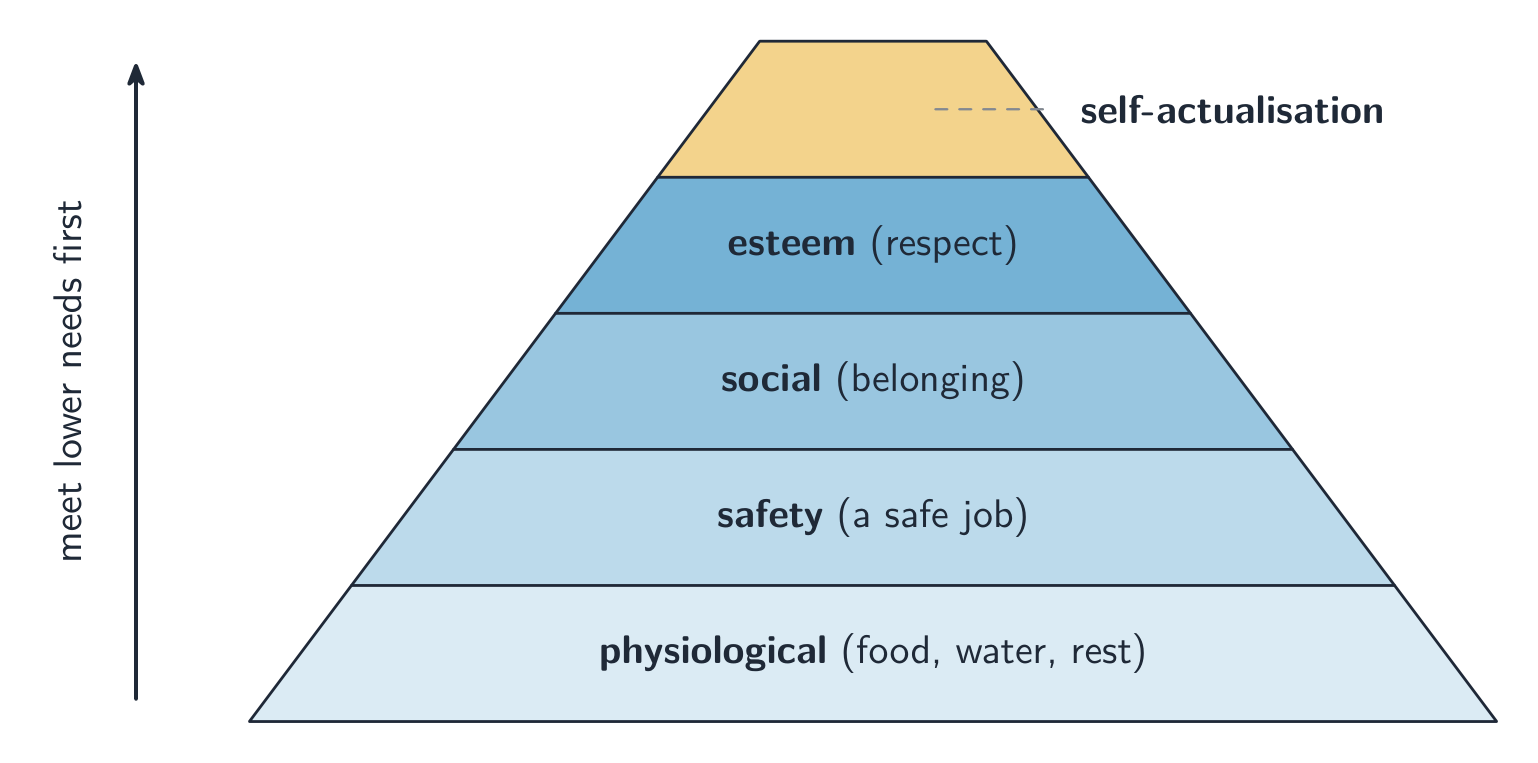
Maslow said people try to meet lower needs first, then move up:

  1. physiological needs 生理需求 — food, water, rest (met by pay).
  2. safety needs — a safe job and workplace.
  3. social needs — friendship and being part of a team.
  4. esteem needs 尊重需求 — respect and recognition 认可.
  5. self-actualisation 自我实现 — reaching your full potential.

Herzberg's two factors

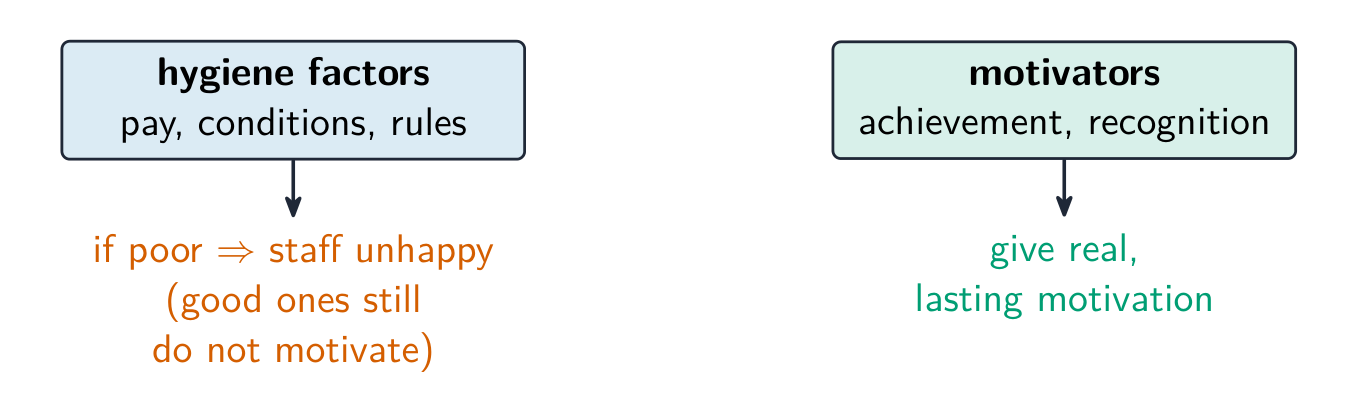
  • hygiene factors 保健因素 — things like pay, conditions and rules. If they are poor, staff are unhappy; but fixing them does not truly motivate.
  • motivators 激励因素 — things like achievement, responsibility and recognition. These give real, lasting motivation.
Español
Jerarquía de necesidades de Maslow dibujada como una pirámide de cinco niveles
Jerarquía de necesidades de Maslow, con ejemplos laborales en cada nivel.

Varios pensadores intentaron explicar qué motiva a las personas. Debes conocer la idea principal de cada uno.

Thinker Main idea
Taylor gestión científica — los trabajadores están motivados principalmente por el dinero. Pagarles por unidad producida (tarifa por pieza) los hace trabajar más duro.
Mayo relaciones humanas — los trabajadores también están motivados por la atención, el trabajo en equipo y sentirse parte de un grupo.
Maslow jerarquía de necesidades — las personas satisfacen las necesidades en orden, de menor a mayor (ver abajo).
Herzberg teoría de dos factores — algunas cosas causan infelicidad si faltan, otras motivan realmente (ver abajo).
McClelland las personas están impulsadas por tres necesidades en diferentes cantidades: logro, poder y afiliación (pertenencia).
Vroom teoría de la expectativa — las personas trabajan duro solo si creen que el esfuerzo conducirá a una recompensa que desean.

Maslow's hierarchy of needs

Maslow dijo que las personas intentan satisfacer primero las necesidades inferiores, y luego ascienden:

  1. necesidades fisiológicas — comida, agua, descanso (satisfechas mediante el salario).
  2. safety needs — a safe job and workplace.
  3. necesidades sociales — amistad y formar parte de un equipo.
  4. esteem needs 尊重需求 — respect and recognition 认可.
  5. self-actualisation 自我实现 — reaching your full potential.
Pirámide de cinco niveles de las necesidades de Maslow, más ancha en la base (fisiológicas) hasta la cúspide (autorrealización), con una flecha que muestra que las necesidades inferiores se satisfacen primero
Jerarquía de Maslow: las personas satisfacen las necesidades inferiores antes que las superiores

Herzberg's two factors

  • factores higiénicos — cosas como el salario, las condiciones y las normas. Si son malas, el personal está infeliz; pero corregirlas no motiva realmente.
  • motivadores — cosas como el logro, la responsabilidad y el reconocimiento. Estos brindan una motivación real y duradera.
Diagrama de Herzberg: los factores higiénicos (salario, condiciones) solo evitan que el personal esté infeliz, mientras que los motivadores (logro, reconocimiento) brindan una motivación real y duradera
Los factores higiénicos evitan la infelicidad; solo los motivadores brindan una motivación real y duradera
Explore · ⁨Explorar⁩

Jerarquía de necesidades de Maslow

Maslow afirmó que las personas están motivadas por necesidades en orden: satisfacer primero las básicas, luego buscar niveles superiores.

Vocabulary · ⁨Vocabulario⁩ Train · ⁨Entrenar⁩
English · ⁨Inglés⁩ Chinese · ⁨Chino⁩ Pinyin
hierarchy of needs/ˈhaɪərɑːki ɒv niːdz/ 需求层次 xū qiú céng cì
two-factor theory/tuː ˈfæktə ˈθɪəri/ 双因素理论 shuāng yīn sù lǐ lùn
achievement/əˈtʃiːvmənt/ 成就 chéng jiù
expectancy theory/ekˈspektənsi ˈθɪəri/ 期望理论 qī wàng lǐ lùn
physiological needs/ˌfɪzɪəˈlɒdʒɪkl niːdz/ 生理需求 shēng lǐ xū qiú
esteem needs/eˈstiːm niːdz/ 尊重需求 zūn zhòng xū qiú
recognition/ˌrekəɡˈnɪʃn/ 认可 rèn kě
self-actualisation/self ˌæktʃuːəlaɪˈzeɪʃn/ 自我实现 zì wǒ shí xiàn
hygiene factors/ˈhaɪdʒiːn ˈfæktəz/ 保健因素 bǎo jiàn yīn sù
2.2

Motivadores financieros

English

Financial motivators 经济激励 are rewards paid in money:

  • wages 工资 — pay by the hour or week, often for manual work 体力劳动.
  • salary 薪水 — a fixed yearly amount, paid monthly.
  • piece rate — pay for each unit made.
  • commission 佣金 — pay based on how much you sell.
  • bonus 奖金 — an extra payment for good results.
  • profit sharing 利润分享 — staff get a share of the firm's profit.
  • performance-related pay 绩效工资 — extra pay for those who meet targets.
  • fringe benefits 附加福利 — non-cash extras, such as a company car or health care.
Español

Financial motivators 经济激励 are rewards paid in money:

  • salarios — pago por hora o semana, a menudo para trabajo manual.
  • salary 薪水 — a fixed yearly amount, paid monthly.
  • piece rate — pay for each unit made.
  • comisiones — pago basado en cuánto se vende.
  • bonus 奖金 — an extra payment for good results.
  • participación en beneficios — el personal recibe una parte de las ganancias de la empresa.
  • salario vinculado al rendimiento — pago extra para quienes cumplen los objetivos.
  • beneficios adicionales — extras no monetarios, como un coche de empresa o asistencia sanitaria.
Explore · ⁨Explorar⁩

Laboratorio de métodos de motivación

Comparar formas financieras y no financieras para aumentar el esfuerzo.

Vocabulary · ⁨Vocabulario⁩ Train · ⁨Entrenar⁩
English · ⁨Inglés⁩ Chinese · ⁨Chino⁩ Pinyin
piece rate/piːs reɪt/ 计件工资 jì jiàn gōng zī
human relations/ˈhjuːmən rɪˈleɪʃnz/ 人际关系 rén jì guān xì
motivators/ˈməʊtɪveɪtəz/ 激励因素 jī lì yīn sù
financial motivators/faɪˈnænʃl ˈməʊtɪveɪtəz/ 经济激励 jīng jì jī lì
wages/ˈweɪdʒɪz/ 工资 gōng zī
manual work/ˈmænjuːəl wɜːk/ 体力劳动 tǐ lì láo dòng
salary/ˈsæləri/ 薪水 xīn shuǐ
commission/kəˈmɪʃn/ 佣金 yòng jīn
bonus/ˈbəʊnəs/ 奖金 jiǎng jīn
profit sharing/ˈprɒfɪt ˈʃeərɪŋ/ 利润分享 lì rùn fēn xiǎng
performance-related pay/pəˈfɔːməns rɪˈleɪtɪd peɪ/ 绩效工资 jì xiào gōng zī
fringe benefits/frɪndʒ ˈbenɪfɪts/ 附加福利 fù jiā fú lì
non-financial motivators/nɒn faɪˈnænʃl ˈməʊtɪveɪtəz/ 非经济激励 fēi jīng jì jī lì
job enrichment/dʒɒb enˈrɪtʃmənt/ 工作丰富化 gōng zuò fēng fù huà
job rotation/dʒɒb rəʊˈteɪʃn/ 工作轮换 gōng zuò lún huàn
job enlargement/dʒɒb enˈlɑːdʒmənt/ 工作扩大化 gōng zuò kuò dà huà
empowerment/emˈpaʊəmənt/ 授权 shòu quán
teamworking/ˈtiːmwɜːkɪŋ/ 团队合作 tuán duì hé zuò
2.2

Motivadores no financieros

English

Non-financial motivators 非经济激励 reward staff without extra money, by making work more interesting and giving more control:

  • job enrichment 工作丰富化 — giving more challenging tasks and responsibility.
  • job rotation 工作轮换 — moving between different tasks to reduce boredom.
  • job enlargement 工作扩大化 — adding more tasks at the same level.
  • empowerment 授权 — letting staff make their own decisions about their work.
  • teamworking 团队合作 — organising staff into teams that share goals.
Español

Los motivadores no financieros recompensan al personal sin dinero extra, haciendo el trabajo más interesante y otorgando más control:

  • enriquecimiento del puesto — asignar tareas más desafiantes y responsabilidad.
  • rotación de puestos — moverse entre diferentes tareas para reducir el aburrimiento.
  • ampliación del puesto — añadir más tareas al mismo nivel.
  • empoderamiento — permitir que el personal tome sus propias decisiones sobre su trabajo.
  • trabajo en equipo — organizar al personal en equipos que compartan objetivos.
Mapa mental que divide las formas de motivar al personal en recompensas financieras (salarios, tarifa por pieza, bonificación) y métodos no financieros (enriquecimiento del puesto, rotación, empoderamiento, trabajo en equipo)
Los motivadores son ya sea financieros (dinero) o no financieros (mejor, trabajo más completo)
2.3

Management and its functions

Syllabus
English
  1. explain the role and functions of management (Fayol, Mintzberg)
  2. explain leadership versus management and the importance of effective management
Español
  1. explicar el papel y las funciones de la gestión (Fayol, Mintzberg)
  2. explicar la diferencia entre liderazgo y gestión, así como la importancia de una gestión efectiva

Source: Cambridge International syllabus · ⁨Fuente: Plan de estudios Cambridge International⁩

English

Management 管理 means getting work done through other people to reach the firm's objectives.

Fayol said managers carry out five functions:

Function What the manager does
planning 计划 set objectives and decide how to reach them
organising 组织 arrange people and resources
commanding 指挥 give clear instructions and guidance
coordinating 协调 make sure all parts work together
controlling 控制 check results against the plan and correct problems

Mintzberg said managers also play ten roles 角色 in three groups: interpersonal (working with people), informational (sharing information), and decisional (making decisions). This shows that real management is busy and varied, not just the five neat functions.

Español

La gestión significa lograr que el trabajo se haga a través de otras personas para alcanzar los objetivos de la empresa.

Fayol said managers carry out five functions:

Function What the manager does
planificación establecer objetivos y decidir cómo alcanzarlos
organising 组织 arrange people and resources
commanding 指挥 give clear instructions and guidance
coordinating 协调 make sure all parts work together
control verificar los resultados frente al plan y corregir problemas
Ciclo de las cinco funciones de gestión de Fayol — planificación, organización, mando, coordinación, control — dispuestas en un anillo alrededor de la palabra gestión
Las cinco funciones de Fayol para la gestión forman un ciclo repetitivo

Mintzberg dijo que los gerentes también desempeñan diez roles en tres grupos: interpersonales (trabajar con personas), informativos (compartir información) y decisorios (tomar decisiones). Esto muestra que la gestión real es ocupada y variada, no solo las cinco funciones ordenadas.

Explore · ⁨Explorar⁩

Laboratorio de estilos de liderazgo

Elige el estilo de gestión que se adapte a cada situación.

Vocabulary · ⁨Vocabulario⁩ Train · ⁨Entrenar⁩
English · ⁨Inglés⁩ Chinese · ⁨Chino⁩ Pinyin
organising/ˈɔːɡənaɪzɪŋ/ 组织 zǔ zhī
commanding/kəˈmændɪŋ/ 指挥 zhǐ huī
coordinating/kəʊˈɔːdɪneɪtɪŋ/ 协调 xié tiáo
controlling/kənˈtrəʊlɪŋ/ 控制 kòng zhì
2.3

Liderazgo versus gestión

English

Leadership 领导 and management are not the same.

  • a manager plans, organises and controls the day-to-day work.
  • a leader sets a vision 愿景, inspires people, and guides change.

The best managers are also good leaders. Effective management matters because it raises productivity, keeps good staff, helps the firm adapt to change, and turns plans into real results.

Español

Leadership 领导 and management are not the same.

  • un gerente planifica, organiza y controla el trabajo diario.
  • un líder establece una visión, inspira a las personas y guía el cambio.
Dos cajas: un gerente que planifica, organiza y controla el trabajo diario, y un líder que establece una visión, inspira a las personas y guía el cambio
Un gerente dirige el trabajo diario; un líder establece la dirección e inspira — las mejores personas hacen ambas cosas

Los mejores gestores también son buenos líderes. La gestión eficaz es importante porque aumenta la productividad, retiene al buen personal, ayuda a la empresa a adaptarse al cambio y convierte los planes en resultados reales.

Vocabulary · ⁨Vocabulario⁩ Train · ⁨Entrenar⁩
English · ⁨Inglés⁩ Chinese · ⁨Chino⁩ Pinyin
leadership/ˈliːdəʃɪp/ 领导 lǐng dǎo
vision/ˈvɪʒn/ 愿景 yuàn jǐng
2.3

Exam tips · ⁨Consejos para el examen⁩

English
  • Calculate and interpret labour turnover and labour productivity; high turnover raises recruitment and training costs.
  • Link a motivation theory to a method: Maslow (needs), Herzberg (hygiene vs motivators), Taylor (pay).
  • Distinguish financial (piece rate, bonus) from non-financial (job enrichment, empowerment) motivators.
  • Distinguish leadership from management and match a style (autocratic, democratic, laissez-faire) to the situation.
Español
  • Calcular e interpretar la rotación de personal y la productividad laboral; una alta rotación aumenta los costos de reclutamiento y formación.
  • Relacionar una teoría de motivación con un método: Maslow (necesidades), Herzberg (higiénico vs motivadores), Taylor (salario).
  • Distinguir entre motivadores financieros (tarifa por pieza, bonificación) y no financieros (enriquecimiento del puesto, empoderamiento).
  • Distinguir liderazgo de gestión y emparejar un estilo (autocrático, democrático, laissez-faire) a la situación.

Interactive lessons on this topic · ⁨Lecciones interactivas sobre este tema⁩

Work through it step by step, with instant-check exercises. · ⁨Trátalo paso a paso, con ejercicios de verificación instantánea.⁩

Past Papers · ⁨Exámenes Anteriores⁩

More topics in A-Level Empresa · ⁨Más temas en A-Level Empresa⁩

Log in or create account · ⁨Iniciar sesión o crear cuenta⁩

IGCSE, A-Level & AP