Skip to content · ⁨الانتقال إلى المحتوى⁩

Linear Momentum · ⁨الزخم الخطي⁩

AP Physics 1 · ⁨AP الفيزياء 1⁩ · Topic 4 · ⁨الموضوع 4⁩

Video lesson for this topic · ⁨درس فيديو لهذا الموضوع⁩ Open the video page · ⁨افتح صفحة الفيديو⁩
7:49

الزخم الخطي

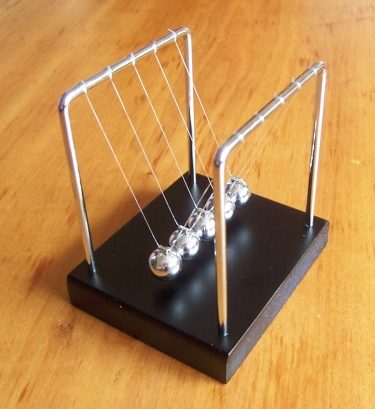
خمسة كرات فولاذية معلقة في صف، تتلامس تماماً. ارفع واحدة، وأفلتها، فتطير كرة من الطرف البعيد. كرة واحدة فقط. ارفع اثنتين، فتطيران اثنتان بالضبط. شيء ما…

English narration · English + 中文 subtitles burned in · ⁨سرد باللغة الإنجليزية · ترجمة مدمجة بالإنجليزية + الصينية⁩

4.1

Linear Momentum · ⁨الزخم الخطي⁩

Syllabus · ⁨المنهج⁩
English

Learning Objective 4.1.A: Describe the linear momentum of an object or system.

  • 4.1.A.1 Linear momentum is defined by the equation $\vec{p} = m\vec{v}$.
    • Equation: $\vec{p} = m\vec{v}$
  • 4.1.A.2 Momentum is a vector quantity and has the same direction as the velocity.
  • 4.1.A.3 Momentum can be used to analyze collisions and explosions.
    • 4.1.A.3.i A collision is a model for an interaction where the forces exerted between the involved objects in the system are much larger than the net external force exerted on those objects during the interaction.
    • 4.1.A.3.ii As only the initial and final states of a collision are analyzed, the object model may be used to analyze collisions.
    • 4.1.A.3.iii An explosion is a model for an interaction in which forces internal to the system move objects within that system apart.

Boundary statement: Unless otherwise stated, the general term "momentum" will refer specifically to linear momentum.

العربية

هدف التعلم 4.1.A: صف الزخم الخطي لجسم أو نظام.

  • 4.1.A.1 يُعرَّف الزخم الخطي بالمعادلة $\vec{p} = m\vec{v}$.
    • المعادلة: $\vec{p} = m\vec{v}$
  • 4.1.A.2 الزخم كمية متجهة ولها نفس اتجاه السرعة.
  • 4.1.A.3 يمكن استخدام الزخم لتحليل الاصطدامات والانفجارات.
    • 4.1.A.3.i الاصطدام هو نموذج لتفاعل تكون فيه القوى المؤثرة بين الأجسام المشاركة في النظام أكبر بكثير من محصلة القوى الخارجية المؤثرة على تلك الأجسام أثناء التفاعل.
    • 4.1.A.3.ii بما أنه يتم تحليل حالة البداية والنهاية فقط للاصطدام، يمكن استخدام نموذج الجسم النقطي لتحليل الاصطدامات.
    • 4.1.A.3.iii الانفجار هو نموذج لتفاعل تتحرك فيه القوى الداخلية للنظام الأجسام الموجودة داخله مبتعدة عن بعضها البعض.

بيان الحدود: ما لم يُذكر خلاف ذلك، يشير المصطلح العام "الزخم" تحديدًا إلى الزخم الخطي.

Source: College Board AP Course and Exam Description · ⁨المصدر: وصف دورة وامتحان College Board AP⁩

English

Linear momentum 动量 is mass times velocity – a vector pointing the same way as the velocity:

$$\vec{p}=m\vec{v}.$$
It measures "how hard it is to stop" a moving object. A heavy slow truck and a light fast ball can have the same momentum. Its unit is $\text{kg m/s}$, the same as $\text{N s}$.

العربية

الزخم الخطي هو حاصل ضرب الكتلة في السرعة – وهو متجه يشير في نفس اتجاه السرعة:

$$\vec{p}=m\vec{v}.$$
إنه يقيس "مدى صعوبة إيقاف" جسم متحرك. قد يكون شاحنة ثقيلة بطيئة وكرة خفيفة سريعة لهما نفس الزخم. وحدة قياسه هي $\text{kg m/s}$، وهي نفسها $\text{N s}$.

4.2

Change in Momentum and Impulse · ⁨التغير في الزخم والدفع⁩

Syllabus · ⁨المنهج⁩
English

Learning Objective 4.2.A: Describe the impulse delivered to an object or system.

  • 4.2.A.1 The rate of change of momentum is equal to the net external force exerted on an object or system.
    • Equation: $\vec{F}_{\text{net}} = \dfrac{\Delta \vec{p}}{\Delta t}$
  • 4.2.A.2 Impulse is defined as the product of the average force exerted on a system and the time interval during which that force is exerted on the system.
    • Equation: $\vec{J} = \vec{F}_{\text{avg}} \Delta t$
  • 4.2.A.3 Impulse is a vector quantity and has the same direction as the net force exerted on the system.
  • 4.2.A.4 The impulse delivered to a system by a net external force is equal to the area under the curve of a graph of the net external force exerted on the system as a function of time.
  • 4.2.A.5 The net external force exerted on a system is equal to the slope of a graph of the momentum of the system as a function of time.

Learning Objective 4.2.B: Describe the relationship between the impulse exerted on an object or a system and the change in momentum of the object or system.

  • 4.2.B.1 Change in momentum is the difference between a system's final momentum and its initial momentum.
    • Equation: $\Delta \vec{p} = \vec{p} - \vec{p}_0$
  • 4.2.B.2 The impulse–momentum theorem relates the impulse exerted on a system and the system's change in momentum.
    • Equation: $\vec{J} = \vec{F}_{\text{avg}} \Delta t = \Delta \vec{p}$
  • 4.2.B.3 Newton's second law of motion is a direct result of the impulse–momentum theorem applied to systems with constant mass.
    • Equation: $\vec{F}_{\text{net}} = \dfrac{\Delta \vec{p}}{\Delta t} = m\dfrac{\Delta \vec{v}}{\Delta t} = m\vec{a}$

Boundary statement: AP Physics 1 does not require students to quantitatively analyze systems in which the mass of the system changes with respect to time.

العربية

هدف التعلم 4.2.A: صف الدفع المقدم لجسم أو نظام.

  • 4.2.A.1 معدل تغير الزخم يساوي محصلة القوى الخارجية المؤثرة على جسم أو نظام.
    • المعادلة: $\vec{F}_{\text{net}} = \dfrac{\Delta \vec{p}}{\Delta t}$
  • 4.2.A.2 يُعرف الدفع بأنه حاصل ضرب متوسط القوة المؤثرة على النظام في الفترة الزمنية التي تُؤثّر فيها تلك القوة على النظام.
    • المعادلة: $\vec{J} = \vec{F}_{\text{avg}} \Delta t$
  • 4.2.A.3 الدفع كمية متجهة ولها نفس اتجاه محصلة القوى المؤثرة على النظام.
  • 4.2.A.4 الدفع المقدم لنظام بواسطة محصلة قوى خارجية يساوي المساحة تحت منحنى بياني لمحصلة القوى الخارجية المؤثرة على النظام كدالة للزمن.
  • 4.2.A.5 محصلة القوى الخارجية المؤثرة على نظام تساوي ميل بيانية لزخم该系统 كدالة للزمن.

هدف التعلم 4.2.B: صف العلاقة بين الدفع المؤثر على جسم أو نظام والتغير في زخم ذلك الجسم أو النظام.

  • 4.2.B.1 التغير في الزخم هو الفرق بين الزخم النهائي للنظام وزخمه الابتدائي.
    • المعادلة: $\Delta \vec{p} = \vec{p} - \vec{p}_0$
  • 4.2.B.2 تربط نظرية الدفع-الزخم بين الدفع المؤثر على النظام والتغير في زخمه.
    • المعادلة: $\vec{J} = \vec{F}_{\text{avg}} \Delta t = \Delta \vec{p}$
  • 4.2.B.3 قانون نيوتن الثاني للحركة هو نتيجة مباشرة لتطبيق نظرية الدفع-الزخم على الأنظمة ذات الكتلة الثابتة.
    • المعادلة: $\vec{F}_{\text{net}} = \dfrac{\Delta \vec{p}}{\Delta t} = m\dfrac{\Delta \vec{v}}{\Delta t} = m\vec{a}$

بيان الحدود: لا يتطلب امتحان الفيزياء AP 1 من الطلاب إجراء تحليل كمي للأنظمة التي تتغير فيها كتلتها بالنسبة للزمن.

Source: College Board AP Course and Exam Description · ⁨المصدر: وصف دورة وامتحان College Board AP⁩

English

A net force acting over time changes momentum. The impulse 冲量 delivered is

$$\vec{J}=\vec{F}\,\Delta t=\Delta\vec{p}.$$
This is the impulse–momentum theorem: impulse equals the change in momentum. On a force–time graph, impulse is the area under the curve. It explains why airbags and follow-through help – spreading the same momentum change over a longer time reduces the force.

Worked example. A $0.15\ \text{kg}$ ball hits a wall at $20\ \text{m/s}$ and bounces straight back at $15\ \text{m/s}$. The contact lasts $0.020\ \text{s}$. Find the average force on the ball. Take the rebound direction as positive, so $u=-20\ \text{m/s}$ and $v=+15\ \text{m/s}$:

$$\Delta p=m(v-u)=0.15\big(15-(-20)\big)=5.25\ \text{kg m/s},\qquad F=\frac{\Delta p}{\Delta t}=\frac{5.25}{0.020}=260\ \text{N}.$$
The sign work matters: forgetting that the velocity reverses is the most common mistake here.

العربية

قوة محصلة تؤثر لفترة زمنية تُحدث تغيرًا في الزخم. الدفع المُقدَّم هو

$$\vec{J}=\vec{F}\,\Delta t=\Delta\vec{p}.$$
هذا هو نظرية الدفع–الزخم: الدفع يساوي التغير في الزخم. على الرسم البياني للقوة–الزمن، يمثل الدفع المساحة تحت المنحنى. إنه يفسر لماذا تساعد الوسائد الهوائية والمتابعة في التحرك – توزيع نفس التغير في الزخم على فترة زمنية أطول يقلل من القوة.

الدفع هو المساحة تحت منحنى القوة–الزمن، مساوية لمتوسط القوة مضروبًا في زمن التلامس

مثال محلل. اصطدمت كرة وزنها $0.15\ \text{kg}$ جدارًا بسرعة $20\ \text{m/s}$ وتردّت بشكل مستقيم بسرعة $15\ \text{m/s}$. استمر التلامس لمدة $0.020\ \text{s}$. أوجد متوسط القوة المؤثرة على الكرة. اعتبر اتجاه الارتداد موجبًا، لذا $u=-20\ \text{m/s}$ و$v=+15\ \text{m/s}$:

$$\Delta p=m(v-u)=0.15\big(15-(-20)\big)=5.25\ \text{kg m/s},\qquad F=\frac{\Delta p}{\Delta t}=\frac{5.25}{0.020}=260\ \text{N}.$$
إشارة الشغل مهمة: نسيان أن السرعة تنعكس هو أكثر خطأ شائع هنا.

Vocabulary · ⁨مفردات⁩ Train · ⁨تدريب⁩
English العربية
Linear momentum/ˈlɪnɪə məʊˈmentəm/ الزخم الخطي
impulse/ˈɪmpʌls/ انفعال
conserved/kənˈsɜːvd/ محفوظة
collisions/kəˈlɪʒnz/ التصادمات
center-of-mass velocity/ˈsentə ɒv mæs vəˈlɒsɪti/ سرعة مركز الكتلة
elastic collision/ɪˈlæstɪk kəˈlɪʒn/ اصطدام مرن
inelastic collision/ɪnɪˈlæstɪk kəˈlɪʒn/ اصطدام غير مرن
recoil/rɪˈkɔɪl/ ارتداد
4.3

Conservation of Linear Momentum · ⁨حفظ الزخم الخطي⁩

Syllabus · ⁨المنهج⁩
English

Learning Objective 4.3.A: Describe the behavior of a system using conservation of linear momentum.

  • 4.3.A.1 A collection of objects with individual momenta can be described as one system with one center-of-mass velocity.
    • 4.3.A.1.i For a collection of objects, the velocity of a system's center of mass can be calculated using the equation $\vec{v}_{\text{cm}} = \dfrac{\sum \vec{p}_i}{\sum m_i} = \dfrac{\sum m_i \vec{v}_i}{\sum m_i}$.
    • 4.3.A.1.ii The velocity of a system's center of mass is constant in the absence of a net external force.
  • 4.3.A.2 The total momentum of a system is the sum of the momenta of the system's constituent parts.
  • 4.3.A.3 In the absence of net external forces, any change to the momentum of an object within a system must be balanced by an equivalent and opposite change of momentum elsewhere within the system. Any change to the momentum of a system is due to a transfer of momentum between the system and its surroundings.
    • 4.3.A.3.i The impulse exerted by one object on a second object is equal and opposite to the impulse exerted by the second object on the first. This is a direct result of Newton's third law.
    • 4.3.A.3.ii A system may be selected so that the total momentum of that system is constant.
    • 4.3.A.3.iii If the total momentum of a system changes, that change will be equivalent to the impulse exerted on the system.
      • Equation: $\vec{J} = \Delta \vec{p}$
  • 4.3.A.4 Correct application of conservation of momentum can be used to determine the velocity of a system immediately before and immediately after collisions or explosions.

Boundary statement: AP Physics 1 includes a quantitative and qualitative treatment of conservation of momentum in one dimension and a semiquantitative treatment of conservation of momentum in two dimensions. Exam questions involving solution of simultaneous equations are not included in AP Physics 1, but the AP Physics 1 Exam may include questions that assess whether students can set up the equations properly and reason about how changing a given mass, speed, or angle would affect other quantities. AP Physics 2 includes a full treatment of conservation of momentum in two dimensions for problems that include one unknown final velocity.

Learning Objective 4.3.B: Describe how the selection of a system determines whether the momentum of that system changes.

  • 4.3.B.1 Momentum is conserved in all interactions.
  • 4.3.B.2 If the net external force on the selected system is zero, the total momentum of the system is constant.
  • 4.3.B.3 If the net external force on the selected system is nonzero, momentum is transferred between the system and the environment.
العربية

هدف التعلم 4.3.A: صف سلوك نظام باستخدام مبدأ حفظ الزخم الخطي.

  • 4.3.A.1 يمكن وصف مجموعة من الأجسام ذات زخم فردي بأنها نظام واحد له سرعة مركز كتلة واحدة.
    • 4.3.A.1.i بالنسبة لمجموعة من الأجسام، يمكن حساب سرعة مركز كتلة النظام باستخدام المعادلة $\vec{v}_{\text{cm}} = \dfrac{\sum \vec{p}_i}{\sum m_i} = \dfrac{\sum m_i \vec{v}_i}{\sum m_i}$.
    • 4.3.A.1.ii سرعة مركز كتلة النظام تكون ثابتة في غياب محصلة القوى الخارجية.
  • 4.3.A.2 الزخم الكلي للنظام هو مجموع زخم أجزاءه المكونة.
  • 4.3.A.3 في غياب محصلة القوى الخارجية، يجب أن يكون أي تغيير في زخم جسم داخل نظام ما مقابلاً لتغير مساوٍ ومعاكس في الزخم في مكان آخر داخل النظام. أي تغيير في زخم النظام ناتج عن انتقال زخم بين النظام ومحيطه.
    • 4.3.A.3.i الدفع المؤثر من جسم أول على جسم ثانٍ يساوي في المقدار وعكس في الاتجاه الدفع المؤثر من الجسم الثاني على الأول. وهذا نتيجة مباشرة لقانون نيوتن الثالث.
    • 4.3.A.3.ii يمكن اختيار نظام بحيث يكون الزخم الكلي لذلك النظام ثابتًا.
    • 4.3.A.3.iii إذا تغير الزخم الكلي لنظام، فإن هذا التغير يعادل الدفع المؤثر على该系统.
      • معادلة: $\vec{J} = \Delta \vec{p}$
  • 4.3.A.4 يمكن استخدام التطبيق الصحيح لحفظ الزخم لتحديد سرعة النظام فورًا قبل وبعد الاصطدامات أو الانفجارات.

عبارة الحدود: يتضمن امتحان AP Physics 1 معالجة كمية ونوعية لحفظ الزخم في بُعد واحد ومعالجة شبه كمية لحفظ الزخم في بُعدين. لا تُدرج أسئلة الامتحان التي تتضمن حل معادلات متزامنة في امتحان AP Physics 1، لكن قد يتضمن امتحان AP Physics 1 أسئلة تقيّم ما إذا كان الطلاب يستطيعون إعداد المعادلات بشكل صحيح والتفكير في كيفية تأثير تغيير كتلة معينة أو سرعة أو زاوية على كميات أخرى. يتضمن امتحان AP Physics 2 معالجة كاملة لحفظ الزخم في بُعدين لمسائل تتضمن سرعة نهائية مجهولة واحدة.

الهدف التعليمي 4.3.B: صف كيف يحدد اختيار نظام ما إذا كان زخم ذلك النظام سيتغير.

  • 4.3.B.1 يُحفظ الزخم في جميع التفاعلات.
  • 4.3.B.2 إذا كانت محصلة القوى الخارجية المؤثرة على النظام المختار تساوي صفرًا، فإن الزخم الكلي للنظام يكون ثابتًا.
  • 4.3.B.3 إذا كانت محصلة القوى الخارجية المؤثرة على النظام المختار غير صفرية، يتم نقل الزخم بين النظام والبيئة المحيطة.

Source: College Board AP Course and Exam Description · ⁨المصدر: وصف دورة وامتحان College Board AP⁩

English

If the net external force on a system is zero, its total momentum is conserved 守恒:

$$\sum \vec{p}_{\text{before}}=\sum \vec{p}_{\text{after}}.$$
Internal forces (like the push between two colliding carts) come in third-law pairs and cancel, so they cannot change the total momentum. This is the key tool for collisions 碰撞 and explosions – apply it separately in the $x$ and $y$ directions.

Worked example (recoil 反冲). A $60\ \text{kg}$ skater, initially at rest on frictionless ice, throws a $2.0\ \text{kg}$ ball at $8.0\ \text{m/s}$. Find her recoil speed. The total momentum starts at zero and stays zero:

$$0=(60)v+(2.0)(8.0)\;\Rightarrow\;v=-\frac{16}{60}=-0.27\ \text{m/s},$$
so she moves at $0.27\ \text{m/s}$ in the opposite direction to the ball – the principle behind rockets and guns.

A whole collection of objects can be described by a single center-of-mass velocity 质心速度:

$$\vec{v}_{\text{cm}}=\frac{\sum m_i\vec{v}_i}{\sum m_i}=\frac{\vec{p}_{\text{total}}}{M_{\text{total}}}.$$
Since total momentum is conserved when no net external force acts, $\vec{v}_{\text{cm}}$ then stays constant – a $v_{\text{cm}}$-versus-time graph is flat unless an outside force acts. An internal collision or explosion never changes it, however violently the parts fly apart.

العربية

إذا كانت القوة الخارجية المحصلة المؤثرة على نظام ما تساوي صفرًا، فإن زخمه الكلي يُحفظ:

$$\sum \vec{p}_{\text{before}}=\sum \vec{p}_{\text{after}}.$$
تأتي القوى الداخلية (مثل الدفع بين عربة مصطدمتين) في أزواج من قانون نيوتن الثالث وتُلغي بعضها البعض، لذا لا يمكنها تغيير الزخم الكلي. هذه الأداة الرئيسية لـالتصادمات والانفجارات – طبقها بشكل منفصل في الاتجاهين $x$ و$y$.

اصطدام أمامي: الزخم الكلي قبل الاصطدام يساوي الزخم الكلي بعده

مثال محلل (الارتداد). قفزّة وزنها $60\ \text{kg}$، كانت في البداية ساكنة على جليد غير احتكاكي، أطلقت كرة وزنها $2.0\ \text{kg}$ بسرعة $8.0\ \text{m/s}$. أوجد سرعة ارتدادها. يبدأ الزخم الكلي من الصفر ويبقى صفرًا:

$$0=(60)v+(2.0)(8.0)\;\Rightarrow\;v=-\frac{16}{60}=-0.27\ \text{m/s},$$
لذا فهي تتحرك بسرعة $0.27\ \text{m/s}$ في الاتجاه المعاكس للكرة – وهو المبدأ الذي تقوم عليه الصواريخ والأسلحة.

يمكن وصف مجموعة كاملة من الأجسام باستخدام سرعة مركز الكتلة واحدة:

$$\vec{v}_{\text{cm}}=\frac{\sum m_i\vec{v}_i}{\sum m_i}=\frac{\vec{p}_{\text{total}}}{M_{\text{total}}}.$$
بما أن الزخم الكلي يُحفظ عندما لا تؤثر قوة خارجية محصلة، فإن $\vec{v}_{\text{cm}}$ يبقى ثابتًا – فإن الرسم البياني لـ$v_{\text{cm}}$–الزمن يكون أفقيًا إلا إذا أثرت قوة خارجية. ومع ذلك، فإن التصادم الداخلي أو الانفجار لا يغيره أبدًا، بغض النظر عن شدة انفصال الأجزاء.

Explore · ⁨استكشف⁩

Collide two carts and conserve momentum · ⁨اصطدم بعربة أخرى واحفظ الزخم⁩

In any collision the total momentum $\sum mv$ before equals the total after. Set the masses and speeds and check the momentum bookkeeping. · ⁨في أي تصادم، يكون الزخم الكلي $\sum mv$ قبل التصادم مساويًا له بعد التصادم. حدد الكتل والسرعات وتحقق من حسابات الزخم.⁩

4.4

Elastic and Inelastic Collisions · ⁨التصادمات المرنة وغير المرنة⁩

Syllabus · ⁨المنهج⁩
English

Learning Objective 4.4.A: Describe whether an interaction between objects is elastic or inelastic.

  • 4.4.A.1 An elastic collision between objects is one in which the initial kinetic energy of the system is equal to the final kinetic energy of the system.
  • 4.4.A.2 In an elastic collision, the final kinetic energies of each of the objects within the system may be different from their initial kinetic energies.
  • 4.4.A.3 An inelastic collision between objects is one in which the total kinetic energy of the system decreases.
  • 4.4.A.4 In an inelastic collision, some of the initial kinetic energy is not restored to kinetic energy but is transformed by nonconservative forces into other forms of energy.
  • 4.4.A.5 In a perfectly inelastic collision, the objects stick together and move with the same velocity after the collision.
العربية

الهدف التعليمي 4.4.A: صف ما إذا كان التفاعل بين الأجسام مرناً أم غير مرن.

  • 4.4.A.1 التصادم المرن بين الأجسام هو الذي تكون فيه الطاقة الحركية الأولية للنظام مساوية للطاقة الحركية النهائية للنظام.
  • 4.4.A.2 في التصادم المرن، قد تختلف الطاقة الحركية النهائية لكل من الأجسام داخل النظام عن طاقتها الحركية الأولية.
  • 4.4.A.3 التصادم غير المرن بين الأجسام هو الذي تنخفض فيه الطاقة الحركية الكلية للنظام.
  • 4.4.A.4 في التصادم غير المرن، لا تُستعاد بعض الطاقة الحركية الأولية كطاقة حركية، بل تتحول بواسطة قوى غير محتفظة إلى أشكال أخرى من الطاقة.
  • 4.4.A.5 في التصادم غير المرن تماماً، تتصل الأجسام ببعضها وتتحرك بنفس السرعة بعد التصادم.

Source: College Board AP Course and Exam Description · ⁨المصدر: وصف دورة وامتحان College Board AP⁩

English
Conservation of momentum in a collision

Momentum is conserved in every collision (with no external force). Kinetic energy is not:

  • In an elastic collision 弹性碰撞, kinetic energy is also conserved (objects bounce apart cleanly).
  • In an inelastic collision 非弹性碰撞, some kinetic energy becomes heat or deformation. In a perfectly inelastic collision the objects stick together and move with one common velocity afterward.

Strategy: always write momentum conservation; add energy conservation only if the collision is stated to be elastic. One elastic fact worth memorising: in a 1D elastic collision between equal masses, the two objects simply swap velocities (a moving ball striking an identical stationary one stops dead, and the target flies off at the incoming speed).

Worked example. A $1000\ \text{kg}$ car moving at $20\ \text{m/s}$ runs into a stationary $1500\ \text{kg}$ car and they lock together. Find their common speed, and the kinetic energy lost. Momentum conservation gives

$$1000\times20=(1000+1500)\,v\;\Rightarrow\;v=\frac{20000}{2500}=8.0\ \text{m/s}.$$
Kinetic energy before is $\tfrac12(1000)(20^2)=2.0\times10^{5}\ \text{J}$; after is $\tfrac12(2500)(8.0^2)=8.0\times10^{4}\ \text{J}$. So $1.2\times10^{5}\ \text{J}$ (about $60\%$) is lost to crumpling and heat – momentum is still conserved, but kinetic energy is not.

العربية
حفظ الزخم في اصطدام

يُحفظ الزخم في كل تصادم (بدون قوة خارجية). أما الطاقة الحركية فلا تُحفظ:

تصادم جانبي، مُحلّل على طول محورين متعامدين
  • في التصادم المرن، تُحفظ الطاقة الحركية أيضًا (تنفصل الأجسام عن بعضها بنظافة).
  • في التصادم غير المرن، تتحول بعض الطاقة الحركية إلى حرارة أو تشوه. في التصادم غير المرن تمامًا، تلتصق الأجسام معًا وتتحرك بسرعة مشتركة واحدة لاحقًا.

الاستراتيجية: اكتب دائماً معادلة حفظ الزخم؛ أضف معادلة حفظ الطاقة فقط إذا ذُكر أن التصادم مرن. حقيقة مرنة واحدة تستحق الحفظ: في تصادم مرن ثنائي الأبعاد 1 بين كتلتين متساويتين، يتبادل الجسمان ببساطة سرعتيهما (كرة متحركة تصطدم بكرة ساكنة مماثلة لها فتتوقف تماماً، وتطلق الكرة المستهدفة بسرعة الكرة الساقطة).

مثال محلول. سيارة $1000\ \text{kg}$ تتحرك بسرعة $20\ \text{m/s}$ تصطدم بسيارة $1500\ \text{kg}$ متوقفة وتلتصقان معاً. أوجد سرعهما المشترك، والطاقة الحركية المفقودة. يعطي حفظ الزخم

$$1000\times20=(1000+1500)\,v\;\Rightarrow\;v=\frac{20000}{2500}=8.0\ \text{m/s}.$$
الطاقة الحركية قبل الاصطدام هي $\tfrac12(1000)(20^2)=2.0\times10^{5}\ \text{J}$؛ وبعد الاصطدام هي $\tfrac12(2500)(8.0^2)=8.0\times10^{4}\ \text{J}$. لذا فإن $1.2\times10^{5}\ \text{J}$ (حول $60\%$) تضيع في التشوه والحرارة – الزخم لا يزال محفوظاً، لكن الطاقة الحركية ليست محفوظة.

منظار نيوتن: خمس كرات فولاذية معلقة في صف واحد
يُظهر منظار نيوتن مرور الزخم والطاقة الحركية عبر سلسلة من الكرات في اصطدام شبه مرن
Explore · ⁨استكشف⁩

Compare elastic and inelastic collisions · ⁨قارن بين التصادم المرن وغير المرن⁩

Momentum is always conserved, but kinetic energy is only conserved in an elastic collision. In an inelastic one the carts stick and some energy becomes heat. · ⁨يُحفظ الزخم دائمًا، لكن الطاقة الحركية تُحفظ فقط في التصادم المرن. أما في التصادم غير المرن، فتلتصق العربات ببعضها وتتحول بعض الطاقة إلى حرارة.⁩

4.4

Exam tips · ⁨نصائح للامتحان⁩

English
  • Momentum is a vector — assign $+$/$-$ signs before adding; a ball that rebounds reverses its velocity, giving a large $\Delta p$.
  • Momentum is conserved in every collision (no external force); kinetic energy is conserved only if the collision is stated to be elastic.
  • In a perfectly inelastic collision the objects stick and move with one common velocity.
  • Impulse $=F\,\Delta t=\Delta p$ = the area under a force–time graph; spreading a collision over a longer time reduces the force (airbags, bending knees).
  • For recoil/explosions, set the total momentum equal before and after (often zero before).
العربية
  • الزخم متجه — عين $+$/$-$ الإشارات قبل الجمع؛ الكرة التي ترتد تعكس سرعتها، مما يعطي تغيراً كبيراً في $\Delta p$.
  • يُحفظ الزخم في كل اصطدام (بغياب قوى خارجية)؛ تُحفظ الطاقة الحركية فقط إذا ذُكر أن الاصطدام مرن.
  • في الاصطدام غير المرن تماماً، تلتصق الأجسام وتتحرك بسرعة مشتركة واحدة.
  • الدفع $=F\,\Delta t=\Delta p$ = المساحة تحت منحنى القوة–الزمن؛ توزيع الاصطدام على زمن أطول يقلل من القوة (أكياس الهواء، ثني الركبتين).
  • بالنسبة للانقباض/الانفجارات، ضع الزخم الكلي مساوياً قبل وبعد (غالباً يساوي صفراً قبل).

Interactive lessons on this topic · ⁨دروس تفاعلية حول هذا الموضوع⁩

Work through it step by step, with instant-check exercises. · ⁨ا-working عليه خطوة بخطوة، مع تمارين تحقق فوري.⁩

Past Papers · ⁨أوراق الامتحانات السابقة⁩

More topics in AP Physics 1 · ⁨AP الفيزياء 1⁩ · ⁨المزيد من المواضيع في AP Physics 1 · ⁨AP الفيزياء 1⁩⁩

Log in or create account · ⁨تسجيل الدخول أو إنشاء حساب⁩

IGCSE, A-Level & AP