Skip to content · ⁨ข้ามไปยังเนื้อหา⁩
Subjects · ⁨รายวิชา⁩

AP Physics C: Mechanics

Tips · ⁨เคล็ดลับ⁩

AP Physics C: Mechanics เป็นเวอร์ชันที่ ใช้แคลคูลัส: จลนศาสตร์, แรง, งาน พลังงานกำลัง, โมเมนตัม, แรงบิดและการหมุน, และ การสั่น ครอบคลุมเนื้อหา น้อยกว่า Physics 1 แต่ลึกซึ้งกว่ามาก และแคลคูลัสไม่ใช่แค่ตกแต่ง — มันคือวิธี derivation ผลลัพธ์以及如何 exam expects them to be used.

ในทางปฏิบัติ: อินทิเกรตเพื่อหาค่ารวมจากปริมาณที่แปรผัน และ ดิฟ จากตำแหน่งสู่ความเร็วสู่ความเร่งได้อย่างคล่องแคล่วโดยไม่ต้องรอคำสั่ง

พลศาสตร์การหมุนคือส่วนที่ใช้เวลานานที่สุด เพราะ โมเมนต์ของความเฉื่อยต้องตั้งเป็นอินทิกรัล แทนที่จะทบทวนจากความจำ

หมายเหตุจัดเรียงแต่ละหน่วยตามลำดับ CED พร้อมแสดงแคลคูลัสอย่างละเอียด ข้อสอบเก่าและคู่มือการให้คะแนนวางอยู่ในห้องสมุด เนื่องจากคะแนนหลายส่วนขึ้นอยู่กับวิธีการตั้งโจทย์มากกว่าการคำนวณ ตัวอย่างเฉลยจึงเน้นแสดง การสร้างอินทิกรัล ก่อนที่จะนำไปคำนวณผลลัพธ์

  • 1

    Kinematics · ⁨จลนศาสตร์⁩

    Watch lesson · ⁨ดูบทเรียน⁩
    1.1

    Scalars and Vectors · ⁨สเกลาร์และเวกเตอร์⁩

    Syllabus · ⁨หลักสูตร⁩
    English

    Learning Objective 1.1.A: Describe a scalar or vector quantity using magnitude and direction, as appropriate.

    • 1.1.A.1 Scalars are quantities described by magnitude only; vectors are quantities described by both magnitude and direction.
    • 1.1.A.2 Vectors can be visually modeled as arrows with appropriate direction and lengths proportional to their magnitude.
    • 1.1.A.3 Distance and speed are examples of scalar quantities, while position, displacement, velocity, and acceleration are examples of vector quantities.
    • 1.1.A.4 Vectors can be expressed in unit vector notation or as a magnitude and a direction.
      • 1.1.A.4.i Unit vector notation can be used to represent vectors as the sum of their constituent components in the $x$-, $y$-, and $z$-directions, denoted by $\hat{i}$, $\hat{j}$, and $\hat{k}$, respectively.
        • Equation: $\vec{r} = \left( A\hat{i} + B\hat{j} + C\hat{k} \right)$
      • 1.1.A.4.ii The position vector of a point is given by $\vec{r}$, and the unit vector in the direction of the position vector is denoted $\hat{r}$.
      • 1.1.A.4.iii A resultant vector is the vector sum of the addend vectors' components.
        • Equation: $\vec{C} = \vec{A} + \vec{B}$
        • Equation: $\vec{C} = \left( A_x + B_x \right)\hat{i} + \left( A_y + B_y \right)\hat{j}$
    • 1.1.A.5 In a given one-dimensional coordinate system, opposite directions are denoted by opposite signs.
    ไทย

    วัตถุประสงค์การเรียนรู้ 1.1.A: อธิบายปริมาณสเกลาร์หรือเวกเตอร์โดยใช้ขนาดและทิศทาง ตามความเหมาะสม

    • 1.1.A.1 สเกลาร์คือปริมาณที่อธิบายได้ด้วยขนาดเพียงอย่างเดียว; เวกเตอร์คือปริมาณที่อธิบายได้ด้วยทั้งขนาดและทิศทาง
    • 1.1.A.2 เวกเตอร์สามารถแสดงด้วยภาพเป็นลูกศรที่มีทิศทางที่เหมาะสมและความยาวแปรผันตรงกับขนาดของมัน
    • 1.1.A.3 ระยะทางและอัตราเร็วเป็นตัวอย่างของปริมาณสเกลาร์ ในขณะที่ตำแหน่ง, การกระจัด, ความเร็ว, และความเร่งเป็นตัวอย่างของปริมาณเวกเตอร์
    • 1.1.A.4 เวกเตอร์สามารถแสดงในรูปProgramming unit vector notation หรือเป็นขนาดและทิศทาง
      • 1.1.A.4.i Unit vector notation สามารถใช้แทนเวกเตอร์ด้วยการบวกองค์ประกอบย่อยของเวกเตอร์ในทิศทาง $x$-, $y$-, และ $z$- ซึ่งระบุด้วย $\hat{i}$, $\hat{j}$, และ $\hat{k}$ ตามลำดับ
        • สมการ: $\vec{r} = \left( A\hat{i} + B\hat{j} + C\hat{k} \right)$
      • 1.1.A.4.ii Position vector ของจุดกำหนดโดย $\vec{r}$ และ unit vector ในทิศทางของ position vector ระบุด้วย $\hat{r}$
      • 1.1.A.4.iii Resultant vector คือผลบวกของเวกเตอร์ขององค์ประกอบของเวกเตอร์ที่บวกกัน
        • สมการ: $\vec{C} = \vec{A} + \vec{B}$
        • สมการ: $\vec{C} = \left( A_x + B_x \right)\hat{i} + \left( A_y + B_y \right)\hat{j}$
    • 1.1.A.5 ในระบบพิกัดแบบหนึ่งมิติ ทิศทางตรงข้ามจะระบุด้วยเครื่องหมายตรงข้าม
    Source: College Board AP Course and Exam Description · ⁨แหล่งที่มา: คำอธิบายหลักสูตรและข้อสอบ College Board AP⁩

    English

    Kinematics 运动学 describes motion. Two kinds of quantity:

    • A scalar 标量 has only size (magnitude 大小): distance, speed, mass, time.
    • A vector 矢量 has magnitude and direction: displacement, velocity, acceleration, force.

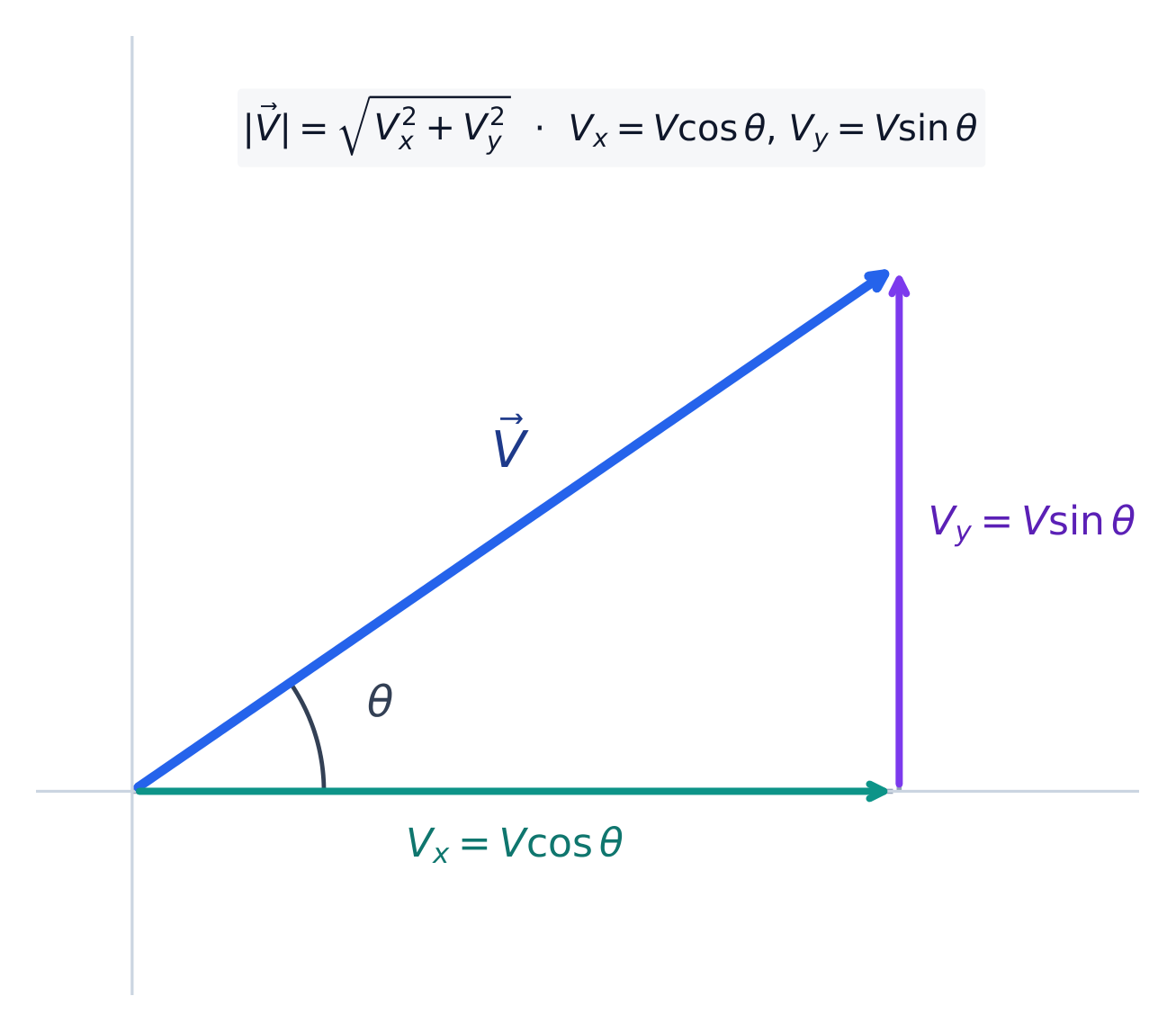
    In this calculus-based course you resolve vectors into components 分量 and add them component by component; a vector's magnitude is $\sqrt{v_x^2+v_y^2+\cdots}$. Physics C also writes vectors with unit vectors 单位矢量: $\vec{v}=v_x\hat{i}+v_y\hat{j}$, where $\hat{i}$ and $\hat{j}$ are directions of length one along $x$ and $y$ – handy because calculus can then act on each component separately.

    ไทย

    จลนศาสตร์ อธิบายการเคลื่อนที่ มีสองประเภทของปริมาณ:

    • สเกลาร์ มีเพียงขนาด (magnitude): ระยะทาง, ความเร็ว, มวล, เวลา
    • เวกเตอร์ มีทั้งขนาด และ ทิศทาง: การกระจัด, ความเร็ว, ความเร่ง, แรง

    ในรายวิชาที่ใช้แคลคูลัสนี้ คุณแยกเวกเตอร์ออกเป็น ส่วนประกอบ และบวกทีละส่วน; ขนาดของเวกเตอร์คือ $\sqrt{v_x^2+v_y^2+\cdots}$. Physics C ยังเขียนเวกเตอร์ด้วย เวกเตอร์หน่วย: $\vec{v}=v_x\hat{i}+v_y\hat{j}$, โดยที่ $\hat{i}$ และ $\hat{j}$ เป็นทิศทางที่มีความยาวหนึ่งตาม $x$ และ $y$ – สะดวกเพราะแคลคูลัสสามารถกระทำต่อแต่ละส่วนประกอบแยกต่างหาก

    การแยกเวกเตอร์ออกเป็น:x และ y components
    การแยกเวกเตอร์ออกเป็น:x และ y components
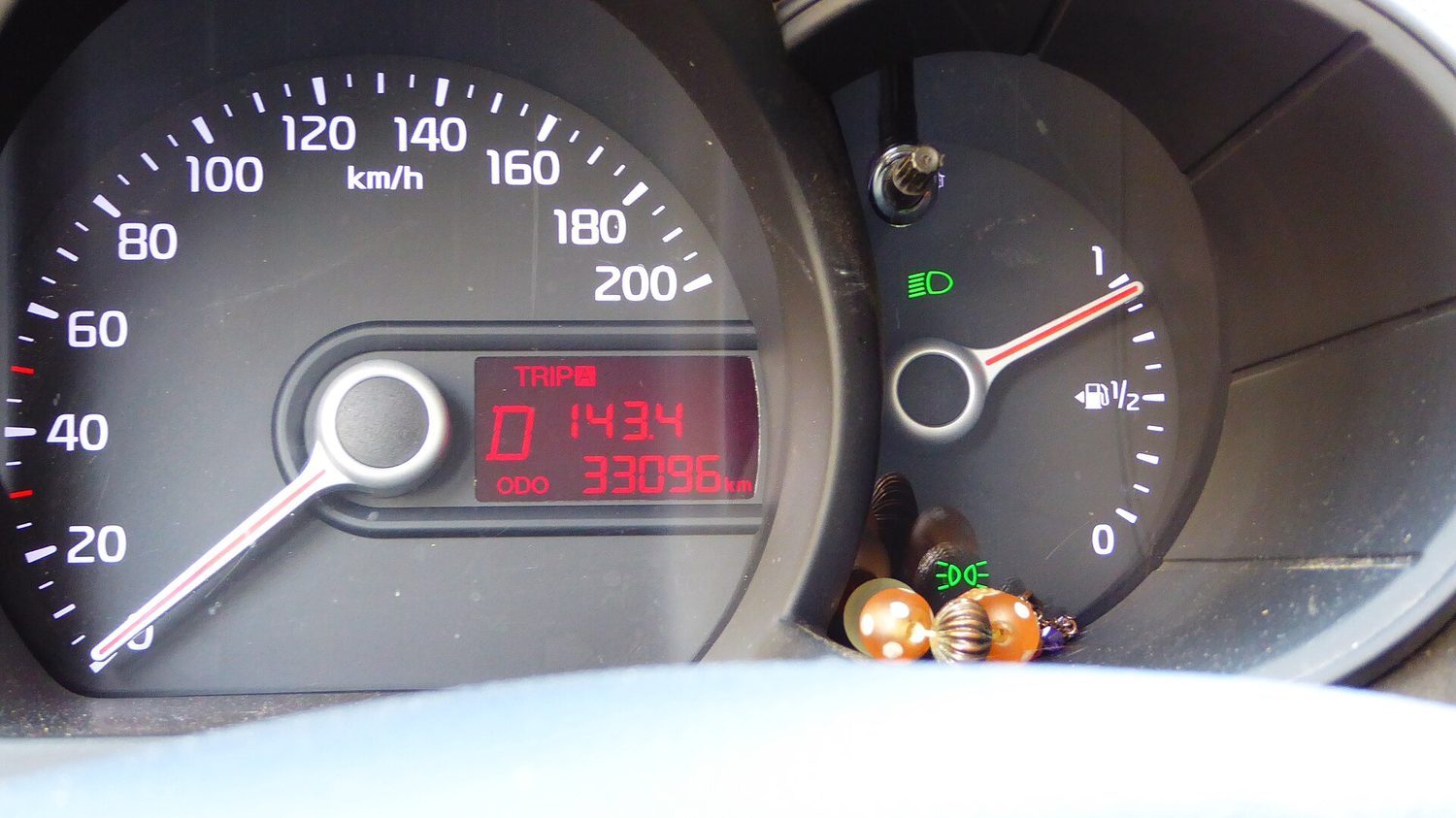
    มาตรวัดความเร็วรถยนต์: ความเร็วคือขนาดของความเร็ว vector — อัตราการเคลื่อนที่เป็นสเกลาร์
    มาตรวัดความเร็วรถยนต์: ความเร็วคือขนาดของความเร็ว vector — อัตราการเคลื่อนที่เป็นสเกลาร์
    Explore · ⁨สำรวจ⁩

    Explore the dot product · ⁨สำรวจผลคูณสเกลาร์⁩

    Drag the components of $\vec{A}$ and $\vec{B}$. The dot product $\vec{A}\cdot\vec{B}=A_xB_x+A_yB_y$ reaches zero exactly when the two vectors are perpendicular — the geometry behind $\cos\theta$. · ⁨ลากองค์ประกอบของ $\vec{A}$ และ $\vec{B}$ ผล ผลคูณสเกลาร์ $\vec{A}\cdot\vec{B}=A_xB_x+A_yB_y$ จะเท่ากับ ศูนย์ พอดีเมื่อเวกเตอร์ทั้งสอง ตั้งฉากกัน — ซึ่งเป็นเรขาคณิตเบื้องหลัง $\cos\theta$⁩

    Vocabulary · ⁨คำศัพท์⁩ Train · ⁨ฝึกฝน⁩
    English ไทย
    magnitude/ˈmæɡnɪtjuːd/ ขนาด
    vector/ˈvektə/ เวกเตอร์
    components/kəmˈpəʊnənts/ components
    unit vectors/ˈjuːnɪt ˈvektəz/ เวกเตอร์หน่วย
    1.2

    Displacement, Velocity, and Acceleration · ⁨การกระจัด, ความเร็ว, และความเร่ง⁩

    Syllabus · ⁨หลักสูตร⁩
    English

    Learning Objective 1.2.A: Describe a change in an object's position.

    • 1.2.A.1 When using the object model, the size, shape, and internal configuration are ignored. The object may be treated as a single point with extensive properties such as mass and charge.
    • 1.2.A.2 Displacement is the change in an object's position.
      • Equation: $\Delta x = x - x_0$

    Learning Objective 1.2.B: Describe the average velocity and acceleration of an object.

    • 1.2.B.1 Averages of velocity and acceleration are calculated considering the initial and final states of an object over an interval of time.
    • 1.2.B.2 Average velocity is the displacement of an object divided by the interval of time in which that displacement occurs.
      • Equation: $\vec{v}_{\text{avg}} = \dfrac{\Delta \vec{x}}{\Delta t}$
    • 1.2.B.3 Average acceleration is the change in velocity divided by the interval of time in which that change in velocity occurs.
      • Equation: $\vec{a}_{\text{avg}} = \dfrac{\Delta \vec{v}}{\Delta t}$
    • 1.2.B.4 An object is accelerating if either the magnitude and/or direction of the object's velocity are changing.
    • 1.2.B.5 Calculating average velocity or average acceleration over a very small time interval yields a value that is very close to the instantaneous velocity or instantaneous acceleration.

    Learning Objective 1.2.C: Describe the instantaneous position, velocity, and acceleration of an object as a function of time.

    • 1.2.C.1 As the time interval used to calculate the average value of a quantity approaches zero, the average value of that quantity approaches the value of the quantity at that instant, called the instantaneous value.
      • 1.2.C.1.i Instantaneous velocity is the rate of change of the object's position, which is equal to the derivative of position with respect to time.
        • Equation: $\vec{v} = \dfrac{d\vec{r}}{dt}$
        • Equation: $v_x = \dfrac{dx}{dt}$
      • 1.2.C.1.ii Instantaneous acceleration is the rate of change of the object's velocity, which is equal to the derivative of velocity with respect to time.
        • Equation: $\vec{a} = \dfrac{d\vec{v}}{dt}$
        • Equation: $a_x = \dfrac{dv_x}{dt}$
    • 1.2.C.2 Time-dependent functions and instantaneous values of position, velocity, and acceleration can be determined using differentiation and integration.
    ไทย

    วัตถุประสงค์การเรียนรู้ 1.2.A: อธิบายการเปลี่ยนแปลงตำแหน่งของวัตถุ

    • 1.2.A.1 เมื่อใช้โมเดลวัตถุ ขนาด รูปร่าง และการจัดเรียงภายในถูกตัดทอนไป วัตถุนั้นอาจถูกพิจารณาเป็นจุดเดียวที่มีคุณสมบัติเชิง extensive เช่น มวลและประจุไฟฟ้า
    • 1.2.A.2 การกระจัดคือการเปลี่ยนแปลงตำแหน่งของวัตถุ
      • สมการ: $\Delta x = x - x_0$

    วัตถุประสงค์การเรียนรู้ 1.2.B: อธิบายความเร็วเฉลี่ยและความเร่งเฉลี่ยของวัตถุ

    • 1.2.B.1 ค่าเฉลี่ยของความเร็วและความเร่งคำนวณโดยพิจารณาจากสถานะเริ่มต้นและสถานะสุดท้ายของวัตถุในช่วงเวลาหนึ่ง
    • 1.2.B.2 ความเร็วเฉลี่ยคือค่าของการกระจัดของวัตถุหารด้วยช่วงเวลาที่ยังมีการกระดกลนั้นเกิดขึ้น
      • สมการ: $\vec{v}_{\text{avg}} = \dfrac{\Delta \vec{x}}{\Delta t}$
    • 1.2.B.3 ความเร่งเฉลี่ยคือค่าของการเปลี่ยนแปลงความเร็วหารด้วยช่วงเวลาที่ยังเกิดการเปลี่ยนแปลงความเร็วนั้นขึ้น
      • สมการ: $\vec{a}_{\text{avg}} = \dfrac{\Delta \vec{v}}{\Delta t}$
    • 1.2.B.4 วัตถุกำลังมีความเร่งหากขนาดและ/หรือทิศทางของความเร็วของวัตถุนั้นกำลังเปลี่ยนไป
    • 1.2.B.5 การคำนวณความเร็วเฉลี่ยหรือความเร่งเฉลี่ยในช่วงเวลาที่สั้นมากจะได้ค่าที่ใกล้เคียงกับความเร็วทันทีหรือความเร่งทันทีมาก

    จุดประสงค์การเรียนรู้ 1.2.C: อธิบายตำแหน่ง ความเร็ว และความเร่งของวัตถุในฐานะฟังก์ชันของเวลา

    • 1.2.C.1 เมื่อช่วงเวลาที่ใช้ในการคำนวณค่าเฉลี่ยของปริมาณหนึ่งเข้าใกล้ศูนย์ ค่าเฉลี่ยของปริมาณนั้นจะเข้าใกล้ค่าของปริมาณ ณ วินาทีนั้น ซึ่งเรียกว่าค่าทันที (instantaneous value)
      • 1.2.C.1.i ความเร็วทันทีคืออัตราการเปลี่ยนแปลงตำแหน่งของวัตถุ ซึ่งเท่ากับอนุพันธ์ของตำแหน่งเทียบกับเวลา
        • สมการ: $\vec{v} = \dfrac{d\vec{r}}{dt}$
        • สมการ: $v_x = \dfrac{dx}{dt}$
      • 1.2.C.1.ii ความเร่งทันทีคืออัตราการเปลี่ยนแปลงความเร็วของวัตถุ ซึ่งเท่ากับอนุพันธ์ของความเร็วเทียบกับเวลา
        • สมการ: $\vec{a} = \dfrac{d\vec{v}}{dt}$
        • สมการ: $a_x = \dfrac{dv_x}{dt}$
    • 1.2.C.2 ฟังก์ชันที่ขึ้นอยู่กับเวลาและค่าทันทีของตำแหน่ง ความเร็ว และความเร่ง สามารถหาได้โดยใช้การหาอนุพันธ์และการอินทิเกรต

    Source: College Board AP Course and Exam Description · ⁨แหล่งที่มา: คำอธิบายหลักสูตรและข้อสอบ College Board AP⁩

    English
    Projectile motion is two independent motions

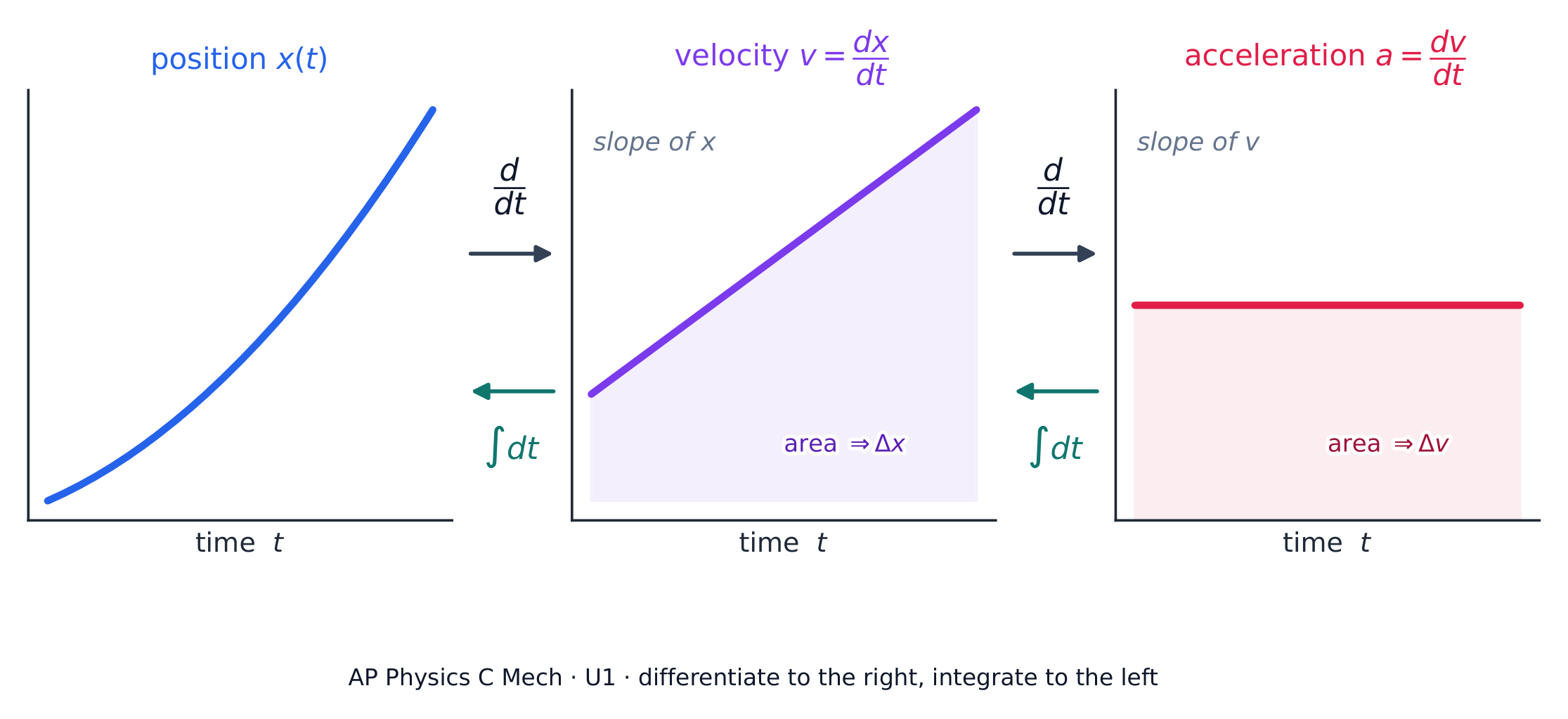
    Because motion can change continuously, define the rates as derivatives 导数:

    $$v=\frac{dx}{dt},\qquad a=\frac{dv}{dt}=\frac{d^2x}{dt^2}.$$
    Reversing this, integrate to recover velocity and position:
    $$v(t)=v_0+\int_0^t a\,dt,\qquad x(t)=x_0+\int_0^t v\,dt.$$
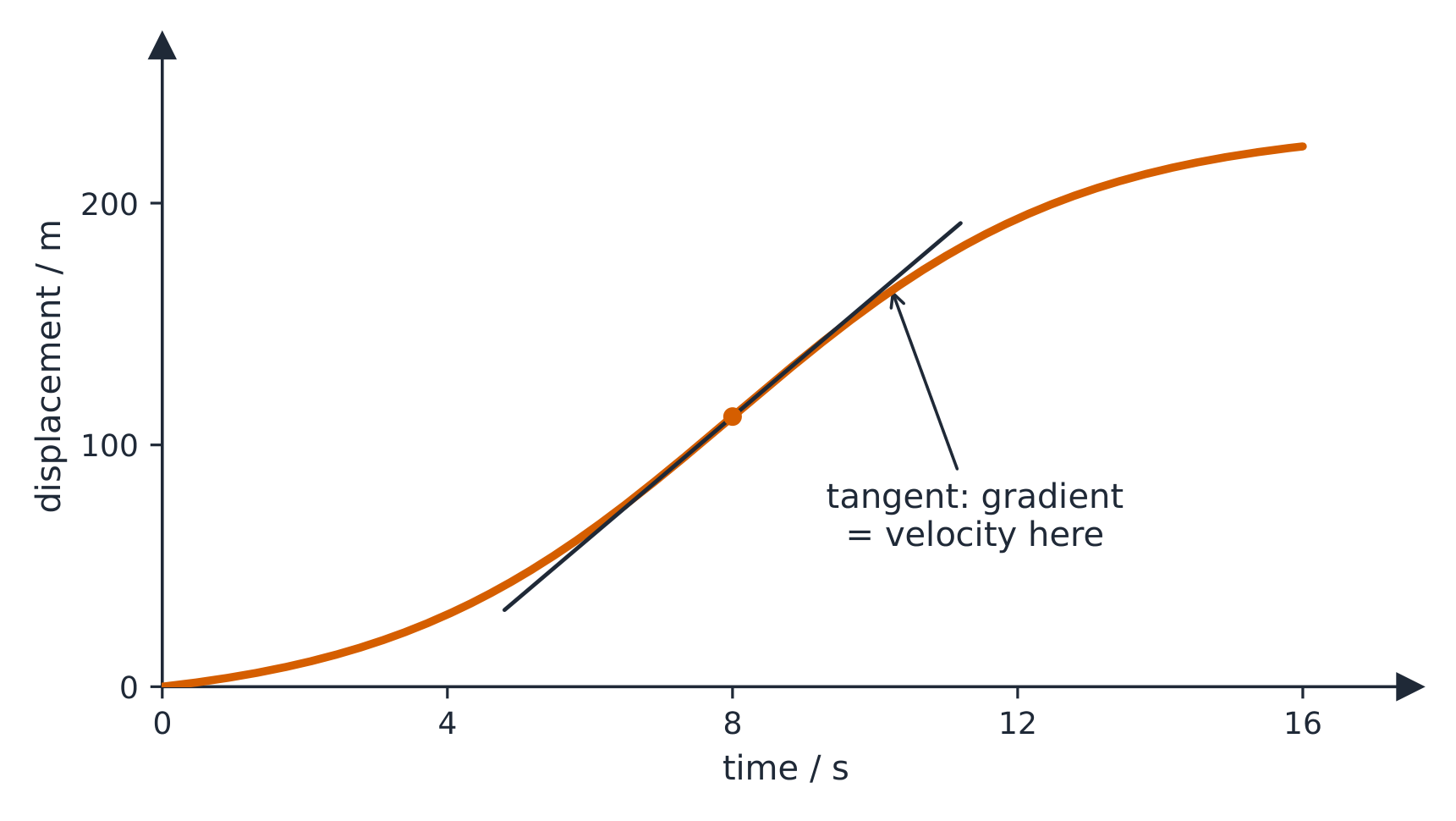
    Distinguish the average from the instantaneous: average velocity 平均速度 is $\Delta x/\Delta t$ over an interval, while instantaneous velocity 瞬时速度 is the derivative at one moment – the slope of the tangent line, and what a speedometer shows.

    For constant acceleration these give the familiar kinematic equations ($v=v_0+at$, $x=x_0+v_0t+\tfrac12at^2$, $v^2=v_0^2+2a\,\Delta x$). The most important constant-$a$ case is free fall 自由落体: near Earth's surface every object, heavy or light, accelerates downward at $g=9.8\ \text{m/s}^2$ once air resistance is negligible. When $a$ or $v$ varies with time, use the integrals directly.

    Worked example. A particle moves with $x(t)=2t^3-3t^2$ (metres). Differentiate for velocity and acceleration:

    $$v=\frac{dx}{dt}=6t^2-6t,\qquad a=\frac{dv}{dt}=12t-6.$$
    At $t=2\ \text{s}$, $v=24-12=12\ \text{m/s}$ and $a=24-6=18\ \text{m/s}^2$. This calculus link – not just the constant-$a$ formulas – is what distinguishes Physics C.

    Worked example. A particle starts from rest at the origin with $a(t)=6t$. Integrate: $v=\int 6t\,dt=3t^2$ and $x=\int 3t^2\,dt=t^3$. At $t=2\ \text{s}$, $v=12\ \text{m/s}$ and $x=8\ \text{m}$.

    ไทย
    Projectile motion is two independent motions

    เนื่องจาก.motion สามารถเปลี่ยนแปลงอย่างต่อเนื่อง, นิยามอัตราเป็นการ ดิฟเฟอเรนเทียล (derivatives):

    $$v=\frac{dx}{dt},\qquad a=\frac{dv}{dt}=\frac{d^2x}{dt^2}.$$
    กลับด้านนี้, integrate เพื่อ recovering velocity and position:
    $$v(t)=v_0+\int_0^t a\,dt,\qquad x(t)=x_0+\int_0^t v\,dt.$$
    แยกแยะ เฉลี่ย กับ ทันที: ความเร็วเฉลี่ย คือ $\Delta x/\Delta t$ ในช่วงเวลาหนึ่ง, mientras ความเร็วทันที คือ derivative ณ某一个 moment – ความชันของเส้นสัมผัส และสิ่งที่แสดงบนมาตรวัดความเร็ว

    สำหรับ ความเร่งคงที่ สมการเหล่านี้ให้สมการจลนศาสตร์ที่คุ้นเคย ($v=v_0+at$, $x=x_0+v_0t+\tfrac12at^2$, $v^2=v_0^2+2a\,\Delta x$). กรณีที่สำคัญที่สุดของความเร่ง$a$คงที่คือ การตกอิสระ: ใกล้พื้นผิวโลกวัตถุทุกชนิด无论หนักหรือเบา จะเร่งลงที่ $g=9.8\ \text{m/s}^2$ เมื่อแรงต้านอากาศน้อยมาก. เมื่อ $a$ หรือ $v$แปรผันตามเวลา, ใช้ integrals โดยตรง

    ตัวอย่างวิธีทำ. อนุภาคเคลื่อนที่ด้วย $x(t)=2t^3-3t^2$ (เมตร). ดิฟเพื่อหา velocity and acceleration:

    $$v=\frac{dx}{dt}=6t^2-6t,\qquad a=\frac{dv}{dt}=12t-6.$$
    ที่ $t=2\ \text{s}$, $v=24-12=12\ \text{m/s}$ และ $a=24-6=18\ \text{m/s}^2$. ความเชื่อมโยงด้วย calculus นี้ – ไม่ใช่แค่สูตร constant-$a$ – คือสิ่งที่แยก Physics C ออกมา

    ตัวอย่างวิธีทำ. อนุภาคเริ่มจากหยุดนิ่งที่จุดกำเนิดด้วย $a(t)=6t$. Integrate: $v=\int 6t\,dt=3t^2$ และ $x=\int 3t^2\,dt=t^3$. ที่ $t=2\ \text{s}$, $v=12\ \text{m/s}$ และ $x=8\ \text{m}$.

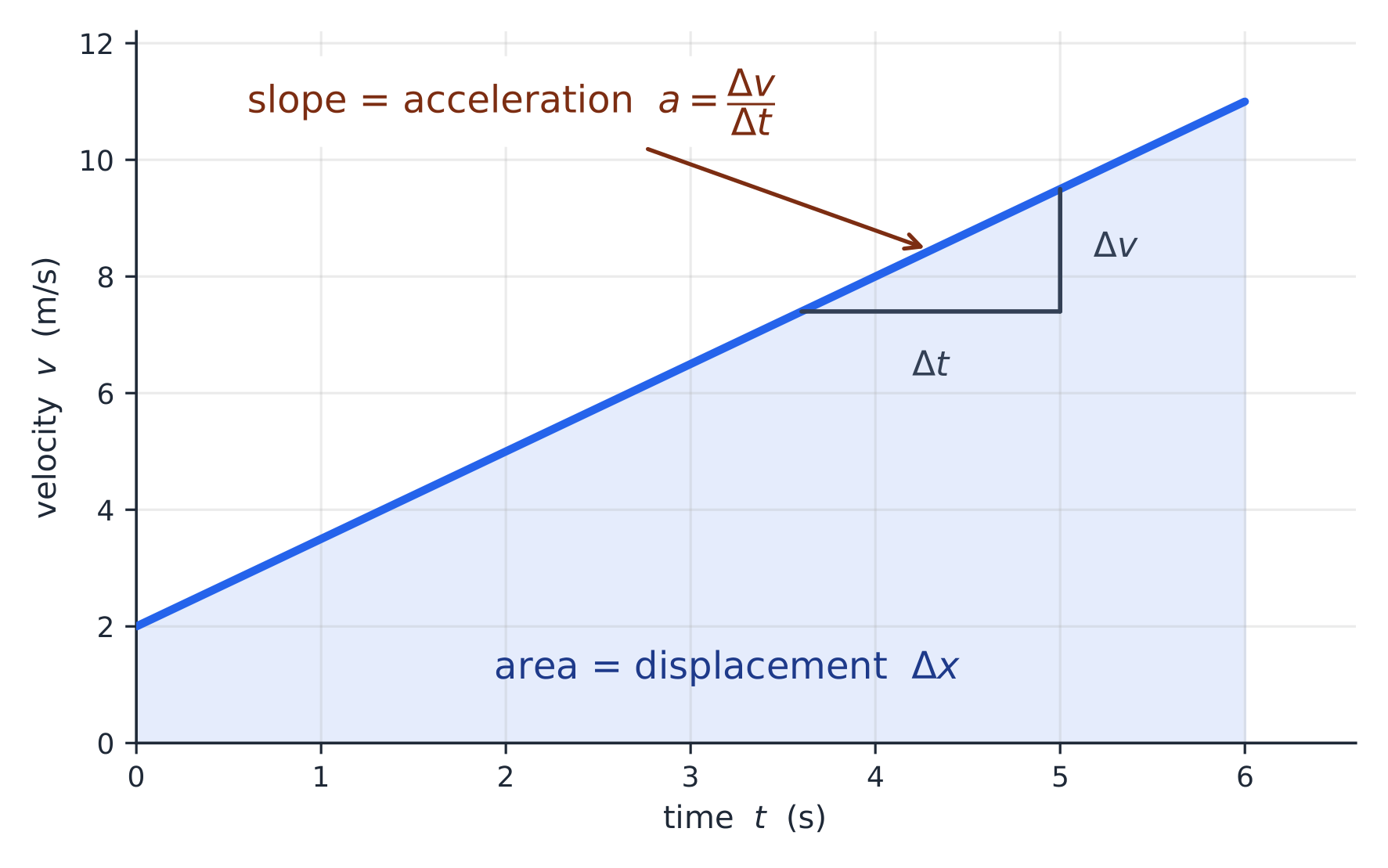
    บนกราฟความเร็ว–เวลา ความชันคือความเร่งและพื้นที่คือ displacement
    บนกราฟความเร็ว–เวลา ความชันคือความเร่งและพื้นที่คือ displacement
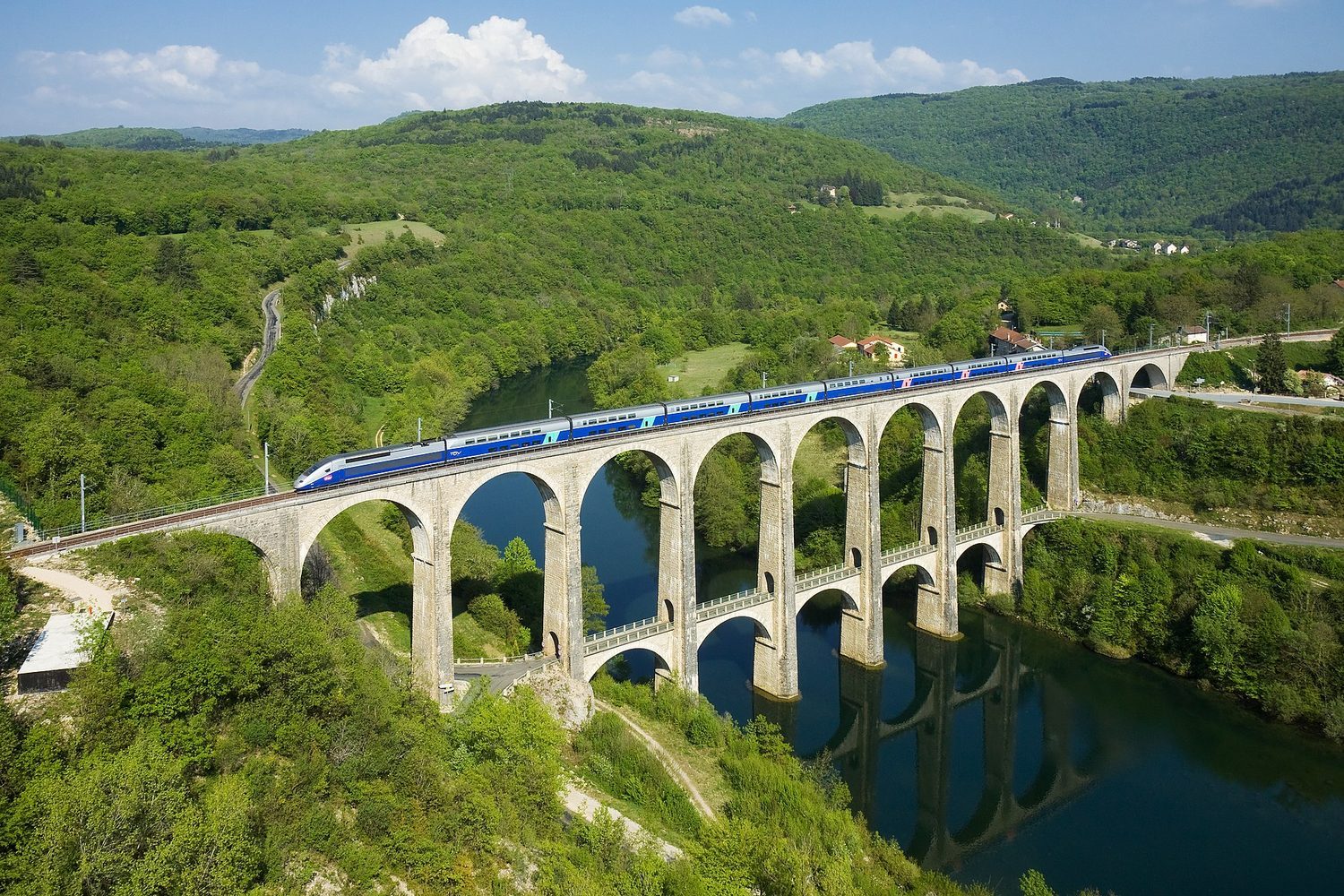
    รถไฟความเร็วสูง: Kinematics อธิบายการกระจัด, ความเร็ว และความเร่งตามเวลา
    รถไฟความเร็วสูง: Kinematics อธิบายการกระจัด, ความเร็ว และความเร่งตามเวลา
    Vocabulary · ⁨คำศัพท์⁩ Train · ⁨ฝึกฝน⁩
    English ไทย
    Kinematics/ˌkɪnɪˈmætɪks/ จลนศาสตร์
    scalar/ˈskeɪlə/ สเกลาร์
    derivatives/dɪˈrɪvətɪvz/ อนุพันธ์
    average velocity/ˈævrɪdʒ vəˈlɒsɪti/ ความเร็วเฉลี่ย
    instantaneous velocity/ˌɪnstənˈteɪnɪəs vəˈlɒsɪti/ ความเร็วทันที
    free fall/friː fɔːl/ การตกอย่างอิสระ
    reference frame/ˈrefrəns freɪm/ กรอบอ้างอิง
    relative motion/ˈrelətɪv ˈməʊʃn/ การเคลื่อนที่สัมพัทธ์
    projectile motion/prəˈdʒektaɪl ˈməʊʃn/ การเคลื่อนที่ของโปรเจกไทล์
    1.3

    Representing Motion · ⁨การแสดงการเคลื่อนที่⁩

    Syllabus · ⁨หลักสูตร⁩
    English

    Learning Objective 1.3.A: Describe the position, velocity, and acceleration of an object using representations of that object's motion.

    • 1.3.A.1 Motion can be represented by motion diagrams, figures, graphs, equations, and narrative descriptions.
    • 1.3.A.2 For constant acceleration, three kinematic equations can be used to describe instantaneous linear motion in one dimension:
      • Equation: $v_x = v_{x0} + a_x t$
      • Equation: $x = x_0 + v_{x0} t + \dfrac{1}{2} a_x t^2$
      • Equation: $v_x^2 = v_{x0}^2 + 2a_x \left( x - x_0 \right)$
      • Note: The equations above are written to indicate motion in the $x$-direction, but these equations can be used in any single dimension as appropriate.
    • 1.3.A.3 Near the surface of Earth, the vertical acceleration caused by the force of gravity is downward, constant, and has a measured value approximately equal to
      • Equation: $a_g = g \approx 10 \ \text{m/s}^2$.
    • 1.3.A.4 Graphs of position, velocity, and acceleration as functions of time can be used to find the relationships between those quantities.
      • 1.3.A.4.i An object's instantaneous velocity is the rate of change of the object's position, which is equal to the slope of a line tangent to a point on a graph of the object's position as a function of time.
        • Equation: $v_x = \dfrac{dx}{dt}$
      • 1.3.A.4.ii An object's instantaneous acceleration is the rate of change of the object's velocity, which is equal to the slope of a line tangent to a point on a graph of the object's velocity as a function of time.
        • Equation: $a_x = \dfrac{dv_x}{dt}$
      • 1.3.A.4.iii The displacement of an object during a time interval is equal to the area under the curve of a graph of the object's velocity as a function of time (i.e., the area bounded by the function and the horizontal axis for the appropriate interval).
        • Equation: $\Delta x = \displaystyle\int_{t_1}^{t_2} v_x(t) \ dt$
      • 1.3.A.4.iv The change in velocity of an object during a time interval is equal to the area under the curve of a graph of the acceleration of the object as a function of time.
        • Equation: $\Delta v_x = \displaystyle\int_{t_1}^{t_2} a_x(t) \ dt$

    Boundary statement: AP Physics C: Mechanics and AP Physics C: Electricity and Magnetism expects that for all situations in which a numerical quantity is required for g, the value $g \approx 10 \ \text{m/s}^2$ will be used. However, students will not be penalized for correctly using the more precise commonly accepted values of $g = 9.81 \ \text{m/s}^2$ or $g = 9.8 \ \text{m/s}^2$.

    ไทย

    วัตถุประสงค์การเรียนรู้ 1.3.A: อธิบายตำแหน่ง, ความเร็ว, และความเร่งของวัตถุโดยใช้การแสดงการเคลื่อนที่ของวัตถุนั้น

    • 1.3.A.1 การเคลื่อนที่สามารถแสดงได้ด้วยแผนภาพการเคลื่อนที่, ภาพ, กราฟ, สมการ, และการบรรยายแบบข้อความ
    • 1.3.A.2 สำหรับกรณีที่มีความเร่งคงที่ สามารถใช้สมการจลนศาสตร์สามสมการเพื่ออธิบายการเคลื่อนที่เชิงเส้นทันทีในหนึ่งมิติ:
      • สมการ: $v_x = v_{x0} + a_x t$
      • สมการ: $x = x_0 + v_{x0} t + \dfrac{1}{2} a_x t^2$
      • สมการ: $v_x^2 = v_{x0}^2 + 2a_x \left( x - x_0 \right)$
      • หมายเหตุ: สมการข้างต้นเขียนขึ้นเพื่อแสดงการเคลื่อนที่ใน $x$-ทิศทาง แต่สมการเหล่านี้สามารถใช้ได้ในทุกมิติเดียวตามความเหมาะสม
    • 1.3.A.3 ใกล้พื้นผิวโลก ความเร่งแนวตั้งที่เกิดจากแรงโน้มถ่วงมีทิศลง มีค่าคงที่ และมีค่าที่วัดได้ประมาณเท่ากับ
      • สมการ: $a_g = g \approx 10 \ \text{m/s}^2$.
    • 1.3.A.4 กราฟของตำแหน่ง, ความเร็ว, และความเร่งในฟังก์ชันของเวลาสามารถใช้เพื่อหาความสัมพันธ์ระหว่างปริมาณเหล่านั้นได้
      • 1.3.A.4.i ความเร็วทันทีของวัตถุคืออัตราการเปลี่ยนแปลงตำแหน่งของวัตถุ ซึ่งมีค่าเท่ากับความชันของเส้นสัมผัสกับจุดบนกราฟตำแหน่งของวัตถุในฟังก์ชันของเวลา
        • สมการ: $v_x = \dfrac{dx}{dt}$
      • 1.3.A.4.ii ความเร่งทันทีของวัตถุคืออัตราการเปลี่ยนแปลงความเร็วของวัตถุ ซึ่งมีค่าเท่ากับความชันของเส้นสัมผัสกับจุดบนกราฟความเร็วของวัตถุในฟังก์ชันของเวลา
        • สมการ: $a_x = \dfrac{dv_x}{dt}$
      • 1.3.A.4.iii การกระจัดของวัตถุในช่วงเวลาหนึ่งมีค่าเท่ากับพื้นที่ใต้เส้นโค้งของกราฟความเร็วของวัตถุในฟังก์ชันของเวลา (นั่นคือ พื้นที่ที่ถูกปิดล้อมโดยฟังก์ชันและแกนแนวนอนสำหรับช่วงเวลาที่กำหนด)
        • สมการ: $\Delta x = \displaystyle\int_{t_1}^{t_2} v_x(t) \ dt$
      • 1.3.A.4.iv การเปลี่ยนแปลงความเร็วของวัตถุในช่วงเวลาหนึ่งมีค่าเท่ากับพื้นที่ใต้เส้นโค้งของกราฟความเร่งของวัตถุในฟังก์ชันของเวลา
        • สมการ: $\Delta v_x = \displaystyle\int_{t_1}^{t_2} a_x(t) \ dt$

    ข้อจำกัด: AP Physics C: Mechanics และ AP Physics C: Electricity and Magnetism คาดหวังว่าสำหรับทุกสถานการณ์ที่ต้องการใช้ค่า g เป็นตัวเลข จะใช้ค่า $g \approx 10 \ \text{m/s}^2$ อย่างไรก็ตาม นักเรียนจะไม่ถูกตัดคะแนนหากใช้ค่าที่ยอมรับกันทั่วไปที่แม่นยำกว่าของ $g = 9.81 \ \text{m/s}^2$ หรือ $g = 9.8 \ \text{m/s}^2$ ได้อย่างถูกต้อง

    Source: College Board AP Course and Exam Description · ⁨แหล่งที่มา: คำอธิบายหลักสูตรและข้อสอบ College Board AP⁩

    English

    Move fluently between description, graph, table, and equation:

    • On a position–time graph, the slope ($dx/dt$) is velocity.
    • On a velocity–time graph, the slope is acceleration and the area ($\int v\,dt$) is displacement.
    • On an acceleration–time graph, the area ($\int a\,dt$) is the change in velocity.

    Slopes are derivatives; areas are integrals – the two are inverse operations here.

    ไทย

    เคลื่อนที่ได้อย่างคล่องแคล่วระหว่างคำอธิบาย, กราฟ, ตาราง และสมการ:

    กราฟตำแหน่ง–เวลา: ความชัน ณ某 instant คือ velocity
    กราฟตำแหน่ง–เวลา: ความชัน ณ某 instant คือ velocity
    • บน กราฟตำแหน่ง–เวลา, ความชัน ($dx/dt$) คือความเร็ว
    • บน กราฟความเร็ว–เวลา, ความชันคือความเร่งและ พื้นที่ ($\int v\,dt$) คือ displacement
    • บน กราฟความเร่ง–เวลา, พื้นที่ ($\int a\,dt$) คือการเปลี่ยนแปลงของความเร็ว

    ความชันคือ derivatives; พื้นที่คือ integrals – ทั้งสองเป็นการดำเนินการที่ Reaction กันในที่นี้

    Position, velocity, and acceleration are linked by differentiation
    ตำแหน่ง ความเร็ว และความเร่ง เชื่อมโยงกันผ่านการหาอนุพันธ์
    Explore · ⁨สำรวจ⁩

    Explore the velocity–time graph · ⁨สำรวจกราฟความเร็ว-เวลา⁩

    Change the start velocity and acceleration. The slope of a $v$–$t$ line is the acceleration $a=\tfrac{dv}{dt}$, and the area underneath is the displacement $\Delta x=\int v\,dt$ — slope and area are the graphical faces of the derivative and the integral. · ⁨เปลี่ยนความเร็วเริ่มต้นและความเร่ง ความชัน ของกราฟ $v$–$t$ คือความเร่ง $a=\tfrac{dv}{dt}$ และ พื้นที่ ด้านใต้คือการกระจัด $\Delta x=\int v\,dt$ — ความชันและพื้นที่คือด้านกราฟิกของดิฟเฟอเรนเชียลและอินทิกรัล⁩

    1.4

    Reference Frames and Relative Motion · ⁨กรอบอ้างอิงและการเคลื่อนที่สัมพัทธ์⁩

    Syllabus · ⁨หลักสูตร⁩
    English

    Learning Objective 1.4.A: Describe the reference frame of a given observer.

    • 1.4.A.1 The choice of reference frame will determine the direction and magnitude of quantities measured by an observer in that reference frame.

    Learning Objective 1.4.B: Describe the motion of objects as measured by observers in different inertial reference frames.

    • 1.4.B.1 Measurements from a given reference frame may be converted to measurements from another reference frame.
    • 1.4.B.2 The observed velocity of an object results from the combination of the object's velocity and the velocity of the observer's reference frame.
      • 1.4.B.2.i Combining the motion of an object and the motion of an observer in a given reference frame involves the addition or subtraction of vectors.
      • 1.4.B.2.ii The acceleration of any object is the same as measured from all inertial reference frames.

    Boundary statement: Unless otherwise stated, the frame of reference of any problem may be assumed to be inertial.

    ไทย

    วัตถุประสงค์การเรียนรู้ 1.4.A: อธิบายกรอบอ้างอิงของผู้สังเกตที่กำหนดให้

    • 1.4.A.1 การเลือกกรอบอ้างอิงจะกำหนดทิศทางและขนาดของปริมาณที่ผู้สังเกตในกรอบอ้างอิงนั้นวัดได้

    วัตถุประสงค์การเรียนรู้ 1.4.B: อธิบายการเคลื่อนที่ของวัตถุตามที่ผู้สังเกตในกรอบอ้างอิงเฉื่อยที่แตกต่างกันวัดได้

    • 1.4.B.1 ข้อมูลการวัดจากกรอบอ้างอิงที่กำหนดสามารถแปลงเป็นข้อมูลการวัดจากกรอบอ้างอิงอื่นได้
    • 1.4.B.2 ความเร็วที่สังเกตได้จากวัตถุเกิดจากการรวมกันระหว่างความเร็วของวัตถุนั้นและความเร็วของกรอบอ้างอิงของผู้สังเกต
      • 1.4.B.2.i การรวมการเคลื่อนที่ของวัตถุและการเคลื่อนที่ของผู้สังเกตในกรอบอ้างอิงที่กำหนดเกี่ยวข้องกับการบวกหรือลบเวกเตอร์
      • 1.4.B.2.ii ความเร่งของวัตถุใดๆ มีค่าเท่ากันเมื่อวัดจากกรอบอ้างอิงเฉื่อยทุกกรอบ

    คำจำกัดความ: เว้นแต่จะระบุไว้เป็นพิเศษ กรอบอ้างอิงของโจทย์ปัญหาใด ๆ สามารถสมมติว่าเป็นกรอบอ้างอิงเฉื่อยได้

    Source: College Board AP Course and Exam Description · ⁨แหล่งที่มา: คำอธิบายหลักสูตรและข้อสอบ College Board AP⁩

    English

    All motion is relative to a reference frame 参考系. Combine velocities by vector addition: $\vec{v}_{A/C}=\vec{v}_{A/B}+\vec{v}_{B/C}$. This handles boats crossing rivers and passengers on moving vehicles – relative motion 相对运动 problems. Read the subscripts as a chain: "A relative to B" plus "B relative to C" gives "A relative to C".

    Worked example. A boat that moves at $4.0\ \text{m/s}$ in still water heads straight across a river flowing at $3.0\ \text{m/s}$. Relative to the ground the boat moves at $\sqrt{4.0^2+3.0^2}=5.0\ \text{m/s}$, angled downstream. If the river is $80\ \text{m}$ wide, the crossing still takes $t=\dfrac{80}{4.0}=20\ \text{s}$ – only the across-stream component crosses the river; the current just carries the boat $60\ \text{m}$ downstream.

    ไทย

    การเคลื่อนที่ทั้งหมดเป็นสัมพัทธ์ต่อ กรอบอ้างอิง รวมความเร็วด้วยการบวกเวกเตอร์: $\vec{v}_{A/C}=\vec{v}_{A/B}+\vec{v}_{B/C}$. สิ่งนี้ใช้กับเรือข้ามแม่น้ำและผู้โดยสารในยานพาหนะเคลื่อนที่ – ปัญหาการเคลื่อนที่แบบ สัมพัทธ์. อ่านตัวชี้ใต้ (subscript) เป็นลำดับ: "A สัมพัทธ์ B" บวก "B สัมพัทธ์ C" ได้ "A สัมพัทธ์ C".

    ตัวอย่างวิธีทำ. เรือที่เคลื่อนที่ได้ $4.0\ \text{m/s}$ ในน้ำนิ่ง มุ่งตรงข้ามแม่น้ำที่ไหลด้วยความเร็ว $3.0\ \text{m/s}$. สัมพัทธ์กับพื้นดิน เรือเคลื่อนที่ด้วย $\sqrt{4.0^2+3.0^2}=5.0\ \text{m/s}$, ทำมุมไปทาง downstream. ถ้าแม่น้ำกว้าง $80\ \text{m}$, เวลาที่ใช้ข้ามก็ยังคงเป็น $t=\dfrac{80}{4.0}=20\ \text{s}$ – เพียงองค์ประกอบแนวข้ามสายน้ำเท่านั้นที่ข้ามได้; กระแสน้ำเพียงพาเรือ $60\ \text{m}$ ไปทาง downstream.

    1.5

    Motion in Two or Three Dimensions · ⁨การเคลื่อนที่ในสองหรือสามมิติ⁩

    Syllabus · ⁨หลักสูตร⁩
    English

    Learning Objective 1.5.A: Describe the motion of an object moving in two or three dimensions.

    • 1.5.A.1 Motion in two or three dimensions can be analyzed using one-dimensional kinematic relationships if the motion is separated into components.
    • 1.5.A.2 Velocity and acceleration may be different in each dimension and may be nonuniform.
    • 1.5.A.3 Motion in one dimension may be changed without causing a change in a perpendicular dimension.
    • 1.5.A.4 Projectile motion is a special case of two-dimensional motion that has zero acceleration in one dimension and constant, nonzero acceleration in the second dimension.

    Boundary statement: AP Physics C: Mechanics only expects students to quantitatively analyze the motion of an object in two dimensions. AP Physics C: Electricity and Magnetism expects students to also qualitatively describe the motion of a particle in three dimensions.

    ไทย

    วัตถุประสงค์การเรียนรู้ 1.5.A: อธิบายการเคลื่อนที่ของวัตถุที่เคลื่อนที่ในสองหรือสามมิติ

    • 1.5.A.1 การเคลื่อนที่ในสองหรือสามมิติสามารถวิเคราะห์ได้ด้วยความสัมพันธ์ทางจลนศาสตร์แบบหนึ่งมิติ หากแยกการเคลื่อนที่ออกเป็นองค์ประกอบ
    • 1.5.A.2 ความเร็วและความเร่งอาจแตกต่างกันในแต่ละมิติและอาจไม่สม่ำเสมอ
    • 1.5.A.3 การเคลื่อนที่ในหนึ่งมิติอาจเปลี่ยนแปลงโดยไม่ทำให้发生了การเปลี่ยนแปลงในมิติที่ตั้งฉาก
    • 1.5.A.4 การเคลื่อนที่แบบโปรเจกไทล์เป็นกรณีพิเศษของการเคลื่อนที่แบบสองมิติที่มีค่าความเร่งเป็นศูนย์ในหนึ่งมิติ และมีค่าความเร่งคงที่ไม่ใช่ศูนย์ในอีกมิติหนึ่ง

    ข้อจำกัด: AP Physics C: Mechanics คาดหวังให้นักเรียนวิเคราะห์การเคลื่อนที่ของวัตถุในสองมิติเชิงปริมาณเท่านั้น AP Physics C: Electricity and Magnetism คาดหวังให้นักเรียนอธิบายการเคลื่อนที่ของอนุภาคในสามมิติเชิงคุณภาพเพิ่มเติมด้วย

    Source: College Board AP Course and Exam Description · ⁨แหล่งที่มา: คำอธิบายหลักสูตรและข้อสอบ College Board AP⁩

    English

    In two or three dimensions, position is a vector $\vec{r}(t)=\langle x(t),y(t),z(t)\rangle$, and velocity and acceleration are its successive derivatives – each component handled independently.

    Worked example. $\vec{r}(t)=\big(2t^2\big)\hat{i}+\big(4t-t^3\big)\hat{j}$ (metres). Differentiating each component: $\vec{v}=4t\,\hat{i}+(4-3t^2)\,\hat{j}$ and $\vec{a}=4\,\hat{i}-6t\,\hat{j}$. At $t=1\ \text{s}$: $\vec{v}=4\hat{i}+1\hat{j}$, so the speed is $\sqrt{17}\approx4.1\ \text{m/s}$ – no new physics, just one derivative per component.

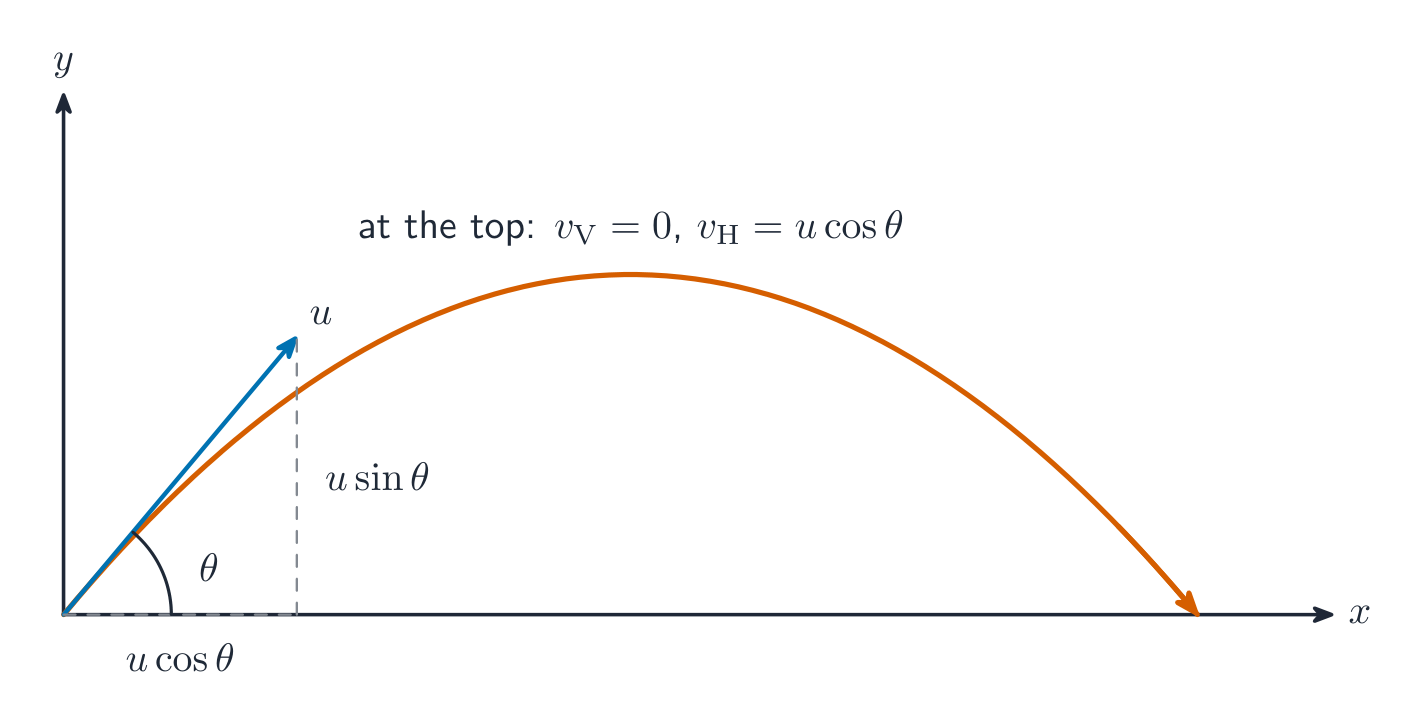
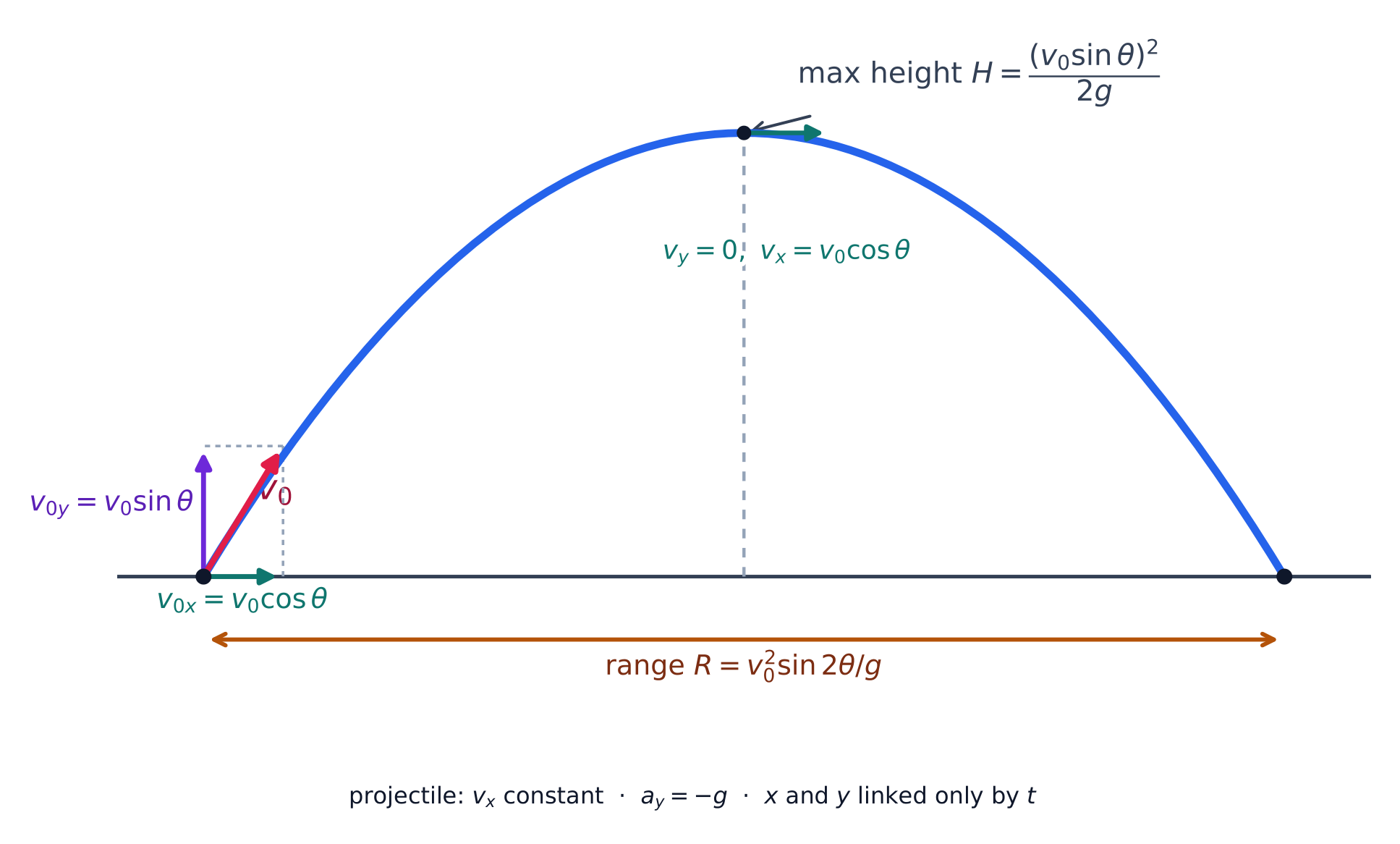
    For projectile motion 抛体运动, horizontal and vertical motions are independent, linked only by time $t$: horizontally $a_x=0$ (constant velocity), vertically $a_y=-g$. The path is a parabola. This component method extends to any two-dimensional motion where the accelerations along each axis are known.

    Worked example. A ball is launched at $20\ \text{m/s}$, $30^{\circ}$ above the horizontal ($g=9.8\ \text{m/s}^2$). The components are $v_{0x}=20\cos30^{\circ}=17.3\ \text{m/s}$ and $v_{0y}=20\sin30^{\circ}=10\ \text{m/s}$. The vertical motion sets the time: total flight $=\dfrac{2v_{0y}}{g}=\dfrac{20}{9.8}=2.0\ \text{s}$, maximum height $=\dfrac{v_{0y}^2}{2g}=5.1\ \text{m}$, and range $=v_{0x}\times2.0=35\ \text{m}$.

    ไทย

    ในสองหรือสามมิติ ตำแหน่งคือเวกเตอร์ $\vec{r}(t)=\langle x(t),y(t),z(t)\rangle$, และความเร็วและความเร่งคือผลต่างต่อเนื่องของตำแหน่งนั้น – แต่ละองค์ประกอบจัดการแยกต่างหาก

    ตัวอย่างวิธีทำ. $\vec{r}(t)=\big(2t^2\big)\hat{i}+\big(4t-t^3\big)\hat{j}$ (เมตร). หาอนุพันธ์แต่ละองค์ประกอบ: $\vec{v}=4t\,\hat{i}+(4-3t^2)\,\hat{j}$ และ $\vec{a}=4\,\hat{i}-6t\,\hat{j}$. ที่ $t=1\ \text{s}$: $\vec{v}=4\hat{i}+1\hat{j}$, ดังนั้นความเร็วคือ $\sqrt{17}\approx4.1\ \text{m/s}$ – ไม่มีฟิสิกส์ใหม่ merely การหาอนุพันธ์หนึ่งครั้งต่อองค์ประกอบ

    โปรเจคไทล์ที่ถูกยิงในมุม: การเคลื่อนที่แนวนอนและแนวตั้งเป็นอิสระต่อกัน
    โปรเจคไทล์ที่ถูกยิงในมุม: การเคลื่อนที่แนวนอนและแนวตั้งเป็นอิสระต่อกัน

    สำหรับการเคลื่อนที่แบบ โปรเจคไทล์ การเคลื่อนที่แนวนอนและแนวตั้งเป็นอิสระต่อกัน เชื่อมโยงกันโดยเวลา $t$: แนวราบ $a_x=0$ (ความเร็วคงที่), แนวตั้ง $a_y=-g$. เส้นทางเป็นพาราโบลา. วิธีองค์ประกอบนี้ขยายไปยังการเคลื่อนที่สองมิติอื่นๆ เมื่อความเร่งตามแกนแต่ละแกนทราบแล้ว

    ตัวอย่างวิธีทำ. ลูกบอลถูกยิงด้วย $20\ \text{m/s}$, มุม $30^{\circ}$ เหนือนอน ($g=9.8\ \text{m/s}^2$). องค์ประกอบคือ $v_{0x}=20\cos30^{\circ}=17.3\ \text{m/s}$ และ $v_{0y}=20\sin30^{\circ}=10\ \text{m/s}$. การเคลื่อนที่แนวตั้งกำหนดเวลา: เวลาบินรวม $=\dfrac{2v_{0y}}{g}=\dfrac{20}{9.8}=2.0\ \text{s}$, สูงสุด $=\dfrac{v_{0y}^2}{2g}=5.1\ \text{m}$, และระยะทาง $=v_{0x}\times2.0=35\ \text{m}$.

    ลูกบอลที่ถูกยิงด้วยมุม: องค์ประกอบความเร็ว, สูงสุด, และระยะทาง
    ลูกบอลที่ถูกยิงด้วยมุม: องค์ประกอบความเร็ว, สูงสุด, และระยะทาง
    Explore · ⁨สำรวจ⁩

    Explore projectile motion · ⁨สำรวจการเคลื่อนที่แบบโปรเจกไทล์⁩

    Fire the projectile, then vary the angle and speed. The horizontal motion is steady while gravity acts only downward — together they trace a parabola. Find the angle that gives the greatest range (it peaks near $45^\circ$), and try the Moon. · ⁨ยิงวัตถุพาราบولا แล้วปรับ มุม และ ความเร็ว การเคลื่อนที่แนวนอนมีความคงที่ในขณะที่แรงโน้มถ่วงกระทำเพียงลงด้านล่าง — ทั้งคู่สร้างรูป พาราโบลา หามุมที่ให้ ระยะทาง มากที่สุด (จะสูงสุดใกล้ $45^\circ$) และลองใช้ดวงจันทร์⁩

    1.5

    Exam tips · ⁨ข้อแนะนำสำหรับการสอบ⁩

    English
    • Resolve every vector into components before adding — never add magnitudes at an angle directly.
    • On Physics C you are expected to use calculus: velocity is $\vec v=\tfrac{d\vec r}{dt}$ and acceleration $\vec a=\tfrac{d\vec v}{dt}$; reverse with integration.
    • Carry and check units and treat direction with signs (choose a positive axis and stick to it).
    • Use the dot product for work-type quantities and the cross product for torque and angular momentum.
    • Sketch the vectors — a diagram catches sign and direction errors the algebra hides.
    ไทย
    • แยกทุกเวกเตอร์ออกเป็นองค์ประกอบก่อนการบวก – ห้ามบวกขนาดโดยตรงเมื่อมีมุม
    • ใน Physics C คุณควรใช้ แคลคูลัส: ความเร็วคือ $\vec v=\tfrac{d\vec r}{dt}$ และความเร่ง $\vec a=\tfrac{d\vec v}{dt}$; กลับด้านด้วยการอินทิเกรต
    • ระบุและตรวจสอบ หน่วย และใช้เครื่องหมายบอกลักษณะทิศทาง (เลือกแกนบวกและยึดมั่นในมัน)
    • ใช้ dot product สำหรับปริมาณงาน และ cross product สำหรับโมเมนต์แรงและโมเมนตัมเชิงมุม
    • วาดสเก็ตช์เวกเตอร์ – แผนภาพจับข้อผิดพลาดเรื่องเครื่องหมายและทิศทางที่พีชคณิตซ่อนอยู่
  • 2

    Force and Translational Dynamics · ⁨แรงและพลวัตการเคลื่อนที่เชิงเส้น⁩

    Watch lesson · ⁨ดูบทเรียน⁩
    2.1

    Systems and Center of Mass

    Syllabus · ⁨หลักสูตร⁩
    English

    Learning Objective 2.1.A: Describe the properties and interactions of a system.

    • 2.1.A.1 System properties are determined by the interactions between objects within the system.
    • 2.1.A.2 If the properties or interactions of the constituent objects within a system are not important in modeling the behavior of the macroscopic system, the system can itself be treated as a single object.
    • 2.1.A.3 Systems may allow interactions between constituent parts of the system and the environment, which may result in the transfer of energy or mass.
    • 2.1.A.4 Individual objects within a chosen system may behave differently from each other as well as from the system as a whole.
    • 2.1.A.5 The internal structure of a system affects the analysis of that system.
    • 2.1.A.6 As variables external to a system are changed, the system's substructure may change.

    Learning Objective 2.1.B: Describe the location of a system's center of mass with respect to the system's constituent parts.

    • 2.1.B.1 For objects or systems with symmetrical mass distributions, the center of mass is located on lines of symmetry.
    • 2.1.B.2 The location of a system's center of mass along a given axis can be calculated using the equation
      • Equation: $\vec{x}_{\text{cm}} = \dfrac{\sum m_i \vec{x}_i}{\sum m_i}$
    • 2.1.B.3 For a nonuniform solid that can be considered as a collection of differential masses, $dm$, the solid's center of mass can be calculated using the equation
      • Equation: $\vec{r}_{\text{cm}} = \dfrac{\int \vec{r}\, dm}{\int dm}$
      • 2.1.B.3.i The linear mass density of a rod or other linear rigid body is the derivative of the rod's mass with respect to the position of the differential mass element on the rigid body.
        • Equation: $\lambda = \dfrac{d}{d\ell} m(\ell)$
      • 2.1.B.3.ii If a function of mass density is given for a solid, the total mass can be determined by integrating the mass density over the length (one dimension), area (two dimensions), or volume (three dimensions) of the solid. For example:
        • Equation: $M_{\text{total}} = \int \rho(r)\, dV$
    • 2.1.B.4 A system can be modeled as a singular object that is located at the system's center of mass.
    ไทย

    วัตถุประสงค์การเรียนรู้ 2.1.A: อธิบายคุณสมบัติและปฏิสัมพันธ์ของระบบ

    • 2.1.A.1 คุณสมบัติของระบบถูกกำหนดโดยปฏิสัมพันธ์ระหว่างวัตถุภายในระบบ
    • 2.1.A.2 หากคุณสมบัติหรือปฏิสัมพันธ์ของวัตถุส่วนประกอบภายในระบบไม่สำคัญในการสร้างแบบจำลองพฤติกรรมของระบบมาโครสโคปิก ระบบนั้นเองสามารถถูกพิจารณาเป็นวัตถุเดียวได้
    • 2.1.A.3 ระบบอาจอนุญาตให้มีความสัมพันธ์ระหว่างส่วนประกอบภายในระบบกับสิ่งแวดล้อม ซึ่งอาจนำไปสู่การถ่ายโอนพลังงานหรือมวล
    • 2.1.A.4 วัตถุแต่ละตัวภายในระบบที่ถูกเลือกอาจมีพฤติกรรมที่แตกต่างจากกันเองและต่างจากระบบโดยรวม
    • 2.1.A.5 โครงสร้างภายในของระบบมีผลต่อการวิเคราะห์ระบบนั้น
    • 2.1.A.6 เมื่อตัวแปรภายนอกที่นอกเหนือจากระบบมีการเปลี่ยนแปลง โครงสร้างย่อยของระบบอาจเปลี่ยนแปลงไปด้วย

    วัตถุประสงค์การเรียนรู้ 2.1.B: อธิบายตำแหน่งของจุดศูนย์กลางมวลของระบบเมื่อเทียบกับส่วนประกอบต่างๆ ของระบบ

    • 2.1.B.1 สำหรับวัตถุหรือระบบที่มีการกระจายมวลแบบสมมาตร จุดศูนย์กลางมวลจะอยู่บนเส้นสมมาตร
    • 2.1.B.2 ตำแหน่งของจุดศูนย์กลางมวลของระบบตามแกนที่กำหนดสามารถคำนวณได้โดยใช้สมการ ⟦number⟧
      • สมการ: $\vec{x}_{\text{cm}} = \dfrac{\sum m_i \vec{x}_i}{\sum m_i}$
    • 2.1.B.3 สำหรับของแข็งที่ไม่สม่ำเสมอซึ่งสามารถพิจารณาว่าเป็นกลุ่มของมวลต่าง ๆ $dm$ จุดศูนย์กลางมวลของของแข็งนี้สามารถคำนวณได้จากสมการ
      • สมการ: $\vec{r}_{\text{cm}} = \dfrac{\int \vec{r}\, dm}{\int dm}$
      • 2.1.B.3.i ความหนาแน่นมวลเชิงเส้นของแท่งหรือวัตถุแข็งรูปทรงอื่นใดคืออนุพันธ์ของมวลแท่งเทียบกับตำแหน่งขององค์ประกอบมวลต่าง ๆ บนวัตถุแข็ง
        • สมการ: $\lambda = \dfrac{d}{d\ell} m(\ell)$
      • 2.1.B.3.ii หากกำหนดฟังก์ชันความหนาแน่นมวลของของแข็งไว้ สามารถหามวลรวมได้โดยการอินทิเกรตความหนาแน่นมวลตลอดความยาว (หนึ่งมิติ) พื้นที่ (สองมิติ) หรือปริมาตร (สามมิติ) ของของแข็ง ตัวอย่างเช่น:
        • สมการ: $M_{\text{total}} = \int \rho(r)\, dV$
    • 2.1.B.4 ระบบสามารถจำลองเป็นวัตถุเดี่ยวที่อยู่ที่จุดศูนย์กลางมวลของระบบนั้น

    Source: College Board AP Course and Exam Description · ⁨แหล่งที่มา: คำอธิบายหลักสูตรและข้อสอบ College Board AP⁩

    A system 系统 is the object or objects you analyze, treated as a point at its center of mass 质心. For a set of masses, $x_{\text{cm}}=\dfrac{\sum m_i x_i}{\sum m_i}$; for a continuous body, $x_{\text{cm}}=\dfrac{1}{M}\int x\,dm$. Only external forces move the center of mass.

    Vocabulary · ⁨คำศัพท์⁩ Train · ⁨ฝึกฝน⁩
    English ไทย
    system/ˈsɪstəm/ ระบบ
    center of mass/ˈsentə ɒv mæs/ ศูนย์กลางมวล
    2.2

    Forces and Free-Body Diagrams

    Syllabus · ⁨หลักสูตร⁩
    English

    Learning Objective 2.2.A: Describe a force as an interaction between two objects or systems

    • 2.2.A.1 Forces are vector quantities that describe the interactions between objects or systems.
      • 2.2.A.1.i A force exerted on an object or system is always due to the interaction of that object or system with another object or system.
      • 2.2.A.1.ii An object or system cannot exert a net force on itself.
    • 2.2.A.2 Contact forces describe the interaction of an object or system touching another object or system and are macroscopic effects of interatomic electric forces.

    Learning Objective 2.2.B: Describe the forces exerted on an object or system using a free-body diagram.

    • 2.2.B.1 Free-body diagrams are useful tools for visualizing forces being exerted on a single object or system and for determining the equations that represent a physical situation.
    • 2.2.B.2 The free-body diagram of an object or system shows each of the forces exerted on the object or system by the environment.
    • 2.2.B.3 Forces exerted on an object or system are represented as vectors originating from the representation of the center of mass, such as a dot. A system is treated as though all of its mass is located at the center of mass.
    • 2.2.B.4 A coordinate system with one axis parallel to the direction of acceleration of the object or system simplifies the translation from free-body diagram to algebraic representation. For example, in a free-body diagram of an object on an inclined plane, it is useful to set one axis parallel to the surface of the incline.

    Boundary statement: AP Physics C: Mechanics and AP Physics C: Electricity and Magnetism only expect students to depict the forces exerted on objects, not the force components on free-body diagrams. On the AP Physics exams, individual forces represented on a free-body diagram must be drawn as individual straight arrows, originating on the dot and pointing in the direction of the force. Individual forces that are in the same direction must be drawn side by side, not overlapping.

    ไทย

    วัตถุประสงค์การเรียนรู้ 2.2.A: อธิบายแรงในฐานะการมีปฏิสัมพันธ์ระหว่างวัตถุสองชิ้นหรือระบบสองระบบ

    • 2.2.A.1 แรงเป็นปริมาณเวกเตอร์ที่อธิบายปฏิสัมพันธ์ระหว่างวัตถุหรือระบบ
      • 2.2.A.1.i แรงที่กระทำต่อวัตถุหรือระบบใด ๆ นั้นเกิดจากการมีปฏิสัมพันธ์ของวัตถุนั้นหรือระบบนั้นกับวัตถุหรือระบบอื่นเสมอ
      • 2.2.A.1.ii วัตถุหรือระบบไม่สามารถ exert แรงสุทธิต่อตัวเองได้
    • 2.2.A.2 แรงสัมผัสอธิบายการสัมผัสระหว่างวัตถุหรือระบบกับวัตถุหรือระบบอื่น และเป็นผลกระทบทางมาโครสโคปิกของแรงไฟฟ้าระหว่างอะตอม

    วัตถุประสงค์การเรียนรู้ 2.2.B: อธิบายแรงที่กระทำต่อวัตถุหรือระบบโดยใช้แผนภาพร่างกายอิสระ

    • 2.2.B.1 แผนภาพร่างกายอิสระเป็นเครื่องมือที่มีประโยชน์สำหรับการจินตนาการถึงแรงที่กระทำต่อวัตถุหรือวัตถุเดียวหรือระบบ และการหาคำสมการที่แสดงถึงสถานการณ์ทางฟิสิกส์
    • 2.2.B.2 แผนภาพร่างกายอิสระ (free-body diagram) ของวัตถุหรือระบบจะแสดงแรงทั้งหมดที่กระทำต่อวัตถุนั้นหรือระบบนั้นจากสิ่งแวดล้อม
    • 2.2.B.3 แรงที่กระทำต่อวัตถุหรือระบบจะถูกแทนด้วยเวกเตอร์ที่เริ่มต้นจากตัวแทนของจุดศูนย์กลางมวล เช่น จุดจุดหนึ่ง ระบบจะถูกพิจารณาว่ามวลทั้งหมดรวมอยู่ที่จุดศูนย์กลางมวล
    • 2.2.B.4 การใช้ระบบพิกัดที่มีแกนหนึ่งขนานกับทิศทางการเคลื่อนที่ของวัตถุหรือระบบ ช่วยให้ง่ายต่อการแปลงจากแผนภาพร่างกายอิสระไปเป็นรูปสมการทางพีชคณิต ตัวอย่างเช่น ในแผนภาพร่างกายอิสระของวัตถุบนพื้นเอียง จะช่วยได้หากกำหนดให้แกนหนึ่งขนานกับพื้นผิวของพื้นเอียง

    คำประกาศขอบเขต: AP Physics C: Mechanics และ AP Physics C: Electricity and Magnetism คาดหวังให้นักเรียนแสดงเฉพาะแรงที่กระทำต่อวัตถุ ไม่ใช่ส่วนประกอบของแรงบนแผนภาพร่างกายอิสระ ในการสอบ AP Physics แรงแต่ละตัวที่แสดงบนแผนภาพร่างกายอิสระต้องวาดเป็นลูกศรตรงเดี่ยว ที่เริ่มต้นจากจุดกึ่งกลางและชี้ไปในทิศทางของแรง แรงที่เป็นตัวเดียวกันต้องวาดอยู่ข้างกัน ไม่ซ้อนทับกัน

    Source: College Board AP Course and Exam Description · ⁨แหล่งที่มา: คำอธิบายหลักสูตรและข้อสอบ College Board AP⁩

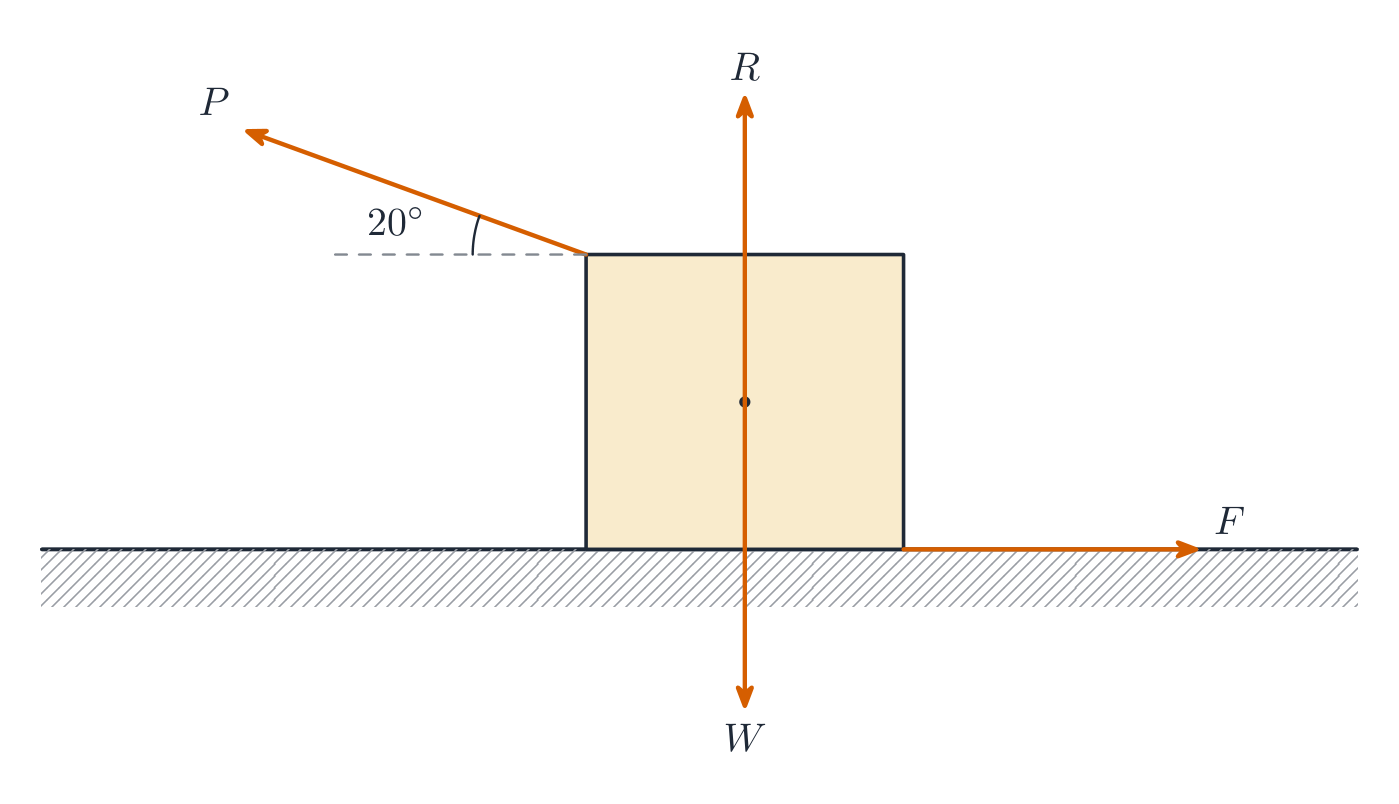
    A force 力 is a push or pull (a vector, in newtons). A free-body diagram 受力图 draws one object with an arrow for every force on it – weight, normal, tension, friction, applied, drag. Draw it first; it sets up every dynamics equation.

    A free-body diagram shows every force acting on one object
    A free-body diagram shows every force acting on one object
    Explore · ⁨สำรวจ⁩

    Balance the forces on a free-body diagram · ⁨ดุลย์แรงบนแผนภาพวัตถุอิสระ⁩

    A free-body diagram shows every force on one object as an arrow. The object accelerates only if the forces don't cancel — the net force sets $a=F/m$. · ⁨แผนภาพวัตถุอิสระ แสดงแรงทั้งหมดที่กระทำต่อวัตถุหนึ่งด้วยลูกศร วัตถุจะเร่งความเร็วได้ก็ต่อเมื่อแรงไม่หักล้างกัน — แรงลัพธ์ กำหนด $a=F/m$⁩

    Vocabulary · ⁨คำศัพท์⁩ Train · ⁨ฝึกฝน⁩
    English ไทย
    force/fɔːs/ แรง
    free-body diagram/friː ˈbɒdi ˈdaɪəɡræm/ แผนภาพวัตถุอิสระ
    2.3

    Newton's Third Law

    Syllabus · ⁨หลักสูตร⁩
    English

    Learning Objective 2.3.A: Describe the interaction of two objects or systems using Newton's third law and a representation of paired forces exerted on each object or system.

    • 2.3.A.1 Newton's third law describes the interaction of two objects or systems in terms of the paired forces that each exerts on the other.
      • Equation: $\vec{F}_{\text{A on B}} = -\vec{F}_{\text{B on A}}$
    • 2.3.A.2 Interactions between objects within a system (internal forces) do not influence the motion of a system's center of mass.
    • 2.3.A.3 Tension is the macroscopic net result of forces that infinitesimal segments of a string, cable, chain, or similar system exert on each other in response to an external force.
      • 2.3.A.3.i An ideal string has negligible mass and does not stretch when under tension.
      • 2.3.A.3.ii The tension in an ideal string is the same at all points within the string.
      • 2.3.A.3.iii In a string with nonnegligible mass, tension may not be the same at all points within the string.
      • 2.3.A.3.iv An ideal pulley is a pulley that has negligible mass and rotates about an axle through its center of mass with negligible friction.
    ไทย

    วัตถุประสงค์การเรียนรู้ 2.3.A: อธิบายการมีปฏิสัมพันธ์ของวัตถุสองชิ้นหรือระบบสองระบบโดยใช้กฎข้อที่สามของนิวตันและการแสดงแรงคู่ที่กระทำต่อวัตถุหรือระบบแต่ละตัว

    • 2.3.A.1 กฎข้อที่สามของนิวตันอธิบายการมีปฏิสัมพันธ์ของวัตถุสองชิ้นหรือระบบสองระบบในแง่ของแรงคู่ที่แต่ละฝ่ายกระทำต่อกัน
      • สมการ: $\vec{F}_{\text{A on B}} = -\vec{F}_{\text{B on A}}$
    • 2.3.A.2 การมีปฏิสัมพันธ์ระหว่างวัตถุภายในระบบ (แรงภายใน) ไม่ส่งผลต่อการเคลื่อนที่ของจุดศูนย์กลางมวลของระบบ
    • 2.3.A.3 แรงตึง (Tension) เป็นผลลัพธ์ทางมหภาคของแรงที่ส่วนย่อยขนาดเล็ก ๆ ของเชือก สายเคเบิล โซ่ หรือระบบคล้ายคลึงกันกระทำต่อกันเพื่อตอบสนองต่อแรงภายนอก
      • 2.3.A.3.i เชือกในอุดมคติมีมวลน้อยจนสามารถละเลยได้และไม่ยืดเมื่อถูกดึงตึง
      • 2.3.A.3.ii แรงตึงเชือกในอุดมคตินั้นเท่ากันทุกจุดภายในเชือก
      • 2.3.A.3.iii ในกรณีของเชือกที่มีมวลไม่เล็กน้อย แรงตึงอาจไม่เท่ากันทุกจุดภายในเชือก
      • 2.3.A.3.iv รอกในอุดมคตินั้นคือรอกที่มีมวลน้อยจนสามารถละเลยได้และหมุนรอบแกนผ่านจุดศูนย์กลางมวลโดยมีแรงเสียดทานน้อยจนสามารถละเลยได้

    Source: College Board AP Course and Exam Description · ⁨แหล่งที่มา: คำอธิบายหลักสูตรและข้อสอบ College Board AP⁩

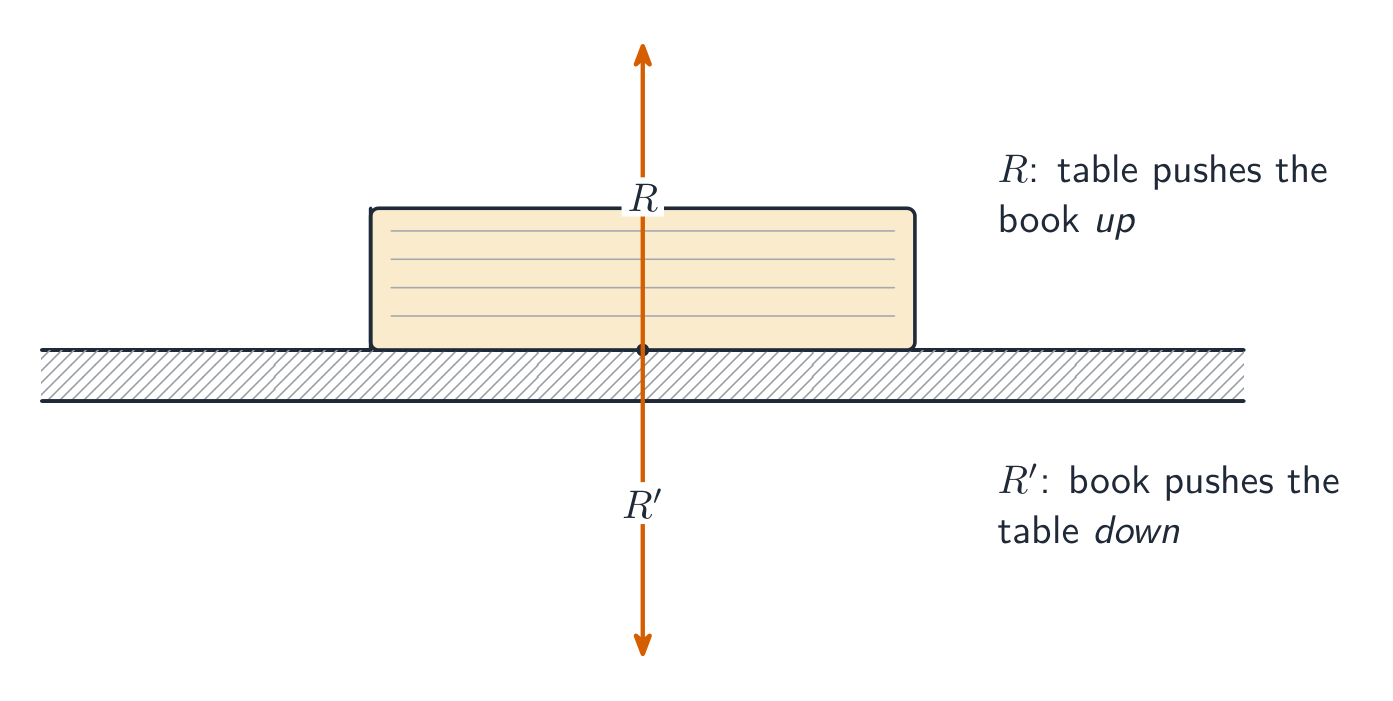
    Newton's third law 牛顿第三定律: A pushes B, B pushes back equally and oppositely. The pair acts on different objects, so it never cancels within one free-body diagram.

    A Newton's third-law pair: equal and opposite forces on two different objects
    A Newton's third-law pair: equal and opposite forces on two different objects
    Vocabulary · ⁨คำศัพท์⁩ Train · ⁨ฝึกฝน⁩
    English ไทย
    Newton's third law/ˈnjuːtnz θɜːd lɔː/ กฎข้อที่สามของนิวตัน
    2.4

    Newton's First Law

    Syllabus · ⁨หลักสูตร⁩
    English

    Learning Objective 2.4.A: Describe the conditions under which a system's velocity remains constant.

    • 2.4.A.1 The net force on a system is the vector sum of all forces exerted on the system.
    • 2.4.A.2 Translational equilibrium is the configuration of forces such that the net force exerted on a system is zero.
      • Derived equation: $\sum \vec{F}_i = 0$
    • 2.4.A.3 Newton's first law states that if the net force exerted on a system is zero, the velocity of that system will remain constant.
    • 2.4.A.4 Forces may be balanced in one dimension but unbalanced in another. The system's velocity will change only in the direction of the unbalanced force.
    • 2.4.A.5 An inertial reference frame is one from which an observer would verify Newton's first law of motion.
    ไทย

    จุดประสงค์การเรียนรู้ 2.4.A: อธิบายเงื่อนไขภายใต้ซึ่งความเร็วของระบบคงที่

    • 2.4.A.1 แรงสุทธิที่กระทำต่อ系统是ผลบวกเวกเตอร์ของแรงทั้งหมดที่กระทำต่อระบบ
    • 2.4.A.2 สมดุลแบบถลาง (Translational equilibrium) คือการจัดเรียงของแรงที่ทำให้แรงลัพธ์ที่กระทำต่อระบบเป็นศูนย์
      • สมการที่ได้มา: $\sum \vec{F}_i = 0$
    • 2.4.A.3 กฎข้อที่หนึ่งของนิวตันระบุว่าหากแรงสุทธิที่กระทำต่อระบบเป็นศูนย์ ความเร็วของระบบนั้นจะคงที่
    • 2.4.A.4 แรงอาจสมดุลกันในมิติเดียวแต่ไม่สมดุลในอีกมิติหนึ่ง ความเร็วของระบบจะเปลี่ยนแปลงเพียงในทิศทางของแรงที่ไม่สมดุล
    • 2.4.A.5 กรอบอ้างอิงเฉื่อยคือกรอบอ้างอิงที่ผู้สังเกตสามารถยืนยันกฎข้อที่หนึ่งของนิวตันได้

    Source: College Board AP Course and Exam Description · ⁨แหล่งที่มา: คำอธิบายหลักสูตรและข้อสอบ College Board AP⁩

    Newton's first law (inertia 惯性): with zero net force 合力, velocity stays constant – the object is in translational equilibrium 平动平衡.

    Vocabulary · ⁨คำศัพท์⁩ Train · ⁨ฝึกฝน⁩
    English ไทย
    inertia/ɪˈnɜːʃə/ ความเฉื่อย
    net force/net fɔːs/ แรงลัพธ์
    translational equilibrium/trænˈsleɪʃənl ˌiːkwɪˈlɪbrɪəm/ สมดุลการเลื่อน
    2.5

    Newton's Second Law

    Syllabus · ⁨หลักสูตร⁩
    English

    Learning Objective 2.5.A: Describe the conditions under which a system's velocity changes.

    • 2.5.A.1 Unbalanced forces are a configuration of forces such that the net force exerted on a system is not equal to zero.
    • 2.5.A.2 Newton's second law of motion states that the acceleration of a system's center of mass has a magnitude proportional to the magnitude of the net force exerted on the system and is in the same direction as that net force.
      • Equation: $\vec{a}_{\text{sys}} = \dfrac{\sum \vec{F}}{m_{\text{sys}}} = \dfrac{\vec{F}_{\text{net}}}{m_{\text{sys}}}$
    • 2.5.A.3 The velocity of a system's center of mass will only change if a nonzero net external force is exerted on that system.
    ไทย

    จุดประสงค์การเรียนรู้ 2.5.A: อธิบายเงื่อนไขภายใต้ซึ่งความเร็วของระบบเปลี่ยนไป

    • 2.5.A.1 แรงที่ไม่สมดุลคือสภาวะของแรงที่ทำให้แรงสุทธิที่กระทำต่อระบบไม่เท่ากับศูนย์
    • 2.5.A.2 กฎข้อที่สองของการเคลื่อนที่ของนิวตันระบุว่าความเร่งของจุดศูนย์กลางมวลของระบบมีขนาดแปรผันตรงกับขนาดของแรงสุทธิที่กระทำต่อระบบ และมีทิศทางเดียวกับแรงสุทธินั้น
      • สมการ: $\vec{a}_{\text{sys}} = \dfrac{\sum \vec{F}}{m_{\text{sys}}} = \dfrac{\vec{F}_{\text{net}}}{m_{\text{sys}}}$
    • 2.5.A.3 ความเร็วของจุดศูนย์กลางมวลของระบบจะเปลี่ยนแปลงก็ต่อเมื่อมีแรงภายนอกสุทธิที่ไม่เป็นศูนย์กระทำต่อระบบเท่านั้น

    Source: College Board AP Course and Exam Description · ⁨แหล่งที่มา: คำอธิบายหลักสูตรและข้อสอบ College Board AP⁩

    The general form uses momentum:

    $$\sum\vec{F}=\frac{d\vec{p}}{dt}=m\vec{a}\ \ (\text{for constant mass}).$$
    Apply it one axis at a time. When forces depend on velocity or position, this becomes a differential equation 微分方程 to solve.

    Worked example. A $2.0\ \text{kg}$ block slides down a frictionless incline 斜面 at $30^{\circ}$. Only the along-ramp component of gravity drives it, so $a=g\sin30^{\circ}=9.8(0.5)=4.9\ \text{m/s}^2$, independent of the mass.

    Worked example (two bodies). A $6.0\ \text{kg}$ cart on a frictionless table is pulled by a string over a light pulley to a hanging $2.0\ \text{kg}$ mass. Treat the pair as one system: only the hanging weight drives it, so $a=\dfrac{2.0(9.8)}{8.0}=2.45\ \text{m/s}^2$. Then isolate the cart alone to find the string tension 张力: $T=6.0(2.45)\approx15\ \text{N}$. System first for $a$, single body for internal forces – that two-step is the standard pattern.

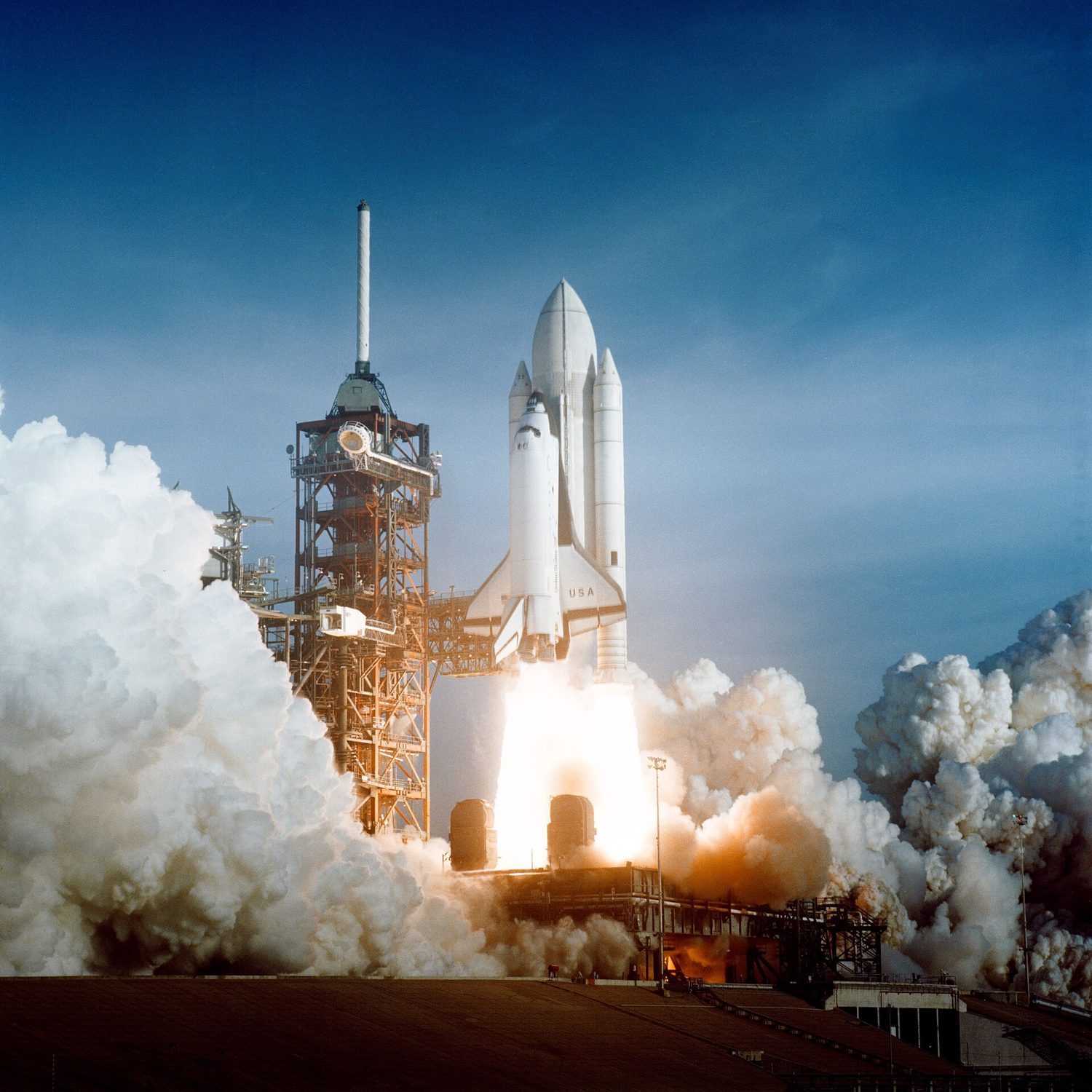
    A rocket launch: net force changes momentum — F_net = ma for translational dynamics
    A rocket launch: net force changes momentum — F_net = ma for translational dynamics
    Vocabulary · ⁨คำศัพท์⁩ Train · ⁨ฝึกฝน⁩
    English ไทย
    differential equation/ˌdɪfəˈrenʃl ɪˈkweɪʒn/ สมการเชิงอนุพันธ์
    incline/ɪnˈklaɪn/ พื้นผิวเอียง
    tension/ˈtenʃn/ แรงตึง
    2.6

    Gravitational Force

    Syllabus · ⁨หลักสูตร⁩
    English

    Learning Objective 2.6.A: Describe the gravitational interaction between two objects or systems with mass.

    • 2.6.A.1 Newton's law of universal gravitation describes the gravitational force between two objects or systems as directly proportional to each of their masses and inversely proportional to the square of the distance between the systems' centers of mass.
      • Equation: $\left| \vec{F}_g \right| = G \dfrac{m_1 m_2}{r^2}$
      • 2.6.A.1.i The gravitational force is attractive.
      • 2.6.A.1.ii The gravitational force is always exerted along the line connecting the center of mass of the two interacting systems.
      • 2.6.A.1.iii The gravitational force on a system can be considered to be exerted on the system's center of mass.
    • 2.6.A.2 A field models the effects of a noncontact force exerted on an object at various positions in space.
      • 2.6.A.2.i The magnitude of the gravitational field created by a system of mass $M$ at a point in space is equal to the ratio of the gravitational force exerted by the system on a test object of mass $m$ to the mass of the test object.
        • Derived equation: $\left| \vec{g} \right| = \dfrac{\left| \vec{F}_g \right|}{m} = G \dfrac{M}{r^2}$
      • 2.6.A.2.ii If the gravitational force is the only force exerted on an object, the observed acceleration of the object (in $\text{m/s}^2$) is numerically equal to the magnitude of the gravitational field strength (in $\text{N/kg}$) at that location.
    • 2.6.A.3 The gravitational force exerted by an astronomical body on a relatively small nearby object is called weight.
      • Derived equation: $\text{Weight} = F_g = mg$

    Learning Objective 2.6.B: Describe situations in which the gravitational force can be considered constant.

    • 2.6.B.1 If the gravitational force between two systems' centers of mass has a negligible change as the relative position of the two systems changes, the gravitational force can be considered constant at all points between the initial and final positions of the systems.
    • 2.6.B.2 Near the surface of Earth, the strength of the gravitational field is
      • Equation: $g \approx 10\ \text{N/kg}$

    Learning Objective 2.6.C: Describe the conditions under which the magnitude of a system's apparent weight is different from the magnitude of the gravitational force exerted on that system.

    • 2.6.C.1 The magnitude of the apparent weight of a system is the magnitude of the normal force exerted on the system.
    • 2.6.C.2 If the system is accelerating, the apparent weight of the system is not equal to the magnitude of the gravitational force exerted on the system.
    • 2.6.C.3 A system appears weightless when there are no forces exerted on the system or when the force of gravity is the only force exerted on the system.
    • 2.6.C.4 The equivalence principle states that an observer in a noninertial reference frame is unable to distinguish between an object's apparent weight and the gravitational force exerted on the object by a gravitational field.

    Learning Objective 2.6.D: Describe inertial and gravitational mass.

    • 2.6.D.1 Objects have inertial mass, or inertia, a property that determines how much an object's motion resists changes when interacting with another object.
    • 2.6.D.2 Gravitational mass is related to the force of attraction between two systems with mass.
    • 2.6.D.3 Inertial mass and gravitational mass have been experimentally verified to be equivalent.

    Learning Objective 2.6.E: Describe the gravitational force exerted on an object by a uniform spherical distribution of mass.

    • 2.6.E.1 The net gravitational force exerted on an object by a uniform spherical distribution of mass is the sum of the individual forces from small differential masses that comprise the distribution.
    • 2.6.E.2 Newton's shell theorem describes the net gravitational force exerted on an object by a uniform spherical shell of mass.
      • 2.6.E.2.i The net gravitational force exerted on an object inside a thin spherical shell is zero.
      • 2.6.E.2.ii The net gravitational force exerted on an object outside a thin spherical shell can be determined by treating the shell as a single massive object located at the center of the shell.
      • 2.6.E.2.iii An object inside a sphere of uniform density experiences a net gravitational force from only a partial mass of the sphere.
      • 2.6.E.2.iv The partial mass of a sphere that contributes to the net gravitational force exerted on an object within that sphere is the portion of the sphere's mass located a distance less than or equal to the object's distance from the center of the sphere and can be calculated using the density of the sphere.
        • Derived equation: $m_{\text{partial}} = \rho \dfrac{4}{3} \pi \left( r_{\text{partial}} \right)^3$
    • 2.6.E.3 The gravitational force exerted on an object within a uniform sphere can be shown to be proportional to the object's distance from the sphere's center.
      • Derived equation: $F_{g,\text{partial}} = -k r_{\text{partial}}$

    Boundary statement: AP Physics C: Mechanics does not expect students to mathematically prove or derive Newton's shell theorem.

    ไทย

    จุดประสงค์การเรียนรู้ 2.6.A: อธิบายการมีปฏิสัมพันธ์ทางโน้มถ่วงระหว่างวัตถุหรือระบบที่มีมวล

    • 2.6.A.1 กฎความโน้มถ่วงสากลของนิวตันอธิบายแรงโน้มถ่วงระหว่างวัตถุหรือสองระบบว่าเป็นสัดส่วนโดยตรงกับมวลของแต่ละ物体และเป็นสัดส่วนผกผันกับกำลังสองของระยะห่างระหว่างจุดศูนย์กลางมวลของระบบ
      • สมการ: $\left| \vec{F}_g \right| = G \dfrac{m_1 m_2}{r^2}$
      • 2.6.A.1.i แรงโน้มถ่วงมีลักษณะเป็นการดึงดูด
      • 2.6.A.1.ii แรงโน้มถ่วงจะถูกกระทำตามเส้นที่เชื่อมระหว่างศูนย์กลางมวลของระบบทั้งสองที่มีปฏิสัมพันธ์กันเสมอ
      • 2.6.A.1.iii แรงโน้มถ่วงที่กระทำต่อระบบสามารถพิจารณาได้ว่ากระทำที่จุดศูนย์กลางมวลของระบบ
    • 2.6.A.2 สนามเป็นแบบจำลองที่แสดงผลของแรงที่ไม่สัมผัสที่ทำต่อวัตถุ ณ ตำแหน่งต่างๆ ในอวกาศ
      • 2.6.A.2.i ขนาดของสนามโน้มถ่วงที่เกิดจากระบบที่มีมวล $M$ ที่จุดหนึ่งในอวกาศ มีค่าเท่ากับอัตราส่วนของแรงโน้มถ่วงที่ระบบกระทำต่อวัตถุทดสอบที่มีมวล $m$ ต่อมวลของวัตถุทดสอบ
        • สมการที่ได้จาก: $\left| \vec{g} \right| = \dfrac{\left| \vec{F}_g \right|}{m} = G \dfrac{M}{r^2}$
      • 2.6.A.2.ii หากแรงโน้มถ่วงเป็นแรงเดียวที่กระทำต่อวัตถุ ความเร่งที่สังเกตได้ของวัตถุนั้น (ใน $\text{m/s}^2$) จะมีค่าเท่ากับขนาดของความเข้มสนามโน้มถ่วง (ใน $\text{N/kg}$) ณ จุดนั้น
    • 2.6.A.3 แรงโน้มถ่วงที่วัตถุทางดาราศาสตร์กระทำต่อวัตถุใกล้เคียงขนาดเล็กเรียกว่า น้ำหนัก
      • สมการที่ได้มา: $\text{Weight} = F_g = mg$

    จุดประสงค์การเรียนรู้ 2.6.B: อธิบายสถานการณ์ที่แรงโน้มถ่วงสามารถพิจารณาได้ว่าคงที่

    • 2.6.B.1 หากแรงโน้มถ่วงระหว่างจุดศูนย์กลางมวลของระบบสองระบบมีการเปลี่ยนแปลงน้อยจนสามารถละเลยได้เมื่อตำแหน่งสัมพัทธ์ของระบบทั้งสองเปลี่ยนไป แรงโน้มถ่วงสามารถพิจารณาได้ว่าคงที่ตลอดช่วงระหว่างตำแหน่งเริ่มต้นและตำแหน่งสุดท้ายของระบบ
    • 2.6.B.2 ใกล้ผิวโลก ความเข้มของสนามโน้มถ่วงคือ
      • สมการ: $g \approx 10\ \text{N/kg}$

    จุดประสงค์การเรียนรู้ 2.6.C: อธิบายเงื่อนไขภายใต้ซึ่งขนาดของน้ำหนัก apparent ของระบบต่างจากขนาดของแรงโน้มถ่วงที่กระทำต่อระบบนั้น

    • 2.6.C.1 ขนาดของน้ำหนัก apparent ของระบบคือขนาดของแรงปฏิกิริยาที่กระทำต่อระบบ
    • 2.6.C.2 หากระบบมีความเร่ง น้ำหนัก apparent ของระบบจะไม่เท่ากับขนาดของแรงโน้มถ่วงที่กระทำต่อระบบ
    • 2.6.C.3 ระบบจะรู้สึกไร้وزนเมื่อไม่มีแรงใดกระทำต่อระบบ หรือเมื่อแรงโน้มถ่วงเป็นแรงเดียวที่กระทำต่อระบบ
    • 2.6.C.4 หลักการสมมูลระบุว่าผู้สังเกตในกรอบอ้างอิงที่ไม่ใช่กรอบอ้างอิงเฉื่อยไม่สามารถแยกแยะระหว่างน้ำหนักที่ปรากฏของวัตถุกับแรงโน้มถ่วงที่กระทำต่อวัตถุจากสนามโน้มถ่วงได้

    วัตถุประสงค์การเรียนรู้ 2.6.D: อธิบายมวลเฉื่อยและมวลโน้มถ่วง

    • 2.6.D.1 วัตถุมีมวลเฉื่อย หรือ ความเฉื่อย ซึ่งเป็นคุณสมบัติที่กำหนดว่าความเคลื่อนไหวของวัตถุนั้นจะต้านทานการเปลี่ยนแปลงมากเพียงใดเมื่อมีปฏิสัมพันธ์กับวัตถุอื่น
    • 2.6.D.2 มวลโน้มถ่วงเกี่ยวข้องกับแรงดึงดูดระหว่างระบบสองระบบที่มีมวล
    • 2.6.D.3 มวลเฉื่อยและมวลโน้มถ่วงได้รับการยืนยันด้วยวิธีการทดลองแล้วว่าสมมูลกัน

    วัตถุประสงค์การเรียนรู้ 2.6.E: อธิบายแรงโน้มถ่วงที่กระทำต่อวัตถุโดยการกระจายตัวของมวลทรงกลมสม่ำเสมอ

    • 2.6.E.1 แรงโน้มถ่วงสุทธิที่กระทำต่อวัตถุโดยการกระจายตัวของมวลทรงกลมสม่ำเสมอ คือผลรวมของแรง individuais จากมวลย่อยๆ ที่ประกอบเป็นการกระจายตัวนั้น
    • 2.6.E.2 ทฤษฎีเปลือกหอยของนิวตัน (Newton's shell theorem) อธิบายแรงโน้มถ่วงสุทธิที่กระทำต่อวัตถุโดยเปลือกหอยทรงกลมของมวลที่สม่ำเสมอ
      • 2.6.E.2.i แรงโน้มถ่วงสุทธิที่กระทำต่อวัตถุภายในเปลือกหอยทรงกลมบางจะมีค่าเป็นศูนย์
      • 2.6.E.2.ii แรงโน้มถ่วงสุทธิที่กระทำต่อวัตถุภายนอกเปลือกหอยทรงกลมบางสามารถหาได้โดยการพิจารณาว่าเปลือกหอยนั้นเป็นวัตถุที่มีมวลเพียงชิ้นเดียวตั้งอยู่ที่ศูนย์กลางของเปลือกหอย
      • 2.6.E.2.iii วัตถุที่อยู่ภายในทรงกลมที่มีความหนาแน่นสม่ำเสมอจะได้รับแรงโน้มถ่วงสุทธิจากเพียงมวลบางส่วนเท่านั้นของทรงกลมนั้น
      • 2.6.E.2.iv มวลบางส่วนของทรงกลมที่มีส่วนทำให้เกิดแรงโน้มถ่วงสุทธิที่กระทำต่อวัตถุภายในทรงกลมนั้น คือส่วนของมวลทรงกลมที่地址位于ระยะห่างน้อยกว่าหรือเท่ากับระยะห่างของวัตถุนั้นจากศูนย์กลางทรงกลม และสามารถคำนวณได้จากความหนาแน่นของทรงกลมนั้น
        • สมการที่ได้จาก: $m_{\text{partial}} = \rho \dfrac{4}{3} \pi \left( r_{\text{partial}} \right)^3$
    • 2.6.E.3 แรงโน้มถ่วงที่กระทำต่อวัตถุภายในทรงกลมที่สม่ำเสมอสามารถพิสูจน์ได้ว่าแปรผันตรงกับระยะห่างของวัตถุนั้นจากศูนย์กลางของทรงกลม
      • สมการที่ได้มา: $F_{g,\text{partial}} = -k r_{\text{partial}}$

    คำประกาศขอบเขต: AP Physics C: Mechanics ไม่คาดหวังให้นักเรียนพิสูจน์หรือหาสูตรทฤษฎีเปลือกหอยของนิวตันอย่างคณิตศาสตร์

    Source: College Board AP Course and Exam Description · ⁨แหล่งที่มา: คำอธิบายหลักสูตรและข้อสอบ College Board AP⁩

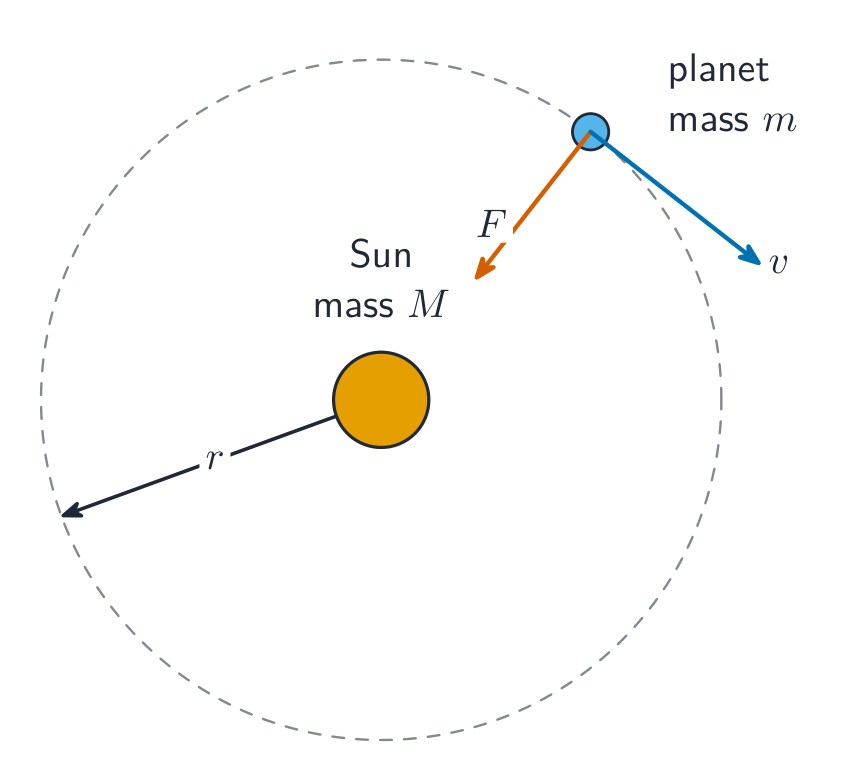
    Orbital motion (Kepler's 2nd law)

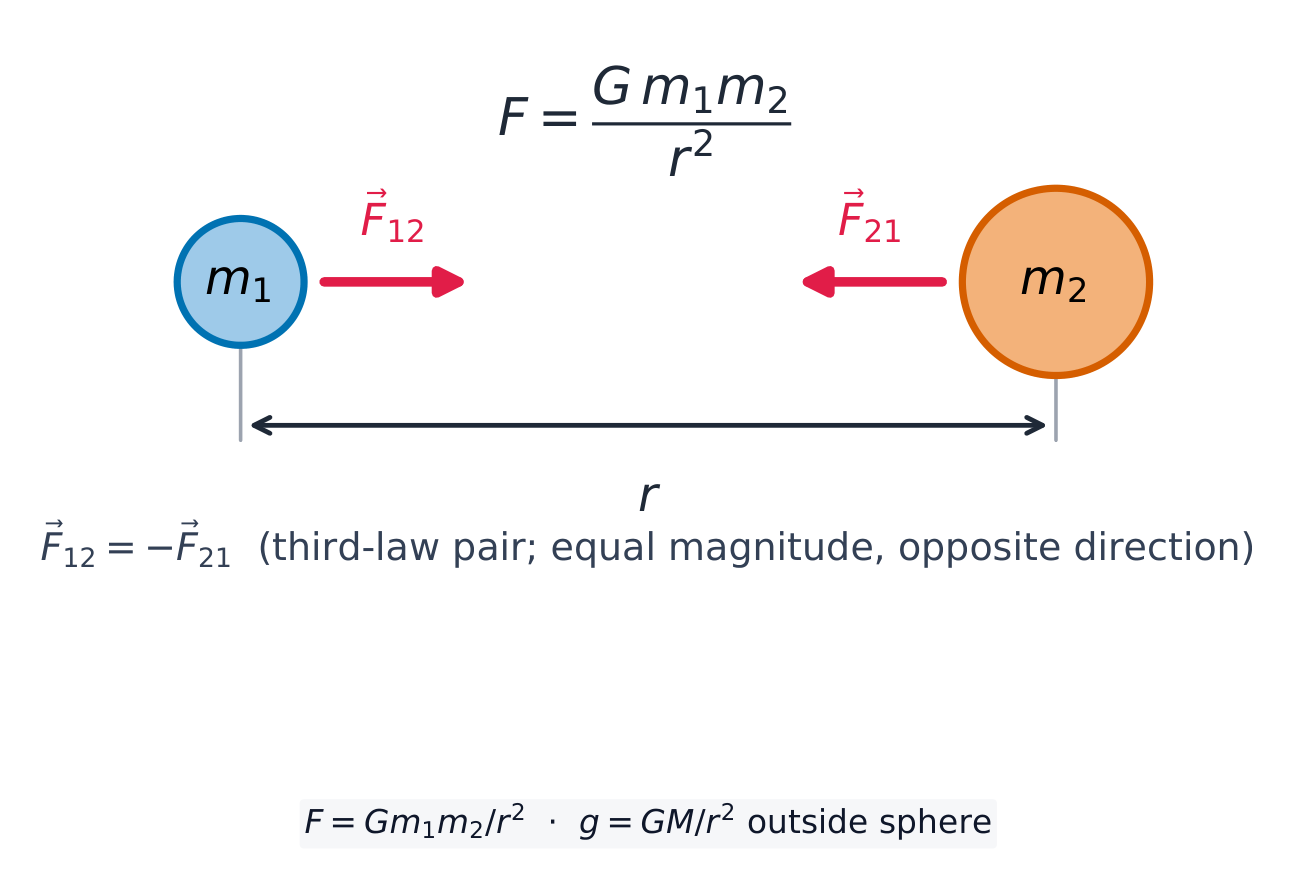
    Near a surface, weight is $F_g=mg$. In general, Newton's law of gravitation 万有引力定律:

    $$F_g=\frac{Gm_1m_2}{r^2},$$
    attractive and inverse-square. The gravitational field is $g=\dfrac{GM}{r^2}$.

    Two masses attract each other with equal, opposite, inverse-square forces along the line joining them
    Two masses attract each other with equal, opposite, inverse-square forces along the line joining them
    Vocabulary · ⁨คำศัพท์⁩ Train · ⁨ฝึกฝน⁩
    English ไทย
    Newton's law of gravitation/ˈnjuːtnz lɔː ɒv ˌɡrævɪˈteɪʃn/ กฎความโน้มถ่วงของนิวตัน
    2.7

    Kinetic and Static Friction

    Syllabus · ⁨หลักสูตร⁩
    English

    Learning Objective 2.7.A: Describe kinetic friction between two surfaces.

    • 2.7.A.1 Kinetic friction occurs when two surfaces in contact move relative to each other.
      • 2.7.A.1.i The kinetic friction force is exerted in a direction opposite the motion of each surface relative to the other surface.
      • 2.7.A.1.ii The force of friction between two surfaces does not depend on the size of the surface area of contact.
    • 2.7.A.2 The magnitude of the kinetic friction force exerted on an object is the product of the normal force the surface exerts on the object and the coefficient of kinetic friction.
      • Equation: $\left| \vec{F}_{f,k} \right| = \left| \mu_k \vec{F}_N \right|$
      • 2.7.A.2.i The coefficient of kinetic friction depends on the material properties of the surfaces that are in contact.
      • 2.7.A.2.ii Normal force is the perpendicular component of the force exerted on an object by the surface with which it is in contact; it is directed away from the surface.

    Learning Objective 2.7.B: Describe static friction between two surfaces.

    • 2.7.B.1 Static friction may occur between the contacting surfaces of two objects that are not moving relative to each other.
    • 2.7.B.2 Static friction adopts the value and direction required to prevent an object from slipping or sliding on a surface.
      • Equation: $\left| \vec{F}_{f,s} \right| \leq \left| \mu_s \vec{F}_n \right|$
      • 2.7.B.2.i Slipping and sliding refer to situations in which two surfaces are moving relative to each other.
      • 2.7.B.2.ii There exists a maximum value for which static friction will prevent an object from slipping on a given surface.
        • Derived equation: $F_{f,s,\text{max}} = \mu_s F_N$
    • 2.7.B.3 The coefficient of static friction is typically greater than the coefficient of kinetic friction for a given pair of surfaces.
    ไทย

    วัตถุประสงค์การเรียนรู้ 2.7.A: อธิบายแรงเสียดทานแบบไถล (kinetic friction) ระหว่างพื้นผิวสองชนิด

    • 2.7.A.1 แรงเสียดทานแบบเคลื่อนที่เกิดขึ้นเมื่อพื้นผิวสองชนิดที่สัมผัสกันเคลื่อนที่สัมพัทธ์ต่อกัน
      • 2.7.A.1.i แรงเสียดทานแบบไถลจะถูกกระทำในทิศทางตรงข้ามกับการเคลื่อนที่ของแต่ละพื้นผิวเมื่อเทียบกับอีกพื้นผิวหนึ่ง
      • 2.7.A.1.ii แรงเสียดทานระหว่างพื้นผิวสองชนิดไม่ขึ้นอยู่กับขนาดของพื้นที่สัมผัส
    • 2.7.A.2 ขนาดของแรงเสียดทานแบบเคลื่อนที่ที่กระทำต่อวัตถุเท่ากับผลคูณของแรงตั้งฉากที่พื้นผิวกระทำต่อวัตถุและสัมประสิทธิ์แรงเสียดทานแบบเคลื่อนที่
      • สมการ: $\left| \vec{F}_{f,k} \right| = \left| \mu_k \vec{F}_N \right|$
      • 2.7.A.2.i สัมประสิทธิ์แรงเสียดทานแบบเคลื่อนที่ขึ้นอยู่กับคุณสมบัติของวัสดุของพื้นผิวที่สัมผัสกัน
      • 2.7.A.2.ii แรงตั้งฉากคือองค์ประกอบในแนวตั้งฉากของแรงที่กระทำต่อวัตถุโดยพื้นผิวที่สัมผัสกัน โดยจะมีทิศทางออกจากพื้นผิวนั้น

    วัตถุประสงค์การเรียนรู้ 2.7.B: อธิบายแรงเสียดทานแบบหยุดนิ่งระหว่างพื้นผิวสองชนิด

    • 2.7.B.1 แรงเสียดทานแบบหยุดนิ่งอาจเกิดขึ้นระหว่างพื้นผิวที่สัมผัสกันของวัตถุสองชิ้นที่ไม่เคลื่อนที่สัมพัทธ์ต่อกัน
    • 2.7.B.2 แรงเสียดทานแบบหยุดนิ่งจะปรับค่าและทิศทางตามที่ต้องการเพื่อป้องกันไม่ให้วัตถุลื่นไถลหรือเลื่อนบนพื้นผิว
      • สมการ: $\left| \vec{F}_{f,s} \right| \leq \left| \mu_s \vec{F}_n \right|$
      • 2.7.B.2.i การลื่นไถลและการเลื่อนหมายถึงสถานการณ์ที่พื้นผิวสองชนิดเคลื่อนที่สัมพัทธ์ต่อกัน
      • 2.7.B.2.ii จะมีค่าสูงสุดสำหรับแรงเสียดทานแบบหยุดนิ่งที่จะสามารถป้องกันไม่ให้วัตถุลื่นไถลบนพื้นผิวที่กำหนดได้
        • สมการที่ได้จาก: $F_{f,s,\text{max}} = \mu_s F_N$
    • 2.7.B.3 สัมประสิทธิ์แรงเสียดทานแบบหยุดนิ่งมักจะมีค่ามากกว่าสัมประสิทธิ์แรงเสียดทานแบบเคลื่อนที่สำหรับคู่พื้นผิวที่กำหนด

    Source: College Board AP Course and Exam Description · ⁨แหล่งที่มา: คำอธิบายหลักสูตรและข้อสอบ College Board AP⁩

    Friction 摩擦力 opposes sliding along a surface: kinetic 动摩擦 $f_k=\mu_k N$ while sliding, and static 静摩擦 $f_s\le\mu_s N$ up to a maximum before sliding. $N$ is the normal force 法向力. Note the inequality: static friction is only as large as it needs to be, and $\mu_s N$ is its ceiling, not its value.

    Worked example. The same block on the same $30^{\circ}$ incline, now with $\mu_k=0.20$. Perpendicular to the ramp: $N=mg\cos30^{\circ}$. Along the ramp: $ma=mg\sin30^{\circ}-\mu_k mg\cos30^{\circ}$, so $a=g(\sin30^{\circ}-0.20\cos30^{\circ})=9.8(0.500-0.173)=3.2\ \text{m/s}^2$ – the mass cancels again.

    Explore · ⁨สำรวจ⁩

    Slide a block down a slope with friction · ⁨ลื่น BLOCK ลงบนลาดเอียงที่มีแรงเสียดทาน⁩

    Friction opposes motion up to a maximum $\mu N$. Tilt the slope until gravity's pull along it beats static friction and the block starts to slide. · ⁨แรงเสียดทาน ทวนการเคลื่อนที่จนถึงค่าสูงสุด $\mu N$ เอียงลาดเอียงจนกว่าแรงโน้มถ่วงตามแนวลาดจะเหนือกว่าแรงเสียดทานสถิตและ BLOCK เริ่มลื่นไหล⁩

    Vocabulary · ⁨คำศัพท์⁩ Train · ⁨ฝึกฝน⁩
    English ไทย
    Friction/ˈfrɪkʃn/ แรงเสียดทาน
    kinetic/kɪˈnetɪk/ พลังงานจลน์
    static/ˈstætɪk/ นิ่ง不動
    normal force/ˈnɔːml fɔːs/ แรงปฏิกิริยาตั้งฉาก
    2.8

    Spring Forces

    Syllabus · ⁨หลักสูตร⁩
    English

    Learning Objective 2.8.A: Describe the force exerted on an object by an ideal spring.

    • 2.8.A.1 An ideal spring has negligible mass and exerts a force that is proportional to the change in its length as measured from its relaxed length. A nonideal spring either has nonnegligible mass or exerts a force that is not proportional to the change in its length as measured from its relaxed length.
    • 2.8.A.2 The magnitude of the force exerted by an ideal spring on an object is given by Hooke's law:
      • Equation: $\vec{F}_s = -k \Delta \vec{x}$
    • 2.8.A.3 The force exerted on an object by a spring is always directed toward the equilibrium position of the object–spring system.

    Learning Objective 2.8.B: Describe the equivalent spring constant of a combination of springs exerting forces on an object.

    • 2.8.B.1 A collection of springs that exert forces on an object may behave as though they were a single spring with an equivalent spring constant $k_{\text{eq}}$.
      • 2.8.B.1.i The inverse of the equivalent spring constant of a set of springs in series is equal to the sum of the inverses of the individual spring constants.
        • Derived equation: $\dfrac{1}{k_{\text{eq, series}}} = \sum_i \dfrac{1}{k_i} = \dfrac{1}{k_1} + \dfrac{1}{k_2} + \dots$
      • 2.8.B.1.ii The equivalent spring constant of a set of springs arranged in series is smaller than the smallest constituent spring constant.
      • 2.8.B.1.iii The equivalent spring constant of a set of springs arranged in parallel is the sum of the individual spring constants.
        • Derived equation: $k_{\text{eq, parallel}} = \sum_i k_i = k_1 + k_2 + \dots$

    Boundary statement: AP Physics C: Mechanics only expects students to find the effective spring constant of systems of springs that are arranged either in series or in parallel and does not expect students to find the effective spring constant of a system in which springs are arranged in both series and parallel.

    ไทย

    วัตถุประสงค์การเรียนรู้ 2.8.A: อธิบายแรงที่กระทำต่อวัตถุโดยสปริงในอุดมคติ

    • 2.8.A.1 สปริงในอุดมคติมีมวลน้อยจนละเลยได้ และกระทำแรงที่แปรผันตรงกับความเปลี่ยนแปลงของความยาวเมื่อวัดจากความยาวที่ผ่อนคลาย (relaxed length) สปริงที่ไม่ใช่ในอุดมคติอาจมีมวลที่ไม่สามารถละเลยได้ หรือกระทำแรงที่ไม่แปรผันกับความเปลี่ยนแปลงของความยาวเมื่อวัดจากความยาวที่ผ่อนคลาย
    • 2.8.A.2 ขนาดของแรงที่กระทำโดยสปริงในอุดมคติต่อวัตถุกำหนดโดยกฎของฮุก:
      • สมการ: $\vec{F}_s = -k \Delta \vec{x}$
    • 2.8.A.3 แรงที่กระทำต่อวัตถุโดยสปริงจะมีทิศทางเข้าหาตำแหน่งสมดุลของระบบวัตถุ-สปริงเสมอ

    วัตถุประสงค์การเรียนรู้ 2.8.B: อธิบายค่าคงที่สปริงสมมูลของชุดสปริงที่ทำแรงต่อวัตถุ

    • 2.8.B.1 ชุดสปริงที่ทำแรงต่อวัตถุอาจ behaves ราวกับว่าเป็นสปริงเดียวที่มีค่าคงที่สปริงสมมูล $k_{\text{eq}}$
      • 2.8.B.1.i ส่วนกลับของค่าคงที่สปริงสมมูลของชุดสปริงที่ต่อแบบอนุกรม (series) เท่ากับผลรวมของส่วนกลับของค่าคงที่สปริงรายตัว
        • สมการที่ได้จาก: $\dfrac{1}{k_{\text{eq, series}}} = \sum_i \dfrac{1}{k_i} = \dfrac{1}{k_1} + \dfrac{1}{k_2} + \dots$
      • 2.8.B.1.ii ค่าคงที่สปริงสมมูลของชุดสปริงที่ต่อแบบอนุกรมจะมีค่าน้อยกว่าค่าคงที่สปริงรายตัวที่น้อยที่สุด
      • 2.8.B.1.iii ค่าคงที่สปริงสมมูลของชุดสปริงที่ต่อแบบขนาน (parallel) คือผลรวมของค่าคงที่สปริงรายตัว
        • สมการที่ได้จาก: $k_{\text{eq, parallel}} = \sum_i k_i = k_1 + k_2 + \dots$

    คำประกาศขอบเขต: AP Physics C: Mechanics คาดหวังให้นักเรียนหาค่าคงที่สปริงที่มีประสิทธิผลของระบบสปริงที่ต่อแบบอนุกรมหรือแบบขนานเท่านั้น และไม่คาดหวังให้นักเรียนหาค่าคงที่สปริงที่มีประสิทธิผลของระบบที่สปริงต่อทั้งแบบอนุกรมและแบบขนาน

    Source: College Board AP Course and Exam Description · ⁨แหล่งที่มา: คำอธิบายหลักสูตรและข้อสอบ College Board AP⁩

    Hooke's law & the elastic limit

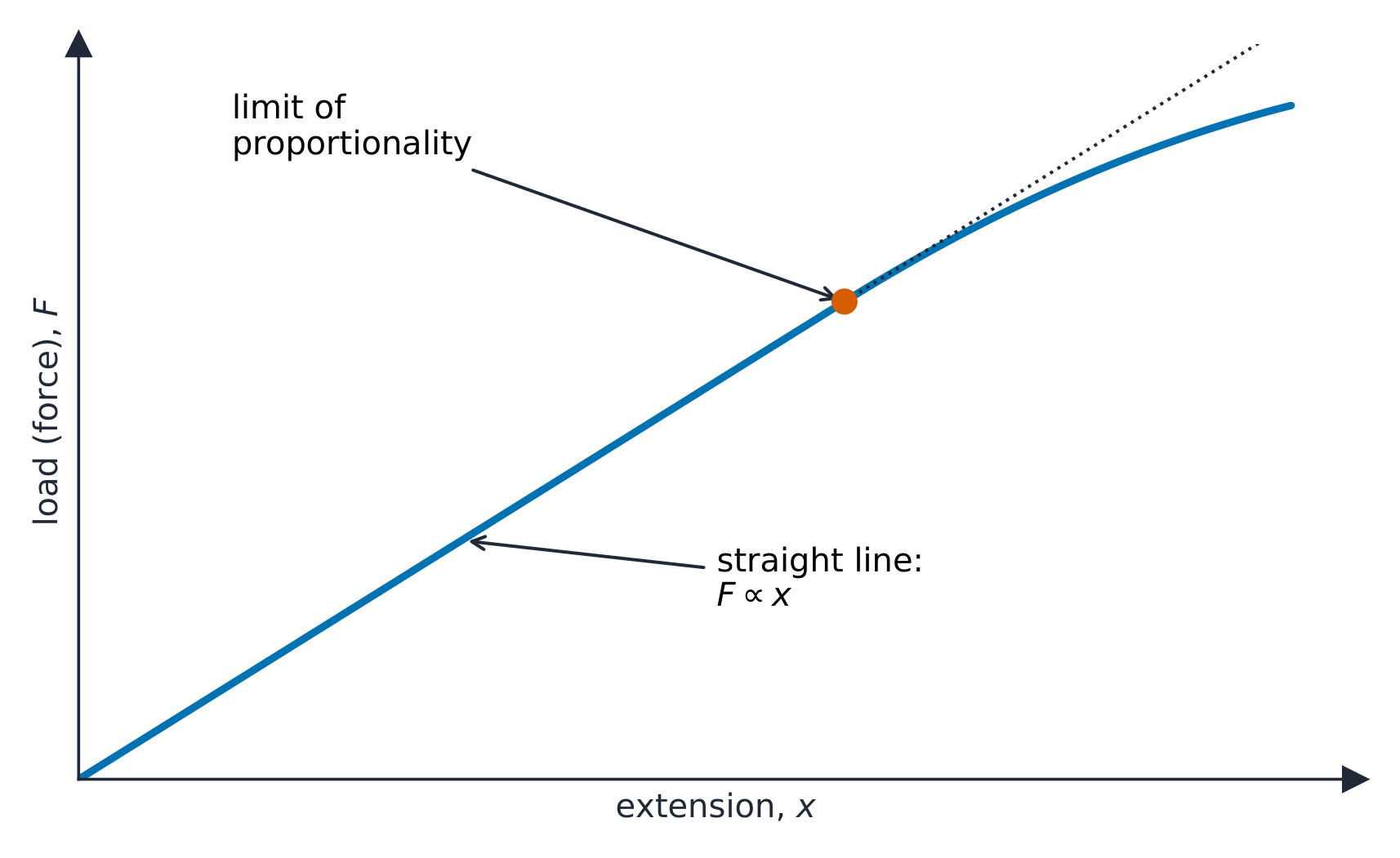
    An ideal spring obeys Hooke's law 胡克定律 $F_s=-kx$, a restoring force set by the spring constant 弹簧劲度系数 $k$. Its stored energy is $U=\tfrac12 kx^2$.

    Hooke's law: extension is proportional to load up to the limit of proportionality
    Hooke's law: extension is proportional to load up to the limit of proportionality

    Combined springs act as one equivalent spring of constant $k_{\text{eq}}$. In parallel (side by side, sharing the load) the constants add, $k_{\text{eq}}=k_1+k_2$ – stiffer than either. In series (end to end) they combine as $\dfrac{1}{k_{\text{eq}}}=\dfrac{1}{k_1}+\dfrac{1}{k_2}$ – softer than the softest one. Two springs pulling a mass from opposite sides also act in parallel, giving a restoring constant $k_1+k_2$. Whichever you have, the SHM period uses $k_{\text{eq}}$: $T=2\pi\sqrt{m/k_{\text{eq}}}$.

    Explore · ⁨สำรวจ⁩

    Stretch a spring (Hooke's law) · ⁨ยืดสปริง (กฎของฮุค)⁩

    A spring's force is proportional to its extension, $F=kx$ (Hooke's law). Pull harder and the extension grows in step — until the spring's limit. · ⁨แรงของสปริงแปรผันตรงกับระยะยืด $F=kx$ (กฎของฮุค) ดึงแรงขึ้น ระยะยืดก็เพิ่มขึ้นตาม比例 — จนกว่าจะถึงขีดจำกัดของสปริง⁩

    Vocabulary · ⁨คำศัพท์⁩ Train · ⁨ฝึกฝน⁩
    English ไทย
    Hooke's law/hʊks lɔː/ กฎของฮুক
    spring constant/sprɪŋ ˈkɒnstənt/ ค่าคงที่ของสปริง
    2.9

    Resistive Forces

    Syllabus · ⁨หลักสูตร⁩
    English

    Learning Objective 2.9.A: Describe the motion of an object subject to a resistive force.

    • 2.9.A.1 A resistive force is defined as a velocity-dependent force in the opposite direction of an object's velocity, for example:
      • Equation: $\vec{F}_r = -k\vec{v}$
    • 2.9.A.2 Applying Newton's second law to an object upon which a resistive force is exerted results in a differential equation for velocity.
      • 2.9.A.2.i Using the method of separation of variables, the velocity can be determined by integrating over the proper limits of integration.
      • 2.9.A.2.ii The acceleration or position of a moving object that is subject to a velocity-dependent force may be determined using initial conditions of the object and methods of calculus, once a function for velocity is determined.
      • 2.9.A.2.iii The position, velocity, and acceleration as functions of time of an object under the influence of a resistive force of the form $\vec{F}_r = -k\vec{v}$ are exponential and have asymptotes that are determined by the initial conditions of the object and the forces exerted on the object.
    • 2.9.A.3 Terminal velocity is defined as the maximum speed achieved by an object moving under the influence of a constant force and a resistive force that are exerted on the object in opposite directions. The terminal condition is reached when the net force exerted on the object is zero.
    ไทย

    วัตถุประสงค์การเรียนรู้ 2.9.A: อธิบายการเคลื่อนที่ของวัตถุภายใต้แรงต้านทาน

    • 2.9.A.1 แรงต้านทานถูกนิยามว่าเป็นแรงที่ขึ้นอยู่กับความเร็วและมีทิศทางตรงข้ามกับความเร็วของวัตถุ ตัวอย่างเช่น:
      • สมการ: $\vec{F}_r = -k\vec{v}$
    • 2.9.A.2 การประยุกต์ใช้กฎข้อที่สองของนิวตันต่อวัตถุที่มีแรงต้านกระทำ จะทำให้ได้สมการเชิงอนุพันธ์สำหรับความเร็ว
      • 2.9.A.2.i การใช้วิธีแยกตัวแปร สามารถหาค่าความเร็วได้โดยการอินทิเกรตตามขอบเขตการอินทิเกรตที่เหมาะสม
      • 2.9.A.2.ii ความเร่งหรือตำแหน่งของวัตถุที่เคลื่อนที่ภายใต้แรงที่ขึ้นอยู่กับความเร็ว สามารถกำหนดได้โดยใช้เงื่อนไขเริ่มต้นของวัตถุและวิธีการคำนวณเชิงอนุพันธ์ เมื่อได้ฟังก์ชันของความเร็วแล้ว
      • 2.9.A.2.iii ตำแหน่ง ความเร็ว และความเร่งในฐานะฟังก์ชันของเวลาของวัตถุภายใต้แรงต้านในรูป $\vec{F}_r = -k\vec{v}$ จะมีลักษณะเป็นเอกซ์โพเนนเชียล และมีเส้นประ (asymptotes) ที่กำหนดโดยเงื่อนไขเริ่มต้นของวัตถุและแรงที่ทำต่อวัตถุ
    • 2.9.A.3 ความเร็วสูงสุด (terminal velocity) นิยามว่าเป็นความเร็วสูงสุดที่วัตถุสามารถบรรลุได้ขณะเคลื่อนที่ภายใต้แรงคงที่และแรงต้านซึ่งกระทำต่อวัตถุในทิศทางตรงกันข้าม สภาวะความเร็วสูงสุดจะเกิดขึ้นเมื่อผลรวมแรงที่ทำต่อวัตถุเป็นศูนย์

    Source: College Board AP Course and Exam Description · ⁨แหล่งที่มา: คำอธิบายหลักสูตรและข้อสอบ College Board AP⁩

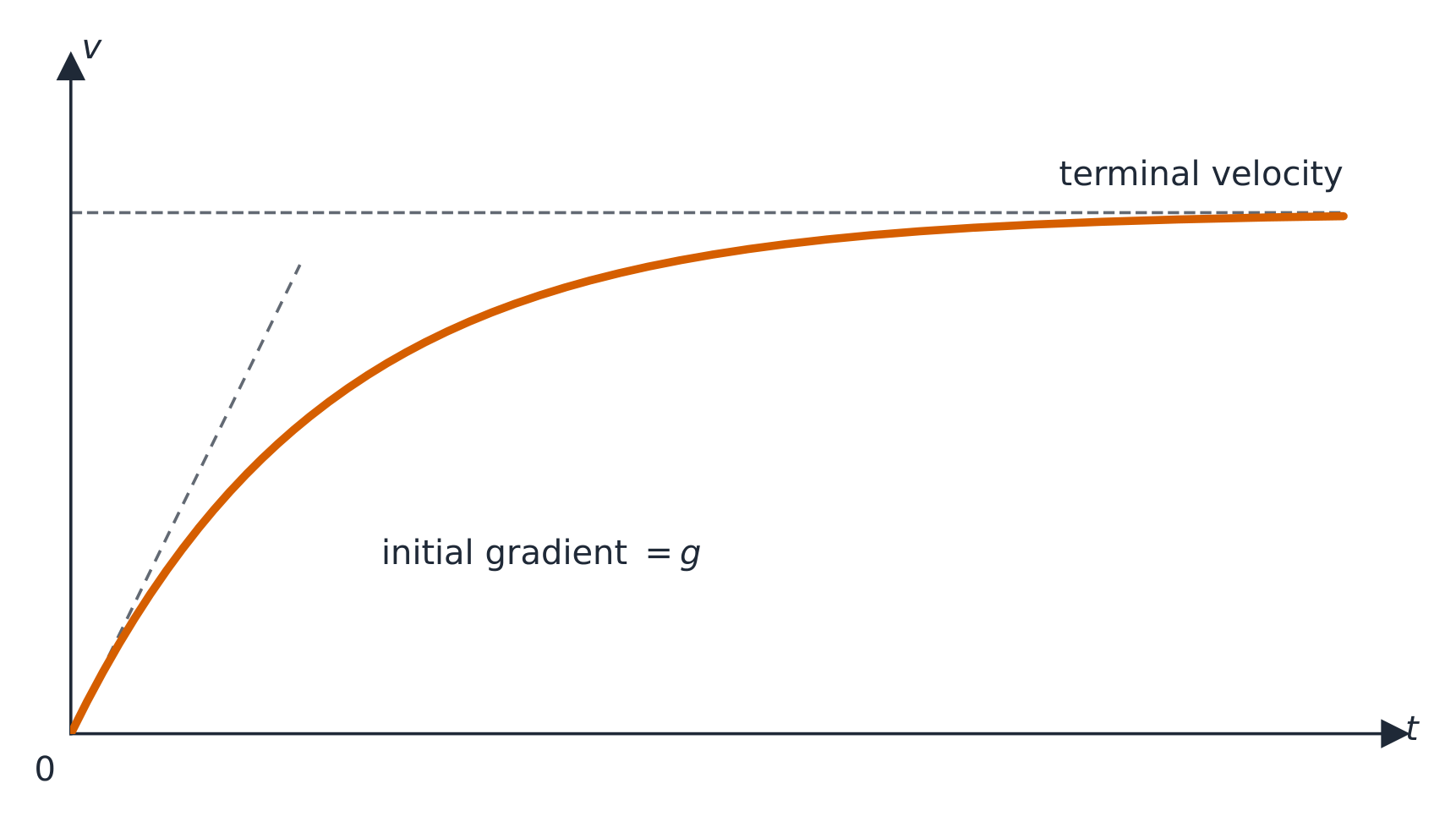
    A resistive force 阻力 (drag) opposes motion through a fluid and grows with speed, often modeled as $F=-bv$ or $F=-cv^2$. Newton's second law then gives a differential equation, e.g. $m\dfrac{dv}{dt}=mg-bv$ for a falling object. As speed rises, drag builds until it balances the driving force; the object then stops accelerating and moves at a constant terminal velocity 终极速度, found by setting the net force (and $dv/dt$) to zero.

    Worked example. For a falling object with $m\dfrac{dv}{dt}=mg-bv$, the terminal velocity is where $\dfrac{dv}{dt}=0$: $mg=bv_T$, so $v_T=\dfrac{mg}{b}$. With $m=0.10\ \text{kg}$ and $b=0.50\ \text{kg/s}$, $v_T=\dfrac{0.10(9.8)}{0.50}=2.0\ \text{m/s}$.

    To get the full motion $v(t)$, separate the variables 分离变量 and integrate from rest:

    $$\int_0^{v}\frac{dv'}{mg-bv'}=\int_0^{t}\frac{dt'}{m}\;\Rightarrow\;-\frac{1}{b}\ln\!\frac{mg-bv}{mg}=\frac{t}{m},$$
    which rearranges to $v(t)=v_T\left(1-e^{-bt/m}\right)$ – the speed rising exponentially toward $v_T$. Showing this integration is the calculus skill a Physics C free-response rewards, not just quoting the final formula.

    An object falling through a fluid speeds up to a terminal velocity
    An object falling through a fluid speeds up to a terminal velocity
    Skydivers in freefall: drag grows with speed until it balances weight at terminal velocity
    Skydivers in freefall: drag grows with speed until it balances weight at terminal velocity
    Vocabulary · ⁨คำศัพท์⁩ Train · ⁨ฝึกฝน⁩
    English ไทย
    resistive force/rɪˈzɪstɪv fɔːs/ แรงต้านทาน
    terminal velocity/ˈtɜːmɪnl vəˈlɒsɪti/ ความเร็วสูงสุด
    separate the variables/ˈseprət ðə ˈveərɪəblz/ แยกตัวแปร
    2.10

    Circular Motion

    Syllabus · ⁨หลักสูตร⁩
    English

    Learning Objective 2.10.A: Describe the motion of an object traveling in a circular path.

    • 2.10.A.1 Centripetal acceleration is the component of an object's acceleration directed toward the center of the object's circular path.
      • 2.10.A.1.i The magnitude of centripetal acceleration for an object moving in a circular path is the ratio of the object's tangential speed squared to the radius of the circular path.
        • Equation: $a_c = \dfrac{v^2}{r}$
      • 2.10.A.1.ii Centripetal acceleration is directed toward the center of an object's circular path.
    • 2.10.A.2 Centripetal acceleration can result from a single force, more than one force, or components of forces that are exerted on an object in circular motion.
      • 2.10.A.2.i At the top of a vertical, circular loop, an object requires a minimum speed to maintain circular motion. At this point, and with this minimum velocity, the gravitational force is the only force that causes the centripetal acceleration.
        • Derived equation: $v = \sqrt{gr}$
      • 2.10.A.2.ii Components of the static friction force and the normal force can contribute to the net force producing centripetal acceleration of an object traveling in a circle on a banked surface.
      • 2.10.A.2.iii A component of tension contributes to the net force producing centripetal acceleration experienced by a conical pendulum.
    • 2.10.A.3 Tangential acceleration is the rate at which an object's speed changes and is directed tangent to the object's circular path.
    • 2.10.A.4 The net acceleration of an object moving in a circle is the vector sum of the centripetal acceleration and tangential acceleration.
    • 2.10.A.5 The revolution of an object traveling in a circular path at a constant speed (uniform circular motion) can be described using period and frequency.
      • 2.10.A.5.i The time to complete one full circular path, one full rotation, or a full cycle of oscillatory motion is defined as period, $T$.
      • 2.10.A.5.ii The rate at which an object is completing revolutions is defined as frequency, $f$.
        • Equation: $T = \dfrac{1}{f}$
      • 2.10.A.5.iii For an object traveling at a constant speed in a circular path, the period is given by the derived equation
        • Derived equation: $T = \dfrac{2\pi r}{v}$

    Learning Objective 2.10.B: Describe circular orbits using Kepler's third law.

    • 2.10.B.1 For a satellite in circular orbit around a central body, the satellite's centripetal acceleration is caused only by gravitational attraction. The period and radius of the circular orbit are related to the mass of the central body.
      • Derived equation: $T^2 = \dfrac{4\pi^2}{GM} R^3$

    Boundary statement: AP Physics C: Mechanics does not expect students to know Kepler's first or second laws of planetary motion.

    ไทย

    วัตถุประสงค์การเรียนรู้ 2.10.A: อธิบายการเคลื่อนที่ของวัตถุที่เคลื่อนที่ตามเส้นทางวงกลม

    • 2.10.A.1 ความเร่งเข้าสู่ศูนย์กลางคือองค์ประกอบของความเร่งของวัตถุที่มีทิศ指向 hacia ศูนย์กลางของเส้นทางวงกลมของวัตถุนั้น
      • 2.10.A.1.i ขนาดของความเร่งเข้าสู่ศูนย์กลางสำหรับวัตถุที่เคลื่อนที่ตามเส้นทางวงกลมคืออัตราส่วนของกำลังสองของความเร็วด้านสัมผัสต่อรัศมีของเส้นทางวงกลม
        • สมการ: $a_c = \dfrac{v^2}{r}$
      • 2.10.A.1.ii ความเร่งเข้าสู่ศูนย์กลางมีทิศ指向 towards ศูนย์กลางของเส้นทางวงกลมของวัตถุ
    • 2.10.A.2 ความเร่งเข้าสู่ศูนย์กลางอาจเกิดจากแรงเดียว แรงหลายแรง หรือองค์ประกอบของแรงที่กระทำต่อวัตถุที่กำลังเคลื่อนที่แบบวงกลม
      • 2.10.A.2.i ที่จุดสูงสุดของวงแหวนแนวตั้ง วัตถุลำดับแรกต้องการความเร็วขั้นต่ำเพื่อรักษาการเคลื่อนที่แบบวงกลม ในจุดนี้และด้วยความเร็วขั้นต่ำนี้ แรงโน้มถ่วงเป็นแรงเดียวที่ทำให้เกิดความเร่งเข้าสู่ศูนย์กลาง
        • สมการที่ได้จาก: $v = \sqrt{gr}$
      • 2.10.A.2.ii องค์ประกอบของแรงเสียดทานนิ่งและแรงปฏิกิริยาสามารถมีส่วนร่วมในแรงสุทธิที่สร้างความเร่งเข้าสู่ศูนย์กลางของวัตถุที่เคลื่อนที่บนพื้นเอียง
      • 2.10.A.2.iii องค์ประกอบของแรงตึง contributes to แรงสุทธิที่สร้างความเร่งเข้าสู่ศูนย์กลางที่ลูกตุ้มนอกลูกบาศก์ (conical pendulum) สัมผัส
    • 2.10.A.3 ความเร่งด้านสัมผัสคืออัตราการเปลี่ยนแปลงความเร็วของวัตถุและมีทิศ tangent กับเส้นทางวงกลมของวัตถุ
    • 2.10.A.4 ความเร่งสุทธิของวัตถุที่เคลื่อนที่ในวงกลมคือผลบวกเวกเตอร์ของความเร่งเข้าสู่ศูนย์กลางและความเร่งด้านสัมผัส
    • 2.10.A.5 การหมุนรอบของวัตถุที่เคลื่อนที่ตามเส้นทางวงกลมด้วยความเร็วคงที่ (การเคลื่อนที่แบบวงกลมสม่ำเสมอ) สามารถอธิบายได้ด้วยคาบและความถี่
      • 2.10.A.5.i เวลาที่ใช้ในการ走完เส้นทางวงกลมหนึ่งเต็มรอบ การหมุนหนึ่งเต็มรอบ หรือการสั่นสะเทือนหนึ่งรอบเต็มถูกนิยามว่า คาบ, $T$
      • 2.10.A.5.ii อัตราที่วัตถุหมุนรอบครบถูกนิยามว่า ความถี่, $f$
        • สมการ: $T = \dfrac{1}{f}$
      • 2.10.A.5.iii สำหรับวัตถุที่เคลื่อนที่ด้วยความเร็วคงที่ตามเส้นทางวงกลม คาบกำหนดโดยสมการที่ได้มา
        • สมการที่ได้จาก: $T = \dfrac{2\pi r}{v}$

    วัตถุประสงค์การเรียนรู้ 2.10.B: อธิบายวงโคจรแบบวงกลมโดยใช้กฎที่สามของเคปเลอร์

    • 2.10.B.1 สำหรับดาวเทียมในวงโคจรแบบวงกลมรอบร่างกายหลัก ความเร่งเข้าสู่ศูนย์กลางของดาวเทียมเกิดจากการดึงดูดของแรงโน้มถ่วงเท่านั้น คาบและรัศมีของวงโคจรแบบวงกลมสัมพันธ์กับมวลของร่างกายหลัก
      • สมการที่ได้มา: $T^2 = \dfrac{4\pi^2}{GM} R^3$

    คำกล่าวจำกัดขอบเขต: AP Physics C: Mechanics does not expect students to know Kepler's first or second laws of planetary motion.

    Source: College Board AP Course and Exam Description · ⁨แหล่งที่มา: คำอธิบายหลักสูตรและข้อสอบ College Board AP⁩

    Uniform circular motion

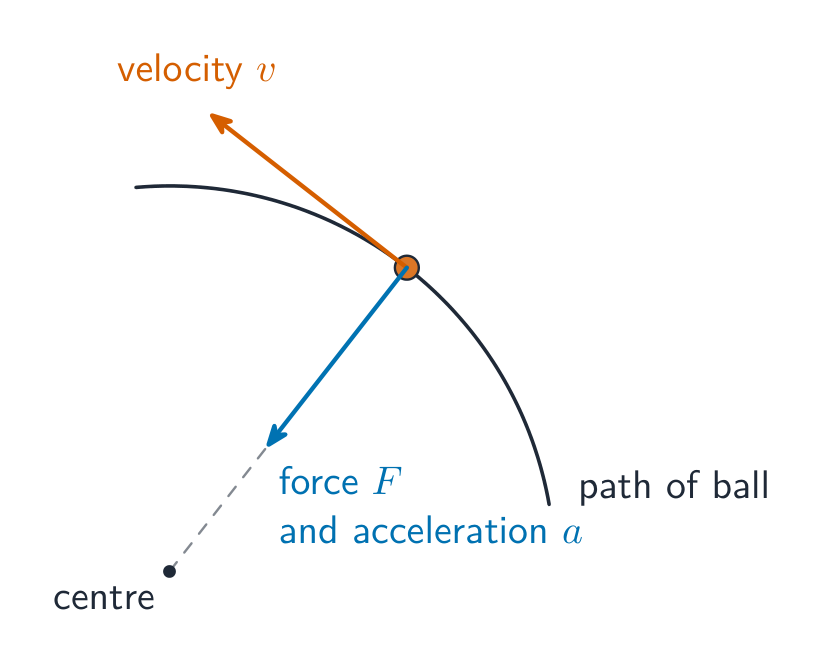
    Uniform circular motion has a centripetal acceleration 向心加速度 $a_c=\dfrac{v^2}{r}$ pointing to the center, requiring a net inward force $F_c=\dfrac{mv^2}{r}$ supplied by a real force (tension, gravity, friction, normal). There is no outward force. For vertical circles and banked curves, decompose the real forces to find which provides the centripetal requirement.

    Worked example. A $0.50\ \text{kg}$ ball is whirled on a $1.0\ \text{m}$ string in a horizontal circle at $3.0\ \text{m/s}$. The string tension supplies the whole centripetal force: $T=\dfrac{mv^2}{r}=\dfrac{0.50(3.0)^2}{1.0}=4.5\ \text{N}$.

    Worked example (vertical circle). At the top of a vertical loop of radius $r$, gravity and the normal force both point toward the center: $N+mg=\dfrac{mv^2}{r}$. The slowest possible speed at the top is where the track pushes with nothing at all ($N=0$): $v_{\min}=\sqrt{gr}$. For $r=2.5\ \text{m}$: $v_{\min}=\sqrt{9.8(2.5)}=4.9\ \text{m/s}$. Any slower and the cart leaves the track before the top.

    The velocity points along the tangent; the centripetal force points to the centre
    The velocity points along the tangent; the centripetal force points to the centre
    Vocabulary · ⁨คำศัพท์⁩ Train · ⁨ฝึกฝน⁩
    English ไทย
    centripetal acceleration/senˈtrɪpɪtl əkˌseləˈreɪʃn/ ความเร่งเข้าสู่ศูนย์กลาง
    2.10

    Exam tips

    • Locate the center of mass with $x_{cm}=\tfrac{1}{M}\int x\,dm$ (or $\tfrac{\sum m_i x_i}{\sum m_i}$ for point masses) and use $\lambda,\sigma,\rho$ for the mass element.
    • The net external force moves the center of mass as if all mass sat there: $\vec F_{net}=M\vec a_{cm}$.
    • Define your system clearly — internal forces cancel, so only external forces change its momentum.
    • Exploit symmetry to shortcut a center-of-mass integral.
    • Distinguish center of mass from center of gravity (identical in a uniform field).
  • 3

    Work, Energy, and Power · ⁨งาน พลังงาน และกำลัง⁩

    Watch lesson · ⁨ดูบทเรียน⁩
    3.1

    Translational Kinetic Energy · ⁨พลังงานจลน์เชิงแปล⁩

    Syllabus · ⁨หลักสูตร⁩
    English

    Learning Objective 3.1.A: Describe the translational kinetic energy of an object in terms of the object's mass and velocity.

    • 3.1.A.1 An object's translational kinetic energy is given by the equation
      • Equation: $K = \dfrac{1}{2}mv^2$
    • 3.1.A.2 Translational kinetic energy is a scalar quantity.
    • 3.1.A.3 Different observers may measure different values of the translational kinetic energy of an object, depending on the observer's frame of reference.
    ไทย

    วัตถุประสงค์การเรียนรู้ 3.1.A: อธิบายพลังงานจลน์แบบเลื่อนของวัตถุในแง่ของมวลและความเร็วของวัตถุนั้น

    • 3.1.A.1 พลังงานจลน์แบบเลื่อนของวัตถุกำหนดโดยสมการ
      • สมการ: $K = \dfrac{1}{2}mv^2$
    • 3.1.A.2 พลังงานจลน์แบบเลื่อนเป็นปริมาณสเกลาร์
    • 3.1.A.3 ผู้สังเกตที่แตกต่างกันอาจวัดค่าพลังงานจลน์แบบเลื่อนของวัตถุได้แตกต่างกัน ขึ้นอยู่กับกรอบอ้างอิงของผู้สังเกต

    Source: College Board AP Course and Exam Description · ⁨แหล่งที่มา: คำอธิบายหลักสูตรและข้อสอบ College Board AP⁩

    English

    Kinetic energy 动能 is the energy of motion, a scalar 标量 measured in joules 焦耳 (J):

    $$K=\tfrac{1}{2}mv^2.$$

    It grows with the square of speed – doubling the speed quadruples $K$. One subtlety worth knowing: kinetic energy depends on the observer's reference frame 参考系. A passenger walking down a train has a small $K$ measured inside the train and a huge one measured from the ground – both observers are right, each in their own frame.

    ไทย

    พลังงานจลน์ คือพลังงานจากการเคลื่อนที่ เป็น สเกลาร์ ที่วัดด้วยหน่วย จูล (J):

    $$K=\tfrac{1}{2}mv^2.$$

    มันเพิ่มขึ้นตาม กำลังสอง ของความเร็ว – หากเพิ่มความเร็วเป็นสองเท่า $K$ จะเพิ่มขึ้นสี่เท่า ข้อควรระวังหนึ่งข้อที่ควรรู้: พลังงานจลน์ขึ้นอยู่กับ กรอบอ้างอิง ของผู้สังเกต ผู้โดยสารเดินลงบนรถไฟจะมี $K$ เล็กเมื่อวัดภายในรถไฟ และมีค่ามหาศาลเมื่อวัดจากพื้นดิน – ผู้สังเกตทั้งสองถูกต้อง แต่ละคนอยู่ในกรอบของตัวเอง

    3.2

    Work · ⁨งาน⁩

    Syllabus · ⁨หลักสูตร⁩
    English

    Learning Objective 3.2.A: Describe the work done on an object or system by a given force or collection of forces.

    • 3.2.A.1 Work is the amount of energy transferred into or out of a system by a force exerted on that system over a distance.
      • 3.2.A.1.i The work done by a conservative force exerted on a system is path-independent and only depends on the initial and final configurations of that system.
      • 3.2.A.1.ii The work done by a conservative force on a system—or the change in the potential energy of the system—will be zero if the system returns to its initial configuration.
      • 3.2.A.1.iii Potential energies are associated only with conservative forces.
      • 3.2.A.1.iv The work done by a nonconservative force is path-dependent.
      • 3.2.A.1.v The most common nonconservative forces are friction and air resistance.
    • 3.2.A.2 Work is a scalar quantity that may be positive, negative, or zero.
    • 3.2.A.3 The work done on an object by a variable force is calculated using
      • Equation: $W = \displaystyle\int_a^b \vec{F}(r) \cdot d\vec{r}$, where the integral is taken over the path from point $a$ to point $b$.
      • 3.2.A.3.i The dot product between two vectors, $\vec{A}$ and $\vec{B}$, results in a scalar quantity of magnitude $\vec{A} \cdot \vec{B} = AB\cos\theta$.
      • 3.2.A.3.ii Only the component of the force exerted on a system that is parallel to the displacement of the point of application of the force will change the system's total energy.
      • 3.2.A.3.iii If the component of the force exerted on a system that is parallel to the displacement is constant, the work done on the system by the force is given by the derived equation $W = F_{\parallel}d = Fd\cos\theta$.
      • 3.2.A.3.iv The component of the force exerted on a system perpendicular to the direction of the displacement of the system's center of mass can change the direction of the system's motion without changing the system's kinetic energy.
    • 3.2.A.4 The work–energy theorem states that the change in an object's kinetic energy is equal to the sum of the work (net work) being done by all forces exerted on the object.
      • Equation: $\Delta K = \displaystyle\sum W_i = \sum F_{\parallel,i}\, d_i$
      • 3.2.A.4.i An external force may change the configuration of a system. The component of the external force parallel to the displacement times the displacement of the point of application of the force gives the change in kinetic energy of the system.
      • 3.2.A.4.ii If the system's center of mass and the point of application of the force move the same distance when a force is exerted on a system, then the system may be modeled as an object, and only the system's kinetic energy can change.
      • 3.2.A.4.iii The energy dissipated by friction is typically equated to the force of friction times the length of the path over which the force is exerted.
        • Equation: $\Delta E_{\text{mech}} = F_f d\cos\theta$
      • 3.2.A.5 Work is equal to the area under the curve of a graph of $F_{\parallel}$ as a function of displacement.

    Boundary statement: AP Physics C: Mechanics only expects students to analyze the transfer of mechanical energy, although students should be aware that mechanical energy may be dissipated in the form of thermal energy or sound.

    ไทย

    วัตถุประสงค์การเรียนรู้ 3.2.A: อธิบายงานที่ทำต่อวัตถุหรือระบบโดยแรงที่กำหนดหรือกลุ่มแรง

    • 3.2.A.1 งานคือปริมาณพลังงานที่ถูกถ่ายโอนเข้าสู่หรือออกจากระบบโดยแรงที่กระทำต่อระบบนั้นตลอดระยะทาง
      • 3.2.A.1.i งานที่ทำโดยแรงอนุรักษ์ที่กระทำต่อระบบไม่ขึ้นอยู่กับเส้นทางและขึ้นอยู่กับเพียงการจัดวางตัวเริ่มต้นและสุดท้ายของระบบเท่านั้น
      • 3.2.A.1.ii งานที่ทำโดยแรงอนุรักษ์ต่อระบบ—หรือการเปลี่ยนแปลงพลังงานศักย์ของระบบ—จะเป็นศูนย์หากระบบกลับไปยังการจัดวางตัวเริ่มต้น
      • 3.2.A.1.iii พลังงานศักย์เกี่ยวข้องกับเฉพาะแรงอนุรักษ์เท่านั้น
      • 3.2.A.1.iv งานที่ทำโดยแรงที่ไม่ใช่แรงอนุรักษ์ขึ้นอยู่กับเส้นทาง
      • 3.2.A.1.v แรงที่ไม่รักษาพลังงาน (nonconservative forces) ที่พบบ่อยที่สุดคือแรงเสียดทานและแรงต้านอากาศ
    • 3.2.A.2 งานเป็นปริมาณสเกลาร์ซึ่งอาจมีค่าเป็นบวก ลบ หรือศูนย์
    • 3.2.A.3 งานที่ทำต่อวัตถุโดยแรงแปรผัน คำนวณได้จาก
      • สมการ: $W = \displaystyle\int_a^b \vec{F}(r) \cdot d\vec{r}$, โดยอินทิกรัลนี้คำนวณตามเส้นทางจากจุด $a$ ไปยังจุด $b$
      • 3.2.A.3.i ผลคูณสเกลาร์ระหว่างเวกเตอร์สองตัว, $\vec{A}$ และ $\vec{B}$, จะได้ปริมาณสเกลาร์ขนาด $\vec{A} \cdot \vec{B} = AB\cos\theta$
      • 3.2.A.3.ii เฉพาะองค์ประกอบของแรงที่ทำต่อระบบในแนวขนานกับการกระจัดของจุดที่แรงกระทำเท่านั้นที่จะเปลี่ยนพลังงานรวมของระบบ
      • 3.2.A.3.iii หากองค์ประกอบของแรงที่ทำต่อ系统在แนวขนานกับการกระจัดมีค่าคงที่ งานที่ทำต่อระบบโดยแรงนี้จะกำหนดโดยสมการที่ได้ $W = F_{\parallel}d = Fd\cos\theta$
      • 3.2.A.3.iv องค์ประกอบของแรงที่ทำต่อระบบในแนวตั้งฉากกับทิศทางการเคลื่อนที่ของจุดศูนย์กลางมวลของระบบ สามารถเปลี่ยนทิศทางการเคลื่อนที่ของระบบโดยไม่เปลี่ยนพลังงานจลน์ของระบบ
    • 3.2.A.4 theorem พลังงาน-งาน ระบุว่า การเปลี่ยนแปลงพลังงานจลน์ของวัตถุ เท่ากับผลรวมของงาน (งานสุทธิ) ที่ทำโดยแรงทั้งหมดที่ทำต่อวัตถุนั้น
      • สมการ: $\Delta K = \displaystyle\sum W_i = \sum F_{\parallel,i}\, d_i$
      • 3.2.A.4.i แรงภายนอกอาจเปลี่ยนแปลงการจัดวางตัวของระบบ ผลคูณขององค์ประกอบของแรงภายนอกที่ขนานกับการกระจัดกับการกระจัดของจุดประบดแรงให้ค่าการเปลี่ยนแปลงพลังงานจลน์ของระบบ
      • 3.2.A.4.ii หากศูนย์กลางมวลของระบบและจุดประบดแรงเคลื่อนที่ในระยะเท่ากันเมื่อมีแรงกระทำต่อระบบ ระบบสามารถจำลองเป็นวัตถุได้ และการเปลี่ยนแปลงจะเกิดขึ้นเฉพาะพลังงานจลน์ของระบบเท่านั้น
      • 3.2.A.4.iii พลังงานที่สูญเสียไปเนื่องจากแรงเสียดทาน มักเท่ากับแรงเสียดทานคูณกับความยาวของเส้นทางที่แรงกระทำ
        • สมการ: $\Delta E_{\text{mech}} = F_f d\cos\theta$
      • 3.2.A.5 งานเท่ากับพื้นที่ใต้กราฟของ $F_{\parallel}$ ในฟังก์ชันของการกระจัด

    ข้อความขอบเขต: AP Physics C: Mechanics ต้องการให้นักเรียนวิเคราะห์เฉพาะการถ่ายโอนพลังงานกลเท่านั้น แม้ว่าจะควรทราบว่าพลังงานกลอาจถูกกระจาย出去ในรูปของพลังงานความร้อนหรือเสียงก็ได้

    Source: College Board AP Course and Exam Description · ⁨แหล่งที่มา: คำอธิบายหลักสูตรและข้อสอบ College Board AP⁩

    English

    Work 功 is energy transferred into or out of a system by a force acting over a distance. For a variable force it is an integral 积分 along the path:

    $$W=\int_a^b \vec{F}\cdot d\vec{r}=\int F\cos\theta\,dr.$$

    For a constant force this reduces to $W=Fd\cos\theta$; on a force–position graph, work is the area under the curve. Work is a scalar with a sign, and the sign is physics, not bookkeeping:

    • Positive – force has a component along the motion (it speeds the object up).
    • Negative – force opposes the motion (friction 摩擦力 and air drag do negative work).
    • Zero – force perpendicular to the motion (the normal force 法向力 on a sliding block, gravity on a horizontal move, tension in a circular swing).

    The work–energy theorem 动能定理 collects every force's contribution: the net work equals the change in kinetic energy,

    $$W_{\text{net}}=\sum W_i=\Delta K.$$

    Worked example. A variable force $F(x)=3x^2\ \text{N}$ (along the motion) acts from $x=0$ to $x=2\ \text{m}$: $W=\displaystyle\int_0^2 3x^2\,dx=\big[x^3\big]_0^2=8\ \text{J}$. Acting alone on a body starting from rest, it would raise the kinetic energy to exactly $8\ \text{J}$.

    ไทย

    งาน คือพลังงานที่ถูกถ่ายโอนเข้าสู่หรือออกจากระบบโดยแรงที่กระทำผ่านระยะทาง สำหรับแรงแปรผัน งานคือ อินทิกรัล ตามเส้นทาง:

    $$W=\int_a^b \vec{F}\cdot d\vec{r}=\int F\cos\theta\,dr.$$

    สำหรับแรงคงที่ มันลดรูปเหลือ $W=Fd\cos\theta$; บนกราฟแรง–ตำแหน่ง งานคือ พื้นที่ใต้curve. งานเป็นสเกลาร์ที่มีเครื่องหมาย และเครื่องหมายนั้นเป็นฟิสิกส์ ไม่ใช่แค่การบันทึกบัญชี:

    • บวก – แรงมีองค์ประกอบตามทิศทางการเคลื่อนที่ (ทำให้วัตถุเร็วขึ้น).
    • ลบ – แรงต้านทิศทางการเคลื่อนที่ (แรงเสียดทาน และแรงต้านอากาศทำงานลบ).
    • ศูนย์ – แรงตั้งฉากกับการเคลื่อนที่ (แรงปกติบนบล็อกที่ลื่นไถล, แรงโน้มถ่วงในการเคลื่อนที่แนวนอน, แรงตึงในลูกตุ้มนิวตัน).
    มีเพียงองค์ประกอบของแรงตามการกระจัดเท่านั้นที่ทำ功
    มีเพียงองค์ประกอบของแรงตามการกระจัดเท่านั้นที่ทำ功

    ทฤษฎีบทงาน-พลังงาน รวบรวม的贡献ของทุกแรง: งานสุทธิเท่ากับผลต่างของพลังงานจลน์,

    $$W_{\text{net}}=\sum W_i=\Delta K.$$

    ตัวอย่างคำนวณ. แรงแปรผัน $F(x)=3x^2\ \text{N}$ (ตามทิศทางการเคลื่อนที่) กระทำตั้งแต่ $x=0$ ถึง $x=2\ \text{m}$: $W=\displaystyle\int_0^2 3x^2\,dx=\big[x^3\big]_0^2=8\ \text{J}$. เมื่อกระทำต่อวัตถุที่เริ่มจากหยุดนิ่งเพียงอย่างเดียว จะเพิ่มพลังงานจลน์ให้ถึง $8\ \text{J}$ พอดี

    Vocabulary · ⁨คำศัพท์⁩ Train · ⁨ฝึกฝน⁩
    English ไทย
    Kinetic energy/kɪˈnetɪk ˈenədʒi/ พลังงานจลน์
    scalar/ˈskeɪlə/ สเกลาร์
    joules/dʒuːlz/ จูล
    reference frame/ˈrefrəns freɪm/ กรอบอ้างอิง
    Work/wɜːk/ งาน
    integral/ˈɪntɪɡrəl/ อินทิกรัล
    friction/ˈfrɪkʃn/ แรงเสียดทาน
    normal force/ˈnɔːml fɔːs/ แรงปฏิกิริยาตั้งฉาก
    work–energy theorem/wɜːk ˈenədʒi ˈθɪərəm/ ทฤษฎีงาน–พลังงาน
    3.3

    Potential Energy · ⁨พลังงานศักย์⁩

    Syllabus · ⁨หลักสูตร⁩
    English

    Learning Objective 3.3.A: Describe the potential energy of a system.

    • 3.3.A.1 A system composed of two or more objects has potential energy if the objects within that system only interact with each other through conservative forces.
    • 3.3.A.2 Potential energy is a scalar quantity associated with the position of objects within a system.
    • 3.3.A.3 The definition of zero potential energy for a given system is a decision made by the observer considering the situation to simplify or otherwise assist in analysis.
    • 3.3.A.4 The relationship between conservative forces exerted on a system and the system's potential energy is
      • Equation: $\Delta U = -\displaystyle\int_a^b \vec{F}_{cf}(r) \cdot d\vec{r}$
    • 3.3.A.5 The conservative forces exerted on a system in a single dimension can be determined using the slope of the system's potential energy with respect to position in that dimension; these forces point in the direction of decreasing potential energy.
      • Equation: $F_x = -\dfrac{dU(x)}{dx}$
    • 3.3.A.6 Graphs of a system's potential energy as a function of its position can be useful in determining physical properties of that system.
      • 3.3.A.6.i Stable equilibrium is a location at which a small displacement in an object's position results in a force exerted on the object opposite to the direction of the small displacement, accelerating the object back toward the equilibrium position.
      • 3.3.A.6.ii Unstable equilibrium is a location at which a small displacement in an object's position results in a force exerted on the object in the same direction as the small displacement, accelerating the object away from the equilibrium position.
      • 3.3.A.6.iii In a given dimension, stable equilibrium positions exist at locations where the potential energy as a function of position in that dimension has a local minimum.
      • 3.3.A.6.iv In a given dimension, unstable equilibrium positions occur at locations where the potential energy as a function of position in that dimension has a local maximum.
    • 3.3.A.7 The potential energy of common physical systems can be described using the physical properties of that system.
      • 3.3.A.7.i The elastic potential energy of an ideal spring is given by the following equation, where $\Delta x$ is the distance the spring has been stretched or compressed from its equilibrium length.
        • Equation: $U_s = \dfrac{1}{2}k(\Delta x)^2$
      • 3.3.A.7.ii The general form for the gravitational potential energy of a system consisting of two approximately spherical distributions of mass (e.g., moons, planets, or stars) is given by the equation
        • Equation: $U_g = -G\dfrac{m_1 m_2}{r}$
      • 3.3.A.7.iii Because the gravitational field near the surface of a planet is nearly constant, the change in gravitational potential energy in a system consisting of an object with mass $m$ and a planet with gravitational field of magnitude $g$ when the object is near the surface of the planet may be approximated by the equation
        • Equation: $\Delta U_g = mg\Delta y$
    • 3.3.A.8 The total potential energy of a system containing more than two objects is the sum of the potential energy of each pair of objects within the system.
    ไทย

    วัตถุประสงค์การเรียนรู้ 3.3.A: อธิบายพลังงานศักย์ของระบบ

    • 3.3.A.1 ระบบที่ประกอบด้วยวัตถุสองชิ้นขึ้นไปจะมีพลังงานศักย์หากวัตถุภายในระบบ tersebut相互作用กันเฉพาะผ่านแรงอนุรักษ์เท่านั้น
    • 3.3.A.2 พลังงานศักย์เป็นปริมาณสเกลาร์ที่เกี่ยวข้องกับตำแหน่งของวัตถุภายในระบบ
    • 3.3.A.3 การกำหนดจุดศูนย์ของพลังงานศักย์สำหรับระบบหนึ่งเป็นการตัดสินใจของผู้สังเกตพิจารณาจากสถานการณ์เพื่อทำให้การวิเคราะห์ง่ายขึ้นหรือช่วยในการวิเคราะห์อื่นๆ
    • 3.3.A.4 ความสัมพันธ์ระหว่างแรงรักษาพลังงาน (conservative forces) ที่กระทำต่อระบบกับพลังงานศักย์ของระบบคือ
      • สมการ: $\Delta U = -\displaystyle\int_a^b \vec{F}_{cf}(r) \cdot d\vec{r}$
    • 3.3.A.5 แรงรักษาพลังงานที่กระทำต่อระบบ在一มิติเดียว สามารถหาได้จากการชันของพลังงานศักย์ของระบบเทียบกับตำแหน่งในมิตินั้น; แรงเหล่านี้ชี้ไปในทิศทางที่พลังงานศักย์ลดลง
      • สมการ: $F_x = -\dfrac{dU(x)}{dx}$
    • 3.3.A.6 กราฟของพลังงานศักย์ของระบบในฐานะฟังก์ชันของตำแหน่ง สามารถช่วยในการกำหนดคุณสมบัติทางฟิสิกส์ของระบบนั้นได้
      • 3.3.A.6.i สมดุลเสถียร คือตำแหน่งที่เมื่อมีการกระจัดเล็กน้อยของวัตถุ จะเกิดแรงกระทำต่อวัตถุในทิศทางตรงข้ามกับการกระจัดเล็กน้อย ทำให้วัตถุมีความเร่งกลับเข้าสู่ตำแหน่งสมดุล
      • 3.3.A.6.ii สมดุลไม่เสถียร คือตำแหน่งที่เมื่อมีการกระจัดเล็กน้อยของวัตถุ จะเกิดแรงกระทำต่อวัตถุในทิศทางเดียวกับ การกระจัดเล็กน้อย ทำให้วัตถุมีความเร่งห่างออกจากตำแหน่งสมดุล
      • 3.3.A.6.iii ในมิตินั้นๆ ตำแหน่งสมดุลเสถียรจะอยู่ในตำแหน่งที่พลังงานศักย์ในฐานะฟังก์ชันของตำแหน่งในมิตินั้น มีค่าต่ำสุดสัมพัทธ์
      • 3.3.A.6.iv ในมิตินั้นๆ ตำแหน่งสมดุลไม่เสถียรจะอยู่ในตำแหน่งที่พลังงานศักย์ในฐานะฟังก์ชันของตำแหน่งในมิตินั้น มีค่าสูงสุดสัมพัทธ์
    • 3.3.A.7 พลังงานศักย์ของระบบฟิสิกส์ทั่วไป สามารถอธิบายได้ด้วยคุณสมบัติทางฟิสิกส์ของระบบนั้น
      • 3.3.A.7.i พลังงานศักย์ยืดหยุ่นของสปริงอุดมคติ กำหนดโดยสมการต่อไปนี้ โดยที่ $\Delta x$ คือระยะที่สปริงถูกยืดหรืออัดออกจากความยาวสมดุล
        • สมการ: $U_s = \dfrac{1}{2}k(\Delta x)^2$
      • 3.3.A.7.ii รูปแบบทั่วไปของพลังงานศักย์โน้มถ่วงของระบบที่ประกอบด้วยมวลกระจายตัวแบบทรงกลมสองชนิดประมาณเท่ากัน (เช่น ดวงจันทร์ ดาวเคราะห์ หรือดวงดาว) กำหนดโดยสมการ
        • สมการ: $U_g = -G\dfrac{m_1 m_2}{r}$
      • 3.3.A.7.iii เนื่องจากสนามโน้มถ่วงใกล้พื้นผิวของดาวเคราะห์เกือบจะเป็นค่าคงที่ การเปลี่ยนแปลงพลังงานศักย์โน้มถ่วงในระบบที่ประกอบด้วยวัตถุที่มีมวล $m$ และดาวเคราะห์ที่มีสนามโน้มถ่วงขนาด $g$ เมื่อวัตถุอยู่ใกล้พื้นผิวของดาวเคราะห์ สามารถประมาณด้วยสมการ
        • สมการ: $\Delta U_g = mg\Delta y$
    • 3.3.A.8 พลังงานศักย์รวมของระบบที่มีวัตถุมากกว่าสองวัตถุ คือผลรวมของพลังงานศักย์ของแต่ละคู่ของวัตถุภายในระบบ

    Source: College Board AP Course and Exam Description · ⁨แหล่งที่มา: คำอธิบายหลักสูตรและข้อสอบ College Board AP⁩

    English

    Potential energy 势能 is energy a system stores by the positions of its parts – it exists only for conservative forces 保守力, whose work is path independent. It is defined through work:

    $$\Delta U=-\int_a^b\vec{F}\cdot d\vec{r},$$

    and you are free to choose where $U=0$ – only changes in $U$ matter, so pick the zero that makes the problem simplest. The standard results:

    • Gravity near a surface: $\Delta U_g=mg\,\Delta y$.
    • Gravity in general: $U_g=-\dfrac{Gm_1m_2}{r}$ (zero at infinite separation).
    • Spring: $U_s=\tfrac12k(\Delta x)^2$, with $\Delta x$ measured from natural length.

    For systems of several objects, add the potential energy of each pair. Turning the definition around, a conservative force is minus the derivative 导数 of its potential energy:

    $$F_x=-\frac{dU}{dx}.$$

    The force points "downhill" on the $U(x)$ curve. Equilibrium sits where the slope is zero: a minimum is a stable equilibrium 稳定平衡 (displaced, the force pushes back), a maximum is an unstable equilibrium 不稳定平衡 (displaced, the force pushes away).

    Worked example. Given $U(x)=2x^3-6x$ (joules), the force is $F=-\dfrac{dU}{dx}=6-6x^2$. Equilibria sit at $F=0$: $x=\pm1$. Since $\dfrac{d^2U}{dx^2}=12x$ is positive at $x=+1$ (a minimum – stable) and negative at $x=-1$ (a maximum – unstable), the two points behave oppositely.

    ไทย

    พลังงานศักย์ คือพลังงานที่ ระบบ เก็บไว้โดยตำแหน่งของส่วนประกอบต่างๆ – มีอยู่เฉพาะสำหรับ แรงอนุรักษ์ ที่งานไม่ขึ้นกับเส้นทาง它ถูกนิยามผ่านงาน:

    $$\Delta U=-\int_a^b\vec{F}\cdot d\vec{r},$$

    และคุณสามารถ เลือกตำแหน่งที่ $U=0$ ได้อิสระ – เพียงแต่การเปลี่ยนแปลงใน $U$ สำคัญ ดังนั้นจงเลือกจุดศูนย์ที่ทำให้ปัญหาง่ายที่สุด ผลลัพธ์มาตรฐาน:

    • แรงโน้มถ่วงใกล้พื้นผิว: $\Delta U_g=mg\,\Delta y$.
    • แรงโน้มถ่วงโดยทั่วไป: $U_g=-\dfrac{Gm_1m_2}{r}$ (ศูนย์ที่ระยะห่าง vôที่สิ้นสุด).
    • สปริง: $U_s=\tfrac12k(\Delta x)^2$, โดยที่ $\Delta x$ วัดจากความยาวธรรมชาติ

    สำหรับระบบของวัตถุหลายตัว ให้บวกพลังงานศักย์ของแต่ละ คู่ การกลับนิยามแรงอนุรักษ์คือลบของ อนุพันธ์ ของพลังงานศักย์ของมัน:

    $$F_x=-\frac{dU}{dx}.$$

    แรงชี้ "ลงเขา" บน curve $U(x)$ จุดสมดุลอยู่ที่ where slope เป็นศูนย์: ต่ำสุดคือ สมดุลเสถียร (ถูก displaced, แรงดันกลับ), สูงสุดคือ สมดุลไม่เสถียร (ถูก displaced, แรงดันออกไป)

    บน curve พลังงานศักย์ แรงชี้ลงเขา และ E = U บ่งบอกจุดกลับทิศทาง
    บน curve พลังงานศักย์ แรงชี้ลงเขา และ E = U บ่งบอกจุดกลับทิศทาง

    **ตัวอย่างคำนวณ.**给定 $U(x)=2x^3-6x$ (จูล), แรงคือ $F=-\dfrac{dU}{dx}=6-6x^2$. จุดสมดุลอยู่ที่ $F=0$: $x=\pm1$. เนื่องจาก $\dfrac{d^2U}{dx^2}=12x$ เป็นบวกที่ $x=+1$ (จุดต่ำสุด – เสถียร) และลบที่ $x=-1$ (จุดสูงสุด – ไม่เสถียร) จุดทั้งสองจึงมีพฤติกรรมตรงกันข้าม

    Explore · ⁨สำรวจ⁩

    Store elastic potential energy in a spring · ⁨เก็บพลังงานศักย์ยืดหยุ่นในสปริง⁩

    Stretching a spring stores elastic potential energy $\tfrac12 kx^2$ — the area under the force-extension line. Release it and that energy becomes kinetic. · ⁨การยืดสปริงจะเก็บ พลังงานศักย์ยืดหยุ่น $\tfrac12 kx^2$ — ซึ่งเท่ากับพื้นที่ใต้เส้นแรง-การต่อ ย่อสปริงแล้ว พลังงานนี้จะเปลี่ยนเป็นพลังงานจลน์⁩

    Vocabulary · ⁨คำศัพท์⁩ Train · ⁨ฝึกฝน⁩
    English ไทย
    Potential energy/pəˈtenʃl ˈenədʒi/ พลังงานศักย์
    conservative forces/kənˈsɜːvətɪv ˈfɔːsɪz/ แรงอนุรักษ์
    derivative/dɪˈrɪvətɪv/ อนุพันธ์เชิงซ้อน (ดีริวทีฟ)
    stable equilibrium/ˈsteɪbl ˌiːkwɪˈlɪbrɪəm/ สมดุลมั่นคง
    unstable equilibrium/ʌnˈsteɪbl ˌiːkwɪˈlɪbrɪəm/ ไม่สมดุล
    Mechanical energy/mɪˈkænɪkl ˈenədʒi/ พลังงานกล
    nonconservative forces/ˌnɒŋkənˈsɜːvətɪv ˈfɔːsɪz/ แรงไม่อนุรักษ์
    thermal energy/ˈθɜːml ˈenədʒi/ 热能
    turning points/ˈtɜːnɪŋ pɔɪnts/ จุดกลับตัว
    3.4

    Conservation of Energy · ⁨กฎการอนุรักษ์พลังงาน⁩

    Syllabus · ⁨หลักสูตร⁩
    English

    Learning Objective 3.4.A: Describe the energies present in a system.

    • 3.4.A.1 A system composed of only a single object can only have kinetic energy.
    • 3.4.A.2 A system that contains objects that interact via conservative forces or that can change its shape reversibly may have both kinetic and potential energies.

    Learning Objective 3.4.B: Describe the behavior of a system using conservation of mechanical energy principles.

    • 3.4.B.1 Mechanical energy is the sum of a system's kinetic and potential energies.
    • 3.4.B.2 Any change to a type of energy within a system must be balanced by an equivalent change of other types of energies within the system or by a transfer of energy between the system and its surroundings.
    • 3.4.B.3 A system may be selected so that the total energy of that system is constant.
    • 3.4.B.4 If the total energy of a system changes, that change will be equivalent to the energy transferred into or out of the system.

    Learning Objective 3.4.C: Describe how the selection of a system determines whether the energy of that system changes.

    • 3.4.C.1 Energy is conserved in all interactions.
    • 3.4.C.2 If the work done on a selected system is zero and there are no nonconservative interactions within the system, the total mechanical energy of the system is constant.
    • 3.4.C.3 If the work done on a selected system is nonzero, energy is transferred between the system and the environment.

    Boundary statement: AP Physics C: Mechanics expects students to know that mechanical energy can be dissipated as thermal energy or sound by nonconservative forces.

    ไทย

    วัตถุประสงค์การเรียนรู้ 3.4.A: อธิบายพลังงานที่มีอยู่ในระบบ

    • 3.4.A.1 ระบบ consisting of only a single object สามารถมีเพียงพลังงานจลน์เท่านั้น
    • 3.4.A.2 ระบบที่มีวัตถุที่相互作用กันผ่านแรงอนุรักษ์หรือสามารถเปลี่ยนรูปร่างได้อย่างย้อนกลับอาจมีทั้งพลังงานจลน์และพลังงานศักย์

    วัตถุประสงค์การเรียนรู้ 3.4.B: อธิบายพฤติกรรมของระบบโดยใช้หลักการอนุรักษ์พลังงานกล

    • 3.4.B.1 พลังงานกลคือผลรวมของพลังงานจลน์และพลังงานศักย์ของระบบ
    • 3.4.B.2 การเปลี่ยนแปลง任何形式的พลังงานภายในระบบต้องถูกสมดุลด้วยการเปลี่ยนแปลงของพลังงานประเภทอื่นที่มีค่าเท่ากันภายในระบบ หรือโดยการถ่ายโอนพลังงานระหว่างระบบกับสิ่งแวดล้อมรอบข้าง
    • 3.4.B.3 สามารถเลือกกำหนดระบบได้โดยที่พลังงานรวมของระบบนั้นคงที่
    • 3.4.B.4 หากพลังงานรวมของระบบมีการเปลี่ยนแปลง การเปลี่ยนแปลงนั้นจะมีค่าเท่ากับพลังงานที่ถูกถ่ายโอนเข้าสู่หรือออกจากระบบ

    วัตถุประสงค์การเรียนรู้ 3.4.C: อธิบายว่าการกำหนดระบบมีผลต่อการเปลี่ยนแปลงพลังงานของระบบอย่างไร

    • 3.4.C.1 พลังงานถูกอนุรักษ์ในทุกการมีปฏิสัมพันธ์
    • 3.4.C.2 หากงานที่ทำต่อระบบที่กำหนดเป็นศูนย์และไม่มีการมีปฏิสัมพันธ์ที่ไม่ถาวรภายใน ระบบ พลังงานกลรวมของระบบจะคงที่
    • 3.4.C.3 หากงานที่ทำต่อระบบที่กำหนดไม่ใช่ศูนย์ จะมีการถ่ายโอนพลังงานระหว่างระบบกับสิ่งแวดล้อม

    ข้อความขอบเขต: AP Physics C: Mechanics ต้องการให้นักเรียนทราบว่าพลังงานกลสามารถถูกกระจาย出去เป็นพลังงานความร้อนหรือเสียงโดยแรงที่ไม่รักษาพลังงาน

    Source: College Board AP Course and Exam Description · ⁨แหล่งที่มา: คำอธิบายหลักสูตรและข้อสอบ College Board AP⁩

    English
    Energy conservation: KE ⇄ PE

    Energy is conserved in all interactions – the question is only where it goes. Mechanical energy 机械能 is the sum $E=K+U$. If the external work on a system is zero and nothing inside it acts through nonconservative forces 非保守力, then

    $$K_1+U_1=K_2+U_2.$$

    When friction or drag act, they convert mechanical energy into thermal energy 热能 ($\Delta E_{\text{mech}}=-F_fd$), and the balance must include that term. If external work is done, the system's total energy changes by exactly the energy transferred: $W_{\text{ext}}=\Delta E_{\text{sys}}$. Choosing the system is choosing the bookkeeping – a single object can only have kinetic energy; include the Earth or the spring and the system can store potential energy too.

    A potential-energy graph is a complete motion map: the horizontal line at height $E$ is the total energy, the gap $E-U(x)$ is the kinetic energy at each $x$, and the crossings $E=U$ are the turning points 转折点 where the object momentarily stops and reverses.

    Worked example. A $2.0\ \text{kg}$ block slides down a ramp from rest at height $1.5\ \text{m}$, arriving at the bottom at $4.0\ \text{m/s}$. Energy accounting: $mgh=29.4\ \text{J}$ available; $\tfrac12mv^2=16\ \text{J}$ arrives as kinetic energy; so friction converted $29.4-16=13\ \text{J}$ into thermal energy along the way.

    ไทย
    การอนุรักษ์พลังงาน: KE ⇄ PE

    พลังงานถูกอนุรักษ์ในทุกปฏิกิริยา – คำถามคือมันไปไหน พลังงานกล คือผลรวม $E=K+U$. หากงานภายนอกต่อ系统是ศูนย์และไม่มีการกระทำภายในโดย แรงไม่อนุรักษ์, แล้ว

    $$K_1+U_1=K_2+U_2.$$

    เมื่อแรงเสียดทานหรือแรงต้านกระทำ พวกมันแปลงพลังงานกลเป็น พลังงานความร้อน ($\Delta E_{\text{mech}}=-F_fd$), และสมดุลต้องรวมเทอมนี้ด้วย. หากมีงานภายนอก ถูกกระทำ, พลังงานรวมของระบบเปลี่ยนไปExactly equal to energy transferred: $W_{\text{ext}}=\Delta E_{\text{sys}}$. การเลือก系统是การเลือกการบันทึกบัญชี – วัตถุเดียวสามารถมีได้เพียงพลังงานจลน์; รวมโลกหรือสปริงเข้าไป ระบบสามารถเก็บพลังงานศักย์ได้ด้วย

    ลูกตุ้มนาฬิกาแลกเปลี่ยนพลังงานศักย์โน้มถ่วงเป็นพลังงานจลน์และกลับ
    ลูกตุ้มนาฬิกาแลกเปลี่ยนพลังงานศักย์โน้มถ่วงเป็นพลังงานจลน์และกลับ

    กราฟพลังงานศักย์คือแผนภาพการเคลื่อนที่ที่สมบูรณ์: เส้นแนวนอนที่ระดับสูง $E$ คือพลังงานรวม, ช่องว่าง $E-U(x)$ คือพลังงานจลน์ที่ตำแหน่ง $x$ ใด ๆ, และจุดตัด $E=U$ คือ จุดกลับด้าน ที่วัตถุหยุดนิ่งชั่วคราวก่อนเปลี่ยนทิศ

    ตัวอย่างที่คำนวณแล้ว. บล็อก $2.0\ \text{kg}$ ลื่นไหลลงมาบนทางลาดจากสถานะหยุดนิ่งที่ความสูง $1.5\ \text{m}$, ถึงด้านล่างด้วยความเร็ว $4.0\ \text{m/s}$. การบัญชีพลังงาน: มี $mgh=29.4\ \text{J}$ พร้อมใช้; เมื่อถึงด้านล่างมี $\tfrac12mv^2=16\ \text{J}$ เป็นพลังงานจลน์; ดังนั้นแรงเสียดทานได้แปลง $29.4-16=13\ \text{J}$ เป็นพลังงานความร้อนระหว่างทาง

    รถเหวี่ยงแลกเปลี่ยนพลังงานไปมา: สูงสุด (PE มากที่สุด) ที่ยอด, เร็วที่สุด (KE มากที่สุด) ที่ก้น
    รถเหวี่ยงแลกเปลี่ยนพลังงานไปมา: สูงสุด (PE มากที่สุด) ที่ยอด, เร็วที่สุด (KE มากที่สุด) ที่ก้น
    Explore · ⁨สำรวจ⁩

    Watch energy convert as an object falls · ⁨สังเกตการแปลงพลังงานขณะวัตถุตก⁩

    With no friction, mechanical energy is conserved: as an object falls, gravitational potential energy turns into kinetic energy while the total stays fixed. · ⁨เมื่อไม่มีแรงเสียดทาน พลังงานกลคงที่: ขณะวัตถุตก พลังงาน ศักย์ ของแรงโน้มถ่วงเปลี่ยนเป็นพลังงาน จลน์ โดยรวมคงที่⁩

    Watch lesson · ⁨ดูบทเรียน⁩
    3.5

    Power · ⁨กำลัง⁩

    Syllabus · ⁨หลักสูตร⁩
    English

    Learning Objective 3.5.A: Describe the transfer of energy into, out of, or within a system in terms of power.

    • 3.5.A.1 Power is the rate at which energy changes with respect to time, either by transfer into or out of a system or by conversion from one type to another within a system.
    • 3.5.A.2 Average power is the amount of energy being transferred or converted, divided by the time it took for that transfer or conversion to occur.
      • Equation: $P_{\text{avg}} = \dfrac{\Delta E}{\Delta t}$
    • 3.5.A.3 Because work is the change in energy of an object or system due to a force, average power is the total work done, divided by the time during which that work was done.
      • Equation: $P_{\text{avg}} = \dfrac{W}{\Delta t}$
    • 3.5.A.4 The instantaneous power delivered to an object by a force is given by the equation
      • Equation: $P_{\text{inst}} = \dfrac{dW}{dt}$
    • 3.5.A.5 The instantaneous power delivered to an object by the component of a constant force parallel to the object's velocity can be described with the derived equation
      • Equation: $P_{\text{inst}} = F_{\parallel}v = Fv\cos\theta$
    ไทย

    วัตถุประสงค์การเรียนรู้ 3.5.A: อธิบายการถ่ายโอนพลังงานเข้าสู่ ออก หรือภายในระบบในเชิงกำลัง

    • 3.5.A.1 กำลังคืออัตราการเปลี่ยนแปลงพลังงานเทียบกับเวลา โดยอาจเป็นการถ่ายโอนเข้าสู่หรือออกจากระบบ หรือการเปลี่ยนจากพลังงานประเภทหนึ่งไปเป็นอีกประเภทหนึ่งในระบบ
    • 3.5.A.2 กำลังเฉลี่ยคือปริมาณพลังงานที่ถูกถ่ายโอนหรือเปลี่ยน تقด้วยด้วยระยะเวลาที่ใช้ในการถ่ายโอนหรือการเปลี่ยนนั้น
      • สมการ: $P_{\text{avg}} = \dfrac{\Delta E}{\Delta t}$
    • 3.5.A.3 เนื่องจากงานคือการเปลี่ยนแปลงพลังงานของวัตถุหรือระบบเนื่องจากแรง ดังนั้นกำลังเฉลี่ยจึงเท่ากับงานทั้งหมดที่ทำหารด้วยช่วงเวลาที่ทำงานนั้น
      • สมการ: $P_{\text{avg}} = \dfrac{W}{\Delta t}$
    • 3.5.A.4 กำลังทันทีที่ถูกส่งให้กับวัตถุโดยแรงหนึ่ง กำหนดโดยสมการ
      • สมการ: $P_{\text{inst}} = \dfrac{dW}{dt}$
    • 3.5.A.5 กำลังทันทีที่ถูกส่งให้กับวัตถุโดยองค์ประกอบของแรงคงที่ที่ขนานกับความเร็วของวัตถุ สามารถอธิบายได้ด้วยสมการที่ได้
      • สมการ: $P_{\text{inst}} = F_{\parallel}v = Fv\cos\theta$

    Source: College Board AP Course and Exam Description · ⁨แหล่งที่มา: คำอธิบายหลักสูตรและข้อสอบ College Board AP⁩

    English

    Power 功率 is the rate of energy transfer, in watts 瓦特 (W):

    $$P_{\text{avg}}=\frac{\Delta E}{\Delta t}=\frac{W}{\Delta t},\qquad P_{\text{inst}}=\frac{dW}{dt}=\vec{F}\cdot\vec{v}.$$

    It measures how fast work is done, not how much. The dot product matters: only the force component along the velocity delivers power.

    Worked example. A block released from rest at the top of a frictionless $3.0\ \text{m}$-high ramp reaches the bottom at $v=\sqrt{2gh}=7.7\ \text{m/s}$ (from $mgh=\tfrac12mv^2$). A motor that then drives it at a steady $7.7\ \text{m/s}$ against a $20\ \text{N}$ resistance delivers $P=Fv=20(7.7)\approx150\ \text{W}$.

    Worked example. A $1200\ \text{kg}$ car climbs a hill that rises $1.0\ \text{m}$ for every $20\ \text{m}$ of road, at a steady $15\ \text{m/s}$. The engine must supply gravity's power drain: $P=mg\,v\sin\theta=1200(9.8)(15)\big(\tfrac{1}{20}\big)\approx8.8\ \text{kW}$ – before adding air resistance.

    Exam skill. Energy FRQs reward the accounting sentence: name your system, state which forces do work on it, and write the balance ($W_{\text{ext}}=\Delta K+\Delta U+\Delta E_{\text{thermal}}$) before plugging in numbers. "Friction is present, so mechanical energy is not conserved" is a scored statement.

    ไทย

    กำลัง คืออัตราการถ่ายโอนพลังงาน, ในหน่วย วัตต์ (W):

    $$P_{\text{avg}}=\frac{\Delta E}{\Delta t}=\frac{W}{\Delta t},\qquad P_{\text{inst}}=\frac{dW}{dt}=\vec{F}\cdot\vec{v}.$$

    มันวัดว่า ทำงานเร็วแค่ไหน ไม่ใช่จำนวนงานที่ทำ การคูณสเกลาร์มีความสำคัญ: เพียงส่วนประกอบของแรงในแนวความเร็วเท่านั้นที่ให้กำลัง

    กำลังคือความชันของกราฟงาน–เวลา: งานเท่ากันในเวลาที่น้อยกว่าหมายถึงกำลังมากกว่า
    กำลังคือความชันของกราฟงาน–เวลา: งานเท่ากันในเวลาที่น้อยกว่าหมายถึงกำลังมากกว่า

    ตัวอย่างวิธีทำ. บล็อกปล่อยจากหยุดนิ่งบนทางลาดสูง $3.0\ \text{m}$ ที่ไม่มีแรงเสียดทาน ถึงด้านล่างด้วยความเร็ว $v=\sqrt{2gh}=7.7\ \text{m/s}$ (คำนวณจาก $mgh=\tfrac12mv^2$). มอเตอร์ที่ขับเคลื่อนมันด้วยความเร็วคงที่ $7.7\ \text{m/s}$ ต้านทานแรงต้าน $20\ \text{N}$ ให้กำลัง $P=Fv=20(7.7)\approx150\ \text{W}$

    ตัวอย่างวิธีทำ. รถ $1200\ \text{kg}$ ขับขึ้นเนินที่มีความชัน $1.0\ \text{m}$ ต่อระยะทาง $20\ \text{m}$ บนถนน, ด้วยความเร็วคงที่ $15\ \text{m/s}$. เครื่องยนต์ต้องจ่ายกำลัง對抗แรงโน้มถ่วง: $P=mg\,v\sin\theta=1200(9.8)(15)\big(\tfrac{1}{20}\big)\approx8.8\ \text{kW}$ – ก่อนเพิ่มแรงต้านอากาศ

    เทคนิคข้อสอบ. ข้อ FRQ ด้านพลังงานให้คะแนน "ประโยคบัญชี": ระบุระบบของคุณ, ระบุว่าแรงใดทำงานกับระบบ, และเขียนสมการสมดุล ($W_{\text{ext}}=\Delta K+\Delta U+\Delta E_{\text{thermal}}$) ก่อนแทนค่าตัวเลข statement "มีแรงเสียดทาน ดังนั้นพลังงานกลไม่คงที่" เป็นคำตอบที่ได้คะแนน

    Vocabulary · ⁨คำศัพท์⁩ Train · ⁨ฝึกฝน⁩
    English ไทย
    Power/ˈpaʊə/ กำลัง
    watts/wɒts/ วัตต์
    3.5

    Exam tips · ⁨ข้อแนะนำสำหรับการสอบ⁩

    English
    • Use the work–energy theorem $W_{net}=\Delta KE$ and compute work as $W=\int \vec F\cdot d\vec r$ for a variable force.
    • Read work off a force–position graph as the area under the curve.
    • Power is $P=\tfrac{dW}{dt}=\vec F\cdot\vec v$; watch instantaneous vs average.
    • Split forces into conservative (define a potential energy) and non-conservative (dissipate energy).
    • Choose energy methods over kinematics when the force varies or the path is complex.
    ไทย
    • ใช้ ทฤษฎีบทงาน-พลังงาน $W_{net}=\Delta KE$ และคำนวณงานเป็น $W=\int \vec F\cdot d\vec r$ สำหรับแรงแปรผัน
    • อ่านค่างานจาก กราฟแรง–ตำแหน่ง เป็นพื้นที่ใต้เส้นโค้ง
    • กำลังเป็น $P=\tfrac{dW}{dt}=\vec F\cdot\vec v$; ระวังระหว่างค่าทันที vs ค่าเฉลี่ย
    • แยกแรงออกเป็นแรงอนุรักษ์ (กำหนดพลังงานศักย์) และไม่อนุรักษ์ (กระจายพลังงาน)
    • เลือกใช้วิธีพลังงานแทนจลนศาสตร์เมื่อแรงแปรผันหรือเส้นทางซับซ้อน
  • 4

    Linear Momentum · ⁨โมเมนตัมเชิงเส้น⁩

    Watch lesson · ⁨ดูบทเรียน⁩
    4.1

    Linear Momentum

    Syllabus · ⁨หลักสูตร⁩
    English

    Learning Objective 4.1.A: Describe the linear momentum of an object or system.

    • 4.1.A.1 Linear momentum is defined by the equation $\vec{p} = m\vec{v}$.
    • 4.1.A.2 Momentum is a vector quantity and has the same direction as the velocity.
    • 4.1.A.3 Momentum can be used to analyze collisions and explosions.
      • 4.1.A.3.i A collision is a model for an interaction where the forces exerted between the involved objects in the system are much larger than the net external force exerted on those objects during the interaction.
      • 4.1.A.3.ii As only the initial and final states of a collision are analyzed, the object model may be used to analyze collisions.
      • 4.1.A.3.iii An explosion is a model for an interaction in which forces internal to the system move objects within that system apart.
    ไทย

    วัตถุประสงค์การเรียนรู้ 4.1.A: อธิบายโมเมนตัมเชิงเส้นของวัตถุหรือระบบ

    • 4.1.A.1 โมเมนตัมเชิงเส้นนิยามได้จากสมการ $\vec{p} = m\vec{v}$
    • 4.1.A.2 โมเมนตัมเป็นปริมาณเวกเตอร์และมีทิศทางเดียวกับความเร็ว
    • 4.1.A.3 โมเมนตัมสามารถใช้วิเคราะห์การชนและการระเบิดได้
      • 4.1.A.3.i การชนเป็นแบบจำลองของการมีปฏิสัมพันธ์ที่แรงกระทำระหว่างวัตถุที่เกี่ยวข้องในระบบมีค่ามากกว่าแรงภายนอกสุทธิที่กระทำต่อวัตถุนั้นมากduring การมีปฏิสัมพันธ์
      • 4.1.A.3.ii เนื่องจากพิจารณาเฉพาะสถานะเริ่มต้นและสถานะสุดท้ายของการชน จึงสามารถใช้แบบจำลองวัตถุเพื่อวิเคราะห์การชนได้
      • 4.1.A.3.iii การระเบิดเป็นแบบจำลองของการมีปฏิสัมพันธ์ที่แรงภายในระบบทำให้วัตถุภายในระบบเคลื่อนที่ออกห่างจากกัน

    Source: College Board AP Course and Exam Description · ⁨แหล่งที่มา: คำอธิบายหลักสูตรและข้อสอบ College Board AP⁩

    Linear momentum 动量 is mass times velocity:

    $$\vec{p}=m\vec{v}.$$

    It is a vector 矢量 pointing along the velocity, and it is the quantity for analysing collisions 碰撞 and explosions 爆炸. A collection of objects can be treated as one system moving with the velocity of its center of mass 质心:

    $$\vec{v}_{\text{cm}}=\frac{\sum m_i\vec{v}_i}{\sum m_i},$$

    so the system's total momentum is its total mass times $\vec{v}_{\text{cm}}$ – one object's worth of bookkeeping for any number of parts.

    Vocabulary · ⁨คำศัพท์⁩ Train · ⁨ฝึกฝน⁩
    English ไทย
    Linear momentum/ˈlɪnɪə məʊˈmentəm/ โมเมนตัมเชิงเส้น
    vector/ˈvektə/ เวกเตอร์
    collisions/kəˈlɪʒnz/ การชนกัน
    explosions/ekˈspləʊʒnz/ การระเบิด
    center of mass/ˈsentə ɒv mæs/ ศูนย์กลางมวล
    4.2

    Change in Momentum and Impulse

    Syllabus · ⁨หลักสูตร⁩
    English

    Learning Objective 4.2.A: Describe the impulse delivered to an object or system.

    • 4.2.A.1 The rate of change of a system's momentum is equal to the net external force exerted on that system.
      • Equation: $\vec{F}_{\text{net}} = \dfrac{d\vec{p}}{dt}$
    • 4.2.A.2 Impulse is defined as the integral of a force exerted on an object or system over a time interval.
      • Equation: $\vec{J} = \displaystyle\int_{t_1}^{t_2} \vec{F}_{\text{net}}(t)\,dt$
    • 4.2.A.3 Impulse is a vector quantity and has the same direction as the net force exerted on the system.
    • 4.2.A.4 The impulse delivered to a system by a net external force is equal to the area under the curve of a graph of the net external force exerted on the system as a function of time.
    • 4.2.A.5 The net external force exerted on a system is equal to the slope of a graph of the momentum of the system as a function of time.

    Learning Objective 4.2.B: Describe the relationship between the impulse exerted on an object or system and the change in momentum of the object or system.

    • 4.2.B.1 Change in momentum is the difference between a system's final momentum and its initial momentum.
      • Equation: $\Delta\vec{p} = \vec{p} - \vec{p}_0$
    • 4.2.B.2 The impulse–momentum theorem relates the impulse delivered to an object and the object's change in momentum.
      • 4.2.B.2.i The impulse exerted on an object is equal to the object's change in momentum.
        • Equation: $\vec{J} = \displaystyle\int_{t_1}^{t_2} \vec{F}_{\text{net}}(t)\,dt = \Delta\vec{p}$
      • 4.2.B.2.ii Newton's second law of motion is a direct result of the impulse–momentum theorem applied to systems with constant mass.
        • Equation: $\vec{F}_{\text{net}} = \dfrac{d\vec{p}}{dt} = m\dfrac{d\vec{v}}{dt} = m\vec{a}$
      • 4.2.B.2.iii The impulse–momentum theorem also describes the behavior of a system in which the velocity is constant but the mass changes with respect to time.
        • Equation: $\vec{F}_{\text{net}} = \dfrac{d\vec{p}}{dt} = \dfrac{dm}{dt}\vec{v}$
    ไทย

    วัตถุประสงค์การเรียนรู้ 4.2.A: อธิบายแรงกระแทก (Impulse) ที่ส่งให้กับวัตถุหรือระบบ

    • 4.2.A.1 อัตราการเปลี่ยนแปลงโมเมนตัมของระบบเท่ากับแรงภายนอกสุทธิที่กระทำต่อระบบนั้น
      • สมการ: $\vec{F}_{\text{net}} = \dfrac{d\vec{p}}{dt}$
    • 4.2.A.2 แรงกระแทก (Impulse) นิยามว่าคืออินทิกรัลของแรงที่กระทำต่อบริบทหรือระบบในช่วงเวลาหนึ่ง
      • สมการ: $\vec{J} = \displaystyle\int_{t_1}^{t_2} \vec{F}_{\text{net}}(t)\,dt$
    • 4.2.A.3 แรงกระแทกเป็นปริมาณเวกเตอร์และมีทิศทางเดียวกับแรงสุทธิที่กระทำต่อระบบ
    • 4.2.A.4 แรงกระแทกที่ส่งให้กับระบบโดยแรงภายนอกสุทธิมีค่าเท่ากับพื้นที่ใต้กราฟของแรงภายนอกสุทธิที่กระทำต่อระบบเมื่อพิจารณาเป็นฟังก์ชันของเวลา
    • 4.2.A.5 แรงภายนอกสุทธิที่กระทำต่อระบบมีค่าเท่ากับความชันของกราฟโมเมนตัมของระบบเมื่อพิจารณาเป็นฟังก์ชันของเวลา

    วัตถุประสงค์การเรียนรู้ 4.2.B: อธิบายความสัมพันธ์ระหว่างแรงกระแทกที่กระทำต่อบริบทหรือระบบกับการเปลี่ยนแปลงโมเมนตัมของบริบทหรือระบบนั้น

    • 4.2.B.1 การเปลี่ยนแปลงโมเมนตัมคือผลต่างระหว่างโมเมนตัมสุดท้ายและโมเมนตัมเริ่มต้นของระบบ
      • สมการ: $\Delta\vec{p} = \vec{p} - \vec{p}_0$
    • 4.2.B.2 ทฤษฎีบทแรงกระแทก-โมเมนตัมเชื่อมโยงแรงกระแทกที่ส่งไปยังบริบทกับการเปลี่ยนแปลงโมเมนตัมของบริบทนั้น
      • 4.2.B.2.i แรงกระแทกที่กระทำต่อบริบทมีค่าเท่ากับการเปลี่ยนแปลงโมเมนตัมของบริบทนั้น
        • สมการ: $\vec{J} = \displaystyle\int_{t_1}^{t_2} \vec{F}_{\text{net}}(t)\,dt = \Delta\vec{p}$
      • 4.2.B.2.ii กฎข้อที่สองของนิวตันเกี่ยวกับการเคลื่อนที่เป็นผลโดยตรงจากทฤษฎีบทแรงกระแทก-โมเมนตัมเมื่อใช้กับระบบที่มีมวลคงที่
        • สมการ: $\vec{F}_{\text{net}} = \dfrac{d\vec{p}}{dt} = m\dfrac{d\vec{v}}{dt} = m\vec{a}$
      • 4.2.B.2.iii ทฤษฎีบทแรงกระแทก-โมเมนตัมยังอธิบายพฤติกรรมของระบบซึ่งมีความเร็วคงที่แต่มีมวลเปลี่ยนแปลงตามเวลา
        • สมการ: $\vec{F}_{\text{net}} = \dfrac{d\vec{p}}{dt} = \dfrac{dm}{dt}\vec{v}$

    Source: College Board AP Course and Exam Description · ⁨แหล่งที่มา: คำอธิบายหลักสูตรและข้อสอบ College Board AP⁩

    Newton's second law is really a statement about momentum:

    $$\vec{F}_{\text{net}}=\frac{d\vec{p}}{dt},$$

    which reduces to $m\vec{a}$ when the mass is constant – and handles a changing mass when it is not (the special case $\vec{F}=\dfrac{dm}{dt}\vec{v}$ holds only when the velocity is constant, e.g. a chain piling onto a scale or sand landing on a belt moving at fixed speed; a rocket does not fit, since it accelerates). The impulse 冲量 delivered by a force is its time integral, and the impulse–momentum theorem 冲量-动量定理 says it equals the change in momentum:

    $$\vec{J}=\int_{t_1}^{t_2}\vec{F}_{\text{net}}\,dt=\Delta\vec{p}.$$

    Impulse is a vector along the net force. Read it off graphs both ways:

    • On a force–time graph, impulse is the area under the curve.
    • On a momentum–time graph, the net force is the slope 斜率 at each instant.
    Impulse is the area under the force-time curve, equal to the average force times the contact time
    Impulse is the area under the force-time curve, equal to the average force times the contact time

    Spreading the same $\Delta p$ over a longer time lowers the force – that is why airbags, crumple zones, and soft landings work, and why you bend your knees when you land.

    Worked example. A time-varying force $F(t)=10t\ \text{N}$ acts on a $2.0\ \text{kg}$ object for $2.0\ \text{s}$. The impulse is $J=\displaystyle\int_0^2 10t\,dt=\big[5t^2\big]_0^2=20\ \text{N}\cdot\text{s}$, so the speed changes by $\Delta v=J/m=10\ \text{m/s}$.

    Vocabulary · ⁨คำศัพท์⁩ Train · ⁨ฝึกฝน⁩
    English ไทย
    impulse/ˈɪmpʌls/ สัญญาณ
    impulse–momentum theorem/ˈɪmpʌls məʊˈmentəm ˈθɪərəm/ ทฤษฎี impulse–momentum
    slope/sləʊp/ ความชัน
    4.3

    Conservation of Linear Momentum

    Syllabus · ⁨หลักสูตร⁩
    Learning ObjectiveEssential Knowledge

    4.3.A
    Describe the behavior of a system using conservation of linear momentum.

    • 4.3.A.1 A collection of objects with individual momenta can be described as one system with one center-of-mass velocity.
      • 4.3.A.1.i For a collection of objects, the velocity of a system's center of mass can be calculated using the equation
        • Equation: $\vec{v}_{\text{cm}} = \dfrac{\sum \vec{p}_i}{\sum m_i} = \dfrac{\sum (m_i \vec{v}_i)}{\sum m_i}$
      • 4.3.A.1.ii The velocity of a system's center of mass is constant in the absence of a net external force.
    • 4.3.A.2 The total momentum of a system is the sum of the momenta of the system's constituent parts.
    • 4.3.A.3 In the absence of net external forces, any change to the momentum of an object within a system must be balanced by an equivalent and opposite change of momentum elsewhere within the system. Any change to the momentum of a system is due to a transfer of momentum between the system and its surroundings.
      • 4.3.A.3.i The impulse exerted by one object on a second object is equal and opposite to the impulse exerted by the second object on the first. This is a direct result of Newton's third law.
      • 4.3.A.3.ii A system may be selected so that the total momentum of that system is constant.
      • 4.3.A.3.iii If the total momentum of a system changes, that change will be equivalent to the impulse exerted on the system.
        • Equation: $\vec{J} = \Delta\vec{p}$
    • 4.3.A.4 Correct application of conservation of momentum can be used to determine the velocity of a system immediately before and immediately after collisions or explosions.

    Boundary statement: AP Physics C: Mechanics only expects students to quantitatively analyze collisions and interactions in one or two dimensions. Three-dimensional collisions may be analyzed qualitatively.

    4.3.B
    Describe how the selection of a system determines whether the momentum of that system changes.

    • 4.3.B.1 Momentum is conserved in all interactions.
    • 4.3.B.2 If the net external force on the selected system is zero, the total momentum of the system is constant.
    • 4.3.B.3 If the net external force on the selected system is nonzero, momentum is transferred between the system and the environment.

    Source: College Board AP Course and Exam Description · ⁨แหล่งที่มา: คำอธิบายหลักสูตรและข้อสอบ College Board AP⁩

    Internal forces come in Newton's-third-law pairs, so they cancel inside any system: they can shuffle momentum between parts but never change the total. Momentum only enters or leaves a system through a net external force ($\vec{J}=\Delta\vec{p}$). So, with zero net external force, total momentum is conserved 守恒:

    $$\sum\vec{p}_{\text{before}}=\sum\vec{p}_{\text{after}}.$$

    Momentum is conserved in every collision, however violent – choose the system large enough that the collision forces are internal. Apply conservation separately along each axis; AP asks for quantitative work in one or two dimensions.

    A head-on collision: total momentum before equals total momentum after
    A head-on collision: total momentum before equals total momentum after

    Worked example (explosion). A $6.0\ \text{kg}$ shell at rest splits into a $2.0\ \text{kg}$ piece moving at $9.0\ \text{m/s}$ east and a $4.0\ \text{kg}$ piece. Total momentum stays zero, so the heavy piece moves west at $v=\dfrac{2.0(9.0)}{4.0}=4.5\ \text{m/s}$. The kinetic energy came from stored (chemical or spring) energy – momentum conservation does not require kinetic-energy conservation.

    Explore · ⁨สำรวจ⁩

    Collide two carts and conserve momentum · ⁨ชนรถเข็นสองคันและรักษาโมเมนตัมไว้⁩

    In any collision the total momentum $\sum mv$ before equals the total after. Set the masses and speeds and check the momentum bookkeeping. · ⁨ในการชนใดๆ โมเมนตัมรวม $\sum mv$ ก่อนเท่าหลัง ตั้งค่ามวลและความเร็วแล้วตรวจสอบการบัญชีโมเมนตัม⁩

    Vocabulary · ⁨คำศัพท์⁩ Train · ⁨ฝึกฝน⁩
    English ไทย
    conserved/kənˈsɜːvd/ คงที่
    4.4

    Elastic and Inelastic Collisions

    Syllabus · ⁨หลักสูตร⁩
    English

    Learning Objective 4.4.A: Describe whether an interaction between objects is elastic or inelastic.

    • 4.4.A.1 An elastic collision between objects is one in which the initial kinetic energy of the system is equal to the final kinetic energy of the system.
    • 4.4.A.2 In an elastic collision, the final kinetic energies of each of the objects within the system may be different from their initial kinetic energies.
    • 4.4.A.3 An inelastic collision between objects is one in which the total kinetic energy of the system decreases.
    • 4.4.A.4 In an inelastic collision, some of the initial kinetic energy is not restored to kinetic energy but is transformed by nonconservative forces into other forms of energy.
    • 4.4.A.5 In a perfectly inelastic collision, the objects stick together and move with the same velocity after the collision.
    ไทย

    วัตถุประสงค์การเรียนรู้ 4.4.A: อธิบายว่าปฏิกิริยาระหว่างวัตถุเป็นการชนแบบยืดหยุ่นหรือไม่ยืดหยุ่น

    • 4.4.A.1 การชนแบบยืดหยุ่นระหว่างวัตถุคือการชนที่พลังงานจลน์เริ่มต้นของระบบเท่ากับพลังงานจลน์สุดท้ายของระบบ
    • 4.4.A.2 ในการชนแบบยืดหยุ่น พลังงานจลน์สุดท้ายของแต่ละวัตถุภายในระบบอาจต่างจากพลังงานจลน์เริ่มต้นของวัตถุนั้นๆ
    • 4.4.A.3 การชนแบบไม่ยืดหยุ่นระหว่างวัตถุคือการชนที่พลังงานจลน์รวมของระบบลดลง
    • 4.4.A.4 ในการชนแบบไม่ยืดหยุ่น บางส่วนของพลังงานจลน์เริ่มต้นไม่ได้กลับคืนมาเป็นพลังงานจลนอีกต่อไป แต่ถูกแปลงโดยแรงที่ไม่อนุรักษ INTO เป็นรูปพลังงานอื่น
    • 4.4.A.5 ในกรณีการชนแบบไม่ยืดหยุ่นเต็มที่ วัตถุจะติดกันและเคลื่อนที่ด้วยความเร็วเดียวกันหลังจากการชน

    Source: College Board AP Course and Exam Description · ⁨แหล่งที่มา: คำอธิบายหลักสูตรและข้อสอบ College Board AP⁩

    Conservation of momentum in a collision

    All collisions conserve momentum; they differ in what happens to the kinetic energy 动能:

    type momentum kinetic energy
    elastic collision 弹性碰撞 conserved total conserved (individual shares may change)
    inelastic collision 非弹性碰撞 conserved decreases – some becomes heat, sound, deformation 形变
    perfectly inelastic collision 完全非弹性碰撞 conserved largest possible loss – the objects stick and share one velocity

    Strategy: always write momentum conservation first; add the kinetic-energy equation only when the problem says "elastic". Two useful elastic facts: equal masses in a 1D elastic collision simply exchange velocities, and in the center-of-mass frame each object just reverses its velocity.

    Worked example. A $1000\ \text{kg}$ car at $20\ \text{m/s}$ strikes a stationary $1500\ \text{kg}$ car and they lock together – perfectly inelastic. Momentum: $v=\dfrac{1000(20)}{2500}=8.0\ \text{m/s}$. Kinetic energy falls from $2.0\times10^5\ \text{J}$ to $\tfrac12(2500)(8.0)^2=8.0\times10^4\ \text{J}$: about $60\%$ is lost, even though momentum is exactly conserved.

    Worked example (2D). A puck moving east at $4.0\ \text{m/s}$ strikes an identical puck at rest; after the glancing hit, one moves at $2.0\ \text{m/s}$ at $60^\circ$ north of east. Conserve each axis: east–west, $m(4.0)=m(2.0)\cos60^\circ+mv_x$, so $v_x=3.0\ \text{m/s}$; north–south, $0=m(2.0)\sin60^\circ-mv_y$, so $v_y=1.7\ \text{m/s}$. The second puck moves at $\sqrt{3.0^2+1.7^2}=3.5\ \text{m/s}$, about $30^\circ$ south of east.

    A glancing collision, resolved along two perpendicular axes
    A glancing collision, resolved along two perpendicular axes

    Exam skill. On FRQs, justify with the condition, not the slogan: "the net external force on the two-puck system is zero during the collision, so its total momentum is constant." If asked whether the collision is elastic, compute the kinetic energy before and after and compare – never assume.

    A Newton's cradle: five steel balls hanging in a row
    A Newton's cradle shows momentum and kinetic energy passing through a near-elastic collision
    Explore · ⁨สำรวจ⁩

    Compare elastic and inelastic collisions · ⁨เปรียบเทียบการชนแบบยืดหยุ่นและไม่ยืดหยุ่น⁩

    Momentum is always conserved, but kinetic energy is only conserved in an elastic collision. In an inelastic one the carts stick and some energy becomes heat. · ⁨โมเมนตัมถูกอนุรักษ์เสมอ แต่ พลังงานจลน์ จะถูกอนุรักษ์เฉพาะใน การชนแบบยืดหยุ่น เท่านั้น ในการชนที่ไม่ยืดหยุ่น รถเข็นจะติดกันและพลังงานบางส่วนจะกลายเป็นความร้อน⁩

    Vocabulary · ⁨คำศัพท์⁩ Train · ⁨ฝึกฝน⁩
    English ไทย
    kinetic energy/kɪˈnetɪk ˈenədʒi/ พลังงานจลน์
    elastic collision/ɪˈlæstɪk kəˈlɪʒn/ การชนแบบยืดหยุ่น
    inelastic collision/ɪnɪˈlæstɪk kəˈlɪʒn/ การชนแบบไม่ยืดหยุ่น
    deformation/ˌdiːfɔːˈmeɪʃn/ การเปลี่ยนรูป
    perfectly inelastic collision/ˈpɜːfektlɪ ɪnɪˈlæstɪk kəˈlɪʒn/ การชนแบบไม่ยืดหยุ่นสมบูรณ์
    4.4

    Exam tips

    • Impulse equals the momentum change: $\vec J=\int \vec F\,dt=\Delta\vec p$, and it is the area under a force–time graph.
    • Momentum is conserved whenever the net external force is zero — always the go-to for collisions.
    • Distinguish elastic (kinetic energy conserved) from inelastic (kinetic energy decreases) collisions; in a perfectly inelastic collision the objects stick and move with one velocity.
    • Apply conservation to each component (x and y) separately in 2-D.
    • Connect to center of mass: total momentum $=M\vec v_{cm}$.
  • 5

    Torque and Rotational Dynamics · ⁨โมเมนต์และพลวัตการหมุน⁩

    Watch lesson · ⁨ดูบทเรียน⁩
    5.1

    Rotational Kinematics · ⁨จลนศาสตร์การหมุน⁩

    Syllabus · ⁨หลักสูตร⁩
    English

    Learning Objective 5.1.A: Describe the rotation of a system with respect to time using angular displacement, angular velocity, and angular acceleration.

    • 5.1.A.1 Angular displacement is the measurement of the angle, in radians, through which a point on a rigid system rotates about a specified axis.
      • Equation: $\Delta\theta = \theta - \theta_0$
      • 5.1.A.1.i A rigid system is one that holds its shape but in which different points on the system move in different directions during rotation. A rigid system cannot be modeled as an object.
      • 5.1.A.1.ii One direction of angular displacement about an axis of rotation—clockwise or counterclockwise—is typically indicated as mathematically positive, with the other direction becoming mathematically negative.
      • 5.1.A.1.iii If the rotation of a system about an axis may be well described using the motion of the system's center of mass, the system may be treated as a single object. For example, the rotation of Earth about its axis may be considered negligible when considering the revolution of Earth about the center of mass of the Earth–Sun system.
    • 5.1.A.2 Angular velocity is the rate at which angular position changes with respect to time.
      • Equation: $\omega = \dfrac{d\theta}{dt}$
    • 5.1.A.3 Angular acceleration is the rate at which angular velocity changes with respect to time.
      • Equation: $\alpha = \dfrac{d\omega}{dt}$
    • 5.1.A.4 Angular displacement, angular velocity, and angular acceleration around one axis are analogous to linear displacement, velocity, and acceleration in one dimension and demonstrate the same mathematical relationships.
      • 5.1.A.4.i For constant angular acceleration, the mathematical relationships between angular displacement, angular velocity, and angular acceleration can be described with the following equations:
        • $\omega = \omega_0 + \alpha t$
        • $\theta = \theta_0 + \omega_0 t + \dfrac{1}{2}\alpha t^2$
        • $\omega^2 = \omega_0^2 + 2\alpha(\theta - \theta_0)$
      • 5.1.A.4.ii Graphs of angular displacement, angular velocity, and angular acceleration as functions of time can be used to find the relationships between those quantities.

    Boundary statement: AP Physics C: Mechanics expects students to be able to mathematically manipulate the magnitudes of angular displacement, angular velocity, and angular acceleration using vector conventions. However, the directions of said vectors will not be assessed on the exam.

    Descriptions of the directions of rotational kinematics quantities for a point or rigid body are limited to clockwise and counterclockwise with respect to a given axis of rotation.

    ไทย

    วัตถุประสงค์การเรียนรู้ 5.1.A: อธิบายการหมุนของระบบเทียบกับเวลาโดยใช้การกระจัดเชิงมุม ความเร็วเชิงมุม และความเร่งเชิงมุม

    • 5.1.A.1 การกระจัดเชิงมุมคือขนาดของมุมในหน่วยเรเดียน ที่จุดหนึ่งบนระบบแข็งหมุนรอบแกนที่กำหนด
      • สมการ: $\Delta\theta = \theta - \theta_0$
      • 5.1.A.1.i ระบบแข็งคือระบบที่รักษารูปทรงไว้ได้แต่จุดต่างๆ บนระบบเคลื่อนที่ไปในทิศทางที่แตกต่างกันระหว่างการหมุน ระบบแข็งไม่สามารถจำลองเป็นวัตถุเดี่ยวได้
      • 5.1.A.1.ii ทิศทางหนึ่งของการกระจัดเชิงมุมรอบแกนหมุน—ตามทเข็มนาฬิกาหรือทวนทเข็มนาฬิกา—มักถูกกำหนดให้เป็นค่าบวกทางคณิตศาสตร์ โดยทิศทางอีกด้านจะเป็นค่าลบทางคณิตศาสตร์
      • 5.1.A.1.iii หากการหมุนของระบบรอบแกนสามารถอธิบายได้ดีด้วยการเคลื่อนที่ของศูนย์กลางมวลของระบบ ระบบสามารถพิจารณาเป็นวัตถุเดียวได้ ตัวอย่างเช่น การหมุนของโลก حولตัวเองอาจถูกละเลยเมื่อพิจารณาถึงการโคจรของโลกรอบศูนย์กลางมวลของระบบโลก-ดวงอาทิตย์
    • 5.1.A.2 ความเร็วเชิงมุมคืออัตราที่ตำแหน่งเชิงมุมเปลี่ยนแปลงเทียบกับเวลา
      • สมการ: $\omega = \dfrac{d\theta}{dt}$
    • 5.1.A.3 ความเร่งเชิงมุมคืออัตราที่ความเร็วเชิงมุมเปลี่ยนแปลงเทียบกับเวลา
      • สมการ: $\alpha = \dfrac{d\omega}{dt}$
    • 5.1.A.4 การกระจัดเชิงมุม ความเร็วเชิงมุม และความเร่งเชิงมุมรอบแกนหนึ่งมีความคล้ายคลึงกับการกระจัดเชิงเส้น ความเร็ว และ ความเร่ง ในหนึ่งมิติ และแสดงความสัมพันธ์ทางคณิตศาสตร์เดียวกัน
      • 5.1.A.4.i สำหรับความเร่งเชิงมุมคงที่ ความสัมพันธ์ทางคณิตศาสตร์ระหว่างการกระจัดเชิงมุม ความเร็วเชิงมุม และความเร่งเชิงมุมสามารถอธิบายได้ด้วยสมการต่อไปนี้:
        • $\omega = \omega_0 + \alpha t$
        • $\theta = \theta_0 + \omega_0 t + \dfrac{1}{2}\alpha t^2$
        • $\omega^2 = \omega_0^2 + 2\alpha(\theta - \theta_0)$
      • 5.1.A.4.ii กราฟของการกระจัดเชิงมุม ความเร็วเชิงมุม และความเร่งเชิงมุมในฐานะฟังก์ชันของเวลาสามารถใช้เพื่อหาความสัมพันธ์ระหว่างปริมาณเหล่านั้นได้

    คำจำกัดขอบเขต: AP Physics C: Mechanics คาดหวังให้นักเรียนสามารถจัดการทางคณิตศาสตร์ด้วยขนาดของการกระจัดเชิงมุม ความเร็วเชิงมุม และความเร่งเชิงมุมโดยใช้กฎเวกเตอร์ อย่างไรก็ตาม ทิศทางของเวกเตอร์ดังกล่าวจะไม่ถูกทดสอบในการสอบ

    คำอธิบายทิศทางของปริมาณจลนศาสตร์การหมุนสำหรับจุดหรือวัตถุแข็งเกร็งจำกัดอยู่แค่การหมุนตามเข็มนาฬิกาและทวนเข็มนาฬิกาเทียบกับแกนหมุนที่กำหนด

    Source: College Board AP Course and Exam Description · ⁨แหล่งที่มา: คำอธิบายหลักสูตรและข้อสอบ College Board AP⁩

    English

    Rotation mirrors linear motion with angular quantities, defined as derivatives:

    $$\omega=\frac{d\theta}{dt},\qquad \alpha=\frac{d\omega}{dt}=\frac{d^2\theta}{dt^2}.$$

    Here $\theta$ is angular displacement 角位移 in radians 弧度, $\omega$ the angular velocity 角速度, and $\alpha$ the angular acceleration 角加速度. (AP works with their magnitudes and signs; the 3D vector directions are not assessed.) For constant $\alpha$, the kinematic equations are the linear ones re-lettered:

    $$\omega=\omega_0+\alpha t,\qquad \Delta\theta=\omega_0t+\tfrac12\alpha t^2,\qquad \omega^2=\omega_0^2+2\alpha\,\Delta\theta.$$

    Worked example. A fan blade slows from $30\ \text{rad/s}$ to rest with $\alpha=-6.0\ \text{rad/s}^2$: it takes $t=5.0\ \text{s}$ and turns through $\Delta\theta=\dfrac{0-30^2}{2(-6.0)}=75\ \text{rad}$ – about $12$ revolutions.

    ไทย

    การหมุนมีลักษณะคล้ายกับการเคลื่อนที่เชิงเส้น โดยใช้ปริมาณเชิงมุม ซึ่งนิยามได้ว่าเป็นอนุพันธ์:

    $$\omega=\frac{d\theta}{dt},\qquad \alpha=\frac{d\omega}{dt}=\frac{d^2\theta}{dt^2}.$$

    ที่นี่ $\theta$ คือ การเปลี่ยนตำแหน่งเชิงมุม มีหน่วยเป็น เรเดียน, $\omega$ คือ ความเร็วเชิงมุม, และ $\alpha$ คือ ความเร่งเชิงมุม. (ใน AP จะพิจารณาเพียงขนาดและเครื่องหมาย; ทิศทางของเวกเตอร์ 3 มิติจะไม่ถูกทดสอบ) สำหรับ $\alpha$ ที่คงที่ สมการจลนศาสตร์จะเป็นสมการเชิงเส้นที่เปลี่ยนตัวอักษรใหม่:

    $$\omega=\omega_0+\alpha t,\qquad \Delta\theta=\omega_0t+\tfrac12\alpha t^2,\qquad \omega^2=\omega_0^2+2\alpha\,\Delta\theta.$$
    หนึ่งเรเดียนคือมุมที่มีความยาวส่วนโค้งเท่ากับรัศมี
    หนึ่งเรเดียนคือมุมที่มีความยาวส่วน弧เท่ากับรัศมี

    ตัวอย่างวิธีทำ. ใบพัดพัดลมชะลอตัวจาก $30\ \text{rad/s}$ เป็นหยุดนิ่ง ด้วย $\alpha=-6.0\ \text{rad/s}^2$: ใช้เวลา $t=5.0\ \text{s}$ และหมุนไปได้ทั้งหมด $\Delta\theta=\dfrac{0-30^2}{2(-6.0)}=75\ \text{rad}$ – ประมาณ $12$ รอบ

    5.2

    Connecting Linear and Rotational Motion · ⁨การเชื่อมโยงการเคลื่อนที่เชิงเส้นและการเคลื่อนที่เชิงมุม⁩

    Syllabus · ⁨หลักสูตร⁩
    English

    Learning Objective 5.2.A: Describe the linear motion of a point on a rotating rigid system that corresponds to the rotational motion of that point, and vice versa.

    • 5.2.A.1 For a point at a distance $r$ from a fixed axis of rotation, the linear distance $s$ traveled by the point as the system rotates through an angle $\Delta\theta$ is given by the equation $\Delta s = r\Delta\theta$.
    • 5.2.A.2 Derived relationships of linear velocity and of the tangential component of acceleration to their respective angular quantities are given by the following equations:
      • $s = r\theta$
      • $v = r\omega$
      • $a_T = r\alpha$
    • 5.2.A.3 For a rigid system, all points within that system have the same angular velocity and angular acceleration.

    Boundary statement: AP Physics C: Mechanics expects students to be able to mathematically manipulate the magnitudes of angular displacement, angular velocity, and angular acceleration using vector conventions. However, the directions of the vectors will not be assessed on the exam.

    Descriptions of the directions of rotational kinematics quantities for a point or rigid body are limited to clockwise and counterclockwise with respect to a given axis of rotation.

    ไทย

    วัตถุประสงค์การเรียนรู้ 5.2.A: อธิบายการเคลื่อนที่เชิงเส้นของจุดบนระบบแข็งที่กำลังหมุนซึ่งสอดคล้องกับการเคลื่อนที่แบบหมุนของจุดนั้น และในทางกลับกัน

    • 5.2.A.1 สำหรับจุดที่อยู่ที่ระยะ $r$ จากแกนหมุนคงที่ ระยะทางเชิงเส้น $s$ ที่จุดนั้นเคลื่อนที่ขณะระบบหมุนผ่านมุม $\Delta\theta$ ให้โดยสมการ $\Delta s = r\Delta\theta$
    • 5.2.A.2 ความสัมพันธ์ที่ได้มาของความเร็วจงเส้นและองค์ประกอบแนวสัมผัสของความเร่งเทียบกับปริมาณเชิงมุมที่เกี่ยวข้องให้โดยสมการต่อไปนี้:
      • $s = r\theta$
      • $v = r\omega$
      • $a_T = r\alpha$
    • 5.2.A.3 สำหรับระบบแข็ง จุดทั้งหมดภายในระบบมีความเร็วเชิงมุมและความเร่งเชิงมุมเท่ากัน

    คำจำกัดขอบเขต: AP Physics C: Mechanics คาดหวังให้นักเรียนสามารถจัดการทางคณิตศาสตร์ด้วยขนาดของการกระจัดเชิงมุม ความเร็วเชิงมุม และความเร่งเชิงมุมโดยใช้กฎเวกเตอร์ อย่างไรก็ตาม ทิศทางของเวกเตอร์จะไม่ใช่ส่วนที่วัดผลในการสอบ

    คำอธิบายทิศทางของปริมาณจลนศาสตร์การหมุนสำหรับจุดหรือวัตถุแข็งเกร็งจำกัดอยู่แค่การหมุนตามเข็มนาฬิกาและทวนเข็มนาฬิกาเทียบกับแกนหมุนที่กำหนด

    Source: College Board AP Course and Exam Description · ⁨แหล่งที่มา: คำอธิบายหลักสูตรและข้อสอบ College Board AP⁩

    English

    A point at radius $r$ from the axis moves along its arc with

    $$s=r\theta,\qquad v=r\omega,\qquad a_t=r\alpha,$$

    so points farther out move faster. A rotating point generally has two acceleration components at once: the tangential acceleration 切向加速度 $a_t=r\alpha$ (speeding up along the arc) and the centripetal acceleration 向心加速度 $a_c=\dfrac{v^2}{r}=r\omega^2$ (turning, towards the axis). They are perpendicular, so $a=\sqrt{a_t^2+a_c^2}$.

    ไทย

    จุดอยู่ที่ระยะ $r$ จากแกนนอนจะเคลื่อนที่ไปตามส่วนโค้งด้วย

    $$s=r\theta,\qquad v=r\omega,\qquad a_t=r\alpha,$$

    ดังนั้นจุดที่อยู่ห่างจากแกนมากขึ้นจะเคลื่อนที่เร็วขึ้น จุดที่กำลังหมุนโดยทั่วไปจะมีองค์ประกอบการเร่ง สอง อย่างพร้อมกัน: ความเร่งสัมผัส $a_t=r\alpha$ (เพิ่มความเร็วตามส่วนโค้ง) และ ความเร่งเข้าหาจุดศูนย์กลาง $a_c=\dfrac{v^2}{r}=r\omega^2$ (เปลี่ยนทิศทาง เข้าหาแกน) ทั้งสองตั้งฉากกัน ทำให้ $a=\sqrt{a_t^2+a_c^2}$

    เมื่อรัศมีหมุนผ่านมุมหนึ่ง จุดจะเคลื่อนที่ตามส่วนโค้งด้วยความเร็ว v
    เมื่อรัศมีหมุนผ่านมุมหนึ่ง จุดจะเคลื่อนที่ตามส่วนโค้งด้วยความเร็ว v
    5.3

    Torque · ⁨แรงบิด⁩

    Syllabus · ⁨หลักสูตร⁩
    English

    Learning Objective 5.3.A: Identify the torques exerted on a rigid system.

    • 5.3.A.1 Torque results only from the force component perpendicular to the position vector from the axis of rotation to the point of application of the force.
    • 5.3.A.2 The lever arm is the perpendicular distance from the axis of rotation to the line of action of the exerted force.

    Learning Objective 5.3.B: Describe the torques exerted on a rigid system.

    • 5.3.B.1 Torques can be described using force diagrams.
      • 5.3.B.1.i Force diagrams are similar to free-body diagrams and are used to analyze the torques exerted on a rigid system.
      • 5.3.B.1.ii Similar to free-body diagrams, force diagrams represent the relative magnitude and direction of the forces exerted on a rigid system. Force diagrams also depict the location at which those forces are exerted relative to the axis of rotation.
    • 5.3.B.2 The torque exerted on a rigid system about a chosen pivot point by a given force is described by $\vec{\tau} = \vec{r} \times \vec{F}$.
      • 5.3.B.2.i The cross-product between two vectors, $\vec{A}$ and $\vec{B}$, results in a vector quantity of magnitude $\vec{A} \times \vec{B} = AB\sin\theta$.
      • 5.3.B.2.ii The direction of the vector resulting from the cross-product of vectors $\vec{A}$ and $\vec{B}$ is perpendicular to both vectors $\vec{A}$ and $\vec{B}$ and therefore is normal to the plane defined by vectors $\vec{A}$ and $\vec{B}$.
      • 5.3.B.2.iii The direction of the vector resulting from the cross-product of vectors $\vec{A}$ and $\vec{B}$ can be qualitatively determined by applying the appropriate right-hand rule.
    ไทย

    วัตถุประสงค์การเรียนรู้ 5.3.A: ระบุแรงบิดที่กระทำต่อระบบแข็ง

    • 5.3.A.1 แรงบิดเกิดจากองค์ประกอบของแรงที่ตั้งฉากกับเวกเตอร์ตำแหน่งจากแกนหมุนไปยังจุดที่แรงกระทำเท่านั้น
    • 5.3.A.2 ค้างคาว (lever arm) คือระยะทางตั้งฉากจากแกนหมุนไปยังเส้นกระทำของแรงที่ exerted

    วัตถุประสงค์การเรียนรู้ 5.3.B: อธิบายโมเมนต์แรงที่กระทำต่อระบบแข็ง

    • 5.3.B.1 โมเมนต์แรงสามารถอธิบายได้โดยใช้แผนภาพแรง
      • 5.3.B.1.i แผนภาพแรงคล้ายกับแผนภาพวัตถุอิสระ (free-body diagrams) และใช้เพื่อวิเคราะห์โมเมนต์แรงที่กระทำต่อระบบแข็ง
      • 5.3.B.1.ii คล้ายกับแผนภาพวัตถุอิสระ แผนภาพแรงแสดงขนาดสัมพัทธ์และทิศทางของแรงที่กระทำต่อระบบแข็ง นอกจากนี้แผนภาพแรงยังแสดงตำแหน่งที่แรงเหล่านั้นถูกกระทำเมื่อเทียบกับแกนหมุน
    • 5.3.B.2 โมเมนต์แรง (Torque) ที่กระทำต่อระบบแข็งเกร็งรอบจุดหมุนที่เลือกโดยแรงที่กำหนด สามารถอธิบายได้ด้วย $\vec{\tau} = \vec{r} \times \vec{F}$
      • 5.3.B.2.i ผลคูณข้ามระหว่างเวกเตอร์ $\vec{A}$ และ $\vec{B}$ จะให้ผลลัพธ์เป็นปริมาณเวกเตอร์ที่มีขนาด $\vec{A} \times \vec{B} = AB\sin\theta$
      • 5.3.B.2.ii ทิศทางของเวกเตอร์ที่ได้จากผลคูณข้ามของเวกเตอร์ $\vec{A}$ และ $\vec{B}$ ตั้งฉากกับเวกเตอร์ทั้ง $\vec{A}$ และ $\vec{B}$ ดังนั้นจึงตั้งฉากกับระนาบที่กำหนดโดยเวกเตอร์ $\vec{A}$ และ $\vec{B}$
      • 5.3.B.2.iii ทิศทางของเวกเตอร์ที่ได้จากผลคูณข้ามของเวกเตอร์ $\vec{A}$ และ $\vec{B}$ สามารถกำหนดแบบคุณภาพได้โดยการประยุกต์ใช้กฎมือขวาที่เหมาะสม

    Source: College Board AP Course and Exam Description · ⁨แหล่งที่มา: คำอธิบายหลักสูตรและข้อสอบ College Board AP⁩

    English
    The principle of moments (torque)

    Torque 力矩 is the turning effect of a force – the rotational cause, as force is the translational cause. It is a vector product 矢量积:

    $$\vec{\tau}=\vec{r}\times\vec{F},\qquad \tau=rF\sin\theta=F\,r_\perp,$$

    where $r_\perp$, the moment arm 力臂, is the perpendicular distance from the axis to the force's line of action. More force, applied farther from the axis, more perpendicular: more torque. A force pointing straight at (or away from) the axis has zero torque. In a plane, give counterclockwise and clockwise torques opposite signs and add.

    As a vector product, $\vec\tau=\vec r\times\vec F$ points perpendicular to the plane of $\vec r$ and $\vec F$, with its direction fixed by the right-hand rule 右手定则: curl your right fingers from $\vec r$ toward $\vec F$ and your thumb points along $\vec\tau$ – out of the page for a counterclockwise turn, into it for a clockwise one. The same rule gives the direction of angular momentum $\vec L=\vec r\times\vec p$.

    ไทย
    หลักการของโมเมนต์ (แรงบิด)

    แรงบิด (Torque) คือผลจากการหมุนของแรง – เป็นสาเหตุของการหมุน เหมือนที่แรงเป็นสาเหตุของการเคลื่อนที่เชิงเส้น มันคือ ผลคูณเชิงเวกเตอร์:

    $$\vec{\tau}=\vec{r}\times\vec{F},\qquad \tau=rF\sin\theta=F\,r_\perp,$$

    ซึ่ง $r_\perp$, หรือ แขนของแรง, คือระยะตั้งฉากจากแกนไปยังแนวกระทำของแรง ยิ่งใช้แรงมาก ยึดให้ห่างจากแกน越多 และตั้งฉาก越多 แรงบิดจะยิ่งมาก แรงที่ชี้ตรงเข้าไปใน (หรือออกจาก) แกน จะมีแรงบิดเป็นศูนย์ ในระนาบ ให้กำหนดให้แรงบิดทวนเข็มและตามเข็มนาฬิกามีเครื่องหมายตรงข้าม แล้วบวกกัน
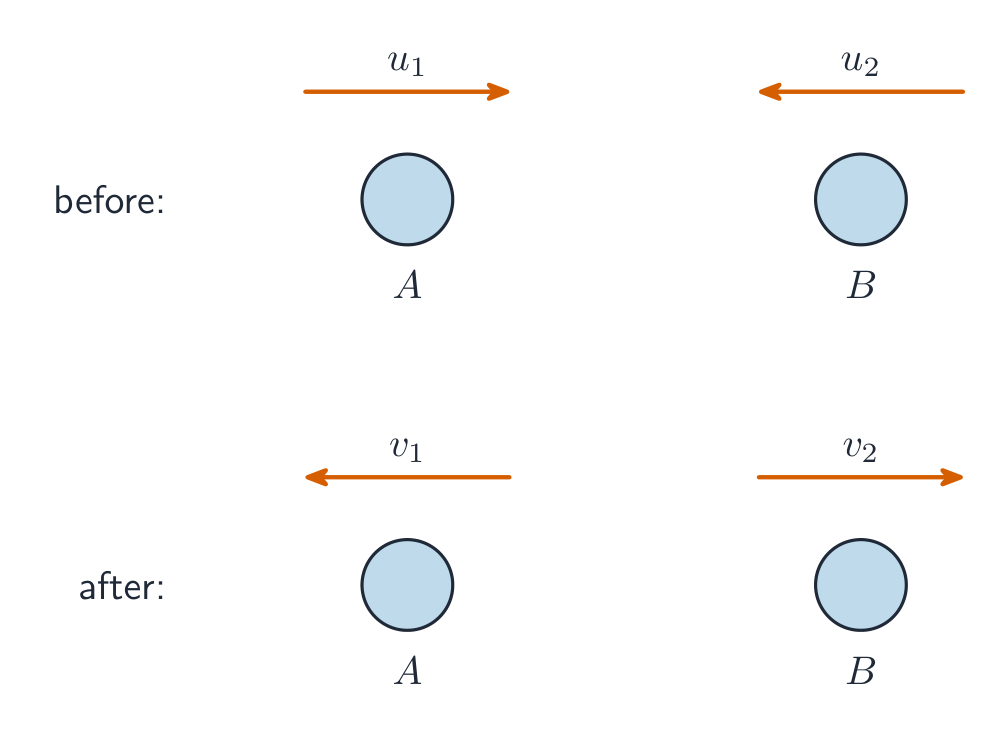
    ในฐานะผลคูณเชิงเวกเตอร์, $\vec\tau=\vec r\times\vec F$ ชี้ ตั้งฉากกับระนาบ ของ $\vec r$ และ $\vec F$ โดยทิศทางกำหนดโดย กฎมือขวา: ม้วนนิ้วขวาจาก $\vec r$ ไปยัง $\vec F$ แล้วหัวแม่มือจะชี้ตาม $\vec\tau$ – ออกหน้ากระดาษสำหรับการหมุนทวนเข็ม, เข้าหากระดาษสำหรับการหมุนตามเข็ม กฎเดียวกันนี้ใช้กำหนดทิศทางการเคลื่อนที่เชิงมุม $\vec L=\vec r\times\vec p$ ได้เช่นกัน
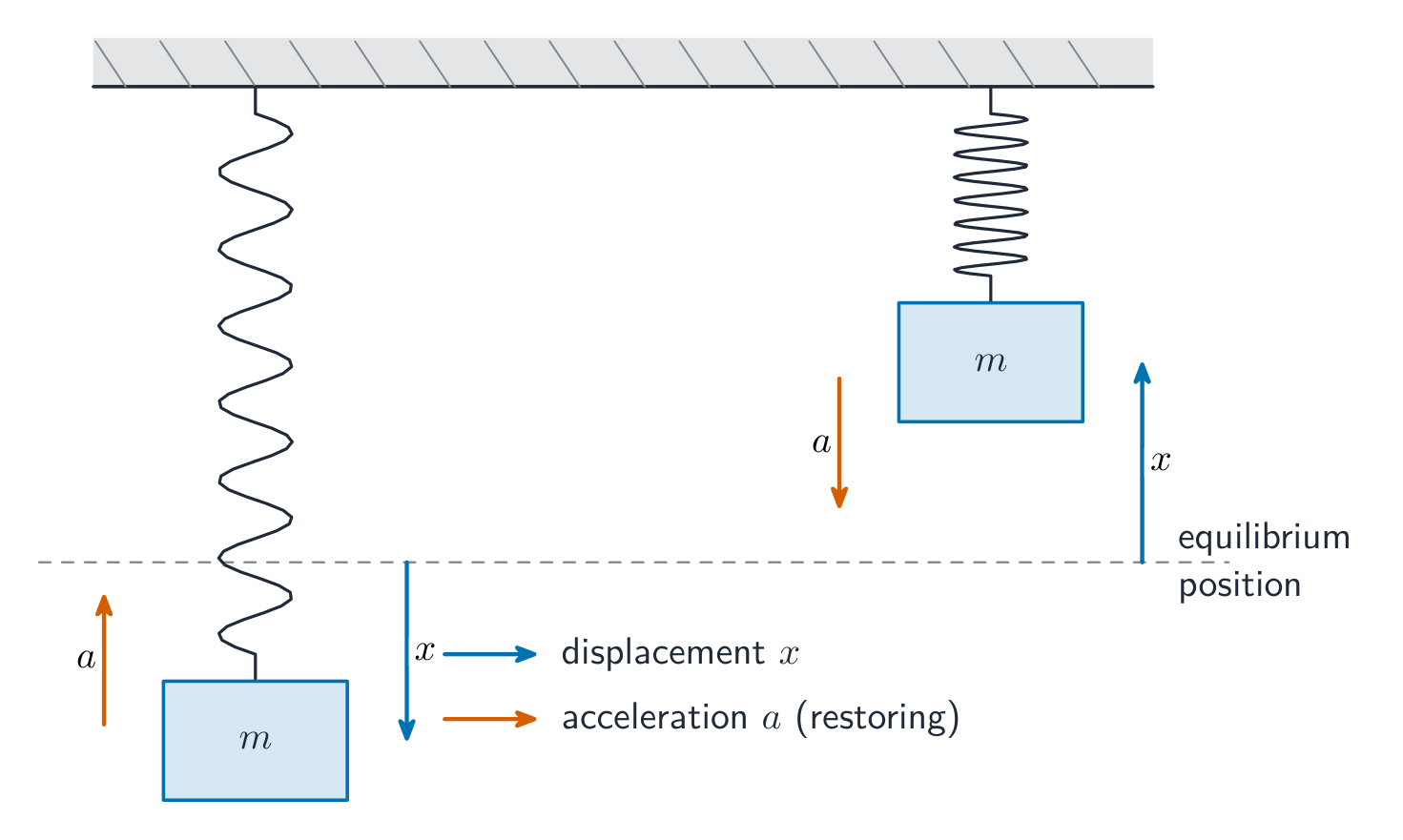
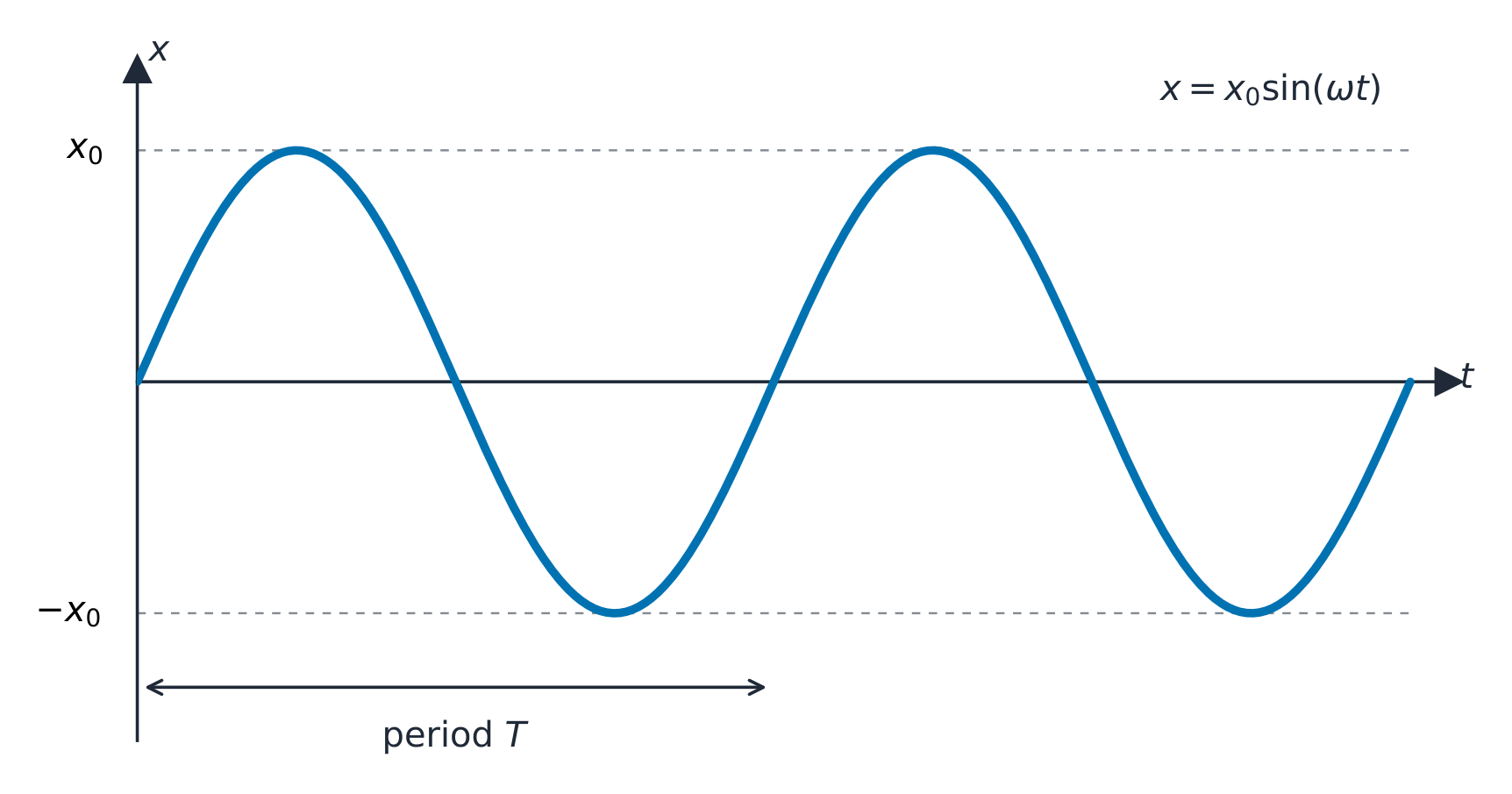
    แรงบิดของแรงขึ้นอยู่กับระยะตั้งฉากจากแกน
    แรงบิดของแรงขึ้นอยู่กับระยะตั้งฉากจากแกน
    ชุดเฟือง: แรงบิดและโมเมนต์ความเฉื่อยเชื่อมโยงกันผ่านอัตราทดเฟือง
    ชุดเฟือง: แรงบิดและโมเมนต์ความเฉื่อยเชื่อมโยงกันผ่านอัตราทดเฟือง
    Explore · ⁨สำรวจ⁩

    Balance torques on a beam · ⁨ปรับสมดุลแรงบิดบนคาน⁩

    Torque is force times perpendicular distance, $\tau=Fd$. The beam is in rotational equilibrium when the torques on each side are equal. · ⁨แรงบิด คือ แรงคูณด้วยระยะตั้งฉาก $\tau=Fd$ คานจะอยู่ใน สภาวะสมดุลหมุน เมื่อแรงบิดทั้งสองข้างมีค่าเท่ากัน⁩

    Vocabulary · ⁨คำศัพท์⁩ Train · ⁨ฝึกฝน⁩
    English ไทย
    angular displacement/ˈæŋɡjʊlə dɪˈspleɪsmənt/ การกระจัดเชิงมุม
    radians/ˈreɪdɪənz/ เรเดียน
    angular velocity/ˈæŋɡjʊlə vəˈlɒsɪti/ ความเร็วเชิงมุม
    angular acceleration/ˈæŋɡjʊlə əkˌseləˈreɪʃn/ ความเร่งมุม
    tangential acceleration/tænˈdʒenʃl əkˌseləˈreɪʃn/ ความเร่งสัมผัส
    centripetal acceleration/senˈtrɪpɪtl əkˌseləˈreɪʃn/ ความเร่งเข้าสู่ศูนย์กลาง
    Torque/tɔːk/ โมเมนต์แรงบิด
    vector product/ˈvektə ˈprɒdʌkt/ ผลคูณเวกเตอร์
    moment arm/ˈməʊmənt ɑːm/ แขนงแรงบิด
    right-hand rule/raɪt hænd ruːl/ กฎมือขวา
    Watch lesson · ⁨ดูบทเรียน⁩
    5.4

    Rotational Inertia · ⁨ความเฉื่อยต่อการหมุน⁩

    Syllabus · ⁨หลักสูตร⁩
    English

    Learning Objective 5.4.A: Describe the rotational inertia of a rigid system relative to a given axis of rotation.

    • 5.4.A.1 Rotational inertia measures a rigid system's resistance to changes in rotation and is related to the mass of the system and the distribution of that mass relative to the axis of rotation.
    • 5.4.A.2 The rotational inertia of an object rotating a perpendicular distance $r$ from an axis is described by the equation $I = mr^2$.
    • 5.4.A.3 The total rotational inertia of a collection of objects about an axis is the sum of the rotational inertias of each object about that axis.
      • Equation: $I_{\text{tot}} = \sum I_i = \sum m_i r_i^2$
    • 5.4.A.4 For a solid that can be considered as a collection of differential masses, $dm$, the solid's rotational inertia can be calculated using the equation $I = \int r^2\, dm$, where $r$ is the perpendicular distance from $dm$ to the axis of rotation.

    Learning Objective 5.4.B: Describe the rotational inertia of a rigid system rotating about an axis that does not pass through the system's center of mass.

    • 5.4.B.1 A rigid system's rotational inertia in a given plane is at a minimum when the rotational axis passes through the system's center of mass.
    • 5.4.B.2 The parallel axis theorem uses the following equation to relate the rotational inertia of a rigid system about any axis that is parallel to an axis through its center of mass:
      • Equation: $I' = I_{\text{cm}} + Md^2$

    Boundary statement: AP Physics C: Mechanics only expects students to use calculus in the derivations of the rotational inertia of thin rods of uniform or nonuniform density about an arbitrary axis perpendicular to the rod, as well as derivations of the rotational inertia of a thin cylindrical shell, disk, or rigid bodies that can be considered to be made up of coaxial rings or shells about an axis that passes through their centers (e.g., annular rings).

    Students should have a qualitative understanding of the factors that affect rotational inertia; for example, how rotational inertia is greater when mass is farther from the axis of rotation, which is why a hoop has more rotational inertia than a solid puck of the same mass and radius.

    ไทย

    วัตถุประสงค์การเรียนรู้ 5.4.A: อธิบายความเฉื่อยรอบแกนหมุนของระบบแข็งเมื่อเทียบกับแกนหมุนที่กำหนด

    • 5.4.A.1 ความเฉื่อยรอบแกนหมุนวัดความต้านทานของการเปลี่ยนแปลงการหมุนของระบบแข็ง และมีความสัมพันธ์กับมวลของระบบและการกระจายตัวของมวลนั้นเมื่อเทียบกับแกนหมุน
    • 5.4.A.2 โมเมนต์ความเฉื่อยของวัตถุที่หมุนในระยะตั้งฉาก $r$ จากแกนหมุน สามารถอธิบายได้ด้วยสมการ $I = mr^2$
    • 5.4.A.3 โมเมนต์ความเฉื่อยรวมของกลุ่มวัตถุรอบแกนใด ๆ คือผลรวมของโมเมนต์ความเฉื่อยของแต่ละวัตถุรอบแกนนั้น
      • สมการ: $I_{\text{tot}} = \sum I_i = \sum m_i r_i^2$
    • 5.4.A.4 สำหรับวัตถุแข็งที่พิจารณาเป็นกลุ่มของมวลดิฟเฟอเรนเชียล $dm$ โมเมนต์ความเฉื่อยของวัตถุสามารถคำนวณได้จากสมการ $I = \int r^2\, dm$ โดยที่ $r$ คือระยะตั้งฉากจาก $dm$ ไปยังแกนหมุน

    วัตถุประสงค์การเรียนรู้ 5.4.B: อธิบายความเฉื่อยรอบแกนหมุนของระบบแข็งที่หมุนรอบแกนที่ไม่ผ่านศูนย์กลางมวลของระบบ

    • 5.4.B.1 ความเฉื่อยรอบแกนหมุนของระบบแข็งในระนาบหนึ่งๆ จะมีค่าต่ำสุดเมื่อแกนหมุนผ่านศูนย์กลางมวลของระบบ
    • 5.4.B.2 theorem แกขนอนขนานใช้สมการต่อไปนี้เพื่อแสดงความสัมพันธ์ของความเฉื่อยรอบแกนหมุนของระบบแข็งรอบแกนใดๆ ที่ขนานกับแกนที่ผ่านศูนย์กลางมวล:
      • สมการ: $I' = I_{\text{cm}} + Md^2$

    คำจำกัดขอบเขต: AP Physics C: Mechanics คาดหวังให้นักเรียนใช้แคลคูลัสเพียงในการพิสูจน์หาโมเมนต์ความเฉื่อยของแท่งบางที่มีความหนาแน่นสม่ำเสมอหรือไม่สม่ำเสมอรอบแกนwhateverที่วางตั้งฉากกับแท่ง รวมถึงการพิสูจน์หาโมเมนต์ความเฉื่อยของเปลือกทรงกระบอกบาง จาน หรือวัตถุแข็งเกร็งที่พิจารณาว่าเป็นวงแหวนหรือเปลือก Playoff รอบแกนที่ผ่านจุดศูนย์กลาง (เช่น วงแหวนรูปแฉก)

    นักเรียนควรมีความเข้าใจแบบคุณภาพเกี่ยวกับปัจจัยที่มีผลต่อโมเมนต์ความเฉื่อย เช่น โมเมนต์ความเฉื่อยจะมากขึ้นเมื่อมวลอยู่ห่างจากแกนหมุน ซึ่งเป็นเหตุผลว่าทำไมห่วงจึงมีโมเมนต์ความเฉื่อยมากกว่าดิสก์ทึบที่มีมวลและรัศมีเท่ากัน

    Source: College Board AP Course and Exam Description · ⁨แหล่งที่มา: คำอธิบายหลักสูตรและข้อสอบ College Board AP⁩

    English

    Rotational inertia 转动惯量 $I$ measures resistance to angular acceleration – the rotational analog of mass, but it depends on where the mass sits. For point masses, $I=\sum m_ir_i^2$; for a continuous body,

    $$I=\int r^2\,dm.$$

    Mass far from the axis dominates, because of the $r^2$.

    Worked example (rod). A uniform rod (mass $M$, length $L$) about its centre: with linear density 线密度 $\lambda=M/L$, $dm=\lambda\,dx$, so $I=\displaystyle\int_{-L/2}^{L/2}x^2\,\frac{M}{L}\,dx=\frac{1}{12}ML^2$. AP also expects nonuniform rods: if $\lambda(x)=cx$ on $[0,L]$, first find $M=\int_0^L cx\,dx=\tfrac12cL^2$, then $I=\int_0^L x^2(cx)\,dx=\tfrac14cL^4=\tfrac12ML^2$ about the light end.

    Worked example (disk from rings). A solid disk is a nest of rings: a ring at radius $r$ of width $dr$ has $dm=\dfrac{M}{\pi R^2}\,2\pi r\,dr$, so

    $$I=\int_0^R r^2\,dm=\frac{2M}{R^2}\int_0^R r^3\,dr=\tfrac12MR^2.$$

    The same coaxial-shell method handles cylindrical shells and annular rings.

    The parallel-axis theorem 平行轴定理 shifts any known $I$ to a parallel axis a distance $d$ away:

    $$I'=I_{\text{cm}}+Md^2.$$

    For the rod about one end: $I=\tfrac1{12}ML^2+M\big(\tfrac{L}{2}\big)^2=\tfrac13ML^2$.

    ไทย

    โมเมนต์ความเฉื่อย (Rotational inertia) $I$ วัดความต้านทานต่อการเร่งเชิงมุม –相当于มวลแต่มีความสัมพันธ์กับการเคลื่อนที่เชิงเส้น แต่มันขึ้นอยู่กับว่า มวลอยู่在哪里. สำหรับมวลจุด, $I=\sum m_ir_i^2$; สำหรับวัตถุต่อเนื่อง,

    $$I=\int r^2\,dm.$$

    มวลที่อยู่ห่างจากแกนมีอิทธิพลมากกว่า เนื่องจาก $r^2$

    ตัวอย่างวิธีทำ (คาน). คานสม่ำเสมอ (มวล $M$, ความยาว $L$) หมุนรอบจุดกึ่งกลาง: ด้วย ความหนาแน่นเชิงเส้น $\lambda=M/L$, $dm=\lambda\,dx$, ดังนั้น $I=\displaystyle\int_{-L/2}^{L/2}x^2\,\frac{M}{L}\,dx=\frac{1}{12}ML^2$. ใน AP ยังคาดหวังคานที่ไม่สม่ำเสมอ: ถ้า $\lambda(x)=cx$ บน $[0,L]$, หา $M=\int_0^L cx\,dx=\tfrac12cL^2$ ก่อน, แล้วหาค่า $I=\int_0^L x^2(cx)\,dx=\tfrac14cL^4=\tfrac12ML^2$ รอบปลายเบาที่สุด

    ตัวอย่างวิธีทำ (ดิสก์จากวงแหวน). ดิสก์ทึบคือกลุ่มวงแหวนซ้อนกัน: วงแหวนที่รัศมี $r$ มีความกว้าง $dr$ จะมี $dm=\dfrac{M}{\pi R^2}\,2\pi r\,dr$, ดังนั้น

    $$I=\int_0^R r^2\,dm=\frac{2M}{R^2}\int_0^R r^3\,dr=\tfrac12MR^2.$$

    วิธีเปลือกทรงกลมร่วมแกนเดียวกันนี้สามารถนำไปใช้กับเปลือกทรงกระบอกและวงแหวนรูปแฉนงได้

    ทฤษฎีบทแกนขนาน ย้ายค่า known $I$ ไปยังแกนขนานที่ห่างออกไป $d$:

    $$I'=I_{\text{cm}}+Md^2.$$

    สำหรับคานที่หมุนรอบปลายด้านหนึ่ง: $I=\tfrac1{12}ML^2+M\big(\tfrac{L}{2}\big)^2=\tfrac13ML^2$

    Vocabulary · ⁨คำศัพท์⁩ Train · ⁨ฝึกฝน⁩
    English ไทย
    Rotational inertia/rəʊˈteɪʃənl ɪˈnɜːʃə/ ความเฉื่อยในการหมุน
    linear density/ˈlɪnɪə ˈdensɪti/ ความหนาแน่นเชิงเส้น
    parallel-axis theorem/ˈpærəlel ˈæksɪs ˈθɪərəm/ ทฤษฎีบทแกนขนาน
    rotational equilibrium/rəʊˈteɪʃənl ˌiːkwɪˈlɪbrɪəm/ สมดุลการหมุน
    static equilibrium/ˈstætɪk ˌiːkwɪˈlɪbrɪəm/ สมดุลสถิต
    5.5

    Rotational Equilibrium · ⁨สมดุลเชิงมุม⁩

    Syllabus · ⁨หลักสูตร⁩
    English

    Learning Objective 5.5.A: Describe the conditions under which a system's angular velocity remains constant.

    • 5.5.A.1 A system may exhibit rotational equilibrium (constant angular velocity) without being in translational equilibrium, and vice versa.
      • 5.5.A.1.i Free-body and force diagrams describe the nature of the forces and torques exerted on an object or rigid system.
      • 5.5.A.1.ii Rotational equilibrium is a configuration of torques such that the net torque exerted on the system is zero.
        • Equation: $\sum \tau_i = 0$
      • 5.5.A.1.iii The rotational analog of Newton's first law is that a system will have a constant angular velocity only if the net torque exerted on the system is zero.
    • 5.5.A.2 A rotational corollary to Newton's second law states that if the torques exerted on a rigid system are not balanced, the system's angular velocity must be changing.

    Boundary statement: AP Physics C: Mechanics does not expect students to simultaneously analyze rotation in multiple planes.

    ไทย

    วัตถุประสงค์การเรียนรู้ 5.5.A: อธิบายเงื่อนไขที่ทำให้ความเร็วเชิงมุมของระบบคงที่

    • 5.5.A.1 ระบบอาจอยู่ในสภาวะสมดุลการหมุน (ความเร็วเชิงมุมคงที่) โดยไม่ได้อยู่ในสภาวะสมดุลการเคลื่อนที่ และการเคลื่อนที่ก็反之亦然
      • 5.5.A.1.i แผนภาพวัตถุอิสระและแผนภาพแรงอธิบายลักษณะของแรงและโมเมนต์แรงที่กระทำต่อวัตถุหรือระบบแข็ง
      • 5.5.A.1.ii สมดุลการหมุนคือสภาวะของโมเมนต์แรง使得ผลรวมของโมเมนต์แรงที่กระทำต่อระบบเป็นศูนย์
        • สมการ: $\sum \tau_i = 0$
      • 5.5.A.1.iii รูปแบบการหมุนของกฎข้อแรกของนิวตันระบุว่าระบบจะมีความเร็วเชิงมุมคงที่ก็ต่อเมื่อผลรวมของโมเมนต์แรงที่กระทำต่อ系统是ศูนย์
    • 5.5.A.2 บทสรุปของการหมุนของกฎข้อที่สองของนิวตันระบุว่าหากโมเมนต์แรงที่กระทำต่อระบบแข็งไม่สมดุล ความเร็วเชิงมุมของระบบจะต้องมีการเปลี่ยนแปลง

    คำจำกัดขอบเขต: AP Physics C: Mechanics ไม่คาดหวังให้นักเรียนวิเคราะห์การหมุนในหลายระนาบพร้อมกัน

    Source: College Board AP Course and Exam Description · ⁨แหล่งที่มา: คำอธิบายหลักสูตรและข้อสอบ College Board AP⁩

    English

    Newton's first law has a rotational form: with zero net torque, angular velocity is constant – an object in rotational equilibrium 转动平衡 either does not rotate or rotates steadily. Full static equilibrium 静平衡 needs both $\sum F=0$ and $\sum\tau=0$ (about any axis). The standard move for beams and ladders: put the axis at the point where an unknown force acts, so that force drops out of the torque equation.

    Worked example. A uniform $20\ \text{kg}$ beam, $4.0\ \text{m}$ long, is pivoted at its left end and held horizontal by a vertical rope at its right end. A $40\ \text{kg}$ child sits $1.0\ \text{m}$ from the pivot. Torques about the pivot: $T(4.0)=20g(2.0)+40g(1.0)$, so $T=\dfrac{392+392}{4.0}=196\ \text{N}$. Then vertical force balance gives the pivot's upward push: $F_p=(60)(9.8)-196=392\ \text{N}$. Choosing the pivot as the axis removed $F_p$ from the torque equation entirely.

    ไทย

    กฎข้อหนึ่งของนิวตันมีรูปแบบการหมุน: เมื่อไม่มีแรงบิดสุทธิ ความเร็วเชิงมุมจะคงที่ – วัตถุใน สมดุลเชิงหมุน จะไม่หมุน หรือหมุนด้วยความเร็วคงที่ สมดุลสถิตสมบูรณ์ ต้องมีทั้ง $\sum F=0$ และ $\sum\tau=0$ (รอบ แกนใดก็ได้) วิธีมาตรฐานสำหรับคานและบันได: วางแกนไว้ที่จุดที่แรงที่ไม่ทราบค่ากระทำ เพื่อให้แรงนั้นหายไปจากสมการแรงบิด

    เมื่อสมดุล แรงบิดตามเข็มนาฬิกาและทวนเข็มนาฬิการอบแกนจะเท่ากัน
    เมื่อสมดุล แรงบิดตามเข็มนาฬิกาและทวนเข็มนาฬิการอบแกนจะเท่ากัน

    ตัวอย่างวิธีทำ. คาน $20\ \text{kg}$ สม่ำเสมอ, ยาว $4.0\ \text{m}$, ถูกยึดหมุนรอบปลายซ้ายและรับแรงดึงด้วยเชือกแนวตั้งที่ปลายขวา เด็กน้ำหนัก $40\ \text{kg}$ นั่งอยู่ที่ระยะ $1.0\ \text{m}$ จากจุดหมุน แรงบิดรอบจุดหมุน: $T(4.0)=20g(2.0)+40g(1.0)$, ดังนั้น $T=\dfrac{392+392}{4.0}=196\ \text{N}$. จากนั้นการสมดุลแรงแนวตั้งจะได้แรงดันขึ้นจากจุดหมุน: $F_p=(60)(9.8)-196=392\ \text{N}$. การเลือกจุดหมุนเป็นแกนทำให้ $F_p$ หายไปจากสมการแรงบิดโดยสิ้นเชิง

    เครื่องชั่งคาน: สมดุลเชิงหมุนเมื่อแรงบิดตามเข็มนาฬิกาและทวนเข็มนาฬิกาเท่ากัน
    เครื่องชั่งคาน: สมดุลเชิงหมุนเมื่อแรงบิดตามเข็มนาฬิกาและทวนเข็มนาฬิกาเท่ากัน
    Explore · ⁨สำรวจ⁩

    Find the balance point · ⁨หาค่าสมดุล⁩

    For rotational equilibrium the total clockwise torque equals the total anticlockwise torque. Move the forces and distances until the beam balances. · ⁨สำหรับ สภาวะสมดุลหมุน แรงบิดตามนัยรวมต้องเท่ากับแรงบิดทวนนัยรวม เคลื่อนย้ายแรงและระยะทางจนกว่าคานจะสมดุล⁩

    Watch lesson · ⁨ดูบทเรียน⁩
    5.6

    Newton's Second Law in Rotational Form · ⁨กฎข้อที่สองของนิวตันในรูปแบบการหมุน⁩

    Syllabus · ⁨หลักสูตร⁩
    English

    Learning Objective 5.6.A: Describe the conditions under which a system's angular velocity changes.

    • 5.6.A.1 Angular velocity changes when the net torque exerted on the object or system is not equal to zero.
    • 5.6.A.2 The rate at which the angular velocity of a rigid system changes is directly proportional to the net torque exerted on the rigid system and is in the same direction. The angular acceleration of the rigid system is inversely proportional to the rotational inertia of the rigid system.
      • Equation: $\alpha_{\text{sys}} = \dfrac{\Sigma\tau}{I_{\text{sys}}} = \dfrac{\tau_{\text{net}}}{I_{\text{sys}}}$
    • 5.6.A.3 To fully describe a rotating rigid system, linear and rotational analyses may need to be performed independently.
    ไทย

    วัตถุประสงค์การเรียนรู้ 5.6.A: อธิบายเงื่อนไขที่ทำให้ความเร็วเชิงมุมของระบบเปลี่ยนแปลง

    • 5.6.A.1 ความเร็วเชิงมุมจะเปลี่ยนเมื่อผลรวมของโมเมนต์แรงที่กระทำต่อวัตถุหรือระบบไม่เท่ากับศูนย์
    • 5.6.A.2 อัตราการเปลี่ยนแปลงความเร็วเชิงมุมของระบบแข็งแปรผันตรงกับโมเมนต์แรงสุทธิที่กระทำต่อระบบแข็งและมีทิศทางเดียวกัน ความเร่งเชิงมุมของระบบแข็งแปรผกผันกับความเฉื่อยรอบแกนหมุนของระบบแข็ง
      • สมการ: $\alpha_{\text{sys}} = \dfrac{\Sigma\tau}{I_{\text{sys}}} = \dfrac{\tau_{\text{net}}}{I_{\text{sys}}}$
    • 5.6.A.3 เพื่ออธิบายระบบแข็งที่กำลังหมุนอย่างสมบูรณ์ อาจจำเป็นต้องทำการวิเคราะห์แบบเส้นตรงและการวิเคราะห์แบบการหมุนแยกต่างหาก

    Source: College Board AP Course and Exam Description · ⁨แหล่งที่มา: คำอธิบายหลักสูตรและข้อสอบ College Board AP⁩

    English

    A net torque produces angular acceleration in proportion to the rotational inertia:

    $$\alpha=\frac{\sum\tau}{I}\qquad\Big(\text{more generally }\sum\vec{\tau}=\frac{d\vec{L}}{dt}\Big).$$

    Solve rotational dynamics exactly like translational dynamics, with $\tau\leftrightarrow F$, $I\leftrightarrow m$, $\alpha\leftrightarrow a$ – free-body diagram, equations, solve.

    Worked example (massive pulley). Masses $m_1=4.0\ \text{kg}$ and $m_2=2.0\ \text{kg}$ hang from a rope over a pulley 滑轮 of rotational inertia $I=0.50\ \text{kg}\cdot\text{m}^2$ and radius $R=0.20\ \text{m}$. Three Newton's-law equations, one per body:

    $$m_1g-T_1=m_1a,\qquad T_2-m_2g=m_2a,\qquad (T_1-T_2)R=I\alpha=\frac{Ia}{R}.$$

    Adding them (with $I/R^2=12.5\ \text{kg}$): $a=\dfrac{(m_1-m_2)g}{m_1+m_2+I/R^2}=\dfrac{19.6}{18.5}=1.1\ \text{m/s}^2$. Then $T_1=m_1(g-a)=35\ \text{N}$ and $T_2=m_2(g+a)=22\ \text{N}$. The tensions must differ – otherwise nothing would spin the pulley. (If a problem says the pulley is light, then $I\approx0$ and the tensions become equal again.)

    Exam skill. Rotational FRQs score the setup: separate free-body diagrams for each mass and the pulley, the string constraint $a=R\alpha$ stated, and the sign convention consistent. The single most common error is assuming one tension throughout a rope that passes over a massive pulley.

    ไทย

    แรงบิดสุทธิทำให้เกิดการเร่งเชิงมุมแปรผันตรงกับโมเมนต์ความเฉื่อย:

    $$\alpha=\frac{\sum\tau}{I}\qquad\Big(\text{more generally }\sum\vec{\tau}=\frac{d\vec{L}}{dt}\Big).$$

    แก้โจทย์พลศาสตร์การหมุนเหมือนพลศาสตร์การเคลื่อนที่เชิงเส้นเป๊ะๆ โดยมี $\tau\leftrightarrow F$, $I\leftrightarrow m$, $\alpha\leftrightarrow a$ – วาดแผนภาพวัตถุอิสระ, ตั้งสมการ, แก้

    รอกที่มีมวล: แรงตึงเชือกทั้งสองข้างต่างกันเพราะรอกต้องการแรงบิดสุทธิ
    รอกที่มีมวล: แรงตึงเชือกทั้งสองข้างต่างกันเพราะรอกต้องการแรงบิดสุทธิ

    ตัวอย่างวิธีทำ (รอกที่มีมวล). มวล $m_1=4.0\ \text{kg}$ และ $m_2=2.0\ \text{kg}$ แขวนด้วยเชือกพาดผ่าน รอก ที่มีโมเมนต์ความเฉื่อย $I=0.50\ \text{kg}\cdot\text{m}^2$ และรัศมี $R=0.20\ \text{m}$. มีสมการกฎของนิวตัน 3 สมการ, 1 ต่อวัตถุ:

    $$m_1g-T_1=m_1a,\qquad T_2-m_2g=m_2a,\qquad (T_1-T_2)R=I\alpha=\frac{Ia}{R}.$$

    เมื่อรวมกัน (ด้วย $I/R^2=12.5\ \text{kg}$): $a=\dfrac{(m_1-m_2)g}{m_1+m_2+I/R^2}=\dfrac{19.6}{18.5}=1.1\ \text{m/s}^2$. จากนั้น $T_1=m_1(g-a)=35\ \text{N}$ และ $T_2=m_2(g+a)=22\ \text{N}$. แรงตึง ต้อง แตกต่างกัน – มิฉะนั้นกลอกล้อจะไม่หมุน (หากโจทย์ระบุว่ากลอกล้อมีมวลน้อยมาก那么 $I\approx0$ และแรงตึงจะเท่ากันอีกครั้ง)

    ทักษะการสอบ. FRQ ด้านการหมุนให้คะแนนที่การจัดตั้ง: แยก Free-body diagrams สำหรับแต่ละมวล และ กลอกล้อ, ข้อจำกัดของเชือก $a=R\alpha$ ถูกระบุไว้, และการกำหนดเครื่องหมายมีความสอดคล้องกัน. ความผิดพลาดที่พบบ่อยที่สุดคือการสันนิษฐานว่าแรงตึงเท่ากันตลอดทั้งเส้นเชือกที่ผ่านบน กลอกล้อที่มีมวล

    Vocabulary · ⁨คำศัพท์⁩ Train · ⁨ฝึกฝน⁩
    English ไทย
    pulley/ˈpʊli/ รอก
    5.6

    Exam tips · ⁨ข้อแนะนำสำหรับการสอบ⁩

    English
    • Use the rotational analogues: $\theta,\omega=\tfrac{d\theta}{dt},\alpha=\tfrac{d\omega}{dt}$, with the constant-$\alpha$ equations mirroring linear kinematics.
    • Convert between linear and angular with $v=r\omega$ and $a_t=r\alpha$ (plus centripetal $a_c=\tfrac{v^2}{r}=\omega^2 r$).
    • Keep radians throughout and fix a positive sense of rotation.
    • Relate torque to angular acceleration through $\tau=I\alpha$.
    • Draw the rotation axis — the moment arm is the perpendicular distance to it.
    ไทย
    • ใช้ตัวแทนของการหมุน: $\theta,\omega=\tfrac{d\theta}{dt},\alpha=\tfrac{d\omega}{dt}$, กับสมการคงที่-$\alpha$ ที่สะท้อนจลนศาสตร์เชิงเส้น.
    • แปลงระหว่างเชิงเส้นและมุมด้วย $v=r\omega$ และ $a_t=r\alpha$ (บวกกับ $a_c=\tfrac{v^2}{r}=\omega^2 r$ แนวเข้าศูนย์กลาง).
    • รักษารadian ตลอดและกำหนดทิศทางบวกของการหมุนให้ชัดเจน.
    • เชื่อมโยงโมเมนต์แรงกับการเร่งเชิงมุมผ่าน $\tau=I\alpha$.
    • วาดแกนหมุน – ระยะแขนโมเมนต์คือระยะตั้งฉากไปยังมัน
  • 6

    Energy and Momentum of Rotating Systems · ⁨พลังงานและโมเมนตัมของระบบหมุน⁩

    Watch lesson · ⁨ดูบทเรียน⁩
    6.1

    Rotational Kinetic Energy · ⁨พลังงานจลน์จากการหมุน⁩

    Syllabus · ⁨หลักสูตร⁩
    English

    Learning Objective 6.1.A: Describe the rotational kinetic energy of a rigid system in terms of the rotational inertia and angular velocity of that rigid system.

    • 6.1.A.1 The rotational kinetic energy of an object or rigid system is related to the rotational inertia and angular velocity of the rigid system and is given by the equation $K_{\text{rot}} = \dfrac{1}{2} I \omega^2$.
      • Equation: $K_{\text{rot}} = \dfrac{1}{2} I \omega^2$
      • 6.1.A.1.i The rotational inertia of an object about a fixed axis can be used to show that the rotational kinetic energy of that object is equivalent to its translational kinetic energy, which is its total kinetic energy.
      • 6.1.A.1.ii The total kinetic energy of a rigid system is the sum of its rotational kinetic energy due to its rotation about its center of mass and the translational kinetic energy due to the linear motion of its center of mass.
    • 6.1.A.2 A rigid system can have rotational kinetic energy while its center of mass is at rest due to the individual points within the rigid system having linear speed and, therefore, kinetic energy.
    • 6.1.A.3 Rotational kinetic energy is a scalar quantity.
    ไทย

    วัตถุประสงค์การเรียนรู้ 6.1.A: อธิบายพลังงานจลน์การหมุนของระบบแข็งในterms of ความเฉื่อยรอบแกนหมุนและความเร็วเชิงมุมของระบบแข็งนั้น

    • 6.1.A.1 พลังงานจลน์การหมุนของวัตถุหรือระบบแข็งมีความสัมพันธ์กับความเฉื่อยรอบแกนหมุนและความเร็วเชิงมุมของระบบแข็ง และกำหนดโดยสมการ $K_{\text{rot}} = \dfrac{1}{2} I \omega^2$
      • สมการ: $K_{\text{rot}} = \dfrac{1}{2} I \omega^2$
      • 6.1.A.1.i ความเฉื่อยรอบแกนหมุนของวัตถุรอบแกนคงที่สามารถใช้เพื่อบ่งชี้ว่าพลังงานจลน์การหมุนของวัตถุนั้นเทียบเท่าพลังงานจลน์การเคลื่อนที่ ซึ่งคือพลังงานจลน์ทั้งหมดของมัน
      • 6.1.A.1.ii พลังงานจลน์รวมของระบบแข็งคือผลรวมของพลังงานจลน์การหมุนเนื่องจากหมุนรอบศูนย์กลางมวล และพลังงานจลน์การเคลื่อนที่เนื่องจากการเคลื่อนที่เชิงตรงของศูนย์กลางมวล
    • 6.1.A.2 ระบบแข็งสามารถมีพลังงานจลน์การหมุนในขณะที่ศูนย์กลางมวลหยุดนิ่งได้ เนื่องจากจุดต่างๆ ภายในระบบแข็งมีความเร็วเชิงเส้นและดังนั้นจึงมีพลังงานจลน์
    • 6.1.A.3 พลังงานจลน์การหมุนเป็นปริมาณสเกลาร์

    Source: College Board AP Course and Exam Description · ⁨แหล่งที่มา: คำอธิบายหลักสูตรและข้อสอบ College Board AP⁩

    English

    A spinning body has rotational kinetic energy 转动动能

    $$K_{\text{rot}}=\tfrac12 I\omega^2,$$

    the rotational twin of $\tfrac12mv^2$, with the rotational inertia 转动惯量 $I$ playing the role of mass. A body that both moves and spins carries both terms:

    $$K=\tfrac12 mv_{\text{cm}}^2+\tfrac12 I\omega^2.$$

    Worked example. A uniform cylinder ($I=\tfrac12mr^2$) rolls at speed $v$. Its kinetic energy is $K=\tfrac12mv^2+\tfrac12\big(\tfrac12mr^2\big)\big(\tfrac{v}{r}\big)^2=\tfrac34mv^2$ – one third of it is rotational. The same ball of energy bookkeeping decides every rolling problem.

    ไทย

    วัตถุที่กำลังหมุนมี พลังงานจลน์เชิงหมุน

    $$K_{\text{rot}}=\tfrac12 I\omega^2,$$

    คู่หูเชิงหมุนของ $\tfrac12mv^2$, โดยที่ โมเมนต์ความเฉื่อย $I$ ทำหน้าที่แทนมวล. วัตถุที่เคลื่อนที่และหมุนพร้อมกันจะพกพา ทั้งสอง พจน์นี้:

    $$K=\tfrac12 mv_{\text{cm}}^2+\tfrac12 I\omega^2.$$

    ตัวอย่างทำข้อ. ทรงกระบอกสม่ำเสมอ ($I=\tfrac12mr^2$) ม้วนด้วยความเร็ว $v$. พลังงานจลน์ของมันคือ $K=\tfrac12mv^2+\tfrac12\big(\tfrac12mr^2\big)\big(\tfrac{v}{r}\big)^2=\tfrac34mv^2$ – หนึ่งในสามเป็นพลังงานหมุน. การบัญชีพลังงานแบบเดียวกันนี้ตัดสินใจทุกปัญหาม้วน

    6.2

    Torque and Work · ⁨โมเมนต์แรงและงาน⁩

    Syllabus · ⁨หลักสูตร⁩
    English

    Learning Objective 6.2.A: Describe the work done on a rigid system by a given torque or collection of torques.

    • 6.2.A.1 A torque can transfer energy into or out of an object or rigid system if the torque is exerted over an angular displacement.
    • 6.2.A.2 The amount of work done on a rigid system by a torque is related to the magnitude of that torque and the angular displacement through which the rigid system rotates during the interval in which that torque is exerted.
      • Equation: $W = \displaystyle\int_{\theta_1}^{\theta_2} \tau \, d\theta$
    • 6.2.A.3 Work done on a rigid system by a given torque can be found from the area under the curve of a graph of the torque as a function of angular position.
    ไทย

    จุดประสงค์การเรียนรู้ 6.2.A: อธิบายงานที่ทำต่อระบบแข็งโดยโมเมนต์แรงหรือกลุ่มโมเมนต์ที่กำหนดให้

    • 6.2.A.1 โมเมนต์แรงสามารถถ่ายโอนพลังงานเข้าสู่หรือออกจากวัตถุหรือระบบแข็งได้ หากโมเมนต์แรงนั้นกระทำต่อวัตถุในระหว่างที่มีการเลื่อนตัวเชิงมุม
    • 6.2.A.2 ปริมาณงานที่ทำต่อระบบแข็งโดยโมเมนต์แรงมีสัมพันธ์กับความใหญ่ของโมเมนต์แรงนั้นและการเลื่อนตัวเชิงมุมที่ระบบแข็งหมุนไปในช่วงเวลาที่โมเมนต์แรงนั้นถูกกระทำ
      • สมการ: $W = \displaystyle\int_{\theta_1}^{\theta_2} \tau \, d\theta$
    • 6.2.A.3 งานที่ทำต่อระบบแข็งเกร就由โมเมนต์แรงที่กำหนด สามารถหาค่าได้จากพื้นที่ใต้กราฟของโมเมนต์แรงในฐานะฟังก์ชันของตำแหน่งเชิงมุม

    Source: College Board AP Course and Exam Description · ⁨แหล่งที่มา: คำอธิบายหลักสูตรและข้อสอบ College Board AP⁩

    English

    A torque 力矩 acting through an angular displacement 角位移 does work, and power is torque times angular velocity:

    $$W=\int_{\theta_1}^{\theta_2}\tau\,d\theta,\qquad P=\tau\omega.$$

    These are the rotational forms of $W=\int F\,dx$ and $P=Fv$ – the whole translational energy toolkit carries over with $F\to\tau$, $x\to\theta$, $v\to\omega$.

    Worked example. A motor applies a constant $8.0\ \text{N}\cdot\text{m}$ torque to a flywheel for $5.0$ full turns: $W=\tau\,\Delta\theta=8.0(5.0)(2\pi)=250\ \text{J}$, which appears as rotational kinetic energy if friction is negligible.

    ไทย

    โมเมนต์แรง ที่กระทำผ่าน การเลื่อนตำแหน่งเชิงมุม ทำงาน, และกำลังคือโมเมนต์แรงคูณความเร็วเชิงมุม:

    $$W=\int_{\theta_1}^{\theta_2}\tau\,d\theta,\qquad P=\tau\omega.$$

    นี่คือรูปแบบการหมุนของ $W=\int F\,dx$ และ $P=Fv$ – ชุดเครื่องมือพลังงานการเคลื่อนที่ทั้งหมดถ่ายโอนได้โดย $F\to\tau$, $x\to\theta$, $v\to\omega$.

    ตัวอย่างทำข้อ. มอเตอร์ใช้โมเมนต์แรงคงที่ $8.0\ \text{N}\cdot\text{m}$ กับเฟลwheel เป็นเวลา $5.0$ รอบเต็ม: $W=\tau\,\Delta\theta=8.0(5.0)(2\pi)=250\ \text{J}$, ซึ่งปรากฏเป็นพลังงานจลน์เชิงหมุนหากแรงเสียดทานมีน้อยมาก

    Explore · ⁨สำรวจ⁩

    Balance torques on a beam · ⁨ปรับสมดุลแรงบิดบนคาน⁩

    Torque is force times perpendicular distance, $\tau=Fd$. Equal torques on each side keep the beam in rotational equilibrium. · ⁨โมเมนต์แรง คือแรงคูณระยะตั้งฉาก, $\tau=Fd$ โมเมนต์แรงเท่ากันทั้งสองข้างทำให้คานอยู่ในสมดุลหมุน⁩

    6.3

    Angular Momentum and Angular Impulse · ⁨โมเมนตัมเชิงมุมและแรงกระแทกเชิงมุม⁩

    Syllabus · ⁨หลักสูตร⁩
    English

    Learning Objective 6.3.A: Describe the angular momentum of an object or rigid system.

    • 6.3.A.1 The magnitude of the angular momentum of a rigid system about a specific axis can be described with the equation $L = I\omega$.
      • Equation: $L = I\omega$
    • 6.3.A.2 The angular momentum of an object about a given point is $\vec{L} = \vec{r} \times \vec{p}$.
      • Equation: $\vec{L} = \vec{r} \times \vec{p}$
      • 6.3.A.2.i The selection of the axis about which an object is considered to rotate influences the determination of the angular momentum of that object.
      • 6.3.A.2.ii The measured angular momentum of an object traveling in a straight line depends on the distance between the reference point and the object, the mass of the object, the speed of the object, and the angle between the radial distance and the velocity of the object.

    Learning Objective 6.3.B: Describe the angular impulse delivered to an object or rigid system by a torque.

    • 6.3.B.1 Angular impulse is defined as the product of the torque exerted on an object or rigid system and the time interval during which the torque is exerted.
      • Equation: $\text{angular impulse} = \displaystyle\int \tau \, dt$
    • 6.3.B.2 Angular impulse has the same direction as the torque imparting it.
    • 6.3.B.3 The angular impulse delivered to an object or rigid system by a torque can be found from the area under the curve of a graph of the torque as a function of time.

    Learning Objective 6.3.C: Relate the change in angular momentum of an object or rigid system to the angular impulse given to that object or rigid system.

    • 6.3.C.1 The magnitude of the change in angular momentum can be described by comparing the magnitudes of the final and initial momenta of the object or rigid system.
      • Equation: $\Delta L = L - L_0$
    • 6.3.C.2 A rotational form of the impulse–momentum theorem relates the angular impulse delivered to an object or rigid system and the change in angular momentum of that object or rigid system.
      • 6.3.C.2.i The angular impulse exerted on an object or rigid system is equal to the change in angular momentum of that object or rigid system.
        • Equation: $\Delta L = \displaystyle\int_{t_1}^{t_2} \tau \, dt$
      • 6.3.C.2.ii The rotational form of the impulse–momentum theorem is a direct result of Newton's second law of motion for cases in which rotational inertia is constant.
        • Equation: $\tau_{\text{net}} = \dfrac{dL}{dt} = I\dfrac{d\omega}{dt} = I\alpha$
    • 6.3.C.3 The net torque exerted on an object or rigid system is equal to the slope of the graph of the angular momentum of an object as a function of time.
    • 6.3.C.4 The angular impulse delivered to an object or rigid system is equal to the area under the curve of a graph of the net external torque exerted on an object as a function of time.
    ไทย

    จุดประสงค์การเรียนรู้ 6.3.A: อธิบายโมเมนตัมเชิงมุมของวัตถุหรือระบบแข็ง

    • 6.3.A.1 ความใหญ่ของโมเมนตัมเชิงมุมของระบบแข็งรอบแกนเฉพาะสามารถอธิบายได้ด้วยสมการ $L = I\omega$
      • สมการ: $L = I\omega$
    • 6.3.A.2 โมเมนตัมเชิงมุมของวัตถุรอบจุดที่กำหนดคือ $\vec{L} = \vec{r} \times \vec{p}$
      • สมการ: $\vec{L} = \vec{r} \times \vec{p}$
      • 6.3.A.2.i การเลือกแกนที่วัตถุถูกพิจารณาว่าหมุนรอบนั้นมีผลต่อการกำหนดโมเมนตัมเชิงมุมของวัตถุนั้น
      • 6.3.A.2.ii โมเมนตัมเชิงมุมที่วัดได้จากวัตถุที่เคลื่อนที่เป็นเส้นตรงขึ้นอยู่กับระยะห่างระหว่างจุดอ้างอิงกับวัตถุ มวลของวัตถุ ความเร็วของวัตถุ และมุมระหว่างระยะรัศมีและความเร็วของวัตถุ

    จุดประสงค์การเรียนรู้ 6.3.B: อธิบายอิมพัลส์เชิงมุมที่ถูกส่งไปยังวัตถุหรือระบบแข็งโดยโมเมนต์แรง

    • 6.3.B.1 อิมพัลส์เชิงมุมนิยามเป็นผลคูณของโมเมนต์แรงที่ทำต่อวัตถุหรือระบบแข็งกับช่วงเวลาที่ใช้ในการกระทำโมเมนต์แรงนั้น
      • สมการ: $\text{angular impulse} = \displaystyle\int \tau \, dt$
    • 6.3.B.2 แรงกระแทกเชิงมุมมีทิศทางเดียวกับโมเมนต์แรงที่ทำให้เกิดมัน
    • 6.3.B.3 อิมพัลส์เชิงมุมที่ถูกส่งไปยังวัตถุหรือระบบแข็งโดยโมเมนต์แรงสามารถหาได้จากพื้นที่ใต้กราฟของโมเมนต์แรงในฟังก์ชันของเวลา

    จุดประสงค์การเรียนรู้ 6.3.C: เชื่อมโยงการเปลี่ยนแปลงโมเมนตัมเชิงมุมของวัตถุหรือระบบแข็งกับอิมพัลส์เชิงมุมที่ได้รับจากวัตถุนั้นหรือระบบนั้น

    • 6.3.C.1 ขนาดของการเปลี่ยนแปลงโมเมนตัมเชิงมุมสามารถอธิบายได้ด้วยการเปรียบเทียบขนาดของโมเมนตัมสุดท้ายและเริ่มต้นของวัตถุหรือระบบแข็งเกรจง
      • สมการ: $\Delta L = L - L_0$
    • 6.3.C.2 รูปแบบการหมุนของทฤษฎีบทอิมพัลส์-โมเมนตัมเชื่อมโยงอิมพัลส์เชิงมุมที่ถูกส่งไปยังวัตถุหรือระบบแข็งกับการเปลี่ยนแปลงโมเมนตัมเชิงมุมของวัตถุนั้นหรือระบบนั้น
      • 6.3.C.2.i อิมพัลส์เชิงมุมที่ทำต่อวัตถุหรือระบบแข็งมีค่าเท่ากับการเปลี่ยนแปลงโมเมนตัมเชิงมุมของวัตถุนั้นหรือระบบนั้น
        • สมการ: $\Delta L = \displaystyle\int_{t_1}^{t_2} \tau \, dt$
      • 6.3.C.2.ii รูปแบบการหมุนของทฤษฎีบทแรงกระแทก-โมเมนตัมเป็นผลโดยตรงจากกฎข้อที่สองของนิวตันสำหรับการเคลื่อนที่ในกรณีที่มีโมเมนต์ความเฉื่อยคงที่
        • สมการ: $\tau_{\text{net}} = \dfrac{dL}{dt} = I\dfrac{d\omega}{dt} = I\alpha$
    • 6.3.C.3 โมเมนต์แรงสุทธิที่กระทำต่อวัตถุหรือระบบแข็งเกรจงมีค่าเท่ากับความชันของกราฟโมเมนตัมเชิงมุมของวัตถุในฐานะฟังก์ชันของเวลา
    • 6.3.C.4 แรงกระแทกเชิงมุมที่ส่งไปยังวัตถุหรือระบบแข็งเกรจงมีค่าเท่ากับพื้นที่ใต้กราฟของโมเมนต์แรงภายนอกสุทธิที่กระทำต่อวัตถุในฐานะฟังก์ชันของเวลา

    Source: College Board AP Course and Exam Description · ⁨แหล่งที่มา: คำอธิบายหลักสูตรและข้อสอบ College Board AP⁩

    English

    Angular momentum 角动量 for a particle is

    $$\vec{L}=\vec{r}\times\vec{p},\qquad |L|=mvr\sin\theta,$$

    so even a particle moving in a straight line has angular momentum about any point not on that line ($L=mv\,d$, with $d$ the perpendicular distance). For a rigid body spinning about a fixed axis, $L=I\omega$. Newton's second law in rotational form is

    $$\vec{\tau}_{\text{net}}=\frac{d\vec{L}}{dt}\quad(=I\alpha\ \text{when }I\text{ is constant}),$$

    and a net torque acting over time delivers an angular impulse 角冲量 $\int\tau\,dt=\Delta L$ – the rotational impulse–momentum theorem.

    ไทย

    โมเมนตัมเชิงมุม สำหรับอนุภาคคือ

    $$\vec{L}=\vec{r}\times\vec{p},\qquad |L|=mvr\sin\theta,$$

    ดังนั้นแม้แต่อนุภาคที่เคลื่อนที่ในเส้นตรงก็มีโมเมนตัมเชิงมุมรอบจุดใดๆ นอกเส้นนั้น ($L=mv\,d$, โดยที่ $d$ คือระยะตั้งฉาก). สำหรับวัตถุแข็งที่หมุนรอบแกนคงที่, $L=I\omega$. กฎที่สองของนิวตันในรูปแบบการหมุนคือ

    $$\vec{\tau}_{\text{net}}=\frac{d\vec{L}}{dt}\quad(=I\alpha\ \text{when }I\text{ is constant}),$$

    และโมเมนต์แรงสุทธิที่กระทำเป็นเวลาจะส่งมอบ ** импульเชิงมุม** $\int\tau\,dt=\Delta L$ – theorem impulse-momentum แบบการหมุน

    6.4

    Conservation of Angular Momentum · ⁨การอนุรักษ์โมเมนตัมเชิงมุม⁩

    Syllabus · ⁨หลักสูตร⁩
    English

    Learning Objective 6.4.A: Describe the behavior of a system using conservation of angular momentum.

    • 6.4.A.1 The total angular momentum of a system about a rotational axis is the sum of the angular momenta of the system's constituent parts about that rotational axis.
    • 6.4.A.2 Any change to a system's angular momentum must be due to an interaction between the system and its surroundings.
      • 6.4.A.2.i The angular impulse exerted by one object or system on a second object or system is equal and opposite to the angular impulse exerted by the second object or system on the first. This is a direct result of Newton's third law.
      • 6.4.A.2.ii A system may be selected so that the total angular momentum of that system is constant.
      • 6.4.A.2.iii The angular speed of a nonrigid system may change without the angular momentum of the system changing if the system changes shape by moving mass closer to or farther from the rotational axis.
      • 6.4.A.2.iv If the total angular momentum of a system changes, that change will be equivalent to the angular impulse exerted on the system.

    Learning Objective 6.4.B: Describe how the selection of a system determines whether the angular momentum of that system changes.

    • 6.4.B.1 Angular momentum is conserved in all interactions.
    • 6.4.B.2 If the net external torque exerted on a selected object or rigid system is zero, the total angular momentum of that system is constant.
    • 6.4.B.3 If the net external torque exerted on a selected object or rigid system is nonzero, angular momentum is transferred between the system and the environment.
    ไทย

    จุดประสงค์การเรียนรู้ 6.4.A: อธิบายพฤติกรรมของระบบโดยใช้หลักการอนุรักษ์โมเมนตัมเชิงมุม

    • 6.4.A.1 โมเมนตัมเชิงมุมรวมของระบบรอบแกนหมุนคือผลรวมของโมเมนตัมเชิงมุมของส่วนประกอบต่างๆ ของระบบรอบแกนหมุนนั้น
    • 6.4.A.2 การเปลี่ยนแปลงใดๆ ต่อโมเมนตัมเชิงมุมของระบบต้องเกิดจากการมีปฏิสัมพันธ์ระหว่างระบบกับสิ่งแวดล้อมรอบข้าง
      • 6.4.A.2.i อิมพัลส์เชิงมุมที่ทำโดยวัตถุหรือระบบหนึ่งต่อวัตถุหรือระบบอีกแห่งหนึ่งมีขนาดเท่ากันแต่มีทิศทางตรงข้ามกับอิมพัลส์เชิงมุมที่ทำโดยวัตถุหรือระบบนั้นต่อวัตถุหรือระบบแรก นี่คือผลลัพธ์โดยตรงของกฎข้อที่สามของนิวตัน
      • 6.4.A.2.ii สามารถเลือกระบบได้这样一种使得该系统的总角动量保持不变。
      • 6.4.A.2.iii The angular speed of a nonrigid system may change without the angular momentum of the system changing if the system changes shape by moving mass closer to or farther from the rotational axis.
      • 6.4.A.2.iv หากโมเมนตัมเชิงมุมรวมของระบบเปลี่ยนแปลง การเปลี่ยนแปลงนั้นจะเท่ากับอิมพัลส์เชิงมุมที่ทำต่อระบบ

    จุดประสงค์การเรียนรู้ 6.4.B: อธิบายว่าการเลือกระบบมีผลอย่างไรต่อการ决定是否该系统的角动量是否改变。

    • 6.4.B.1 โมเมนตัมเชิงมุมจะถูกอนุรักษ์ในทุกการมีปฏิสัมพันธ์
    • 6.4.B.2 หากโมเมนต์แรงภายนอกสุทธิที่ทำต่อวัตถุหรือระบบแข็งที่ถูกเลือกมีค่าเป็นศูนย์ โมเมนตัมเชิงมุมรวมของระบบนั้นจะมีค่าคงที่
    • 6.4.B.3 หากโมเมนต์แรงภายนอกสุทธิที่ทำต่อวัตถุหรือระบบแข็งที่ถูกเลือกมีค่าน้อยกว่าหรือมากกว่าศูนย์ โมเมนตัมเชิงมุมจะถูกถ่ายโอนระหว่างระบบกับสภาพแวดล้อม

    Source: College Board AP Course and Exam Description · ⁨แหล่งที่มา: คำอธิบายหลักสูตรและข้อสอบ College Board AP⁩

    English
    Angular momentum: pull in, spin faster

    With zero net external torque, total angular momentum is conserved 守恒:

    $$L_{\text{before}}=L_{\text{after}},\qquad I_1\omega_1=I_2\omega_2\ \text{(one rigid body reshaping)}.$$

    If $I$ shrinks, $\omega$ grows – a spinning skater speeds up pulling her arms in. The rule survives collisions and shape changes, which is what makes it so useful: pick the axis so that every external force (gravity, the pivot force) exerts no torque about it.

    Worked example. A skater spins at $2.0\ \text{rev/s}$ with $I_1=4.0\ \text{kg}\cdot\text{m}^2$. Pulling in her arms drops it to $I_2=1.6\ \text{kg}\cdot\text{m}^2$: $\omega_2=\dfrac{4.0}{1.6}(2.0)=5.0\ \text{rev/s}$. Her kinetic energy rises – the extra energy is the work her muscles do pulling her arms inward.

    Worked example (rotational collision). A $0.020\ \text{kg}$ bullet at $300\ \text{m/s}$ strikes the tip of a uniform rod ($M=1.5\ \text{kg}$, length $l=0.60\ \text{m}$) hanging from a pivot, and embeds. About the pivot, gravity and the pivot force exert no torque during the strike, so $L$ is conserved: $L=mvl=0.020(300)(0.60)=3.6\ \text{kg}\cdot\text{m}^2/\text{s}$. Afterwards $I=\tfrac13Ml^2+ml^2=0.18+0.0072=0.187\ \text{kg}\cdot\text{m}^2$, so $\omega=\dfrac{3.6}{0.187}\approx19\ \text{rad/s}$. (Linear momentum is not conserved here – the pivot pushes on the rod – and kinetic energy certainly is not: check both before claiming them.)

    ไทย
    โมเมนตัมเชิงมุม: ดึงเข้า, หมุนเร็วขึ้น

    ด้วย โมเมนต์แรงภายนอกสุทธิเป็นศูนย์, โมเมนตัมเชิงมุมรวม คงที่:

    $$L_{\text{before}}=L_{\text{after}},\qquad I_1\omega_1=I_2\omega_2\ \text{(one rigid body reshaping)}.$$

    หาก $I$ ลดลง, $\omega$ เพิ่มขึ้น – นักสเก็ตที่หมุนจะเร่งความเร็วเมื่อดึงแขนเข้า. กฎนี้ยังคงอยู่ในการชนและการเปลี่ยนรูปร่าง, ซึ่งเป็นสิ่งที่ทำให้มันมีประโยชน์: เลือกแกนที่ทุกแรงภายนอก (แรงโน้มถ่วง, แรงจากจุดหมุน) ไม่สร้างโมเมนต์รอบมัน

    ตัวอย่างทำข้อ. นักสเก็ตหมุนที่ $2.0\ \text{rev/s}$ ด้วย $I_1=4.0\ \text{kg}\cdot\text{m}^2$. การดึงแขนเข้าลดเหลือ $I_2=1.6\ \text{kg}\cdot\text{m}^2$: $\omega_2=\dfrac{4.0}{1.6}(2.0)=5.0\ \text{rev/s}$. พลังงานจลน์ของเธอ เพิ่มขึ้น – พลังงานเพิ่มนี้คืองานที่กล้ามเนื้อเธอทำในการดึงแขนเข้าด้านใน

    การดึงมวลเข้าใกล้แกนลด I ลง sehingga ω เพิ่มขึ้นเพื่อรักษา L = Iω ไว้
    การดึงมวลเข้าใกล้แกนลด I ลง sehingga ω เพิ่มขึ้นเพื่อรักษา L = Iω ไว้
    โมเมนตัมเชิงมุมรอบจุดหมุนคงที่ขณะกระสุนฝังอยู่ในแท่ง
    โมเมนตัมเชิงมุมรอบจุดหมุนคงที่ขณะกระสุนฝังอยู่ในแท่ง

    ตัวอย่างทำข้อ (การชนแบบหมุน). กระสุน $0.020\ \text{kg}$ ที่ $300\ \text{m/s}$ ตัดปลายของแท่งสม่ำเสมอ ($M=1.5\ \text{kg}$, ยาว $l=0.60\ \text{m}$) ที่แขวนจากจุดหมุน, และฝังตัว. รอบจุดหมุน, แรงโน้มถ่วงและแรงจากจุดหมุนไม่สร้างโมเมนต์during การชน, ดังนั้น $L$ คงที่: $L=mvl=0.020(300)(0.60)=3.6\ \text{kg}\cdot\text{m}^2/\text{s}$. ต่อจากนั้น $I=\tfrac13Ml^2+ml^2=0.18+0.0072=0.187\ \text{kg}\cdot\text{m}^2$, ดังนั้น $\omega=\dfrac{3.6}{0.187}\approx19\ \text{rad/s}$. (โมเมนตัมเชิงเส้น ไม่ คงที่ที่นี่ – จุดหมุนดันแท่ง – และพลังงานจลน์แน่นอนว่าไม่: ตรวจสอบทั้งสองก่อนอ้างถึงพวกมัน)

    นักสเก็ตหน้าน้ำแข็งกำลังแสดงบนน้ำแข็ง
    การสเก็ตหน้า水和โมเมนตัมเชิงมุม: นักสเก็ตที่ดึงแขนเข้าขณะหมุนจะลดโมเมนต์ความเฉื่อยเชิงหมุน שלה, sehingga หมุนเร็วขึ้น
    Vocabulary · ⁨คำศัพท์⁩ Train · ⁨ฝึกฝน⁩
    English ไทย
    rotational kinetic energy/rəʊˈteɪʃənl kɪˈnetɪk ˈenədʒi/ พลังงานจลน์เชิงหมุน
    rotational inertia/rəʊˈteɪʃənl ɪˈnɜːʃə/ โมเมนต์ความเฉื่อย
    torque/tɔːk/ แรงบิด
    angular displacement/ˈæŋɡjʊlə dɪˈspleɪsmənt/ การกระจัดเชิงมุม
    Angular momentum/ˈæŋɡjʊlə məʊˈmentəm/ โมเมนตัมเชิงมุม
    angular impulse/ˈæŋɡjʊlə ˈɪmpʌls/ แรงกระแทกเชิงมุม
    conserved/kənˈsɜːvd/ คงที่
    6.5

    Rolling · ⁨การกลิ้ง⁩

    Syllabus · ⁨หลักสูตร⁩
    English

    Learning Objective 6.5.A: Describe the kinetic energy of a system that has translational and rotational motion.

    • 6.5.A.1 The total kinetic energy of a system is the sum of the system's translational and rotational kinetic energies.
      • Equation: $K_{\text{tot}} = K_{\text{trans}} + K_{\text{rot}}$

    Learning Objective 6.5.B: Describe the motion of a system that is rolling without slipping.

    • 6.5.B.1 While rolling without slipping, the translational motion of a system's center of mass is related to the rotational motion of the system itself with the following equations:
      • Equation: $\Delta x_{\text{cm}} = r\Delta\theta$
      • Equation: $v_{\text{cm}} = r\omega$
      • Equation: $a_{\text{cm}} = r\alpha$
    • 6.5.B.2 For ideal cases, rolling without slipping implies that the frictional force does not dissipate any energy from the rolling system.

    Learning Objective 6.5.C: Describe the motion of a system that is rolling while slipping.

    • 6.5.C.1 When slipping, the motion of a system's center of mass and the system's rotational motion cannot be directly related.
    • 6.5.C.2 When a rotating system is slipping relative to another surface, the point of application of the force of kinetic friction exerted on the system moves with respect to the surface, so the force of kinetic friction will dissipate energy from the system.

    Boundary statement: Rolling friction is beyond the scope of AP Physics C: Mechanics.

    ไทย

    จุดประสงค์การเรียนรู้ 6.5.A: อธิบายพลังงานจลน์ของระบบที่มีทั้งการเคลื่อนที่แบบแปลนและการเคลื่อนที่แบบหมุน

    • 6.5.A.1 พลังงานจลน์รวมของ系统是ผลบวกของพลังงานจลน์แบบแปลนและพลังงานจลน์แบบหมุนของระบบ
      • สมการ: $K_{\text{tot}} = K_{\text{trans}} + K_{\text{rot}}$

    จุดประสงค์การเรียนรู้ 6.5.B: อธิบายการเคลื่อนที่ของระบบที่กลิ้งโดยไม่ลื่นไถล

    • 6.5.B.1 ขณะกลิ้งโดยไม่ลื่น การเคลื่อนที่แบบเลื่อนของจุดศูนย์กลางมวลของระบบมีความสัมพันธ์กับการเคลื่อนที่แบบหมุนของระบบเองด้วยสมการต่อไปนี้:
      • สมการ: $\Delta x_{\text{cm}} = r\Delta\theta$
      • สมการ: $v_{\text{cm}} = r\omega$
      • สมการ: $a_{\text{cm}} = r\alpha$
    • 6.5.B.2 สำหรับกรณีในอุดมคติ การกลิ้งโดยไม่ลื่นไถลหมายถึงแรงเสียดทานไม่ทำให้พลังงานของระบบกลิ้งลดลง

    วัตถุประสงค์การเรียนรู้ 6.5.C: อธิบายการเคลื่อนที่ของระบบที่กำลังกลิ้งพร้อมทั้งลื่นไถล

    • 6.5.C.1 เมื่อมีการลื่นไถล การเคลื่อนที่ของจุดศูนย์กลางมวลและระบบไม่ได้มีความสัมพันธ์โดยตรงกับการเคลื่อนที่แบบหมุนของระบบ
    • 6.5.C.2 เมื่อระบบหมุนกำลังลื่นไถลเทียบกับพื้นผิวอื่น จุดที่แรงเสียดทานจลน์กระทำต่อระบบจะเคลื่อนที่เทียบกับพื้นผิวนั้น ดังนั้นแรงเสียดทานจลน์จึงทำให้พลังงานของระบบลดลง

    ข้อความขอบเขต: แรงเสียดทานจากการกลิ้งอยู่นอกเหนือขอบเขตของ AP Physics C: Mechanics

    Source: College Board AP Course and Exam Description · ⁨แหล่งที่มา: คำอธิบายหลักสูตรและข้อสอบ College Board AP⁩

    English
    Rolling without slipping

    Rolling without slipping 无滑滚动 ties translation to rotation: the contact point is momentarily at rest, so

    $$\Delta x_{\text{cm}}=r\,\Delta\theta,\qquad v_{\text{cm}}=r\omega,\qquad a_{\text{cm}}=r\alpha.$$

    Static friction supplies the torque that keeps the spin matched to the motion, but at a point that is not sliding – so for pure rolling, friction does no work, and energy conservation is safe to use. (Rolling friction is beyond the AP course.)

    Racing shapes down an incline shows the energy split. With $I=\beta mr^2$, energy conservation gives

    $$a_{\text{cm}}=\frac{g\sin\theta}{1+\beta}:$$

    a sphere ($\beta=\tfrac25$) beats a disk 圆盘 ($\beta=\tfrac12$), which beats a hoop 圆环 ($\beta=1$) – mass and radius cancel completely. More of the hoop's energy is locked in rotation, so its center moves slower.

    Worked example. A solid sphere rolls from rest down a $30^\circ$ incline: $a=\dfrac{g\sin30^\circ}{1+\tfrac25}=\dfrac{9.8(0.50)}{1.4}=3.5\ \text{m/s}^2$, versus $4.9\ \text{m/s}^2$ for a frictionless slider – rolling objects always lose the race against sliding ones.

    ไทย
    ม้วนโดยไม่ลื่น

    ม้วนโดยไม่ลื่น เชื่อมต่อการเคลื่อนที่กับการหมุน: จุดสัมผัสหยุดนิ่งชั่วคราว, ดังนั้น

    $$\Delta x_{\text{cm}}=r\,\Delta\theta,\qquad v_{\text{cm}}=r\omega,\qquad a_{\text{cm}}=r\alpha.$$
    ในการกลิ้งโดยไม่ลื่นไถล จุดสัมผัสจะหยุดนิ่ง ดังนั้น v = rω
    ในการกลิ้งโดยไม่ลื่นไถล จุดสัมผัสจะหยุดนิ่ง ดังนั้น v = rω

    แรงเสียดทานสถิตจัดโมเมนต์แรงที่ทำให้การหมุนตรงกับ gerakan, แต่ที่จุดที่ไม่ลื่น所以对于การม้วนบริสุทธิ์, แรงเสียดทานไม่ ทำงาน, และการอนุรักษ์พลังงานสามารถใช้ได้อย่างปลอดภัย. (แรงเสียดทานการม้วนอยู่นอกหลักสูตร AP.)

    การแข่งขันทรงต่างๆ ลงทางลาดแสดงการแบ่งพลังงาน. ด้วย $I=\beta mr^2$, การอนุรักษ์พลังงานให้

    $$a_{\text{cm}}=\frac{g\sin\theta}{1+\beta}:$$

    ทรง ลูกบอล ($\beta=\tfrac25$) ชนะ ดิสก์ ($\beta=\tfrac12$), ซึ่งชนะ วงแหวน ($\beta=1$) – มวลและรัศมีตัดกันหมด. ส่วนใหญ่ของพลังงานวงแหวนถูกล็อกไว้ในหมุน, ดังนั้นศูนย์กลางของมันเคลื่อนที่ช้ากว่า

    การแข่งขันม้วน: รูปร่างที่มี I/mr² น้อยสุดไปถึงด้านล่างก่อน
    การแข่งขันม้วน: รูปร่างที่มี I/mr² น้อยสุดไปถึงด้านล่างก่อน

    ตัวอย่างทำข้อ. ลูกบอลทึบม้วนจากจุดหยุดนิ่งลงทางลาด $30^\circ$: $a=\dfrac{g\sin30^\circ}{1+\tfrac25}=\dfrac{9.8(0.50)}{1.4}=3.5\ \text{m/s}^2$, เทียบกับ $4.9\ \text{m/s}^2$ สำหรับตัวลื่นไร้แรงเสียดทาน – วัตถุที่ม้วนจะแพ้การแข่งขันต่อวัตถุที่ลื่นเสมอ

    Vocabulary · ⁨คำศัพท์⁩ Train · ⁨ฝึกฝน⁩
    English ไทย
    Rolling without slipping/ˈrəʊlɪŋ wɪˈðaʊt ˈslɪpɪŋ/ การกลิ้งโดยไม่ลื่นไถล
    disk/dɪsk/ ดิสก์
    hoop/huːp/ ห่วงวงกลม
    centripetal force/senˈtrɪpɪtl fɔːs/ แรงเข้าสู่ศูนย์กลาง
    satellite/ˈsætəlaɪt/ ดาวเทียม
    gravitational potential energy/ˌɡrævɪˈteɪʃənl pəˈtenʃl ˈenədʒi/ พลังงานศักย์โน้มถ่วง
    total mechanical energy/ˈtəʊtl mɪˈkænɪkl ˈenədʒi/ พลังงานกลทั้งหมด
    escape velocity/eˈskeɪp vəˈlɒsɪti/ ความเร็วหลุดพ้น
    elliptical orbit/ɪˈlɪptɪkl ˈɔːbɪt/ วงโคจรวงรี
    Kepler's second law/ˈkepləz ˈsekənd lɔː/ กฎ Kepler ที่สอง
    6.6

    Motion of Orbiting Satellites · ⁨การเคลื่อนที่ของดาวเทียมโคจร⁩

    Syllabus · ⁨หลักสูตร⁩
    English

    Learning Objective 6.6.A: Describe the motions of a system consisting of two objects or systems interacting only via gravitational forces.

    • 6.6.A.1 In a system consisting only of a massive central object and an orbiting satellite with mass that is negligible in comparison to the central object's mass, the motion of the central object itself is negligible.
    • 6.6.A.2 The motion of satellites in orbits is constrained by conservation laws.
      • 6.6.A.2.i In circular orbits, the system's total mechanical energy, the system's gravitational potential energy, and the satellite's angular momentum and kinetic energy are constant.
      • 6.6.A.2.ii In elliptical orbits, the system's total mechanical energy and the satellite's angular momentum are constant, but the system's gravitational potential energy and the satellite's kinetic energy can each change.
      • 6.6.A.2.iii The gravitational potential energy of a system consisting of a satellite and a massive central object is defined to be zero when the satellite is an infinite distance from the central object.
        • Equation: $U_g = -G\dfrac{m_1 m_2}{r}$
    • 6.6.A.3 The total energy of a system consisting of a satellite orbiting a central object in a circular path can be written in terms of the gravitational potential energy of that system or the kinetic energy of the satellite.
      • Equation: $K = -\dfrac{1}{2}U$
      • Equation: $E_{total} = \dfrac{1}{2}U = -\dfrac{GMm}{2r}$
    • 6.6.A.4 The escape velocity of a satellite is the satellite's velocity such that the mechanical energy of the satellite–central-object system is equal to zero.
      • 6.6.A.4.i When the only force exerted on a satellite is gravity from a central object, a satellite that reaches escape velocity will move away from the central body until its speed reaches zero at an infinite distance from the central body.
      • 6.6.A.4.ii The escape velocity of a satellite from a central body of mass $M$ can be derived using conservation of energy laws.
        • Equation: $v_{\text{esc}} = \sqrt{\dfrac{2GM}{r}}$
    ไทย

    วัตถุประสงค์การเรียนรู้ 6.6.A: อธิบายการเคลื่อนที่ของระบบที่ประกอบด้วยวัตถุสอง物体หรือระบบที่มีปฏิสัมพันธ์กันเพียงผ่านแรงโน้มถ่วงเท่านั้น

    • 6.6.A.1 ในระบบที่ประกอบด้วยวัตถุกลางที่มีมวลมากและดาวเทียมโคจรที่มีมวลน้อยเมื่อเทียบกับมวลของวัตถุกลาง การเคลื่อนที่ของวัตถุกลางเองนั้นน้อยมากจนสามารถละเลยได้
    • 6.6.A.2 การเคลื่อนที่ของดาวเทียมในวงโคจรถูกกำหนดโดยกฎการอนุรักษ์
      • 6.6.A.2.i ในวงโคจรเป็นวงกลม พลังงานกลรวมของระบบ พลังงานศักย์โน้มถ่วงของระบบ และโมเมนตัมเชิงมุมกับพลังงานจลน์ของดาวเทียมจะมีค่าคงที่
      • 6.6.A.2.ii ในวงโคจรเป็นวงรี พลังงานกลรวมของระบบและโมเมนตัมเชิงมุมของดาวเทียมจะมีค่าคงที่ แต่พลังงานศักย์โน้มถ่วงของระบบและพลังงานจลน์ของดาวเทียมสามารถเปลี่ยนแปลงได้
      • 6.6.A.2.iii พลังงานศักย์โน้มถ่วงของระบบที่ประกอบด้วยดาวเทียมและวัตถุกลางที่มีมวลมากถูกกำหนดให้มีค่าเป็นศูนย์เมื่อดาวเทียมอยู่ที่ระยะห่างอนันต์จากวัตถุกลาง
        • สมการ: $U_g = -G\dfrac{m_1 m_2}{r}$
    • 6.6.A.3 พลังงานรวมของระบบที่ประกอบด้วยดาวเทียมโคจรรอบวัตถุศูนย์กลางในเส้นทางวงกลมสามารถเขียนในรูปของพลังงานศักย์โน้มถ่วงของระบบนั้นหรือพลังงานจลน์ของดาวเทียมได้
      • สมการ: $K = -\dfrac{1}{2}U$
      • สมการ: $E_{total} = \dfrac{1}{2}U = -\dfrac{GMm}{2r}$
    • 6.6.A.4 ความเร็วหลุดพ้นของดาวเทียมคือความเร็วของดาวเทียมที่ทำให้พลังงานกลของระบบดาวเทียม-วัตถุศูนย์กลางมีค่าเท่ากับศูนย์
      • 6.6.A.4.i เมื่อแรงเดียวที่ทำต่อดาวเทียมคือแรงโน้มถ่วงจากวัตถุศูนย์กลาง ดาวเทียมที่จะถึงความเร็วหลุดพ้นจะเคลื่อนที่ห่างจากวัตถุศูนย์กลางไปจนกว่าความเร็วจะลดลงเป็นศูนย์ที่ระยะอนันต์จากวัตถุศูนย์กลาง
      • 6.6.A.4.ii ความเร็วหลุดพ้นของดาวเทียมจากวัตถุศูนย์กลางที่มีมวล $M$ สามารถหาได้จากกฎการอนุรักษ์พลังงาน
        • สมการ: $v_{\text{esc}} = \sqrt{\dfrac{2GM}{r}}$

    Source: College Board AP Course and Exam Description · ⁨แหล่งที่มา: คำอธิบายหลักสูตรและข้อสอบ College Board AP⁩

    English
    Orbital motion (Kepler's 2nd law)

    Gravity supplies the centripetal force 向心力 for a satellite 卫星 in a circular orbit:

    $$\frac{GMm}{r^2}=\frac{mv^2}{r}\quad\Rightarrow\quad v=\sqrt{\frac{GM}{r}}$$

    – larger orbits are slower. With gravitational potential energy 引力势能 $U_g=-\dfrac{GMm}{r}$, a circular orbit obeys $K=-\tfrac12U$, so the total mechanical energy 总机械能 is

    $$E=K+U=\frac{U}{2}=-\frac{GMm}{2r},$$

    negative because the satellite is bound. To escape from radius $r$, total energy must reach zero, giving the escape velocity 逃逸速度

    $$v_{\text{esc}}=\sqrt{\frac{2GM}{r}}.$$

    In an elliptical orbit 椭圆轨道, $E$ and $L$ are fixed: gravity points at the focus, so it exerts no torque about it. Conserved $L$ means the satellite sweeps equal areas in equal times – Kepler's second law 开普勒第二定律 – and therefore moves fastest at closest approach, slowest at the far point. Energy conservation connects speeds at the two ends.

    Worked example. For a satellite at $r=7.0\times10^{6}\ \text{m}$ around Earth ($GM=4.0\times10^{14}\ \text{m}^3/\text{s}^2$): orbital speed $v=\sqrt{GM/r}=7.6\times10^{3}\ \text{m/s}$, while escaping from that radius needs $v_{\text{esc}}=\sqrt{2GM/r}=1.1\times10^{4}\ \text{m/s}$ – exactly $\sqrt2$ times the circular speed.

    Exam skill. Orbit FRQs are energy-and-angular-momentum problems in disguise: write $E=\tfrac12mv^2-\dfrac{GMm}{r}$ and $L=mvr\sin\theta$ at the two points of interest and solve the pair – never assume the orbit formulae for circles apply to an ellipse.

    ไทย
    Orbital motion (Kepler's 2nd law)

    แรงโน้มถ่วงจัด แรงแนวเข้าศูนย์กลาง สำหรับ ดาวเทียม ในวงโคจรวงกลม:

    $$\frac{GMm}{r^2}=\frac{mv^2}{r}\quad\Rightarrow\quad v=\sqrt{\frac{GM}{r}}$$

    – วงโคจรที่ใหญ่กว่าจะช้ากว่า. ด้วย ศักย์พลังงานโน้มถ่วง $U_g=-\dfrac{GMm}{r}$, วงโคจรวงกลมปฏิบัติตาม $K=-\tfrac12U$, ดังนั้น พลังงานกลรวม คือ

    $$E=K+U=\frac{U}{2}=-\frac{GMm}{2r},$$

    เป็นลบเพราะดาวเทียมถูกผูกมัด. เพื่อหลบหนีจากรัศมี $r$, พลังงานรวมต้องเป็นศูนย์, ให้ ความเร็วหลบหนี

    $$v_{\text{esc}}=\sqrt{\frac{2GM}{r}}.$$
    แรงโน้มถ่วงให้แรงสู่ศูนย์กลางที่ยึดดาวเทียมไว้ในวงโคจร
    แรงโน้มถ่วงให้แรงสู่ศูนย์กลางที่ยึดดาวเทียมไว้ในวงโคจร

    ใน วงโคจรวงรี, $E$ และ $L$ คงที่: แรงโน้มถ่วงชี้ไปที่โฟกัส, ดังนั้นมันไม่สร้างโมเมนต์รอบมัน. โมเมนตัมเชิงมุมคงที่ $L$ หมายความว่าดาวเทียมกวาดพื้นที่เท่ากันในเวลาที่เท่ากัน – กฎที่สองของเคปเลอร์ – และดังนั้นจึงเคลื่อนที่เร็วที่สุดที่จุดใกล้ที่สุด, ช้าที่สุดที่จุดไกลที่สุด. การอนุรักษ์พลังงานเชื่อมความเร็วที่ปลายทั้งสอง

    ตัวอย่างที่คำนวณแล้ว. สำหรับดาวเทียมที่ $r=7.0\times10^{6}\ \text{m}$ รอบโลก ($GM=4.0\times10^{14}\ \text{m}^3/\text{s}^2$): ความเร็ววงโคจรคือ $v=\sqrt{GM/r}=7.6\times10^{3}\ \text{m/s}$, ในขณะที่หลบหนีออกจากรัศมีนั้นต้องใช้ $v_{\text{esc}}=\sqrt{2GM/r}=1.1\times10^{4}\ \text{m/s}$ – ซึ่งเท่ากับ $\sqrt2$ เท่าของความเร็วจักรรดิ

    ทักษะการสอบ. FRQ เรื่องวงโคจรคือปัญหาเรื่องพลังงานและโมเมนตัมเชิงมุมที่ซ่อนอยู่: เขียน $E=\tfrac12mv^2-\dfrac{GMm}{r}$ และ $L=mvr\sin\theta$ ที่จุดทั้งสองที่ต้องการ แล้วแก้ระบบสมการคู่ – อย่าเพิ่งสันนิษฐานว่าสูตรวงโคจรสำหรับวงกลมใช้กับวงรีได้

    Explore · ⁨สำรวจ⁩

    Compare orbits at different radii · ⁨เปรียบเทียบวงโคจรที่รัศมิต่างๆ⁩

    An orbiting satellite is in free fall, gravity supplying the centripetal force. A larger orbit means a slower speed and longer period (Kepler's third law). · ⁨ดาวเทียมโคจรอยู่ในการตกอิสระ โดยแรงโน้มถ่วงทำหน้าที่เป็นแรงเข้าศูนย์กลาง วงโคจรที่ใหญ่ขึ้น意味着ความเร็วช้าลงและ周期ยาวนานขึ้น (กฎที่สามของเคปเลอร์)⁩

    6.6

    Exam tips · ⁨ข้อแนะนำสำหรับการสอบ⁩

    English
    • Compute the moment of inertia $I=\int r^2\,dm$ and shift axes with the parallel-axis theorem $I=I_{cm}+Md^2$.
    • Rotational kinetic energy is $\tfrac12 I\omega^2$; a rolling body has both translational and rotational KE.
    • Conserve angular momentum $L=I\omega$ when net external torque is zero (a spinning skater pulling in).
    • Use energy conservation for rolling-without-slipping problems ($v=r\omega$ ties the two motions).
    • Know standard $I$ values (hoop, disk, rod, sphere) and where the axis is.
    ไทย
    • คำนวณ โมเมนต์ความเฉื่อย $I=\int r^2\,dm$ และเลื่อนแกนด้วย ทฤษฎีบทแกนขนาน $I=I_{cm}+Md^2$.
    • พลังงานจลน์จากการหมุนคือ $\tfrac12 I\omega^2$; วัตถุที่กลิ้งจะมีทั้งพลังงานจลน์แบบเคลื่อนที่และแบบหมุน
    • บำรุงรักษา โมเมนตัมเชิงมุม $L=I\omega$ เมื่อแรงบิดภายนอกสุทธิเป็นศูนย์ (นักสเก็ตที่หมุนแล้วดึงแขนเข้าหาตัว)
    • ใช้การอนุรักษ์พลังงานสำหรับปัญหารูปแบบกลิ้งโดยไม่ลื่นไถล ($v=r\omega$ เชื่อมโยงการเคลื่อนที่ทั้งสองเข้าด้วยกัน)
    • จำค่ามาตรฐานของ $I$ ได้ (ห่วง, ดิสก์, แท่ง, ลูกบอล) และรู้ว่าแกนอยู่ที่ไหน
  • 7

    Oscillations · ⁨การสั่นสะเทือน⁩

    Watch lesson · ⁨ดูบทเรียน⁩
    7.1

    Defining Simple Harmonic Motion · ⁨นิยามการเคลื่อนที่แบบฮาร์มอนิกอย่างง่าย⁩

    Syllabus · ⁨หลักสูตร⁩
    English

    Learning Objective 7.1.A: Describe simple harmonic motion.

    • 7.1.A.1 Simple harmonic motion is a special case of periodic motion.
    • 7.1.A.2 SHM results when the magnitude of the restoring force exerted on an object is proportional to that object's displacement from its equilibrium position.
      • Derived equation: $ma_x = -k\Delta x$
      • 7.1.A.2.i A restoring force is a force that is exerted in a direction opposite to the object's displacement from an equilibrium position.
      • 7.1.A.2.ii An equilibrium position is a location at which the net force exerted on an object or system is zero.
    ไทย

    วัตถุประสงค์การเรียนรู้ 7.1.A: อธิบายการเคลื่อนที่แบบฮาร์มอนิกง่าย

    • 7.1.A.1 การเคลื่อนที่แบบฮาร์มอนิกง่ายเป็นกรณีพิเศษของการเคลื่อนที่แบบซ้ำ周期
    • 7.1.A.2 SHM เกิดขึ้นเมื่อขนาดของแรงคืนกลับที่ทำต่อวัตถุแปรผันตรงกับระยะการกระจัดของวัตถุนั้นจากตำแหน่งสมดุล
      • สมการที่ได้มา: $ma_x = -k\Delta x$
      • 7.1.A.2.i แรงคืนกลับคือแรงที่กระทำในทิศทางตรงข้ามกับระยะการกระจัดของวัตถุจากตำแหน่งสมดุล
      • 7.1.A.2.ii ตำแหน่งสมดุลคือตำแหน่งที่ผลรวมแรงที่ทำต่อวัตถุหรือระบบมีค่าเป็นศูนย์

    Source: College Board AP Course and Exam Description · ⁨แหล่งที่มา: คำอธิบายหลักสูตรและข้อสอบ College Board AP⁩

    English
    Simple harmonic motion

    Simple harmonic motion 简谐运动 (SHM) is a special case of periodic motion 周期运动. It appears whenever two things are true: there is an equilibrium 平衡位置 position where the net force is zero, and displacing the object produces a restoring force 回复力 – a force pointing back toward equilibrium – whose magnitude is proportional to the displacement:

    $$F=-k\,\Delta x.$$

    Newton's second law then gives the defining differential equation 微分方程:

    $$\frac{d^2x}{dt^2}=-\frac{k}{m}\,x=-\omega^2 x,\qquad \omega=\sqrt{\frac{k}{m}}.$$

    Its solution is sinusoidal, $x(t)=A\cos(\omega t+\phi)$. You do not need to prove this solution – you need to recognise the equation: any system whose motion obeys "$\ddot{x}=-\omega^2x$" is a simple harmonic oscillator, whatever it is made of. (A mass hanging on a vertical spring works the same way: gravity only shifts the equilibrium point; the oscillation about it is unchanged.)

    ไทย
    การเคลื่อนที่แบบฮาร์มอนิกอย่างง่าย

    การเคลื่อนที่แบบฮาร์มอนิกง่าย (SHM) เป็นกรณีพิเศษของการ เคลื่อนที่แบบรอบตัว เกิดขึ้นเมื่อมีสองสิ่งนี้จริง: มีตำแหน่ง สมดุล ที่แรงลัพธ์เป็นศูนย์ และการกระจัดวัตถุออกไปจะเกิด แรงคืนสู่สภาพเดิม – ซึ่งเป็นแรงชี้กลับเข้าสู่จุดสมดุล – ที่มีขนาด แปรผันตรงกับ การกระจัด:

    $$F=-k\,\Delta x.$$

    กฎข้อที่สองของนิวตันจึงให้ สมการเชิงอนุพันธ์ ที่กำหนดลักษณะไว้ดังนี้:

    $$\frac{d^2x}{dt^2}=-\frac{k}{m}\,x=-\omega^2 x,\qquad \omega=\sqrt{\frac{k}{m}}.$$

    คำตอบของมันคือรูปทรงไซน์-คอสাইน, $x(t)=A\cos(\omega t+\phi)$ คุณไม่จำเป็นต้องพิสูจน์คำตอบนี้ – แต่คุณต้อง จดจำ สมการได้ว่า: ระบบใดwhose motion obeys "$\ddot{x}=-\omega^2x$" คือเครื่องสั่นแบบฮาร์มอนิกง่าย ไม่ว่าระบบนั้นจะประกอบด้วยอะไรก็ตาม (มวลที่แขวนอยู่บนสปริงแนวตั้งทำงานเหมือนกัน: แรงโน้มถ่วงเพียงย้ายจุดสมดุลไปเท่านั้น การสั่นรอบจุดใหม่นี้จะคงเดิม)

    ในการเคลื่อนที่แบบฮาร์มอนิก ความเร่งจะชี้กลับเข้าหาจุดสมดุลเสมอ ตรงข้ามกับการกระจัด
    ในการเคลื่อนที่แบบฮาร์มอนิก ความเร่งจะชี้กลับเข้าหาจุดสมดุล เสมอ ตรงข้ามกับการกระจัด
    7.2

    Frequency and Period of SHM · ⁨ความถี่และคาบของการเคลื่อนที่แบบฮาร์มอนิก⁩

    Syllabus · ⁨หลักสูตร⁩
    English

    Learning Objective 7.2.A: Describe the frequency and period of an object exhibiting SHM.

    • 7.2.A.1 The period of SHM is related to the angular frequency, $\omega$, of the object's motion by the following equation:
      • Equation: $T = \dfrac{2\pi}{\omega} = \dfrac{1}{f}$
      • 7.2.A.1.i The period of an object–ideal-spring oscillator is given by the equation
        • Equation: $T_s = 2\pi\sqrt{\dfrac{m}{k}}.$
      • 7.2.A.1.ii The period of a simple pendulum displaced by a small angle is given by the equation
        • Equation: $T_p = 2\pi\sqrt{\dfrac{l}{g}}.$
    ไทย

    วัตถุประสงค์การเรียนรู้ 7.2.A: อธิบายความถี่และคาบของวัตถุที่แสดงการเคลื่อนที่แบบฮาร์มอนิกง่าย

    • 7.2.A.1 คาบของการสั่นสะเทือนแบบsimple harmonic motion (SHM) มีความสัมพันธ์กับความถี่เชิงมุม $\omega$ ของการเคลื่อนที่ของวัตถุโดยสมการต่อไปนี้:
      • สมการ: $T = \dfrac{2\pi}{\omega} = \dfrac{1}{f}$
      • 7.2.A.1.i คาบของออสซิลเลเตอร์วัตถุ-สปริงอุดมคติกำหนดโดยสมการ
        • สมการ: $T_s = 2\pi\sqrt{\dfrac{m}{k}}.$
      • 7.2.A.1.ii คาบของลูกตุ้มน้อยที่เบี่ยงเบนจากตำแหน่งสมดุลด้วยมุมเล็กกำหนดโดยสมการ
        • สมการ: $T_p = 2\pi\sqrt{\dfrac{l}{g}}.$

    Source: College Board AP Course and Exam Description · ⁨แหล่งที่มา: คำอธิบายหลักสูตรและข้อสอบ College Board AP⁩

    English

    The angular frequency 角频率 $\omega$ sets the period 周期 and frequency 频率:

    $$T=\frac{2\pi}{\omega}=\frac{1}{f}.$$

    For the two standard systems:

    $$T_{\text{spring}}=2\pi\sqrt{\frac{m}{k}},\qquad T_{\text{pendulum}}=2\pi\sqrt{\frac{\ell}{g}}.$$

    Two classic conceptual traps: the period of SHM never depends on the amplitude 振幅, and each system ignores one obvious variable – the pendulum's period does not involve its mass, and the spring's period does not involve $g$ (a spring–block oscillator keeps perfect time in orbit; a pendulum clock does not).

    ไทย

    ความถี่เชิงมุม $\omega$ กำหนด คาบ และ ความถี่ :

    $$T=\frac{2\pi}{\omega}=\frac{1}{f}.$$

    สำหรับระบบมาตรฐานทั้งสอง:

    $$T_{\text{spring}}=2\pi\sqrt{\frac{m}{k}},\qquad T_{\text{pendulum}}=2\pi\sqrt{\frac{\ell}{g}}.$$

    กับดักแนวคิดคลาสสิกสองอย่าง: คาบของ SHM ไม่เคยขึ้นอยู่กับ แอมพลิจูด, และแต่ละระบบละเลยตัวแปรที่ดูชัดเจนไปหนึ่งอย่าง – คาบของลูกตุ้มนั้นไม่เกี่ยวข้องกับมวลของมัน, และคาบของสปริงไม่เกี่ยวข้องกับ $g$ (เครื่องสั่นสปริง-มวลจะรักษาเวลาได้อย่างแม่นยำในอวกาศ; แต่นาฬิกาลูกตุ้มไม่ได้)

    Explore · ⁨สำรวจ⁩

    Time a pendulum's swing · ⁨วัดเวลาแกว่งของลูกตุ้มน้ำหนัก⁩

    A pendulum's period depends on its length and gravity, not its mass or (small) amplitude: $T=2\pi\sqrt{L/g}$. Lengthen it and each swing takes longer. · ⁨คาบ ของลูกตุ้มน้ำหนักขึ้นอยู่กับความยาวและแรงโน้มถ่วง ไม่ใช่มวลหรือขนาดการแกว่ง (เล็ก): $T=2\pi\sqrt{L/g}$. ยืดความยาวออกแล้วแต่ละรอบจะใช้เวลา lâuขึ้น⁩

    7.3

    Representing and Analyzing SHM · ⁨การแสดงและการวิเคราะห์การเคลื่อนที่แบบฮาร์มอนิก⁩

    Syllabus · ⁨หลักสูตร⁩
    English

    Learning Objective 7.3.A: Describe the displacement, velocity, and acceleration of an object exhibiting SHM.

    • 7.3.A.1 For an object exhibiting SHM, the displacement of that object measured from its equilibrium position can be represented by the equations $x = A\cos(2\pi ft)$ or $x = A\sin(2\pi ft)$.
      • 7.3.A.1.i Minima, maxima, and zeros of displacement, velocity, and acceleration are features of harmonic motion.
      • 7.3.A.1.ii Recognizing the positions or times at which the displacement, velocity, and acceleration for SHM have extrema or zeros can help in qualitatively describing the behavior of the motion.
    • 7.3.A.2 The position as a function of time for an object exhibiting SHM is a solution of the second-order differential equation derived from the application of Newton's second law.
      • Derived equation: $\dfrac{d^2 x}{dt^2} = -\omega^2 x$
    • 7.3.A.3 Characteristics of SHM, such as velocity and acceleration, can be determined by or derived from the equation $x = A\cos(\omega t + \phi).$
      • 7.3.A.3.i The acceleration of an object exhibiting SHM is related to the object's angular frequency and position.
        • Derived equation: $a = -\omega^2 x$
      • 7.3.A.3.ii It can be shown that the maximum velocity and acceleration of an object exhibiting SHM are related to the angular frequency of the object's motion.
        • Derived equations: $v_{\max} = A\omega$
        • $a_{\max} = A\omega^2$
    • 7.3.A.4 In the presence of a sinusoidal external force, a system may exhibit resonance.
      • 7.3.A.4.i Resonance occurs when an external force is exerted at the natural frequency of an oscillating system.
      • 7.3.A.4.ii Resonance increases the amplitude of oscillating motion.
      • 7.3.A.4.iii The natural frequency of a system is the frequency at which the system will oscillate when it is displaced from its equilibrium position.
    • 7.3.A.5 Changing the amplitude of a system exhibiting SHM will not change its period.
    • 7.3.A.6 Properties of SHM can be determined and analyzed using graphical representations.

    Boundary statement: AP Physics C: Mechanics only expects students to know the solution to the second-order differential equation that describes SHM, as well as be able to identify SHM. AP Physics C: Mechanics does not expect students to mathematically prove that the solution is correct.

    ไทย

    วัตถุประสงค์การเรียนรู้ 7.3.A: อธิบายการกระจัด ความเร็ว และความเร่งของวัตถุที่แสดงการเคลื่อนที่แบบฮาร์มอนิกง่าย

    • 7.3.A.1 สำหรับวัตถุที่แสดงการเคลื่อนที่แบบฮาร์มอนิกง่าย การกระจัดของวัตถุนั้นวัดจากตำแหน่งสมดุลสามารถแทนได้ด้วยสมการ $x = A\cos(2\pi ft)$ หรือ $x = A\sin(2\pi ft)$
      • 7.3.A.1.i ค่าต่ำสุด ค่าสูงสุด และค่าศูนย์ของการกระจัด ความเร็ว และความเร่งเป็นลักษณะของการเคลื่อนที่แบบฮาร์มอนิก
      • 7.3.A.1.ii การระบุตำแหน่งหรือเวลาที่การกระจัด ความเร็ว และความเร่งสำหรับการเคลื่อนที่แบบฮาร์มอนิกง่ายมีค่าสูงสุดหรือต่ำสุดหรือศูนย์ ช่วยในการอธิบายพฤติกรรมของการเคลื่อนที่เชิงคุณภาพ
    • 7.3.A.2 ตำแหน่งในฐานะฟังก์ชันของเวลาสำหรับวัตถุที่แสดง SHM เป็นคำตอบของสมการเชิงอนุพันธ์อันดับสองที่ได้มาจากการประยุกต์ใช้กฎข้อที่สองของนิวตัน
      • สมการที่ได้มา: $\dfrac{d^2 x}{dt^2} = -\omega^2 x$
    • 7.3.A.3 ลักษณะของ SHM เช่น ความเร็วและความเร่ง สามารถระบุได้หรือหาได้จากสมการ $x = A\cos(\omega t + \phi).$
      • 7.3.A.3.i ความเร่งของวัตถุที่แสดง SHM มีความสัมพันธ์กับความถี่เชิงมุมและตำแหน่งของวัตถุนั้น
        • สมการที่ได้จาก: $a = -\omega^2 x$
      • 7.3.A.3.ii สามารถพิสูจน์ได้ว่าความเร็วสูงสุดและความเร่งสูงสุดของวัตถุที่แสดง SHM มีความสัมพันธ์กับความถี่เชิงมุมของการเคลื่อนที่ของวัตถุนั้น
        • สมการที่หาได้: $v_{\max} = A\omega$
        • $a_{\max} = A\omega^2$
    • 7.3.A.4 ในกรณีที่มีแรงภายนอกแบบไซน์อย์ด มีระบบหนึ่งอาจเกิดปรากฏการณ์เรโซแนนซ์
      • 7.3.A.4.i เรโซแนนซ์เกิดขึ้นเมื่อมีแรงภายนอกกระทำที่ความถี่ธรรมชาติของระบบสั่นสะเทือน
      • 7.3.A.4.ii เรโซแนนซ์ทำให้แอมพลิจูดของการเคลื่อนที่สั่นสะเทือนเพิ่มขึ้น
      • 7.3.A.4.iii ความถี่ธรรมชาติของระบบคือความถี่ที่ระบบจะสั่นสะเทือนเมื่อถูกเบี่ยงเบนออกจากตำแหน่งสมดุล
    • 7.3.A.5 การเปลี่ยนแอมพลิจูดของระบบที่แสดง SHM จะไม่ทำให้คาบเปลี่ยนไป
    • 7.3.A.6 คุณสมบัติของ SHM สามารถระบุและวิเคราะห์ได้โดยใช้กราฟแสดง

    ข้อความขอบเขต: AP Physics C: Mechanics คาดหวังให้นักเรียน只知道คำตอบของสมการเชิงอนุพันธ์อันดับสองที่อธิบาย SHM และรู้จักจำแนก SHM เท่านั้น AP Physics C: Mechanics ไม่คาดหวังให้นักเรียนพิสูจน์ทางคณิตศาสตร์ว่าคำตอบนั้นถูกต้อง

    Source: College Board AP Course and Exam Description · ⁨แหล่งที่มา: คำอธิบายหลักสูตรและข้อสอบ College Board AP⁩

    English

    Differentiate $x(t)=A\cos(\omega t+\phi)$ twice:

    $$v=-A\omega\sin(\omega t+\phi),\qquad a=-A\omega^2\cos(\omega t+\phi)=-\omega^2x.$$

    So at the ends of the swing ($x=\pm A$) the speed is zero and the acceleration is largest; passing through equilibrium ($x=0$) the acceleration is zero and the speed is largest, $v_{\max}=A\omega$. The amplitude $A$ and the phase constant 相位常数 $\phi$ come from the initial conditions: where the object starts and how fast it is moving. Eliminating $t$ (or using energy, below) gives speed as a function of position:

    $$v=\pm\,\omega\sqrt{A^2-x^2}.$$

    Worked example. A $0.50\ \text{kg}$ mass on a $k=200\ \text{N/m}$ spring: $\omega=\sqrt{k/m}=20\ \text{rad/s}$, $T=2\pi/\omega=0.31\ \text{s}$. With $A=0.10\ \text{m}$: $v_{\max}=A\omega=2.0\ \text{m/s}$ at equilibrium, and at $x=0.050\ \text{m}$ the speed is $v=\omega\sqrt{A^2-x^2}=20\sqrt{0.10^2-0.050^2}=1.7\ \text{m/s}$.

    ไทย

    หาอนุพันธ์ $x(t)=A\cos(\omega t+\phi)$ สองครั้ง:

    $$v=-A\omega\sin(\omega t+\phi),\qquad a=-A\omega^2\cos(\omega t+\phi)=-\omega^2x.$$

    ดังนั้นที่ปลายการแกว่ง ($x=\pm A$) ความเร็วจะเป็นศูนย์และความเร่งมีค่ามากที่สุด; ผ่านจุดสมดุล ($x=0$) ความเร่งจะเป็นศูนย์และความเร็วจะมีค่ามากที่สุด, $v_{\max}=A\omega$. แอมพลิจูด $A$ และ ค่าคงที่เฟส $\phi$ มาจากเงื่อนไขเริ่มต้น: ตำแหน่งที่วัตถุเริ่มและความเร็วขณะนั้น การกำจัด $t$ (หรือใช้พลังงาน, ด้านล่าง) จะให้ความเร็วในฐานะฟังก์ชันของตำแหน่ง:

    $$v=\pm\,\omega\sqrt{A^2-x^2}.$$
    Displacement varies sinusoidally with time in simple harmonic motion
    ระยะกระจัดแปรผันตามเวลาแบบไซน์ในกรณีการเคลื่อนที่แบบฮาร์มอนิกเชิงเส้น

    ตัวอย่างวิธีทำ. มวล $0.50\ \text{kg}$ บนสปริง $k=200\ \text{N/m}$: $\omega=\sqrt{k/m}=20\ \text{rad/s}$, $T=2\pi/\omega=0.31\ \text{s}$. ด้วย $A=0.10\ \text{m}$: $v_{\max}=A\omega=2.0\ \text{m/s}$ ที่จุดสมดุล, และที่ $x=0.050\ \text{m}$ ความเร็วคือ $v=\omega\sqrt{A^2-x^2}=20\sqrt{0.10^2-0.050^2}=1.7\ \text{m/s}$.

    Vocabulary · ⁨คำศัพท์⁩ Train · ⁨ฝึกฝน⁩
    English ไทย
    Simple harmonic motion/ˈsɪmpl hɑːˈmɒnɪk ˈməʊʃn/ การเคลื่อนที่แบบฮาร์มอนิกอย่างง่าย
    periodic motion/ˌpɪərɪˈɒdɪk ˈməʊʃn/ การเคลื่อนที่ซ้ำ周期 periodic motion
    equilibrium/ˌiːkwɪˈlɪbrɪəm/ จุดดุลยภาพ
    restoring force/rɪˈstɔːrɪŋ fɔːs/ แรงฟื้นฟู
    differential equation/ˌdɪfəˈrenʃl ɪˈkweɪʒn/ สมการเชิงอนุพันธ์
    angular frequency/ˈæŋɡjʊlə ˈfriːkwənsi/ ความถี่เชิงมุม
    7.4

    Energy of Simple Harmonic Oscillators · ⁨พลังงานของเครื่องสั่นแบบฮาร์มอนิก⁩

    Syllabus · ⁨หลักสูตร⁩
    English

    Learning Objective 7.4.A: Describe the mechanical energy of a system exhibiting SHM.

    • 7.4.A.1 The total energy of a system exhibiting SHM is the sum of the system's kinetic and potential energies.
      • Relevant equation: $E_{\text{total}} = U + K$
    • 7.4.A.2 Conservation of energy indicates that the total energy of a system exhibiting SHM is constant.
    • 7.4.A.3 The kinetic energy of a system exhibiting SHM is at a maximum when the system's potential energy is at a minimum.
    • 7.4.A.4 The potential energy of a system exhibiting SHM is at a maximum when the system's kinetic energy is at a minimum.
      • 7.4.A.4.i The minimum kinetic energy of a system exhibiting SHM is zero.
      • 7.4.A.4.ii Changing the amplitude of a system exhibiting SHM will change the maximum potential energy of the system and, therefore, the total energy of the system.
        • Relevant equation for a spring–object system: $E_{\text{total}} = \dfrac{1}{2}kA^2$
    ไทย

    วัตถุประสงค์การเรียนรู้ 7.4.A: อธิบายพลังงานกลของระบบที่แสดงการเคลื่อนที่แบบฮาร์มอนิกง่าย

    • 7.4.A.1 พลังงานรวมของระบบที่แสดงการเคลื่อนที่แบบฮาร์มอนิกง่ายคือผลบวกของพลังงานจลน์และพลังงานศักย์ของระบบ
      • สมการที่เกี่ยวข้อง: $E_{\text{total}} = U + K$
    • 7.4.A.2 กฎการอนุรักษ์พลังงานบ่งชี้ว่าพลังงานรวมของระบบที่แสดงการเคลื่อนที่แบบฮาร์มอนิกง่ายมีค่าคงที่
    • 7.4.A.3 พลังงานจลน์ของระบบที่แสดงการเคลื่อนที่แบบฮาร์มอนิกง่ายจะมีค่าสูงสุดเมื่อพลังงานศักย์ของระบบมีค่าน้อยที่สุด
    • 7.4.A.4 พลังงานศักย์ของระบบที่แสดงการเคลื่อนที่แบบฮาร์มอนิกอย่างง่าย (SHM) จะมีค่าสูงสุดเมื่อพลังงานจลน์ของระบบมีค่าน้อยที่สุด
      • 7.4.A.4.i พลังงานจลน์ต่ำสุดของระบบที่แสดงการเคลื่อนที่แบบฮาร์มอนิกอย่างง่ายมีค่าเป็นศูนย์
      • 7.4.A.4.ii การเปลี่ยนขนาดแอมพลิจูดของระบบที่แสดงการเคลื่อนที่แบบฮาร์มอนิกอย่างง่ายจะส่งผลต่อพลังงานศักย์สูงสุดของระบบ และดังนั้นก็ส่งผลต่อพลังงานรวมของระบบด้วย
        • สมการที่เกี่ยวข้องกับระบบสป링-วัตถุ: $E_{\text{total}} = \dfrac{1}{2}kA^2$

    Source: College Board AP Course and Exam Description · ⁨แหล่งที่มา: คำอธิบายหลักสูตรและข้อสอบ College Board AP⁩

    English

    The total energy of the oscillator is the sum $E=U+K$, and with no friction it is constant – energy just trades back and forth between the spring's potential energy and the mass's kinetic energy:

    $$E=\tfrac12kA^2=\tfrac12kx^2+\tfrac12mv^2.$$

    All potential at the ends (where $K=0$), all kinetic at equilibrium (where $U$ is minimum). Because $E\propto A^2$, doubling the amplitude quadruples the energy.

    Worked example. Where is the energy split evenly? Set $\tfrac12kx^2=\tfrac12E=\tfrac14kA^2$, so $x=A/\sqrt2\approx0.71A$ – much closer to the end than to the middle. For the system above ($A=0.10\ \text{m}$): $x=0.071\ \text{m}$.

    Left alone, a system oscillates at its own natural frequency 固有频率 (set by $k$ and $m$: $f_0=\frac{1}{2\pi}\sqrt{k/m}$). Drive it with a periodic force at that same frequency and the amplitude grows dramatically – resonance 共振. Each well-timed push adds energy faster than damping removes it, so the driven amplitude peaks sharply when the driving frequency matches $f_0$ (a swing pumped in time, a bridge shaken by wind).

    ไทย

    พลังงานรวมของเครื่องสั่นคือผลบวก $E=U+K$, และเมื่อไม่มีแรงเสียดทาน มันจะคงที่ – พลังงานแค่แลกเปลี่ยนกลับไปมาระหว่างพลังงานศักย์ของสปริงและพลังงานจลน์ของมวล:

    $$E=\tfrac12kA^2=\tfrac12kx^2+\tfrac12mv^2.$$

    ทุกพลังงานเป็นศักย์ที่ปลาย (ที่ $K=0$), ทุกพลังงานเป็นจลน์ที่จุดสมดุล (ที่ $U$ เป็นค่าต่ำสุด) เนื่องจาก $E\propto A^2$ การเพิ่มแอมพลิจูดเป็นสองเท่าจะทำให้พลังงานเพิ่มขึ้นสี่เท่า

    การแลกเปลี่ยนระหว่างพลังงานจลน์และพลังงานศักย์ตลอดรอบwhileพลังงานรวมคงที่
    พลังงานจลนและพลังงานศักย์สลับกันตลอดรอบ mientrasพลังงานรวมคงที่

    ตัวอย่างวิธีทำ. พลังงานถูกแบ่งเท่ากันที่ไหน? ตั้ง $\tfrac12kx^2=\tfrac12E=\tfrac14kA^2$, ดังนั้น $x=A/\sqrt2\approx0.71A$ – ใกล้เคียงกับปลายมากกว่ากึ่งกลาง สำหรับระบบข้างต้น ($A=0.10\ \text{m}$): $x=0.071\ \text{m}$.

    เมื่อปล่อยให้อยู่ตามลำพัง ระบบจะสั่นด้วยความถี่ ธรรมชาติ ของมันเอง (กำหนดโดย $k$ และ $m$: $f_0=\frac{1}{2\pi}\sqrt{k/m}$). ขับเคลื่อนมันด้วยแรงแบบรอบตัวที่ความถี่เดียวกันและแอมพลิจูดจะเติบโตอย่างมาก – การสั่นพ้อง. การผลักที่มีจังหวะดีในแต่ละครั้งจะเพิ่มพลังงานเร็วกว่าการลดทอนทำให้สูญเสีย, ดังนั้นแอมพลิจูดที่ถูกขับเคลื่อนจะพุ่งสูง.when when the driving frequency matches $f_0$ ( Schaukel yang didorong dengan tempo, jembatan yang diguncang oleh angin).

    Explore · ⁨สำรวจ⁩

    Trade kinetic and potential energy in SHM · ⁨แลกเปลี่ยนพลังงานจลน์และศักย์ในการเคลื่อนที่แบบฮาร์มอนิกอย่างง่าย⁩

    In simple harmonic motion, energy sloshes between kinetic (fastest at the centre) and potential (greatest at the extremes) while the total stays constant. · ⁨ใน การเคลื่อนที่แบบฮาร์มอนิกอย่างง่าย พลังงานสลับระหว่างพลังงานจลน์ (เร็วที่สุดที่จุดกึ่งกลาง) และศักย์ (มากที่สุดที่จุดสุดขั้ว) ในขณะที่พลังงานรวมคงที่⁩

    Vocabulary · ⁨คำศัพท์⁩ Train · ⁨ฝึกฝน⁩
    English ไทย
    frequency/ˈfriːkwənsi/ ความถี่
    7.5

    Simple and Physical Pendulums · ⁨ลูกตุ้มน้ำหนักเบาและลูกตุ้มน้ำหนักแข็ง⁩

    Syllabus · ⁨หลักสูตร⁩
    English

    Learning Objective 7.5.A: Describe the properties of a physical pendulum.

    • 7.5.A.1 A physical pendulum is a rigid body that undergoes oscillation about a fixed axis.
    • 7.5.A.2 For small amplitudes of motion, the period of a physical pendulum is derived from the application of Newton's second law in rotational form.
      • Relevant equation: $T_{\text{phys}} = 2\pi\sqrt{\dfrac{I}{mgd}}$
      • 7.5.A.2.i When displaced from equilibrium, the gravitational force exerted on a physical pendulum's center of mass provides a restoring torque.
        • Derived equation: $\tau = -mgd\sin\theta$
      • 7.5.A.2.ii For small amplitudes of motion, the small-angle approximation can be applied to the restoring torque.
        • Derived equation: $\sin\theta \approx \theta$
        • $\tau = -mgd\theta = I\alpha$
      • 7.5.A.2.iii The small-angle approximation and Newton's second law in rotational form yield a second-order differential equation that describes SHM:
        • Equation: $\dfrac{d^2\theta}{dt^2} = -\omega^2\theta$
    • 7.5.A.3 A simple pendulum is a special case of physical pendulums in which the hanging object can be modeled as a point mass at a distance, $l$, from the pivot point.
      • Relevant equation: $T_p = 2\pi\sqrt{\dfrac{\ell}{g}}$
    • 7.5.A.4 A torsion pendulum is a case of SHM where the restoring torque is proportional to the angular displacement of a rotating system. For example, a horizontal disk that is suspended from a wire attached to its center of mass may undergo rotational oscillations about the wire in the horizontal plane.
      • Derived equation: $I\alpha = -k\Delta\theta$
    ไทย

    วัตถุประสงค์การเรียนรู้ 7.5.A: อธิบายคุณสมบัติของลูกตุ้มนิพจน์

    • 7.5.A.1 ลูกตุ้มนิพจน์คือวัตถุแข็งตัวที่ undergoing การสั่นสะเทือนรอบๆ แกนคงที่
    • 7.5.A.2 สำหรับแอมพลิจูดการเคลื่อนที่ขนาดเล็ก คาบของลูกตุ้มนิพจน์หาได้จากกฎข้อที่สองของนิวตันในรูปเชิงหมุน
      • สมการที่เกี่ยวข้อง: $T_{\text{phys}} = 2\pi\sqrt{\dfrac{I}{mgd}}$
      • 7.5.A.2.i เมื่อถูกเบี่ยงเบนจากตำแหน่งสมดุล แรงโน้มถ่วงที่ทำต่อจุดศูนย์กลางมวลของลูกตุ้มนิพจน์จะให้แรงบิดคืนตัว
        • สมการที่ได้จาก: $\tau = -mgd\sin\theta$
      • 7.5.A.2.ii สำหรับแอมพลิจูดการเคลื่อนที่ขนาดเล็ก สามารถใช้การประมาณมุมเล็กได้กับแรงบิดคืนตัว
        • สมการที่ได้จาก: $\sin\theta \approx \theta$
        • $\tau = -mgd\theta = I\alpha$
      • 7.5.A.2.iii การประมาณมุมเล็กและกฎข้อที่สองของนิวตันในรูปเชิงหมุนให้สมการเชิงอนุพันธ์อันดับสองที่อธิบาย SHM:
        • สมการ: $\dfrac{d^2\theta}{dt^2} = -\omega^2\theta$
    • 7.5.A.3 ลูกตุ้มนาฬิกาเป็นกรณีพิเศษของลูกตุ้มนิพจน์ที่วัตถุที่แขวนสามารถจำลองเป็นมวลจุดที่ระยะ $l$ จากจุดหมุน
      • สมการที่เกี่ยวข้อง: $T_p = 2\pi\sqrt{\dfrac{\ell}{g}}$
    • 7.5.A.4 ลูกตุ้มนิรประคองคือกรณีของ SHM ที่แรงบิดคืนตัวแปรผันตรงกับมุมเบี่ยงเบนของระบบหมุน ตัวอย่างเช่น จานแนวนอนที่แขวนด้วยลวดที่เชื่อมต่อกับจุดศูนย์กลางมวลของมันอาจ undergo การสั่นสะเทือนแบบหมุนรอบๆ ลวดในระนาบแนวนอน
      • สมการที่ได้มา: $I\alpha = -k\Delta\theta$

    Source: College Board AP Course and Exam Description · ⁨แหล่งที่มา: คำอธิบายหลักสูตรและข้อสอบ College Board AP⁩

    English
    Energy conservation: KE ⇄ PE

    A physical pendulum 物理摆 is any rigid body swinging about a fixed pivot. Displace it by an angle $\theta$ and gravity, acting at the center of mass a distance $d$ from the pivot, supplies a restoring torque

    $$\tau=-mgd\sin\theta.$$

    For small angles, apply the small-angle approximation 小角度近似 $\sin\theta\approx\theta$ and Newton's second law in rotational form ($\tau=I\alpha$):

    $$\frac{d^2\theta}{dt^2}=-\frac{mgd}{I}\,\theta=-\omega^2\theta\quad\Rightarrow\quad T_{\text{phys}}=2\pi\sqrt{\frac{I}{mgd}}.$$

    This is the same "$\ddot\theta=-\omega^2\theta$" pattern as before – recognising it is the derivation. A simple pendulum 单摆 is the special case of a point mass on a light string: $I=m\ell^2$ and $d=\ell$ give $T=2\pi\sqrt{\ell/g}$.

    Worked example. A uniform rod (mass $M$, length $L$) swings from one end: $I=\tfrac13ML^2$, $d=\tfrac{L}{2}$, so

    $$T=2\pi\sqrt{\frac{\tfrac13ML^2}{Mg\,\tfrac{L}{2}}}=2\pi\sqrt{\frac{2L}{3g}}$$

    – shorter than a simple pendulum of length $L$, because the rod's mass sits nearer the pivot.

    A torsion pendulum 扭摆 – a disk hanging from a wire that twists – is SHM one more time: the wire's restoring torque is proportional to the twist angle, $I\alpha=-\kappa\,\Delta\theta$, giving $T=2\pi\sqrt{I/\kappa}$.

    Exam skill. Every pendulum FRQ wants the same three steps: write the restoring torque about the pivot, apply the small-angle approximation, and match the result to $\ddot\theta=-\omega^2\theta$ to read off $\omega$. State the small-angle step explicitly – it is a scored point, and it is why large-amplitude swings are not simple harmonic.

    ไทย
    การอนุรักษ์พลังงาน: KE ⇄ PE

    ลูกตุ้มน้ำหนักแข็ง คือวัตถุแข็งใดๆ ที่แกว่งรอบจุดหมุนคงที่ กระจัด它以出角度 $\theta$ และแรงโน้มถ่วง,作用于质心距支点距离 $d$, 提供恢复力矩

    $$\tau=-mgd\sin\theta.$$

    สำหรับมุมเล็ก, ใช้ การประมาณมุมเล็ก $\sin\theta\approx\theta$ และกฎข้อที่สองของนิวตันในรูปแบบหมุน ($\tau=I\alpha$):

    $$\frac{d^2\theta}{dt^2}=-\frac{mgd}{I}\,\theta=-\omega^2\theta\quad\Rightarrow\quad T_{\text{phys}}=2\pi\sqrt{\frac{I}{mgd}}.$$

    นี่คือรูปแบบ "$\ddot\theta=-\omega^2\theta$" เดิม – การจดจำมัน คือ การพิสูจน์ itself. ลูกตุ้มน้ำหนักเบา เป็นกรณีพิเศษของมวลจุดบนเชือกน้ำหนักเบา: $I=m\ell^2$ และ $d=\ell$ ให้ $T=2\pi\sqrt{\ell/g}$.

    แรงโน้มถ่วงที่กระทำที่จุดศูนย์กลางมวลให้แรงคืนสู่สภาพเดิมของลูกตุ้มน้ำหนักแข็ง
    แรงโน้มถ่วงที่กระทำที่จุดศูนย์กลางมวลให้แรงคืนสู่สภาพเดิมของลูกตุ้มน้ำหนักแข็ง

    ตัวอย่างวิธีทำ. แท่งสม่ำเสมอ (มวล $M$, ยาว $L$) แกว่งจากปลายด้านหนึ่ง: $I=\tfrac13ML^2$, $d=\tfrac{L}{2}$, ดังนั้น

    $$T=2\pi\sqrt{\frac{\tfrac13ML^2}{Mg\,\tfrac{L}{2}}}=2\pi\sqrt{\frac{2L}{3g}}$$

    – สั้นกว่าลูกตุ้มน้ำหนักเบายาว $L$, เพราะมวลของแท่งอยู่ใกล้จุดหมุนมากกว่า

    ลูกตุ้มน้ำหนักแข็งแบบบิด – จานที่ห้อยจากสายที่บิดตัว – เป็นการสั่นแบบฮาร์มอนิกอีกครั้ง: แรงคืนสู่สภาพเดิมของสายแปรผันตรงกับมุมบิด, $I\alpha=-\kappa\,\Delta\theta$, ให้ $T=2\pi\sqrt{I/\kappa}$.

    ทักษะการสอบ. FRQ ลูกตุ้มทุกข้อต้องการสามขั้นตอนเดียวกัน: เขียนแรงคืนสู่สภาพเดิมรอบจุดหมุน, ใช้การประมาณมุมเล็ก, และจับคู่ผลลัพธ์กับ $\ddot\theta=-\omega^2\theta$ เพื่ออ่านค่า $\omega$. ระบุขั้นตอนนี้ให้ชัดเจน – มันเป็นคะแนนที่ประเมิน, และนั่นคือเหตุผลที่การแกว่งที่มีแอมพลิจูดใหญ่ ไม่ใช่ การสั่นแบบฮาร์มอนิกง่าย

    ลูกตุ้มนิโคเล่ขนาดใหญ่ที่แกว่งเหนือพื้นที่มีเครื่องหมาย
    ลูกตุ้มนิโคเล่: ลูกตุ้มนานหนัก whose slow swing reveals the Earth turning beneath it
    Vocabulary · ⁨คำศัพท์⁩ Train · ⁨ฝึกฝน⁩
    English ไทย
    physical pendulum/ˈfɪzɪkl ˈpendjʊləm/ ลูกตุ້มนิรภัยจริง
    7.5

    Exam tips · ⁨ข้อแนะนำสำหรับการสอบ⁩

    English
    • Identify SHM from a linear restoring force $F=-kx$, which gives $\tfrac{d^2x}{dt^2}=-\omega^2 x$ with $\omega=\sqrt{k/m}$.
    • Write the solution $x=A\cos(\omega t+\phi)$ and get $v,a$ by differentiating; period $T=\tfrac{2\pi}{\omega}$ is amplitude-independent.
    • Energy trades between $\tfrac12 kx^2$ and $\tfrac12 mv^2$, with total $\tfrac12 kA^2$.
    • For a pendulum, use the small-angle approximation $\sin\theta\approx\theta$ to reach SHM.
    • Match phase to the start: released from rest at maximum displacement uses cosine.
    ไทย
    • ระบุ SHM จาก แรงคืนสู่สภาพเดิมเชิงเส้น $F=-kx$, which gives $\tfrac{d^2x}{dt^2}=-\omega^2 x$ with $\omega=\sqrt{k/m}$.
    • เขียนคำตอบ $x=A\cos(\omega t+\phi)$ และได้ $v,a$ by differentiating; period $T=\tfrac{2\pi}{\omega}$ is amplitude-independent.
    • Energy trades between $\tfrac12 kx^2$ and $\tfrac12 mv^2$, with total $\tfrac12 kA^2$.
    • For a pendulum, use the small-angle approximation $\sin\theta\approx\theta$ to reach SHM.
    • Match phase to the start: released from rest at maximum displacement uses cosine.
    Vocabulary · ⁨คำศัพท์⁩ Train · ⁨ฝึกฝน⁩
    English ไทย
    period/ˈpɪərɪəd/ รอบ
    amplitude/ˈæmplɪtjuːd/ แอมพลิจูด
    phase constant/feɪz ˈkɒnstənt/ เฟสคงที่
    natural frequency/ˈnætʃərəl ˈfriːkwənsi/ ความถี่ธรรมชาติ
    resonance/ˈrezənəns/ เรโซแนนซ์
    small-angle approximation/smɔːl ˈæŋɡl əˌprɒksɪˈmeɪʃn/ การประมาณมุมเล็ก
    simple pendulum/ˈsɪmpl ˈpendjʊləm/ ลูกตุ้มนิรภัย
    torsion pendulum/ˈtɔːʃn ˈpendjʊləm/ ลูกตุ้ยมุมบิด

Log in or create account · ⁨เข้าสู่ระบบหรือสร้างบัญชี⁩

IGCSE, A-Level & AP