Skip to content · ⁨Перейти к содержанию⁩

Scientific, Philosophical, and Political Developments · ⁨Научные, философские и политические изменения⁩

AP European History · ⁨AP Історія Європи⁩ · Topic 4 · ⁨Тема 4⁩

Video lesson for this topic · ⁨Видеоурок по этой теме⁩ Open the video page · ⁨Открыть страницу видео⁩
7:53

Блок 4: Научные, философские и политические достижения

Одно предложение содержит весь этот блок, и его стоит выучить словами самого CED. Распространение концепций и практик Научной революции, а также…

English narration · English + 中文 subtitles burned in · ⁨Английское озвучивание · Английский + китайские субтитры (встроенные)⁩

4.1

Contextualizing the Scientific Revolution and the Enlightenment · ⁨Научная революция и Просвещение в контексте⁩

Syllabus · ⁨Программа⁩

4.1 Contextualizing the Scientific Revolution and the Enlightenment

Learning ObjectivePreview: Unit 4 Key Concepts

Unit 4.A
Explain the context in which the Scientific Revolution and Enlightenment developed in Europe.

  • KC-1.1 The rediscovery of works from ancient Greece and Rome and observation of the natural world changed many Europeans’ view of their world.
    • KC-1.1.IV New ideas in science based on observation, experimentation, and mathematics challenged classical views of the cosmos, nature, and the human body, although existing traditions of knowledge and the universe continued.
  • KC-2.3 The spread of Scientific Revolution concepts and practices and the Enlightenment’s application of these concepts and practices to political, social, and ethical issues led to an increased but not unchallenged emphasis on reason in European culture.
    • KC-2.3.I Enlightenment thought, which focused on concepts such as empiricism, skepticism, human reason, rationalism, and classical sources of knowledge, challenged the prevailing patterns of thought with respect to social order, institutions of government, and the role of faith.
    • KC-2.3.II New public venues and print media popularized Enlightenment ideas.
    • KC-2.3.III New political and economic theories challenged absolutism and mercantilism.
    • KC-2.3.IV During the Enlightenment, the rational analysis of religious practices led to natural religion and the demand for religious toleration.
  • KC-2.4 The experiences of everyday life were shaped by demographic, environmental, medical, and technological changes.
    • KC-2.4.III By the 18th century, family and private life reflected new demographic patterns and the effects of the commercial revolution.

Source: College Board AP Course and Exam Description · ⁨Источник: Описание курса и экзамена College Board AP⁩

English

Unit 4 rests on one claim, and it is worth learning in the CED's own words: the spread of Scientific Revolution 科学革命 concepts and practices, and the Enlightenment's application of those concepts and practices to political, social, and ethical issues, fostered debate about the role of the individual in relation to the state and society.

That sentence contains the whole unit. A method developed for studying nature was turned on human institutions, and the result was a set of arguments about what a government owes the people it rules.

Running alongside it: everyday experience was shaped by demographic, environmental, medical, and technological changes - which is why this unit pairs high intellectual history with population statistics and consumer goods.

Русский

Блок 4 базируется на одном утверждении, которое важно выучить собственными словами CED: распространение концепций и практик Научной революции, а также применение этих концепций и практик Просвещением к политическим, социальным и этическим вопросам, стимулировали дискуссии о роли личности в отношении государства и общества.

Это предложение содержит весь раздел. Метод, разработанный для изучения природы, был направлен на человеческие учреждения, результатом чего стал набор аргументов о том, что правительство обязано своему народу.

Параллельно с этим: повседневная жизнь формировалась под влиянием демографических, экологических, медицинских и технологических изменений — именно поэтому этот раздел сочетает интеллектуальную историю со статистикой населения и потребительскими товарами.

4.2

The Scientific Revolution · ⁨Научная революция⁩

Syllabus · ⁨Программа⁩
English

4.2 The Scientific Revolution

Thematic Focus (TSI): Technological and Scientific Innovation — Scientific and technological innovations have increased efficiency, improved daily life, and shaped human development and interactions, having both intended and unintended consequences.

Learning Objective Unit 4.B: Explain how understanding of the natural world developed and changed during the Scientific Revolution and Enlightenment.

  • KC-1.1.IV.A New ideas and methods in astronomy led individuals, including Copernicus, Galileo, and Newton, to question the authority of the ancients and traditional knowledge, and to develop a heliocentric view of the cosmos.
  • KC-1.1.IV.B Anatomical and medical discoveries by physicians, including William Harvey, presented the body as an integrated system, challenging the traditional humoral theory of the body and of disease espoused by Galen.
  • KC-1.1.IV.C Francis Bacon and René Descartes defined inductive and deductive reasoning and promoted experimentation and the use of mathematics, which would ultimately shape the scientific method.
  • KC-1.1.IV.D Alchemy and astrology continued to appeal to elites and some natural philosophers, in part because they shared with the new science the notion of a predictable and knowable universe. At the same time, many people continued to believe that the cosmos was governed by spiritual forces.

Illustrative examples:

  • Additional physicians who challenged Galen:
    • Paracelsus
    • Andreas Vesalius
  • Natural philosophers who continued to hold traditional views of alchemy and astrology:
    • Paracelsus
    • Johannes Kepler
    • Sir Isaac Newton
Русский

4.2 Научная революция

Тематический акцент (TSI): Технологические и научные инновации — Научные и технологические инновации повысили эффективность, улучшили повседневную жизнь и сформировали развитие и взаимодействие людей, имея как преднамеренные, так и непредвиденные последствия.

Цель обучения Модуль 4.B: Объяснить, как понимание мира природы развивалось и изменялось во время Научной революции и Просвещения.

  • KC-1.1.IV.A Новые идеи и методы в астрономии побудили отдельных лиц, включая Коперника, Галилея и Ньютона, поставить под сомнение авторитет древних и традиционные знания, и разработать гелиоцентрическую картину вселенной.
  • KC-1.1.IV.B Анатомические и медицинские открытия врачей, включая Уильяма Гарвея, представили тело как интегрированную систему, поставив под сомнение традиционную гуморальную теорию тела и болезней, продвигаемую Галеном.
  • KC-1.1.IV.C Фрэнсис Бэкон и Рене Декарт определили индуктивное и дедуктивное рассуждение и продвигали эксперимент и использование математики, что в конечном итоге сформирует научный метод.
  • KC-1.1.IV.D Алхимия и астрология продолжали привлекать элиту и некоторых натурфилософов, частично потому, что они разделяли с новой наукой идею предсказуемой и познаваемой вселенной. В то же время многие люди продолжали верить, что вселенная управляется духовными силами.

Иллюстративные примеры:

  • Дополнительные врачи, бросившие вызов Галену:
    • Парацельс
    • Андреас Везалий
  • Натурфилософы, которые продолжали придерживаться традиционных взглядов на алхимию и астрологию:
    • Парацельс
    • Иоганн Кеплер
    • Сэр Исаак Ньютон

Source: College Board AP Course and Exam Description · ⁨Источник: Описание курса и экзамена College Board AP⁩

English

New ideas and methods in astronomy led Copernicus 哥白尼, Galileo 伽利略, and Newton 牛顿 to question the authority of the ancients and develop a heliocentric view of the cosmos.

Alongside astronomy:

  • Anatomical and medical discoveries by physicians including William Harvey 哈维 presented the body as an integrated system 整体系统, challenging inherited medical theory.
  • Francis Bacon 培根 and René Descartes 笛卡尔 defined inductive and deductive reasoning 归纳与演绎推理 and promoted experimentation and the use of mathematics.

The CED then adds a point students find surprising and examiners like: alchemy and astrology continued to appeal to elites and to some natural philosophers, partly because they shared with the new science the assumption that the natural world is governed by discoverable rules. The Scientific Revolution was not a clean break, and saying so demonstrates real understanding of continuity.

Русский

Новые идеи и методы в астрономии побудили Коперника, Галилея и Ньютона оспорить авторитет древних и разработать гелиоцентрическую картину вселенной.

Параллельно с астрономией:

  • Анатомические и медицинские открытия врачей, включая Уильяма Гарвея, представили тело как интегрированную систему, поставив под сомнение унаследованную медицинскую теорию.
  • Фрэнсис Бэкон и Рене Декарт определили индуктивное и дедуктивное рассуждение и продвигали экспериментальные методы и использование математики.

CED затем добавляет пункт, который удивляет студентов, но нравится экзаменаторам: алхимия и астрология продолжали привлекать элиту и некоторых естествоиспытателей, частично потому, что они разделяли с новой наукой предположение о том, что природный мир управляется открываемыми законами. Научная революция не была чистым разрывом, и упоминание этого демонстрирует реальное понимание преемственности.

Индукция и дедукция движутся в противоположных направлениях — их объединяет цель
Explore · ⁨Исследовать⁩

Sort each step to induction or deduction · ⁨Сгруппировать каждый шаг индукции или дедукции⁩

Bacon and Descartes run in opposite directions. What they share is the target: neither settles a question by citing the ancients. · ⁨Бейкон и Декарт идут в противоположных направлениях. Их общее — цель: ни один не решает вопрос ссылкой на древних.⁩

4.3

The Enlightenment · ⁨Просвещение⁩

Syllabus · ⁨Программа⁩
English

4.3 The Enlightenment

Thematic Focus (SCD): Social Organization and Development — Economic, political, and cultural factors have influenced the form and status of family, class, and social groups in European history, which has, in turn, affected both the individual and society.

Thematic Focus (CID): Cultural and Intellectual Developments — The creation and transmission of knowledge, including the relationship between traditional sources of authority and the development of differing world views, had significant political, intellectual, economic, cultural, and social effects on European and world societies.

Learning Objective Unit 4.C: Explain the causes and consequences of Enlightenment thought on European society from 1648 to 1815.

  • KC-2.3.I.A Intellectuals, including Voltaire and Diderot, began to apply the principles of the Scientific Revolution to society and human institutions.
  • KC-2.3.I.B Locke and Rousseau developed new political models based on the concept of natural rights and the social contract.
  • KC-2.3.I.C Despite the principles of equality espoused by the Enlightenment and the French Revolution, intellectuals such as Rousseau offered controversial arguments for the exclusion of women from political life.

Learning Objective Unit 4.D: Explain the influence of Enlightenment thought on European intellectual development from 1648 to 1815.

  • KC-2.3.II.A A variety of institutions, including salons, explored and disseminated Enlightenment culture.
  • KC-2.3.III.A Political theories, including John Locke’s, conceived of society as composed of individuals driven by self-interest and argued that the state originated in the consent of the governed (i.e., a social contract) rather than in divine right or tradition.
  • KC-2.3.III.B Mercantilist theory and practice were challenged by new economic ideas, including Adam Smith’s, which espoused free trade and a free market.
  • KC-2.3.I Enlightenment thought, which focused on concepts such as empiricism, skepticism, human reason, rationalism, and classical sources of knowledge, challenged the prevailing patterns of thought with respect to social order, institutions of government, and the role of faith.
  • KC-2.3.IV.A Intellectuals, including Voltaire and Diderot, developed new philosophies of deism, skepticism, and atheism.
  • KC-2.3.IV.B Religion was viewed increasingly as a matter of private rather than public concern.

Illustrative examples:

  • Works applying scientific principles to society:
    • Montesquieu’s The Spirit of the Laws
    • Cesare Beccaria’s On Crimes and Punishments
  • Individuals who challenged Rousseau’s position on women:
    • Mary Wollstonecraft
    • Marquis de Condorcet
  • Institutions that broadened the audience for new ideas:
    • Coffeehouses Academies Bullet Bullet Lending libraries
    • Masonic lodges
  • Proponents of new economic ideas:
    • Physiocrats
    • Francois Quesnay
    • Anne Robert Jacques Turgot
  • Intellectuals: §Bullet David Hume
    • Baron d’Holbach
  • Religious developments:
    • Revival of German Pietism
Русский

4.3 Просвещение

Тематический фокус (SCD): Социальная организация и развитие — Экономические, политические и культурные факторы влияли на форму и статус семьи, классов и социальных групп в истории Европы, что, в свою очередь, повлияло как на отдельную личность, так и на общество.

Тематический фокус (CID): Культурные и интеллектуальные достижения — Создание и распространение знаний, включая соотношение между традиционными источниками авторитета и формированием разных мировоззрений, оказало значительное политическое, интеллектуальное, экономическое, культурное и социальное воздействие на европейские и мировые общества.

Цель обучения Модуль 4.C: Объяснить причины и последствия мыслей Просвещения для европейского общества с 1648 по 1815 год.

  • KC-2.3.I.A Интеллектуалы, включая Вольтера и Дидро, начали применять принципы Научной революции к обществу и человеческим институтам.
  • KC-2.3.I.B Локк и Руссо разработали новые политические модели, основанные на концепции естественных прав и общественного договора.
  • KC-2.3.I.C Несмотря на провозглашаемые Просвещением и Французской революцией принципы равенства, такие интеллектуалы, как Руссо, выдвигали спорные аргументы в пользу исключения женщин из политической жизни.

Цель обучения Раздела 4.D: Объяснить влияние идей Просвещения на развитие европейского интеллектуального движения с 1648 по 1815 год.

  • KC-2.3.II.A Разнообразные институты, включая салоны, изучали и распространяли культуру Просвещения.
  • KC-2.3.III.A Политические теории, включая учение Джона Локка, рассматривали общество как совокупность индивидов, движимых личными интересами, и утверждали, что государство возникло благодаря согласию управляемых (т.е. общественному договору), а не божественному праву или традиции.
  • KC-2.3.III.B Меркантилистская теория и практика подверглись критике со стороны новых экономических идей, включая идеи Адама Смита, которые поддерживали свободную торговлю и свободный рынок.
  • KC-2.3.I Мысли Просвещения, ориентированные на такие понятия, как эмпиризм, скептицизм, человеческий разум, рационализм и классические источники знаний, поставили под сомнение устоявшиеся представления о социальном устройстве, государственных институтах и роли веры.
  • KC-2.3.IV.A Интеллектуалы, включая Вольтера и Дидро, разработали новые философии деизма, скептицизма и атеизма.
  • KC-2.3.IV.B Религия все чаще рассматривалась как вопрос личной, а не общественной значимости.

Иллюстративные примеры:

  • Произведения, применяющие научные принципы к обществу:
    • «О духе законов» Монтескье
    • «О преступлениях и наказаниях» Чезаре Беккариа
  • Лица, оспаривавшие позицию Руссо относительно женщин:
    • Мэри Уоллстонкрафт
    • маркиз де Кондорсе
  • Институты, расширившие аудиторию для новых идей:
    • Кофейни Академии Библиотеки на прокат
    • Масонские ложи
  • Сторонники новых экономических идей:
    • Физиократы
    • Франсуа Кенэ
    • Анн Робер Жак Тюрго
  • Интеллектуалы: §Bullet Дэвид Юм
    • барон д’Гольбах
  • Религиозные изменения:
    • Возрождение немецкого пиетизма

Source: College Board AP Course and Exam Description · ⁨Источник: Описание курса и экзамена College Board AP⁩

English

Enlightenment 启蒙运动 thought focused on empiricism, scepticism, human reason, rationalism, and classical sources of knowledge. Its outputs group into four kinds:

  • Political: Locke 洛克 and Rousseau 卢梭 developed new political models based on natural rights 天赋权利 and the social contract 社会契约. Locke's theory conceived society as composed of individuals driven by self-interest, and argued the state's role was to protect their rights.
  • Economic: mercantilist theory and practice were challenged by new ideas, including Adam Smith's 亚当·斯密, which espoused free trade 自由贸易 and a limited role for the state in the economy.
  • Religious: intellectuals including Voltaire 伏尔泰 and Diderot 狄德罗 developed deism, scepticism, and atheism 自然神论、怀疑主义与无神论, and religion came to be seen increasingly as a private rather than a public concern.
  • Social: a variety of institutions, notably salons 沙龙, explored and disseminated Enlightenment culture.

One limit is examinable and should never be omitted: despite the principles of equality the Enlightenment espoused, intellectuals such as Rousseau offered controversial arguments about the proper role of women in society. An answer that presents the Enlightenment as uniformly egalitarian is not the answer the CED wants.

The names the CED expects you to cite

An essay scores for specific evidence, so learn one work per thinker rather than a list of surnames:

Thinker Work The argument, in one line
Montesquieu 孟德斯鸠 The Spirit of the Laws power must be divided between branches of government so that each checks the others
Cesare Beccaria 贝卡里亚 On Crimes and Punishments punishment should deter rather than avenge; torture and the death penalty do neither well
Anne Robert Jacques Turgot 杜尔哥 as Louis XVI's controller-general free the grain trade and abolish the guilds — reform from inside the state, and it failed against entrenched interests
Adam Smith The Wealth of Nations the division of labour and free exchange produce more than mercantilist regulation

Where the ideas were exchanged matters as much as who wrote them, because it explains how a small readership became a public: coffeehouses, academies, lending libraries and salons put print and conversation in front of people who owned few books. The CED groups these as the institutions of Enlightenment sociability.

⚠️ Not everyone answered with reason. The same century saw a revival of German Pietism 虔敬主义 and other movements of emotional, personal faith — a reaction against rationalism, not a survival of the old order. A question about the Enlightenment's limits usually wants that, together with the controversial views on women that the section above records.

Русский
Центральный ход раздела: метод, созданный для природы, направлен на общество
Так CED понимает применение Научной революции Просвещением к человеческим учреждениям

Мыслители Просвещения фокусировались на эмпиризме, скептицизме, человеческом разуме, рационализме и классических источниках знаний. Их продукты группируются в четыре вида:

  • Политические: Локк и Руссо разработали новые политические модели на основе естественных прав и общественного договора. Теория Локка представляла общество как совокупность индивидов, движимых личными интересами, и утверждала, что роль государства — защищать их права.
  • Экономика: меркантилистская теория и практика были поставлены под сомнение новыми идеями, включая идеи Адама Смита, которые пропагандировали свободную торговлю и ограниченную роль государства в экономике.
  • Религия: мыслители, включая Вольтера и Дидро, развивали деизм, скептицизм и атеизм; религия всё чаще рассматривалась как частное, а не публичное дело.
  • Общество: множество институтов, особенно салоны, изучали и распространяли культуру Просвещения.

Одним из ограничений, которое можно спрашивать на экзамене и которое никогда нельзя опускать: несмотря на провозглашённые Просвещением принципы равенства, такие мыслители, как Руссо, приводили спорные доводы о надлежащей роли женщин в обществе. Ответ, представляющий Просвещение как единодушно эгалитарное, не будет правильным ответом для CED.
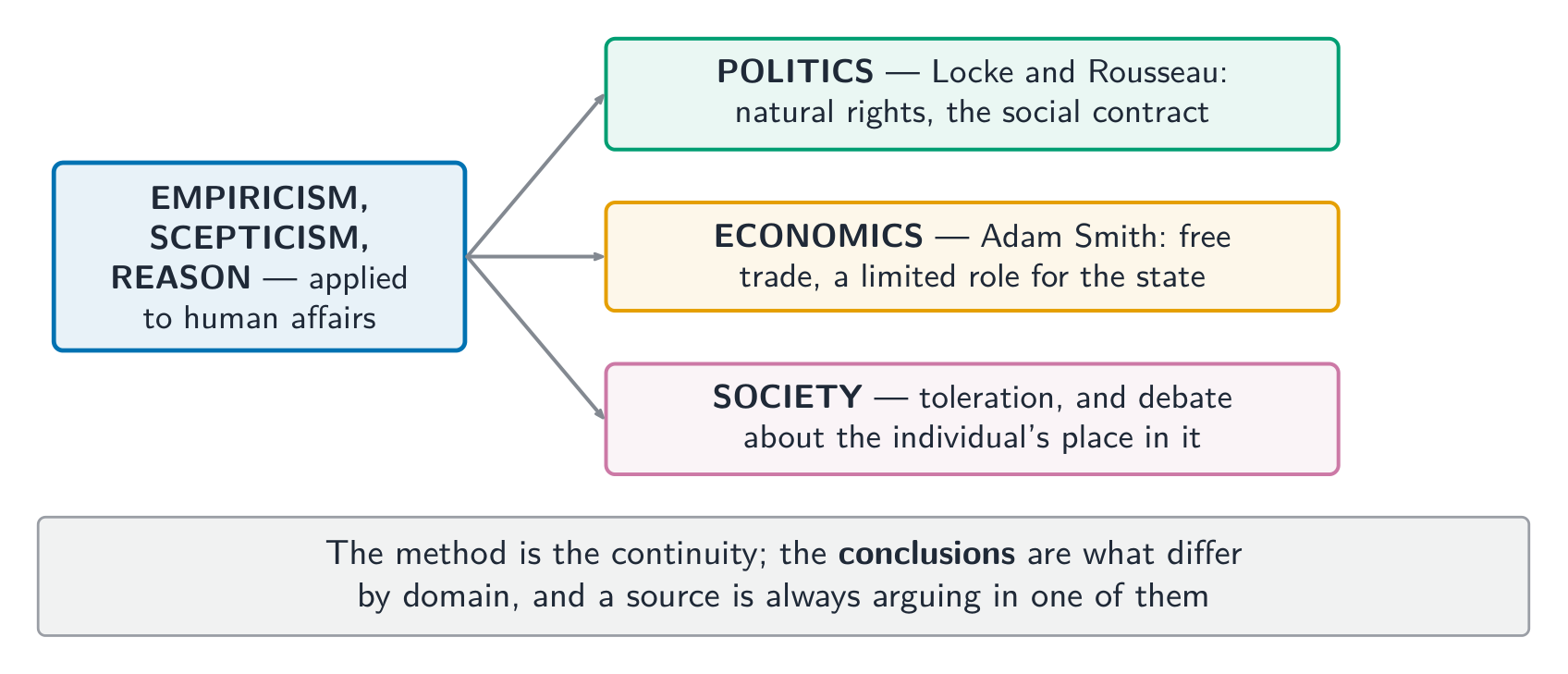
Один метод, три области — источник всегда аргументирует внутри одной из них

Имена, которые ожидает увидеть CED

Эссе оценивается за конкретные доказательства, поэтому лучше выучить одно произведение каждого мыслителя, а не просто список фамилий:

Мыслитель Произведение Аргумент в одной строке
Монтескьё Дух законов власть должна быть разделена между ветвями правительства, чтобы каждая сдерживала другие
Чезаре Беккариа «О преступлениях и наказаниях» наказание должно служить отпугиванию, а не мести; пытки и смертная казнь плохо справляются ни с тем, ни с другим
Анн Робер Жак Тюрго при генеральном контролере Людовика XVI освободить торговлю зерном и упразднить цехи — реформы изнутри государства, но они потерпели неудачу перед лицом укоренившихся интересов
Адам Смит «Богатство народов» разделение труда и свободный обмен создают больше, чем меркантилистское регулирование

Где обменивались идеями, так же важно, кто их написал, потому что это объясняет, как узкий круг читателей превратился в общественность: кофейни, академии, библиотеки по подписке и салоны ставили печатную продукцию и беседу перед людьми, у которых было мало книг. CED объединяет их в институты просветительской социальности.

⚠️ Не все отвечали разумом. В том же веке наблюдалось возрождение немецкого пиетизма и других течений эмоциональной, личной веры — это была реакция против рационализма, а не выживание старого порядка. Вопрос об ограничениях Просвещения обычно требует именно этого, вместе со спорными взглядами на женщин, зафиксированными в предыдущем разделе.

Vocabulary · ⁨Словарь⁩ Train · ⁨Тренировать⁩
English Русский
Scientific Revolution/saɪənˈtɪfɪk ˌrevəˈluːʃn/ Научная революция
Copernicus/ˈkəʊpənɪkəs/ Коперник
Galileo/ˌɡælɪˈleɪəʊ/ Галилей
Newton/ˈnjuːtn/ Ньютон
William Harvey/ˈwɪlɪəm ˈhɑːvi/ Уильям Гарвей
integrated system/ˈɪntɪɡreɪtɪd ˈsɪstəm/ интегрированная система
Francis Bacon/ˈfrænsɪs ˈbeɪkən/ Фрэнсис Бэкон
inductive and deductive reasoning/ɪnˈdʌktɪv ænd dɪˈdʌktɪv ˈriːzənɪŋ/ индуктивное и дедуктивное рассуждение
Enlightenment/enˈlaɪtənmənt/ Эпоха Просвещения
Locke/lɒk/ Локк
Rousseau/ˈraʊsəʊ/ Руссо
natural rights/ˈnætʃərəl raɪts/ естественные права
social contract/ˈsəʊʃl ˈkɒntrækt/ общественный договор
Adam Smith's/ˈædəm smɪθz/ Адама Смита
free trade/friː treɪd/ свободная торговля
Voltaire/vəʊlˈteə/ Вольтер
Diderot/ˈdaɪdrɒt/ Дидро
deism, scepticism, and atheism/ˈdeɪzəm ˈskeptɪsɪzəm ænd ˈeɪθɪɪzəm/ деизм, скептицизм и атеизм
salons/ˈsælɒnz/ салоны
Montesquieu/ˈmɒntɪskwɪuː/ Монтескье
Cesare Beccaria/ˈseseə beˈkeərɪə/ Чезаре Беккариа
Anne Robert Jacques Turgot/æn ˈrɒbət ʒæk ˈtɜːɡət/ Анн Робер Жак Тюрго
revival of German Pietism/rɪˈvaɪvl ɒv ˈdʒɜːmən ˈpaɪətɪzəm/ возрождение немецкого пиетизма
European marriage pattern/ˌjʊərəˈpɪən ˈmærɪdʒ ˈpætn/ европейская модель брака
inoculation/ɪˌnɒkjʊˈleɪʃn/ вакцинация
censorship/ˈsensəʃɪp/ цензура
literate public/ˈlɪtərət ˈpʌblɪk/ грамотная публика
consumer revolution/kənˈsuːmə ˌrevəˈluːʃn/ революция потребления
privacy/ˈprɪvəsi/ конфиденциальности
4.4

18th-Century Society and Demographics · ⁨Общество и демография 18-го века⁩

Syllabus · ⁨Программа⁩

4.4 18th-Century Society and Demographics

Thematic FocusLearning ObjectiveHistorical Developments

SCD
Social Organization and Development — Economic, political, and cultural factors have influenced the form and status of family, class, and social groups in European history, which has, in turn, affected both the individual and society.

Unit 4.E
Explain the factors contributing to and the consequences of demographic changes from 1648 to 1815.

  • KC-2.4.I In the 17th century, small landholdings, low-productivity agricultural practices, poor transportation, and adverse weather limited and disrupted the food supply, causing periodic famines. By the 18th century, the balance between population and the food supply stabilized, resulting in steady population growth.
    • KC-2.4.I.A By the middle of the 18th century, higher agricultural productivity and improved transportation increased the food supply, allowing populations to grow and reducing the number of demographic crises (a process known as the Agricultural Revolution).
    • KC-2.4.I.B In the 18th century, plague disappeared as a major epidemic disease, and inoculation reduced smallpox mortality.
  • KC-2.4.III.A Although the rate of illegitimate births increased in the 18th century, population growth was limited by the European marriage pattern, and in some areas by various birth control methods.
  • KC-2.4.III.B As infant and child mortality decreased, and commercial wealth increased, families dedicated more space and resources to children and child-rearing, as well as private life and comfort.
  • KC-2.4.IV Cities offered economic opportunities, which attracted increasing migration from rural areas, transforming urban life and creating challenges for the new urbanites and their families.
    • KC-2.4.IV.A The Agricultural Revolution produced more food using fewer workers; as a result, people migrated from rural areas to the cities in search of work.
    • KC-2.4.IV.B The growth of cities eroded traditional communal values, and city governments strained to provide protection and a healthy environment.
    • KC-2.4.IV.C The concentration of the poor in cities led to a greater awareness of poverty, crime, and prostitution as social problems, and prompted increased efforts to police marginal groups.

Illustrative examples:

  • Inoculation and disease control:
    • Lady Mary Wortley Montagu
  • Increased emphasis on childhood: §Bullet Jean-Jacques Rousseau
    • Education in Napoleonic France and Austria
    • Painting and portraiture

Source: College Board AP Course and Exam Description · ⁨Источник: Описание курса и экзамена College Board AP⁩

English

The demographic story has a clear before and after:

  • In the seventeenth century, small landholdings, low-productivity agriculture, poor transportation, and adverse weather limited population growth and caused periodic subsistence crises.
  • Although the rate of illegitimate births rose in the eighteenth century, growth was still limited by the European marriage pattern 欧洲婚姻模式 - late marriage and a significant proportion never marrying.
  • As infant and child mortality decreased and commercial wealth increased, families dedicated more space and resources to children and their education.
  • Cities offered economic opportunities, which attracted migration from rural areas, transforming urban life and creating new social problems.

Inoculation and disease control belong to this story too: the spread of inoculation 接种 against smallpox — and later Jenner's vaccination — together with better sanitation and the retreat of plague, is part of why mortality fell. It is the clearest case in the unit of a scientific method producing a demographic effect.

Русский

Демографическая история имеет чёткое "до" и "после":

  • В семнадцатом веке небольшие земельные владения, малопроизводительное сельское хозяйство, плохая транспортная сеть и неблагоприятная погода ограничивали рост населения и вызывали периодические кризисы выживания.
  • Хотя рождаемость вне брака возросла в восемнадцатом веке, рост всё ещё сдерживался европейским брачным паттерном — поздними браками и значительной долей тех, кто так и не женился.
  • По мере снижения детской и младенческой смертности и роста коммерческого богатства семьи выделяли больше места и ресурсов на детей и их образование.
  • Города предлагали экономические возможности, что привлекало миграцию из сельских районов, трансформируя городскую жизнь и порождая новые социальные проблемы.

Иммунизация и контроль болезней также входят в эту историю: распространение прививок от оспы — а позже прививки Дженнера — наряду с улучшением гигиены и отступлением чумы — часть причин снижения смертности. Это самый явный случай в данном модуле, когда научный метод дал демографический эффект.

4.5

18th-Century Culture and Arts · ⁨Культура и искусство 18-го века⁩

Syllabus · ⁨Программа⁩
English

4.5 18th-Century Culture and Arts

Thematic Focus (CID): Cultural and Intellectual Developments — The creation and transmission of knowledge, including the relationship between traditional sources of authority and the development of differing world views, had significant political, intellectual, economic, cultural, and social effects on European and world societies.

Learning Objective Unit 4.F: Explain how European cultural and intellectual life was maintained and changed throughout the period from 1648 to 1815.

  • KC-2.3.II.B Despite censorship, increasingly numerous and varied printed materials served a growing literate public and led to the development of public opinion.
  • KC-2.3.II.C Natural sciences, literature, and popular culture increasingly exposed Europeans to representations of peoples outside Europe and, on occasion, challenges to accepted social norms.
  • KC-2.3.V The arts moved from the celebration of religious themes and royal power to an emphasis on private life and the public good.
    • KC-2.3.V.A Until about 1750, Baroque art and music promoted religious feeling and was employed by monarchs to illustrate state power.
    • KC-2.3.V.B 18th-century art and literature increasingly reflected the outlook and values of commercial and bourgeois society. Neoclassicism expressed new Enlightenment ideals of citizenship and political participation.
  • KC-2.4.II The consumer revolution of the 18th century was shaped by a new concern for privacy, encouraged the purchase of new goods for homes, and created new venues for leisure activities.

Illustrative examples:

  • Printed materials:
    • Newspapers
    • Periodicals
    • Books
    • Pamphlets
    • The Encyclopédie
  • Baroque artists and musicians who promoted religion or glorified monarchy:
    • Diego Velásquez
    • Gian Bernini
    • George Frideric Handel
    • J. S. Bach
  • Artistic movements that reflected commercial society or Enlightenment ideals:
    • Dutch painting
    • Rembrandt
    • Jan Vermeer
    • Jacques-Louis David
    • Pantheon in Paris
  • Literature that reflected commercial society or Enlightenment ideals:
    • Daniel Defoe
    • Samuel Richardson
    • Henry Fielding
    • Johann Wolfgang von Goethe
    • Jane Austen (CONT’D) A new concern for privacy:
    • Homes built to include private retreats, such as the boudoir §Bullet Novels that encouraged a reflection on private emotion New consumer goods for homes: §Bullet Porcelain dishes
    • Cotton and linens for home décor §Bullet Mirrors
    • Prints New leisure venues: §Bullet Coffeehouses §Bullet Taverns §Bullet Theaters and opera houses
Русский

4.5 Культура и искусство 18 века

Тематический фокус (CID): Культурные и интеллектуальные достижения — Создание и распространение знаний, включая соотношение между традиционными источниками авторитета и формированием разных мировоззрений, оказало значительное политическое, интеллектуальное, экономическое, культурное и социальное воздействие на европейские и мировые общества.

Цель обучения Раздела 4.F: Объяснить, как европейская культурная и интеллектуальная жизнь поддерживалась и изменялась в период с 1648 по 1815 год.

  • KC-2.3.II.B Несмотря на цензуру, все более многочисленная и разнообразная печатная продукция обслуживала растущую грамотную публику и способствовала формированию общественного мнения.
  • KC-2.3.II.C Естественные науки, литература и популярная культура все чаще знакомили европейцев с изображениями народов вне Европы и время от времени ставили под сомнение принятые социальные нормы.
  • KC-2.3.V Искусство перешло от прославления религиозных тем и королевской власти к акценту на частной жизни и общественном благе.
    • KC-2.3.V.A Примерно до 1750 года барочное искусство и музыка пропагандировали религиозные чувства и использовались монархами для иллюстрации государственной власти.
    • KC-2.3.V.B Искусство и литература 18 века все чаще отражали мировоззрение и ценности коммерческого и буржуазного общества. Неоклассицизм выразил новые просветительские идеалы гражданского участия и политической деятельности.
  • KC-2.4.II Революция потребления в 18 веке была обусловлена новым стремлением к частной жизни, стимулировала покупку новых товаров для дома и создала новые места для досуга.

Иллюстративные примеры:

  • Печатные издания:
    • Газеты
    • Периодические издания
    • Книги
    • Буклеты
    • «Энциклопедия»
  • Художники и музыканты барокко, продвигавшие религию или воспевавшие монархию:
    • Диего Веласкес
    • Джан Бернини
    • Джордж Фридерик Гендель
    • И. С. Бах
  • Художественные течения, отражавшие коммерческое общество или идеи Просвещения:
    • Голландская живопись
    • Рембрандт
    • Ян Вермеер
    • Жак-Луи Давид
    • Пантеон в Париже
  • Литература, отражающая коммерческое общество или идеи Просвещения:
    • Даниэль Дефо
    • Сэмюэл Ричардсон
    • Генри Филдинг
    • Йохан Вольфганг фон Гёте
    • Джейн Остин (ПРОДОЛЖЕНИЕ) Новое стремление к приватности:
    • Дома, спроектированные с учетом наличия личных пространств, таких как будуар §Буллет Романы-сентименталисты, способствовавшие рефлексии на тему частных эмоций Новые потребительские товары для дома: §Буллет Фарфоровая посуда
    • Хлопок и лен для домашнего декора §Булзер Зеркала
    • Гравюры Новые места для досуга: §Буллет Кофейни §Буллет Таверны §Буллет Театры и оперные залы

Source: College Board AP Course and Exam Description · ⁨Источник: Описание курса и экзамена College Board AP⁩

English
  • Despite censorship 审查, increasingly numerous and varied printed materials served a growing literate public 识字公众 and produced a public sphere in which opinion could form outside the state.
  • Natural sciences, literature, and popular culture increasingly exposed Europeans to representations of peoples outside Europe.
  • The arts moved from the celebration of religious themes and royal power to an emphasis on private life and the public good - a shift in subject that tracks the shift in authority.
  • The consumer revolution 消费革命 of the eighteenth century was shaped by a new concern for privacy 隐私 and encouraged the purchase of new goods for the home.
Русский
  • Несмотря на цензуру, всё более многочисленные и разнообразные печатные материалы обслуживали растущую грамотную аудиторию и формировали публичную сферу, в которой мнение могло складываться вне контроля государства.
  • Естественные науки, литература и массовая культура всё чаще знакомили европейцев с образами народов вне Европы.
  • Искусство перешло от празднования религиозных тем и королевской власти к акценту на частной жизни и общественном благе — смена темы отражает смену авторитета.
  • Революция потребления восемнадцатого века была сформирована новой заботой о частной жизни и стимулировала покупку новых товаров для дома.
4.6

Enlightened and Other Approaches to Power · ⁨Просвещённые и иные подходы к власти⁩

Syllabus · ⁨Программа⁩
English

4.6 Enlightened and Other Approaches to Power

Thematic Focus (SOP): States and Other Institutions of Power — European states and nations developed governmental and civil institutions from 1450 to the present to organize society and consolidate political power, with a variety of social, cultural, and economic effects.

Learning Objective Unit 4.G: Explain how different forms of political power were influenced by Enlightenment thought from 1648 to 1815. THEMATIC FOCUS National and European Identity NEI Definitions and perceptions of regional, cultural, national, and European identity have developed and been challenged over time, with varied and often profound effects on the political, social, and cultural order in Europe. LEARNING OBJECTIVE

  • KC-2.1.I.C In the 18th century, a number of states in eastern and central Europe experimented with enlightened absolutism.
  • KC-2.3.IV.C By 1800, most governments in western and central Europe had extended toleration to Christian minorities and, in some states, civil equality to Jews. HISTORICAL DEVELOPMENTS

Learning Objective Unit 4.H: Explain how and why political and religious developments challenged or reinforced the idea of a unified Europe from 1648 to 1815.

  • KC-2.1.III.A As a result of the Holy Roman Empire’s limitation of sovereignty in the Peace of Westphalia, Prussia rose to power, and the Habsburgs, centered in Austria, shifted their empire eastward.

Illustrative examples:

  • Enlightened monarchs: §Bullet Frederick II of Prussia §Bullet Joseph II of Austria Prussian and Habsburg rulers:
    • Maria Theresa of Austria
    • Frederick William I of Prussia
    • Frederick II of Prussia
Русский

4.6 Просвещенный и иные подходы к власти

Тематический акцент (SOP): Государства и другие институты власти — Европейские государства и нации создавали государственные и гражданские институты с 1450 года по настоящее время для организации общества и консолидации политической власти, что имело различные социальные, культурные и экономические последствия.

Цель обучения Раздел 4.G: Объяснить, как различные формы политической власти подверглись влиянию идей Просвещения в период с 1648 по 1815 год. ТЕМАТИЧЕСКИЙ ФОКУС Национальная и европейская идентичность NEI Определения и восприятие региональной, культурной, национальной и европейской идентичности развивались и оспаривались на протяжении времени, оказывая разнообразное и часто глубокое влияние на политический, социальный и культурный порядок в Европе. ЦЕЛЬ ОБУЧЕНИЯ

  • KC-2.1.I.C В 18 веке ряд государств в Восточной и Центральной Европе экспериментировали с просвещенным абсолютизмом.
  • KC-2.3.IV.C К 1800 году большинство правительств Западной и Центральной Европы расширило веротерпимость к христианским меньшинствам, а в некоторых государствах — гражданское равенство для евреев. ИСТОРИЧЕСКОЕ РАЗВИТИЕ

Цель обучения Раздел 4.H: Объяснить, как политические и религиозные изменения бросали вызов идее единой Европы или укрепляли её в период с 1648 по 1815 год.

  • KC-2.1.III.A В результате ограничения Священной Римской империей суверенитета Вестфальским миром Пруссия возвысилась, а Габсбурги, сосредоточенные в Австрии, переместили свою империю на восток.

Иллюстративные примеры:

  • Просвещенные монархи: §Буллет Фридрих II Прусский §Буллет Иосиф II Австрийский Прусские и габсбургские правители:
    • Мария Терезия Австрийская
    • Фридрих Вильгельм I Прусский
    • Фридрих II Прусский

Source: College Board AP Course and Exam Description · ⁨Источник: Описание курса и экзамена College Board AP⁩

English

In the eighteenth century a number of states in eastern and central Europe experimented with enlightened absolutism 开明专制 - rulers adopting Enlightenment-inspired reforms in law, education, and administration while retaining absolute authority. The tension in that phrase is the examinable point.

By 1800 most governments in western and central Europe had extended toleration to Christian minorities, and in some states civil rights as well.

And as a result of the Holy Roman Empire's limitation of sovereignty at Westphalia, Prussia rose to power 普鲁士 while the Habsburgs turned toward their eastern lands - a structural consequence of Unit 2's settlement arriving a century later.

Русский

В восемнадцатом веке ряд государств восточной и центральной Европы экспериментировали с просвещённым абсолютизмом — правители проводили реформы в праве, образовании и администрации, вдохновлённые идеями Просвещения, сохраняя при этом абсолютную власть. Напряжение в этой фразе является ключевым моментом для экзамена.

К 1800 году большинство правительств западной и центральной Европы расширило терпимость к христианским меньшинствам, а в некоторых государствах — даже гражданские права.

В результате ограничения верховенства Священной Римской империей при Вестфальском мире Пруссия пришла к власти, тогда как Габсбурги обратились к своим восточным землям — структурное следствие урегулирования блока 2, наступившее век спустя.

Что было принято, а от чего никогда не отказывались
Explore · ⁨Исследовать⁩

Sort what was adopted from what was never given up · ⁨Сгруппировать, что было принято, а от чего никогда не отказывались⁩

The CED's clause is 'while retaining absolute authority', and the marks are in that clause. · ⁨Положение CED гласит «при сохранении абсолютной власти», и баллы ставятся именно за это положение.⁩

Vocabulary · ⁨Словарь⁩ Train · ⁨Тренировать⁩
English Русский
enlightened absolutism/enˈlaɪtnd ˈæbsəluːtɪzəm/ просвещенный абсолютизм
Prussia rose to power/ˈprʌʃə rəʊz tə ˈpaʊə/ Пруссия возвысилась как держава
René Descartes/rɪˈneɪ dɪˈskɑːts/ Рене Декарт
4.7

Causation in the Age of the Enlightenment · ⁨Причинность в эпоху Просвещения⁩

Syllabus · ⁨Программа⁩

4.7 Causation in the Age of the Scientific Revolution and the Enlightenment

Learning ObjectiveReview: Unit 4 Key Concepts

Unit 4.I
Explain how and why the Scientific Revolution and Enlightenment challenged the existing European order and understanding of the world.

  • KC-1.1 The rediscovery of works from ancient Greece and Rome and observation of the natural world changed many Europeans’ view of their world.
    • KC-1.1.IV New ideas in science based on observation, experimentation, and mathematics challenged classical views of the cosmos, nature, and the human body, although existing traditions of knowledge and the universe continued.
  • KC-2.3 The spread of Scientific Revolution concepts and practices and the Enlightenment’s application of these concepts and practices to political, social, and ethical issues led to an increased but not unchallenged emphasis on reason in European culture.
    • KC-2.3.I Enlightenment thought, which focused on concepts such as empiricism, skepticism, human reason, rationalism, and classical sources of knowledge, challenged the prevailing patterns of thought with respect to social order, institutions of government, and the role of faith.
    • KC-2.3.II New public venues and print media popularized Enlightenment ideas.
    • KC-2.3.III New political and economic theories challenged absolutism and mercantilism.
    • KC-2.3.IV During the Enlightenment, the rational analysis of religious practices led to natural religion and the demand for religious toleration.
  • KC-2.4 The experiences of everyday life were shaped by demographic, environmental, medical, and technological changes.
    • KC-2.4.III By the 18th century, family and private life reflected new demographic patterns and the effects of the commercial revolution.

Source: College Board AP Course and Exam Description · ⁨Источник: Описание курса и экзамена College Board AP⁩

English

The unit's reasoning skill is causation, applied to how these movements challenged the existing European worldview.

Worked example (a real AP exam question). AP European History short-answer questions here ask, for example, to "Explain one way in which Enlightenment thought challenged existing political authority in the eighteenth century." A full-mark answer identifies the challenge and traces it: "Locke's theory of natural rights and the social contract held that government exists to protect the rights of individuals and derives its authority from their consent. This directly undermined the claim that a monarch's authority came from God, because it made obedience conditional on the ruler's performance rather than unconditional." Notice the mechanism: the answer shows how one argument displaces another, rather than listing thinkers.

Русский

Навык рассуждения данного модуля — причинность, применяемый к тому, как эти движения ставили под сомнение существующий европейский мировоззрение.

Разбор примера (реальный вопрос экзамена AP). В вопросах с кратким ответом по европейской истории, например, требуется "Объяснить один способ, которым мысли Просвещения бросали вызов существующей политической власти в XVIII веке." Полный ответ на все баллы выявляет вызов и прослеживает его: "Теория Локка о естественных правах и общественном договоре утверждала, что государство существует для защиты прав личности и получает свою власть от их согласия. Это напрямую подрывало утверждение о том, что власть монарха исходит от Бога, поскольку делало подчинение условным выполнением правителем своих обязанностей, а не безусловным." Обратите внимание на механизм: ответ показывает, как одна аргументация вытесняет другую, а не просто перечисляет мыслителей.

4.7

Exam tips · ⁨Советы для экзамена⁩

English
  • Learn the CED's own sentence: the Enlightenment applied Scientific Revolution methods to political, social, and ethical issues. Many questions are answered by unpacking it.
  • The Scientific Revolution was not a clean break - alchemy and astrology persisted. Continuity points score.
  • Group Enlightenment outputs as political, economic, religious, social. Four labelled kinds beat a list of names.
  • Always note the limits on equality, especially regarding women. The CED names them explicitly.
  • Enlightened absolutism is a tension, not a contradiction: reform without surrendering authority.
  • The public sphere - print, literacy, salons - is the mechanism by which ideas became political. Use it to explain, not just to describe.
Русский
  • Выучите собственную фразу CED: Просвещение применило методы Научной революции к политическим, социальным и этическим проблемам. Многие вопросы решаются путем раскрытия этого тезиса.
  • Научная революция не была чистым разрывом — алхимия и астрология сохранялись. Точки преемственности приносят баллы.
  • Группируйте достижения Просвещения как политические, экономические, религиозные, социальные. Четыре помеченных типа лучше, чем список имен.
  • Всегда отмечайте ограничения равенства, особенно в отношении женщин. CED называет их явно.
  • «Просвещенный абсолютизм» — это напряжение, а не противоречие: реформы без уступки власти.
  • Публичная сфера — печать, грамотность, салоны — является механизмом, посредством которого идеи становились политическими. Используйте это для объяснения, а не только для описания.

Interactive lessons on this topic · ⁨Интерактивные уроки по этой теме⁩

Work through it step by step, with instant-check exercises. · ⁨Пройдите его шаг за шагом с упражнениями мгновенной проверки.⁩

Past Papers · ⁨Архив экзаменационных работ⁩

More topics in AP European History · ⁨AP Історія Європи⁩ · ⁨Больше тем в AP European History · ⁨AP Історія Європи⁩⁩

Log in or create account · ⁨Войти или создать аккаунт⁩

IGCSE, A-Level & AP