8.1 Contextualizing 20th-Century Global Conflicts
| Learning Objective | Preview: Unit 8 Key Concepts |
|---|---|
Unit 8.A |
|
AP European History · Topic 8
 9:08
Unit 8: 20th-Century Global Conflicts
Learn the chain, and this unit becomes navigable. War. Settlement. Economic collapse. Radical movements. Failed appeasement. War again. Most questions ask…
English narration · English + 中文 subtitles burned in
| Learning Objective | Preview: Unit 8 Key Concepts |
|---|---|
Unit 8.A |
|
Source: College Board AP Course and Exam Description
Unit 8 covers c. 1914 to the present as a story of conflict, and four key concepts frame it:
| English |
|---|
| total war/ˈtəʊtl wɔː/ |
| political instability |
| Cold War/kəʊld wɔː/ |
| objective knowledge |

| Thematic Focus | Learning Objective | Historical Developments |
|---|---|---|
TSI | Unit 8.B |
|
Unit 8.C |
| |
Unit 8.D |
|
Illustrative examples:
Source: College Board AP Course and Exam Description
The war was caused by a complex interaction of long- and short-term factors and produced immense losses and disruption. The CED's specific claims:
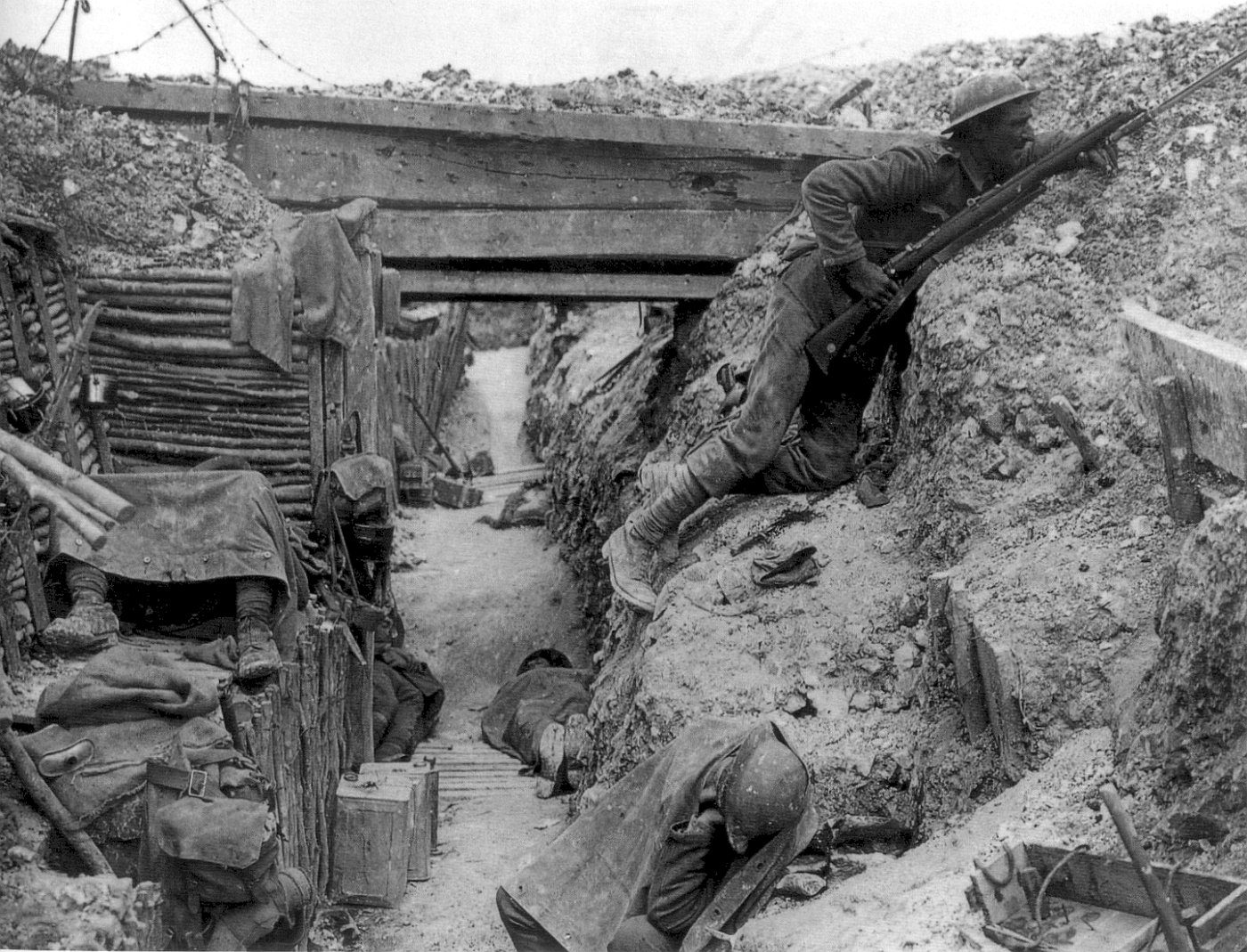
Technology, then stalemate, then national mobilisation, then total war — the 'because' at each step is what is marked.
| English |
|---|
| trench warfare/trentʃ ˈwɔːfeə/ |
| stalemate |
| mobilisation |
| protest |
| insurrection |
| belligerent |
| theatre |
| Thematic Focus | Learning Objective | Historical Developments |
|---|---|---|
SOP | Unit 8.E |
|
Illustrative examples:
Source: College Board AP Course and Exam Description
The Russian Revolution 俄国革命 created a regime based on Marxist-Leninist theory 马克思列宁主义 - the first state to be founded explicitly on that programme, which is what makes it a turning point rather than a national event.
| English |
|---|
| Russian Revolution/ˈrʌʃn ˌrevəˈluːʃn/ |
| Marxist-Leninist theory/ˈmɑːksɪst ˈlenɪnɪst ˈθɪəri/ |

| Thematic Focus | Learning Objective | Historical Developments |
|---|---|---|
SOP | Unit 8.F |
|
Illustrative examples:
Source: College Board AP Course and Exam Description
The conflicting goals of the peace negotiators in Paris pitted diplomatic idealism 理想主义 against the desire to punish Germany, and the resulting settlement satisfied neither aim fully.
The League of Nations 国际联盟 distributed former German and Ottoman possessions to powers including France, Great Britain, Japan and Belgium, as well as British dominions, through the mandate system 委任统治, which extended imperial control under a new name - a point worth making because it connects the settlement to decolonisation later in the course.
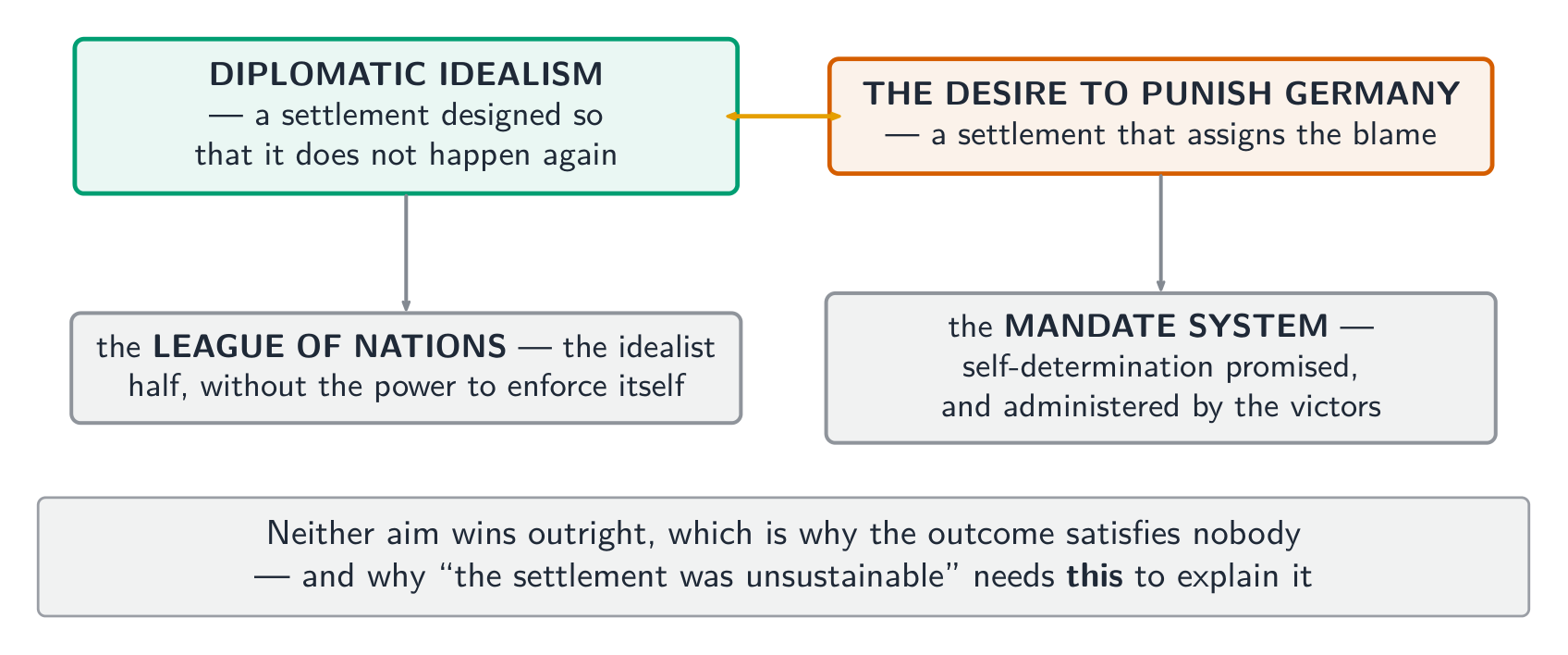
The settlement is a compromise between two incompatible aims, which is why it satisfied nobody.
| English |
|---|
| idealism |
| League of Nations/liːɡ ɒv ˈneɪʃnz/ |
| mandate system/ˈmændeɪt ˈsɪstəm/ |
| Thematic Focus | Learning Objective | Historical Developments |
|---|---|---|
ECD | Unit 8.G |
|
Illustrative examples:
Source: College Board AP Course and Exam Description
The Great Depression 大萧条, caused by weaknesses in international trade and in monetary theory and practice, undermined Western European democracies 民主国家 and fostered radical political responses across Europe.
This is the pivot of the unit. The Depression enlarged the political opportunity for movements such as Nazism in Germany. It cannot explain every fascist accession: Mussolini had become Italian prime minister in 1922, before the Depression began.
| English |
|---|
| Great Depression/ɡreɪt dɪˈpreʃn/ |

| Thematic Focus | Learning Objective | Historical Developments |
|---|---|---|
SOP | Unit 8.H |
|
Unit 8.I |
|
Illustrative examples:
Source: College Board AP Course and Exam Description
The ideology of fascism 法西斯主义, with roots in the pre-war era, gained popularity in an environment of postwar bitterness, the rise of communism, uncertain transitions to democracy, and economic instability. That four-part environment is the CED's own answer to "why then", and it is better than any single cause.
On the Soviet side, after Lenin's death Stalin 斯大林 undertook a centralised programme of rapid economic modernisation 现代化, often with severe repression 镇压. The CED states the cost explicitly: modernisation came at a high price, including the liquidation of the kulaks 富农 and a catastrophic famine 饥荒.
The comparison the unit invites is structural rather than ideological: both regimes claimed total authority over the relationship between individual and state, which is the second key concept doing its work.
| English |
|---|
| democracy |
| fascism/ˈfæʃɪzəm/ |
| Stalin/ˈstɑːlɪn/ |
| modernisation |
| repression/rɪˈpreʃn/ |
| kulak |
| famine |
| Thematic Focus | Learning Objective | Historical Developments |
|---|---|---|
SOP | Unit 8.J |
|
Illustrative examples:
Source: College Board AP Course and Exam Description
The failure to prevent a second war has named causes:
| English |
|---|
| isolationism |
| appeasement |
| Thematic Focus | Learning Objective | Historical Developments |
|---|---|---|
TSI | Unit 8.K |
|
Illustrative examples:
Source: College Board AP Course and Exam Description
| English |
|---|
| Blitzkrieg/ˈblɪtskrɪɡ/ |
| Axis powers |
| genocide/ˈdʒenəsaɪd/ |
| nuclear proliferation/ˈnjuːklɪə prəˌlɪfəˈreɪʃn/ |
| Thematic Focus | Learning Objective | Historical Developments |
|---|---|---|
NEI | Unit 8.L |
|
Illustrative examples:
Source: College Board AP Course and Exam Description
Fuelled by racism 种族主义 and anti-Semitism 反犹主义, Nazi Germany - with the cooperation of some other Axis powers and collaborators 合作者 - used industrial technology and bureaucratic structures to carry out the systematic murder of European Jewish people and other targeted groups.
The CED's framing is precise and should be reproduced: what distinguishes this from earlier mass violence is the use of the modern state's own instruments - industry, bureaucracy, transport, record-keeping - as the means. That is why this topic belongs with the technology and total-war themes rather than standing apart from them.
The demographic consequence is stated directly: the Second World War decimated a generation of Russian and German men, virtually destroyed European Jewry, and killed millions of others.
| English |
|---|
| racism |
| anti-Semitism |
| collaborator |
| Thematic Focus | Learning Objective | Historical Developments |
|---|---|---|
CID | Unit 8.M |
|
Illustrative examples:
Source: College Board AP Course and Exam Description
| English |
|---|
| "lost generation" |
| disillusionment |
| cynicism |
| Learning Objective | Review: Unit 8 Key Concepts |
|---|---|
Unit 8.N |
|
Source: College Board AP Course and Exam Description
The unit's reasoning skill is continuity and change.
Original worked example. For original short-answer practice, try "Explain one way in which the peace settlement of 1919 contributed to political instability in Europe in the 1920s and 1930s." An illustrative answer traces a mechanism: "The settlement combined punitive terms against Germany with an appeal to national self-determination it could not deliver consistently. That left a German republic burdened with reparations and blamed for accepting them, which gave nationalist and fascist movements a grievance they could use, and which the economic collapse of 1929 turned into mass support." Notice that the answer runs the chain forward to the point the question asks about.
Each part needs only one or two sentences: answer the question, cite one specific piece of evidence, and explain how it supports the answer.
Answer (a), (b) and (c).
(a) Briefly describe ONE cause of the First World War.
(b) Briefly explain ONE effect of the Russian Revolution on the First World War.
(c) Briefly explain ONE cause of the Second World War.
Model answer.
Vocabulary card meanings
trench warfare: Fighting from fortified ditches, typical of the Western Front in the First World War. protest and insurrection: Public opposition that sometimes became armed rebellion. Russian Revolution: The 1917 overthrow of the tsar and the Bolshevik seizure of power. Marxist-Leninist theory: A version of socialism that justified a vanguard party and a one-party state. League of Nations: The interwar organisation meant to keep peace through collective security. mandate system: Former Ottoman and German colonies administered by victors under League oversight. undermined Western European democracies: Forces such as depression and extremist parties that weakened parliamentary rule. fascism: Authoritarian nationalism that glorified the state and crushed opposition. Stalin: The Soviet leader who industrialised by force and ran a personal dictatorship. liquidation of the kulaks: The violent campaign against richer peasants during collectivisation. catastrophic famine: Mass starvation, including the one that followed forced collectivisation. American isolationism: A US policy of staying out of European alliances between the world wars. Blitzkrieg: Fast armoured warfare used by Germany early in the Second World War. racism and anti-Semitism: Ideologies of racial hierarchy and hatred of Jews, central to Nazism. "lost generation": Writers and veterans who felt the First World War had emptied old certainties. disillusionment and cynicism: A loss of faith in progress, often turning into bitter distrust.
Work through it step by step, with instant-check exercises.
Loading subjects…