Aqui está um enigma que derrubou a física clássica. Aponte a lâmpada vermelha mais brilhante que você encontrar em uma placa metálica. Adicione mais e mais luz. E ainda assim — nada…
English narration · English + 中文 subtitles burned in · Narração em inglês · Legendas em inglês + 中文 gravadas
22.1
Photons: the particle nature of light · Fótons: a natureza corpuscular da luz
Syllabus · Programa
English
understand that electromagnetic radiation has a particulate nature
understand that a photon is a quantum of electromagnetic energy
recall and use $E = hf$
use the electronvolt (eV) as a unit of energy
understand that a photon has momentum and that the momentum is given by $p = E/c$
Português
compreender que a radiação eletromagnética tem uma natureza corpuscular
compreender que um fóton é um quanta de energia eletromagnética
recordar e usar $E = hf$
usar o eletron-volt (eV) como unidade de energia
compreender que um fóton possui momento e que o momento é dado por $p = E/c$
Source: Cambridge International syllabus · Fonte: Programa Cambridge International
English
Electromagnetic radiation behaves like particles as well as like a wave. The particles of EM radiation are photons 光子 — small packets ("quanta" 量子) of EM energy that travel at the speed of light.
"State what is meant by a photon" (two marks).A photon is a quantum (a discrete packet) of energy of electromagnetic radiation. Both halves score: quantum or packet (or "discrete amount"), and of electromagnetic radiation (or "of light"). "A particle of light" alone is not enough. That radiation comes in such packets is what the syllabus calls its particulate nature 粒子性: energy is delivered in lumps of $hf$, never in smaller pieces.
Energy of a photon
A photon of frequency 频率$f$ has energy
$$E = h f,$$
where $h = 6.63 \times 10^{-34}\ \text{J s}$ is the Planck constant 普朗克常量. Using $c = f\lambda$:
$$E = \frac{h c}{\lambda}.$$
Worked example. Find the energy of a photon of green light of wavelength $500\ \text{nm}$. ($h = 6.63 \times 10^{-34}\ \text{J s}$, $c = 3.0 \times 10^{8}\ \text{m s}^{-1}$.)
It is the kinetic energy 动能 an electron 电子 gains moving through a potential difference 电势差 of 1 V. For example, a visible photon ($\lambda \approx 500\ \text{nm}$) has energy $\approx 2.5\ \text{eV}$. To go eV → J multiply by $1.60 \times 10^{-19}$; J → eV divide.
Using the electronvolt. Photon energies, work functions and energy levels are all a few eV, so the exam quotes them that way and expects you to move between units without fuss: a $2.0\ \text{eV}$ work function is $2.0 \times 1.60 \times 10^{-19} = 3.2 \times 10^{-19}\ \text{J}$; a photon of $4.0 \times 10^{-19}\ \text{J}$ is $2.5\ \text{eV}$. A useful shortcut for wavelengths: $hc = 1.99 \times 10^{-25}\ \text{J m} = 1240\ \text{eV nm}$, so a $2.0\ \text{eV}$ photon has $\lambda = 1240/2.0 = 620\ \text{nm}$ (red) and a $400\ \text{nm}$ photon carries $3.1\ \text{eV}$.
Momentum of a photon
A photon also carries momentum 动量:
$$p = \frac{E}{c} = \frac{h}{\lambda}.$$
It has zero rest mass but a non-zero momentum $E/c$. Radiation pressure (photons pushing on a surface) follows from this.
"Show that $p = h/\lambda$." Start from the two photon relations: $E = hf$ and $p = E/c$. Then $p = hf/c$, and since $c = f\lambda$, $f/c = 1/\lambda$, so $p = h/\lambda$. Give both starting equations and the wave equation; the mark is for the chain, not the result.
Worked example. A photon in free space has momentum $9.5 \times 10^{-28}\ \text{N s}$. Show that it is a photon of red light.
$\lambda = h/p = 6.63 \times 10^{-34}/9.5 \times 10^{-28} = 7.0 \times 10^{-7}\ \text{m} = 700\ \text{nm}$, which lies at the red end of the visible spectrum ($400$–$700\ \text{nm}$). The energy is $pc = 2.9 \times 10^{-19}\ \text{J} = 1.8\ \text{eV}$.
Radiation pressure 辐射压. A beam of intensity $I$ (power per unit area) falling on area $A$ delivers $IA/(hf)$ photons per second, each with momentum $h/\lambda$. Force is the rate of change of momentum. On a mirror each photon bounces back, so its momentum changes by $2p$ and the force is $F = 2IA/c$ (pressure $2I/c$); on a black surface each photon is absorbed, the change is $p$, and the pressure is $I/c$. Two things follow, and both are examined: the pressure depends on the intensity, not on the colour, because blue light of the same intensity has fewer photons per second but each carries proportionally more momentum; and even sunlight ($I \approx 1\ \text{kW m}^{-2}$) exerts only a few micropascals.
Worked example. Red light of intensity $160\ \text{W m}^{-2}$ falls normally on a plane mirror; each photon has momentum $9.5 \times 10^{-28}\ \text{N s}$. Find the number of photons hitting $1.0\ \text{m}^{2}$ of the mirror per second, and the pressure on it.
Photon energy $E = pc = (9.5 \times 10^{-28})(3.00 \times 10^{8}) = 2.85 \times 10^{-19}\ \text{J}$. Photons per second on $1.0\ \text{m}^{2}$: $160/2.85 \times 10^{-19} = 5.6 \times 10^{20}\ \text{s}^{-1}$. Each is reflected, so the force is $F = 5.6 \times 10^{20} \times 2 \times 9.5 \times 10^{-28} = 1.1 \times 10^{-6}\ \text{N}$ on $1.0\ \text{m}^{2}$: a pressure of $1.1 \times 10^{-6}\ \text{Pa}$ (check: $2I/c = 320/3.00 \times 10^{8} = 1.1 \times 10^{-6}\ \text{Pa}$). Replace the beam with blue light of the same intensity and the pressure is unchanged.
Worked example. A laser emits $2.0\ \text{mW}$ of light of wavelength $650\ \text{nm}$. Find the number of photons it emits per second, and the force on a surface that absorbs the beam completely.
$E = hc/\lambda = (6.63 \times 10^{-34})(3.00 \times 10^{8})/(650 \times 10^{-9}) = 3.06 \times 10^{-19}\ \text{J}$, so the rate is $P/E = 2.0 \times 10^{-3}/3.06 \times 10^{-19} = 6.5 \times 10^{15}\ \text{s}^{-1}$. The force is the momentum delivered per second: $F = P/c = 2.0 \times 10^{-3}/3.00 \times 10^{8} = 6.7 \times 10^{-12}\ \text{N}$ (or $6.5 \times 10^{15} \times h/\lambda$, the same thing).
Português
A radiação eletromagnética comporta-se como partículas além de uma onda. As partículas da radiação EM são fótons 光子 — pequenos pacotes ("quanta" 量子) de energia EM que viajam à velocidade da luz.
"Afirme o que se entende por fóton (duas marcas).** Um fóton é um quanta (um pacote discreto) de energia de radiação eletromagnética. Ambas as metades pontuam: quanta ou pacote (ou "quantidade discreta"), e de radiação eletromagnética (ou "de luz"). "Uma partícula de luz" sozinho não é suficiente. O fato de a radiação vir nesses pacotes é o que o programa denomina sua natureza corpuscular 粒子性: a energia é entregue em lotes de $hf$, nunca em pedaços menores.
Um fóton é um pacote de energia, E = hf
Energia de um fóton
Um fóton de frequência 频率$f$ tem energia
$$E = h f,$$
onde $h = 6.63 \times 10^{-34}\ \text{J s}$ é a constante de Planck 普朗克常量. Usando $c = f\lambda$:
$$E = \frac{h c}{\lambda}.$$
Exemplo resolvido. Encontre a energia de um fóton de luz verde de comprimento de onda $500\ \text{nm}$. ($h = 6.63 \times 10^{-34}\ \text{J s}$, $c = 3.0 \times 10^{8}\ \text{m s}^{-1}$.)
Fótons de frequência mais alta (comprimento-de-onda 波长 mais curto) carregam mais energia: um fóton de raios $\gamma$ carrega muito mais do que um fóton de rádio.
O elétron-volt
O elétron-volt 电子伏特 (eV) é uma unidade de energia conveniente na escala atômica:
É a energia cinética 动能 que um elétron 电子 ganha movendo-se através de uma diferença de potencial 电势差 de 1 V. Por exemplo, um fóton visível ($\lambda \approx 500\ \text{nm}$) tem energia $\approx 2.5\ \text{eV}$. Para ir de eV → J multiplique por $1.60 \times 10^{-19}$; J → eV divida.
Usando o elétron-volt. Energias de fótons, funções trabalho e níveis de energia são todos alguns eV, então o exame os cita dessa forma e espera que você mude entre unidades sem complicação: uma função trabalho de $2.0\ \text{eV}$ é $2.0 \times 1.60 \times 10^{-19} = 3.2 \times 10^{-19}\ \text{J}$; um fóton de $4.0 \times 10^{-19}\ \text{J}$ é $2.5\ \text{eV}$. Um atalho útil para comprimentos de onda: $hc = 1.99 \times 10^{-25}\ \text{J m} = 1240\ \text{eV nm}$, então um fóton de $2.0\ \text{eV}$ tem $\lambda = 1240/2.0 = 620\ \text{nm}$ (vermelho) e um fóton de $400\ \text{nm}$ carrega $3.1\ \text{eV}$.
Momento de um fóton
Um fóton também carrega momento 动量:
$$p = \frac{E}{c} = \frac{h}{\lambda}.$$
Ele tem massa de repouso zero, mas momento não-zero $E/c$. A pressão da radiação (fótons empurrando uma superfície) decorre disso.
"Mostre que $p = h/\lambda$." Comece com as duas relações do fóton: $E = hf$ e $p = E/c$. Então $p = hf/c$, e já que $c = f\lambda$, $f/c = 1/\lambda$, então $p = h/\lambda$. Forneça ambas as equações iniciais e a equação de onda; a marca é para a cadeia, não para o resultado.
Exemplo resolvido. Um fóton no espaço livre tem momento $9.5 \times 10^{-28}\ \text{N s}$. Mostre que é um fóton de luz vermelha.
$\lambda = h/p = 6.63 \times 10^{-34}/9.5 \times 10^{-28} = 7.0 \times 10^{-7}\ \text{m} = 700\ \text{nm}$, que está na extremidade vermelha do espectro visível ($400$–$700\ \text{nm}$). A energia é $pc = 2.9 \times 10^{-19}\ \text{J} = 1.8\ \text{eV}$.
Pressão da radiação: força igual ao número de fótons chegando por segundo vezes a mudança no momento de cada um; um espelho dobra a mudança, um absorvedor não faz
Pressão da radiação 辐射压. Um feixe de intensidade $I$ (potência por área unitária) caindo sobre uma área $A$ entrega $IA/(hf)$ fótons por segundo, cada um com momento $h/\lambda$. Força é a taxa de mudança do momento. Em um espelho, cada fóton reflete, então sua mudança de momento é $2p$ e a força é $F = 2IA/c$ (pressão $2I/c$); em uma superfície preta, cada fóton é absorvido, a mudança é $p$, e a pressão é $I/c$. Duas coisas seguem, e ambas são examinadas: a pressão depende da intensidade, não da cor, porque a luz azul da mesma intensidade tem menos fótons por segundo, mas cada um carrega proporcionalmente mais momento; e mesmo a luz solar ($I \approx 1\ \text{kW m}^{-2}$) exerce apenas alguns micropascals.
Exemplo resolvido. Luz vermelha de intensidade $160\ \text{W m}^{-2}$ incide normalmente em um espelho plano; cada fóton tem momento $9.5 \times 10^{-28}\ \text{N s}$. Encontre o número de fótons atingindo $1.0\ \text{m}^{2}$ do espelho por segundo, e a pressão sobre ele.
Energia do fóton $E = pc = (9.5 \times 10^{-28})(3.00 \times 10^{8}) = 2.85 \times 10^{-19}\ \text{J}$. Fótons por segundo em $1.0\ \text{m}^{2}$: $160/2.85 \times 10^{-19} = 5.6 \times 10^{20}\ \text{s}^{-1}$. Cada um é refletido, então a força é $F = 5.6 \times 10^{20} \times 2 \times 9.5 \times 10^{-28} = 1.1 \times 10^{-6}\ \text{N}$ em $1.0\ \text{m}^{2}$: uma pressão de $1.1 \times 10^{-6}\ \text{Pa}$ (confira: $2I/c = 320/3.00 \times 10^{8} = 1.1 \times 10^{-6}\ \text{Pa}$). Substitua o feite por luz azul da mesma intensidade e a pressão permanece inalterada.
Exemplo resolvido. Um laser emite $2.0\ \text{mW}$ de luz de comprimento de onda $650\ \text{nm}$. Encontre o número de fótons que ele emite por segundo, e a força sobre uma superfície que absorve o feixe completamente.
$E = hc/\lambda = (6.63 \times 10^{-34})(3.00 \times 10^{8})/(650 \times 10^{-9}) = 3.06 \times 10^{-19}\ \text{J}$, então a taxa é $P/E = 2.0 \times 10^{-3}/3.06 \times 10^{-19} = 6.5 \times 10^{15}\ \text{s}^{-1}$. A força é o momento entregue por segundo: $F = P/c = 2.0 \times 10^{-3}/3.00 \times 10^{8} = 6.7 \times 10^{-12}\ \text{N}$ (ou $6.5 \times 10^{15} \times h/\lambda$, a mesma coisa).
Explore · Explorar
Energia de um fóton
E = h·f
A energia de um fóton é proporcional à frequência — a inclinação é a constante de Planck h.
understand that photoelectrons may be emitted from a metal surface when it is illuminated by electromagnetic radiation
understand and use the terms threshold frequency and threshold wavelength
explain photoelectric emission in terms of photon energy and work function energy
recall and use $hf = \Phi + \frac{1}{2}m{v_{\text{max}}}^2$
explain why the maximum kinetic energy of photoelectrons is independent of intensity, whereas the photoelectric current is proportional to intensity
Português
compreender que fotoelétrons podem ser emitidos de uma superfície metálica quando iluminada por radiação eletromagnética
compreender e usar os termos frequência limiar e comprimento de onda limiar
explicar a emissão fotoelétrica em termos de energia de fótons e energia de função de trabalho
recordar e usar $hf = \Phi + \frac{1}{2}m{v_{\text{max}}}^2$
explicar por que a energia cinética máxima dos fotoelétrons é independente da intensidade, enquanto a corrente fotoelétrica é proporcional à intensidade
Source: Cambridge International syllabus · Fonte: Programa Cambridge International
English
The photoelectric effect, photon by photon
When EM radiation of high enough frequency hits a metal, electrons are emitted. These are photoelectrons 光电子, and the effect is the photoelectric effect 光电效应.
"State what is meant by the photoelectric effect."The emission of electrons from (the surface of) a metal when electromagnetic radiation of high enough frequency is incident on it. Two marks: emission of electrons and from a metal surface illuminated by electromagnetic radiation (or "when light is shone on it"). It is the syllabus's evidence for the particulate nature of radiation, because a wave could not explain what follows.
Threshold frequency and work function
Each metal has a lowest photon frequency, the threshold frequency 极限频率$f_{0}$, below which no electrons come out, however bright the light. The work function 逸出功$\Phi$ is the least energy needed to free an electron from the surface:
$$\Phi = h f_{0}.$$
Different metals have different work functions (about $2$–$5\ \text{eV}$).
The two-mark definitions.The work function energy of a metal is the minimum energy needed to remove an electron from the surface of the metal. Both "minimum" and "from the surface" carry marks: an electron deeper in the metal needs more, which is why the equation gives a maximum kinetic energy. The threshold frequency is the minimum frequency of radiation for which photoelectrons are emitted, and the threshold wavelength 极限波长$\lambda_{0} = c/f_{0} = hc/\Phi$ is the corresponding maximum wavelength: longer wavelengths do nothing.
Worked example. Light of wavelength $400\ \text{nm}$ falls on four metals whose work functions are: caesium $2.1\ \text{eV}$, sodium $2.3\ \text{eV}$, zinc $4.3\ \text{eV}$, platinum $5.6\ \text{eV}$. Which emit photoelectrons, and with what maximum kinetic energy?
The photon energy is $hc/\lambda = 1240/400 = 3.1\ \text{eV}$. Emission needs $hf \geq \Phi$, so caesium ($3.1 - 2.1 = 1.0\ \text{eV}$) and sodium ($0.8\ \text{eV}$) emit; zinc and platinum do not, however intense the light. To make zinc emit, the wavelength must fall below $\lambda_{0} = 1240/4.3 = 290\ \text{nm}$, in the ultraviolet, which is why the electroscope demonstration needs a UV lamp on zinc.
Worked example. A polished magnesium sheet in a vacuum emits electrons only when the ultraviolet frequency is at least $8.8 \times 10^{14}\ \text{Hz}$. It is illuminated at $1.2 \times 10^{15}\ \text{Hz}$. Find the work function and the maximum speed of the photoelectrons.
$\Phi = hf_{0} = (6.63 \times 10^{-34})(8.8 \times 10^{14}) = 5.8 \times 10^{-19}\ \text{J}$ ($3.6\ \text{eV}$). Then $\tfrac{1}{2}mv_{\text{max}}^{2} = h(f - f_{0}) = (6.63 \times 10^{-34})(1.2 \times 10^{15} - 8.8 \times 10^{14}) = 2.1 \times 10^{-19}\ \text{J}$, so $v_{\text{max}} = \sqrt{2 \times 2.1 \times 10^{-19}/9.11 \times 10^{-31}} = 6.8 \times 10^{5}\ \text{m s}^{-1}$. Subtract the frequencies before multiplying by $h$; rounding $hf$ and $\Phi$ separately loses a significant figure in the small difference.
Einstein's photoelectric equation
One photon gives all its energy to one electron. If the photon energy $hf$ is more than the work function, the electron escapes with kinetic energy up to a maximum:
$$h f = \Phi + \tfrac{1}{2} m v_{\text{max}}^{2}, \qquad\text{so}\qquad \tfrac{1}{2} m v_{\text{max}}^{2} = h(f - f_{0}).$$
Worked example. A metal has a work function of $2.0\ \text{eV}$. Light made of photons of energy $3.5\ \text{eV}$ shines on it. Find the maximum kinetic energy of the photoelectrons.
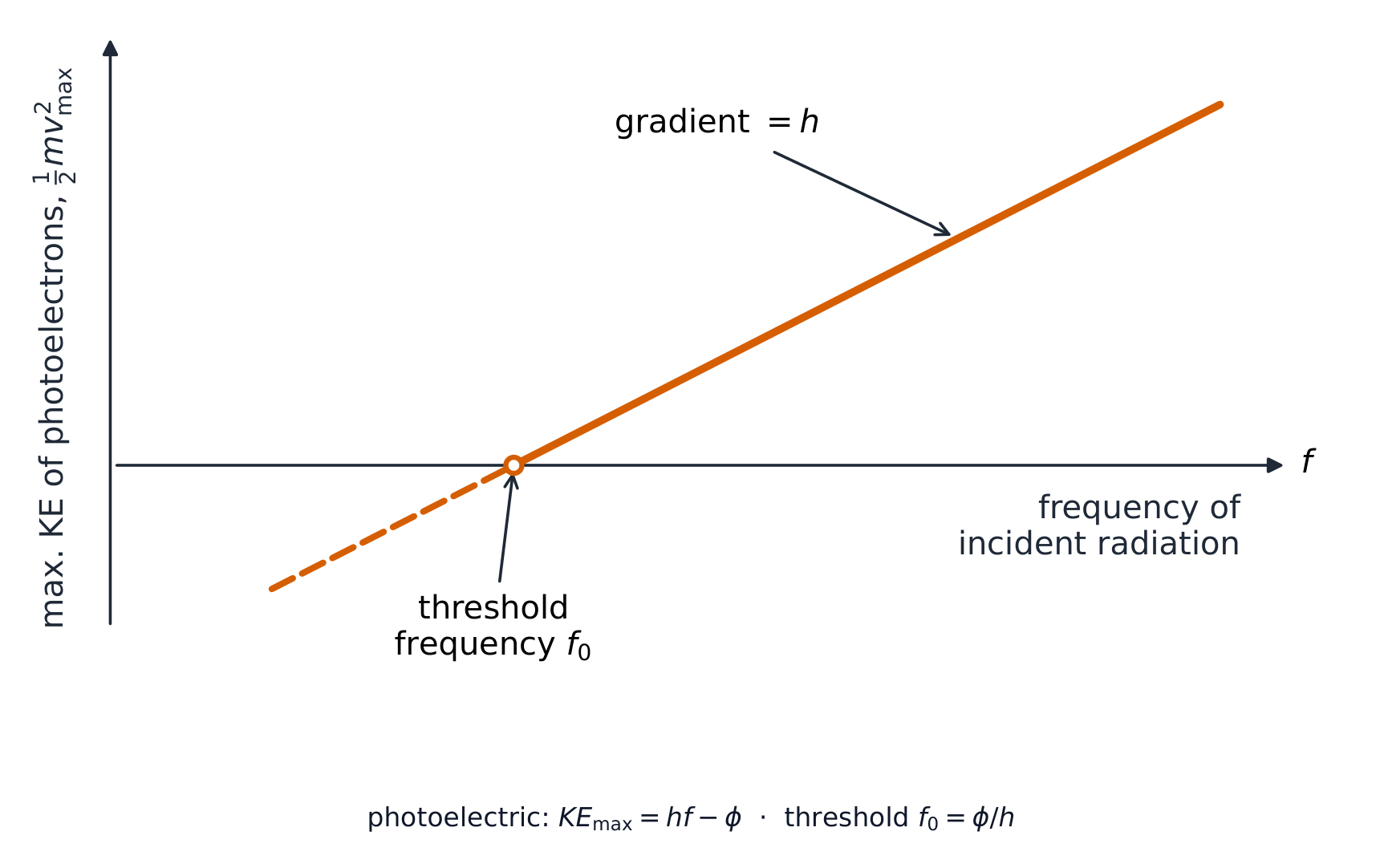
So the maximum KE of photoelectrons depends linearly on frequency, not on brightness.
Reading the graph. Write the equation as $E_{\text{K,max}} = hf - \Phi$: a straight line of gradient $h$, intercept $-\Phi$ on the energy axis and $f_{0} = \Phi/h$ on the frequency axis. So a graph for two metals shows two parallel lines (same gradient $h$ for every metal), the metal with the larger work function cutting the frequency axis further to the right; the intensity of the light moves neither line. This is how the Planck constant is measured, and "sketch the line for metal Y" is marked on exactly those two features.
Measuring the maximum kinetic energy. In a photocell the photoelectrons cross a vacuum to a collector and the current is a count of electrons per second. Make the collector negative and the electrons must climb a potential hill; raise the reverse p.d. until the current just reaches zero, the stopping potential 遏止电势$V_{\text{s}}$, and then $eV_{\text{s}} = E_{\text{K,max}}$. Two results, both examined: at fixed frequency, doubling the intensity doubles the current at low reverse p.d. but leaves $V_{\text{s}}$ unchanged; raising the frequency raises $V_{\text{s}}$ but, at fixed intensity, does not raise the current.
Why the wave model fails
A wave model predicts that brightness should set the electrons' kinetic energy, and that emission should happen at any frequency given enough time. But experiments show:
no emission below the threshold frequency, however bright.
immediate emission at or above the threshold, even when dim.
maximum KE depends on frequency, not brightness.
the number of photoelectrons (the current) depends on brightness.
The photon model explains this: light arrives as photons each of energy $hf$. One photon–electron interaction either has enough energy to free the electron ($hf \geq \Phi$) or it does not.
Why max KE is fixed but current grows with brightness
A brighter beam of the same frequency has more photons per second, but each still carries $hf$. So the maximum KE of any electron is $hf - \Phi$ (set by $f$ only), while the rate of emission (the current) grows with the number of photons, i.e. with brightness. Doubling the brightness doubles the current but does not change the maximum KE.
Writing the explanation (a standard three-marker). (1) Each photon interacts with, and gives all its energy to, one electron. (2) The photon energy $hf$ depends only on the frequency, so the maximum energy an electron can leave with, $hf - \Phi$, is fixed by the frequency. (3) Increasing the intensity at the same frequency increases the number of photons per second, so more electrons are emitted per second (a larger current), but each still receives the same energy. A wave, by contrast, would spread its energy over the surface, so a brighter wave should have given faster electrons and a dim one should have needed a delay to accumulate energy; neither happens.
Português
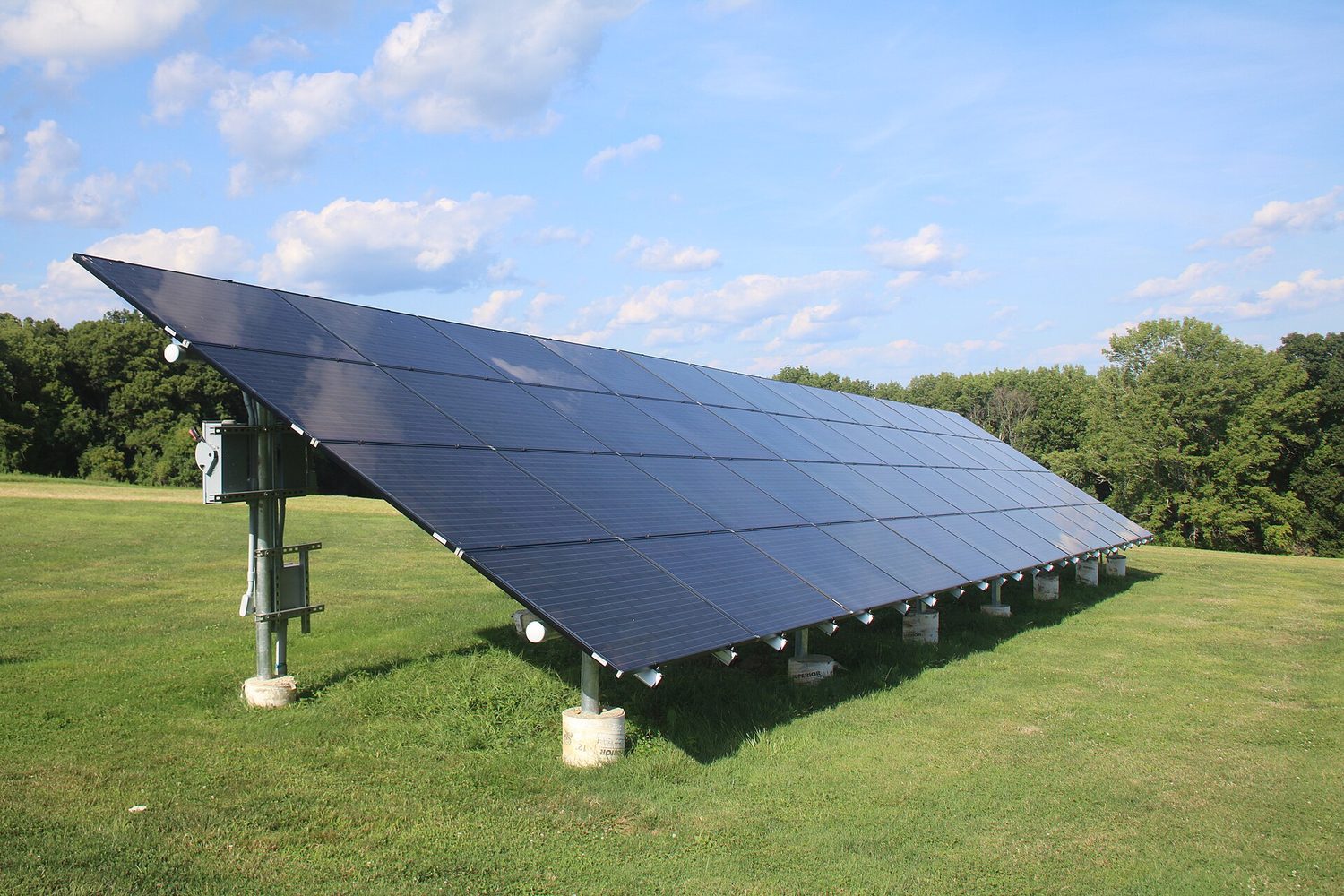
O efeito fotoelétrico, fóton por fótonCélulas solares usam o efeito fotoelétrico para converter luz em eletricidade.
Quando radiação EM de frequência suficientemente alta atinge um metal, elétrons são emitidos. Estes são fotoelétrons 光电子, e o efeito é o efeito fotoelétrico 光电效应.
"Afirme o que se entende pelo efeito fotoelétrico." A emissão de elétrons de (a superfície de) um metal quando radiação eletromagnética de frequência suficientemente alta incide sobre ele. Duas marcas: emissão de elétrons e de uma superfície metálica iluminada por radiação eletromagnética (ou "quando luz é projetada sobre ele"). É a evidência do programa para a natureza corpuscular da radiação, porque uma onda não poderia explicar o que se segue.
Um fóton dá sua energia $hf$ a um elétron: parte o libera (a função trabalho $\Phi$), o resto é a KE do elétronUma placa de zinco carregada perde sua carga — a lâmina de ouro cai — quando a luz ultravioleta incide sobre ela
Frequência limite e função trabalho
Cada metal possui uma frequência mínima de fóton, a frequência limite 极限频率$f_{0}$, abaixo da qual nenhum elétron é emitido, independentemente da intensidade da luz. A função trabalho 逸出功$\Phi$ é a menor energia necessária para libertar um elétron da superfície:
$$\Phi = h f_{0}.$$
Diferentes metais têm diferentes funções trabalho (cerca de $2$–$5\ \text{eV}$).
As definições de duas marcas.A energia de função trabalho de um metal é a energia mínima necessária para remover um elétron da superfície do metal. Ambas as palavras "mínima" e "da superfície" valem pontos: um elétron mais profundo no metal precisa de mais energia, motivo pelo qual a equação fornece uma energia cinética máxima. A frequência limite é a frequência mínima de radiação para a qual fotoelétrons são emitidos, e o comprimento de onda limite 极限波长$\lambda_{0} = c/f_{0} = hc/\Phi$ é o correspondente comprimento de onda máximo: comprimentos de onda maiores não causam efeito.
Exemplo resolvido. Luz de comprimento de onda $400\ \text{nm}$ incide sobre quatro metais cujas funções trabalho são: césio $2.1\ \text{eV}$, sódio $2.3\ \text{eV}$, zinco $4.3\ \text{eV}$, platina $5.6\ \text{eV}$. Quais emitem fotoelétrons e com que energia cinética máxima?
A energia do fóton é $hc/\lambda = 1240/400 = 3.1\ \text{eV}$. A emissão exige $hf \geq \Phi$, portanto césio ($3.1 - 2.1 = 1.0\ \text{eV}$) e sódio ($0.8\ \text{eV}$) emitem; zinco e platina não emitem, por mais intensa que seja a luz. Para fazer o zinco emitir, o comprimento de onda deve ser inferior a $\lambda_{0} = 1240/4.3 = 290\ \text{nm}$, na faixa ultravioleta, razão pela qual a demonstração com eletroscópio requer uma lâmpada UV no zinco.
Exemplo resolvido. Uma folha polida de magnésio em vácuo emite elétrons apenas quando a frequência ultravioleta é pelo menos $8.8 \times 10^{14}\ \text{Hz}$. Ela é iluminada a $1.2 \times 10^{15}\ \text{Hz}$. Encontre a função trabalho e a velocidade máxima dos fotoelétrons.
$\Phi = hf_{0} = (6.63 \times 10^{-34})(8.8 \times 10^{14}) = 5.8 \times 10^{-19}\ \text{J}$ ($3.6\ \text{eV}$). Então $\tfrac{1}{2}mv_{\text{max}}^{2} = h(f - f_{0}) = (6.63 \times 10^{-34})(1.2 \times 10^{15} - 8.8 \times 10^{14}) = 2.1 \times 10^{-19}\ \text{J}$, logo $v_{\text{max}} = \sqrt{2 \times 2.1 \times 10^{-19}/9.11 \times 10^{-31}} = 6.8 \times 10^{5}\ \text{m s}^{-1}$. Subtraia as frequências antes de multiplicar por $h$; arredondar $hf$ e $\Phi$ separadamente reduz uma algarismo significativo na pequena diferença.
Equação do efeito fotoelétrico de Einstein
Um fóton transfere toda a sua energia a um único elétron. Se a energia do fóton $hf$ for maior que a função trabalho, o elétron escapa com energia cinética até um máximo:
$$h f = \Phi + \tfrac{1}{2} m v_{\text{max}}^{2}, \qquad\text{so}\qquad \tfrac{1}{2} m v_{\text{max}}^{2} = h(f - f_{0}).$$
Exemplo resolvido. Um metal tem função trabalho de $2.0\ \text{eV}$. Luz composta por fótons de energia $3.5\ \text{eV}$ incide sobre ele. Encontre a energia cinética máxima dos fotoelétrons.
Assim, a energia cinética máxima dos fotoelétrons depende linearmente da frequência, não do brilho.
A energia cinética máxima dos fotoelétrons aumenta linearmente com a frequência, atingindo zero na frequência limite $f_0$Dois metais num mesmo gráfico: linhas paralelas (a inclinação é a constante de Planck para ambos), cada uma cortando o eixo das frequências na sua própria frequência limite e o eixo de energia em menos a sua própria função trabalho
Lendo o gráfico. Reescreva a equação como $E_{\text{K,max}} = hf - \Phi$: uma linha reta de inclinação $h$, intercepto $-\Phi$ no eixo de energia e $f_{0} = \Phi/h$ no eixo das frequências. Assim, um gráfico para dois metais mostra duas linhas paralelas (mesma inclinação $h$ para todo metal), o metal com maior função trabalho cortando o eixo das frequências mais à direita; a intensidade da luz não desloca nenhuma das linhas. É assim que a constante de Planck é medida, e "desenhe a linha para o metal Y" é pontuado exatamente por essas duas características.
Investigando o efeito: a corrente mede a taxa de emissão, e a p.d. reversível que para exatamente os elétrons mais rápidos mede sua energia cinética máxima
Medindo a energia cinética máxima. Numa célula fotoelétrica, os fotoelétrons atravessam o vácuo até um coletor e a corrente é uma contagem de elétrons por segundo. Torne o coletor negativo e os elétrons devem subir uma colina potencial; aumente a p.d. reversível até que a corrente caia a zero, a potencial de parada 遏止电势$V_{\text{s}}$, e então $eV_{\text{s}} = E_{\text{K,max}}$. Dois resultados cobrados em prova: a frequência fixa, dobrar a intensidade dobra a corrente a baixa p.d. reversível, mas deixa $V_{\text{s}}$ inalterado; aumentar a frequência eleva $V_{\text{s}}$, mas, a intensidade fixa, não eleva a corrente.
Por que o modelo de onda falha
Um modelo de onda prevê que o brilho deve definir a energia cinética dos elétrons e que a emissão deveria ocorrer em qualquer frequência dado tempo suficiente. Mas os experimentos mostram:
nenhuma emissão abaixo da frequência limite, por mais brilhante que seja.
emissão imediata em ou acima do limite, mesmo quando tênue.
energia cinética máxima depende da frequência, não do brilho.
o número de fotoelétrons (a corrente) depende do brilho.
O modelo de fótons explica isso: a luz chega como fótons, cada um com energia $hf$. Uma interação fóton-elétron ou tem energia suficiente para libertar o elétron ($hf \geq \Phi$) ou não tem.
Por que a KE máxima é fixa mas a corrente cresce com o brilho
Um feixe mais brilhante da mesma frequência tem mais fótons por segundo, mas cada um ainda carrega $hf$. Assim, a energia cinética máxima de qualquer elétron é $hf - \Phi$ (definida apenas por $f$), enquanto a taxa de emissão (a corrente) cresce com o número de fótons, isto é, com o brilho. Dobrar o brilho dobra a corrente, mas não altera a energia cinética máxima.
Escrevendo a explicação (um padrão de três marcadores). (1) Cada fóton interage com e transfere toda a sua energia a um elétron. (2) A energia do fóton $hf$ depende apenas da frequência, então a energia máxima que um elétron pode ter ao sair, $hf - \Phi$, é fixada pela frequência. (3) Aumentar a intensidade na mesma frequência aumenta o número de fótons por segundo, então mais elétrons são emitidos por segundo (uma corrente maior), mas cada um ainda recebe a mesma energia. Uma onda, por outro lado, espalharia sua energia sobre a superfície, então uma onda mais brilhante deveria ter dado elétrons mais rápidos e uma tênue deveria ter precisado de atraso para acumular energia; nada disso acontece.
Explore · Explorar
Efeito fotoelétrico
KEmax = h·f − φ
KE máxima é uma linha reta em função da frequência, com intercepto −φ (a função trabalho).
understand that the photoelectric effect provides evidence for a particulate nature of electromagnetic radiation while phenomena such as interference and diffraction provide evidence for a wave nature
describe and interpret qualitatively the evidence provided by electron diffraction for the wave nature of particles
understand the de Broglie wavelength as the wavelength associated with a moving particle
recall and use $\lambda = h/p$
Português
compreender que o efeito fotoelétrico fornece evidências para uma natureza corpuscular da radiação eletromagnética, enquanto fenômenos como interferência e difração fornecem evidências para uma natureza ondulatória
descrever e interpretar qualitativamente as evidências fornecidas pela difração de elétrons para a natureza ondulatória das partículas
compreender o comprimento de onda de de Broglie como o comprimento de onda associado a uma partícula em movimento
recordar e usar $\lambda = h/p$
Source: Cambridge International syllabus · Fonte: Programa Cambridge International
English
The photoelectric effect is strong evidence for the particle nature of light. But interference 干涉 (Young's double slit, the diffraction grating 衍射光栅) and diffraction 衍射 show its wave nature. So light has both wave and particle sides — this is wave–particle duality 波粒二象性.
"Describe what is meant by wave–particle duality" (two marks).Electromagnetic radiation (and matter) can exhibit both wave properties, such as interference and diffraction, and particle properties, such as the photoelectric effect (or, for matter, discrete collisions). Asked for one piece of evidence for each nature of radiation, give: particulate, the photoelectric effect (the threshold frequency and the immediate emission); wave, diffraction or interference (Young's slits, a diffraction grating). For matter, the wave evidence is electron diffraction.
De Broglie hypothesis
If a wave can act like particles, perhaps particles can act like waves. De Broglie proposed that any moving particle has a de Broglie wavelength 德布罗意波长:
$$\lambda = \frac{h}{p},$$
where $p = mv$. Example: an electron at $v = 4.9 \times 10^{7}\ \text{m s}^{-1}$ has $p = 4.46 \times 10^{-23}\ \text{kg m s}^{-1}$, so $\lambda = 1.49 \times 10^{-11}\ \text{m} \approx 0.015\ \text{nm}$ — close to atomic spacings.
"State what is meant by the de Broglie wavelength."The wavelength associated with a moving particle, or the wavelength of the wave associated with a particle of momentum $p$, given by $\lambda = h/p$ where $h$ is the Planck constant. In "state the formula and the meaning of any other symbol", name $h$ as the Planck constant and $p$ as the momentum of the particle. The wavelength is small because $h$ is small: a $0.10\ \text{kg}$ ball at $10\ \text{m s}^{-1}$ has $\lambda = 6.6 \times 10^{-34}\ \text{m}$, far below any slit or lattice spacing, which is why everyday objects show no diffraction.
Electron diffraction
When electrons are fired at a crystal lattice 晶格 (e.g. thin graphite), they make a diffraction pattern of bright rings on a screen — exactly what waves of wavelength $\lambda = h/p$ would do. This is direct evidence for the wave nature of particles (electron diffraction 电子衍射): only waves diffract, yet electrons do.
A faster electron has more momentum, so a shorter de Broglie wavelength, which diffracts less — the rings move closer together. Slowing the electrons spreads the rings apart. To calculate: $p = \sqrt{2 m E_{\text{K}}}$, and for an electron accelerated through p.d. $V$, $E_{\text{K}} = eV$, so $\lambda = h/\sqrt{2m_{e} e V}$.
Worked example. An electron is accelerated from rest through a p.d. of $2500\ \text{V}$. Find its de Broglie wavelength. ($m_{e} = 9.11 \times 10^{-31}\ \text{kg}$, $e = 1.6 \times 10^{-19}\ \text{C}$, $h = 6.63 \times 10^{-34}\ \text{J s}$.)
Its kinetic energy is $E_{\text{K}} = eV$, so $\lambda = \dfrac{h}{\sqrt{2 m_{e} e V}}$:
This is close to the spacing between atoms in a crystal, which is why the electrons diffract off the graphite.
Deriving $\lambda$ for an accelerated electron. An electron of mass $m$ and charge $q$ accelerated from rest through a p.d. $V$ gains kinetic energy $qV = \tfrac{1}{2}mv^{2}$, so $v = \sqrt{2qV/m}$ and $p = mv = \sqrt{2mqV}$; hence $\lambda = h/\sqrt{2mqV}$. Two consequences the exam asks for: increasing$V$ increases the momentum and shortens the wavelength, so the diffraction rings shrink towards the centre; halving the wavelength needs four times the p.d.
Describing electron diffraction (four marks). (1) Electrons from a heated filament are accelerated through a high p.d. into a beam. (2) The beam meets a thin polycrystalline 多晶的 graphite film; the regular spacing of the carbon atoms, about $10^{-10}\ \text{m}$, acts as a diffraction grating. (3) On a fluorescent screen the electrons produce a bright central spot surrounded by concentric rings. (4) Rings are a diffraction pattern, and diffraction is a wave property, so the electrons are behaving as waves; the ring radii match a wavelength $h/p$, which confirms de Broglie's relation. Sketch the pattern as rings, not spots or a fringe pattern. A faster beam gives rings of smaller radius.
Português
O efeito fotoelétrico é forte evidência da natureza particular da luz. Mas interferência 干涉 (fenda dupla de Young, a rede de difração 衍射光栅) e difração 衍蚓 mostram sua natureza ondulatória. Assim, a luz tem ambos os lados — onda e partícula — isso é dualidade onda-partícula 波粒二象性.
"Descreva o que se entende por dualidade onda-partícula" (duas marcas).Radiação eletromagnética (e matéria) pode exibir tanto propriedades ondulatórias, como interferência e difração, quanto propriedades particulares, como o efeito fotoelétrico (ou, para matéria, colisões discretas). Pedida uma peça de evidência para cada natureza da radiação, dê: partícula, o efeito fotoelétrico (a frequência limite e a emissão imediata); onda, difração ou interferência (fendas de Young, uma rede de difração). Para matéria, a evidência ondulatória é a difração de elétrons.
Hipótese de De Broglie
Se uma onda pode agir como partículas, talvez partículas possam agir como ondas. De Broglie propôs que qualquer partícula em movimento tem um comprimento de onda de De Broglie 德布罗意波长:
$$\lambda = \frac{h}{p},$$
onde $p = mv$. Exemplo: um elétron a $v = 4.9 \times 10^{7}\ \text{m s}^{-1}$ tem $p = 4.46 \times 10^{-23}\ \text{kg m s}^{-1}$, logo $\lambda = 1.49 \times 10^{-11}\ \text{m} \approx 0.015\ \text{nm}$ — próximo às distâncias atômicas.
"Enuncie o que se entende por comprimento de onda de De Broglie."O comprimento de onda associado a uma partícula em movimento, ou o comprimento de onda da onda associada a uma partícula de momento $p$, dado por $\lambda = h/p$ onde $h$ é a constante de Planck. Em "enuncie a fórmula e o significado de qualquer outro símbolo", nomeie $h$ como a constante de Planck e $p$ como o momento da partícula. O comprimento de onda é pequeno porque $h$ é pequeno: uma bola de $0.10\ \text{kg}$ a $10\ \text{m s}^{-1}$ tem $\lambda = 6.6 \times 10^{-34}\ \text{m}$, muito abaixo de qualquer fenda ou espaçamento de rede, razão pela qual objetos cotidianos não mostram difração.
Difração de elétrons
Quando elétrons são disparados contra uma rede cristalina 晶格 (ex. grafite fino), eles formam um padrão de difração de anéis brilhantes numa tela — exatamente o que ondas de comprimento de onda $\lambda = h/p$ fariam. Esta é evidência direta da natureza ondulatória das partículas (difração de elétrons 电子衍射): apenas ondas difratam, contudo os elétrons o fazem.
Um elétron mais rápido tem mais momento, logo um comprimento de onda de De Broglie mais curto, que difrata menos — os anéis ficam mais juntos. Desacelerar os elétrons espalha os anéis. Para calcular: $p = \sqrt{2 m E_{\text{K}}}$, e para um elétron acelerado através de p.d. $V$, $E_{\text{K}} = eV$, logo $\lambda = h/\sqrt{2m_{e} e V}$.
Elétrons disparados contra grafite formam um padrão de difração em anéis — apenas ondas difratam, logo os elétrons se comportam como ondas
Exemplo resolvido. Um elétron é acelerado do repouso através de uma p.d. de $2500\ \text{V}$. Encontre seu comprimento de onda de De Broglie. ($m_{e} = 9.11 \times 10^{-31}\ \text{kg}$, $e = 1.6 \times 10^{-19}\ \text{C}$, $h = 6.63 \times 10^{-34}\ \text{J s}$.)
Sua energia cinética é $E_{\text{K}} = eV$, logo $\lambda = \dfrac{h}{\sqrt{2 m_{e} e V}}$:
Isso é próximo ao espaçamento entre átomos num cristal, razão pela qual os elétrons difratam no grafite.
Derivando $\lambda$ para um elétron acelerado. Um elétron de massa $m$ e carga $q$ acelerado do repouso através de uma p.d. $V$ ganha energia cinética $qV = \tfrac{1}{2}mv^{2}$, logo $v = \sqrt{2qV/m}$ e $p = mv = \sqrt{2mqV}$; logo $\lambda = h/\sqrt{2mqV}$. Duas consequências que a prova pede: aumentar$V$ aumenta o momento e encurta o comprimento de onda, logo os anéis de difração encolhem em direção ao centro; reduzir o comprimento de onda pela metade exige quatro vezes a p.d.
Descrevendo a difração de elétrons (quatro pontos). (1) Elétrons de um filamento aquecido são acelerados por uma alta d.p. em um feixe. (2) O feixe encontra um filme fino de grafite poli cristalino 多晶; o espaçamento regular dos átomos de carbono, cerca de $10^{-10}\ \text{m}$, atua como uma rede de difração. (3) Em uma tela fluorescente, os elétrons produzem um ponto central brilhante rodeado por anéis concêntricos. (4) Os anéis são um padrão de difração e a difração é uma propriedade de onda, então os elétrons estão se comportando como ondas; os raios dos anéis correspondem a um comprimento de onda $h/p$, o que confirma a relação de de Broglie. Desenhe o padrão como anéis, não como pontos ou um padrão de franjas. Um feixe mais rápido produz anéis de raio menor.
Explore · Explorar
O comprimento de onda de de Broglie
λ = h/p
O comprimento de onda de uma partícula é inversamente proporcional ao seu momento — partículas mais rápidas e pesadas têm ondas mais curtas.
Energy levels in atoms · Níveis de energia em átomos
Syllabus · Programa
English
understand that there are discrete electron energy levels in isolated atoms (e.g. atomic hydrogen)
understand the appearance and formation of emission and absorption line spectra
recall and use $hf = E_1 - E_2$
Português
compreender que existem níveis de energia eletrônicos discretos em átomos isolados (ex.: hidrogênio atômico)
compreender a aparência e formação de espectros de linhas de emissão e absorção
recordar e usar $hf = E_1 - E_2$
Source: Cambridge International syllabus · Fonte: Programa Cambridge International
English
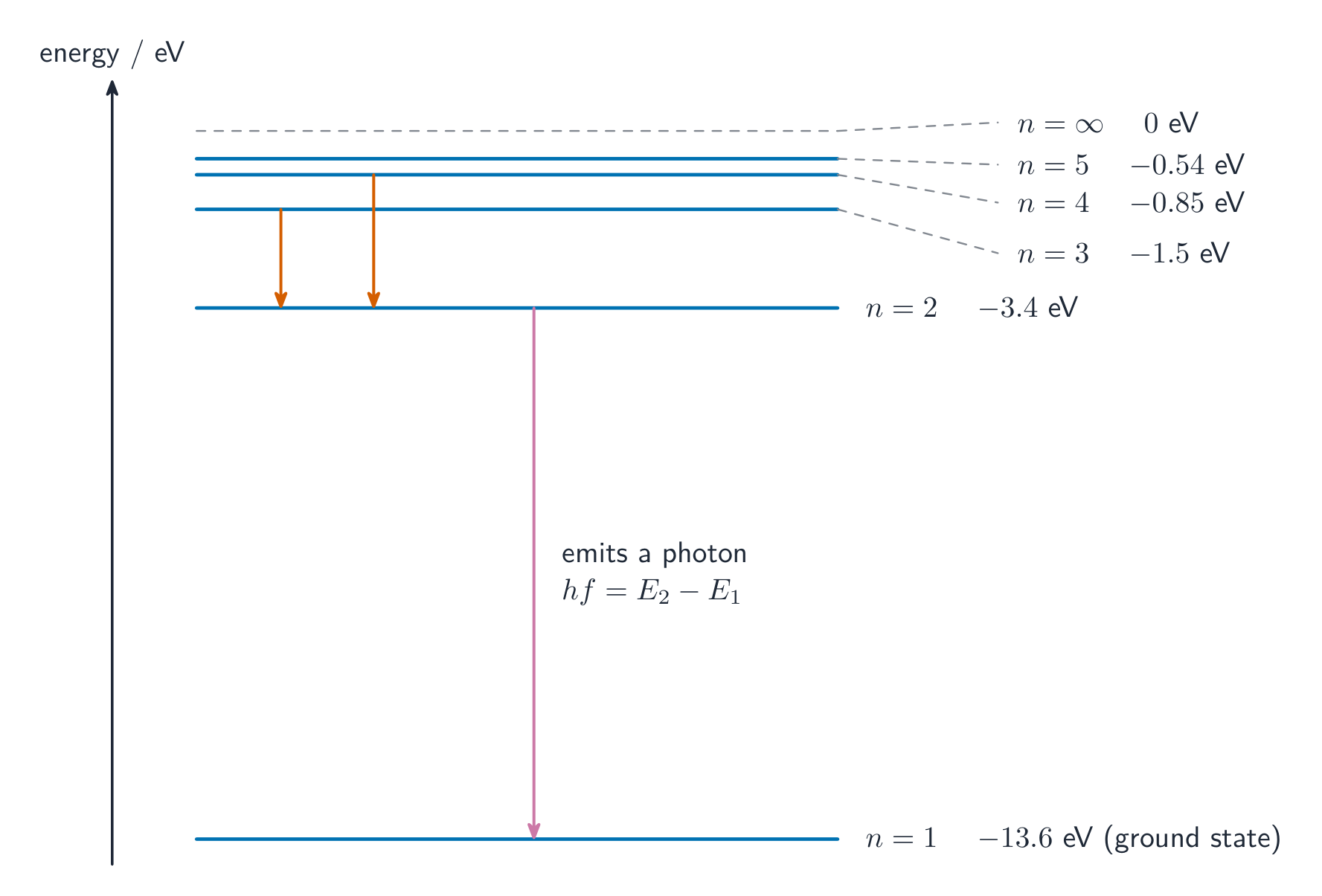
In an isolated atom, electrons can only sit at certain discrete 分立energy levels 能级 — never in between. The lowest is the ground state 基态; the others are excited states 激发态.
By convention, energies are written negative, with $E = 0$ for an electron just free of the atom. For hydrogen the ground state is $E_{1} = -13.6\ \text{eV}$; higher states approach zero.
Emission spectrum
When an electron drops from a higher level $E_{2}$ to a lower level $E_{1}$, it emits one photon of energy
$$h f = E_{2} - E_{1}.$$
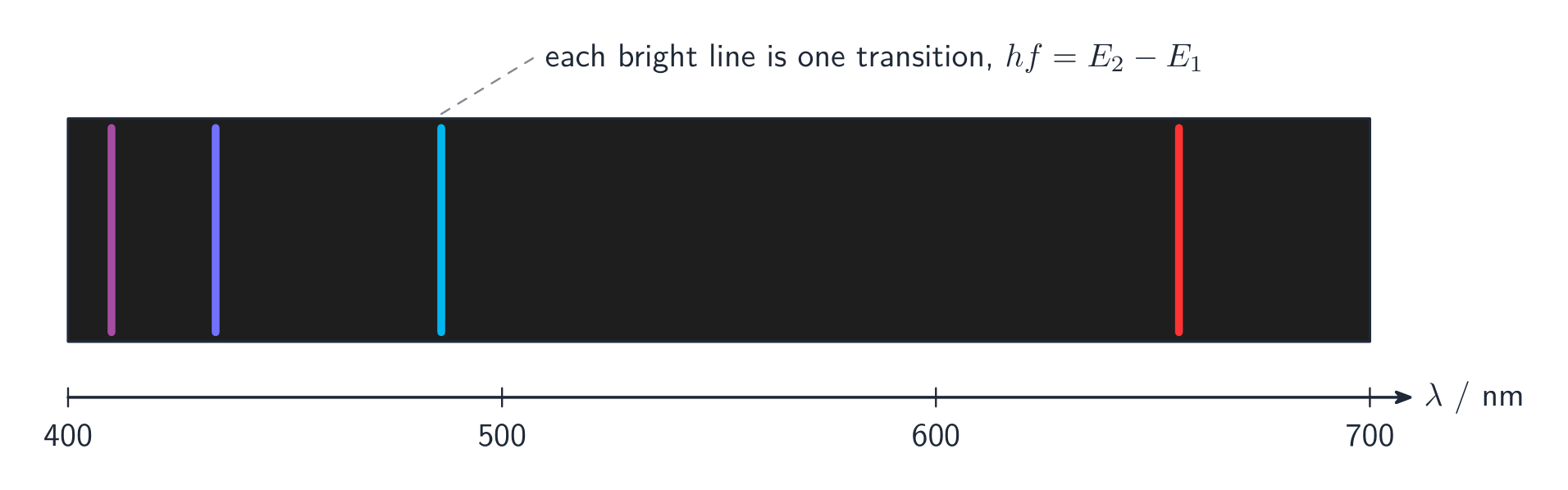
(Both energies are negative; their difference is positive.) Because the levels are discrete, only certain photon energies — and so certain wavelengths — come out. The emission spectrum 发射光谱 is a set of sharp bright lines on a dark background, one line per transition 跃迁. The pattern is a "fingerprint" of the element.
Explaining a line spectrum (the standard four-marker). (1) The electrons in an isolated atom can only occupy discrete energy levels. (2) An electron in an excited state falls to a lower level and the energy it loses is emitted as one photon. (3) The photon energy equals the difference between the two levels, $hf = E_{2} - E_{1}$, so only certain frequencies (wavelengths) are emitted. (4) Each possible transition gives one line; the same set of levels gives the same lines every time, which is why a spectrum identifies the element. Asked to match lines to transitions: the largest energy gap gives the line of highest frequency and shortest wavelength.
Absorption spectrum
When white light passes through a cool gas, photons whose energy exactly matches an upward transition are absorbed. The light then shows dark lines on a bright background — the absorption spectrum 吸收光谱. The dark lines sit at the same wavelengths as the emission lines of the same gas.
Explaining the dark lines. Photons whose energy equals the difference between two levels are absorbed, raising an electron to the higher level; the excited electron soon falls back and re-emits a photon of the same energy, but in a random direction, so almost none of that light continues along the original path. The rest of the white light, whose photons match no gap, passes through unchanged. Hence dark lines at exactly the wavelengths the same gas would emit: the Sun's spectrum shows the absorption lines of the cooler gases in its outer layers.
Work in consistent units — convert eV to joules (× $1.60 \times 10^{-19}$) before finding $\lambda$ in metres, or use $hc \approx 1240\ \text{eV nm}$ for a quick estimate.
Worked example. The lowest four energy levels of hydrogen are $-13.6$, $-3.40$, $-1.51$ and $-0.85\ \text{eV}$. Find the wavelengths of the three lines produced by transitions to the ground state, and the number of lines these four levels can produce altogether.
Transition $2 \to 1$: $\Delta E = 13.6 - 3.40 = 10.2\ \text{eV}$, so $\lambda = 1240/10.2 = 122\ \text{nm}$. $3 \to 1$: $12.09\ \text{eV}$, $\lambda = 103\ \text{nm}$. $4 \to 1$: $12.75\ \text{eV}$, $\lambda = 97.3\ \text{nm}$: all ultraviolet, the largest jump giving the shortest wavelength. Four levels allow $4 \to 3$, $4 \to 2$, $4 \to 1$, $3 \to 2$, $3 \to 1$ and $2 \to 1$: six lines. The visible red line of hydrogen is $3 \to 2$: $1.89\ \text{eV}$, $656\ \text{nm}$. (Working in joules: $10.2\ \text{eV} = 1.63 \times 10^{-18}\ \text{J}$, $\lambda = hc/E = 1.99 \times 10^{-25}/1.63 \times 10^{-18} = 1.22 \times 10^{-7}\ \text{m}$.)
Worked example. A laser emits red light of wavelength $650\ \text{nm}$ when electrons drop from one level to another. Find the energy gap between the two levels.
$\Delta E = hc/\lambda = 1240/650 = 1.91\ \text{eV} = 3.1 \times 10^{-19}\ \text{J}$. The gap, not either level, fixes the colour: two atoms with different levels but the same gap emit the same line.
Worked example (annihilation). An electron and a positron, each moving slowly, meet and annihilate 湮灭, producing two identical photons. Find the wavelength of each photon. ($m_{\text{e}} = 9.11 \times 10^{-31}\ \text{kg}$.)
The rest energy of each particle is $E = mc^{2} = (9.11 \times 10^{-31})(3.00 \times 10^{8})^{2} = 8.2 \times 10^{-14}\ \text{J}$ ($0.51\ \text{MeV}$), and momentum conservation shares the energy between two photons moving in opposite directions, so each carries $8.2 \times 10^{-14}\ \text{J}$: $\lambda = hc/E = 1.99 \times 10^{-25}/8.2 \times 10^{-14} = 2.4 \times 10^{-12}\ \text{m}$, a gamma ray. (Any kinetic energy the pair had is added to the photon energies.)
Português
Em um átomo isolado, os elétrons podem ocupar apenas certos níveis de energia discretos 分立energy levels 能级 — nunca entre eles. O mais baixo é o estado fundamental 基态; os demais são estados excitados 激发态.
Por convenção, as energias são escritas negativas, com $E = 0$ para um elétron livre do átomo. Para o hidrogênio, o estado fundamental é $E_{1} = -13.6\ \text{eV}$; estados superiores aproximam-se de zero.
Os níveis de energia do elétron no hidrogênio são discretos e negativos, com o estado fundamental em $-13.6\ \text{eV}$
Espectro de emissão
Quando um elétron cai de um nível mais alto $E_{2}$ para um nível mais baixo $E_{1}$, ele emite um fóton de energia
$$h f = E_{2} - E_{1}.$$
(Ambas as energias são negativas; sua diferença é positiva.) Como os níveis são discretos, apenas certas energias de fótons — e, portanto, certos comprimentos de onda — são emitidos. O espectro de emissão 发射光谱 é um conjunto de linhas brilhantes finas sobre um fundo escuro, uma linha por transição 跃迁. O padrão é uma "impressão digital" do elemento.
Explicando um espectro de linhas (o marcador padrão de quatro). (1) Os elétrons em um átomo isolado só podem ocupar níveis de energia discretos. (2) Um elétron em um estado excitado cai para um nível mais baixo e a energia que perde é emitida como um único fóton. (3) A energia do fóton é igual à diferença entre os dois níveis, $hf = E_{2} - E_{1}$, então apenas certas frequências (comprimentos de onda) são emitidas. (4) Cada transição possível dá uma linha; o mesmo conjunto de níveis produz as mesmas linhas sempre, pelo que um espectro identifica o elemento. Pedido para associar linhas às transições: a maior lacuna de energia resulta na linha de maior frequência e menor comprimento de onda.
*O espectro de emissão do hidrogênio é um conjunto de linhas brilhantes finas sobre um fundo escuro
*Espectros de emissão reais dos elementos: cada um é um conjunto único de linhas brilhantes — uma impressão digital daquele elemento
Espectro de absorção
Quando luz branca passa por um gás frio, fótons cuja energia corresponde exatamente a uma transição ascendente são absorvidos. A luz mostra então linhas escuras sobre um fundo brilhante — o espectro de absorção 吸收光谱. As linhas escuras estão nos mesmos comprimentos de onda das linhas de emissão do mesmo gás.
Explicando as linhas escuras. Fótons cuja energia é igual à diferença entre dois níveis são absorvidos, elevando um elétron ao nível mais alto; o elétron excitado logo volta e reemite um fóton da mesma energia, mas em uma direção aleatória, quase nenhum dessa luz continua no caminho original. O resto da luz branca, cujos fótons não correspondem a nenhuma lacuna, passa inalterado. Daí as linhas escuras exatamente nos comprimentos de onda que o mesmo gás emitiria: o espectro do Sol mostra as linhas de absorção dos gases mais frios em suas camadas externas.
*Linhas escuras de absorção no espectro do Sol marcam os comprimentos de onda absorvidos pelo gás mais frio
Trabalhe em unidades consistentes — converta eV para joules (× $1.60 \times 10^{-19}$) antes de encontrar $\lambda$ em metros, ou use $hc \approx 1240\ \text{eV nm}$ para uma estimativa rápida.
*De níveis para linhas: cada transição para baixo até o estado fundamental produz uma linha, e o maior salto landing mais longe na extremidade de menor comprimento de onda
Exemplo resolvido. Os quatro níveis de energia mais baixos do hidrogênio são $-13.6$, $-3.40$, $-1.51$ e $-0.85\ \text{eV}$. Encontre os comprimentos de onda das três linhas produzidas por transições para o estado fundamental, e o número total de linhas que esses quatro níveis podem produzir.
Transição $2 \to 1$: $\Delta E = 13.6 - 3.40 = 10.2\ \text{eV}$, então $\lambda = 1240/10.2 = 122\ \text{nm}$. $3 \to 1$: $12.09\ \text{eV}$, $\lambda = 103\ \text{nm}$. $4 \to 1$: $12.75\ \text{eV}$, $\lambda = 97.3\ \text{nm}$: todos ultravioleta, o maior salto dando o menor comprimento de onda. Quatro níveis permitem $4 \to 3$, $4 \to 2$, $4 \to 1$, $3 \to 2$, $3 \to 1$ e $2 \to 1$: seis linhas. A linha vermelha visível do hidrogênio é $3 \to 2$: $1.89\ \text{eV}$, $656\ \text{nm}$. (Trabalhando em joules: $10.2\ \text{eV} = 1.63 \times 10^{-18}\ \text{J}$, $\lambda = hc/E = 1.99 \times 10^{-25}/1.63 \times 10^{-18} = 1.22 \times 10^{-7}\ \text{m}$.)
Exemplo resolvido. Um laser emite luz vermelha de comprimento de onda $650\ \text{nm}$ quando elétrons caem de um nível para outro. Encontre a lacuna de energia entre os dois níveis.
$\Delta E = hc/\lambda = 1240/650 = 1.91\ \text{eV} = 3.1 \times 10^{-19}\ \text{J}$. A lacuna, não qualquer nível, define a cor: dois átomos com níveis diferentes, mas a mesma lacuna, emitem a mesma linha.
Exemplo resolvido (aniquilação). Um elétron e um pósitron, ambos movendo-se lentamente, encontram-se e aniquilam 湮灭, produzindo dois fótons idênticos. Encontre o comprimento de onda de cada fóton. ($m_{\text{e}} = 9.11 \times 10^{-31}\ \text{kg}$.)
A energia de repouso de cada partícula é $E = mc^{2} = (9.11 \times 10^{-31})(3.00 \times 10^{8})^{2} = 8.2 \times 10^{-14}\ \text{J}$ ($0.51\ \text{MeV}$), e a conservação do momento divide a energia entre dois fótons movendo-se em direções opostas, então cada um carrega $8.2 \times 10^{-14}\ \text{J}$: $\lambda = hc/E = 1.99 \times 10^{-25}/8.2 \times 10^{-14} = 2.4 \times 10^{-12}\ \text{m}$, um raio gama. (Qualquer energia cinética que o par tivesse é adicionada às energias dos fótons.)
Explore · Explorar
Formam as linhas espectrais de um elemento
Um elétron caindo entre níveis de energia fixos emite um fóton com exatamente a energia da diferença — um comprimento de onda e cor fixos. Cada salto é uma linha do código de barras do elemento.
Definitions the examiner accepts · Definições aceitas pelo examinador
English
A definition question is marked against fixed wording. Learn these exactly, and give one answer only.
Term
Definition
photon
a quantum (discrete packet) of energy of electromagnetic radiation
electronvolt
the energy gained by an electron accelerated through a potential difference of one volt; $1.60 \times 10^{-19}\ \text{J}$
photoelectric effect
the emission of electrons from a metal surface when electromagnetic radiation of high enough frequency is incident on it
work function energy
the minimum energy needed to remove an electron from the surface of the metal
threshold frequency
the minimum frequency of radiation that causes photoelectric emission from a metal
threshold wavelength
the maximum wavelength of radiation that causes photoelectric emission, $\lambda_{0} = hc/\Phi$
wave–particle duality
radiation and matter show both wave properties (diffraction, interference) and particle properties (photoelectric effect, discrete collisions)
de Broglie wavelength
the wavelength associated with a moving particle, $\lambda = h/p$
energy level
one of the discrete energies an electron in an isolated atom may have
emission line spectrum
a set of bright lines of definite wavelengths, each from a transition between two energy levels
absorption line spectrum
dark lines on a continuous spectrum at the wavelengths absorbed by transitions to higher levels
Português
Uma questão de definição é avaliada contra wording fixo. Aprenda estas exatamente, e dê apenas uma resposta.
Termo
Definição
fóton
um quanta (pacote discreto) de energia da radiação eletromagnética
eletronvolt
a energia ganho por um elétron acelerado através de uma diferença de potencial de um volt; $1.60 \times 10^{-19}\ \text{J}$
efeito fotoelétrico
a emissão de elétrons da superfície de um metal quando radiação eletromagnética de frequência suficientemente alta incide sobre ele
energia de função trabalho
a energia mínima necessária para remover um elétron da superfície do metal
frequência limiar
a frequência mínima de radiação que causa emissão fotoelétrica de um metal
comprimento de onda limiar
o comprimento de onda máximo de radiação que causa emissão fotoelétrica, $\lambda_{0} = hc/\Phi$
dualidade onda-partícula
radiação e matéria mostram tanto propriedades de onda (difração, interferência) quanto propriedades de partícula (efeito fotoelétrico, colisões discretas)
comprimento de onda de de Broglie
o comprimento de onda associado a uma partícula em movimento, $\lambda = h/p$
nível de energia
uma das energias discretas que um elétron em um átomo isolado pode ter
espectro de linhas de emissão
um conjunto de linhas brilhantes de comprimentos de onda definidos, cada uma de uma transição entre dois níveis de energia
espectro de linhas de absorção
linhas escuras em um espectro contínuo nos comprimentos de onda absorvidos por transições para níveis superiores
22.4
Exam tips · Dicas de prova
English
Photon: $E = hf = hc/\lambda$, $p = E/c = h/\lambda$. Use $hc = 1240\ \text{eV nm}$ to move between wavelength and energy in eV, then convert to joules only if the answer demands it.
Photoelectric equation $hf = \Phi + \tfrac{1}{2}mv_{\text{max}}^{2}$: maximum energy, one photon to one electron; the graph of $E_{\text{K,max}}$ against $f$ has gradient $h$ and intercepts $f_{0}$ and $-\Phi$.
Intensity changes the number of photons per second (the current); frequency changes the energy of each (the maximum kinetic energy). Keep those two sentences apart and every explanation writes itself.
Evidence: photoelectric effect for particles, diffraction and interference for waves; electron diffraction for the wave nature of matter, with $\lambda = h/p = h/\sqrt{2mqV}$.
Line spectra: discrete levels, one photon per transition, $hf = E_{2} - E_{1}$; the biggest gap gives the shortest wavelength; absorption lines sit where emission lines would, because the absorbed light is re-emitted in all directions.
Radiation pressure: force $=$ photons per second $\times$ momentum change per photon; $2p$ for a mirror, $p$ for an absorber; pressure depends on intensity, not colour.
Common mistakes
Defining a photon as "a particle of light" without "quantum/packet of energy", or the work function without "minimum" and "from the surface".
Saying brighter light gives faster photoelectrons, or that below the threshold frequency emission happens eventually.
Mixing eV and joules in one equation; forgetting to subtract the work function; using $\tfrac{1}{2}mv^{2}$ with the maximum kinetic energy in eV.
Writing the de Broglie wavelength for an accelerated electron as $h/(mv)$ with $v$ guessed, instead of $h/\sqrt{2mqV}$.
Describing electron diffraction as bright fringes or spots; the pattern is concentric rings, and a higher p.d. makes them smaller.
Getting the direction of a transition wrong: emission is a fall to a lower level, absorption a rise; the photon energy is the difference, never the energy of one level.
Claiming the largest energy gap gives the longest wavelength.
Forgetting that a reflected photon changes momentum by $2p$, or that the pressure of blue light of the same intensity is the same as red.
Português
Fóton: $E = hf = hc/\lambda$, $p = E/c = h/\lambda$. Use $hc = 1240\ \text{eV nm}$ para mover entre comprimento de onda e energia em eV, depois converta para joules apenas se a resposta exigir.
Equação fotoelétrica $hf = \Phi + \tfrac{1}{2}mv_{\text{max}}^{2}$: energia máxima, um fóton para um elétron; o gráfico de $E_{\text{K,max}}$ contra $f$ tem inclinação $h$ e interceptos $f_{0}$ e $-\Phi$.
Intensidade muda o número de fótons por segundo (a corrente); frequência muda a energia de cada um (a energia cinética máxima). Mantenha essas duas frases separadas e toda explicação se escreve sozinha.
Evidência: efeito fotoelétrico para partículas, difração e interferência para ondas; difração de elétrons para a natureza ondulatória da matéria, com $\lambda = h/p = h/\sqrt{2mqV}$.
Espectros de linhas: níveis discretos, um fóton por transição, $hf = E_{2} - E_{1}$; a maior lacuna dá o menor comprimento de onda; linhas de absorção ficam onde estariam as linhas de emissão, porque a luz absorvida é reemitida em todas as direções.
Pressão de radiação: força $=$ fótons por segundo $\times$ mudança de momento por fóton; $2p$ para um espelho, $p$ para um absorvedor; a pressão depende da intensidade, não da cor.
Erros comuns
Definir um fóton como "uma partícula de luz" sem "quanta/pacote de energia", ou a função trabalho sem "mínimo" e "da superfície".
Dizer que luz mais brilhante dá fotoeletrons mais rápidos, ou que abaixo da frequência limiar a emissão acontece eventualmente.
Misturar eV e joules em uma equação; esquecer de subtrair a função trabalho; usar $\tfrac{1}{2}mv^{2}$ com a energia cinética máxima em eV.
Escrever o comprimento de onda de de Broglie para um elétron acelerado como $h/(mv)$ com $v$ adivinhado, em vez de $h/\sqrt{2mqV}$.
Descrever a difração de elétrons como franjas brilhantes ou pontos; o padrão é anéis concêntricos, e uma d.p. maior os torna menores.
Obter a direção de uma transição errada: emissão é uma queda para um nível mais baixo, absorção uma subida; a energia do fóton é a diferença, nunca a energia de um nível.
Afirmar que a maior lacuna de energia dá o maior comprimento de onda.
Esquecer que um fóton refletido muda o momento em $2p$, ou que a pressão de luz azul da mesma intensidade é a mesma que a vermelha.
Interactive lessons on this topic · Aulas interativas sobre este tópico
Work through it step by step, with instant-check exercises. · Passe por ele passo a passo, com exercícios de verificação instantânea.
Pick one and the site follows you — notes, papers, videos and practice all open on it. · Escolha uma e o site te seguirá — notas, provas, vídeos e prática abrirão nela.
Type to search notes, lessons, code, vocabulary and past-paper questions across every subject. · Digite para pesquisar notas, aulas, código, vocabulário e questões de provas anteriores em todas as disciplinas.






 *O espectro de emissão do hidrogênio é um conjunto de linhas brilhantes finas sobre um fundo escuro
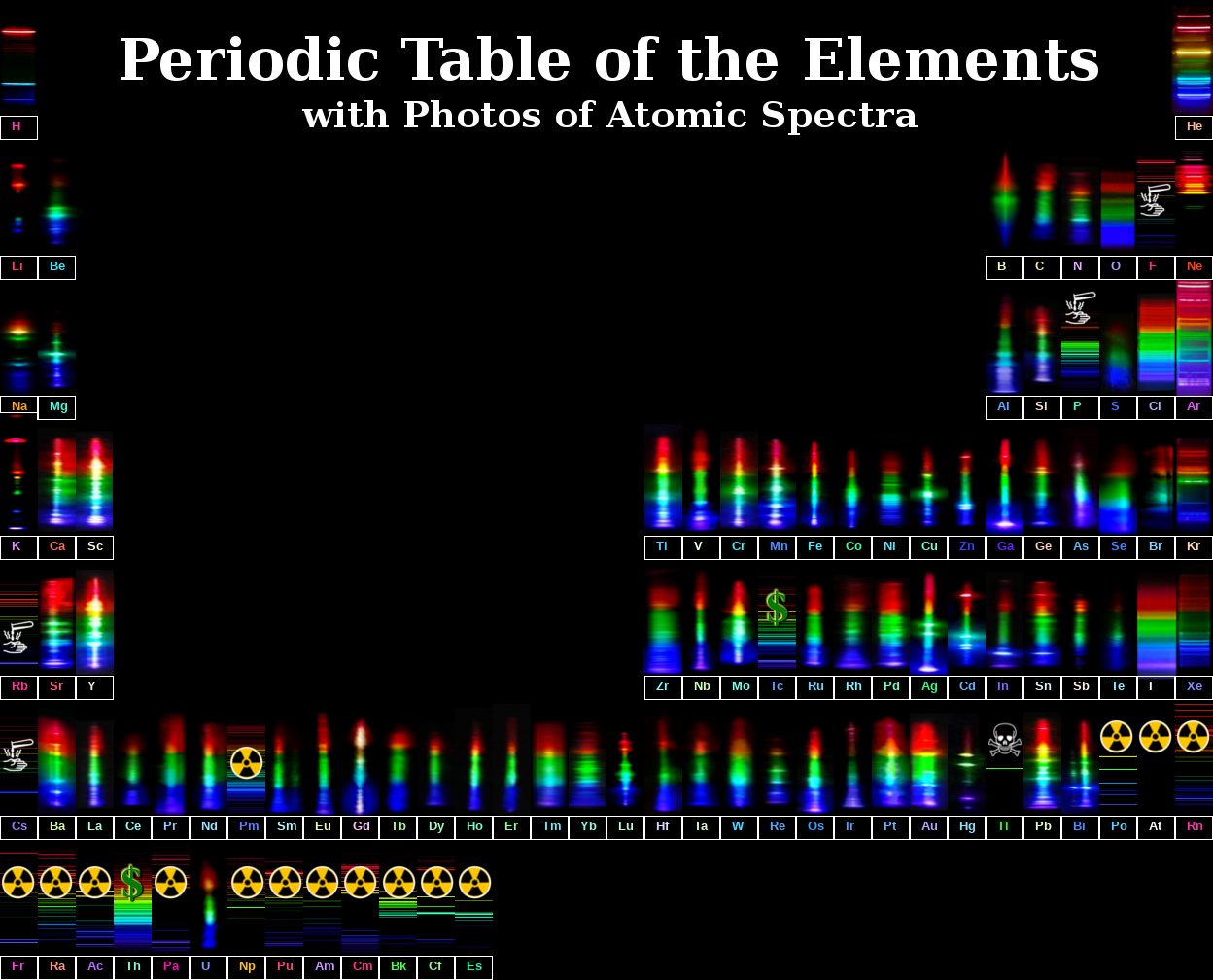 *Espectros de emissão reais dos elementos: cada um é um conjunto único de linhas brilhantes — uma impressão digital daquele elemento
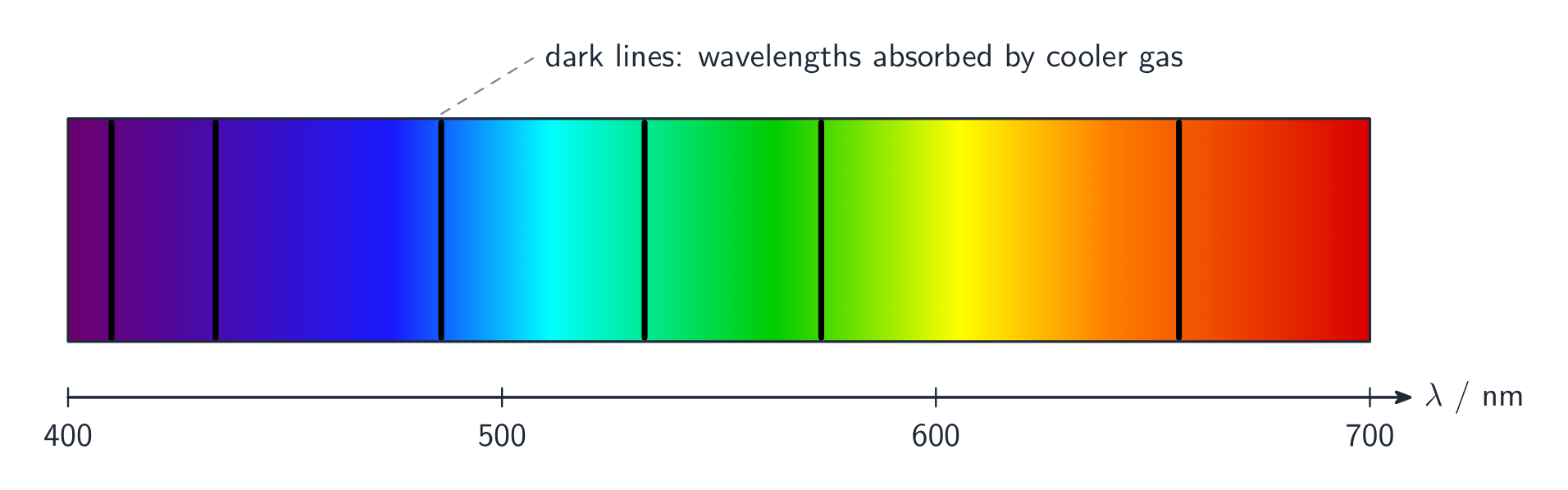 *Linhas escuras de absorção no espectro do Sol marcam os comprimentos de onda absorvidos pelo gás mais frio
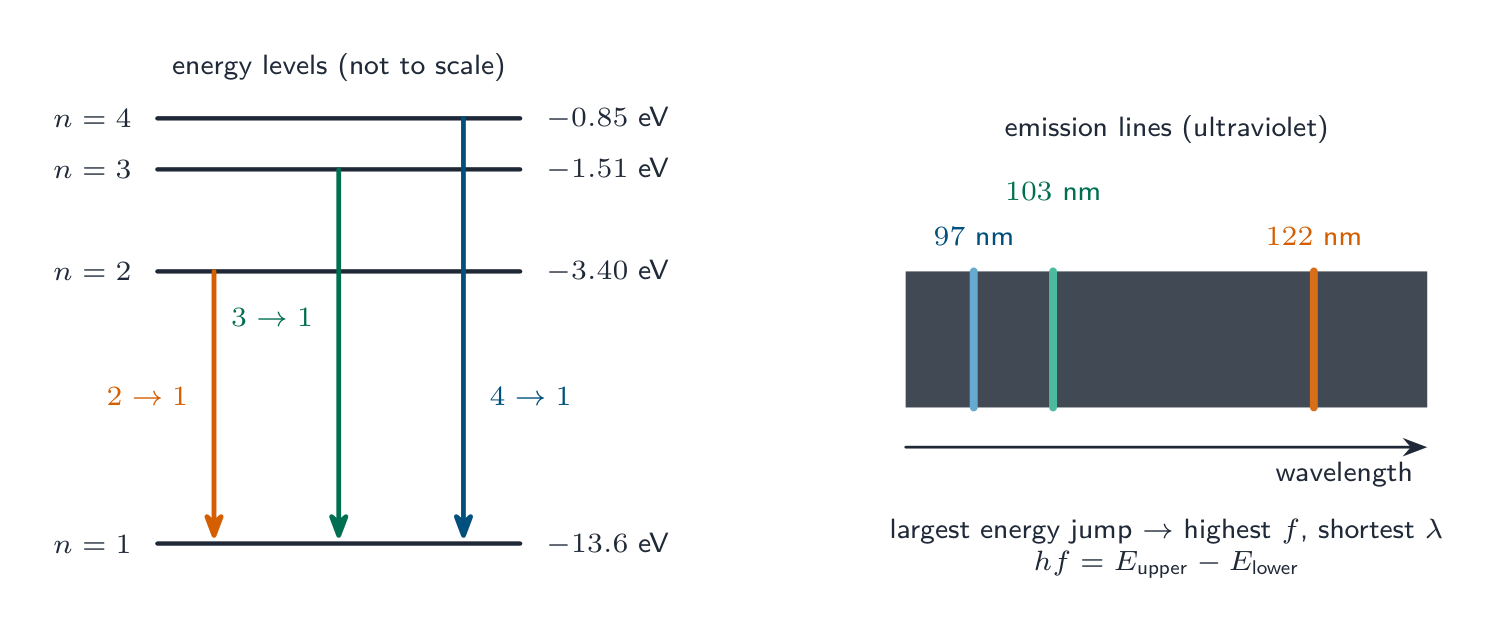 *De níveis para linhas: cada transição para baixo até o estado fundamental produz uma linha, e o maior salto landing mais longe na extremidade de menor comprimento de onda