This handout covers Topic 3, Coordinate geometry. Parts marked (Extended) are only tested on the Extended papers; everything else is for both levels.
Coordinate geometry
IGCSE Mathematics · Topic 3
 7:35
Coordinate geometry
Look down on a city like this and every street corner has an address: so many blocks across, so many blocks up. Two numbers, and you know exactly where you…
English narration · English + 中文 subtitles burned in
3.1
Coordinates

Syllabus
| Subject content | Notes and examples |
|---|---|
| Use and interpret Cartesian coordinates in two dimensions. |
Source: Cambridge International syllabus
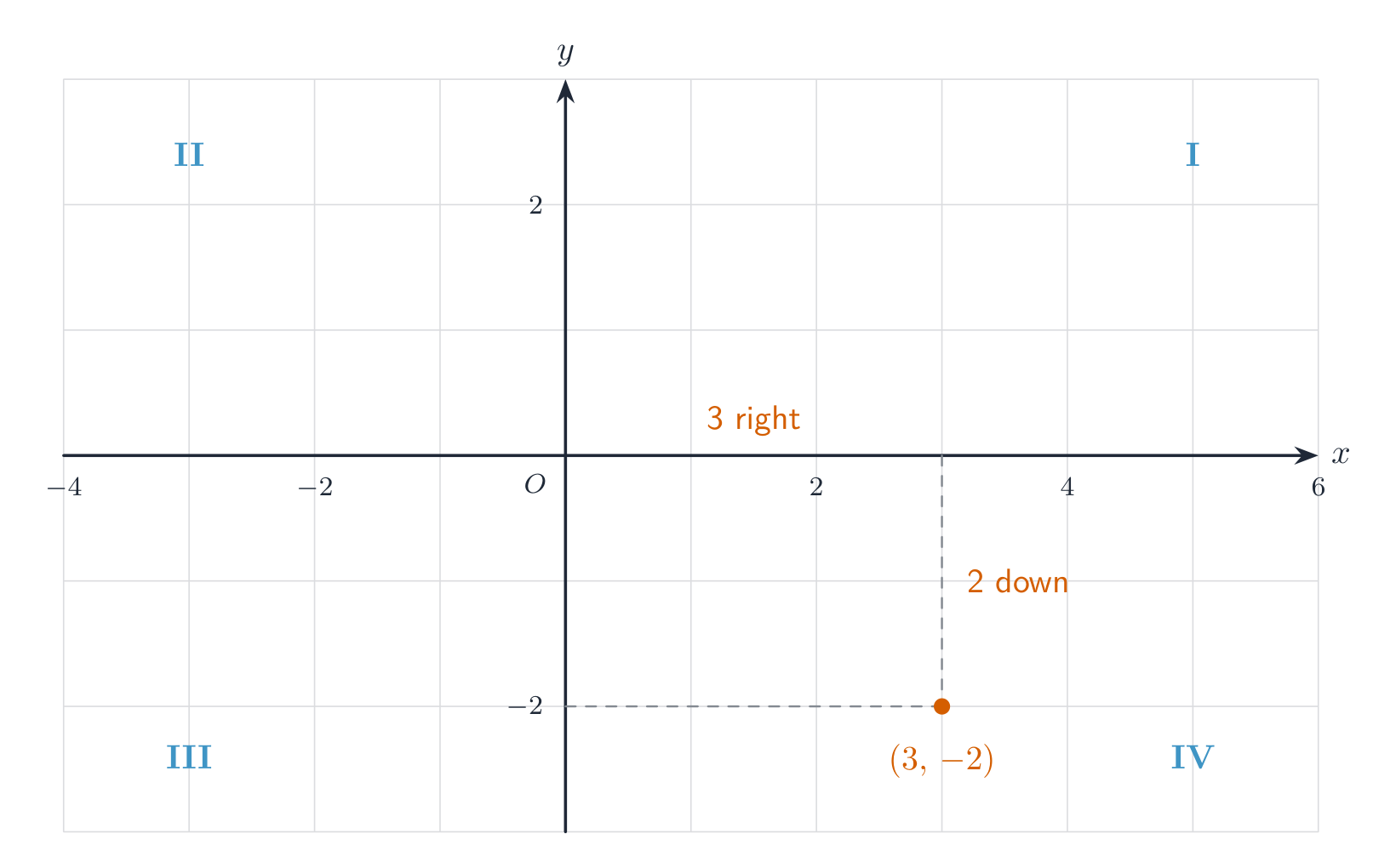
A point on a graph is described by its coordinates 坐标, sometimes called Cartesian coordinates, written $(x, y)$. The first number is the across value and the second is the up value.
- The two number lines are the axes 坐标轴: the horizontal 水平 $x$-axis and the vertical 竖直 $y$-axis.
- They cross at the origin 原点, the point $(0, 0)$.
- The axes split the grid into four quadrants 象限.
So the point $(3, -2)$ is found by going $3$ to the right and $2$ down.
Explore
The coordinate plane
y = mx + c
Every point has an (x, y) coordinate. A straight line is the set of points where y depends on x in a fixed way.
Vocabulary
Train
| English |
|---|
| coordinates/kəʊˈɔːdɪnəts/ |
| axes/ˈæksɪz/ |
| horizontal/ˌhɒrɪˈzɒntl/ |
| vertical/ˈvɜːtɪkl/ |
| origin/ˈɒrɪdʒɪn/ |
| quadrants/ˈkwɒdrənts/ |
3.5
The equation of a straight line
Syllabus
| Subject content | Notes and examples |
|---|---|
| Interpret and obtain the equation of a straight-line graph in the form $y = mx + c$. | Questions may: • use and request lines in the forms $y = mx + c$, $x = k$ • involve finding the equation when the graph is given • ask for the gradient or $y$-intercept of a graph from an equation, e.g. find the gradient and $y$-intercept of the graph with the equation $y = 6x + 3$. Candidates are expected to give equations of a line in a fully simplified form. |
| Subject content | Notes and examples |
|---|---|
| Interpret and obtain the equation of a straight-line graph. | Questions may: • use and request lines in different forms, e.g. $ax + by = c$, $y = mx + c$, $x = k$ • involve finding the equation when the graph is given • ask for the gradient or $y$-intercept of a graph from an equation, e.g. find the gradient and $y$-intercept of the graph with equation $5x + 4y = 8$. Candidates are expected to give equations of a line in a fully simplified form. |
Source: Cambridge International syllabus
Every non-vertical straight line can be written as
$$y = mx + c,$$
where $m$ is the gradient 斜率 (steepness) and $c$ is the intercept 截距 — the $y$-value where the line crosses the $y$-axis.
- A line like $x = k$ (for example $x = 3$) is vertical.
- A line like $y = k$ (for example $y = 3$) is horizontal.
Extended: a line may also be given as $ax + by = c$. Rearrange it into $y = mx + c$ to read off the gradient and intercept.
Worked example (Extended). Find the gradient and $y$-intercept of $5x + 4y = 8$.
$$4y = -5x + 8 \;\Rightarrow\; y = -\tfrac{5}{4}x + 2.$$
So the gradient is $-\tfrac{5}{4}$ and the $y$-intercept is $2$.
Explore
y = mx + c
y = ax + b
Drag the gradient and the intercept. a is the gradient (steepness) and b is where the line crosses the y-axis.
Vocabulary
Train
| English |
|---|
| gradient/ˈɡreɪdɪənt/ |
| intercept/ˌɪntəˈsept/ |
3.3
Gradient

Syllabus
| Subject content | Notes and examples |
|---|---|
| Find the gradient of a straight line. | From a grid only. |
| Subject content | Notes and examples |
|---|---|
| 1 Find the gradient of a straight line. | |
| 2 Calculate the gradient of a straight line from the coordinates of two points on it. |
Source: Cambridge International syllabus
The gradient measures how steep a line is:
$$m = \frac{\text{change in } y}{\text{change in } x} = \frac{\text{rise}}{\text{run}}.$$
A positive gradient goes up to the right; a negative gradient goes down to the right. Horizontal lines have gradient zero; vertical lines have undefined gradient because the horizontal change is zero.
Core and Extended: from a grid. Choose two clear intersections on the drawn line, preferably far apart. Draw a right-angled triangle and read its horizontal and signed vertical changes in axis units. Check both numbered scales: counting squares alone may be wrong. Core gradient questions use a grid; calculation from two given coordinate pairs without a grid is an Extended demand.
Independent grid task. Use $L$ below. Draw a large gradient triangle, read its changes in axis units and calculate the gradient. Then read the $y$-intercept and find the simplified equation of the line. Check a different grid point. Explain the trap caused by the two scales.
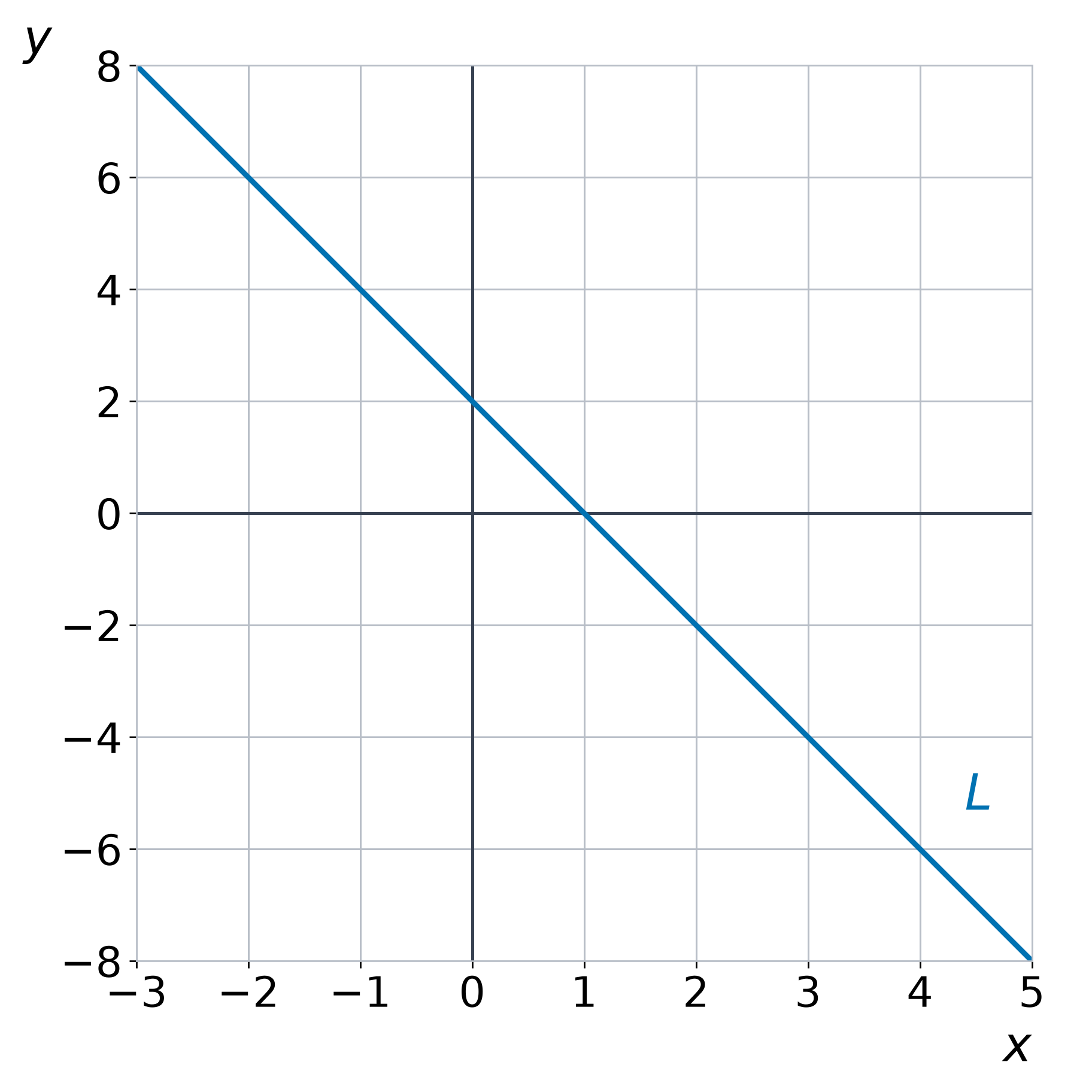
Check after attempting: for example, $(0,2)$ to $(2,-2)$ gives changes $2$ across and $-4$ vertically, so $m=-2$. The intercept is $2$, hence $y=-2x+2$. The point $(1,0)$ checks it. There are two large squares across and two down, but the vertical squares represent twice as many units. Counting squares alone would wrongly give $-1$.
Worked example (Extended: two given coordinate pairs). Find the gradient of the line through $(1, 2)$ and $(4, 11)$.
$$m = \frac{11 - 2}{4 - 1} = \frac{9}{3} = 3.$$

Explore
Gradient
y = ax + b
The gradient a measures steepness — rise over run.
3.2
Drawing a straight-line graph

Syllabus
| Subject content | Notes and examples |
|---|---|
| Draw straight-line graphs for linear equations. | Equations will be given in the form $y = mx + c$ (e.g. $y = -2x + 5$), unless a table of values is given. |
| Subject content | Notes and examples |
|---|---|
| Draw straight-line graphs for linear equations. | Examples include: • $y = -2x + 5$ • $y = 7 - 4x$ • $3x + 2y = 5$. |
Source: Cambridge International syllabus
To draw $y = mx + c$, the quickest way is:
- Mark the intercept $c$ on the $y$-axis.
- Use the gradient to step to more points (for $m = 3$, go $1$ right and $3$ up).
- Join the points with a straight line.
You can also make a small table of values 数值表: choose at least three $x$-values, work out $y$, and plot the points. A third point checks the line through the first two. Label both axes and draw with a ruler across the requested interval, not just between nearby points.
Independent drawing task. Draw $y=-2x+3$ for $-2\le x\le3$, using $x=-2,0,1,3$. Draw $x=-1$ on the same axes. Your table should give $y=7,3,1,-3$; the second line is vertical. Check the actual drawing against all four points. Extended: drawing may also start from an equation such as $3x+2y=6$. Rearrange it to $y=-\tfrac32x+3$, or substitute values directly. Core drawing equations are normally given in $y=mx+c$ form unless a table is supplied.
Vocabulary
Train
| English |
|---|
| table of values/ˈteɪbl ɒv ˈvæljuːz/ |
3.5
Finding the equation of a line
Syllabus
| Subject content | Notes and examples |
|---|---|
| Interpret and obtain the equation of a straight-line graph in the form $y = mx + c$. | Questions may: • use and request lines in the forms $y = mx + c$, $x = k$ • involve finding the equation when the graph is given • ask for the gradient or $y$-intercept of a graph from an equation, e.g. find the gradient and $y$-intercept of the graph with the equation $y = 6x + 3$. Candidates are expected to give equations of a line in a fully simplified form. |
| Subject content | Notes and examples |
|---|---|
| Interpret and obtain the equation of a straight-line graph. | Questions may: • use and request lines in different forms, e.g. $ax + by = c$, $y = mx + c$, $x = k$ • involve finding the equation when the graph is given • ask for the gradient or $y$-intercept of a graph from an equation, e.g. find the gradient and $y$-intercept of the graph with equation $5x + 4y = 8$. Candidates are expected to give equations of a line in a fully simplified form. |
Source: Cambridge International syllabus
If you know the gradient $m$ and one point on the line, put the point into $y = mx + c$ to find $c$.
Worked example. A line has gradient $3$ and passes through $(1, 2)$. Find its equation.
$$y = 3x + c, \qquad 2 = 3(1) + c, \qquad c = -1.$$
So the equation is $y = 3x - 1$. (Extended: if two coordinate pairs are given without a grid, first calculate the gradient, then do this.)
Worked example (Extended: through two points). Find the equation of the line through $(-2, 5)$ and $(4, -1)$.
$$m = \frac{-1 - 5}{4 - (-2)} = \frac{-6}{6} = -1, \qquad 5 = -1(-2) + c \;\Rightarrow\; c = 3,$$
so $y = -x + 3$. Check with the other point: $-4 + 3 = -1$, which is correct.
Common mistakes. Putting the change in $x$ on top of the gradient fraction (it is $\dfrac{\text{change in } y}{\text{change in } x}$) and losing a minus sign when subtracting a negative coordinate.
For a graph-to-equation question, read $c$ where the drawn line crosses the $y$-axis and use a large grid triangle to find $m$. Then write $y=mx+c$ and check another point. A vertical graph through $x=4$ has equation $x=4$, not $y=4$.
3.4
Length and midpoint (Extended)
Syllabus
| Subject content | Notes and examples |
|---|---|
| 1 Calculate the length of a line segment. | |
| 2 Find the coordinates of the midpoint of a line segment. |
Source: Cambridge International syllabus
A line segment 线段 is the straight piece between two points.
To find the length 长度 of the segment between $(x_1, y_1)$ and $(x_2, y_2)$, use Pythagoras' theorem 勾股定理 on the horizontal and vertical gaps:
$$\text{length} = \sqrt{(x_2 - x_1)^2 + (y_2 - y_1)^2}.$$
To find the midpoint 中点 (the point exactly in the middle), average the coordinates:
$$\text{midpoint} = \left( \frac{x_1 + x_2}{2}, \; \frac{y_1 + y_2}{2} \right).$$
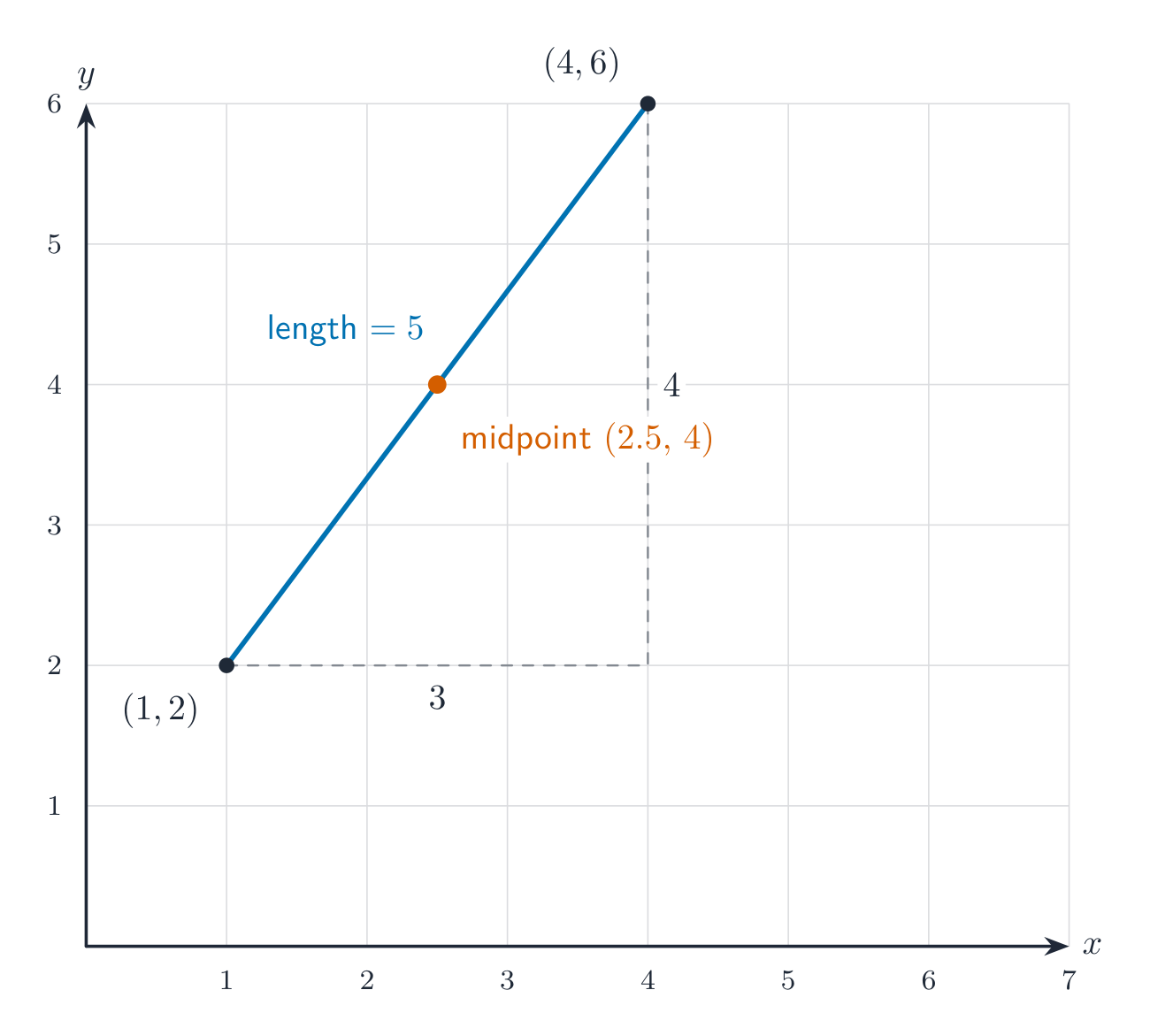
Worked example. Find the length and midpoint of the segment from $(1, 2)$ to $(4, 6)$.
$$\text{length} = \sqrt{(4 - 1)^2 + (6 - 2)^2} = \sqrt{9 + 16} = \sqrt{25} = 5.$$
$$\text{midpoint} = \left( \frac{1 + 4}{2}, \; \frac{2 + 6}{2} \right) = (2.5, \, 4).$$
Signed changes and a missing endpoint (Extended)
For $P(-4,3)$ and $Q(2,-5)$, the coordinate changes are $6$ and $-8$. The length is $\sqrt{6^2+(-8)^2}=10$ and midpoint is $(-1,-1)$. A coordinate change can be negative; a distance cannot. For a horizontal or vertical segment, use the absolute value of the one non-zero coordinate change.
If $A$ and midpoint $M$ are known, recover the other endpoint by $x_B=2x_M-x_A$ and $y_B=2y_M-y_A$. For $A(-3,4)$ and $M(2,-1)$, $B=(7,-6)$. Check by averaging $A$ and $B$. Their distance is $\sqrt{10^2+(-10)^2}=\sqrt{200}$, about $14.1$.
Explore
Length and midpoint lab
midpoint is halfway between endpoints
Move along a line segment and see midpoint as halfway.
Vocabulary
Train
| English |
|---|
| line segment/laɪn ˈseɡmənt/ |
| length/leŋθ/ |
| Pythagoras' theorem/paɪˈθæɡərəs ˈθɪərəm/ |
| midpoint/ˈmɪdpɔɪnt/ |
3.6
Parallel lines

Syllabus
| Subject content | Notes and examples |
|---|---|
| Find the gradient and equation of a straight line parallel to a given line. | e.g. find the equation of the line parallel to $y = 4x - 1$ that passes through $(1, -3)$. |
Source: Cambridge International syllabus
Distinct non-vertical parallel 平行 lines never meet and have the same gradient. Vertical lines are parallel too, but their gradients are undefined. Equal gradients and equal intercepts describe the same line, not two distinct parallel lines.
Worked example. Find the equation of the line parallel to $y = 4x - 1$ that passes through $(1, -3)$.
The gradient is also $4$. Put the point in:
$$-3 = 4(1) + c \;\Rightarrow\; c = -7,$$
so the line is $y = 4x - 7$.
Explore
Parallel & perpendicular
y = ax + b
Parallel lines share a gradient; perpendicular gradients multiply to −1.
Vocabulary
Train
| English |
|---|
| parallel/ˈpærəlel/ |
3.7
Perpendicular lines (Extended)

Syllabus
| Subject content | Notes and examples |
|---|---|
| Find the gradient and equation of a straight line perpendicular to a given line. | Examples include: • find the gradient of a line perpendicular to $2y = 3x + 1$ • find the equation of the perpendicular bisector of the line joining the points $(-3, 8)$ and $(9, -2)$. |
Source: Cambridge International syllabus
Two lines are perpendicular 垂直 if they meet at a right angle 直角. When both gradients are finite, their product is $-1$:
$$m_1 \times m_2 = -1, \qquad \text{so} \qquad m_2 = -\frac{1}{m_1}.$$
In words: flip the fraction and change the sign.
Worked example. Find the gradient of a line perpendicular to $2y = 3x + 1$.
Rearrange: $y = \tfrac{3}{2}x + \tfrac{1}{2}$, so the gradient is $\tfrac{3}{2}$. The perpendicular gradient is $-\tfrac{2}{3}$.
Common mistake. Changing only the sign ($-\tfrac{3}{2}$) or only turning the fraction over ($\tfrac{2}{3}$). The perpendicular gradient needs both: the negative reciprocal. Check that the two gradients multiply to $-1$.
Perpendicular bisector
The perpendicular bisector 垂直平分线 of a segment cuts it in half at a right angle. To find its equation: get the midpoint, then use the perpendicular gradient through that midpoint.
Worked example. Find the perpendicular bisector of the segment joining $(-3, 8)$ and $(9, -2)$.
- Midpoint: $\left( \frac{-3 + 9}{2}, \frac{8 + (-2)}{2} \right) = (3, 3)$.
- Gradient of the segment: $\frac{-2 - 8}{9 - (-3)} = \frac{-10}{12} = -\tfrac{5}{6}$.
- Perpendicular gradient: $\frac{6}{5}$.
Through $(3, 3)$: $\; 3 = \tfrac{6}{5}(3) + c \Rightarrow c = 3 - \tfrac{18}{5} = -\tfrac{3}{5}$. So the bisector is
$$y = \tfrac{6}{5}x - \tfrac{3}{5}.$$
Independent bisector task (Extended). Find the perpendicular bisector of $A(-4,1)$ and $B(2,5)$ in $y=mx+c$ form. Check both the midpoint and the right-angle condition.
Check after attempting: midpoint $(-1,3)$; segment gradient $2/3$; perpendicular gradient $-3/2$. Substituting the midpoint gives $c=3/2$, so $y=-\tfrac32x+\tfrac32$. At $x=-1$ this gives $3$, and $(2/3)(-3/2)=-1$.
Axis cases (Extended). For endpoints $(-3,2)$ and $(5,2)$, the segment is horizontal and its midpoint is $(1,2)$, so its perpendicular bisector is $x=1$. For $(4,-5)$ and $(4,1)$, the bisector is $y=-2$. Handle these orientations directly: a vertical gradient is undefined, and there is no reciprocal of zero.
Vocabulary
Train
| English |
|---|
| perpendicular/ˌpɜːpənˈdɪkjʊlə/ |
| right angle/raɪt ˈæŋɡl/ |
| perpendicular bisector/ˌpɜːpənˈdɪkjʊlə baɪˈsektə/ |
3.7
Exam tips
- The straight line is $y = mx + c$: $m$ is the gradient and $c$ is where the line crosses the $y$-axis.
- Core and Extended: gradient is signed vertical change divided by horizontal change, in grid units. Extended: keep coordinate subtraction in matching order when calculating from two pairs.
- Distinct non-vertical parallel lines have equal gradients. Extended: perpendicular finite gradients have product $-1$; handle horizontal/vertical pairs directly.
- Extended: midpoint is the coordinate average; distance comes from Pythagoras on coordinate differences. Use both midpoint and perpendicularity to check a bisector.
Interactive lessons on this topic
Work through it step by step, with instant-check exercises.