This handout covers Topic 6, Trigonometry. Parts marked (Extended) are only tested on the Extended papers; everything else is for both levels. Give angle answers to one decimal place.
Trigonometry
IGCSE Mathematics · Topic 6
 8:37
Trigonometry
How tall is that tower? You cannot climb it with a tape measure. But you can stand on the ground, walk fifty metres back, and measure one angle — the angle you…
English narration · English + 中文 subtitles burned in
6.1
Pythagoras' theorem

Syllabus
| Subject content | Notes and examples |
|---|---|
| Know and use Pythagoras’ theorem. |
Source: Cambridge International syllabus
Pythagoras' theorem 勾股定理 links the three sides of a right-angled triangle 直角三角形 (a triangle 三角形 with one $90^{\circ}$ angle). If the longest side (the hypotenuse 斜边, opposite the right angle) is $c$, then
$$a^{2} + b^{2} = c^{2}.$$
Use it to find a missing side.
Worked example. A right-angled triangle has a hypotenuse of $13\text{ cm}$ and one short side of $5\text{ cm}$. Find the other short side.
$$b^{2} = 13^{2} - 5^{2} = 169 - 25 = 144, \qquad b = \sqrt{144} = 12\text{ cm}.$$
Worked example: a ladder. A ladder $6\text{ m}$ long leans against a vertical wall. Its foot is $1.5\text{ m}$ from the wall. How high up the wall does it reach?
The ladder is the hypotenuse, so subtract:
$$h^{2} = 6^{2} - 1.5^{2} = 36 - 2.25 = 33.75, \qquad h = 5.81\text{ m}\ \text{(3 s.f.)}.$$
Common mistake. Adding the squares when the hypotenuse is one of the sides you know. Find the hypotenuse first: if you know it, subtract; if you want it, add.
Explore
Pythagoras' theorem
Change the two short sides and see $a^2 + b^2 = c^2$ — the squares on the sides really do add up.
Vocabulary
Train
| English |
|---|
| Pythagoras' theorem/paɪˈθæɡərəs ˈθɪərəm/ |
| right-angled triangle/raɪt ˈæŋɡld ˈtraɪæŋɡl/ |
| triangle/ˈtraɪæŋɡl/ |
| hypotenuse/haɪˈpɒtənjuːs/ |
6.2
Trigonometry in right-angled triangles

Syllabus
| Subject content | Notes and examples |
|---|---|
| 1 Know and use the sine, cosine and tangent ratios for acute angles in calculations involving sides and angles of a right-angled triangle. | Angles will be given in degrees and answers should be written in degrees, with decimals correct to one decimal place. |
| 2 Solve problems in two dimensions using Pythagoras’ theorem and trigonometry. | Knowledge of bearings may be required. |
| 3 Know that the perpendicular distance from a point to a line is the shortest distance to the line. | |
| 4 Carry out calculations involving angles of elevation and depression. |
Source: Cambridge International syllabus
Label the sides from the acute angle you are using: the opposite 对边 (across from the angle), the adjacent 邻边 (next to the angle, excluding the hypotenuse), and the hypotenuse. The three ratios are the sine 正弦, cosine 余弦 and tangent ratio 正切 (sin, cos, tan):
$$\sin\theta = \frac{\text{opp}}{\text{hyp}}, \qquad \cos\theta = \frac{\text{adj}}{\text{hyp}}, \qquad \tan\theta = \frac{\text{opp}}{\text{adj}}.$$
Remember them as SOH-CAH-TOA. To find an angle, use the inverse ($\sin^{-1}$, $\cos^{-1}$, $\tan^{-1}$).
Worked example (find a side). In a right-angled triangle the hypotenuse is $10\text{ cm}$ and the angle is $30^{\circ}$. Find the opposite side.
$$\text{opp} = 10 \times \sin 30^{\circ} = 10 \times 0.5 = 5\text{ cm}.$$
Worked example (find an angle). The opposite side is $4\text{ cm}$ and the adjacent side is $3\text{ cm}$.
$$\tan\theta = \frac{4}{3}, \qquad \theta = \tan^{-1}\!\left(\frac{4}{3}\right) = 53.1^{\circ}.$$
Worked example: bearings. Amir walks $5\text{ km}$ due north and then $8\text{ km}$ due east. Find how far he is from his starting point, and his bearing from it.
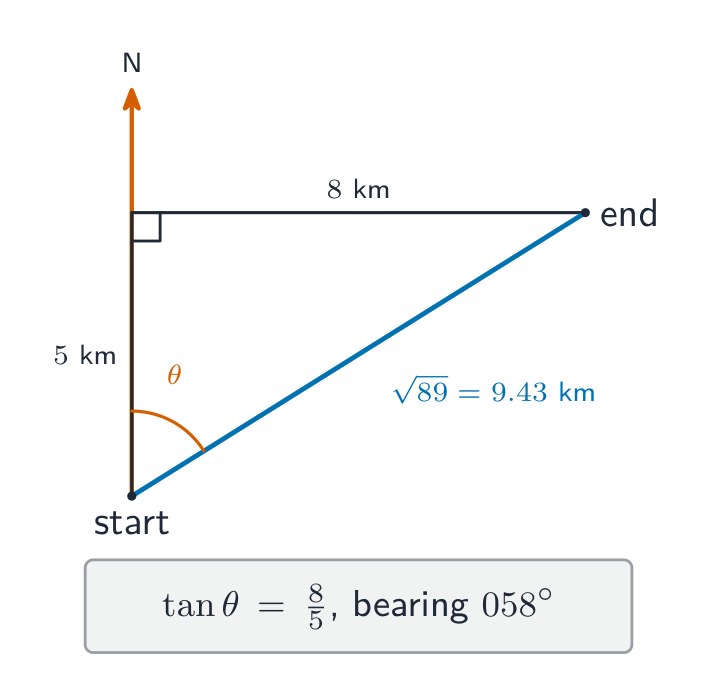
The two walks make a right-angled triangle, so
$$\text{distance} = \sqrt{5^{2} + 8^{2}} = \sqrt{89} = 9.43\text{ km}.$$
A bearing is measured clockwise from north, so use the angle at the start, between north and his path:
$$\tan\theta = \frac{8}{5}, \qquad \theta = 58.0^{\circ}, \quad \text{so the bearing is } 058^{\circ}.$$
Common mistakes. Calling the side next to the right angle the hypotenuse (the hypotenuse is always opposite the right angle), and leaving the calculator in radians: $\sin 30$ should give $0.5$.
Explore
Sine, cosine and tangent
Drag the angle on the unit circle to see where sin, cos and tan come from.
Vocabulary
Train
| English |
|---|
| opposite/ˈɒpəzɪt/ |
| adjacent/əˈdʒeɪsənt/ |
| sine/saɪn/ |
| cosine/ˈkəʊsaɪn/ |
| tangent ratio/ˈtændʒənt ˈreɪʃɪəʊ/ |
6.2
Angles of elevation and depression (Extended)
Syllabus
| Subject content | Notes and examples |
|---|---|
| 1 Know and use the sine, cosine and tangent ratios for acute angles in calculations involving sides and angles of a right-angled triangle. | Angles will be given in degrees and answers should be written in degrees, with decimals correct to one decimal place. |
| 2 Solve problems in two dimensions using Pythagoras’ theorem and trigonometry. | Knowledge of bearings may be required. |
| 3 Know that the perpendicular distance from a point to a line is the shortest distance to the line. | |
| 4 Carry out calculations involving angles of elevation and depression. |
Source: Cambridge International syllabus
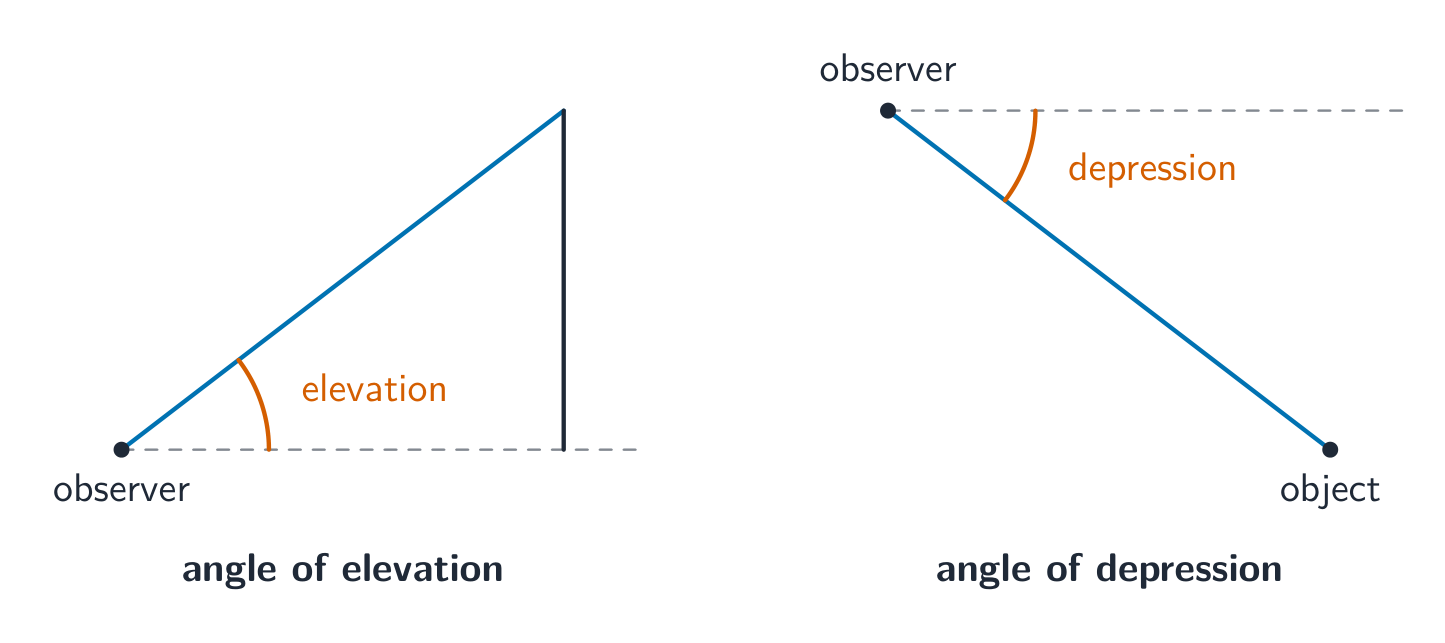
The angle of elevation 仰角 is the angle up from the horizontal to an object above you. The angle of depression 俯角 is the angle down from the horizontal to an object below you. The shortest distance from a point to a line is the perpendicular 垂直 distance.
Worked example. From a point $50\text{ m}$ from the foot of a tower, the angle of elevation to the top is $40^{\circ}$. Find the height of the tower.
$$\text{height} = 50 \times \tan 40^{\circ} = 50 \times 0.839 = 42.0\text{ m}.$$
Worked example: angle of depression. From the top of a cliff $80\text{ m}$ high, the angle of depression of a boat is $25^{\circ}$. How far is the boat from the foot of the cliff?
The angle of depression from the cliff top equals the angle of elevation from the boat (alternate angles), so at the boat the cliff is the opposite side:
$$\tan 25^{\circ} = \frac{80}{d}, \qquad d = \frac{80}{\tan 25^{\circ}} = 172\text{ m}\ \text{(3 s.f.)}.$$
Common mistake. Putting the angle of depression between the cliff and the line of sight. It is always measured from the horizontal.
Vocabulary
Train
| English |
|---|
| angle of elevation/ˈæŋɡl ɒv ˌelɪˈveɪʃn/ |
| angle of depression/ˈæŋɡl ɒv dɪˈpreʃn/ |
| perpendicular/ˌpɜːpənˈdɪkjʊlə/ |
6.3
Exact trigonometric values (Extended)

Syllabus
| Subject content | Notes and examples |
|---|---|
| Know the exact values of: 1 $\sin x$ and $\cos x$ for $x = 0^\circ, 30^\circ, 45^\circ, 60^\circ$ and $90^\circ$. 2 $\tan x$ for $x = 0^\circ, 30^\circ, 45^\circ$ and $60^\circ$. |
Source: Cambridge International syllabus
You must know these exact values without a calculator.
| $x$ | $0^{\circ}$ | $30^{\circ}$ | $45^{\circ}$ | $60^{\circ}$ | $90^{\circ}$ |
|---|---|---|---|---|---|
| $\sin x$ | $0$ | $\tfrac{1}{2}$ | $\tfrac{\sqrt{2}}{2}$ | $\tfrac{\sqrt{3}}{2}$ | $1$ |
| $\cos x$ | $1$ | $\tfrac{\sqrt{3}}{2}$ | $\tfrac{\sqrt{2}}{2}$ | $\tfrac{1}{2}$ | $0$ |
| $\tan x$ | $0$ | $\tfrac{1}{\sqrt{3}}$ | $1$ | $\sqrt{3}$ | — |
6.4
Graphs and trigonometric equations (Extended)

Syllabus
| Subject content | Notes and examples |
|---|---|
| 1 Recognise, sketch and interpret the following graphs for $0^\circ \leqslant x \leqslant 360^\circ$: • $y = \sin x$ • $y = \cos x$ • $y = \tan x$. | |
| 2 Solve trigonometric equations involving $\sin x$, $\cos x$ or $\tan x$, for $0^\circ \leqslant x \leqslant 360^\circ$. | e.g. solve: • $\sin x = \frac{\sqrt{3}}{2}$ for $0^\circ \leqslant x \leqslant 360^\circ$ • $2 \cos x + 1 = 0$ for $0^\circ \leqslant x \leqslant 360^\circ$. |
Source: Cambridge International syllabus
For $0^{\circ} \leqslant x \leqslant 360^{\circ}$:
- $y = \sin x$ is a wave starting at $0$, peaking at $90^{\circ}$, back to $0$ at $180^{\circ}$, down to $-1$ at $270^{\circ}$.
- $y = \cos x$ is the same wave but starting at $1$.
- $y = \tan x$ rises steeply and repeats every $180^{\circ}$.

A trigonometric equation 三角方程 often has more than one answer in this range. Use the graph (or the symmetry of the wave) to find them all.
Worked example. Solve $\sin x = \tfrac{\sqrt{3}}{2}$ for $0^{\circ} \leqslant x \leqslant 360^{\circ}$.
One answer is $x = 60^{\circ}$. The sine wave is also $\tfrac{\sqrt{3}}{2}$ at $180^{\circ} - 60^{\circ} = 120^{\circ}$. So $x = 60^{\circ}$ or $120^{\circ}$.
Worked example. Solve $2\cos x + 1 = 0$ for $0^{\circ} \leqslant x \leqslant 360^{\circ}$.
$$\cos x = -\tfrac{1}{2} \;\Rightarrow\; x = 120^{\circ} \text{ or } 240^{\circ}.$$
Worked example. Solve $\tan x = 1.5$ for $0^{\circ} \leqslant x \leqslant 360^{\circ}$.
The calculator gives $x = 56.3^{\circ}$. The tangent repeats every $180^{\circ}$, so the other answer is $56.3^{\circ} + 180^{\circ} = 236.3^{\circ}$.
Worked example. Solve $\sin x = -0.4$ for $0^{\circ} \leqslant x \leqslant 360^{\circ}$.
The calculator gives $-23.6^{\circ}$, which is outside the range. Work with $23.6^{\circ}$: sine is negative between $180^{\circ}$ and $360^{\circ}$, so
$$x = 180^{\circ} + 23.6^{\circ} = 203.6^{\circ} \quad\text{or}\quad x = 360^{\circ} - 23.6^{\circ} = 336.4^{\circ}.$$
Common mistake. Stopping at the calculator's answer. Sketch the graph and look for every point at the right height in the range.
Explore
Trig graphs & equations
(cos θ, sin θ)
As θ turns, sin and cos trace their waves — and repeat every 360°.
Vocabulary
Train
| English |
|---|
| trigonometric equation/ˌtrɪɡənəʊˈmetrɪk ɪˈkweɪʒn/ |
6.5
The sine and cosine rules (Extended)

Syllabus
| Subject content | Notes and examples |
|---|---|
| 1 Use the sine and cosine rules in calculations involving lengths and angles for any triangle. | Includes problems involving obtuse angles and the ambiguous case. |
| 2 Use the formula $\text{area of triangle} = \frac{1}{2} ab \sin C$. | The sine and cosine rules and the formula for area of a triangle are given in the List of formulas. |
Source: Cambridge International syllabus
For any triangle (not just right-angled), with sides $a, b, c$ opposite angles $A, B, C$:
$$\text{sine rule:}\quad \frac{a}{\sin A} = \frac{b}{\sin B} = \frac{c}{\sin C},$$
$$\text{cosine rule:}\quad a^{2} = b^{2} + c^{2} - 2bc\cos A.$$
Use the sine rule 正弦定理 when you have a side and its opposite angle. Use the cosine rule 余弦定理 when you have two sides and the angle between them, or all three sides. With the sine rule, watch for the ambiguous case 两解情况, where an angle could be acute or obtuse.
The area of any triangle is
$$\text{area} = \tfrac{1}{2}ab\sin C.$$
Worked example. A triangle has $b = 7\text{ cm}$, $c = 8\text{ cm}$ and the angle between them $A = 40^{\circ}$. Find side $a$.
$$a^{2} = 7^{2} + 8^{2} - 2(7)(8)\cos 40^{\circ} = 113 - 112 \times 0.766\ldots = 27.20\ldots,$$
$$a = \sqrt{27.20\ldots} = 5.22\text{ cm}\ \text{(3 s.f.)}.$$
Worked example: cosine rule for an angle. A triangle has sides $5\text{ cm}$, $7\text{ cm}$ and $8\text{ cm}$. Find the angle opposite the $7\text{ cm}$ side.
Rearrange the cosine rule so the angle is the subject:
$$\cos\theta = \frac{5^{2} + 8^{2} - 7^{2}}{2 \times 5 \times 8} = \frac{40}{80} = 0.5, \qquad \theta = 60^{\circ}.$$
Worked example: sine rule for a side. In triangle $ABC$, angle $B = 48^{\circ}$, angle $C = 71^{\circ}$ and $AB = 12\text{ cm}$. Find $AC$.
$AB$ is side $c$ (opposite $C$) and $AC$ is side $b$ (opposite $B$):
$$\frac{b}{\sin 48^{\circ}} = \frac{12}{\sin 71^{\circ}}, \qquad b = \frac{12 \sin 48^{\circ}}{\sin 71^{\circ}} = 9.43\text{ cm}\ \text{(3 s.f.)}.$$
Worked example: the ambiguous case. In triangle $ABC$, $a = 7\text{ cm}$, $b = 9\text{ cm}$ and angle $A = 40^{\circ}$. Find the two possible values of angle $B$.
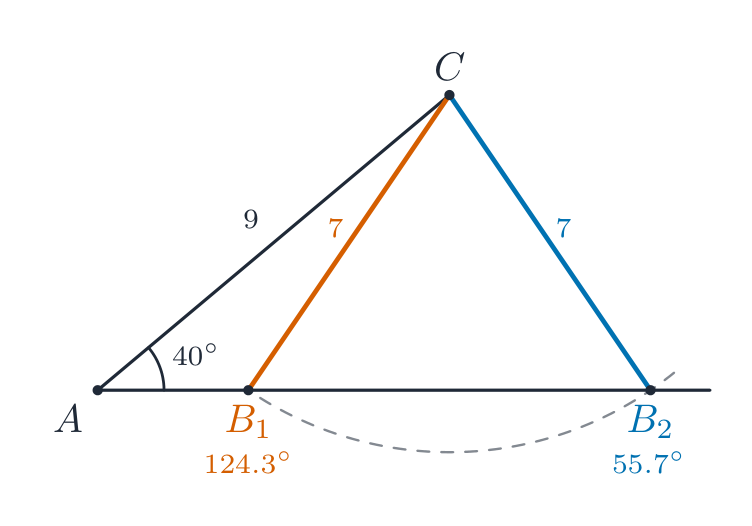
$$\sin B = \frac{9 \sin 40^{\circ}}{7} = 0.826\ldots, \qquad B = 55.7^{\circ}.$$
Because $\sin(180^{\circ} - B) = \sin B$, $B = 180^{\circ} - 55.7^{\circ} = 124.3^{\circ}$ also works. Both fit in a triangle with $A = 40^{\circ}$, since $40^{\circ} + 124.3^{\circ} < 180^{\circ}$, so there are two different triangles.
Worked example: area. Two sides of a triangle are $8\text{ cm}$ and $11\text{ cm}$, and the angle between them is $35^{\circ}$. Find the area.
$$\text{area} = \tfrac{1}{2} \times 8 \times 11 \times \sin 35^{\circ} = 25.2\text{ cm}^{2}\ \text{(3 s.f.)}.$$
Common mistakes. Working out $113 - 112$ first in the cosine rule (multiply $112 \times \cos 40^{\circ}$ first), using the sine rule with a side and an angle that are not opposite each other, and rounding in the middle of a calculation (keep the full calculator value until the end).
Explore
Sine & cosine rule
Two sides and the angle between them fix the triangle: the cosine rule finds the third side, the sine rule the other angles.
Explore
What sin and cos mean
Spin the angle on the unit circle: the horizontal leg is cos θ and the vertical leg is sin θ — the same ratios the sine and cosine rules use.
Vocabulary
Train
| English |
|---|
| sine rule/saɪn ruːl/ |
| cosine rule/ˈkəʊsaɪn ruːl/ |
| ambiguous case/æmˈbɪɡjuːəs keɪs/ |
6.6
Pythagoras and trigonometry in 3D (Extended)
Syllabus
| Subject content | Notes and examples |
|---|---|
| Carry out calculations and solve problems in three dimensions using Pythagoras' theorem and trigonometry, including calculating the angle between a line and a plane. |
Source: Cambridge International syllabus
In three dimensions, find a right-angled triangle inside the solid, then use Pythagoras or trigonometry on it. A common task is the angle between a line and a flat surface (a plane 平面).
Worked example. A box has a base $6\text{ cm}$ by $8\text{ cm}$ and height $5\text{ cm}$. Find the angle between a space diagonal and the base.
First the base diagonal: $\sqrt{6^{2} + 8^{2}} = \sqrt{100} = 10\text{ cm}$. This diagonal and the height form a right-angled triangle, so the angle $\theta$ with the base is
$$\tan\theta = \frac{5}{10} = 0.5, \qquad \theta = \tan^{-1}(0.5) = 26.6^{\circ}.$$
Explore
Pythagoras' theorem
In a right-angled triangle a² + b² = c². The same idea, applied twice, gives lengths inside 3-D solids.
Vocabulary
Train
| English |
|---|
| plane/pleɪn/ |
6.6
Exam tips
- Use Pythagoras ($a^2 + b^2 = c^2$) when there is no angle; use SOH-CAH-TOA when an angle is involved.
- The hypotenuse is always opposite the right angle. Label the sides (opposite, adjacent, hypotenuse) relative to the angle you are using.
- To find an angle, use the inverse ($\sin^{-1}$, $\cos^{-1}$, $\tan^{-1}$), and check your calculator is set to degrees.
- For a triangle with no right angle, use the sine rule or the cosine rule — the cosine rule when you know two sides and the angle between them.
Interactive lessons on this topic
Work through it step by step, with instant-check exercises.