This handout covers Topic 7, Transformations and vectors. Parts marked (Extended) are only tested on the Extended papers; everything else is for both levels. Vectors as a whole topic are Extended.
Transformations and vectors
IGCSE Mathematics · Topic 7
 7:56
Transformations and vectors
Look at this wall. It seems complicated — hundreds of shapes locking together. But nobody drew every piece. Someone drew one small shape, then moved it again…
English narration · English + 中文 subtitles burned in
7.1
Transformations

Syllabus
| Subject content | Notes and examples |
|---|---|
| Recognise, describe and draw the following transformations: | Questions will not involve combinations of transformations. A ruler must be used for all straight edges. |
| 1 Reflection of a shape in a vertical or horizontal line. | |
| 2 Rotation of a shape about the origin, vertices or midpoints of edges of the shape, through multiples of 90°. | |
| 3 Enlargement of a shape from a centre by a scale factor. | Positive and fractional scale factors only. |
| 4 Translation of a shape by a vector $\begin{pmatrix} x \\ y \end{pmatrix}$. |
| Transformations | Notes and examples |
|---|---|
| Recognise, describe and draw the following transformations: | Questions may involve combinations of transformations. A ruler must be used for all straight edges. |
| 1 Reflection of a shape in a straight line. | |
| 2 Rotation of a shape about a centre through multiples of 90°. | |
| 3 Enlargement of a shape from a centre by a scale factor. | Positive, fractional and negative scale factors may be used. |
| 4 Translation of a shape by a vector $\begin{pmatrix} x \\ y \end{pmatrix}$. |
Source: Cambridge International syllabus
A transformation 变换 changes the position or size of a shape. The original is the object and the result is the image. There are four types. When asked to describe one, you must name the type and give all the details below.
Reflection
A reflection 反射 flips the shape over a mirror line 对称轴. Each image point is the same distance from the line as the object point, on the other side.
- To describe it, give the equation of the mirror line (for Core, a horizontal or vertical line; Extended allows any line such as $y = x$).
Worked example. Reflect the point $(3, 2)$ in the $y$-axis. Only the sign of $x$ changes: the image is $(-3, 2)$. (In the $x$-axis it would be $(3, -2)$.)

Worked example: other mirror lines. Reflect $(1, 4)$ in the line $x = 3$. The point is $2$ units left of the line, so the image is $2$ units right of it: $(5, 4)$. (Extended: in the line $y = x$ the coordinates swap, so $(1, 4) \to (4, 1)$.)
Rotation
A rotation 旋转 turns the shape about a fixed point, the centre 中心 of rotation, through multiples of $90^{\circ}$.
- To describe it, give the centre, the angle, and the direction (clockwise or anticlockwise).
Worked example. Rotate $(3, 1)$ by $90^{\circ}$ anticlockwise about the origin. The rule is $(x, y) \to (-y, x)$, so the image is $(-1, 3)$.

Worked example: describe a rotation. Triangle $A$ has vertices $(3, 1)$, $(5, 1)$ and $(3, 3)$. Triangle $B$ has vertices $(3, -1)$, $(3, -3)$ and $(5, -1)$. Describe the single transformation that maps $A$ onto $B$.
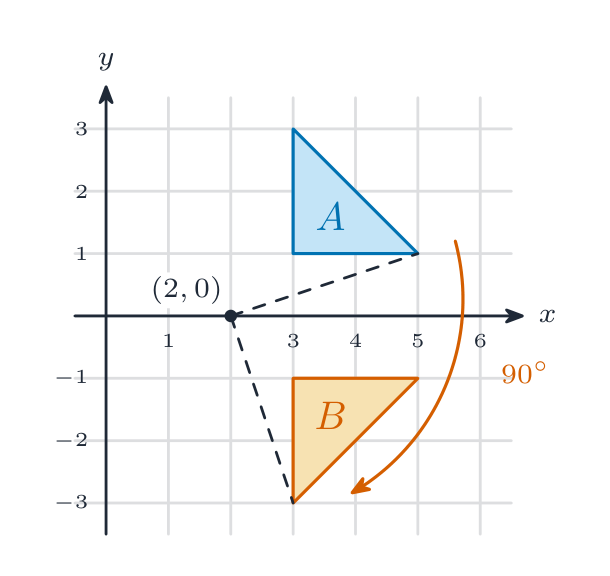
The side from $(3, 1)$ to $(5, 1)$ points right; its image, from $(3, -1)$ to $(3, -3)$, points down. So the shape has turned $90^{\circ}$ clockwise. Try the centre $(2, 0)$: it is $\sqrt{2}$ from both $(3, 1)$ and its image $(3, -1)$, and $\sqrt{10}$ from both $(5, 1)$ and $(3, -3)$. Tracing paper confirms it.
Answer: rotation, $90^{\circ}$ clockwise, centre $(2, 0)$. Three pieces of information give three marks.
Enlargement
An enlargement 放大 changes the size by a scale factor 比例因子 $k$, measured from a fixed centre. Each position relative to the centre is multiplied by $k$; actual distances are multiplied by $|k|$.
- To describe it, give the centre and the scale factor. A fractional scale factor (between 0 and 1) makes the shape smaller. For Extended, $k$ may also be negative (the image appears on the other side of the centre).
Worked example. Enlarge $(1, 2)$ from the origin by scale factor $2$. Multiply both coordinates: the image is $(2, 4)$.
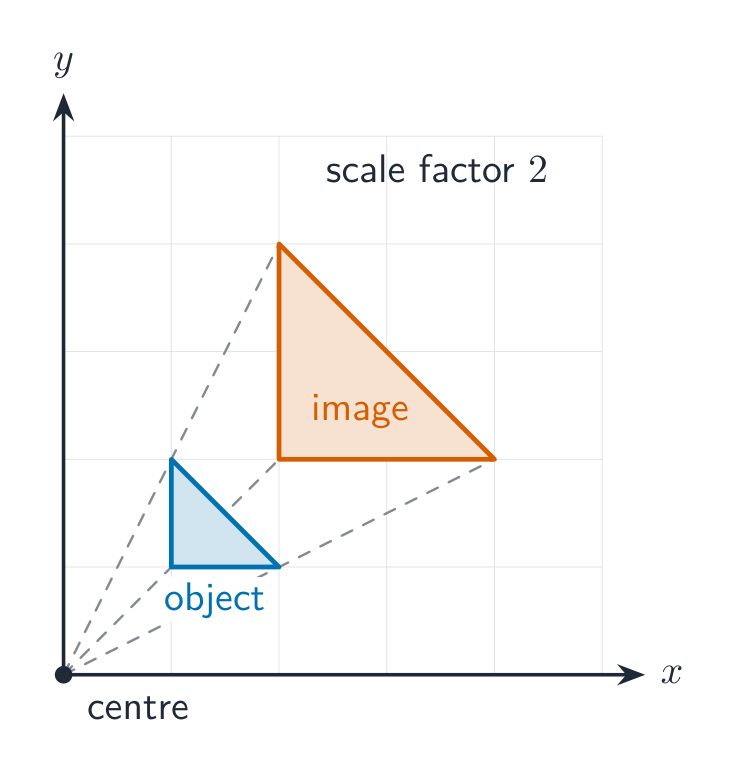
Worked example: find the centre and scale factor. Triangle $P$ has vertices $(1, 1)$, $(2, 1)$ and $(1, 3)$. Triangle $Q$ has vertices $(3, 3)$, $(5, 3)$ and $(3, 7)$. Describe the transformation that maps $P$ onto $Q$.
The side of length $1$ (from $(1,1)$ to $(2,1)$) becomes length $2$, so the scale factor is image length $\div$ object length $= 2 \div 1 = 2$. Draw lines from each image vertex back through the matching object vertex; they meet at the centre $(-1, -1)$. Check: from $(-1, -1)$ to $(1, 1)$ is $\begin{pmatrix} 2 \\ 2 \end{pmatrix}$, and twice that reaches $(3, 3)$.
Answer: enlargement, scale factor $2$, centre $(-1, -1)$.
Worked example: fractional and negative scale factors. From the origin, scale factor $\tfrac{1}{2}$ takes $(4, 6)$ to $(2, 3)$, closer to the centre. (Extended: scale factor $-2$ takes $(2, 1)$ to $(-4, -2)$, on the other side of the centre and twice as far away.)
Translation
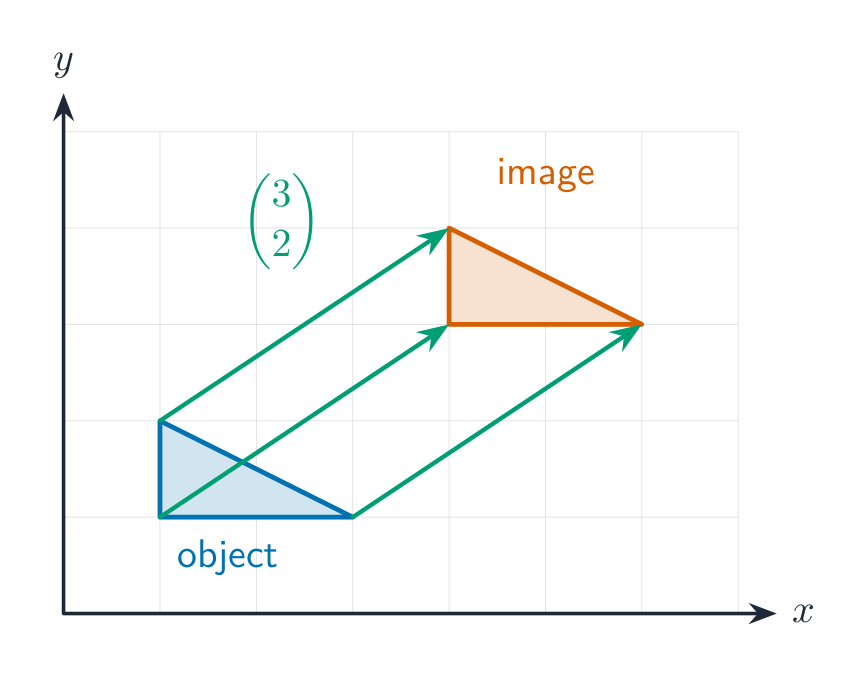
A translation 平移 slides the shape with no turning, by a vector 向量 written as a column vector 列向量 $\begin{pmatrix} x \\ y \end{pmatrix}$ ($x$ across, $y$ up).
Worked example. Translate $(5, 3)$ by $\begin{pmatrix} -2 \\ 4 \end{pmatrix}$: move $2$ left and $4$ up to get $(3, 7)$.
(Extended: a question may ask you to combine two transformations and describe the single transformation that has the same effect.)
Worked example: a combination (Extended). Reflect a shape in the $x$-axis, then reflect the image in the $y$-axis. What single transformation has the same effect?
Follow a general point: $(x, y) \to (x, -y) \to (-x, -y)$. Both signs change, which is a rotation of $180^{\circ}$ about the origin. (For $180^{\circ}$ no direction is needed.)
Common mistakes. Giving two transformations when the question asks for a single one, using words such as "turn" or "move" instead of the proper names, leaving out the direction of a rotation, and writing the scale factor upside down (it is image length $\div$ object length).
Explore
Transforming a shape
Translate, reflect, rotate or enlarge the shape and watch where it lands.
Vocabulary
Train
| English |
|---|
| transformation/trænsfɔːˈmeɪʃn/ |
| reflection/rɪˈflekʃn/ |
| mirror line/ˈmɪrə laɪn/ |
| rotation/rəʊˈteɪʃn/ |
| centre/ˈsentə/ |
| enlargement/enˈlɑːdʒmənt/ |
| scale factor/skeɪl ˈfæktə/ |
| translation/trænˈsleɪʃn/ |
| vector/ˈvektə/ |
| column vector/ˈkɒlʌm ˈvektə/ |
7.2
Vectors in two dimensions (Extended)

Syllabus
| Vectors in two dimensions | Notes and examples |
|---|---|
| 1 Describe a translation using a vector represented by $\begin{pmatrix} x \\ y \end{pmatrix}$, $\overrightarrow{AB}$ or $\mathbf{a}$. | Vectors will be printed as $\overrightarrow{AB}$ or $\mathbf{a}$. |
| 2 Add and subtract vectors. | |
| 3 Multiply a vector by a scalar. |
Source: Cambridge International syllabus
A vector has both size and direction. It can be written as a column vector, as $\overrightarrow{AB}$ (from $A$ to $B$), or in bold as $\mathbf{a}$.
- Add or subtract by working on the top and bottom numbers separately.
- Multiply by a scalar 标量 (an ordinary number) by multiplying both numbers.
Worked example. If $\mathbf{a} = \begin{pmatrix} 3 \\ 1 \end{pmatrix}$ and $\mathbf{b} = \begin{pmatrix} 2 \\ -4 \end{pmatrix}$, then
$$\mathbf{a} + \mathbf{b} = \begin{pmatrix} 5 \\ -3 \end{pmatrix}, \qquad 3\mathbf{a} = \begin{pmatrix} 9 \\ 3 \end{pmatrix}.$$
Subtracting works the same way, but take care with the signs:
$$2\mathbf{a} - \mathbf{b} = \begin{pmatrix} 6 - 2 \\ 2 - (-4) \end{pmatrix} = \begin{pmatrix} 4 \\ 6 \end{pmatrix}.$$

Explore
Adding vectors
Drag two vectors and add them tip to tail to get the resultant.
Vocabulary
Train
| English |
|---|
| scalar/ˈskeɪlə/ |
7.3
Magnitude of a vector (Extended)

Syllabus
| Magnitude of a vector | Notes and examples |
|---|---|
| Calculate the magnitude of a vector $\begin{pmatrix} x \\ y \end{pmatrix}$ as $\sqrt{x^2 + y^2}$. | The magnitudes of vectors will be denoted by modulus signs, e.g. • $|\mathbf{a}|$ is the magnitude of $\mathbf{a}$ • $|\overrightarrow{AB}|$ is the magnitude of $\overrightarrow{AB}$. |
Source: Cambridge International syllabus
The magnitude 模 (length) of a vector is found with Pythagoras. For $\begin{pmatrix} x \\ y \end{pmatrix}$,
$$\left| \begin{pmatrix} x \\ y \end{pmatrix} \right| = \sqrt{x^{2} + y^{2}}.$$
Worked example. The magnitude of $\begin{pmatrix} 3 \\ 4 \end{pmatrix}$ is $\sqrt{3^{2} + 4^{2}} = \sqrt{25} = 5$.
Worked example: from two points. $A$ is $(2, -1)$ and $B$ is $(7, 11)$. Find $\left|\overrightarrow{AB}\right|$.
$$\overrightarrow{AB} = \begin{pmatrix} 7 - 2 \\ 11 - (-1) \end{pmatrix} = \begin{pmatrix} 5 \\ 12 \end{pmatrix}, \qquad \left|\overrightarrow{AB}\right| = \sqrt{5^{2} + 12^{2}} = \sqrt{169} = 13.$$
Vocabulary
Train
| English |
|---|
| magnitude/ˈmæɡnɪtjuːd/ |
7.4
Vector geometry (Extended)
Syllabus
| Vector geometry | Notes and examples |
|---|---|
| 1 Represent vectors by directed line segments. | |
| 2 Use position vectors. | |
| 3 Use the sum and difference of two or more vectors to express given vectors in terms of two coplanar vectors. | |
| 4 Use vectors to reason and to solve geometric problems. | Examples include: • show that vectors are parallel • show that 3 points are collinear • solve vector problems involving ratio and similarity. |
Source: Cambridge International syllabus
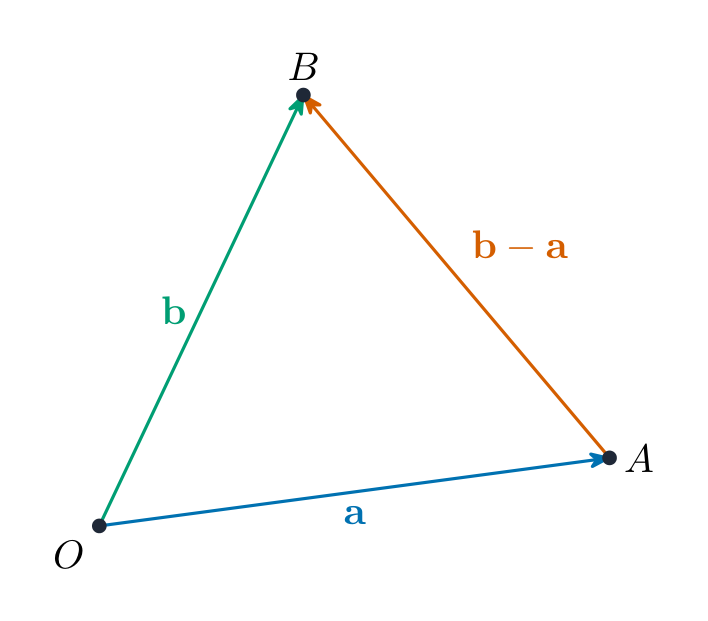
A vector can be drawn as a directed line segment 有向线段 (an arrow). The position vector 位置向量 of a point is the vector from the origin $O$ to that point.
A key idea: the vector from $A$ to $B$ is
$$\overrightarrow{AB} = \mathbf{b} - \mathbf{a},$$
where $\mathbf{a}$ and $\mathbf{b}$ are the position vectors of $A$ and $B$.
Two non-zero vectors are parallel 平行 if one is a scalar multiple of the other (for example $\overrightarrow{AB} = 2\,\overrightarrow{CD}$). Three distinct points are collinear 共线 (in a straight line) if the connecting vectors are parallel. Any vector in a plane can be expressed using two non-parallel coplanar 共面 vectors in that plane.
Worked example. $O$ is the origin, with $\overrightarrow{OA} = \mathbf{a}$ and $\overrightarrow{OB} = \mathbf{b}$. $M$ is the midpoint of $AB$. Find $\overrightarrow{OM}$ in terms of $\mathbf{a}$ and $\mathbf{b}$.
$$\overrightarrow{OM} = \mathbf{a} + \tfrac{1}{2}\overrightarrow{AB} = \mathbf{a} + \tfrac{1}{2}(\mathbf{b} - \mathbf{a}) = \tfrac{1}{2}(\mathbf{a} + \mathbf{b}).$$
Worked example: a ratio. With the same $\mathbf{a}$ and $\mathbf{b}$, $P$ lies on $AB$ with $AP : PB = 1 : 3$. Find $\overrightarrow{OP}$.
$AP$ is $\tfrac{1}{4}$ of $AB$ (one part out of $1 + 3 = 4$), so
$$\overrightarrow{OP} = \mathbf{a} + \tfrac{1}{4}(\mathbf{b} - \mathbf{a}) = \tfrac{3}{4}\mathbf{a} + \tfrac{1}{4}\mathbf{b}.$$
Worked example: show that points are collinear. $\overrightarrow{OA} = \mathbf{a}$, $\overrightarrow{OB} = \mathbf{b}$ and $\overrightarrow{OC} = 3\mathbf{b} - 2\mathbf{a}$. Show that $A$, $B$ and $C$ lie on a straight line.
$$\overrightarrow{AB} = \mathbf{b} - \mathbf{a}, \qquad \overrightarrow{AC} = (3\mathbf{b} - 2\mathbf{a}) - \mathbf{a} = 3\mathbf{b} - 3\mathbf{a} = 3(\mathbf{b} - \mathbf{a}).$$
So $\overrightarrow{AC} = 3\,\overrightarrow{AB}$: the two vectors are parallel, and they share the point $A$, so $A$, $B$ and $C$ are collinear. Both facts are needed for full marks.
Common mistakes. Writing $\overrightarrow{AB} = \mathbf{a} - \mathbf{b}$ (it is end minus start, $\mathbf{b} - \mathbf{a}$), using $\tfrac{1}{3}$ for the ratio $1 : 3$ (the whole line has $4$ parts), and saying "parallel" without the shared point in a collinearity proof.
Explore
Vector geometry
resultant = a + b
Combine vectors to reach a point — the resultant is the direct route.
Vocabulary
Train
| English |
|---|
| directed line segment/daɪˈrektɪd laɪn ˈseɡmənt/ |
| position vector/pəˈzɪʃn ˈvektə/ |
| parallel/ˈpærəlel/ |
| collinear/ˈkɒlɪnɪə/ |
| coplanar/ˌkəʊˈpleɪnə/ |
7.4
Exam tips
- Fully describe each transformation: a translation (a vector), a reflection (the mirror line), a rotation (centre, angle and direction), an enlargement (centre and scale factor).
- A negative scale factor turns the image upside down through the centre; a fractional one (between 0 and 1) makes it smaller.
- Add vectors tip-to-tail — add the top numbers, then the bottom numbers. The magnitude of a vector comes from Pythagoras on its components.
- $\overrightarrow{AB} = \mathbf{b} - \mathbf{a}$ (end minus start). Two vectors are parallel if one is a scalar multiple of the other.
Interactive lessons on this topic
Work through it step by step, with instant-check exercises.