Length and midpoint
Introduced| English | Meaning |
|---|---|
| midpoint/ˈmɪdpɔɪnt/ | The point halfway between the endpoints of a line segment. |
| Pythagoras/paɪˈθæɡərəs/ | The theorem that a²+b²=c² for a right-angled triangle, where c is the hypotenuse. |
| line segment/laɪn ˈseɡmənt/ | The straight part of a line between two endpoints. |
| hypotenuse/haɪˈpɒtənjuːs/ | The side opposite the right angle in a right-angled triangle. |
Across the map or along the streets?
- On a square street grid, going $3$ units east and $4$ north is a walk of $7$ units, but the straight distance is only $5$ units.
- This Extended coordinate topic finds straight-line lengths and midpoints 中点. Use Pythagoras 勾股定理 for a length and averages for a halfway position.
Length and midpoint lab
midpoint is halfway between endpoints
Move along a line segment and see midpoint as halfway.
Length of a segment (Extended)
- A line segment 线段 is the straight piece between two points $(x_1, y_1)$ and $(x_2, y_2)$.
- Draw a right triangle with the segment as the hypotenuse 斜边:
- The horizontal gap is $x_2 - x_1$ and the vertical gap is $y_2 - y_1$.
- By Pythagoras, the length is:
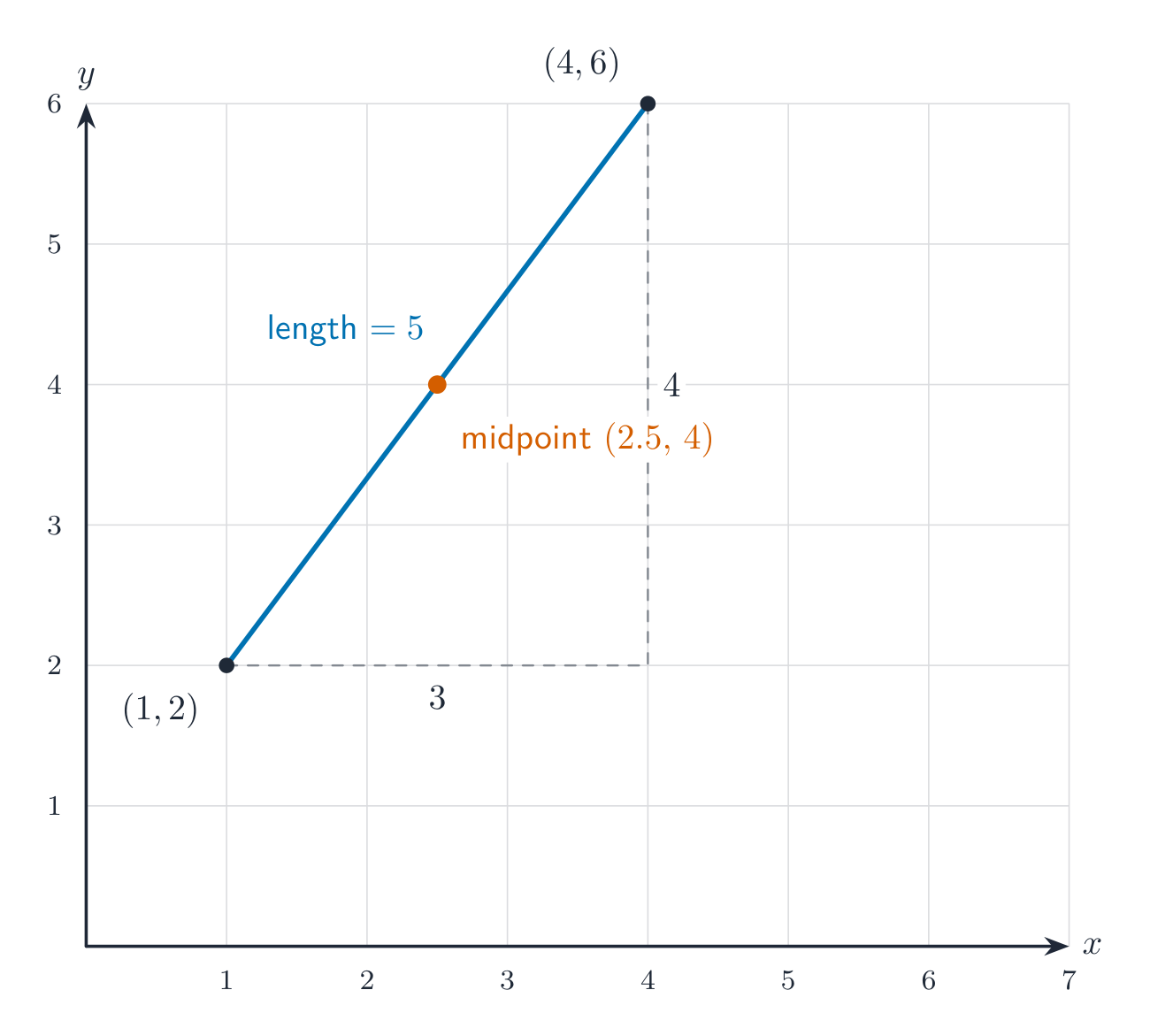
The gap across (3) and the gap up (4) give the length by Pythagoras; the midpoint is the average of the coordinates
Worked example — length
- Find the length from $(1, 2)$ to $(4, 6)$.
- Horizontal gap $= 4 - 1 = 3$; vertical gap $= 6 - 2 = 4$.
- Length $= \sqrt{3^2 + 4^2} = \sqrt{9 + 16} = \sqrt{25} = 5$.
- The classic 3-4-5 right triangle makes a clean answer.
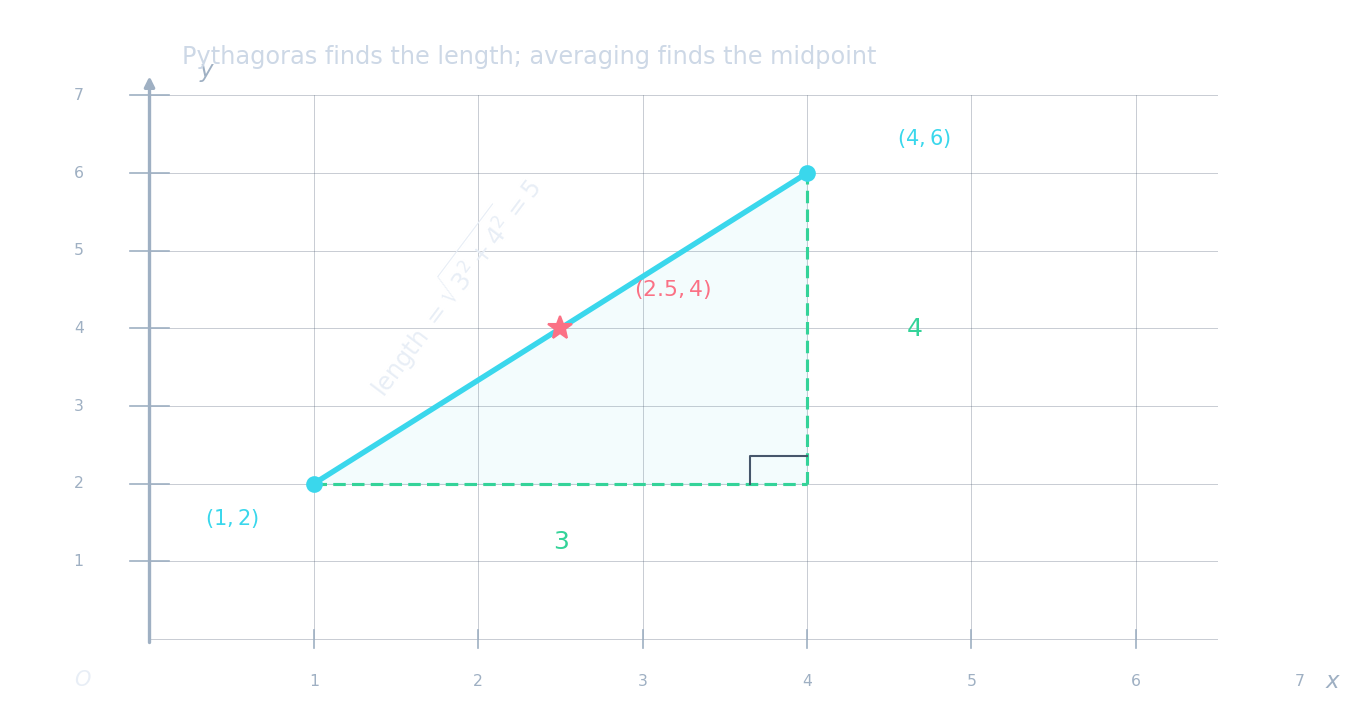
Pythagoras finds the length (hypotenuse); averaging finds the midpoint (star).
From the origin. Length from $(0, 0)$ to $(3, 4)$: $\sqrt{3^2 + 4^2} = \sqrt{25} = 5$. Same triangle, different starting point.
Find the length of the segment from (1, 2) to (4, 6).
Difficulty 2/5 · 140 coins + a small bonus on first completion today
√((4−1)² + (6−2)²) = √(9 + 16) = √25 = 5.
Find the length of the segment from (0, 0) to (3, 4).
Difficulty 2/5 · 140 coins + a small bonus on first completion today
√(3² + 4²) = √(9 + 16) = √25 = 5. The classic 3-4-5 triangle.
Find the length of the segment from (1, 5) to (7, 5).
Difficulty 2/5 · 140 coins + a small bonus on first completion today
Both points have y = 5 (horizontal segment). Length = 7 − 1 = 6.
Midpoint of a segment (Extended)
- The midpoint is the point exactly halfway between the two endpoints.
- Find it by averaging each coordinate:
- It's the "halfway" $x$ paired with the "halfway" $y$.
Worked example — midpoint
- Find the midpoint from $(1, 2)$ to $(4, 6)$.
- Mid-$x = \dfrac{1 + 4}{2} = \dfrac{5}{2} = 2.5$.
- Mid-$y = \dfrac{2 + 6}{2} = \dfrac{8}{2} = 4$.
- Midpoint $= (2.5,\, 4)$ — exactly halfway along.
Average, don't add. The midpoint of $(1, 2)$ and $(4, 6)$ is $(2.5, 4)$, not $(5, 8)$. You must divide by 2 — averaging, not summing.
The midpoint of (1, 2) and (4, 6) is (a, 4). What is a?
Difficulty 2/5 · 140 coins + a small bonus on first completion today
Average the x-values: (1 + 4)/2 = 2.5.
The midpoint of (2, 3) and (8, 9) is (5, b). What is b?
Difficulty 2/5 · 140 coins + a small bonus on first completion today
Average the y-values: (3 + 9)/2 = 6.
The x-coordinate of the midpoint of (x₁, y₁) and (x₂, y₂) is:
Difficulty 1/5 · 100 coins + a small bonus on first completion today
The midpoint is the average of each coordinate: (x₁ + x₂)/2. Choice 2 forgets to divide; choice 3 gives half the gap, not the position.
Complete: the midpoint x-coordinate = (x₁ + ______) / 2.
Difficulty 1/5 · 100 coins + a small bonus on first completion today
The midpoint x-coordinate is the average of the two x-values: (x₁ + x₂)/2.
Extended: P=(−4,3) and Q=(2,−5). Find PQ and its midpoint, showing the coordinate changes. Explain why the length cannot be −10.
A displacement may be negative; a distance is non-negative.
Recover a missing endpoint (Extended)
- If $M$ is the midpoint of $AB$, then $x_A+x_B=2x_M$ and $y_A+y_B=2y_M$. Rearrange each coordinate equation; do not add the midpoint directly to the known endpoint.
- For $A(-2,5)$ and $M(1,1)$, the missing end is $B(2(1)-(-2),\,2(1)-5)=(4,-3)$. Check: the midpoint of $(-2,5)$ and $(4,-3)$ is $(1,1)$. Horizontal or vertical lengths are positive coordinate differences: use an absolute value if subtracting in the opposite order.
For a horizontal segment, the length is the absolute difference of its endpoint x-coordinates.
Difficulty 1/5 · 100 coins + a small bonus on first completion today
The y-coordinates are equal, so the length is |x₂−x₁|, always non-negative.
Match each segment to its length.
Difficulty 2/5 · 140 coins + a small bonus on first completion today
(0,0)–(5,0) is horizontal, length 5. (1,1)–(1,4) is vertical, length 3. (0,0)–(6,8): √(36+64) = √100 = 10. (2,3)–(5,7): √(9+16) = √25 = 5.
Extended: A=(−3,4) and the midpoint of AB is M=(2,−1). Find B, check the midpoint and find AB.
Doubling the midpoint before subtracting the known end is essential.
Extended: A=(5,−2), B=(−1,−2) and C=(5,4). Find AB and AC and their midpoints. Explain why a sloping-distance formula is not needed.
The order of subtraction must not turn a length negative.
You've got it
- length $= \sqrt{(x_2 - x_1)^2 + (y_2 - y_1)^2}$ (Pythagoras on the horizontal and vertical gaps)
- midpoint $= \left( \dfrac{x_1 + x_2}{2}, \; \dfrac{y_1 + y_2}{2} \right)$ (average each coordinate)
- $(1,2)$ to $(4,6)$: length $5$, midpoint $(2.5,\, 4)$
- recover an endpoint using twice the midpoint minus the known endpoint, separately for each coordinate
Find a new distance independently
- Find the distance from (0, 0) to (6, 8).
- Use Pythagoras.
What is the length of the segment from (0, 0) to (6, 8)?
100 has square root 10.
Extended: find the distance from (0,0) to (6,8).
Difficulty 1/5 · 100 coins + a small bonus on first completion today
6-8-10 is a right-angled triple. Other options — 5 (the lesson length); 14 (the coordinates added).